A Look Back at Spider-Man 2099 #32 (1995)

Welcome back superhero enthusiasts, 1990s culture enthusiasts and comic book collectors! Today we go back to the year 1995 and explore a part of the Marvel 2099 comics universe through a tale of the Spider-Man 2099 franchise.

As some of you may already be aware, the protagonist Miguel O’Hara got his Spider-Man 2099 costume in Mexico during the Day of the Dead festival he attended. If you are wondering if there was any comic book published that showed the futuristic Spidey on location in Mexico for the mentioned festival, there definitely is such a tale printed.

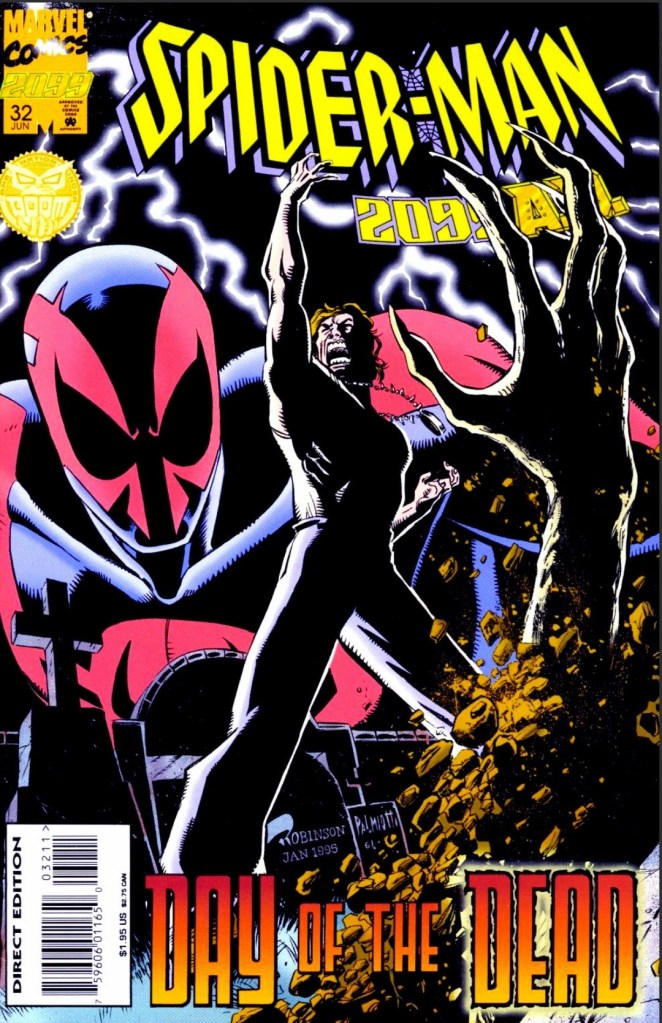
With those details laid down, here is a look back at Spider-Man 2099 #32, published in 1995 by Marvel Comics with a story written by Peter David and drawn by Roger Robinson.

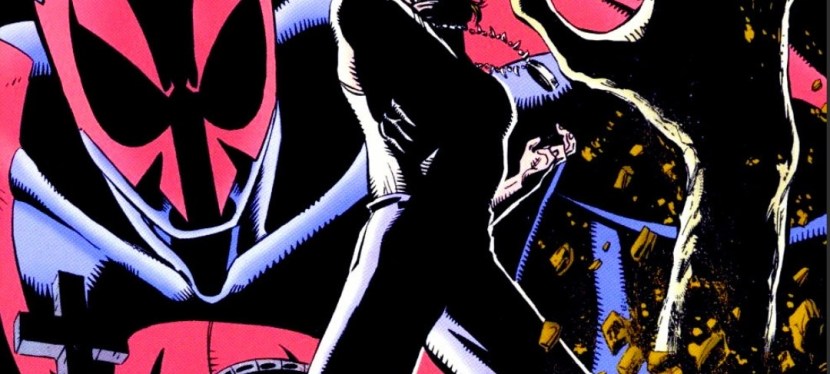
The cover.

Early story

The story begins during the middle of the night in Mexico City. At a graveyard, the night watchman catches a man digging up one of the graves and tells him that what was done was obscene. The grave digger then hits the watchman with his shovel.

Elsewhere a lady practicing sorcery sees the image of Spider-Man and she is told that he will be her ally on a mission.

At another location in Mexico, the Day of the Dead festival occurs attracting a huge crowd of attendees and bystanders. Several people wore costumes that not only reflected the dead but also of evil figures and idols.

Inside a hotel room, Miguel O’Hara watches the festival from the window and on bed near him is a naked Xina covered by a blanket. It turns out Miguel did not sleep with her but alone on the couch. As far as he is concerned, there is no romance between him and her. While Miguel focuses on the festival below, Xina nakedly stands up and enters the bathroom.

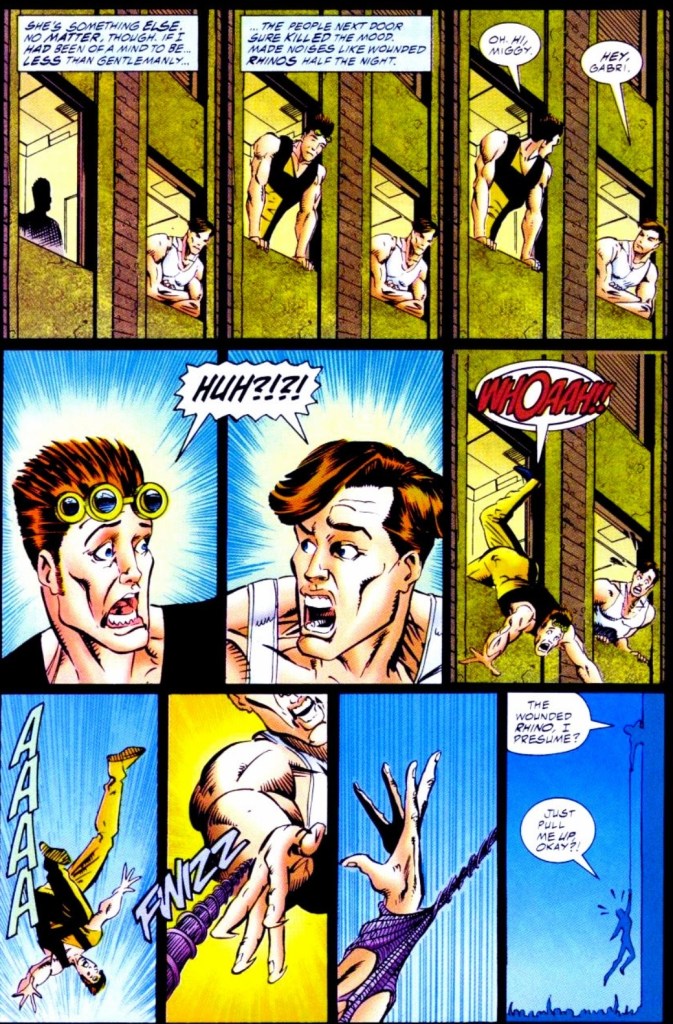
Just outside the hotel room window, Miguel sees his brother Gabriel on the very next hotel room window…

Quality

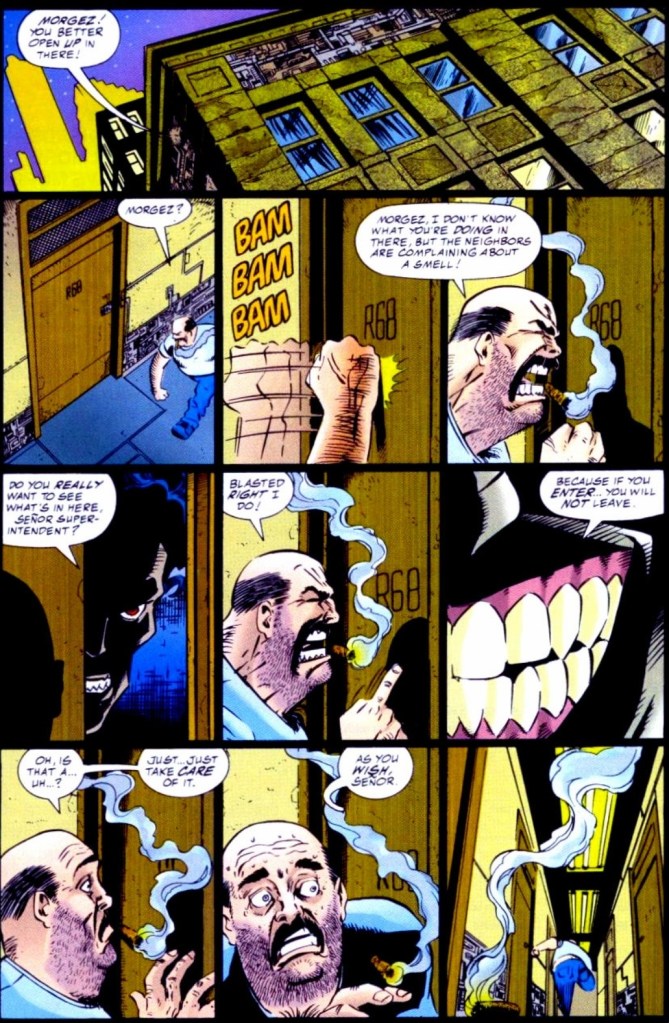
Something sinister inside.

To make things clear, this story marks Miguel’s return to Mexico and his first as Spider-Man. As typical with this 1990s monthly series, Peter David crafted a story that focused on its concept while literally planting seeds for future stories. What is notable about this tale is that Spider-Man will not only get involved in an unexpected mission with some destined to be with him, his personality gets tested again in his civilian identity as he unexpectedly encounters his brother Gabriel and the two most notable ladies – Xina and Dana – are present with them. The presence of the two ladies is significant given what happened in later issues of this monthly series (click here and here).

More on this particular story, the tone really turned dark which is deliberately done by the creators as the Day of the Dead is featured here. Apart from the dark atmosphere established by the festival, this story has elements of evil such as sorcery, the worship of evil entities, idolatry committed and rituals of the wicked performed. It should be noted that even in a predominantly Catholic nation like Mexico, there are still lots of sinners, wickedness and demonic elements present. Very clearly, the sci-fi tone of this monthly series was completely replaced with the supernatural of the evil type. Along the way, a Mexican character is introduced and he even got a good share of the spotlight.

Given the shift to the supernatural, the story was executed with the build-up of tension and the next issue in mind. Spider-Man 2099 fans will still have character moments of Miguel, Gabriel, Xina and Dana to enjoy. That being said, if you are anticipating to see superhero spectacle, there is not much to find here.

Conclusion

A tremendous coincidence to have the O’Hara brothers together in Mexico.

Spider-Man 2099 #32 (1995) can best be described as a build-up issue with the planned pay-offs set to happen afterwards. To the credit of the creators, having a different tone and a totally new location for Spider-Man to be in made this comic book standout somewhat compared to all the previous issues published in terms of aesthetics. The best way to enjoy this comic book is to set your expectations low, don’t anticipate superhero action and focus on the further development of the futuristic Spider-Man and the supporting characters involved.

Overall, Spider-Man 2099 #32 (1995) is satisfactory.

+++++

Thank you for reading. If you find this article engaging, please click the like button below, share this article to others and also please consider making a donation to support my publishing. If you are looking for a copywriter to create content for your special project or business, check out my services and my portfolio. Feel free to contact me with a private message. Also please feel free to visit my Facebook page Author Carlo Carrasco and follow me on Twitter at  @HavenorFantasy as well as on Tumblr at https://carlocarrasco.tumblr.com/ and on Instagram at https://www.instagram.com/authorcarlocarrasco

A Look Back at Stephen King’s Creepshow (1982)

Disclaimer: This is my original work with details sourced from reading the comic book and doing personal research. Anyone who wants to use this article, in part or in whole, needs to secure first my permission and agree to cite me as the source and author. Let it be known that any unauthorized use of this article will constrain the author to pursue the remedies under R.A. No. 8293, the Revised Penal Code, and/or all applicable legal actions under the laws of the Philippines.

Welcome back fellow geeks, pop culture enthusiasts and comic book collectors! Way back in 1982, the horror comedy anthology film Creepshow was released in cinemas and it gave moviegoers a fun time getting scared as it featured well-made short stories written by Stephen King and directed by George Romero. The two creators were strongly influenced by the 1950s horror comic books of EC Comics when they made the movie. Very recently, Creepshow was released on 4K Blu-ray loaded with lots of extras for fans and moviegoers to enjoy. The said 4K Blu-ray release can be ordered online now.

I myself first saw Creepshow on home video sometime in 1983 and got to replay it occasionally on cable TV and DVD. Strangely enough, it was only a few years ago when I first learned that there was indeed a comic book adaptation of the movie that was also released the same year it hit cinemas.

With those details laid down, here is a look back at Stepehen King’s Creepshow published in 1982 by Plum with stories written by Stephen King and drawn by Bernie Wrightson (with Michele Wrightson). The cover was illustrated by the late EC Comics legend Jack Kamen.

The cover.

Early stories

Father’s Day – Sylvia Grantham, her nephew Richard, niece Cass and Hank (husband of Cass) enjoy time together at the Grantham estate anticipating the arrival of Bedelia for the annual family dinner. It is an open secret within the family that Bedelia killed her late father Nathan Grantham who was so overbearing to her as she became responsible on nursing him full-time.

Bedelia apart from her relatives in Father’s Day.

The Lonesome Death of Jordy Verril – A lonely farmer named Jordy witnesses the unexpected arrival of a meteorite from out space which landed violently on his farm. After realizing what it is, he touches it without any protection and gets his fingers burned. Considering the rarity of the object, Jordy begins to imagine making a lot money by bringing it to the local college.

A page of the story of Jordy and the meteor.

The Crate – In the basement level of Amberson Hall (science building of Horlicks University), a janitor accidentally finds a very old wooden crate located right under the staircase. The writings “Ship to Horlicks University via Julia Carpenter – Arctic Expedition – June 19, 1834” were marked on the crate. Meanwhile a faculty party is taking place across town. During the party, the mild-mannered college professor Henry Northrup experiences embarrassment as his unhinged wife Wilma (note: referred to as Billie) talks way too much in front of professor Dexter Stanley and many others. Henry reveals to Dexter that he has grown to hate his wife. Suddenly, someone tells Dexter that a telephone call for him is waiting. It was the janitor who made the call.

Henry, wife Wilma (AKA Bilie), the janitor and Dexter Stanley in The Crate.

Something to Tide You Over – At a beach, Harry Wentworth could do nothing but remain helplessly immobile as his entire body and neck have been buried under the sand by Richard. It turns out that Harry has been having an affair with Becky, Richard’s wife. The helpless Harry expressed that he and Becky were really in love with each other. For his part, Richard has something else to show to him and he certainly has some things prepared.

Richard and Harry in Something to Tide You Over.

They’re Creeping Up on You – A wealthy and cruel businessman named Upson Pratt is alone in his well-lighted apartment. He has been suffering from mysophobia and has been living in isolation and only communicates with others using the telephone and other electronic methods. Slowly but surely, cockroaches begin to multiply in his apartment.

Upson Pratt and the cockroaches in They’re Creeping Up on You.

Quality

Starting with the storytelling with emphasis on how the comic creators selected content from the movie and translated it all into illustrated literature format with a little over sixty pages to work with, I can say that this comic book is pretty much a faithful adaptation of the film’s five short stories (note: the cinematic prologue and epilogue were never adapted). For each short story, it is clear that sufficient details from each cinematic tale were adapted and the overall concepts, acts and characterizations were pretty much maintained. This is a credible piece of illustrated literature work as each tale is not only readable but also engaging and entertaining complete with shock moments. Take note that Stephen King not only wrote all these tales for the movie, there were two tales that were previously published in literary format before Creepshow was even made. Whoever participated in the editing process behind the production of this comic book deserves commendations.

While the writing used in adapting the film’s concepts and characters turned out good, it is clearly obvious that certain cinematic elements could not be translated here. Remember how frantic and scared Dexter Stanley (played by the late Fritz Weaver) was in the movie after he witnessed the janitor got killed by the monster? Those cinematic emotions never made it in illustrated literary format here.

The artworks by Bernie Wrightson are pretty good to look at. Similar to the writing, the visuals here were made to recapture the look of the movie not in a shot-for-shot manner but with the artist’s own approach on how such scenes should be presented. That being said, I should state that the comic book panels that appeared in the movie’s transition scenes (example: still live action image slowly turning into illustrated comic book form) are NOT here at all.

You will instead see Wrightson’s own visual interpretation of the scenes from the movie and the artworks were inspired a bit by the 1950s horror comics of EC Comics and ultimately were more in line with the contemporary approach of drawing comic book art of the 1980s. The gory scenes from the movie made it in this comic book. When it comes to drawing monsters or the undead, the art result was uneven. While Wrightson’s art of the monster in The Crate was really scary to look at (in accordance to how it appeared cinematically), the work on the walking dead in Something to Tide You Over looked much less scary compared to those in the film.

While Wrightson clearly did not prioritize recapturing the likenesses of the actors to illustrate their respective characters, there were a few shots in which professor Henry Northrup somewhat looked like the late Hal Holbrook, and the illustrated Bedelia resembled the late Viveca Lindfors.

Conclusion

The best way to describe Stephen King’s Creepshow (1982) is this…it is indeed a very solid adaptation of the movie and its five short stories. While it was clear that not all the dialogue and other types of content of the movie could ever fit in this comic book, the creators did a very credible job of adapting Creepshow’s core elements and succeeded in making what they had solidly presented for readers to enjoy. Each short story from the movie turned out to be cohesive and enjoyable for reading.

When it comes to really enjoying this graphic novel, I personally would recommend you readers to watch the Creepshow movie first before reading. The film is the complete package of entertainment showcasing the combined works of Stephen King and director George Romero, while this comic book is ultimately the companion piece for those who enjoyed the movie as well as EC Comics’s horror comic books of the 1950s.

Overall, Stephen King’s Creepshow (1982) is highly recommended!

+++++

Thank you for reading. If you find this article engaging, please click the like button below, share this article to others and also please consider making a donation to support my publishing. If you are looking for a copywriter to create content for your special project or business, check out my services and my portfolio. Feel free to contact me with a private message. Also please feel free to visit my Facebook page Author Carlo Carrasco and follow me on Twitter at  @HavenorFantasy as well as on Tumblr at https://carlocarrasco.tumblr.com/ and on Instagram at https://www.instagram.com/authorcarlocarrasco

A Look Back at Prime #11 (1994)

Disclaimer: This is my original work with details sourced from reading the comic book and doing personal research. Anyone who wants to use this article, in part or in whole, needs to secure first my permission and agree to cite me as the source and author. Let it be known that any unauthorized use of this article will constrain the author to pursue the remedies under R.A. No. 8293, the Revised Penal Code, and/or all applicable legal actions under the laws of the Philippines.

“I’m Prime. The real Prime!”

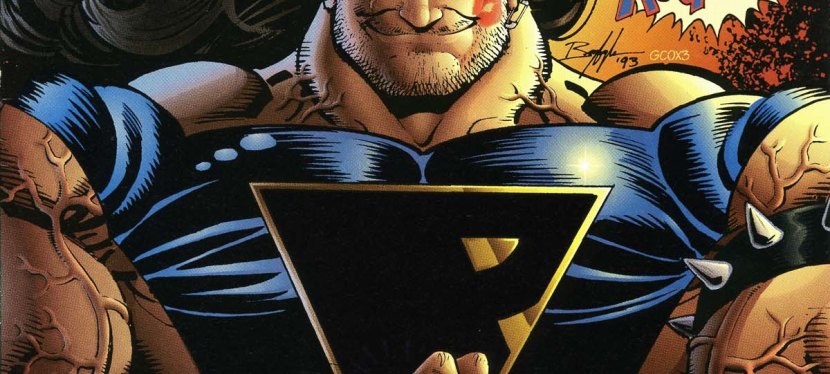
Those were the words Prime said in conflict involving the American military and Firearm (another Ultraverse main hero) as told in the pages of Prime #10. It was also at that same moment Prime appeared in a totally new look, a look so radical a change! Instead of heaving a clean haircut, he has long hair with a spiked headband. Instead of a cape (the most traditional part of superhero costumes), he wore a V-shaped shirt and chains.

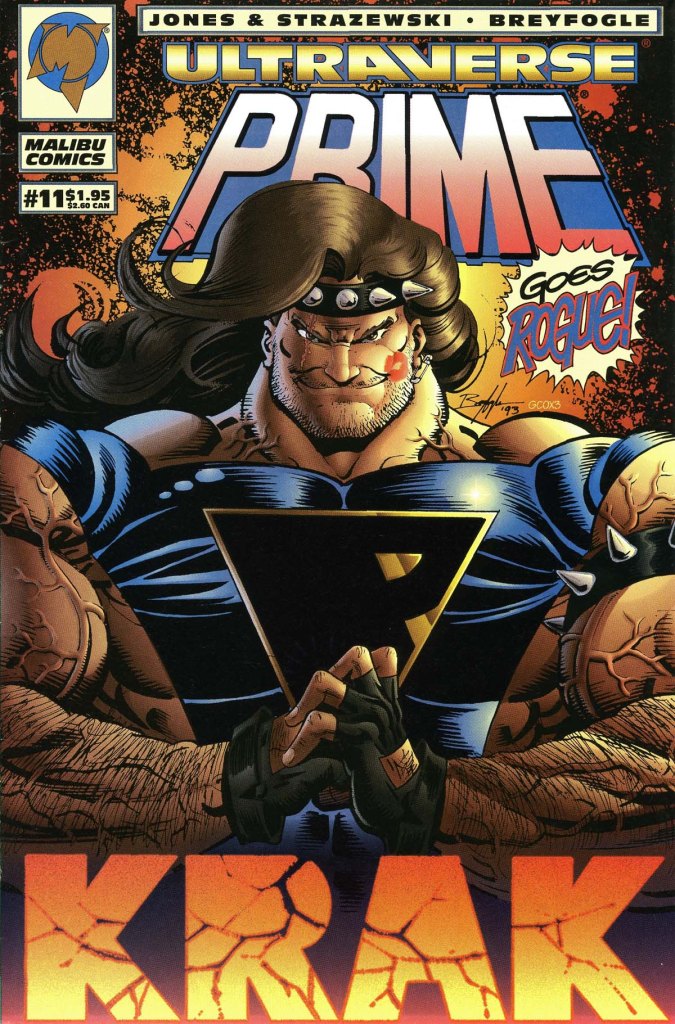
To put it short, this was Prime’s new look in the Ultraverse (note: he appeared already like this in the early issues of UltraForce in 1994) and we will find out how people will react to his appearance in this look back at Prime #11, published in 1994 by Malibu Comics with a story written by Len Strazewski and Gerard Jones, and drawn by the late Norm Breyfogle.

The cover.

Early story

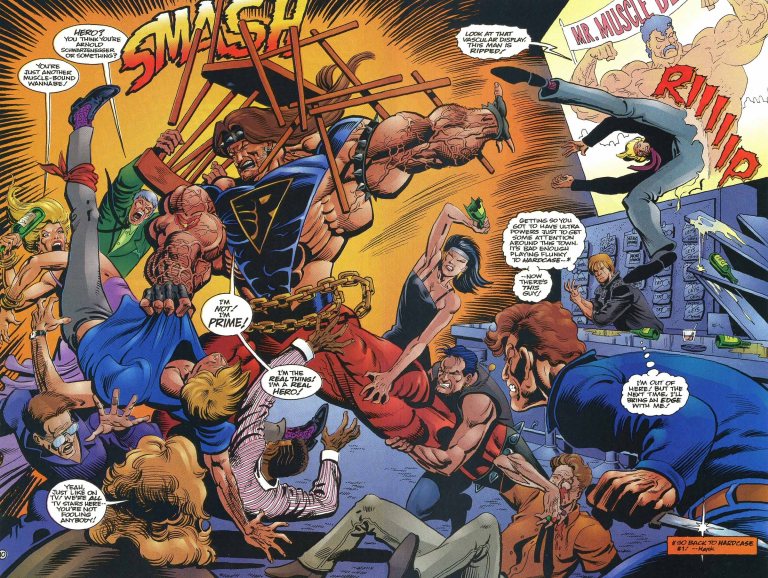
The story begins with Prime flying over the Sunset Strip. There he visits a night club filled with a lot of people drinking, dancing and socializing while a live band performs for them. Prime easily catches people’s attention as he walks to the bar thinking how as his real self (teenager Kevin Green) could never go into a place like the club. As he is about to order an alcoholic drink, a pretty lady tells him to buy her a drink which compels him to say he left his wallet.

As they drink and socialize, Prime begins to enjoy the lady’s way of flirting with him. Suddenly a Hollywood celebrity (Justin Kuttner who appeared in Hardcase #1) interrupts them by confronting the lady. As the tension rises between the two, Prime intervenes a strikes Justin away from the lady. Justin gets up and prepares to fight Prime no matter the odds…

Quality

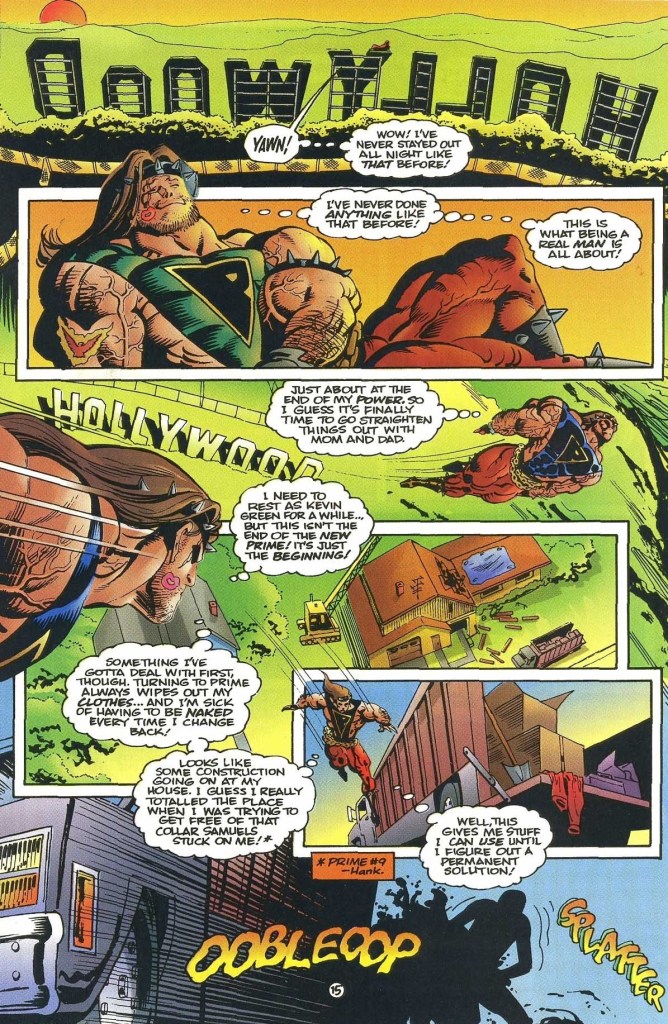
Prime in California.

There is a lot more in this comic book than simply showing Prime with his new look. To say the least, the story, dialogue and characterization are all very well-written. Even though there is a lack of a conflict between Prime and someone bad (note: Prime just got freed from the military’s grasp), the strong writing made this a character-driven piece that focuses more on Kevin and how his dual-life continues to impact himself and his family.

The biggest attraction in this comic book is the flashback showing the events that led to establishing the origin of Prime. This alone justifies acquiring this issue.

Conclusion

The money shot!

Prime #11 is a solid old comic book worthy of inclusion in anyone’s collection of Ultraverse and Malibu Comics-published issues. It does not have the expected good-versus-bad battle but it still managed to have some scenes of spectacle and its characterization makes it a must-read.

If you are seriously planning to buy an existing hard copy of Prime #11 (1994), be aware that as of this writing, MileHighComics.com shows that the near-mint copy of the regular edition costs $8 while the near-mint copy of the newsstand edition costs $26.

Overall, Prime #11 (1994) is recommended.

+++++

Thank you for reading. If you find this article engaging, please click the like button below and also please consider sharing this article to others. If you are looking for a copywriter to create content for your special project or business, check out my services and my portfolio. Feel free to contact me as well. Also please feel free to visit my Facebook page Author Carlo Carrasco and follow me at HavenorFantasy@twitter.com