A Look Back at What If #23 (1991)

Welcome back superhero enthusiasts, 1990s arts and culture enthusiasts, Marvel Comics fans and comic book collectors! Today we go back to the year 1991 and explore a part of Marvel Comics’ universe through the reimagined tales emphasized in the What If monthly series.

If you are not aware of the extensive literary history of the X-Men, the mutant franchise of Marvel Comics had its turning point in the mid-1970s with the release of the 68-page Giant-Size X-Men  which introduced a newer lineup of mutants (Wolverine, Cyclops, Nightcrawler, Thunderbird and Storm). It has been argued that Giant-Size X-Men marked the starting point of the bronze age of comics in America and creatively it sparked a new chain of X-Men stories that captivated the fans and attracted new readers.

But what would have happened had the newer lineup of the X-Men did not even exist?

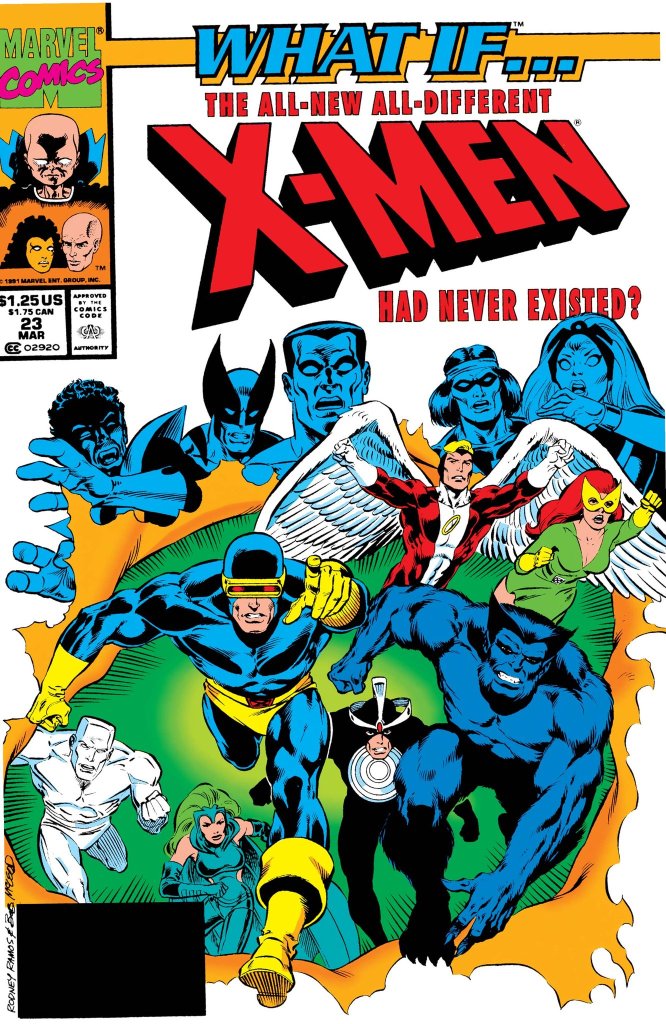
With those details laid down, here is a look back at What If , published in 1991 by Marvel Comics with a story written by Kurt Busiek and drawn by Rodney Ramos.

The cover.

Early story

The story begins when the original X-Men (Cyclops, Jean Grey, Angel, Beast and Iceman) members, Havok and Polaris arrive on the island of Krakoa. A huge green monster suddenly appears and attacks them. Guided by Professor X’s mind, Marvel Girl/Jean Grey helps Polaris by overriding the mental blocks that prevented her from using her full magnetic might. With a lot more power in her, Polaris takes action and helps the X-Men not only overwhelm the monster but also hurled the entire island of Krakoa into space.

As the X-Men were never captured by Krakoa, there was no reason to recruit a new team. The X-Men returned home and proceeded with other matters. On the other hand, Charles Xavier experiences a series of intense nightmares of conflict in outer space. As the nightmares took its toll on him, Professor X decides to take a vacation. Before he could leave, the X-Men are suddenly attacked by Eric the Red, Proudstar and Nightcrawler…  

Quality

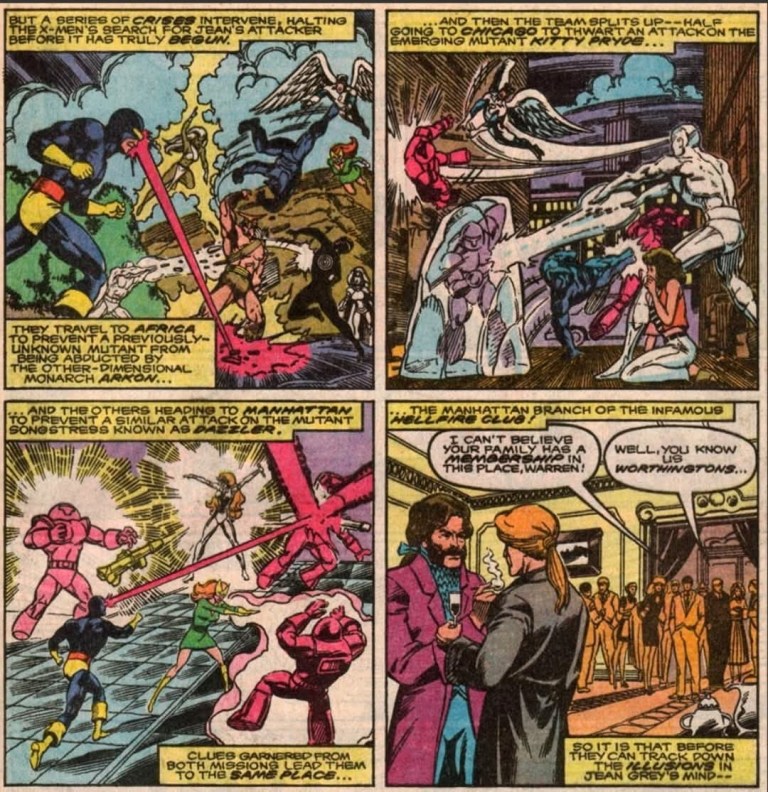
Without the existence of the 2nd X-Men team (from Giant-Size X-Men ), the original X-Men’s first encounters with Dazzler, Kitty Pryde and the Hellfire Club turned out totally different.

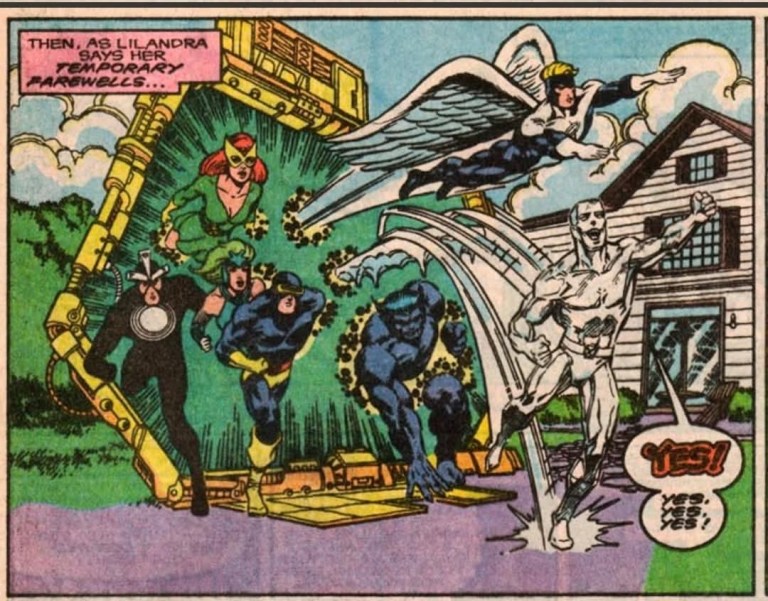
This What If tale exploring an alternate chain of events involving only the original X-Men is not only a daring piece of work by the creators but it is also highly ambitious as seen through the scope of the plot. I’m not just talking about the non-existence of the 2nd X-Men lineup of Giant-Size X-Men but also alternate realities of real X-Men developments such as the encounter with the Phoenix, Lilandra and Professor X’s first encounter, the X-Men’s encounter with the Hellfire Club, and more. Truly, the alterations were executed and the consequences were quite intense.

By focusing on the concept of the original X-Men proceeding as the 2nd X-Men team did not materialize, the Busiek-Ramos team really went all-in exploring the different possibilities and most of them were intriguing and entertaining to follow. The reading experience can be jarring because of the sudden change of scope that happens when the narrative suddenly shifted from one plot development (of local conflict) to another (a conflict on a galactic scale). Indeed, the narrative can be challenging to follow and to really enjoy it, you should pay strong attention to the details as you read on.

When it comes to character development, there is very little to find here which is not surprising given the way the script was written and also because the spotlight had to be shared by so many characters. Still, I enjoyed the character moments between Cyclops and Jean Grey, particularly during important points in the 2nd half of the story.  

If there were any weak spots in the presentation, it is the fact that a lot of exposition had to be done and there were certain parts of the narrative that felt crammed with an excessive amount of details. Not only that, there is also an excessive amount of characters that go beyond the X-Men such as Lilandra of the Shi’ar Empire, the Starjammers, Alpha Flight, the Avengers and other beings of science fiction mixed in which make following the narrative challenging at certain points.

Conclusion

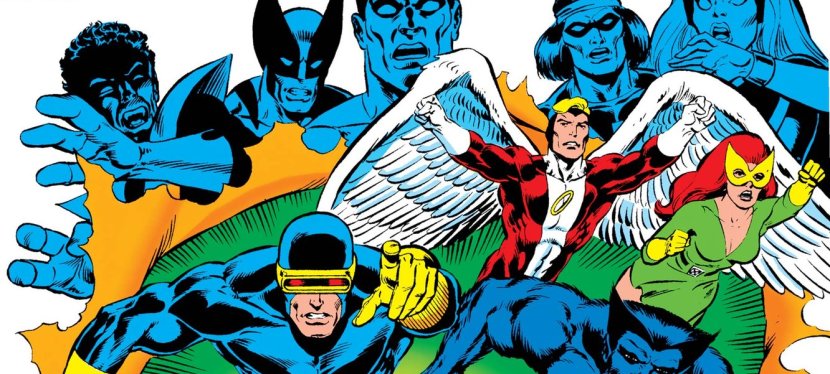
The original X-Men team plus Polaris and Havok.

What If (1991) has more than enough advantages that outweigh the disadvantages. It’s story is very intriguing and enjoyable to read even though there were some bumpy parts on the narrative. Still, it is great to see what would have happened had the newer X-Men team never materialized and this comic book’s ending is very impactful to see.

Overall, What If (1991) is recommended.

+++++

Thank you for reading. If you find this article engaging, please click the like button below, share this article to others and also please consider making a donation to support my publishing. If you are looking for a copywriter to create content for your special project or business, check out my services and my portfolio. Feel free to contact me with a private message. Also please feel free to visit my Facebook page Author Carlo Carrasco and follow me on Twitter at  @HavenorFantasy as well as on Tumblr at https://carlocarrasco.tumblr.com/ and on Instagram at https://www.instagram.com/authorcarlocarrasco

A Look Back at Dazzler #22 (1982)

Disclaimer: This is my original work with details sourced from reading the comic book and doing personal research. Anyone who wants to use this article, in part or in whole, needs to secure first my permission and agree to cite me as the source and author. Let it be known that any unauthorized use of this article will constrain the author to pursue the remedies under R.A. No. 8293, the Revised Penal Code, and/or all applicable legal actions under the laws of the Philippines.

Welcome back superhero enthusiasts, 1980s culture enthusiasts and comic book collectors! Today we go back to the 1980s to examine the Marvel Comics universe through the exploits of Dazzler!

In my retro review of Dazzler #21 (1982), I observed that the story had no good-versus-evil conflict at all as it was purely character-driven and focused a lot on the personal development of Alison Blaire/Dazzler. More notably, the story shed light on both Alison’s father (a judge) and mother (who left the judge) and how the past affected the protagonist. Very clearly, Dazzler’s development really went deep since her first-ever appearance in an X-Men comic book. Speaking of the X-Men, I must say that one of the team’s notable members had an early (not the first) appearance in the next Dazzler issue I just reviewed. That character is none other than Rogue and she looks nothing like the way Jim Lee modernized her in the 1990s.

With those details laid down, here is a look back Dazzler #22, published by Marvel Comics in 1982 with a story written by Danny Fingeroth and drawn by the late Frank Springer.

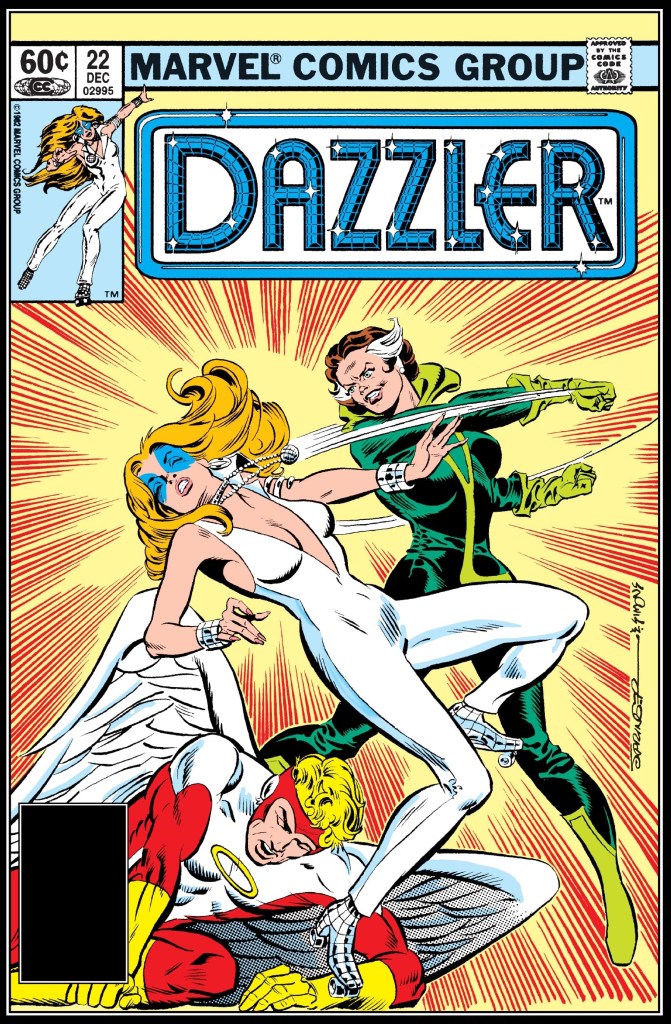
The cover.

Early story

The story begins in the air high above the streets of New York City. Warren Worthington III/Angel’s flight gets disrupted as a group of hawks suddenly attack him from all sides. With quick thinking, he uses different methods to gradually lure each hawk and trick them into bumping into something to end their pursuit.

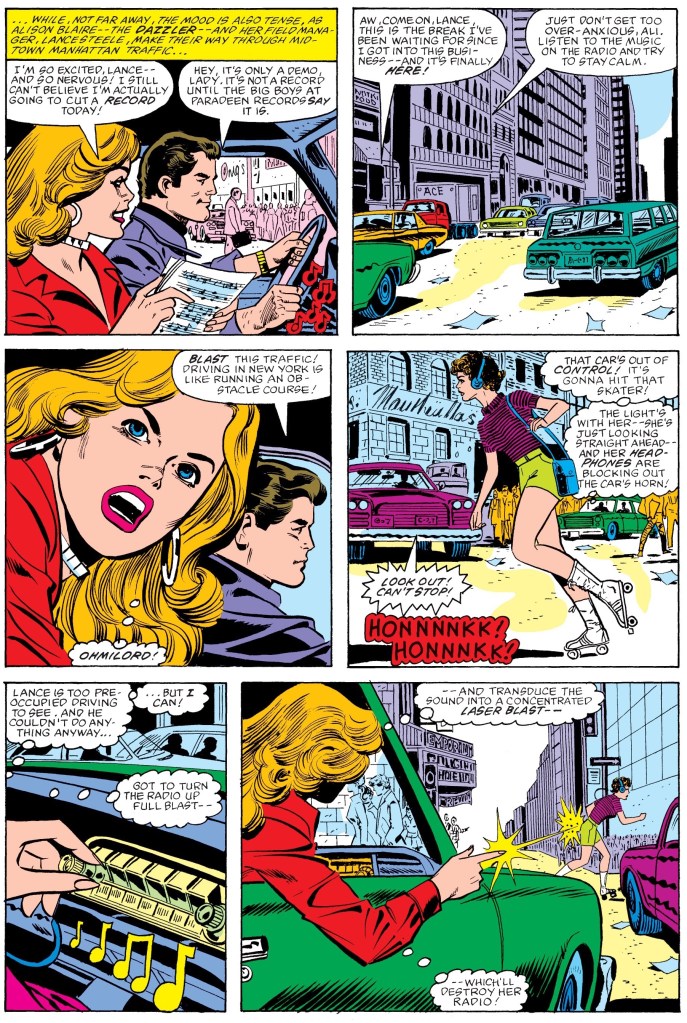
Meanwhile, as Alison Blaire rides the car driven by her field manager Lance going to the studio, she saves a roller-skating lady from colliding with a car using clever methods. At the studio, Alison prepares herself for a recording session under the watch of the perfectionist music producer L.B. Holman…

Quality

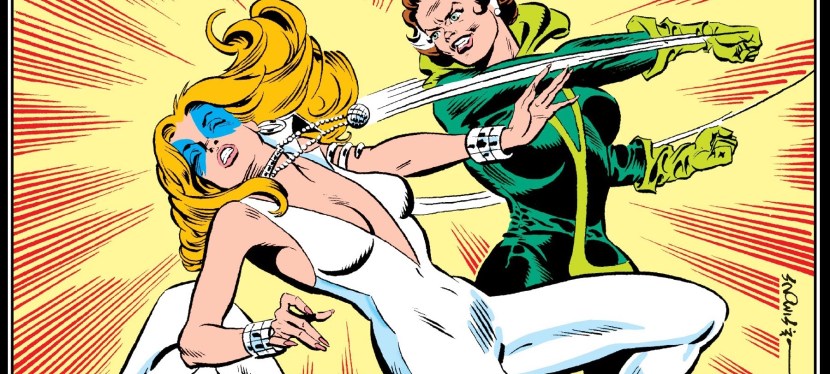
The Brotherhood of Evil Mutants led by Mystique.

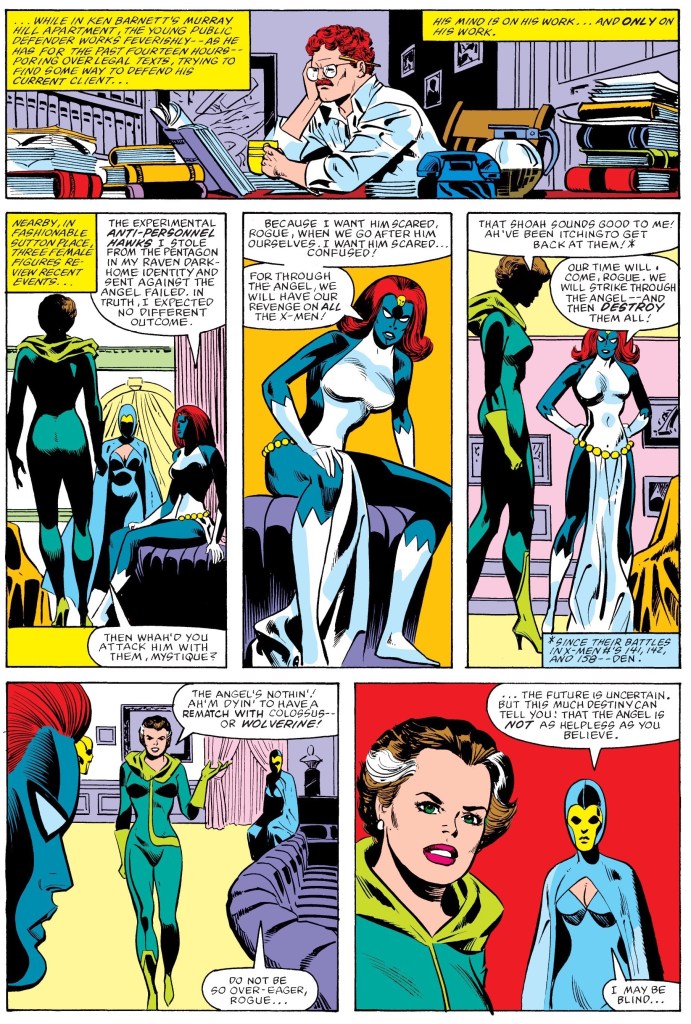
As expected, the story in this comic book showed natural progression on developing the protagonist as well as her parents while also reviving the superhero trope of good-versus-evil which was clearly done for entertainment value. While the cover art had Rogue hitting Dazzler, the good-versus-evil conflict within is actually bigger than that as the story involves not only Rogue but also notable X-Men villainess Mystique plus Destiny.

As this was in the early 1980s, Rogue was not a member of the X-Men at the time and was still new (her first-ever appearance was in Avengers Annual in 1981). Regarding Mystique, her appearance in this comic book was not merely just an appearance but rather an extension of the exploits of her group called the Brotherhood of Evil Mutants and it has been her desire to get back at the X-Men over what happened in Uncanny X-Men #142 (part 2 of the Days of Future Past storyline). As such, having Dazzler encounter the evil group in the presence of the X-Men’s Angel was a very strategic move by Danny Fingeroth as it emphasized the crossover aspect within the Marvel Comics universe of the time complete with pretty good dialogue and details emphasized.

This also helps remind readers of Dazzler’s previous involvement with the X-Men and cleverly gave them the idea of what would things be like if the protagonist someday really joined the team of mutants.

On character development, dramatizing Alison’s mother and father shows progress from what happened near the end of the previous issue which is a nice touch. Even Alison’s boyfriend Ken got his own share of the spotlight. What is most notable when it comes to characterization in this comic book is the smooth and fine chemistry between Alison and Warren Worthington. The two made convincing friends and how their respective circumstances brought them together here was well executed by the creators.

Conclusion

Discreetly, Alison Blaire uses her power to help someone.

Dazzler #22 (1982) is enjoyable and has that fine balance between characterization, plotting and spectacle. The good-versus-evil conflict here should really catch the attention of readers, especially those who are deeply interested with the X-Men-related characters and groups of the early 1980s. There is also enough superhero action to keep readers entertained and clearly this was done to make up for the lack of action in the very dramatic issue #21.

If you are seriously planning to buy an existing hard copy of Dazzler #22 (1982), be aware that as of this writing, MileHighComics.com shows that the near-mint copy of the regular edition costs $57 while the near-mint copy of the newsstand edition costs $113.

Overall, Dazzler #22 (1982) is recommended.

+++++

Thank you for reading. If you find this article engaging, please click the like button below and also please consider sharing this article to others. If you are looking for a copywriter to create content for your special project or business, check out my services and my portfolio. Feel free to contact me with a private message. Also please feel free to visit my Facebook page Author Carlo Carrasco and follow me on Twitter at  @HavenorFantasy as well as on Tumblr at https://carlocarrasco.tumblr.com/