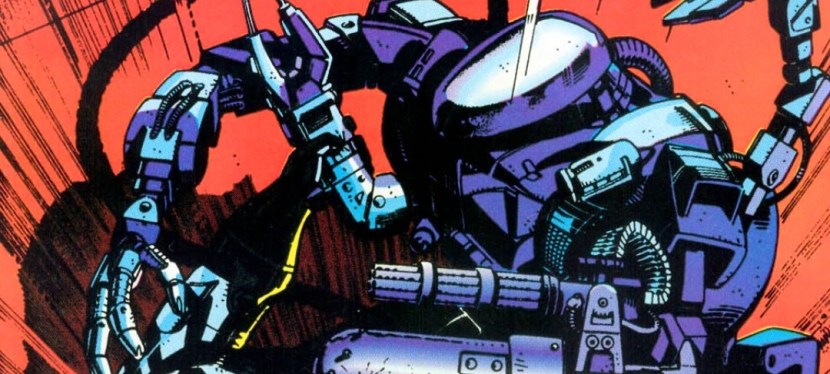
A Look Back at RoboCop 2 #3 (1990)

Welcome back superhero enthusiasts, 1990s arts and culture enthusiasts, Marvel Comics fans and comic book collectors! Today we go back to the year 1990 to take a close look at the concluding chapter of the comic book adaptation of the movie RoboCop 2 (1990).

In my previous retro review, I found the 2nd issue of the 3-part comic book adaptation mini-series that it lacked the impact of issue . It was understood that the comic book team was limited by the source material they had and the movie’s comedic scenes showing RoboCop not being his normal self were adapted. Those scenes did not translate into humorous comic book moments. At the very least, the build-up achieved by the comic book creators in issue (which includes several internal developments at Omni Consumer Products) sets the stage for the final issue.

With those details laid down, here is a look back at RoboCop 2 , published in 1990 by Marvel with a story written by Alan Grant and drawn by Mark Bagley based on the movie screenplay by Frank Miller and Walon Green.
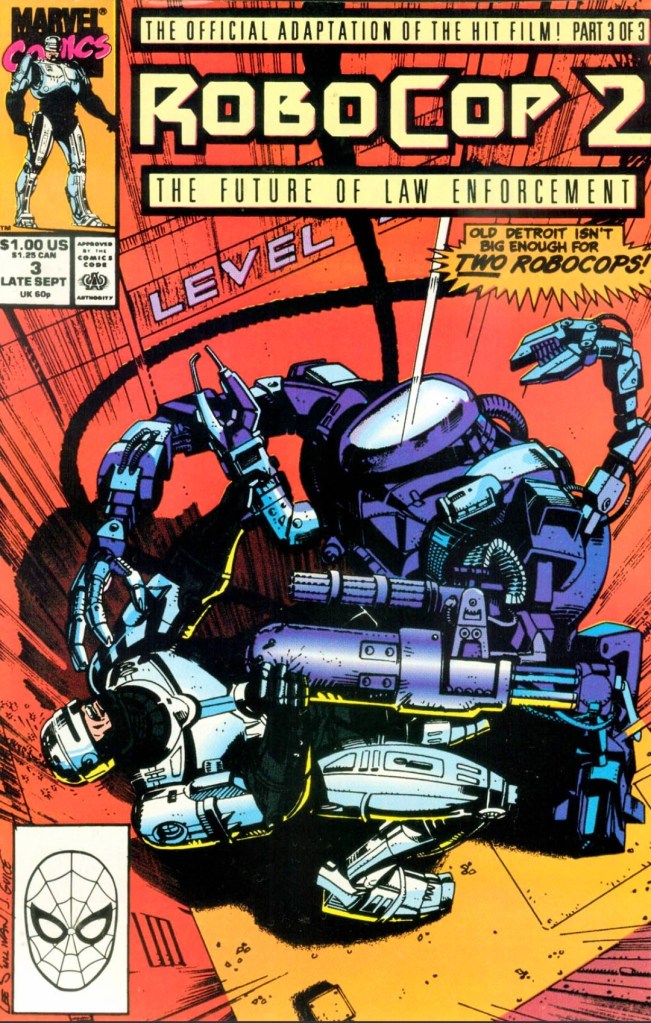
The cover.

Early story

The story begins in Detroit where OCP executives press RoboCop (Officer Murphy) for answers about the spying he recently did on his ex-wife. It turns out that his wife was so traumatized over his death, there were therapists, hypnotists and other treatments involved to help her recover. As a result of the spying, his ex-wife now believes her husband is still alive. In response to questions, RoboCop gave answers that the OCP guys wanted – he is no longer a husband, no longer human, no longer Alex Murphy and he is simply a machine. The private meeting between him and his ex-wife did not go well.

Meanwhile, the City Government of Detroit organizes a telethon in an attempt to raise funds needed to pay off the $37,985,300 they owe OCP. The mayor receives a very important call from former associates of Cain (RoboCop 2).   

Shortly after, OCP realizes that the City Government could pay soon and if they fail to foreclose Detroit, their stock will plummet. With the approval from the corporation’s chief, Dr. Juliette Faxx proceeds to launch RoboCop 2 with the mind of Cain inside it…

Quality
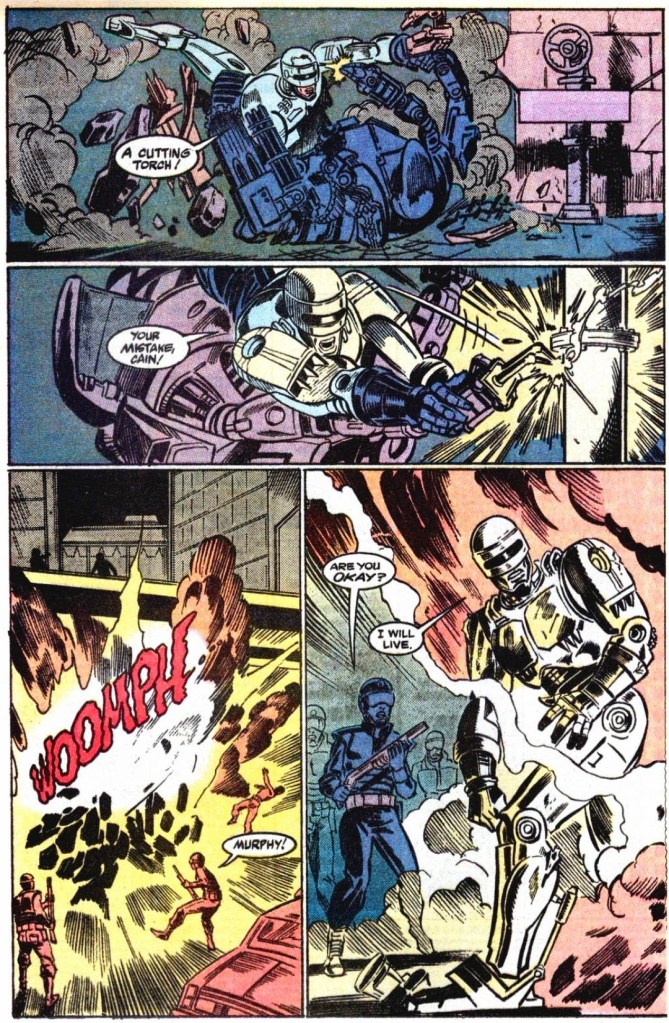
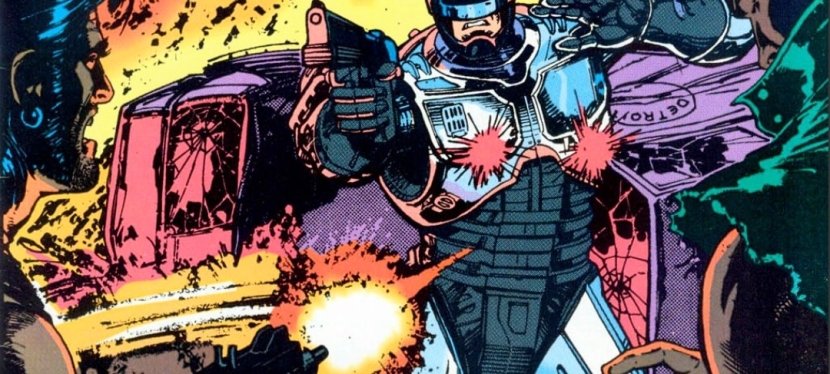
The battle between RoboCop and his bigger rival (Cain) is action-packed and fun to read.

As it is clear that the imagery and plot developments of the movie screenplay were adapted by the comic book creators with their very own distinctive ways throughout the mini-series, this comic book succeeded in concluding its 3-part story. In fact, this is a huge pay-off to most of the build-up that took place in issues and . The much-awaited big battle between RoboCop and the Cain-controlled RoboCop 2 lasted eight pages and it was indeed action-packed and satisfying. Before the said battle took place, RoboCop 2’s debut is short, stylishly obscured visually and yet vicious to see.

Considering the huge amount of details the movie screenplay had, the Grant-Bagley duo managed to adapt the most relevant content efficiently while also telling a literary tale that is cohesive enough.
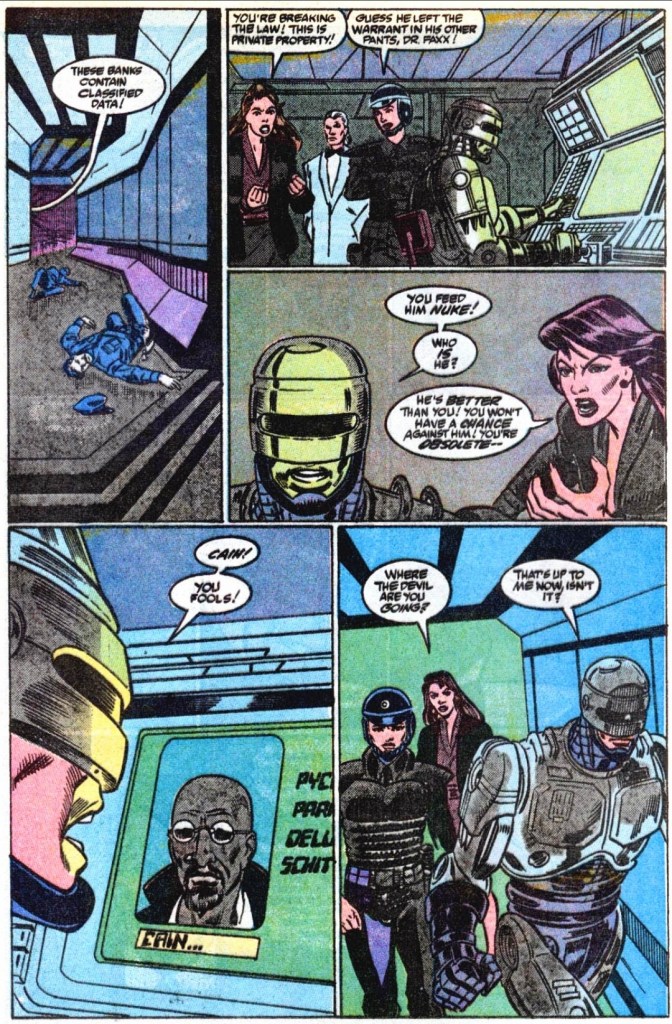
This scene did not appear in the movie.

What I found very notable is the fact that this comic book opened with RoboCop getting berated by OCP executives for his spying on his ex-wife. The said scene actually happened very early in the movie itself and to have it as an opener of this comic book added depth to RoboCop’s character development in this adaptation.

When it comes to weaknesses, there were times when Mark Bagley’s drawing of RoboCop 2 were off. RoboCop 2 was visually huge and intimidating in the movie but in this comic book, the size and scale were clearly lacking particularly in the shot where he is standing near OCP’s chief. The lack of visual details on RoboCop 2’s body showed signs of rush by the artist.

Conclusion
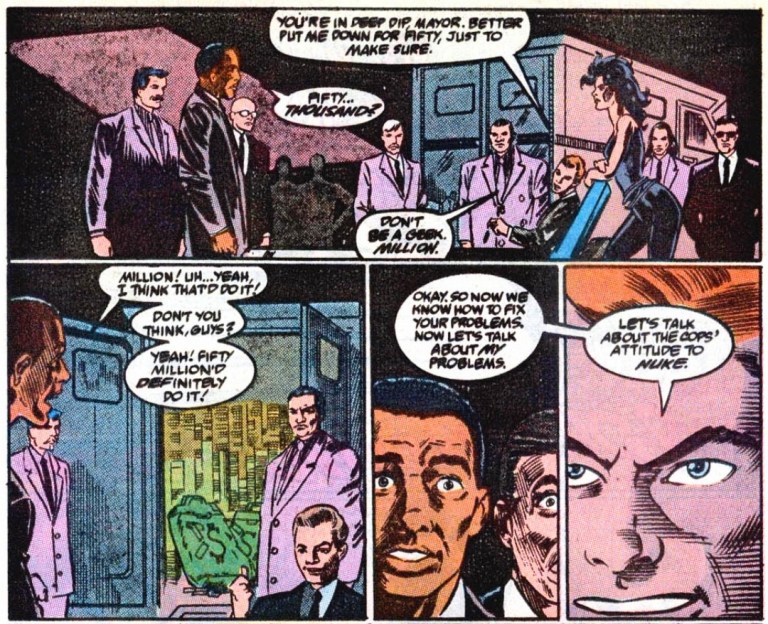
Is your local government leader making secret deals with criminals in real life?

RoboCop 2 (1990) is a nice pay-off to the build-up that preceded it and, more importantly, it was a satisfying mini-series conclusion. As a standalone comic book, it has a good amount of plot details, dialogue and action scenes that can delight RoboCop fans. As the conclusion of the 3-part adaptation of the 1990 movie, it has a stronger focus on RoboCop and the plot moved at a better pace than in issue . The storytelling is good and the spectacle was much improved.

Overall, RoboCop 2 (1990) is recommended.

+++++

Thank you for reading. If you find this article engaging, please click the like button below, share this article to others and also please consider making a donation to support my publishing. If you are looking for a copywriter to create content for your special project or business, check out my services and my portfolio. Feel free to contact me with a private message. Also please feel free to visit my Facebook page Author Carlo Carrasco and follow me on Twitter at  @HavenorFantasy as well as on Tumblr at https://carlocarrasco.tumblr.com/ and on Instagram at https://www.instagram.com/authorcarlocarrasco
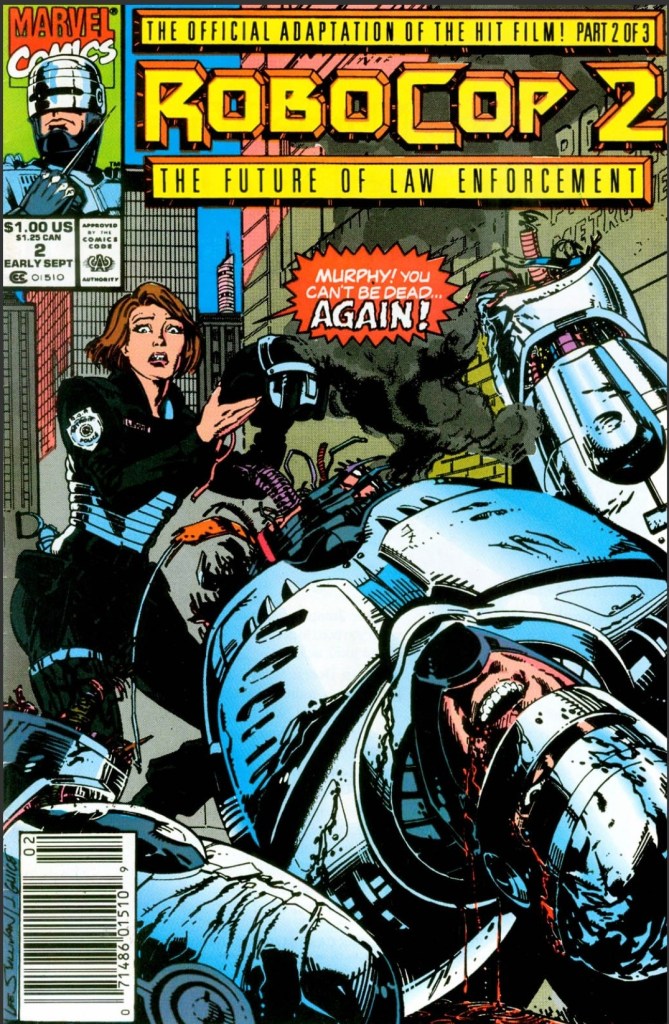
A Look Back at RoboCop 2 #2 (1990)

Welcome back superhero enthusiasts, 1990s arts and culture enthusiasts, Marvel Comics fans and comic book collectors! Today we go back to the year 1990 to take a close look at the 2nd part of the comic book adaptation of the movie RoboCop 2 (1990).

In my previous retro review of Robocop 2 #1, I pointed out that the comic book was not a faithful adaptation of the movie but more of the creators’ creative interpretation of the movie script they had which resulted in a stylized presentation. It was a surprisingly enjoyable reading experience for me.

With those details laid down, here is a look back at RoboCop 2 , published in 1990 by Marvel with a story written by Alan Grant and drawn by Mark Bagley based on the movie screenplay by Frank Miller and Walon Green.

The cover.

Early story

The story begins in Detroit with RoboCop reduced into a very bad condition with most of his parts missing. The cops are still on strike and the ultra-addicting drug Nuke continues to spread through the city causing social problems. Cain and his gang are still on the loose, and his video statement (which emphasizes his gang’s defeat of RoboCop) spreads through the news cycles.

Inside a hideout, Cain and his loyal companions terrify and killed traitorous police officer Duffy for betraying them. Meanwhile at police headquarters, the support crew bumps heads with the Omni Consumer Products (OCP) executive who does not see RoboCop’s poor state as a problem. As far as OCP is concerned, getting replacement parts for RoboCop is very expensive.

Over at OCP, the psychologist executive Dr. Juliette Faxx begins researching criminals for the new RoboCop project…

Quality

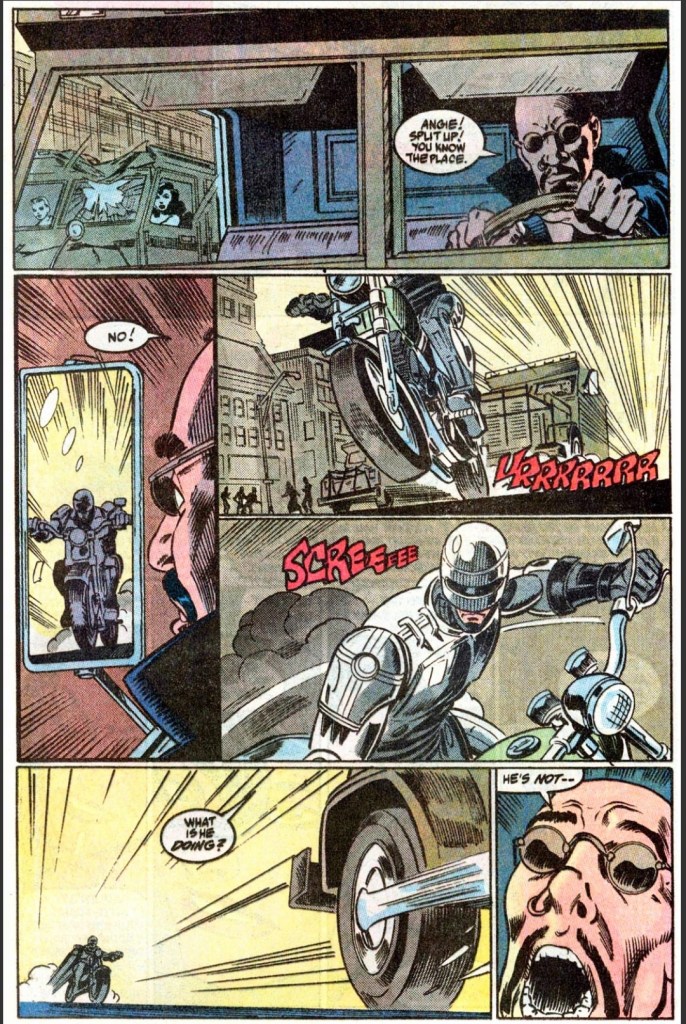
The motorized encounter between RoboCop and Cain here is shorter and much inferior compared to what the movie showed.

As with issue , this comic book followed the events and scenes of the film but left enough room for the creative team to make their stylized version suitable with the literary format. Mark Bagley, who is best known for drawing Spider-Man and Venom in the 1990s, came up with nice artwork that brought Grant’s script to life. There were a few shots here that were pretty graphic or brutal to see at the time of publication which makes me wonder why did the Comics Code Authority (CCA) give its approval to this comic book.

Without spoiling the plot, I can say that the creative team and editor Gregory Wright did a good job adapting scenes of the movie script to (fill up the pages) while also succeeding in setting up readers for the final conflict in the 3rd and final issue.

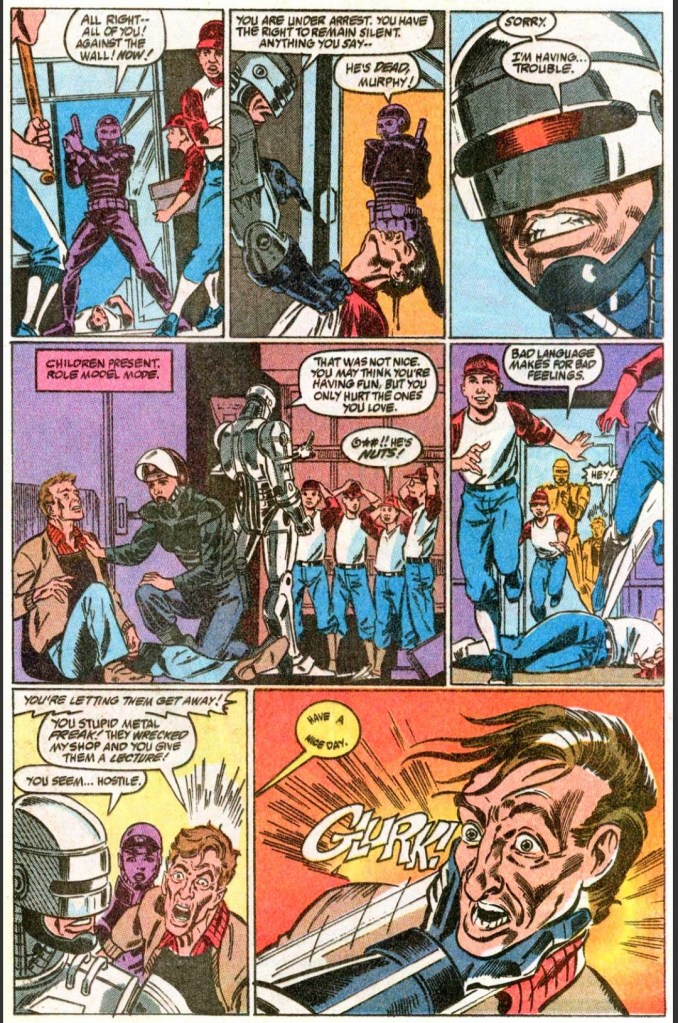
As a standalone reading material, this comic book will lead readers deep into the crisis of the police force as well as into the developments behind the closed doors of OCP. Due to the selected scenes of the film’s script, RoboCop has sufficient presence but lacked his normal personality. That being said, the movie’s comedic look of RoboCop acting very out-of-touched (hint: OCP tampered with his mind digitally) did not translate well into literary format. If you’re hoping to see solid storytelling with a consistent tone, you won’t find it here.

When it comes to action, there is just enough of it to keep the reading experience entertaining. Again, this comic book does not have the final conflict and the selected action scenes are rather limiting in terms of impact. If you want to see the police raid of the Nuke facility as well as RoboCop’s motorized chase with Cane, you are better off replaying the movie.  

Conclusion

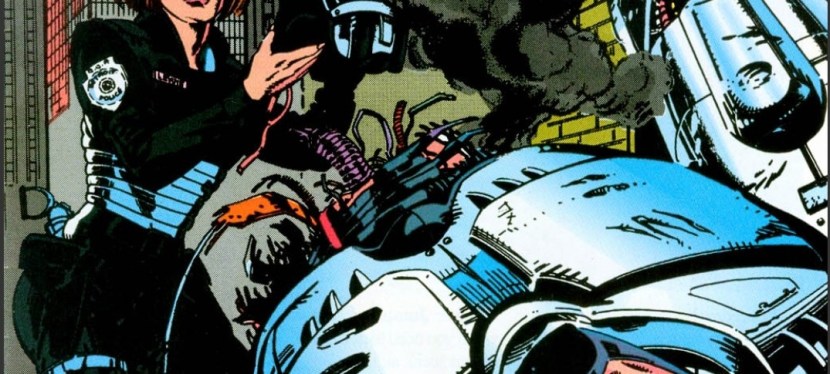
There definitely is something wrong with RoboCop here.

Considering the selected movie script scenes for adaptation, RoboCop 2 (1990) lacks impact compared to the first issue. In fairness, this comic book was clearly meant to set-up readers for the next issue. If there is anything worth looking at within the 2nd issue’s pages, it would be the details that were highlighted during the internal developments at OCP and the police. As mentioned earlier, RoboCop is not his usual self for a significant portion of this comic book. While the engagement and fun factor are lower this time around, I’m still interested to read the next issue.

Overall, RoboCop 2 (1990) is serviceable.

+++++

Thank you for reading. If you find this article engaging, please click the like button below, share this article to others and also please consider making a donation to support my publishing. If you are looking for a copywriter to create content for your special project or business, check out my services and my portfolio. Feel free to contact me with a private message. Also please feel free to visit my Facebook page Author Carlo Carrasco and follow me on Twitter at  @HavenorFantasy as well as on Tumblr at https://carlocarrasco.tumblr.com/ and on Instagram at https://www.instagram.com/authorcarlocarrasco
A Look Back at RoboCop 2 #1 (1990)

Welcome back superhero enthusiasts, 1990s arts and culture enthusiasts, Marvel Comics fans and comic book collectors! Today we go back to the year 1990 to take a close look at the comic book adaptation of the movie RoboCop 2 (1990).

Before getting to the new retro comic book review, I should state that my friends and I had a fun time watching RoboCop 2 in the cinema shortly after it opened here in the Philippines. Back then, I was not yet a comic book collector and I rarely visited comic book specialty stores. That being said, I was unaware that Marvel Comics actually published an adaptation in the form of a 3-issue mini-series.

With those details laid down, here is a look back at RoboCop 2 , published in 1990 by Marvel with a story written by Alan Grant and drawn by Mark Bagley based on the movie screenplay by Frank Miller and Walon Green.

The cover.

Early story

The story begins in Detroit where the cops are run by corporations and the streets have turned into red-alert war zones. Crime is overwhelming the city and the highly addictive narcotic poses the greatest threat facing societies. The surgeon general who made the public warning about nuke was killed and the crime boss Cain (leader of a cult of nuke addicts and pushers) claims responsibility. Through the news media, Cain tells the public that nuke will make people’s problems go away and people want its paradise.

Under the management of Omni Consumer Products (OCP), several of Detroit’s police officers go on strike demanding better terms from their employer. The City Government of Detroit under Mayor Kuzak missed a payment (in relation to them owing $37 million) and OCP begins to move to foreclose the city and its assets in accordance to the terms of the contract. Mayor Kuzak accuses OCP of engineering the police strike which made crime rampant.

Elsewhere in the evening, the cruel activities of the thugs got disrupted by the arrival of a police car. Even though the police car got destroyed by the thugs, RoboCop emerges and begins to fight back…

Quality

There is simply no holding back for RoboCop when it comes to doing police work at a time when many police officers are on strike while crime has turned more rampant in Detroit.

This opening issue of the mini-series sticks close the basic plot of the movie (right until after Cain’s gang dismantled RoboCop) although there were a few notable differences with the sequence of events and there were scenes that showed the creative team took liberties to make the story suitable with the literary format in mind. That being said, don’t expect to see the key moments of the movie look exactly the same in this comic book and don’t expect to see the characters here looking like the actors who played them on the big screen. In terms of visual and literary presentation, this adaptation has a lot in common with the Total Recall comic book adaptation which coincidentally was released the same year.  

For me, this is indeed a really readable comic book that has its stylized approach on telling the movie’s concept. OCP is the most powerful entity in the story while Cain and his gang are clearly the force of evil that strongly pose danger not only to Detroit’s people but even to the very divided police force. Nuke as the dangerous object of the plot clearly was inspired from elements of the real life war against drugs in 1980s America which made this story socially relevant.

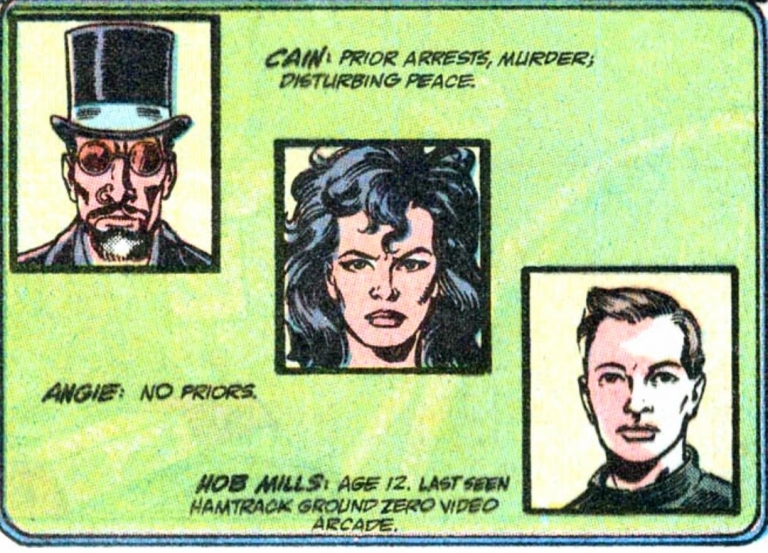
Very clearly these villains look nothing like actors Tom Noonan, Galyn Görg and Gabriel Damon.

Like in the movie, RoboCop here performs his law enforcement duty in an uncompromising manner even though memories of his past life as officer Murphy re-emerged deep inside. That being said, there are a few moments in which you might sympathize with the titular hero as this comic book pays close attention to the conflict between humanity and technology.

The action scenes here are sufficient but clearly don’t come anywhere close to the intensity of the film in terms of violence. Still, there is enough action for readers to enjoy.

When it comes to the visuals, the artwork done by Mark Bagley eerily looks comparable with Tom Lyle’s art in the Total Recall comic book of 1990. For the newcomers read this, Bagley became a popular artist through the Amazing Spider-Man monthly series and the Venom: Lethal Protector comic books that were released after years after this one. Having seen many of Bagley’s works published in 1992 to 1995, I can hardly recognize his art style in this comic book adaptation. The way he drew people’s faces in this comic book looks very different from those seen in Amazing Spider-Man issues. At the same time, Bagley’s own take on RoboCop has that balanced approach on depicting humanity with machinery while also making the hero look less bulky compared to the movie’s version.

Conclusion

Julie Faxx of OCP sure talks like a woke nut and rabid feminist in this scene.

RoboCop 2 (1990) is clearly not a faithful adaptation of selected parts of the movie but that’s not necessarily a bad thing. This is more about the Grant-Bagley team doing their own visual presentation of the movie script copy they had and ultimately they succeeded in making this comic book a stylized and worthy reading experience. This is indeed a surprisingly entertaining read and I can say that I am looking forward to reading the next issue.

Overall, RoboCop 2 (1990) is recommended.

+++++

Thank you for reading. If you find this article engaging, please click the like button below, share this article to others and also please consider making a donation to support my publishing. If you are looking for a copywriter to create content for your special project or business, check out my services and my portfolio. Feel free to contact me with a private message. Also please feel free to visit my Facebook page Author Carlo Carrasco and follow me on Twitter at  @HavenorFantasy as well as on Tumblr at https://carlocarrasco.tumblr.com/ and on Instagram at https://www.instagram.com/authorcarlocarrasco
A Look Back at Jurassic Park #4 (1993)

Disclaimer: This is my original work with details sourced from reading the comic book and doing personal research. Anyone who wants to use this article, in part or in whole, needs to secure first my permission and agree to cite me as the source and author. Let it be known that any unauthorized use of this article will constrain the author to pursue the remedies under R.A. No. 8293, the Revised Penal Code, and/or all applicable legal actions under the laws of the Philippines.

Welcome back superhero enthusiasts, 1990s culture enthusiasts and comic book collectors! Today we go back to the year 1993 for another look at Steven Spielberg’s Jurassic Park in the form of licensed comic books published by Topps Comics.

In my previous retro review, I found issue to be much more entertaining than the two previous issues mainly due to the thrills and suspense that were the result of the comic book creators’ interpretation the encounter between Dr. Alan Grant’s group and the Tyrannosaurus Rex at its paddock (with the fence no longer electrified due to Dennis Nedry’s dirty act). While the said comic book still had lots of exposition and a wordy presentation, the pace of the storytelling notably moved a bit faster overall.

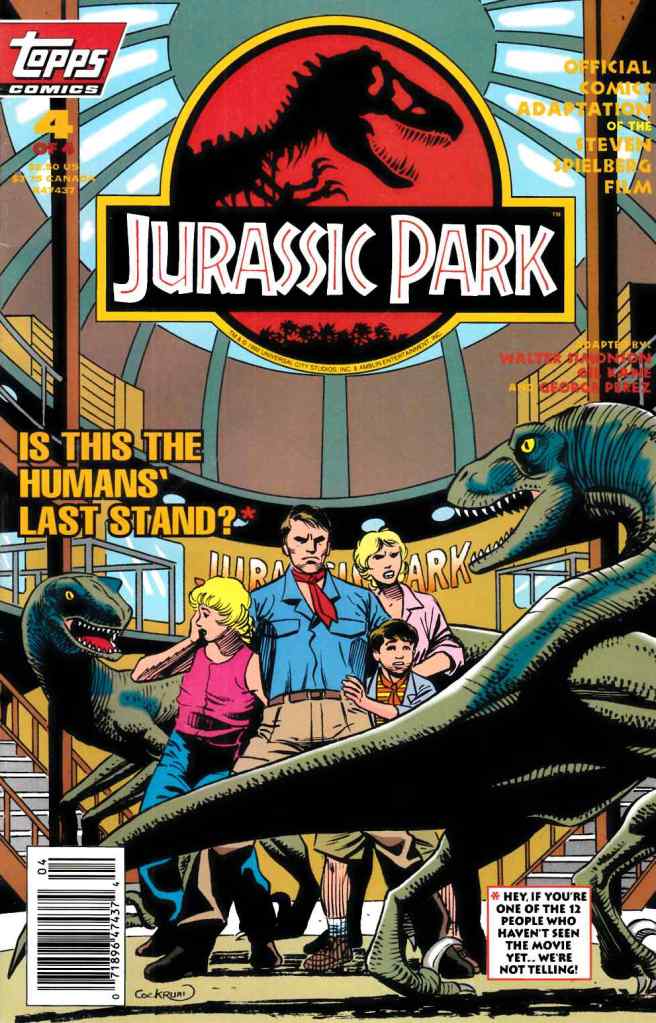
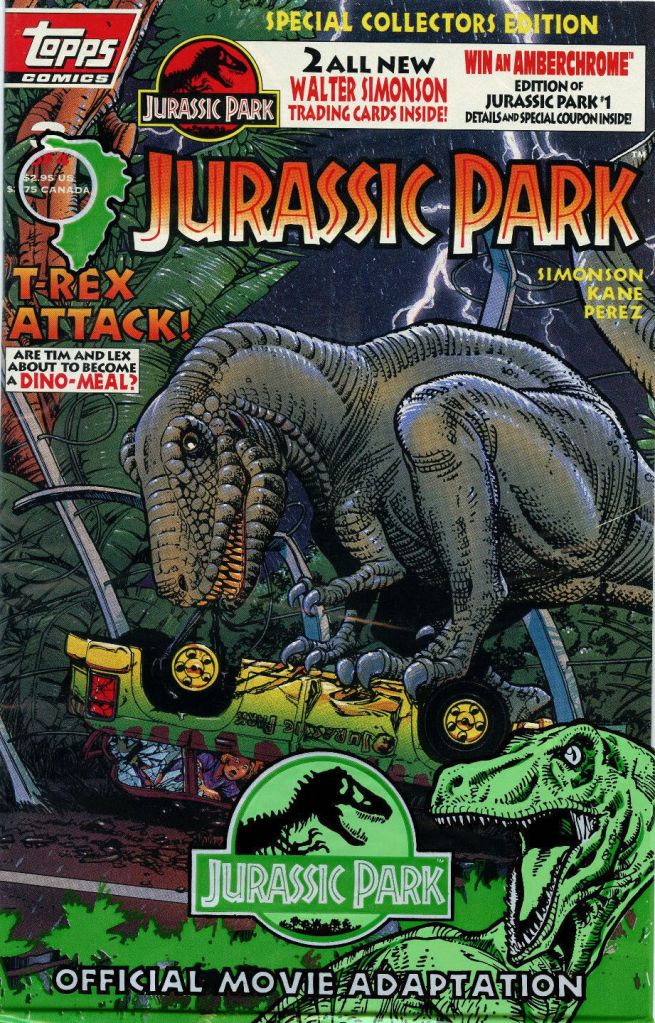
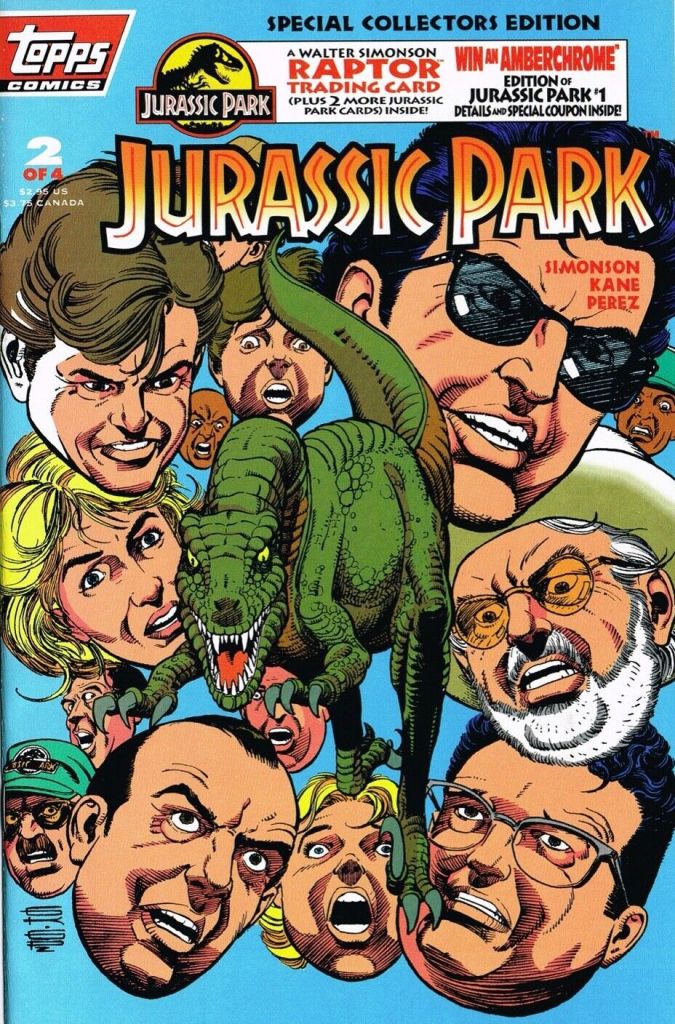
With those details laid down, here is a look back at Jurassic Park , published in 1993 by Topps Comics with a story written by Walter Simonson and drawn by Gil Kane with ink work done by the late George Perez. This comic book was the fourth of a 4-issue mini-series based on the Spielberg-directed movie.

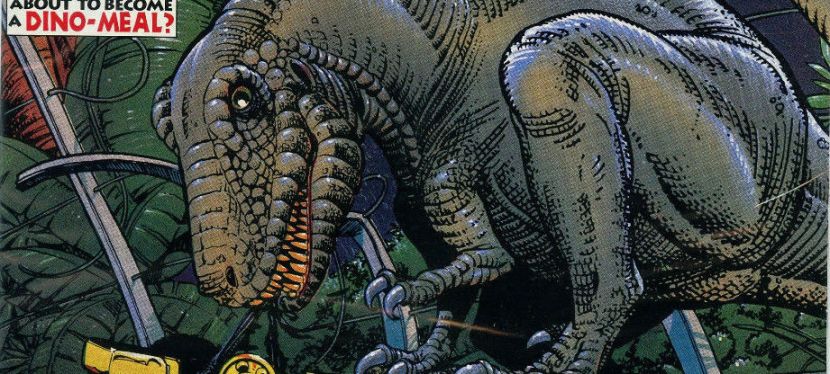
The cover.

Early story

The story begins at the ruined side of the Tyrannosaurus Rex paddock. Lawyer Gennaro is dead while Dr. Ian Malcolm got serious injured as a result of being chased by the T. Rex. The same T. Rex is right in front of Dr. Alan Grant and teenager Lex with the flipped, ruined vehicle near them (with Tim still inside). Knowing that the huge dinosaur’s vision is based on movement, Grant tells Lex to stand perfectly still no matter what happens. As they try to make their slow move to safety, the T. Rex suddenly moves the ruined vehicle against them by the wall of the still deactivated fence. While holding Lex with his left arm, Grant grabs a loose cable to break their fall as the vehicle got pushed over the edge. Several feet down, Grant and Lex land safely as the vehicle hits the ground.

Over at Jurassic Park’s control center, John Hammond is outraged over what happened as Nedry left them (secretly carrying the stolen dinosaur embryos) and their safety systems are all down. Hammond dispatches Robert Muldoon to go out and rescue his grandchildren, and Ellie Sattler volunteers to help out. Struggling with the computer, Ray Arnold tells his boss that there is no way to get Jurassic Park back on-line without Nedry.

Elsewhere within the park, Dennis Nedry struggles to find his way to his destination. Suddenly, his vehicle slips and loses traction…

Quality

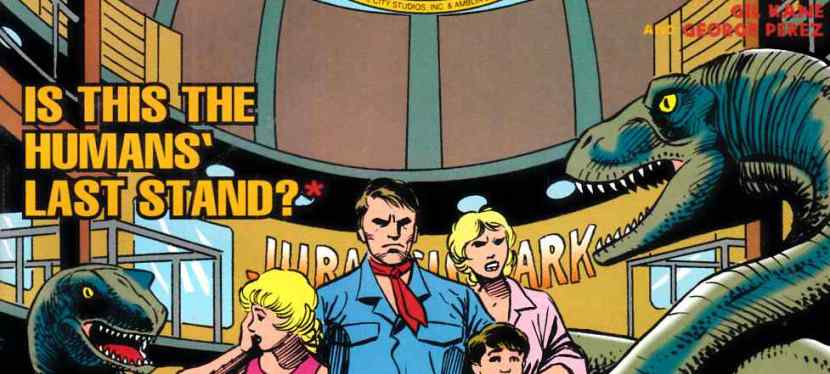
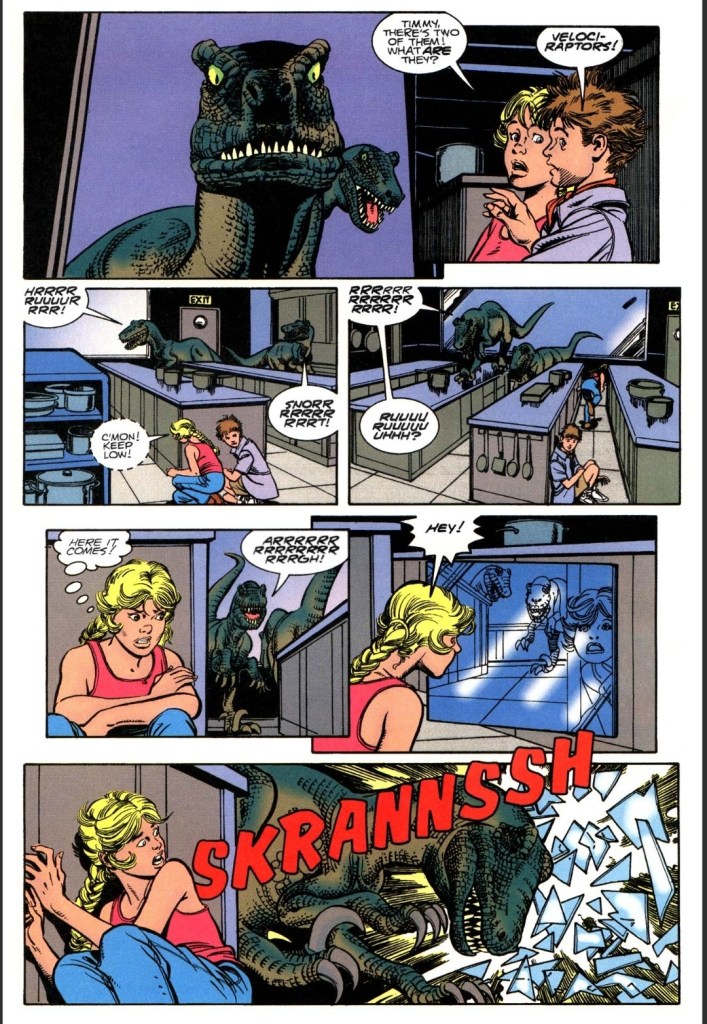
This is how the memorable scene of the Raptors and Hammond’s grandchildren was adapted.

Let me start by stating what is very obvious here….this comic book is easily the most enjoyable and fastest-moving adaptation of the key events of Spielberg’s movie (from the T. Rex encounter until the end of the film) albeit with some signs of rush and creative short-cuts. It is also here where the exposition has been lessened and the creators focused more on adapting the cinematic dialogue and the remaining scenes along with the spectacle. The narrative is clearly rushed and it is amusingly amazing to see how the creators managed to cover the remaining events of the movie (note: Dennis Nedry’s death, Robert Muldoon’s tragic encounter with the raptors, Ellie Sattler’s struggle to reactivate the park’s power system, and the varied encounters with the raptors were included) to fit within the pages of this very comic book. In my reading experience, it still worked.

While it is flawed in its execution, this comic book managed to click as a pay-off to the build-up that happened in the first three issues. There is a decent amount of action and sudden moments of incidents here and there, and still the creators managed to tell their own interpretation of the remaining events from the movie.

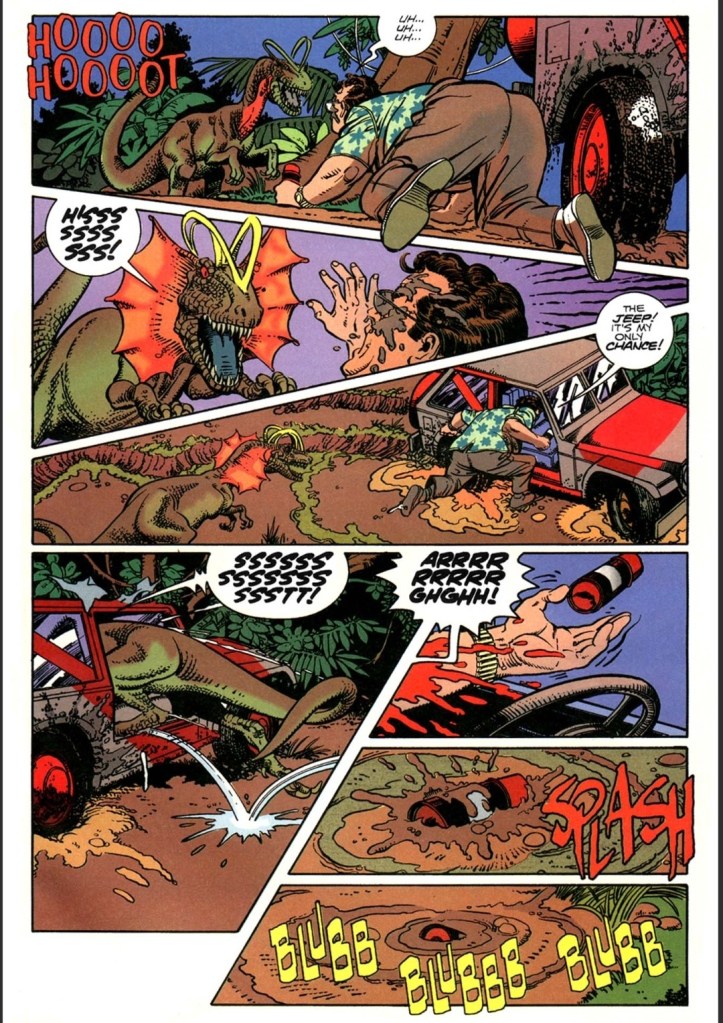
This is how Dennis Nedry’s death and the loss of the canister (containing the stolen dinosaur embros) were portrayed in this comic book.

Gil Kane’s art on the dinosaurs are somewhat good but in what seems to be a sign of behind-the-scenes production rush, his visual take on the T. Rex’s unexpected heroic moment and struggle with the two raptors was drawn with a lack of precision on size and scale. Such literary translation only made me want to return to the movie itself and replay the said scene (which was climactic cinematically speaking). Surprisingly, Gil Kane managed to visualize a few but noticeable bloody moments particularly with the respective deaths of Dennis Nedry (to the Dilophosaurus) and Robert Muldoon (to the raptors).

As the focus here has always been the adaptation of cinematic events, it is unsurprising that there really was no room for character development. Dr. Grant is the only one who showed any real change from being rough on children (as seen in issue ) to becoming more caring on them (specifically John Hammond’s grandchildren) due to incidents. All the development on Dr. Grant took four issues both literally and visually. John Hammond could have been developed a lot more if only the dialogue was not too limited with the focus on adapting movie dialogue. Speaking of adaptation, the cinematic error about the instant drop (from the perimeter fence of the T. Rex paddock opposite the road) also made it in this comic book.

Conclusion

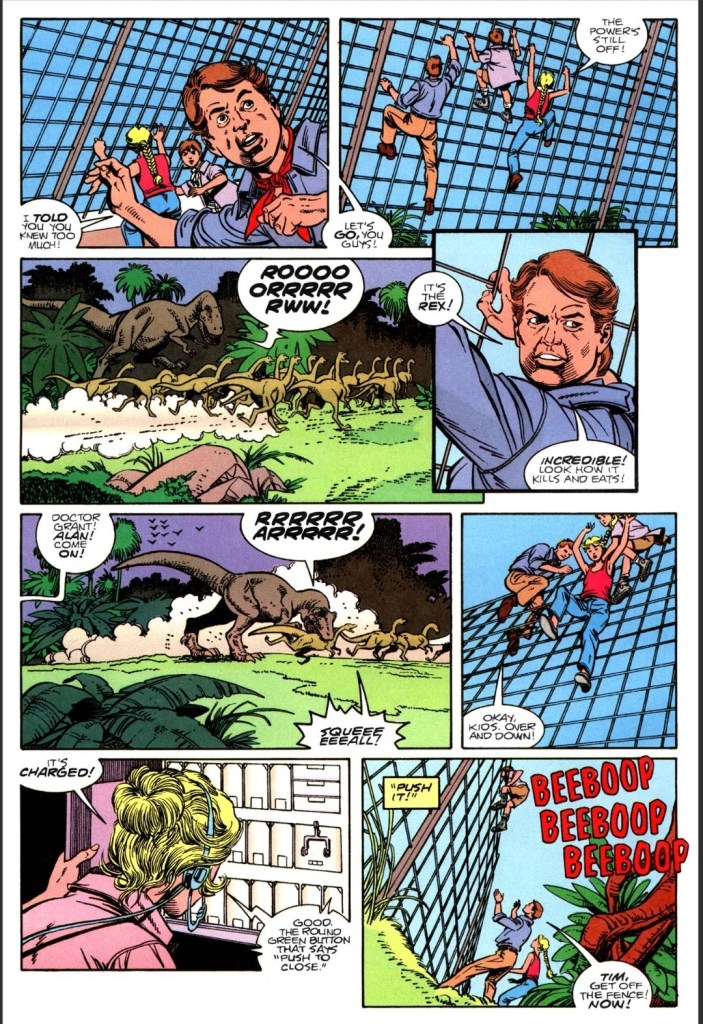
This is a creative and clever way the comic book creators combined elements of two separate film scenes into a single sequence with readers in mind.

Even though it had a rushed narrative, Jurassic Park (1993) ironically managed to be the most enjoyable issue of the 4-issue mini-series adapting the blockbuster movie. It has the most amount of spectacle, more dinosaur visuals for dinosaur enthusiasts to enjoy, and the pace moved much faster. Compared to each of the previous issues, this one was a breeze to read and there were bouts of fun. As a companion piece to the blockbuster movie, the 4-part Jurassic Park movie adaptation mini-series served its purpose to translate its events within the limits of illustrated literature. While it does not obviously capture the magical moments nor the sentimental elements of Spielberg’s work, this mini-series managed to complete its own interpretation ultimately creating stuff that could satisfy the brainy comic book reader, the reader who loves thrills and the reader who is simply obsessed with dinosaurs. It is somewhat symbolic that this final issue had the most fun stuff.

Overall, Jurassic Park (1993) is recommended.

+++++

Thank you for reading. If you find this article engaging, please click the like button below and also please consider sharing this article to others. If you are looking for a copywriter to create content for your special project or business, check out my services and my portfolio. Feel free to contact me with a private message. Also please feel free to visit my Facebook page Author Carlo Carrasco and follow me on Twitter at  @HavenorFantasy as well as on Tumblr at https://carlocarrasco.tumblr.com/ and on Instagram at https://www.instagram.com/authorcarlocarrasco/

A Look Back at Jurassic Park #3 (1993)

Disclaimer: This is my original work with details sourced from reading the comic book and doing personal research. Anyone who wants to use this article, in part or in whole, needs to secure first my permission and agree to cite me as the source and author. Let it be known that any unauthorized use of this article will constrain the author to pursue the remedies under R.A. No. 8293, the Revised Penal Code, and/or all applicable legal actions under the laws of the Philippines.

Welcome back superhero enthusiasts, 1990s culture enthusiasts and comic book collectors! Today we go back to the year 1993 for another look at Steven Spielberg’s Jurassic Park in the form of licensed comic books published by Topps Comics.

In my previous retro review, the comic book still had the creative issues of heavy exposition and being very word-heavy to read as the creators focused on adapting the movie’s story closely (from the iconic brachiosaurus scene up to the encounter with the triceratops). Compared to issue , the comic book’s narrative improved temporarily as it closely adapted the lunch-and-talk scene between John Hammond, Donald Gennaro, Ellie Sattler, Alan Grant and Ian Malcolm whose dialogue was easily the most engaging in both film and in literary format.

With those details laid down, here is a look back at Jurassic Park , published in 1993 by Topps Comics with a story written by Walter Simonson and drawn by Gil Kane with ink work done by the late George Perez. This comic book was the third of a 4-issue mini-series based on the Spielberg-directed movie.

The cover.

Early story

The story begins with the group of Alan Grant, Ellie Sattler, Ian Malcolm, Donald Gennaro and the two kids Lex and Tim who are shocked to see a living triceratops. The large dinosaur, however, falls down on its side causing Ellie Sattler to go near and examine it. Gerry Harding, a Jurassic Park employee, suddenly appears and explains that the triceratops was tranquilized by Robert Muldoon and has been sick. After examining the dinosaur further, Ellie wants to have its droppings examined.

Back in the control room of Jurassic Park, Ray Arnold explains to John Hammond that the center of an approaching story has not changed course and states that he likes to cut the current tour and resume the next day. He emphasized to Hammond that the storm is risky to those on tour.

Just across the room, Dennis Nedry (who secretly cut a deal with a business rival of inGen’s and has been frustrated working for John Hammond) carefully communicates with the captain of the ship that will depart once all the workers have boarded. Knowing he is running out of time to steal the dinosaur embryos and send it to Biosyn, he starts his move with Jurassic Park’s main system…

Quality

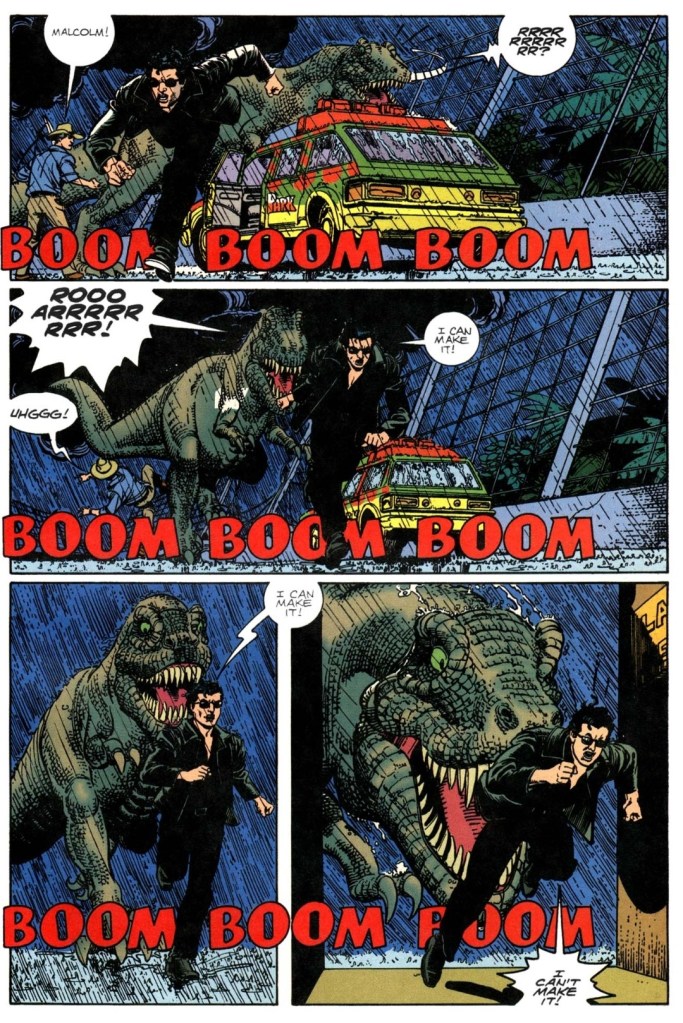
While the sequences of the T.Rex going after Ian Malcolm are not the same as those in the movie, the dinosaur itself really looks creepy.

When it comes to entertainment value related to spectacle, I can say clearly that this issue really marked the beginning of fun in this 4-issue mini-series. This is because this comic book includes the appearance of the Tyrannosaurus Rex (T.Rex) which arrived just when Alan Grant, Ian Malcolm, Lex, Tim and Donald Gennaro are helpless sitting inside vehicles that stopped by the said dinosaur’s paddock with the fences no longer electrified.

Of course, the minutes-long T. Rex scene in the movie remains memorable as it had a well-blended mix of suspense, action and some horror directed by Steven Spielberg. This comic book’s creators did their best to replicate the experience in illustrated literature format. While it’s not surprising that the essence of the T.Rex paddock scenes in movie were not perfectly captured, this comic book’s adaptation still managed to be entertaining to read showing suspense, horror and some thrills plus Gil Kane managed to even make the infamous dinosaur look frightening. Very clearly, Kane went all-out in presenting the T.Rex as the main dinosaur not only in this comic book but for the whole mini-series.

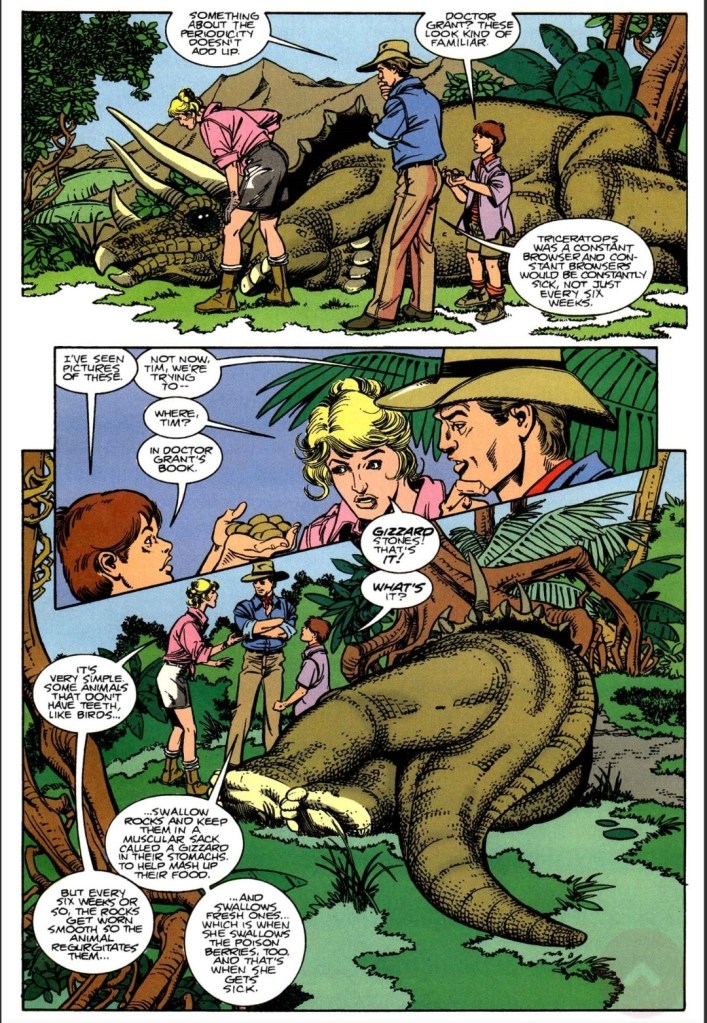
While the T.Rex paddock scene is the highlight of this comic book, the scene with the triceratops proved to be another exposition-heavy presentation laced with pretentious science and technical explanations dealing with plants, animal health and the like. Meanwhile, the scenes about John Hammond, Robert Muldoon and Ray Arnold struggling with the failures of the park systems while Nedry betrays them secretly were pretty intense to read.

Conclusion

Lots of exposition and creative explanations in this scene about the sick triceratops.

So far, I find Jurassic Park (1993) to be the most entertaining issue so far thanks to the way the comic book creators adapted the Tyrannosaurus Rex paddock scene from the movie. While the narrative still had lots of exposition and creative explanations that started since issue #1, the consequential events of Dennis Nedry’s acts intensified the reading experience and the T.Rex scenes really ramped up the fun factor.

Overall, Jurassic Park (1993) is recommended.

+++++

Thank you for reading. If you find this article engaging, please click the like button below and also please consider sharing this article to others. If you are looking for a copywriter to create content for your special project or business, check out my services and my portfolio. Feel free to contact me with a private message. Also please feel free to visit my Facebook page Author Carlo Carrasco and follow me on Twitter at  @HavenorFantasy as well as on Tumblr at https://carlocarrasco.tumblr.com/ and on Instagram at https://www.instagram.com/authorcarlocarrasco/

A Look Back at Jurassic Park #2 (1993)

Disclaimer: This is my original work with details sourced from reading the comic book and doing personal research. Anyone who wants to use this article, in part or in whole, needs to secure first my permission and agree to cite me as the source and author. Let it be known that any unauthorized use of this article will constrain the author to pursue the remedies under R.A. No. 8293, the Revised Penal Code, and/or all applicable legal actions under the laws of the Philippines.

Welcome back superhero enthusiasts, 1990s culture enthusiasts and comic book collectors! Today we go back to the year 1993 for another look at Steven Spielberg’s Jurassic Park in the form of licensed comic books published by Topps Comics.

My previous retro review was the literary version of the film’s opening until the start of the iconic scene of the brachiosaur. The comic book was very exposition-heavy, had too few dinosaurs visualized and was ultimately a word-heavy experience with little entertainment value.

With those details laid down, here is a look back at Jurassic Park , published in 1993 by Topps Comics with a story written by Walter Simonson and drawn by Gil Kane with ink work done by the late George Perez. This comic book was the second of a 4-issue mini-series based on the Spielberg movie.

The cover.

Early story

The story begins on an island where John Hammond’s guests (Alan Grant, Ellie Sattler, Ian Malcolm and lawyer Gennaro) cannot help but stare and marvel at the brachiosaurus walking in front of them. Soon enough, they spot five more dinosaurs of the same species moving around. As they stare, Dr. Alan Grant and Ellie Sattler can’t help but be amazed as the sight of living dinosaurs literally broke the limits of what they previously learned about dinosaurs through books.

Grant then asks Jurassic Park owner John Hammond how he was able to come up with dinosaurs. Hammond then takes his guests into the visitor’s center which has a 50-seat auditorium for the prepared pre-show he prepared for their orientation. With Hammond taking an active part in the program, a video presentation shows how Jurassic Park’s personnel extracted dinosaur DNA from fossilized mosquitoes (which drew blood from dinosaurs), used advanced technologies and amphibian DNA to complete DNA sequencing, and created dinosaurs…

Quality

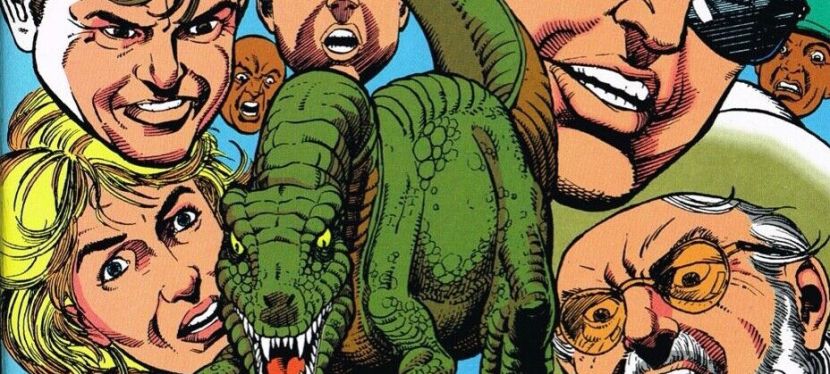
The baby Velociraptor, John Hammond, Ian Malcolm, Dr. Grant, Ellie Sattler and Dr. Wu in a scene.

The most obvious thing about this comic book (which starts with the brachiosaurus reveal until the triceratops’ appearance) is that it is very wordy and has lots of expository dialogue and creative explanations which reflected the film it was based on. What makes this a slightly better reading experience over issue is that it closely captured the essence of the best talk scene of Spielberg’s movie – the lunch meeting hosted by Hammond. To see Gennaro, Dr. Grant and Ellie give their feedback to Hammond with Ian Malcolm’s extensive opinion about Jurassic Park’s use of genetics, their revival of extinct species and their lack of humility before nature was easily the most compelling part of the comic book to read. In a way, a lot of exposition dump and build-up that started in issue were paid off nicely in the said scene.

As mentioned earlier, this comic book’s story reaches the appearance of the triceratops and by then John Hammond’s grandchildren (Tim and Lex) joined Grant, Gennaro, Sattler and Malcolm on the basic tour in vehicles. That being said, the story moved at a moderate pace and the only comic book spectacle here are the images of dinosaurs which were decently drawn by Gil Kane. Don’t expect any action nor thrills here because those would not happen until the T. Rex’s first appearance.

Conclusion

Can you imagine how you would react if you ever see large dinosaurs walking in front of you?

I can say that Jurassic Park (1993) is a slightly better reading experience than issue mainly due to the way the comic book creators adapted the movie’s best talk scene. The same old issues of heavy exposition and excessive dialogue are here which reflect Simonson and Kane’s focus on adapting scenes from the movie closely. Other than that, there is still no excitement to enjoy here which can be disappointing if you are anticipating dinosaur-related thrills and action sequences. Readers who enjoy exposition and the Jurassic Park entertainment franchise’s approach on portraying science (distorted and fantasized to be more attractive than true science) will still find something to enjoy here.

Overall, Jurassic Park (1993) is satisfactory.

+++++

Thank you for reading. If you find this article engaging, please click the like button below and also please consider sharing this article to others. If you are looking for a copywriter to create content for your special project or business, check out my services and my portfolio. Feel free to contact me with a private message. Also please feel free to visit my Facebook page Author Carlo Carrasco and follow me on Twitter at  @HavenorFantasy as well as on Tumblr at https://carlocarrasco.tumblr.com/ and on Instagram at https://www.instagram.com/authorcarlocarrasco/

A Look Back at Jurassic Park #1 (1993)

Disclaimer: This is my original work with details sourced from reading the comic book and doing personal research. Anyone who wants to use this article, in part or in whole, needs to secure first my permission and agree to cite me as the source and author. Let it be known that any unauthorized use of this article will constrain the author to pursue the remedies under R.A. No. 8293, the Revised Penal Code, and/or all applicable legal actions under the laws of the Philippines.

Welcome back superhero enthusiasts, 1990s culture enthusiasts and comic book collectors! Today we go back to the year 1993 which was a wild time for entertainment not only because of the comic book collection craze of the time but also because the whole world marveled at Steven Spielberg’s sci-fi film Jurassic Park which was simply unavoidable.  

Jurassic Park was released into cinemas worldwide at a time when computer-generated imagery (CGI) was advanced enough to show and animated dinosaurs in a photo-realistic way on the big screen. Unlike films of today, CGI in Spielberg’s movie was sparingly used and they cleverly used computer graphics to show dinosaurs in their entirety especially on really wide shots that literally made human actors look really small compared to them. What added also to the photorealism of the dinosaurs was the use of animatronics (read: physical models) when capturing close-ups of the dinosaurs. For millions of people, Jurassic Park was a dream come true for those who wanted to see very convincing and lively dinosaurs on the big screen in ways that stop motion animation could not do.

As mentioned earlier, Jurassic Park was unavoidable as it was everywhere from the cinemas to the TV and print ads, to the stores that had licensed toys and merchandise of the movie, to the book stores that sold copies of the novel written by Michael Crichton, and also in the comic book stores that had copies of the comic book adaptation published by Topps Comics.

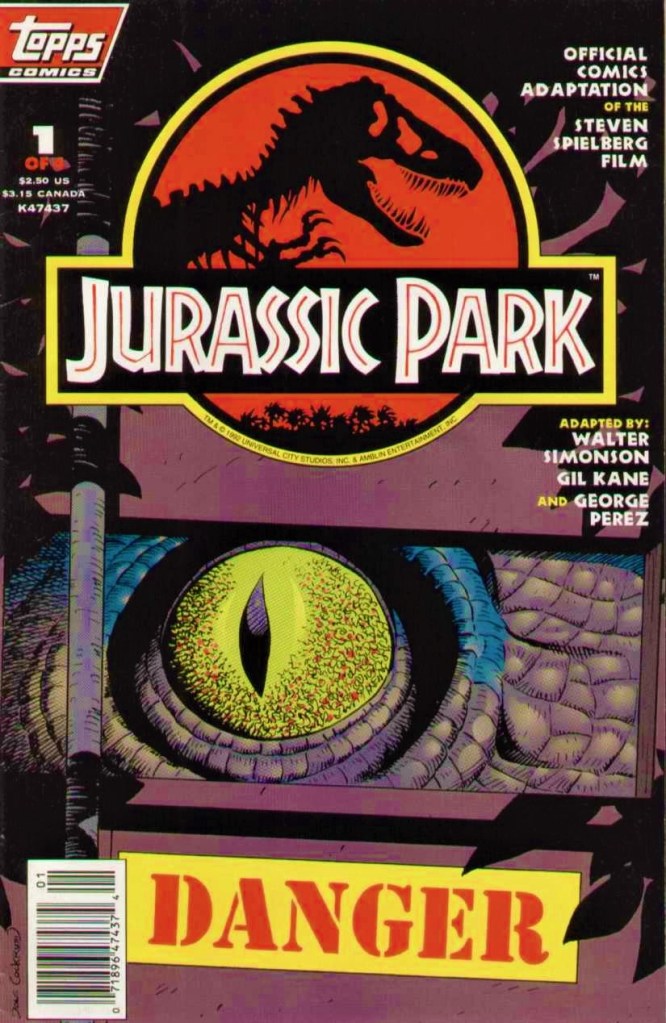
With those details laid down, here is a look back at Jurassic Park , published in 1993 by Topps Comics with a story written by Walter Simonson and drawn by Gil Kane with ink work done by the late George Perez. This comic book was the first of a 4-issue mini-series based on the Spielberg movie.

The cover.

Early story

The story begins at Isla Nublar, an island located over a hundred miles west of the nation of Costa Rica. Uniformed men and heavy equipment operators carefully moved a heavy containment unit that has a dinosaur inside. They are trying to connect the unit into an unusual looking containment facility which has vegetation inside. Their objective was to move the dinosaur into the facility and that includes lifting up the containment unit’s door.

Suddenly, the containment unit shakes as its door opened causing one man (who was responsible for opening the door from the top) falls down. It turns out, the dinosaur inside played a trick on them and it grabbed and pulled the fallen man inside which leads to tragedy.

A short time later, lawyer Gennaro arrives at an amber mind in the Dominican Republic searching for John Hammond for an important matter about a $20 million lawsuit from the family of the injured worker and an insurance company that thinks the accident raises serious safety questions about Jurassic Park.

Over at Montana, Dr. Alan Grant and Ellie Sattler are conducting work at a dig site not knowing that an unexpected visit will happen to them…

Quality

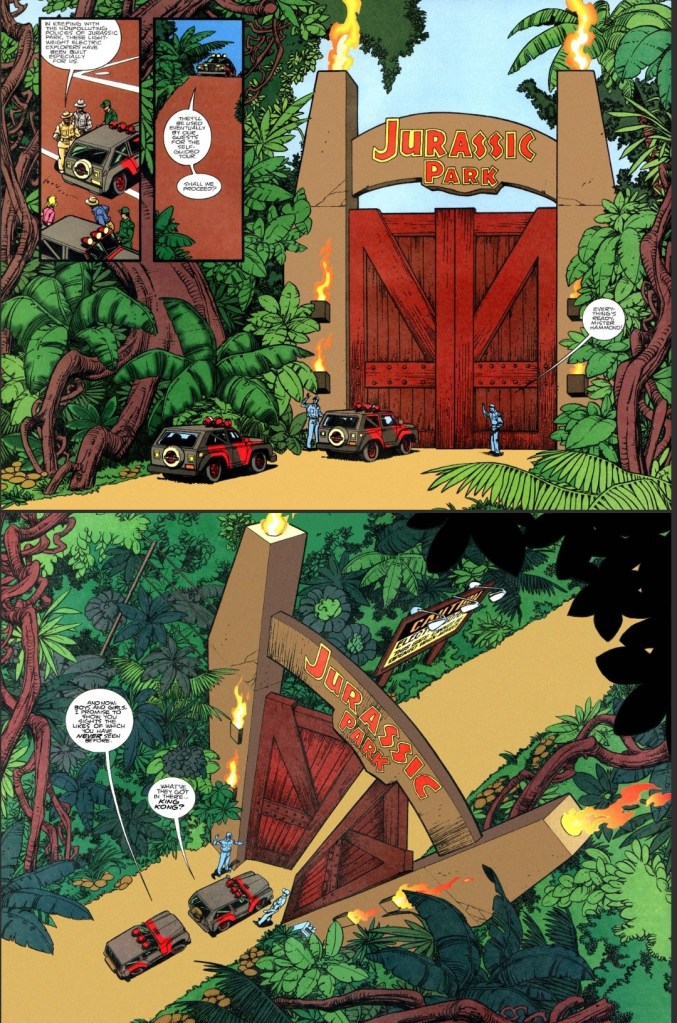
Nothing like entering a large gate going into a theme park.

I will start with what is very obvious about this first issue of the mini-series adapting the events of Steven Spielberg’s movie. This is one very wordy comic book filled with lots of details spilled all over by lots of expository dialogue clearly sourced from the movie. To be clear, this comic book follows the movie’s opening scene until the start of the iconic scene in which Dr. Grant, Ellie and Dr. Ian Malcolm saw the large dinosaur for the first time ever (note: this scene stunned and amazed viewers back then).

As the comic creators really pushed themselves to fill in the key details straight out of the movie most of the time, this comic book lacks spectacle and it is unsurprising that it has very few images of dinosaurs.

Like most comic book adaptations of movies, there were certain cosmetic differences between scenes adapted from the movie such as the traitor Dennis Nedry meeting with Lewis Dodgson in a very urban city street setting (as opposed to the location with lots of trees and vegetation in the film). Also notably different looking was Dr. Grant’s place where he and Ellie first meet John Hammond (in the movie, Dr. Grant’s place looked more lived-in).

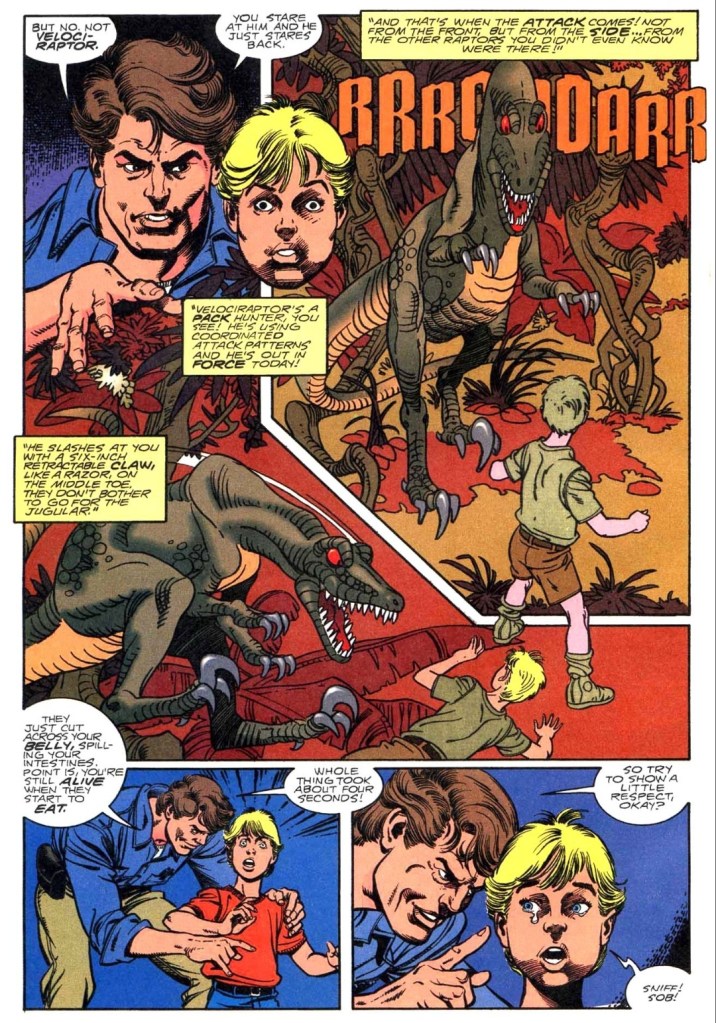
In what looked like the creators’ attempt to emphasize something more than what was shown in the movie, the scene in which Dr. Grant scares a kid by showing what a Velociraptor would do to him was visualized with two panels of a dream sequence.

Gil Kane’s art looks good here but don’t expect to see the characters resembling their cinematic counterparts at all. I can only guess that Topps Comics had no authority to capture the likeness of the actors for this adaptation. Dr. Grant does not look like Sam Neill. Ellie Sattler looks nothing like Laura Dern.  

Conclusion

This is easily the most entertaining and the most intriguing page from the comic book. The comic book creators succeeded in making Dr. Alan Grant scare the kid more convincingly than the movie.

Jurassic Park (1993) is not a fun read due to its heavy load of expository dialogue and explanations of key details. This issue, to say the least, was done mainly to get readers oriented with terms and details in order to help them understand Jurassic Park’s concepts. Due to the exposition and explanations, the storytelling here moved at a slow space which ironically provides readers opportunities to understand Jurassic Park. The way this comic book script was written, there was clearly too little space for entertainment. If you are the brainy type of reader or if you like junk science mixed with real science explained, then this one can still entertain you. When it comes to visuals, Gil Kane’s art made this one attractive and also established this comic book’s own look.

Overall, Jurassic Park (1993) is satisfactory.

+++++

Thank you for reading. If you find this article engaging, please click the like button below and also please consider sharing this article to others. If you are looking for a copywriter to create content for your special project or business, check out my services and my portfolio. Feel free to contact me with a private message. Also please feel free to visit my Facebook page Author Carlo Carrasco and follow me on Twitter at  @HavenorFantasy as well as on Tumblr at https://carlocarrasco.tumblr.com/ and on Instagram at https://www.instagram.com/authorcarlocarrasco/