A Look Back at Prototype #12 (1994)

Disclaimer: This is my original work with details sourced from reading the comic book and doing personal research. Anyone who wants to use this article, in part or in whole, needs to secure first my permission and agree to cite me as the source and author. Let it be known that any unauthorized use of this article will constrain the author to pursue the remedies under R.A. No. 8293, the Revised Penal Code, and/or all applicable legal actions under the laws of the Philippines.

Apart from the in-depth storytelling, spectacle and solid characterization consistently delivered by writers Tom Mason and Len Strazewski for the Prototype monthly series of the Ultraverse, I also enjoyed their implementation of corporate intrigue. In fact, the storytelling in issues #7, #8, #9, #10 and #11 also showed corporate intrigue gradually building up leading to something. Without spoiling the story too much, what happened in issue #11 showed a clear change of direction involving Prototype pilots Jimmy Ruiz and Bob Campbell complete with something brewing at Ultratech.

Will the payoff of the corporate intrigue build-up be realized in the next Prototype issue? We can all find out together in this look back at Prototype #12, published in 1994 by Malibu Comics with a story written by Tom Mason and Len Strazewski, and drawn by Roger Robinson.
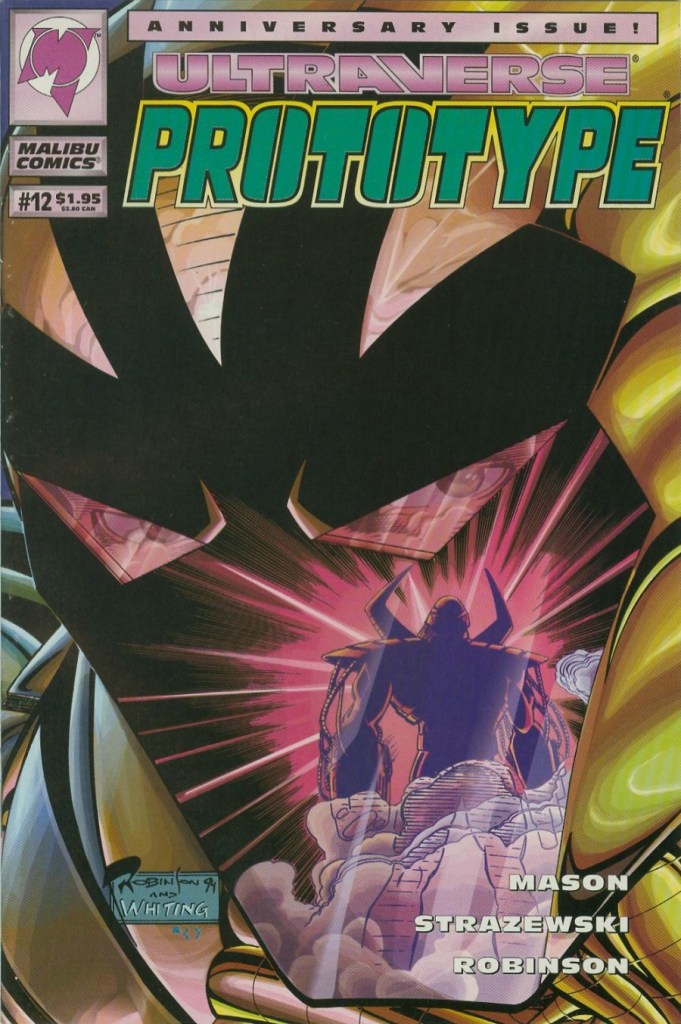
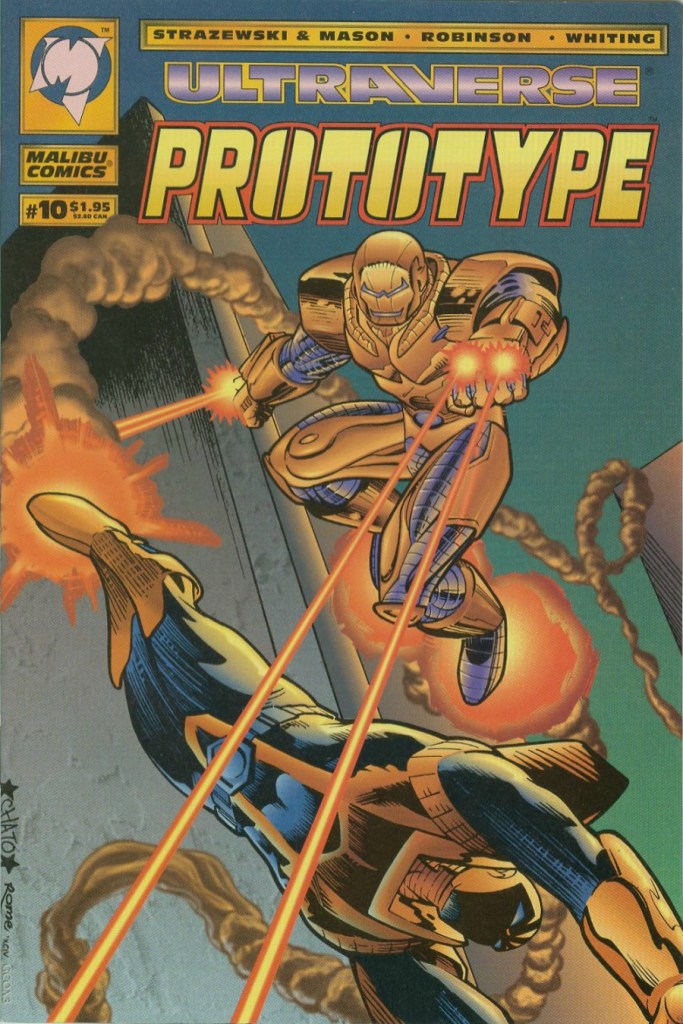
The cover.

Early story

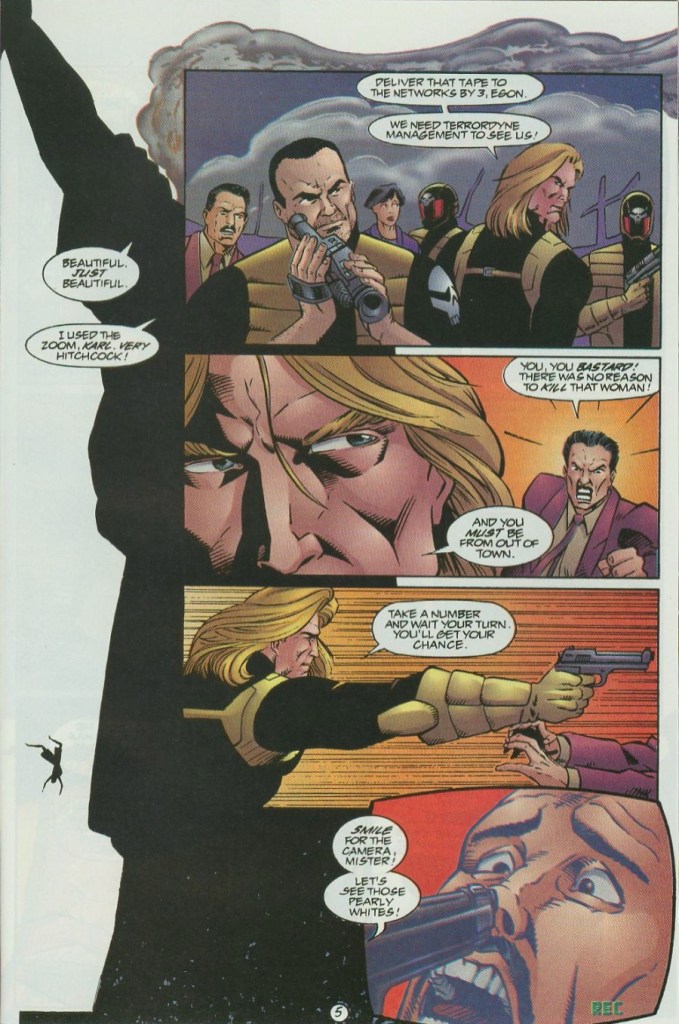
The story begins at the Ultratech tower in New York City. At the lobby, Felicia Campbell gently knocks the guard out with an injection and takes control of the security desk to allow Bob Campbell/Ranger and Jimmy Ruiz/Prototype (wearing a “goofy” outfit) to come in and, together, they move to the basement for a certain need (of Jimmy) – the Prototype armor.

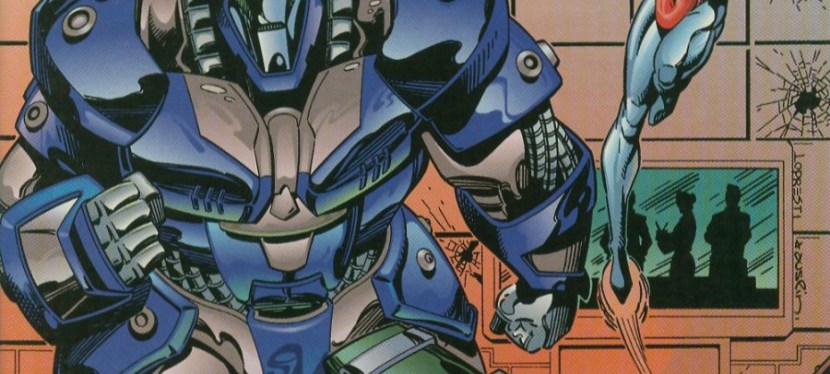
Suddenly Ultratech’s newest hire Prototype Mark III fires a blast at Ranger’s back pushing him down and surprising both Jimmy and Dr. Campbell. The dark-armored Prototype Mark III introduces himself to Jimmy as his replacement and states: Ultratech has somebody man enough to do what it takes!

With Bob Campbell beside him, Jimmy recalls that Prototype Mark III was one of the trainees that his boss Leland often flaunted in front of him. What Jimmy finds hard to believe is that one of the trainees was actually placed into an actual Prototype suit…

Quality

Once again, the creative team delivered the great stuff with storytelling, twists, spectacle and suspense all with a high level of quality. This comic book suggests that careful planning on plotting, characterization and intrigue were done by Tom Mason and Len Strazewski with a good amount of care and timing. As for what I mentioned earlier, I do confirm that the payoff for the corporate intrigue build-up has been realized big time and I should state that this comic book’s ending is very powerful (and also enticing for reading the next issue). This one is a smash hit!
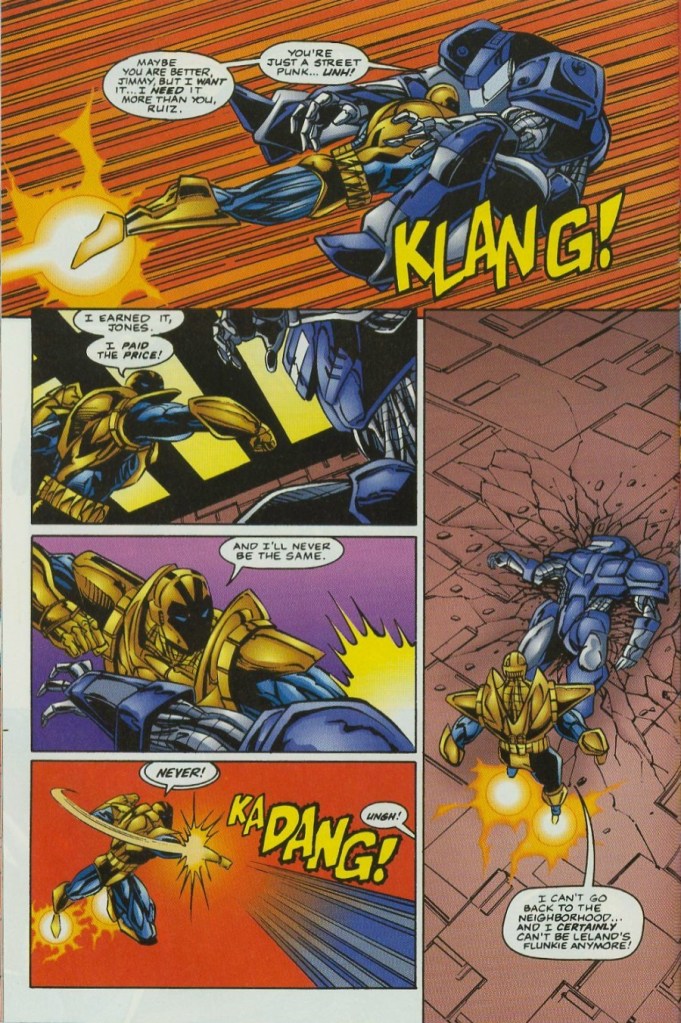
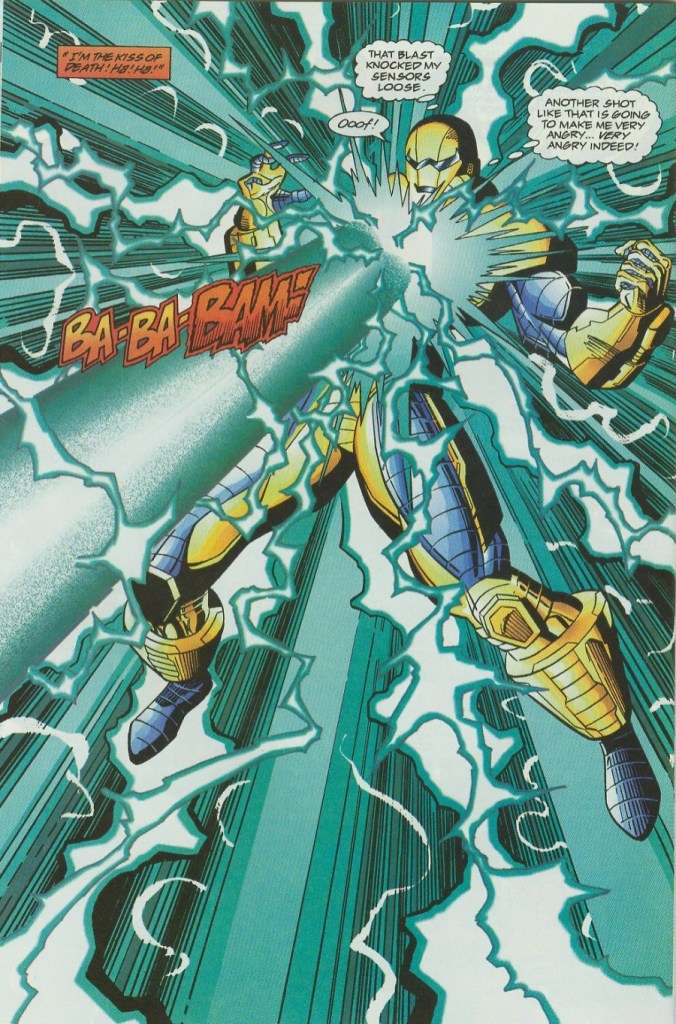
This is only a few of the many action scenes that worked nicely with the in-depth story.

Conclusion

Prototype #12 is indeed great, worthy of serving as the anniversary issue (the two words stated on the cover) and as the climax of the first year of its series. For the most part, the series told events of not one but two Prototype pilots (the current one Jimmy Ruiz and the past one Bob Campbell) who eventually got together just as the series’ direction took a solid turn reflecting the changing interests of Ultratech. This one is definitely one of the best Ultraverse comics published in 1994 and it surely proved that the storytellers were not afraid to take risks or move against conventional storytelling (as far as armored superheroes go). Lastly, this comic book encouraged me to look back at issues #0 and #1.

If you are seriously planning to buy an existing hard copy of Prototype #12 (1994), be aware that as of this writing, MileHighComics.com shows that the near-mint copy of the comic book costs $8.

Overall, Prototype #12 (1994) is highly recommended!

+++++

Thank you for reading. If you find this article engaging, please click the like button below and also please consider sharing this article to others. If you are looking for a copywriter to create content for your special project or business, check out my services and my portfolio. Feel free to contact me as well. Also please feel free to visit my Facebook page Author Carlo Carrasco and follow me at HavenorFantasy@twitter.com
A Look Back at UltraForce #2 (1994)

Disclaimer: This is my original work with details sourced from reading the comic book and doing personal research. Anyone who wants to use this article, in part or in whole, needs to secure first my permission and agree to cite me as the source and author. Let it be known that any unauthorized use of this article will constrain the author to pursue the remedies under R.A. No. 8293, the Revised Penal Code, and/or all applicable legal actions under the laws of the Philippines.

Some time ago, I wrote and explored what would happen had superheroes been real and got involved with government leaders and the corporate media. Considering what has been going on for some time now, I hope that more readers would read the article and realize the conspiracy between political parties and corporate media is real and even dangerous. Did you even notice that in America, the Left-leaning media outlets have been distorting the facts about the riots involving the Marxist movement Black Lives Matter and the violent Antifa group? Also, did you notice that the liberal media distorted the meaning of the words peaceful protesters? Being a former local community print media publication journalist myself, I know why media outlets (whose owners and managers willingly get involved with those who wield power) would distort the news and insult the public’s intelligence. Really, the truth is that objective, truthful, responsible and professional journalism is shrinking.

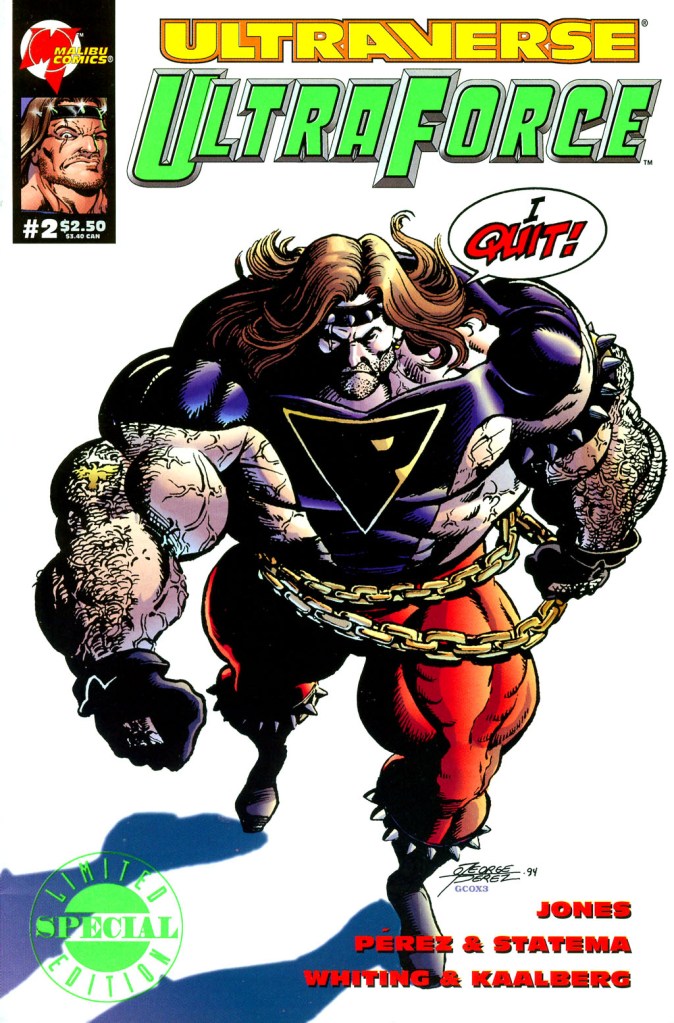
Enough with the sickening news wave of negativity magnified by corporate media. It’s time to examine the superhero-government-media conspiracy followed by a fantastic conflict within the Ultraverse in this look back at UltraForce #2, published in 1994 by Malibu Comics with a story written by Gerard Jones and art by George Perez (breakdowns) and John Statema (finished pencils).  

The cover of the limited edition.

Early story

The story begins with UltraForce member Ghoul visiting a place within the woods. He stops at a huge grave site of the Exiles and tries to communicate with his former teammates but to no avail. He only got glimmers from them. After expressing himself to nobody, he walks away.

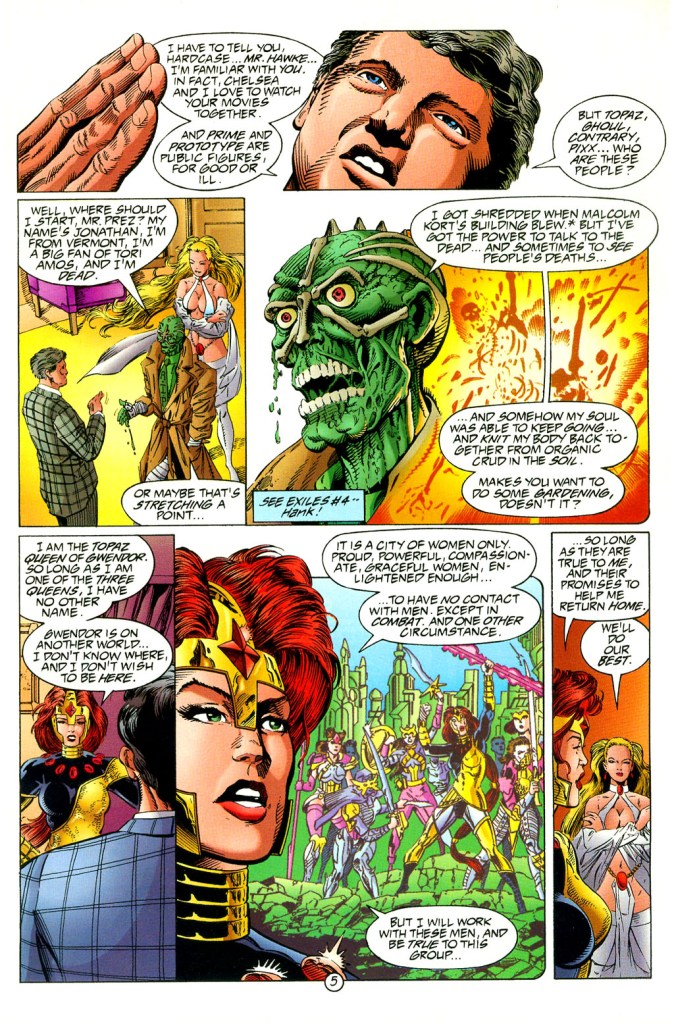
Shortly after, UltraForce composed of Hardcase, Prime, Prototype, Ghoul, Pixx, Contrary and Topaz meet with US President Bill Clinton, US Senator Bob Dole, UN’s secretary general Boutros-Ghali and Blackrock of the press in the Oval Office at the White House in Washington, DC. As they discuss important matters together, Atalon makes his move against the civilized world…

Quality

The interactions between the members of UltraForce are richly written.

To start with, this comic book is a build-up type of story containing lots dialogue, exposition and explanatory pieces with not too much spectacle. That’s not to say this is a boring issue, in fact it still remained quite engaging to read. The very wordy script for this comic book was written with care and there were efforts made to keep the story cohesive even as it grapples with all the details for explaining. What the writer presented not only explained what is happening and why the world is being threatened by Atalon and his forces from underneath, the script also took its time in presenting the characters struggling with each other’s views while providing key moments that add some development to the personality of some of the characters (example: Prime’s interest in Chelsea Clinton reflected not only his teenage self but also his first encounter with her during the Prime monthly series). As far as storytelling goes, it succeeded in helping me understand the huge event transpiring and justified why UltraForce as a team is needed. When you think about it, Prime, Hardcase and Prototype already have major affairs of their own (especially when you read their respective monthly series) but Atalon is a major threat that requires the three to work together (along with Pixx, Ghoul, Topaz and the ever scheming Contrary).

More on the conspiracy between the superheroes, the government leaders and the corporate press, this comic book is more relevant than ever today even though superheroes do not even exist in real life. I like the moments when Contrary wanted access to government files which drew a strong reaction from Bill Clinton who in turn is being watched carefully by opposition leader Bob Dole. For his part, Hardcase expressed that his team does not want any power struggle between ultras and the government. And then Bob Dole stressed to Prototype that he works for Ultratech and said: I take it that you are a defender of the rights of the private sector?

Of course, the highlight of the writing is the dynamic interactions between the UltraForce members when they are on their own and struggle to work together due to their respective differences. The dialogue is very rich.

When it comes to visuals, this one is rather unique because it has breakdowns by the legendary George Perez with finished pencil work by John Statema. It’s not a pure Perez art work which is obvious but still I recognized the characters and there is still a high level of visual detail all throughout. Still a solid looking comic book!

Conclusion

This is a clever way of doing exposition…Bill Clinton learns more about Topaz and Ghoul but only the readers get a visual presentation.

Never mind the fact that it lacked spectacle, UltraForce #2 is still compelling to read mainly due to its strong writing, the memorable interactions between the characters and emphasis of the crisis that justifies the presence of the team complete with impact on the world. Not only that, this comic book event went the extra mile to emphasize crossing-over within the Ultraverse by including The Strangers (check out The Strangers #4 and Hardcase #4 for reference).

If you are seriously planning to buy an existing hard copy of UltraForce #2 (1994), be aware that as of this writing, MileHighComics.com shows that the near-mint copy of the regular edition costs $8 while the near-mint copy of the limited edition costs $12.

Overall, UltraForce #2 (1994) is highly recommended!

+++++

Thank you for reading. If you find this article engaging, please click the like button below and also please consider sharing this article to others. If you are looking for a copywriter to create content for your special project or business, check out my services and my portfolio. Feel free to contact me as well. Also please feel free to visit my Facebook page Author Carlo Carrasco and follow me at HavenorFantasy@twitter.com
A Look Back at Batman versus Predator II #2 (1995)

Disclaimer: This is my original work with details sourced from reading the comic book and doing personal research. Anyone who wants to use this article, in part or in whole, needs to secure first my permission and agree to cite me as the source and author. Let it be known that any unauthorized use of this article will constrain the author to pursue the remedies under R.A. No. 8293, the Revised Penal Code, and/or all applicable legal actions under the laws of the Philippines.

When done right with the comic book format, fantasy crossover concepts can become very entertaining and memorable. Such was the case with the comic book Batman versus Predator II: Bloodmatch #1 which I enjoyed reading a lot.

Now we can find out if the creative team behind that memorable comic book could maintain the high quality of fun and engagement in this look back at Batman versus Predator II #2, published in 1995 by DC Comics and Dark Horse Comics with a story written by Doug Moench and drawn by Paul Gulacy.

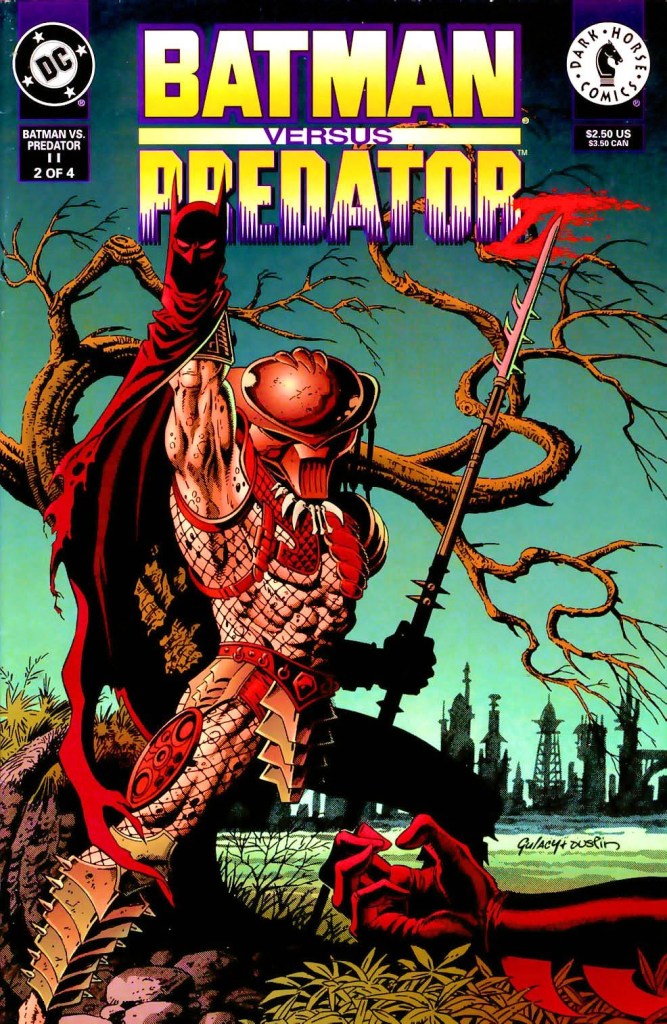
The cover.

Early story

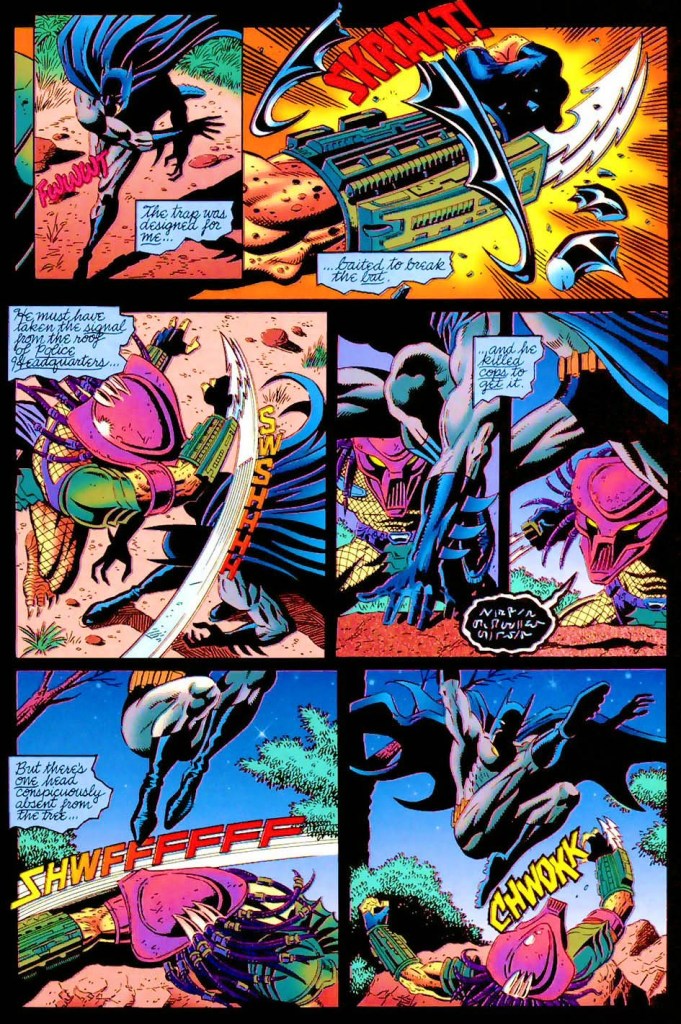
The story begins in the forest outside of Gotham City. A fake use of the Batman signal was lighted there by the Predator which was meant to lure Batman into a potential trap. As soon as he arrived, Batman believes that his old ally commissioner James Gordon bought a portable Batman signal meant to call him to a crime scene far away from the urbanized areas.

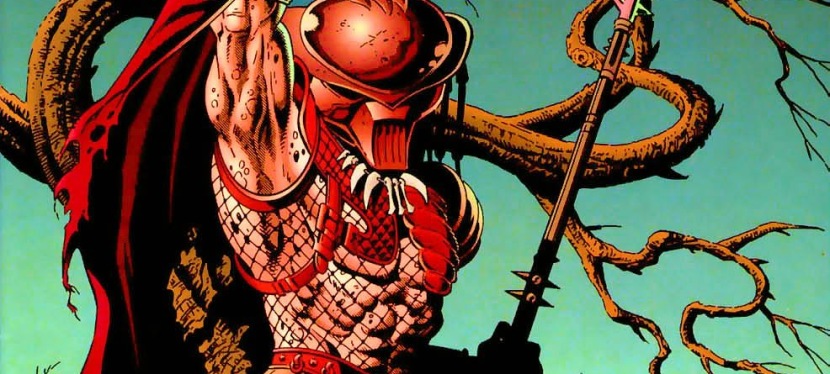
Expecting to see Gordon in the woods, Batman sees a tree with several men’s heads hanging each with a net. He realizes that the Predator lured him into what he calls the hunting ground. Batman is correct as the Predator, standing nearby, unleashes a weapon to attack him…

Quality

This one really looked out of place in this comic book.

A pretty good crossover comic book. When it comes to storytelling, the comic book starts paying off the anticipation built up in issue #1 by presenting Batman in an early encounter with the Predator which, I must say, was smartly handled complete with key references to the previous Batman versus Predator crossover series from the early 1990s. What happened in the said encounter between the two pop culture icons will make you reflect about what you know about Batman and the Predator. Given how the story turned out, clearly the encounter (which was quite beefy) served as a sign of what is more to come between Batman and the Predator (or the race of Predators). The Huntress meanwhile has a slightly reduced spotlight which is not surprising but she still proved her worth in the conflict. When it comes to presenting the respective views of Batman and the Huntress, I admire the use of narration boxes (instead of the traditional thought balloons) which added depth to the story.

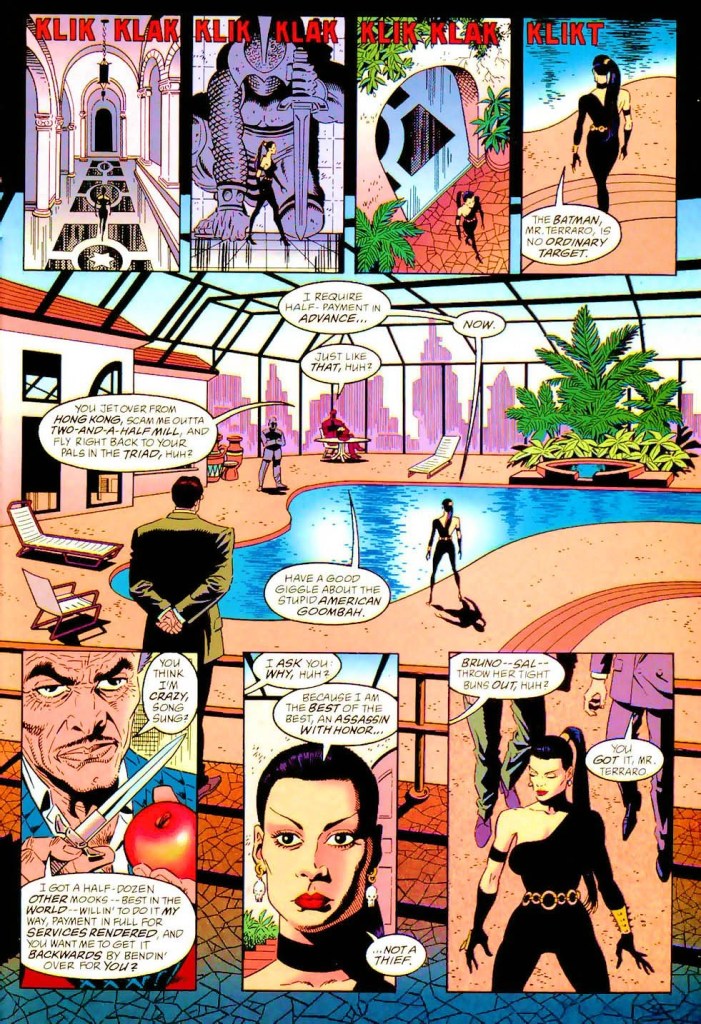
Meanwhile, there is a subplot about an assassin from Asia who came all the way to America for a key transaction. However, this subplot (which does not even look like it’s related to the Batman-Predator conflict) ended up looking like filler.  

Conclusion

An action-packed encounter between the Dark Knight and the warrior from outer space!

Batman versus Predator II #2 (1995) is almost as good as issue #1 but its first, action-packed encounter between the Dark Knight and the warrior from outer space alone makes it worth collecting.

If you are seriously planning to buy an existing hard copy of Batman versus Predator II #2 (1995), be aware that as of this writing, MileHighComics.com shows that the near-mint copy costs $30.

Overall, Batman versus Predator II #2 (1995) is recommended.

+++++

Thank you for reading. If you find this article engaging, please click the like button below and also please consider sharing this article to others. If you are looking for a copywriter to create content for your special project or business, check out my services and my portfolio. Feel free to contact me as well. Also please feel free to visit my Facebook page Author Carlo Carrasco and follow me at HavenorFantasy@twitter.com

A Look Back at Prototype #11 (1994)

Disclaimer: This is my original work with details sourced from reading the comic book and doing personal research. Anyone who wants to use this article, in part or in whole, needs to secure first my permission and agree to cite me as the source and author. Let it be known that any unauthorized use of this article will constrain the author to pursue the remedies under R.A. No. 8293, the Revised Penal Code, and/or all applicable legal actions under the laws of the Philippines.

Hey fellow superhero comic book geeks and Ultraverse fans! Welcome back to my continuing retrospective of the Ultraverse through the Prototype series of comic books published by Malibu Comics. Last time around, Jimmy Ruiz (Prototype) was not prominent as the comic book focused more on Ranger (the previous Prototype piloy Bob Campbell actually) who took on a group of terrorists with some help.

As such, we can see what happens next with this look back at Prototype #11, published in 1994 by Malibu Comics with a story by Tom Mason and Len Strazewski and art by Roger Robinson.

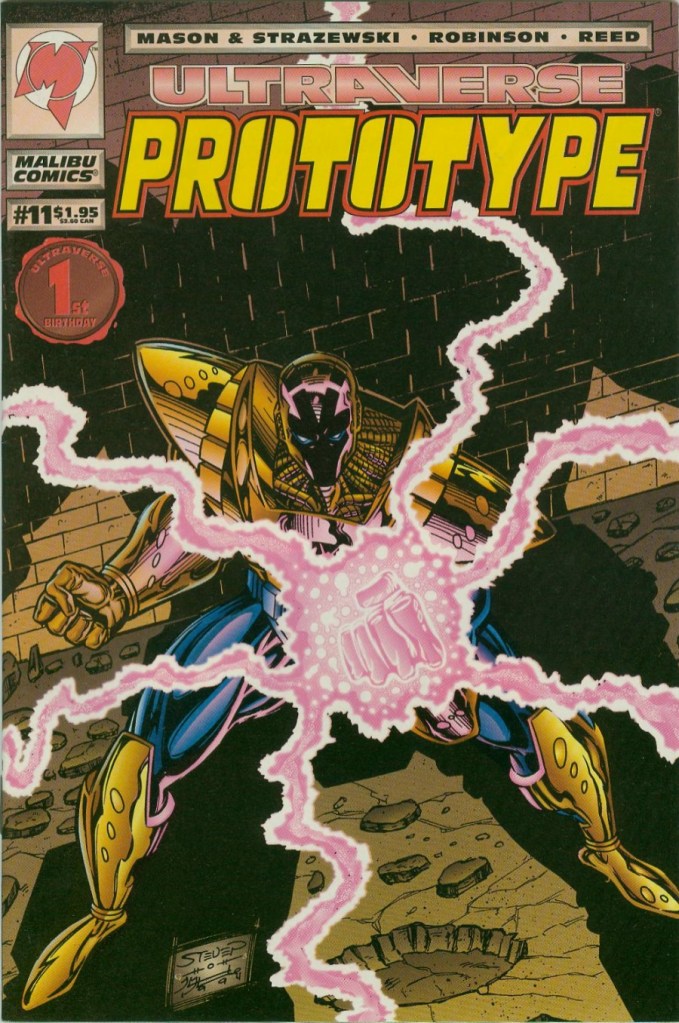
The cover.

Early story

The story begins with Glare, an old nemesis of Prototype. As it turns out, he was revived by some scientists in a high-tech facility of the sinister group Aladdin. The green-skinned Glare breaks free from the restraints and starts causing some damage. He is driven by revenge against Stanley Leland, Ultratech and Ranger (Bob Campbell).

Meanwhile on the street of New York, Jimmy Ruiz (Prototype) and Bob Campbell are together. Jimmy, who is not even using the powered suit of armor, released a lot of energy while floating off the surface causing a major public disturbance. Afterwards, Bob decides to help his Prototype successor…

Quality

Bob Campbel in his Ranger powered suit of armor.

Let me start by confirming that the storytelling is very good. In fact, the high quality of writing was maintained and judging from the presentation of having Jimmy Ruiz and Bob Campbell together in a full issue (note: they got together only in the late stages of issue #10), it seems that Tom Mason and Len Strazewski had things planned out in an organized fashion. The result is having the two Prototype pilots not only together but getting involved (in a pretty believable way) in response to a rising danger. To make things clearer, this is NOT the anticipated superheroes-set-aside-their-differences-to-work-together-to-solve-the-problem type of story.

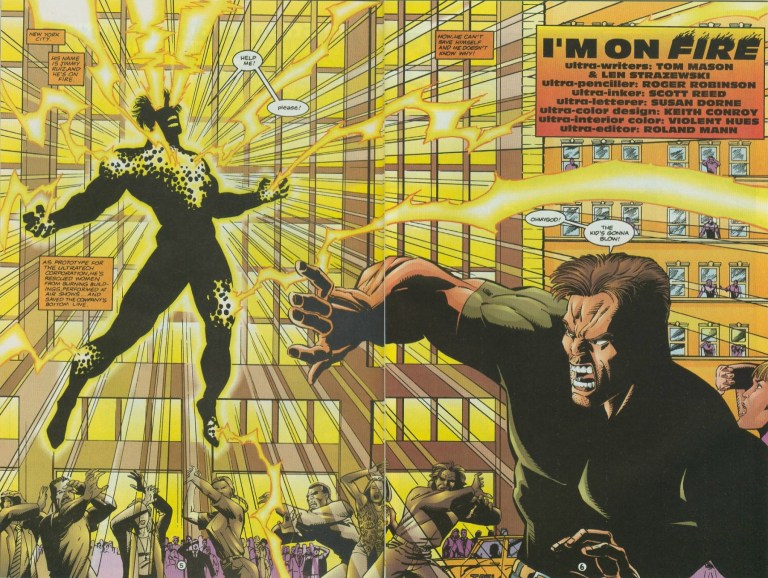
Bob Campbell still got plenty of the spotlight as Ranger and his battle with Glare is a lot of fun to read. Jimmy Ruiz meanwhile is developed even further. I also like the scenes that emphasized the difference between being an ultra and a tool of Ultratech which affects Jimmy.

Conclusion

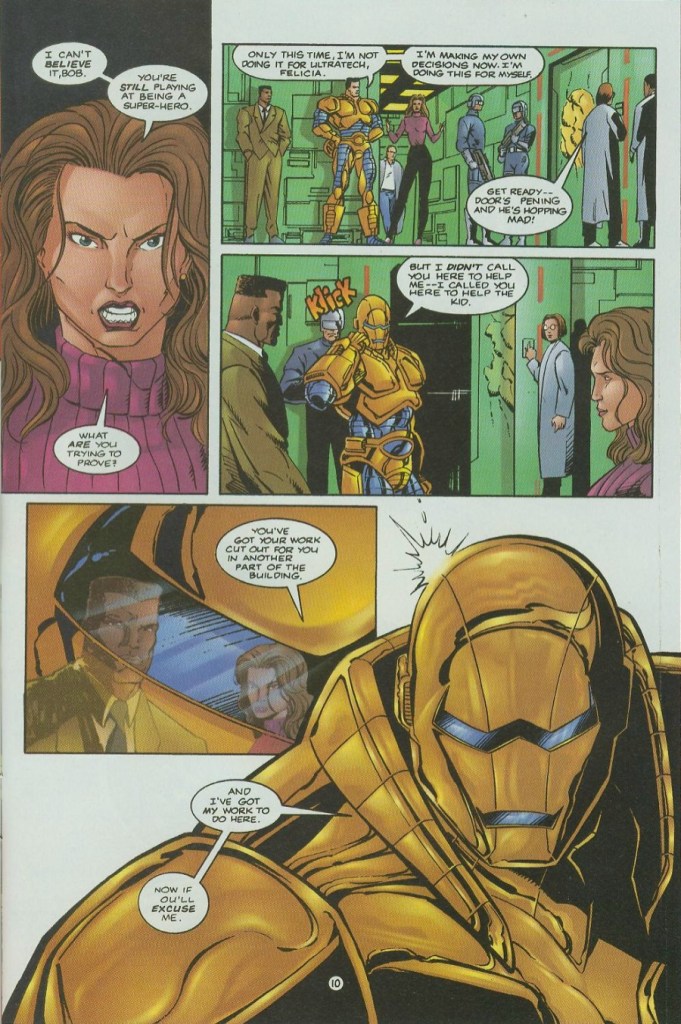
Jimmy Ruiz and Bob Campbell together.

Prototype #11 is another enjoyable and compelling Ultraverse comic book to read. Its own story is indeed special and worthy of being an Ultraverse 1st birthday issue (as marked on the cover). Clearly this comic book marked a bold new direction of storytelling just as the two Prototype pilots are finally together.

If you are seriously planning to buy an existing hard copy of Prototype #11 (1994), be aware that as of this writing, MileHighComics.com shows that the near-mint copy of the comic book costs $8.

Overall, Prototype #11 (1994) is highly recommended!

+++++

Thank you for reading. If you find this article engaging, please click the like button below and also please consider sharing this article to others. If you are looking for a copywriter to create content for your special project or business, check out my services and my portfolio. Feel free to contact me as well. Also please feel free to visit my Facebook page Author Carlo Carrasco and follow me at HavenorFantasy@twitter.com
A Look Back at SOS (SNES)

Disclaimer: This is my original work with details sourced from playing the video game and doing personal research. Anyone who wants to use this article, in part or in whole, needs to secure first my permission and agree to cite me as the source and author. Let it be known that any unauthorized use of this article will constrain the author to pursue the remedies under R.A. No. 8293, the Revised Penal Code, and/or all applicable legal actions under the laws of the Philippines.

Back in the 1990s when cable TV was not yet popular in the local community I lived in here in the Philippines, I got to watch on free TV a late night showing of the old movie The Poseidon Adventure. That movie, which included Gene Hackman and other stars, was about a huge passenger ship that got capsized as a result of a huge wave that hit it so hard. The survivors in that film had no choice but to band together and find their way out through countless obstacles.

That creative concept was reused by game developer Human Entertainment for a video game I played on the Super NES (SNES) a few years later…SOS (titled in Japan as Septentrion).

Released for the SNES in 1994 by Vic Tokai, SOS was an adventure game that had players take on the role of one of four characters (each with a different story plus different endings) who must escape the ship within sixty minutes in real-time. Along the way, the player must avoid obstacles, get to the hard-to-reach places and escape the ship before time runs out.

How good or bad the game is, you can find out in this look back at SOS.

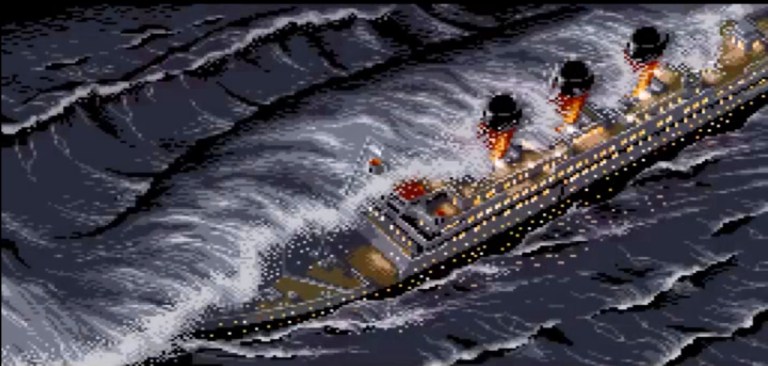
The misadventure begins on the Lady Crithania with the disaster.

Early story

The story begins in the luxury passenger ship called Lady Crithania. Depending on which character you choose, Capris is an architect who has a sick sister; Luke is a crew member of the ship whose superiors don’t take his warnings about harsh sea conditions seriously; Jeffrey is a doctor who is traveling with his wife and Redwin is a counselor who is traveling with a family.

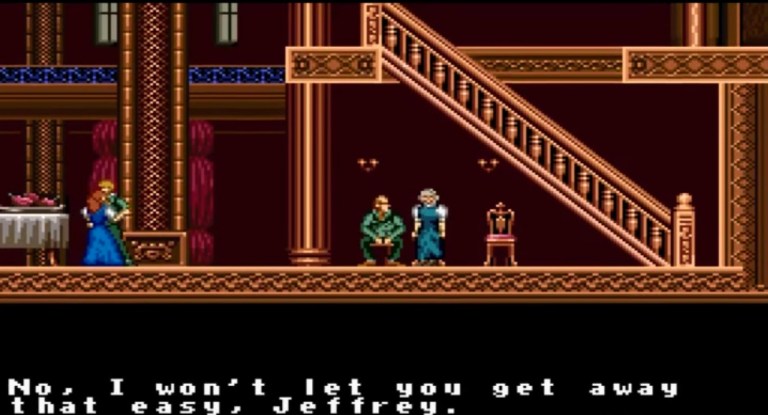
A cut scene emphasizing the story of one of the characters.
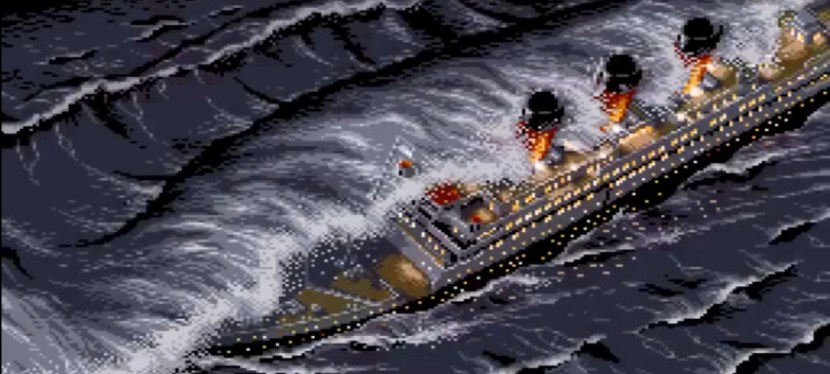
This is what the ship looks like after the disaster. At this point, the struggle for survival truly begins.

Regardless of which character was selected, a massive wave hits the Lady Crithania so hard it got capsized. The interiors suddenly turned upside down causing lots of damage and deaths. The protagonist is challenged with the chaotic interiors, obstacles, interacting with some survivors and reach the boiler room to survive.

Gameplay and Quality

As it is a 2-dimensional (2D) game, SOS is a side-scrolling adventure with some platform gaming elements mixed in. You can have your character move and jump most of the time with the occasional action of helping passengers (by means of reaching) travel with you (with some commands to communicate with them). While the design made sense, playing SOS always turned out to be a tiring chore and a test of patience due to the lack of precision when it comes to control response.

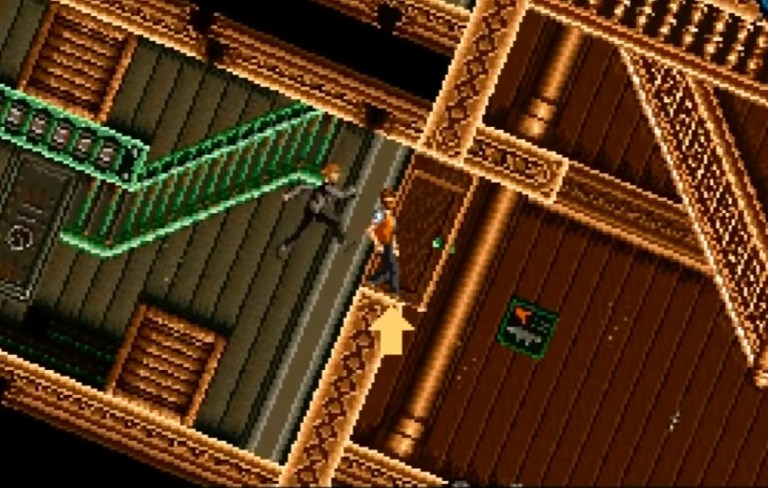
Adding further to challenge is the occasional shift of the capsized shift which changes the angles of the interiors which instantly alters the difficulty on moving around and jumping to the essential platforms (to progress to the next place). The shifting was visually done using the SNES’ Mode 7 feature. For the newcomers reading this, Mode 7 is the graphics mode unique to the SNES which enables scaling and rotating of the background image. While the sprites and 2D art in this game lacked punch, it is the Mode 7 feature that really added some quality to SOS’ visuals temporarily.

The more survivors you help and take with you to the very end, the better the ending will be.
You can also swim through flood sections.

More on the difficulty, the artificial intelligence (AI) programmed for the survivors that you can choose to rescue is pretty low which leads to a lack of response whenever your character calls them to follow you to get to the next level and survive. Not only were there times the other characters did not respond, some got even stuck in tight places.

As this game has 1-hour countdown in real time, making a mistake is costly. For example, you jump but fail to reach a crucial platform and fall down into the abyss and die will lead to your character respawning but with a noticeable amount of time reduced. Considering the lack of precision on controls and other factors, this made SOS challenging and frustrating to play.

If only the other survivors were more responsive to your calls…

And then there is the challenge to get the best possible ending you could by means of rescuing as many other survivors as you could and reach the very end with them. To put it this way, if you decide to be completely self-centered, disregard all the other survivors and make your way to the end without them, will result a really bad ending. You rescue more and make it alive with them, then the ending will get better.

Conclusion

If you fall and die, your character will respawn but with an amount of time reduced.

SOS has a very nice concept of adventuring that focuses mainly on survival and involves no combat and certainly no clear enemies to encounter. It is just too bad that the flaws of this game made it more frustrating to play and very few people will actually get to enjoy it.

If you own a working SNES and you are thinking about buying an existing copy of SOS, I do not recommend buying it with your precious money. Better rent it instead.

+++++

Thank you for reading. If you find this article engaging, please click the like button below and also please consider sharing this article to others. If you are looking for a copywriter to create content for your special project or business, check out my services and my portfolio. Feel free to contact me as well. Also please feel free to visit my Facebook page Author Carlo Carrasco and follow me at HavenorFantasy@twitter.com
A Look Back at RoboCop versus The Terminator #3 (1992)

Disclaimer: This is my original work with details sourced from reading the comic book and doing personal research. Anyone who wants to use this article, in part or in whole, needs to secure first my permission and agree to cite me as the source and author. Let it be known that any unauthorized use of this article will constrain the author to pursue the remedies under R.A. No. 8293, the Revised Penal Code, and/or all applicable legal actions under the laws of the Philippines.

Hey everyone! It’s time to go back to the comic book crossover featuring two metallic titans, The Terminator and RoboCop! I have already reviewed two issues of the 4-issue mini-series published by Dark Horse Comics and so far, it’s been a mixed ride. Issue #1 was pretty much a huge build-up that led to a nice pay-off in issue #2. Considering what happened at the end of the last issue, I got hooked with wanting to see what follows next.

As such, here is my look back at RoboCop versus The Terminator #3, published in 1992 by Dark Horse Comics with a story written by Frank Miller and drawn by Walt Simonson.

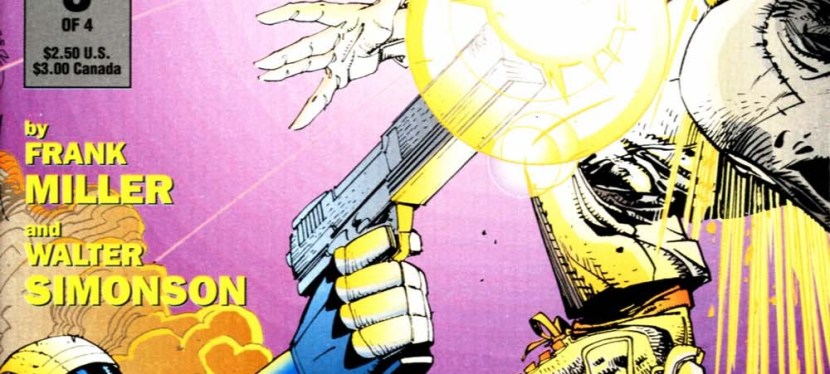
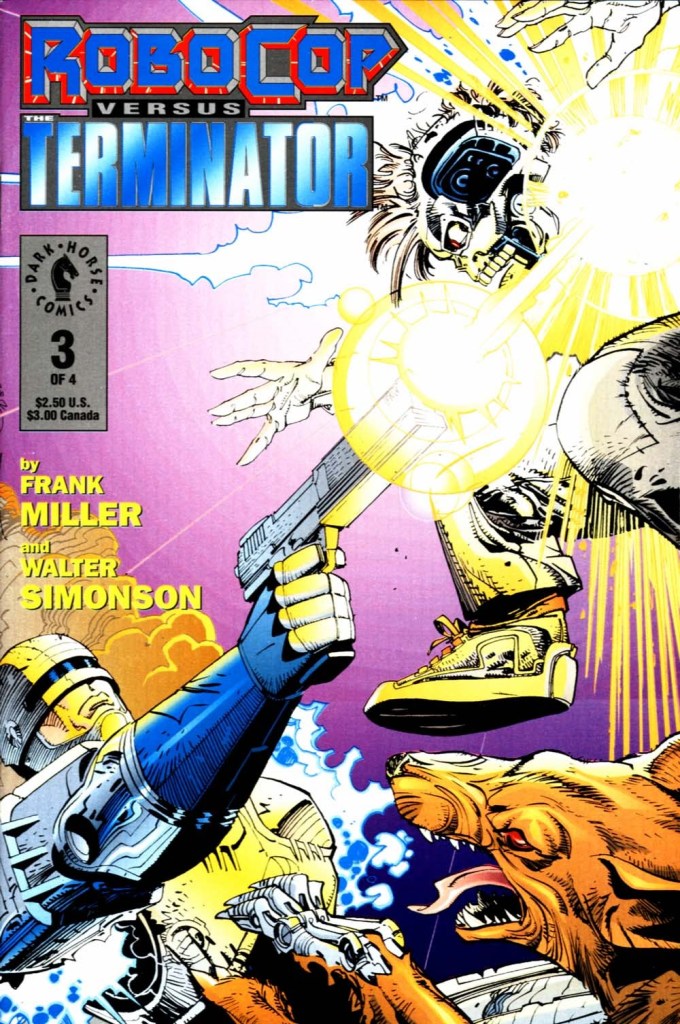
The cover.

Early story

The story begins in the far future in with planet Earth already saved but at the expense of humanity. The human race not only got crushed but also flattened, processed and converted into energy to fuel the Terminators. While things look certain and final for machines and man in the far future, a universe is about to organize.

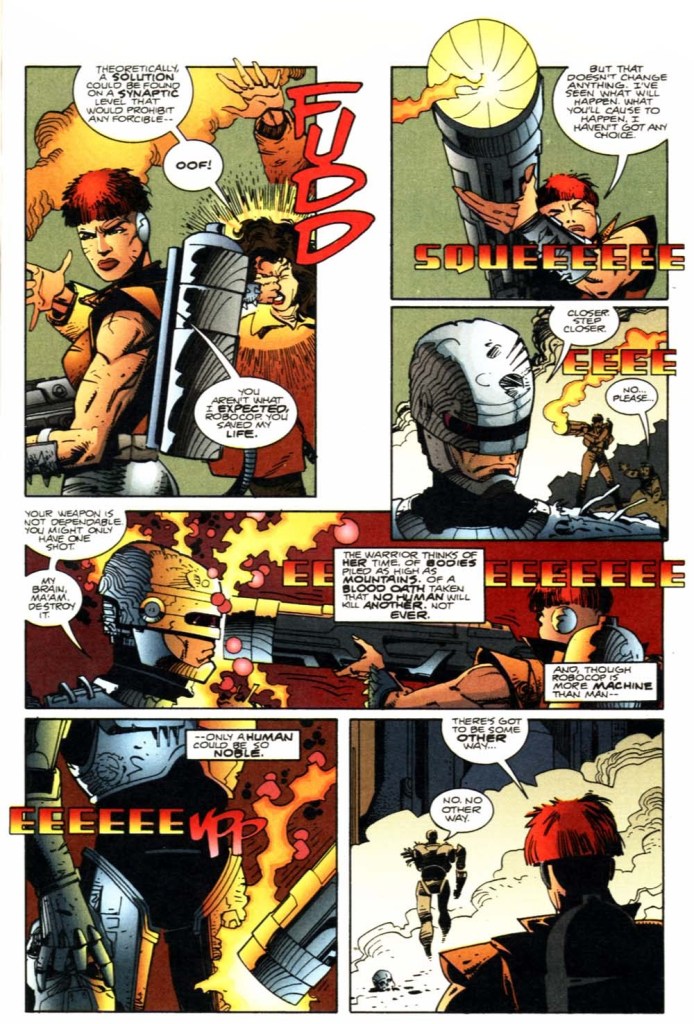
Back in the present day, RoboCop just defeated the Terminator in a high-octane battle that caused a whole lot of damage. The lady from the far future asked RoboCop if he understood what has happened and if he finally believes she told the truth. Realizing the truth, RoboCop allows her to come close and try to blast him with her huge weapon. The attempt failed and RoboCop walks away.

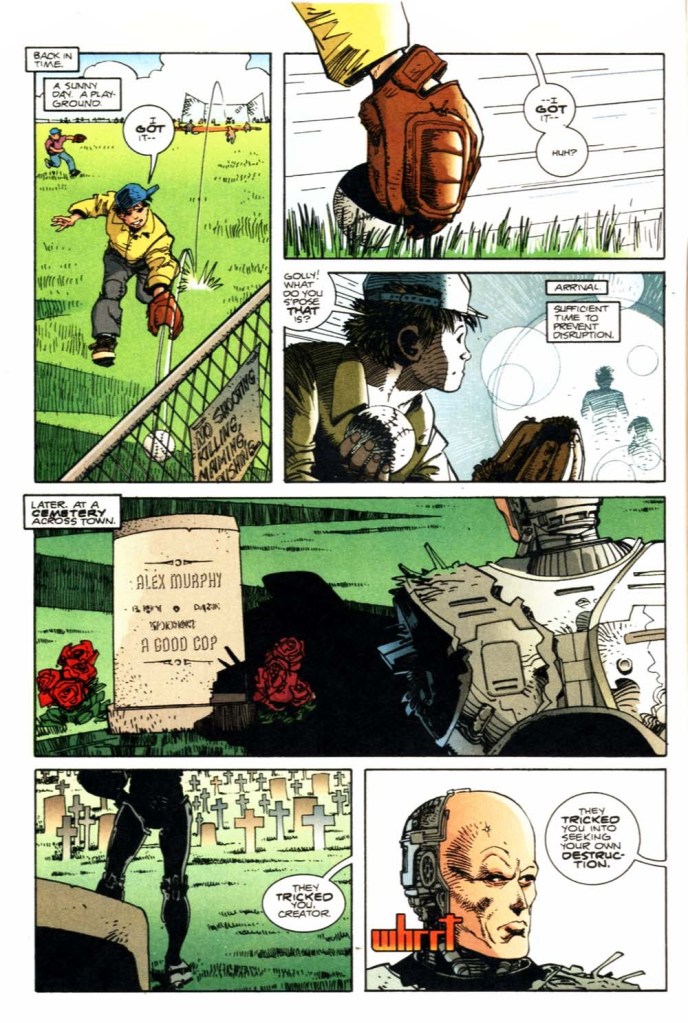
RoboCop visits the cemetery and spends time at his grave that states his name: Alex Murphy. After some deep reflection, RoboCop recalls his vision of the far future. This prompts him to take the most drastic action he could think of…

Quality

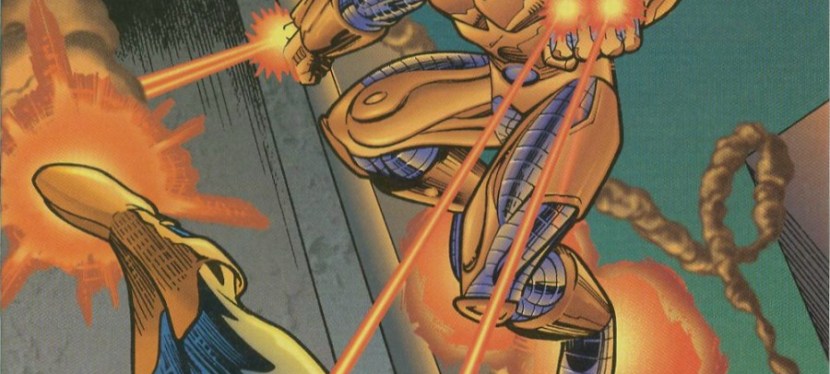
Something suspenseful…

Considering how the story turned out in the first two issues, it was no surprise that some drastic twists had to be taken to not only continue the combined universes of RoboCop and the Terminator, but also keep things fresh. The good news here is that Frank Miller’s writing is pretty good and he successfully kept the story cohesive even though drastic twists were made.

At the very core of the story is the theme about RoboCop being acknowledged as the creator of Skynet and the Terminators. As a police officer, RoboCop’s duty is to protect the innocent and uphold the law for the good of his local society, and yet for as long as he exists, so will Skynet and the Terminators of the far future. How Frank Miller fused key elements of RoboCop’s mythos with those of the Terminator franchise was pretty clever and believable from a fantasy viewpoint.

When it comes to weak points, I should say that Walt Simonson’s are here is not great although he does a descent job with drawing RoboCop. Simonson’s visual take on the Terminators has that cartoony look which is alienating.

Conclusion

It sure is hard to make the moves to drastically alter the future for the good of humanity.

RoboCop versus The Terminator #3 is a successfully told chapter in its 4-issue mini-series. It falls short of the greatness of issue #2 but it still proved to be fun and compelling to read. By the time the comic book ended, the stakes were raised for the next issue which I look forward to read.

If you are seriously planning to buy an existing hard copy of RoboCop versus The Terminator #3 (1992), be aware that as of this writing, MileHighComics.com shows that the near-mint copy costs $15.

Overall, RoboCop versus The Terminator #3 (1992) is recommended.

+++++

Thank you for reading. If you find this article engaging, please click the like button below and also please consider sharing this article to others. If you are looking for a copywriter to create content for your special project or business, check out my services and my portfolio. Feel free to contact me as well. Also please feel free to visit my Facebook page Author Carlo Carrasco and follow me at HavenorFantasy@twitter.com
A Look Back at Prototype #10 (1994)

Disclaimer: This is my original work with details sourced from reading the comic book and doing personal research. Anyone who wants to use this article, in part or in whole, needs to secure first my permission and agree to cite me as the source and author. Let it be known that any unauthorized use of this article will constrain the author to pursue the remedies under R.A. No. 8293, the Revised Penal Code, and/or all applicable legal actions under the laws of the Philippines.

Without spoiling the story, the ending of Prototype #9 (1994) proved to be enticing for me to continue reading what happens next. As such, I went on to read the next issue.

Once again, we take another journey back into the Ultraverse in this look back at the comic book Prototype #10, published in 1994 by Malibu Comics with a story by Tom Mason and Len Strazewski, drawn by Roger Robinson.

The cover.

Early story

The story begins at the top of the Statue of Liberty in New York where a police helicopter flies and its personnel see a few people hanged. Suddenly the head of the Statue of Liberty blew up which turned out to be the act of a terrorist group called Terrordyne. Terrorydyne’s leader Karl is determined to cause chaos and let the mainstream news media magnify their message of fear. By occupying the Statue of Liberty, the terrorists insists that it will down anything that violates their so-called airpace and territorial waters.

Meanwhile, news about Prototype’s (Jimmy Ruiz specifically) departure from Ultratech reaches previous Prototype pilot Bob Campbell. As a result, the city of New York does not have a full-time ultra of its own. Bob makes a move to take centerstage with his armor (Ranger).

Over at the headquarters of Ultratech, top executive Leland talks with Donovan, the new Prototype…

Quality

No surprise, the quality of the writing done by Len Strazewski and Tom Mason is pretty high but the big difference is that the spotlight was focused more on former Prototype pilot Bob Campbell (who was absent from the last issue) and the corporate sector with the terrorist act compelling them respectively.

While issue #9 was mostly about Jimmy Ruiz and his personal development while returning to his old community, this comic book brings back the spectacle (lots of action-packed scenes here) and the corporate intrigue big time! Bob Campbell is clearly the protagonist in this story and what he does here will make you interested to learn about his history as the previous Prototype pilot when he was still the one valuable employee of Ultratech.

While the story is enjoyable, I should say that terrorist leader Karl is pretty hollow as the villain and there is nothing interesting in him.

Bob Campbell as Ranger!

Conclusion

Do not let the nice cover fool you. Prototype #10 is an enjoyable read and the way its presentation was handled, it showed signs that careful planning was made by the creative team as the comic book (focused more on Bob Campbell and the corporations) served nicely as a companion piece to issue #9 which was more focused on Jimmy Ruiz.

If you are seriously planning to buy an existing hard copy of Prototype #10 (1994), be aware that as of this writing, MileHighComics.com shows that the near-mint copy of the regular edition costs $8 while the near-mint copy of the newsstand edition costs $26.

Overall, Prototype #10 (1994) is recommended.

The terrorists.

+++++

Thank you for reading. If you find this article engaging, please click the like button below and also please consider sharing this article to others. If you are looking for a copywriter to create content for your special project or business, check out my services and my portfolio. Feel free to contact me as well. Also please feel free to visit my Facebook page Author Carlo Carrasco and follow me at HavenorFantasy@twitter.com
A Look Back at Prototype #9 (1994)

Disclaimer: This is my original work with details sourced from reading the comic book and doing personal research. Anyone who wants to use this article, in part or in whole, needs to secure first my permission and agree to cite me as the source and author. Let it be known that any unauthorized use of this article will constrain the author to pursue the remedies under R.A. No. 8293, the Revised Penal Code, and/or all applicable legal actions under the laws of the Philippines.

Hey comic book fans and geeks! Do you enjoy reading comic books about armored superheroes that are not connected with Marvel’s Iron Man? The Ultraverse has an armored figure in Prototype but the big difference is that the said character is owned by a large corporation called Ultratech which in turns hired a young man named Jimmy Ruiz to pilot it. Oh yes, Jimmy Ruiz is actually the second person hired to pilot Prototype as his predecessor Bob Campbell was let go with one arm less.

Let’s revisit the Ultraverse by taking a look back at Prototype #9, published in 1994 by Malibu Comics with a story by Len Strazewski and Tom Mason with art done by Roger Robinson and Jeff Whiting.

The cover.

Early story

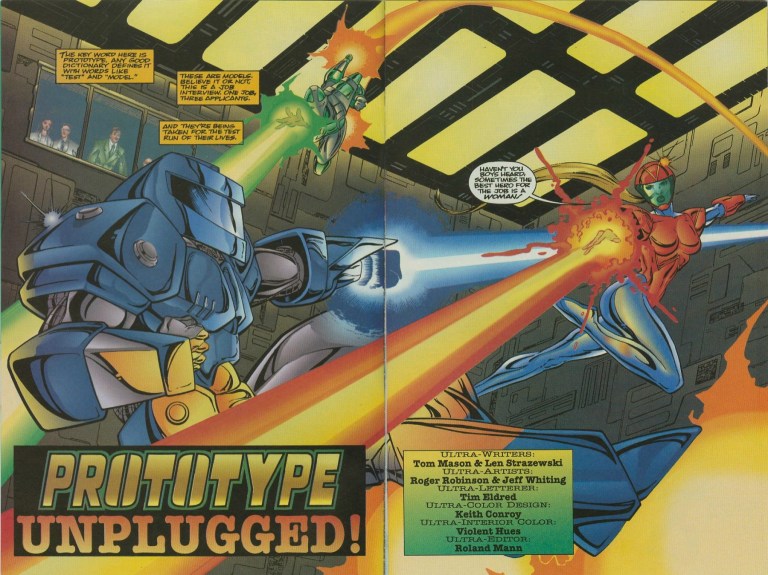
Set a short time after the hard battle between Prototype and Arena, the story begins in a secret facility somewhere in New York City where three armored figures engage in an intense session of flight, attacks and performance. The session is closely monitored by people watching from the observation deck. As it turns out, the session is actually a test for the three persons – two men and one lady – who applied to become the new Prototype which is the result of what happened at the end of issue #8.  Among the three, Donovan Jones was accepted as the new Prototype which Ultratech’s Stanley Leland confirms.

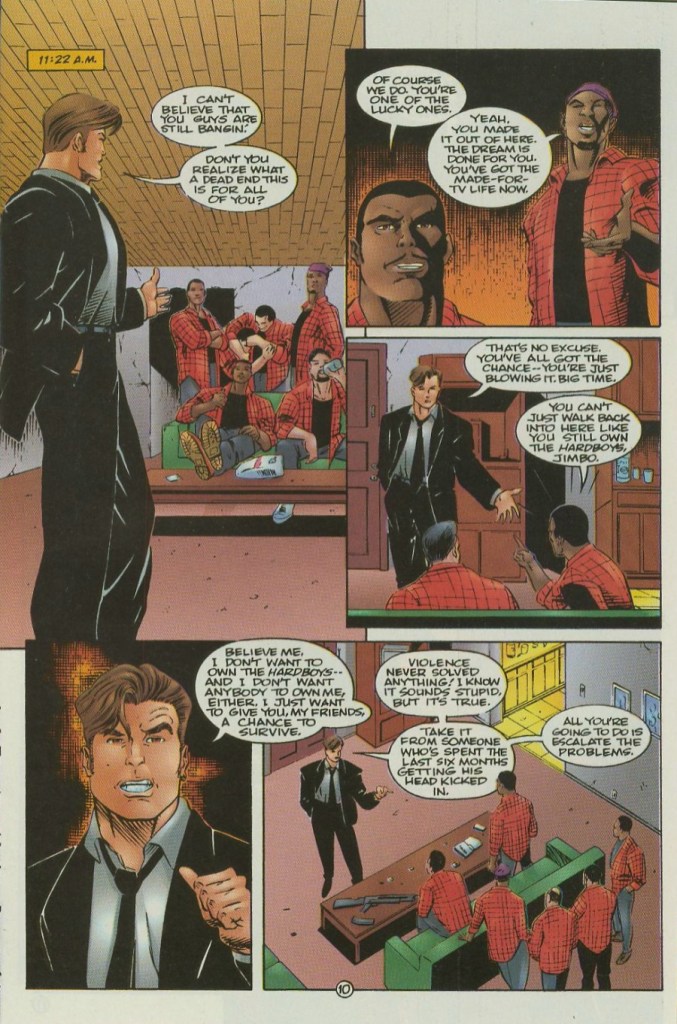
Over at Brooklyn, Jimmy Ruiz (Prototype) meets a lady from his past after paying respect to someone who was about to get buried. She tells him that since he left their old neighborhood, the local gangs have gotten worse. A short time later, the Prototype pilot meets an old gang he personally knows… 

Quality

Jimmy Ruiz and the gang from his past.

Let me start with the storytelling. This comic book is more about Jimmy Ruiz out on his own without the armor than it is about Ultratech and its high-tech interests. Bob Campbell’s not even in the story. That being said, this is pretty much a character-driven piece focused on Jimmy Ruiz as a person than as a hero and I should say that Tom Mason and Len Strazewski did a good job developing his character a lot. The writing is pretty lively and the writers pulled the right moves to define Jimmy Ruiz as a believable human being. There was that notable moment when after Jimmy returned to his old community and spends time with the old gang he personally knew, he realizes how much he has and how his perception changed. By the time you reach the end of the story, you’ll get to know Jimmy much better.

Conclusion

The money shot!

Prototype #9 is a character-driven comic book that succeeds in defining the personality and development of Jimmy Ruiz who is just one of two main characters in this series (which emphasized the struggles of two different persons involved with piloting Prototype). It lacks spectacle but that does not make this a boring comic book. Apart from Jimmy Ruiz, the corporate focus on Ultratech is short yet very intriguing.

If you are seriously planning to buy an existing hard copy of Prototype #9 (1994), be aware that as of this writing, MileHighComics.com shows that the near-mint copy of the regular edition costs $8.

Overall, Prototype #9 (1994) is recommended.

+++++

Thank you for reading. If you find this article engaging, please click the like button below and also please consider sharing this article to others. If you are looking for a copywriter to create content for your special project or business, check out my services and my portfolio. Feel free to contact me as well. Also please feel free to visit my Facebook page Author Carlo Carrasco and follow me at HavenorFantasy@twitter.com
A Look Back at Prime #6 (1993)

Disclaimer: This is my original work with details sourced from reading the comic book and doing personal research. Anyone who wants to use this article, in part or in whole, needs to secure first my permission and agree to cite me as the source and author. Let it be known that any unauthorized use of this article will constrain the author to pursue the remedies under R.A. No. 8293, the Revised Penal Code, and/or all applicable legal actions under the laws of the Philippines.

Hey everyone! Let me ask you…when you were a teenager, was there ever a time when you wished you could instantly transform yourself into a muscular man who can fly and use super strength to make a difference in local society? To be a standout with the public is one thing, but to deal with external forces who focus on you as a result of being super is another.

That being said, let’s take a look back at Prime #6, published in 1993 by Malibu Comics with a story co-written by Len Strazewski and Gerard Jones with art done by the late Norm Breyfogle.

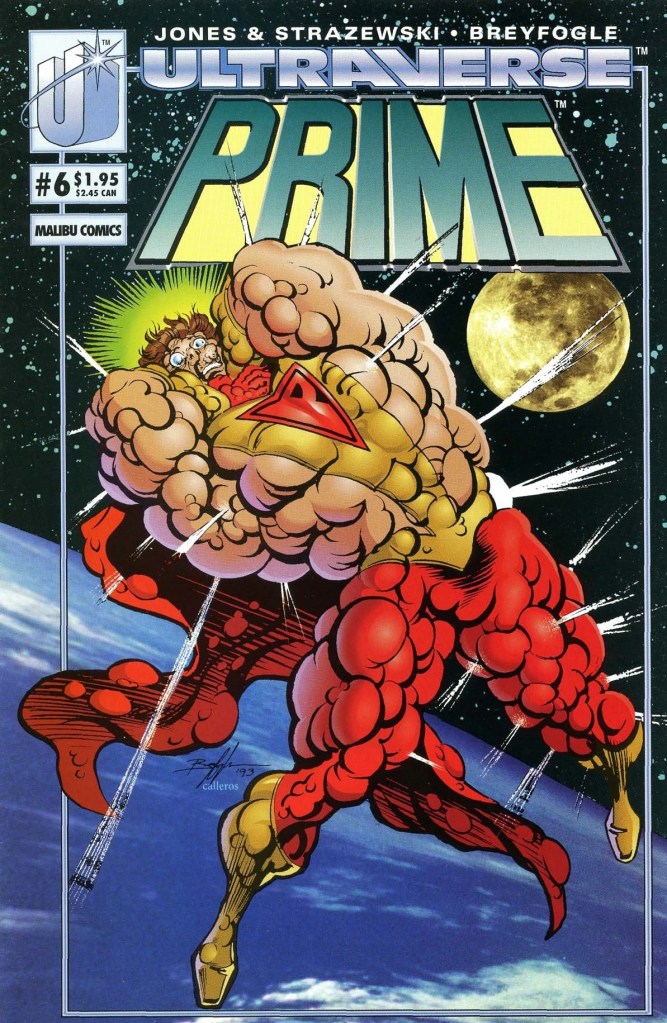
The cover.

Early story

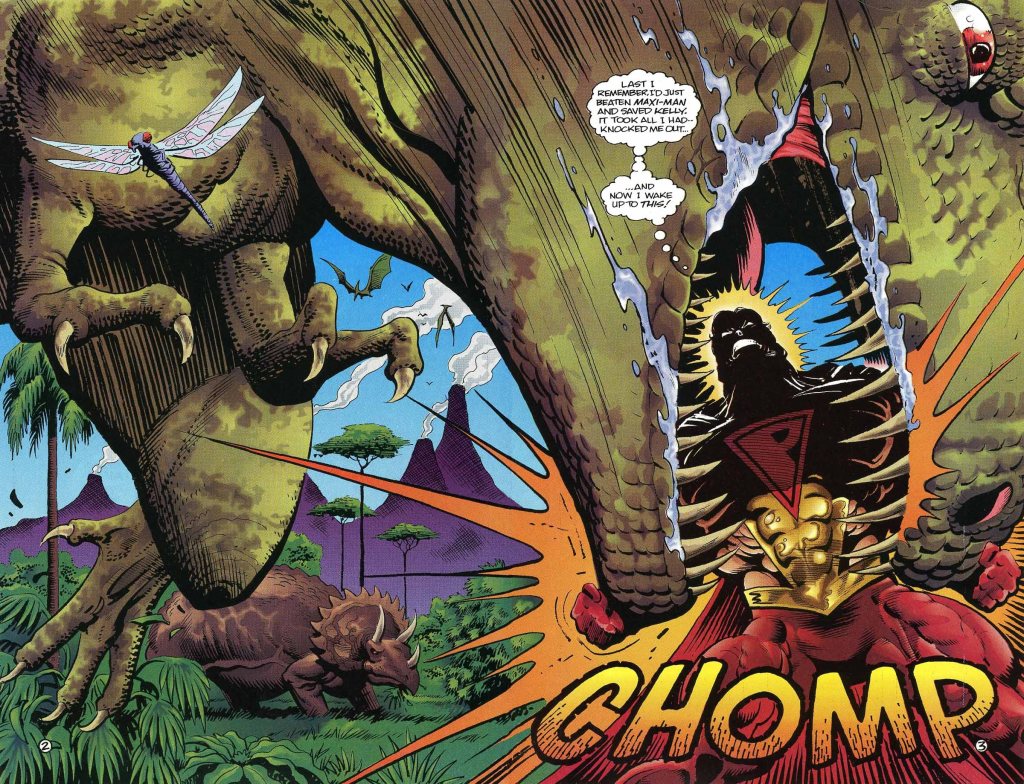
The story begins with Prime in an encounter with a large, meat-eating dinosaur. It’s a Tyrannosaurus Rex which puzzles the caped, muscular hero. The dinosaur traps him in its jaws and tries to eat him, but Prime manages to resist and finds a way to make it lose its balance.

As it turns out, the whole encounter was nothing more than a virtual reality sequence with Prime literally a captive. Behind the scenes are several people managing the secret operation with a high-ranking military officer in charge. The VR sequence ends and Prime calms down.

As the personnel work to aid Prime, the officer states that he needs him functional as he has o rove that his unit does not need the paranoid conspirators at Aladdin. As Prime wakes up, he quickly gets back on his feet putting the personnel off-balance and grabbing the military officer by the neck….

Quality

As expected, the writing and visuals were done with the usual high level of quality. What is clearly the main selling point of this comic book is its story which greatly emphasizes Prime’s place in the Ultraverse. To be specific, this is a tale about Prime (who is really a teenager inside) realizing his involvement with the United States government and its secret operations unit that involves the military and scientists. At the same time, this comic book digs deeper into the Prime’s origin not as a superhero but rather as a person (in the identity of Kevin Green) who was born with certain forms of manipulation done to him by someone who is linked with the government. The good news here is that the story is pretty cohesive and intriguing to read. At the same time, Prime’s personality got developed further and you will see how getting involved with his nation’s government impacts him.

More on the events within the Ultraverse, this comic book showed an early sign of the Prime series getting connected with elements of the respective series of The Strangers and Mantra.  

Conclusion

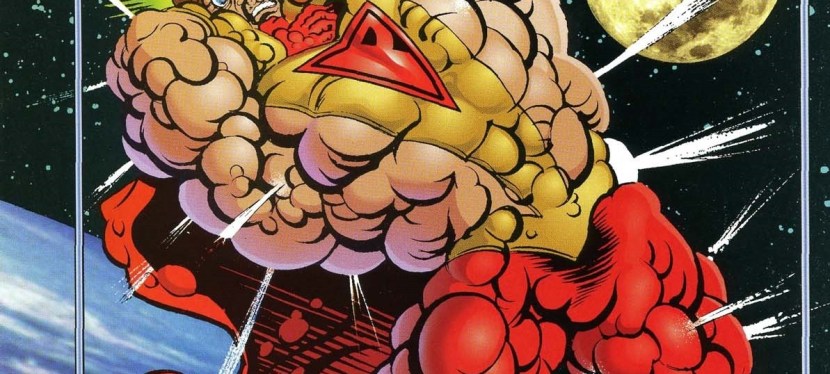
The money shot!

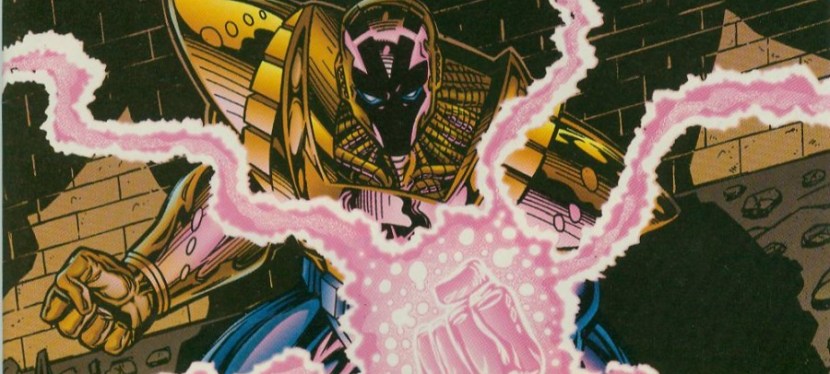
On face value, Prime #6 looked like it was just filler-loaded comic book serving only as a build-up for the Break-Thru crossover event of 1993. In actuality, this one is another well-told story about Prime and even though there is no battle with any villain, it succeeded in telling a standalone story focused on the hero getting involved with his nation’s government. I should also state that this is a nice change of pace following two really big battles of Prime with Prototype and Maxi-Man.

If you are seriously planning to buy an existing hard copy of Prime #6 (1993), be aware that as of this writing, MileHighComics.com shows that the near-mint copy of the regular edition costs $4 while the near-mint copy of the newsstand edition costs #10.

Overall, Prime #6 (1993) is recommended.

+++++

Thank you for reading. If you find this article engaging, please click the like button below and also please consider sharing this article to others. If you are looking for a copywriter to create content for your special project or business, check out my services and my portfolio. Feel free to contact me as well. Also please feel free to visit my Facebook page Author Carlo Carrasco and follow me at HavenorFantasy@twitter.com
A Look Back at Hardcase #14 (1994)

Disclaimer: This is my original work with details sourced from reading the comic book and doing personal research. Anyone who wants to use this article, in part or in whole, needs to secure first my permission and agree to cite me as the source and author. Let it be known that any unauthorized use of this article will constrain the author to pursue the remedies under R.A. No. 8293, the Revised Penal Code, and/or all applicable legal actions under the laws of the Philippines.

Hey comic book geeks and superhero enthusiasts! Are you ready for another trip back to the Ultraverse through the stories of Hardcase? Before getting there, I should state that the last Hardcase comic book I reviewed ended in a very intriguing way.

To find out more what followed, here is a look back at Hardcase #14, published in 1994 by Malibu Comics with a story written by the late James Hudnall and drawn by Steve Carr.

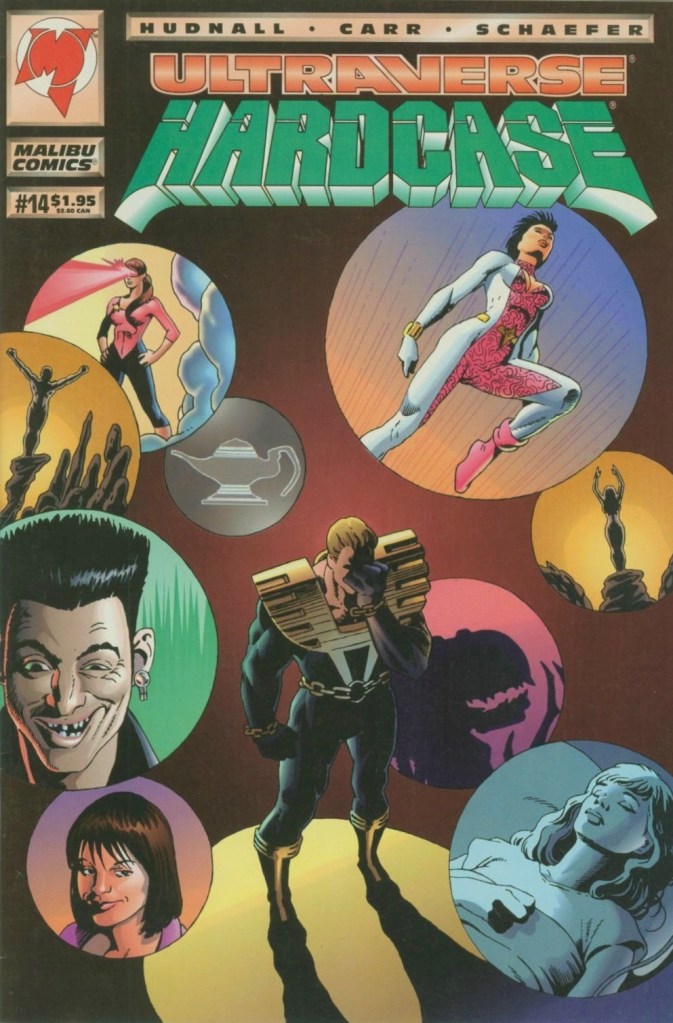
The cover.

Early story

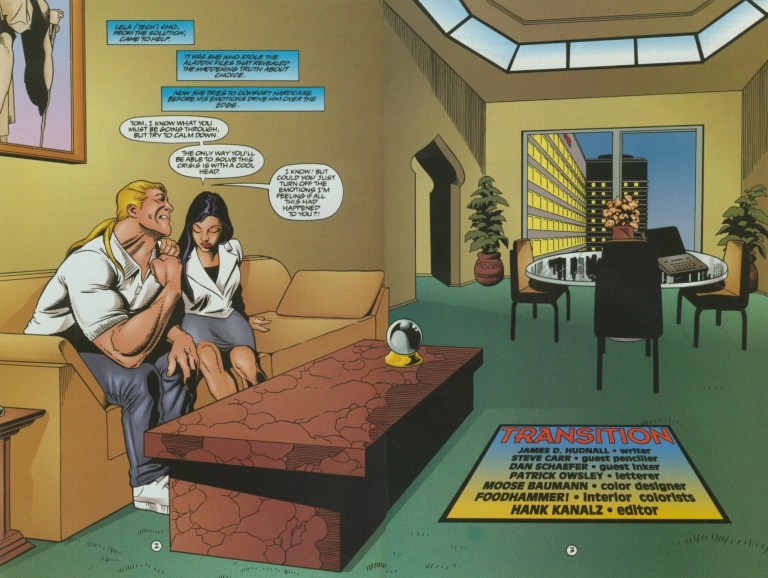
The story begins with Tom Hawke/Hardcase wondering if he is turning insane. He went through a lot lately such as getting targeted by Aladdin for elimination, learning that a portion of Linda’s brain was taken by Aladdin via operation, and his new lover Choice (who has the mentioned part of Linda’s brain in her) just vanished in front of him and Lela Cho/Tech (of The Solution) who seated near him.

Lela tries to calm him down and shares to him that she herself went through a whole lot of trouble which made her form her team. Hardcase is concerned that Choice could be in danger already. Lela reminds him of what happened during their time on the moon. She states that there is something out there, a flat world. Hardcase speculates that someone from out there could have taken Choice away…

Quality

Compared to issue #13, the storytelling in this comic book went back to build-up tension and suspense for future developments waiting to happen. When it comes to characterization, you will find Hardcase being without a partner for the first time since the early issues of the series. This also resulted some short but notably dramatic scenes that further developed Hardcase’s personality. As this was written by the late James Hudnall, there is more crossing-over between Hardcase and a few members of The Solution which is pretty good creative move.

When it comes to the art, Steve Carr did a good job visualizing the characters. His art is a radical change from that of Kelly Krantz in issue #13.

Conclusion

Picking up from where issue #13 ended.

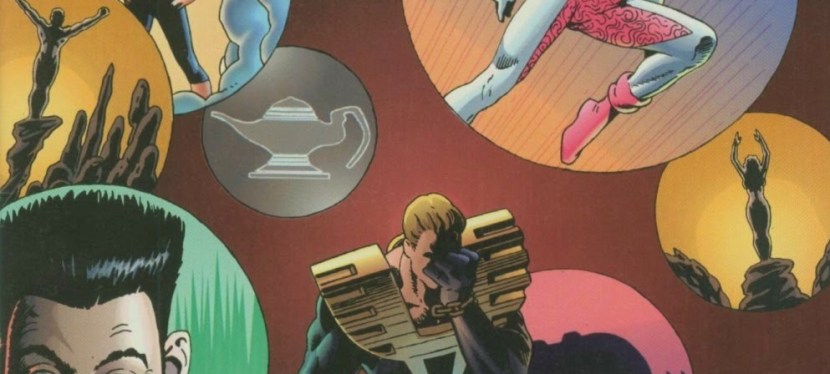
To put straight, Hardcase #14 will appeal to fans who don’t mind the lack of action (like issue #13) for as long as the Hollywood hero became more prominent and his personality developed further. If you are wondering what happened to Choice, you’ll have to search elsewhere in the Ultraverse. Also there is continued build-up behind the scenes setting up gradually (yet again) the inevitable rematch between Hardcase and a certain nemesis from the past.

If you are seriously planning to buy an existing hard copy of Hardcase #14 (1994), be aware that as of this writing, MileHighComics.com shows that the near-mint copy of the regular edition costs $14 while the near-mint copy of the newsstand edition costs $13.
Overall, Hardcase #14 (1994) is recommended.

+++++

Thank you for reading. If you find this article engaging, please click the like button below and also please consider sharing this article to others. If you are looking for a copywriter to create content for your special project or business, check out my services and my portfolio. Feel free to contact me as well. Also please feel free to visit my Facebook page Author Carlo Carrasco and follow me at HavenorFantasy@twitter.com