A Look Back at Wonder Woman #10 (1987)

Disclaimer: This is my original work with details sourced from reading the comic book and doing personal research. Anyone who wants to use this article, in part or in whole, needs to secure first my permission and agree to cite me as the source and author. Let it be known that any unauthorized use of this article will constrain the author to pursue the remedies under R.A. No. 8293, the Revised Penal Code, and/or all applicable legal actions under the laws of the Philippines.

Having reviewed the first nine issues of the 2nd Wonder Woman monthly series (1987-2011) that was handled with care initially by great creators George Perez and Len Wein, I can say that the Queen of Superheroes herself was redefined not only for the readers of the post-Crisis era but in general. Under the Perez-Wein team, Wonder Woman was portrayed to be human and compassionate as she gradually discovers what her destiny is just as she takes part in the struggles and affairs of her fellow Amazons led by her mother Queen Hippolyte.

Also told along the way was the story of the deities of Olympus headed by Zeus. In their realm, the deities are divided and each has his or her own ego and agenda. Because they have tremendous power, they are able to manipulate events on the physical world and make mortals struggle. Under them, the Amazons have struggled and even people of Earth got affected as well.  

When I reviewed the ninth issue, it was the full debut of the modern Cheetah who proved to be a worthy adversary for Wonder Woman. By the way, Cheetah is the antagonist in the new film Wonder Woman 1984 portrayed by Kristen Wiig. By the end of issue #9, Wonder Woman returned home to Themyscira leaving her American friends Julia and Vanessa Kapatelis in tears.

So what happened next? We can all find out in this look back at Wonder Woman #10, published in 1987 by DC Comics with a story written by George Perez and Len Wein. Perez did the art with inkwork by Bruce Patterson. This is the first chapter of the Challenge of the Gods storyline.
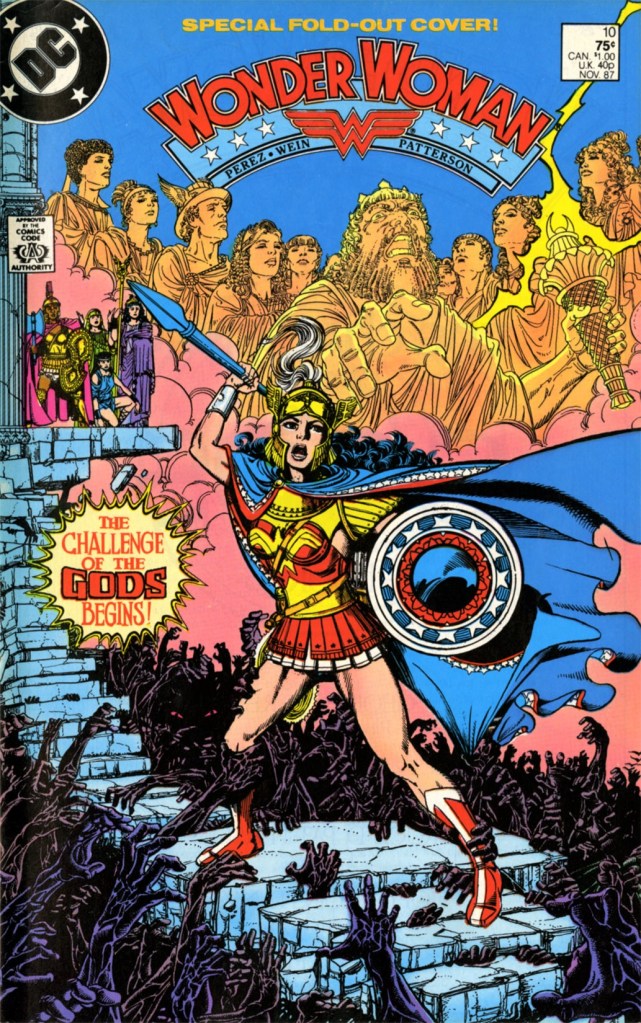
The cover.

Early story

The story begins in the realm of the deities. They noticed Pan has been joyful recently and Zeus states that has been the case since Wonder Woman thwarted the scheme of Ares. Pan approaches Zeus and followed-up on him regarding a past conversation they had. Zeus then looks Themyscira, finding it secluded yet a true paradise. A paradise worthy of his personal favor.

On Themyscira, Princess Diana/Wonder Woman and a fellow Amazon ride horses not knowing Zeus and the others are watching them. Pan tells Zeus that as Heracles (Zeus’ son) once favored Queen Hippolyte (Diana’s mother), it is only fitting that Diana should be the first among the Amazons to experience his manly grace. Zeus then decides to come to the Amazons and tells Pan to play a love song.

Hestia and Artemis notice Zeus’ decision. An angry Artemis makes her move stating that Paradise Island (Themyscira) will be no one’s brothel.

Diana and Euboea talk while riding their horses slowly on a beach. She states that it is good to be home. She learned so much from the world of men finding its people so different and yet so much the same, that the Amazons all could learn from one another.

Meanwhile the Amazons’ council of justice discuss the gifts and records Diana brought home. Queen Hippolyte is in attendance…

Quality
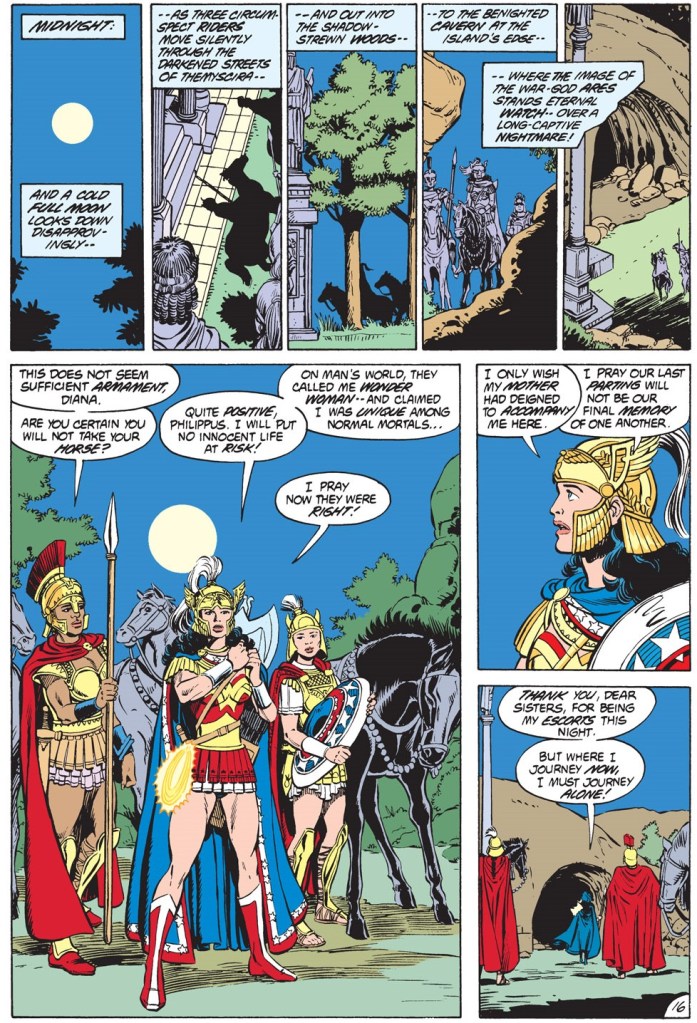
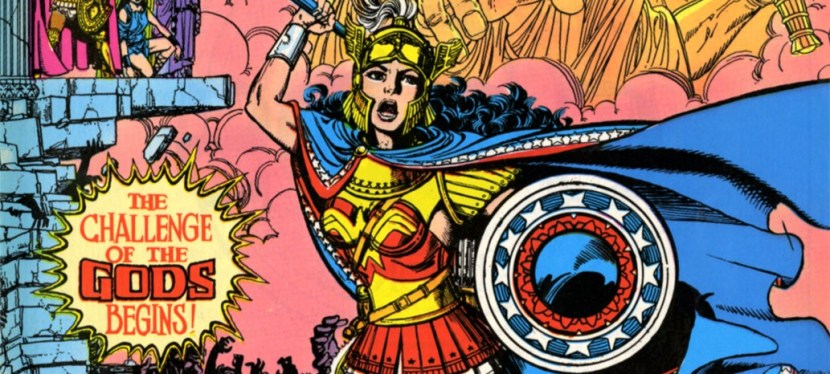
Wearing armor and a helmet, Wonder Woman prepares to start taking on the challenge of the deities.

I can say that this story not only marked the beginning of a new Wonder Woman storyline but also it marked a new turning point not just for the Queen of Superheroes but also for her fellow Amazons as this involves the Olympus deities a whole lot more. The good news here is that the script is of high-quality writing and has special care made on it by the Perez-Wein creative team. As the story is more focused on Themyscira and Olympus, more details about the history and legacy of the Amazons is revealed and it is all done with a deep amount of engagement. The way the details and events were handled, it looked like Perez and Wein had these story elements planned ahead of time as they continued to develop and redefine Wonder Woman in the post-Crisis era of DC Comics.

At the heart of the first chapter of the Challenge of the Gods storyline is the link between the Amazons (who rely on Wonder Woman to represent them) and the divided deities of Olympus. With very compelling writing and visuals, you will get to see how fragile Diana, Queen Hippolyte and their Amazon sisters really are when facing the deities. In relation to that, it is a unique reading experience to see Wonder Woman struggle with interacting with Zeus and the other deities directly.

Conclusion
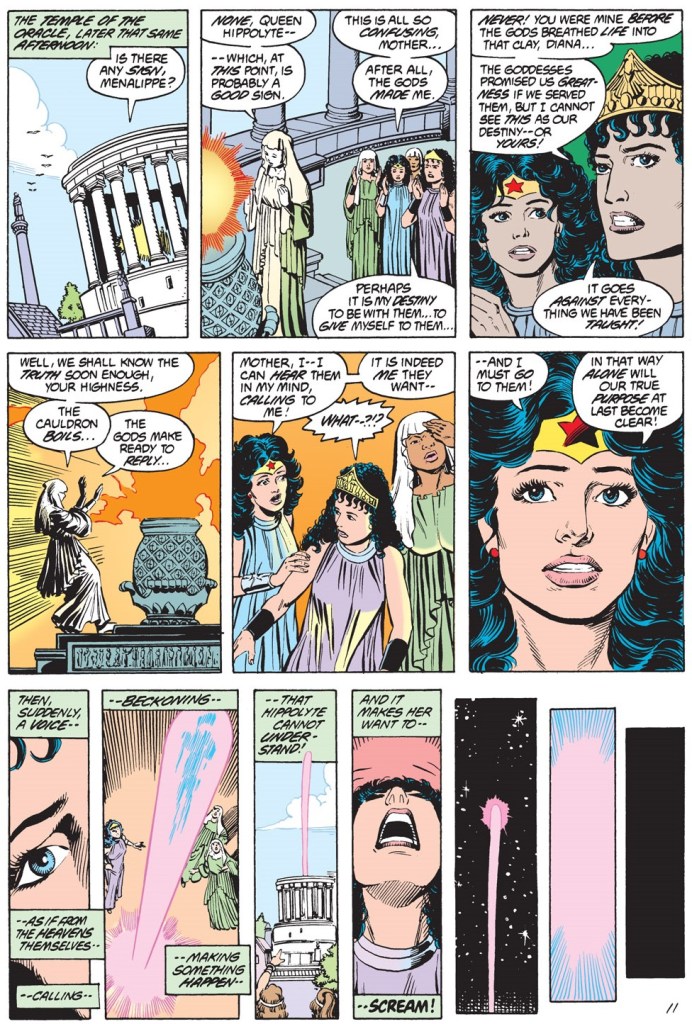
Princess Diana, her mother Queen Hippolyte and the Amazons analyze their situation.

Wonder Woman #10 (1987) is clearly a great comic book to read and it marked the continued excellence done by George Perez, Len Wein and their creative team.

If you are seriously planning to buy an existing hard copy of Wonder Woman #10 (1987), be aware that as of this writing, MileHighComics.com shows that the near-mint copy of the regular edition costs $60 while the near-mint copies of the fold-out edition and the newsstand edition cost $30 and $120 respectively.

Overall, Wonder Woman #10 (1987) is highly recommended!

+++++

Thank you for reading. If you find this article engaging, please click the like button below and also please consider sharing this article to others. If you are looking for a copywriter to create content for your special project or business, check out my services and my portfolio. Feel free to contact me as well. Also please feel free to visit my Facebook page Author Carlo Carrasco and follow me at HavenorFantasy@twitter.com
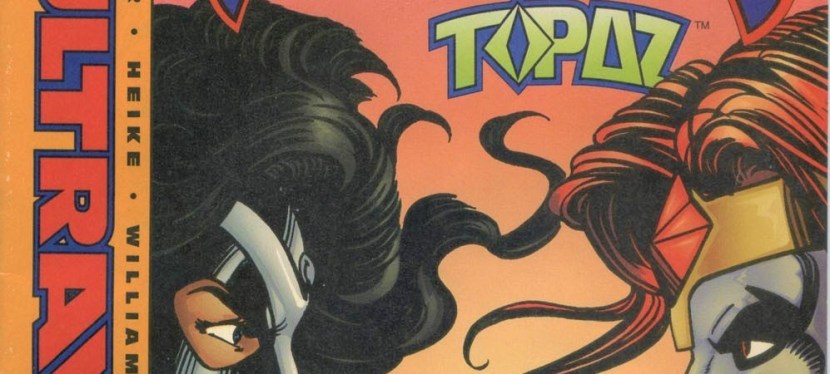
A Look Back at Giant Size Mantra (1994)

Disclaimer: This is my original work with details sourced from reading the comic book and doing personal research. Anyone who wants to use this article, in part or in whole, needs to secure first my permission and agree to cite me as the source and author. Let it be known that any unauthorized use of this article will constrain the author to pursue the remedies under R.A. No. 8293, the Revised Penal Code, and/or all applicable legal actions under the laws of the Philippines.

Welcome back, superhero enthusiasts, comic book collectors and fans of the Ultraverse! In my recent reviews of the Mantra monthly series, the events of the Archimage Quest were examined. For the newcomers reading this, Archimage is the leader of the tribe of warriors that Lukasz served for fifteen centuries. As told in issue #1, Boneyard neutralized Archimage’s power and Lukasz died one last time in a male body only to be reincarnated as a woman (displacing the soul of single mother Eden Blake). As it turned out, the transfer of Lukasz’s soul into Eden Blake’s body was planned by Archimage some time prior.

The Archimage Quest lasted several chapters and one of them took place in a one-shot Mantra comic book. With the details laid down, here is a look back at Giant Size Mantra, published in 1994 by Malibu Comics with a story written by Mike W. Barr and drawn by Mike Heike (1st half) and David Williams (2nd half).

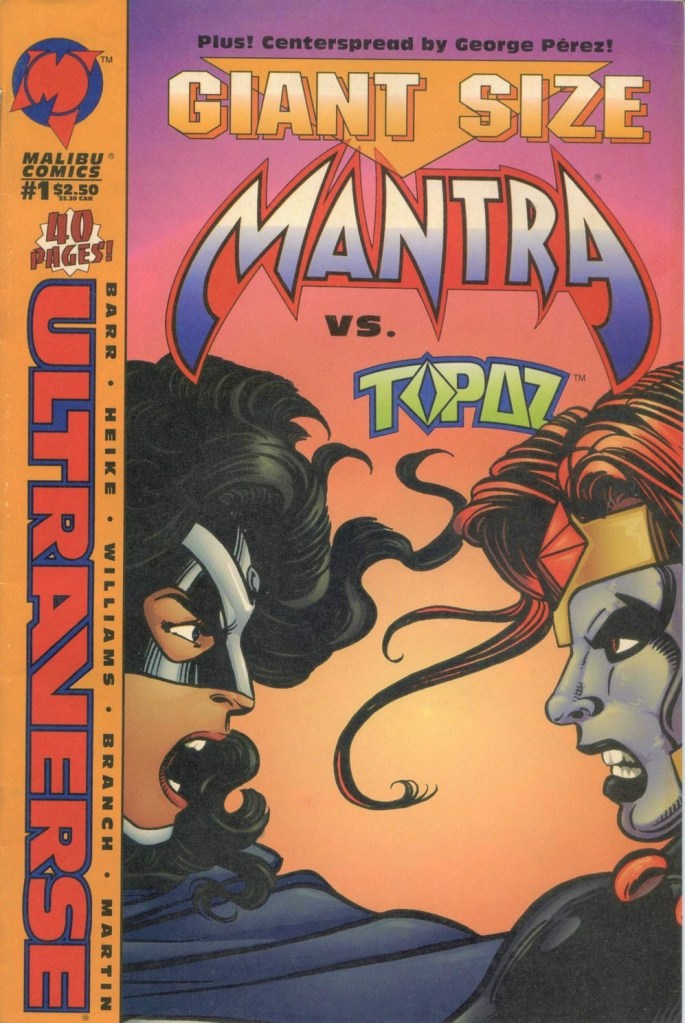
The cover.

Early story

The story begins with Mantra (wearing original costume) waking up in the presence of a lady wearing white. Upon waking, Mantra sees her and recognizes her from some time back at the Moon (refer to Mantra #6). The lady turns out to be none other than Eden Blake whose soul Lukasz displaced.

Mantra, now wearing a new costume, wakes up suddenly. A short time has passed since she left The Strangers during the previous encounter with Boneyard and now she finds herself trapped in dream-like place. Being really the man (Lukasz) inside the body, Mantra does what she can to break out of the place…

Quality

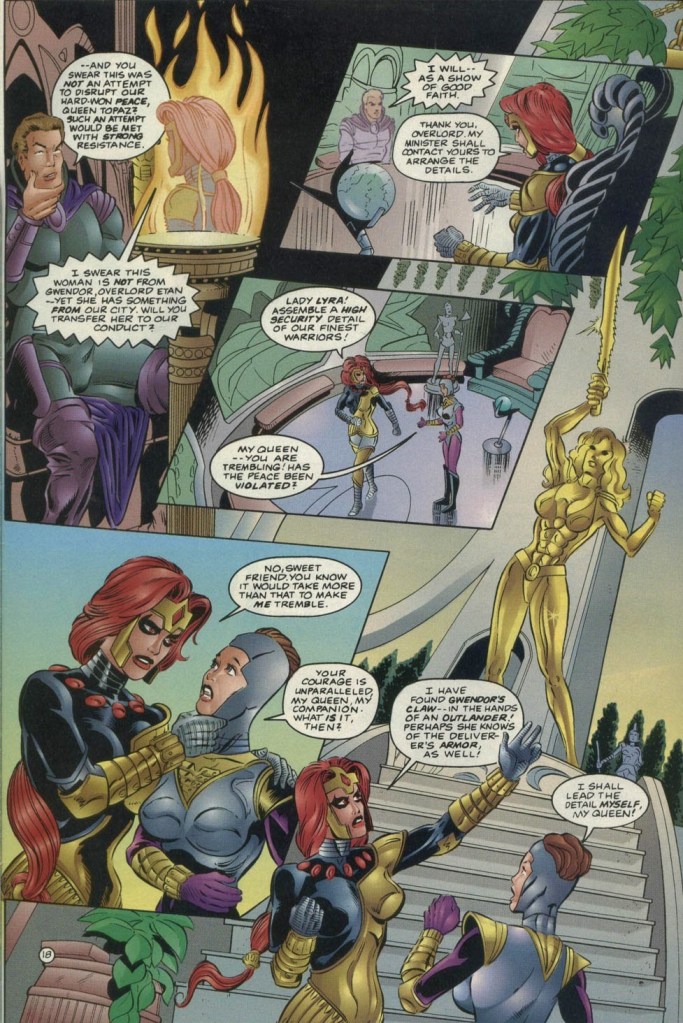
The first appearance of Topaz, the queen of Gwendor.

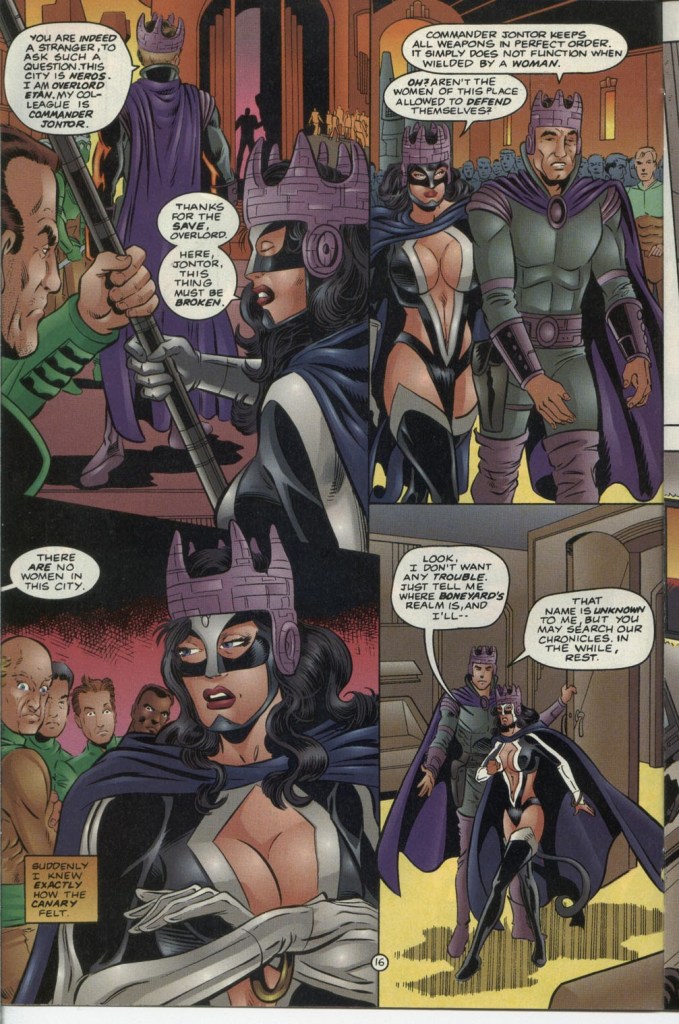
There is no surprise that Mike W. Barr’s writing remains strongly solid. The story is really engaging from start to finish and by this time, Barr not only knew the characters well but also showed clear signs that he prepared how to portray the characters as the story of Mantra continues. Here are further good news…Barr wrote a pretty expansive story that is worthy of this one-shot comic book that has almost 40 pages of content (told in two portions). While the first half told briefly what happened between The Strangers #13 and this comic book, and had Mantra discovering a brand new science fantasy realm with two cities (one male, one female), the second half was were the narrative really became more fantastic especially since this comic book marked the debut of Topaz (who went on to become a key member of the UltraForce) not to mention the introduction of not one but two different societies separated by gender and city walls. To see Topaz and her society of women comes with vibes of Wonder Woman and Themyscira.

The pace of the story ranged from moderate to fast, and Mike W. Barr carefully took his time with the exposition, the spectacle, the characterization and the sense of discovery with the new realm. This is a story worthy of the one-shot format and as a Mantra story, it clearly stands out and fits in well with the main narrative in the monthly series.

When it comes to the art, Mike Heike and David Williams did good jobs visualizing the script. Most notably, their art really brought the fantasy realm (as well as the two societies and cities) to life.

Conclusion

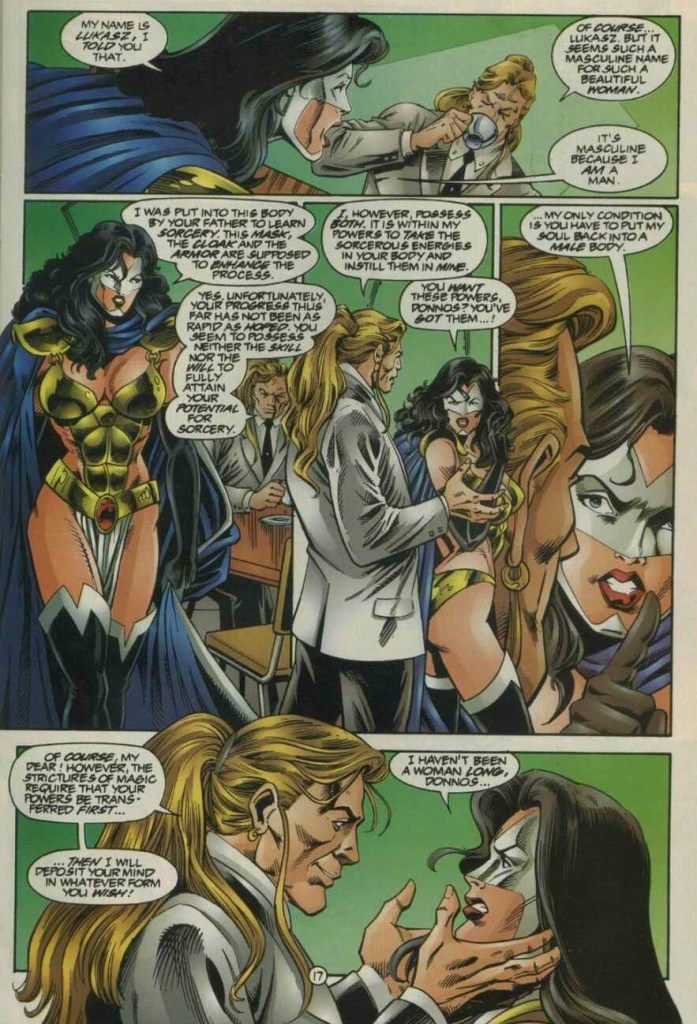
All those men staring at Mantra do not realize that the soul of male warrior Lukasz occupies her body.

I can say that Giant Size Mantra (1994) is a pretty good comic book to read. Its overall concept and high-quality script made it a very worthy one-shot comic book. While this story is not the conclusion of the Archimage Quest, it serves as a turning point in the life of Mantra and the results can be seen in subsequent issues of the monthly series.

If you are seriously planning to buy an existing hard copy of Giant Size Mantra (1994), be aware that as of this writing, MileHighComics.com shows that the near-mint copy of the comic book costs $8.

Overall, Giant Size Mantra (1994) is recommended.

+++++

Thank you for reading. If you find this article engaging, please click the like button below and also please consider sharing this article to others. If you are looking for a copywriter to create content for your special project or business, check out my services and my portfolio. Feel free to contact me as well. Also please feel free to visit my Facebook page Author Carlo Carrasco and follow me at HavenorFantasy@twitter.com
A Look Back at Wonder Woman Gallery (1996)

Disclaimer: This is my original work with details sourced from reading the comic book and doing personal research. Anyone who wants to use this article, in part or in whole, needs to secure first my permission and agree to cite me as the source and author. Let it be known that any unauthorized use of this article will constrain the author to pursue the remedies under R.A. No. 8293, the Revised Penal Code, and/or all applicable legal actions under the laws of the Philippines.

Welcome back, superhero enthusiasts, comic book collectors and fans of Wonder Woman! I should say that this is the most unusual comic book I have reviewed so far due to its main presentation of varied artworks featuring the Queen of all Superheroes herself – Wonder Woman!

For the newcomers reading this, there were several comic books back in the 1990s that did not really tell stories but showcased artworks of varied superheroes done by several artists. Such publications were in the form of swimsuit specials, apparently inspired by Sports Illustrated’s own publications. There were WildStorm Swimsuit Special #1, Ballistic Studios Swimsuit Special #1, Homage Studios Swimsuit Special #1, Lady Death Swimsuit Special #1 and the Avengelyne/Glory: Swimsuit Special #1 to name some.

The 1990s saw a rise of eroticism in superhero comic books. Not even the Wonder Woman monthly series of that time was spared from the trend. There was a time when DC Comics hired Mike Deodato to illustrate a number of Wonder Woman comic books in the mid-1990s which resulted a more eroticized look of Diana/Wonder Woman and her fellow Amazons. John Byrne took over after Deodato and his stint was not an improvement.

While the 1990s was a weak decade of Wonder Woman comics for me personally, not all was doom and gloom. Around twenty years before Gal Gadot debuted on the big screen as the cinematic Wonder Woman, DC Comics published an art gallery of the Queen of Superheroes in the form of a comic book.

With the details established, here is a look back at Wonder Woman Gallery, published by DC Comics in 1996 featuring the works of multiple artists.

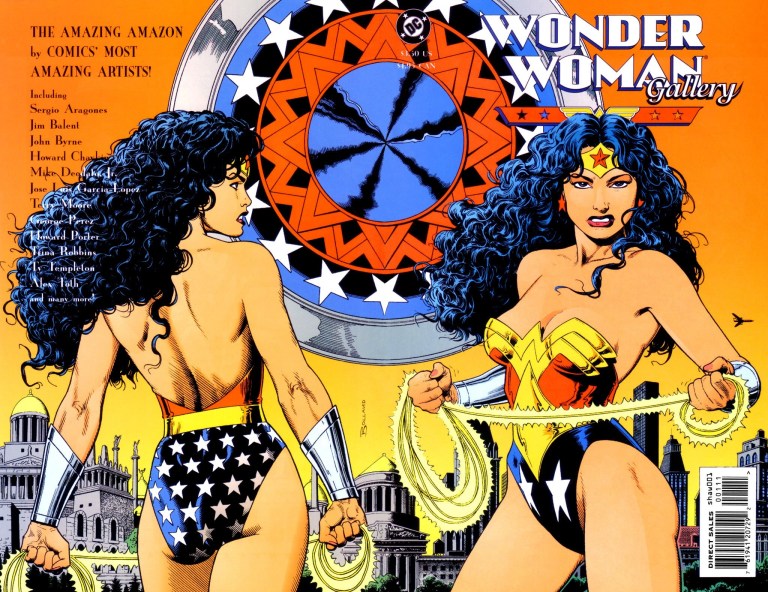
The cover.

What it is

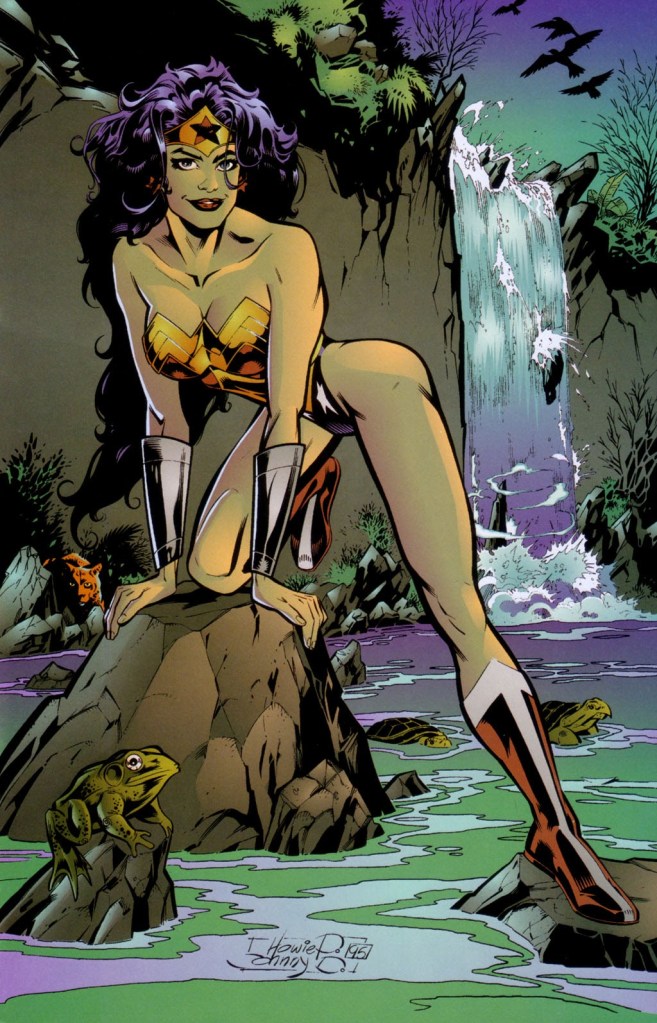
Wonder Woman Gallery is a showcase of thirty-two artworks done by George Perez, Stuart Immonen, Mike Wieringo and Richard Case, Brent Anderson, Howard Porter and John Dell, Jim Balent (misspelled as Jim Balant), Amanda Conner, Chuck Wojtkiewicz and Will Blyberg, Howard Chaykin, Steve Lightle and 22 others.

As this is an art gallery, there is clearly no story to tell. It is all artwork showcasing the different talents of the artists (and the inkers who helped them) on presenting Wonder Woman (note: the only exception here is a solo image of the forgettable WW replacement Artemis).

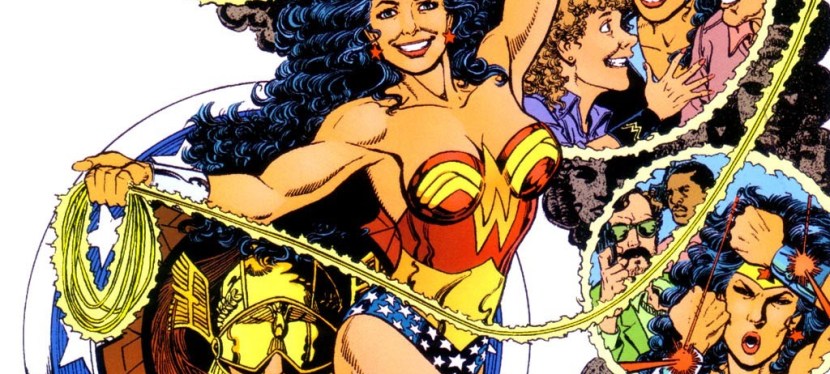
This artistic contribution by Phil Jimenez looks great.
Jill Thompson’s inspired take on Wonder Woman.
Wonder Woman by Howard Porter and John Dell.
Wonder Woman by Ivan Reis and Barbara Kaalberg.

Quality

As this is an art showcase, the overall quality of the collected art here varies. Such a collection of different art styles will appeal to Wonder Woman fans depending on how they like their favorite superhero presented visually.

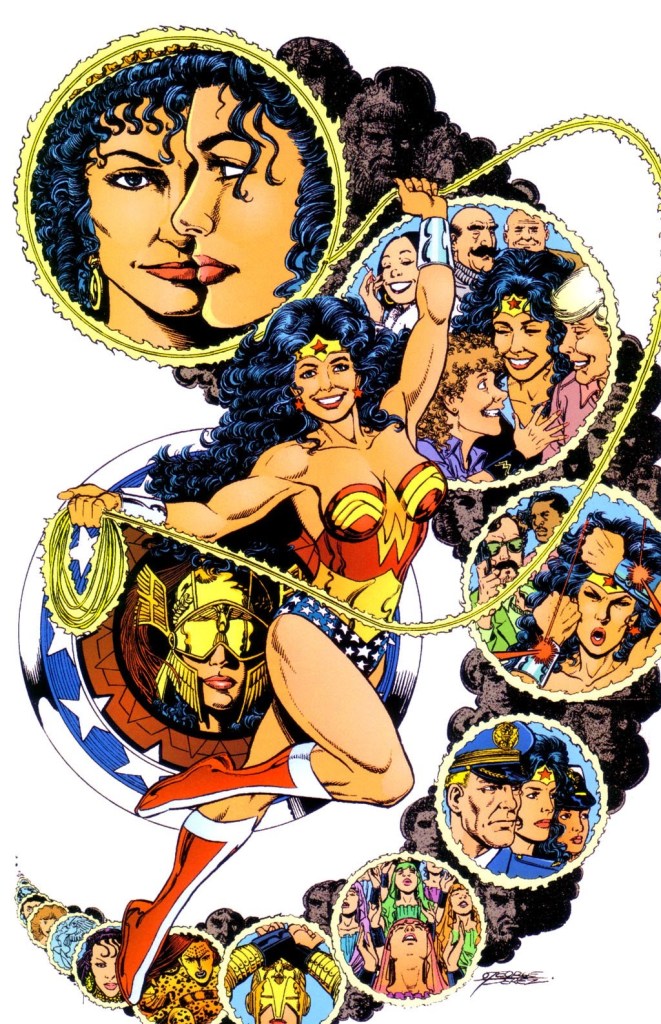
In my honest opinion, I always love the art style done by George Perez on Wonder Woman, her fellow Amazons, the supporting characters and more. His presentation here is flawless and timeless. What surprised me here in this collection is the contribution of Phil Jimenez whose quality and art style seem inspired by George Perez’s Wonder Woman legacy. As many of us know already, Jimenez later went on to become one of the top illustrators of DC Comics in the 2000s and his work here is nice to look.

There were a few artworks that showed Wonder Woman with a very cartoony look. Among them is the Wonder Woman piece done in the very distinct style of Sergio Aragones. Some art pieces here showed WW with a bizarre look and then there were a few others whose take on the Queen of Superheroes turned out good.

Conclusion

This work by George Perez is my favorite in this collection.

I can say that Wonder Woman Gallery (1996) is a published work that Wonder Woman fans will enjoy for as long as they are willing to accept images of their favorite superhero with styles ranging from realistic to cartoony, obscure and simple. Art styles aside, there is a lot here that fans will marvel at again and again, while art enthusiasts (who are not necessarily fans of the Queen of Superheroes) could find something eye-catching here.

If you are seriously planning to buy an existing hard copy of Wonder Woman Gallery (1996), be aware that as of this writing, MileHighComics.com shows that the near-mint copy of the comic book costs $40.

Overall, Wonder Woman Gallery (1996) is recommended.

+++++

Thank you for reading. If you find this article engaging, please click the like button below and also please consider sharing this article to others. If you are looking for a copywriter to create content for your special project or business, check out my services and my portfolio. Feel free to contact me as well. Also please feel free to visit my Facebook page Author Carlo Carrasco and follow me at HavenorFantasy@twitter.com
A Look Back at Mantra #3 (1993)

Disclaimer: This is my original work with details sourced from reading the comic book and doing personal research. Anyone who wants to use this article, in part or in whole, needs to secure first my permission and agree to cite me as the source and author. Let it be known that any unauthorized use of this article will constrain the author to pursue the remedies under R.A. No. 8293, the Revised Penal Code, and/or all applicable legal actions under the laws of the Philippines.

Welcome back, superhero geeks, comic book collectors and fans of the Ultraverse! Join me on this trip back into the Ultraverse and witness the events in one of the early issues of the Mantra monthly series.

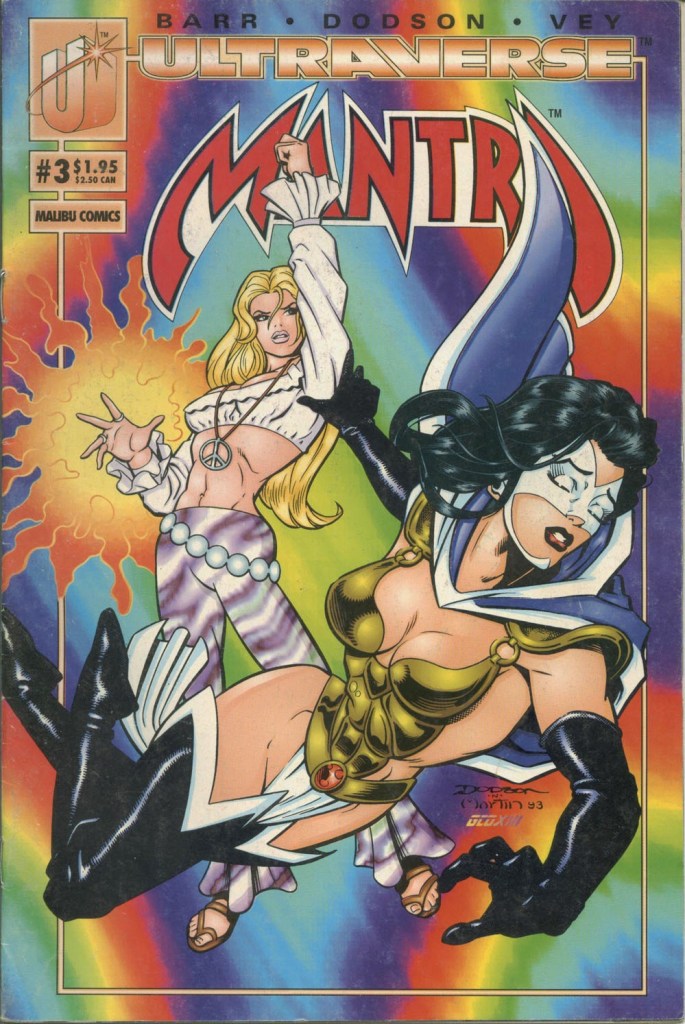
In issue #2, the male warrior Lukasz found himself really challenged being inside the body of a pretty single mother Eden Blake (Mantra) whose soul his displaced. Not only does Lukasz have to avoid getting killed by troops of Boneyard as he strives to somehow leave the lady’s body in favor of a male body, he has to adjust to living as Eden who has a home to keep, a private sector job to fulfill and two children to take care of. With those details laid down, it’s now time to take a look back at Mantra #3, published in 1993 by Malibu Comics with a story written by Mike W. Barr and drawn by Terry Dodson.

The cover.

Early story

The story begins in the hallway of the cinema wherein Mantra finds herself surrounded by the Repo Men who won’t stop at trying to overwhelm her. Mantra is at a disadvantage as she has yet to learn the ways of using magic.

As the Repo Men keep Mantra down, a group of bystanders witness what happened. Meanwhile, Eden’s daughter Evie and son Gus are in the middle of the hallway not realizing that Mantra is their mother in disguise. Eventually Mantra remembers her mantra and finally starts using magic to have the Repo Men off-balance and free herself from them. As the other Repo Men approach her, she blasts them with heat which burns them instantly in front of the bystanders. Mantra decides to fly away leaving behind Evie and Gus. The two kids are searching for their mother Eden.

Quality

Being trapped in the body of Eden Blake, the male warrior Lukasz tries to gain an advantage by charming a man he knew.

The strong quality of storytelling that started in issue #1 and followed through issue #2 is present in this comic book. Mike W. Barr’s story here remains nicely balanced between plot, character development and spectacle. I can also confirm that this story explores more of Lukasz struggling with living the domestic life of Eden which unsurprisingly makes his struggle to meet his goals even tougher. When it comes to defining the characters, there is a very touching scene in which Lukasz as Eden talks privately with a crying Evie in her bedroom, and even with an attempt to somehow separate themselves the unexpected (but really touching) result happens. And then there was another scene in which Lukasz uses Eden’s beauty to charm his way with someone for answers. This comic book’s script was undoubtedly written cleverly by Mike W. Barr.

Like in the first two issues, Terry Dodson excelled with visualizing the script. By this particular issue, the looks of Mantra and other related characters have been well established and he drawn them with a pretty good amount of detail. Dodson’s art here shines even more once Mantra begins to encounter one very particular adversary (note: she’s on the cover) and how it all turns out is something for you readers to find out for yourselves.

Conclusion

Mantra in a serious discussion.

I can confirm that Mantra #3 (1993) is a compelling Ultraverse story to read as it continues to be intriguing and define Mantra’s personality in an efficient and believable way. Along the way are revelations that further establish the core concepts of this monthly series and the way they were done shows strong preparations were made by Mike W. Barr before writing the script.

If you are seriously planning to buy an existing hard copy of Mantra #3 (1993), be aware that as of this writing, MileHighComics.com shows that the near-mint copy of the regular edition costs $8 while the near-mint copy of the newsstand edition costs $26.

Overall, Mantra #3 (1993) is recommended.

+++++

Thank you for reading. If you find this article engaging, please click the like button below and also please consider sharing this article to others. If you are looking for a copywriter to create content for your special project or business, check out my services and my portfolio. Feel free to contact me as well. Also please feel free to visit my Facebook page Author Carlo Carrasco and follow me at HavenorFantasy@twitter.com
HOT STAR Large Fried Chicken in Alabang

If you are looking for fried chicken to eat here in South Metro Manila, there are plenty of places to find them such as Jollibee, KFC, Popeyes and McDonald’s among the many restaurants. You can even find fried chicken meals served in convenience stores like Ministop, 7-Eleven and FamilyMart. Rest assured the mentioned business joints provide a lot of fried chicken whenever you are in Las Piñas, Parañaque and Muntinlupa.

There is one food joint that stand out among them all – HOT STAR Large Fried Chicken Philippines. With its newest branch located inside Festival Mall in Filinvest City, Alabang, HOT STAR is making a comeback here in South Metro Manila. Previously they had a branch along Presidents Avenue, Barangay BF Homes in Parañaque City and I ate there a number of times while they lasted. That particular branch closed down a few years ago so it was nice to see them open a new one in Alabang (note: their space is shared with Dakasi).

The commercial space of HOT STAR with Dakasi.

For the newcomers reading this, the HOT STAR business started in Taiwan and has overseas branches. They are best known for selling the 12-inch fried chicken which has a nugget-like shape but really large and quite filling.

At their Festival Mall branch, I had two stops there. The first time I was there, I joined the line to order myself a meal composed of their signature 12-inch fried chicken (referred to as the Signature XXL Chicken), rice and a drink. When asked for what type and what flavor the chicken should be, I chose the original type flavored with salt and pepper. Soon enough I got served and went to a vacant table.

The 12-inch signature fried chicken of HOT STAR.

Looking at the 12-inch original, salt-and-pepper fried chicken, it really was exactly as I remembered what was served to customers at the previous branch in BF Homes. It was also a bit challenging to cut into pieces given its formation and texture, so there were moments when I had to take the chicken by hand and pull it apart before trying to cut it into pieces with the plastic utensils.

As before, the 12-inch signature fried chicken is pretty tasty on its own. It was tasty enough, I did not bother to use any condiments. What is also notable about it is that it sure has a lot of content of chicken meat to consume. In fact, it was more than enough to fill the stomach. While this might sound unusual to you, this is pretty normal given my previous dining experience at HOT STAR BF Homes. That being said, I had a tasty and really satisfying meal there at HOT STAR Filinvest.

A few weeks later, I returned to the Festival Mall branch mainly to take home one of their newer foods – the Cheese Bomb. After driving home with the chicken from the mall, I got home and placed it on a plate.

This is what the Cheese Bomb looks like on the outside.

On the surface, the Cheese Bomb fried chicken has a different shape compared to the signature fried chicken. It looked ordinary on the outside but it is the cheese content inside the makes the big different not only in terms of content but also on flavor. As I ate the Cheese Bomb, I really felt that fine combined taste of fried chicken and cheese in my mouth and it only made me want to keep consuming until it all ran out. I got my money’s worth.

The cheese of Cheese Bomb exposed.
A closer look at the Cheese Bomb. The cheese itself is tasty.

To put it in short, I can say that the 12-inch signature fried chicken and the Cheese Bomb were both well cooked by HOT STAR Festival Mall and were properly prepared. It is notable that the two fried chicken variants were pretty flavorful respectively which shows that the cooks made them with the utmost care for me. As such, I highly recommend the 12-inch signature fried chicken and the Cheese Bomb to anyone who loves fried chicken. I got my money’s worth and so should you.

So if you happen to be in the Alabang area and you crave for fried chicken, you should visit HOT STAR at Festival Mall. They are on the ground floor level of the mall. Keep in mind that HOT STAR has several other types of food to offer such as spaghetti, rice bowl meals, burgers and fries, and chicken wings to name some. HOT STAR is a standout among the sellers of friend chicken here in South Metro Manila.

+++++

For more South Metro Manila community news and developments, come back here soon. Also say NO to fake news, NO to irresponsible journalism, NO to misinformation, NO to plagiarists, NO to distorted views, NO to reckless publishers, and NO to sinister propaganda when it comes to news and developments. For South Metro Manila-related community developments, engagements, commerce and other relevant updates, visit and join the South Metro Manila FB group at https://www.facebook.com/groups/342183059992673

A Look Back at Mantra #11 (1994)

Disclaimer: This is my original work with details sourced from reading the comic book and doing personal research. Anyone who wants to use this article, in part or in whole, needs to secure first my permission and agree to cite me as the source and author. Let it be known that any unauthorized use of this article will constrain the author to pursue the remedies under R.A. No. 8293, the Revised Penal Code, and/or all applicable legal actions under the laws of the Philippines.

Welcome back, superhero geeks, comic collectors and fans of the Ultraverse! We are about to return to the Ultraverse through the view of Mantra. Since the story of issue #9 and issue #10, the stakes have been raised as Mantra not only found herself in bigger danger as well as revelations from the past related to the long-time war between Archimage and Boneyard. Not only is Mantra still being targeted by Boneyard (who is so evil he wants to marry Mantra and make love to her body even though he knows the soul of the male warrior Lukasz is occupying it) but also by sorcerers from the Earth’s realm. In other words, Mantra/Lukasz really has trouble in different realms.

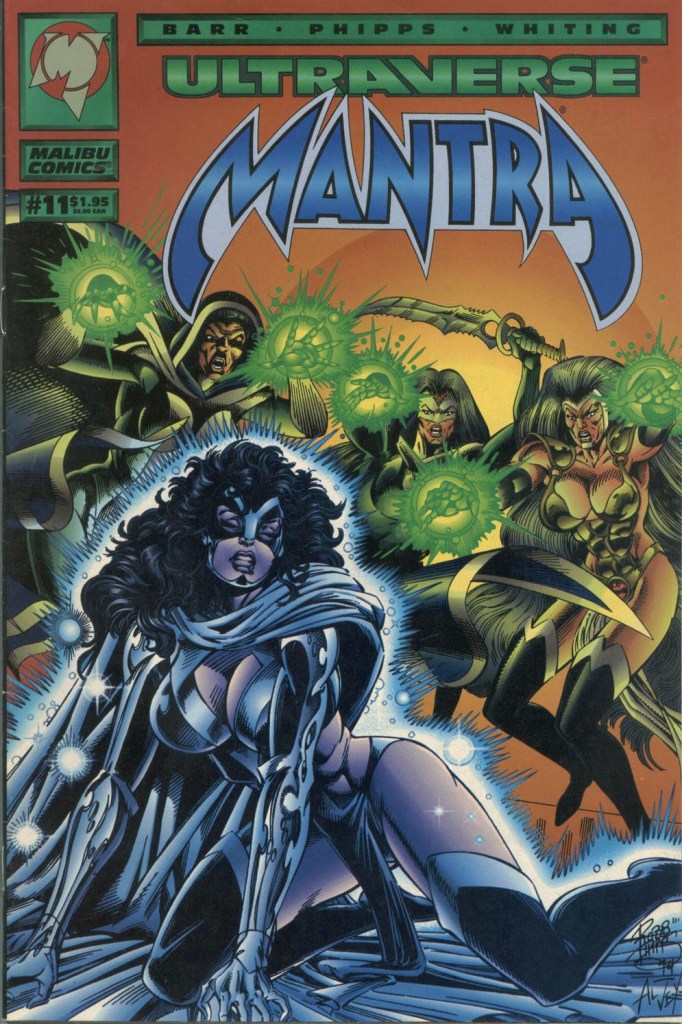
Will something unexpected turn out in the next story of Mantra? We can find out in this look back at Mantra #11, published in 1994 by Malibu Comics with a story written by Mike W. Barr and drawn by Robb Phipps.

The cover.

Early story

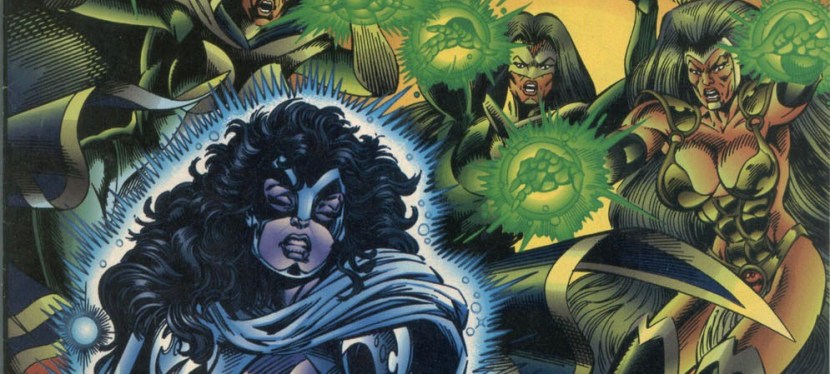
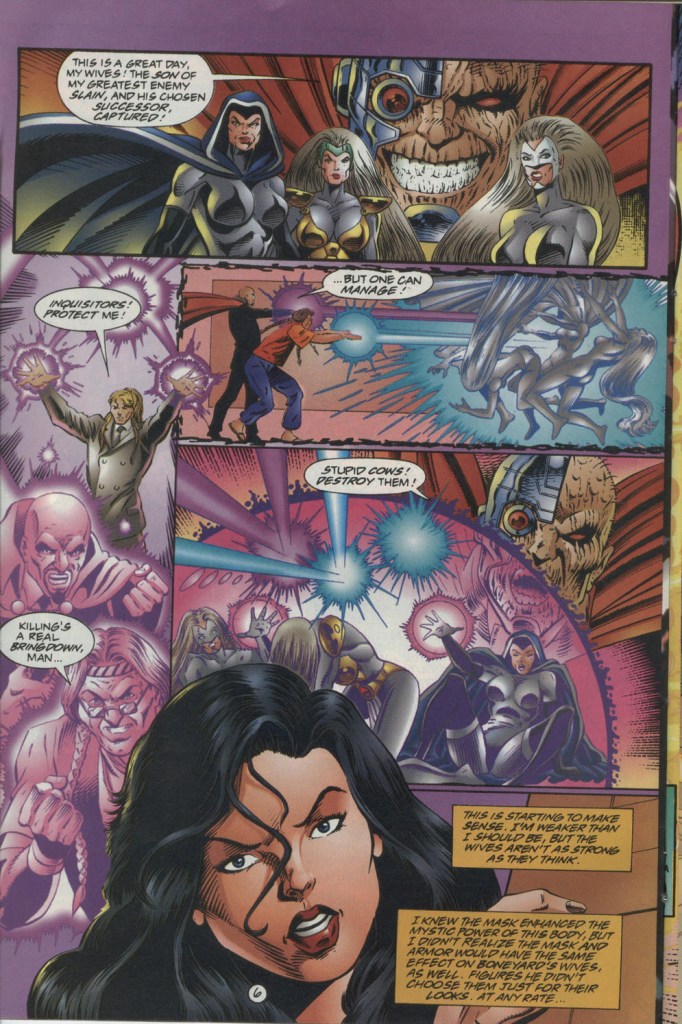
The story begins with Mantra standing completely naked in the full view of Boneyard, his three wives and the four other thugs (who hunted Mantra). Boneyard states, “Your choices are clear, Lukasz—surrender to me and become first among equals in my harem…or be destroyed by my wives—whose powers now equal yours!”

Suddenly the three wives fire beams of energy towards Mantra who successfully blocks them using magic to create a transparent shield. Very quickly, Mantra sees an opportunity to get the other thugs involved as targets of the three wives so she moves toward her previous attackers. The three wives’ attacks cause the thugs to retreat. Boneyard recognizes one of the thugs as the son of his rival Archimage.

Suddenly, the thugs attack Boneyard’s three wives with energy causing them to fall down on the floor. As the conflict shifted, Mantra begins to realize something.

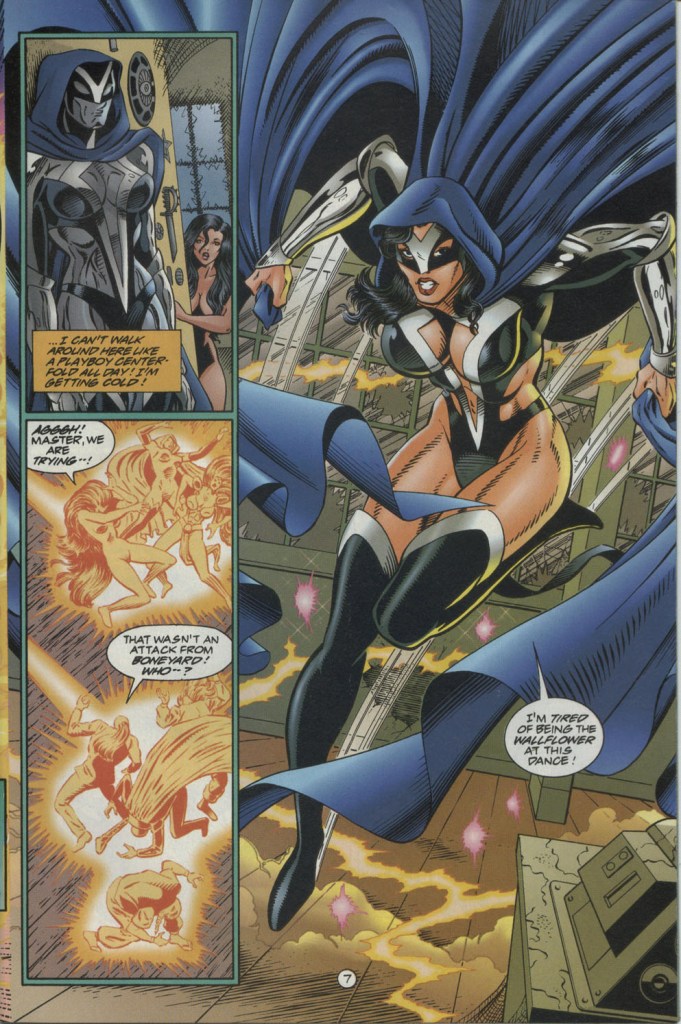
“I knew the mask enhance the mystic power of this body, but I didn’t realize the mask and armor would have the same effect on Boneyard’s wives as well. Figures he didn’t choose them just for their looks. At any rate…I can’t walk around here like a Playboy centerfold all day! I’m getting cold,” Mantra thought.

Quality

This is the first time Mantra wore a new costume which was carried over to issue #12.

No surprise, Mike W. Barr successfully kept the story engaging not only maintaining the engagement carried over from the few previous issues but by raising the stakes for Mantra personally while pulling off some pretty notable revelations that date back before the events of issue #1. Going beyond Boneyard and his three wives, there is a lot of fantasy related stuff waiting to be discovered which further adds depth to Mantra’s struggle (finding a male body to occupy and the ways to leave Eden Blake’s body). The plot really thickened with the revelations and how they turned out is something that you yourselves must pick up a copy of this comic book and read.

Of course, having reviewed issue #12 recently, it is no surprise that the build-up of engagement and suspense in this comic book contributed to its successor. More importantly, by the time you reach the end of this comic book, you will get a deeper understanding of what has been going and what preceded them. Clearly Mike W. Barr made solid preparations and took his time with the revelations just as he kept on telling the present-day story of Mantra.

Like the previous issue, I enjoyed Robb Phipps’ artwork here. If you were disappointed with the cartoony aesthetic of Terry Dodson’s work in issue #10, you will like the expressions as well as the overall style of Phipps.

Conclusion

With a male soul inside the body of Eden Blake, Mantra quickly analyzes the messy situation to find an advantage.

Mantra #11 (1994) is indeed a pretty entertaining and compelling Ultraverse comic book. There is nothing like watching the spectacle happen in between moments of Mantra realizing answers to her questions, and learning new details (including stuff that emphasized how rotten, how wicked and twisted Boneyard truly is as the major villain of not only this particular series but also of the Ultraverse itself) that deepened the narrative for readers.

If you are seriously planning to buy an existing hard copy of Mantra #11 (1994), be aware that as of this writing, MileHighComics.com shows that the near-mint copy of the comic book costs $8.

Overall, Mantra #11 (1994) is recommended.

+++++

Thank you for reading. If you find this article engaging, please click the like button below and also please consider sharing this article to others. If you are looking for a copywriter to create content for your special project or business, check out my services and my portfolio. Feel free to contact me as well. Also please feel free to visit my Facebook page Author Carlo Carrasco and follow me at HavenorFantasy@twitter.com
A Look Back at The Solution #7 (1994)

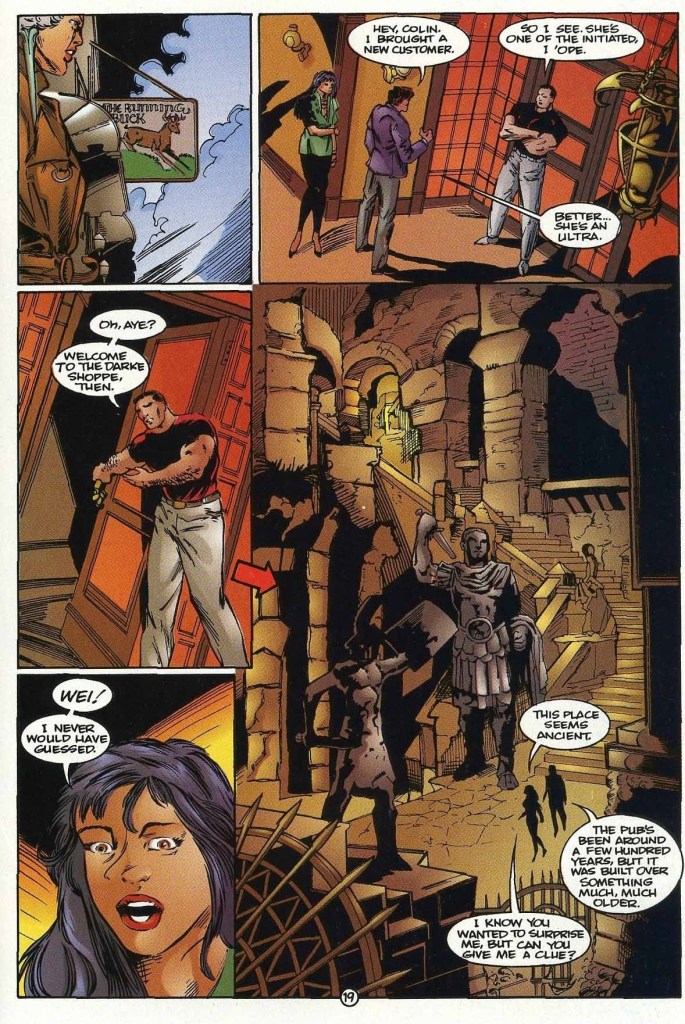
Disclaimer: This is my original work with details sourced from reading the comic book and doing personal research. Anyone who wants to use this article, in part or in whole, needs to secure first my permission and agree to cite me as the source and author. Let it be known that any unauthorized use of this article will constrain the author to pursue the remedies under R.A. No. 8293, the Revised Penal Code, and/or all applicable legal actions under the laws of the Philippines.

Welcome back, superhero geeks, comic book collectors and fans of the Ultraverse! Some time ago, I reviewed the sixth issue of The Solution and it turned out to be a pretty compelling and fun comic book to read. I was pleasantly surprised by its high quality and presentation, and by the end I found Lela Cho/Tech (the leader of The Solution) to be a very interesting character of the Ultraverse. Clearly the creative duo of James Hudnall (who also wrote Hardcase) and John Statema literally scored a home run with The Solution #6.

As The Solution #6 focused on the background story of Tech, its portrayal of the current-day events was laced with suspense, drama and intrigue that only teased what could happen in the next moment. What else could be told about Lela Cho’s past and what might happen next in the present day? We can find out in this look back at The Solution #7, published in 1994 by Malibu Comics with a story written by Hudnall and drawn by Statema.

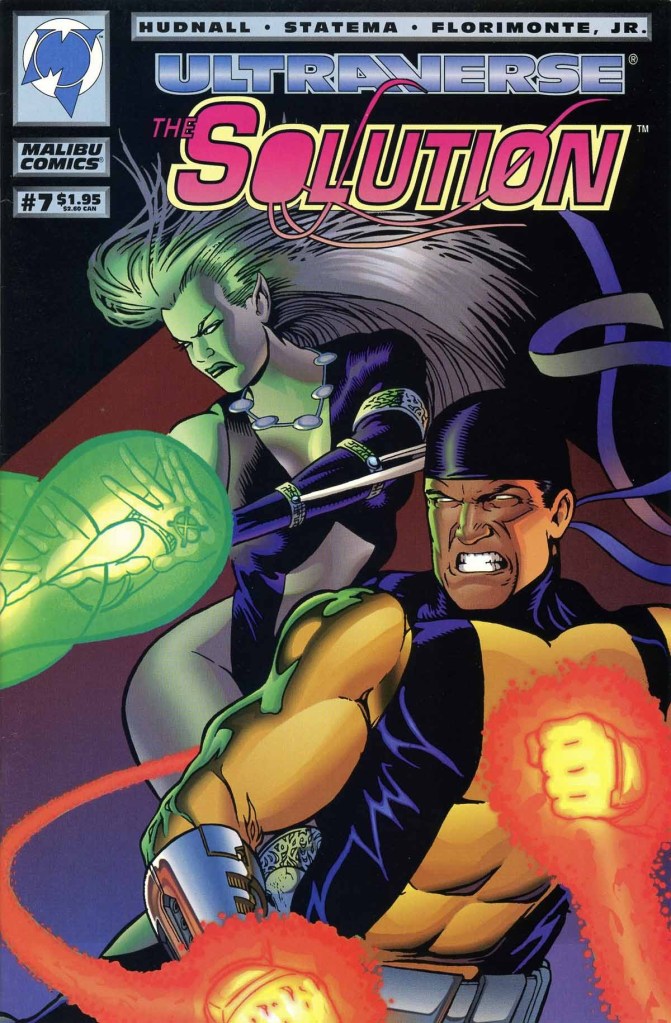
The cover.

Early story

The story begins with Lela Cho accompanied by Troy Wilde standing in front of her father’s grave. The two don’t seem to know that they are being spied on from a distance. A group has set up snipers to take them down.

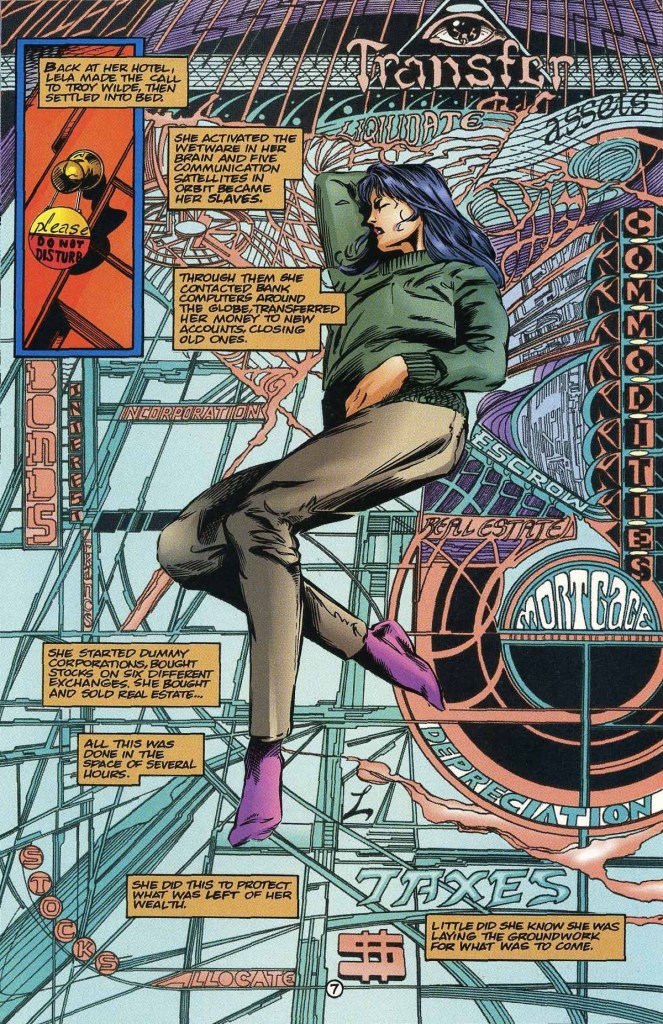
As the two begin to talk, Lela tells Troy details from her past. She recalls that after the sudden death of her father, she could not fully gain the inheritance from her father – the corporation – as its board of directors refused to accept her. As it turned out, a crime gang anticipated her every move and stole her company. To enhance herself, she paid specialists to install wetware implants into her body to make her the mistress of electronic devices.

She arrived in the city of New York already aware that she has been marked by her enemies, and she knew they would come for her. In New York, she meets with Peter Bazinni to seek help. Not only is he a man with many powerful connections, he was also her old flame. While Peter admitted he could not help her in her conflict with the international crime gang, she gives her a reference to another professional who is her best bet. His name was Troy Wilde…   

Quality

Discovering the secret locations.

James Hudnall delivered another pretty solid story. It’s got a nice mix of elements here and there. From time to time, I felt like I was reading a detective story, then a murder tale, then a hard action tale and then a hard-edged superhero tale. While this comic book continued on telling the origin of Lela Cho, it shifted focus on the background of Troy Wilde who would eventually join the team with the codename Dropkick. How Lela and Troy first interacted with each other was very carefully crafted with believable dialogue and well-defining personalities from each (as reflected in the way they talked with each other). Another member of The Solution appeared in here is as well.

What surprised me here was the revelation of a certain villainess. At first, she looked like a probably disposable villainess but proved to be more significant than meets the eye. If you get to read the succeeding issues of The Solution, you will realize what I just stated.

As with his past works, John Statema’s art here is pretty good. The good stuff he delivered in issue #6 continued to shine here.

Conclusion

Lela Cho’s ultra ability to hack systems and alter digital stuff would help her fit in nicely with this age of social media and streaming.

The Solution #7 (1994) is not only a worthy follow-up to its predecessor, it is one of the stronger origin-type comic books of the Ultraverse as a whole. While the previous issue was focused mainly on Lela Cho, this one shows Troy Wilde/Dropkick making his first involvement with her as well as the eventual formation of their team. At this stage, the story of how The Solution got formed really took shape here. I should state, however, that the level of engagement fell down a bit compared to the previous issue.

If you are seriously planning to buy an existing hard copy of The Solution #7 (1994), be aware that as of this writing, MileHighComics.com shows that the near-mint copy of the comic book costs $8.

Overall, The Solution #7 (1994) is recommended.

+++++

Thank you for reading. If you find this article engaging, please click the like button below and also please consider sharing this article to others. If you are looking for a copywriter to create content for your special project or business, check out my services and my portfolio. Feel free to contact me as well. Also please feel free to visit my Facebook page Author Carlo Carrasco and follow me at HavenorFantasy@twitter.com
A Look Back at Sludge #1 (1993)

Disclaimer: This is my original work with details sourced from reading the comic book and doing personal research. Anyone who wants to use this article, in part or in whole, needs to secure first my permission and agree to cite me as the source and author. Let it be known that any unauthorized use of this article will constrain the author to pursue the remedies under R.A. No. 8293, the Revised Penal Code, and/or all applicable legal actions under the laws of the Philippines.

Welcome back, superhero geeks, comic book collectors and fans of the Ultraverse! Before we revisit the Ultraverse, I should state that I am not a fan of monsters as comic book protagonists, especially when it comes to the superhero genre. In the world of pop culture, a lot of people get fascinated with monsters especially those that are dangerous to people. You got the likes of the Swamp Thing, Dracula, the monster of Frankenstein, the Werewolf, etc.

When it comes to the Ultraverse, they have a monster for a protagonist named Sludge. What I find really intriguing was that Sludge was introduced to readers not by making appearances in existing Ultraverse comic books but by actually being featured in full force in the launch of issue of his own series – Sludge #1.

With those details settled, we can find out if there is something special or unique about the Ultraverse monster in this look back at Sludge #1, published by Malibu Comics in 1993 with a story written by Steve Gerber (who previously worked on Marvel’s Man-Thing) and drawn by Aaron Lopresti.

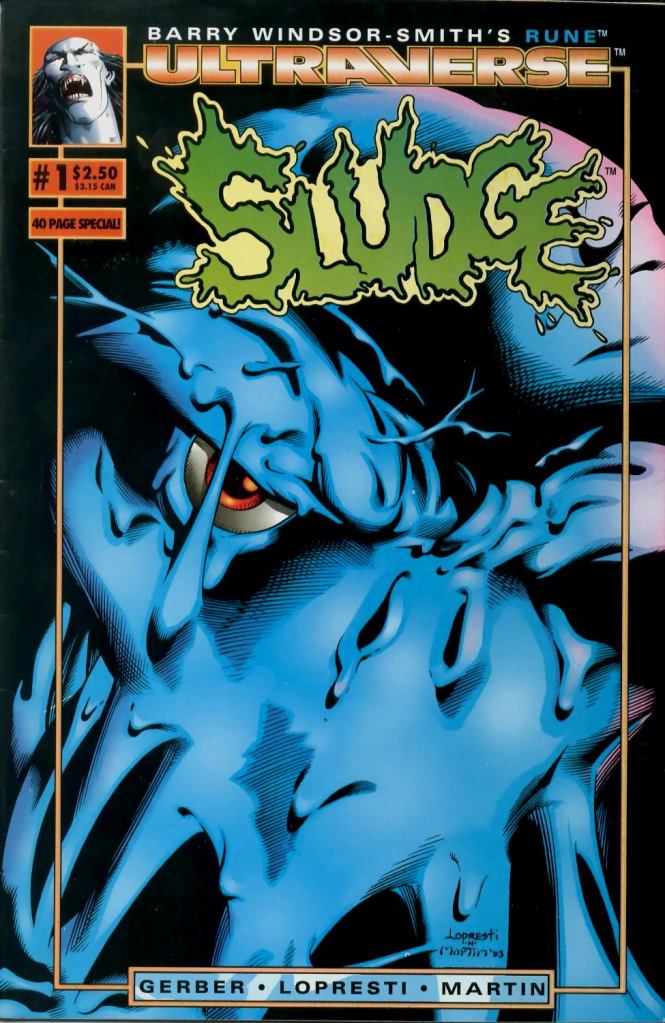
The cover.

Early story

The story begins in a very low place of Manhattan where society’s substratum meets the crust of the earth. Sludge, a grotesque monster with a human perception and a body made out of slime, slowly walks towards a group of poor and homeless people.

Elsewhere somewhere in the city, a radio talk show host talks to his listeners about Frank Hoag, a detective sergeant who worked for twenty years for the New York Police Department or NYPD. It turns out, Hoag has been missing for the past few weeks and the last thing someone knew about him was that he responded to a call about a break-in at the headquarters of a pharmaceutical firm. The next morning at the said place, company employees spotted signs of violence including blood, bullet holes and shell casings. No sign of the detective.

As the radio talk show host engages his listeners by making an issue out of the disappearance of Hoag, police officers got offended while a gang of armed thugs paid close attention to what was said. As the said gang (riding their car) move down the street of homes, they opened fire at the people.

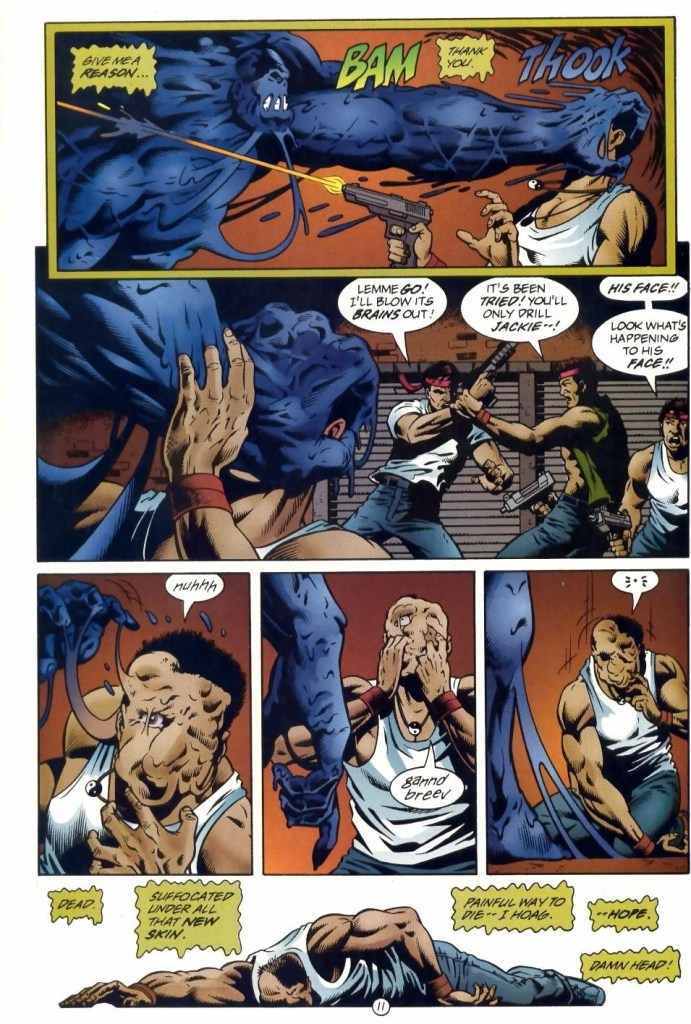
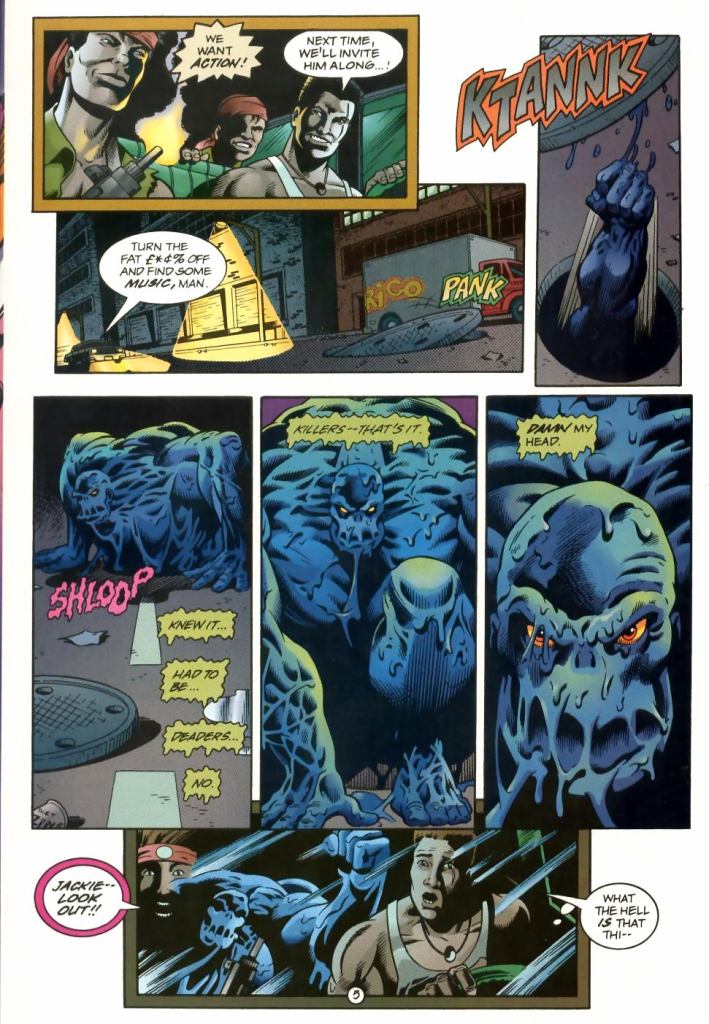
As the gang’s car moves on, the manhole ahead of them opens. Sludge comes out of it and finds himself right on the path of the moving car…

Quality

This is why you don’t mess with Sludge.

The writing is top-notch and this is no surprise not only because of Steve Gerber’s extensive writing experience but also because he knew how to write a story with a monster as a protagonist which was what he did with Marvel’s Man-Thing. Unlike that other monster, Sludge has intelligence and awareness, therefore he is a monster with humanity still existing within. Very cleverly, Gerber introduced Sludge and notable aspects of him in a very smooth and efficient manner. By the time I finished this reading this comic, I realized that I witnessed Sludge’s first appearance and origin story which were done very nicely. I should also state that Sludge here is not a mere monster but really a struggling character worth following.

For his part, Aaron Lopresti’s art is pretty good. His visualization of Sludge really stands out and he did not pull back his punches when it came to drawing the action and presenting the violence.

Conclusion

Considering his physical state, Sludge coming out of the manhole is justified.

I can say that I am very pleasantly surprised and entertained by what was presented in Sludge #1 (1993). It really is a great monster-protagonist story written by Steve Gerber and his work here really shines. By the time I reached the end of the story, I got eager to look forward to the next issue and find out what Sludge will do next. It is a very engaging read and one of the strongest debut issues of the Ultraverse.

If you are seriously planning to buy an existing hard copy of Sludge #1 (1993), be aware that as of this writing, MileHighComics.com shows that the near-mint copy of the regular edition costs $8 while the near-mint copy of the ultra-limited edition costs $32.

Overall, Sludge #1 is highly recommended!

+++++

Thank you for reading. If you find this article engaging, please click the like button below and also please consider sharing this article to others. If you are looking for a copywriter to create content for your special project or business, check out my services and my portfolio. Feel free to contact me as well. Also please feel free to visit my Facebook page Author Carlo Carrasco and follow me at HavenorFantasy@twitter.com
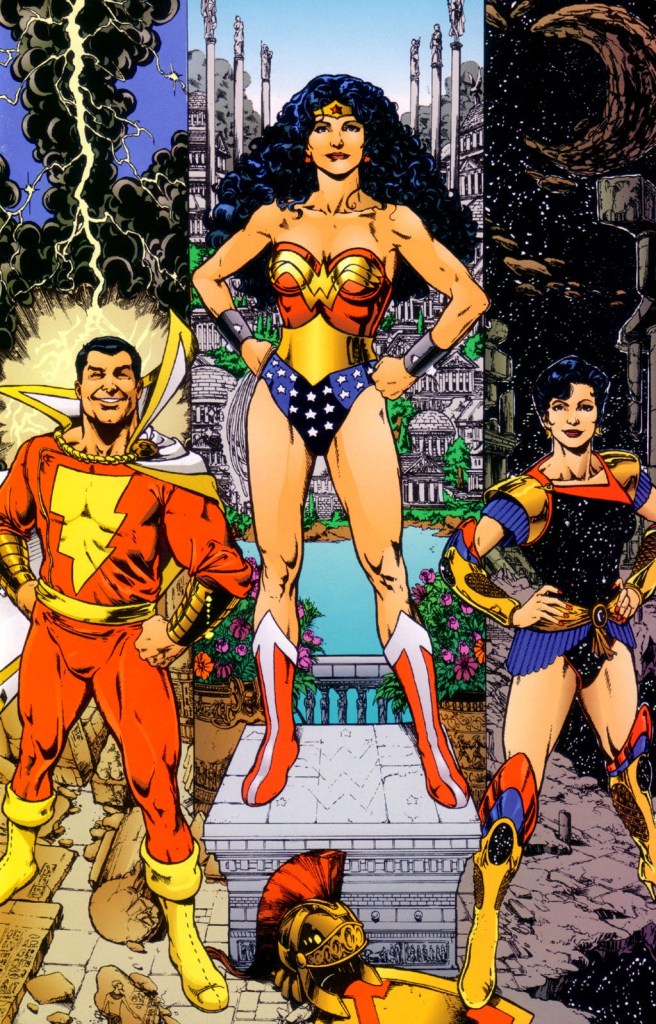
A Look Back at Mantra #10 (1994)

Disclaimer: This is my original work with details sourced from reading the comic book and doing personal research. Anyone who wants to use this article, in part or in whole, needs to secure first my permission and agree to cite me as the source and author. Let it be known that any unauthorized use of this article will constrain the author to pursue the remedies under R.A. No. 8293, the Revised Penal Code, and/or all applicable legal actions under the laws of the Philippines.

Welcome back superhero enthusiasts, comic book collectors and fans of the Ultraverse! We are about continue the retro review of comics from the Mantra monthly series. Previously, details and a close friend of Eden Blake from her past came back which obviously caught Lukasz (the male warrior occupying Eden’s body since issue #1) off-guard and added further pressure on him. And then something happened during the wedding of that close friend which compelled Mantra to fight someone in armor which eventually led to some revelations.

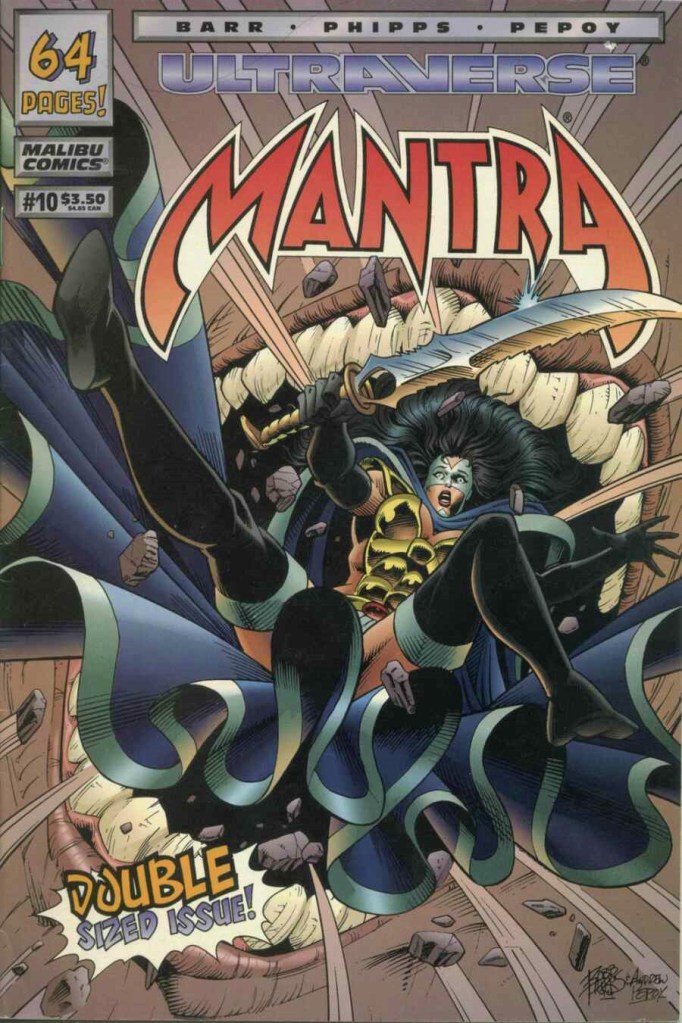
What will happen next to Mantra? We can all find out in this look back at Mantra #10, published in 1994 by Malibu Comics with a story written by Mike W. Barr and illustrated by Rob Phipps (who illustrated Mantra #4). This comic book is another one of those flip-side comics with the other side being Ultraverse Premiere #2 which contains short stories within the Ultraverse.

The cover.

Early story

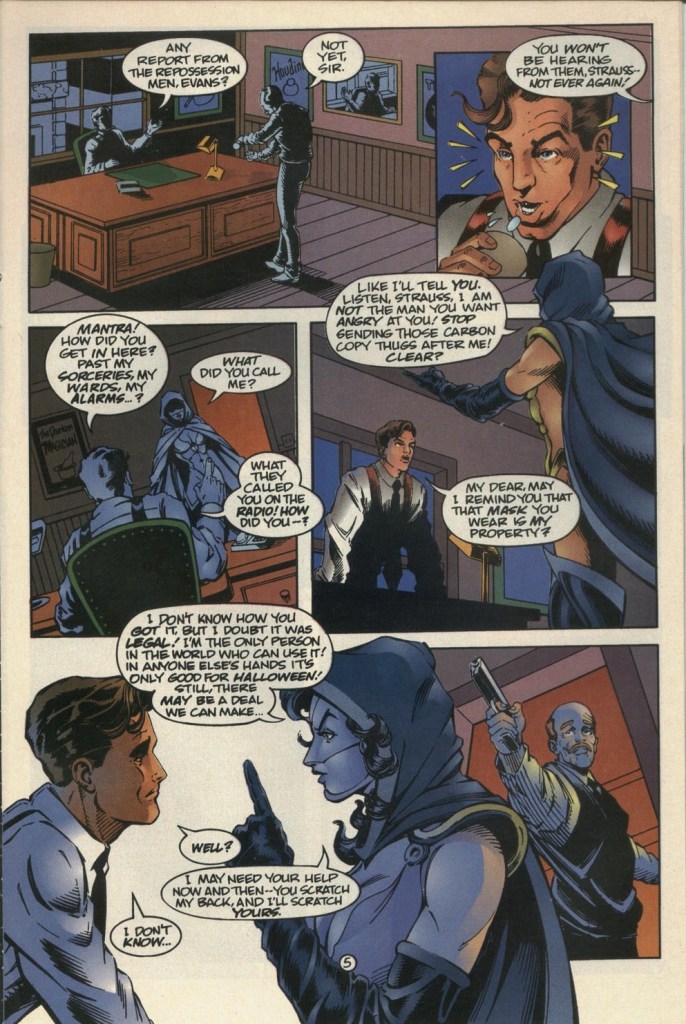
The story begins in the middle of a city when a man arrives at his office at a place called the Conjurirs’ Club. Upon entering, he is surprised to see three sinister looking men and one of them identifies him by his name – Edgar Strauss. Refusing to give in to them, Strauss puts up a seraphic shield. One of the magic users hits Strauss with force pushing him into his office chair. A servant of Strauss comes into the office but is confronted by another man with a hideous looking chest. Strauss suddenly gets overwhelmed with visions. In response to his question, the three men wanted information about Mantra whom they describe to be a witch.

Over at the Blake residence, Lukasz/Eden wakes up after having a very disturbing dream. It turns out, the dream had been repeating. Looking at the mirror, he sees Eden’s face and thought to himself: Still, it’s not much worse than my life which is a nightmare. I’m a warrior. I should be fighting the foes of Archimage with broadswords and mace…instead I was reincarnated as a woman – Eden, a housewife…worse, a housewife with kids!

After going through the morning traditions of feeding Eden’s son and daughter, sending them to school and getting dressed for work, he reports to work at the office inside the highly secured facility of Aladdin in southern California. While working as Eden, Lukasz uses magic to access the digital files via the computer. Suddenly, someone touches his shoulder from behind…

Quality

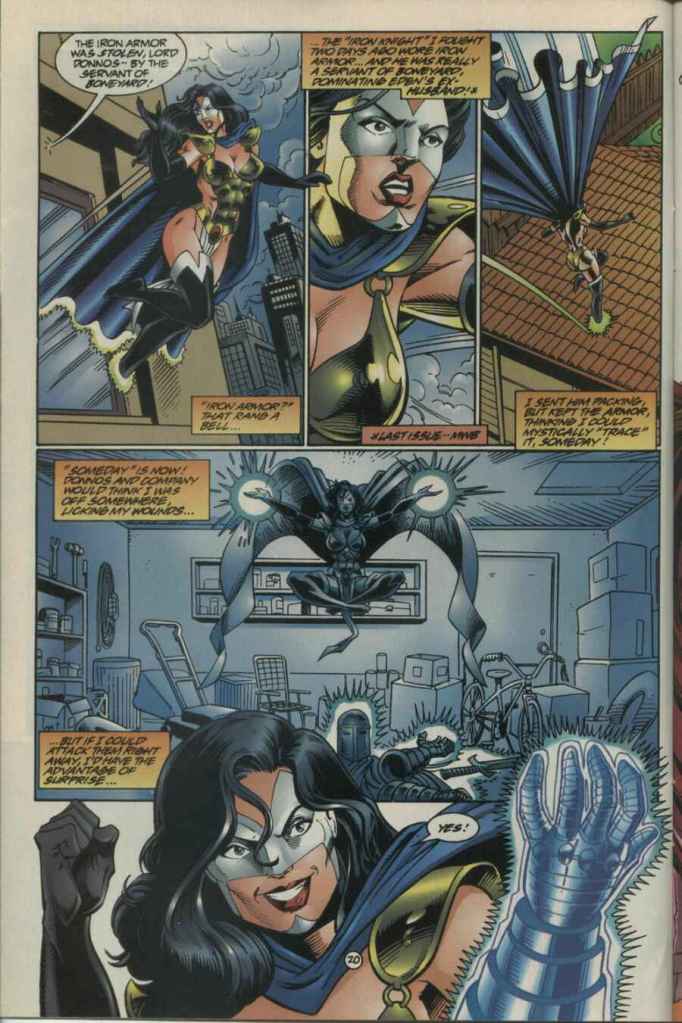
Mantra using a piece of the armor that the antagonist in issue #9 used.

I’ll start first with the art. Robb Phipps, like his previous Mantra work, delivered a fine job visualizing the script with a smooth pace, drawing spectacle nicely and making Mantra and the established characters look recognizable. I also like the way the artist drew facial expressions.

When it comes to the story, this one is even more intriguing and surprising than issue #9. The startling revelations from Lukasz’s past and his history with his tribe under Archimage expanded further here and this added more to the conflict with Boneyard. These revelations confirmed that not everything in the Archimage-Boneyard war is as simple as black and white. When it comes to characterization, Mike W. Barr really developed Lukasz in Eden’s body further and it was pretty notable to see Lukasz (who was oriented to fight with weapon instead of magic) become more adjusted using magic more proficiently while getting around the physical weakness of the lady’s body he is occupying.

As mentioned before, sorcery is an abomination in Christianity and this comic book further adds elements of the occult into the narrative. There was even a short scene of Boneyard (himself an abomination) in a location that looks like Hell.

Conclusion

Homosexuality hinted on the part of the man? Insanity perhaps?

If I were to describe Mantra #10 (1994), it’s an obvious shift to more fantasy and sorcery elements than the previous issues. It certainly is not a tale about good-versus-evil because Mantra is not exactly innocent (note: Lukasz is an established killer and has displaced so many people’s lives) even when compared to Boneyard. Technically, Boneyard is pretty much the Ultraverse version of Satan.

If you are seriously planning to buy an existing hard copy of Mantra #10 (1994), be aware that as of this writing, MileHighComics.com shows that the near-mint copy of the comic book costs $12.

Overall, Mantra #10 (1994) is satisfactory.

+++++

Thank you for reading. If you find this article engaging, please click the like button below and also please consider sharing this article to others. If you are looking for a copywriter to create content for your special project or business, check out my services and my portfolio. Feel free to contact me as well. Also please feel free to visit my Facebook page Author Carlo Carrasco and follow me at HavenorFantasy@twitter.com
A Look Back at What If #13 (1990)

Disclaimer: This is my original work with details sourced from reading the comic book and doing personal research. Anyone who wants to use this article, in part or in whole, needs to secure first my permission and agree to cite me as the source and author. Let it be known that any unauthorized use of this article will constrain the author to pursue the remedies under R.A. No. 8293, the Revised Penal Code, and/or all applicable legal actions under the laws of the Philippines.

Welcome back superhero enthusiasts, comic book collectors and X-Men fans. I’m about to review an issue of Marvel Comics’ What If monthly series which was published 1990 and was related to the X-Men as the central figure of the comic book is Charles Xavier (AKA Professor X).

To put things in perspective, Charles Xavier is forever known as the founder and leader of the X-Men. Within the Marvel Comics universe, he is one of the most powerful telepaths as well as a genius in science and genetics. He is a paraplegic who can do quite a lot and make an impact on the delicate relationship between his fellow mutants and the humans. In the movies, Xavier was portrayed by Patrick Stewart (first performance as Xavier in X-Men) and James McAvoy (first performance as Xavier in X-Men: First Class). Given his legacy of helping mutants gain rights through peaceful means, Charles Xavier has been compared with Martin Luther King, Jr. Going back to the comics, Xavier has a step brother named Cain Marko who became the X-Men villain Juggernaut.

With the background lesson done, we can now take a look back at What If #13, published by Marvel Comics in 1990 with a story written by Kurt Busiek and drawn by Vince Mielcarek.

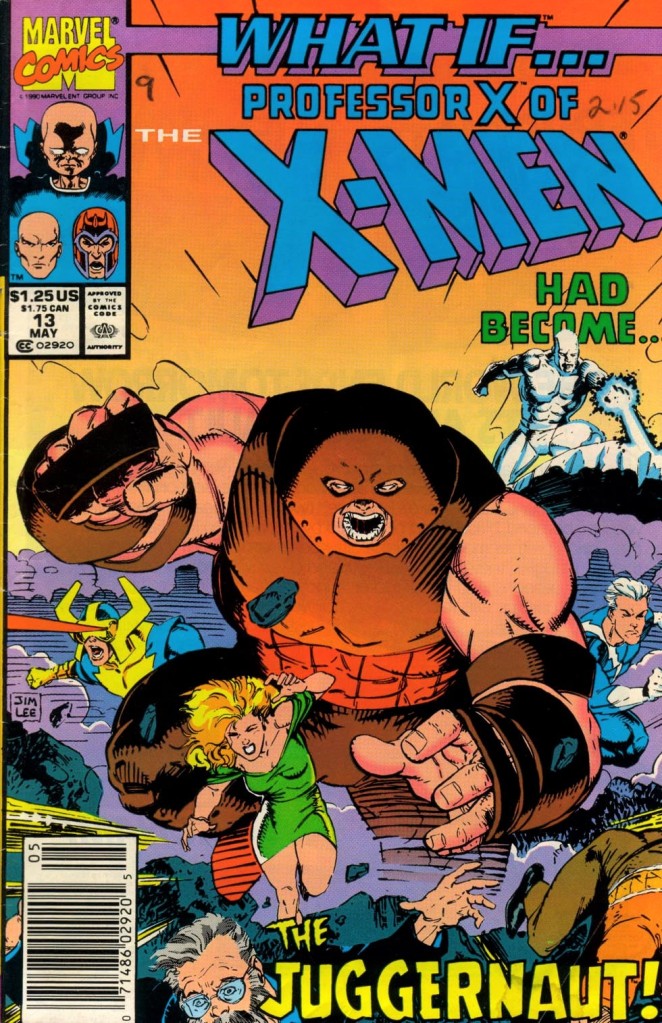
The cover drawn by Jim Lee.

Early story

The story begins in New York in the so-called near future. Graffiti artists attempt to run away from a team of mutants riding a floating vehicle. As Thunderbird is about to hit one of the humans, Cyclops stops him. Suddenly the mutants receive a telepathic message from their big boss who turns out to be Charles Xavier the Juggernaut.

Xavier is leading the effort against a group of humans who have been conspiring against them. Xavier declares, “They must be stopped—for the good of mutantkind!”

The X-Men in this particular story are fascist storm troopers policing a wretched, helpless humanity…

Quality

Xavier-Juggernaut with the X-Men and the invading Fantastic Four.

I can start by say that this comic book written by Kurt Busiek has one of the most compelling what-if scenarios that reflect not only its concept (of Charles Xavier becoming Juggernaut) but also the Marvel Comics universe as we know it. As dedicated X-Men fans know, Cain Marko was the one who touched the ruby in the cave which made him the mainstream Juggernaut. In here, the scenario was altered to make Charles Xavier become Juggernaut and the radical changes did not end there. Without spoiling the great stuff, I can say that this is one great exploration of an alternate version of events that affect not only the X-Men and their villains but also the many other superheroes of the Marvel universe as Xavier-Juggernaut went all-out with his dedication to mutantkind. I can say that in this story, symbolically speaking, Xavier easily outclasses the extreme Magneto on prioritizing mutants over humans.

Comic book concept aside, Kurt Busiek’s writing here is really excellent. Not only did he capture the traits of Xavier as he turned him into the alternate Juggernaut, Busiek also emphasized the many twisted events in the Marvel shared universe with sufficient details. The details implemented made the scenarios really believable. His script for this comic book was brought to life by Vince Mielcarek who did a good job making the characters recognizable (note: there were a lot of superheroes and villains here), showcasing the wide scope of changes made on people and places (in relation to Xavier-Juggernaut’s actions) and there was good pacing with the visuals.

Conclusion

Charles Xavier as you’ve never seen him before.

What If #13 (1990) is great to read and it is a must-have with its story alone. Apart from showing the concept’s deep impact on the Marvel Comics universe, I also enjoyed the way Kurt Busiek blurred the boundaries that separated good and evil. If you are an X-Men and you want to see something different with the mutants – especially Professor X – then you you will find a lot to enjoy here. This is a great alternate superhero story and definitely more people should be aware of this.

If you are seriously planning to buy an existing hard copy of What If #13 (1990), be aware that as of this writing, MileHighComics.com shows that the near-mint copy of the regular edition costs $30 while the near-mint copy of the newsstand edition costs $60.
Overall, What If #13 (1990) is highly recommended!

+++++

Thank you for reading. If you find this article engaging, please click the like button below and also please consider sharing this article to others. If you are looking for a copywriter to create content for your special project or business, check out my services and my portfolio. Feel free to contact me as well. Also please feel free to visit my Facebook page Author Carlo Carrasco and follow me at HavenorFantasy@twitter.com