A Look Back at The Man of Steel #4 (1986)

Welcome back superhero enthusiasts, 1980s culture enthusiasts and comic book collectors! Today we go back to the mid-1980s to explore a part of the DC Comics shared universe through a tale of the iconic Superman.

Shortly after the end of the original multiverse of DC Comics, the publisher organized a massive reboot of its superhero franchises and universe. To reboot and modernize the iconic Superman, DC hired John Byrne and backed him up with a solid creative team. The result was the 6-part comic book mini-series The Man of Steel. Previously, I reviewed The Man of Steel #1 and #2 which collectively established Superman and Lois Lane as the iconic superhero and the definitive supporting character of the post-Crisis age respectively. Of course, the super villain opposite the post-Crisis Superman had to be established.

With those details laid down, here is a look back at The Man of Steel , published in 1986 by DC Comics with a story written and illustrated by John Byrne.
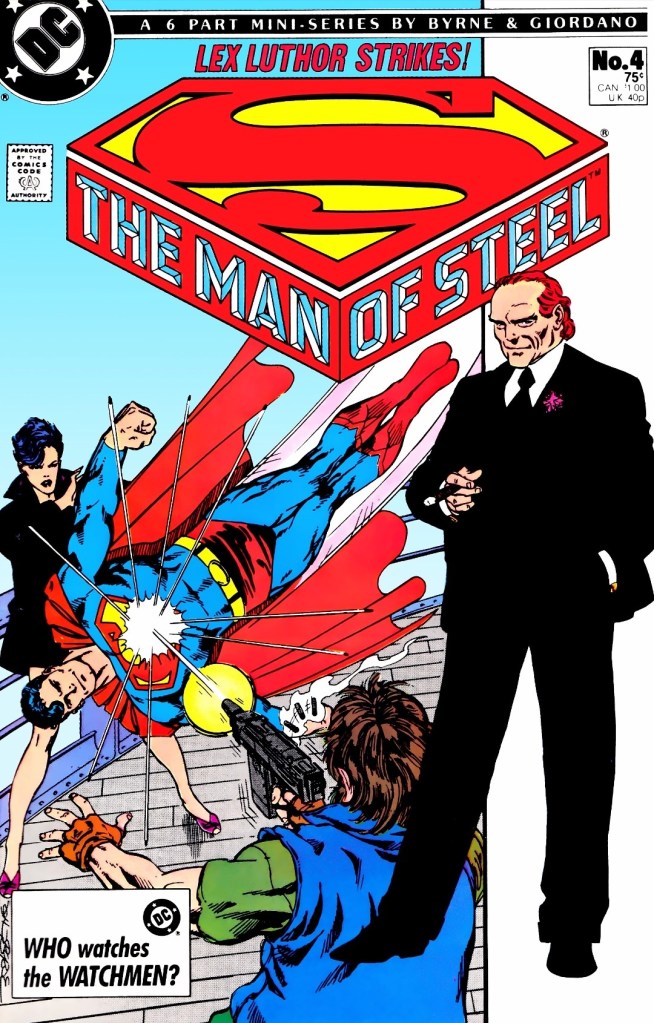
The cover.

Early story

The story begins when a daringly dressed Lois Lane arrives at the apartment of Clark Kent who has not even fully prepared himself for their trip to an extravagant gathering. It turns out, Lois’ ride picked her up earlier than expected which explains her early arrival.

After entering Clark’s apartment, she slowly begins to discover what he looked like in school and who his parents are. By this time, it has been almost eighteen months since Clark beat her to the first-ever Superman news story at the Daily Planet.

Afterwards, Lois and Clark took a surprising helicopter ride going to the luxurious ship of the powerful tycoon Lex Luthor…

Quality
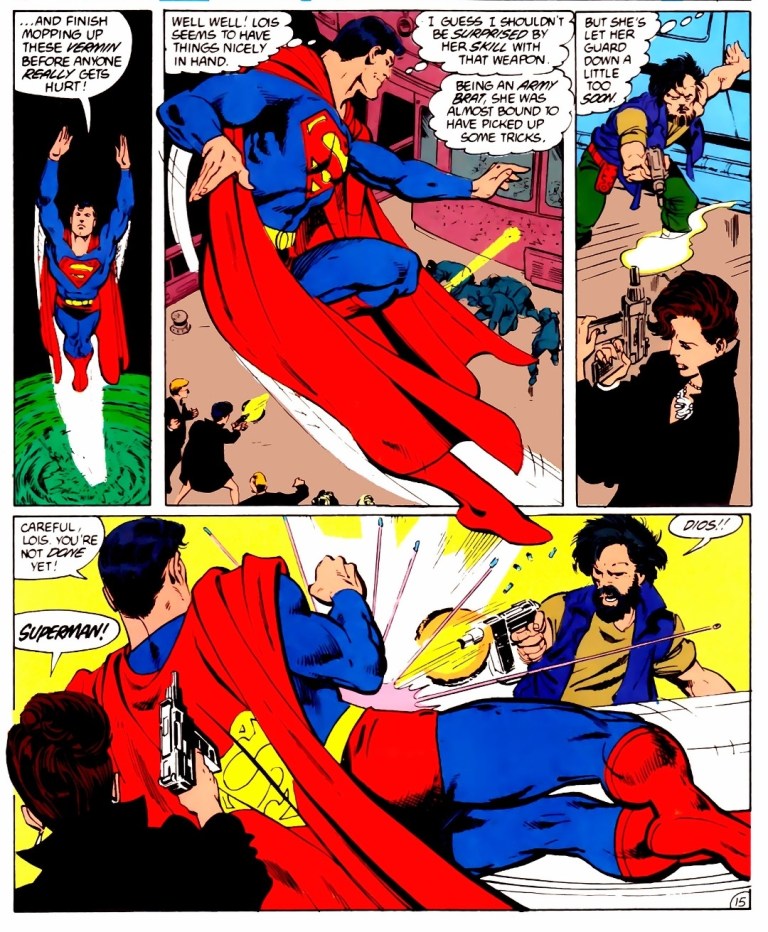
Superman intervenes to protect Lois Lane from one of the terrorists.

To make things clear, this issue is all about John Byrne presenting a new version of Superman’s definitive rival Lex Luthor with the 1980s in mind. Instead of a mad scientist, the post-Crisis Luthor is a billionaire whose corporation (Lexcorp) has an interest in virtually every business in Metropolis and his immense wealth makes him a very powerful figure. This new version of Luthor was clearly done to be more grounded with reality, specifically with regards to the rise of tycoons in America in the 1980s. In short, Luthor was the ruthless and powerful businessman before Michael Douglas even got to play Gordon Gekko in 1987’s Wall Street.

While the effort of making a really new version of Superman’s arch-rival is clear, Luthor here does not appear too menacing at first. The story and impact of Luthor’s evil really started to materialize as soon as the South American terrorists appeared, but not in a way that you might expect. As mentioned above, Luthor here is more grounded with reality and that means you won’t see him oppose Superman with science and technology. Instead, Luthor simply has wealth, the power and resources to go against the Man of Steel. The tycoon also knows that the American-born Kryptonian would not dare attack him as laws already exist.

Having read lots of Superman’s encounters with Luthor in the pre-Crisis era – particularly the 1970s up to the mid-1980s – it is clear to me that their first post-Crisis encounter turned out underwhelming and never dynamic. In fairness, I really enjoyed reading the 2nd encounter between Superman and Luthor as the words of the latter were filled with anger and tension. It should be noted that Byrne’s visual approach on showing the city and the people as Luthor’s dialogue went on was a great touch.

When it comes to the storytelling, it is quite simple which is not surprising because it was crafted to make way for post-Crisis Luthor to be introduced and dramatized. As for the character development, there is indeed progress with regards to the chemistry between Clark Kent and Lois Lane who are portrayed as friends living with a journalistic competition between them. It was also in this comic book where you will see Superman follow the law and the command of Metropolis’ highest official.

Speaking of law, you will notice what kind of impact Luthor has on others when he really does things his own way. This is something you should read in this comic book.

Conclusion

This is John Byrne’s version of Lex Luthor in the form of a powerful tycoon. A complete departure from the mad scientist Luthor of the pre-Crisis era of DC Comics.

While the first-ever conflict between Superman and Luthor in the post-Crisis age was indeed underwhelming, it was John Byrne’s in-depth writing and portrayal of events that made The Man of Steel (1986) a worthy read. Don’t expect to see a lot of action here nor anything spectacular with Superman. Clearly, the tycoon Lex Luthor is the feature character of this tale and the start of his hatred towards Superman is really worth reading. In retrospect, Luthor’s ruthlessness and evil got stronger and clearer after the end of this comic book (for reference, click here).

Overall, The Man of Steel (1986) is recommended.

+++++

Thank you for reading. If you find this article engaging, please click the like button below, share this article to others and also please consider making a donation to support my publishing. If you are looking for a copywriter to create content for your special project or business, check out my services and my portfolio. Feel free to contact me with a private message. Also please feel free to visit my Facebook page Author Carlo Carrasco and follow me on Twitter at  @HavenorFantasy as well as on Tumblr at https://carlocarrasco.tumblr.com/ and on Instagram at https://www.instagram.com/authorcarlocarrasco
A Look Back at The Man of Steel #2 (1986)

Welcome back superhero enthusiasts, 1980s culture enthusiasts and comic book collectors! Today we go back to the mid-1980s to explore a part of the DC Comics shared universe through a tale of the iconic Superman.

Previously, I reviewed the first issue of The Man of Steel mini-series written and drawn by John Byrne. Using a unique structure for storytelling, Byrne gradually told how the post-Crisis version of Superman came to be while also retaining specific classic elements that made DC’s icon inspirational. That very comic book had its influences on other portrayals of Superman beyond comic books such as he Lois & Clark: The New Adventures of Superman TV series and even the very divisive Man of Steel movie.

With those details laid down, here is a look back at The Man of Steel , published in 1986 by DC Comics with a story written and illustrated by John Byrne.

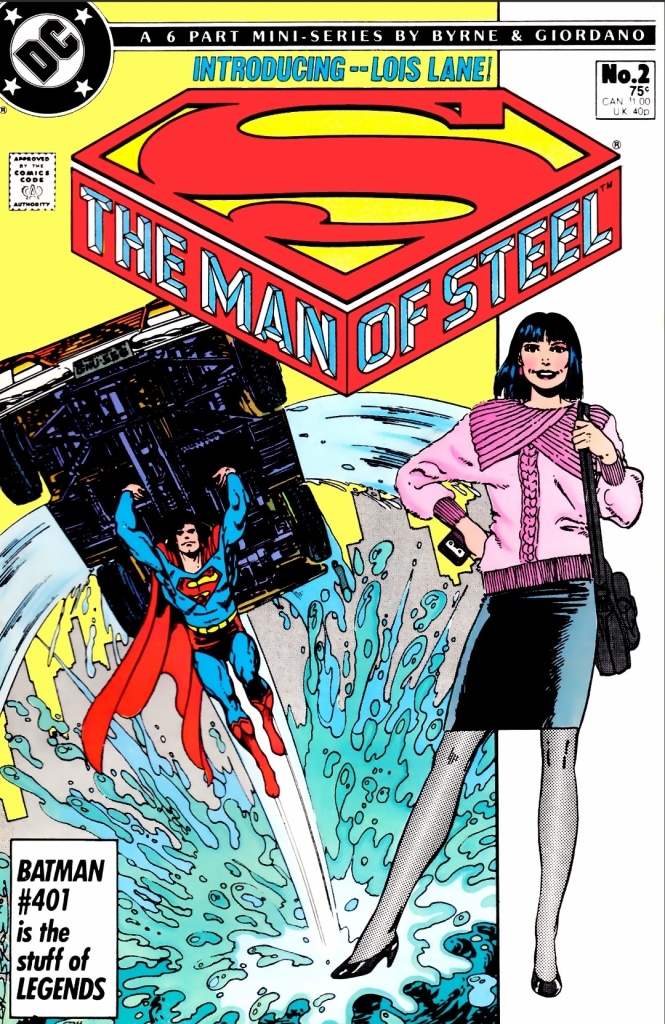
The cover.

Early story

The story begins in the middle of Metropolis when the newly established hero Superman (now in full costume) flies just above the busy road which distracted Daily Planet editor-in-chief Perry White (who was having a coffee break with reported Lois Lane inside a coffee shop). Remembering how the space plane and its crew got saved by Superman (Clark Kent in civilian clothes) sometime prior, White tells Lane (who first encountered Superman immediately after the space plane was saved) to go after him to get the hot scoop.

While Lane crosses the road, a limousine’s opens with the driver telling her that Mister L (Lex Luthor the tycoon) wants to her. Lane declines and proceeds with her chase for Superman…

Quality

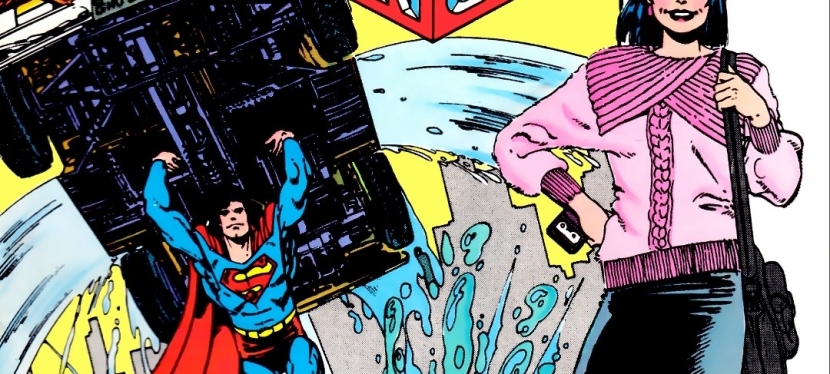
An act of help by Superman for someone who was in trouble.

This story is set during the early days of Superman as the new, randomly appearing hero of Metropolis whose impact on local society is just growing stronger. At the same time, this shows Clark Kent being a very new resident of the city still looking for a job. This is inspired work by Byrne on building up the Man of Steel for what was back then the modern age.

That being said, the most intriguing fact here is that this Superman story has Lois Lane as the actual protagonist. While Lane’s literary presence here is slightly stronger than DC’s icon, this tale is clearly all about her unrelenting approach with newspaper journalism, her use of the Daily Planet’s valuable connections and resources, and how much risk she would take to get the facts, the statements and other details all for the sake of getting the hot story. This is Byrne’s modernization of Lois Lane highlighting the concept that Clark Kent will have serious competition with her within the Daily Planet.  

That being said, there is no romance between Clark and Lois here. This is after all their 2nd encounter (the saving of the space plane in issue was shown in flashback with Lois Lane already present) and Byrne took a careful approach on establishing the first lengthy encounter and interactions between the two. Their encounter here is really engaging.

More on Superman himself, the writer kept the pace of developing him flow smoothly and steadily. You will see how Superman keeps himself in control whenever he talks with normal people or when he encounters criminals who cause danger on others. While he has a priority to help others in need using his powers, he does not neglect his actual identity (and personal life) as Clark Kent and this includes moderating or limiting the use of his special abilities as he levels himself with the rest of the civilian population.

Conclusion

Lois Lane portrayed as the unrelenting and very determined newspaper reporter. Even though Superman always flew away, she just won’t give up.

The Man of Steel (1986) is clearly a very solid follow-up to issue . The continued development of Superman remains solid and the dramatization of Lois Lane as the strongly determined newspaper journalist is compelling to see. With regards to the build-up of the post-Crisis DC Comics shared universe, this particular Superman tale is one of essential parts of it.

Overall, The Man of Steel (1986) is highly recommended!

+++++

Thank you for reading. If you find this article engaging, please click the like button below, share this article to others and also please consider making a donation to support my publishing. If you are looking for a copywriter to create content for your special project or business, check out my services and my portfolio. Feel free to contact me with a private message. Also please feel free to visit my Facebook page Author Carlo Carrasco and follow me on Twitter at  @HavenorFantasy as well as on Tumblr at https://carlocarrasco.tumblr.com/ and on Instagram at https://www.instagram.com/authorcarlocarrasco

A Look Back at Superman: The Man of Steel #18 (1992)

Disclaimer: This is my original work with details sourced from reading the comic book and doing personal research. Anyone who wants to use this article, in part or in whole, needs to secure first my permission and agree to cite me as the source and author. Let it be known that any unauthorized use of this article will constrain the author to pursue the remedies under R.A. No. 8293, the Revised Penal Code, and/or all applicable legal actions under the laws of the Philippines.

Welcome back superhero enthusiasts, 1990s culture enthusiasts and comic book collectors! Today we go back to the early 1990s and explore a key chapter in the post-Crisis era of DC Comics through a Superman comic book – the first full appearance of Doomsday!

To those of you who read my retro review of Adventures of Superman #498 (1993) – which was the opening chapter of the Funeral for a Friend storyline – you might be wondering why I decided to revisit the Death of Superman storyline so suddenly. It all comes down to context related to Superman’s eventual death and what killed him. Not only did Doomsday become a very important part of DC Comics’ gallery of super villains having achieved the killing of the Man of Steel, the oversized monster became part of DC’s further comic book universe reboots as well as part of multimedia adaptations of DC Comics stories specifically in the Smallville TV series as well as in 2016’s Batman v. Superman: Dawn of Justice.

Indeed, Doomsday’s place in American pop culture is sealed and that shows how much of an impact was made by the unstoppable super villain co-created by Dan Jurgens, Brett Breeding, Jerry Ordway, Louise Simonson and Roger Stern. Doomsday was conceived way back in 1991 during the brainstorming session of the Superman comics writers and editors of the time.

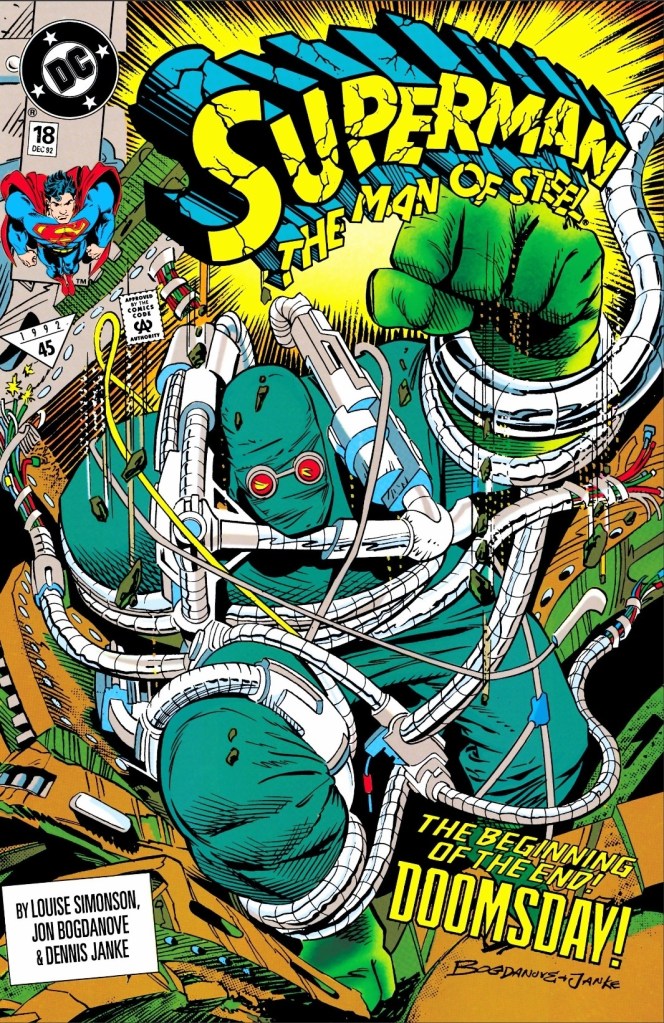
With those details laid down, here is a look back at Superman: The Man of Steel #18, published in 1992 by DC Comics with a story written by Louise Simonson and drawn by Jon Bogdanove. This comic book marked the beginning of the Death of Superman saga.

The cover.

Early story

The story begins deep underground as the left fist of a covered, large being keeps punching the metallic wall to get out of containment. As the punches keep on pounding the wall, the glove gets torn revealing a fist with gray skin and sharp bones protruding through the knuckles. After making its way out of containment, the earth shakes and the animals got disturbed as the creature – mostly covered with an alien body suit  with only the left arm freed – makes its way from deep underground.

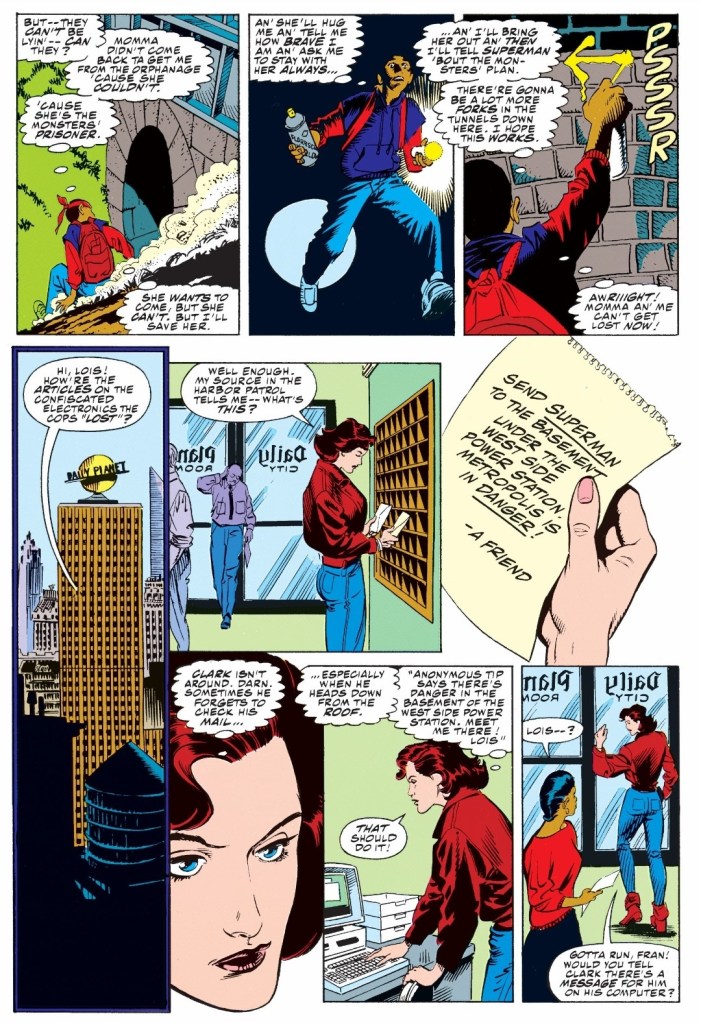
Miles away within the city of Metropolis, a young black boy buys a spray paint container (which has a fluorescent yellow paint that glows in the dark) inside a hardware store. In response to the curiosity of the store owner, the boy denies that he would use the glow-in-the-dark pain on a subway wall. The boy has a very tough task ahead of him as he will be going after monsters.

At a power station, a group of intelligent creatures make their way to steal electricity for their war machines…

Quality

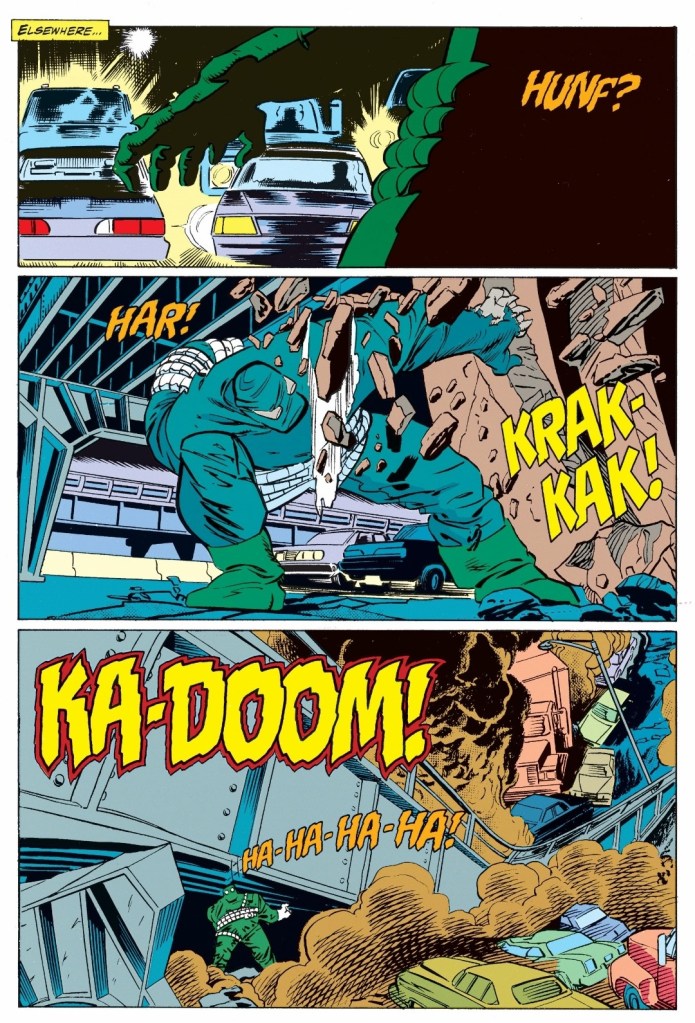
Even with only his left arm free, Doomsday still caused massive destruction causing injuries and deaths to others.

To make things clear, this comic book tells two stories that moved in parallel together. The first story involving Superman, Lois Lane and the affairs that involved the mentioned young black boy is the typical good-versus-evil superhero tale. What made that story standout was Lois Lane’s involvement as she got into trouble facing the opposition before Superman came in to save the day. As before, seeing Lois Lane talk to Superman in the presence of others while keeping his identity secret remains engaging to read. This tale was good enough to read.

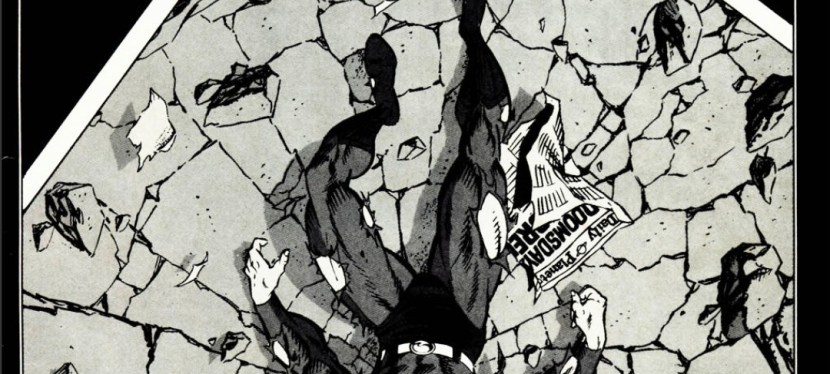
The other story that follows the sudden appearance and the early rampage of Doomsday is the more engaging one to read. This was clearly a build-up for the Death of Superman concept but it was highly effective, well-paced and clearly defined by the creative team. Not only will you see Doomsday’s unstoppable power of destruction, you will witness his complete disregard of life – animals and humans – which strongly hints the an immense danger that Superman, the Justice League America (JLA) and the people of Metropolis are not prepared for. Like the Terminator, Doomsday cannot be reasoned with as massive destruction and death are his core elements. Within the pages of this comic book, it can be viewed that Doomsday was designed for endless waves of destroying life and anything that gets in the way.

Lastly, I should state that Simonson and Bogdanove presented Doomsday not only to be destructive but also as a frightening force that people in real life would not want to see realized.

Conclusion

The other tale that involved Lois Lane and the young black boy.

Superman: The Man of Steel #18 (1992) remains a very powerful read. Yes, it is a build-up of Doomsday and the Death of Superman saga but it remains highly significant as it kicked-off the creative change of direction of DC’s Superman creative teams going towards tragedies that Superman and his allies cannot easily stop. This one marked start of Doomsday’s eventual high rise not only in comics but also in pop culture in general. That being said, this comic book is a must-have in your collection.  

Overall, Superman: The Man of Steel #18 (1992) is highly recommended.

+++++

Thank you for reading. If you find this article engaging, please click the like button below, share this article to others and also please consider making a donation to support my publishing. If you are looking for a copywriter to create content for your special project or business, check out my services and my portfolio. Feel free to contact me with a private message. Also please feel free to visit my Facebook page Author Carlo Carrasco and follow me on Twitter at  @HavenorFantasy as well as on Tumblr at https://carlocarrasco.tumblr.com/ and on Instagram at https://www.instagram.com/authorcarlocarrasco

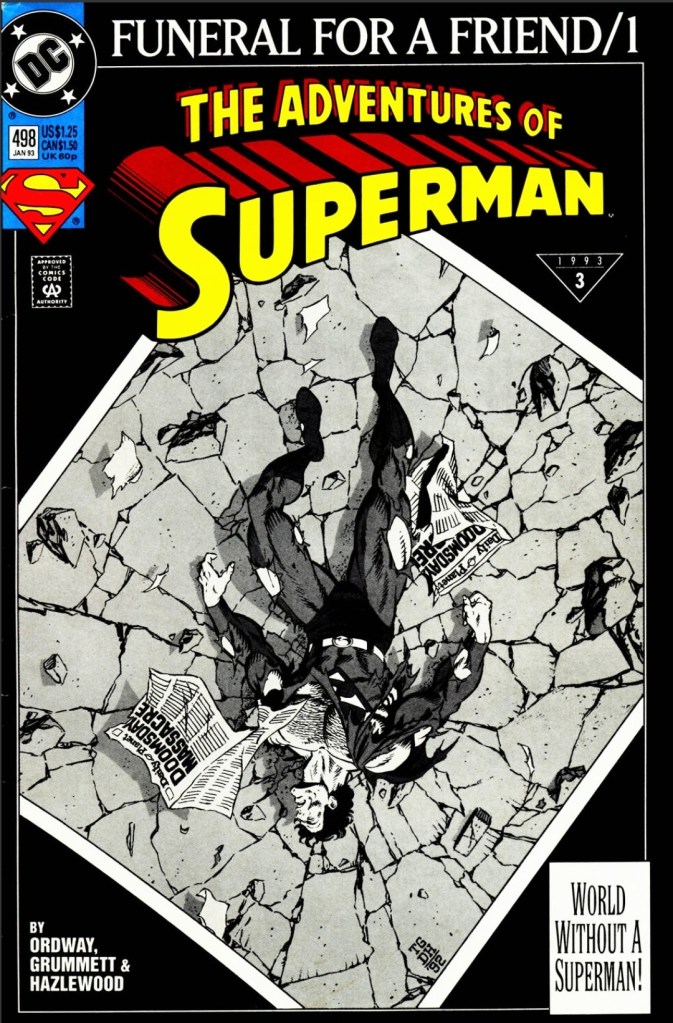
A Look Back at Adventures of Superman #498 (1993)

Disclaimer: This is my original work with details sourced from reading the comic book and doing personal research. Anyone who wants to use this article, in part or in whole, needs to secure first my permission and agree to cite me as the source and author. Let it be known that any unauthorized use of this article will constrain the author to pursue the remedies under R.A. No. 8293, the Revised Penal Code, and/or all applicable legal actions under the laws of the Philippines.

Welcome back superhero enthusiasts, 1990s culture enthusiasts and comic book collectors! Today we go back to the early 1990s and explore a key chapter in the post-Crisis era of DC Comics through a Superman comic book.

To put things in perspective, the Death of Superman which climaxed in Superman (1993) was a major comic book event published by DC Comics and it sure involved a whole lot of risks taken by the creative teams. To put the storyline’s concept short, Superman was beaten by an overwhelming, deformed alien humanoid from outer space who caused massive destruction around. Having no real choice and knowing that his fellow super-powered allies could not stand a chance against the alien called Doomsday, Superman went all-in fighting and stood up against him while defending Metropolis and its people. Superman went on to sell many millions of copies and became an instant collector’s item.

Of course, just because Superman died does not mean that the shared DC universe at that time would come to an end and DC Comics had to keep on telling what happened afterwards.

With those details laid down, here is a look back at Adventures of Superman , published in 1993 by DC Comics with a story written by Jerry Ordway and drawn by Tom Grummett. This comic book marked the first chapter of the Funeral for a Friend storyline.

The cover.

Early story

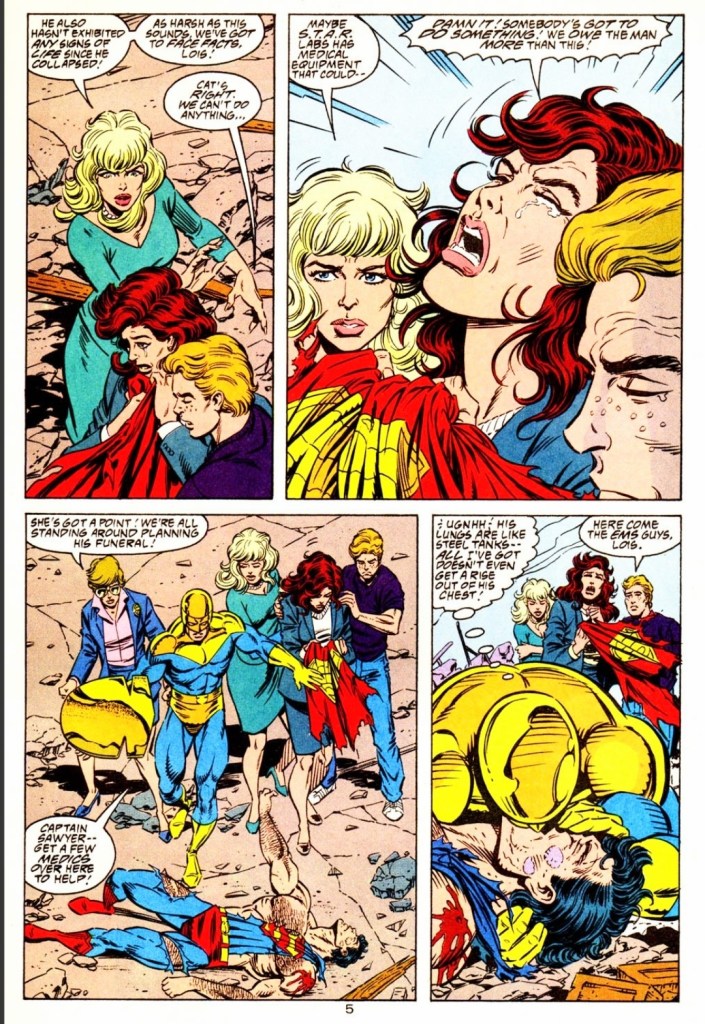
The story begins just moments after the Superman passed away in Lois Lane’s arms. Jimmy Olsen, the body of Doomsday and a few of Superman’s allies were near them. Bloodwynd and Dubbilex shared their respective findings that there is no life left in Superman. As emergency personnel slowly approach Doomsday’s body, Lois Lane turns emotional stating that someone has to do something for Superman. More emergency personnel arrive and attempt to revive the Man of Steel who remains lifeless.

Nearby, a man spots an unrecognizable human-like body among the rubble which turns out to be alive. Suddenly the red-headed tycoon Lex Luthor arrives to take care of the ruined being and walks away carrying it. Luthor refers to the being as a female…   

Quality

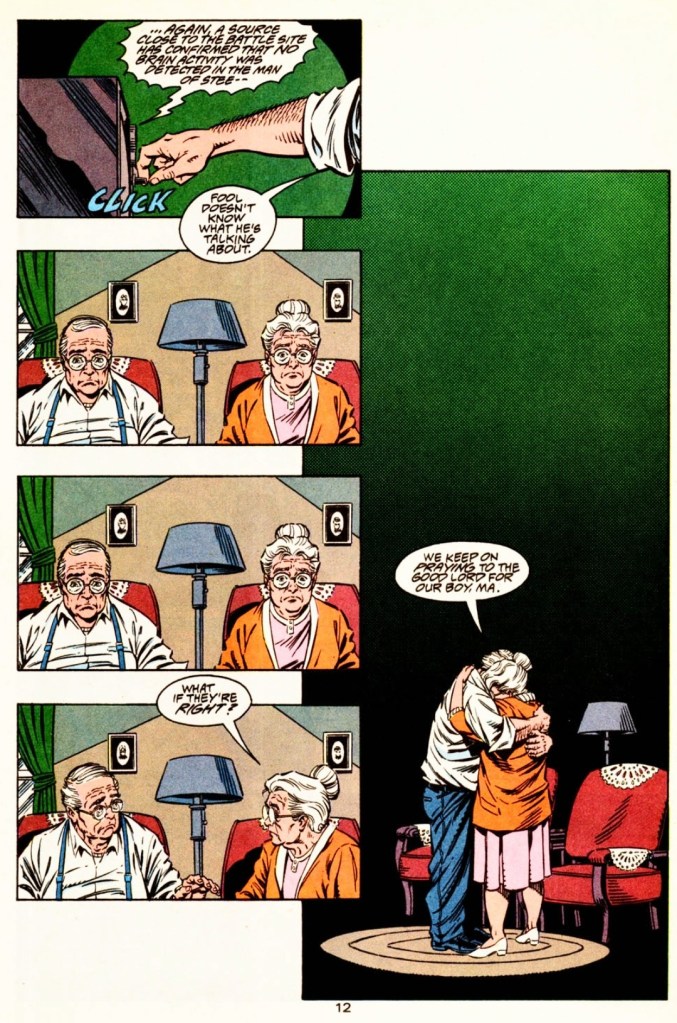
The Ordway-Grummett team should be recommended for this simple yet very dramatic look at the elderly Kent couple reacting to the death of their adopted son from Krypton.

As a post-death Superman story, it is clear that the creative team carefully explored how the many people of Metropolis would react to the sudden death of the Man of Steal while also leaving some room to set the stage to develop Lois Lane – who at this stage knew Superman’s true identity and kept it all secret – in a new way. There were also sub-plots started here particularly with Lex Luthor and Supergirl, the people working for the Daily Planet and the Kents (Clark’s earthly mother and father). The way all the dialogue and character expressions were crafted, there is an undeniable tone of discomfort and uncertainty which dominated the narrative as I read from start to finish.

What I liked the most about this story was how the creative team showed the heavy toll of Superman’s death on Lois Lane who not only has to deal with the loss of her beloved Clark (perceived by her peers to be missing as a possible victim of Doomsday’s rampage) but also do her best to keep working professionally as a journalist of the Daily Planet. I felt Lane’s pain a lot as I read on.  

Conclusion

Tension and emotions turned high in relation to Superman’s sudden death.

In my view, Adventures of Superman (1993) is a really gripping and highly dramatic post-disaster superhero tale to read. The way it was made, it strongly kicked off the Funeral for a Friend storyline with high emotions as well as an understandable amount of uncertainty that can be seen in the characters. Understandably, there is no good-versus-evil conflict in the story nor any superhero spectacle to watch out for but the sub-plots implemented added some depth which made this post-death tale worth reading. More notably, the creative team succeeded in making the people – both in the story and the reading public – start missing Superman.

Overall, Adventures of Superman (1993) is recommended.

+++++

Thank you for reading. If you find this article engaging, please click the like button below, share this article to others and also please consider making a donation to support my publishing. If you are looking for a copywriter to create content for your special project or business, check out my services and my portfolio. Feel free to contact me with a private message. Also please feel free to visit my Facebook page Author Carlo Carrasco and follow me on Twitter at  @HavenorFantasy as well as on Tumblr at https://carlocarrasco.tumblr.com/ and on Instagram at https://www.instagram.com/authorcarlocarrasco
A Look Back at Superman III comic book adaptation (1983)

Disclaimer: This is my original work with details sourced from reading the comic book and doing personal research. Anyone who wants to use this article, in part or in whole, needs to secure first my permission and agree to cite me as the source and author. Let it be known that any unauthorized use of this article will constrain the author to pursue the remedies under R.A. No. 8293, the Revised Penal Code, and/or all applicable legal actions under the laws of the Philippines.

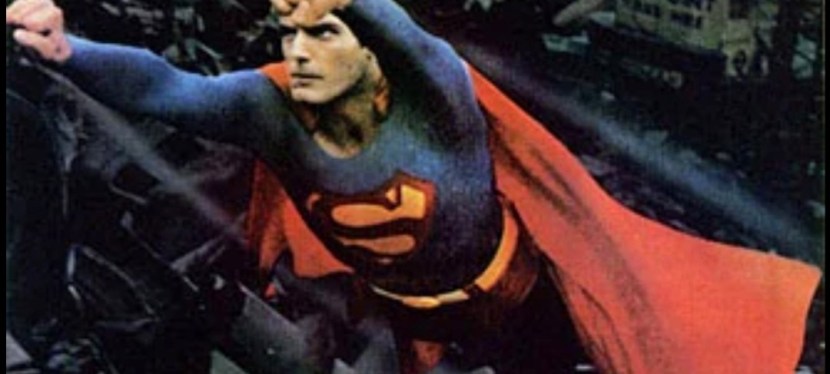
Welcome back superhero enthusiasts, 1980s culture enthusiasts and comic book collectors! Today we go back to the year 1983 which saw the theatrical release of Superman III that featured the late Christopher Reeve as the cinematic Man of Steel.

The 1980s was a very different time with regards to Hollywood’s handling of superhero movies. The concept of a shared cinematic universe was decades away from realization. Warner Bros. back then relied on the Salkind family to produce Superman movies and the first flick in 1978 proved to be a major hit for both viewers and critics while also establishing Christopher Reeve as the definitive live-action Superman for countless people. Unsurprisingly, a sequel was released in the early 1980s which continued box office success for the stakeholders and only led to the approval of another sequel.

Along the way, the late Richard Pryor (a major comedian already) appeared on TV and talked about Superman II which eventually led to him getting hired for Superman III. The movie was released in 1983 making a little over $80 million worldwide while also getting a noticeably weaker reception from critics. More notably, Richard Pryor had a huge chunk of the film’s spotlight as Gus Gorman while the overshadowed Christopher Reeve managed to stretch his cinematic art on playing Clark Kent and Superman (note: there is also the memorable Clark versus Superman battle). Superman III very clearly had a lot more comedy in its presentation. As part of the movie’s marketing, an official comic book adaptation by DC Comics was published.

With those details laid down, here is a look back at the Superman III comic book adaptation,  published by DC Comics in 1983 with a story written by Cary Bates and art made by the late Curt Swan and Sal Amendola.

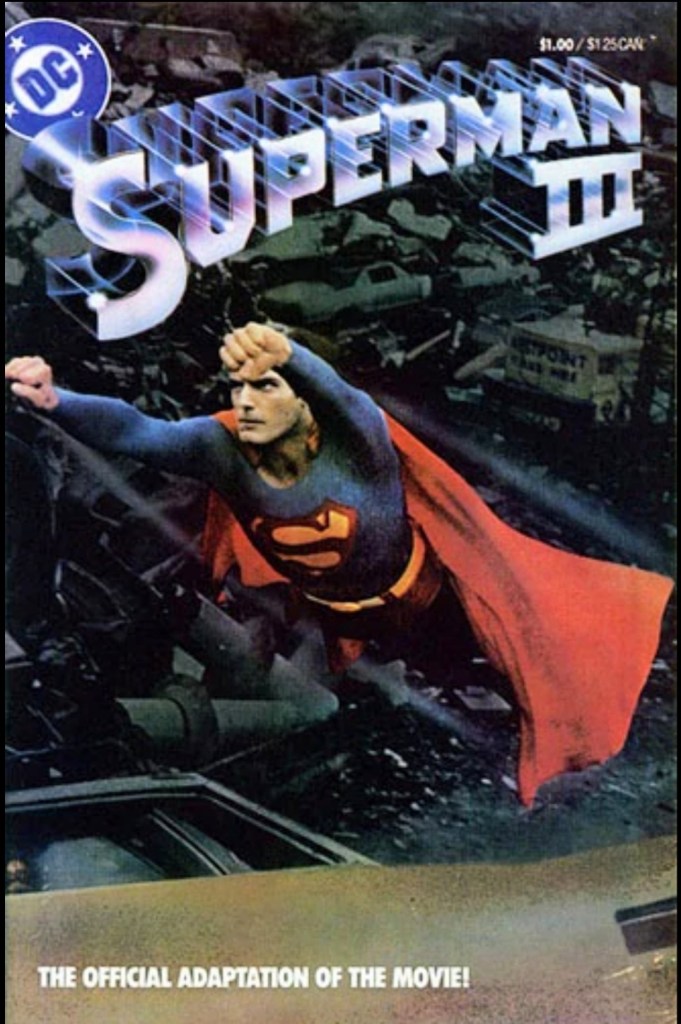
The cover.

Early story

The story begins inside the unemployment bureau of Metropolis. There, August “Gus” Gorman was told after 36 weeks of chronic unemployment, he is no longer eligible for financial assistance (read: welfare) from the city. As he was about to light his cigarette, he noticed computer job ad on the match. Gorman proceeds to the Archibald Data Processing School where he gets enrolled with several others. In front of others, Gorman does something on a computer which impressed the instructor a lot.

Over at the Daily Planet, Clark Kent/Superman, Lois Lane and Jimmy Olsen meet with Perry White at his office. Kent will be returning home to Smallville and make a news story out of it. White gives Kent his approval and then tells Lois she deserves a vacation.

Hours later, Kent and Jimmy Olsen ride the bus together going to Smallville but their ride stops as a result of a huge fire damaging a large chemical plant. A police officer reveals to Olsen that the scientists inside are worried about the plant and its stuff getting destroyed by the fire.

Kent carefully leaves the bus and discreetly changes into Superman to help solve the problem. Olsen, meanwhile, sneaks past the authorities to get to the burning chemical plant.

Over at Webcoe Industries, company head Ross Webster and his sister Vera learn that more than $85,000 worth of company funds was stolen by someone within. Just outside the office, Gus Gorman enters his fancy looking sports car which Webster, Vera and Lorelei notice. Webster asked how could one of their computer technicians afford such a vehicle worth $75,000…    

Quality

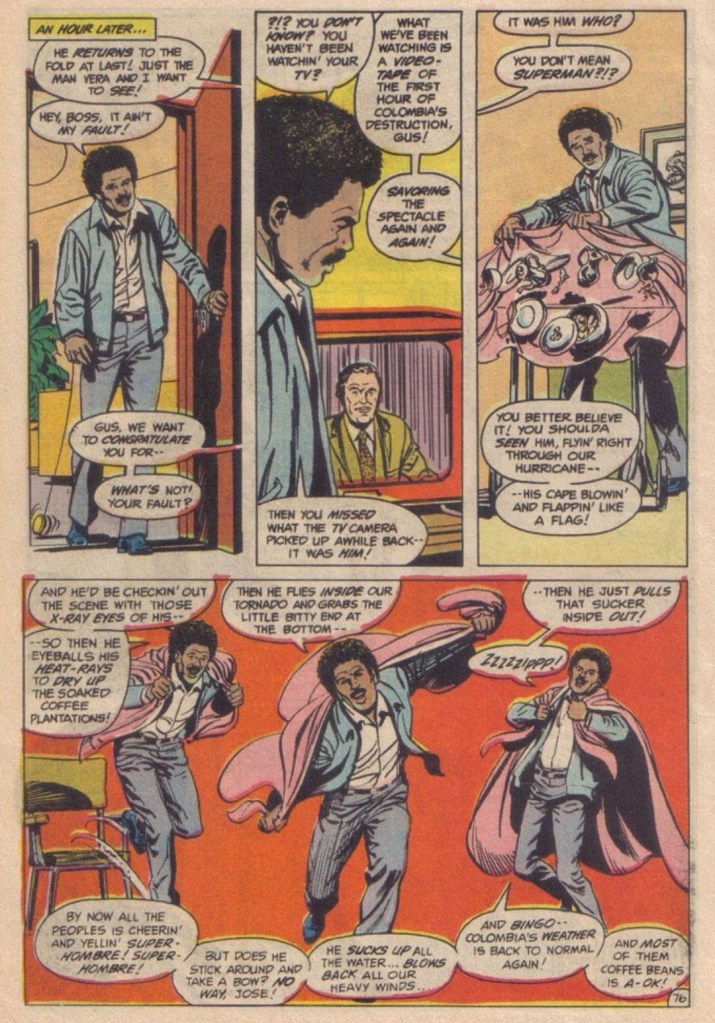
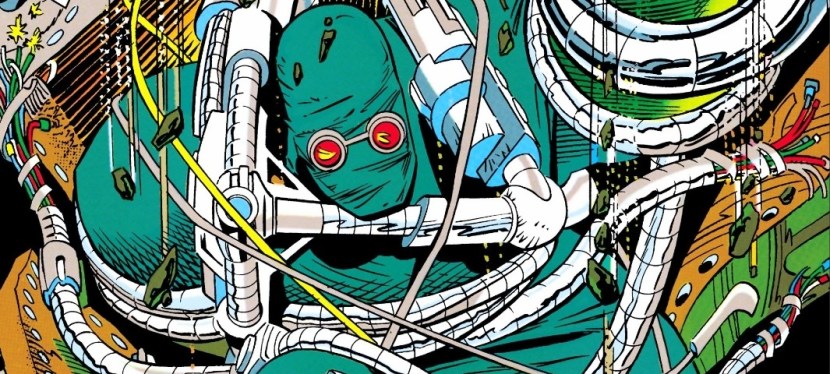
This is a creative way the comic book team used to dramatize Gus Gorman scene revealing and acting the bad news to his boss Ross Webster whose plans were thwarted by Superman.

While it is understandable that not all scenes and not all character moments from the movie  made it on print media, this comic book still managed to capture the film’s essence for the most part. The creative team pulled off their own interpretations of the events and made something entertaining and engaging even though they had to deal with the major challenge of summarizing the movie’s plot and establishing a workable comic book narrative.

I should state that the comic team creatively avoided making in-depth references about liquor and smoking which were obvious in the movie. You will not see Superman drinking liquor at a bar nor will you see Gus Gorman referring to tar listed on a cigarette pack. I suppose this was done to ensure the comic book would be released widely and be acceptable to very young readers and the parents watching them.

The battle between evil Superman and Clark Kent is best viewed in the movie. This one is a shorter and less detailed version of it.

When it comes to establishing the clear lead among all the characters featured, Superman fans should be delighted to know that the Man of Steel is indeed more prominent than Gus Gorman. Take note that in the movie, Richard Pryor’s Gus Gorman overshadowed Christopher Reeve’s Superman/Clark.

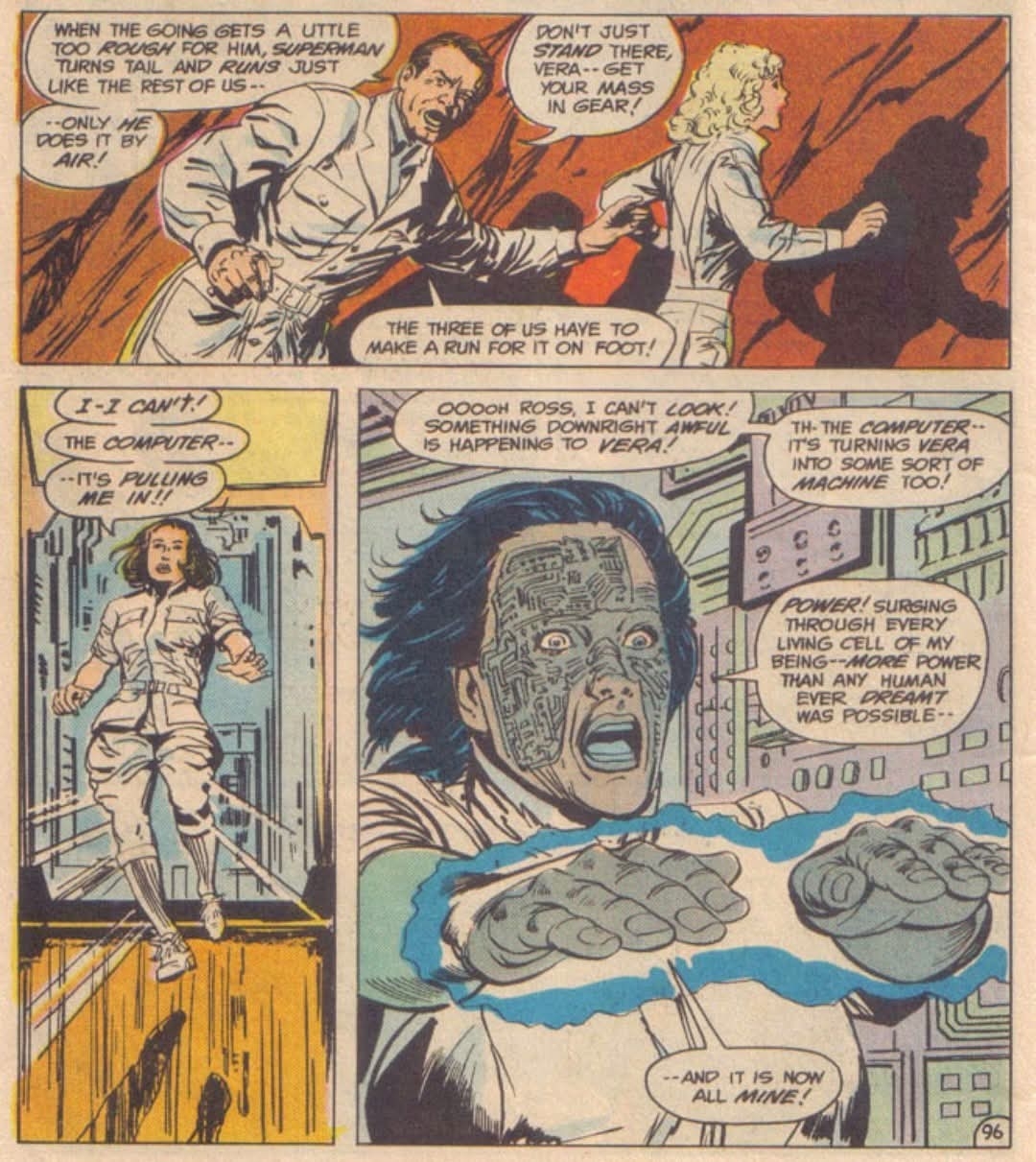
Remember the frightening sequence of Vera getting captured and turned into a cybernetic figure by the Super Computer? This is what it looks like in comic book format.

The art done by Curt Swan and Sal Amendola is decent and it seems to me that their time on visualizing Cary Bates’ script was indeed limited. That being said, it was not surprising to me that, with the exception of Ross Webster in one specific image, none of the characters resembled their cinematic counterparts. Clark Kent/Superman never resembled Christopher Reeve, and Gus Gorman looks nothing like Richard Pryor. Clearly, the artists’ focus was visualizing the narrative which they succeeded.  

Conclusion

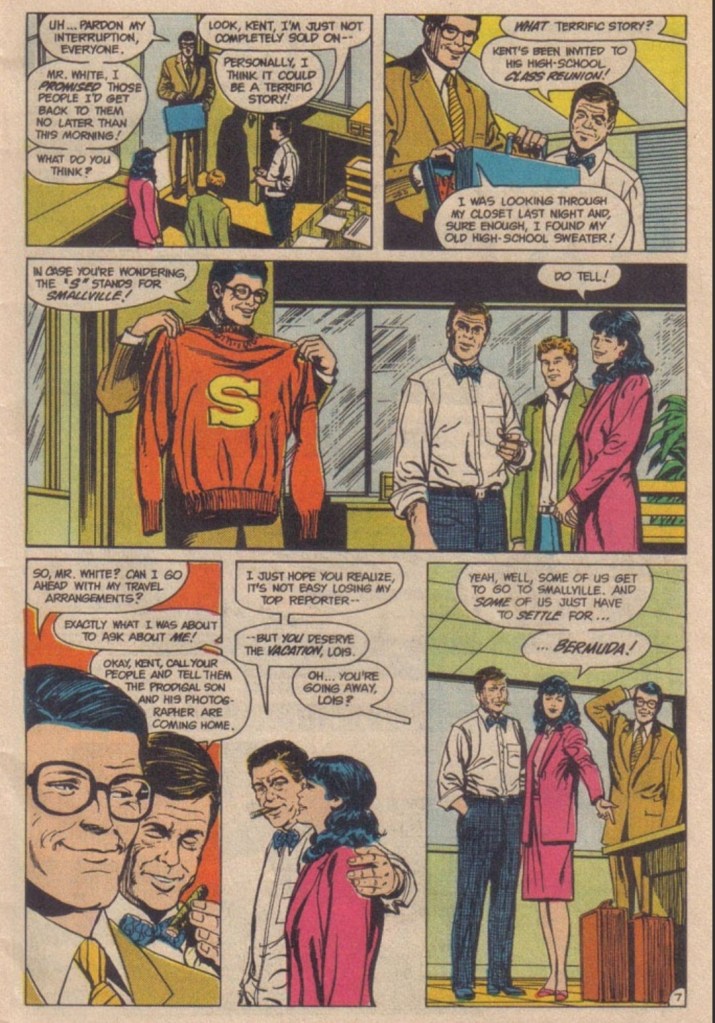
Clark Kent, Lois Lane, Jimmy Olsen and Perry White in the Daily Planet.
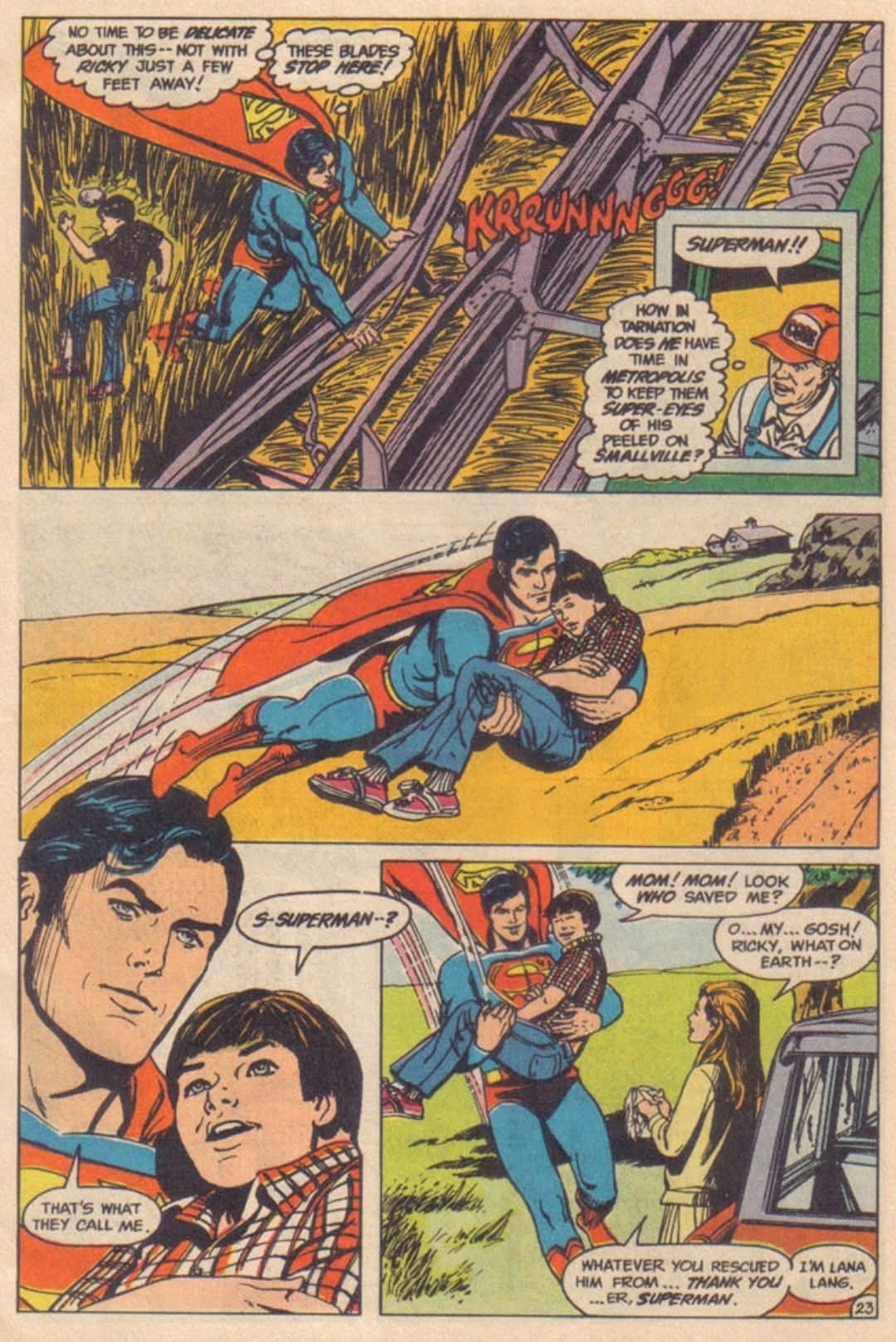
Superman saving Lana Lang’s son from certain death.

Having seen the Christopher Reeve/Richard Pryor movie in the cinema and on cable TV since 1983, I can say that Superman III (1983) is a decent adaptation. It’s not 100% faithful but it is still a worthy read as it will give you the movie’s concept and entertainment values in literary form. If you really want to full essence of film along with the cinematic moments (note: the Superman-Clark battle is the cinematic highlight) all intact, then your obvious choice is to watch the movie. If you are turned off by the movie’s wacky comedy, then the comic book adaptation will deliver to you the more serious approach on telling Superman III’s story. Let me repeat that Superman is more prominent than Gus Gorman in this comic book.

Overall, Superman III (1983) is satisfactory.

+++++

Thank you for reading. If you find this article engaging, please click the like button below and also please consider sharing this article to others. If you are looking for a copywriter to create content for your special project or business, check out my services and my portfolio. Feel free to contact me with a private message. Also please feel free to visit my Facebook page Author Carlo Carrasco and follow me on Twitter at  @HavenorFantasy as well as on Tumblr at https://carlocarrasco.tumblr.com/ and on Instagram at https://www.instagram.com/authorcarlocarrasco/