During the first half of this year, Japan attracted a little more than twenty-one million foreign visitors, according to a news report by VnExpress. What is notable, however, is the fact that Japan experienced its first drop in five years.
To put things in perspective, posted below is an excerpt from the report of VnExpress. Some parts in boldface…
Japan, voted the “world’s most favorite destination” by readers of Condé Nast Traveler last year, received 21.08 million foreign visitors in the first half of the year, down 2% from the same period a year earlier, marking the country’s first decline in inbound tourism for the January-June period in five years.
The drop was largely driven by a sharp decline in arrivals from mainland China after Beijing advised its citizens against traveling to Japan, while strong growth from South Korea helped cushion the decline, Japan Today reported.
Mainland Chinese arrivals plunged 56.4% year-on-year to 2.06 million in the first half, while visitors from South Korea rose 18.6% to 5.68 million, and from Taiwan increased 20.9% to 3.97 million.
Hotel operator Mori Trust forecasts Japan will welcome between 40.5 million and 42 million international visitors in 2026, slightly below the record 42.68 million arrivals recorded last year, The Japan Times reported.
The company said demand for hotel bookings remains strong for the summer and autumn travel seasons, despite airlines increasing fuel surcharges on international flights amid heightened tensions in the Middle East.
Let me end this piece by asking you readers: What is your reaction to this development? With the way it is going, do you think Japan will be able to match the 42.7 million foreign tourists it attracted in 2025? Do you think growth of incoming tourists from South Korea, Taiwan and other nations will heavily offset the lack of Chinese tourists by the end of 2026? Do you consider overtourism a problem for the Japanese?
Thank you for reading. If you find this article engaging, please click the like button below, share this article to others and also please consider making a donation to support my publishing. If you are looking for a copywriter to create content for your special project or business, check out my services and my portfolio. Feel free to contact me with a private message. Also please feel free to visit my Facebook page Author Carlo Carrasco and follow me on Twitter at @CarloCarrascoPH as well as on Tumblr at https://carlocarrasco.tumblr.com/and on Instagram athttps://www.instagram.com/authorcarlocarrasco
Following its current success on attracting tourists from around the world during the first half of this year, Vietnam raked in $9 billion in the said period, according to a news report by VnExpress.
To put things in perspective, posted below is an excerpt from the news report of VnExpress. Some parts in boldface…
Vietnam collected more than US$9 billion from foreign visitors in the first six months, while Vietnamese spent $8 billion abroad in the same period.
The country recorded a tourism trade surplus of $950 million, compared with a surplus of $480 million in 2025 and a deficit of $380 million in 2024, according to the General Statistics Office.
Vietnam’s Party General Secretary and President To Lam, in a meeting with government bodies on Saturday, called for a more detailed analysis of the country’s services trade balance and urged the development of a strategy to rebalance Vietnam’s tourism sector in the coming years.
He said achieving a larger tourism surplus would require upgrading the industry so that international visitors spend more during their stays, while encouraging more Vietnamese travelers to choose domestic destinations.
The country welcomed nearly 12.3 million international visitors in the first six months, up 14.9% year-on-year.
Minister of Culture, Sports and Tourism Lam Thi Phuong Thanh said the government would continue efforts to develop tourism into a genuine key economic sector.
She said the mutually supportive relationship between tourism and related industries should be strengthened, with the sector shifting from a growth model focused on scale and visitor numbers to one emphasizing quality, higher value-added services, creative products, and distinctive travel experiences.
Vietnam’s tourism industry will also target higher-spending visitors and longer-stay travelers, she added.
Let me end this piece by asking you readers: What is your reaction to this development? With tourism booming in their country, do you think Vietnam can collect at least $20 billion from foreign tourists by the end of this year?
Thank you for reading. If you find this article engaging, please click the like button below, share this article to others and also please consider making a donation to support my publishing. If you are looking for a copywriter to create content for your special project or business, check out my services and my portfolio. Feel free to contact me with a private message. Also please feel free to visit my Facebook page Author Carlo Carrasco and follow me on Twitter at @CarloCarrascoPH as well as on Tumblr at https://carlocarrasco.tumblr.com/and on Instagram athttps://www.instagram.com/authorcarlocarrasco
Tourism in Vietnam continues to boom as the nation attracted more than twelve million foreign tourists in the first half of this year, according to a news report by VnExpress.
To put things in perspective, posted below is an excerpt from the news report of VnExpress. Some parts in boldface…
Vietnam received 12.3 million international visitors in the first six months of the year, a 14.9% increase from the same period last year, fueled by the country’s reputation as a safe destination amid global geopolitical uncertainty.
In the second quarter alone, the number of foreign visitors to Vietnam reached 5.49 million, up 18.2% year-on-year, according to the General Statistics Office.
Mainland China remained the largest source of visitors so far this year with 2.69 million, followed by South Korea with 2.1 million. The rest of the top 10 were Russia, Taiwan, the U.S., Cambodia, India, Japan, the Phillippines and Australia.
The Vietnam National Administration of Tourism attributed the strong growth to the country’s reputation as a safe and stable destination amid global political uncertainty.
Let me end this piece by asking you readers: What is your reaction to this development? What do you think makes Vietnam very attractive to visitors from around the world? Have you thought about visiting Vietnam soon?
Thank you for reading. If you find this article engaging, please click the like button below, share this article to others and also please consider making a donation to support my publishing. If you are looking for a copywriter to create content for your special project or business, check out my services and my portfolio. Feel free to contact me with a private message. Also please feel free to visit my Facebook page Author Carlo Carrasco and follow me on Twitter at @CarloCarrascoPH as well as on Tumblr at https://carlocarrasco.tumblr.com/and on Instagram athttps://www.instagram.com/authorcarlocarrasco
Following the recent summit between the United States and China, US President Donald Trump shared the details with Japanese Prime Minister Takaichi Sanae via a phone call, according to a news report by Kyodo News.
Recently, Trump visited China and met with their president Xi Jinping. It is noted that there is tension between China and Japan. As such, Trump’s sharing of the details with Takaichi is significant.
To put things in perspective, posted below is an excerpt from the news report of Kyodo News Some parts in boldface…
Japanese Prime Minister Sanae Takaichi said Friday U.S. President Donald Trump briefed her by phone in “great detail” on his meeting in Beijing with Chinese President Xi Jinping.
Takaichi told reporters after speaking with Trump, who was aboard Air Force One after wrapping up a three-day stay from Wednesday in China, that she is “deeply grateful” for how he brought up Japan, a close U.S. ally, during his meeting with Xi, though she did not elaborate.
Takaichi and Trump also exchanged views on “various challenges regarding China,” in such fields as security and the economy, and agreed to continue to communicate closely in dealing with the situation in the Indo-Pacific region, she said.
“With President Trump, I affirmed the unwavering Japan-U.S. alliance,” Takaichi said at her office.
Trump has said he and Xi made some “fantastic trade deals” without elaborating, and that they feel “very similar” about the need to end the war in Iran and reopen the Strait of Hormuz.
Takaichi and Trump last met in Washington in March, where they “opposed any attempts to unilaterally change the status quo, including by force or coercion,” according to the White House, in an apparent reference to China’s growing economic and military clout.
Ties between Japan and China have been frayed since Takaichi, known for her hawkish security views, infuriated China with her parliamentary remarks in November that a Taiwan contingency could be a “survival-threatening situation” for Japan that could trigger a response by the Self-Defense Forces in support of the United States.
Taiwan, a self-ruled democratic island claimed by Beijing, is viewed as a potential military flashpoint that could draw the United States into conflict with China, posing serious security challenges for Japan.
Before the U.S.-China summit, Japan had been concerned that Trump, known for his deal-making approach, could make compromises on issues regarding Taiwan.
After his meeting with Xi, Trump told reporters that he thinks there is no risk of conflict with China over Taiwan, and that he made “no commitment” to Xi over the island. U.S. Secretary of State Marco Rubio said that U.S. policies on Taiwan remain unchanged.
Let me end this piece by asking you readers: What is your reaction to this development? Do you think the United States will have stable ground when dealing with both China and Japan? Could it be possible that China will bully Japan less this year? Do you think there will be more stability in the Pacific and in financial markets as far as Japan and China are concerned?
Thank you for reading. If you find this article engaging, please click the like button below, share this article to others and also please consider making a donation to support my publishing. If you are looking for a copywriter to create content for your special project or business, check out my services and my portfolio. Feel free to contact me with a private message. Also please feel free to visit my Facebook page Author Carlo Carrasco and follow me on Twitter at @CarloCarrascoPH as well as on Tumblr at https://carlocarrasco.tumblr.com/and on Instagram athttps://www.instagram.com/authorcarlocarrasco
To put things in perspective, posted below is an excerpt from the news article of VnExpress. Some parts in boldface…
Vietnam welcomed 6.76 million international visitors in the first three months of the year 2026, up 12% year-on-year and the highest quarterly figure ever recorded.
With nearly 2.1 million international visitors in March, Vietnam has for the first time achieved a new record of receiving over 2 million visitors for three consecutive months in a year, according to Vietnam National Administration of Tourism.
This result underscores the appeal, resilience, and growing strength of Vietnam’’s tourism sector amid an uncertain global environment, it added.
Of the total 6.76 million international visitors, 82.3% arrived by air, 15.5% by land, and 2.2% by sea.
The administration said that the dominance of air travel highlights Vietnam’s strong appeal to mid- and long-haul markets that are particularly sensitive to geopolitical shifts and fuel costs.
In the context of the Middle East conflict causing soaring oil prices and disrupting some international flights, the high number of visitors arriving by air reflects connectivity and affirms international tourists’ confidence in a safe, stable, and accessible destination, the administration added.
Mainland China and South Korea continue to be the two largest source markets for tourists to Vietnam, accounting for approximately 40% of the total international visitors.
Southeast Asian markets recorded strong growth, including Malaysia (up 21.5%), Singapore (30%), Cambodia (41%), Indonesia (44%), the Philippines (69%), and Thailand (6.5%).
Vietnam has set a target of receiving 25 million international tourists this year.
Let me end this piece by asking you readers: What is your reaction to this development? Have you thought about visiting Vietnam for vacation this year? What is the one location in Vietnam that you find attractive right now?
Even as the United States is busy working alongside Israel on the war against the Islamic terrorist state of Iran, the Trump administration announced that it will launch tariff investigations on several countries including trade partners like Japan, according to a news report by Kyodo News. The probes are meant to find out if unfair trading practices exist.
To put things in perspective, posted below is an excerpt from the Kyodo News report. Some parts in boldface…
U.S. President Donald Trump’s administration said Wednesday it will launch tariff investigations into what it sees as unfair practices by China, Japan and over a dozen other American trading partners.
According to U.S. Trade Representative Jamieson Greer, the move is intended to “uncover a variety of unfair trading practices related to excess capacity in production” in the manufacturing sector, and replace Trump’s sweeping tariff regime that was invalidated by the Supreme Court in February.
“Our view is that key trading partners have developed production capacity that is really untethered from the market incentives of domestic and global demand,” Greer told reporters.
The other trading partners facing the investigations, carried out under Section 301 of the Trade Act of 1974, are the European Union, Bangladesh, Cambodia, India, Indonesia, Malaysia, Mexico, Norway, Singapore, South Korea, Switzerland, Taiwan, Thailand and Vietnam, Greer said.
The statute, which allows the U.S. government to impose tariffs in response to a foreign country’s alleged unfair practices, was a favorite tool of Trump for justifying higher tariffs on Chinese imports when he started a trade war with Beijing during his first term as president.
After the U.S. top court on Feb. 20 struck down a large chunk of Trump’s far-reaching tariff agenda as imposed under the International Emergency Economic Powers Act, his administration introduced a new 10 percent global duty.
However, the new 10 percent surcharge, relying on a different legal framework, can only last 150 days unless Congress approves an extension.
Greer said the Trump administration seeks to complete the investigations as quickly as possible and prepare for new Section 301 tariffs within the 150-day period.
The statute requires consultations with the governments of the targeted trading partners before tariffs can be imposed.
Let me end this piece by asking you readers: What is your reaction to this development? Do you think the United States is doing the right thing with the multiple trade investigations? How do you think the Trump administration will adjust its tariff policy once the 150-day period expires?
Under the leadership of US President Donald J. Trump, America’s new defense strategy urged its allies and partner to increase their defense spending to 5% of their gross domestic product (GDP), according to a news report by Kyodo News. This latest development could result in a chain of events in which American allies will not only spend more but also act more responsibly when it comes to securing their respective nations.
To put things in perspective, posted below is an excerpt from the Kyodo News report. Some parts in boldface…
A new U.S. defense strategy released Friday urges all American allies and partners to increase defense spending to 5 percent of their gross domestic product and be more responsible for their own national security.
Highlighting President Donald Trump’s “America First” and “peace through strength” agenda, the Pentagon’s policy document says they have a bigger role to play, but not as “the dependencies of the last generation,” as the United States needs to prioritize defending its homeland and its interests throughout the Western Hemisphere.
“We will advocate that our allies and partners meet this standard around the world, not just in Europe,” says the first National Defense Strategy since Trump’s return to the office a year ago, referring to the 5 percent defense target.
“As our allies do so, together with the United States, they will be able to field the forces required to deter or defeat potential adversaries in every key region of the world, even in the face of simultaneous aggression,” it says.
NATO members have already pledged to meet Trump’s demand to increase defense spending from 2 percent to 5 percent of GDP by 2035. The new NATO target is composed of 3.5 percent for core military spending and an additional 1.5 percent for security-related spending.
As the document praises Europe and South Korea for committing to raising their defense expenditures since Trump’s return to office, it appears inevitable that other major U.S. allies, including Japan, will face increased pressure from his administration to follow suit.
On par with the National Security Strategy, released by the White House in December, the key defense document touches on China and its fast-paced military buildup.
But the tone is softer compared to previous versions.
It says the second Trump administration’s approach is to deter China in the Indo-Pacific region through strength, “not confrontation.”
In the 34-page document, there is also no mention of Taiwan, the self-ruled island that China regards as its own territory and around which it has been stepping up military pressure.
“President Trump seeks a stable peace, fair trade and respectful relations with China, and he has shown that he is willing to engage (Chinese) President Xi Jinping directly to achieve those goals,” the document says, adding that Washington’s goal is not to dominate China.
“Rather, our goal is simple: To prevent anyone, including China, from being able to dominate us or our allies,” it says.
As part of efforts to meet that end, the U.S. military will erect a “strong denial defense” along the first island chain in line with the security strategy, according to the defense blueprint.
The island chain runs from the Japanese archipelago, through Taiwan, the Philippines and on to Borneo, encircling China’s coastal waters.
Let me end this piece by asking you readers: What is your reaction to this development? Do you think the new American strategy will create a huge impact on how the allies will defend their respective nations? Do you think this will lead to the containment of Communist China’s aggression on the Indo-Pacific? Do you think the new strategy could lead to more stability in both Asia and Europe?
Vietnam, a nation ravaged by war decades ago, has emerged as a major tourism magnet in both Southeast Asia and Asia as a whole after successfully attracting more than twenty-one million foreign tourists in 2025, according to a VnExpress International news report. The figure is a new all-time high. What Vietnam achieved was more than 20% higher than its 2024 foreign tourist numbers. For 2026, Vietnam is aiming high with a target of 25 million foreign visitors.
To put things in perspective, posted below is an excerpt from the news report VnExpress. Some parts in boldface…
Vietnam welcomed a record number of foreign tourists in 2025 with 21.2 million, up 20.4% from the previous year and the highest ever, according to General Statistics Office.
Mainland China was Vietnam’s biggest source of visitors last year with 5.2 million arrivals, up 41% year-on-year, followed by South Korea with 4.3 million and Taiwan with 1.23 million.
The U.S. ranked fourth with 848,000, followed by Japan with 814,000. The rest of the top 10 were India (746,000), Russia (689,000), Cambodia (687,000), Malaysia (573,000) and Australia (548,000).
Tourism industry insiders attributed Vietnam’s strong performance to visa reforms.
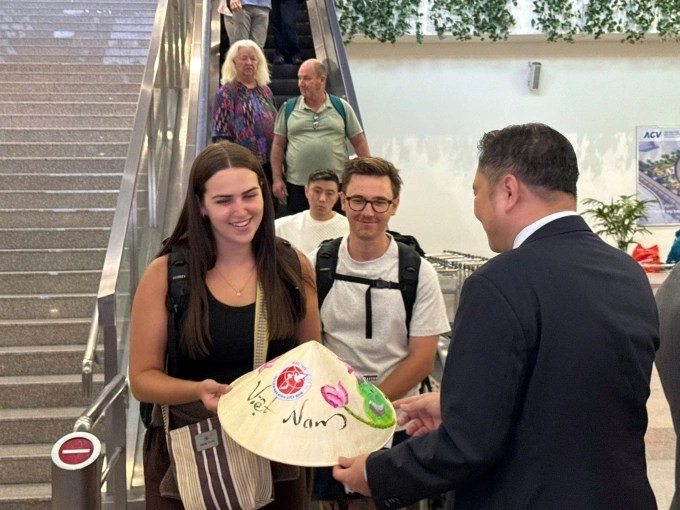
Foreign tourists welcomed in Vietnam. (photo credit: Ho Chi Minh City Department of Tourism)
In March the government decided to extend visa exemptions until 2028 for citizens of 12 countries: Denmark, Finland, France, Germany, Italy, Japan, Norway, Russia, South Korea, Spain, Sweden, and the U.K.
In August it waived visa requirements for stays of up to 45 days for citizens of 12 more countries: Belgium, Bulgaria, Croatia, Czechia, Hungary, Luxembourg, the Netherlands, Poland, Romania, Slovakia, Slovenia, and Switzerland.
This expanded the unilateral visa waiver list to 24 countries and the total number including bilateral waivers to 39.
Let me end this piece by asking you readers: What is your reaction to this development? Considering the strong international tourism momentum it has right now, do you think Vietnam will succeed in attracting 25 million foreign tourists this year? Do you think a lot more visitors from Europe will come to Vietnam this year?
Even though there already is a foreign tourism boom in Southeast Asia, the Philippines has literally been left behind by its neighbors as it attracted only 5.235 million international tourist arrivals for the period of January to November 2025, according to a news report by BusinessWorld.
To put things in perspective, posted below is an excerpt from the report of BusinessWorld. Some parts in boldface…
VISITOR ARRIVALS in the Philippines fell by 2.16% in the first 11 months, amid a decline in tourists from South Korea and China, Tourism department data showed.
Data from the Department of Tourism (DoT) showed international tourist arrivals dropped to 5.235 million in the January-to-November period from 5.35 million in the same period in 2024.
Of the tourist arrivals, the bulk or 4.918 million were foreign tourists, while the rest were overseas Filipinos.
South Korea remained the biggest source of tourists in the first 11 months, accounting for 21.66% of the total. While 1.134 million South Koreans visited the Philippines as of November, this was a 21% decline from the 1.436 million Korean tourists a year ago.
The US was the second-biggest source of tourists, at 894,835 or 17.09% of the total as of end-November. This was 6.57% higher than last year’s 839,635 tourist arrivals from the US.
Japan was the third-biggest source of tourists, accounting for 406,794 or 7.77% of the total, 15.36% up from 352,630 a year ago.
Tourist arrivals from Australia increased by 16.17% to 268,892 in the 11-month period. Meanwhile, tourists from China fell by 16.55% to 248,339 as of end-November.
The other top markets were Canada, Taiwan, the United Kingdom, Singapore, and Malaysia, which cumulatively accounted for 793,750 of the total arrivals.
“The weaker South Korean won amid a volatile political and economic situation over the past year and slower economic growth in China, which is the world’s second-biggest economy, on top of territorial disputes partly weighed on foreign tourism numbers,” Rizal Commercial Banking Corp. Chief Economist Michael L. Ricafort said in a Viber message.
Mr. Ricafort noted that the government should improve infrastructure to make it more convenient for tourists to travel around the country.
“Challenges include the need to further expand and develop tourism-related infrastructure such as airports, seaports, accommodation facilities, and train systems, including the Metro Manila subway and toll roads,” he added.
Despite the decline in the first 11 months, Mr. Ricafort said that it is still possible for the country to surpass the tourist arrivals last year, which reached 5.949 million.
“It is still possible, considering some seasonal increase in foreign tourists during the Christmas holiday season, especially overseas Filipino workers and balikbayans, to spend the most festive time of the year, while others escape winter,” he said.
“A higher US dollar-peso exchange rate would make it cheaper for foreign tourists to come to the Philippines,” he added.
Meanwhile, Mr. Ricafort noted the growth in tourist arrivals from India and other countries, which helped “offset the decline in major traditional sources such as South Korea and China.”
India was the 11th biggest source of tourist arrivals in the January-to-November period, accounting for 85,885 or 1.64% of the total. Tourists from India increased by 17.06% from 73,369 arrivals in the same period in the previous year.
Earlier this year, the Philippines and India signed the Implementation Program on Tourism Cooperation for the years 2025 to 2028.
For his part, Colliers Research Director Joey Roi H. Bondoc said that with only 5.235 million as of end-November, it will be difficult for the country to even surpass last year’s arrivals.
“I think it will be very difficult… We may not be able to beat that or even meet that, but of course we want to end the year stronger,” he said in a phone interview.
“We see a lot of foreign tourists still in December because of the holiday season. Definitely that optimism should spill over to next year,” he added.
As for the drop in arrivals from South Korea, Mr. Bondoc attributed this to the economic downturn and political crisis in the country.
“If you look at some integrated casinos, they were initially targeting Koreans… so they are experiencing the pinch of slower arrivals from South Korea,” he said.
Mr. Bondoc said the Philippines should try to attract tourists from other markets.
For further insight about the tourism industry problem of the Philippines, watch the CNA Insider video below.
Let me end this post by asking you readers: What is your reaction to this recent development? Did you think the Philippines can still beat its 2024 record of international visitor arrivals and generate huge revenues for the economy? Do you think the current administration will be able to improve the nation’s infrastructure and make travel more efficient and convenient for all tourists? Do you think the Philippines is too expensive when it comes to air travel?
Recently in the City of Las Piñas, agents of the Philippine Drug Enforcement Agency (PDEA) raided a house resulting in the arrests of three foreigners, two local cohorts and the seizure of equipment and chemicals that could have been used to make illegal drugs, according to a GMA Network news report.
To put things in perspective, posted below is an excerpt from the news report of GMA. Some parts in boldface…
Five suspects, including 2 Chinese and a Taiwanese, were nabbed in a raid on a shabu lab in Las Piñas.
According to a 24 Oras Weekend report by John Consulta on Saturday, members of the Philippine Drug Enforcement Agency (PDEA) were able to seize large flasks, weighing scales, and drums of chemicals used to create illegal drugs in an exclusive subdivision in Las Piñas.
“Doon sa nakuha natin kanina, yung isang drum can manufacture around 50 to 100 kilos of shabu. Napakarami hong nakuha. Isipin niyo nalang po, kung sakaling natuloy po ang pagmanufacture niyan, ilang buhay yung masisira po niyan,” said PDEA spokesperson Atty. Joseph Calulut.
(From what we seized earlier, a drum could manufacture around 50 to 100 kilos of shabu. We got a lot. Just imagine if the manufacturing pushed through, how many lives could have been ruined.)
Some of the nabbed suspects denied accusations of illegal drugs. However, one of the foreigners and a Filipino runner tested positive in a drug test.
Let me end this piece by asking you readers: If you are a resident of Las Piñas City, what is your reaction to this development? Do you think that there could be more secret or hidden drug labs established inside houses within the city? Do you think your barangay or your village is really drug-free?
For more South Metro Manila community news and developments, come back here soon. Also say NO to fake news, NO to irresponsible journalism, NO to misinformation, NO to plagiarists, NO to reckless publishers and NO to sinister propaganda when it comes to news and developments. For South Metro Manila community developments, member engagement, commerce and other relevant updates, join the growing South Metro Manila Facebook group at https://www.facebook.com/groups/342183059992673