A Look Back at Punisher 2099 #13 (1994)

Disclaimer: This is my original work with details sourced from reading the comic book and doing personal research. Anyone who wants to use this article, in part or in whole, needs to secure first my permission and agree to cite me as the source and author. Let it be known that any unauthorized use of this article will constrain the author to pursue the remedies under R.A. No. 8293, the Revised Penal Code, and/or all applicable legal actions under the laws of the Philippines.

Welcome back, superhero enthusiasts, comic book collectors, 1990s pop culture enthusiasts and fans of Marvel Comics! We finally made it at last with the conclusion of The Fall of the Hammer crossover storyline that highlighted Marvel’s 2099 franchises.

Last time around, Doom 2099 #14 saw the raising of the stakes and tension of the storyline leading up to the sudden team-up of the 2099 universe’s pioneering heroes – Spider-Man 2099, Ravage 2099, Doom 2099 and Punisher 2099 – facing the so-called Thor (the flying idol of the people in 2099), the minions and the secret forces behind the conflict.

With those details laid down, here is a look back at Punisher 2099 #13, published in 1993 (cover dated 1994) by Marvel Comics with a story written by Pat Mills and Tony Skinner, and illustrated by Tom Morgan.

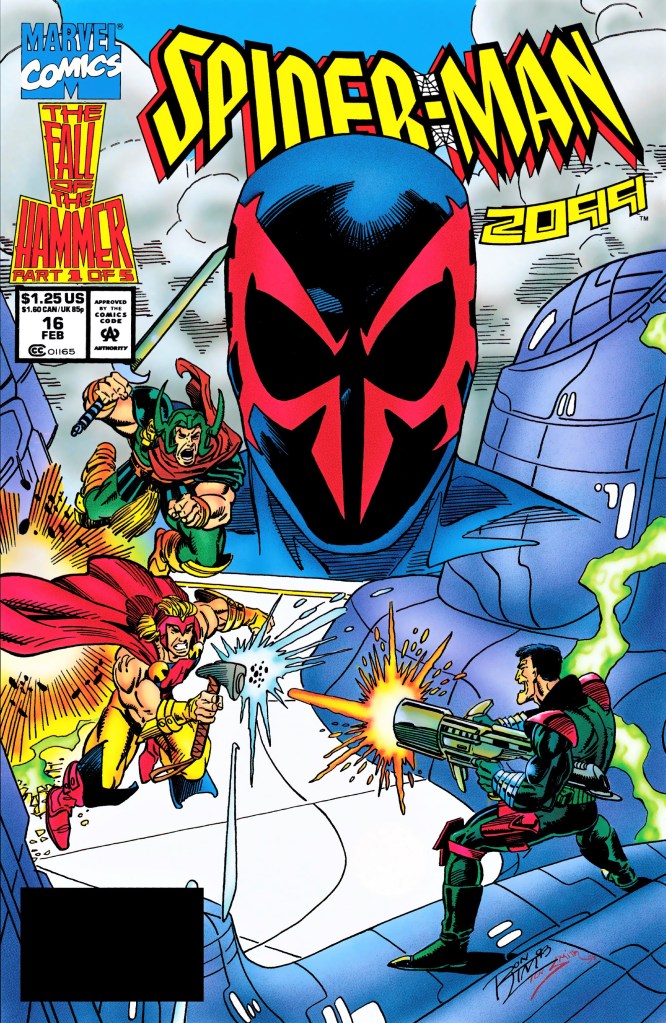
The cover.

Early story

The story begins with Spider-Man, Punisher, Doom and Ravage together facing a horde of Berzerkers approaching them. The four engaged with the horde using violent action. When things calmed down, Doom 2099 tells them that they need to split into duos so that they can prevent the city of Valhalla from harming the millions of people below (in New York).

Before they start their tasks, the schemer Avatarr appears to them through holographic imagery and tells them that Valhalla was created as a base for the heroes that would destroy them and lead mankind along more productive lines. Thanks to Ravage’s move, Doom detects Avatarr’s frequency…

Quality

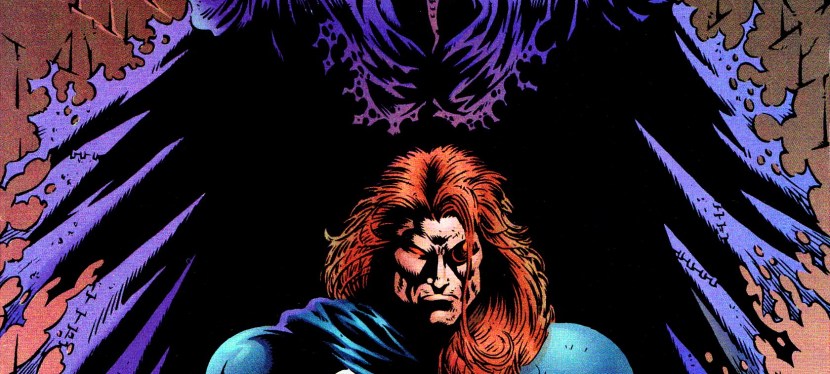
As Punisher 2099 arms himself, look closely and you will see the conflict between him and Jake Gallows.

When it comes to the storytelling, this conclusion to The Fall of the Hammer storyline felt unsatisfying. There were clear signs of rush on the resolution to the plot that preceded the ending which itself had a sudden shift of focus on Punisher 2099.

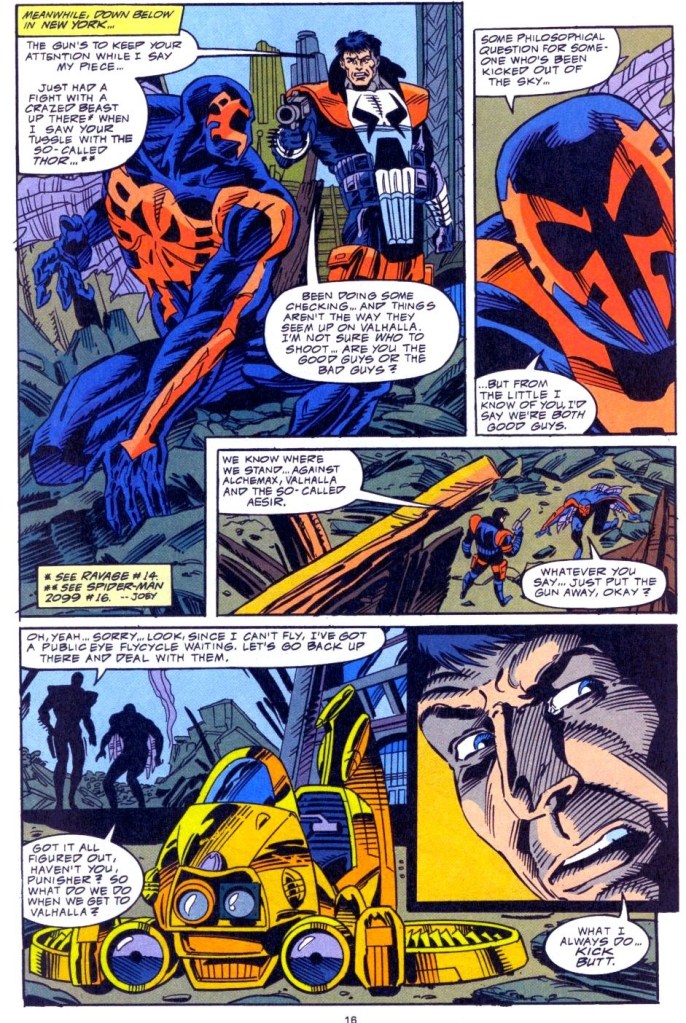
The real meat of this comic book is the team-up of the Marvel 2099’s pioneering protagonists, including the duos that were spawned as the plot required it. For most of this crossover storyline, Spider-Man 2099 and Punisher 2099 were just riding together going to Valhalla. In this comic book, you will really see the two work together which was satisfying enough as pay-off (to the build-up the preceded this issue). The duo of Doom 2099 and Ravage 2099, however, was nowhere as satisfying and, more notably, there was no real chemistry between them.

This comic book continues the theme of false deities and a series of unfortunate events pulled off from a distance by some sinister force located in a secret place. While this storyline had touched on the faith of the Thorites (most notably in Doom 2099 #14), this one simply abandoned it to focus more on 2099’s original heroes doing something heroic.   

When it comes to Punisher 2099 himself, fans will have a lot of stuff to enjoy. There is a short but notable moment in the story implying that Punisher 2099 and Jake Gallows are separate entities presented in the character’s mind.

Conclusion

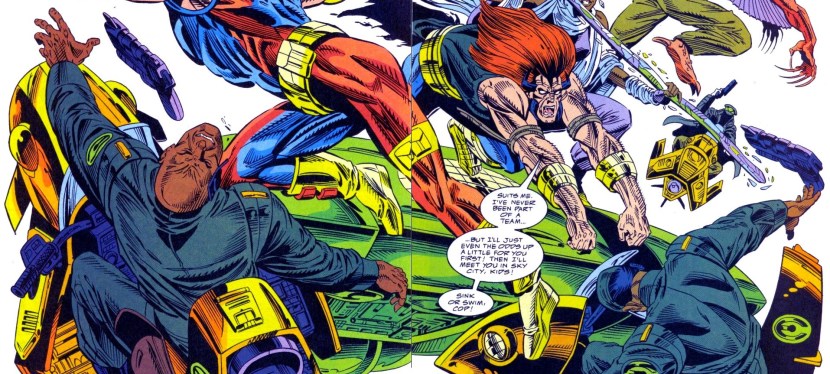
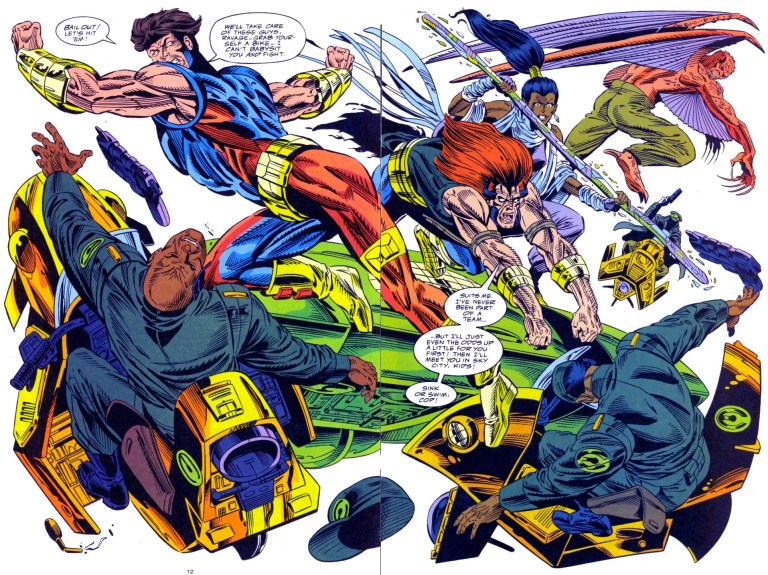
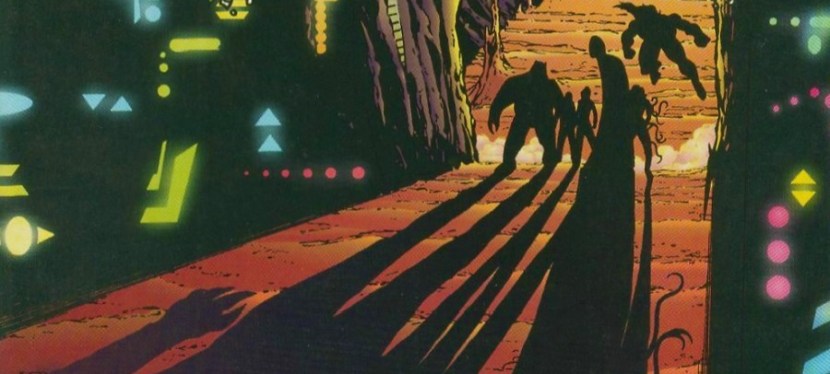
This opening image is easily the best image of the comic book. Things went downhill from after this image.

Punisher 2099 #13 (1994) is not the solid conclusion The Fall of the Hammer storyline deserved. There were clear signs of rush as well as compression of details that had to be done in order to fit the 22 story pages. The so-called final conflict felt hollow and 2099 fans who got invested with the era’s self-declared Thor (who was initially the main antagonist) in the previous chapters will be disappointed with the way he turned out here. That being said, Avatarr as the main villain is just not convincing and was unsatisfying. Having Punisher 2099, Spider-Man 2099, Doom 2099 and Ravage 2099 together to do some saving was pretty interesting and symbolic, as well as the main attraction of this comic book. Sadly, not even those pioneers could save this comic book and the storyline from ending with a whimper.

If you are seriously planning to buy an existing hard copy of Punisher 2099 #13 (1994), be aware that as of this writing, MileHighComics.com shows that the near-mint copy of the regular edition costs $6 while the near-mint copies of the signed-and-numbered and the newsstand editions cost $50 and $16 respectively.

Overall, Punisher 2099 #13 (1994) is worth getting below its cover price.

+++++

Thank you for reading. If you find this article engaging, please click the like button below and also please consider sharing this article to others. If you are looking for a copywriter to create content for your special project or business, check out my services and my portfolio. Feel free to contact me as well. Also please feel free to visit my Facebook page Author Carlo Carrasco and follow me at HavenorFantasy@twitter.com
A Look Back at Doom 2099 #14 (1994)

Disclaimer: This is my original work with details sourced from reading the comic book and doing personal research. Anyone who wants to use this article, in part or in whole, needs to secure first my permission and agree to cite me as the source and author. Let it be known that any unauthorized use of this article will constrain the author to pursue the remedies under R.A. No. 8293, the Revised Penal Code, and/or all applicable legal actions under the laws of the Philippines.

Welcome back, superhero enthusiasts, comic book collectors, fans of 1990s pop culture and fans of Marvel Comics! We return to The Fall of the Hammer crossover storyline of Marvel’s 2099 universe and this is my first time to review a comic book of Doom 2099 (note: this comic book marks the 4th chapter of the crossover).

Last time around, the X-Men of 2099 got involved in the events and their member Skullfire got reunited with them thanks to some help by Doom of 2099. The self-proclaimed Thor realizes that a powerful friend of his is down on the floor.

With those details laid down, here is a look back at Doom 2099 #14, published in 1993 (cover dated 1994) by Marvel Comics with a story written by John Francis Moore and drawn by Pat Broderick.

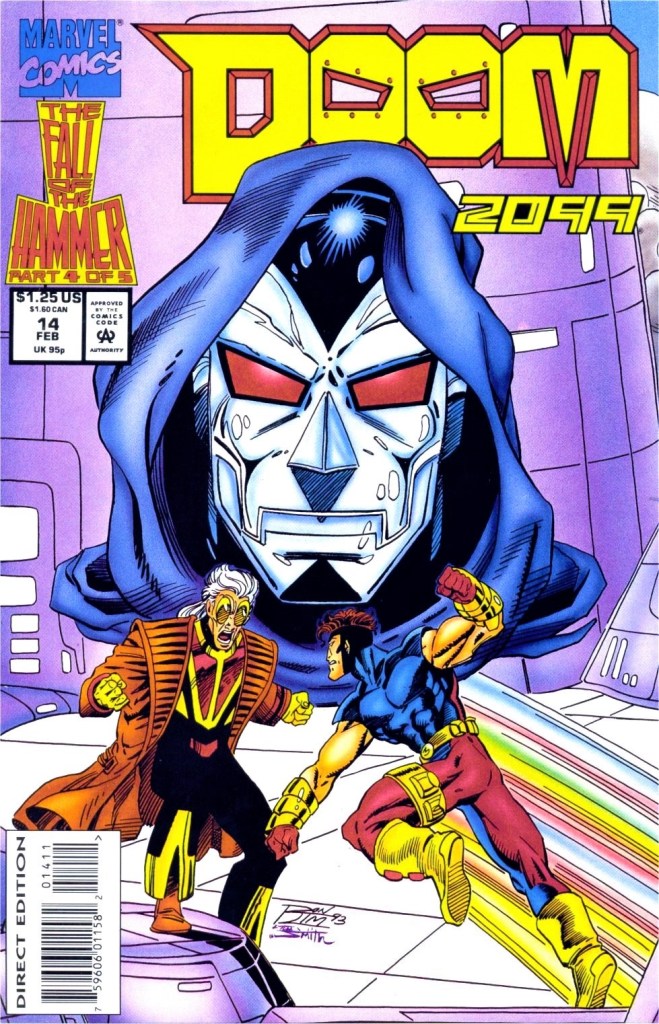
The cover.

Early story

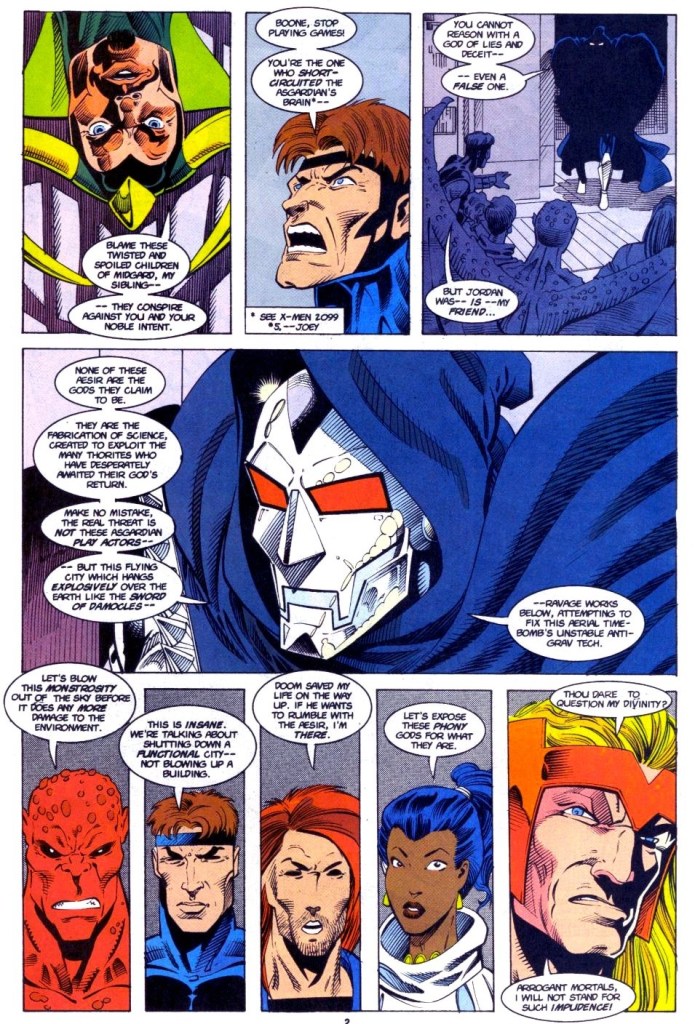
The story begins in Valhalla where Thor sees his powerful friend lying down helpless. X-Men’s Bloodhawk, Krystalin, Meanstreak, Skullfire and the self-proclaimed Loki witness Thor’s curiosity. Loki, who is actually Meanstreak’s friend Boone in disguise, tells Thor to blame what he calls the spoiled children for conspiring against him. Meanstreak tells Boone to stop his act and reminds him that he was the one who caused the short-circuit.

Doom 2099 then tells them that none of the gods are real for they are the fabrication of science created to exploit the believers of Thor who have desperately awaited the return of their god. Doom points out that the real threat is not the Asgardian play actors but rather the flying city of Valhalla itself.

After hearing the ramblings of the others, Thor then makes his move to strike Doom 2099…

Quality

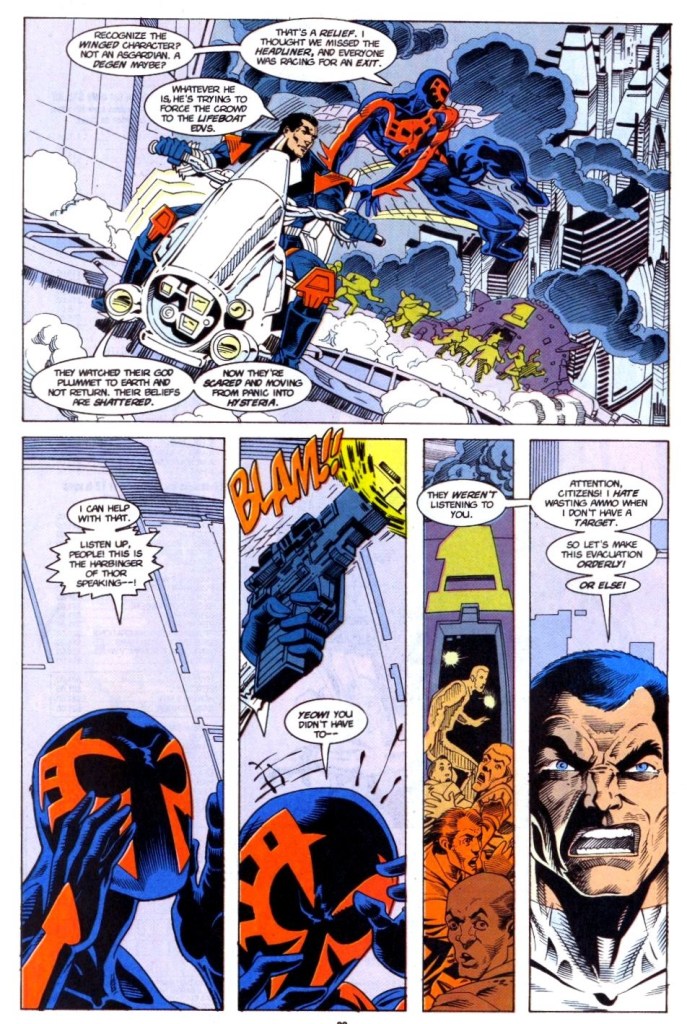
This comic book shows Spider-Man and Punisher of 2099 finally ending their long ride together.

As expected, there is indeed pay-off executed in this comic book in relation to the gradual build-up that took place in the first three chapters (Spider-Man 2099 #16, Ravage 2099 #15, and X-Men 2099 #5). You must be wondering how was the pay-off…I can say it was executed good enough. Not only does this comic book reveal the truth about the so-called Asgardian deities, it also sheds light on who the pretenders really are and, more notably, who is the mastermind behind everything and why did all these unfortunate events happen in the first place.

Behind it all, there is subversion in the form of criticism and accusations against corporations, against people of faith and even against idolaters who don’t realize that idolatry is unholy and foolish. In a certain way, this comic book made its case in support of Marxism, socialism, Communism and atheism even though those four forms of evil were not explicitly emphasized.

When it comes to the characters, Doom 2099’s presence here is actually light but it should be noted that his civil discussion with a powerful figure behind the scenes gave the story a lot of weight. What I enjoyed about Doom 2099 is his Darth Vader-like way of talking and taking action.

The X-Men of 2099 surprisingly have a good share of the spotlight here while Spider-Man 2099 and Punisher 2099 finally stopped riding together and begin to get involved with the troubles of Valhalla. I should state that the first-ever meeting between Spider-Man 2099, Punisher 2099 and Doom 2099 is a short yet powerful scene.  

Conclusion

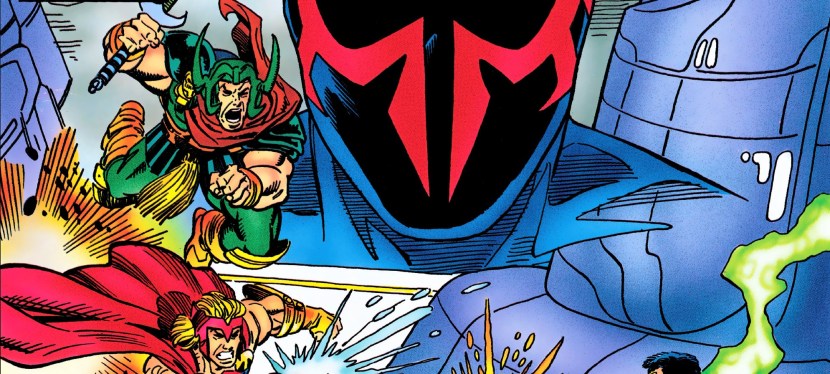
Doom 2099, the X-Men 2099 members, Loki and Thor on the 2nd page.

Being the fourth chapter of The Fall of the Hammer crossover storyline, I can say that Doom 2099 #14 (1994) proved to be the most engaging chapter yet mainly due to its pay-off in relation to what was built-up before it. The revelations were quite strong and clearly this comic book was the tuning point of the storyline, and even set the stage for the concluding chapter. I caution you, however, that the anti-capitalist and anti-faith themes of this comic book can lead you to trouble if you decide to take them seriously. It is bad enough that American society today is being torn down by Marxist, socialist, Communist and atheistic forces. You have been warned!

If you are seriously planning to buy an existing hard copy of Doom 2099 #14 (1994), be aware that as of this writing, MileHighComics.com shows that the near-mint copy of the regular edition costs $60 while the near-mint copies of the newsstand edition and the signed-and-numbered edition cost $180 and $300 respectively.

Overall, Doom 2099 #14 (1994) is recommended.

+++++

Thank you for reading. If you find this article engaging, please click the like button below and also please consider sharing this article to others. If you are looking for a copywriter to create content for your special project or business, check out my services and my portfolio. Feel free to contact me as well. Also please feel free to visit my Facebook page Author Carlo Carrasco and follow me at HavenorFantasy@twitter.com
A Look Back at The Night Man #3 (1993)

Disclaimer: This is my original work with details sourced from reading the comic book and doing personal research. Anyone who wants to use this article, in part or in whole, needs to secure first my permission and agree to cite me as the source and author. Let it be known that any unauthorized use of this article will constrain the author to pursue the remedies under R.A. No. 8293, the Revised Penal Code, and/or all applicable legal actions under the laws of the Philippines.

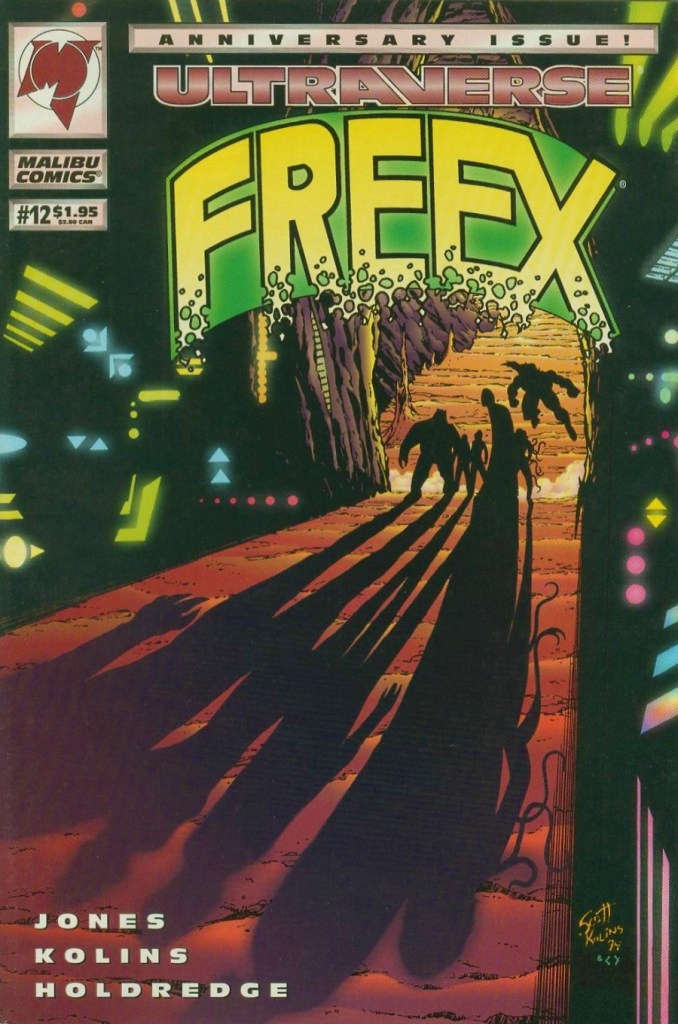
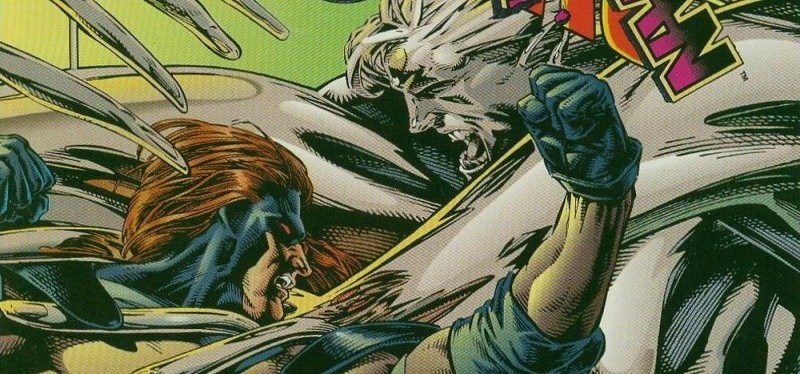
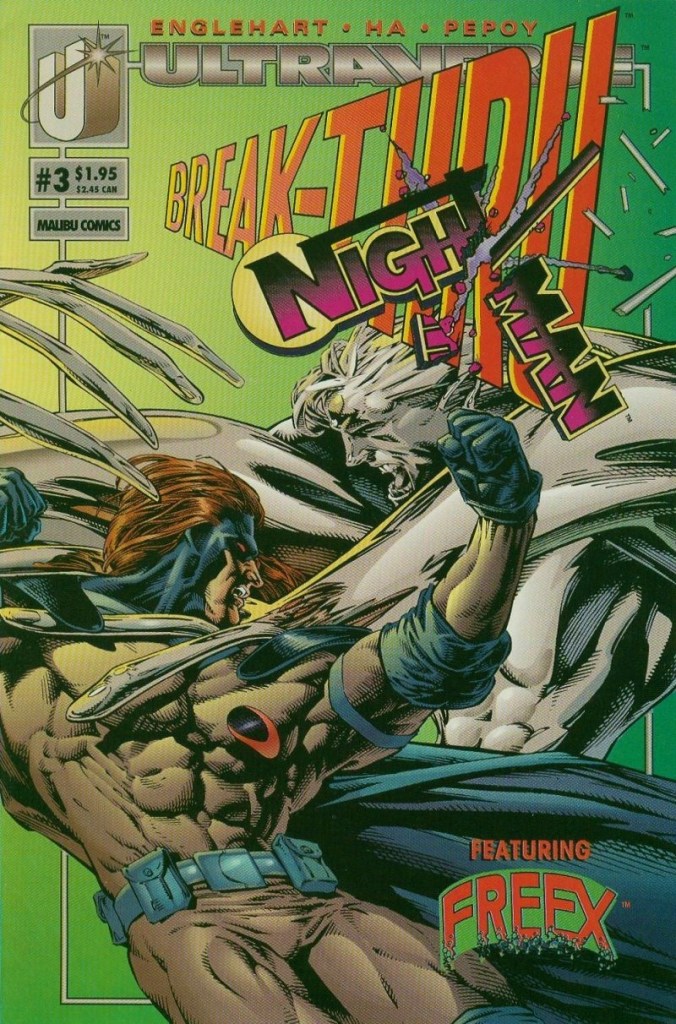
Welcome back, superhero enthusiasts, comic book collectors, 1990s pop culture enthusiasts and fans of Malibu Comics! Today we return to the Ultraverse through the 3rd issue of The Night Man series. While the Night Man continues his pursuit of a rather deformed rival, this comic book is a spin-off of the Ultraverse crossover Break-Thru and it also marks the protagonist’s continuing crossover with Freex (which officially started in Freex #6).

With those details laid down, here is a look back at The Night Man #3, published in 1993 by Malibu Comics with a story written by Steve Englehart and drawn by Gene Ha.

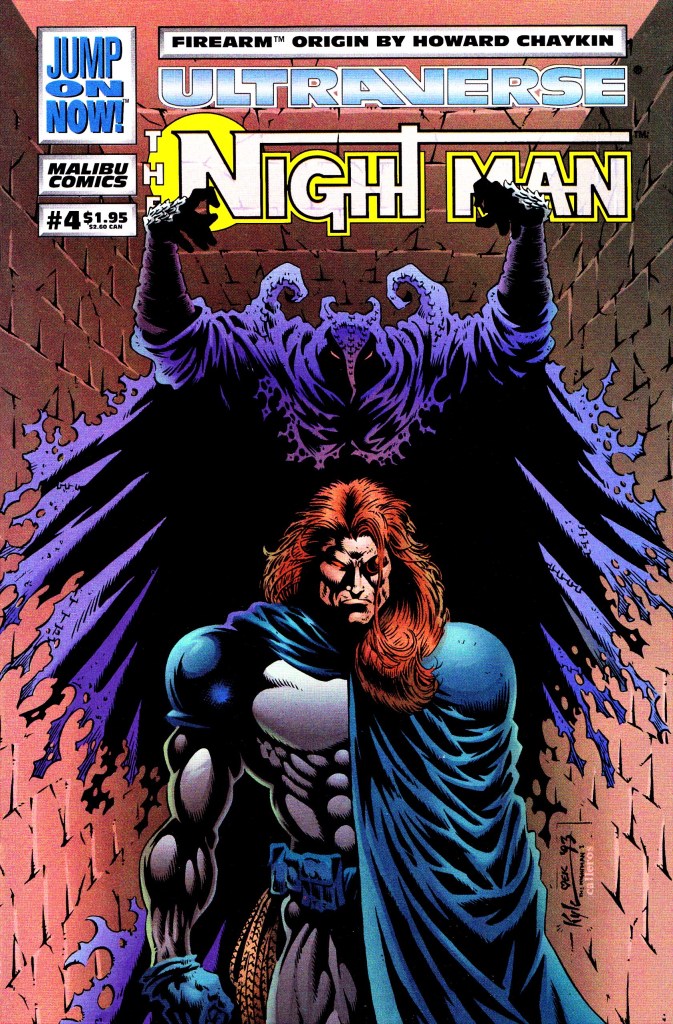
The cover.

Early story

The story begins with Night Man overlooking a portion of a major city from a high tower. He wonders how he could find five kids, referring to Freex who have gotten involved with his rival Mangle. For Night Man, the team of teenagers think Mangle is a freak like them and he knows that his rival targets kids as victims.

After acquiring almost a thousand Dollars worth of new equipment, he goes on the air reaching out to Freex. Freex, meanwhile, are with Mangle hiding inside am unknown place. After a news report was aired revealing that the Strangers used a rocket to go to the moon and mentioned J.D. Hunt’s name, Mangle reacts loudly and states that the said business tycoon will be at Moffett Field.

Freex, believing that Hunt can cure them, leave with Mangle by car…

Quality

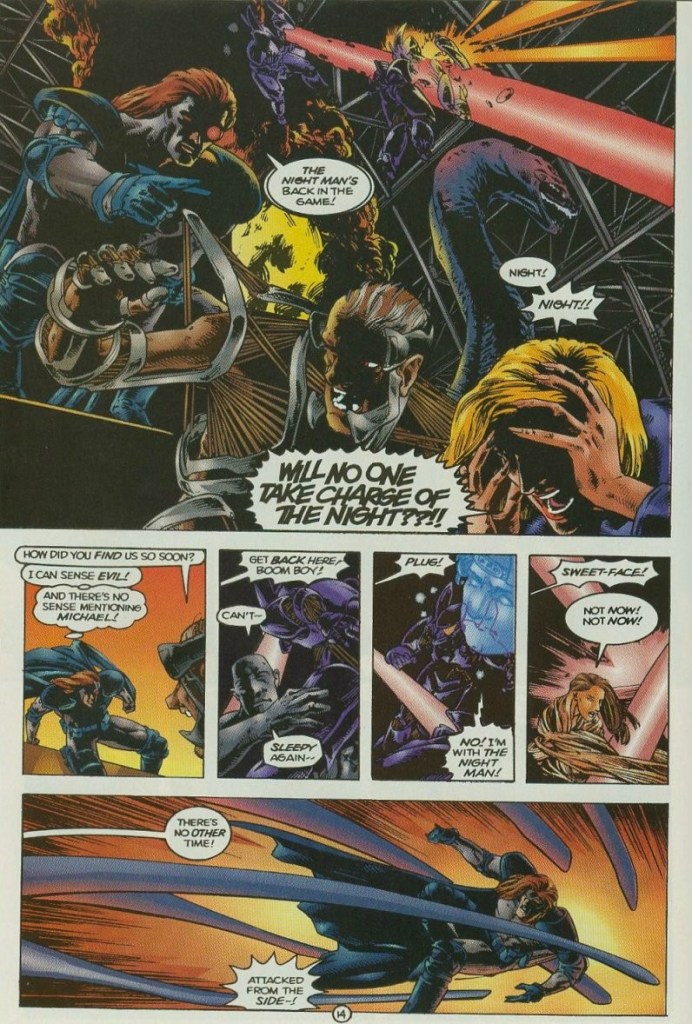
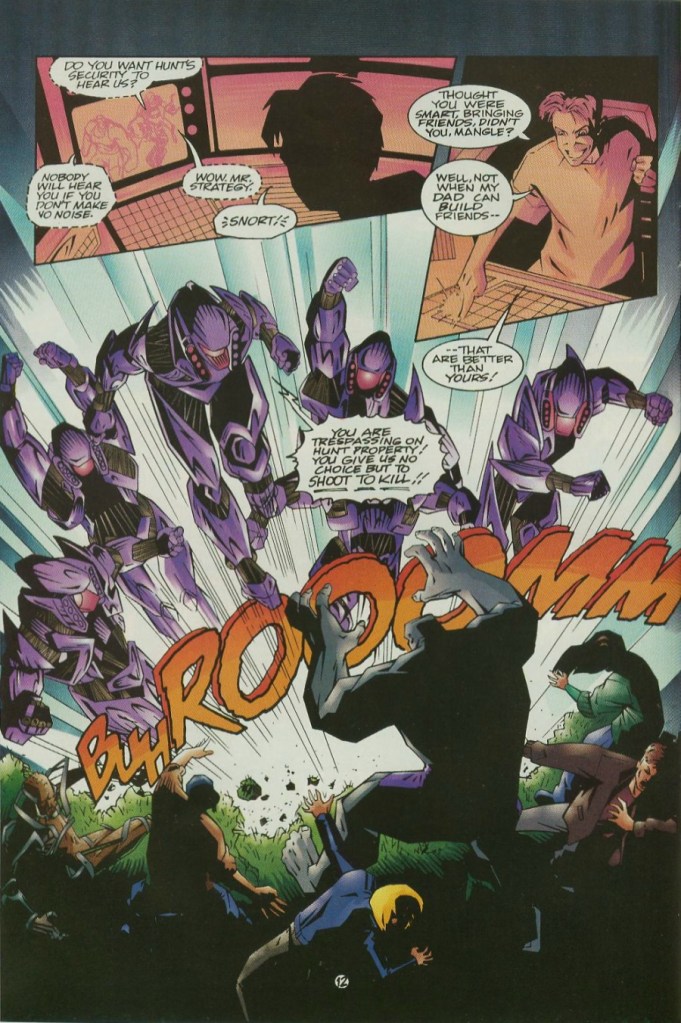
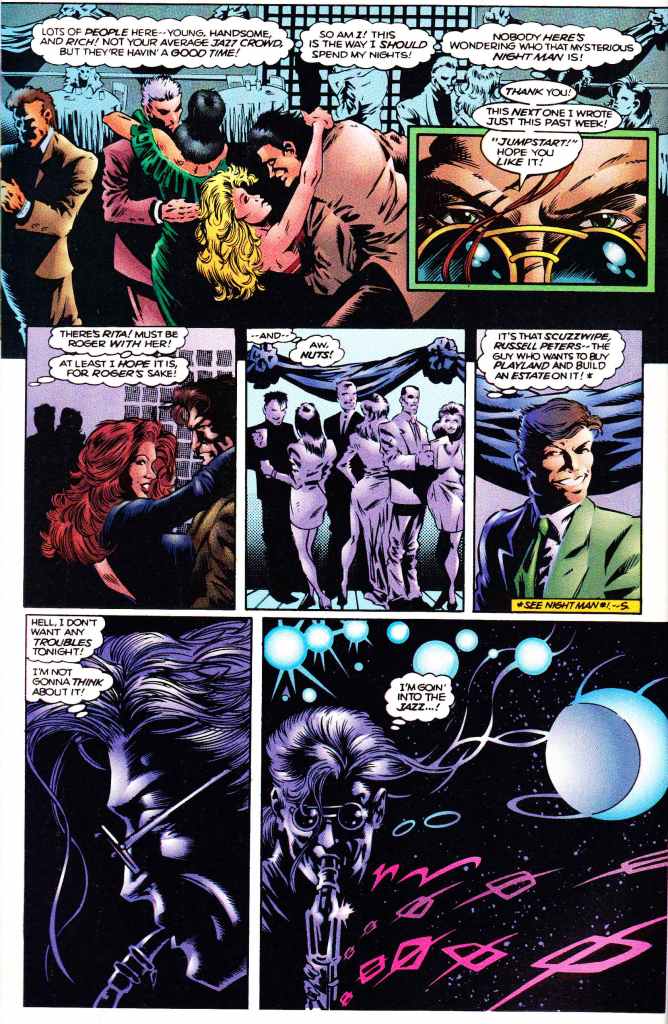
Night Man, Mangle and Freex!

With regards, Steve Englehart raised the stakes and added a lot of intrigue throughout the story. Without spoiling the plot, I can say that I enjoyed the pay-off executed here in relation to what was built up in Freex #6 and The Night Man #2.

The biggest selling point of the story is not the crossover between Night Man and Freex, but rather the presentation of JD Hunt and his young but wicked son Guy, as well as their involvement with Mangle. Themes explored in this comic book include manipulating a person to actually believe what evil acts he commits are not evil, and the manipulation of helpless youth to join a wrongful cause.

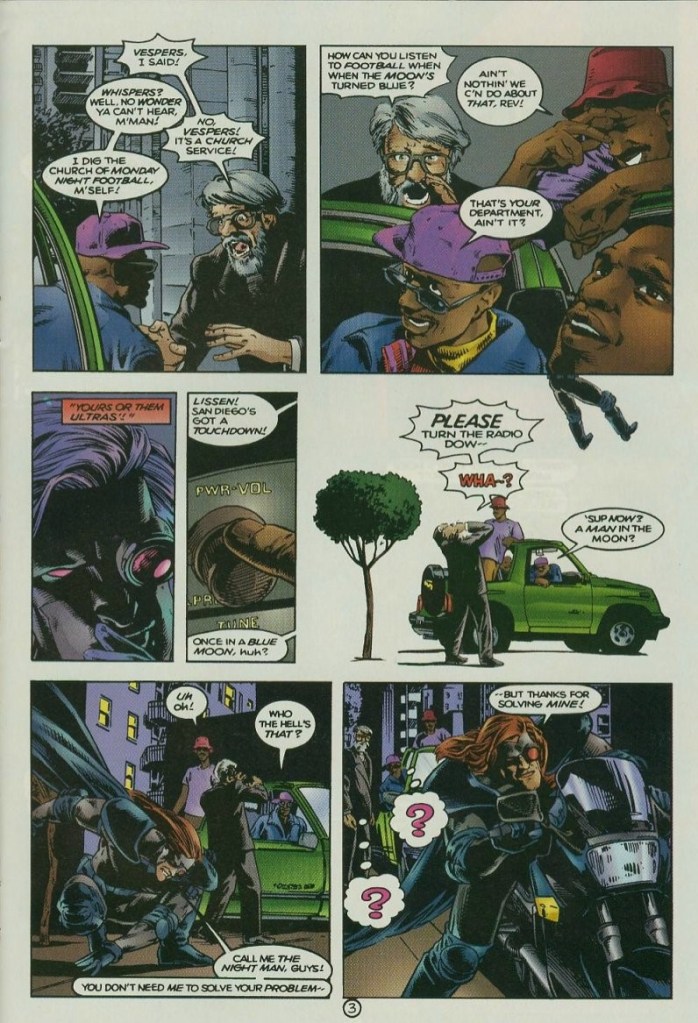
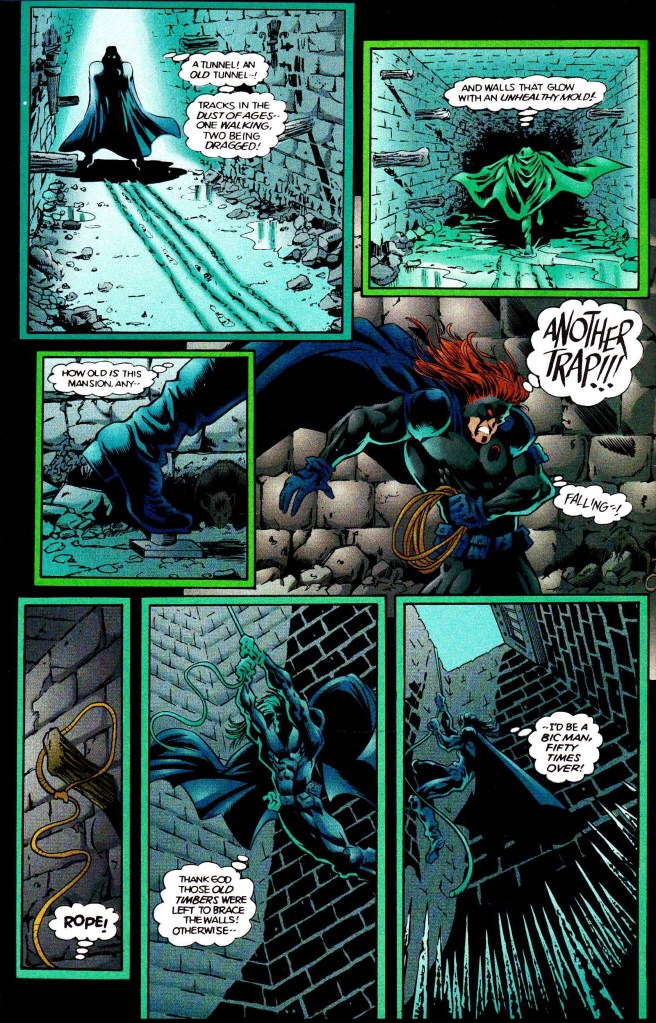
As for the title character himself, Night Man does more than just action and solving problems. You will see a more ethical side of his personality and his insistence on doing what is right without ever going overboard.  

Conclusion

Night Man learning something from the people on the street.

The Night Man #3 (1993) is an enjoyable and compelling part of the Break-Thru crossover (with creative connections to what happened in Prototype #5 and The Strangers #7) that also succeeds in developing Night Man further while showing more personality from JD Hunt and his son. The crossover between Freex and the title hero, again, did not last long but this is understandable considering the focus on the Hunts and Mangle. Lastly, I should state that artist Gene Ha’s dark and gritty style worked nicely in this comic book.

If you are seriously planning to buy an existing hard copy of The Night Man #3 (1993), be aware that as of this writing, MileHighComics.com shows that the near-mint copy of the comic book costs $16.

Overall, The Night Man #3 (1993) is recommended.

+++++

Thank you for reading. If you find this article engaging, please click the like button below and also please consider sharing this article to others. If you are looking for a copywriter to create content for your special project or business, check out my services and my portfolio. Feel free to contact me as well. Also please feel free to visit my Facebook page Author Carlo Carrasco and follow me at HavenorFantasy@twitter.com
A Look Back at X-Men 2099 #5 (1994)

Disclaimer: This is my original work with details sourced from reading the comic book and doing personal research. Anyone who wants to use this article, in part or in whole, needs to secure first my permission and agree to cite me as the source and author. Let it be known that any unauthorized use of this article will constrain the author to pursue the remedies under R.A. No. 8293, the Revised Penal Code, and/or all applicable legal actions under the laws of the Philippines.

Welcome back, superhero enthusiasts, comic book collectors, 1990s culture enthusiasts and fans of Marvel Comics! This is the continuation of a look back at the Marvel 2099 crossover storyline The Fall of The Hammer which started in Spider-Man 2099 #16 followed next in Ravage 2099 #15. The 3rd chapter of the said crossover filled the fifth issue of the X-Men 2099 monthly series.

For the newcomers reading this, a few of the X-Men of the far future were officially involved in this 5-part crossover storyline that was meant to celebrate the Marvel 2099 franchise back in the 1990s. This was the reason why Skullfire, Meanstreak, Krystalin and Bloodhawk were separated from their team leader Xi’an and the remaining teammates. Last time around, three of the mentioned X-Men got involved with Ravage and eventually reached the floating city of Valhalla together only to get separated.

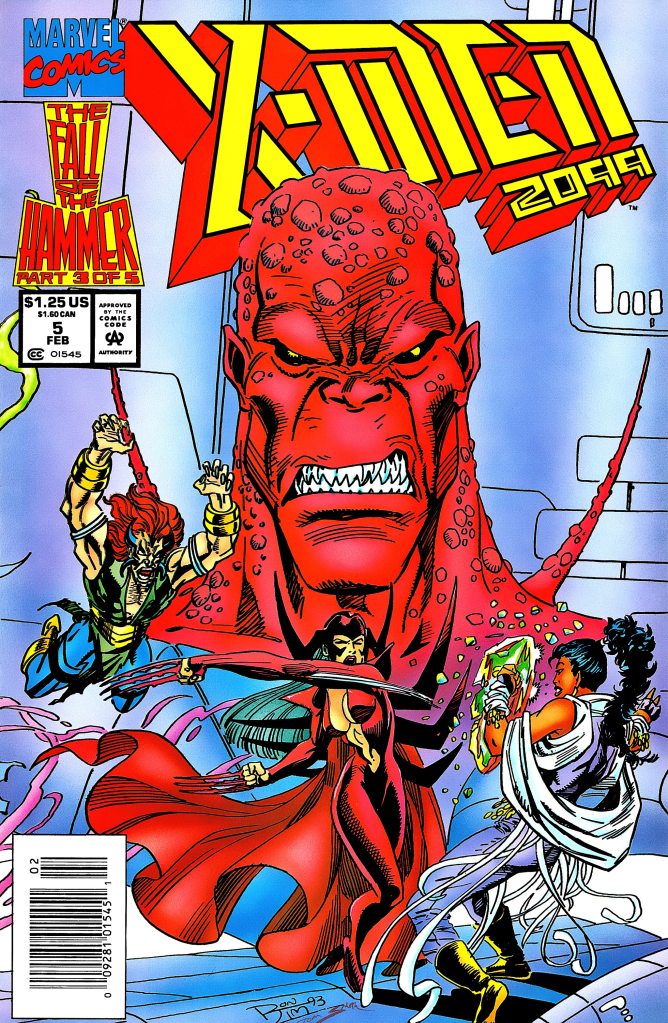
With those details laid down, here is a look back at X-Men 2099 #5, published in 1993 (cover dated 1994) by Marvel Comics with a story written by John Francis Moore and drawn by Ron Lim.

The cover.

Early story

The story begins in New York City where a vehicle moves at high speed until it hits a wall and stops. Out comes Tim Fitzgerald/Skullfire who moves away and spots Valhalla above him. In the floating city, Krystalin, Meanstreak and Bloodhawk are in confrontation with a powerful enemy called Heimdall who tells them to bow to him and swear allegiance.

Bloodhawk attacks Heimdall only to get pushed back. Krystalin fires crystal bits at him but to no success. Thinking that he’s too fast for Heimdall, Meanstreak tries a sneak attack from the side only to be hit hard, lose control and crashes to a wall. As the X-Men’s fastest member is down, a shadowy figure approaches him nearby…

Quality

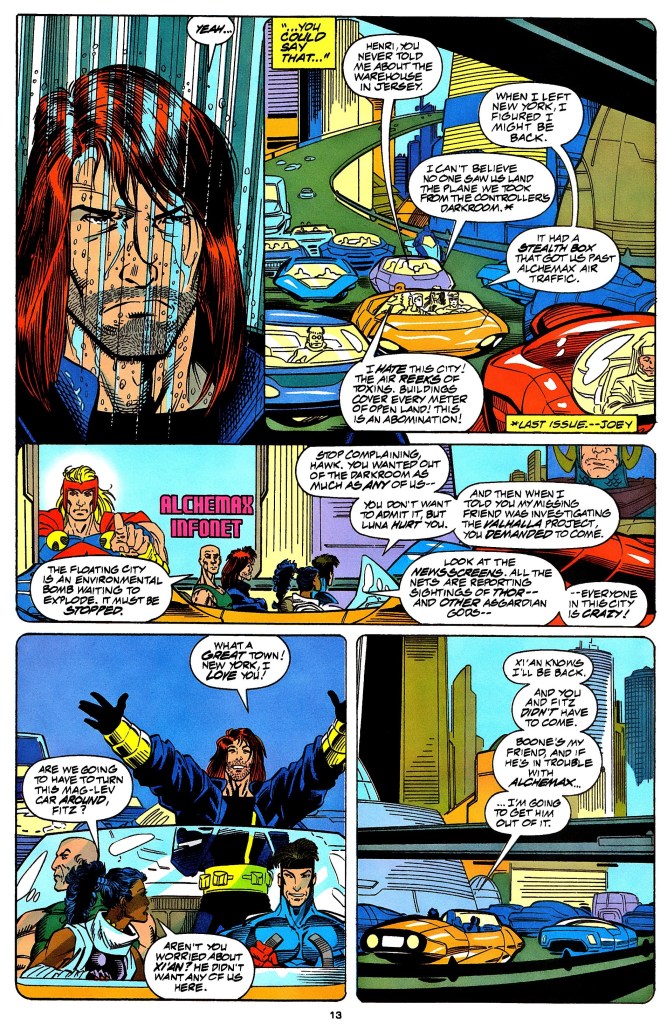
This quick flashback explains how the four X-Men 2099 members went to New York.

As an X-Men 2099 tale, this one felt like a catch-up for Skullfire who was absent in the first two parts of The Fall of the Hammer storyline even though it was confirmed in X-Men 2099 #4 that he joined his teammates and help Meanstreak find his friend Jordan. That being said, there is a good amount of scenes focused on Skullfire as he makes his way up to Valhalla. There is also a quick flashback showing that indeed he was with his teammates as they arrived in New York only to get separated (which explains why only Krystalin, Bloodhawk and Meanstreak approached Ravage). More importantly, the flashback also contains additional details that explain what the X-Men discovered before arriving at Valhalla and why they decided to approach Ravage.

As the 3rd chapter of The Fall of The Hammer storyline, this comic book barely moved the present-day narrative forward mainly due to having to use a few but precious pages to tell the short flashback to explain the X-Men’s involvement. Still, key revelations related to what happened behind-the-scenes added a lot of depth to the narrative and this properly sets the stage of for the remaining chapters. The 2099 major figures like Spider-Man, Punisher, Doom and Ravage all appeared here but very sparsely.    

Conclusion

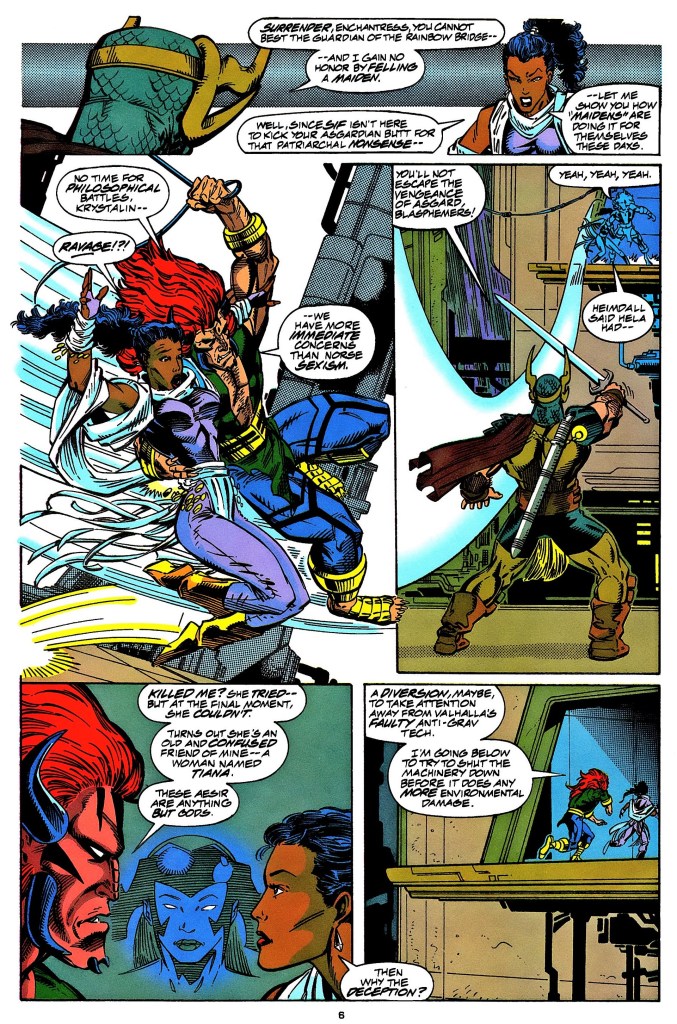
Ravage 2099 helps Krystalin.

X-Men 2099 #5 (1994) pushed the narrative of the crossover a few notches forward but the revelations written saved it from being a throw-away story. For fans of X-Men 2099, there is a lot to like here and Skullfire’s late entry into the crossover will delight them. The writing was good enough and by the end of the story, the explanations were satisfying and the ending suggested that the stakes would be raised for the final two chapters of the crossover. Those who missed the presence of Thor 2099 should be happy to see him here, even though it was clear that he was being conserved for the last two chapters.

If you are seriously planning to buy an existing hard copy of X-Men 2099 #5 (1994), be aware that as of this writing, MileHighComics.com shows that the near-mint copy of the regular edition costs $6 while the near-mint copy of the newsstand edition costs $18.

Overall, X-Men 2099 #5 (1994) is recommended.

+++++

Thank you for reading. If you find this article engaging, please click the like button below and also please consider sharing this article to others. If you are looking for a copywriter to create content for your special project or business, check out my services and my portfolio. Feel free to contact me as well. Also please feel free to visit my Facebook page Author Carlo Carrasco and follow me at HavenorFantasy@twitter.com
A Look Back at Ravage 2099 #15 (1994)

Disclaimer: This is my original work with details sourced from reading the comic book and doing personal research. Anyone who wants to use this article, in part or in whole, needs to secure first my permission and agree to cite me as the source and author. Let it be known that any unauthorized use of this article will constrain the author to pursue the remedies under R.A. No. 8293, the Revised Penal Code, and/or all applicable legal actions under the laws of the Philippines.

Welcome back, superhero enthusiasts, comic book collectors, 1990s culture enthusiasts and fans of Marvel Comics! To those who read my previous retro comic book reviews related to the 2099 universe of Marvel Comics, you know fully well that I found the first eight issues of the Ravage 2099 monthly series to be lackluster even though they all involved the writing of the late legend Stan Lee. After Lee stopped working, the Ravage 2099 series was taken over by Pat Mills and Tony Skinner for the writing duties and those two were in-charge of the Punisher 2099 series.

Eventually, a crossover storyline of the 2099 universe was published titled The Fall of the Hammer. It was told in five parts and each of the existing 2099 monthly series at the time – Spider-Man 2099, Ravage 2099, Doom 2099, Punisher 2099 and X-Men 2099 – had one issue forming it. The Fall of the Hammer kicked off with Spider-Man 2099 #16 which had solid writing by Peter David.

Part 2 was told in a Ravage 2099 issue. To find out the story and its quality, here is a look back at Ravage 2099 #15, published in 1993 (cover dated 1994) by Marvel Comics with a story written by Pat Mills and Tony Skinner, and drawn by Grant Miehm.

Early story

The story begins at the place of Paul-Phillip Ravage who is now in human form. In his presence are X-Men 2099 members Meanstreak, Krystalin and Bloodhawk. Suddenly Bloodhawk comes after Ravage and tries to make him give out information in relation to the disappearance of Jordan Boone, a friend of Meanstreak. Boone disappeared after compiling data related to Alchemax’s problem with Valhalla.

Ravage then transforms into his monstrous form which surprises Bloodhawk. After the winged X-Men member mentioned Valhalla, Ravage calms down and decides to talk with the team. Soon enough, they fly above the city streets in a vehicle heading towards Valhalla. As they approach the floating city, armed flying personnel move in to attack Ravage 2099 and the three X-Men.

Elsewhere in New York, Spider-Man 2099 finds himself at a disadvantage as Punisher 2099 has a gun pointed at him…

Quality

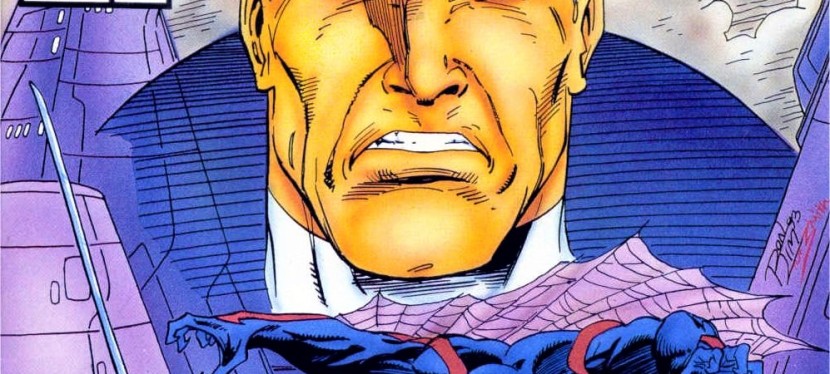
2099’s Spider-Man and Punisher together.

To put it clearly, this 2nd part of The Fall of the Hammer storyline is where the 2099 heroes begin to actually cross over with each other and the first panel showing Ravage with the three X-Men members is symbolic of that. The plot here is actually simple…Ravage and the X-Men make it to Valhalla which is their common destination. The mutants want information about Jordan Boone while Ravage tries to meet Doom 2099 (whom he met in Ravage 2099 #14). Apart from those objectives, there is a lot of action scenes laced with dialogue designed to move the narrative forward little by little. If you are looking for character development of Ravage, you won’t find much here. What you will find, however, are some scenes of intrigue that show Ravage getting disturbed temporarily as a result of realizing the presence of a certain someone he got close with.

As for Valhalla, the city here is more of a technical playground than an actual threat to the people and societies it flew over. What weakens the story here is the absence of 2099’s Thor.

Conclusion

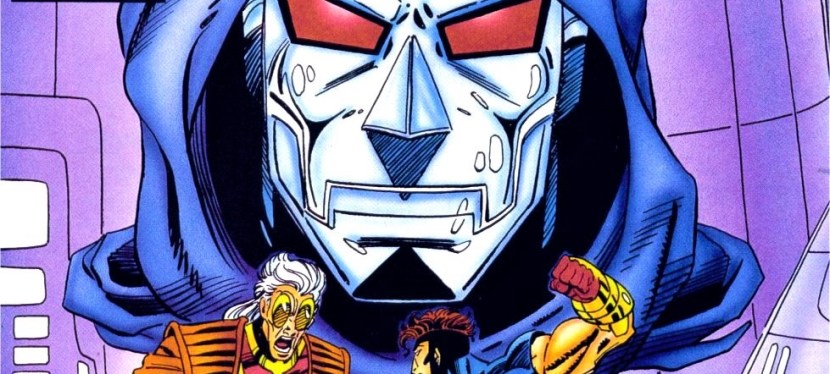
The money shot of this comic book!

To a certain extent, Ravage 2099 #15 (1994) is a somewhat entertaining read mainly due to the mix up of 2099 characters together here. The story is pretty light but at the very least fans of Ravage 2099 will find their monstrous hero in a somewhat interesting misadventure here. The concept that started in Spider-Man 2099 #16 showing Valhalla as a floating danger is weaker here but at least this comic book sets the stage for the next chapter of the storyline decently.

If you are seriously planning to buy an existing hard copy of Ravage 2099 #15 (1994), be aware that as of this writing, MileHighComics.com shows that the near-mint copy of the regular edition costs $16 while the near-mint copy of the newsstand edition costs $48.

Overall, Ravage 2099 #15 (1994) is satisfactory.

+++++

Thank you for reading. If you find this article engaging, please click the like button below and also please consider sharing this article to others. If you are looking for a copywriter to create content for your special project or business, check out my services and my portfolio. Feel free to contact me as well. Also please feel free to visit my Facebook page Author Carlo Carrasco and follow me at HavenorFantasy@twitter.com
A Look Back at The Strangers #24 (1995)

Disclaimer: This is my original work with details sourced from reading the comic book and doing personal research. Anyone who wants to use this article, in part or in whole, needs to secure first my permission and agree to cite me as the source and author. Let it be known that any unauthorized use of this article will constrain the author to pursue the remedies under R.A. No. 8293, the Revised Penal Code, and/or all applicable legal actions under the laws of the Philippines.

Wow! What a journey it has been! Back in the 1990s, I could never forget the first time I read The Strangers #1 which was so captivating, I decided to follow its monthly series and it was easily my favorite superhero team of the Ultraverse. It was also my first time to see the collaboration of Steve Englehart and Rick Hoberg leading the creativity which, as the many months and issues went on, resulted a series that was never boring and often satisfying and fun to read. I should state that the literary team of strangers composed of Atom Bob, Grenade, Lady Killer, Yrial, Spectral, Zip-Zap and Electrocute was memorable. Truly Malibu Comics had very talented creators for the Ultraverse which eventually lasted just a few years (read: Marvel Comics acquired Malibu Comics).

This brings me to my next point…this retro comic book review is about the last issue of The Strangers monthly series ever published. As I love the Ultraverse, it is sorrowful to see the end of an enjoyable monthly series. In recent times, I reviewed the final issue of the Prototype monthly series (which itself was fun overall) which ended in a rather unsatisfying manner. Prototype’s final issue was not even written by the original creators of the series!

How will this final issue of The Strangers series turn out? We can all find out in this look back at The Strangers #24, published in 1995 by Malibu Comics with a story written by Steve Englehart and drawn by Rick Hoberg with inkwork done by Barbara Kaalberg.

The cover.

Early story

The story begins with Teknight, Spectral, Grenade, Lady Killer, Yrial, Zip-Zap and Electrocute back together (note: Lady Killer and Yrial went somewhere far in the previous issue). They talked about Electrocute’s codition, Atom Bob being in a comatose state at the Clinique de Parsival, and the dangerous encounter with Taboo.

Meanwhile inside a passenger jet flying above the North Atlantic, a man expresses his passion and fondness of the Strangers to the passenger sitting to his left. The said passenger wants to learn more about the team.

The following night at Union City in California, the same passenger knocks on the window of a van with a man and a lady kissing passionately inside. As the man comes out of the van feeling very annoyed, the passenger introduces himself to him as Taboo. A new team of TNTNT is being formed…  

Quality

Pay close attention to the details on the words of Lady Killer.

To start with, I confirm that the usual high quality of writing and art by the Englehart-Hoberg duo is evident in this comic book. Not a single part of it looks rushed to me. The plot is very well structured and the visuals are great to see!

While the story is not as conclusive as I hoped it would be, it is still a lot of fun to read. For one thing, it’s nice to see the Strangers together again (note: Teknight has been with the team for some time already) and it was entertaining to see them face worthy opposition in the form of a new team of their rival TNTNT (with an obsessed Taboo as the new addition). The Strangers-TNTNT battle was not an all-out brawl but the match-ups were nicely done complete with really fun action scenes. I should state that not only did Rick Hoberg frame the action scenes greatly, he pushed his imagination up a few notches with regards to adding a lot of flair to the battle between Teknight and Taboo.  

As mentioned earlier, this comic book was unfortunately the last of the series and clearly it was not written to be the end (note: the comic book ended with the anticipation of the celebration of the Jumpstart). There was a part in which Lady Killer told her teammates about using the funds they made from licensing to build for themselves their own headquarters and Grenade even mentioned having a room for Atom Bob in anticipation of a return. There was also a sub-plot about J.D. Hunt and his very rebellious son who clearly wants to do more while he exists. More on the battle between the Strangers and TNTNT, it’s clearly not decisive and in my own view, a rematch was needed.

Conclusion

The updated TNTNT.

As the final issue of its monthly series, The Strangers #24 (1995) is pretty entertaining on its own. It was definitely not a conclusive story and in fact, art was made for what could have been the 25th, the 26th and 27th issues of The Strangers (see the A Fond Farewell excerpt below). It’s too bad those conceptualized issues did not materialize because there was a lot of good and enjoyable stuff to read in this comic book. This only shows that Steve Englehart and Rick Hoberg still had more great and new stuff to tell through The Strangers.

If you are seriously planning to buy an existing hard copy of The Strangers #24 (1995), be aware that as of this writing, MileHighComics.com shows that the near-mint copy of the comic book costs $50.

Rick Hoberg’s farewell message plus art for what would have been The Strangers #25, #26 and #27.

Overall, The Strangers #24 (1995) is highly recommended!

+++++

Thank you for reading. If you find this article engaging, please click the like button below and also please consider sharing this article to others. If you are looking for a copywriter to create content for your special project or business, check out my services and my portfolio. Feel free to contact me as well. Also please feel free to visit my Facebook page Author Carlo Carrasco and follow me at HavenorFantasy@twitter.com

A Look Back at Spider-Man 2099 #16 (1994)

Disclaimer: This is my original work with details sourced from reading the comic book and doing personal research. Anyone who wants to use this article, in part or in whole, needs to secure first my permission and agree to cite me as the source and author. Let it be known that any unauthorized use of this article will constrain the author to pursue the remedies under R.A. No. 8293, the Revised Penal Code, and/or all applicable legal actions under the laws of the Philippines.

By the year 1993, Marvel Comics’ new comic book line of the 2099 universe kept filling the shelves of retailers and made it into the hands of collectors and fans with the monthly series composed of Spider-Man 2099, Ravage 2099, Doom 2099, Punisher 2099 and the new addition of the year X-Men 2099. Back then, the Marvel 2099 line expanded a lot and saw the establishment of new fans. Even the quarterly series 2099 Unlimited caught the attention of some readers as it told the early stories of Hulk 2099 (who debuted in 2099 Unlimited #1).

Unsurprisingly, there were fans of the 2099 universe who wished for a crossover storyline that would bring together their respective favorite futuristic heroes. Remember the rivalry between classic Spider-Man (Peter Parker) and the Punisher (Frank Castle)? Some wanted Spider-Man 2099 and Punisher 2099 to encounter each other.

Eventually, the crossover dream of the fans came through in the form of The Fall of the Hammer storyline that took place in five parts. Specifically one issue each of Spider-Man 2099, Ravage 2099, Doom 2099, Punisher 2099 and X-Men 2099. It was also an opportunity for the 2099 creative teams (note: the legendary Stan Lee and Peter David were among the writers at the time) to get together and contribute to make something special under the watch of 2099 editor Joey Cavalieri.

With those details laid down, we can finally start examining the beginning of The Fall of the Hammer storyline in this look back at Spider-Man 2099 #16, published in 1993 (cover dated 1994) by Marvel Comics with a story written by Peter David and drawn by Rick Leonardi.

The cover drawn by Ron Lim.

Early story

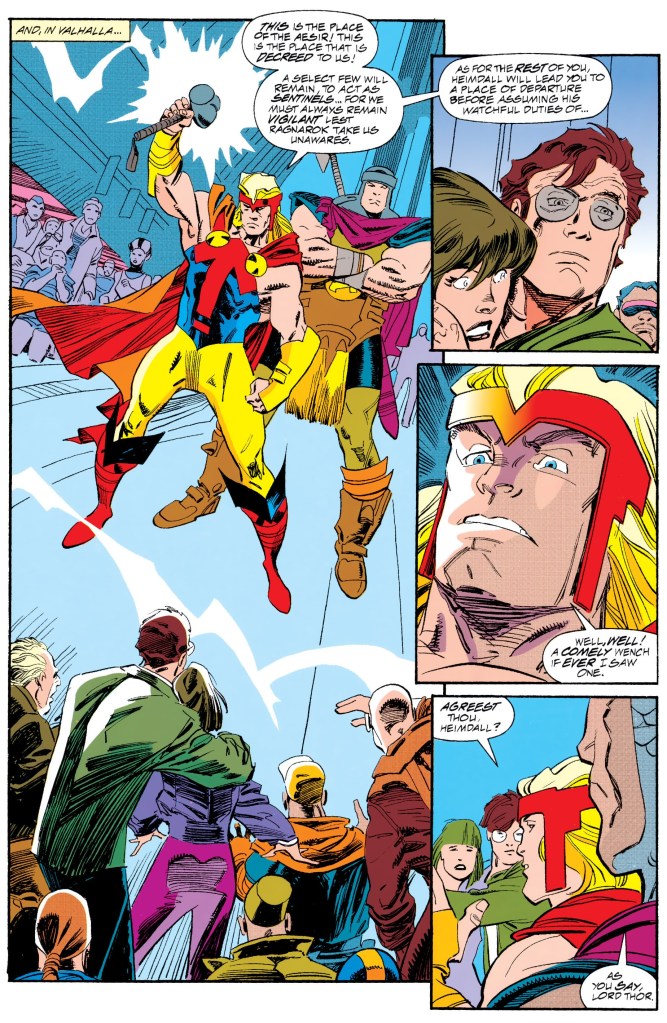
The story begins with the arrival of the floating city of Valhalla, disturbing the people of the town of Randall below. On the floating city itself, a crowd of people – with Miguel O’Hara and Dana among them – stare at a hammer-wielding, caped blonde man who claims to be Thor (their idol). Accompanied by Heimdall, Thor tells them that a select few among them will remain in the city to act as sentinels while the rest will come with Heimdall to a place of departure.

Thor turns his attention on Dana causing Miguel to intervene and challenge his so-called authority. As Thor reacts to Miguel’s defiance, he throws a punch which got deflected. This causes the so-called god of thunder to be surprised given Miguel looking ordinary to him. In reaction, Thor grabs him and throws his body several feet over many people’s heads. This leaves Dana helpless.

Miguel crashes through a glass window, falling outside until he shoots a web to control his movement. He takes off his civilian clothes, revealing his costume as Spider-Man of 2099. He sets off to get back at Thor…  

Quality

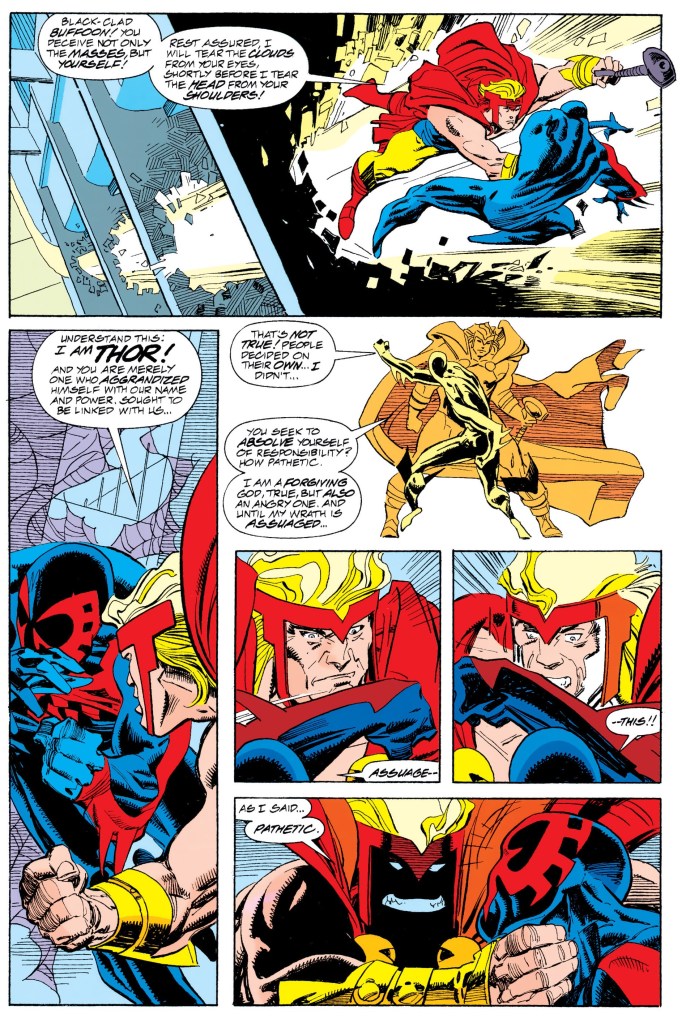
The highlight of the comic book is Spider-Man 2099’s conflict with Thor.

To make clear the obvious, the writing by Peter David is indeed solid although the sketch-like aesthetic of the art of Rick Leonardi badly needed more visual details.

As for the story itself, it is succeeded in creating tension with regards to the caped figure who believes himself to be Thor who is the central figure of religion in 2099 America and has the means to wield power by even involving technology (with Valhalla as the center piece). That being said, Spider-Man 2099’s encounter with him was inevitable, and so was the result (a bit predictable). The story also sheds light on the perceived omnipotence of Thor and how Spider-Man 2099 (who was previously referred to by some people as Thor’s harbinger) got associated with his legend.

To make things clear, this one is purely a Spider-Man 2099 story that justifies the concept of needing other 2099 heroes as the threat was simply too great for any one hero to handle. I should also state that the crossover between any heroes does not begin until the final page of this comic book.

Conclusion

Nothing like being in a crowd of people watching helplessly in front of two so-called omnipotent figures.

Spider-Man 2099 #16 (1994) is still a good read and as the first chapter of The Fall of the Hammer storyline, it served its purpose well. This is mainly due to the strong writing by Peter David who also succeeded in establishing 2099’s Thor not only as the villain but also as a figure who truly is a threat to the people. This comic book also shows that people in 2099 failed to realize who their true Creator is as they embraced religion (instead of faith) and committed idolatry (which is truly unholy) by believing in a false god like Thor.

If you are seriously planning to buy an existing hard copy of Spider-Man 2099 #16 (1994), be aware that as of this writing, MileHighComics.com shows that the near-mint copy of the regular edition costs $40 while the near-mint copies of the newsstand and the signed-and-numbered editions cost $120 and $300 respectively.

Overall, Spider-Man 2099 #16 (1994) is recommended.

+++++

Thank you for reading. If you find this article engaging, please click the like button below and also please consider sharing this article to others. If you are looking for a copywriter to create content for your special project or business, check out my services and my portfolio. Feel free to contact me as well. Also please feel free to visit my Facebook page Author Carlo Carrasco and follow me at HavenorFantasy@twitter.com

A Look Back at Freex #6 (1993)

Disclaimer: This is my original work with details sourced from reading the comic book and doing personal research. Anyone who wants to use this article, in part or in whole, needs to secure first my permission and agree to cite me as the source and author. Let it be known that any unauthorized use of this article will constrain the author to pursue the remedies under R.A. No. 8293, the Revised Penal Code, and/or all applicable legal actions under the laws of the Philippines.

Welcome back, superhero enthusiasts, comic book collectors, 1990s arts and culture fans and fans of Malibu Comics! Remember the Break-Thru crossover of the Ultraverse back in late 1993? Already I have reviewed the spin-off issues related to Break-Thru such as Mantra #6, The Solution #4, Prime #6, and The Strangers #7 to name same.  

Today, I got to review another Break-Thru tale told through the presence of the team called Freex. In addition to being connected with the big crossover, this comic book is a continuation of the events that took place in The Night Man #2 and this means a crossover between Freex and Night Man!

With those details laid down, here is a look back at Freex #6, published by Malibu Comics in 1993 with a story written by Gerard Jones and drawn by Ben Herrera.

The cover.

Early story

The story begins with the Freex listening to someone who tells them not to be afraid and that he is a victim of the world. He introduces himself as Mangle and even though he has a deformed look, the team keeps on focusing on what he tells them. He reveals that he was chased by a murderous crowd led by Night Man. After trying to justify his presence in the Christmas tree lot they are occupying, Lewis of the Freex rejects his idea and states that the situation for his team has been pretty bad as they are not only hunted by the police but also have been demonized through the media. He tells Mangle to stay away. Valerie then starts to lose control of herself which Lewis refers to as the possession. Michael speculates that sky must be affecting them.

Meanwhile, Night Man arrives in the city in pursuit of Mangle. He remembers breaking the freak’s collar bone. On the street, he notices a group of people who are obsessing about the sky above them. Something chaotic begins…

Quality

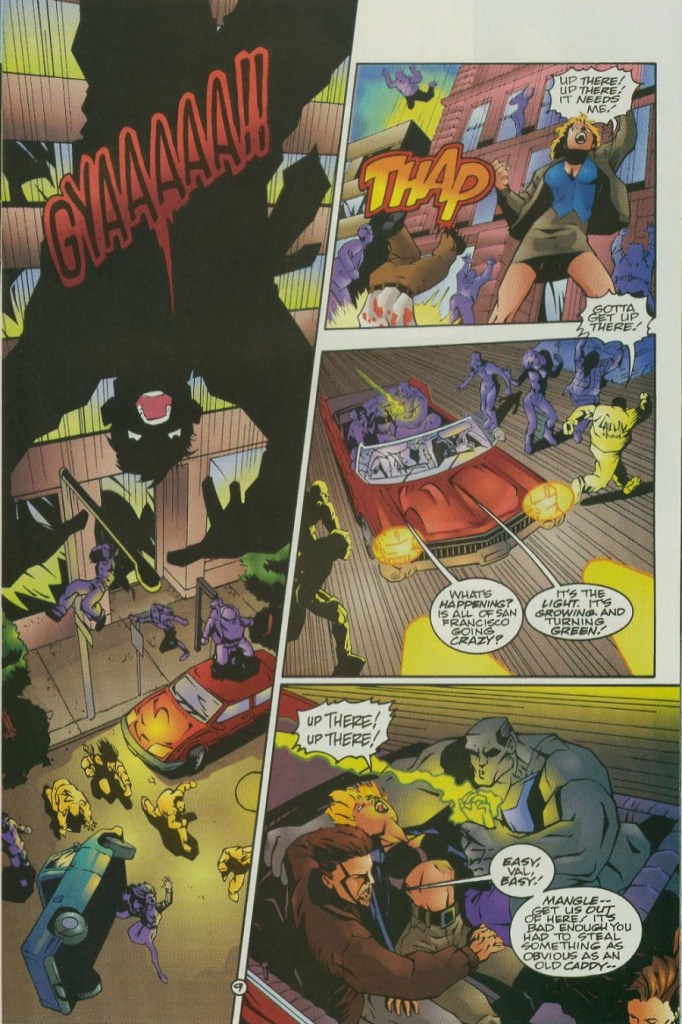
In the heat of the action.

When it comes to its story, I want to say that the crossover between Freex and Night Man is really short and it happened in the later part of the story. As far as crossovers go, this one is more like Freex-meets-Mangle. The first encounter between the team and Night Man is really underwhelming. As a spin-off tale of Break-Thru, this one dramatizes how a force of influence from the sky causes chaos on the people below. Anyone who is familiar with the existing forces on the moon within the Ultraverse will be able to relate with the concept of Break-Thru.  

When it comes to the other concept of this comic book, also interesting to follow was the significance (expressed in words) of J.D. Hunt and how he impacted the lives of each member of Freex through technology.

There is a decent amount of action as well as character development scenes to balance with the main story. Nothing spectacular to see though.

Conclusion

The Break-Thru effect on the people.

Freex #6 (1993) biggest feature is not really the expected crossover with Night Man. Really, its theme is about a group of freaks following another freak (Mangle) to do something to make their dreams of normalizing and improving their lives come true. This comic book shows just how vulnerable and manipulative the Freex really are as they don’t have a mature leader to guide them. Going back to crossing over with Night Man, this comic book is really the first of two parts.

If you are seriously planning to buy an existing hard copy of Freex #6 (1993), be aware that as of this writing, MileHighComics.com shows that the near-mint copy of the regular edition costs $14 while the near-mint copy of the newsstand edition costs $42.

Overall, Freex #6 (1993) is satisfactory.

+++++

Thank you for reading. If you find this article engaging, please click the like button below and also please consider sharing this article to others. If you are looking for a copywriter to create content for your special project or business, check out my services and my portfolio. Feel free to contact me as well. Also please feel free to visit my Facebook page Author Carlo Carrasco and follow me at HavenorFantasy@twitter.com

A Look Back at The Night Man #2 (1993)

Disclaimer: This is my original work with details sourced from reading the comic book and doing personal research. Anyone who wants to use this article, in part or in whole, needs to secure first my permission and agree to cite me as the source and author. Let it be known that any unauthorized use of this article will constrain the author to pursue the remedies under R.A. No. 8293, the Revised Penal Code, and/or all applicable legal actions under the laws of the Philippines.

Welcome back, superhero fans, comic book collectors, fans of 1990s arts and culture, and fans of Malibu Comics! Today we return to the Ultraverse for another tale of The Night Man, specifically from one of the early issues of its monthly series that launched in 1993.

For the newcomers reading this, Night Man is a solo hero within the Ultraverse who is a musician by day and a crime fighter by night. He was involved in a major accident with a certain cable car in San Francisco that got hit by a bolt of energy from the sky (as told in The Strangers #1). His life was never the same.

With those details laid down, here is a look back at The Night Man #2, published in 1993 by Malibu Comics with a story written by Steve Englehart and drawn by Gene Ha.

The cover.

Early story

The story begins with Johnny Domingo (Night Man) failing to sleep during the night. The operation he had recently kept him awake and his mind is just racing. He could not even properly play his saxophone.

He dresses again as the Night Man, takes his motorcycle out of his place and then he speeds away. Shortly after, he senses another person’s thoughts…those of a man wearing a trench coat messing with a young boy. Night Man decides to jump in, intervene and save the boy but to his surprise, the man easily hit him moving him back and making him fall on the road.

Unwilling to give up, Night Man goes back to him and strikes back with a kick to the head. During their conflict, Night Man pulls the man’s trench coat revealing a rather shocking form for a body that looked inhuman. This shocks the costumed vigilante giving the man time to pull down scaffoldings in an attempt to hurt him and the boy…

Quality

Night Man and Mangle fight!

Focusing on the plot, while the first issue showed Night Man beginning as a vigilante and self-made detective, this comic book shows him struggling to do what he believes to be good (by means of saving another person’s life) and having to face both rejection and skepticism from people. Of course, Night Man himself is flawed with his execution and the way he presents himself to others (note: including doing the radical thing of climbing a tall building just to talk to someone powerful). It does not help that he is restless which clearly impacts his perception even though he has the will to be helpful and make local society a bit safer from dangerous people.  

Back to the story, the introduction of a new villain named Mangle is quite intriguing and it seems very fitting that Night Man’s reaction to seeing him in his inhuman form would reflect the same shocked reaction on the part of the reader. Mangle is very distinct from the many other villains of the Ultraverse and he is indeed a powerful adversary to Night Man.

When it comes to the visuals, Gene Ha’s art style is excellent. He has this distinct, gritty style on drawing people as well as their facial expressions. His art on Mangle made the villain look really scary and intimidating. Gene Ha also proved to be good with framing the action scenes while keeping enough creative space for the dialogue or narration to come in for readers to follow.

Conclusion

Nothing like coming all the way down from a very tall building to move on.

The Night Man #2 (1993) is pretty compelling and as it is free from the baggage that came with building up the vigilante in issue #1, this one has a more cohesive story and shows more of the him doing his best to be helpful. The story is good enough to keep me interested for the next issue. I should also state that if readers love seeing a hero struggle in helping others, then there is a lot to like in this story.

If you are seriously planning to buy an existing hard copy of The Night Man #2 (1993), be aware that as of this writing, MileHighComics.com shows that the near-mint copy of the comic book costs $14.

Overall, The Night Man #2 (1993) is recommended.

+++++

Thank you for reading. If you find this article engaging, please click the like button below and also please consider sharing this article to others. If you are looking for a copywriter to create content for your special project or business, check out my services and my portfolio. Feel free to contact me as well. Also please feel free to visit my Facebook page Author Carlo Carrasco and follow me at HavenorFantasy@twitter.com
A Look Back at Prototype #18 (1995)

Disclaimer: This is my original work with details sourced from reading the comic book and doing personal research. Anyone who wants to use this article, in part or in whole, needs to secure first my permission and agree to cite me as the source and author. Let it be known that any unauthorized use of this article will constrain the author to pursue the remedies under R.A. No. 8293, the Revised Penal Code, and/or all applicable legal actions under the laws of the Philippines.

Welcome back, superhero fans, comic book collectors, fans of 1990s culture and fans of Malibu Comics! After going through reviewing seventeen issues of the Prototype monthly series that started with the 1993 launch of the Ultraverse, the end of the said series is here.

Before doing the retro review of the 18th and final issue of Prototype, I should state that the armored hero is indeed one of the most significant Ultraverse heroes of them all. Other than having a standalone monthly series (which includes issue #0) plus a giant size one-shot comic book, Prototype also was part of UltraForce and his presence and overall contribution in that short-lived series were undeniably good. Prototype is also memorable for his conflicts with Prime (read my review of Prime #4). As a series, Prototype also sheds light on the concept about how society would react to an actual functioning, flying armored hero who was also marketed for commercial purposes.

You must be wondering…is the 18th issue a conclusive story of the monthly series? What were the effects of Marvel’s acquisition of Malibu Comics on the creative team? We can all find out in this look back at Prototype #18, published in 1995 by Malibu Comics with a story written by R.A. Jones and drawn by Paul Abrams.

The cover.

Early story

The story begins in a certain department store in Manhattan where a special anniversary celebration is being held and Prototype (piloted by Jimmy Ruiz) is the special guest. The affair turns out to be an assignment for him from his employer. Suddenly an armored figure (human-like above the belt, mechanical below the belt) breaks into the store causing a major disturbance. He calls himself Battlewagon.

Battlewagon suddenly opens fire and hits many items around, causing people to panic. Prototype decides to take action and their conflict causes even more damage.

As Battlewagon speaks out against him, Prototype notices the use of a word which was a reference to the gang that he (Jimmy Ruiz) used to hang out with. Prototype also realizes that his new foe is after him in a rather personal way…

Quality

Does this scene remind you of today’s manipulative and irresponsible news media coverage?

To put it straight to the point, this comic book is not as conclusive as what Prototype fans would hope for. Sure the words “The end.” were written on the last page but, without fully spoiling the story of the comic book, sub-plots that started building up in the few previous issues were left unresolved. You hoped to see Jimmy reunited with Angella in this issue? You hoped to what happened to the deformed Stanley Leland? You will be disappointed.

More on the comic book itself, the conflict between Prototype and Battlewagon is actually written to be intense in terms of dialogue and interaction between the two. While that is a good thing, it does not hide the fact that Battlewagon, as a villain, felt more like an afterthought in terms of character introduction and the flashback relating to collateral damage in Prototype #7 does not really add much to the him. What I liked most in the script written by R.A. Jones was the look back at the past of Jimmy Ruiz when he was younger and was a thug on the streets.

Conclusion

Chaos inside the department store.

While it is not strong enough to be a worthy conclusion to its series, Prototype #18 (1995) managed to tell its own tale in a satisfying manner by adding another villain for the hero to fight with, and also expanding Jimmy Ruiz’s past as a gang member. Of course, I don’t have the details about what happened behind the scenes at Malibu Comics as a result of getting acquired by Marvel Comics, and how all that impacted the creators working on Prototype. I can only speculate that there were planned stories of Prototype that did not get published. In fact, there was a short announcement of Prototype: Turf War #1 shown.

If this comic book is any indication, its story really felt more like a substitution as it had no references to the plot elements of the immediate few issues before it. Considering what happened at the end of issue #17, Jimmy Ruiz really acted out of character in this story.   

If you are seriously planning to buy an existing hard copy of Prototype #18 (1995), be aware that as of this writing, MileHighComics.com shows that the near-mint copy of the comic book costs $35.
Overall, Prototype #18 (1995) is satisfactory. As a series’ final issue, however, it is a disappointment.

+++++

Thank you for reading. If you find this article engaging, please click the like button below and also please consider sharing this article to others. If you are looking for a copywriter to create content for your special project or business, check out my services and my portfolio. Feel free to contact me as well. Also please feel free to visit my Facebook page Author Carlo Carrasco and follow me at HavenorFantasy@twitter.com