Retro Gaming Ads Blast – Part 16

Welcome back readers, fellow geeks and electronic gaming fans!

In this edition of the Retro Gaming Ads Blast (RGAB) series, we will take a look at another batch of retro gaming print ads – including arcade flyers – from the 1980s and 1990s.

For the newcomers reading this, Retro Gaming Ads Blast (RGAB) looks back at the many print ads of games (console, arcade, computer and handheld) that were published in comic books, magazines, flyers and newspapers long before smartphones, social media, the worldwide web and streaming became popular. To put things in perspective, people back in the 1980s and 1990s were more trusting of print media for information and images about electronic games and related products.

With those details laid down, here is the newest batch of retro gaming print ads for you to see and enjoy…

1. A-Jax North American arcade flyer
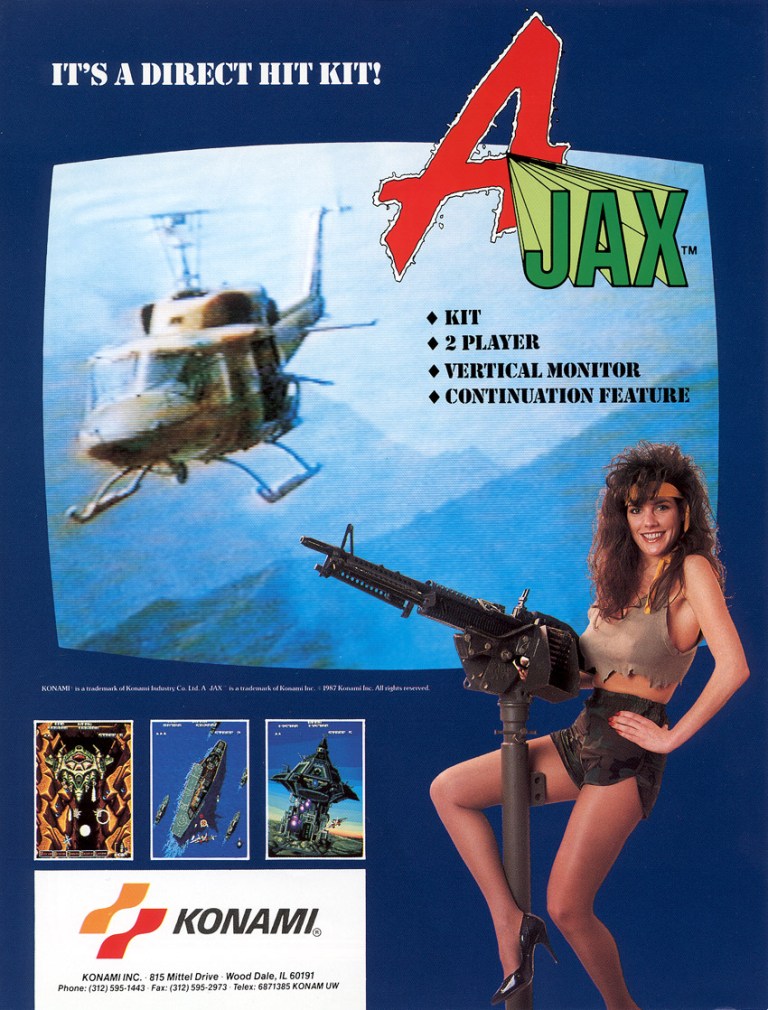
Another one of Konami’s arcade flyers showing a pretty fashion model with a touch of militarism.

A-Jax (also referred to as Ajax) is another one of the many military themed games Konami released for the arcades in the 1980s. It was a 2D vertically scrolling shooter in which players use aircrafts to shoot enemies both in the air and on the ground. The game was a hit in Japanese arcades and Konami came up with the North American arcade flyer showing three screenshots, an archive footage shot of a military helicopter and a sexy lady (with a light military look) with a machine gun. The style of presentation was similar in style with the North American arcade flyers of Contra and M.I.A.: Missing in Action.

2. The Combatribes print ad
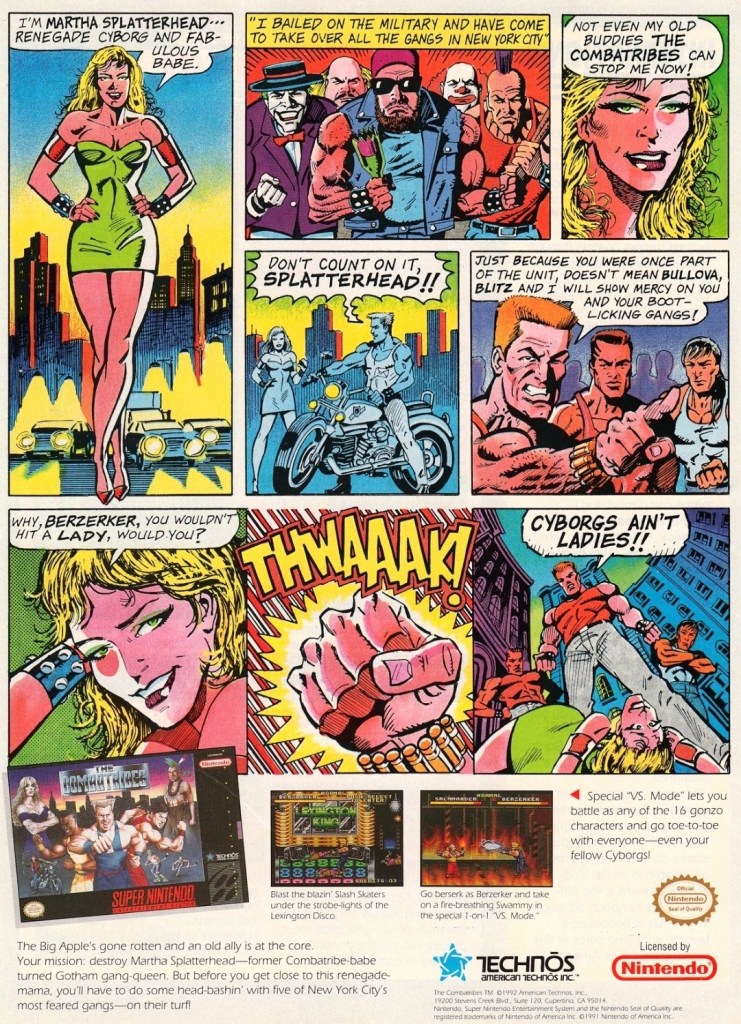
The short comic book approach was used to emphasize the setting and concept of the video game.

Technos, the Japanese company behind the wildly popular Double Dragon games franchise, proved to be successful with the arcade release of The Combatribes. In an attempt to keep the wave of success moving, Technos released The Combatribes on the Super Nintendo Entertainment System (SNES) in 1992 and someone involved with the North American marketing came up with the idea of creating a comic book-style presentation for the print ad. Creatively speaking, the comic book approach was done to emphasize the story and visual concepts of the game, and entice readers to play it. By today’s standards of video game marketing, this print ad’s approach is both unusual and notable.

3. Dead or Alive 2 Dreamcast port print ad
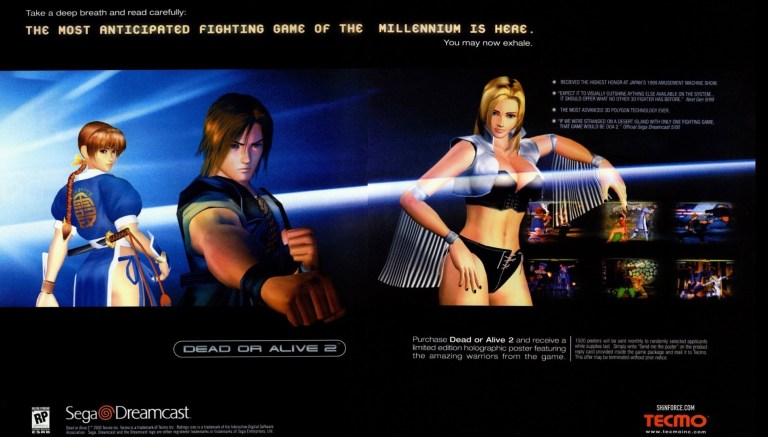
This was a wide print ad that appeared on magazines and it sure was eye-catching. It was an effective way to promote the game and inform people of the Sega Dreamcast’s presence in the market.

When Dead or Alive 2 was released in the arcades in 1999, a lot of gamers were astounded by it as developer Team Ninja (led by Tomonobu Itagaki) made it much bigger and a lot better than its 1996 predecessor. Team Ninja really went all out making the sequel utilizing Sega’s NAOMI arcade technology, inviting martial artists to do motion-capture, and having a very ambitious game design. Since the game was developed with the NAOMI hardware, porting the game for the Sega Dreamcast was reportedly convenient and smooth for the developers who went on to add more gameplay features and modes. Publisher Tecmo came up with this wide print ad (promoting the Dreamcast release) showcasing three characters, six screenshots and text descriptions emphasizing the universal acclaim the game received. The promotional approach was simple yet effective.  

4. Jet Moto (PC version) print ad
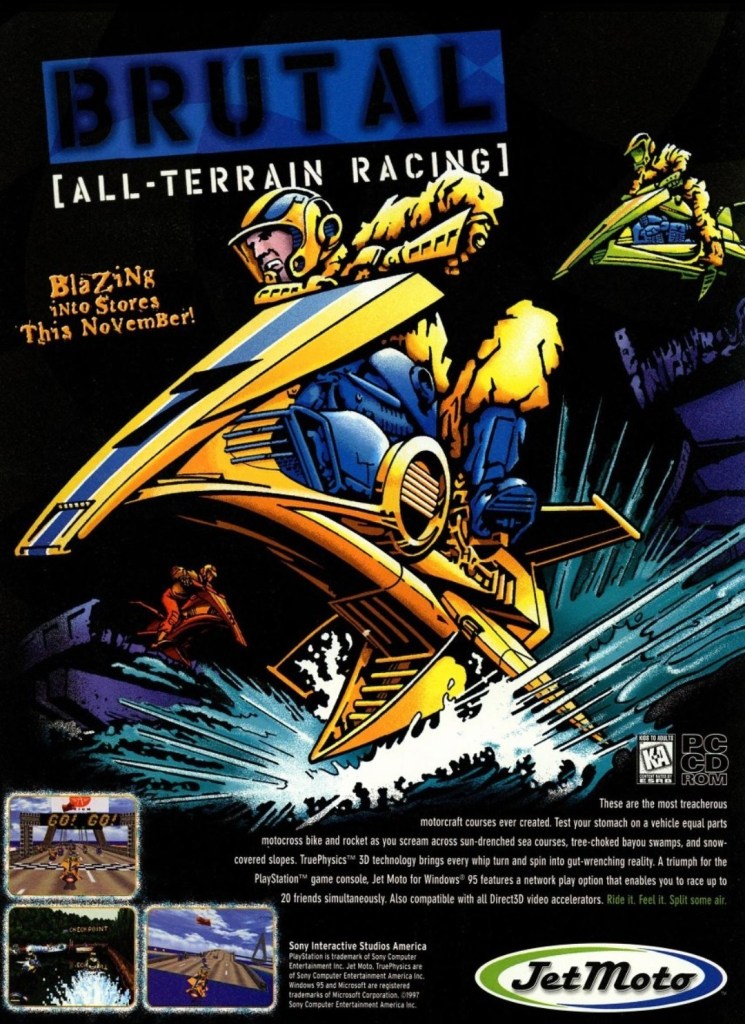
From PlayStation to PC.

In November 1996, the futuristic all-terrain hoverbikes racing game Jet Moto was released on the PlayStation which went on to sell well and attract mostly positive reviews. Sony Computer Entertainment eventually released a version of the game for the personal computer (PC) in November 1997. As seen in the above print ad, the network play option and compatibility with Direct3D video accelerators were emphasized as such features resonated with the interests of PC gamers of the era. This print ad showed how willing Sony was to release PlayStation hits on PC back then.

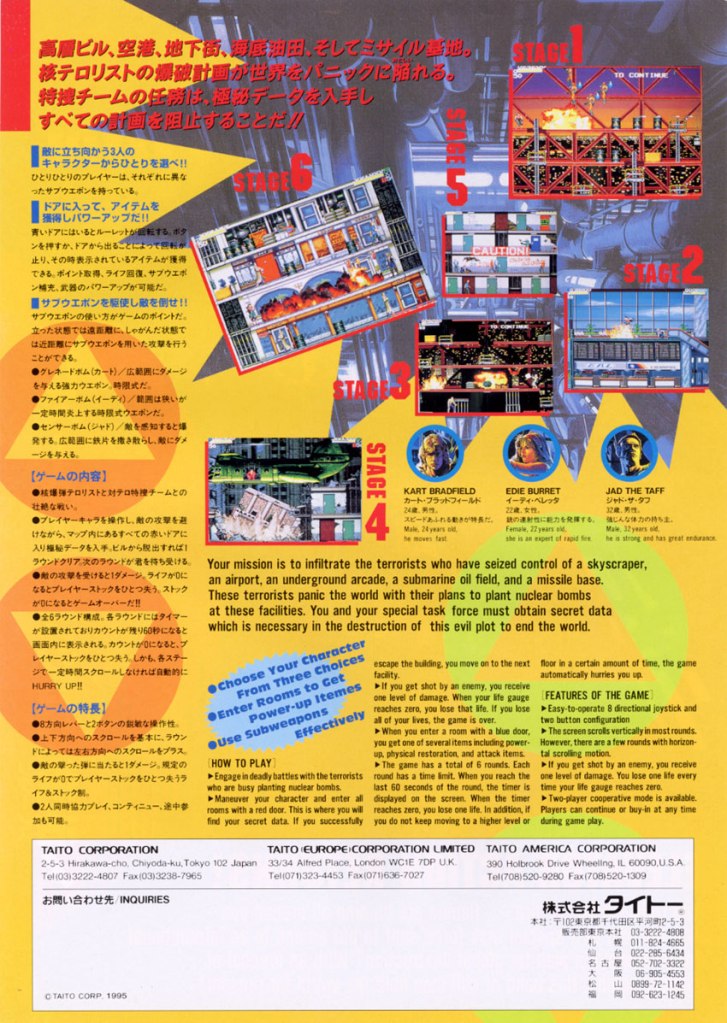
5. Elevator Action Returns Japanese arcade flyer
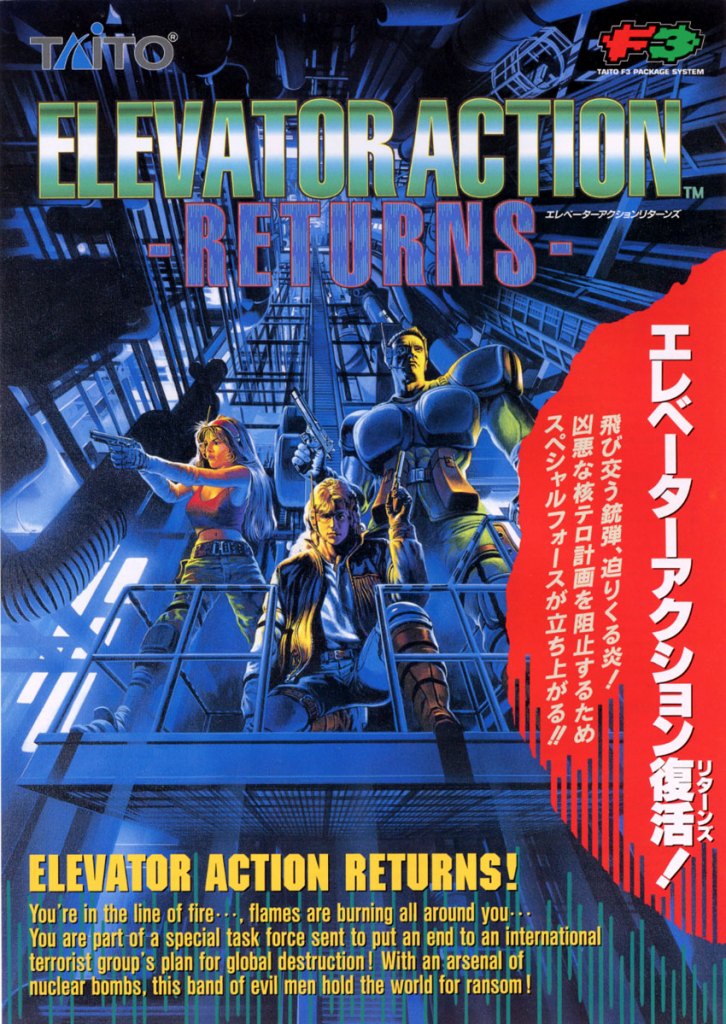
Great looking art on the front.
The rear of the flyer.

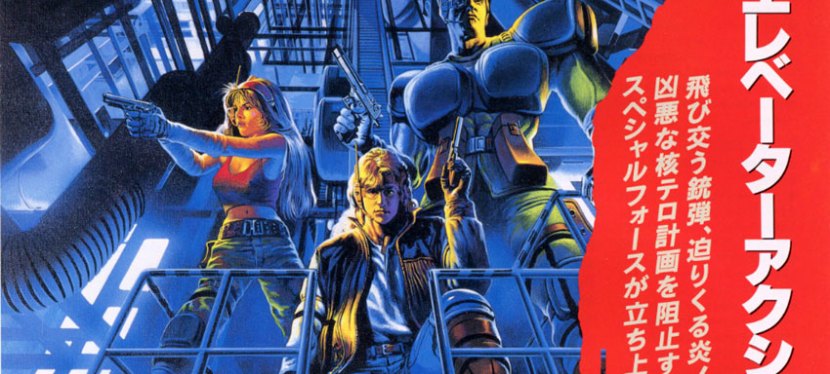
When Taito released Elevator Action Returns (also titled as Elevator Action II in other nations) in the arcades in 1994, it became a hit as gamers enjoyed its action-packed gameplay, ambitious 2D visual presentation and varied level designs that clearly went beyond its 1983 predecessor. The front of the Japanese arcade flyer has really nice art showing the three playable protagonists on an elevator on their way to do their mission. The back of the flyer shows screenshots (which emphasized the varied level designs), text descriptions explaining how the game played (English version printed), and what the features are. Another text description confirmed that terrorists are the antagonists that players will be dealing with which was reflective of the rise of Islamic terrorism in the 1990s. Oh yes, if you look closely you will the word “item” misspelled as “items”.

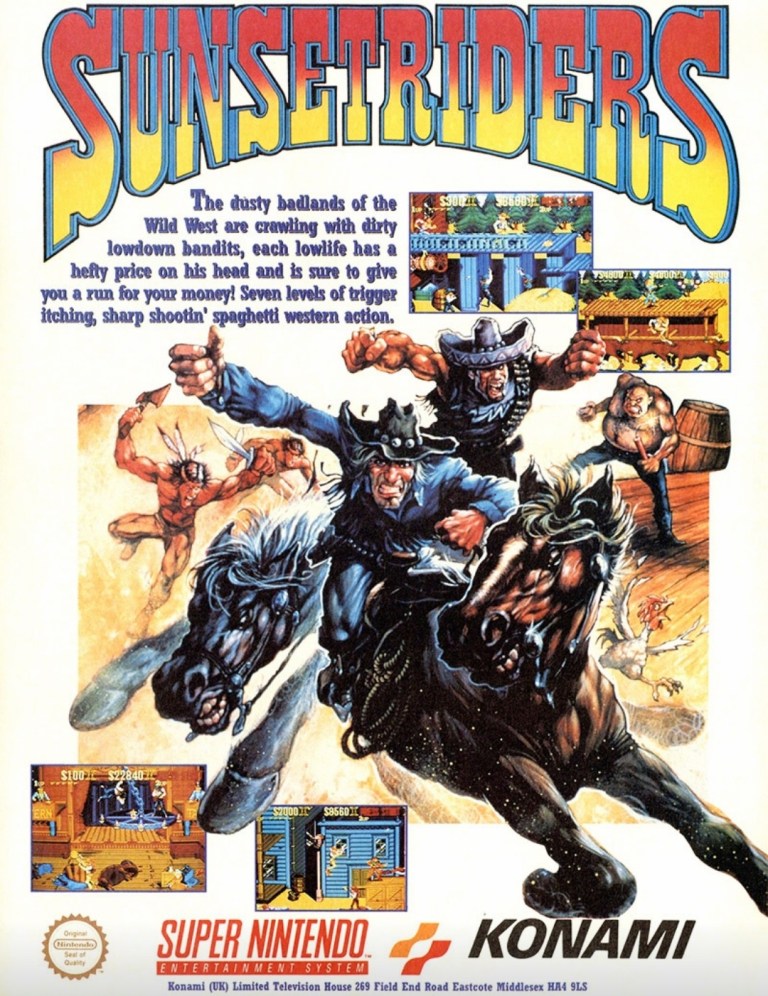
6. Sunset Riders print ads
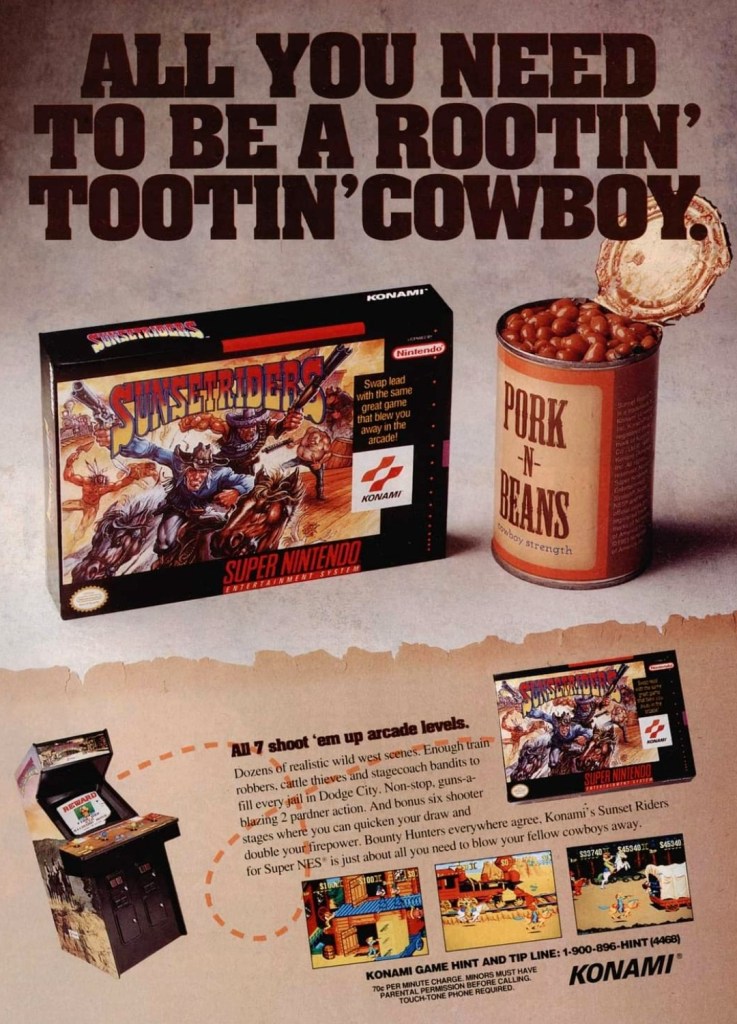
The Sunset Riders arcade machine, the SNES version, screenshots and a can of pork-and-beans on this ad.
This print ad appeared in some comic books I read long ago.

After enjoying a lot of success in the arcades with their 1991 game Sunset Riders, Konami went on to release ports of it to the Sega Genesis in 1992 and the Super Nintendo Entertainment System (SNES) in 1993. With regards to conversions and procedural/artistic changes between the arcade and console ports, the SNES version had few changes implemented compared to the one released on the Genesis. As seen in one of the print ads of Sunset Riders on SNES, it came with 7 arcade levels, 2-player mode and additional shooter stages. What the print ads did not reveal were notable replacements of specific characters in key parts of the game such as the dynamite-tossing female bandits getting replaced by male bandits, North American Indian villains getting replaced with outlaws, etc.  

7. Jackal Japanese arcade flyer
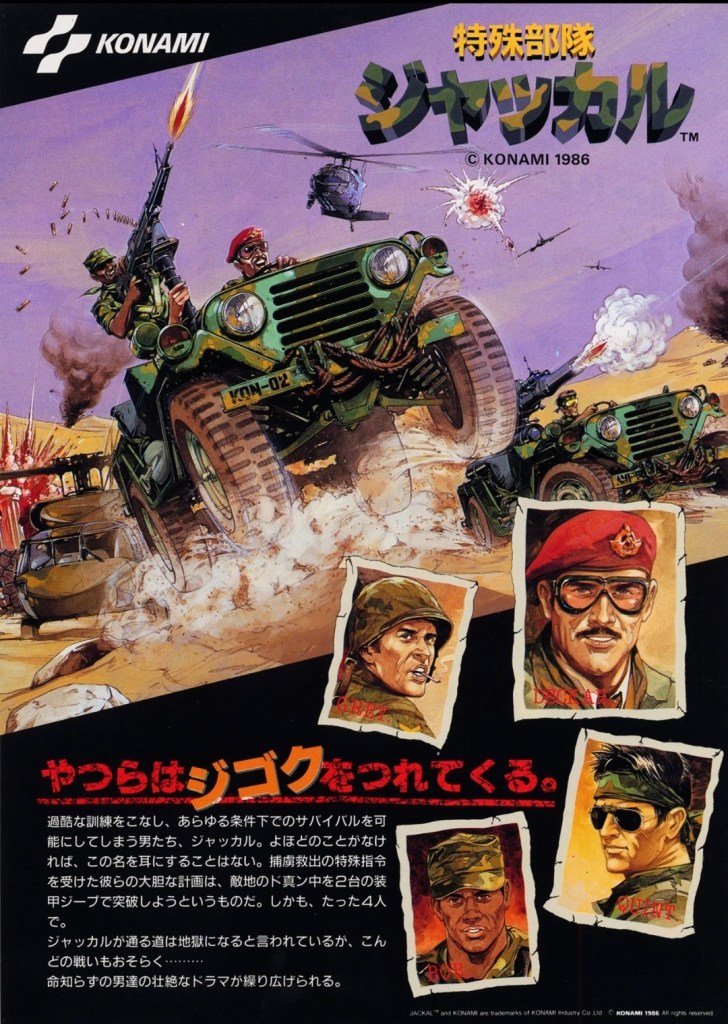
Whoever was the artist Konami hired truly delivered great-looking art!

Konami’s military themed game Jackal (Japanese title: Tokushu Butai Jackal) debuted in Japanese arcades in October 1986 and became a hit. The Japanese market arcade flyer had great looking artwork on the front that strongly emphasized the very concept of the game (players move military jeeps to shoot at enemies as they move into enemy territory). One of the characters (the one wearing the red beret) somewhat resembles the late Sean Connery which only shows that someone within Konami’s development team took inspiration from movies. This arcade flyer’s front still looks great.

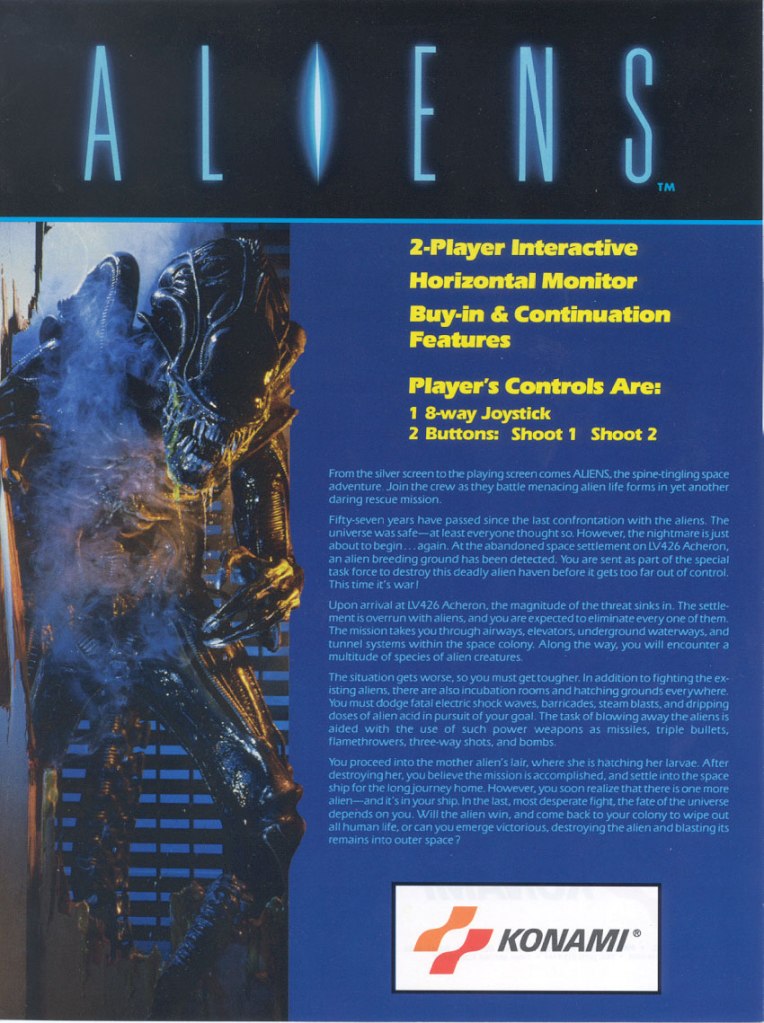
8. Aliens North American arcade flyer
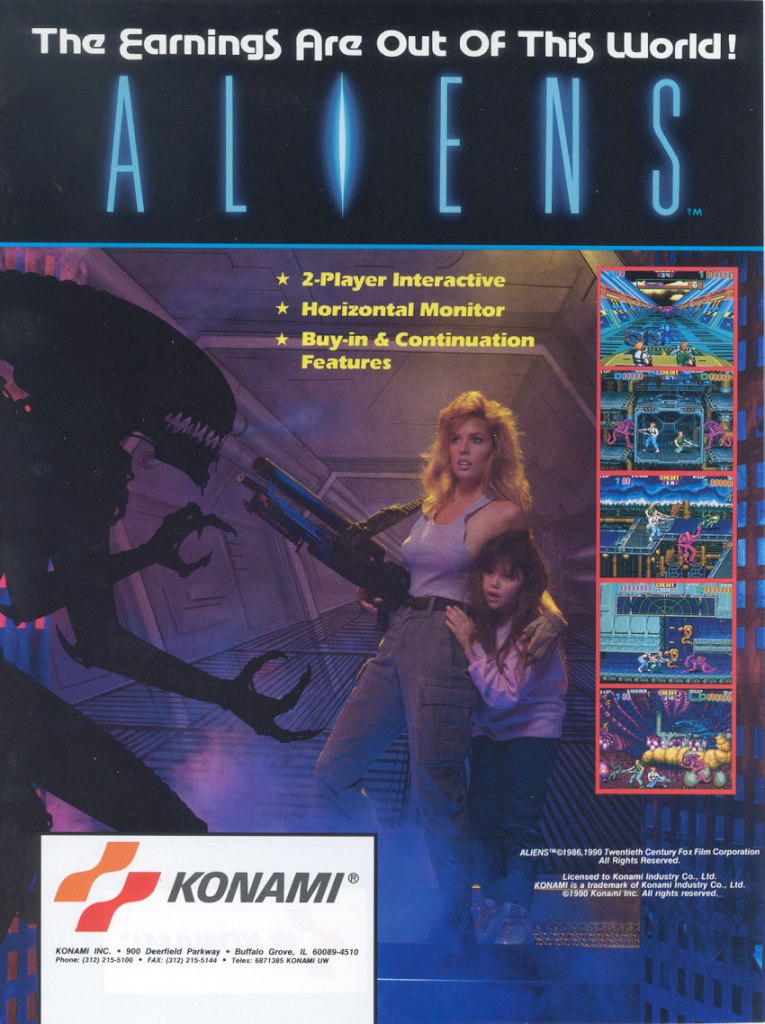
A good amount of effort was done to truly capture Aliens’ concept using hired models (as Ripley and Newt), a Xenomorph physical model and a suitable background.
The key details presented on the rear of the flyer. The Xenomorph’s presence adds tension.

In 1990, Konami released their ambitious arcade game Aliens which was loosely based on the 1986 movie that starred Sigourney Weaver and was directed by James Cameron. As Konami’s Aliens license was only temporary and the movie was so highly regarded, the Japanese company’s marketing team really had to exert extra effort to truly capture the film’s sci-fi horror concept in order to make a strong presentation towards arcade operators and their paying customers (the gamers).

Apart from showing screenshots on the front, the creative team hired a blonde model as Ellen Ripley holding a gun and a young girl as the character Newt, and have them pose convincingly in front of a Xenomorph model (darkened in the foreground). On the back of the flyer, the team heavily revealed the details using the text description to emphasize the gaming experience and story concept. The technical details, meanwhile, were presented in simplistic, easy-to-follow fashion. Aliens was a smash hit in the arcades and there are long-time gamers who regard it as one of the best game adaptations of the 1986 movie. This arcade flyer is a strong reminder that the featured game was never ever ported to any game console nor to any personal computer.

+++++

Thank you for reading. If you find this article engaging, please click the like button below, share this article to others and also please consider making a donation to support my publishing. If you are looking for a copywriter to create content for your special project or business, check out my services and my portfolio. Feel free to contact me with a private message. Also please feel free to visit my Facebook page Author Carlo Carrasco and follow me on Twitter at  @HavenorFantasy as well as on Tumblr at https://carlocarrasco.tumblr.com/ and on Instagram at https://www.instagram.com/authorcarlocarrasco
From PlayStation to Xbox – Crash Bandicoot: N. Sane Trilogy now available via Xbox Game Pass (XGP)

Welcome back Xbox fans, geeks and gamers!

In case you missed the news, Crash Bandicoot: N. Sane Trilogy was recently launched on Xbox Game Pass (XGP) effectively making the three classic games – Crash Bandicoot (1996), Crash Bandicoot 2: Cortex Strikes Back (1997) and Crash Bandicoot: Warped (1998) – available for millions of subscribers to enjoy. In fact, Crash Bandicoot: N.Sane Trilogy on XGP is already a massive success in terms of of player count increase reaching 2,808%!

A clip I captured while playing the remastered Crash Bandicoot of 1996 on my Xbox Series X.

The said release on XGP is very significant. Firstly, this is the initial offering for Xbox Game Pass that is directly connected with the Xbox-Activision-Blizzard-King deal. We are now living in the age of Microsoft-owned Activision and it should be remembered that Activision first released Crash Bandicoot: N. Sane Trilogy on PlayStation 4  (PS4) in 2017 before landing on Xbox One and other platforms.

Crash Bandicoot: N. Sane Trilogy on Xbox Game Pass is most likely the first of many Activision titles that will make their way on to the subscription service in the months to come. Think about the many Call of Duty (COD) games that will soon land on XGP and reignite public interest on the service which can help Team Xbox convince many players out there to start considering subscriptions.

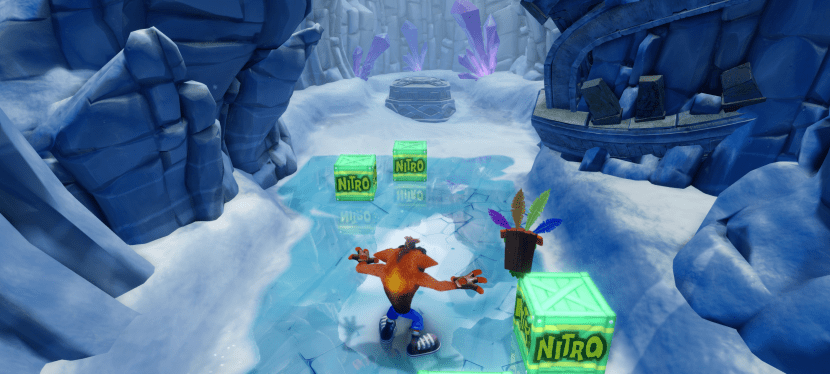
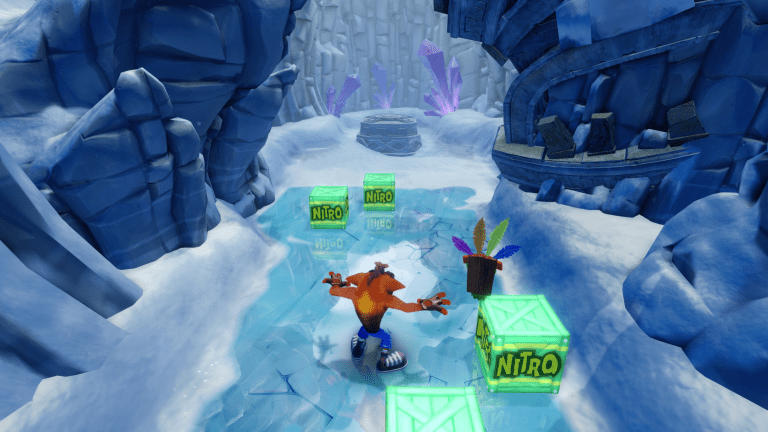
Caution and precision in key segments like this one happened during a snowy level on Crash Bandicoot 2.

Secondly and more notably, the classic Crash Bandicoot games all started on the first PlayStation console and the titular character Crash (created by Andy Gavin and Jason Rubin during their time with Naughty Dog) served as the mascot for Sony Computer Entertainment until the year 2000.

Each PlayStation-exclusive Crash video game released from 1996 to 1998 was a million-seller and also a hit with video game critics of the era. Crash Bandicoot N. Sane Trilogy also sold millions when it was initially released on PlayStation 4.

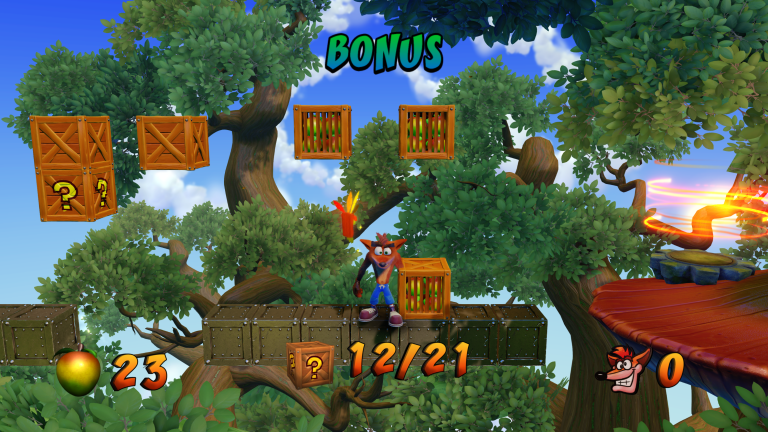
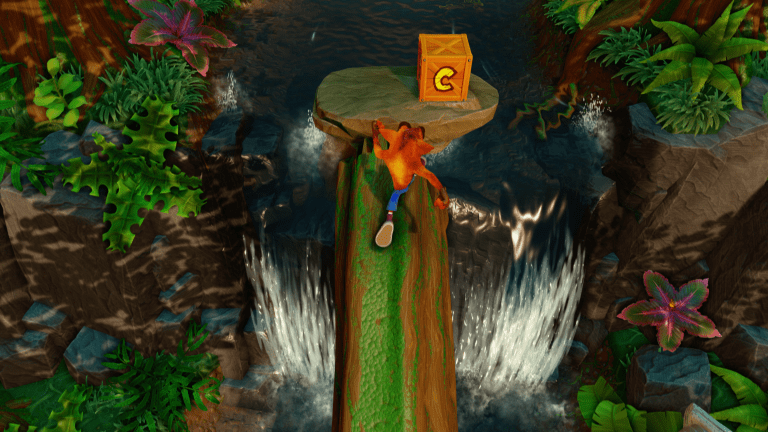
From one of the 2D side-scrolling levels of the first Crash Bandicoot.

Crash Bandicoot N. Sane Trilogy on Xbox Game Pass is a clear indication that the PlayStation-related exclusivity on Crash Bandicoot games is over and there is nothing Sony could do to change that. With Microsoft owning Activision, it is only a matter of time before the Crash Bandicoot franchise will become solidly associated with Xbox commercially and culturally. I am speculating that Team Xbox and Activision must have plans for more Crash Bandicoot sequels and spin-offs with multi-platform releases and subsequent XGP releases in mind.

With my XGP subscription, I took some time out to replay parts of the three classic games in the Crash Bandicoot N. Sane Trilogy on my Xbox Series X console. I can say that regardless of which game I played, I enjoyed playing them again and it brings back memories of my enjoyment of them on the PlayStation console in 1996-1998. The remastered visuals (on gameplay and cinematic cut scenes) were nicely done and they looked lively on our UHDTV.

From the sea water level in Crash Bandicoot: Warped.

If you are an Xbox gamer who enjoys platform gaming or if you are an Xbox Game Pass subscriber looking for something new and fun to play, then Crash Bandicoot: N. Sane Trilogy is a good choice as it is fun retro gaming of the platform kind. I encourage you to play it while it is available and you can do your part by expressing your feedback to Team Xbox about having more Activision games on XGP.

For more details about Crash Bandicoot: N. Sane Trilogy, click https://www.xbox.com/en-US/games/store/crash-bandicoot-n-sane-trilogy/c27xpr5xdmft

+++++

Thank you for reading. If you find this article engaging, please click the like button below, share this article to others and also please consider making a donation to support my publishing. If you are looking for a copywriter to create content for your special project or business, check out my services and my portfolio. Feel free to contact me with a private message. Also please feel free to visit my Facebook page Author Carlo Carrasco and follow me on Twitter at  @HavenorFantasy as well as on Tumblr at https://carlocarrasco.tumblr.com/ and on Instagram athttps://www.instagram.com/authorcarlocarrasco
Grandia HD Collection all set for release on Xbox on March 26, 2024

Finally, an old wish of mine came true as GungHo Online Entertainment America, Inc. (GOEA) officially announced that the Grandia HD Collection – which contains the classic Japanese role-playing game Grandia and its sequel Grandia II – will be released on Xbox consoles on March 26, 2024. For the newcomers reading this, the said collection of the two Grandia RPGs was previously released for the Nintendo Switch and on PC in 2019. Grandia HD Collection has been listed on the Xbox store.

This surprise development is definitely much more exciting and better than Team Xbox’s releasing four Xbox-original games on PlayStation and Nintendo consoles. For your excitement and enlightenment, watch the latest Grandia HD Collection announcement and trailer below…

To understand what the collection contains, posted below is an excerpt from the official announcement by GOEA. Some parts in boldface…

A battle from Grandia.
This is what a battle looks like in Grandia II which had fully polygonal graphics.

I am really delighted that Grandia HD Collection is coming to Xbox (note: made for the Xbox One console which is fully compatible with Xbox Series X and Xbox Series S consoles) as I played and enjoyed the original Grandia game on PlayStation way back in 1999.

I do remember Grandia having a very imaginative fantasy world with a story cleverly structured to take players from one location to another to visit new places, meet new characters or tribes of people, and engage in quests. Playing that game was a whole lot of fun because developer Game Arts (the same team behind the Lunar RPGs) crafted a battle system that is highly playable and addicting. As I played Grandia, I saw the playable characters really develop not just with their personalities but also their battle and magic abilities.

Not only that, the music written by Noriyuki Iwadare was great to listen as I played. I also love the artistic approach applied on Grandia which had 2D sprites for the characters and monsters, nicely textured 3D polygonal environments, and very imaginative artworks (including those in animated cutscenes).

Grandia had characters and monsters in 2D sprite forms, as well as detailed textures on the 3D polygonal environment.

Of course, the many quests gradually built-up the tension of the main plot which turned out to be a grand event. Game Arts knew how to execute handsome pay-offs in relation to the build-up that preceded them. That being said, Grandia’s conclusion was really memorable to see.

If there is anything I hope to see within the Grandia HD Collection, it would be improvements on the English translation and the voice acting of the characters because the PlayStation version of Grandia that I played was lackluster with those mentioned elements. Clearly Sony Computer Entertainment (the publisher of Grandia on PlayStation) did not aim high with quality for the game’s American release.

As for Grandia II, I never got to play it as I never had a Sega Dreamcast nor a PlayStation 2 (PS2) console. I do remember some Dreamcast gamers expressing fondness and high enjoyment of the game and there were even a few who enjoyed it more than its predecessor. That being said, Grandia II’s inclusion in the Grandia HD Collection is an added incentive for me to purchase the collection for my Xbox Series X.

A mini-game in Grandia II. The sequel went all-in with 3D polygons which made it a big showcase of art and graphics on the Sega Dreamcast. The PlayStation 2 version of this game reportedly had inferior graphics.

Watch out for Grandia HD Collection on Xbox consoles on March 26, 2024. For more information, click https://www.xbox.com/en-us/games/store/grandia-hd-collection/9n4nlqhx6j18

+++++

Thank you for reading. If you find this article engaging, please click the like button below, share this article to others and also please consider making a donation to support my publishing. If you are looking for a copywriter to create content for your special project or business, check out my services and my portfolio. Feel free to contact me with a private message. Also please feel free to visit my Facebook page Author Carlo Carrasco and follow me on Twitter at  @HavenorFantasy as well as on Tumblr at https://carlocarrasco.tumblr.com/ and on Instagram athttps://www.instagram.com/authorcarlocarrasco