A Look Back at Action Comics #497 (1979)

Welcome back superhero enthusiasts, 1970s arts and culture enthusiasts, DC Comics fans and comic book collectors! Today we go back to the year 1979 to take a close look at a part of the DC Comics universe through a tale of the Action Comics monthly series.

Do you enjoy following stories with the “make-a-wish” concept as a key element? Or do you prefer seeing major events happen because someone else has the power to alter reality? I for one don’t enjoy those concepts very much and the element of wish-making really ruined the story of the glossy cinematic failure Wonder Woman 1984 (written and co-directed by Patty Jenkins). When it comes to Superman, the wish-making or the ability to seriously alter reality could be effect in storytelling when the right creators are involved.

With those details laid down, here is a look back at Action Comics , published in 1979 by DC Comics with a story written by Cary Bates and drawn by Curt Swan.
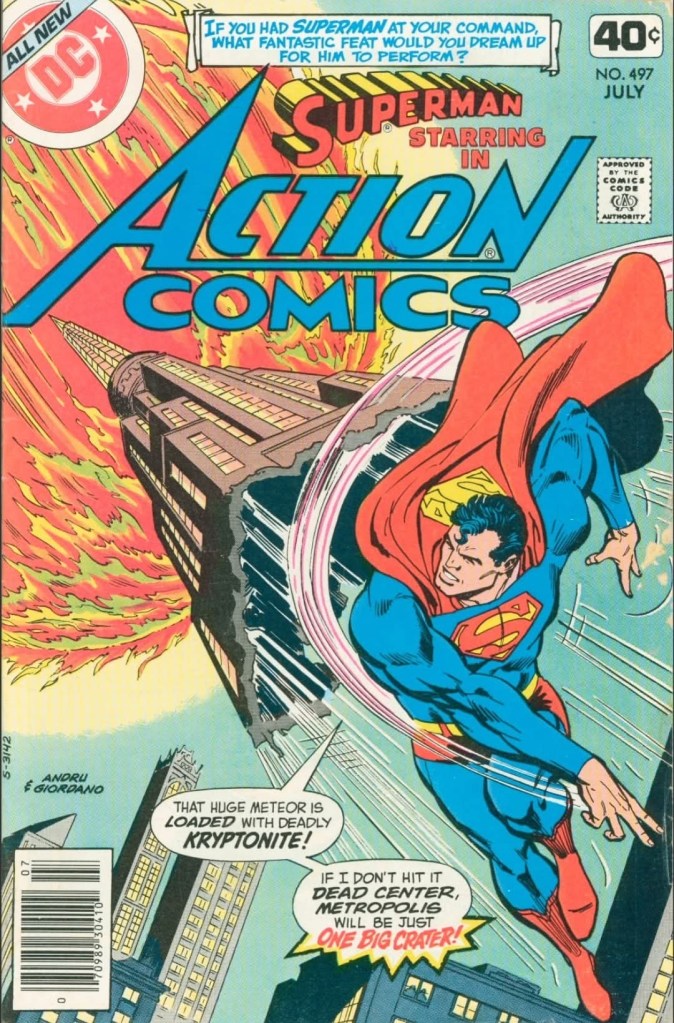
The cover.

Early story

The story begins inside a shed on a lot with three boys who have their own Superman club and support the Man of Steel’s never-ending battle for truth, justice and the American way. Arthur, who is up for drawing something for the next club newsletter, shared his idea (inspired by what he saw in a movie) about a gigantic meteor from outer space heading towards Metropolis which would compel Superman to save the city. Near the three boys is an empty chair reserved for a particular someone.

Many miles away deep within Metropolis, Clark Kent attends a conference in which Lana Lang delivers remarks to an audience of GBS affiliates. As Lana tells the audience that their news team is determined to maintain high standards of broadcasting, a uniformed door man causes a disturbance by telling everyone that a blackout has plunged the entire city into darkness.

Suddenly, the audience exited the venue and Lana notices that Clark is gone. Elsewhere, Superman quickly flies high and sees a giant meteor (the size of a stadium) on a collision course with Metropolis…

Quality
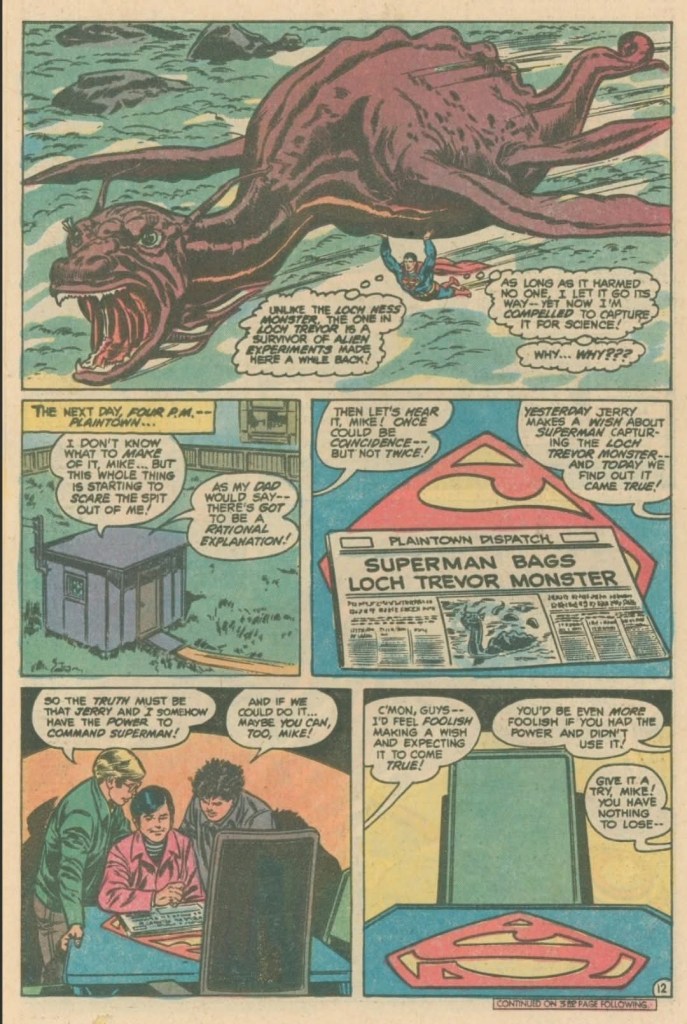
Do you wish you have the power to make superheroes do something as you wish?

Starting with the concept of reality getting seriously altered by someone with tremendous power, the said concept really brought the fantasy aspect of this Superman tale to a very high level. The Man of Steel ends up getting into unbelievable situations and do things that are amazing or shocking. In order words, the concept of altered reality (related to wishful thinking and intense imagination) actually works well in this tale thanks to the Bates-Swan duo.  

Of course, this is not simply a Superman story about wild events that compelled him to react. There are character-driven scenes that emphasize how Superman analyzes what has been going on and why he seems to be controlled or guided to do things that he had no intent of doing. This particular element of the story raises questions about the ethics of having so much power at hand and being able to command a more powerful person to do something (as a wish is made by the one who wields a lot of power).

Considering the wild events that happened throughout the story, I can say that the Bates-Swan duo successfully pulled off a worthy pay-off at the conclusion.

Conclusion
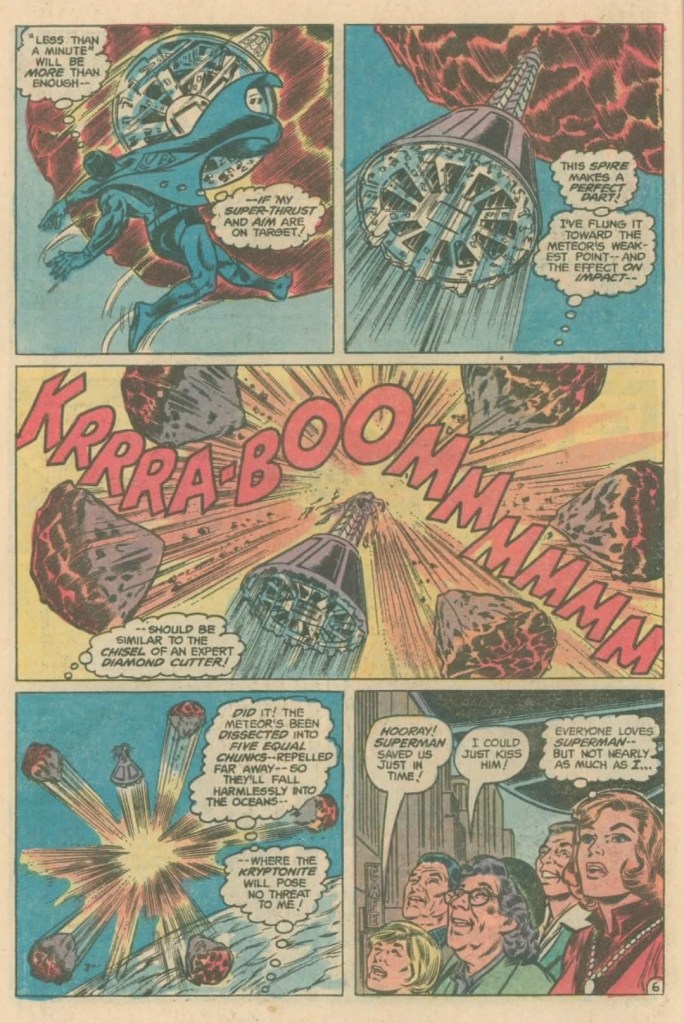
Superman saves Metropolis and many people once again. Lana Lang is among the people on the street.

Action Comics (1979) is an old Superman tale that is worth reading. While you won’t see Superman encountering any super villain, the fantasy elements and wild events more than made up for it. More importantly, the Bates-Swan duo was really careful with using the make-a-wish and reality altering concepts to make the plot believable while preventing it from becoming too outlandish. The result is a Superman tale that is entertaining to read.

Overall, Action Comics (1979) is recommended.

+++++

Thank you for reading. If you find this article engaging, please click the like button below, share this article to others and also please consider making a donation to support my publishing. If you are looking for a copywriter to create content for your special project or business, check out my services and my portfolio. Feel free to contact me with a private message. Also please feel free to visit my Facebook page Author Carlo Carrasco and follow me on Twitter at  @HavenorFantasy as well as on Tumblr at https://carlocarrasco.tumblr.com/ and on Instagram at https://www.instagram.com/authorcarlocarrasco
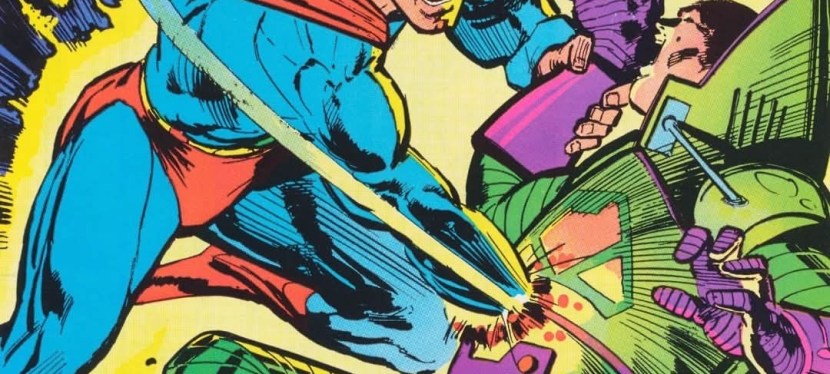
A Look Back at Superman #412 (1985)

Welcome back superhero enthusiasts, 20th century pop culture enthusiasts and comic book collectors! Today we go back to the mid-1980s to take a close look at one of the many tales published through the original Superman monthly series (first launched in 1939).

For the newcomers reading this, the original multiverse of DC Comics formally ended with Crisis on Infinite Earths (1985-1986). That being said, a lot of DC’s monthly comic book series had respective tales the reflect the closing period of the old multiverse (which lasted for decades) and the Superman monthly series of the era was part of the trend.

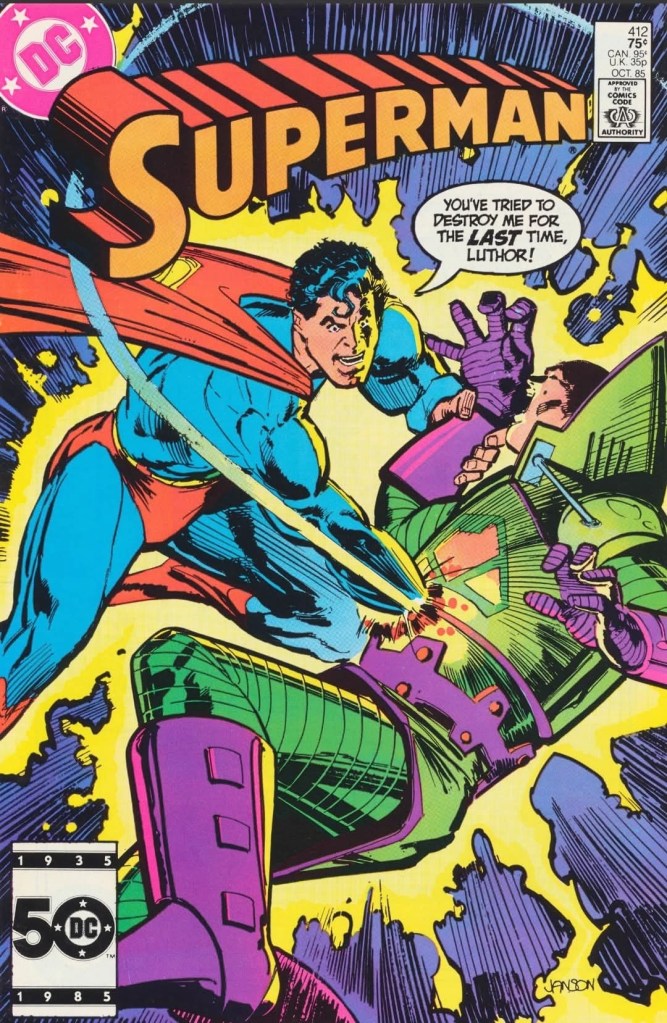
With those details laid down, here is a look back at Superman , published in 1985 by DC Comics with a story written by Cary Bates and drawn by Curt Swan.  

The cover.

Early story

The story begins at the unemployment bureau in Metropolis. Clark Kent, who recently lost his jobs with WGBS and the Daily Planet, stands in line and waits for his turn. Being unemployed, Clark feels troubled and other people nearby recognize him.

As his turn at the counter starts, Clark senses something and decides to get out quickly. He enters the emergency exit, changes into Superman and flies out of the building. It turns out a high-rise building accident has occurred and already several pieces of sharp glass have been falling down. To prevent further harm, Superman uses his heat vision to convert the falling glass and collectively turn them into a growing molten ball. He brings the giant molten ball to the top of the building (still in construction/expansion) and meets the hard-hat workers before flying away.

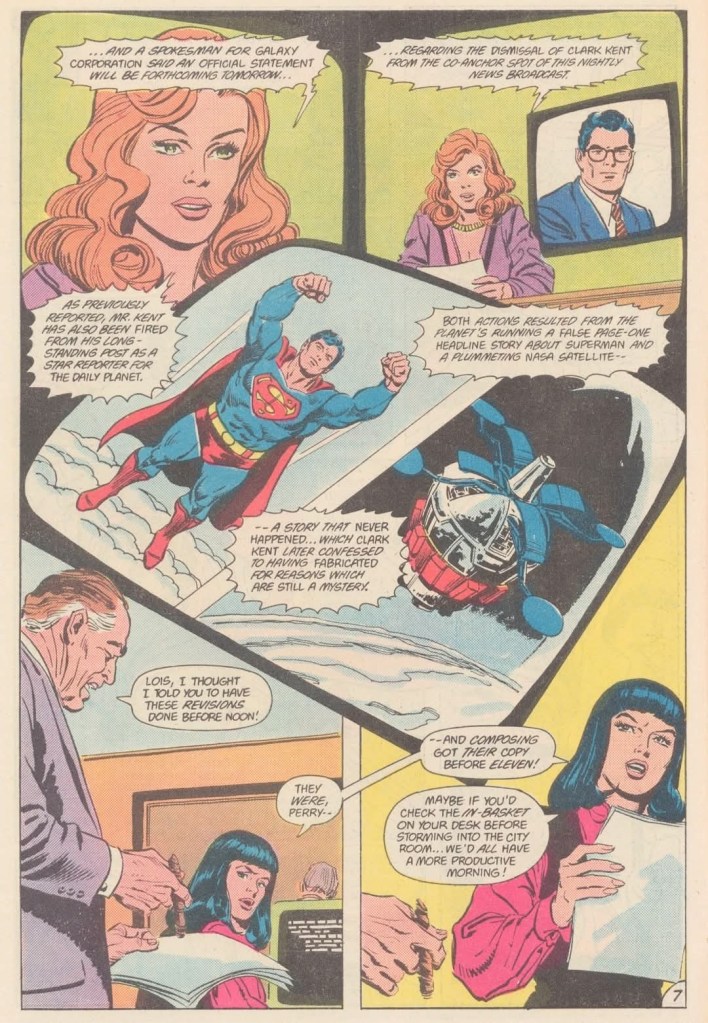
Elsewhere, Lana Lang announces news to TV viewers regarding the dismissal her of close friend Clark Kent which was the result of the fake headline news story about Superman and the NASA satellite. In another location, Lex Luthor is very pleased watching the same broadcast knowing his plan of ruining Superman succeeded and got Clark Kent as a fake news casualty. Luthor is not done with Superman yet…

Quality

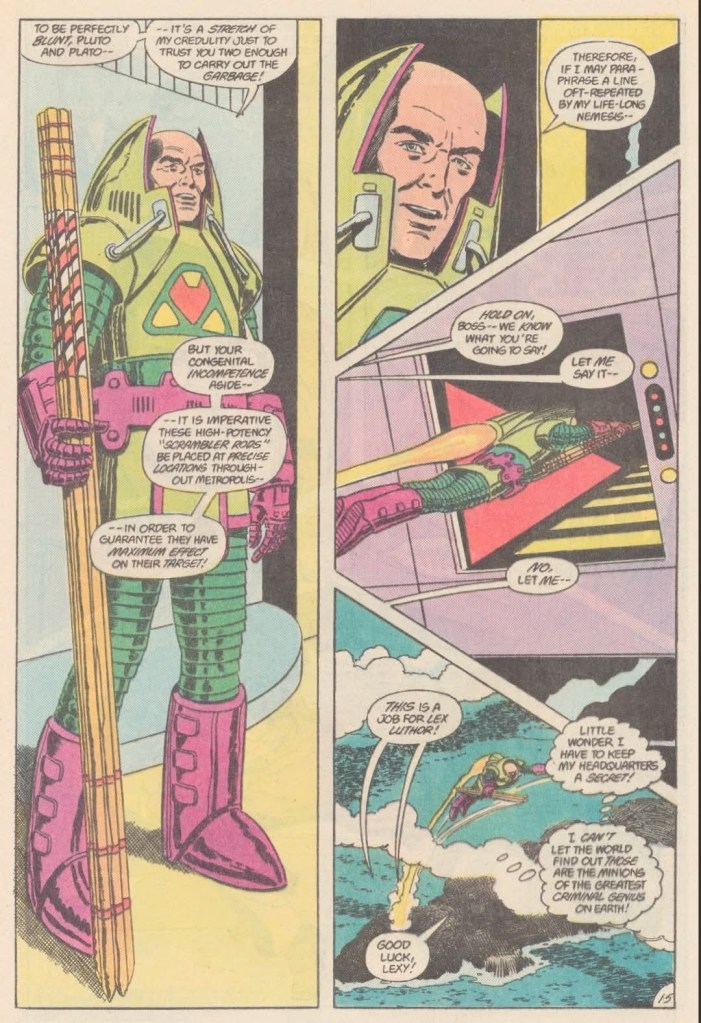
Lex Luthor here is ruthless, strategic and obsessed with defeating Superman.

I really like this Superman tale. This is a story about Superman who is still dedicated to doing acts of good by helping people with problems even though he is socially in deep trouble being unemployed as Clark Kent. Not only is the unemployment aspect relevant, the consequences of fake news and their negative effect on people made this tale more socially relevant with today’s world of fake news and unethical journalism.

Going back to Superman, it is clear that the embarrassment and unemployment of his civilian identity impacted him as a superhero. This is evident when Lana Lang accused him of betraying Clark Kent resulting in a fake news story that led to the firing by WGBS and the Daily Planet. Lana, who does not realize Superman and Clark are the same person, blamed the Man of Steel that the firing of Clark is so devastating to her as she cares for him so much (note: Clark and Lana were romantically involved during their teenage years at Smallville).  

The powerful writing by Cary Bates does not end there. In this comic book, you will see Lex Luthor execute his other plans to ruin Superman whom he personally accused over the loss of his family and his own world Lexor (click here and here for references). This is a Luthor who is not simply being evil but also someone who is well organized, strategic and even fearless. By this stage, the criminal mad scientist Luthor has accumulated a lot of resources to have his own headquarters, technologies and a dedicated staff. In some ways, Luthor in this comic book eerily resembled his financial tycoon version in the post-Crisis era (click here and here for relevance).

I should also state that the personal encounter between Superman and Luthor here is a great pay-off to the build-up that preceded it. You readers should see it for yourselves because to reveal more in this review will ruin it.

Conclusion

As Lana Lang delivers the news to TV viewers regarding Clark Kent and Superman, tension is brewing over at the Daily Planet.

Superman (1985) is undeniably a great Superman story published during the very late stage of the original multiverse (note: Superman #423 was one of the final tales of Superman of this particular era. Superman was part of the post-Crisis era). The portrayal of Superman being disturbed by the huge setback he suffered as a civilian is really compelling to see and his encounter with Lex Luthor really brought the tension and suspense to high levels. At the same time, the consequences of Superman’s actions (including those of his civilian form as Clark Kent) are very evident and nicely dramatized by the Bates-Swan team. You really feel that the creators were wrapping up their Superman stories and decided to move this series to a new direction knowing that the original multiverse will end. This is a must-read tale!

Overall, Superman (1985) is highly recommended.

+++++

Thank you for reading. If you find this article engaging, please click the like button below, share this article to others and also please consider making a donation to support my publishing. If you are looking for a copywriter to create content for your special project or business, check out my services and my portfolio. Feel free to contact me with a private message. Also please feel free to visit my Facebook page Author Carlo Carrasco and follow me on Twitter at  @HavenorFantasy as well as on Tumblr at https://carlocarrasco.tumblr.com/ and on Instagram at https://www.instagram.com/authorcarlocarrasco
A Look Back at Action Comics #481 (1978)

Welcome back superhero enthusiasts, 1970s arts and culture enthusiasts, DC Comics fans and comic book collectors! Today we go back to the year 1978 to take a close look at a part of the DC Comics universe through a tale of the Action Comics monthly series.

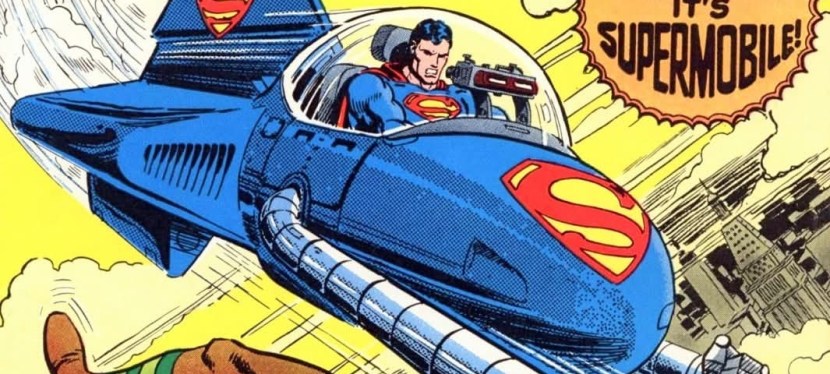
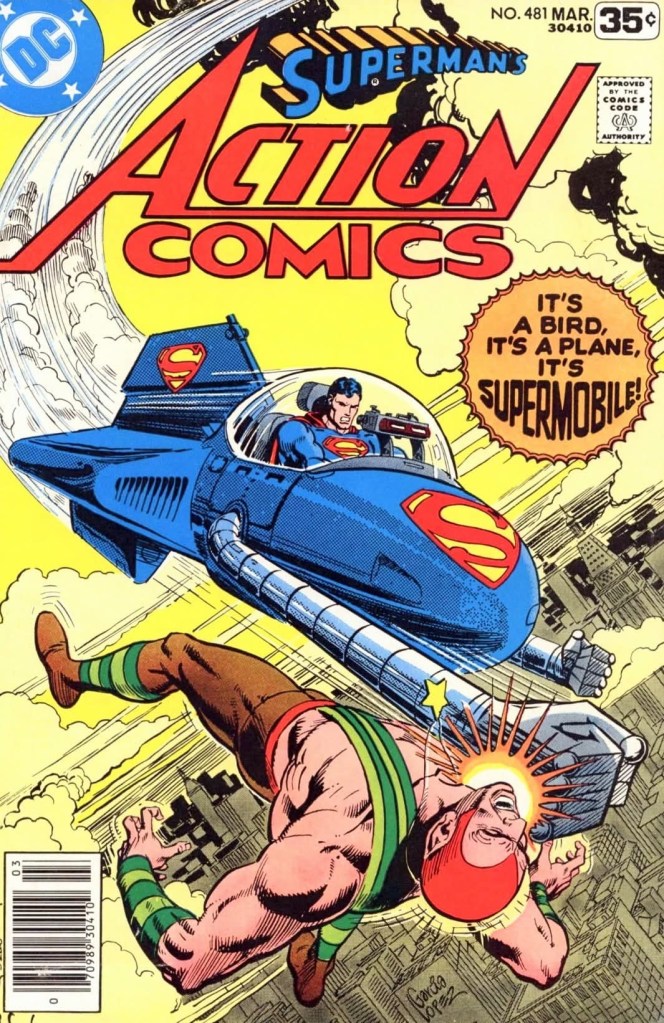
Believe it or not, there were times when Superman used advanced technology and machinery to achieve his goals, to win a battle or at least survive. This is something we people today can relate with since a lot us have smartphones and computers being used daily. As for the Man of Steel, there was a time when I saw an episode of Super Friends on TV in which a very vulnerable Superman had no choice but to use his personal flying vehicle called the Supermobile to travel and do something. It turns out, the Supermobile itself started in comic books.

With those details laid down, here is a look back at Action Comics , published in 1978 by DC Comics with a story written by Cary Bates and drawn by Curt Swan.

The cover.

Early story

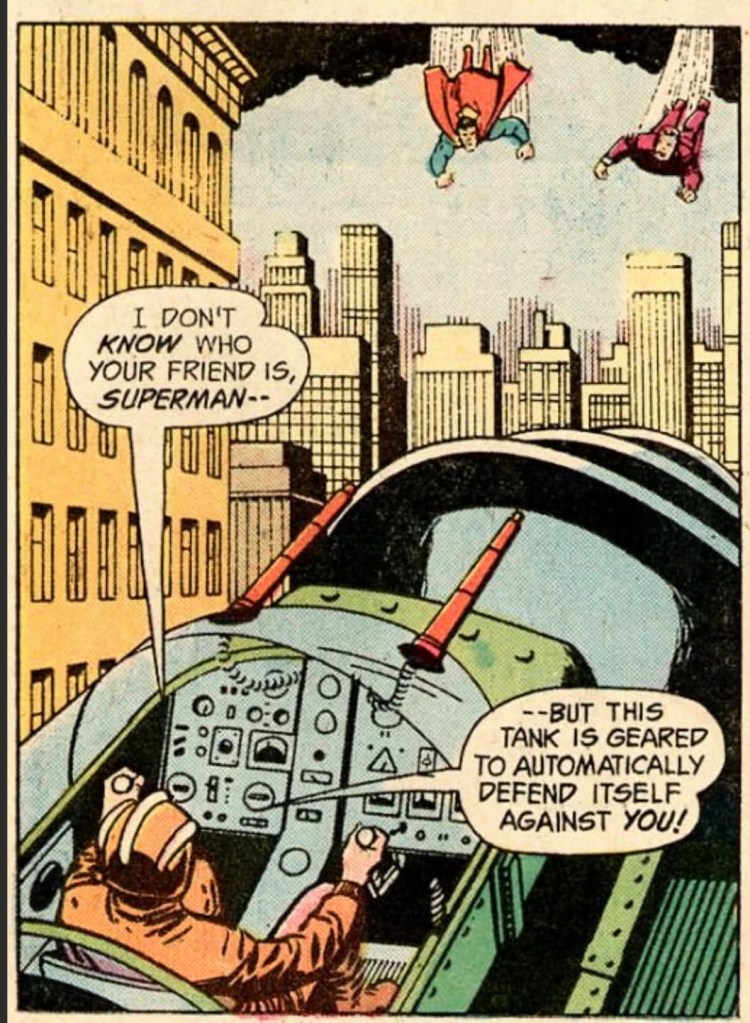
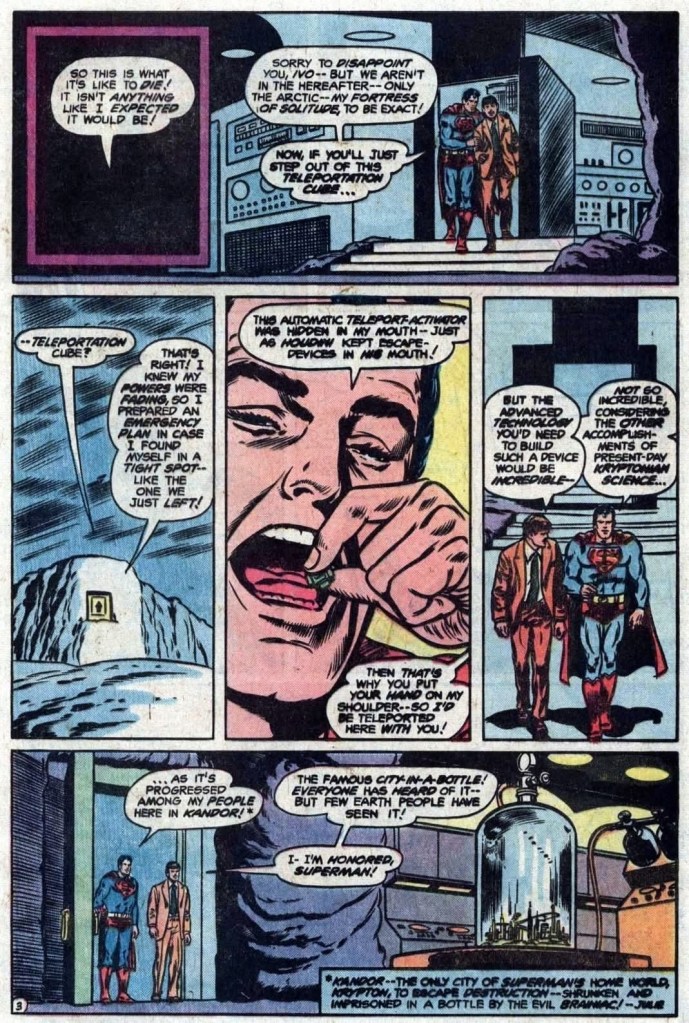
The story begins on a city street as Amazo (who recently gained the powers of Justice League members in a previous encounter) is about to strike a weakened Superman and Professor Ivo (who is responsible for Amazo) in front of many people. Amazo strikes but ends up smashing the part of the road as his targets vanished.

It turns out Superman and the professor were teleported safely all the way into the Fortress of Solitude. With his powers gone due to red radiation, Superman revealed that he made some preparations in relation to Amazo’s eventual rampage….

Quality

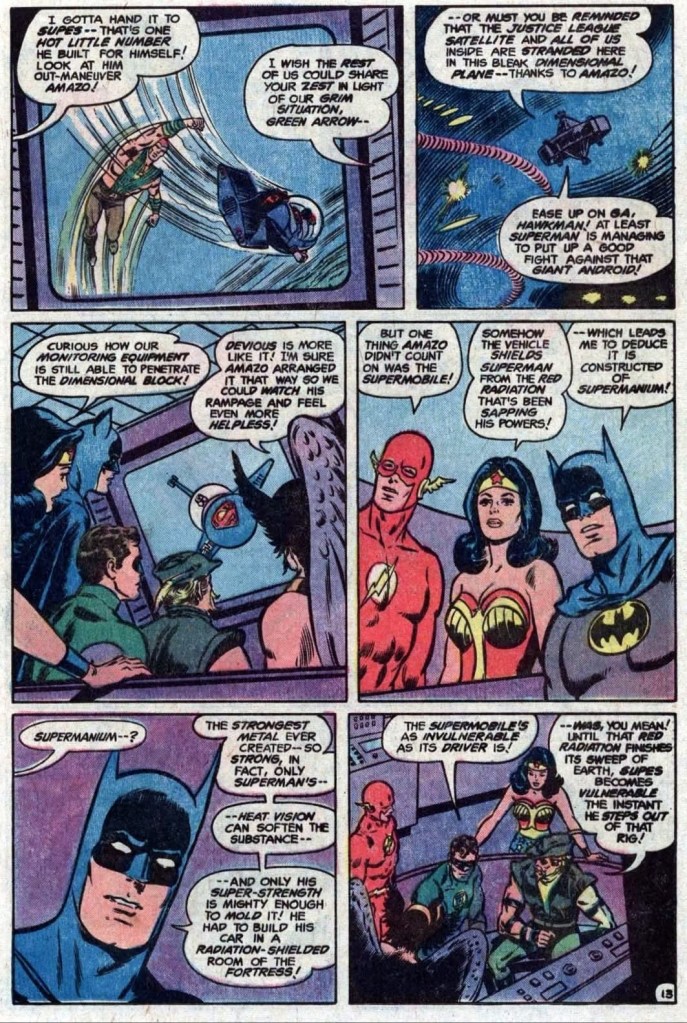
Exposition about the Supermobile in this page showing the trapped Justice League members.

This early, I want to point out that this comic book is not merely a shallow tale designed to introduce the Supermobile in lazy fashion. In fact, there is a lot of work done by the Bates-Swan duo here and this includes plot build-up backed with payoffs, lots of details that were revealed and, most notably, the story has a solid structure complete with smooth execution.

This story was preceded by an unfortunate series of events in which Amazo gained the powers of the Justice League members and had them trapped in space, while Superman got hit by red radiation and managed to get out for a new fighting chance. Here, Superman is powerless and vulnerable, and the fact that Amazo is so powerful, the unveiling and use of the Supermobile is clearly justified. Amazo himself is a fine example of a scientific creation gone wrong and seem inspired by the monster of Frankenstein in literature.

By looking close at the details, the dialogue and the execution of event, this is clearly not a rushed job to introduce the Supermobile. It is a sufficient story on its own and it even delivers a good amount of superhero spectacle to satisfy readers.

Conclusion

Superman and the professor inside the Fortress of Solitude.

Action Comics (1978) is indeed a satisfying and fun read. The build-up leading to the Supermobile’s debut is sufficient and the creators went on to keep building up the plot with Amazo getting bigger as a threat to not only against Superman but also against the Justice League. The Supermobile’s debut is justified and definitely it is not a cheap addition to the plot. The idea of Superman using a personal transport looked silly on face value but this comic book proved it is believable and sensible.

Overall, Action Comics (1978) is recommended.

+++++

Thank you for reading. If you find this article engaging, please click the like button below, share this article to others and also please consider making a donation to support my publishing. If you are looking for a copywriter to create content for your special project or business, check out my services and my portfolio. Feel free to contact me with a private message. Also please feel free to visit my Facebook page Author Carlo Carrasco and follow me on Twitter at  @HavenorFantasy as well as on Tumblr at https://carlocarrasco.tumblr.com/ and on Instagram at https://www.instagram.com/authorcarlocarrasco
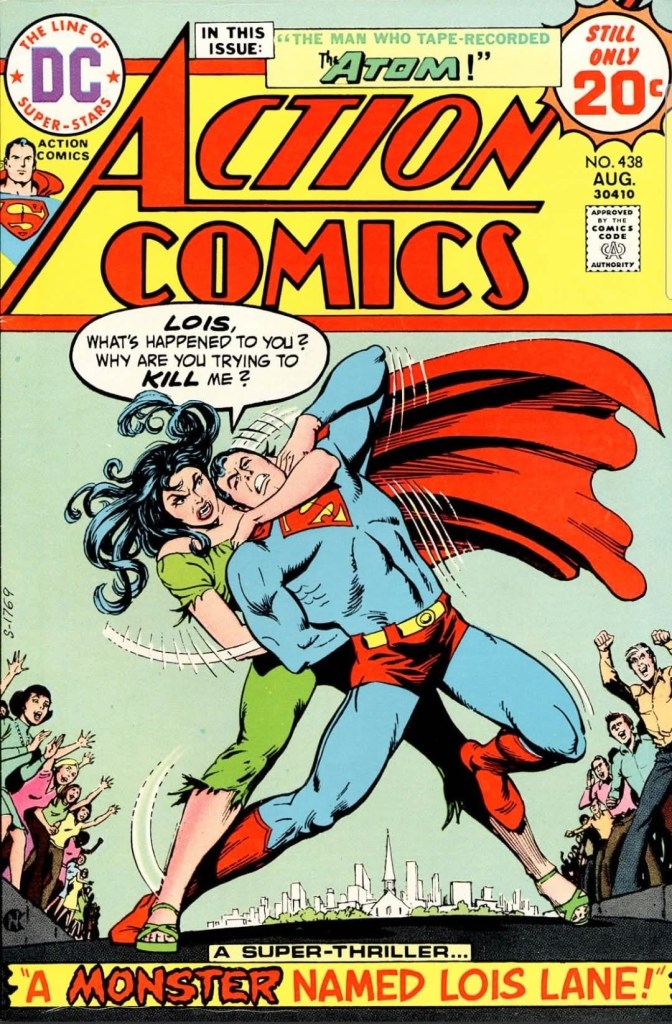
A Look Back at Action Comics #438 (1974)

Welcome back superhero enthusiasts, 1970s arts and culture enthusiasts, DC Comics fans and comic book collectors! Today we go back to the year 1974 to take a close look at a part of the DC Comics universe through a tale of the Action Comics monthly series.

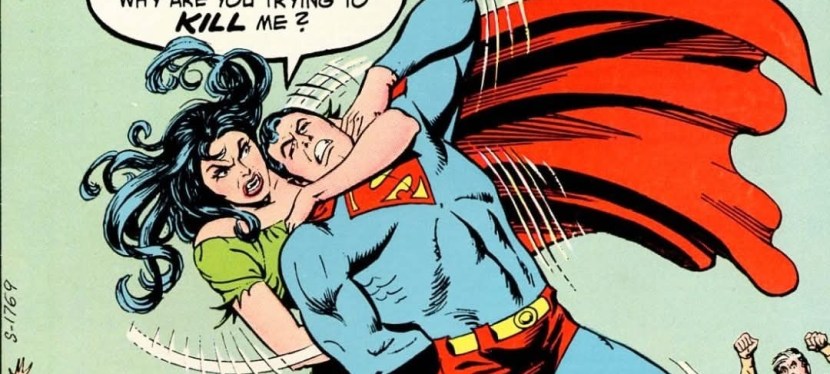
Throughout the superhero comics publishing history of DC Comics, Lois Lane is the definitive leading lady of Superman. Traits of her personality and journalistic work ethic got emphasized through her interactions with fellow reporter Clark Kent (Superman). At times, Lois Lane becomes a rival of Kent’s when it comes to getting the hottest scoop and getting the approval of their boss Perry White for publishing it on the next issue of the Daily Planet. But have ever seen Lane become a monster strong enough to take on Superman?

With those details laid down, here is a look back at Action Comics , published in 1974 by DC Comics with a story written by Cary Bates and drawn by Curt Swan.

The cover.

Early story

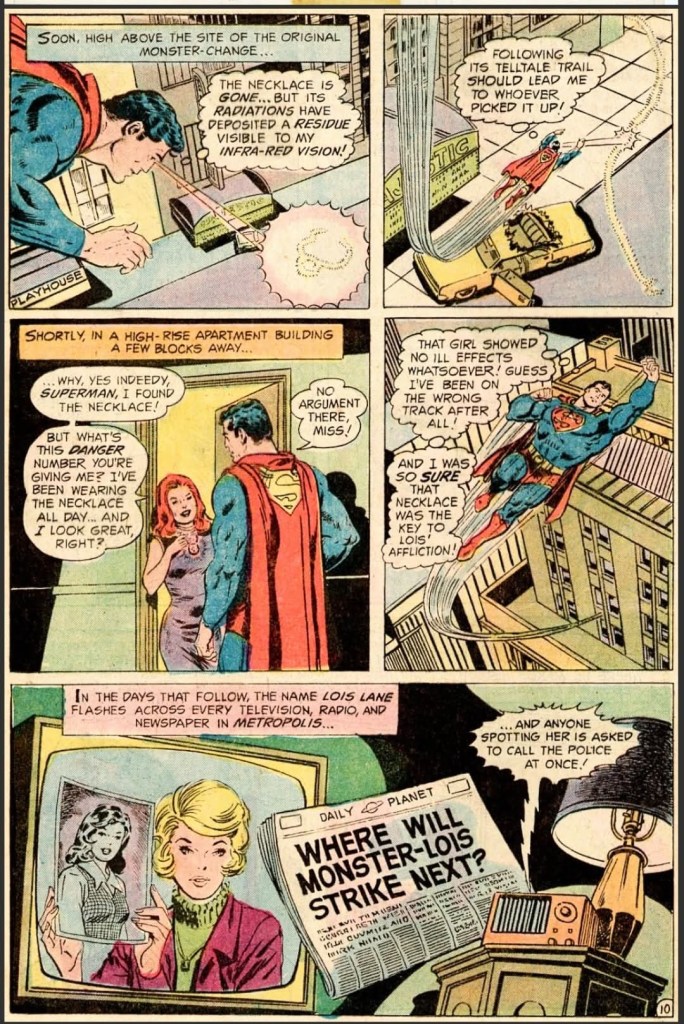
The story begins on the busy streets of Metropolis with Clark Kent and Lois Lane riding in a taxi. He gives her a very unique looking necklace as an advanced birthday gift which she gladly wears. Lois then kisses Clark on the lips which surprises him. Moments later, the taxi stops on a sidewalk as something inside happened. Seconds later, a monstrous woman emerges from the taxi which turned out to be none other than Lois Lane in a transformed state. The monster Lois gets out of the taxi, throws the necklace away and leaves Clark behind. The incident causes a commotion in the city.

Still inside the taxi, Clark discreetly changes into Superman and flies away to search for Lois Lane…

Quality

As Superman works to find monster Lois Lane, the media buzz about her begins on television. This was the time when social media was decades away from realization.

To begin with, the concept of this comic book is clearly outlandish and the creators decided to make a monster out of Lois Lane and explore what would happen to both the city and Superman. The good news here is that the storytelling has a firm structure and the dialogue – most notably that of Superman – still made sense and was believable to follow. Without spoiling the plot, I can say that Superman is still the main focus of the story and how he made moves to solve problems while still caring for Lois Lane is engaging to read.

In this comic book, you will see some interesting developments that emphasize how Clark Kent works within the limitations of his journalistic career and connections, how Superman takes responsibility things he did before, and how he works to protect his secret identity. The Bates-Swan duo really delivered the goods here.  

Conclusion

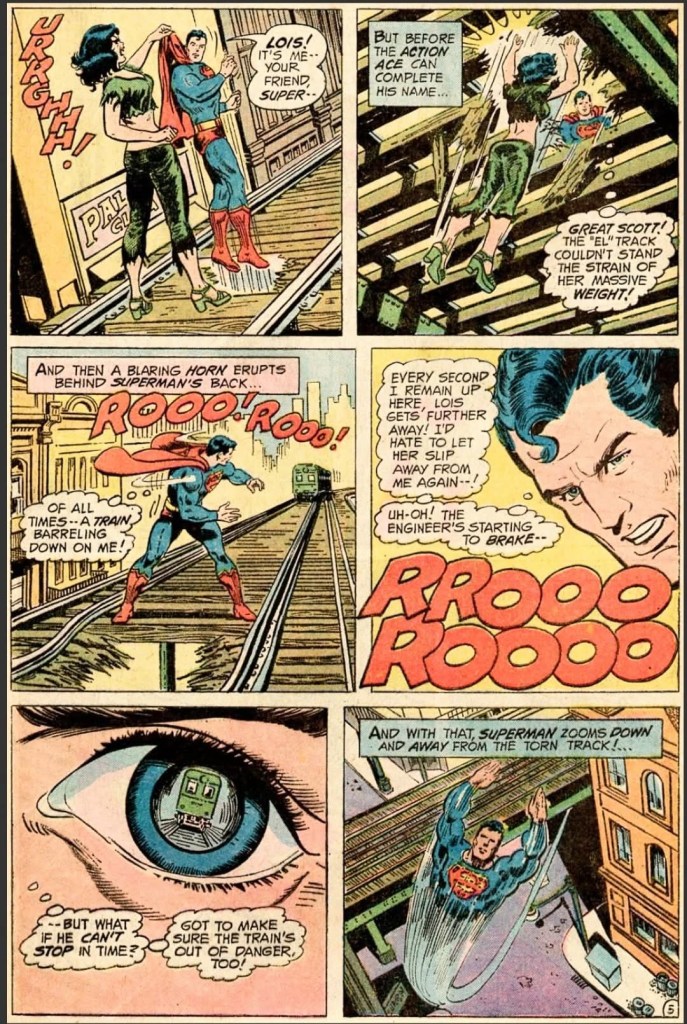
Superman has two problems to deal with – finding monster Lois Lane and preventing a train disaster from happening.

Action Comics (1974) is a fun read but it is not a brainless nor a low-intelligence tale. This is a tale about Superman relying less on his powers and using more of skills as civilian Clark Kent to handle the problem of monster Lois Lane. The story lacked the superhero spectacle of action but it still is entertaining to read, and the emphasis on Superman and Lois alone is worth reading. As for The Atom short story included, it is essentially a somewhat fun additive.

Overall, Action Comics (1974) is recommended.

+++++

Thank you for reading. If you find this article engaging, please click the like button below, share this article to others and also please consider making a donation to support my publishing. If you are looking for a copywriter to create content for your special project or business, check out my services and my portfolio. Feel free to contact me with a private message. Also please feel free to visit my Facebook page Author Carlo Carrasco and follow me on Twitter at  @HavenorFantasy as well as on Tumblr at https://carlocarrasco.tumblr.com/ and on Instagram at https://www.instagram.com/authorcarlocarrasco
A Look Back at Action Comics #436 (1974)

Welcome back superhero enthusiasts, 1970s arts and culture enthusiasts, DC Comics fans and comic book collectors! Today we go back to the year 1974 to take a close look at a part of the DC Comics universe through a tale of the Action Comics monthly series.

If you know the Superman lore in comics, you should be aware that Perry White (first appeared in 1940) is the editor-in-chief of the Daily Planet and is the superior of Clark Kent (Superman), Lois Lane and Jimmy Olsen. As Perry White got race-swapped (a woke move that’s also idiotic) and presented as a black man in Zack Snyder’s Man of Steel and James Gunn’s Superman (2025), be aware that the long-lasting character originated in the comics as a white man who symbolized dedication and management consistently. I still remember the live-action versions of Perry White played by Jackie Cooper in the 1978 movie and by Lane Smith in the TV series Lois & Clark: The New Adventures of Superman.

I read a lot of Superman comic books and many times Perry White appeared as a supporting character. He also appeared in the memorable crossover comic book Superman and Spider-Man, interacting with Peter Parker (Spider-Man). As a supporting character in Superman tales, Perry White occasionally provides journalistic direction or a challenge to Clark Kent who in turn tackles problems in his civilian identity or as Superman.

But what if Perry White overshadows Superman himself?

With those details laid down, here is a look back at Action Comics , published in 1974 by DC Comics with a story written by Elliot S. Maggin and drawn by Curt Swan.

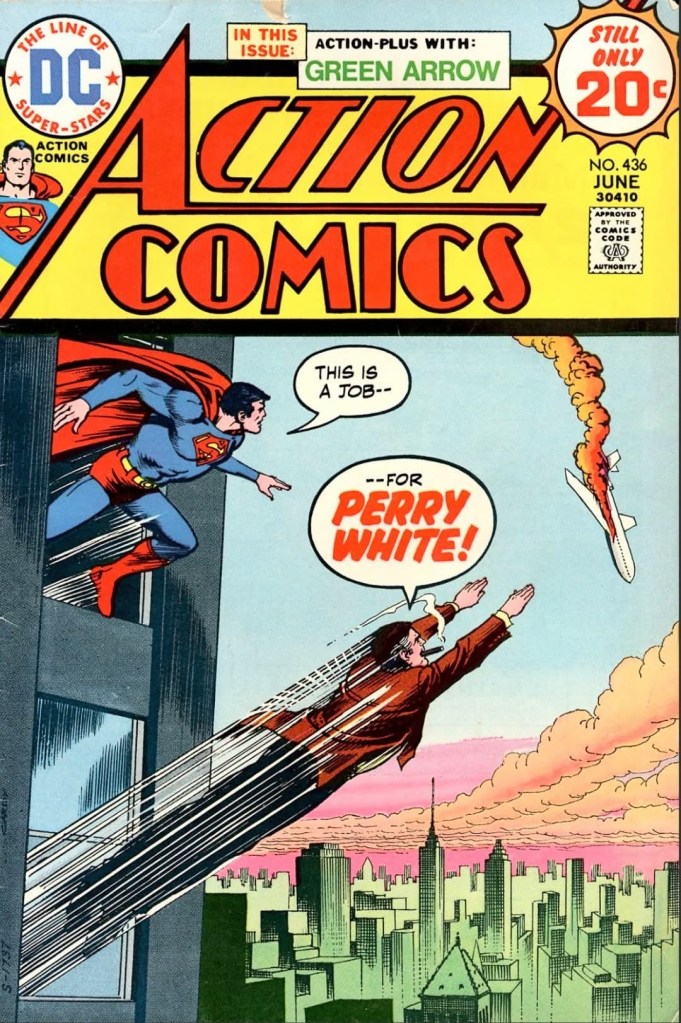
The cover.

Early story

The story begins deep within Metropolis when the Daily Planet’s editor Perry White enters the Galaxy Building. White does not realize that he is being watched by two adults who turned out to have special abilities and together they levitated a gift for him before he reaches his office. The gift for Perry White was their response to the help he provided to them – the mutants – to escape the influence of Calixto sometime before. The two adults then vanished.

As White arrives in his office, Superman discreetly flies into the Galaxy Building and changed into his civilian form as Clark Kent. With his enhanced hearing, Kent heard the phone in his office ringing and quickly rushes to it. Through the phone, White (who was notified he won the Pulitzer Prize again) tells him that Edge Morgan has something big happening on both TV and on paper, and they should fly out to New York to work together…

Quality

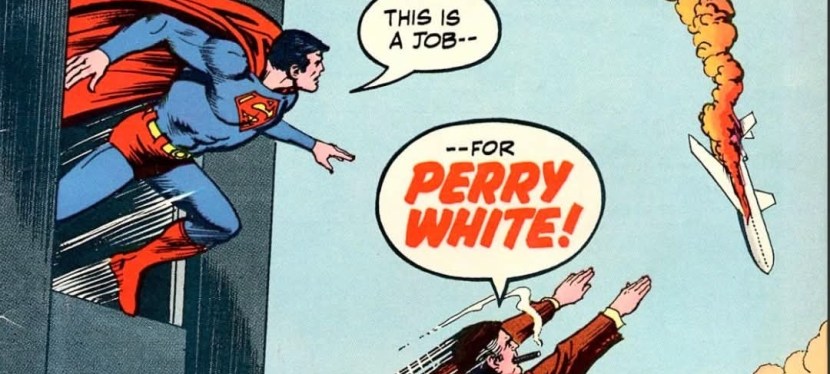
Superman and Perry White fly towards an enemy.

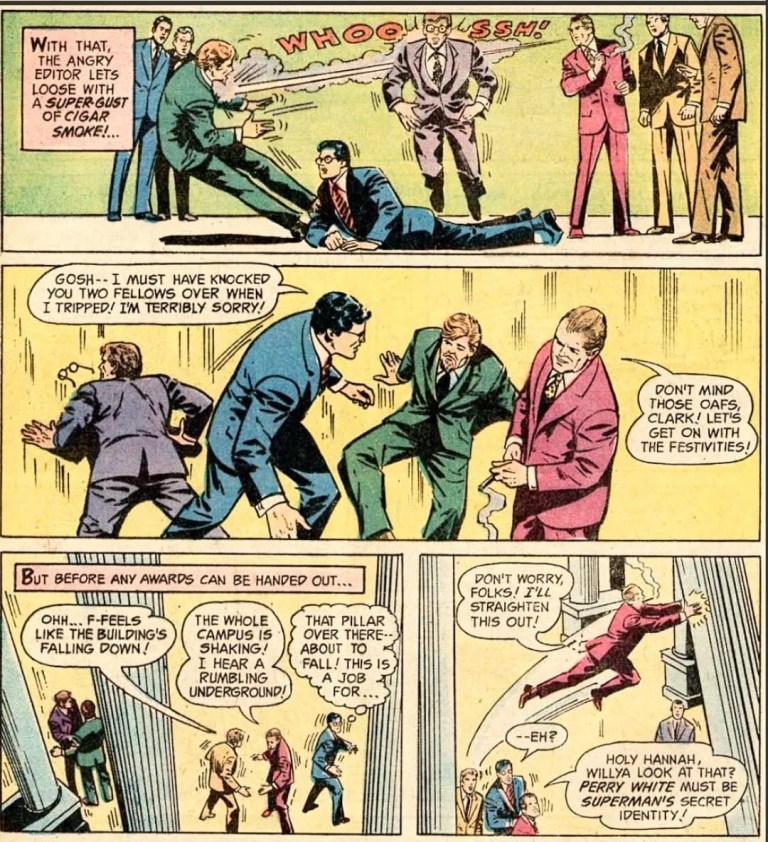
To get straight to the point, this Superman tale shows the wild concept of Perry White overshadowing the Man of Steel in terms of capabilities instead of journalistic power. On paper it sounds crazy but the good news is that the wild concept was told nicely and it is actually fun to follow without ever going over the top.

With witnesses around, Perry White uses his super powers.

Apart from the story’s outlandish idea, the plot shows a new dimension of Perry White transforming from a supporting player (in the form of a newspaper editor) into a more heroic figure. Instead of being a helpless witness of events happening, White becomes more involved and contributes something to the prevention of disaster and even tackling evil head on. That being said, this situation allowed the creative duo to show a new side of White’s personality as he himself realizes the sudden weight and pressure that comes with having super powers, and he still has journalistic standards to live up to.

Conclusion

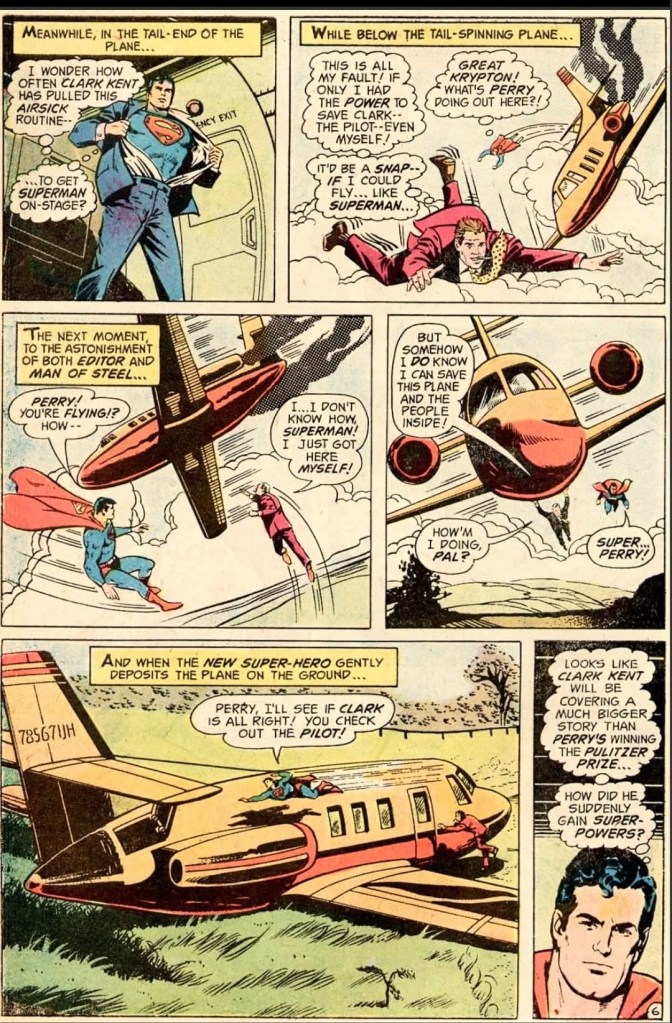
Superman is surprised to witness Perry White fly and prevent a small plane from crashing.

A product of its time, Action Comics (1974) has a short story that had a zany concept which turned out to be an entertaining read. It is nice to see Perry White actually becoming super while the storytelling done by the Maggin-Swan team never became too outlandish. Think of this comic book – which also has a short story of Green Arrow – as a bout of fun focused on Superman and Perry White. I first read this comic book as a young boy and now as an adult, it is still enjoyable to read again. No woke garbage and no Zack Snyder-style darkness here. This is classic Superman.

Overall, Action Comics (1974) is recommended.

+++++

Thank you for reading. If you find this article engaging, please click the like button below, share this article to others and also please consider making a donation to support my publishing. If you are looking for a copywriter to create content for your special project or business, check out my services and my portfolio. Feel free to contact me with a private message. Also please feel free to visit my Facebook page Author Carlo Carrasco and follow me on Twitter at  @HavenorFantasy as well as on Tumblr at https://carlocarrasco.tumblr.com/ and on Instagram at https://www.instagram.com/authorcarlocarrasco
A Look Back at Superman #292 (1975)

Welcome back superhero enthusiasts, 20th century pop culture enthusiasts and comic book collectors! Today we go back to the year 1975 to take a close look at one of the many tales published through the original Superman monthly series (first launched in 1939).

When I first read the literary rivalry between Superman and Lex Luthor, it was before Crisis on Infinite Earths happened. The pre-Crisis Luthor was a criminal mad scientist (as opposed to the tycoon Luthor of the post-Crisis age) who had to use technology and smart moves during his encounters with the Man of Steel. The pre-Crisis conflicts between the two were often dynamic and fantasy inspired. Of course, there is a lot more between Superman and Luthor starting with a shared past in Smallville.

With those details laid down, here is a look back at Superman , published in 1975 by DC Comics with a story written by Elliot S. Maggin and drawn by Curt Swan.  

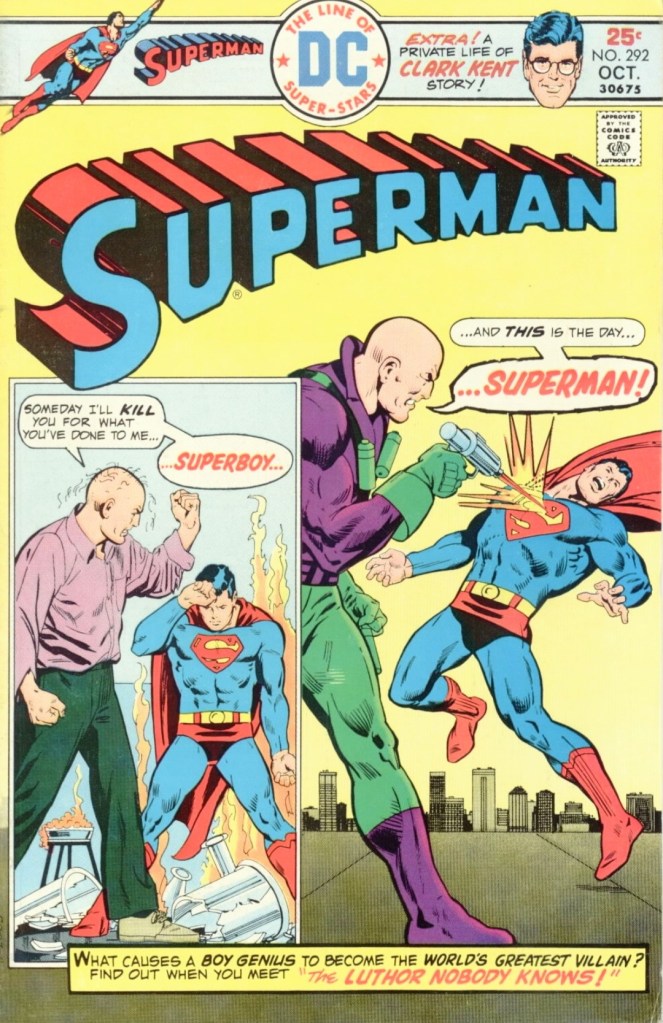
The cover.

Early story

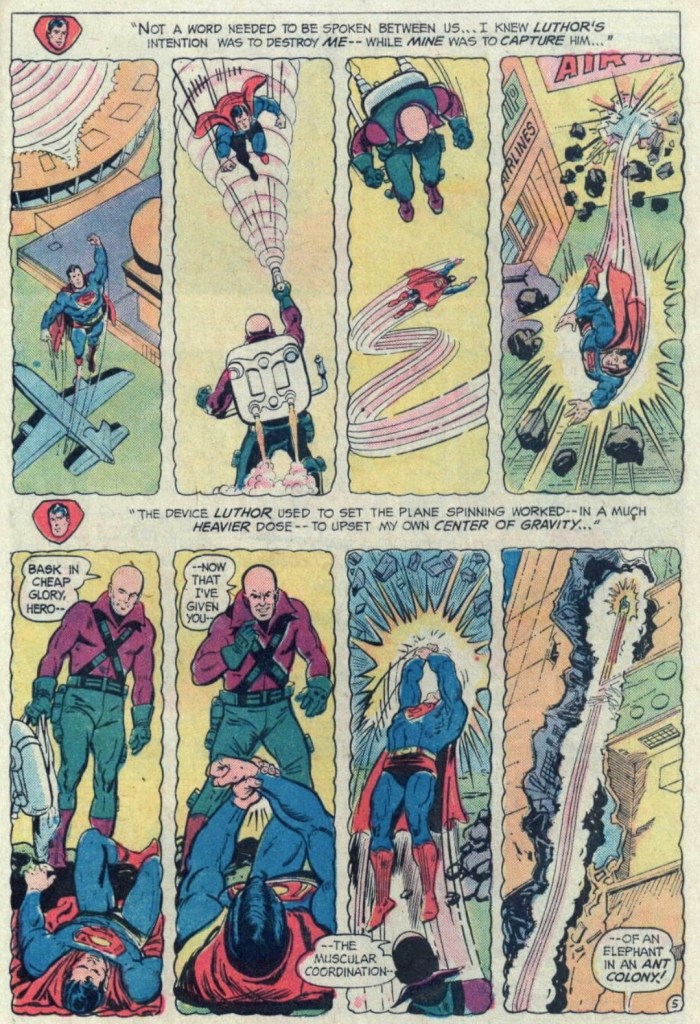
The story begins at the ruined Metropolis International Airport with Superman helping with the huge repair efforts. It turns out, he and Lex Luthor just had an encounter there. When Mr. Hales of the airport authorities asked him why Luthor was always evil, Superman begins to remember the friendship he had with his rival when they were both teenagers in Smallville…

Quality

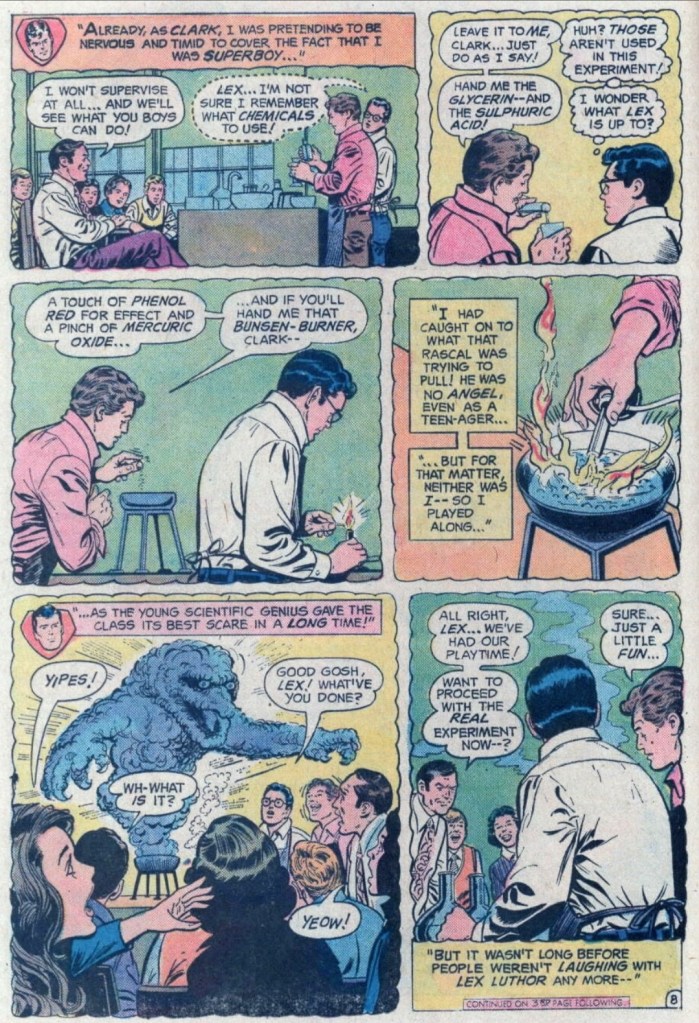
Yes, it is all true. Lex Luthor and Clark Kent were students in the same high school in Smallville when they were teenagers.

To make things clear, this comic book has two stories and the first one – titled “The Luthor Nobody Knows” – is clearly the main story.

The main story has this unusual format of storytelling that resulted in an abundance of flashbacks dominating the present-day tale. In connection with the tale’s title, this is a dramatized look back at the time when Luthor and Clark Kent (then Superboy) were high school students in Smallville. The creators took their time portraying young Clark Kent as the mild and ethical student and the teenage Lex Luthor as the daring student who truly believes he can make great achievements through science.

For those who might have heard the fabled start of the rivalry between Luthor and Superboy, you will see that in this comic book as well as the negative impact the former made as time went on. Along the way, you will see the stark differences between them which were nicely dramatized by the creators. Notably, you will see a more human portrayal of Luthor in his younger self.

The 2nd story of this comic book – titled “The private life of Clark Kent” – is just a 5-page additive geared towards Superman fans wanting more of him in his civilian identity.  

Conclusion

This battle between Superman and criminal mad scientist Luthor should resonate with comic book fans who love the pre-Crisis era of DC Comics.

Considering the way the main story was crafted, Superman (1975) is technically an origin story of Luthor who went from an ambitious young student into a criminal mad scientist. This should surprise readers who remained unaware of the shared past between Luthor and Superman before Crisis on Infinite Earths happened. In relation to what was mentioned earlier in the review, the Superboy-Luthor conflicts here looked dynamic. There is a good amount of entertainment here to see and it should resonate with long-time comic book readers who miss the pre-Crisis era of DC Comics.

Overall, Superman (1975) is recommended.

+++++

Thank you for reading. If you find this article engaging, please click the like button below, share this article to others and also please consider making a donation to support my publishing. If you are looking for a copywriter to create content for your special project or business, check out my services and my portfolio. Feel free to contact me with a private message. Also please feel free to visit my Facebook page Author Carlo Carrasco and follow me on Twitter at  @HavenorFantasy as well as on Tumblr at https://carlocarrasco.tumblr.com/ and on Instagram at https://www.instagram.com/authorcarlocarrasco
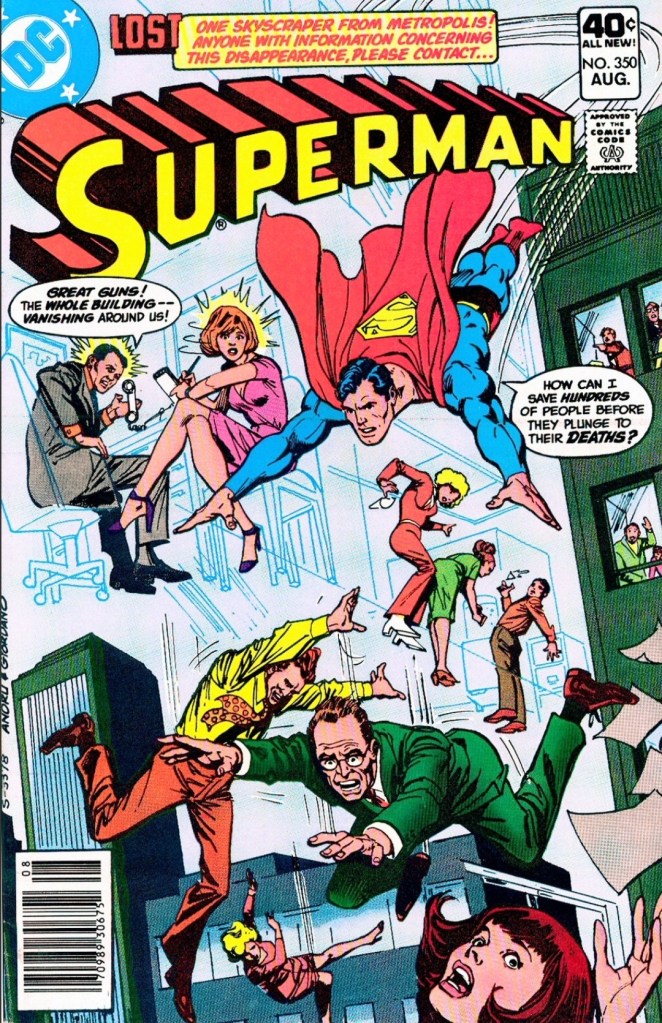
A Look Back at Superman #350 (1980)

Welcome back superhero enthusiasts, 20th century pop culture enthusiasts and comic book collectors! Today we go back to the year 1980 to take a close look at one of the many tales published through the original Superman monthly series (first launched in 1939).

Before Crisis on Infinite Earths happened, the DC Comics multiverse had a lot of superhero stories that had outlandish fantasy elements. For example, Action Comics #454 showed Superman eating tons of food in order to survive. In Action Comics #456, the battles between Superman and The Shark had lots of outlandish looking forms of action. In short, the old multiverse and its tropes are looking fun to revisit.

With those details laid down, here is a look back at Superman , published in 1980 by DC Comics with a story written by Gerry Conway and drawn by Curt Swan.  

The cover.

Early story

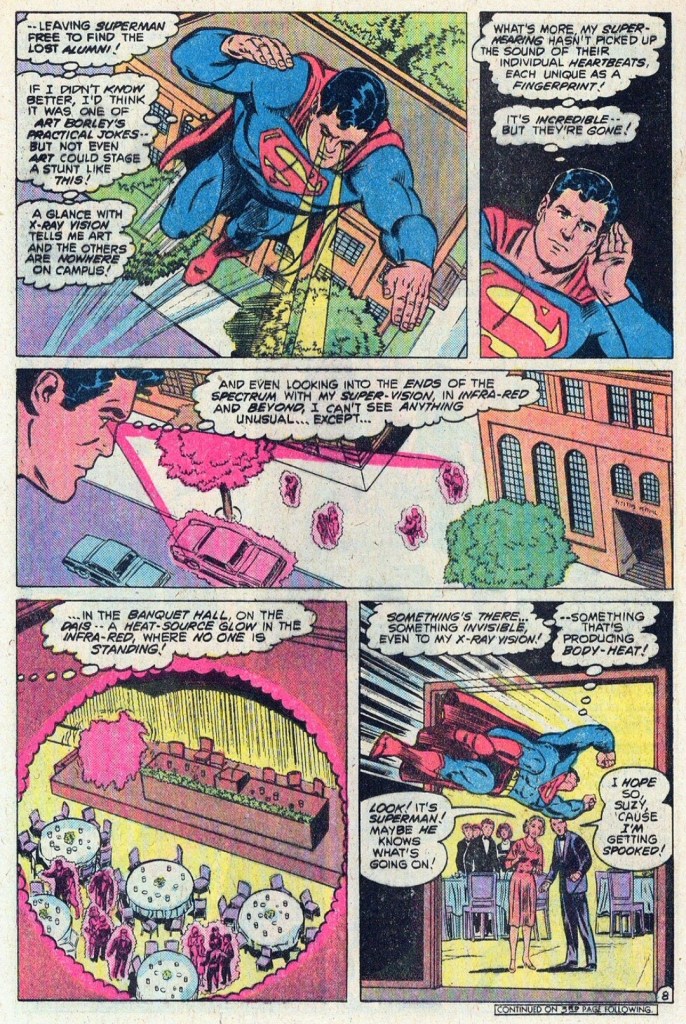
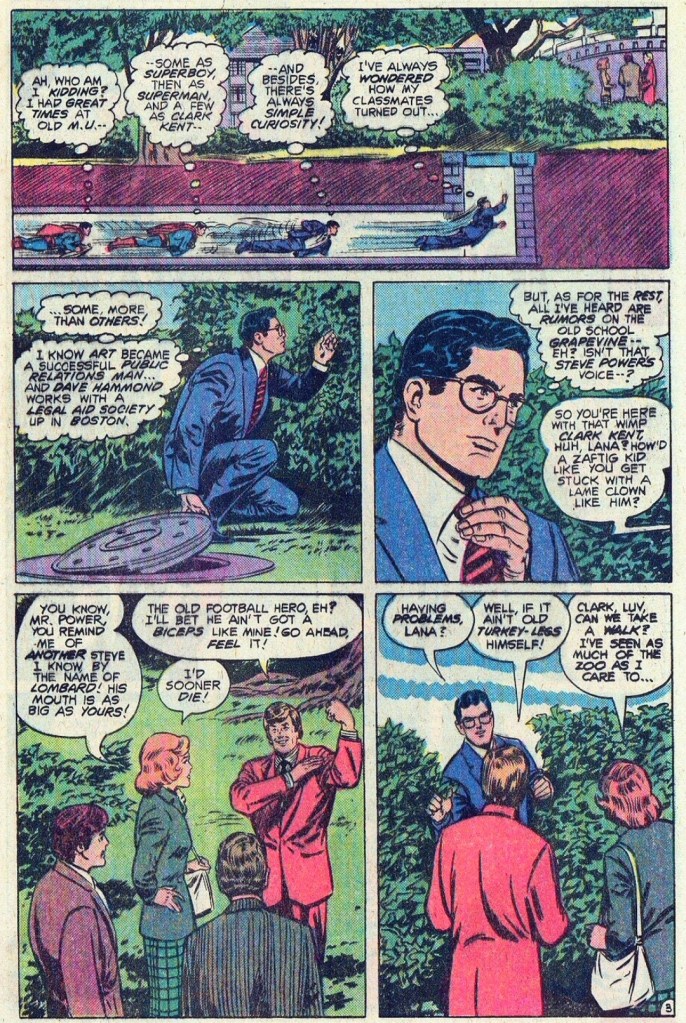
The story begins when Superman makes his move to prevent a punctured hot air balloon transport from crashing. It turns out the balloon was part of the promotion of a reunion event at Metropolis University and Superman really went there to attend it in his civilian identity as Clark Kent. Also attending the event is his long-time friend and colleague Lana Lang.

As the old professor Lemuel B. Tolkein – former superior of Clark and his classmates – speaks during the reunion, several attendees – including people Clark personally knew – begin to disappear into thin air. The remaining attendees and guests begin to panic…

Quality

Superman uses his special abilities to solve problems here.

I really like this story. Without spoiling the plot, I can say that this tale written by Conway is actually a mystery that happens to take place during Clark Kent’s reunion with many people from his past. As there is no good-versus-evil concept, the story is solidly focused on mysterious happenings that challenge Superman’s ability to solve problems. Even though he already has many super powers, the Man of Steel still got challenged a lot by the disappearances of people and things.

Apart from the story, I also enjoyed Conway’s approach on developing Clark Kent/Superman, Lana Lang and Lois Lane. Seeing Clark reconnecting with people from his past at Metropolis University was a refreshing portrayal and it also sheds light on how he handled himself during his collegiate years. As for Lois Lane, she was portrayed to be hostile towards Clark with regards to journalistic competition between them, and yet she still has tenderness towards Superman deep inside.

Conclusion

Superman quickly changes into his Clark Kent identity to attend the reunion.

Superman (1980) is enjoyable and the elements of the pre-Crisis multiverse of DC Comics added depth to it. The story is relaxing to follow and it managed to surprise me and keep me engaged until the very end. I am convinced to follow the next issue.

Overall, Superman (1980) is recommended.

+++++

Thank you for reading. If you find this article engaging, please click the like button below, share this article to others and also please consider making a donation to support my publishing. If you are looking for a copywriter to create content for your special project or business, check out my services and my portfolio. Feel free to contact me with a private message. Also please feel free to visit my Facebook page Author Carlo Carrasco and follow me on Twitter at  @HavenorFantasy as well as on Tumblr at https://carlocarrasco.tumblr.com/ and on Instagram at https://www.instagram.com/authorcarlocarrasco
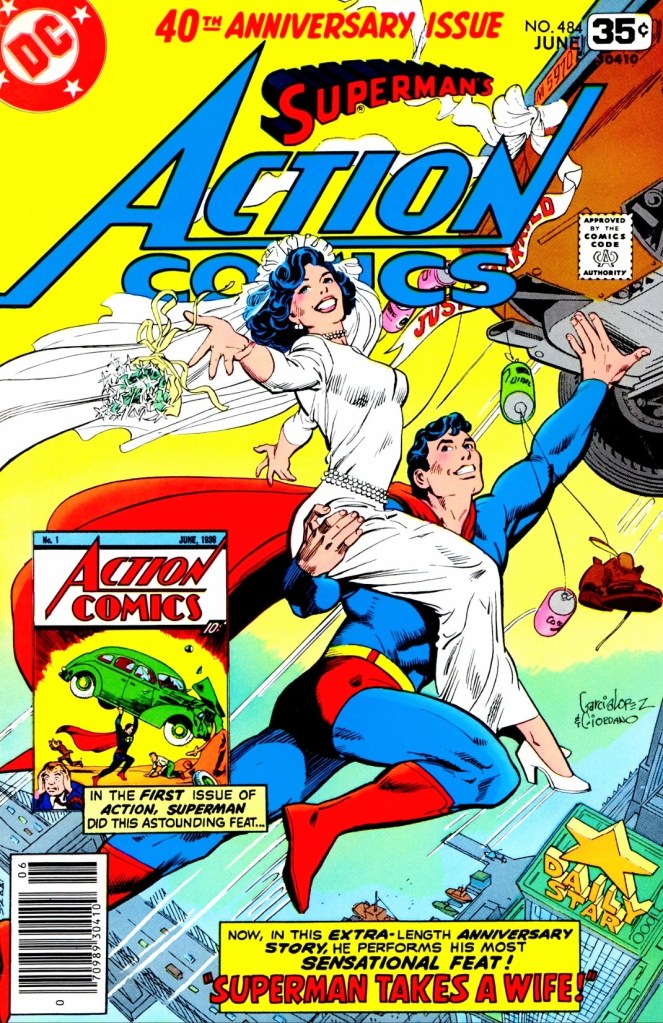
A Look Back at Action Comics #484 (1978)

Welcome back superhero enthusiasts, 20th century pop culture enthusiasts and comic book collectors! Today we go back to the year 1978 to take a close look at one of the many tales published through the original Action Comics monthly series (launched in 1938).

Long before Crisis on Infinite Earths happened, DC Comics had its convoluted multiverse. For the newcomers reading this, this meant that there were actually different versions of Superman and other DC superheroes, plus different universes or parallel worlds existing with each other. This particular Action Comics issue features a certain version of Superman and what happened to him and the related characters.

With those details laid down, here is a look back at Action Comics , published in 1978 by DC Comics with a story written by Cary Bates and drawn by Curt Swan.  

The cover.

Early story

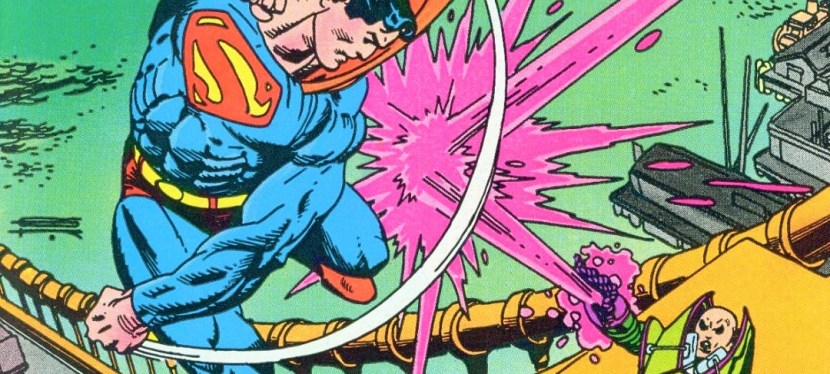
The story begins in Metropolis of Earth-Two when four mechanical marauders fly through the city carrying bags of money taken from a bank. Superman (of Earth-Two) quickly flew after the mechanical marauders and uses his powers to beat them all. From a distance, Colonel Future (leader of the C-F Gang) observes Superman and analyzes his moves. It turns out, the gang is responsible for the mechanical marauders and Colonel Future believes that he can wipe out the Man of Steel.

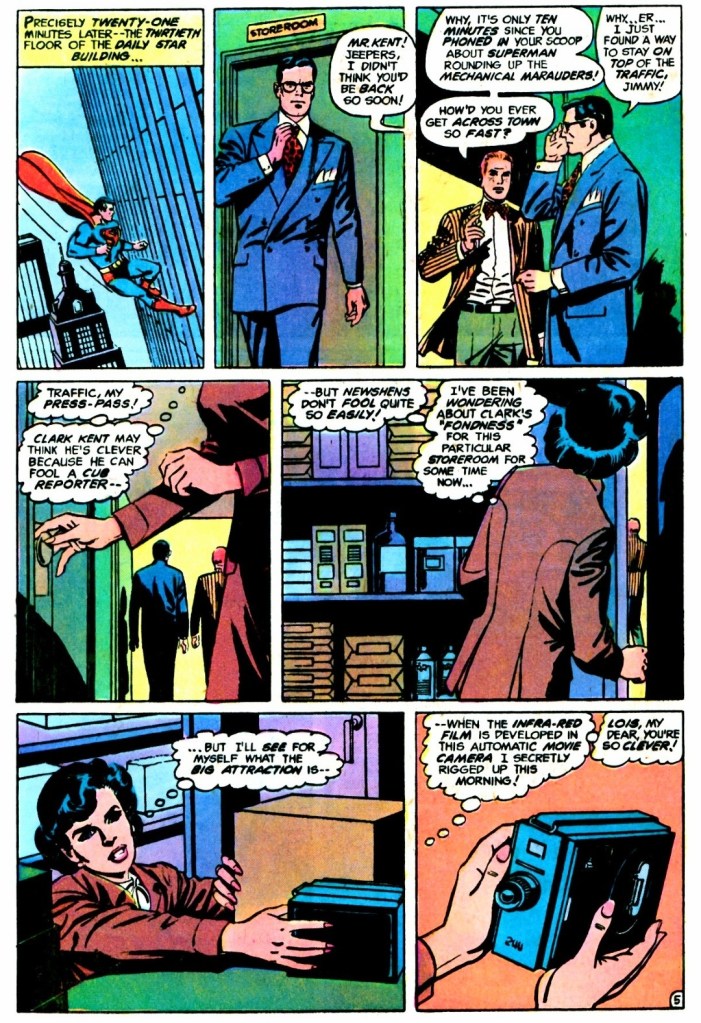
Superman returns quietly into the Daily Star Building and changes into civilian clothing as Clark Kent. His office mate Jimmy Olsen approaches him and together they walk and talk about what has been going on.

Behind them, Lois Lane silently enters the store room where Clark came out of. It turns out, she prepared a hidden camera inside hoping to capture evidence about Clark using the room. She has been suspecting that Superman and Clark Kent are one and the same person…

Quality

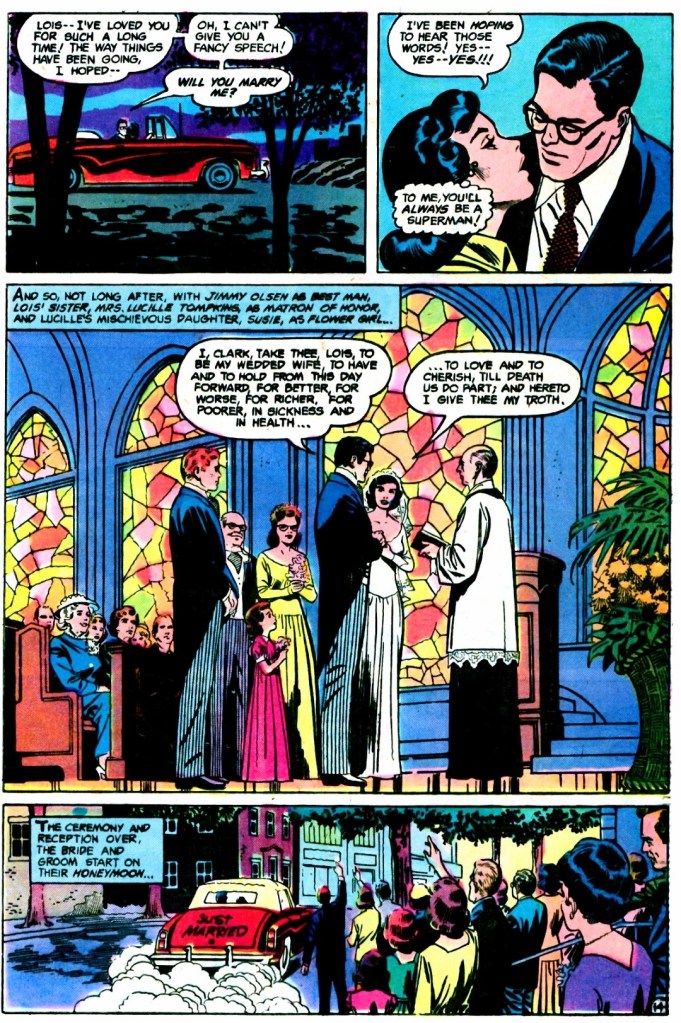
While it is clear that Superman – in his civilian form as Clark Kent – married Lois Lane, there is still a lot more to discover from the in-depth story written by Cary Bates.

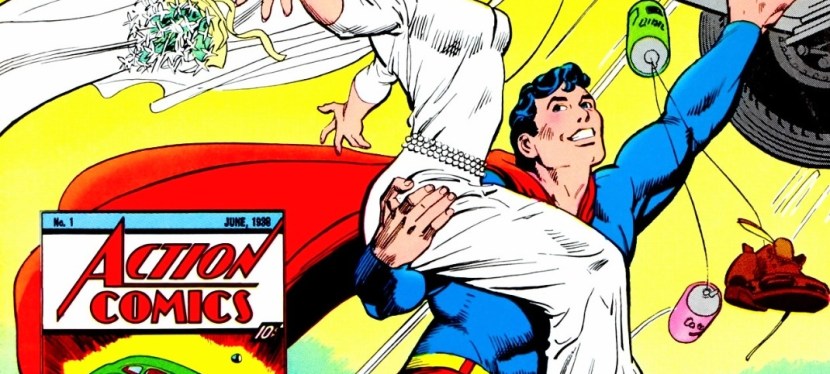
I really like this pre-Crisis Superman story which is specifically set in Earth-Two of the DC multiverse. To make things clear, this is a tale showing Superman getting married to Lois Lane without impacting the mainstream version of DC’s icon at the time. Confused? That’s the consequence of having different versions of Superman complete with detailed parallel universes for each.

More on the core concept of this comic book, there is a lot more at stake – storywise and creatively – than meets the eye. Without spoiling the plot details, I can clearly say that the concept of Superman and Lois Lane getting married involves a daring plot which was executed nicely by the Bates-Swan duo resulting in a really intriguing reading experience for me. In other words, there is nothing simple with the presentation as the fantasy elements are really strong and the creative team took creative risks to emphasize the story while developing the key characters in new ways.

Still on the storytelling, the conflict between good and evil is emphasized not by struggle but rather the consequences which ultimately affect Superman and Lois Lane. The main opposition used by the Bate-Swan duo involves magic as a creative way to impact the Man of Steel and the narrative in general. There are some really intriguing moments about Superman (including his civilian identity as Clark Kent) and Lois Lane that await readers.

Conclusion

Lois Lane has an in-depth portrayal in this comic book, going beyond what the page shows you.

Action Comics (1978) is undoubtedly a very intriguing and surprising read. The creative team came up with ideas that subverted expectations and the execution was well done which made this a powerful and twisting read. Having read lots of Superman comic books through the decades, this comic book is one of the more surprising ones I have read. Finally, this one has a believable presentation about what married life between Superman and Lois Lane would be like reflecting the social norms at the time of publication.

Overall, Action Comics (1978) is highly recommended.

+++++

Thank you for reading. If you find this article engaging, please click the like button below, share this article to others and also please consider making a donation to support my publishing. If you are looking for a copywriter to create content for your special project or business, check out my services and my portfolio. Feel free to contact me with a private message. Also please feel free to visit my Facebook page Author Carlo Carrasco and follow me on Twitter at  @HavenorFantasy as well as on Tumblr at https://carlocarrasco.tumblr.com/ and on Instagram at https://www.instagram.com/authorcarlocarrasco
A Look Back at Superman #385 (1983)

Welcome back superhero enthusiasts, 20th century pop culture enthusiasts and comic book collectors! Today we go back to the year 1983 to take a close look at one of the many tales published through the original Superman monthly series (first launched in 1939).

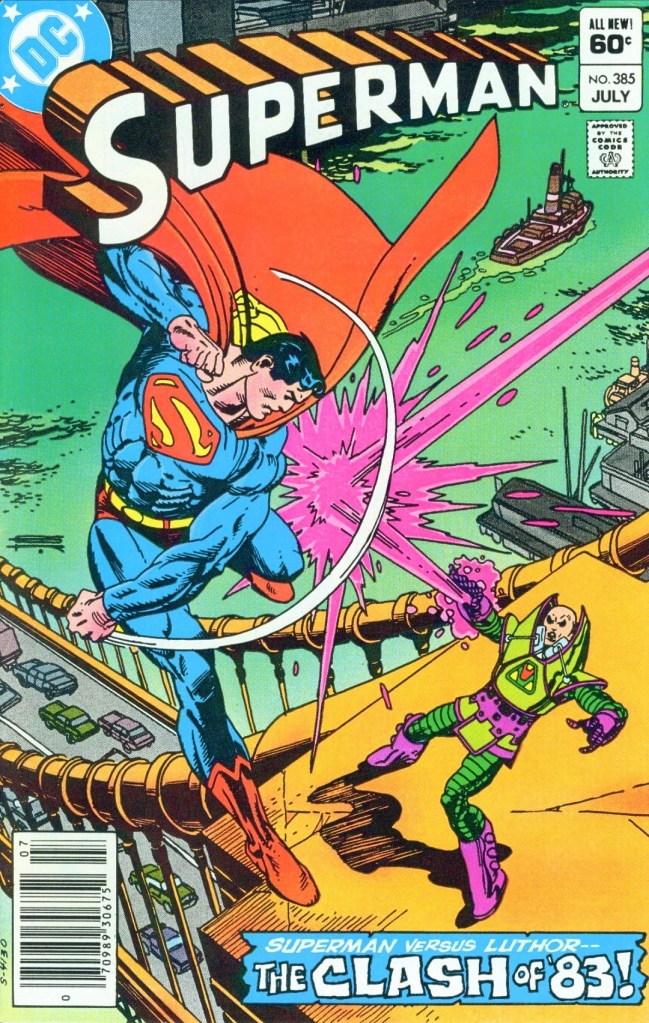
Back in 1983, DC Comics published Action Comics which marked the 45th anniversary of Superman and celebrated it by executing things very differently – introducing the new look of Lex Luthor in battle armor and showing Brainiac in a more robotic body. I really loved reading Action Comics #544 for its very rich storytelling and modernizing the two classic super villains. With regards to what happened in Lex Luthor’s story in the comic book, his tale actually continued with the Superman monthly series afterwards.

With those details laid down, here is a look back at Superman , published in 1983 by DC Comics with a story written by Cary Bates and drawn by Curt Swan.  

The cover.

Early story

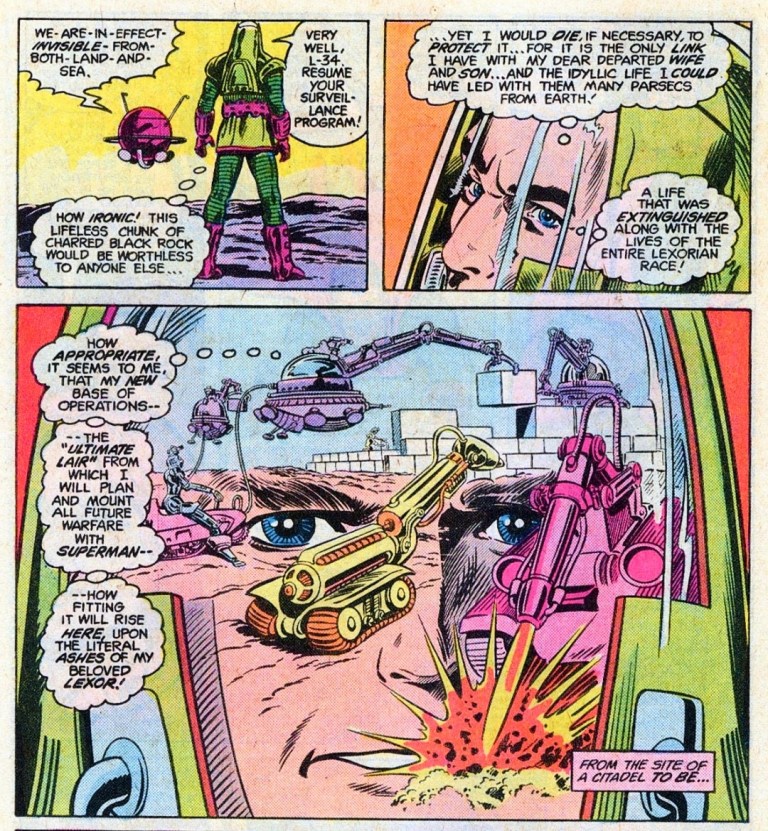
The story begins with the armored Lex Luthor alone and grieving in deep space surrounded by floating rocks. His world Lexor just got destroyed and his wife and child are gone. He blames Superman for being responsible of the massive destruction. He remembers the moment when he fired an energy blast at Superman which got deflected towards the neutrarod (a device Luthor made to shoot a steady stream of stabilizing neutrons into the planet’s unstable core) which started a chain reaction transmitted directly into the core. Lexor detonated but Superman and Luthor survived.

Using the intense power and technologies of his armor, Luthor moves an island-sized rock (a remaining piece of Lexor) towards planet Earth. He is determined to have his revenge against Superman and will stop at nothing to make it happen…

Quality

This is a great visualization of Lex Luthor (in his warsuit) by Curt Swan.

Through the decades, I have read lots of Superman comic books that involved Lex Luthor as the main antagonist. This particular story of good-versus-evil is actually very unique thanks to the approach taken by the Bates-Swan duo. To be clear, this is actually a build-up type of story done with the next conflict between Superman and Luthor in mind.

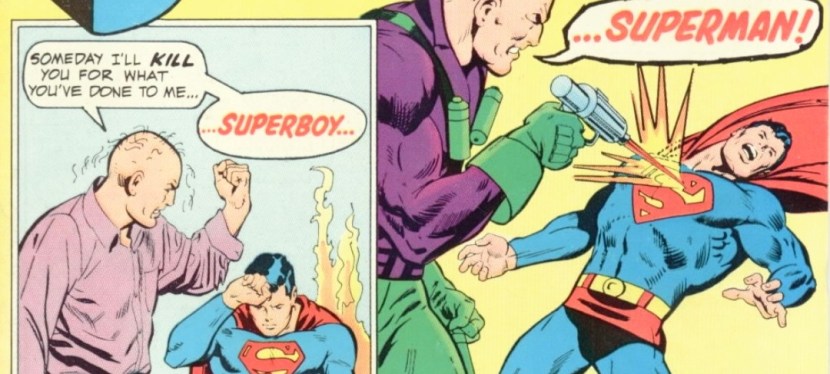
Without spoiling the plot, I can say that Luthor – following the events of Action Comics which really hurt him deeply – got a nice share of the spotlight and deservedly so. He is determined to get back at Superman whom he holds responsible for the destruction of Lexor and its many inhabitants (including Luthor’s wife and child). Luthor does not rush things as he is very focused on preparing himself first which reminds me of Batman’s approach to preparations. In some ways, Luthor has his own principles and he is not just being evil for the sake of it. There is this very human portrayal of him and Bates’ writing could make you even forget that he is a madman.

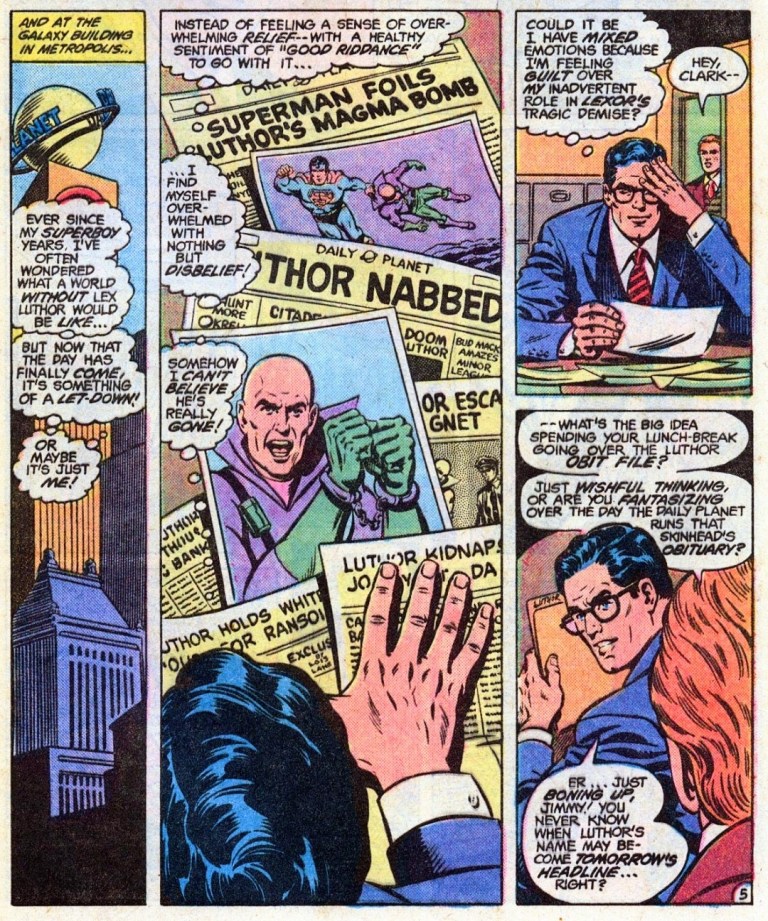
As for the Man of Steel himself, Bates wrote him to be really burdened by having his share of the responsibility of the billions of deaths of the people of Lexor. Instead of the focused Superman dedicated to doing good, you will see him feeling really uneasy and even distracted. He even commits huge blunders! This is a Superman who is showing signs of internal weakness and not even his civilian life as journalist Clark Kent could relieve the tension he is experiencing. I really like this portrayal of DC Comics’ icon.

But there is more! There is the sub-plot of Lois Lane taking a much-needed break from work to relieve herself and it sure is a really interesting portrayal of her. Even Perry White has his own share of the spotlight. There is also the spotlight on some obscure DC villains which actually added to the plot.

Conclusion

A very uneasy Clark Kent at work.

Superman (1983) is clearly a very engaging read and it is a worthy follow-up to what happened in Action Comics . I really like the way the armored Lex Luthor is portrayed here and the build-up for his upcoming conflict with Superman is really powerful. I’m really glad to have read this particular Superman-Luthor story and I can say that I am looking forward to the next issue to see what will happen.

Overall, Superman (1983) is highly recommended.

+++++

Thank you for reading. If you find this article engaging, please click the like button below, share this article to others and also please consider making a donation to support my publishing. If you are looking for a copywriter to create content for your special project or business, check out my services and my portfolio. Feel free to contact me with a private message. Also please feel free to visit my Facebook page Author Carlo Carrasco and follow me on Twitter at  @HavenorFantasy as well as on Tumblr at https://carlocarrasco.tumblr.com/ and on Instagram at https://www.instagram.com/authorcarlocarrasco
A Look Back at Action Comics #456 (1976)

Welcome back superhero enthusiasts, 1970s arts and culture enthusiasts, DC Comics fans and comic book collectors! Today we go back to the year 1976 to take a close look at a part of the DC Comics universe through a tale of the Action Comics monthly series.

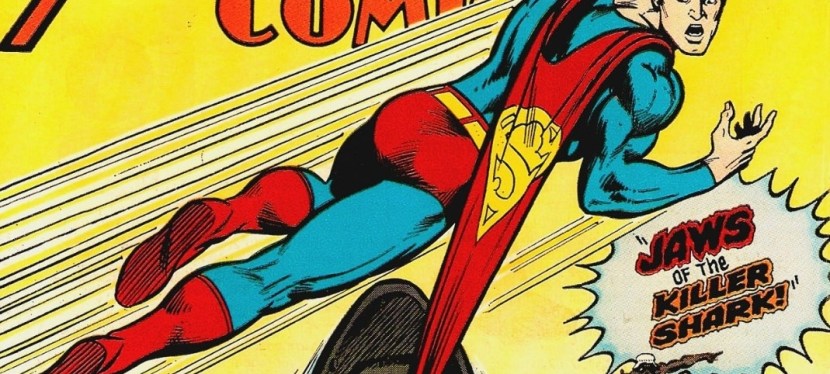
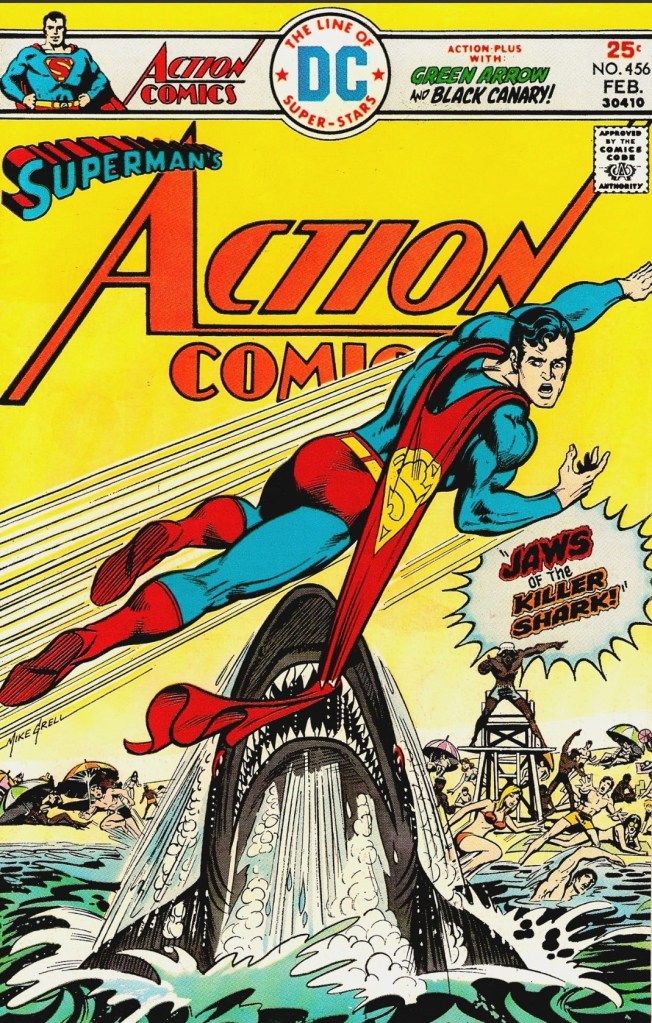
If you know your entertainment history, you should be aware that Steven Spielberg’s Jaws made a tremendous impact on millions of people who saw the film in cinemas in the mid-1970s. The massive success of the movie caused some people to become afraid of sharks which in turn convinced them to avoid swimming alone at sea. Over at DC Comics, it just so happens that they have a super villain who is actually a highly evolved shark called The Shark (Karshon).

With those details laid down, here is a look back at Action Comics , published in 1976 by DC Comics with a story written by Cary Bates and illustrated by Curt Swan.

The cover inspired by Steven Spielberg’s Jaws.

Early story

The story begins inside the Metropolis Aquarium where Captain Strong, young boy Jayson, young girl Jill and others closely watch a tiger shark swimming. What the viewers do not realize is that the tiger shark they are watching is a super shark (The Shark) whose evolution jumped by eons as a result of a freak nuclear accident from the previous years.

The Shark is a highly evolved mutant (half-fish and half-human) endowed with fantastic mental powers. The Shark previously encountered Green Lantern (Hal Jordan) who caused him to devolve back to his primitive form as a tiger shark.

At the aquarium, The Shark moves closely towards Captain Strong and Jayson with strong glass separating them. Suddenly, Jayson is turned into a pool of jelly on the floor and The Shark uses its power to form a large stream of water to break the way out of the Metropolis Aquarium and into the air.

Meanwhile, Lois Lane and Clark Kent are riding the metro-island ferry. A giant water sprout emerges near them…  

Quality

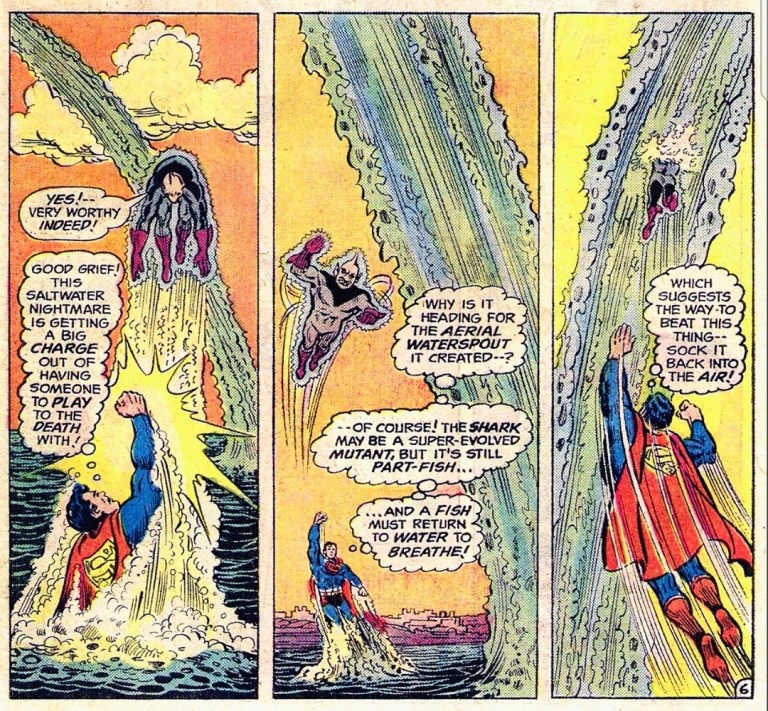
The struggle between Superman and The Shark starts.

While it was clear that DC Comics took a creative stab on people’s awareness of the movie Jaws, the Bates-Swan duo came up with a rather fantastic way of having Superman deal with The Shark. For one thing, the creators efficiently came up with exposition to keep readers informed about who The Shark is, why he exists and what his background was within the DC Comics shared universe. Next, the creators managed to make The Shark an actual threat to the people of Metropolis which serves as an efficient build-up for the inevitable conflict with Superman. The good news here is that Bates-Swan combined efforts turned out to be gripping and believable.

When compared to the many battles Superman had against the other powerful villains, the traditional collateral damage is pretty light in this story. This is because the creators used science fiction concepts and a little bit of real-world science to explain The Shark’s powers, how the water streams used by him got formed and why he has key advantages over Superman. These creative methods more than made up for the lack of hard action and there are explanations that made sense just before the story ends.

This comic book also contains a short, standalone Black Canary tale that ultimate served as added amusement that is not related with the Superman story at all. It should interest fans of Green Arrow.

Conclusion

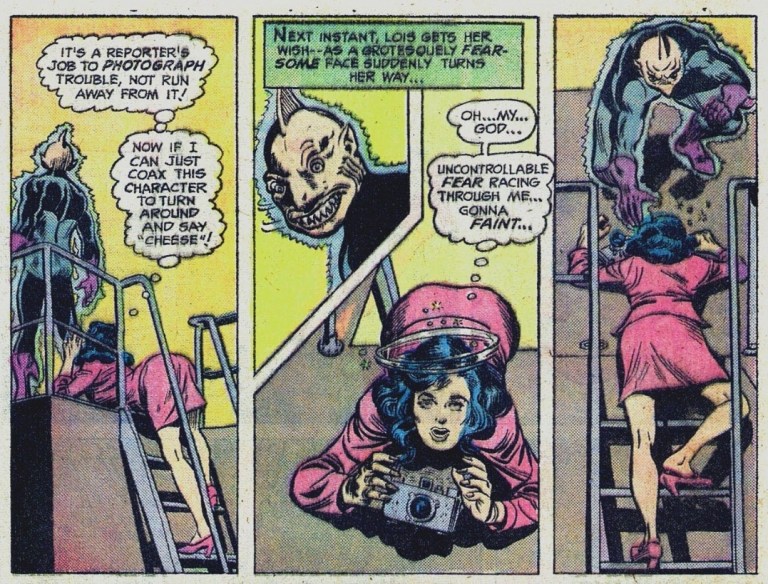
The Shark’s menacing face and power overwhelms Lois Lane.

Do not let the Jaws-inspired cover art fool you. Action Comics (1976) is actually an entertaining read thanks to the combined efforts of the Bates-Swan team. The Shark was a believable threat and the story was well written. To say that this comic book was just a cheap way of exploiting the popularity of Jaws by coming up with shark-related tale of Superman is not true. This old tale is a fun ride free from the politicized science and woke garbage that dominate modern-day entertainment.

Overall, Action Comics (1976) is recommended.

+++++

Thank you for reading. If you find this article engaging, please click the like button below, share this article to others and also please consider making a donation to support my publishing. If you are looking for a copywriter to create content for your special project or business, check out my services and my portfolio. Feel free to contact me with a private message. Also please feel free to visit my Facebook page Author Carlo Carrasco and follow me on Twitter at  @HavenorFantasy as well as on Tumblr at https://carlocarrasco.tumblr.com/ and on Instagram at https://www.instagram.com/authorcarlocarrasco