A Look Back at Prime #8 (1994)

Disclaimer: This is my original work with details sourced from reading the comic book and doing personal research. Anyone who wants to use this article, in part or in whole, needs to secure first my permission and agree to cite me as the source and author. Let it be known that any unauthorized use of this article will constrain the author to pursue the remedies under R.A. No. 8293, the Revised Penal Code, and/or all applicable legal actions under the laws of the Philippines.

Is Prime your favorite caped hero among the many heroes of the Ultraverse? For the newcomers reading this, Prime is an overly muscular hero of the Ultraverse who is actually a kid deep inside his fake flesh. Prime was one of the major heroes of the Ultraverse and was part of UltraForce alongside Hardcase and Prototype (two other major heroes).

In late 1993, a 2-part Ultraverse crossover was published titled Break-Thru and, with the art of the legendary George Perez, it was a big mix of characters from the UV. Prime had a role in Break-Thru and we can see what happened to him after the end of the said crossover in this look back at Prime #8 published in 1994 by Malibu Comics and written by Len Strazewski and Gerard Jones with art done by the late Norm Breyfogle.
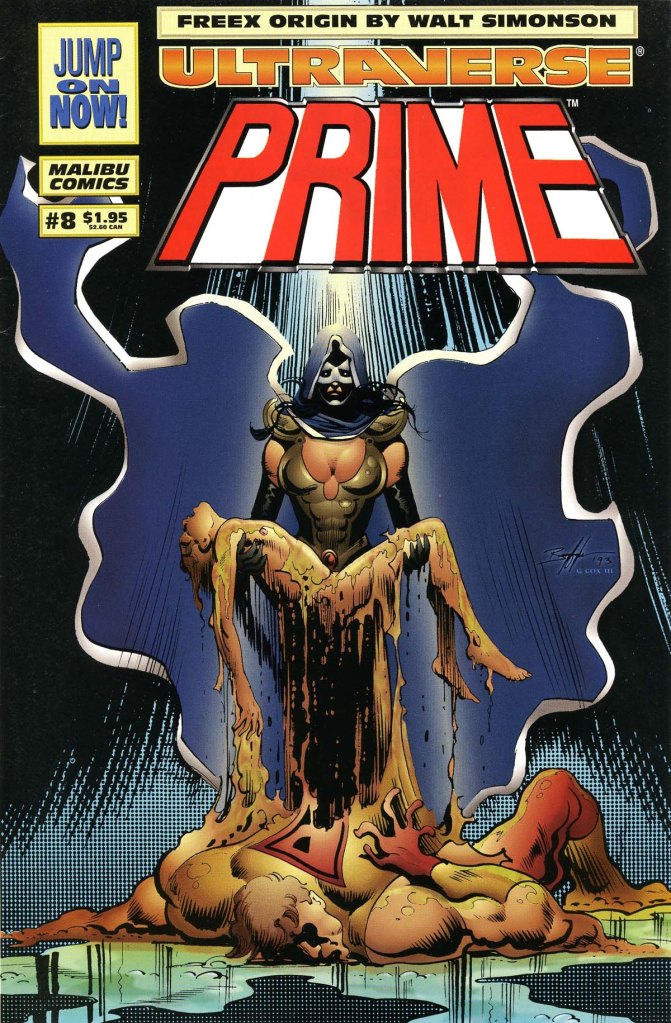
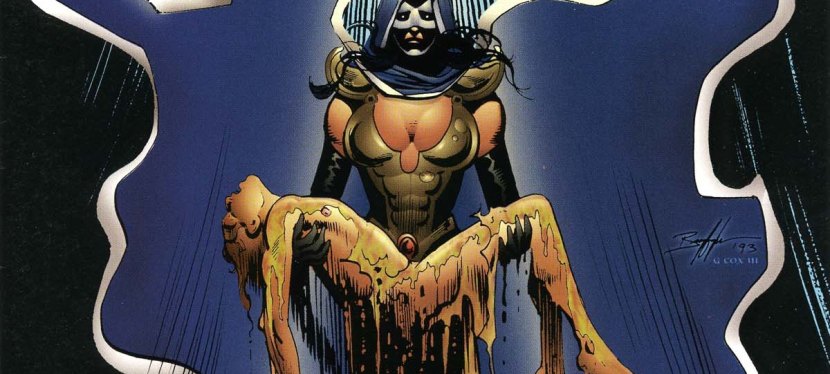
The cover.

Early story

The story begins in outer space with Prime and Prototype re-entering planet Earth. With the heat intensifying, Prime is worried that he won’t be able to make it safely on earth. Prototype, who is flying behind him, wonders if Prime knows what he is doing by leading the way. Prototype’s life is at stake as he relies on Prime to be his flying front shield (note: for the way the flight turned out in Prototype’s perspective, read Prototype #6).

Due to the instability and intense heat, the two ultras got separated flying down. Remembering the strip of Mantra’s cape, Prime uses it and manages to receive faint communication with Mantra. Prime eventually crashes into a swimming pool. With Prime’s flesh quickly dissolving, teenage Kevin Green is exposed naked underwater and struggles. Suddenly, water pushes him up several feet and finds himself being assisted by Mantra.

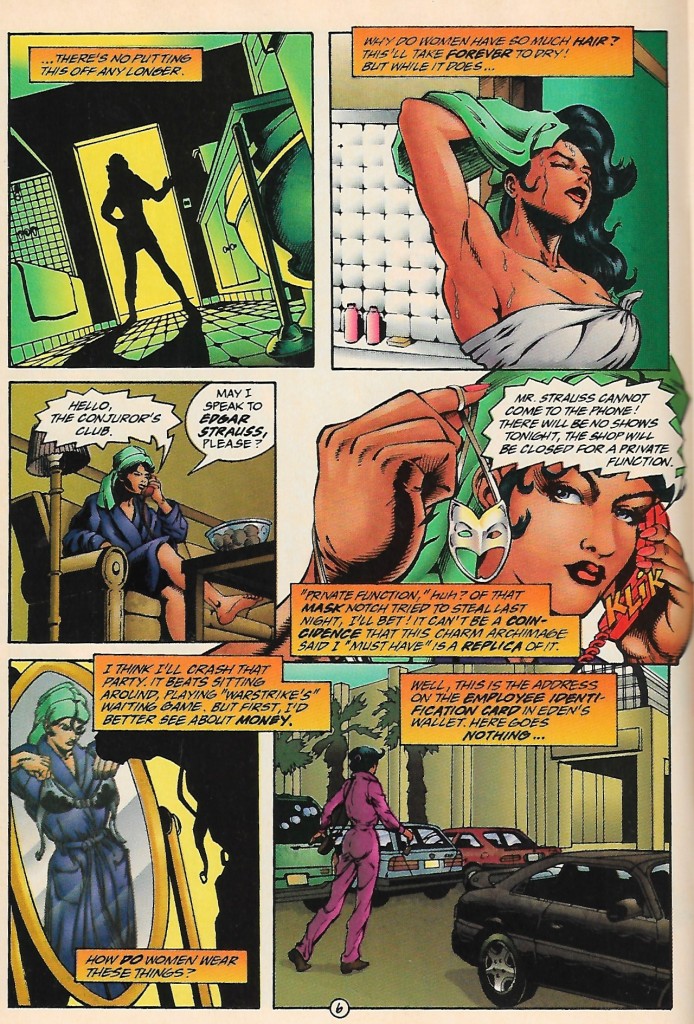
The naked Kevin is carried by Mantra who transform herself into Eden Blake…

Quality
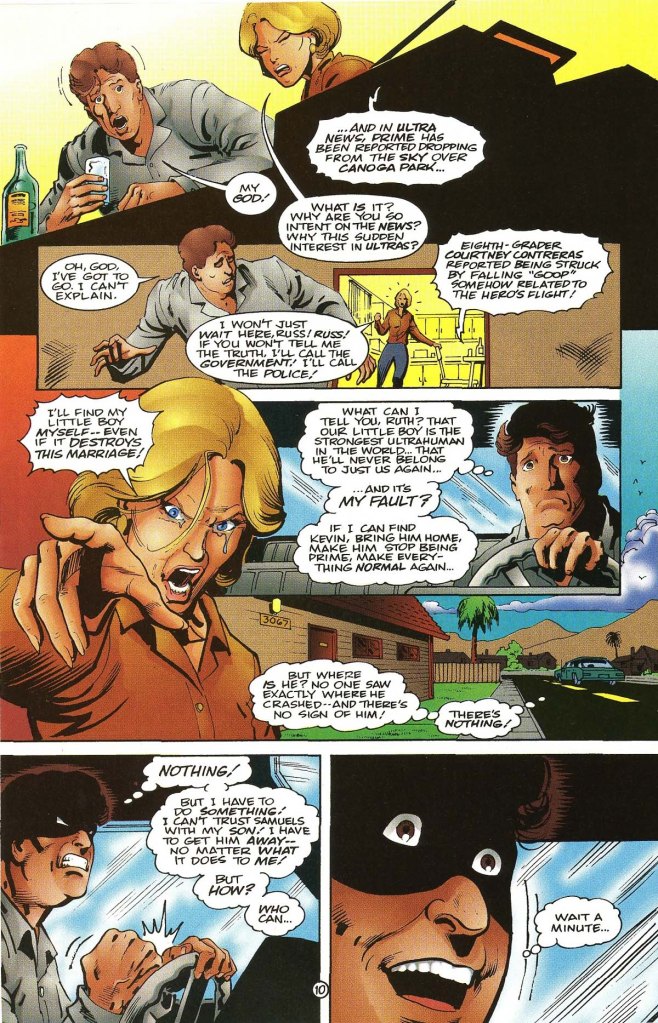
The pressure on the parents of Kevin.

Storywise, this one is a solid follow-up to the Break-Thru crossover and it succeeds in developing Prime further thanks to the combined efforts of Len Strazewski and Gerard Jones. With the narrative shifted away from Break-Thru, the story emphasizes the actions of the covert operations led by Colonel Samuels who simply won’t let Prime go free given the US government’s interests. What Samuels does not know is that someone sinister and hidden is spying on their operations. That someone is also interested in Prime and this alone added a lot of intrigue into the story.

As usual, the character development is very solid. I love the way Strazewski and Jones raise the stakes on the parents of Kevin and made them more troubled knowing their son’s involvement with the military. Kevin’s father, meanwhile, is living with the guilt of keeping the big secrets of the past.

When it comes to crossovers and interactions, the exchange between Kevin/Prime and Eden/Mantra is very compelling to read. Mantra, who knows Prime’s secret, tries to keep her identity secret. Already working for Aladdin under her Eden Blake identity, she sees an opportunity to learn more about Colonel Samuels through Kevin. For his part, Kevin wants to go home instead of getting involved again with the colonel. As their dialogue goes on, the tension really strengthened and added to the plot.   

Without revealing too much, I should state that the introduction of a new character really shook the story and the big fight that followed was a great payoff to all the build-up.

Conclusion
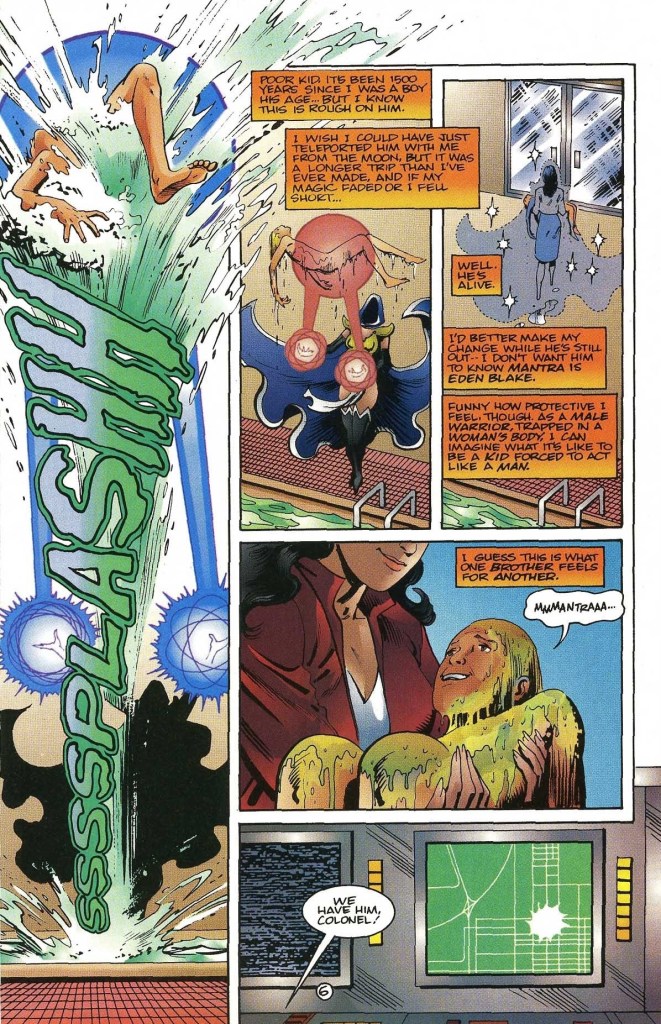
Kevin and Mantra together.

Prime #8 is an excellent superhero comic book! The creative team of Strazewski-Jones-Breyfogle really crafted a post-Break-Thru story that did not slowed down and kept raising the stakes and the intrigue. Suspense, excitement, drama and intrigue made a great mix here.

If you are seriously planning to buy an existing hard copy of Prime #8 (1994), be aware that as of this writing, MileHighComics.com shows that the near-mint copy of the regular edition costs $8 while the near-mint copy of the newsstand edition costs $26.

Overall, Prime #8 (1994) is highly recommended!

+++++

Thank you for reading. If you find this article engaging, please click the like button below and also please consider sharing this article to others. If you are looking for a copywriter to create content for your special project or business, check out my services and my portfolio. Feel free to contact me as well. Also please feel free to visit my Facebook page Author Carlo Carrasco and follow me at HavenorFantasy@twitter.com
A Look Back at Batman versus Predator II #4 (1995)

Disclaimer: This is my original work with details sourced from reading the comic book and doing personal research. Anyone who wants to use this article, in part or in whole, needs to secure first my permission and agree to cite me as the source and author. Let it be known that any unauthorized use of this article will constrain the author to pursue the remedies under R.A. No. 8293, the Revised Penal Code, and/or all applicable legal actions under the laws of the Philippines.

Do you happen to have any comic books of the Batman versus Predator II crossover in your collection? According to MileHighComics.com, their near-mint copies are valuable and you can sell them to make some much-needed money in this time of pandemic, government overreach and economic hardship.

Right now, I am about to finally end my review of the Batman versus Predator II mini-series and so far, I have enjoyed it a lot. To find out if this mini-series will come to a satisfying end, here is my retro review of Batman versus Predator II #4, published in 1995 by DC Comics and Dark Horse Comics with a story written by Doug Moench and drawn by Paul Gulacy.

The cover.

Early story

The story begins in the bat cave with Batman and Alfred discussing what happened lately. As it turned out, there were two other Predators on the lose apparently sent to stop the first one (who killed one of the mentioned two). Batman also mentioned the deaths of Song Sung and Terraro. Now there are two hunters remaining who may not know that the man who issued their contracts is dead.

Just before leaving with the motorcycle, Batman receives a call from Commissioner Gordon through the special line. Afterwards, he leaves.

In the city, a thug on a motorcycle starts chasing Batman which catches the attention of the local police…

Quality

From the final encounter with the hunter from space.

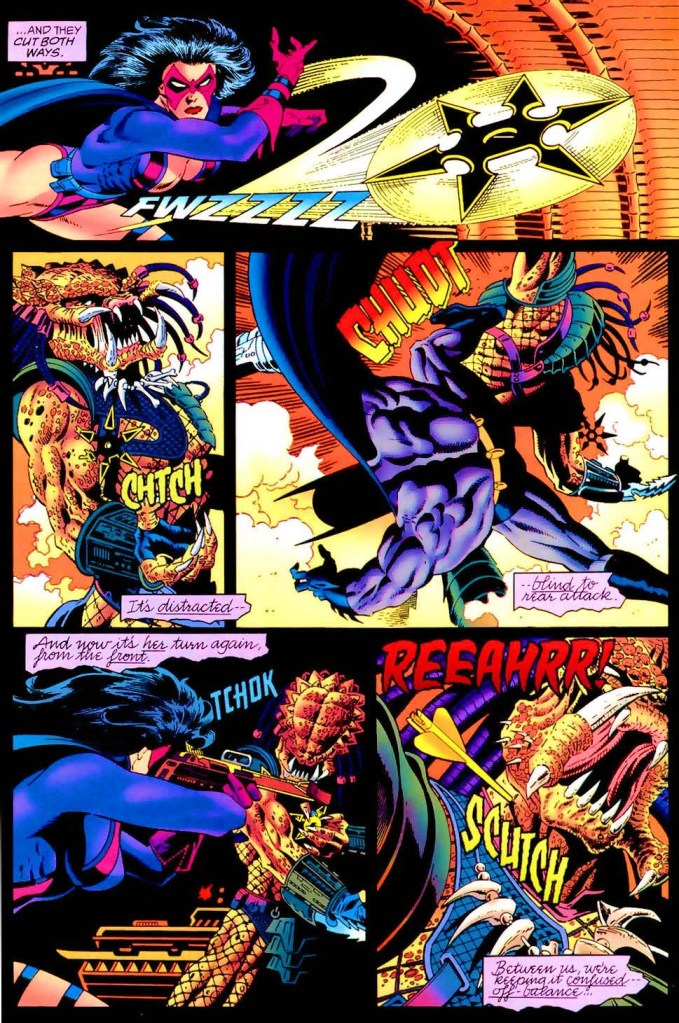
This comic book is a satisfying conclusion to the mini-series. In terms of writing, issue #4 delivered the payoff for what was built-up in issue #3. This results the return of Batman’s trusted ally as well as some more involvement of the police force as the stakes were raised in issue #3 with the involvement of more than one Predator. The hunter Predator – the one Batman and Huntress encountered in the first two issues – was indeed present and it was very interesting to see it pursue its encounter with the two heroes even though he was being hunted by a fellow Predator.

Having more than one Predator was initially confusing but the confusion did not last too long which readers will find relieving. As expected, the Huntress joined Batman in the final encounter and served nicely as a fighting partner whose assistance proved to be valuable. If there is any weak spot in the presentation, it’s the element of the gang and human hunters who only served to add to the death toll.

As with the first three issues of this mini-series, the action here remains very intense and quite uncompromising with its violence. Expect gunshot wounds and decapitations here and there. The hard action presented, especially in the encounters with the Predator, was indeed satisfying. I should state that the final encounter inside the space ship is very thrilling.

Conclusion

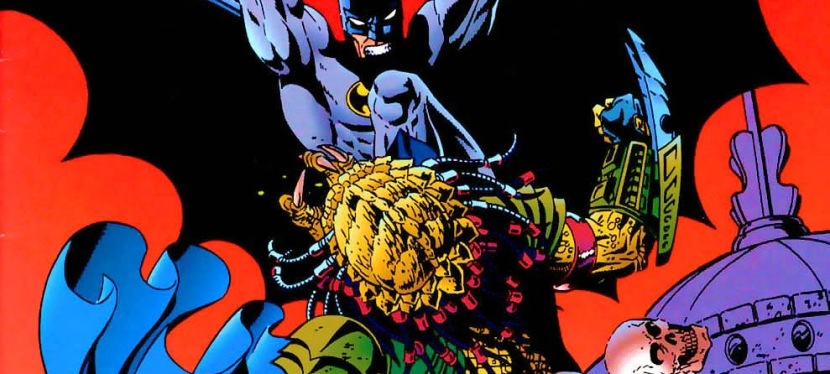
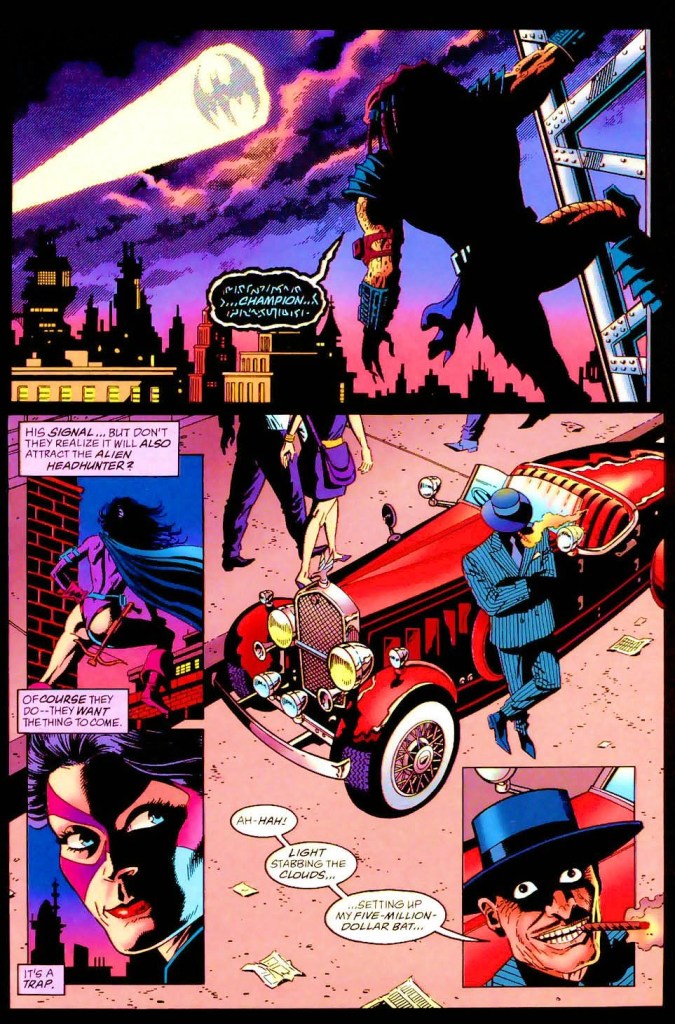
The Bat signal is an attraction to the Predator.

Batman versus Predator II #4 (1995) is a pretty solid read. What was built-up previously, got paid off nicely here. With regards to raising the stakes and making this mini-series different from its predecessor, the creative team succeeded with the resolutions they came up with. In addition, Batman and the Huntress make a solid duo and their interactions together were compelling.

If you are seriously planning to buy an existing hard copy of Batman versus Predator II #4 (1995) be aware that as of this writing, MileHighComics.com shows that the near-mint copy of the comic book costs $50.

Overall, Batman versus Predator II #4 (1995) is highly recommended!

+++++

Thank you for reading. If you find this article engaging, please click the like button below and also please consider sharing this article to others. If you are looking for a copywriter to create content for your special project or business, check out my services and my portfolio. Feel free to contact me as well. Also please feel free to visit my Facebook page Author Carlo Carrasco and follow me at HavenorFantasy@twitter.com

A Look Back at Mantra #5 (1993)

Disclaimer: This is my original work with details sourced from reading the comic book and doing personal research. Anyone who wants to use this article, in part or in whole, needs to secure first my permission and agree to cite me as the source and author. Let it be known that any unauthorized use of this article will constrain the author to pursue the remedies under R.A. No. 8293, the Revised Penal Code, and/or all applicable legal actions under the laws of the Philippines.

Welcome back, Ultraverse fans and comic book collectors! Would you happen to be a fan of illustrator Terry Dodson? I first saw his professional work when I read Mantra #1 way back in 1993 just as my fellow comic book collectors were discovering the newly launched Ultraverse. After the Ultraverse ended, Dodson went on to work for Marvel Comics with projects such as the Storm mini-series and X-Men related comic books. In 2000, Dodson went to DC Comics and his project with them was illustrating issues of the Harley Quinn series. He even got to work on Wonder Woman comic books six years later.

You must be wondering – how did Terry Dodson first broke into the comic book industry and what was his first project? Check out this excerpt from a published interview.

How did you break into comic books?

By doing portfolio samples and taking them to conventions and showing them around. At first it was difficult to hear the critiques, but later on that’s what I wanted to know. What I was doing wrong. Fortunately, when I broke in 1993, they were handing out jobs to anybody with a pulse. I got my first job on Mantra, for the new Malibu Ultraverse.

See? It turns out Mantra of the Ultraverse was his comic book debut.

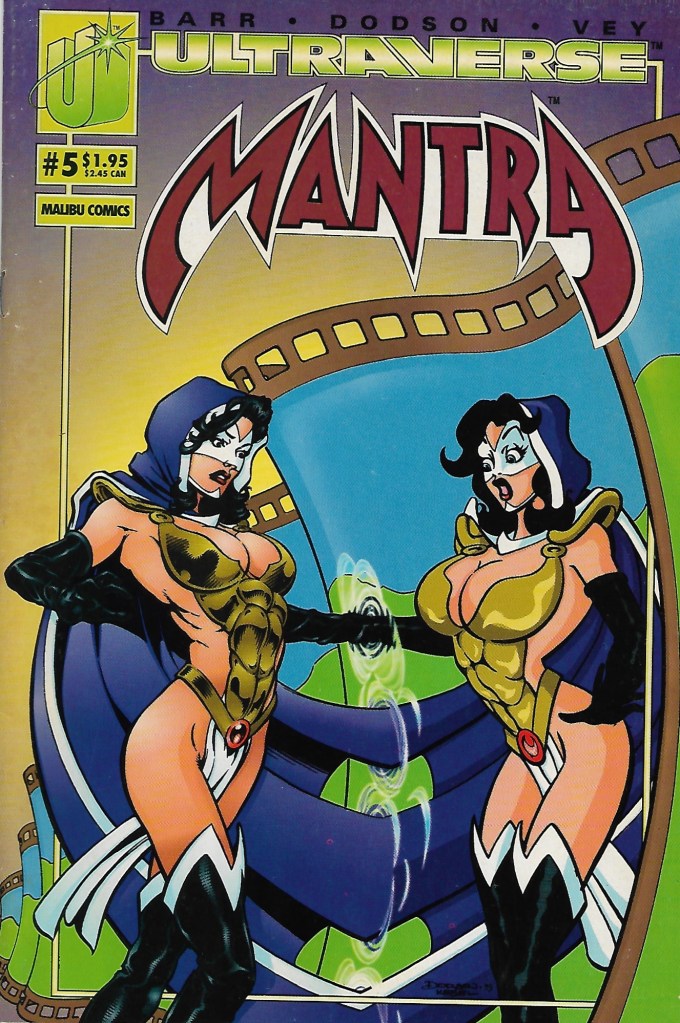
Now that the history lesson is done, we can see more of Dodson’s work on Mantra in the look back at Mantra #5, published in 1993 by Malibu Comics with a story written by Mike W. Barr and drawn by Dodson.

The cover.

Early story

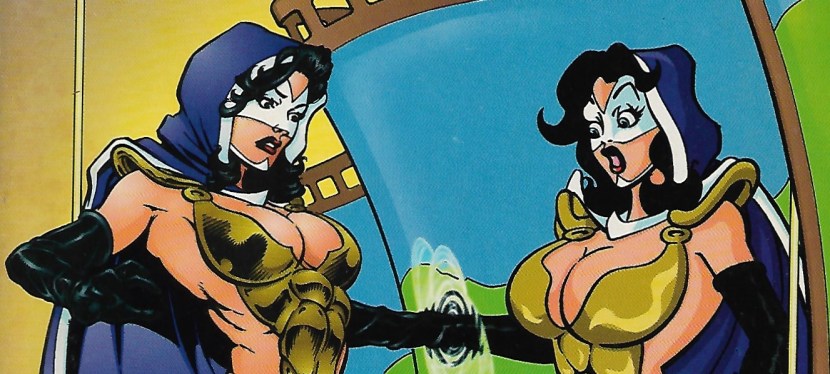
The story begins when a man named Strauss faces Mantra and Warstryke. The armed guy presses Strauss for details about some defective merchandise while Mantra mentions to him about their deal. Strauss shows defiance by defending himself with a green field to protect him. Mantra blocks the flow of air into the field, forcing Strauss to give up and lose his protective field.

After a short talk with Strauss, Mantra and Warstrike chat on top of the building. In reaction to Mantra’s handshake as a sign of thanks for helping, the armed guy tries to get sexually involved with the mystical warrior even though he knows Mantra has a male soul occupying a woman’s body. Mantra defies him and flies away.

Along the way, a demon spots Mantra flying through the air. It turns out he has been looking for her and decides to make a move in pursuit of her…

Quality

What do I think about the story by Mike W. Barr? I find it brilliantly written. As the cliffhanger ending of issue #4 got resolved early, the narrative smoothly shifts into Mantra’s other struggle – being a mother to Eden Blake’s children whom she lost quality time with due to superhero pursuits. There was also this really compelling drama between Eden and her mother (who in turn believes her daughter is failing her responsibility as a parent).

Lukasz – the male soul in Eden/Mantra’s beautiful body – is still obsessed with pursuing his search for answers but even so, he cannot simply abandon the family and household of the woman whose soul he displaced. In this particular comic book, Lukasz continued to adjust in his unexpected life as Eden.

I really like the way Mike W. Barr dramatized Lukasz dealing with family matters as well as career matters. All that led to what I would call the most unexpected superhero misadventures I’ve ever read that has something to do with the dimension of hand-drawn animation. That is something you, my readers, should read to find out. It is something very enjoyable!

In terms of visuals, this comic book showed more of the creativity of Terry Dodson. If you already enjoyed his art in the early Mantra issues, you will see something new and fresh here.

Conclusion

Mantra returns home to the family.

Undoubtedly Mantra #5 is a great comic book to read as it has an excellent mix of drama, intrigue, characterization and many bouts of great spectacle (which nicely paid-off on all the build-up). By this stage in the Mantra monthly series, Lukasz/Eden/Mantra got developed more and the stakes have been raised in relation to Eden’s meeting with her boss.

If you are seriously planning to buy an existing hard copy of Mantra #5 (1993), be aware that as of this writing, MileHighComics.com shows that the near-mint copy of the regular edition costs $8 while the near-mint copy of the newsstand edition costs $26.

Overall, Mantra #5 (1993) is highly recommended!

+++++

Thank you for reading. If you find this article engaging, please click the like button below and also please consider sharing this article to others. If you are looking for a copywriter to create content for your special project or business, check out my services and my portfolio. Feel free to contact me as well. Also please feel free to visit my Facebook page Author Carlo Carrasco and follow me at HavenorFantasy@twitter.com
A Look Back at Bloodshot #7 (1993)

Disclaimer: This is my original work with details sourced from reading the comic book and doing personal research. Anyone who wants to use this article, in part or in whole, needs to secure first my permission and agree to cite me as the source and author. Let it be known that any unauthorized use of this article will constrain the author to pursue the remedies under R.A. No. 8293, the Revised Penal Code, and/or all applicable legal actions under the laws of the Philippines.

It’s been quite some time since I last reviewed a Valiant comic book. Previously, I reviewed Bloodshot #6 (1993) which not only had the first appearance of Colin King (AKA Ninjak) but also had some of the spotlight on my native Philippines as a destination. To be specific, back in the 1990s, it was rare for the Philippines to get mentioned or visualized in American superhero comic books.

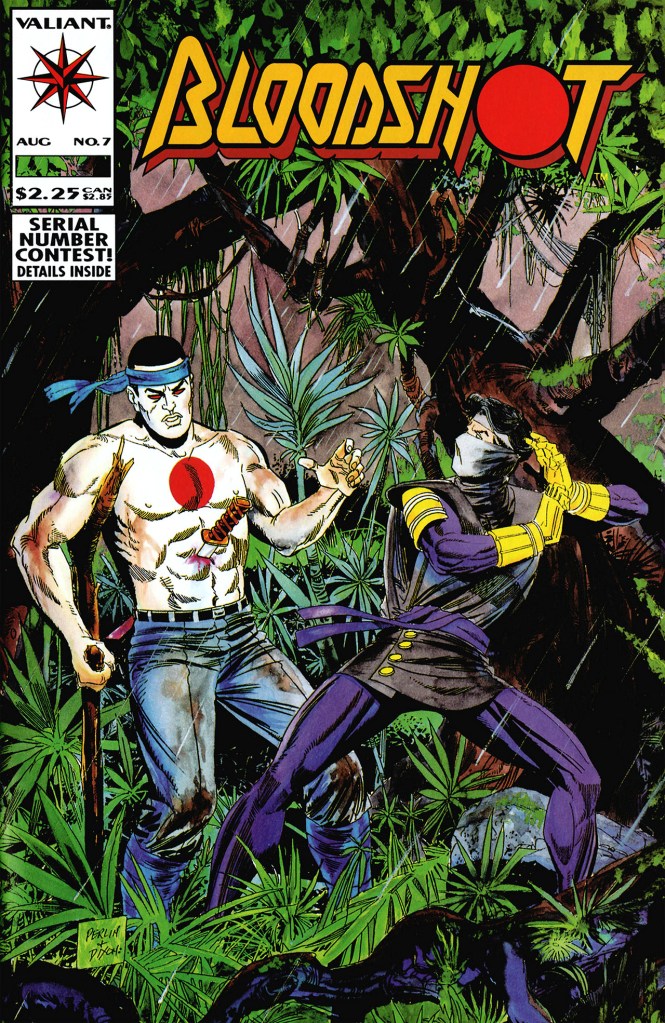
Anyway, we can return to the 1990s universe of Valiant Comics following the misadventure of Bloodshot in this look back at Bloodshot #7, published in 1993 by Valiant Comics with a story by Kevin VanHook and art by Don Perlin.

The cover.

Early story

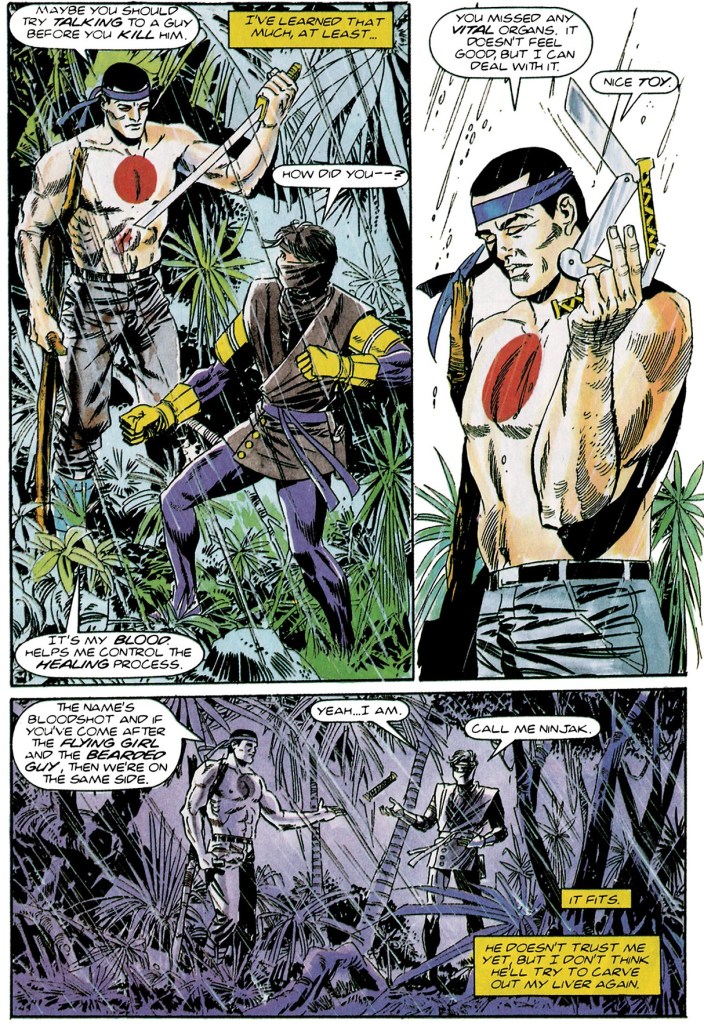
The story begins 1,500 feet in the air above the Philippines with Leigh falling down followed by Bloodshot with the airplane leaving them. After some struggle, Bloodshot manages to grab her boot which turned out helpful as Leigh had been controlling her fall by gliding on the air currents. After breaking the fall, the boot of Leigh slips off separating the them. Bloodshot falls on the jungle’s foliage while the other landed safely.

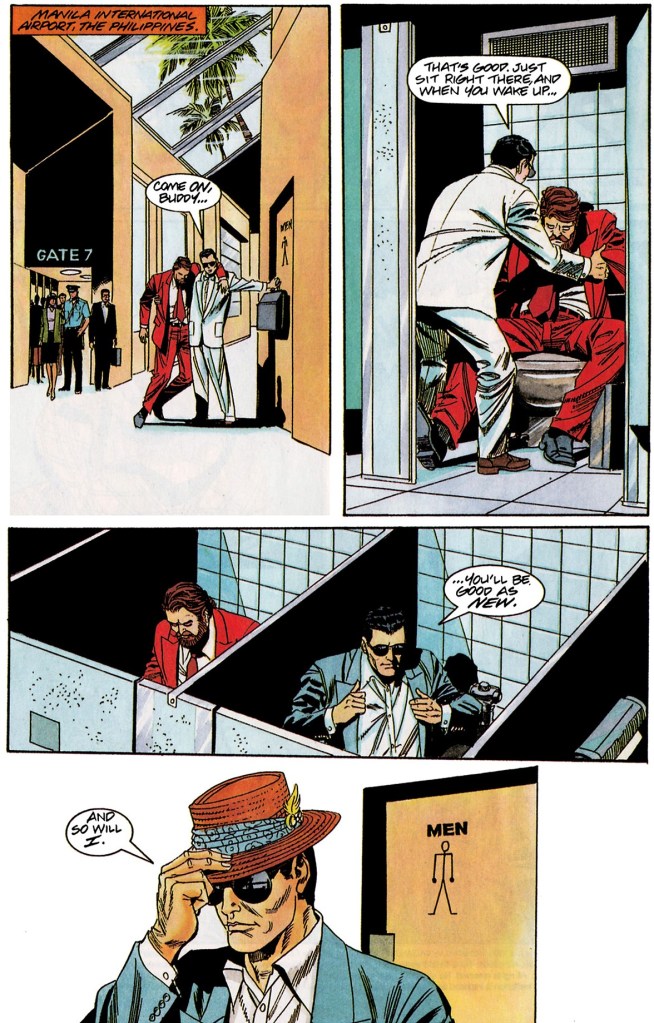
Over at the Manila International Airport, the secret assassin Marco is weak and was assisted by a certain guy and placed on one of the toilets in the restroom. After being left there alone, Marco wakes up and leaves the restroom to make a telephone call. He does not realize that the same man who assisted him is trailing him.

Back in the jungle, Bloodshot gradually adjusts himself to get moving just as his nanites are healing his fractured right leg and broken rib. With no time to lose, he decides to continue his mission even though he is still injured….

Quality

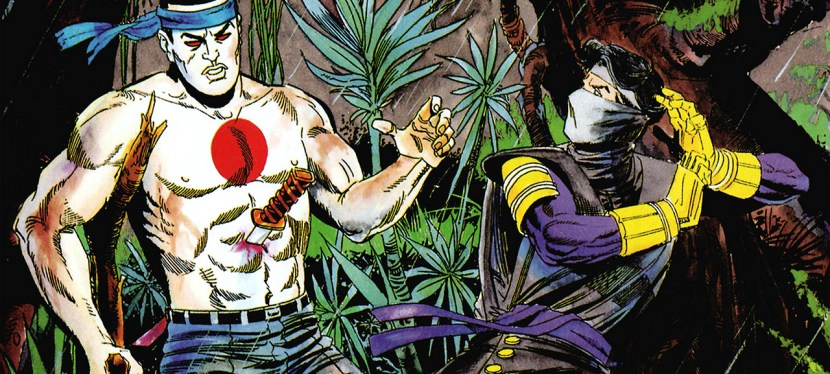
Bloodshot and Ninjak in the jungle in the Philippines.

I can say that this comic book has a stronger story and better spectacle. It is indeed a solid payoff to the build-up in issue #6. Kevin VanHook took his time in pacing the story allowing readers to follow the details behind the events while giving ample spotlight to other characters. Bloodshot is still in the center of the story only this time he’s a lot more vulnerable and less capable as an action hero. As seen in the cover of this comic book, he truly is vulnerable and therefore he is presented more as a survivor striving hard to complete his detective work no matter the costs.

This is not a straightforward action tale. There is still a good amount of intrigue and espionage that happens in the Philippines (as Valiant’s creators imagined it). It should be noted that this comic book marks the first-ever appearance of Ninjak in his costumed form (note: Ninjak appeared in Bloodshot #6 in his civilian form as Colin King) as well as the first-ever personal encounter between Ninjak and Bloodshot (which was written to be believable). Artist Don Perlin cleverly crafted the way Ninjak performs action and evasive maneuvers setting the basic standards that other artists would do later in further comic book featuring the character (who eventually got his own monthly series in 1994).

Conclusion

At the Manila International Airport…

Bloodshot #7 (1993) is a great comic book to read and it also happens to be one of the more memorable character debuts Valiant Comics ever published in the 1990s. The debut of Ninjak in his costume alone makes this one a must-have and it so happens that the story and art were both of very good quality. The gritty realism applied to the tone of the presentation makes the story believable and there never was a moment when the events felt outlandish.

Going back to Ninjak, the character went on to become one of Valiant’s most original and major superheroes of all. In 1994, the Ninjak monthly series launched big time with an issue #1 that had a chromium cover and the great Joe Quesada drew the cover and interior art. In 2015, Valiant Entertainment launched another Ninjak series.

If you are seriously planning to buy an existing hard copy of Bloodshot #7 (1993), be aware that as of this writing, MileHighComics.com shows that the near-mint copy of the comic book costs $40.

Overall, Bloodshot #7 (1993) is highly recommended.

+++++

Thank you for reading. If you find this article engaging, please click the like button below and also please consider sharing this article to others. If you are looking for a copywriter to create content for your special project or business, check out my services and my portfolio. Feel free to contact me as well. Also please feel free to visit my Facebook page Author Carlo Carrasco and follow me at HavenorFantasy@twitter.com
A Look Back at RoboCop versus The Terminator #4 (1992)

Disclaimer: This is my original work with details sourced from reading the comic book and doing personal research. Anyone who wants to use this article, in part or in whole, needs to secure first my permission and agree to cite me as the source and author. Let it be known that any unauthorized use of this article will constrain the author to pursue the remedies under R.A. No. 8293, the Revised Penal Code, and/or all applicable legal actions under the laws of the Philippines.

Hey fellow geeks and comic book collectors plus the fans of RoboCop and Terminator! This is it! I have finally reached the end of the 4-issue RoboCop versus The Terminator mini-series of comic books spearheaded by Frank Miller.

To give a recap without spoiling plot details, issue #1 was mainly a build-up issue which did not entertain on its own. In issue #2, there was a huge pay-off to the build-up and seeing RoboCop battle the Terminator was a grand spectacle! Issue #3 meanwhile saw some very daring creative twists taken that further mixed elements of the respective Terminator and RoboCop universes together which ultimately served as a build-up for what could be a potential epic in the comic book featured in this review.

Is the build-up worth it? Did the issue #3 twists pave the way for something memorable? We will all find out in this look back at RoboCop versus The Terminator 4, published in 1992 by Dark Horse Comics with a story written by Frank Miller and drawn by Walt Simonson.

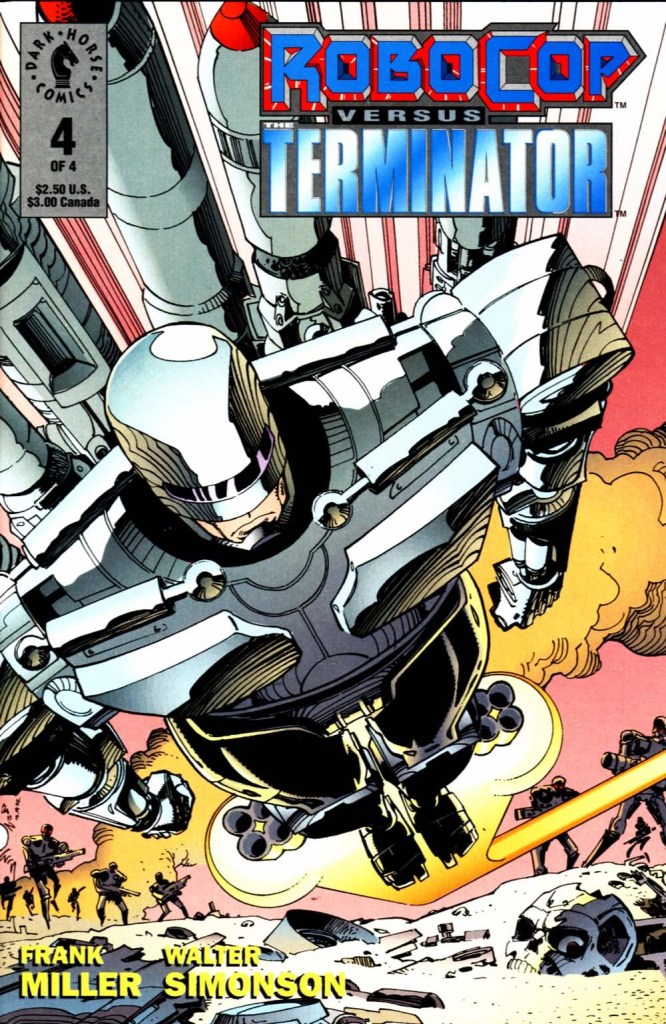
The cover.

Early story

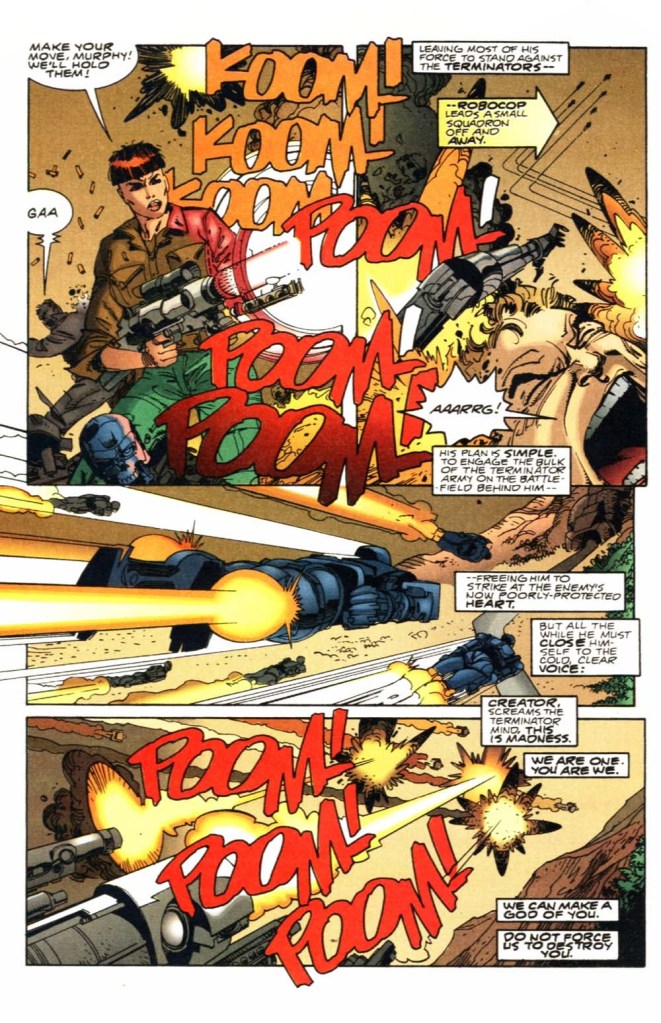
The story begins again in the dark future when the world is ravage by the war between man and machines. As the human resistance falters, the machines of Skynet march further toward their prey. Suddenly, RoboCop flies in and hits them with a very powerful rocket.

Inside a cybernetic hideout, a familiar short-haired lady gets shaken by the blast. As a result, she will not go back in time and will no longer try to kill RoboCop. On the monitors, she watches the armed cyborg cop destroy Skynet’s troops and saved the human resistance from certain death.

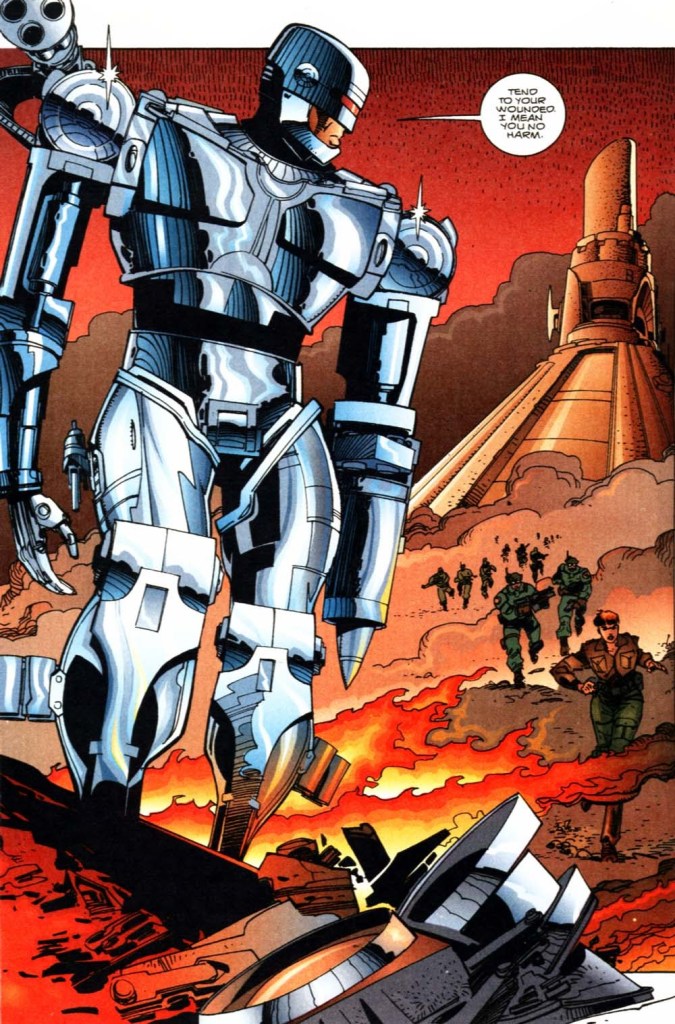
Shortly after, the human warriors take a much-needed rest. Feeling restless, the lady warrior approaches RoboCop privately and states that she figured he is not a Terminator. RoboCop, whose helmet was taken off showing his human face as officer Murphy, pets a dog as the lady approaches them.

It turns out the lady’s name is Flo (short for Florence) and she starts conversing with him peacefully. She then starts trusting RoboCop, even resting by his side. RoboCop, however, knows what has been going on that the humans don’t and he knows that Skynet and its army of Terminators acknowledge him as their creator. How his decision to help the human resistance in the war against the machines will turn out remains to be seen.

Quality

Another twist, another scenario for the war between man and machines.

When it comes to its story, Frank Miller really exerted efforts to give this comic book’s final conflict an epic presentation which is no surprise since the stakes were already raised as a result of the big twists in issue #3. Epic concept aside, the concept of RoboCop helping the humans fight Skynet is indeed awesome and daring to see. There is one additional idea Miller came up with which raise the stakes even further in the war, and what that idea was about is something you readers should find out on your own by getting a copy of this comic book.

If there are any weaknesses here, it’s the presentation of the concept of time travel and time distortion which, even in this concluding part of the mini-series, remains used to justify scenario twists. As a result, the ending of this comic book made the whole conflict look and feel like a twisted, wild dream. Another thing to point out was that Skynet, even in its cybernetic form, was portrayed with human-like patterns and even tried to reason with RoboCop. This one weakened the Terminator concept a bit. Still, the series ended with enough satisfaction for me.

Conclusion

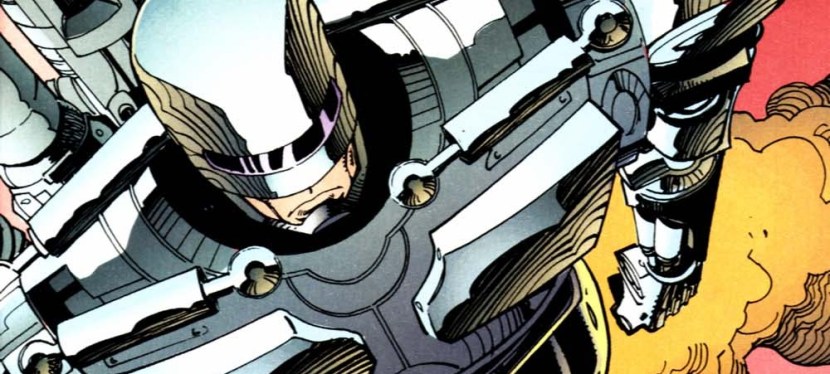
RoboCop and the human resistance.

RoboCop versus The Terminator #4 is worthy conclusion to its mini-series. On its own, it had an epic concept and the creators really did what they could to raise the stakes of the conflict as well as raising the quality of their presentation. When it comes to combining the creative elements of the Terminator and RoboCop franchises, Miller did a solid job. It’s just that time travel and time distortion were used to create new scenarios once again in this particular comic book which I found unnecessary. On the bright side, this comic book is loaded with lots of action scenes and the quality of the dialogue was improved.

If you are seriously planning to buy an existing hard copy of RoboCop versus The Terminator #4 (1992), be aware that as of this writing, MileHighComics.com shows that the near-mint copy of this comic book costs $10.

Overall, RoboCop versus The Terminator #4 (1992) is recommended.

+++++

Thank you for reading. If you find this article engaging, please click the like button below and also please consider sharing this article to others. If you are looking for a copywriter to create content for your special project or business, check out my services and my portfolio. Feel free to contact me as well. Also please feel free to visit my Facebook page Author Carlo Carrasco and follow me at HavenorFantasy@twitter.com
A Look Back at Giant Size Freex #1 (1994)

Disclaimer: This is my original work with details sourced from reading the comic book and doing personal research. Anyone who wants to use this article, in part or in whole, needs to secure first my permission and agree to cite me as the source and author. Let it be known that any unauthorized use of this article will constrain the author to pursue the remedies under R.A. No. 8293, the Revised Penal Code, and/or all applicable legal actions under the laws of the Philippines.

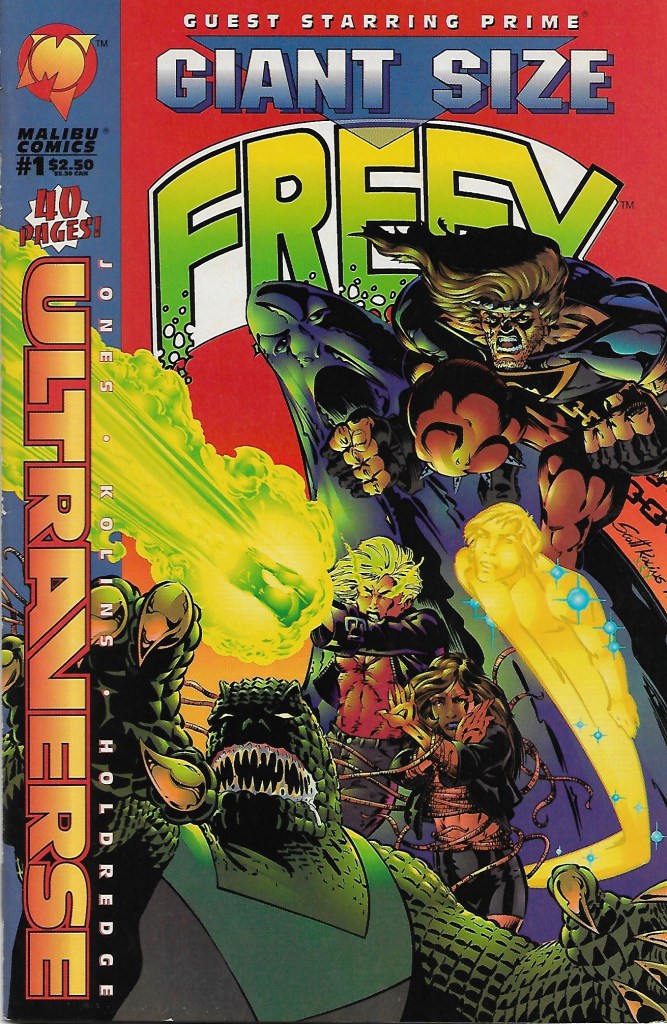
Hey Ultraverse fans! Are you looking for another crossover between one team and one of the major heroes? Try this: Freex mixing up with Prime in his radical 1990s form. By this time in the publishing history of Malibu Comics, Prime was destined to be a major part of the superhero team UltraForce while Freex went through some dramatic changes along the way. As for making the Freex-Prime crossover materialize, Malibu Comics went on to publish a standalone comic book with a $2.50 cover price.

With that being said, here’s a look back at Giant Size Freex #1, published in 1994 by Malibu Comics with a story by Gerard Jones and drawn by Scott Kolins.

The cover.

Early story

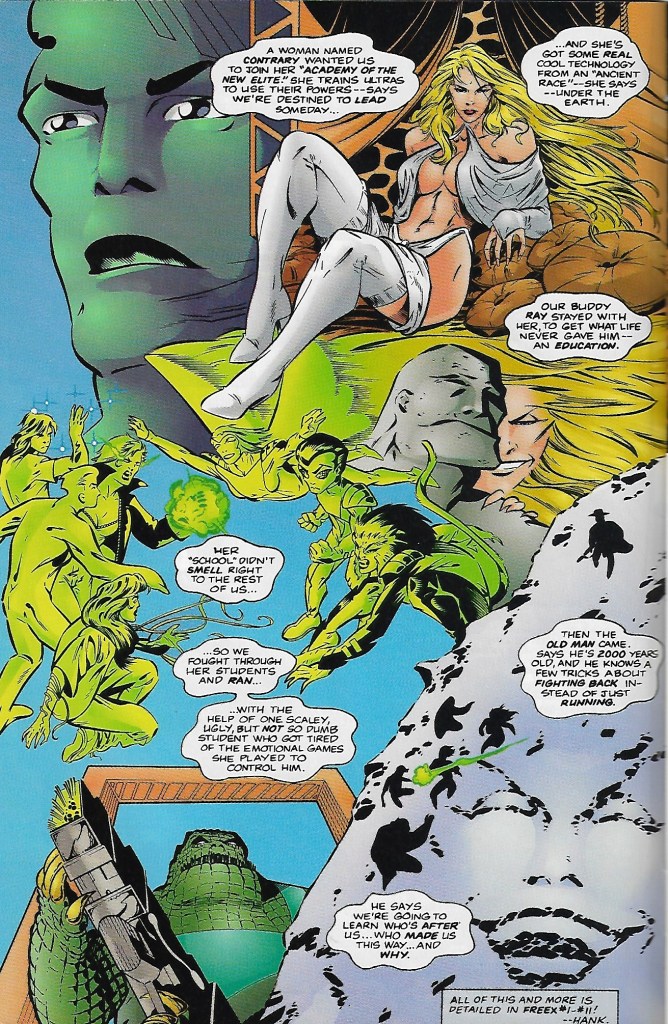
The story begins Prime already in conflict with Lewis/Anything, Valerie/Pressure, Michael/Plug, Angela/Sweetface, Cayman and their recent companion referred to as the Old Man. As the Old Man restrains Valerie from using her steam-sourced power on the muscular hero (who is teenager Kevin Green inside), Prime gets hit by Cayman while being restrained by Sweetface. Prime strikes back at Cayman and grabs Sweetface by her tentacles putting the pressure again on Freex.

Eventually Prime gets electrocuted and things slowed down. This paves the way for Prime and members of Freex to talk reasonably. Lewis explains that sixteen years prior, several infants were injected with Wetware by a nurse referred to as Wetware Mary. This resulted them having different powers or abilities but this also caused them some pain as the said powers were not only hard to control but also deformed them. While they have powers, they became freaks of local society and had no choice but to keep moving to different locations and engage in stealing food and other items.

And then Contrary and her academy of the new elite gets mentioned…

Quality

Contrary and the past recalled.

In terms of storytelling, this comic book succeeds in two things: telling another creative crossover between one major Ultraverse hero and one major team with a memorable adventure together, and establishing literally the building blocks for UltraForce (note: Gerard Jones also wrote the said superhero team title).

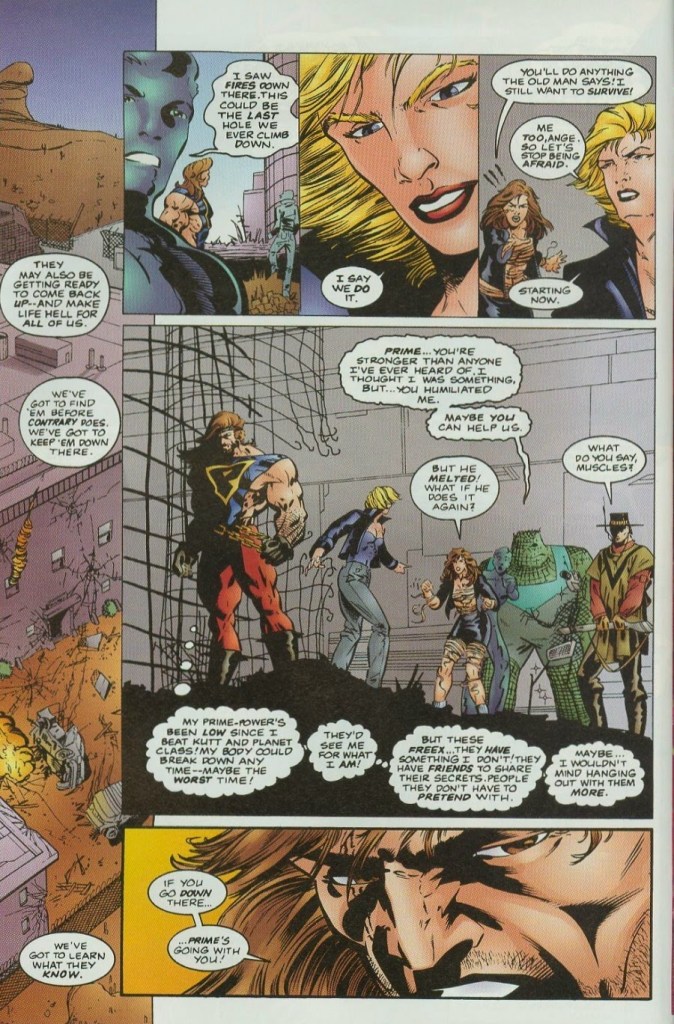
What I enjoyed most here is that the very strong writing clearly defined the characters deeply. Here is Prime (teenager Kevin Green) relating to the plight of Freex (composed of teens and young adults) but decides to keep on pretending he is an adult capable of helping those who are struggling. There is also the Old Man who has lived long enough to see ultras exist through the centuries and by being with Freex, he is giving them something they terribly lacked: guidance and direction. In some ways, the nomadic Freex give Old Man renewed purpose while Prime sees new opportunities to do good by helping Freex. It’s also intriguing to see the overly muscular hero witness the team being hunted by armed groups.

I should also mention that, in addition to the literary feature, there is also a short feature about Contrary and how Pixx (the lone teenage girl of UltraForce) first got involved with her. It was indeed a short yet engaging read.

Conclusion

Prime and Freex plus the Old Man together.

Giant Size Freex #1 is a pretty good comic book that will appeal to fans of Prime, Freex and UltraForce. Very well written and nicely presented were the stories. There was nice balance between exposition and spectacle.

If you are seriously planning to buy an existing hard copy of Giant Size Freex #1 (1994), be aware that as of this writing, MileHighComics.com shows that the near-mint copy of the regular edition costs $8 while the near-mint copy of the newsstand edition costs $26.

Overall, Giant Size Freex #1 is recommended.

+++++

Thank you for reading. If you find this article engaging, please click the like button below and also please consider sharing this article to others. If you are looking for a copywriter to create content for your special project or business, check out my services and my portfolio. Feel free to contact me as well. Also please feel free to visit my Facebook page Author Carlo Carrasco and follow me at HavenorFantasy@twitter.com
A Look Back at X-Men Adventures #3 (1993)

Disclaimer: This is my original work with details sourced from reading the comic book and doing personal research. Anyone who wants to use this article, in part or in whole, needs to secure first my permission and agree to cite me as the source and author. Let it be known that any unauthorized use of this article will constrain the author to pursue the remedies under R.A. No. 8293, the Revised Penal Code, and/or all applicable legal actions under the laws of the Philippines.

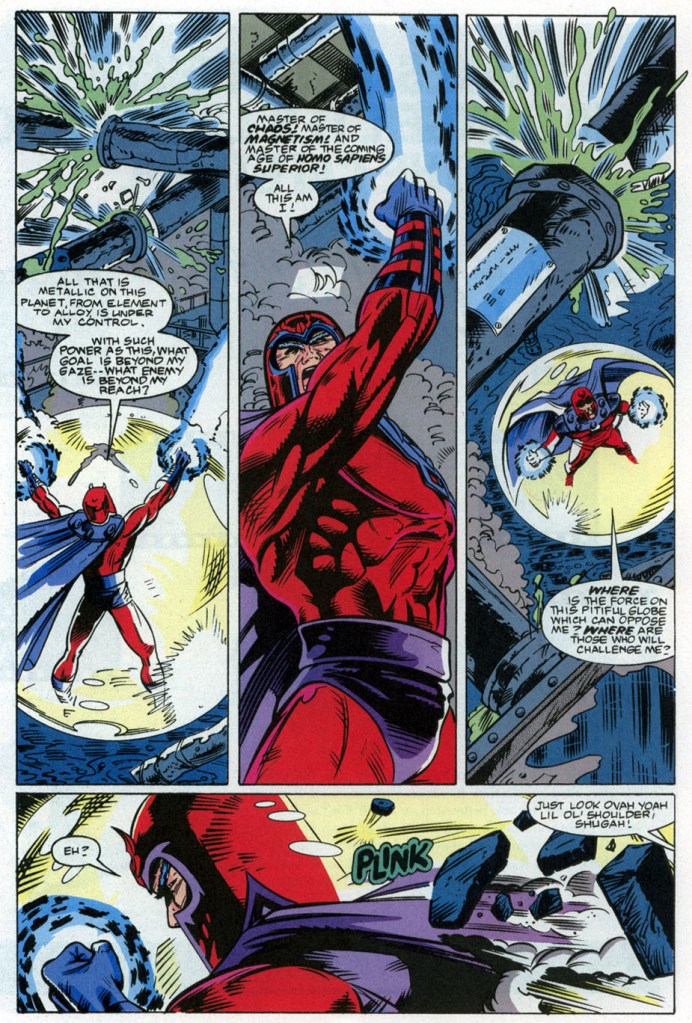
Who is the most definitive X-Men villain ever? That is none other than Magneto! Co-created by Stan Lee and Jack Kirby, Magneto made his literary debut alongside Marvel’s heroic mutants in The X-Men #1 way back in 1963. Magneto is capable of generating and controlling magnetic fields which make him dangerous since he has the power to manipulate metal and even use them as weapons against others, plus he can even cause destruction to buildings by moving the metal in them to bring them down.

What even makes Magneto more dangerous is his very strong belief that his fellow mutants are genetically superior over humans and he does not believe in the concept of mutants and humans co-existing. Character-wise, Magneto is the complete opposite of Charles Xavier/Professor X of the X-Men.

When it comes to pop culture influence, GamesRadar+ declared Magneto as the #1 best X-Men villain of all time. Even more intriguing was the super villain topping IGN’s Top 100 Comic Book Villains List. Beyond comic books, Magneto also appeared in the X-Men arcade game of 1992 made by Konami. On November 27, 1992, Magneto made his debut in the Enter Magneto episode of the popular X-Men animated series on TV. The said episode was, unsurprisingly, adapted into comic book form in issue #3 of the X-Men Adventures monthly comic book series.

How was Magneto’s debut in the said monthly series? We can find out in this look back at X-Men Adventures #3, published in 1993 by Malibu Comics with a story written by Ralph Macchio and drawn by Andrew Wildman.  

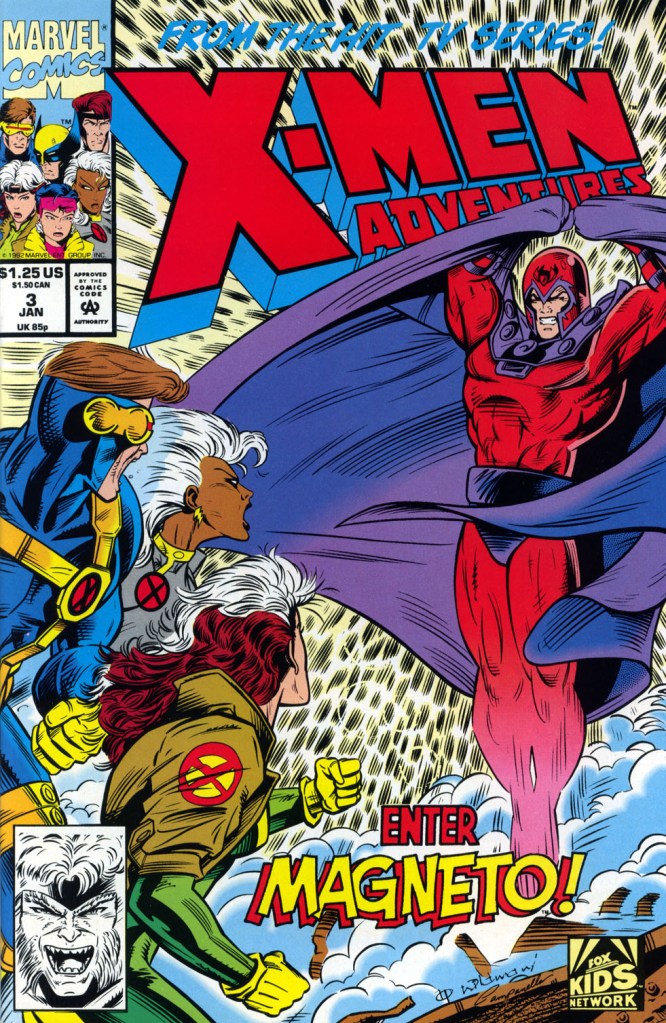
The cover.

Early story

The story begins in outer space where Asteroid M is orbiting above planet Earth completely undetected. As a meteor is on-course to collide with Asteroid M, the operator of the asteroid activates its guns and hits it. While Asteroid M got spared, a smaller meteor found itself falling into Earth’s atmosphere. As it burns through the atmosphere, Charles Xavier spots it from inside his mansion.

Xavier turns his attention to Jean Grey. As they travel together, the doors open and Sabretooth enters landing on the floor. The two have yet to know him.

Over at a prison, the captured Hank McCoy/Beast thinks deeply inside his prison cell only to suddenly witness one of the walls get smashed by some powerful force. Magneto arrives and tells him he came for him…

Quality

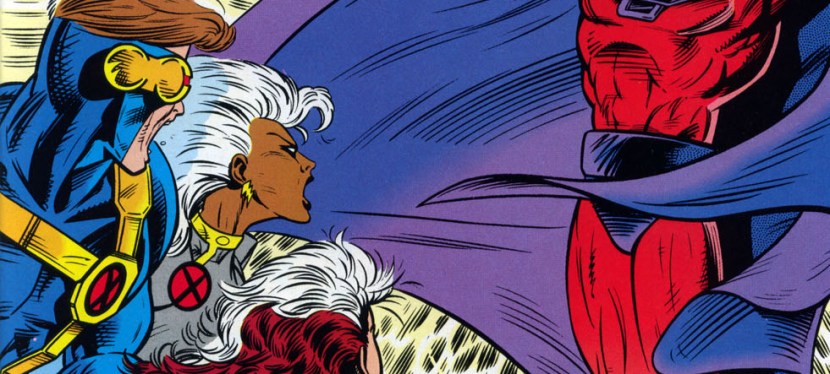
The power of Magneto.

The writing, with credit to the screenwriters behind the animated episode, is pretty solid and the essence of the said episode was very well adapted into this comic book. As this is Magneto’s debut in the X-Men Adventure series reflecting his debut in animated series, his character is portrayed very accurately and it only made perfect sense for him to approach Beast first to try to convince him join his pro-mutant movement. More on the writing, Beast’s restraint brought out more of Magneto’s hardcore beliefs and his complete opposition towards humans.

Of course, the creators did not let down their efforts to portray the struggle mutants have under the laws of human society which is strongly reflected in Beast’s court hearing with Wolverine and Cyclops (in civilian forms) observing powerlessly. The court room drama and arguments were intense.

I should also state that there really was a nice build-up leading to the first battle (first half, actually) between the X-Men and Magneto. Unlike the battles in issues #1 and #2, the conflict here showed the X-Men more in danger which is only fitting considering how great the villain is.

Conclusion

Magneto and Beast.

X-Men Adventures #3 is a strong adaptation of the Enter Magneto episode. There is no doubt about that and most notably, the comic book creators did another good job making the TV animated episode’s concept engaging and fun to read. This comic book should be part of the collection of anyone who is passionate about Magneto.

If you are seriously planning to buy an existing hard copy of X-Men Adventures #3 (1993), be aware that as of this writing, MileHighComics.com shows that the near-mint copy of the regular edition costs $8 while the near-mint copy of the newsstand edition costs $17.

Overall, X-Men Adventures #3 (1993) is highly recommended!

+++++

Thank you for reading. If you find this article engaging, please click the like button below and also please consider sharing this article to others. If you are looking for a copywriter to create content for your special project or business, check out my services and my portfolio. Feel free to contact me as well. Also please feel free to visit my Facebook page Author Carlo Carrasco and follow me at HavenorFantasy@twitter.com

A Look Back at Batman versus Predator II #3 (1995)

Disclaimer: This is my original work with details sourced from reading the comic book and doing personal research. Anyone who wants to use this article, in part or in whole, needs to secure first my permission and agree to cite me as the source and author. Let it be known that any unauthorized use of this article will constrain the author to pursue the remedies under R.A. No. 8293, the Revised Penal Code, and/or all applicable legal actions under the laws of the Philippines.

I am currently enjoying the Batman versus Predator II mini-series of the mid-1990s which was a joint effort between DC Comics and Dark Horse Comics. The first issue was great and nicely built up the energy for the first encounter between Batman and the Predator in issue #2. Along the way, I do enjoy the adulterated tone that came with the presentation. This made each issue look and feel like an R-rated cinematic segment.

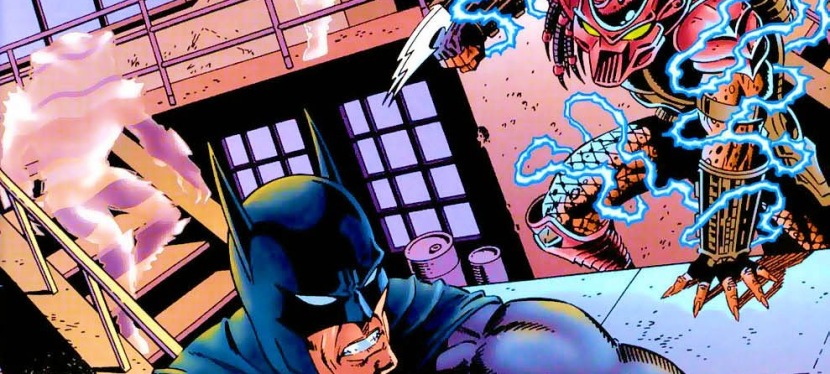
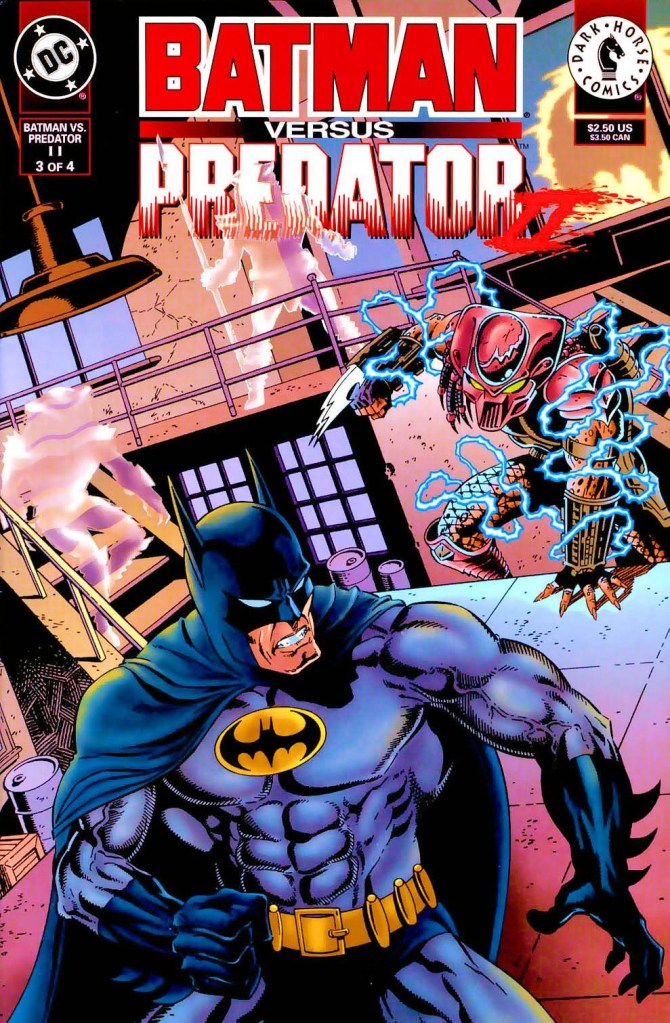
Will the strong quality of this crossover continue in the third issue? Find out with me in this look back at Batman versus Predator II #3, published in 1995 by DC Comics and Dark Horse Comics with a story written by Doug Moench and drawn by Paul Gulacy.

The cover.

Early story

The story begins with Batman emerging from the sewer. He finds himself alone in the middle of a city street and senses danger is around him. Suddenly someone from one of the nearby buildings fires at Batman who dodges and takes cover by a car. He grabs a tool and throws it at the window which hits the rifle. And then, on the street, a man throws a grenade at the caped crusader who deflects it. The grenade enters a nearby establishment and explodes. Batman kicks the antagonist and then encounters a speeding vehicle heading towards him.

The detective fires his weapon which causes the car’s windshield to get smashed. He dodges the car and sees it crash. Suddenly the floor beneath him opens which compels him to use his grapnel to avoid falling down to spikes below.

Meanwhile at another location, the Predator dissolves the decapitated head of a man (killed in issue #2) with hot liquid and keeps the skull for his collection of trophies.

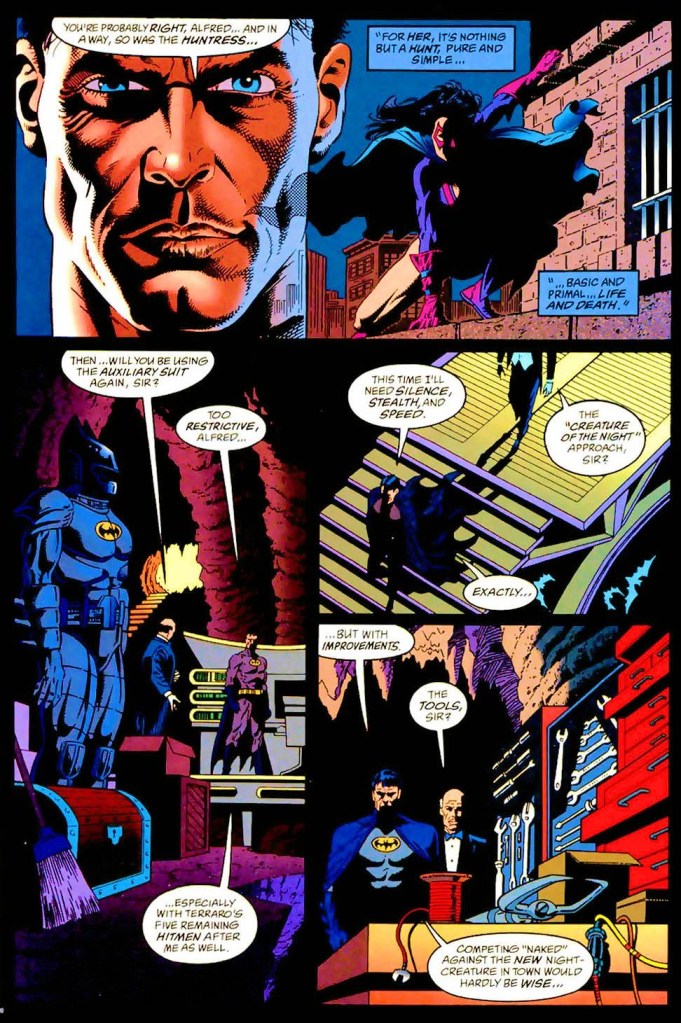
Back at the Bat Cave, Batman and Alfred analyze what happened recently. Alfred states that the Predator killed two of the seven assassins hired by Terraro to kill Batman. The great detective wonders why…

Quality

The Huntress and Batman.

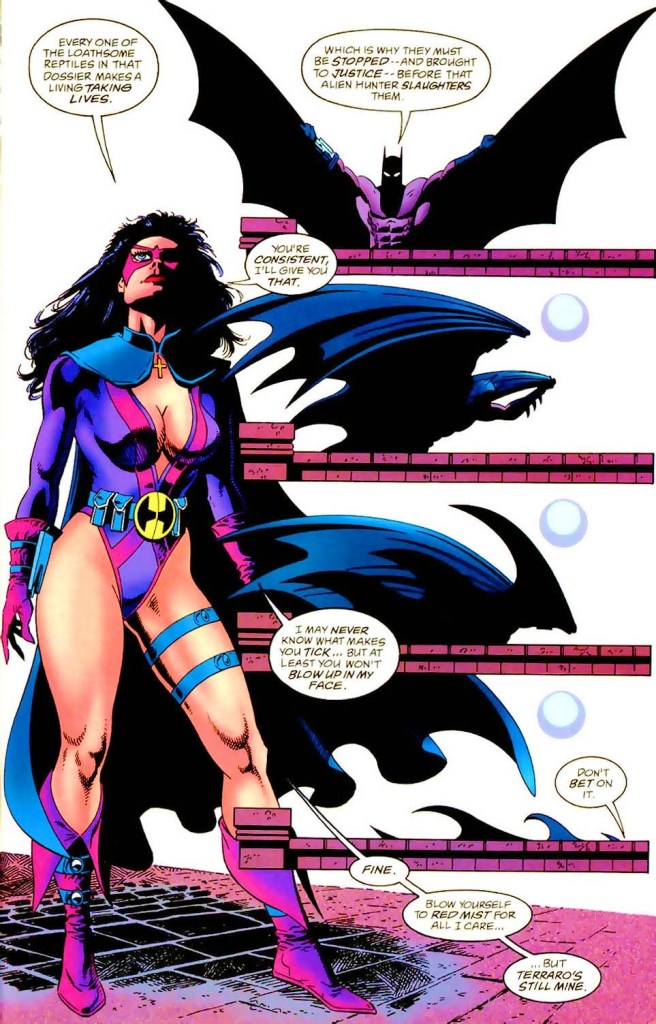
Let me start with the storytelling. The writing by Doug Moench is solid and, more importantly, there is a nice payoff here in relation what was gradually built up in the first two issues – Terraro’s assassins and operations getting more lively within the plot. This alone adds some nice variety into the ongoing Batman-Predator rivalry, and symbolically the Huntress (who is after Terraro) is involved with the mafia plot and the said rivalry between Gotham’s detective and the hunter from space.

More on Batman and the Huntress, I like the way Moench wrote these two heroes as being divided even though they both face threats from the crime gang and from the Predator. Both characters are vigilantes but Batman has justice in mind while the Huntress is focused on hunting the powerful crime boss. Adding more depth to the story is the subplot about Commissioner Gordon being helpless and recovering in the hospital which complicates matters for the Gotham City police department.

Another thing that makes this issue more unique is the in-depth presentation of Batman doing detective work in the Bat Cave with Alfred providing insight. This alone makes this issue an improvement over issue #2.

When it comes to the visuals, artist Paul Gulacy continues to provide really nice artwork backed with strong support by the colorists. Gulacy took his time pacing the story by following the script closely and made key action scenes look dynamic visually when needed.

Conclusion

Remember the armor Batman wore in the previous crossover story against the Predator?

Considering all the good stuff I enjoyed in it, Batman versus Predator II #3 is a great read. It has a better balance on plotting, detective work, spectacle and intrigue. In fact, this comic book has a much more powerful ending than issues #1 and #2, and the ironic thing is that this only leads to the 4th and final issue which I’ll review soon.

If you are seriously planning to buy an existing hard copy of Batman versus Predator II #3 (1995), be aware that as of this writing, MileHighComics.com shows that the near-mint copy of the comic book costs $40.

Overall, Batman versus Predator II #3 (1995) is highly recommended!

+++++

Thank you for reading. If you find this article engaging, please click the like button below and also please consider sharing this article to others. If you are looking for a copywriter to create content for your special project or business, check out my services and my portfolio. Feel free to contact me as well. Also please feel free to visit my Facebook page Author Carlo Carrasco and follow me at HavenorFantasy@twitter.com
A Look Back at Mantra #12 (1994)

Disclaimer: This is my original work with details sourced from reading the comic book and doing personal research. Anyone who wants to use this article, in part or in whole, needs to secure first my permission and agree to cite me as the source and author. Let it be known that any unauthorized use of this article will constrain the author to pursue the remedies under R.A. No. 8293, the Revised Penal Code, and/or all applicable legal actions under the laws of the Philippines.

Hey everyone! Welcome back to my continuing effort on reviewing Ultraverse comic books of Malibu Comics from the 1990s. This time we will continue on the crossover between Mantra and The Strangers that started in The Strangers #13.

What I enjoyed most in The Strangers #13 is the interaction between Mantra and members of the superhero team as well as how Boneyard (mortal enemy of Mantra’s) impacts them. It comes to show that careful research of the characters and planning were done to ensure not only a very good story but one that makes mixing Mantra and the Strangers together memorable.

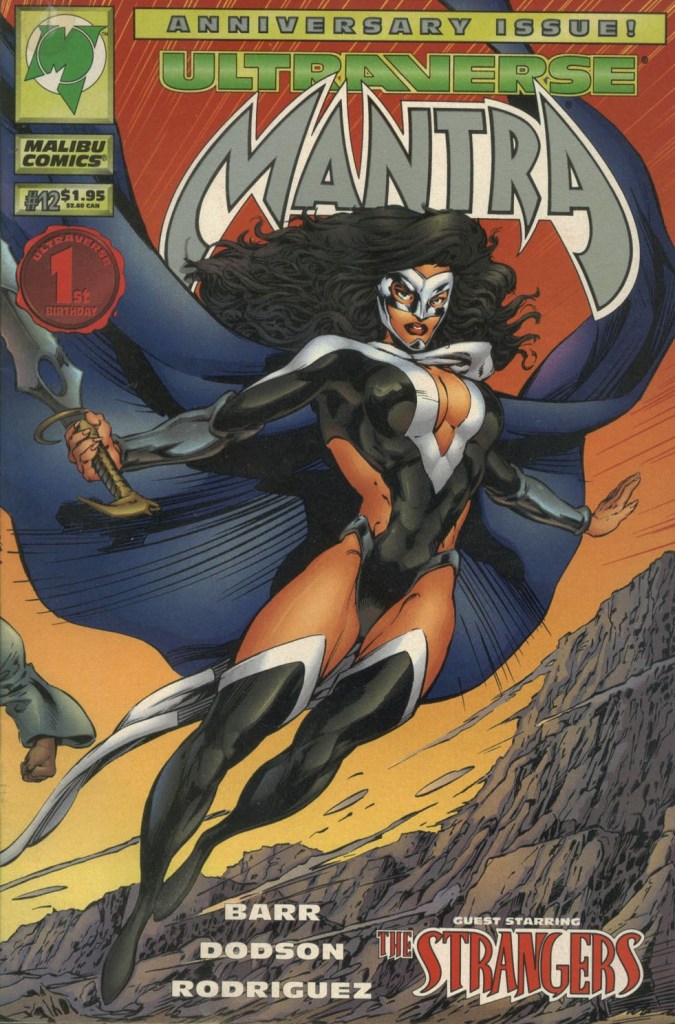
Will the high quality of story, art and crossing over continue? We can find out in the 2nd chapter of the Mantra-Strangers crossover in Mantra #12, published in 1994 by Malibu Comics with a story written by Mike W. Barr and illustrated by Terry Dodson.

The cover.

Early story

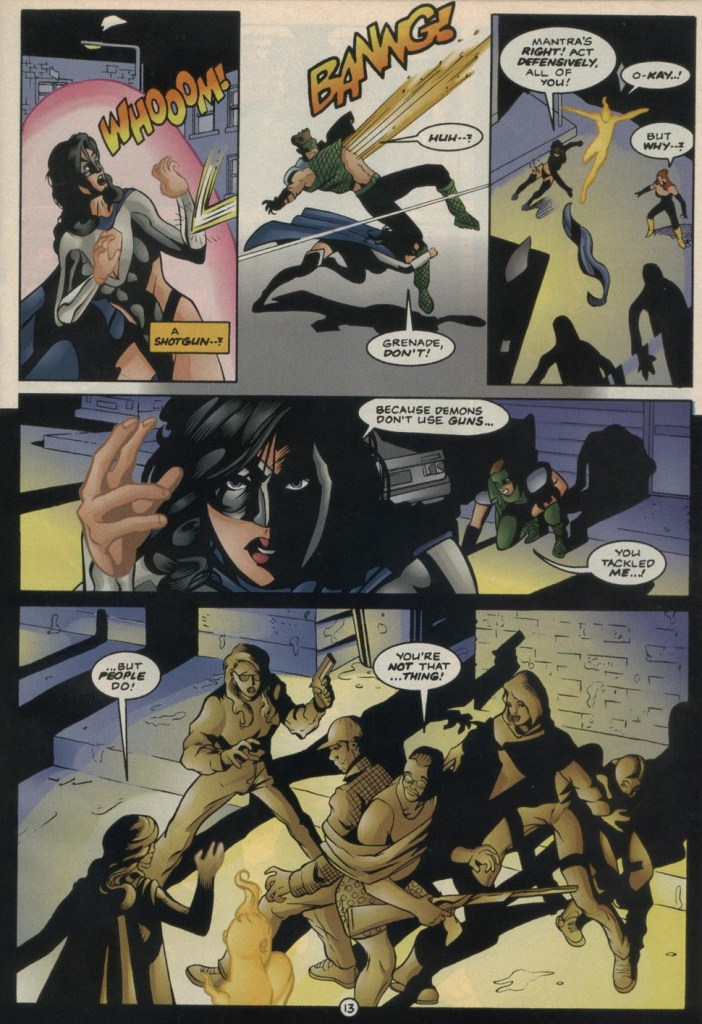
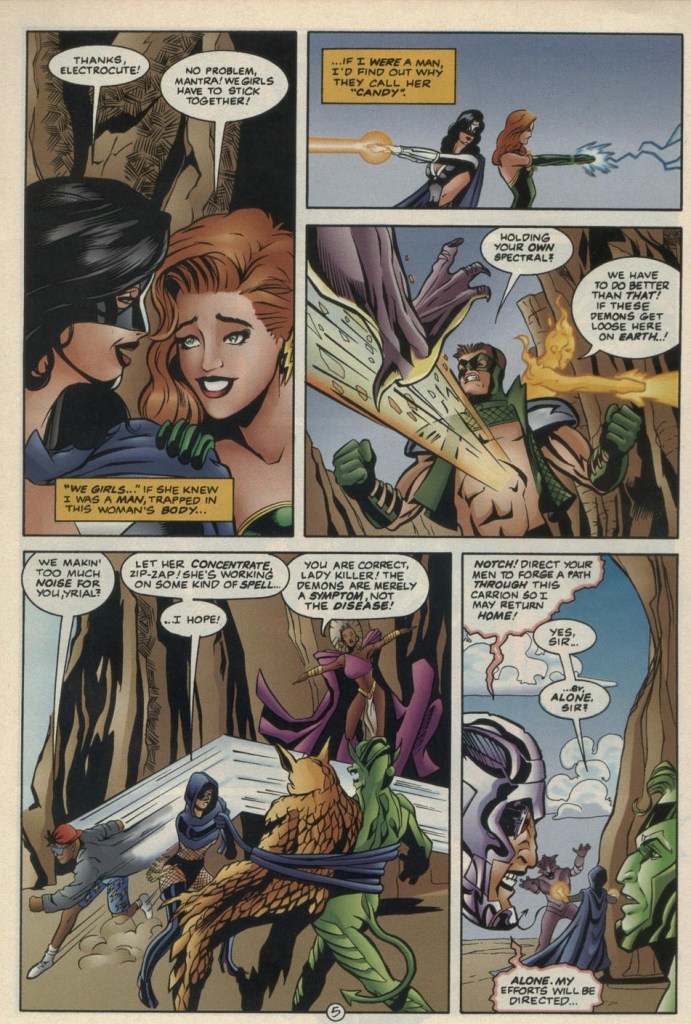
The story begins with Mantra and the Strangers facing Boneyard, his companions and demons. Boneyard has Atom Bob held captive for his magic use. Determined to kill Boneyard, Mantra draws first blood by blasting one of the demons. Due to having weakened powers, Mantra struggles in battle until Electrocute helps taking the other demons off.

As the battle goes on, Boneyard (aided with Notch’s power) makes his move towards Mantra and touches her body with his….

Quality

Action in the city.

The script written by Mike W. Barr (in coordination with Steve Englehart of The Strangers) is pretty solid in the sense that it took the interactions between Mantra and the Strangers a few levels deeper which paved the way for some character revelations and further development of varied personalities. To say the least, this one is pretty wordy and there was clear effort to define the characters even as the struggle went on. There were also common things between Boneyard and Yrial that was nicely explored when it comes to their respective abilities.

This comic book daringly touched on gender issues, particularly with the ever unholy topic of homosexuality (note: read 1 Corinthians 6: 9-10 in the Holy Bible) and even rape. There was this lesbian kiss scene between Electrocute and Mantra. Also it is made clear that even though Boneyard knows Mantra really is male warrior Lukasz occupying a female body, the said villain still wants to mate with the protagonist.

On the visuals, I found this one really looking odd even though it was credited to Terry Dodson. His art here really looked cartoony, so much so it’s almost as if someone else drew it. Try comparing Dodson’s art here with what he did in issue #1 and you will see what I mean.

Conclusion

At the coast.

While it is well written, I should say that the crossover between the protagonist and the featured superhero team could have ended better. Compared to the conclusions of the Prototype-Strangers and Hardcase-Strangers crossovers, Mantra #12 ended up lacking punch. As an anniversary issue, it is serviceable.

If you are seriously planning to buy an existing hard copy of Mantra #12 (1994), be aware that as of this writing, MileHighComics.com shows that the near-mint copy costs $8.

Overall, Mantra #12 (1994) is recommended.

+++++

Thank you for reading. If you find this article engaging, please click the like button below and also please consider sharing this article to others. If you are looking for a copywriter to create content for your special project or business, check out my services and my portfolio. Feel free to contact me as well. Also please feel free to visit my Facebook page Author Carlo Carrasco and follow me at HavenorFantasy@twitter.com
A Look Back at Mantra #2 (1993)

Disclaimer: This is my original work with details sourced from reading the comic book and doing personal research. Anyone who wants to use this article, in part or in whole, needs to secure first my permission and agree to cite me as the source and author. Let it be known that any unauthorized use of this article will constrain the author to pursue the remedies under R.A. No. 8293, the Revised Penal Code, and/or all applicable legal actions under the laws of the Philippines.

It’s been a long time since I reviewed the first issue of Mantra. For the newcomers reading this, Mantra is one of the major protagonists of the Ultraverse and as the series progressed, several stories containing elements of fantasy and even science fiction got published. With the way Mike W. Barr wrote the stories, the Mantra series really had its very own flavor and style among all Ultraverse comic books. What also made the character Mantra unique was that she was established with the use of the unholy element of reincarnation.

Before Mantra came to be, there was a male eternal warrior called Lukasz who was a part of a group that fought a rival group of warriors through the ages. Their leader Archimage used magic to ensure that whenever Lukasz or any of his teammates die, he would get reincarnated (his soul enters a new body belonging to an already living person whose soul gets displaced) and continue the fight. Then something happened in issue #1 which led to Lukasz occupying the body of a pretty woman named Eden.

To find out more, join me in this look back at Mantra #1, published in 1993 by Malibu Comics with a story written by Mike W. Barr and drawn by Terry Dodson.

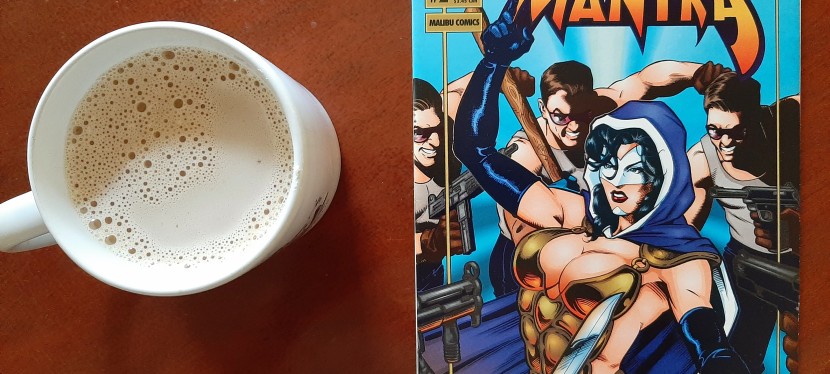
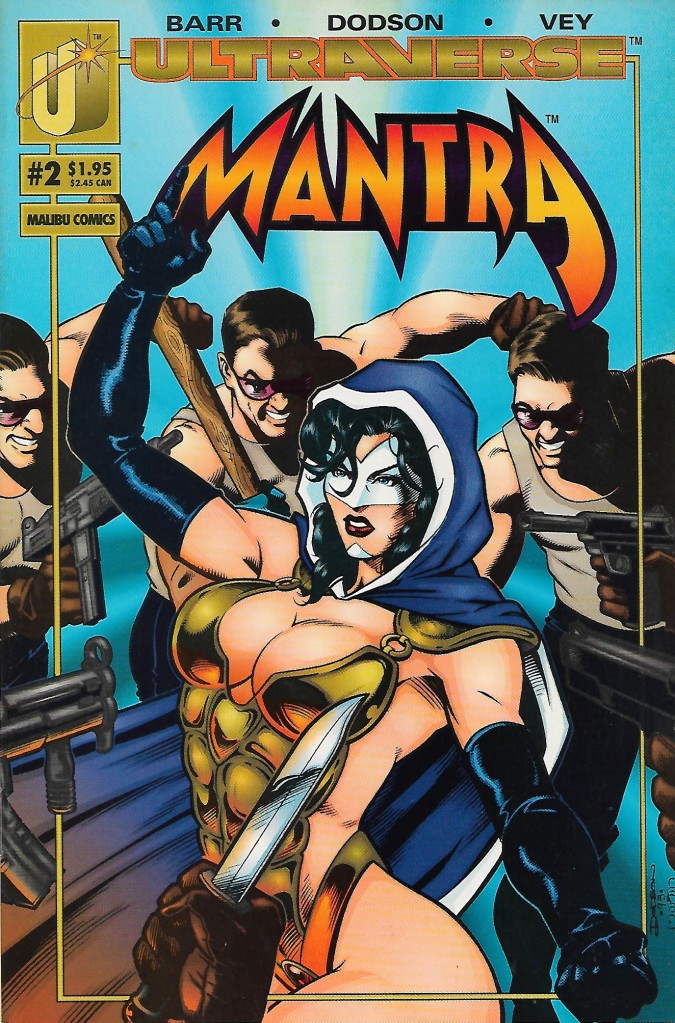
The cover.

Early story

The story begins at the home of Eden Blake in the evening. An armed man named Warstrike knows that Lukasz is occupying Eden’s body. Lukasz/Eden/Mantra starts to resist him but notices that Eden’s son and daughter are both present and seeing them. Quickly and cleverly, Mantra tells the children to get back to bed and hope they did not notice something wrong.

Filled with emotions, Mantra asked Warstrike not to kill her. As it turns out, Warstrike did not come to take her life and reveals that he had been used by Notch (a rival warrior Lukasz often fought with) as a tool to kill him (Lukasz) the last time he was in a male body. Warstrike tells her he’s going to help her.

After the talk and another attempt by Warstrike to charm her, Mantra slams the door and goes to bed. She sleeps to prepare herself for the next day…

Quality

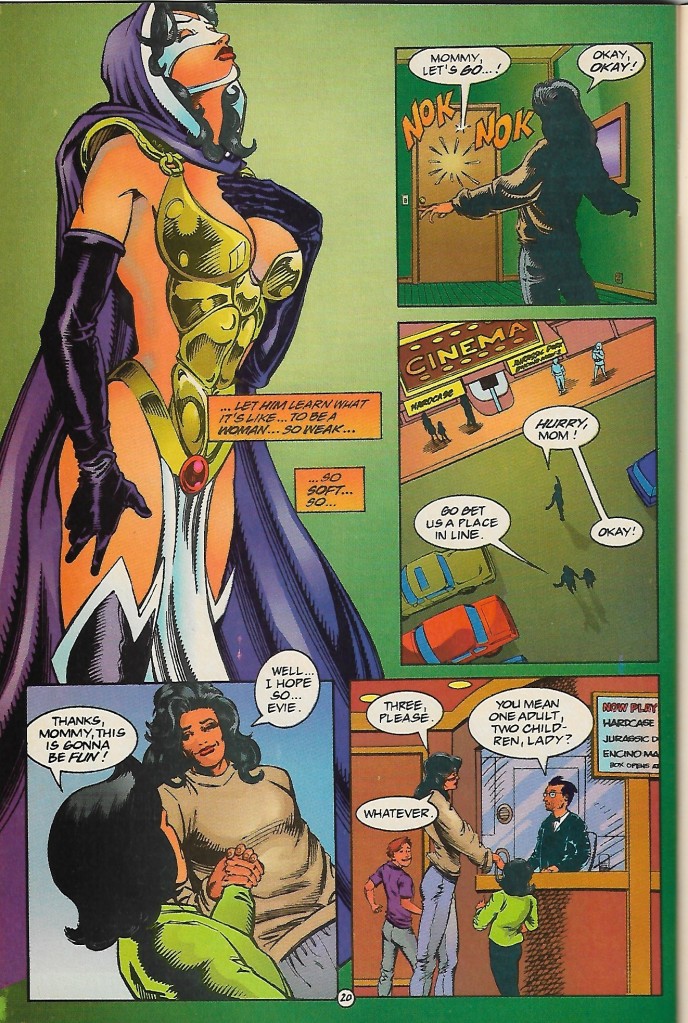
As Eden, Lukasz inherits the responsibility of taking care of her son and daughter.

I’ll star with the most obvious thing about this comic book…the writing done by Mike W. Barr is very strong and has a nice balance between plotting, spectacle and characterization all throughout. For his part, Terry Dodson nicely translated the writing into engaging visuals.

For the most part, this comic book is very character driven which is a nice pay-off considering the plot build-up in issue #1. We get to see Lukasz struggling more not only because he displaced Eden’s soul (again, reincarnation is unholy) as he occupied her body, but because he is living Eden’s life which involves being the single mother of two children, going to work at the office, wearing women’s clothes and shoes, and dealing with a certain someone from Eden’s past. All of these add to the tremendous challenge of Lukasz who already has his own mission to fulfill.

Conclusion

Living Eden’s domestic life alone is a big challenge already for Lukasz who has always been male.

Mantra #2 is a very strong read from start to finish. As it develops Mantra even further, it also adds to the build-up of another story element: Eden’s domestic life. As the armored Mantra, the protagonist has a mission to find and free Archimage. As Eden, spending time with the two little ones is not only challenging but also crucial to their development. These elements are nice twists to the old hero-civilian formula of superhero comics. Indeed, this one is worthy follow-up to issue #1.

If you are seriously planning to buy an existing hard copy of Mantra #2 (1993), be aware that as of this writing, MileHighComics.com shows that the near-mint copy of the regular edition costs $8, the near-mint copy of the bagged edition costs $16 and the near-mint copy of the newsstand edition costs $26.

Overall, Mantra #2 (1993) is recommended.

+++++

Thank you for reading. If you find this article engaging, please click the like button below and also please consider sharing this article to others. If you are looking for a copywriter to create content for your special project or business, check out my services and my portfolio. Feel free to contact me as well. Also please feel free to visit my Facebook page Author Carlo Carrasco and follow me at HavenorFantasy@twitter.com