Retro Gaming Ads Blast – Part 23

Welcome back readers, fellow geeks and electronic gaming fans!

In this edition of the Retro Gaming Ads Blast (RGAB) series, we will take a look at another batch of retro gaming print ads – including arcade flyers – from the 1980s and 1990s.

For the newcomers reading this, Retro Gaming Ads Blast (RGAB) looks back at the many print ads of games (console, arcade, computer and handheld) that were published in comic books, magazines, flyers, posters and newspapers long before smartphones, social media, the worldwide web and streaming became popular. To put things in perspective, people back in the 1980s and 1990s were more trusting of print media for information and images about electronic games and related products.

With those details laid down, here is the newest batch of retro gaming print ads for you to see and enjoy…

1. Raiders of the Lost Ark game print ads
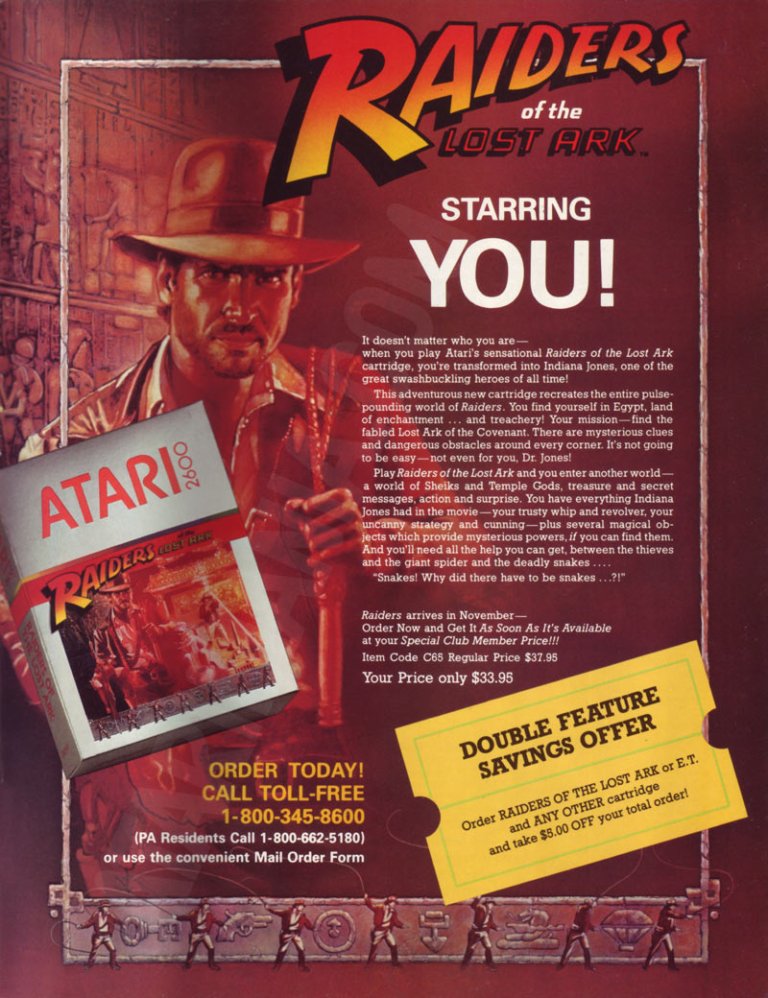
The print ad with strong Indiana Jones imagery.
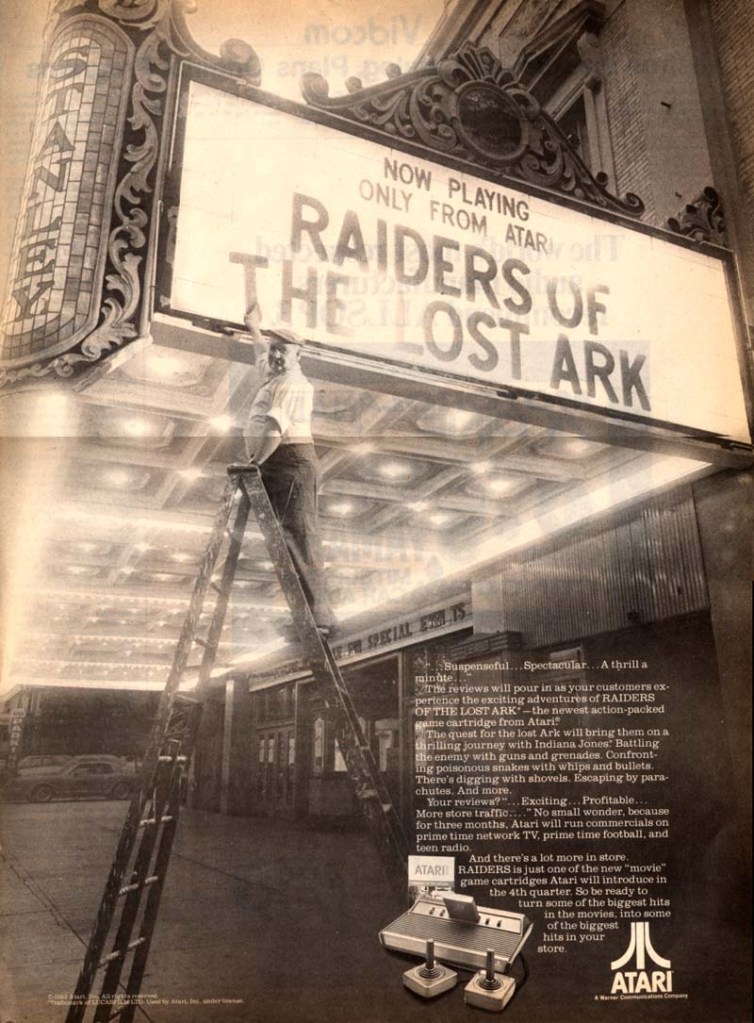
The print ad with the movie theater exterior image and the small image of the Atari 2600 console.

Directed by Steven Spielberg, Raiders of the Lost Ark was one of the best adventure movies ever made as well as the start of the iconic character Indiana Jones. Given its huge commercial success, an official video game adaptation for the Atari 2600 was released in 1982 and game designer Howard Scott Warshaw even met with Spielberg during the game’s development.

To promote the game, Atari released two print ads – one ad had a movie theater exterior visual concept to emphasize they have the official video game adaptation based on the movie while the other ad showed the game’s official artwork and game box cover while emphasizing a savings offer. Atari really did what they could to sell a game while riding on the success of Raiders of the Lost Ark.

2. Phoenix print ad
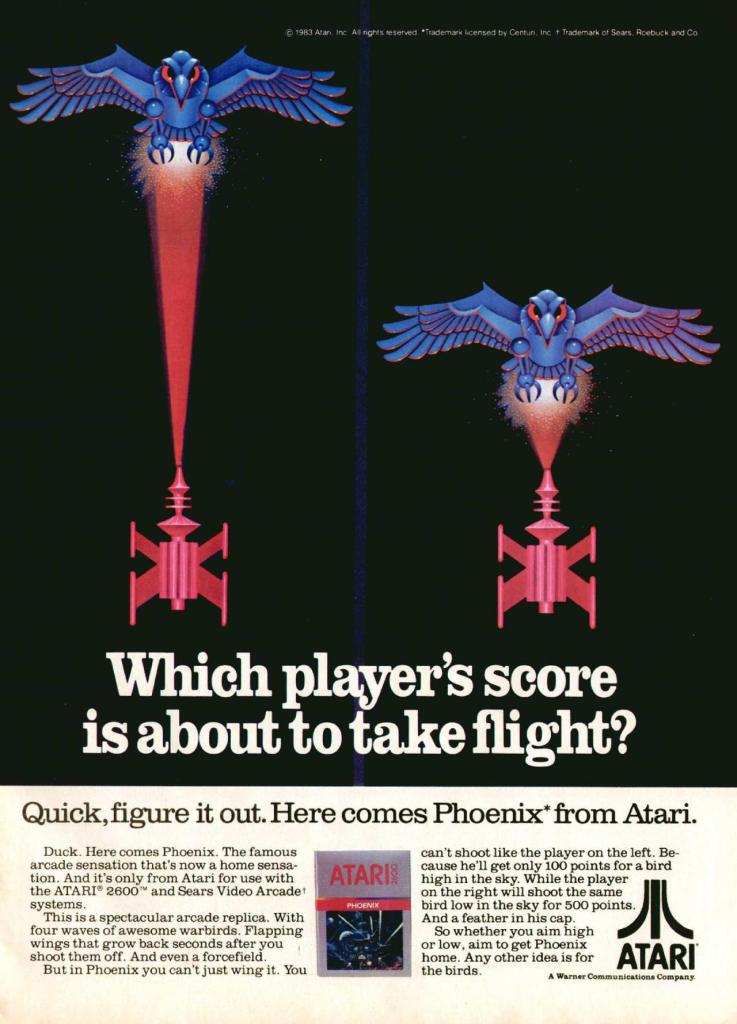
Even without any screenshots, this print ad’s art still gives viewers a clear idea of what to expect.

Similar to what they did with Galaxian and Joust, Atari made this print ad promoting Phoenix which was a 2D sci-fi shooting game that was similar with Space Invaders in design. Colorized, hand-drawn artwork resembling the 2D sprites of the game was done to capture the attention of people. The art is so good, it made up for the lack screenshots of the game. 

3. Moon Patrol arcade flyer
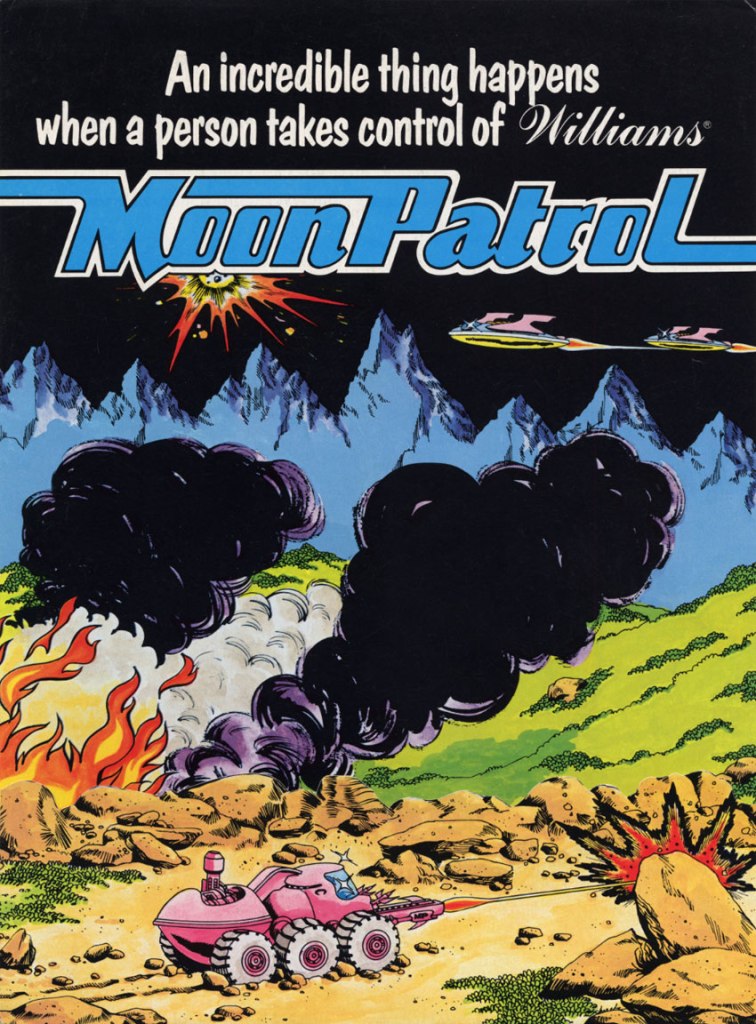
Front of the Moon Patrol flyer.
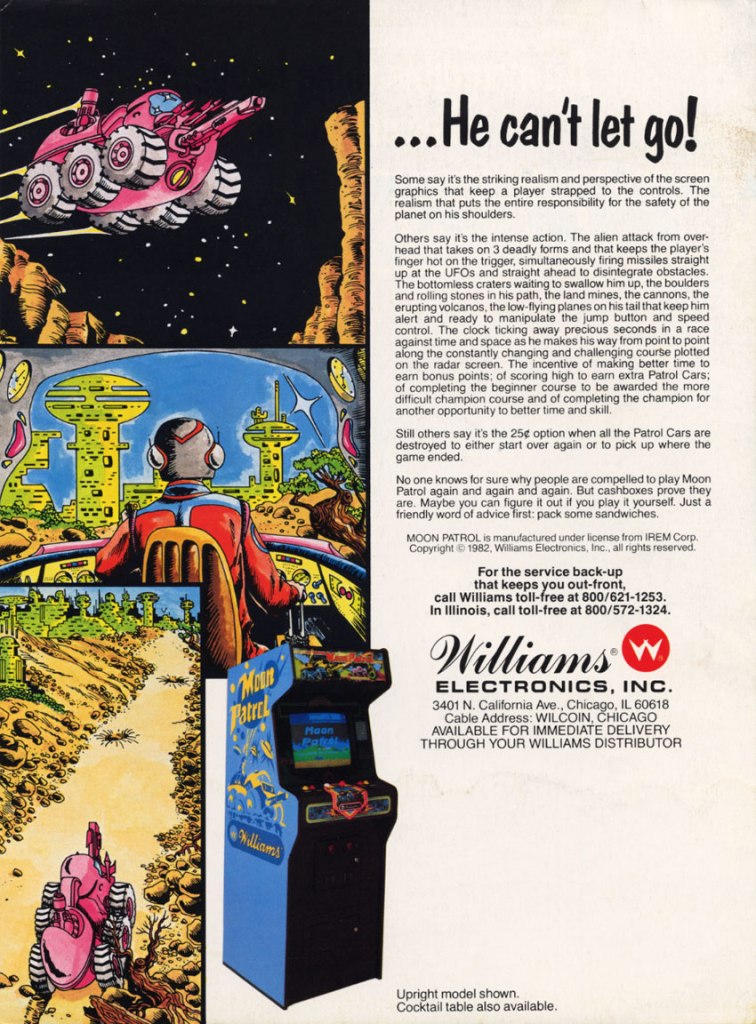
The other side of the arcade flyer.

Moon Patrol was a 2D sci-fi side-scrolling adventure game first released in the arcades in 1982. To sell the game to arcade operators, publisher Williams created the North American arcade flyer that heavily used hand-drawn comic book-style artworks on both sides while using available space on the other side for the descriptive text, contact details and the image of an arcade machine. What is very clear is that no screenshots of the game were shown to stand out which explains why a lot of hand-drawn art was used. The picture of the machine showing a screen of Moon Patrol was the closest thing to see a screenshot on this flyer. Personally, I really like the style and quality of the hand-drawn artwork as it made the flyer look lively.

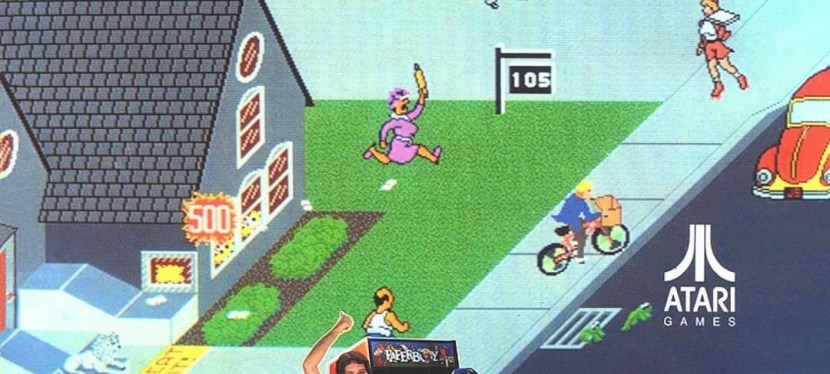
4. Paperboy arcade flyers
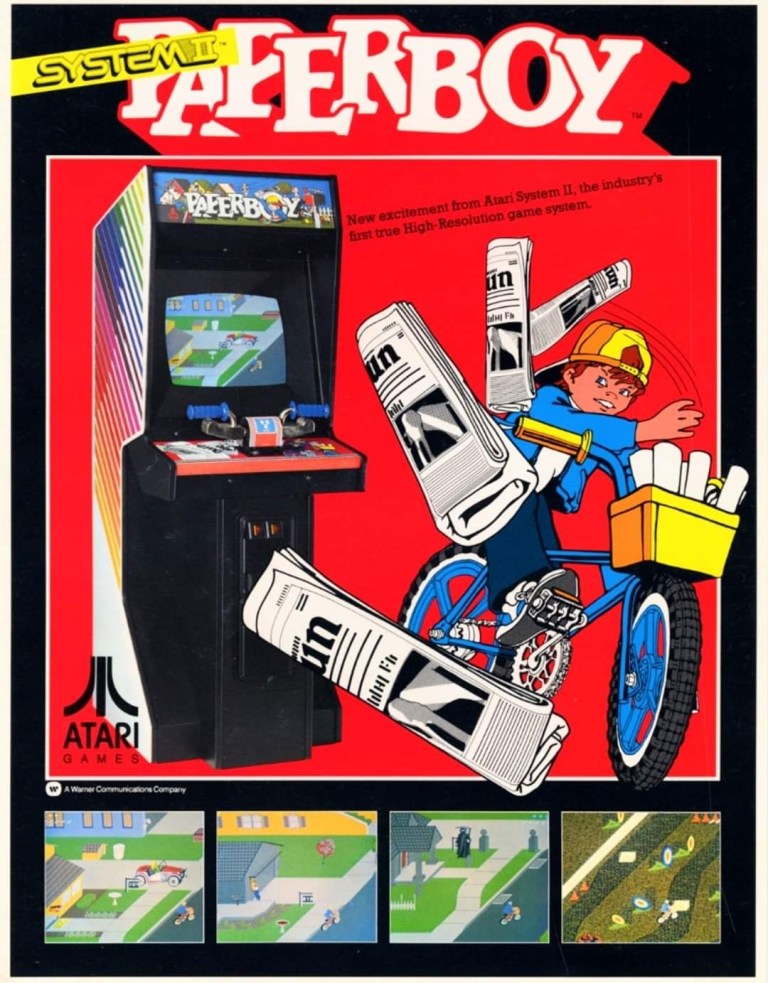
The arcade flyer showing the Paperboy machine and screenshots. The hand-drawn art is nice.
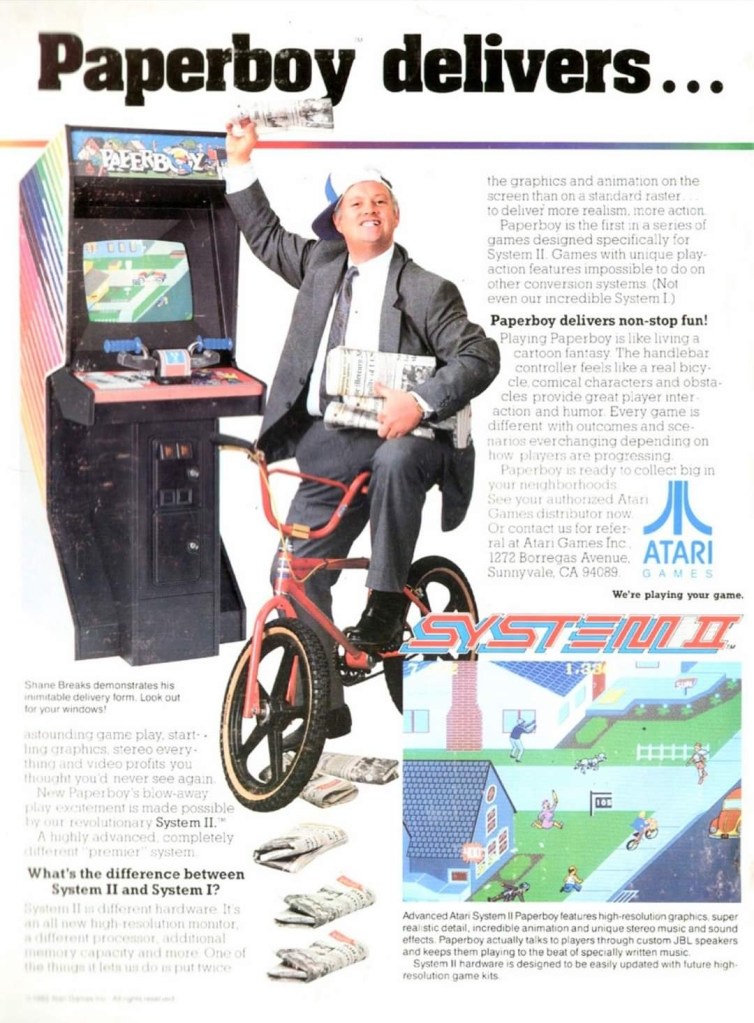
This one uses comedy showing a grown man riding a bike as a paper delivery “boy”.
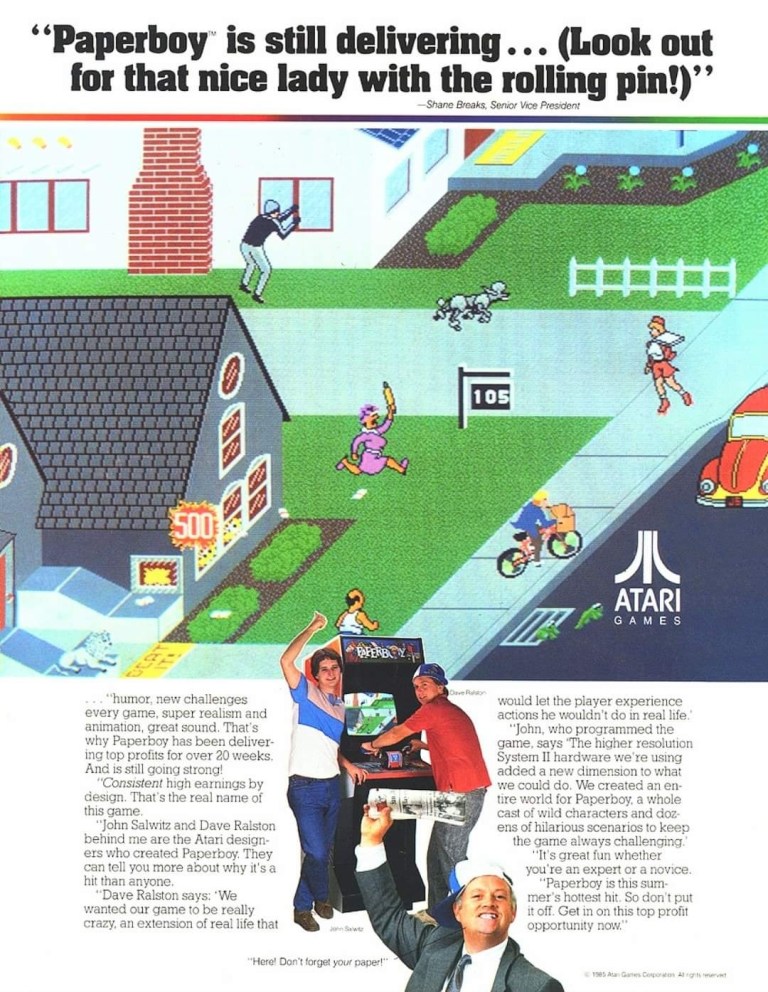
I really like the stronger emphasis on the in-game graphics of Paperboy which dominates the space. What you see is what you get in the arcade.

The first time I ever played the classic Paperboy was in the arcade inside a Las Vegas hotel way back in 1989, and it sure was a challenging yet fun experience. Before its arcade debut in 1985, the developers took a lot of risks making the game which includes coming up with a bicycle handle bar for each machine to have. To promote the game, Atari made at least three arcade flyers that creatively emphasized what the game’s concept was about, how did it play, why does the machine have bicycle handlebars and why players can expect fun. Atari’s promotional efforts paid off as Paperboy became a huge hit in the arcades not only in America but also in Japan.

5. Frogger multi-platform print ad
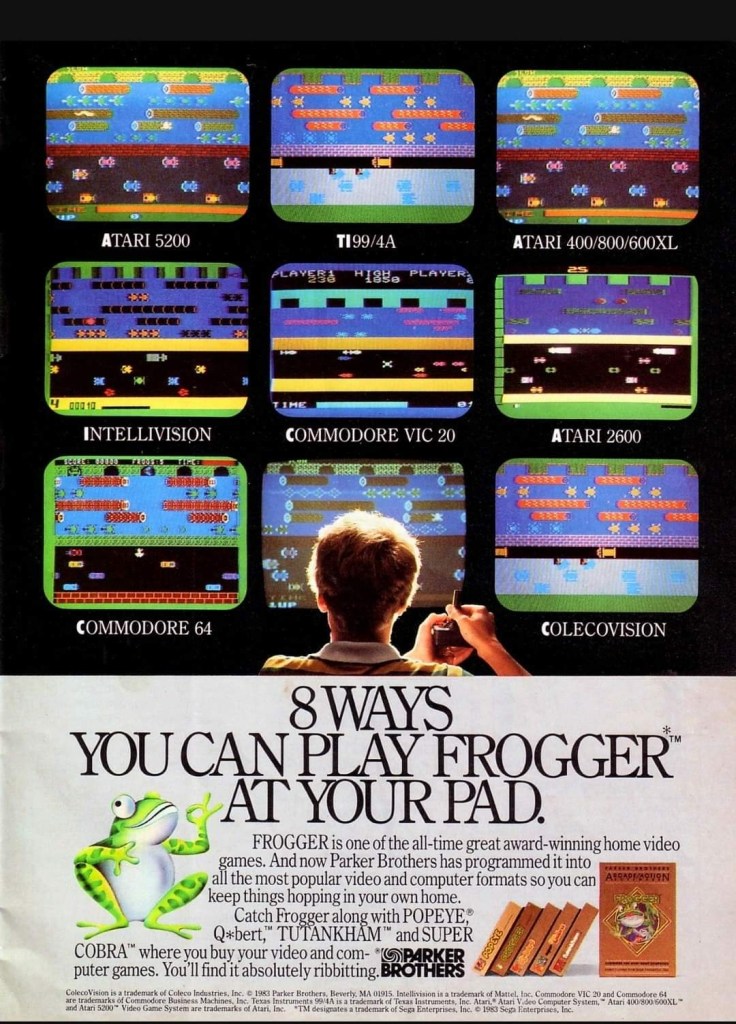
This print ad is still amusing to look at.

After Frogger became a hit in the arcades, Parker Brothers secured the rights to port the game on Atari consoles, the Intellivision, TI-99/4A, vic-20, the Commodore computers and ColecoVision. To promote their Frogger ports, the single-page print ad was made showing a player in the foreground playing in front of screens that each showed what the game looked like on each platform. Parker Brothers found tremendous success selling 4 million copies of Atari 2600 version of Frogger at a time when there were only 13 million units of Atari 2600 in existence. By the year 2005, video game sales of Frogger reached 20 million worldwide across different platforms.

6. Predator 2 print ad
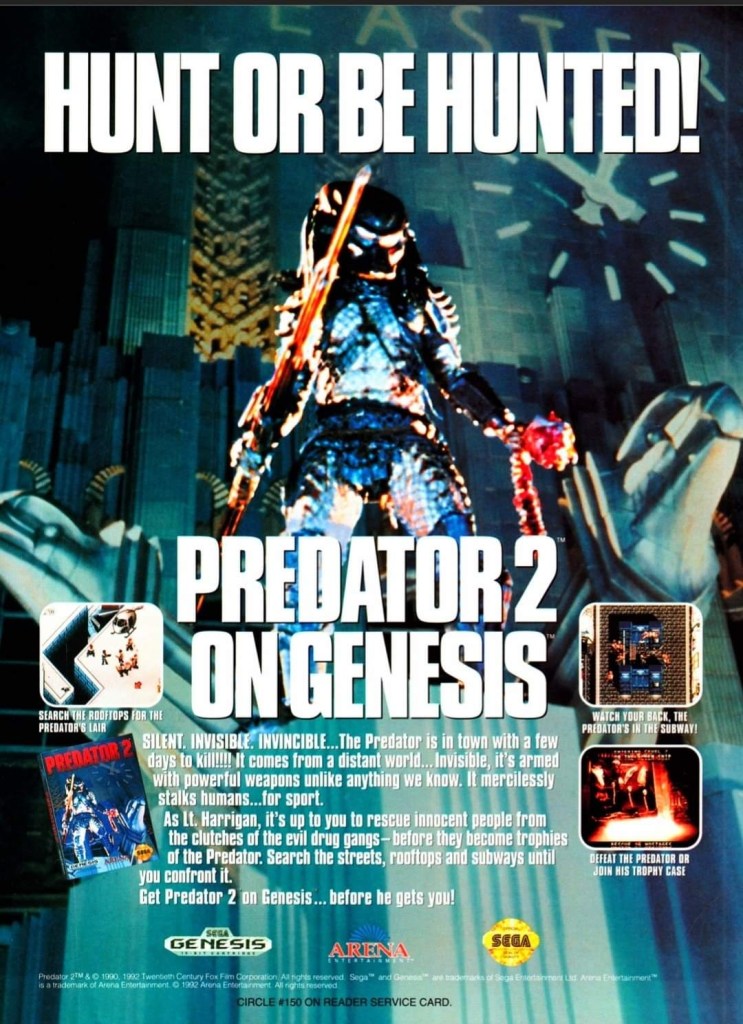
This is one very edgy print ad as used an official image from the movie.

If there is anything memorable about the 1990 film Predator 2, it is the fact that it had the story and the alien hunter itself within a metropolitan setting. That being said, the Sega Genesis Predator 2 video game had a suitable design of shooting and adventuring within the urban settings. This video game ad really captured the vibe of the movie (even showing the reddish human skull with spine on the Predator’s left hand) and clearly showed what gamers could expect. This old ad is still captivating to look at and its edgy approach is still intact.

7. Atari Jaguar print ad
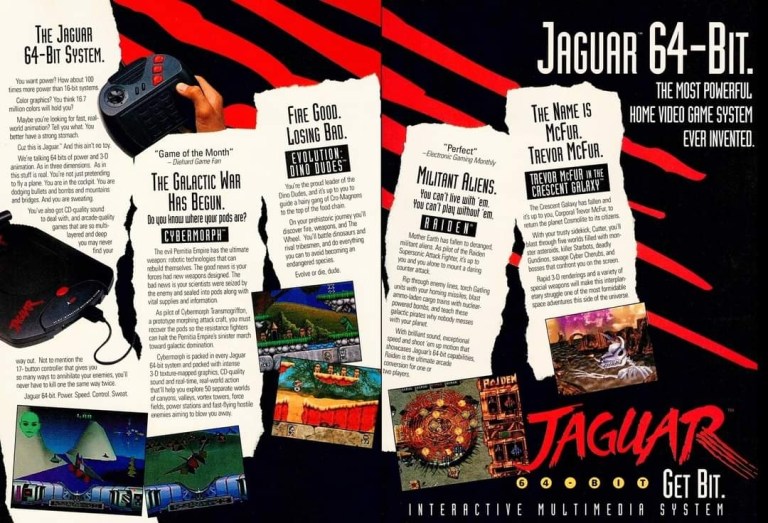
Did you ever own an Atari Jaguar console?

When I was reading video game magazines back in the 1990s, I always found print ads of the Atari Jaguar intriguing to look at. I was very young when I first played the Atari 2600 and its games at home, and later played some Atari games in the arcade. To me, seeing Atari Jaguar print ads like this one gave me moments of nostalgia and it made me wonder if Atari knew what it was doing with their so-called 64-bit game console. They did what they could to promote their console and the games within this 2-page print ad.

8. Vs. print ad
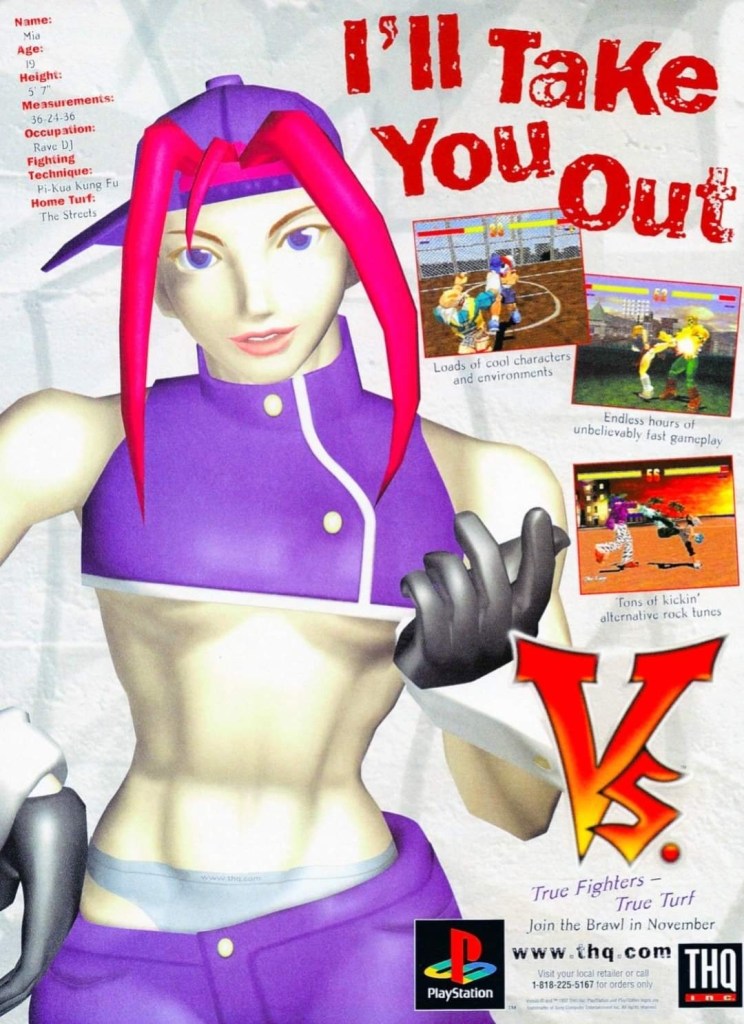
This print ad easily reminds me of the 1990s.

By 1997, both the arcades and the video game console market were filled with lots of 2D and 3D polygonal fighting games. Japan was the hot spot of the production of 3D polygon fighting games and the developer Polygon Magic (based in Japan) made Fighters’ Impact which Taito released in Japanese arcades and the PlayStation. The said game was picked up by THQ for a late-1997 release on the PlayStation in America under the title Vs. I never played this game but I heard that the game’s development included gang-oriented characters designed by Marvel Comics artist Kurtis Fujita. This Vs. ad is a lively reminder about the hip-hop fashion that made its way into video games.

9. GoldStar/LG Electronics 3DO print ad
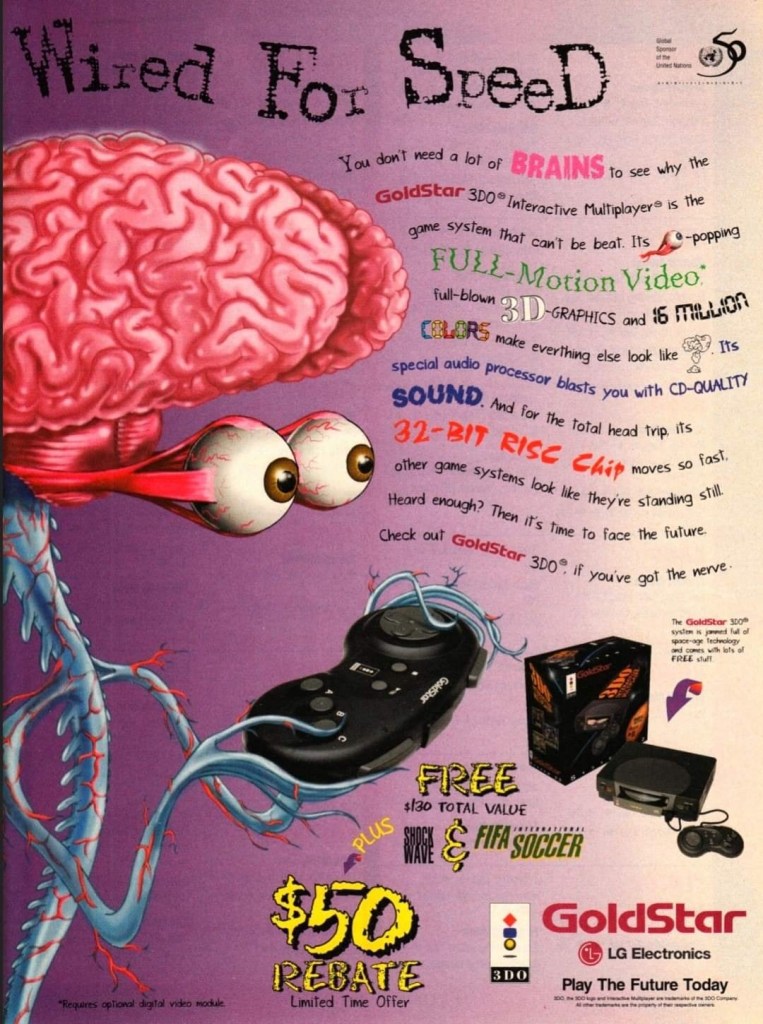
This is a very weird way to market a video game machine.

Back in the 1990s, the South Korean electronics company GoldStar (which was part of the umbrella of LG Electronics) had the license to produce 3DO game consoles with its own style. In some ways, the GoldStar 3DO console looked like a premium console on the outside. Unfortunately, the GoldStar 3DO print ad here had a very sloppy presentation as the ad makers used very weird art of a brain-with-eyes holding a 3DO controller leaving little space left to promote the console and games (without any screenshots). The text description was sloppily done. This is a bad example of promoting video game hardware and games.

10. Pandemonium 2 print ad

I saw this ad but never played the game.

Looking back at 1997, I find it strange that I never got to play Pandemonium 2 on the PlayStation even though I saw its print ad in magazines. I had a lot of fun playing Pandemonium! on the console in 1996 but somehow missed out on its sequel. Looking back at the Pandemonium 2 print ad, I was surprised with how the game developers redesigned the two playable protagonists, especially Nikki who was clearly made to look very sexy. The word “libido” (meaning sexual drive) was deliberately placed above Nikki. The ad also had a hypnotizing mix of colors which I believe was also deliberately done by the ad makers. I can only wonder how the game played.

11. Mission: Impossible print ad
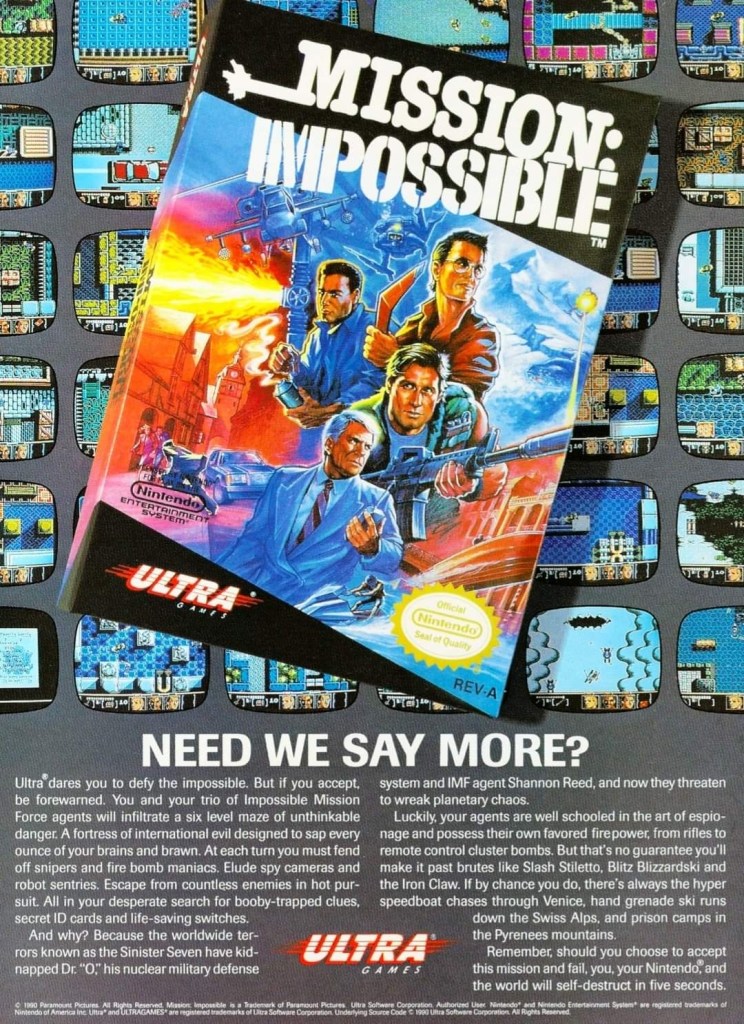
A captivating ad.

In 1990, Ultra Games (a label of Konami) released the Mission: Impossible video game on the Nintendo Entertainment System (NES) in America. Developed by Konami, the game was an adaptation of the 1988 TV series and it had an ambitious design with regards to level design and gameplay. To promote the game, the ad makers came up with a visual design showing the game’s box (which had a nice painted art on the cover) on the foreground and several screenshots resembling TV monitors on the background. Even by today’s standards, this print ad still looks good and captivating even if you are not too familiar with Mission: Impossible on TV.  

12. The Lawnmower Man Sega CD and Genesis print ad
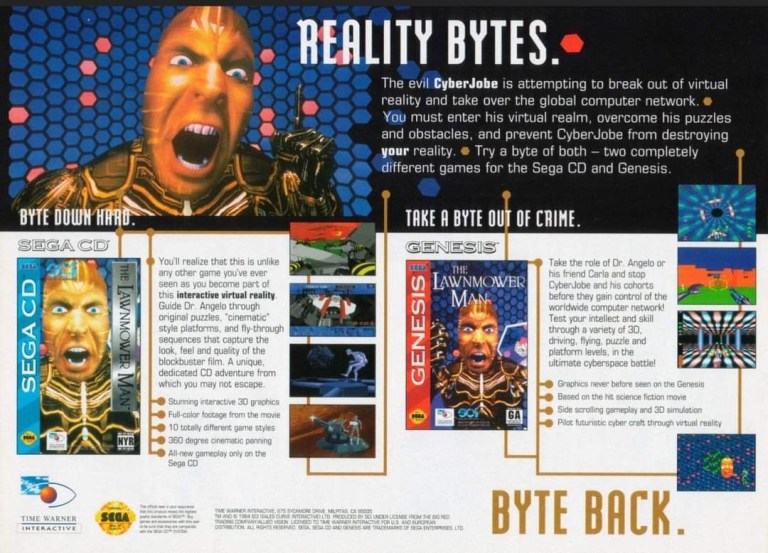
Are you fan of The Lawnmower Man movie?

Back in 1992, there was a lot of buzz generated by the movie The Lawnmower Man as it had a disturbing concept that involved virtual reality and, more notably, author Stephen King sued the filmmakers to remove his name from the title because the film differed so much from the source material. Of course, those developments did not stop the production of video game adaptations of the movie. This print ad promoting the Sega CD and Sega Genesis versions of the game heavily used the images of CyberJobe which were among the most memorable images from the film. Looking at the ad, the ad makers could have made the screenshots look a little larger to really sell the games.

13. Ground Zero: Texas print ad
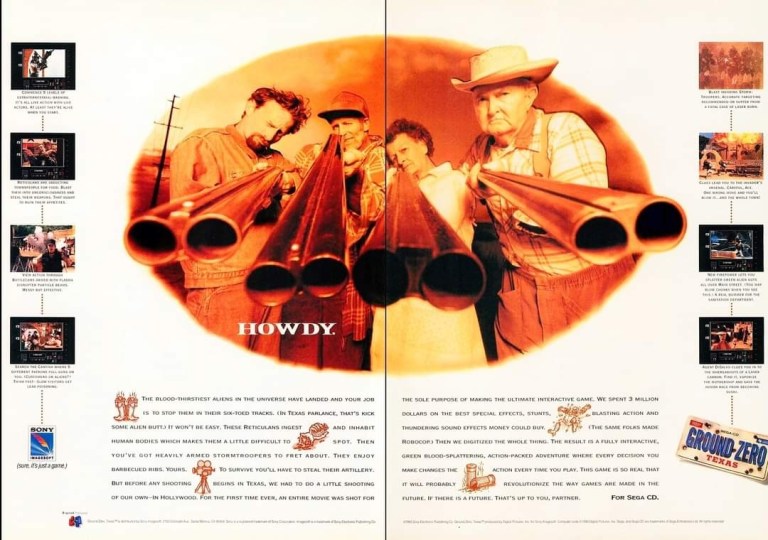
The shotguns really made this ad eye-catching.

I never played the Sega CD video game Ground Zero: Texas but I knew that it was one of those games that heavily relied on video footage while giving players moments to interact. Back in 1993, there was an increase in the number of video games that carried lots of live action footage to drive the narrative and players were given options in order to progress. What is very notable about the game is not the game design but the very 2-page ad used to promote it. The image showing four people pointing their shotguns towards the viewer was easily the most captivating part of the ad. Even though there was vacant space in between, the screenshots of the game were displayed to be really small.

14. Alien vs. Predator for SNES and Game Boy print ad
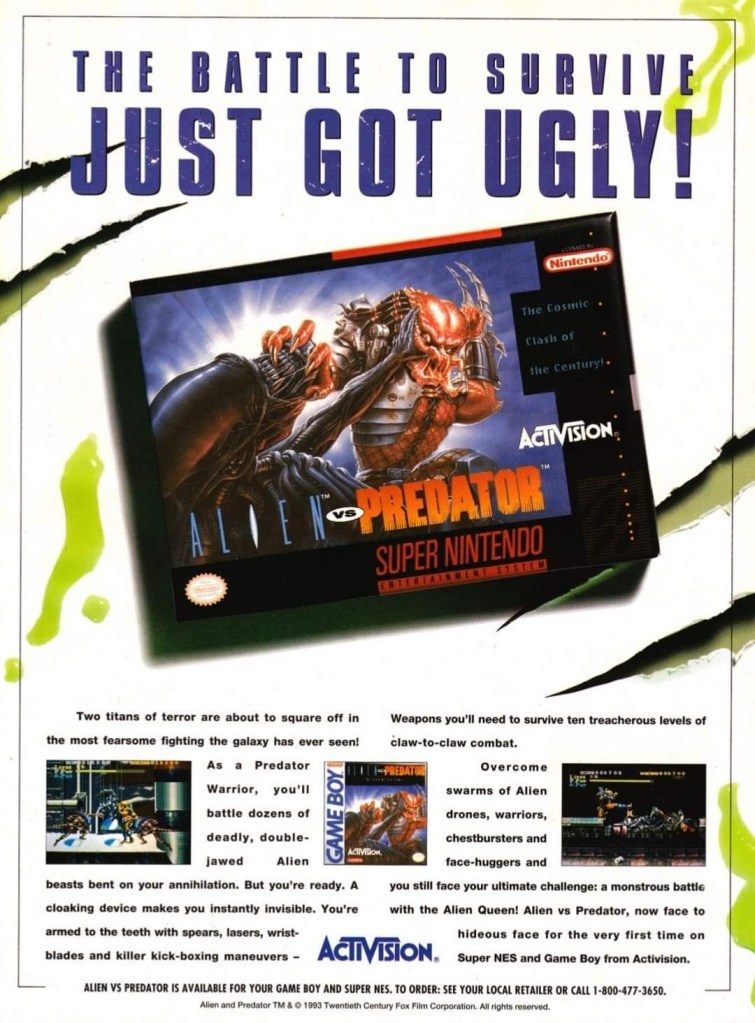
This ad caught the attention of a lot of people back then.

Back in 1990, Dark Horse Comics launched the 4-issue mini-series of Aliens vs. Predator which turned out to be a very intriguing and engaging crossover comic book tale featuring two iconic sci-fi species of monsters. The success of the comic books led to the production of many video games which delighted both fans of Predator and Aliens. In 1993, Activision released Alien vs. Predator on the Super Nintendo Entertainment System (SNES) and the single-page print ad they came up with was engaging to look at. The SNES game box with the fine looking painted art was the main visual highlight leaving just enough space for the descriptive text, the Game Boy cover and two screenshots. Believe it or not, this video game was not related at all with the Alien vs. Predator arcade game and Atari Jaguar console game.

+++++

Thank you for reading. If you find this article engaging, please click the like button below, share this article to others and also please consider making a donation to support my publishing. If you are looking for a copywriter to create content for your special project or business, check out my services and my portfolio. Feel free to contact me with a private message. Also please feel free to visit my Facebook page Author Carlo Carrasco and follow me on Twitter at  @HavenorFantasy as well as on Tumblr at https://carlocarrasco.tumblr.com/ and on Instagram at https://www.instagram.com/authorcarlocarrasco
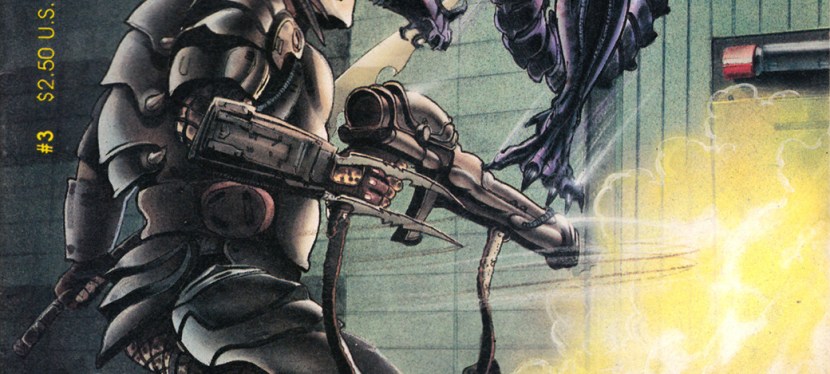
A Look Back at Aliens vs. Predator #3 (1990)

Disclaimer: This is my original work with details sourced from reading the comic book and doing personal research. Anyone who wants to use this article, in part or in whole, needs to secure first my permission and agree to cite me as the source and author. Let it be known that any unauthorized use of this article will constrain the author to pursue the remedies under R.A. No. 8293, the Revised Penal Code, and/or all applicable legal actions under the laws of the Philippines.

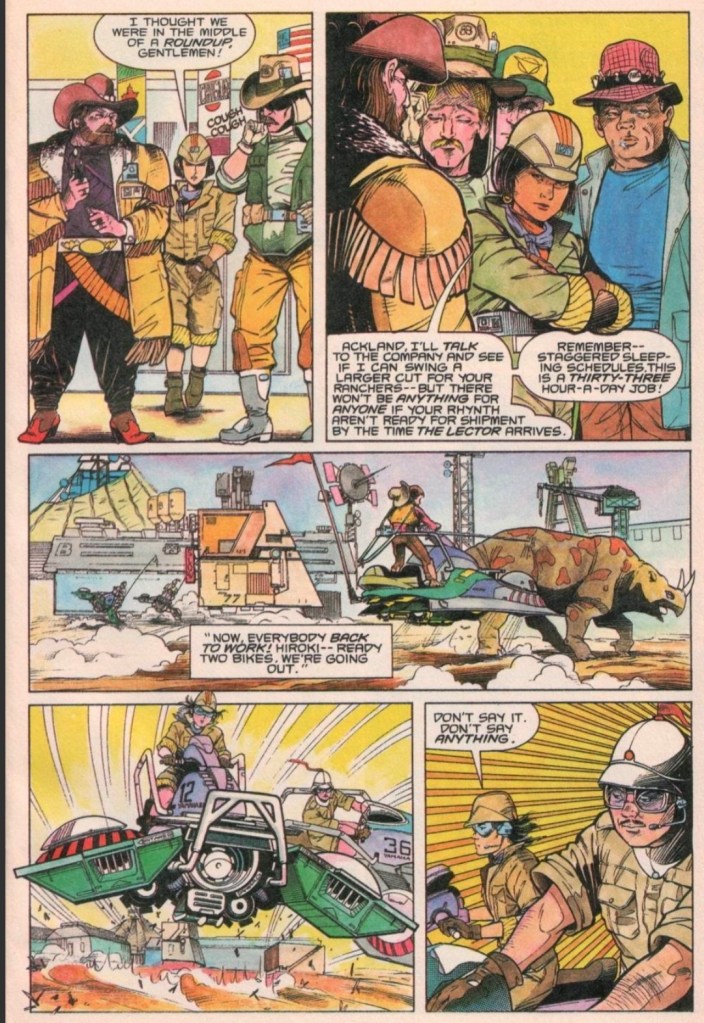
Welcome back superhero enthusiasts, 1990s culture enthusiasts and comic book collectors! Today we go back to the year 1990 to take a close look at one of the more significant non-superhero crossover comic book events ever published – Aliens vs. Predator!

In my previous review, the humans of Prosperity Wells begin to get impacted by the presence of the Predators and the Aliens. A family got killed by Predator hunters at their home in the wilderness and only a young boy was able to get away and catch people’s attention in the outpost. Machiko Noguchi and her team initiate defensive measures in response to what has been happening. Two people even brought back a living Predator with them from the ruins of a Predator ship they inspected in the wilderness.

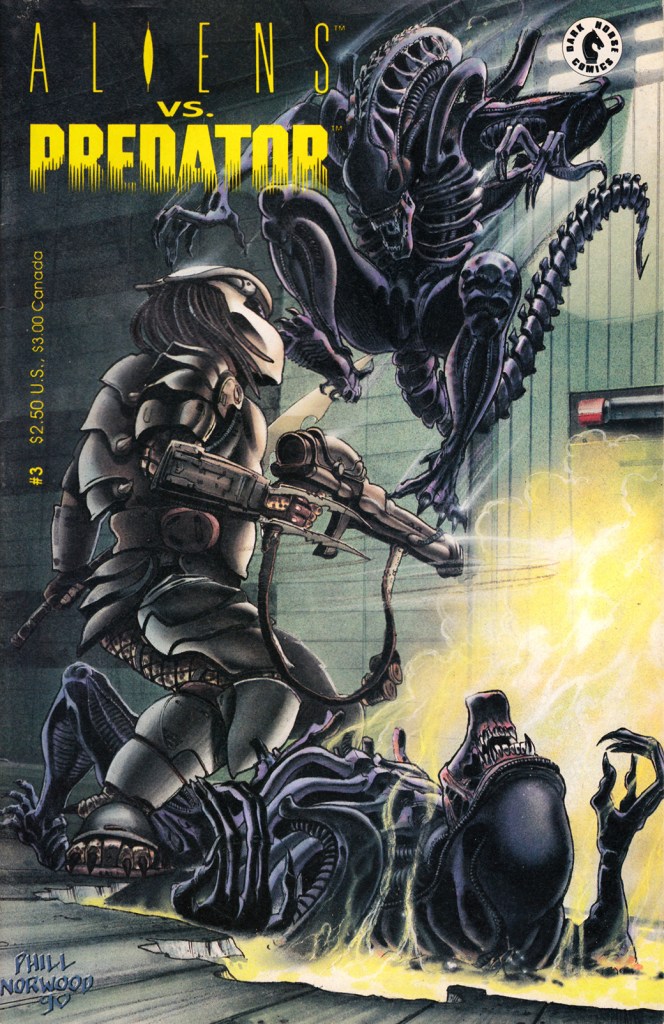
With those details laid down, here is a look back at Aliens vs. Predator , published in 1990 by Dark Horse Comics with a story written by Randy Stradley and drawn by Phill Norwood.  

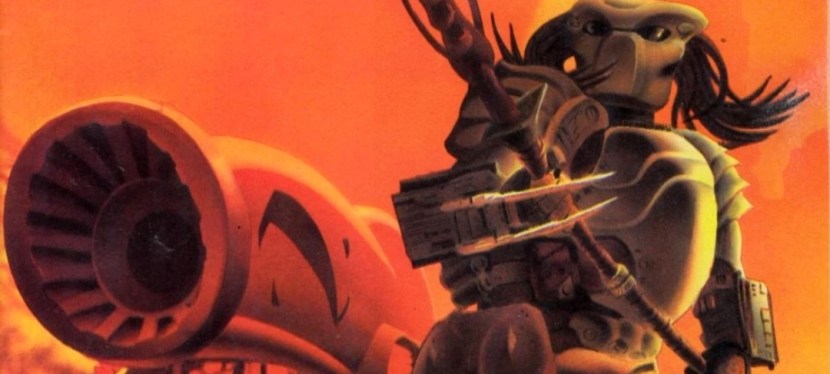
The cover.

Early story

The story begins with Noguchi who finds herself in a dangerous position. In front of her is a horde of Xenomorphs and behind her is one Predator warrior who even assisted her a few moments prior. Armed with futuristic weapons, the armored warrior suddenly jumps above her and right into the Xenomorphs. The Predator efficiently slashed off the parts of a few Aliens using a bladed weapon and blew up one of them using another weapon.

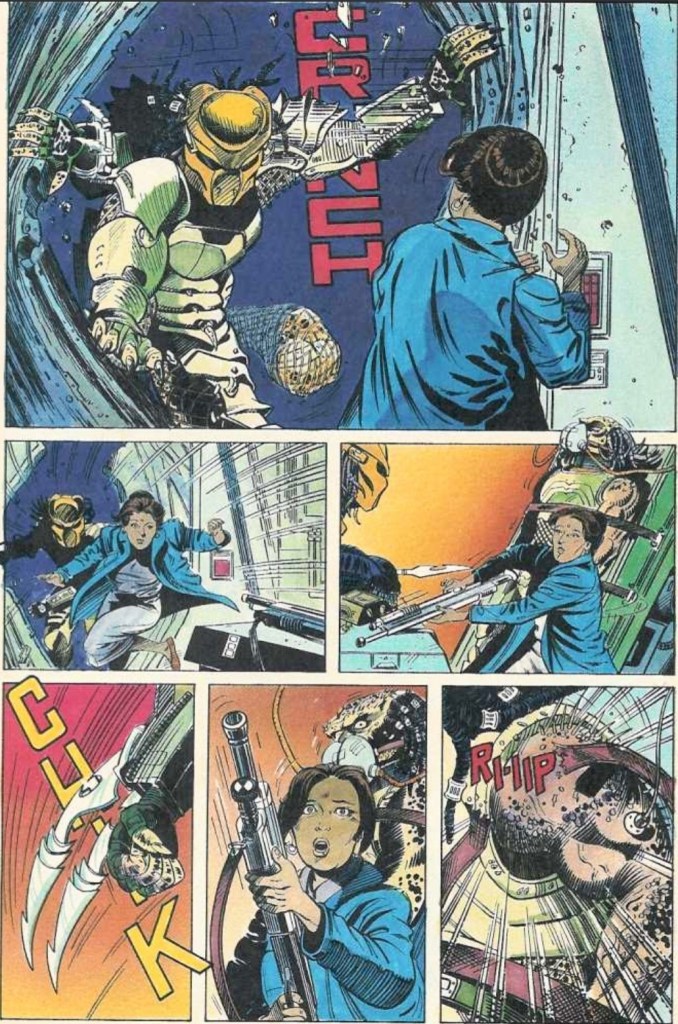
The warrior eventually gets overwhelmed by more Aliens that came into the action. As the Xenomorphs focused strongly on the downed Predator, Noguchi takes advantage of the situation to run away and somehow get back to protecting the people as the outpost has been clearly invaded by two deadly non-human species.

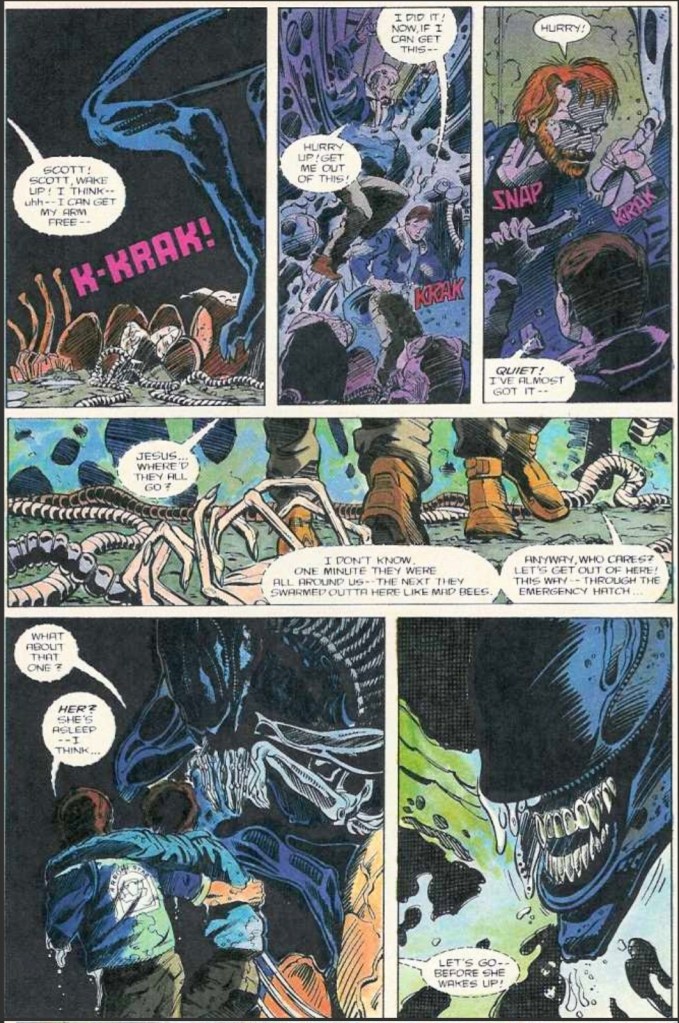
Meanwhile inside the huge cargo ship that did not launch, two crew members freed themselves from the Xenomorphs’ restraints and try to sneak by the Alien Queen which they perceived to be sleeping…

Quality

This is a fine example by the creative team on telling a sequence of intense moments without a single word of dialogue.

From a storytelling point-of-view, this one is a huge pay-off to the build-up established in the first two issues and I can say I enjoyed this one. At this stage of the 4-issue mini-series, the human colony has turned into a battle zone between the Predators and the Xenomorphs and this obviously results in a lot of action scenes and other wild turns of events. It is also in this story where you will get to see Machiko Noguchi at her bravest yet, as well as her uncompromising way of protecting her people and solving the crisis at hand. As she and her fellow humans are in the middle of a crisis, nothing straightforward could happen nor could they make solid plans with any real chance of succeeding. The decisions Noguchi made here came with risks and through her struggles, you will be able to relate with her and you will also witness how the series of unfortunate events turn out with unpredictable ways which added some suspense and surprise to the narrative.

The spectacle here, unsurprisingly, are the battles between the Aliens and Predators. Such conflicts happened mostly in the background which is effective enough to establish the chaos that the humans have to endure. One of the Predators – which does not have a name – became a notable additional supporting player to the cast and his presence and actions added some intensity to storytelling even as the narrative consistently focused on Noguchi.   

The way the story is told, this one maintains the natural progression of details from issue and even though the action has been ramped up, there were still plenty of opportunities for readers to understand the details and grasp the plot. There is also rising tension as the narrative moves forward.

Conclusion

There is nothing like trying to sneak past an Alien Queen in an area surrounded by multiple eggs laid by her.

Being a big pay-off to the huge build-up of issues and , Aliens vs. Predator (1990) is highly entertaining and compelling to read! The action scenes and chain of incidents were ramped up a lot and yet this comic book never turned into a brainless fest of violence. The creative team managed to add some breathing space to not only let readers absorb the story details but also to immerse themselves with the situations. By the time I reached the end, I experienced this great satisfaction as well as further motivation to discover how the story will conclude in the next issue.

Overall, Aliens vs. Predator (1990) is highly recommended!

+++++

Thank you for reading. If you find this article engaging, please click the like button below, share this article to others and also please consider making a donation to support my publishing. If you are looking for a copywriter to create content for your special project or business, check out my services and my portfolio. Feel free to contact me with a private message. Also please feel free to visit my Facebook page Author Carlo Carrasco and follow me on Twitter at  @HavenorFantasy as well as on Tumblr at https://carlocarrasco.tumblr.com/ and on Instagram at https://www.instagram.com/authorcarlocarrasco
A Look Back at Aliens vs. Predator #1 (1990)

Disclaimer: This is my original work with details sourced from reading the comic book and doing personal research. Anyone who wants to use this article, in part or in whole, needs to secure first my permission and agree to cite me as the source and author. Let it be known that any unauthorized use of this article will constrain the author to pursue the remedies under R.A. No. 8293, the Revised Penal Code, and/or all applicable legal actions under the laws of the Philippines.

Welcome back superhero enthusiasts, 1990s culture enthusiasts and comic book collectors! Today we go back to the year 1990 to take a close look at one of the more significant non-superhero crossover comic book events ever published – Aliens vs. Predator!

For the newcomers reading this, the respective movie franchises of Aliens and Predator started many years before the comic book crossover event happened. By the year 1990, moviegoers had enjoyed Alien (1979), Aliens (1986), Predator (1987) and Predator 2 (late 1990). Cinematic between Arnold Schwarzenegger and the Predator in the jungle and that of Sigourney Weaver and the Queen Alien became unforgettable sequences for many millions of people. It should be noted that an Alien head was shown near the end of Predator 2 emphasizing a crossover.

With those details laid down, here is a look back at Aliens vs. Predator , published in 1990 by Dark Horse Comics with a story written by Randy Stradley and drawn by Phill Norwood.  

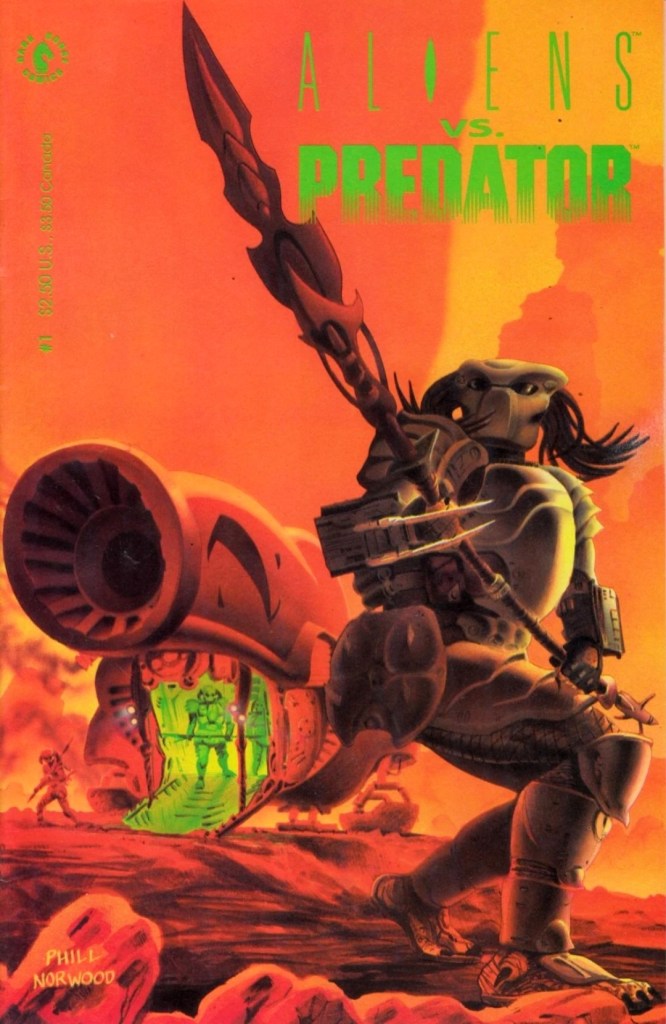
The cover.

Early story

The story begins in space when a fast-moving ship enters the atmosphere of Ryushi, a planet at the edge of the Chigusa Corporation’s holdings in the Beta Cygni System. On the planet is Prosperity Wells, a human outpost with a population of one hundred fifteen composed of freelance ranchers, their families and a staff of corporate overseers.

The ship’s presence gets detected by operators at Prosperity Wells and one of them speculated it to be a meteor that shows no signs of breaking up. Seeking Hiroki Shimura (no longer the head of the outpost), the operator instead contacts his replacement Machiko Noguchi and informs her about the perceived meteor. After talking with the operator, Noguchi tells her predecessor near her that even though she has been leading the outpost for nearly six months, people are still reporting to him as they treat her like a stranger. Shimura tells her that she’s been trying to adapt the job to her rather than adapting herself to it, and that she cannot just run an operation while hiding from it.

Meanwhile in the wilderness, a machine starts to climb out of the pit and starts releasing Alien eggs… 

Quality

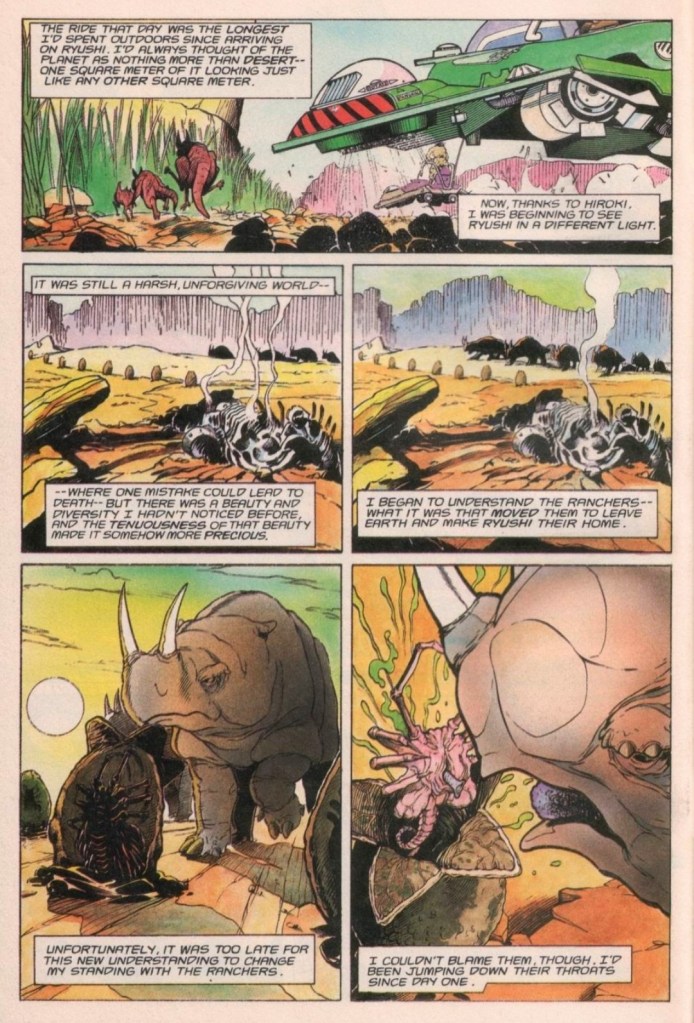
Whenever there are Alien eggs, trouble is inevitable.

I can say that this comic book is essentially one long build-up that intends to execute the conflict between the Aliens (also referred to as the Xenomorphs) and Predators later. While the two galactic species are indeed here, the narrative is told mainly through the humans whose operations – ranching, business administration, outpost activities – are emphasized with heavy and precise details. The result here is that by the end of the comic book, you will be fully immersed with the sci-fi concept, the characters and the related developments which ultimately will prepare you for the inevitable Aliens-Predator conflict. To put it clearly, Stradley crafted a script that efficiently introduces the characters (note: Noguchi is the clear protagonist), emphasize what has been going on while also moving the story forward in a well-paced manner without compromising the details.

That being said, don’t expect the Aliens and Predators to fight each other immediately here. This is one big build-up as a whole and very notably, there is nothing boring and there were no useless scenes portrayed. Everything told and shown in this comic book made sense, and if you are the kind of person who likes paying close attention to details of the story as well as the gradual development of the key characters, you will find this one an engaging read. The narrative moved at a medium pace and cleverly the suspense happens whenever the creative team gradually build-ups the tension for the inevitable Aliens-Predators fight.

As with many other entertainment tales across varied media forms, this story has a critical portrayal of the corporation slightly emphasizing greed while making the contractors (technically the laborers) look disadvantaged. It is not a one-sided portrayal against corporatism, however, as there were moments showing the contractors relying on deception (note: disregarding quality and the safety of consumers who will soon consume the products from the ranching operation) just to achieve their goals.

More on the protagonist Machiko Noguchi, she is not the typical corporate figure for readers to hate. In fact, she is somewhat sympathetic as she is has yet to earn the respect of others even though she had been working as the head of the outpost for months. The grudge against her is subtle yet clear. The comic book also made clear that she is destined for something significant in the upcoming fight between the two galactic species.

The art by Phill Norwood is very good. While the characters have that comic book aesthetic, the Aliens and Predators are easily recognizable and were drawn with sufficient visual details. What I find weird is the creative team’s approach on applying color on the Predators. Norwood also has a really nice approach on illustrating futuristic stuff (examples: the technologies, office equipment, clothes of the characters) while also emphasizing the wilderness of Ryuchi.

Conclusion

Machiko Noguchi takes charge even though she is despised by many.

Aliens vs. Predator (1990) is one very detailed build-up type of comic book that happens to be pretty engaging to read and the set-up for the expected conflict between the two species worked nicely. By the time I reached the end of this tale, I got immersed into its concept, the situations and characters. The build-up also came out with really interesting parts here and there which made the reading experience a very good one. Right now, I am eager to read the next issue.

Overall, Aliens vs. Predator (1990) is highly recommended!

+++++

Thank you for reading. If you find this article engaging, please click the like button below, share this article to others and also please consider making a donation to support my publishing. If you are looking for a copywriter to create content for your special project or business, check out my services and my portfolio. Feel free to contact me with a private message. Also please feel free to visit my Facebook page Author Carlo Carrasco and follow me on Twitter at  @HavenorFantasy as well as on Tumblr at https://carlocarrasco.tumblr.com/ and on Instagram at https://www.instagram.com/authorcarlocarrasco