A Look Back at Demolition Man #1 (1993)

Welcome back movie fans, 1990s arts and culture enthusiasts, and comic book collectors! Today we go back to the year 1993 to examine the first issue of a comic book mini-series that served as the official adaptation of the movie Demolition Man.

Believe it or not, I completely missed out on Demolition Man’s theatrical run here in the Philippines. I only heard about the movie from feedback from my friends who saw it and they often mentioned the virtual reality sex scene. Strangely, they did not talk much about the match-up between Sylvester Stallone and Wesley Snipes.

The first time I saw the movie was on a rented laserdisc in 1995. As it was a Joel Silver production, the movie really had very high production values and it also had that subtle balance between hard action, science fiction and comedy. I enjoyed watching Demolition Man and its unique presentation about the future was memorable to me. Recently, I finally read the first issue of the comic book mini-series based on the movie.

With those details laid down, here is a look back at Demolition Man , published in 1993 by DC Comics with a story written by Gary Cohn (based on the screenplay by Daniel Waters, Robert Reneau and Peter M. Lenkov) and drawn by Rod Whigham. This is the first of a 4-issue mini-series.
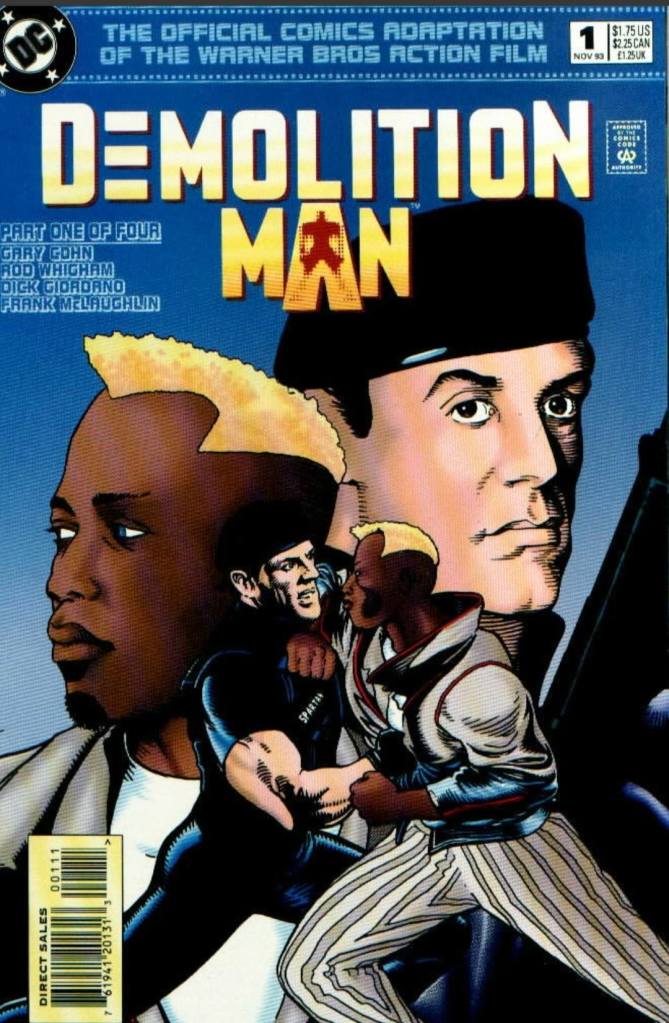
The cover.

Early story

The story begins in 1996. Los Angeles has turned into a city of violent crime with a lot of areas left in ruin. A police department helicopter flies over the Hollywood sign bringing John Spartan (Demolition Man) to a wide, old building filled with some armed criminals. Spartan suspects that Simon Phoenix is responsible for hijacking a bus of thirty people and they all could be inside the building. The thermogram scan on the building only shows seven people and no signs of the passengers.

Determined to find the passengers, Spartan does a bungee jump to safely land on the rooftop of the building. He takes down a few thugs as he gradually infiltrates the place.

Elsewhere, Simon Phoenix sees Spartan via security camera. As Spartan eventually breaks into a large room, Phoenix releases a large amount of gasoline on the floor. Spartan and Phoenix encounter each other and an intense talk about missing passengers begins. As the Demolition Man presses for answers with guns aimed, Phoenix prepares to spark a sudden fire…

Quality
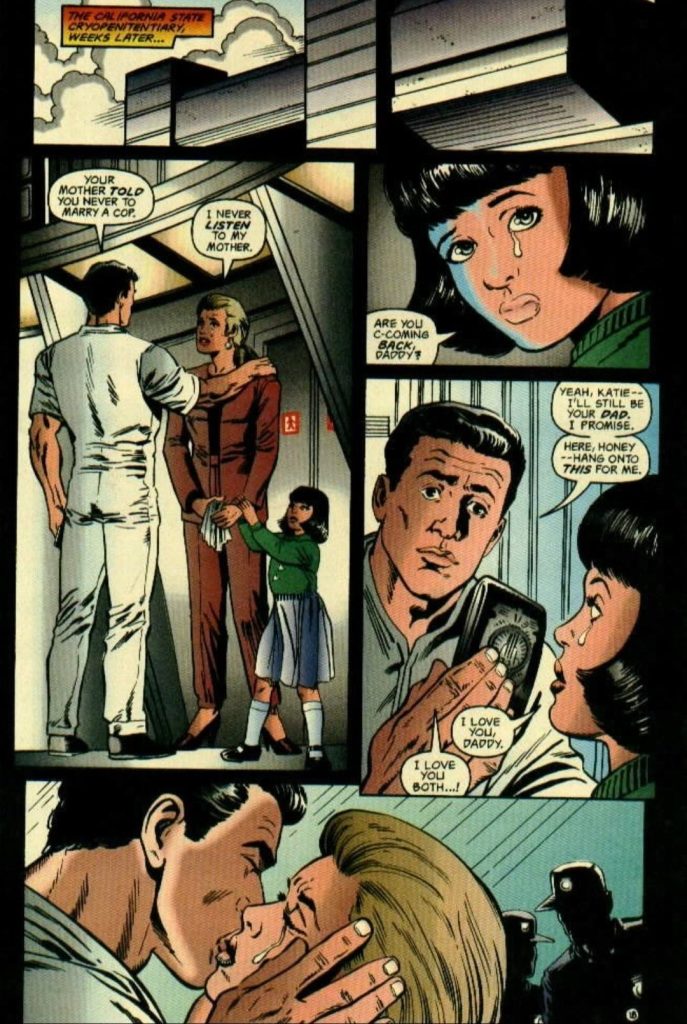
This scene never appeared in the movie. If it made it the final cut, it definitely would have slowed the film’s pace down a lot.

Having seen the movie a number of times, this comic book covers the opening and closes with a notable scene that took place after the shocking revelation about the passengers. The good news here is that the comic book creators did a really fine adaptation of the scenes from the movie. Certain moments looked and felt like they were adapted from an older version of the script (note: Spartan bidding goodbye to his wife and little daughter is the obvious scene) while some moments seem to be creative additions or expansion by the creators.

The pacing of the story is pretty good and even the slowest scenes never felt boring. This is because the writing by Gary Cohn is quite engaging and there is always some interesting or something important to read as the story goes on. That said, when the spectacle happens, the pay-off to the build-up is truly worth it.

Still on the writing, Cohn inserted a good amount of details into the dialogue as well as the moments revealing what John Spartan is thinking. This ultimately gives readers a clearer look into Spartan’s personality as well as what were the elements from his past defined him as the Demolition Man to many.

Rod Whigham is very good with visualizing the script. For one thing, he does a good job capturing the likeness of Stallone and Snipes in specific pages of the comic book. When it comes to spectacle (action, explosions and stunts), Whigham’s work ranges from efficiency to dynamic depending on what happens. This is a good looking comic book!

Conclusion
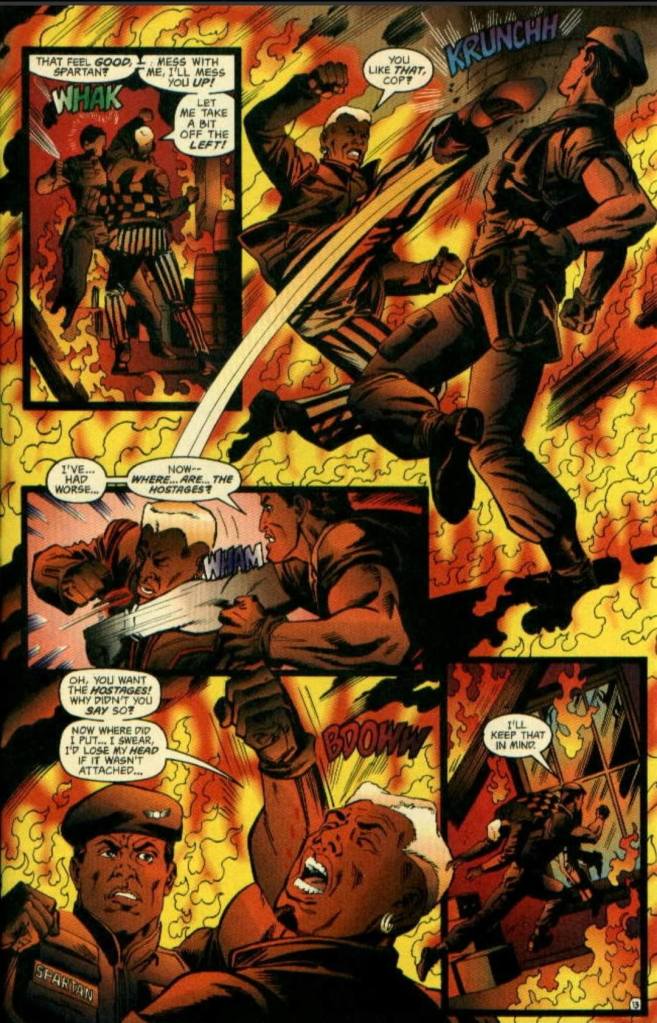
Like in the movie, John Spartan and Simon Phoenix fight surrounded by flames.

Demolition Man (1993) is a very solid adaptation and it is also a great way to start its mini-series. The comic book essentially captured the elements of several scenes from the movie and whenever the spotlight is focused on John Spartan or Simon Phoenix, I could senses Stallone and Snipes in them. The narrative flows smoothly and I had a very good reading experience. I am looking forward to the next issue.

Overall, Demolition Man (1993) is recommended.

+++++

Thank you for reading. If you find this article engaging, please click the like button below, share this article to others and also please consider making a donation to support my publishing. If you are looking for a copywriter to create content for your special project or business, check out my services and my portfolio. Feel free to contact me with a private message. Also please feel free to visit my Facebook page Author Carlo Carrasco and follow me on Twitter at  @HavenorFantasy as well as on Tumblr at https://carlocarrasco.tumblr.com/ and on Instagram at https://www.instagram.com/authorcarlocarrasco
A Look Back at Universal Soldier #1 (1992)

Welcome back comic book readers, 1990s arts and culture enthusiasts, movie fans and comic book collectors! Today we go back to the year 1992 to take a close look at the official comic book adaptation of the action movie Universal Soldier.

Universal Soldier stood out among Hollywood action films in 1992 as it had Jean-Claude Van Damme and Dolph Lundgren as the main stars and both of them were established action movie stars each with huge followings of fans. As it grossed almost $100 million worldwide on a budget of less than $25 million, the movie was successful and eventually sparked its of franchise of movies, TV shows, video games and comic books. NOW Comics was in-charge of making and publishing the comic book adaptation of the 1992 film.  

With those details laid down, here is a look back at Universal Soldier published in 1992 by NOW Comics with a story written by Clint McElroy and drawn by Lenin Delsol. This was the first chapter of a 3-issue mini-series.

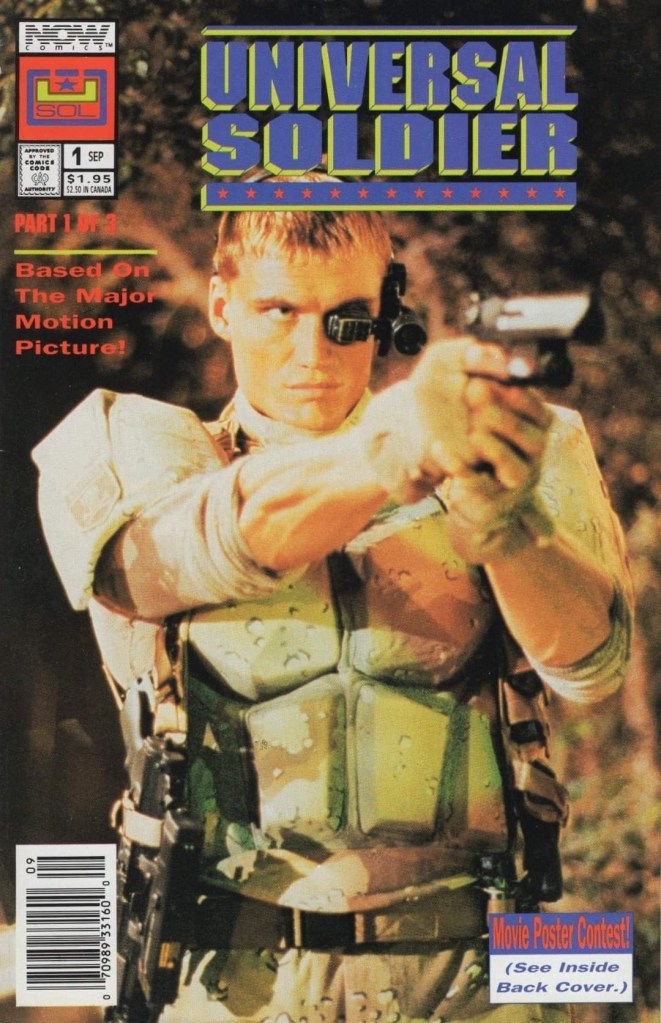
The cover showing a photographic image of star Dolph Lundgren.

Early story

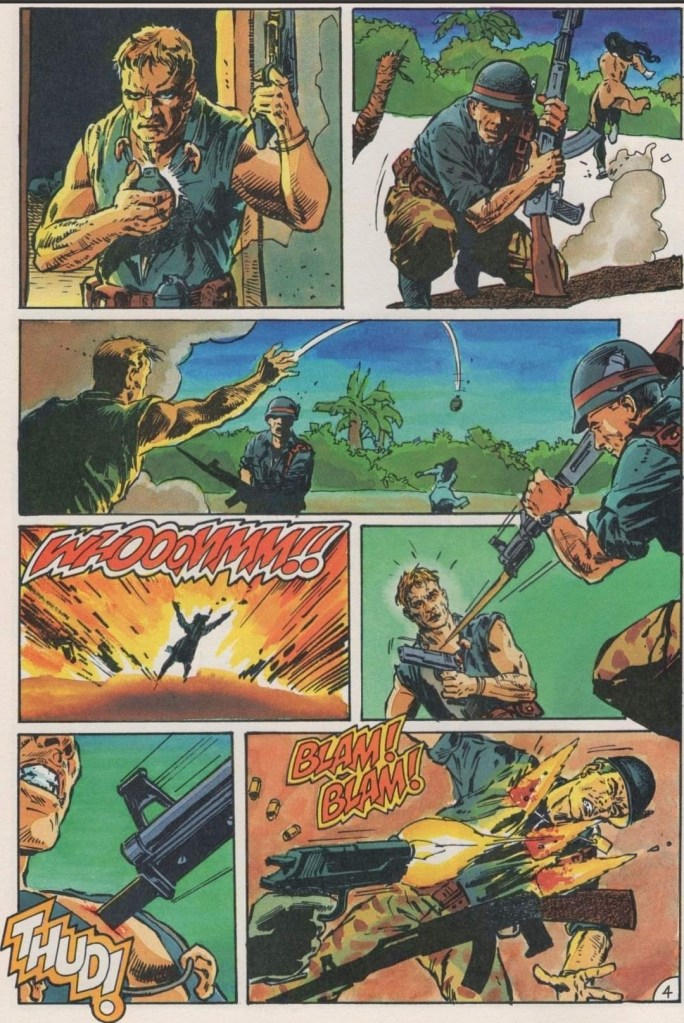
The story begins in Vietnam in 1969. The American soldier Luc Deveraux arrives at a village that was secured by the U.S. Army. To his shock, he finds several dead bodies of his squad members and villagers, then encounters Sergeant Andrew Scott with two Vietnamese individuals (male and female) tied together near him. It turns out that Scott, who made a necklace composed of severed ears, has gone insane and executes the Vietnamese man. As Deveraux refuses to follow Scott’s order to shoot the Vietnamese female, the sergeant kills he. Deveraux and Scott shot each other to death and eventually their corpses were recovered by another squad to be cryogenically frozen.

A few decades later in Nevada, the elite counter-terrorism unit of the UniSol (Universal Soldier) arrives and among the members are Deveraux (identified as GR44) and Scott (GR13) who have been reanimated by the government with their past memories fully suppressed. Their team gets deployed to the Hoover Dam (Mackinley Dam in the comic book) to resolve a hostage situation…

Quality

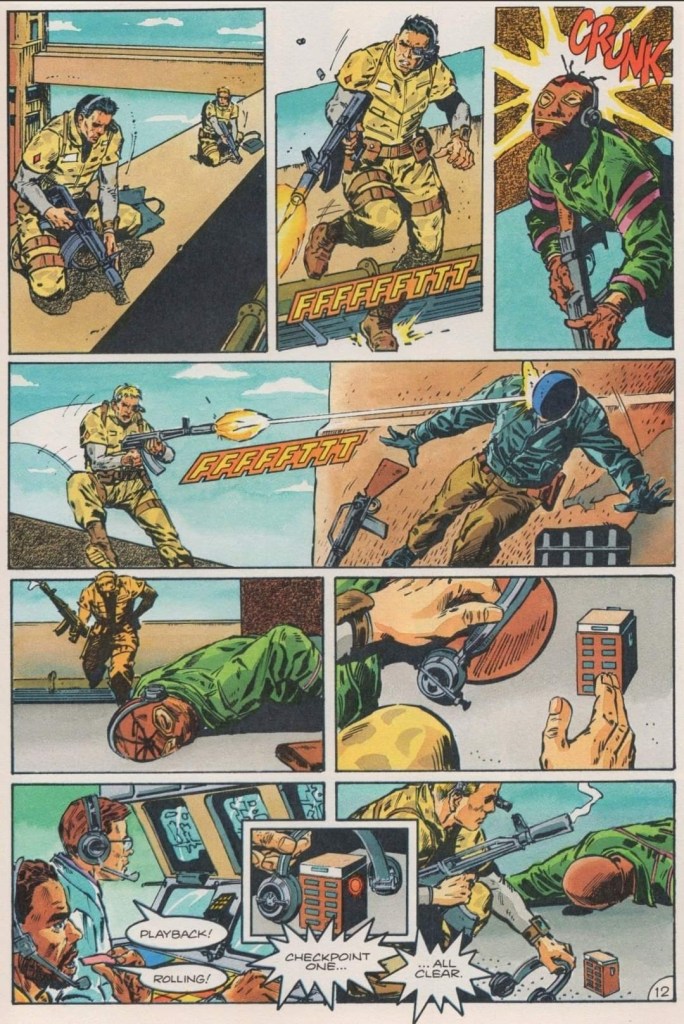
Operating very much like robots, two Universal Soldiers take down terrorists and manipulated their communication as they make their way through to save the hostages from the remaining terrorists.

As an adaptation, I find this comic book a surprisingly accurate translation of the movie’s early part of the story (note: the literary narrative ends when Deveraux leaves with the female reporter). While not 100% of the film’s plot and visual details were captured, this comic book still succeeded in replicating the look, feel and tone of the movie. It is clear that the comic book team had access to the footage of the film and a copy of the screenplay (written by Richard Rothstein, Christopher Leitch and Dean Devlin).

Clint McElroy really stuck close to the film’s plot, the dialogue and the way the characters were portrayed. Again, not 100% of the relevant details were adapted and some liberties were taken but McElroy managed to craft a comic book narrative that was solidly structured, had sufficient details to keep readers oriented and engaged, and ensured the story moved at a satisfying pace. By the time I reached the end of this comic book, I got oriented with the story, the characters and the details shown in between.

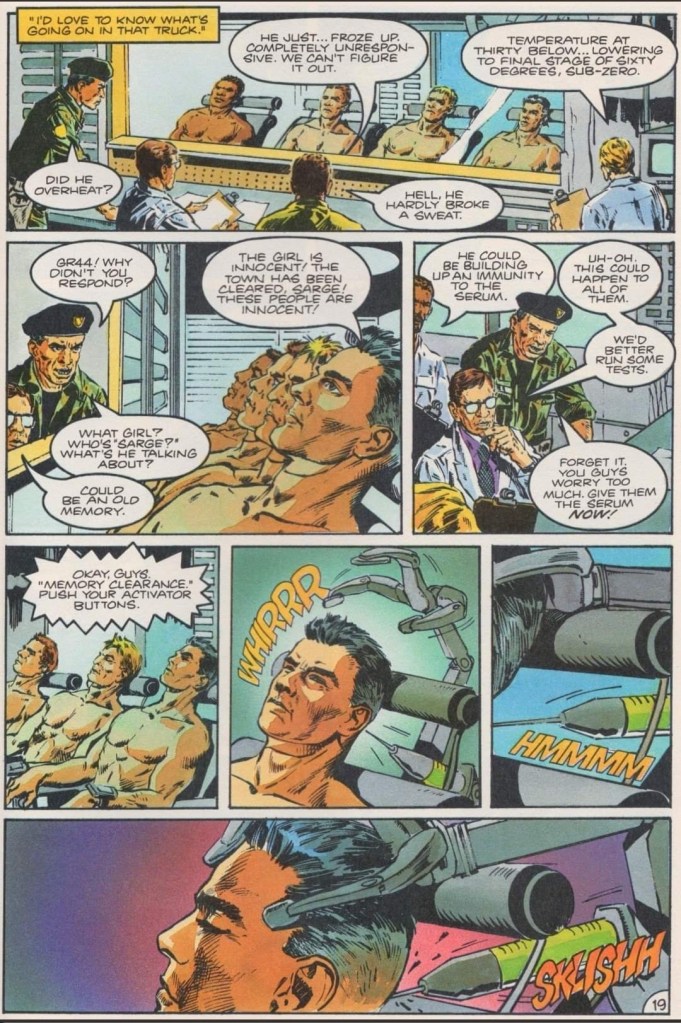
Like in the movie, this comic book emphasizes the government’s very cold and heartless approach on handling their Universal Soldiers who are treated more like tools instead of people.

Lenin Delsol’s artwork here is really good. It is clear that he had access to the film’s production footage as several images of locations and characters here very closely resembled what was shown in the movie most of the time. When it comes to the action scenes, Delsol did not go for visual dynamism (note: the dynamic action style was common with superhero comics of the 1990s) but rather he portrayed the action with realism and varying degrees of brutality.

When it comes to visualizing the characters, it is clear that the creative team was not authorized to use the likenesses of the actors. Luc Deveraux looks absolutely nothing like Jean-Claude Van Damme while journalist Veronica Roberts does not look like Ally Walker. Ironically, there are a few images of Scott’s face that somewhat resembles Dolph Lundgren. The way I see it, it is not problematic to see the characters not resembling the actors from the film. In fact, I like the new character designs Delsol came up with for the characters.

Conclusion

This early scene sets the tone of the entire comic book. As for the characters, Deveraux look nothing like Jean-Claude Van Damme and Sergeant Scott does not look like Dolph Lundgren (note: in other images of Scott shown later in the comic book, he looked a bit like the actor).

Even though I was not a fan of the 1992 movie, Universal Soldier (1992) succeeded in keeping me engaged and entertained until the end. This is a really good adaptation of the early part of the film and I like the approach the Elroy-Densol team took on establishing the literary experience. Of course, if you want more dynamic visuals of the Hoover Dam scene or if you want that strong rated-R vibe when it comes to hard action, you should watch the movie. As of now, I am convinced to look forward to the next issue of this 3-part mini-series adaptation.

Overall, Universal Soldier (1992) is recommended.

+++++

Thank you for reading. If you find this article engaging, please click the like button below, share this article to others and also please consider making a donation to support my publishing. If you are looking for a copywriter to create content for your special project or business, check out my services and my portfolio. Feel free to contact me with a private message. Also please feel free to visit my Facebook page Author Carlo Carrasco and follow me on Twitter at  @HavenorFantasy as well as on Tumblr at https://carlocarrasco.tumblr.com/ and on Instagram at https://www.instagram.com/authorcarlocarrasco
A Look Back at RoboCop 2 #2 (1990)

Welcome back superhero enthusiasts, 1990s arts and culture enthusiasts, Marvel Comics fans and comic book collectors! Today we go back to the year 1990 to take a close look at the 2nd part of the comic book adaptation of the movie RoboCop 2 (1990).

In my previous retro review of Robocop 2 #1, I pointed out that the comic book was not a faithful adaptation of the movie but more of the creators’ creative interpretation of the movie script they had which resulted in a stylized presentation. It was a surprisingly enjoyable reading experience for me.

With those details laid down, here is a look back at RoboCop 2 , published in 1990 by Marvel with a story written by Alan Grant and drawn by Mark Bagley based on the movie screenplay by Frank Miller and Walon Green.

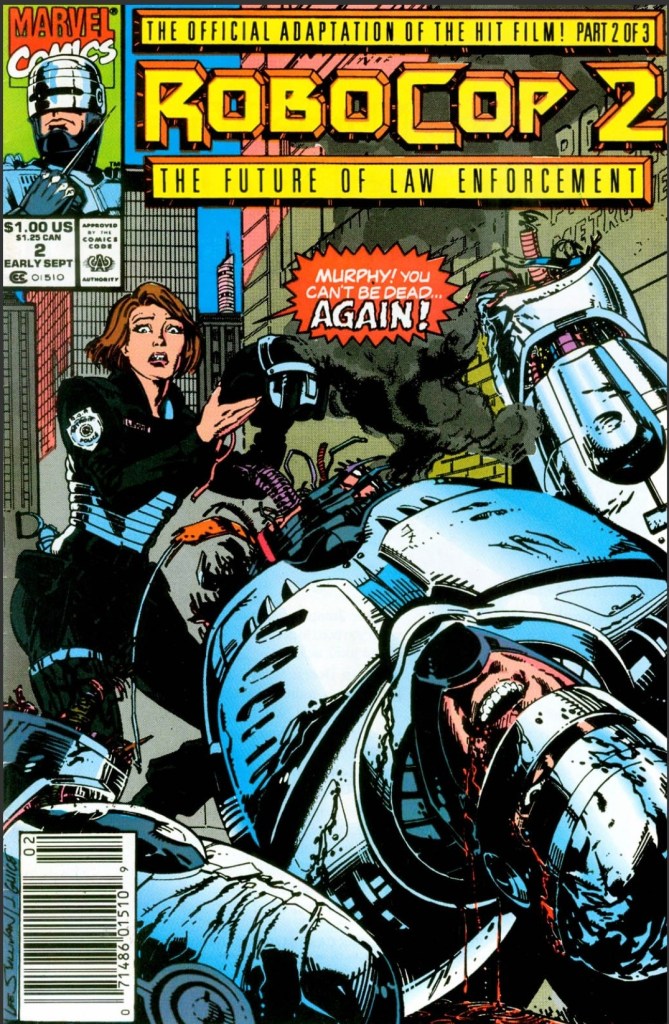
The cover.

Early story

The story begins in Detroit with RoboCop reduced into a very bad condition with most of his parts missing. The cops are still on strike and the ultra-addicting drug Nuke continues to spread through the city causing social problems. Cain and his gang are still on the loose, and his video statement (which emphasizes his gang’s defeat of RoboCop) spreads through the news cycles.

Inside a hideout, Cain and his loyal companions terrify and killed traitorous police officer Duffy for betraying them. Meanwhile at police headquarters, the support crew bumps heads with the Omni Consumer Products (OCP) executive who does not see RoboCop’s poor state as a problem. As far as OCP is concerned, getting replacement parts for RoboCop is very expensive.

Over at OCP, the psychologist executive Dr. Juliette Faxx begins researching criminals for the new RoboCop project…

Quality

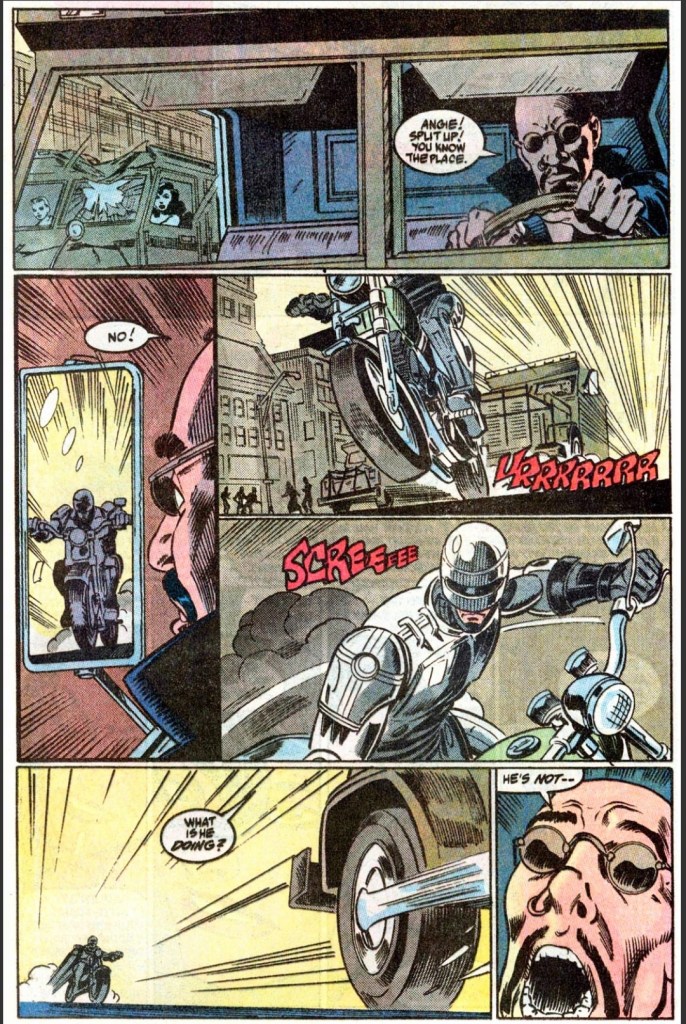
The motorized encounter between RoboCop and Cain here is shorter and much inferior compared to what the movie showed.

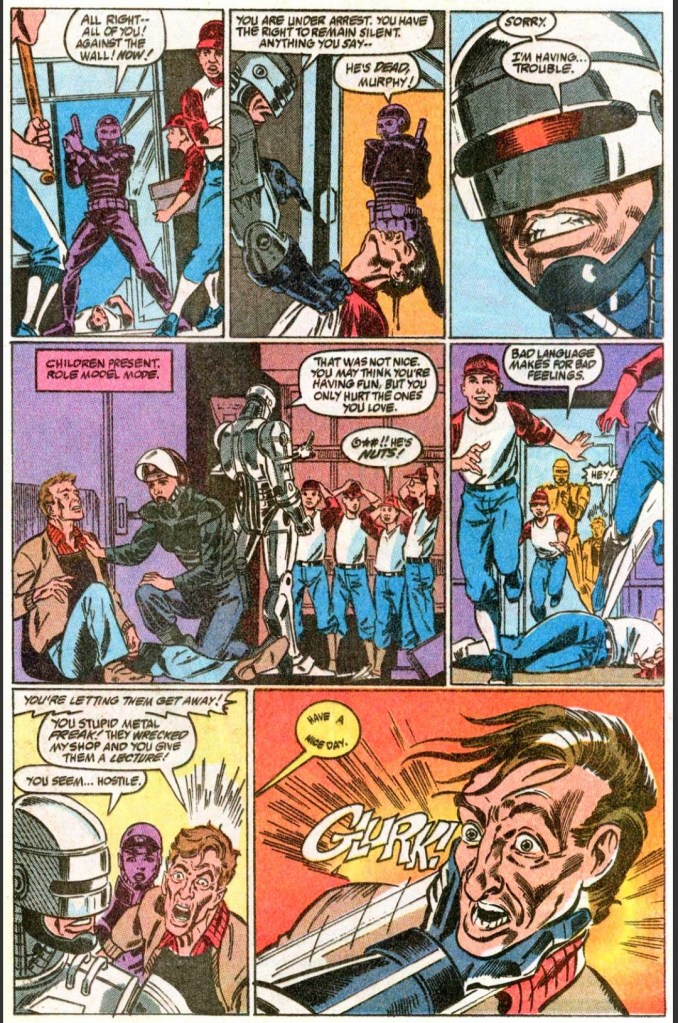
As with issue , this comic book followed the events and scenes of the film but left enough room for the creative team to make their stylized version suitable with the literary format. Mark Bagley, who is best known for drawing Spider-Man and Venom in the 1990s, came up with nice artwork that brought Grant’s script to life. There were a few shots here that were pretty graphic or brutal to see at the time of publication which makes me wonder why did the Comics Code Authority (CCA) give its approval to this comic book.

Without spoiling the plot, I can say that the creative team and editor Gregory Wright did a good job adapting scenes of the movie script to (fill up the pages) while also succeeding in setting up readers for the final conflict in the 3rd and final issue.

As a standalone reading material, this comic book will lead readers deep into the crisis of the police force as well as into the developments behind the closed doors of OCP. Due to the selected scenes of the film’s script, RoboCop has sufficient presence but lacked his normal personality. That being said, the movie’s comedic look of RoboCop acting very out-of-touched (hint: OCP tampered with his mind digitally) did not translate well into literary format. If you’re hoping to see solid storytelling with a consistent tone, you won’t find it here.

When it comes to action, there is just enough of it to keep the reading experience entertaining. Again, this comic book does not have the final conflict and the selected action scenes are rather limiting in terms of impact. If you want to see the police raid of the Nuke facility as well as RoboCop’s motorized chase with Cane, you are better off replaying the movie.  

Conclusion

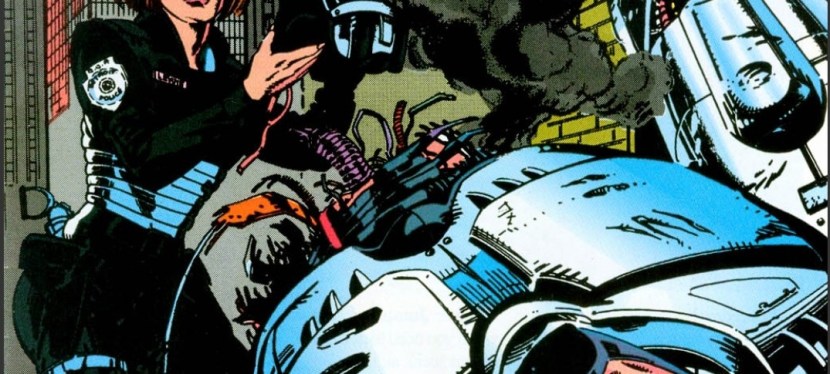
There definitely is something wrong with RoboCop here.

Considering the selected movie script scenes for adaptation, RoboCop 2 (1990) lacks impact compared to the first issue. In fairness, this comic book was clearly meant to set-up readers for the next issue. If there is anything worth looking at within the 2nd issue’s pages, it would be the details that were highlighted during the internal developments at OCP and the police. As mentioned earlier, RoboCop is not his usual self for a significant portion of this comic book. While the engagement and fun factor are lower this time around, I’m still interested to read the next issue.

Overall, RoboCop 2 (1990) is serviceable.

+++++

Thank you for reading. If you find this article engaging, please click the like button below, share this article to others and also please consider making a donation to support my publishing. If you are looking for a copywriter to create content for your special project or business, check out my services and my portfolio. Feel free to contact me with a private message. Also please feel free to visit my Facebook page Author Carlo Carrasco and follow me on Twitter at  @HavenorFantasy as well as on Tumblr at https://carlocarrasco.tumblr.com/ and on Instagram at https://www.instagram.com/authorcarlocarrasco
A Look Back at The Blob (1988)

Welcome back, movie buffs, science fiction fans and geeks! When it comes to making remakes or reimagined versions of established movies from previous decades, the 1980s was indeed a special time to watch them. In 1986, The Fly (directed by David Cronenberg) was released and it made a tremendous impact on moviegoers in ways that the original 1958 movie did not.

Remember when The Blob was first released in 1958? That classic film (read my retro review by clicking here) went on to have a forgettable sequel released in the 1970s but got remade big time with a new version in 1988 simply titled The Blob.

With those details laid down, here is a look back at The Blob, a sci-fi horror movie released in 1988 starring Shawnee Smith and Kevin Dillon, written by Chuck Russell, Frank Darabont, Kaye Linaker and Irving H. Millgate, and directed by Chuck Russell.

The movie poster.

Early story

The story begins in the town of Arborville where many locals attend an exciting football game. High school player Paul (Donovan Leitch, Jr.) asks cheerleader Meg (Shawnee Smith) to a date. Elsewhere, the troubled guy Briann Flagg (Kevin Dillon) fails with his attempted stunt as a result of his flawed motorcycle which was witnessed by an elderly vagabond. Flagg goes back to town and encounters the local sheriff (Jeffrey DeMunn) who warns him about trouble.

That evening at the outskirts of town, a meteorite crashes within the forest which the elderly vagabond pursues. With strong curiosity in his mind, the old man uses a stick on a sizable body of slime mold substance (the blob itself) that came out of the crashed meteor. Suddenly, the substance moves and sticks to the elderly vagabond’s hand causing him great pain.

A short time later in the forest, Brian Flagg got surprised by the sudden appearance of the vagabond who desperately tries cutting off his own hand. The blob, which Brian saw for the first time ever, attaches itself even more on the old man causing him to run away until he gets hit by a car (with Meg and Paul inside)…

Quality

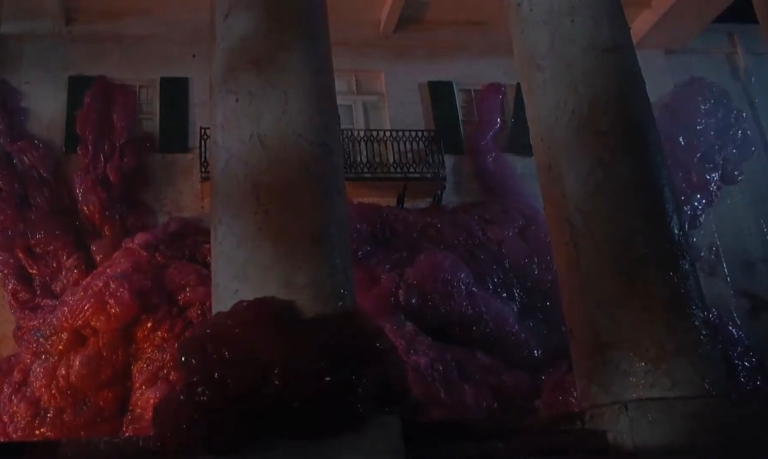
The blob in this movie looks more menacing as it has a tumor look and the special effect work remains excellent to look at. You should also see the blob move and what it sounds like.

This late-1980s remake of The Blob is not only more engaging and more entertaining than its 1958 predecessor…it is easily on of the best sci-fi horror movies of the 1980s thanks to a very talented creative team led by Chuck Russell.

To begin with, Russell and Darabont (this is the same great director behind The Shawshank Redemption), crafted a very solid screenplay that used key story elements from the 1958 classic while successfully updating everything else with 1980s America (or Ronald Reagan’s America) in mind. For this version, the three leading teenagers played by Shawnee Smith, Kevin Dillon and Donovan Leitch, Jr. were relatable and clearly worth following.

(From left to right) Shawnee Smith, Kevin Dillon and Candy Clark in an early encounter with the blob.

While the 1958 movie emphasized American teenagers being disadvantaged as local adults don’t take them seriously (even though the youth knew the problem and intend to solve it), this remake moved away from the generational gap as it strongly focused more on the crisis of a fast-growing blob that simply won’t stop killing people and destroying things. In other words, this is a crisis-focused monster story that is more violent, more horrific, more action-packed and more graphic than its predecessor.

I should also state that Russell and his team established a solid structure for storytelling and the narrative flowed on a medium-to-fast pace. As this movie has more spectacle in terms of action, monster moments and the like, the creative team carefully balanced the fun stuff with the dramatic and exposition scenes smoothly.

If you see people wearing protective suits arriving in your community and implementing a lockdown, you know a crisis is in effect.

The cast here is solid! Shawnee Smith’s Meg is the sweet, young good-natured high school girl who is willing to not only survive but also take part in solving the crisis situation not for herself but for her family and the entire Arborville community. Meg has some common elements with that of the character Sarah Connor from The Terminator and Terminator 2: Judgment Day. I also love the fact that there is NO WOKENESS and NO RABID FEMINIST VALUES in Meg. Kevin Dillon’s Brian – the troubled youth – is clearly the 2nd lead and he does a good job dramatizing how his character changes from a guy of uncertainty into an actual doer whose efforts proved to be valuable. There definitely is a non-romantic chemistry between Meg and Brian as the crisis situation really brought out solid transformations from them respectively.

The supporting cast is really good too. Candy Clark’s Fran is the relatable community diner owner/manager who contributed nicely to the plot as well as the early showdown of the blob. Jeffrey DeMunn’s sheriff is the local law enforcer who has to deal with the local situations while tackling the challenges of his leadership post. Paul McCrane here plays a local cop who is tough but not necessarily abusive, and this is the same guy who played a very vicious bad guy in 1987’s RoboCop! Joe Seneca is the government scientist who has charisma and deception carefully blended together which added to the plot. You will even see Erika Eleniak in a very small and yet notable appearance that happens to involve the blob. This film has a really interesting cast and I encourage you to research the names mentioned here.

This remake is loaded with action scenes, stunts and incredible visual effects!

On the technical side of things, I really like the cinematography done by Mark Irwin as the visuals captured looked really detailed and clear even during the dark or night-time scenes. The music by Michael Hoenig was pretty good too and his tunes ranged nicely from creepy to sentimental and energetic which reflected the scenes. As for the design of the blob, Lyle Conway deserves the credit for making it very monstrous. As for the physical environment of the movie, the state of Louisiana turned out to be a great location and the real-life Louisiana town Abbeville added strongly to the small town concept of the story.

As mentioned earlier, this version has a lot more spectacle to enjoy. For one thing, there is a good amount of hard action, gunfire and stunts which really added to the excitement (on top of the suspense and horror scenes already implemented). Rest assured, you will not get bored at all when watching this.

Shawnee Smith is the protagonist in this movie and her performance is very memorable.

The highlight of the spectacle is the very blob itself which looks so much like a tumor (instead of the jello form in the 1958 version) and the credit goes to the visual effects, sound effects and the animation team behind it all. Compared to its counterpart in the 1958 film, the blob here is very monstrous and horrifying to watch and the way it got animated is excellent. Apart from being unrelenting, this blob is deadlier and even intelligent. Not only does the blob devour the living which adds to its tremendous growth of size and mass, it also has the ability to extend tentacles which added more to the danger. Thanks to the sound effects, the blob is believably animalistic.

Through the blob’s on-screen presence, you can see the hard work implemented by the special effects crew when showing the monster entirely move and devour people, when showing its flexibility on adjusting its size (or its parts) when entering new places through tight spots, and most notably, how the blob alters the flesh of the victims it touches which resulted in very horrifying visuals. The special effects team really excelled with the use of practical effects (read: no computer-generated images) on presenting the titular monster. This is indeed a special effects extravaganza that a lot of people are missing out on.

Conclusion

The Blob (1988) looks and sounds better than ever in 4K Blu-ray format. I highly recommend this version as it is so much better than streaming.

There is no doubt in my mind that The Blob (1988) is a great sci-fi horror film that has a more menacing monster complete with sufficient action, great visual effects and a pretty solid cast! This is indeed a great example of a how a remake of an established film from the past should be done and this also includes raising the stakes within the story, modernizing past cinematic elements and ensuring high entertainment value. What director Russell, his team and the cast collectively achieved is indeed a creative success and this is the kind of film that Commie-filled Hollywood (Commiewood) today does not want to make.

As a companion piece to The Blob (1958), this remake has the good stuff that people who love horror, science fiction, action and monsters will enjoy.

Of all the many movies I have seen, The Blob (1988) stands out as one of the best remakes ever made as well as one of the best mixed-genre movies of its decade as well as of all time. That being said, today is a great time to watch this movie with better-than-ever visuals and sounds through its 4K Blu-ray release (pictured above) which is now available (you can order it online now). There is also a lot of features and extra stuff with the 4K Blu-ray. Make no mistake, The Blob (1988) is great to watch and its replay value is pretty high.

Overall, The Blob (1988) is highly recommended.

+++++

Thank you for reading. If you find this article engaging, please click the like button below, share this article to others and also please consider making a donation to support my publishing. If you are looking for a copywriter to create content for your special project or business, check out my services and my portfolio. Feel free to contact me with a private message. Also please feel free to visit my Facebook page Author Carlo Carrasco and follow me on Twitter at  @HavenorFantasy as well as on Tumblr at https://carlocarrasco.tumblr.com/ and on Instagram at https://www.instagram.com/authorcarlocarrasco
If you wish to join a group of movie enthusiasts and talk about cinema, visit the Movie Fans Worldwide Facebook group at https://www.facebook.com/groups/322857711779576

Better than Streaming: Do you have Die Hard 4K Blu-ray in your collection?

Welcome back, fellow geeks, Blu-ray collectors and movie buffs! As you may have noticed, I am a 4K Blu-ray movie collector and I can say that I really am enjoying watching movies in 4K at the comfort of home with my Xbox Series X console as the 4K Blu-ray player.

When it comes to watching my favorite movies with the best possible video and audio qualities, I always had a grand time replaying Total Recall (1990) on 4K Blu-ray, and I can say the same with replaying the greatest Hollywood action movie ever made – Die Hard (1988)!

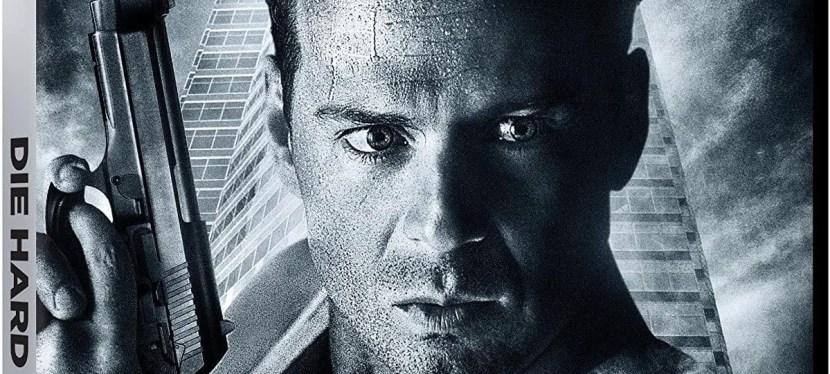
This is my copy of Die Hard 4K Blu-ray.

Back in 2021, I bought myself the 4K Blu-ray copy of Die Hard even though I already have the Blu-ray (1080p) copy. I simply wanted the best possible visuals and home entertainment experience of the classic movie that starred Bruce Willis and was directed by John McTiernan. In my life, I was fortunate to watch Die Hard in the local cinema here in the Philippines way back in 1988 and it was indeed the most thrilling in-theater experience I had as the film drew lots of reactions from all the moviegoers around me (note: this includes a standing ovation during the final conflict between John McClane and Hans Gruber) and its presentation turned out great. Simply put, Die Hard is one of my favorite movies all of time and the greatest Hollywood action movie of all.

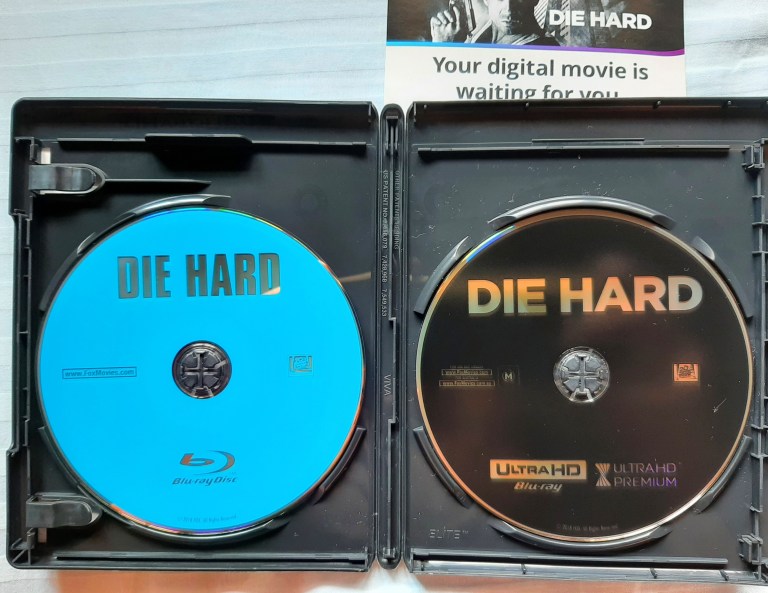
As for Die Hard 4K Blu-ray itself, it came with the 4K Blu-ray disc, the Blu-ray disc and the digital code. I bought it online with a huge discount. Oh yes, the visuals were in native 4K resolution which I always preferred.

To put things in perspective, posted below are the technical details of Die Hard 4K Blu-ray as displayed on its Blu-ray.com page.

Video

Codec: HEVC / H.265 (49.50 Mbps)

Resolution: Native 4K (2160p)

HDR: HDR10

Aspect ratio: 2.39:1

Original aspect ratio: 2.39:1

Audio

English: DTS-HD Master Audio 5.1 (48kHz, 24-bit)

English: DTS-HD Master Audio 2.0 (48kHz, 24-bit)

Spanish: Dolby Digital 5.1

French: DTS 5.1

Spanish: DTS 5.1

German: DTS 5.1

Italian: DTS 5.1

Czech: Dolby Digital 2.0

Polish: Dolby Digital 5.1

Japanese: DTS 5.1

Subtitles – English SDH, French, German, Italian, Japanese, Spanish, Cantonese, Czech, Danish, Dutch, Finnish, Mandarin (Traditional), Norwegian, Polish, Swedish

Discs – 4K Ultra HD, Blu-ray Disc, Two-disc set (1 BD-66, 1 BD-50)

Digital – Digital copy expired, Movies Anywhere

Packaging – Slipcover in original pressing

Playback – 4K Blu-ray: Region free, 2K Blu-ray: Region A

The Blu-ray disc, the 4K Blu-ray disc and the paper for the digital copy.

In my experience watching Die Hard on 4K Blu-ray disc, I noticed there were indeed visual improvements here and there. The film was remastered in 4K and it maintained the cinematic look precisely while it had assorted visual upgrades along the way. There was also a noticeable noise reduction on moments of intense brightness, particularly the explosions (note: they are longer overly bright and their precise colors and shapes became visible) and the fluorescent lights. I also enjoyed how the colors were improved and with the improvements on clarity, the tiny visuals details that were not visible on other formats became visible in 4K.

In connection to the improved visuals, watching Bruce Willis looking so much younger and with a full head of hair turned out to be unique part of the viewing experience. Oh yes, Alan Rickman as Gruber in a fancy looking suit looks better than ever in 4K!

Indeed, watching Die Hard 4K Blu-ray is the best and definitive way to enjoy the 1988 action classic at home. Don’t settle for streaming nor the 1080p Blu-ray nor DVD. Die Hard 4K Blu-ray is the best! If you don’t have it yet in your 4K Blu-ray collection, go for Die Hard 4K Blu-ray while it is still available and currently discounted!

In case you have made up your mind, you can order a copy of Die Hard 4K Blu-ray right now by clicking https://www.amazon.com/Die-Hard-4K-Blu-ray/dp/B07BF2SPZ3?tag=bluray-051-20&linkCode=ogi&th=1&psc=1&m=ATVPDKIKX0DER

If you wish to join a group of movie enthusiasts and talk about cinema, visit the Movie Fans Worldwide Facebook group at https://www.facebook.com/groups/322857711779576

+++++

Thank you for reading. If you find this article engaging, please click the like button below and also please consider sharing this article to others. If you are looking for a copywriter to create content for your special project or business, check out my services and my portfolio. If you want to support my website, please consider making a donation. Feel free to contact me with a private message. Also please feel free to visit my Facebook page Author Carlo Carrasco and follow me on Twitter at  @HavenorFantasy as well as on Tumblr at https://carlocarrasco.tumblr.com/ and on Instagram at https://www.instagram.com/authorcarlocarrasco/.

Better than Streaming: Police Story 3: Supercop 4K Blu-ray set for December 13, 2022 release

Welcome back fellow geeks, Blu-ray collectors and movie buffs! When it comes to cinematic martial arts and stunt works that are thrilling to watch, I can say Hong Kong action filmmakers and performers really stand out. More notably, Jackie Chan and Michelle Yeoh are the cinematic icons of Asia whose decades-old works remain memorable to this day.

That being said, if you are fond of Jackie Chan and Michelle Yeoh, and if you want something really fun to add to your collection of 4K Blu-ray movies, then you should get ready for the release of the 4K Blu-ray of the 1992 Hong Kong action film Police Story 3: Supercop (also referred to as Police Story III: Supercop) which has been set for December 13, 2022. The good news here is that advanced orders of Police Story 3: Supercop 4K Blu-ray are being accepted already. You can order it right now by clicking here.

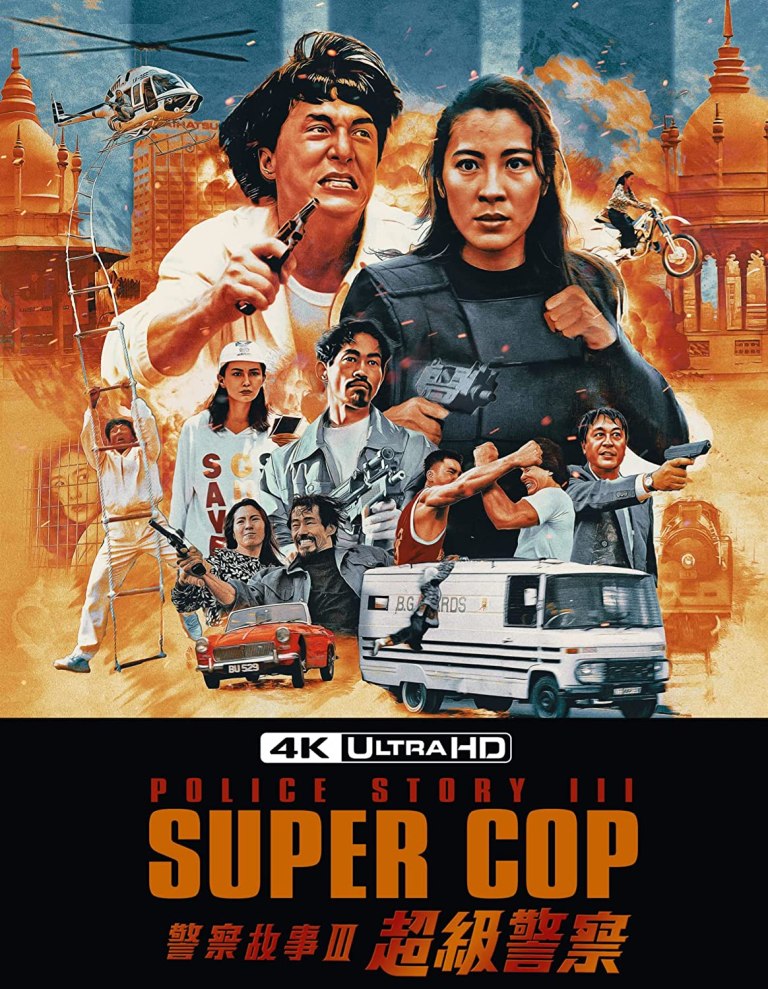
The 4K Blu-ray cover.

For the details of Police Story 3: Supercop 4K Blu-ray, posted below are technical stuff sourced from its Blu-ray.com page.

Video

Codec: HEVC / H.265

Resolution: 4K (2160p)

HDR: Dolby Vision, HDR10

Original aspect ratio: 2.39:1

Audio – TBA

Subtitles – English, English SDH

Discs – 4K Ultra HD, Blu-ray Disc, Single disc (1 BD)

Packaging – Reversible cover

Playback – 4K Blu-ray: Region free, 2K Blu-ray: Region A

Police Story 3: Supercop 4K Blu-ray will come with extra stuff and key features. Check out the official product trailer below…

I personally am interested in this upcoming 4K Blu-ray of the movie that had Jackie Chan and Michelle Yeoh as the stars. For one thing, I only saw the Dimension Films version released in 1996 simply titled Supercop and that version had some content of the original Hong Kong version cut out. I am also interested in the extra stuff related to the dangerous stunts Chan and Yeoh pulled off while making the film. Other aspects of the film’s production, which includes filming in Malaysia, are something I would like to see.  

As for the movie itself, it has a lot of thrills and to watch them – as well as Jackie Chan and Michelle Yeoh themselves – again in 4K is something to look out for. On the aspects of story and continuity, this 1992 movie was the 2nd sequel to the original Police Story (1985) movie that I saw long time ago on home video. Filled with lots of action, very dangerous stunts (note: Chan doing the dangerous pole stunt with exploding electric lights inside a shopping mall was the definitive stunt to see) and car chases, Police Story became successful and spawned sequels. Police Story 3: Supercop had Chan working with Michelle Yeoh (note: this was her comeback) and in my view, they had fine chemistry together and proved how great they are with fighting and stunt work. No computer-generated images here as the action and stunts were really done by the stars with high risk and danger. Chan and Yeoh are movie legends now and their team-up in 1992 is alone a solid reason to anticipate the 4K Blu-ray release.

Asian region movie poster of Police Story 3: Supercop.

Watch out for Police Story 3: Supercop 4K Blu-ray on December 13, 2022.

In closing this Better than Streaming piece, posted below are Police Story 3: Supercop-related videos and some videos related to Jackie Chan and Michelle Yeoh.

+++++

Thank you for reading. If you find this article engaging, please click the like button below, share this article to others and also please consider making a donation to support my publishing. If you are looking for a copywriter to create content for your special project or business, check out my services and my portfolio. Feel free to contact me with a private message. Also please feel free to visit my Facebook page Author Carlo Carrasco and follow me on Twitter at  @HavenorFantasy as well as on Tumblr at https://carlocarrasco.tumblr.com/ and on Instagram at https://www.instagram.com/authorcarlocarrasco
A Look Back at On Deadly Ground

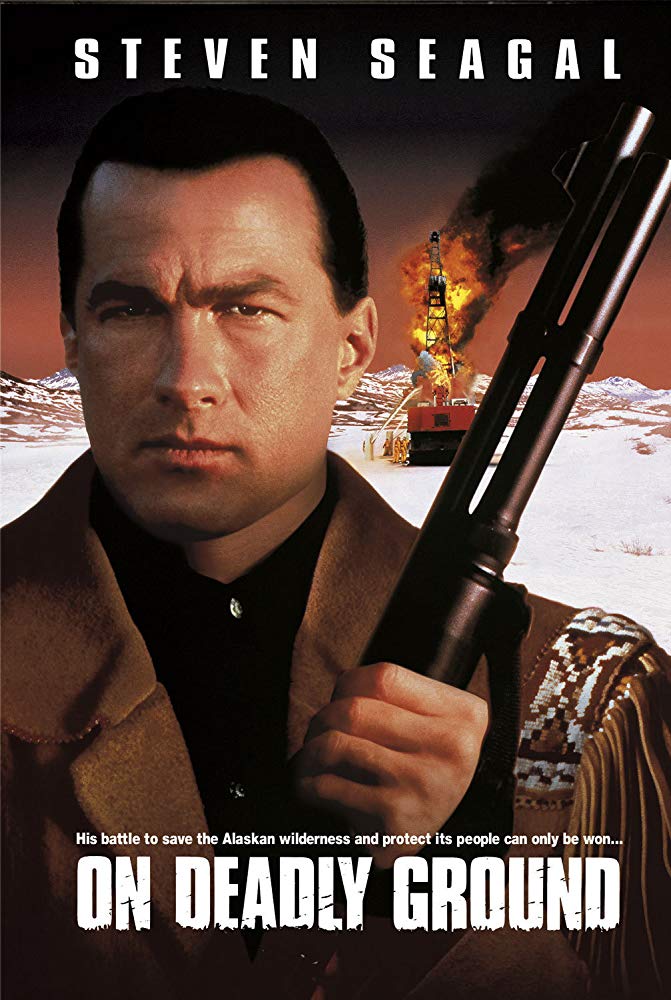
Way back in 1994, Warner Bros. released the action movie On Deadly Ground which marked the directorial debut of its star Steven Seagal. The movie had a poster that easily attracted the attention of avid Steven Seagal fans and eventually the film lured quite a lot of moviegoers to the cinemas.

ODG1
Even though it had a boring design, this image at cinemas excited Steven Seagal fans and moviegoers craving for action.

I never saw it in the cinemas due to a lack of time and money. Instead I saw On Deadly Ground on VHS format (and later on cable TV) in the comfort of home. That comfort however turned into disappointment after watching it.

For starters it’s a Steven Seagal movie which guarantees lots of hard-hitting action with lots of swearing. What makes it feel unique was its focus of the environment and its very forced concept about a very greedy top executive of an oil company is creating danger towards the environment as his team rushes to complete an oil rig called Aegis One in Alaska.

The execution of the movie, to say the least, is rather poor. Just about every character in the movie is one-dimensional. When it comes to action, it is typical (and very predictable) Seagal as the star gets to fight lots of bad guys without ever being hurt by them! Ironically Seagal in the film expresses pain over the treatment of his wounds.

ODG6
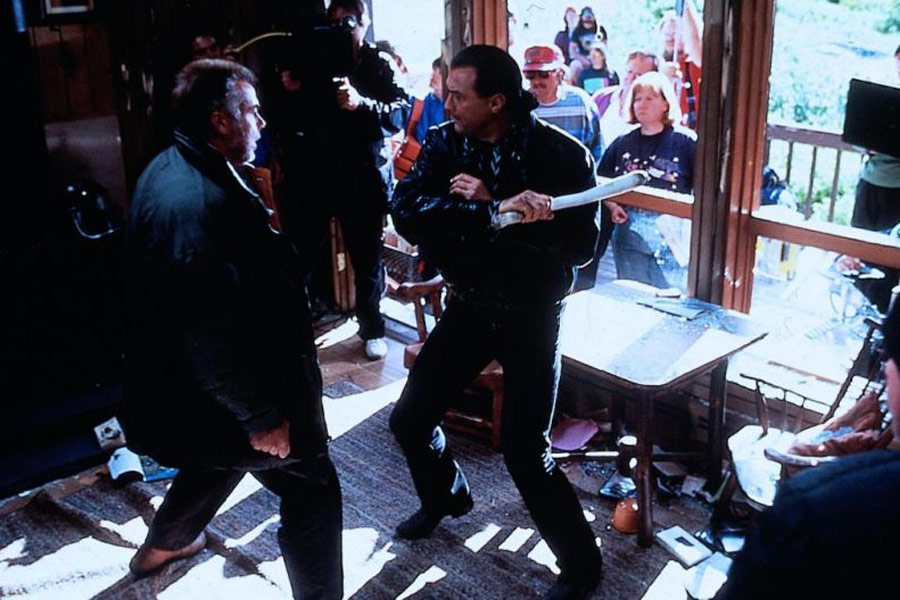
Star-director Steven Seagal and the film crew working on an action sequence.

And then there is the emphasis on the environment. The movie narrowly portrays the fictional oil company as the force of danger to nature and threat to indigenous people of Alaska because it is led by Michael Jennings (played by Michael Caine) who is too greedy and desperate to beat a deadline  and prevent the oil rights from reverting back to native Alaskans.

That’s right! Jenning’s Aegis had the oil rights for twenty years and all they could do is try to launch an oil refinery so near the end of the time period. Does it really take that long to construct an oil rig? What exactly did Jennings do during those twenty years? I mean, he acquired the oil rights from the natives and I could speculate he did not prioritize the construction of any oil-related business project using those same rights. Perhaps Jennings spent years touring the world, suddenly was advised that his corporation has financial trouble and only then did he go to work to make oil rig.

More on the environment, Steven Seagal plays Forrest Taft who initially serves Jennings. He eventually checks the computers of the company to find out that faulty equipment has been used and the delivery of better and more reliable equipment is coming in way too late. Taft even asked Jennings (who eventually learned about Taft’s unauthorized computer access) how much money is enough and this predictably leads to a scene in which Taft gets set up to die in an explosion.

ODG2
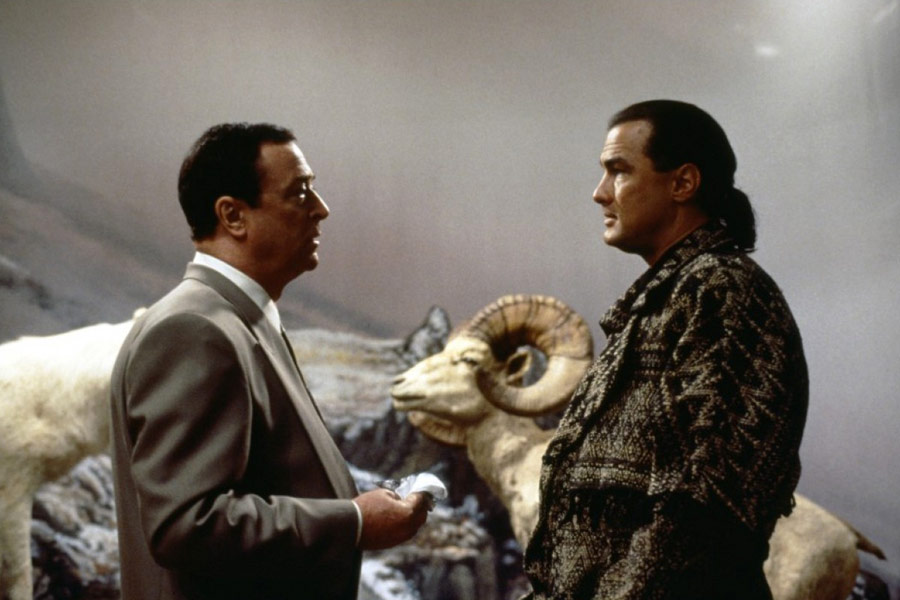
Michael Caine and Steven Seagal.

Unfortunately for Jennings and the other bad guys, Taft survived and got assistance from native Alaskans. Very predictably, he makes a comeback, collects weapons, performed a few destructive operations before proceeding to Aegis Oil’s rig to cause further destruction and kill bad guys!

Then the film ends with Taft giving a speech at the Alaska State Capitol focused on uncontrolled pollution, environmental destruction and big businesses’ contribution to environmental decline.

ODG4
Chinese actress Joan Chen pretending to be a native tribe member.

It’s funny how Taft got to deliver his speech. He was not arrested for causing the oil rig’s devastation nor was held accountable for killing other people. Where were the local authorities who could have initiated an investigation? Even without Michael Jennings, the oil company could have gone to the local authorities or the federal government to accuse Forrest Taft for murder and even acts of terrorism! Also where in the world are those staunch, loudmouth environmental activists, SJWs and climate change activists? The damage caused by Taft on the oil rig clearly caused damage to the natural environment with those toxic fumes from the explosions! Logic was clearly thrown out for the sake of senseless violence.

When it comes to performances, this movie is a showcase of shallow acting and cinematic expressions. Not only are the characters one-dimensional and the script really had no character development, the actors really had no where to go as far as acting is concerned. Chinese actress Joan Chen plays Masu who only serves as the English-speaking expository dialogue delivery person to help the audience understand the norms and concerns of a native tribe. Shari Shattuck  (who is an author and has her own Facebook page) played the pretty, bland and straight-forward special assistant to Michael Jennings. R. Lee Ermey, who is best known for playing military officers, plays the leader of a group of mercenaries who got defeated too easily by Seagal.

In terms of directing and overall presentation, this movie is clearly nothing more than a vanity project of Steven Seagal. There were many moments in the film that looked like it suggested viewers to worship and idolize Seagal. The pacing of the film is very lackluster overall.

Poorly directed scenes? One of them is the excessively violent torture scene of Hugh Palmer (played by a then 73-year-old Richard Hamilton) which showed no restraint on the part of filmmakers. The scene, which was clearly designed to make moviegoers see the evil of Michael Jennings through the acts of his henchmen, would have worked better had the on-screen torture been reduced and shortened.

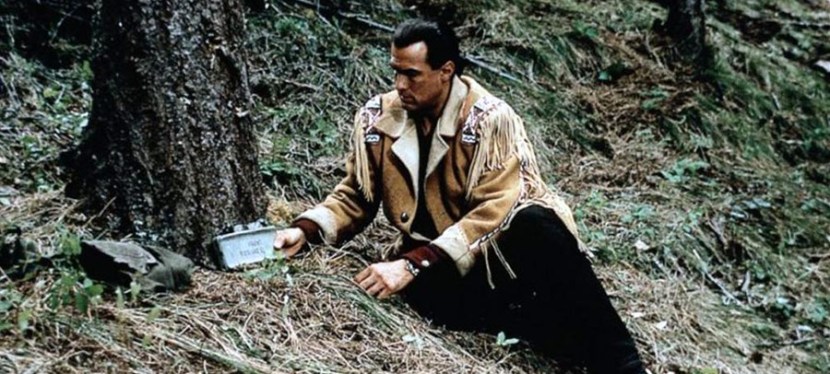
More on the movie’s violence, the scene showing Forrest Taft easily beating up multiple oil workers in response to the mistreatment towards a native man was unnecessary and overly long. Taft looked more like a senseless superhero who does not care about humanity and laws. And then there was that hand-slap game between him and “the man’s man” Big Mike (Mike Starr). The presentation of violence and bloodily injuring a man as means of enlightenment is senseless.

Ultimately On Deadly Ground is a worthless action to film to watch and I believe only die-hard Steven Seagal fans will love it. It was a very bad movie back in 1994, it’s even worse by today’s standards. On Deadly Ground is filled with bad ideas turned into film. A pro-environment concept presented as a senseless action film is a big waste. And then there is the old stereotype that a giant corporation’s head is unabashedly evil, inhuman and greedy (note: not all corporate heads of billion-dollar corporations are like that).

As such, I should say that you should never waste your time nor your money on this piece of crap.

+++

Note: This retro movie review was originally published at my old blog Geeks and Villagers. What you just read was the updated and expanded version. As such, this retro movie review is the most definitive version.


Thank you for reading. If you find this article engaging, please click the like button below and also please consider sharing this article to others. Also my fantasy book The World of Havenor is still available in paperback and e-book format. If you are looking for a copywriter to create content for your special project or business, check out my services and my portfolio. Feel free to contact me as well. Also please feel free to visit my Facebook page Author Carlo Carrasco and follow me at HavenorFantasy@twitter.com