Disclaimer: This is my original work with details sourced from reading the comic book and doing personal research. Anyone who wants to use this article, in part or in whole, needs to secure first my permission and agree to cite me as the source and author. Let it be known that any unauthorized use of this article will constrain the author to pursue the remedies under R.A. No. 8293, the Revised Penal Code, and/or all applicable legal actions under the laws of the Philippines.
Having seen Wonder Woman in cinemas in 2017 and having reviewed the comic book Wonder Woman #6 of 1987 recently, I can say that I enjoyed the two different battles between the Queen of Superheroes and the war deity Ares. Both battles had their respective styles of art and presentation and there were a few similarities between them.
I like both conflicts equally and that’s in relation to very different formats used – cinematic and comic book. Also, the Wonder Woman-Ares battles served as effective story turning points on both the big screen and the comic book. In the case of the Post-Crisis era of DC Comics, the major battle was the climax of the brewing, global military aggression (due to Ares influencing people of man’s world to destroy each other) in which Wonder Woman got involved not only with the Cold War but also with the connections between man’s world, Themyscira and Olympus.
That being said, now is time to move forward with the Post-Crisis Wonder Woman saga with this look back at Wonder Woman #7, published in 1987 by DC Comics with a story co-written by George Perez and Len Wein. Perez drew the story which was inked by Bruce D. Patterson.
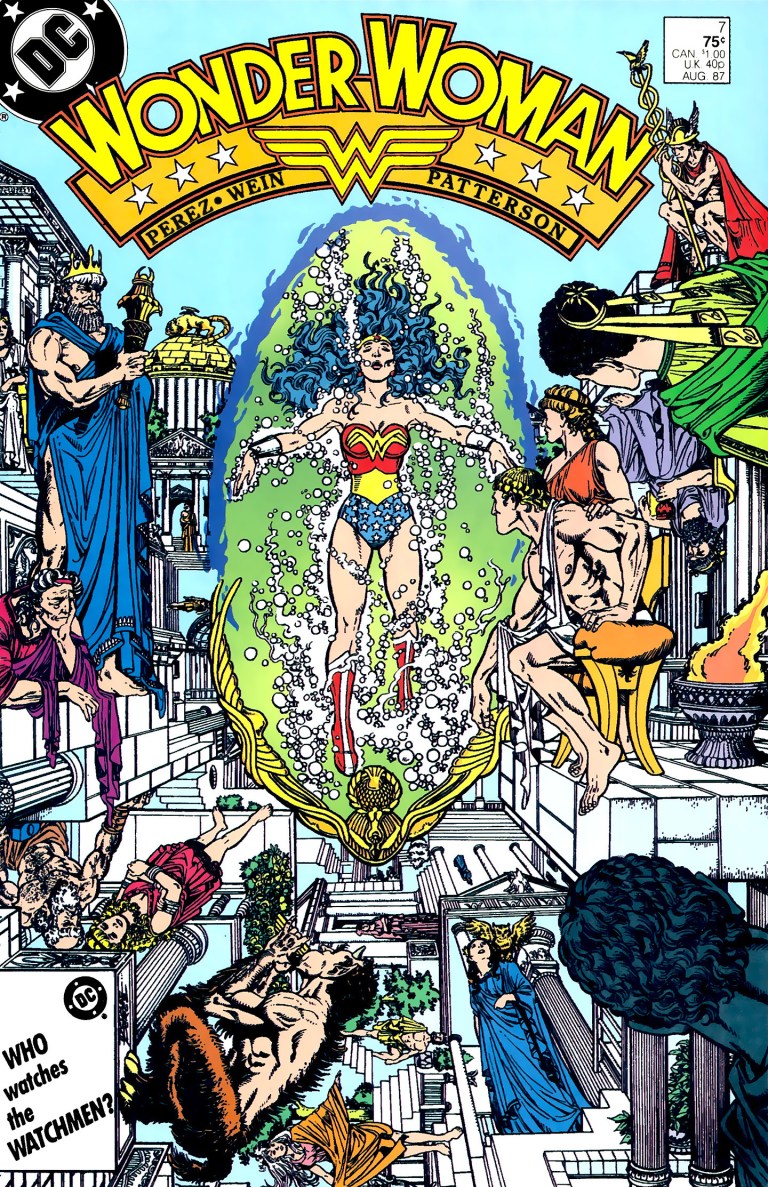
The cover.
Early story
The story begins in Olympus with Hermes spreading the news that the threat by Ares has ended. Zeus declares the news are true and issues a decree of a feast of celebration. The others smiled in reaction. As others make merry to the music of the spheres, Athena reminds Zeus that Prince Diana/Wonder Woman lies at death’s threshold emphasizing the her victory of Ares came at such a high price. Realizing the Amazons’ value, Zeus decides to keep a closer look at them.
Over at Themyscira, the Amazons (under the watch of Queen Hippolyte) perform a ritual of revival for their fallen sister Diana. They noticed no progress has been made. From high above, Zeus and his fellow deities watch…
Quality
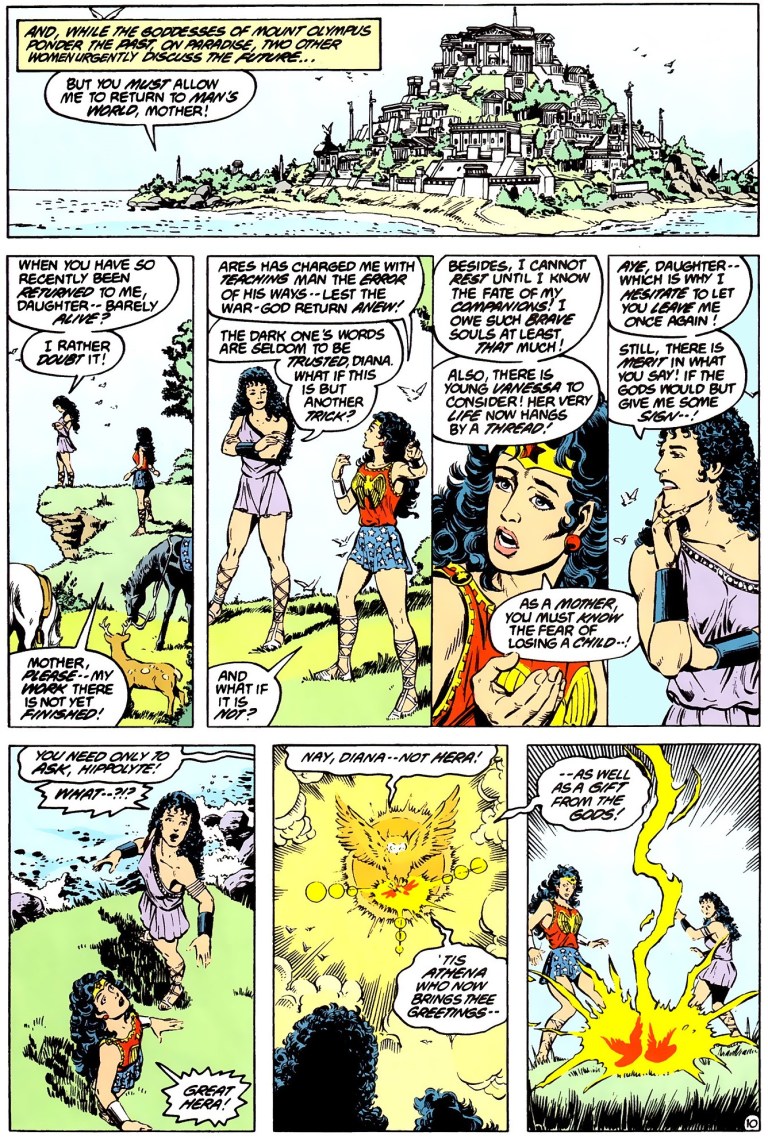
A mother-daughter scene.
Top-notch quality once again achieved by the creative team led by George Perez and Len Wein. While the previous two issues had high fantasy concepts with battles as the highlights, Wonder Woman #7 is much more character-driven showing Wonder Woman’s recovery from the great battle and how the Greek deities’ view of the Amazons changed as a result of Ares’ defeat. Specifically, there is a lot of richness emphasizing Wonder Woman’s continued development as the daughter of Queen Hippolyte and as the continued doer of missions as her people’s representative in man’s world. I also like the way the comic book creators explored the divisions between the deities of Olympus.
Without spoiling all the details, this story resolved the crisis on the part of Vanessa, the young daughter of Julia Kapatelis and it also added to Diana’s evolution as a loving and caring superhero. The academic professional Julia – who has grown into a close friend of Wonder Woman’s – also was developed nicely here. And then there is the introduction of someone who is very savvy with the media.
In stark contrast to issues #4, #5 and #6, Wonder Woman #7 does not have any superhero action as it was much more focused on character development. That’s not to say that it is all just characters talking several lines of dialogue and looking dramatic. This story still has that epic fantasy look as it provides readers a good look at Olympus. This comic book really pushed the narrative far more than the three previous issues.
Conclusion
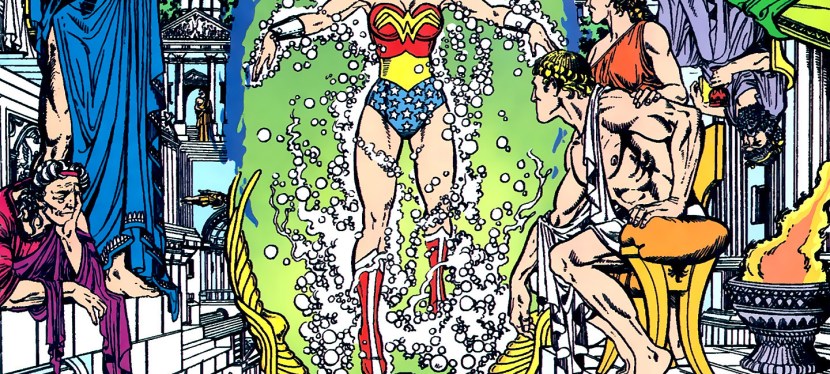
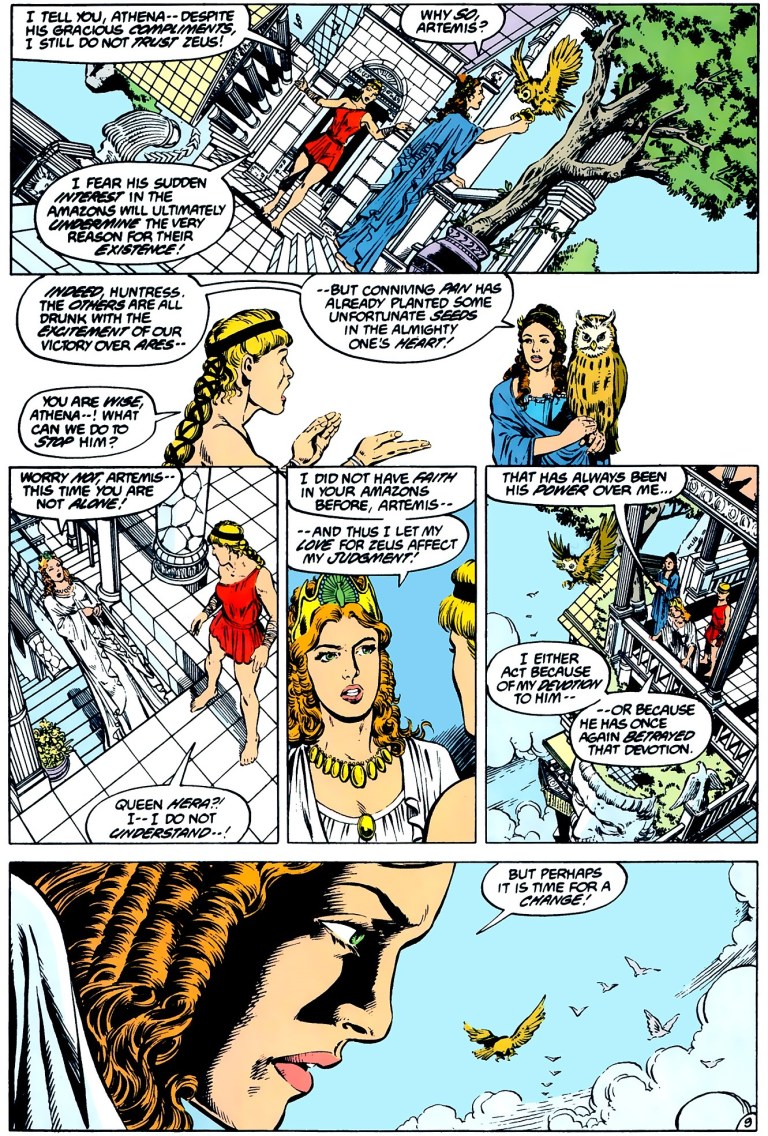
The deities in the spiritual realm.
Another great comic book this truly is. Then again, it should not be a surprise at all considering the great talents of George Perez and Len Wein combined. By the time I finished reviewing Wonder Woman #7, I am convinced that the creative team in-charge of this Post-Crisis version of the Queen of Superheroes not only worked with a high level of confidence but also carefully crafted their plans on reintroducing Wonder Woman with the 1980s in mind and making her much more relevant with the public. Storywise, this comic book marks a turning point in the Wonder Woman monthly series.
Other than being another great Wonder Woman story, Wonder Woman #7also marks the first-ever appearance of Dr. Barbara Minerva (in civilian form specifically) who would later become the Post-Crisis era’s Cheetah a few issues later. For the newcomers reading this, Barbara Minerva/Cheetah was portrayed by Kristen Wiig in the upcoming superhero movie Wonder Woman 1984. With regards to that movie, reading Wonder Woman #9 is a must!
If you are seriously planning to buy an existing hard copy of Wonder Woman #7 (1987), be aware that as of this writing, MileHighComics.com shows that the near-mint copy of the regular edition costs $77 while the near-mint copy of the newsstand edition costs $153.
Overall, Wonder Woman #7 (1987) is highly recommended!
Thank you for reading. If you find this article engaging, please click the like button below and also please consider sharing this article to others. If you are looking for a copywriter to create content for your special project or business, check out my services and my portfolio. Feel free to contact me as well. Also please feel free to visit my Facebook page Author Carlo Carrasco and follow me at HavenorFantasy@twitter.com
Disclaimer: This is my original work with details sourced from reading the comic book and doing personal research. Anyone who wants to use this article, in part or in whole, needs to secure first my permission and agree to cite me as the source and author. Let it be known that any unauthorized use of this article will constrain the author to pursue the remedies under R.A. No. 8293, the Revised Penal Code, and/or all applicable legal actions under the laws of the Philippines.
Action Comics #544 was, indeed, a very memorable comic book to read. For a comic book about Superman and the celebration of his 45th anniversary, Action Comics #544 was more about the drastic reform (and improvement) of the super villains Lex Luthor (gaining a powered suit of armor) and Brainiac (becoming fully robotic). That particular issue ended with Superman actually getting defeated and knocked down during his first encounter with the now metallic Brainiac (who also had a huge squid-like space ship of his own).
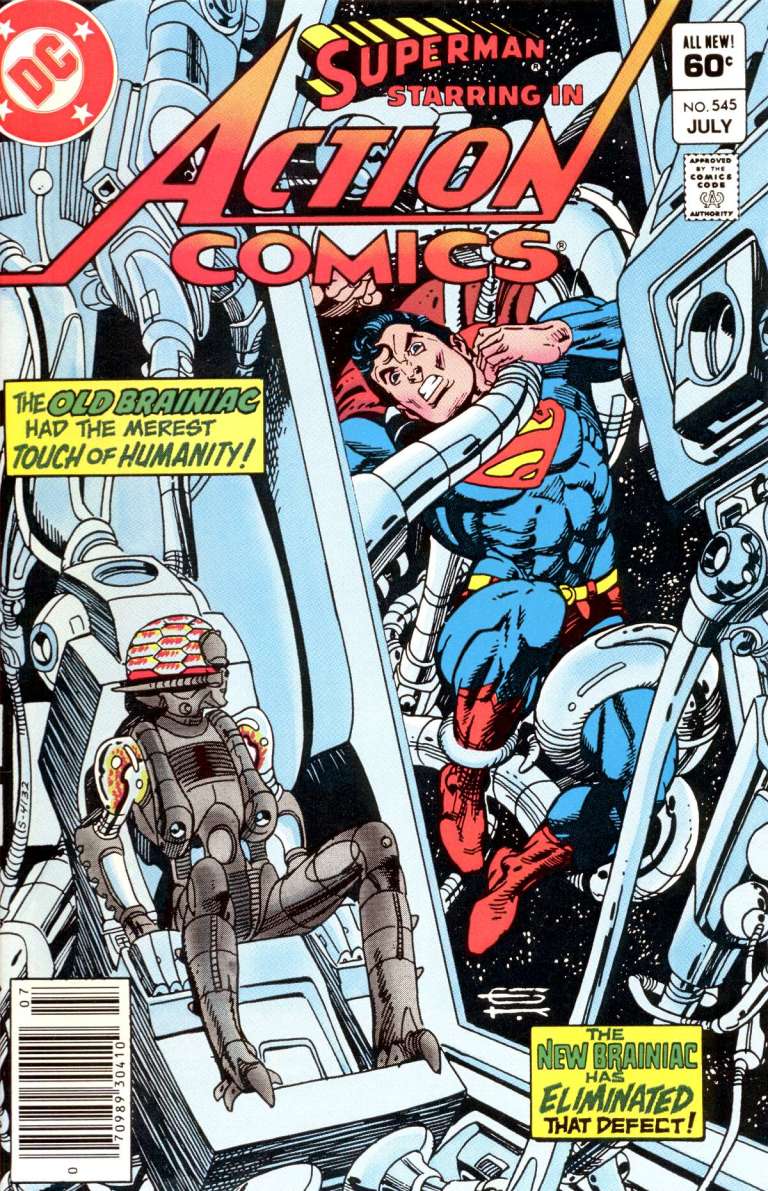
The story continues with this look back at Action Comics #545, published by DC Comics in 1983 with a story written by Marv Wolfman and illustrated by Gil Kane.
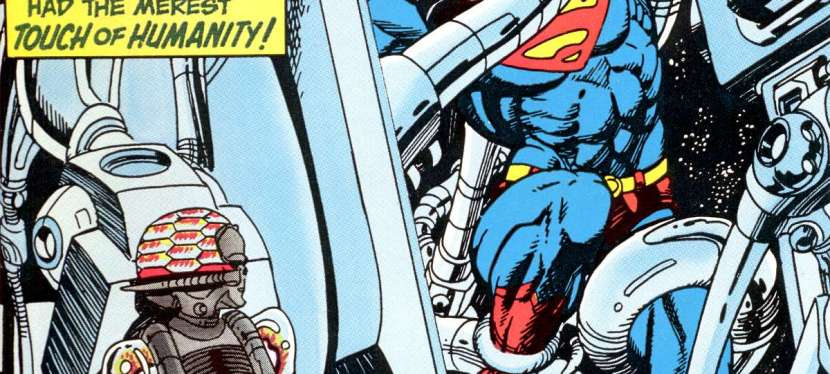
The cover.
Early story
The story begins with Superman already down on the ground on an alien world in the presence of Brainiac and the strange beings (natives of the planet) standing near him. Braniac explains to him that his red-sun missile brought him down and states: With but the merest thought I can and will destroy you! For only with your death can I be victorious in my battle against he-who-created-us-all! With you dead, this universe and all others will be mine to rule!
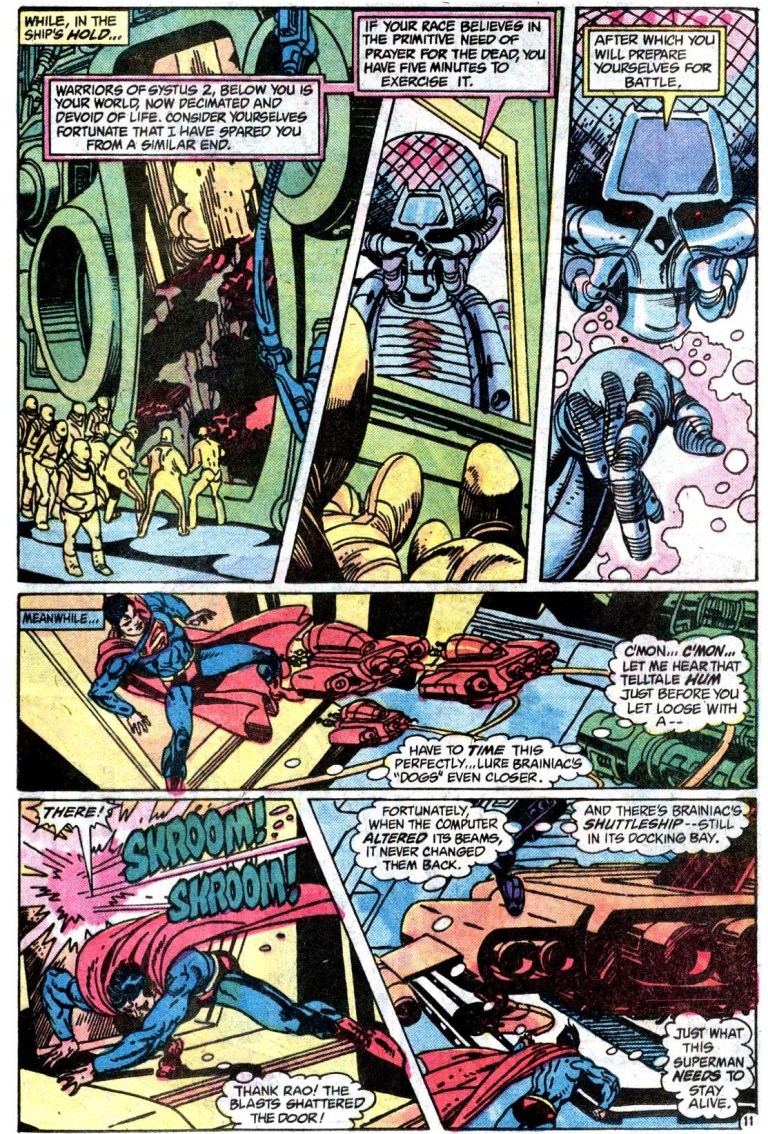
After much talking, Brainiac puts the weakened Superman into his small ship and brings into him the main ship (Brainiac’s flyer). Before departing, Brainiac’s flyer fires a powerful blast killing many of the planet’s natives.
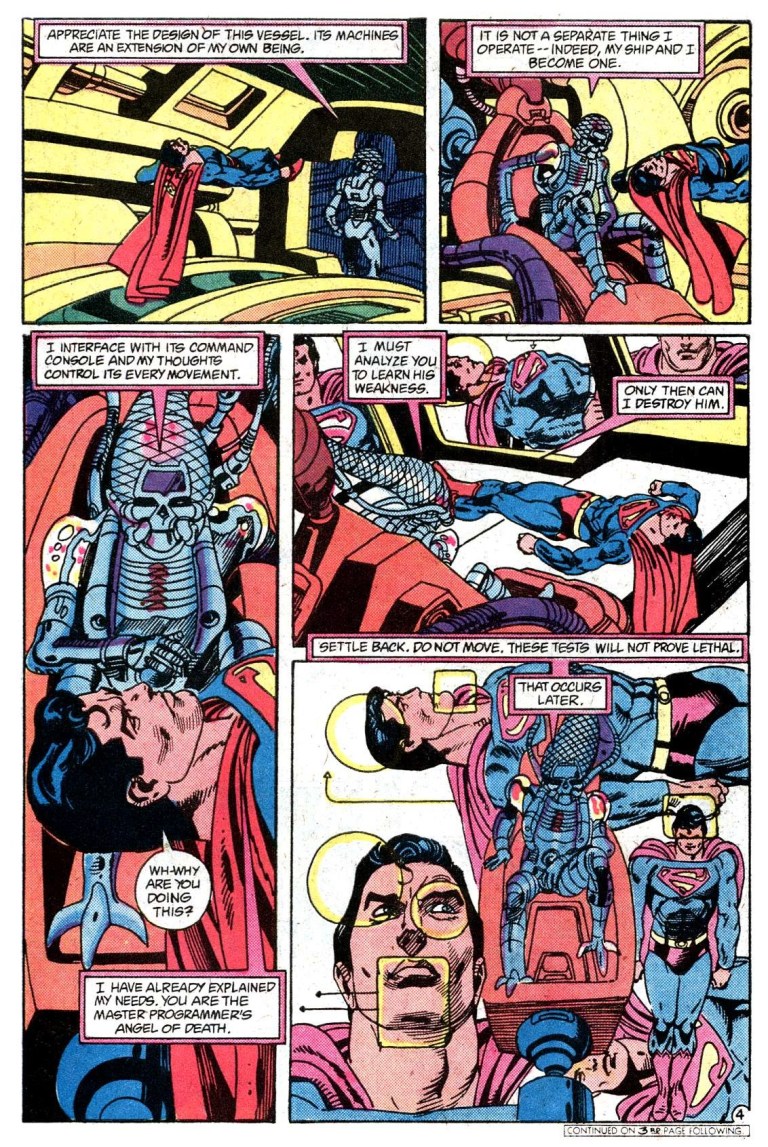
Superman is conscious but is too weak to get up. Brainiac then starts analyzing him using his ship’s state-of-the-art equipment…
Quality
The new Brainiac’s power is felt all over.
Let me start with the story. Written by the legendary Marv Wolfman (who went on to author Crisis on Infinite Earths), Action Comics #545 is the highly compelling extension of the first encounter between Superman and the highly enhanced Brainiac. Continuing from the events that took place in issue #544, this comic book further emphasizes Brainiac’s new technology and new capabilities complete with revisions in his programming which make him even deadlier than his previous form. While Brainiac is cold and very calculating like a computer, there are still threads of humanity in him, mainly in the form of expressions.
Along the way, Superman is portrayed to be very vulnerable and in more danger than usual. The situation is so bad for him, Superman realizes that attacking Brainiac would be suicidal. Since he could not afford to take the risk to defeat Brainiac, the Man of Steel relied more on his instinct and observations to solve problems.
On the art, Gil Kane delivered pretty good visuals. While his take on Superman makes the icon recognizable, it is his art on Brainiac and the futuristic technologies that really shined. Even by today’s standards of comic book art and sci-fi concepts, Brainiac, his ship and all other forms of technology still look futuristic!
Conclusion
A very vulnerable Superman being scanned by Brainiac.
Very entertaining and compelling! That’s how I describe Action Comics #545 and it definitely is a great continuation of the Brainiac story that was featured in issue #544. Lots of action spectacle and intrigue all through the story. While Brainiac’s new abilities and revamped personality were compelling to read, it should be noted that Superman in this comic book thinks more, becomes more strategic and makes decisions knowing he has been weakened. This is a Superman who strives to survive.
As for Brainiac, this comic book shows his rise as one of the premier super villains of DC Comics leading to the events of Crisis on Infinite Earths. The ending here has a very powerful image!
If you are seriously planning to buy an existing hard copy of Action Comics #545, be aware that as of this writing, MileHighComics.com shows that the near-mint copy of the regular edition costs $18 while the near-mint copy of the newsstand edition costs $36.
Overall, Action Comics #545 is highly recommended!
Thank you for reading. If you find this article engaging, please click the like button below and also please consider sharing this article to others. If you are looking for a copywriter to create content for your special project or business, check out my services and my portfolio. Feel free to contact me as well. Also please feel free to visit my Facebook page Author Carlo Carrasco and follow me at HavenorFantasy@twitter.com
Disclaimer: This is my original work with details sourced from reading the comic book and doing personal research. Anyone who wants to use this article, in part or in whole, needs to secure first my permission and agree to cite me as the source and author. Let it be known that any unauthorized use of this article will constrain the author to pursue the remedies under R.A. No. 8293, the Revised Penal Code, and/or all applicable legal actions under the laws of the Philippines.
Right from the start, I got hooked with The Strangers and kept on anticipating the next stories. When it comes to superhero comic books, I am fond of superhero teams like the X-Men, the Teen Titans, Freex, Justice League and WildC.A.T.s
One of the things I enjoyed most from The Strangers #1, which was one of the launch titles of the Ultraverse, was the characterization. Each member of the Strangers was efficiently introduced and his/her uniqueness (apart from having a special ability) caught my attention. And then there was the plot structure that kept me reading for more.
When it comes to the very good quality of storytelling and characterization in The Strangers #1, it should not be much of a surprise since the author Steve Englehart worked on Marvel’s The Avengers, The Defenders and the West Coast Avengers. Englehart also wrote Justice League of America for DC Comics.
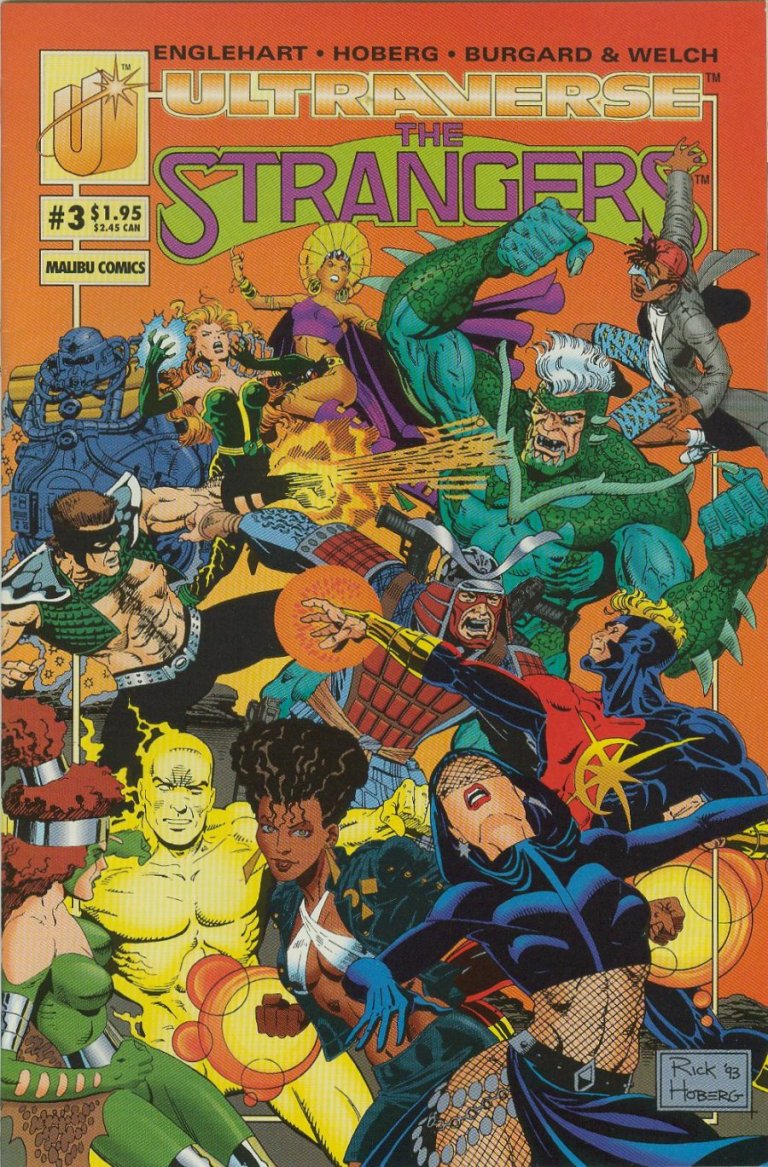
With that short history lesson done, we can now take a look back at The Strangers #3, published in 1993 by Malibu Comics with a story written by Steve Englehart and illustrated by Rick Hoberg.
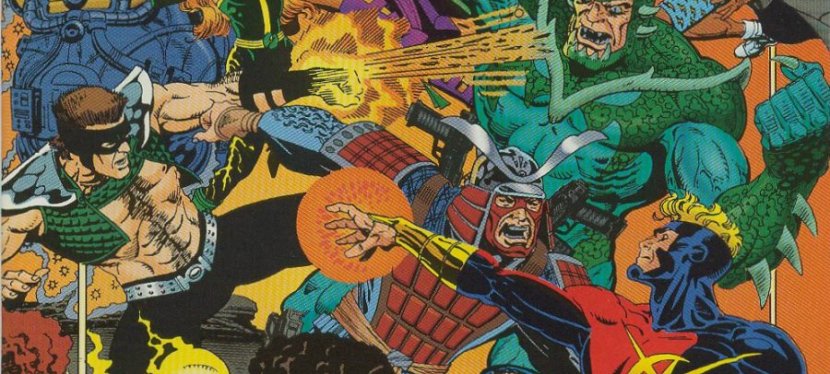
The cover.
Early story
The story begins with the Stangers already in battle with a group called TNTNT composed of Tyrannosaur, Naiad, Torso, Neu-Ronnie and Tugun. The heroic ultras find themselves struggling with their opponents. Just as Tyrannosaur punches one of the Strangers, he states: We want our victims to know us! The work we do precludes us from receiving our proper recognition elsewhere! We are the kings of destruction and death!
The fight goes on…
Quality
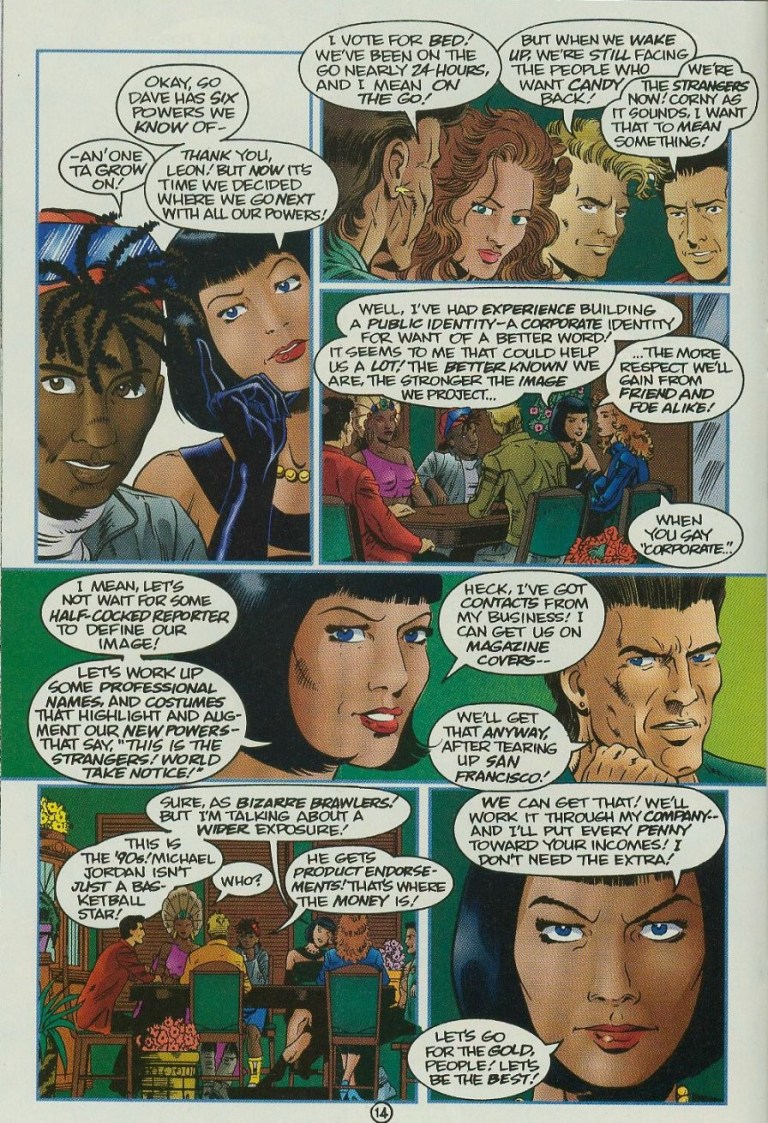
Really in-depth characterization in this flashback.
Let me make it clear to you all that this comic book is mainly a huge battle between the Strangers and TNTNT. However, it is not exactly the overly long, battle royale at all nor is it a brainless story. In fact, at key segments of the comic book, the narrative switches between the battles and flashbacks that not only explain what happened since the end of issue #2 but also showed other events that happened during the Strangers’ free time.
The flashbacks showed the Strangers interacting with each other like normal people. There was this nice scene showing Atom Bob and his teammates visit his parents’ home and have a nice dinner together. It was also during the flashbacks where the character development really got deep and by the time the story ended, I got to know the Strangers even more.
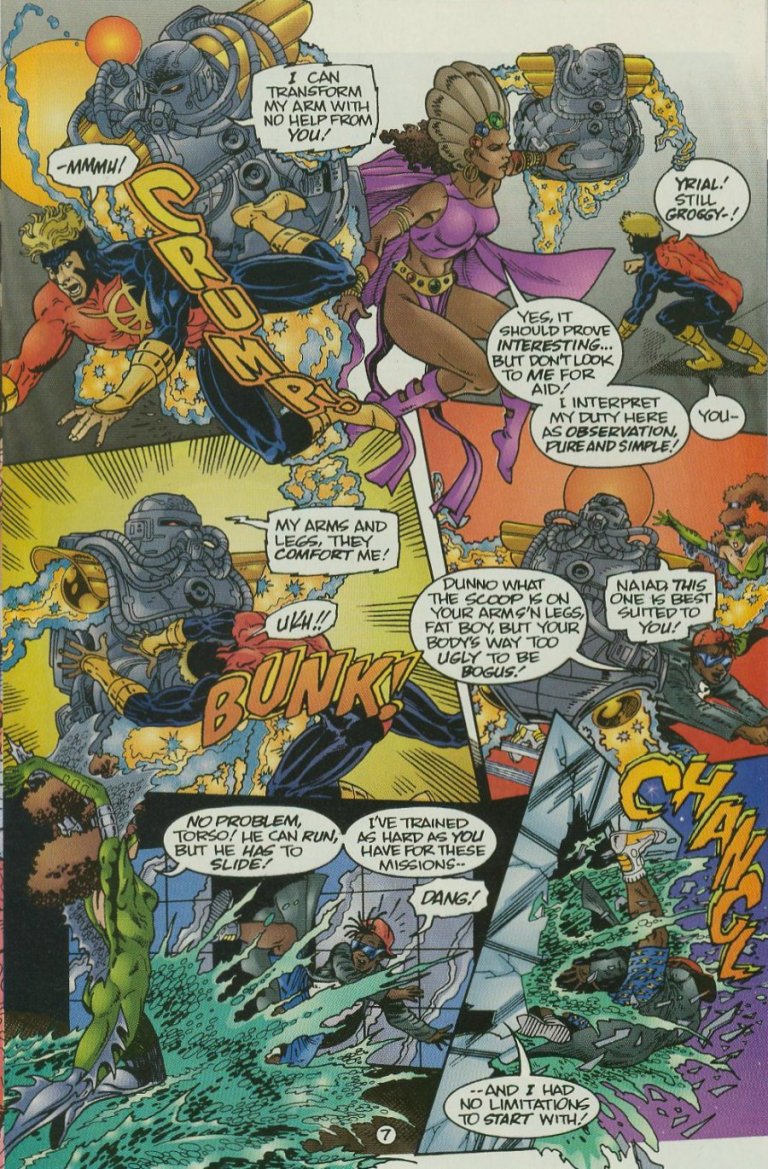
Going back to the long battle, it is clearly a showcase of spectacle in the form of superhero action and the use of their special abilities. Unsurprisingly, Rick Hoberg’s visuals really brought the script to life here. Really good imagery here and there! Also I should say that Hoberg’s designs on the members of TNTNT were really good, even comparable with the Strangers’ designs.
Conclusion
This is just a taste of the action-heavy battle.
The Strangers #3 is fun and compelling to read. What makes this different from issues #1 and #2 is that following the narrative (which switches between the present day battle and the character-driven flashbacks) can be challenging at first. As such, this is a comic book that needs to be re-read in order to fully understand the story. It has a lot of action, super powers showcased and enough character development! Finally, I should say that Steve Englehart and Rick Hoberg crafted a pretty powerful build-up leading to the last page.
If you are seriously planning to buy an existing hard copy of The Strangers #3, be aware that as of this writing, MileHighComics.com shows that the near-mint copy of the regular edition costs $4 while the near-mint copy of the newsstand edition costs $8.
Overall, The Strangers #3 is recommended!
Thank you for reading. If you find this article engaging, please click the like button below and also please consider sharing this article to others. If you are looking for a copywriter to create content for your special project or business, check out my services and my portfolio. Feel free to contact me as well. Also please feel free to visit my Facebook page Author Carlo Carrasco and follow me at HavenorFantasy@twitter.com
Disclaimer: This is my original work with details sourced from reading the comic book and doing personal research. Anyone who wants to use this article, in part or in whole, needs to secure first my permission and agree to cite me as the source and author. Let it be known that any unauthorized use of this article will constrain the author to pursue the remedies under R.A. No. 8293, the Revised Penal Code, and/or all applicable legal actions under the laws of the Philippines.
Spider-Man is not just the icon of Marvel Comics co-created by Stan Lee and Steve Ditko. He is an icon of American culture! From comic books to video games, toys, movies, TV shows and merchandise, Spider-Man’s legacy will always be visible to the public. The fandom of the icon is also undeniable. As if that was not enough, a futuristic, sci-fi version of the superhero was realized in 1992 when Marvel Comics launched its 2099 comic book universe with Spider-Man 2099.
Not even Stan Lee himself anticipated how famous Spider-Man would become.
“”It’s so indescribably thrilling to realize that so many people really care about a character I dreamed up and wrote so many years ago. Although it’s probably lucky I didn’t know how big Spidey would become in later years—because, if I suspected that, I’d have been too nervous to write the stories, worrying if they’re good enough for posterity to judge,” Lee stated.
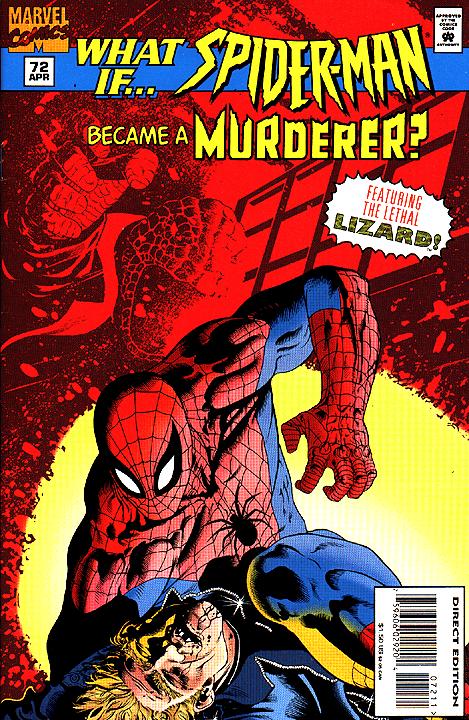
Considering his relevance and attraction to the public, Spider-Man unsurprisingly got featured in issues of the What If monthly series. What I’m about to review is a comic book that explores what would it be had Spider-Man became a murderer.
You read it right!
Anyway, here is a look back at What If #72, published by Marvel Comics in 1995 with a story written by Simon Furman and illustrated by Craig Brasfield.
The cover.
Early story
The story begins with Peter Parker/Spider-Man alone in a dark prison cell. A flashback begins set inside a particular warehouse showing how he (dressed as Spider-Man) savagely beat up a man whom he believed was responsible for the death of his beloved Uncle Ben. By looking at the man’s face, Spider-Man noticed that the guy he just beat up was the fugitive (a burglar) who ran past him…the one man whom he could have stopped when he had the chance. Spider-Man realizes that he just killed the man and starts regretting it.
Suddenly a loud voice from outside the warehouse startled him. It turns out New York’s police officers are located outside and they know he is in the warehouse. They called Spider-Man to surrender. He thought about doing the right thing to surrender but eventually decides to escape and go home.
The next morning, Peter Parker is at home with Aunt May. The guilt of killing a man is bothering him personally and he knows how much his aunt depends on him. He knows that she is already struggling to make ends meet for them both. Aunt May notices Peter looking bad from a lack of sleep.
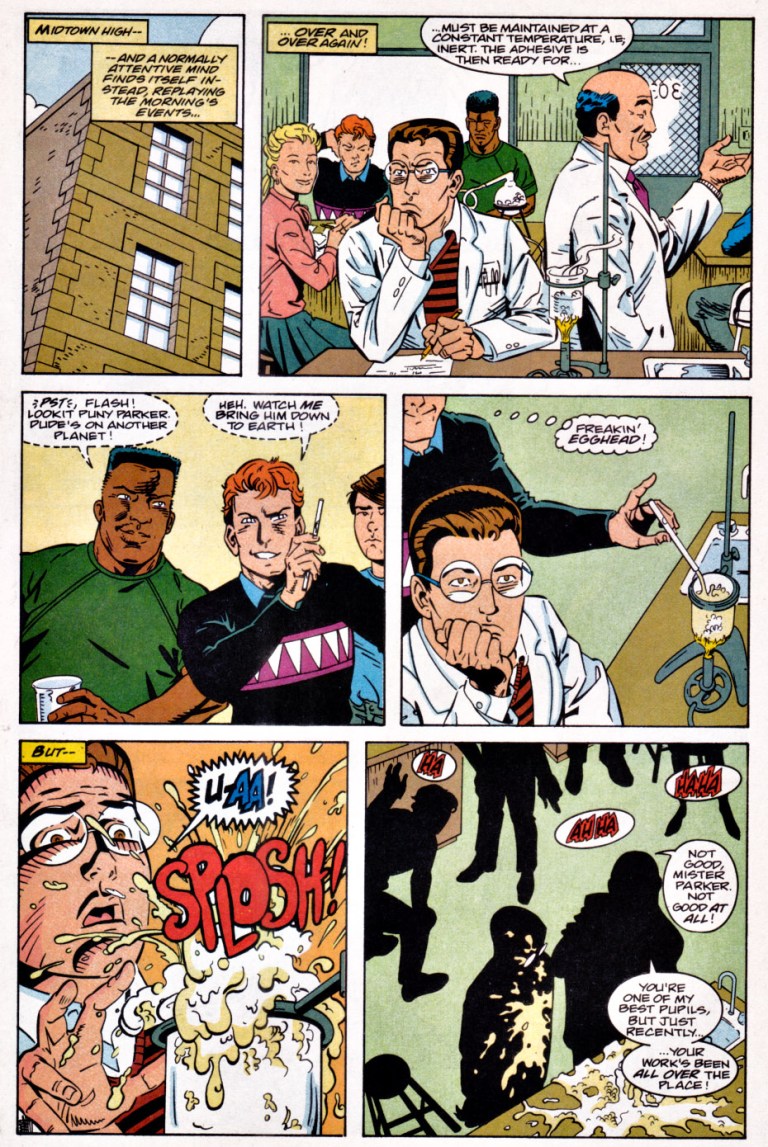
Then Peter goes to school feeling very burdened with guilt…
Quality
Peter Parker bothered by guilt…
I can clearly that this is a very well-written story crafted by Simon Furman. Not only did Furman really strongly focused on the very theme of this comic book, he went the extra mile exploring a darker side of Spider-Man brought out by the burden of guilt. I also enjoyed the scenes crafted showing Spider-Man to not only act different but also become more unsure of himself and even becoming afraid to use his super powers. Worth mentioning is how Peter Parker handles his relationship with Aunt May while carrying the guilt deep inside.
The comic book is not a 100% pure character exploration. There is still a good amount of superhero spectacle here and there to keep you entertained. There are also a few other classic Spider-Man characters that fans will enjoy such as Flash Thompson, Dr. Connors/The Lizard and Sandman. Furman cleverly created nice encounters between Spider-Man and the two mentioned villains which also added further to the hero’s development.
Visually, What If #72 is nice to look at thanks to Craig Brasfield’s work. He proved to be good in drawing Spider-Man although I find his art on the Lizard better and more detailed to look at. When it comes to superhero action, Brasfield delivered the goods.
Conclusion
With the guilt bothering him, Peter Parker is unsure of doing something in a bad situation.
What If #72 is quite compelling to read. It explores how Spider-Man would act while carrying the guilt of accidentally killing someone. That being said, I should say that this comic book achieved its goal of emphasizing its concept – what if Spider-Man became a murderer? – but it ended on a whimper. Remember how the 2012 James Bond movie Skyfall literally broke rules and traditions of James Bond storytelling only to revert back before the movie ended? That’s how I look at this comic book. It went deep with its concept but not all the way. How exactly did it end? You should read the comic book to find out.
If you are seriously planning to buy an existing hard copy of What If #72, be aware that as of this writing, MileHighComics.com shows that the near-mint copy of the regular edition costs $17 while the near-mint copy of the newsstand edition is priced at $51.
Overall, What If #72 (1995) is recommended.
Thank you for reading. If you find this article engaging, please click the like button below and also please consider sharing this article to others. If you are looking for a copywriter to create content for your special project or business, check out my services and my portfolio. Feel free to contact me as well. Also please feel free to visit my Facebook page Author Carlo Carrasco and follow me at HavenorFantasy@twitter.com
Disclaimer: This is my original work with details sourced from reading the comic book and doing personal research. Anyone who wants to use this article, in part or in whole, needs to secure first my permission and agree to cite me as the source and author. Let it be known that any unauthorized use of this article will constrain the author to pursue the remedies under R.A. No. 8293, the Revised Penal Code, and/or all applicable legal actions under the laws of the Philippines.
Remember the final conflict between Wonder Woman and Ares in the 2017 movie? You will see their literary conflict in this old Wonder Woman comic book drawn by the legendary George Perez which I’m about to review.
Before getting to the review, Ares in real life is the Greek deity of war and one of the Twelve Olympians. Within the realm of DC Comics’ superhero universe, the character was very similar to the real-life counterpart and made the first literary appearance in Wonder Woman #1 way back in the early 1940s.
In 1987, when Wonder Woman got rebooted along with the rest of the superhero universe of DC Comics (the Post-Crisis era), George Perez led a revision of the Wonder Woman mythos with a stronger emphasis of Greek mythology in mind. In Wonder Woman #1 of the Post-Crisis era, the deities of Greece were introduced and Ares stood out clearly among them given his nature for conflict. As if that was not enough, Ares appeared in a dark battle armor with a helmet clearly hiding his face (with red-colored eyes) which easily made him the most menacing deity of them all in Olympus.
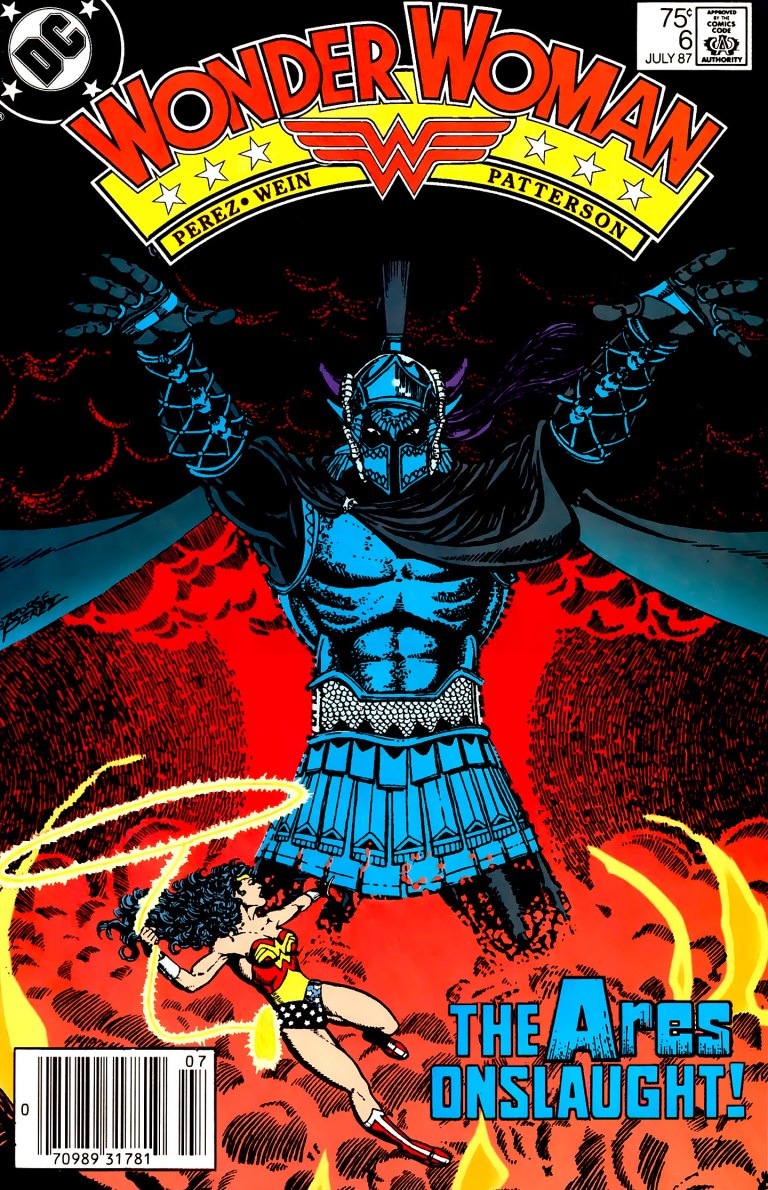
Having reviewed Wonder Woman #5 (1987) which showed how Ares and his forces influence people of man’s world to engage in war with each other, the stage is set for Wonder Woman and Ares’ featured encounter in Wonder Woman #6 published in 1987 by DC Comics with a story co-written by George Perez and Len Wein. Perez illustrated the story with ink work done by Bruce D. Patterson.
The cover.
Early story
The story opens with a television news broadcast about the brewing tension that could lead to a war. The public is informed about the sudden takeover of a federal missile base organized by renegade military personnel led by an Air Force general. Over at the Soviet Union, a similar takeover of a missile facility got reported.
The narrative then shifts at the American military base where Wonder Woman, Julia Kapatelis, Steve Trevor, Etta Candy and Matthew Michaelis just witnessed the arrival of Ares whom the traitorous general Samuel Tolliver referred to as master. Tolliver has several renegade soldiers carefully watching the heroes with guns pointed. Michaelis find the situation getting more insane which draws a response from Ares.
Julia (who researched a lot about foreign cultures and deities), Etta and Steve struggle to believe what they just witnessed. The presence of Ares, the deity of war in Olympus, is too much for them. As Diana whispers to Julia, Ares responds referring to her as Queen Hippolyte’s daughter. As soon as Areas disappears into thin air, Tolliver tells everyone that he will launch the doomsday missiles once he reaches the master control room.
Very quietly, Etta Candy opens a pouch behind Steve Trevor and pulls out to handy canisters. She passes one to Michaelis…
Quality
Follow Wonder Woman’s journey into the unknown!
I’m pleased to say that the high quality of storytelling, characterization, art and spectacle that started since issue #1 has been well maintained here. Like the previous issue, this one is loaded with spectacle as it is a continuing story about tackling Ares and his influence on people engaging more in conflict instead of being calm and reasonable. When it comes to spectacle, there is a nice mix of fantasy battles and military action.
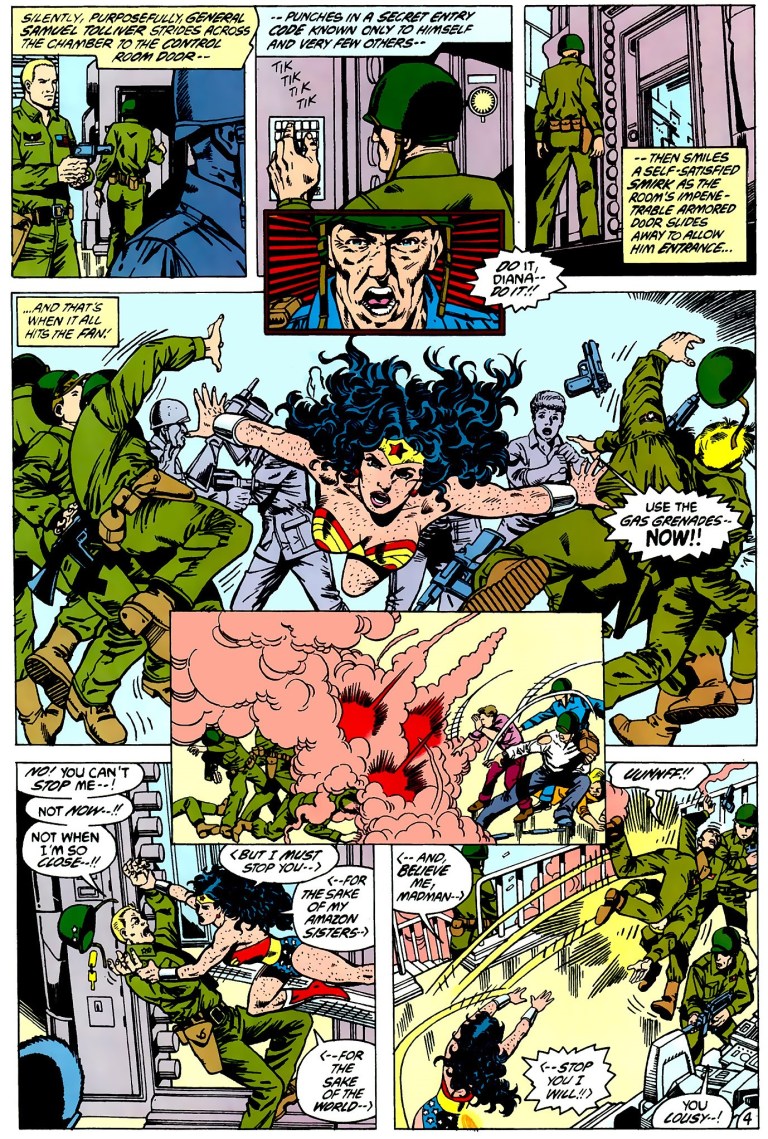
The highlight here, as already made obvious by the cover of this comic book, is the battle between Wonder Woman and Ares. To make things clear without spoiling the story, I should say that their battle together was executed differently from what was showcased in the 2017 live-action movie. To describe it here, I’d say it has a strong fantasy approach on presentation plus emphasis on Greek mythology. If there were any similarities between the literary Wonder Woman-Ares battle and their cinematic battle, it would be exposition done by Ares explaining details to Wonder Woman why he is doing what he’s pursuing, complete with visuals of how his influence impacts the people of man’s world. Ares’ poison of conflict also has a Cold War flavor here which is not surprising since this comic book was published during the 1980s.
Conclusion
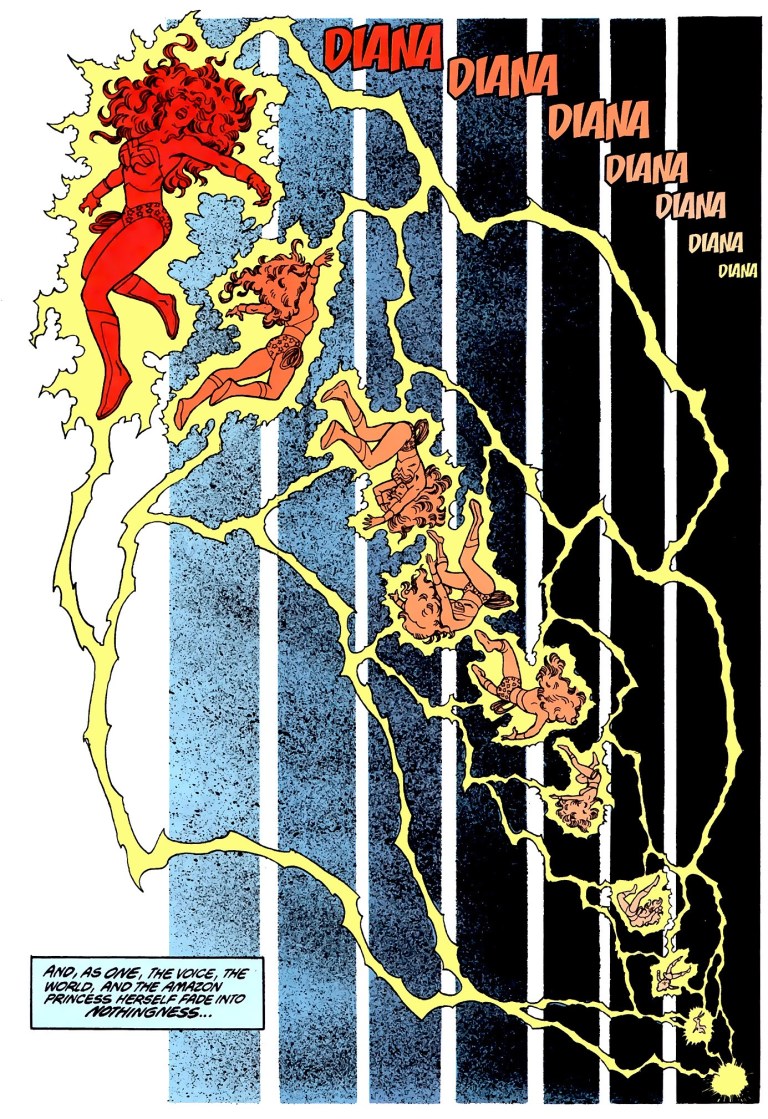
Wonder Woman acts before the situation grows worse.
Wonder Woman #6is a great read! There simply was no slowdown nor a single hiccup with the engagement level of this comic book. With a little over twenty pages of content, this one was loaded with great stuff and its concept was indeed epic. If the battle between Wonder Woman and Ares in the 2017 movie astonished, then their conflict in this comic book will deliver the same impact to you. This one is a true Wonder Woman literary classic and its story even raised the stakes when it comes to Princess Diana’s existence and her mission in man’s world.
If you are seriously planning to buy an existing hard copy of Wonder Woman #6, be aware that as of this writing, MileHighComics.com shows that the near-mint copy of the regular edition and the newsstand edition cost $25 and $51 respectively.
Overall, Wonder Woman #6 (1987) is highly recommended! The conflict between Wonder Woman and Ares should encourage you to replay the acclaimed Wonder Woman movie of 2017.
Thank you for reading. If you find this article engaging, please click the like button below and also please consider sharing this article to others. If you are looking for a copywriter to create content for your special project or business, check out my services and my portfolio. Feel free to contact me as well. Also please feel free to visit my Facebook page Author Carlo Carrasco and follow me at HavenorFantasy@twitter.com
Disclaimer: This is my original work with details sourced from reading the comic book and doing personal research. Anyone who wants to use this article, in part or in whole, needs to secure first my permission and agree to cite me as the source and author. Let it be known that any unauthorized use of this article will constrain the author to pursue the remedies under R.A. No. 8293, the Revised Penal Code, and/or all applicable legal actions under the laws of the Philippines.
I should say that Hardcase is truly a unique title and it also is one of the more defining titles of the Ultraverse. It features a super human being who has powers but remains constantly disturbed with guilt having survived a tragedy that killed two teammates and incapacitated his loved one. On moving forward, he worked in Hollywood movie productions until evil forces compelled him to get involved.
Previously I reviewed Hardcase’s crossover with the Strangers told in two comic books. Now we can focus more on him and his pretty companion choice in a standalone adventure in Hardcase #5, published in 1993 by Malibu Comics with a story written by James Hudnall and drawn by Scott Benefiel.
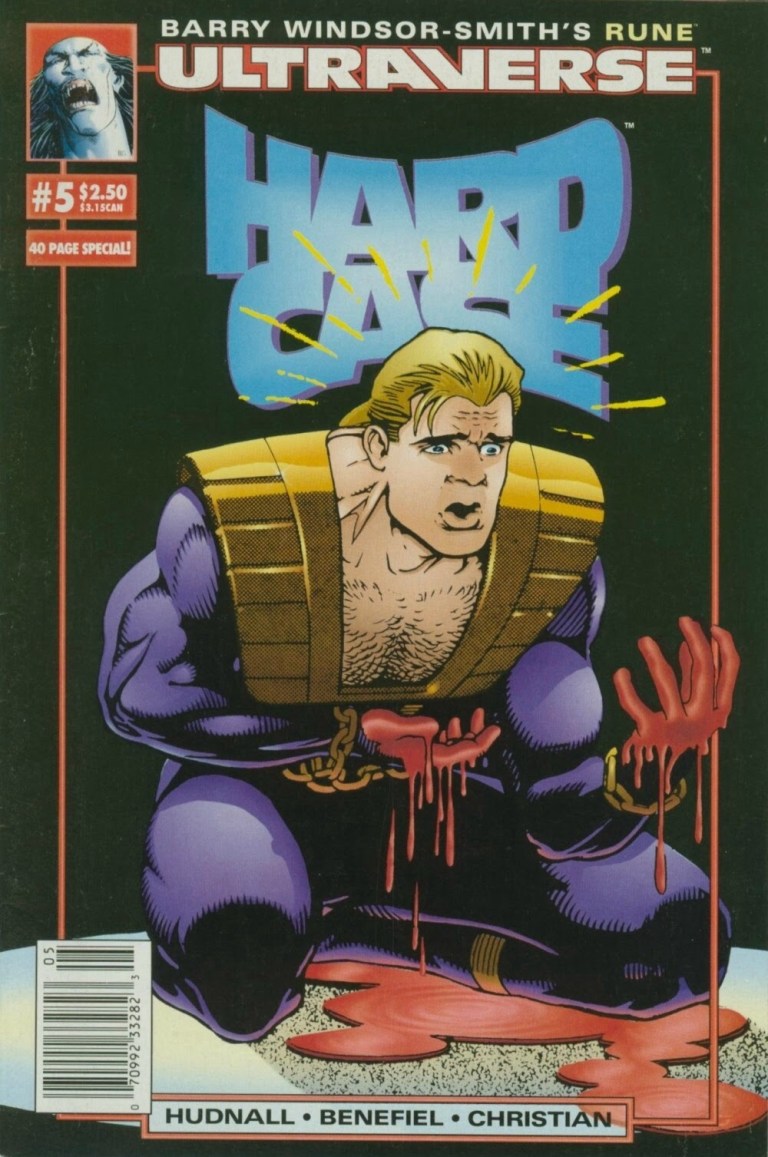
The cover.
Early story
The story begins at a nice home in Dana Point, California, where a man named Jonny Wong is making love with a lady only to be disrupted by a telephone call. Upon answering the phone, Jonny is informed to get out as a killer has been sent to kill him. He does not realize that his bodyguards have been killed. Suddenly a man enters the bedroom and kills him and the lady.
A short time later, Hardcase and Choice arrive to meet with detective Chuck Brown who examines the photograph of the dead Jonny Wong and the woman. With the detective’s assistance, Hardcase and Choice proceed to meet Bob Dixon, the head of the Choice Corporation at its headquarters…
Quality
Meet Sandra Trent and Rex Mundi.
This is another well written story by James Hudnall. I like the way the mystery got established followed by Hardcase’s search for answers. This story, which was nicely illustrated by Scott Benefiel, further explored the Choice Corporation and its control on Choice. Hardcase was shown to really care for Choice which I enjoyed as part of witnessing how his personality developed. Furthermore, this story nicely reconnects to something particular from Hardcase’s last day with The Squad and it sure was presented with a strong horror flavor. As the corporate world in California is further explored, this comic book introduces Sandra Trent who is about to get involved with the dirty business of eliminating ultras.
Conclusion
Hardcase and Choice at the Choice Corporation HQ.
I really like Hardcase #5. Strong mystery element in the story mixed with intrigue and an unrelenting sense of suspense. When it comes to spectacle, this comic book does not have much but that is not a problem at all. This is still an enjoyable read.
If you are seriously planning to buy an existing hard copy of Hardcase #5, be aware that as of this writing, MileHighComics.com shows that the near-mint copy of the regular edition and the newsstand edition cost $4 and $8 respectively.
Overall, Hardcase #5 is recommended.
Thank you for reading. If you find this article engaging, please click the like button below and also please consider sharing this article to others. If you are looking for a copywriter to create content for your special project or business, check out my services and my portfolio. Feel free to contact me as well. Also please feel free to visit my Facebook page Author Carlo Carrasco and follow me at HavenorFantasy@twitter.com
Disclaimer: This is my original work with details sourced from reading the comic book and doing personal research. Anyone who wants to use this article, in part or in whole, needs to secure first my permission and agree to cite me as the source and author. Let it be known that any unauthorized use of this article will constrain the author to pursue the remedies under R.A. No. 8293, the Revised Penal Code, and/or all applicable legal actions under the laws of the Philippines.
It has been months since I last reviewed a Spider-Man 2099 comic book. In recent times, I’ve been reviewing the final issues of X-Men 2099 so I figured now is a good time to revisit Spidey of the far future.
To put things in perspective, my review of Spider-Man 2099 #35 explored the introduction of Venom 2099. Here we get to explore the super villain and discover more about him and how he impacts the this old monthly series.
Here’s a look back at Spider-Man 2099 #36, published in 1995 by Marvel Comics with a story written by Peter David and illustrated by Keith Pollard.
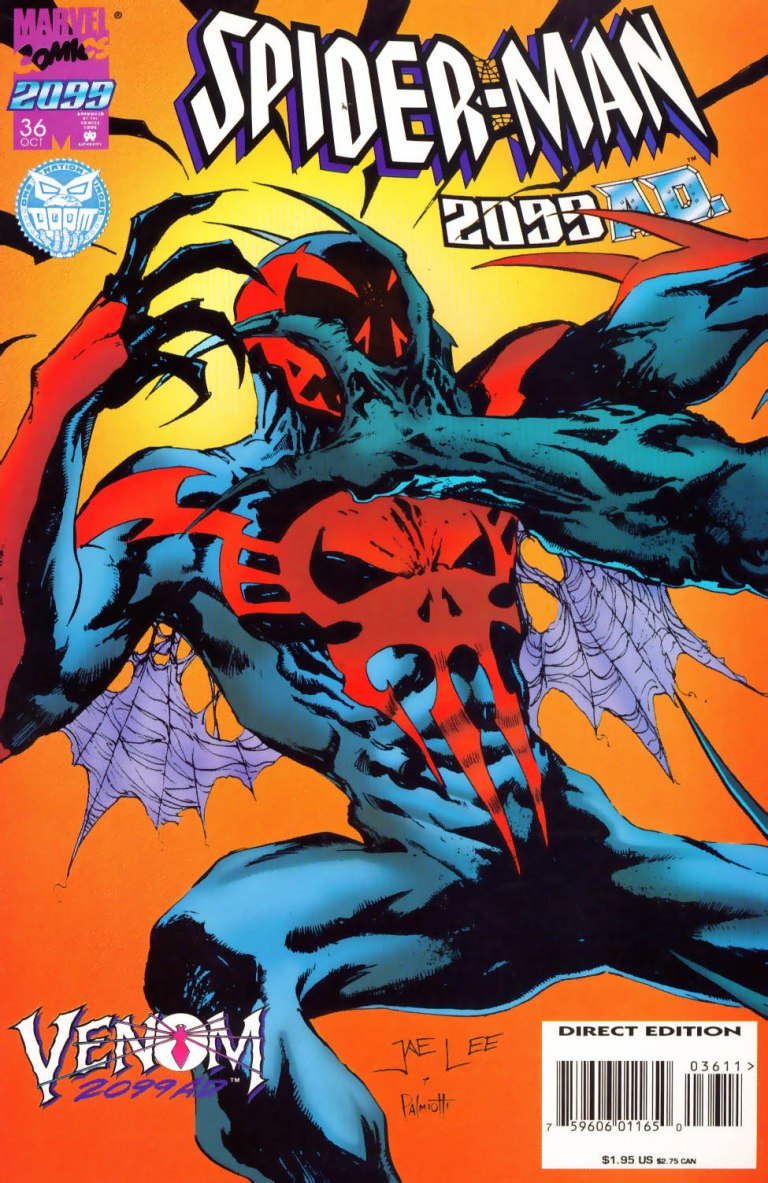
The cover drawn by Jae Lee.
Early story
Picking right after the end of issue #35, the comic book opens with a charging Venom 2099 hitting Spider-Man 2099, crashing out of a high level of a hospital. As they fall down, hospital personnel enter the hospital room to provide assistance to Dana and a recovering Tyler Stone. Dana urged the personnel to move Tyler to a new location fearing that Venom will return.
While falling down, Spider-Man hits Venom, manages to stop falling down and watches him hit the ground hard. To his shock, Venom survived and proved to be much stronger than he thought. Venom climbs up the building’s wall to go after Spider-Man…
Quality
Venom 2099 and the armed personnel.
Dramatic and gripping. That is how I describe the tone of Peter David’s script here. As this is Spider-Man’s first encounter with Venom (which started at the end of the last issue), David not only crafted a very compelling conflict between them but also maintained consistency on developing the supporting cast members. Unsurprisingly, the sufficient focus on Venom made clear to reader that he is not only very dangerous but also uncompromising with his acts which make him a menace not only to people but even to armed personnel. His obsession with Tyler Stone is really something.
Regarding the comic book’s art, guest illustrator Keith Pollard did a fine job capturing the looks of the characters and also maintained the storytelling pace that started with issue #35. He also scored nicely on making the action look dynamic and fun to see. He also paid close attention to key details on the costumes of Spider-Man and Venom. I also like the way Pollard drew Spider-Man when it comes to swinging positions, wall-crawling, etc.
Conclusion
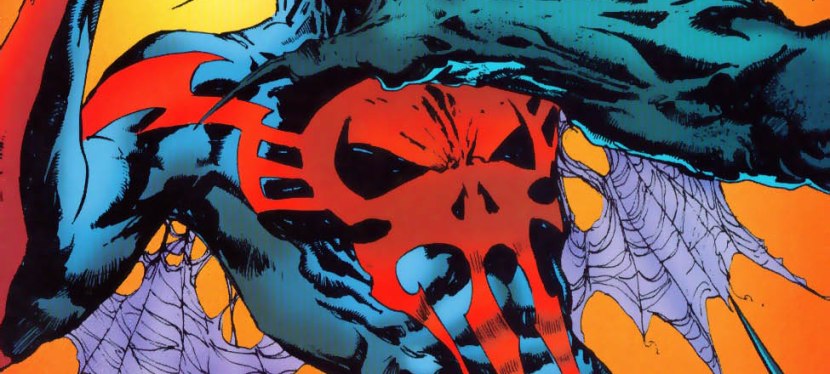
Spider-Man hits Venom while falling down.
Spider-Man 2099 #36is a very good, old comic book! As this is one of the early comic book appearances of Venom 2099, it is significant not just in terms of financial value but also in terms of developing Spider-Man as a character. Partly helped by the massive popularity of the mainstream Venom (Eddie Brock), Venom of 2099 become one of the most significant super villains of Marvel 2099.
If you are seriously planning to buy an existing hard copy of Spider-Man 2099 #36, be aware that as of this writing, MileHighComics.com shows that the near-mint copy of the regular edition (Spider-Man 2099 cover), the “Venom 2099” titled cover regular edition, and the “Venom 2099” titled newsstand edition cost $34, $85 and $255 respectively.
Overall, Spider-Man 2099 #36 is highly recommended!
Thank you for reading. If you find this article engaging, please click the like button below and also please consider sharing this article to others. If you are looking for a copywriter to create content for your special project or business, check out my services and my portfolio. Feel free to contact me as well. Also please feel free to visit my Facebook page Author Carlo Carrasco and follow me at HavenorFantasy@twitter.com
Disclaimer: This is my original work with details sourced from watching the movie and doing personal research. Anyone who wants to use this article, in part or in whole, needs to secure first my permission and agree to cite me as the source and author. Let it be known that any unauthorized use of this article will constrain the author to pursue the remedies under R.A. No. 8293, the Revised Penal Code, and/or all applicable legal actions under the laws of the Philippines.
I miss the old days when an R-rated action-packed science fiction movie can be passionately made with exceptional directing, clever writing, great camera work that’s consistently steady, solid performances from the actors, action that was not too choreographed, and visuals that heavily utilized practical effects and optical effects.
I’m talking about Total Recall, the 1990 sci-fi action movie that starred a much younger Arnold Schwarzenegger supported by Sharon Stone, Michael Ironside, Rachel Ticotin and Ronny Cox. Directed by Paul Verhoeven (who directed the 1987 classic RoboCop) with a screenplay (based on the Philip K. Dick short story We Can Remember It For You Wholesale) by Ronald Shusett, Dan O’Bannon and Gary Goldman, Total Recall was a tremendous hit in the cinemas grossing more than $261 million worldwide with a production budget of over $60 million. To date, the film remains a favorite not only with fans of Schwarzenegger but also with people who love action movies, sci-fi movies, movies of the 1990s and geeks.
But before looking back at this movie, it is important to take note that Total Recall took several years of development before it finally got produced. The very first screenplay was written by O’Bannon and Shusett in the 1970s (after securing the film rights to Philip K. Dick’s short story when the author was still alive). Eventually prolific movie producer Dino De Laurentiis took the project for development. Years later, De Laurentiis’ company collapsed (due to failed projects) which provided Schwarzenegger the golden opportunity to get Total Recall by persuading Carolco to secure the rights for a few million dollars. After many screenplay drafts written and the hiring of Verhoeven as director (note: Schwarzenegger approached him personally) plus Gary Goldman, the rest became history.
Arnold Schwarzenegger, Rachel Ticotin, Michael Ironside and Ronny Cox in a memorable scene.
Now, here is a look back at Total Recall.
Early Story
The story begins at the surface of planet Mars where a man and a lady (both wearing space suits) travel on foot. Suddenly, the man slips down and breaks the frontal shield of his helmet exposing himself to Mars’ air. It turned out to be an intense nightmare for Douglas Quaid who was in bed with his beautiful wife Lori. Lori asked him about the unidentified woman who appeared in his dreams, but Quaid expresses his love for her. On his way to work, Quaid saw a TV ad inside the train about Rekall, a company that sells holidays and adventures in the form of memories. At work, his fellow construction worker discouraged him from availing of any services from Rekall. After work, Quaid visits Rekall and decides to avail of an ego trip as a secret agent. Just as the memory trip was about to start, Quaid wakes up violently…
Quality
This movie is still great to watch. Let me start first with the creative team of Paul Verhoeven and Arnold Schwarzenegger.
A great action scene about to start…
When it comes to the synergy between the director and the lead player, Verhoeven and Schwarzenegger make a great creative team that made this movie very special! When asked during an interview what it was like for him to work with Schwarzenegger, Verhoeven said: Arnold is great. Switching from Rutger Hauer to Arnold is not that big a step. It’s strange to say that, because he’s this crazy Austrian, with an accent—but, for me, Arnold is the American Rutger. I think if I did a few movies with Arnold, I could do as much with him as I did with Rutger. Now, this movie was the wrong thing . . . But I think you can do much more with Arnold, explore more possibilities, than was necessary for this movie.
Sharon Stone as Lori.
Now, it is a fact that Schwarzenegger lacks versatility when it comes to acting. Even so, Verhoeven succeeded in getting a deeper-than-expected performance from the star in this movie. Sure, we get to see Schwarzenegger fight bad guys with really rough action, fire guns, run and jump around here but what really stood out here was his portrayal of a man who discovers that the life he knew was all a lie and goes on to find the truth about himself. This role remains a standout role of Schwarzenegger’s among all the characters he played in his many other action films. What is also notable with Douglas Quaid is that the protagonist is always in danger and never invincible, very similar to how Bruce Willis played John McClane in Die Hard. If you watch this film after seeing Schwarzenegger play his invincible icon in the Terminator movies, you will feel his pain, tension and curiosity here! As if that was not enough, there is also the other role Schwarzenegger played in this movie that you should see.
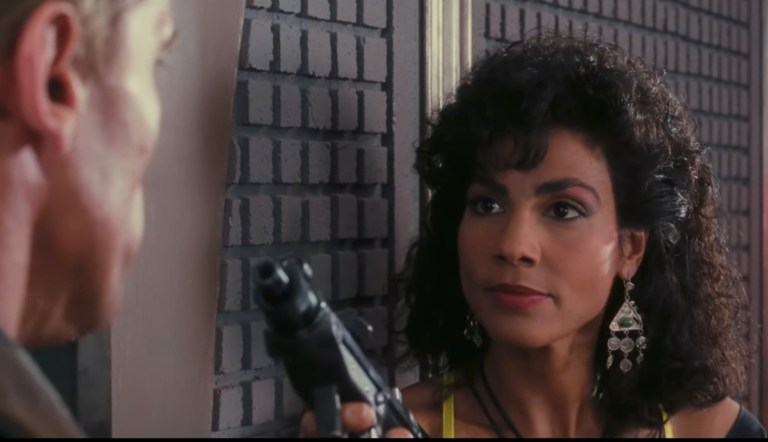
Of course, Total Recall also drew greatness and depth from Verhoeven who also got strong performances from Sharon Stone, Michael Ironside, Rachel Ticotin and Ronny Cox. Sharon Stone is the beautiful wife who will shock you. Michael Ironside is the henchman who will make you root for Schwarzenegger even more. Rachel Ticotin is the brave woman who is believable with the cause she is involved with.
Rachel Ticotin as Melina.
More notably, Ronny Cox is the all-powerful and ruthless executive who will get on your nerves and make you root for Schwarzenegger a lot, very similar to how his villainous role in RoboCop made moviegoers root for the cyborg policeman. It should be noted that the evil executive-henchman duo of Cohaagen (Cox) and Richter (Ironside) here is a directorial trademark of Verhoeven’s and it should bring back memories of the other evil duo in RoboCop. More than that, Ronny Cox succeeded in selling the concept that Cohaagen really had been the administrator of the colony in Mars exploiting the resources and the people for a long time.
More on getting the most out of the actors, Verhoeven and his team crafted a memorable hand-to-hand fight scene between Lori (Stone) and Melina (Ticotin) actually taking part in the action and stunts. Sharon Stone clearly got athletic in this movie and her efforts paid-off nicely, complete with another fight scene with Arnold Schwarzenegger (she actually even threw two high kicks at Schwarzenegger’s head) early in the film. Beyond the hard battle with Stone, Ticotin went on to take part in further action scenes in the film and she sure is believable as an action performer. To put things in perspective, Stone and Ticotin are not action stars but they excelled nicely in their work here and this also made Total Recall special.
When it comes to storytelling under the direction of Verhoeven, Total Recall moved at a medium-to-fast pace and there was never a single moment of rushing, nor a single boring moment at all. The film just kept going smoothly complete with true unpredictability which results lots of twists and surprises. I should also state that the dialogue from the finalized screenplay is still excellent, and they were nicely delivered by the actors. Verhoeven also added depth to the film by using mystery while also getting good performance from Schwarzenegger as Doug Quaid finds out that life is not what it seems. I should state that the sci-fi elements of altering (and adding) human memories with the use of computers and the business of selling virtual holidays and ego trips were strongly emphasized. These also add to the film’s mystery which should engage you to wonder and analyze as the story moves on.
The best view from an office on planet Mars.
On the spectacle, Total Recall is heavily loaded! The action is violent, plentiful and carries that particular aesthetic that only director Verhoeven has. It’s hard to explain in words but once you watch the action in this movie (plus comparing it to RoboCop and Starship Troopers), you will realize it. Even so, the action never turned this movie into a brainless affair. The action worked nicely to balance the mystery and suspense.
The visual effects here were mostly done by practical and optical ways. Special effects specialist Rob Bottin, who famously worked in John Carpenter’s The Thing and worked also with Verhoeven in RoboCop, came up with very memorable animatronics to simulate facial and physical changes on characters on key sequences involving sci-fi elements. The team also crafted really freaky looking makeup works on the Mars mutants, which really gave this film a strong sci-fi look. I also like the use of miniatures and physical sets that visualized the colony in Mars. By today’s standards, this movie’s visual effects still look great and I can only wish that filmmakers today would rely less on computers and go back to using practical effects (note: physical stuff) and, on certain occasions, optical effects.
Really great movie makeup work by Rob Bottin.
When it comes to the physical environments, this movie was filmed a lot in Mexico, specifically on key locations and on the sound stages in an established movie production studio there. Years ago, when I first learned for the first time that the trains used in the film were real-life trains that actually operated in one of Mexico’s real-life transportation systems, I was astounded! Paul Verhoeven himself confirmed that the train sequences were not only shot on location with real trains (note: monitors were added by the filmmakers to achieve a futuristic look) but the place’s architectural design were very unique and fitted nicely with the sci-fi concept of the movie.
The Mars colony set does not look fake to me. In fact, it really looks like it has long been lived in by people and the filmmakers nicely designed it. The Venusville set looks very convincing and, within the story, it got decayed due to long-term businesses, constant vehicular traffic and people who always flocked the place. The Mars hotel meanwhile has that cleaner, nicer look with tourists who paid good money for pleasure and discovery.
I should mention that the cinematography here done by Jost Vacano is excellent. The set-ups of the camera to get great angles of the actors is special, and the same can be said about the capturing of the spectacle that happened on-screen. The flashback of Mars inside Quaid’s mind had great, floating views of the location complete with perfectly smooth movement! Vacano also worked with Verhoeven in RoboCop.
Finally, the musical score by the late Jerry Goldsmith is very memorable and this is my favorite among all his works. The music provided gave this movie a strong sci-fi feel and when suspense plays, the tunes added nicely to it. The most memorable music tracks here are the opening credits music (which is immersive) and the foot chase between Quaid and Richter on Earth (the music really keeps the pace high).
Conclusion
Arnold Schwarzenegger as Douglas Quaid in a key scene.
Total Recall is a true, adulterated sci-fi action classic and easily it is still is one of the best ever movies I’ve seen from Schwarzenegger, Verhoeven and Stone. A few visual elements did not age well but its highly engaging story (combined with the strong performances and spectacle) remains its key selling point. There is a lot of ambiguity throughout the film and it will keep you wondering if the story (or at least portions of it) was reality or all a dream in Quaid’s mind. The way the story is structured combined with the excellent spectacle, this is a movie that is worth watching again and again! It remains an effective viewing experience for me until now.
As it contains the directorial trademarks of Verhoeven mixed with Schwarzenegger’s own style of expression and hard action, Total Recall is a very unique move of its own and it’s impossible to replicate nor match. Keep in mind that the 2012 remake of this movie was badly made (even though it had a big budget and highly advanced visual effects involving the use of computers) and ended up being a complete failure.
To put it short, Total Recall is more than just an action-packed thrill ride. It is also a mystery film that will keep viewers on the edge as the search for answers continues. Total Recall also explores the theme of what would you do when you realize that the life you remember turned to be an exceptional lie, and that you are literally caught in the middle of a web surrounded by dangerous, powerful people. I could never forget how my mind got motivated as I focused on the narrative the first time I ever saw this great movie decades ago. Total Recall was a sci-fi viewing experience like no other.
Overall, Total Recall (1990) is highly recommended! I urge you, my readers, to buy the movie on Blu-ray disc or watch it via streaming.
Thank you for reading. If you find this article engaging, please click the like button below and also please consider sharing this article to others. If you are looking for a copywriter to create content for your special project or business, check out my services and my portfolio. Feel free to contact me as well. Also please feel free to visit my Facebook page Author Carlo Carrasco and follow me at HavenorFantasy@twitter.com
Disclaimer: This is my original work with details sourced from reading the comic book and doing personal research. Anyone who wants to use this article, in part or in whole, needs to secure first my permission and agree to cite me as the source and author. Let it be known that any unauthorized use of this article will constrain the author to pursue the remedies under R.A. No. 8293, the Revised Penal Code, and/or all applicable legal actions under the laws of the Philippines.
When I first read X-Men 2099 #1 way back in 1993, I found Xi’an a pretty interesting team leader. He was a reformed person driven to help not only his fellow mutants but other people described as outcasts who are all unwanted by what he referred to as corporate structures that look down on them. The big speech he delivered in issue #1 technically highlighted diversity which reminds me of how the Political Left of America emphasizes it for their self-serving socio-political agenda. Of course in the comic book, Xi’an did not highlight diversity for political gain but to help the outcasts live on with hope and move forward to choose their destiny.
Several issues later, demons from Xi’an’s past with the Lawless caught up with him and made his leadership of the X-Men questionable. Xi’an then became more impulsive, more violent and a less compassionate person.
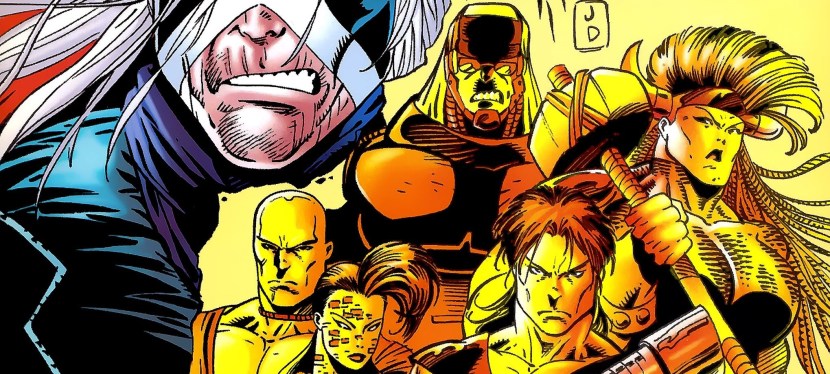
This time, as I’m about to do this retro comic book review, Xi’an past with the Lawless finally got him and anyone who liked him as X-Men leader will find him very alienating.
Here’s a look back at X-Men 2099 #33, published by Marvel Comics in 1996 with a story written by John Francis Moore and drawn by Jan Duursema.
Perhaps this comic book should have been re-titled as The Lawless…
Early story
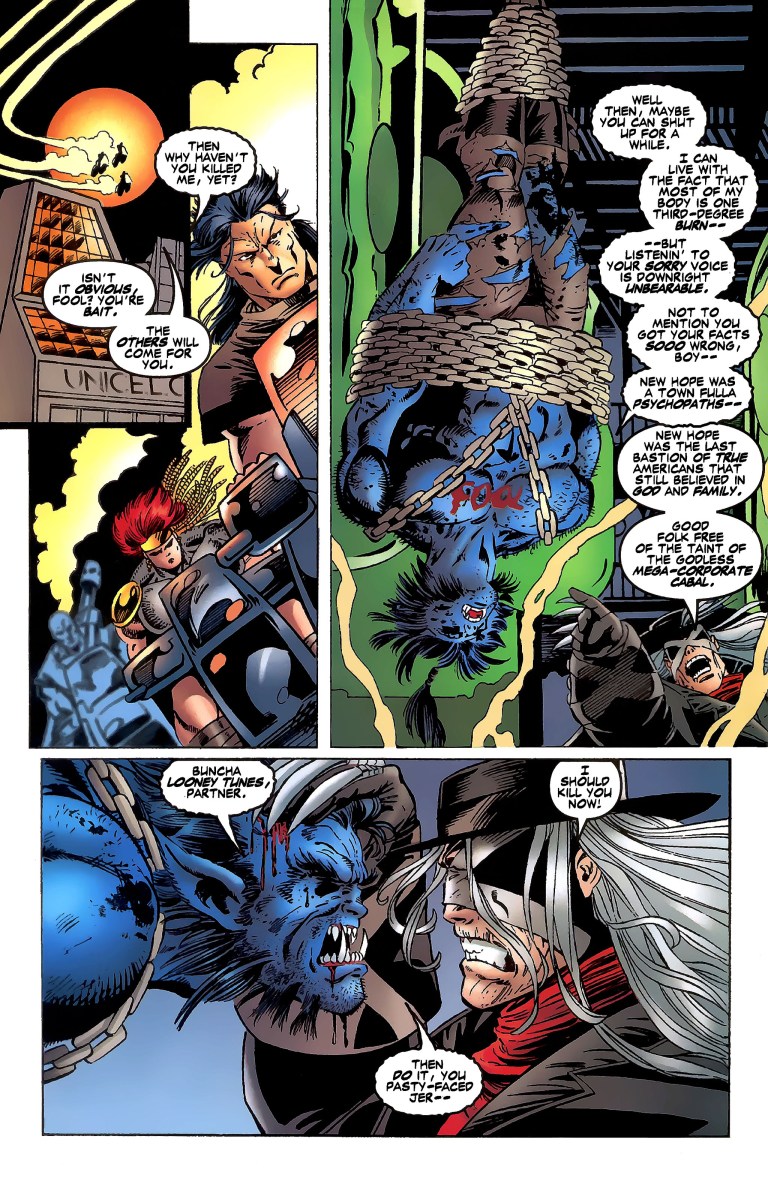
The story begins with Xi’an and the Lawless on the move searching for the Foolkiller who captured their teammate Mongrel (who strongly resembles Hank McCoy/Beast of the mainstream X-Men). As Mongrel and the Foolkiller exchange words with each other, the Lawless arrive to get their teammate back and fight.
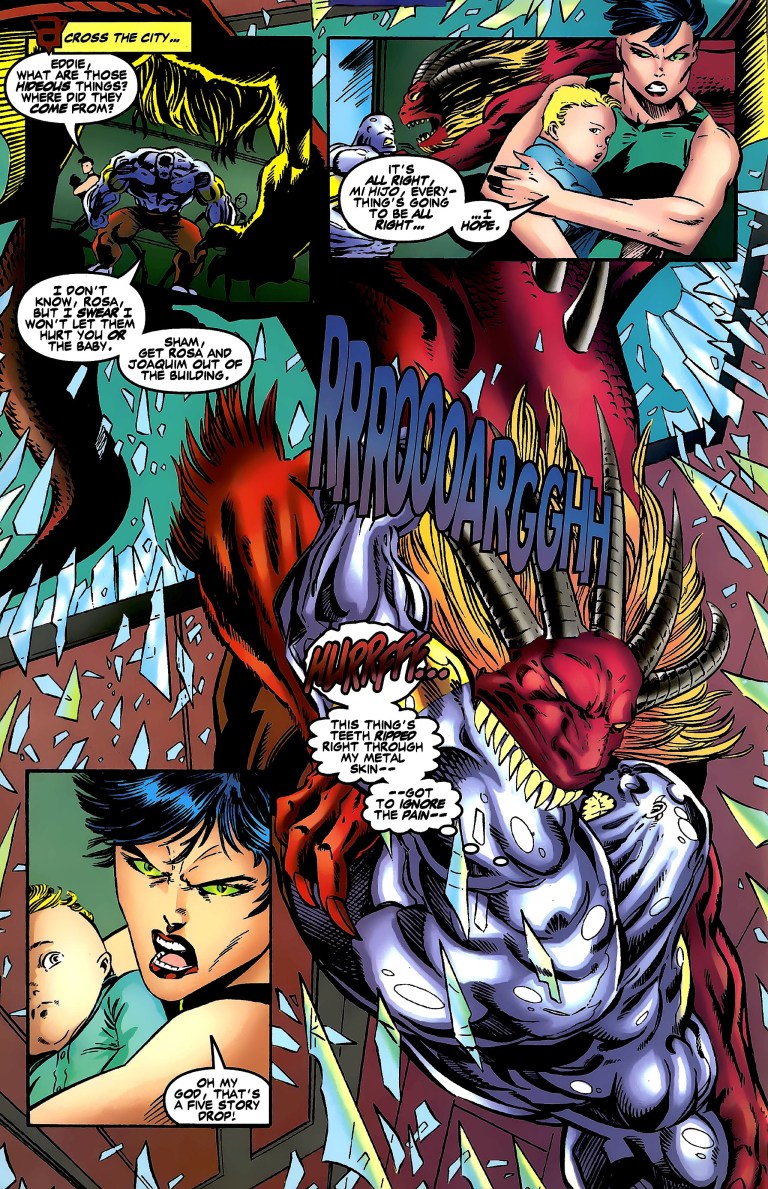
Elsewhere in Halo City, Eddie/Metalhead and Rosa enjoy the nice new place with their baby. They have a friend accompanying them. The peace gets broken when two beasts suddenly appeared to attack them…..
Quality
Some dynamic action by Jan Duursema.
Even though John Francis Moore continued to write consistently and proved to be knowledgeable about all the characters introduced in this monthly series, I should say that the concept of this comic book did not interest me that much. Like the previous issue, this one was less about the X-Men and more about the Lawless (with the continued spotlight on Xi’an) but the more I read it, I found myself becoming less interested. Nothing here impressed me.
As for the art, Jan Duursema’s work here showed how quickly she adapted the established look of not only the characters but also Halo City. Her art here is pretty good. She was a worthy replacement for Ron Lim. John Francis Moore himself stated in an interview that Duursema did an admirable job.
Conclusion
The blue-skinned character is NOT Hank McCoy/Beast.
After the dramatic turn of events for the mutants of 2099 told in issue #25, X-Men 2099 #33 is so far the weakest follow-up. It’s not a terrible comic book, it’s just not too interesting and not too compelling. Anyone who is dedicated with the X-Men team will be disappointed with the shift of the spotlight moved to the Lawless.
If you are seriously planning to buy an existing hard copy of X-Men 2099 #33, be aware that as of this writing, MileHighComics.com shows that the near-mint copy of the regular edition costs $8 while the near-mint copy of the newsstand edition costs $26.
Overall, X-Men 2099 #33 is serviceable. If you intend to really spend money on this comic book, better buy it below its cover price. Really, you should be conscious about your money when it comes to collecting back issues of this past monthly series of the 1990s.
Thank you for reading. If you find this article engaging, please click the like button below and also please consider sharing this article to others. If you are looking for a copywriter to create content for your special project or business, check out my services and my portfolio. Feel free to contact me as well. Also please feel free to visit my Facebook page Author Carlo Carrasco and follow me at HavenorFantasy@twitter.com
Disclaimer: This is my original work with details sourced from reading the comic book and doing personal research. Anyone who wants to use this article, in part or in whole, needs to secure first my permission and agree to cite me as the source and author. Let it be known that any unauthorized use of this article will constrain the author to pursue the remedies under R.A. No. 8293, the Revised Penal Code, and/or all applicable legal actions under the laws of the Philippines.
I could never forget the sense of engagement and fun I had the first time I read the Ultraverse comic book The Strangers #1 decades ago. After completing that comic book, I was really eager to discover more of the team and what else they would encounter in the next issue. Entertainment and literary value aside, The Strangers #1 succeeded in making me craving for more about the Ultraverse (same with reading Hardcase #1, Mantra #1, Freex #1, Prime #1 and Prototype #1).
Take note that the year was 1993 when Malibu Comics launched the Ultraverse and at that time I was already a fan of the X-Men and Marvel Comics organized the celebration of X-Men’s 30th anniversary that same year. As such, it became a challenge for me to collect X-Men-related comic books while keeping up with the Ultraverse releases. While the X-Men 30th anniversary was heavily marketed, The Strangers and Freex were superhero team titles under the Ultraverse that still caught my attention. I’m really glad that
Enough with the history lesson. Let’s now take a look back at The Strangers #2, published in 1993 by Malibu Comics with a story written by Steve Englehart and drawn by Rick Hoberg.
Early story
The story begins with the Strangers riding a private jet piloted by Lady Killer. Flying over the city of Fresno in California, the jet heads to a very strange cloud which seems to be the source of the powers they suddenly gained (as a result of what happened when they rode the cable car in San Francisco).
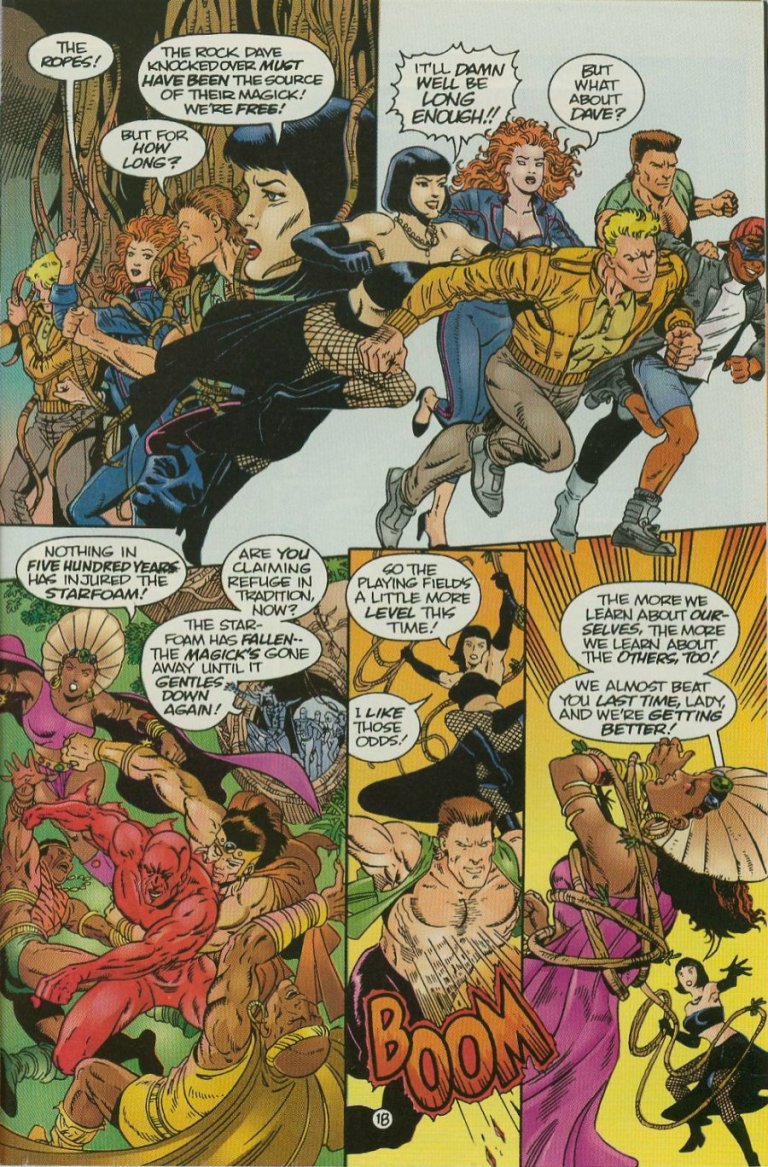
After some effort, they discover, to their surprise, an entire island with a forest and a small mountain completely floating hidden in the cloud. Upon landing, Atom Bob, Grenade, Electrocute, Lady Killer, Spectral and Zip-Zap move into the forest to explore. Eventually they got surrounded by members of a tribe (including the flying lady whom they encountered in issue #1) who use magic to take them down…
Quality
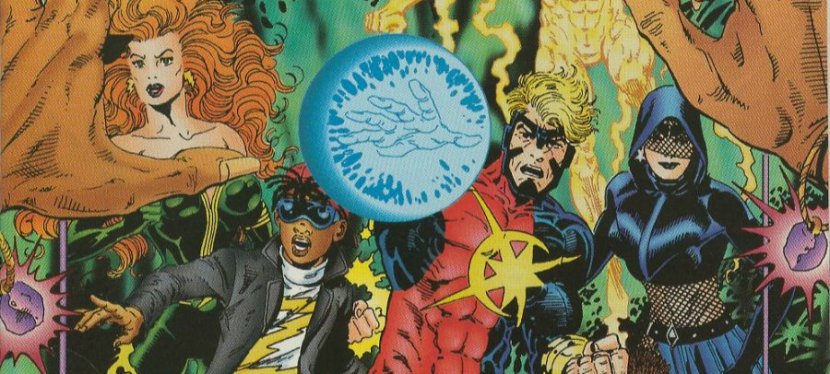
The Strangers move into action!
In terms of quality, this comic book worked strongly as a concluding piece to the previous issue. In issue #1, the story was about one main event that impacted the lives of strangers who happened to be riding the cable car, and those who gained powers got together. The Strangers #2 was more about the powered strangers searching for answers only to find themselves in a tremendous misadventure they did not anticipate. The result is a nice series of further incidents laced with spectacle, interactions between the characters and ultimately another bout of fun and discovery for readers to experience.
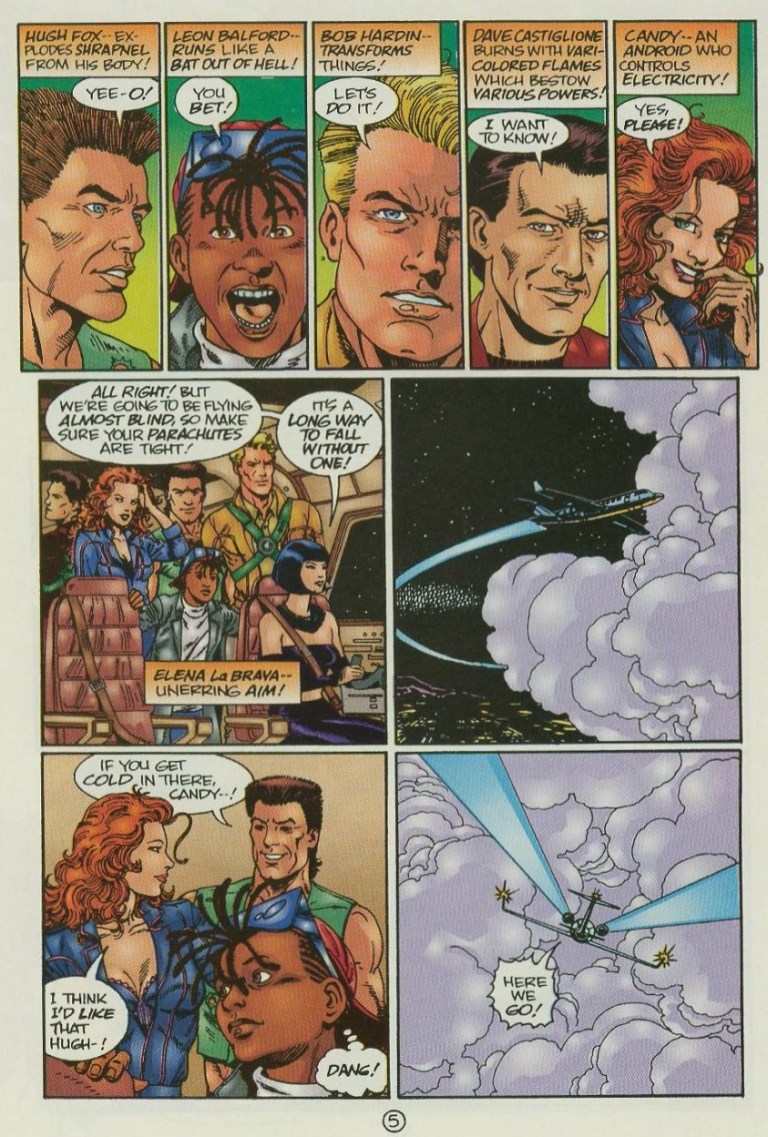
When it comes to the writing, the narrative from the 1st issue continued smoothly here. Apart from the big misadventure on the floating island, the further development of each member of The Strangers proved to be very strong. Lady Killer is firmly established to be strong-willed and capable of leading and organizing people. Spectral starts doing more as he gradually learns more about his untapped potential. By the time I reached the end of this comic book, I got to know the characters much more and also craved for more on their further adventures/misadventures. Visually, Rick Hoberg’s art really brought the story to life.
Conclusion
Get to know the Strangers more with this page.
The Strangers #2 is an excellent comic book worthy of being part of your collection. In my view, this comic book is an essential follow-up to the excellent 1st issue. Without this, your discovery of the Strangers would be incomplete. This comic book also explains how the team got its name.
If you are seriously planning to buy an existing hard copy of The Strangers #2, be aware that as of this writing, MileHighComics.com shows that the near-mint copy of the regular edition, the bagged edition and the newsstand edition cost $4, $4 and $8 respectively.
Overall, The Strangers #2 is highly recommended!
Thank you for reading. If you find this article engaging, please click the like button below and also please consider sharing this article to others. If you are looking for a copywriter to create content for your special project or business, check out my services and my portfolio. Feel free to contact me as well. Also please feel free to visit my Facebook page Author Carlo Carrasco and follow me at HavenorFantasy@twitter.com













 Author Carlo Carrasco