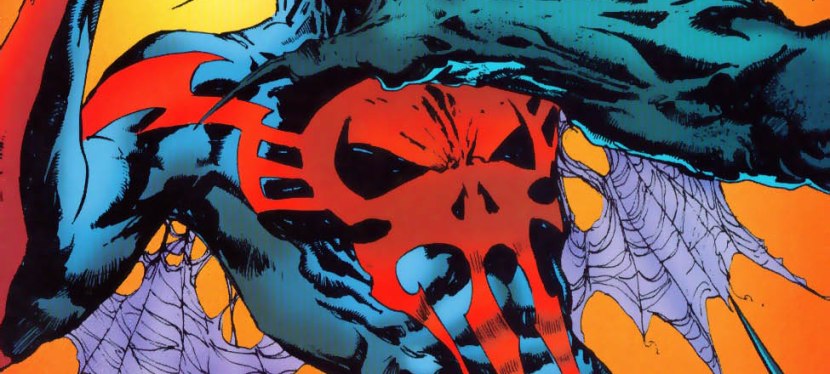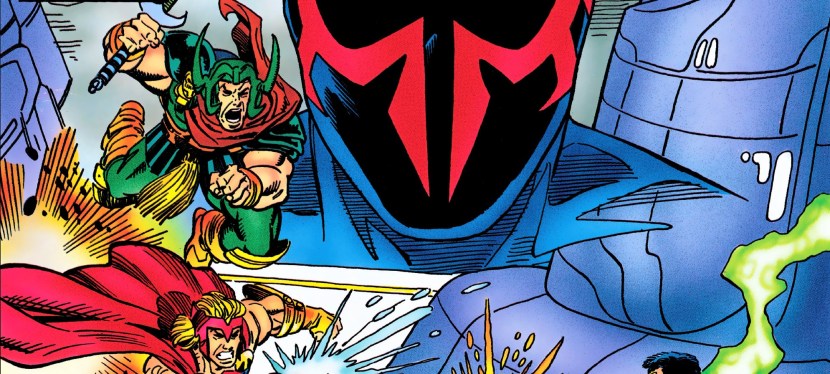
A Look Back at Spider-Man 2099 #16 (1994)

Disclaimer: This is my original work with details sourced from reading the comic book and doing personal research. Anyone who wants to use this article, in part or in whole, needs to secure first my permission and agree to cite me as the source and author. Let it be known that any unauthorized use of this article will constrain the author to pursue the remedies under R.A. No. 8293, the Revised Penal Code, and/or all applicable legal actions under the laws of the Philippines.

By the year 1993, Marvel Comics’ new comic book line of the 2099 universe kept filling the shelves of retailers and made it into the hands of collectors and fans with the monthly series composed of Spider-Man 2099, Ravage 2099, Doom 2099, Punisher 2099 and the new addition of the year X-Men 2099. Back then, the Marvel 2099 line expanded a lot and saw the establishment of new fans. Even the quarterly series 2099 Unlimited caught the attention of some readers as it told the early stories of Hulk 2099 (who debuted in 2099 Unlimited ).

Unsurprisingly, there were fans of the 2099 universe who wished for a crossover storyline that would bring together their respective favorite futuristic heroes. Remember the rivalry between classic Spider-Man (Peter Parker) and the Punisher (Frank Castle)? Some wanted Spider-Man 2099 and Punisher 2099 to encounter each other.

Eventually, the crossover dream of the fans came through in the form of The Fall of the Hammer storyline that took place in five parts. Specifically one issue each of Spider-Man 2099, Ravage 2099, Doom 2099, Punisher 2099 and X-Men 2099. It was also an opportunity for the 2099 creative teams (note: the legendary Stan Lee and Peter David were among the writers at the time) to get together and contribute to make something special under the watch of 2099 editor Joey Cavalieri.

With those details laid down, we can finally start examining the beginning of The Fall of the Hammer storyline in this look back at Spider-Man 2099 , published in 1993 (cover dated 1994) by Marvel Comics with a story written by Peter David and drawn by Rick Leonardi.
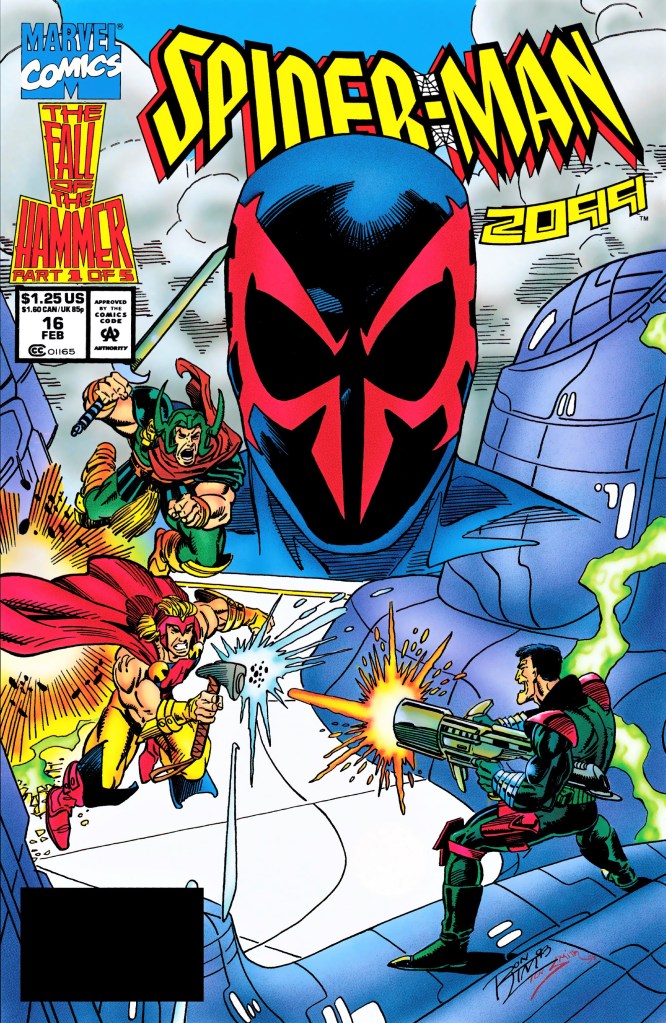
The cover drawn by Ron Lim.

Early story

The story begins with the arrival of the floating city of Valhalla, disturbing the people of the town of Randall below. On the floating city itself, a crowd of people – with Miguel O’Hara and Dana among them – stare at a hammer-wielding, caped blonde man who claims to be Thor (their idol). Accompanied by Heimdall, Thor tells them that a select few among them will remain in the city to act as sentinels while the rest will come with Heimdall to a place of departure.

Thor turns his attention on Dana causing Miguel to intervene and challenge his so-called authority. As Thor reacts to Miguel’s defiance, he throws a punch which got deflected. This causes the so-called god of thunder to be surprised given Miguel looking ordinary to him. In reaction, Thor grabs him and throws his body several feet over many people’s heads. This leaves Dana helpless.

Miguel crashes through a glass window, falling outside until he shoots a web to control his movement. He takes off his civilian clothes, revealing his costume as Spider-Man of 2099. He sets off to get back at Thor…  

Quality
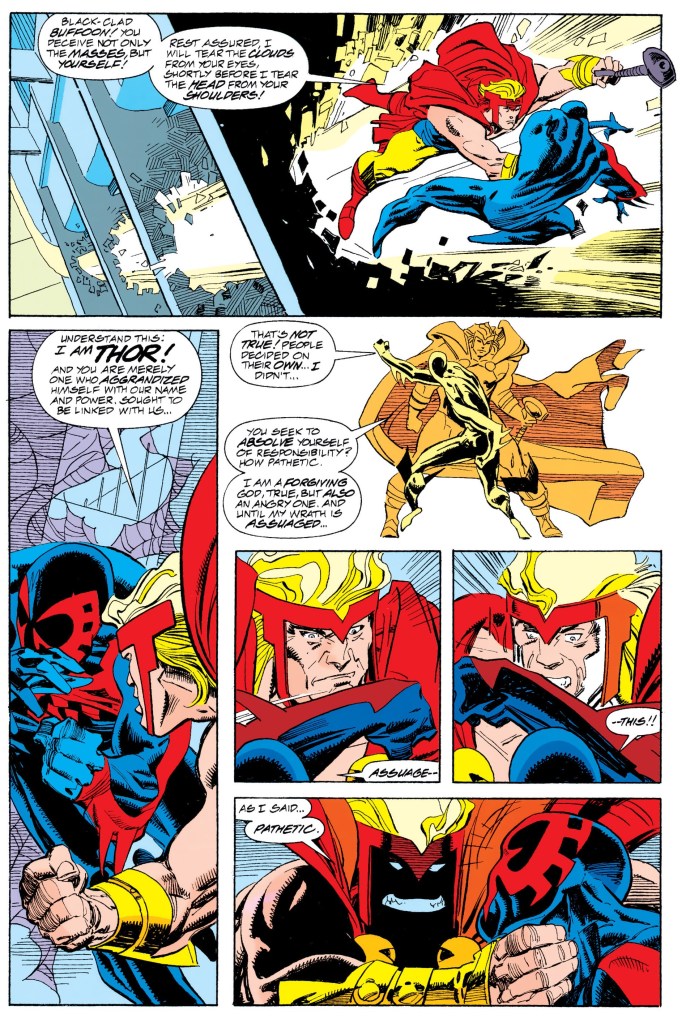
The highlight of the comic book is Spider-Man 2099’s conflict with Thor.

To make clear the obvious, the writing by Peter David is indeed solid although the sketch-like aesthetic of the art of Rick Leonardi badly needed more visual details.

As for the story itself, it is succeeded in creating tension with regards to the caped figure who believes himself to be Thor who is the central figure of religion in 2099 America and has the means to wield power by even involving technology (with Valhalla as the center piece). That being said, Spider-Man 2099’s encounter with him was inevitable, and so was the result (a bit predictable). The story also sheds light on the perceived omnipotence of Thor and how Spider-Man 2099 (who was previously referred to by some people as Thor’s harbinger) got associated with his legend.

To make things clear, this one is purely a Spider-Man 2099 story that justifies the concept of needing other 2099 heroes as the threat was simply too great for any one hero to handle. I should also state that the crossover between any heroes does not begin until the final page of this comic book.

Conclusion
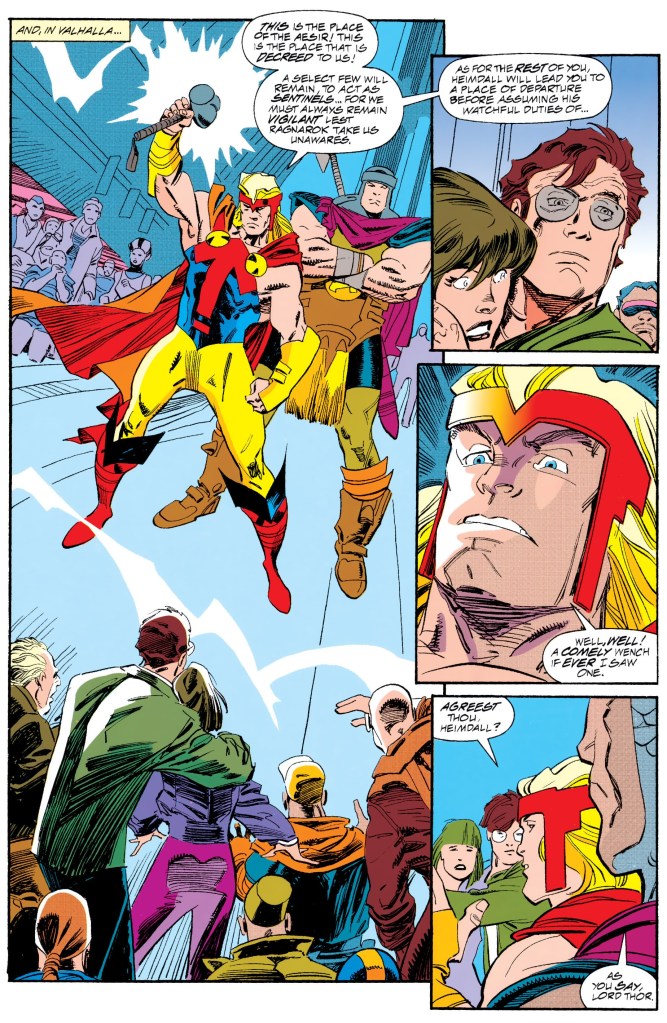
Nothing like being in a crowd of people watching helplessly in front of two so-called omnipotent figures.

Spider-Man 2099 (1994) is still a good read and as the first chapter of The Fall of the Hammer storyline, it served its purpose well. This is mainly due to the strong writing by Peter David who also succeeded in establishing 2099’s Thor not only as the villain but also as a figure who truly is a threat to the people. This comic book also shows that people in 2099 failed to realize who their true Creator is as they embraced religion (instead of faith) and committed idolatry (which is truly unholy) by believing in a false god like Thor.

If you are seriously planning to buy an existing hard copy of Spider-Man 2099 (1994), be aware that as of this writing, MileHighComics.com shows that the near-mint copy of the regular edition costs $40 while the near-mint copies of the newsstand and the signed-and-numbered editions cost $120 and $300 respectively.

Overall, Spider-Man 2099 (1994) is recommended.

+++++

Thank you for reading. If you find this article engaging, please click the like button below and also please consider sharing this article to others. If you are looking for a copywriter to create content for your special project or business, check out my services and my portfolio. Feel free to contact me as well. Also please feel free to visit my Facebook page Author Carlo Carrasco and follow me at HavenorFantasy@twitter.com

A Look Back at Sachs & Violens #1 (1993)

Disclaimer: This is my original work with details sourced from reading the comic book and doing personal research. Anyone who wants to use this article, in part or in whole, needs to secure first my permission and agree to cite me as the source and author. Let it be known that any unauthorized use of this article will constrain the author to pursue the remedies under R.A. No. 8293, the Revised Penal Code, and/or all applicable legal actions under the laws of the Philippines.

Back in the early 1990s, I was fortunate enough to buy and read The Incredible Hulk: Future Imperfect issues and . While each book was pretty expensive, it was all worth it because its literary and artistic content were great to read thanks to the very dynamic creative duo of Peter David and artist George Perez.

To see Future Imperfect’s story by David illustrated greatly by Perez was a magnificent read from start to finish. In 2014, Peter David confirmed that George Perez was his “single favorite artistic collaborator” and when asked as to which artists have come closest to matching the visuals he imagined while writing a comic book script, the author mentioned Perez as one of three artists to do so.

The David-Perez duo’s work together in the 1990s did not necessarily end with Future Imperfect. In fact, they took the challenge of doing an all original, adulterated, non-superhero project published through Epic Comics (Marvel Comics’ imprint that published creator-owned projects not connected with Marvel’s superhero universe) in the form of a 4-issue mini-series titled Sachs & Violens (the title itself is a play on the words “sex and violence”). Back in the 1990s, I completely missed out on that mini-series. It was only recently I finally got to start reading it.

With those details laid down, here is a look back at Sachs & Violens , published by Epic Comics in 1993 with a story written by Peter David and drawn by George Perez.

The cover.

Early story

The story begins in the bedroom deep within the city of New York. A pretty lady arrives, takes off her undergarment and high heels and approaches a smoking man on the bed. As they start making love with each other, a shadowy figure with a bladed weapon approaches them slowly. As the lady notices something going on, a powerful strike happens spreading blood around.

Suddenly, someone yells “Cut!” The lights got turned on and it turns out what happened was a night-time photographic session in which the director expresses his disappointment over what happened.

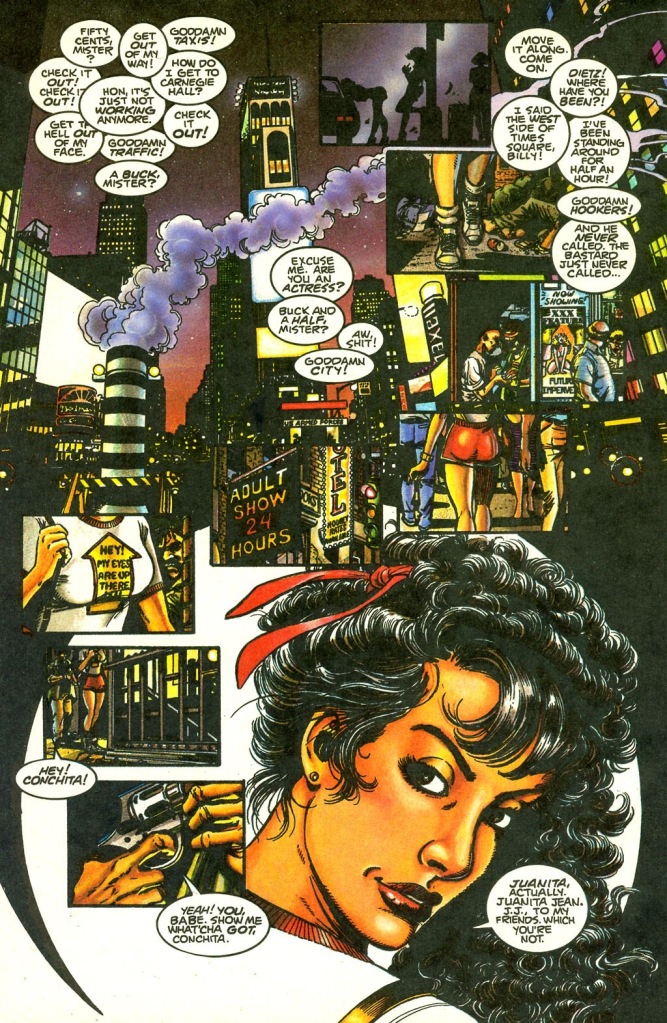
Elsewhere, life in the city goes on during the night. The traffic is frustrating some people. Prostitutes on the sidewalk are doing what they can to attract potential customers. Night clubc and sex shows are rampant. Among the many people walking is a pretty lady named Juanita Jean (nicknamed J.J.) who attracts the attention of a man armed with a gun. In response to his move on her, J.J. fights back by hitting his right wrist, kicking him on the groin and his chin, and knocking him out. Afterwards, she arrives at a photo studio apologizing to the photographer (Violens) for her lateness.

After some talking, J.J. proceeds to change into very erotic attire and posed sexy in front of the camera…

Quality

J.J. Sachs at the police station.

I can start by saying that this comic book is one of the most unusual works I have ever read from either Peter David or George Perez, and it’s more than just its non-superhero concept and presentation.

Starting with the visuals, this is one of the more unique works of George Perez and it surely is a fresh change after seeing so many of his superhero-related comic book works (especially the post-Crisis Wonder Woman). The usual elements of Perez’s art are here: pages with multiple panels, high detail maintained throughout even in images full of people and location stuff, beautiful looking women and the like. As this is an adulterated comic book, the level of visual eroticism got ramped up high although there were clear signs of restraint.   

With regards to the quality of the writing, this is a very adulterated tale about murder and a series of unfortunate events that disturb the public and, incidentally, motivate J.J. Sachs (a softcore porn model) and Ernie Violens (a former Vietnam War veteran working presently as a photographer) to take action. The pacing of the story is decent with lots of build-up dominating the comic book. The dialogue is witty and the main characters really have their own unique patterns of verbal expression. While the script has passionate work written all over, it is not exactly an entertaining read for me. In fact, I find the tale rather sadistic and not even its elements of intrigue and twists could engage me. This is definitely not the comic book you want to read for fun.

Conclusion

Sachs’ introduction.

Even though it has great visuals and a script written passionately (note: Peter David even wrote his opinion about sex and violence in the comic book), I am actually turned off by Sachs & Violens (1993). Other than being made with adults in mind, its really a story of murder that sets off events sparking the protagonists to do something rebellious in nature. While there is indeed an antagonist, the distinction between good and evil remains unconvincing in the story. I can say that die hard fans of Peter David and George Perez will find this comic book more appealing, and there is a good chance that readers seeking material with sex and violence will enjoy it. I personally did not enjoy this one.

If you are seriously planning to buy an existing hard copy of Sachs & Violens (1993), be aware that as of this writing, MileHighComics.com shows that the near-mint copy of the regular edition costs $18 while the near-mint copies of the limited edition, the platinum edition and the signed platinum edition cost $105, $70 and $140 respectively.

Overall, Sachs & Violens (1993) is not recommended.

+++++

Thank you for reading. If you find this article engaging, please click the like button below and also please consider sharing this article to others. If you are looking for a copywriter to create content for your special project or business, check out my services and my portfolio. Feel free to contact me as well. Also please feel free to visit my Facebook page Author Carlo Carrasco and follow me at HavenorFantasy@twitter.com

A Look Back at Spider-Man 2099 #2 (1992)

Disclaimer: This is my original work with details sourced from reading the comic book and doing personal research. Anyone who wants to use this article, in part or in whole, needs to secure first my permission and agree to cite me as the source and author. Let it be known that any unauthorized use of this article will constrain the author to pursue the remedies under R.A. No. 8293, the Revised Penal Code, and/or all applicable legal actions under the laws of the Philippines.

I can hardly believe that it has been a year since Marvel Comics organized the return of their 2099 universe with the release of several comic books. Among those, I bought 2099 Alpha it was a very disappointing read. I also read some other 2099 comic books released late 2019, and none of those engaged me nor gave me much entertainment value in return for what I paid for.

If you ask me, the Marvel 2099 universe of comics was at its best during the early 1990s. That being said, join me on this look back at Spider-Man 2099 , published in 1992 by Marvel Comics with a story written by Peter David and drawn by Rick Leonardi.

The cover.

Early story

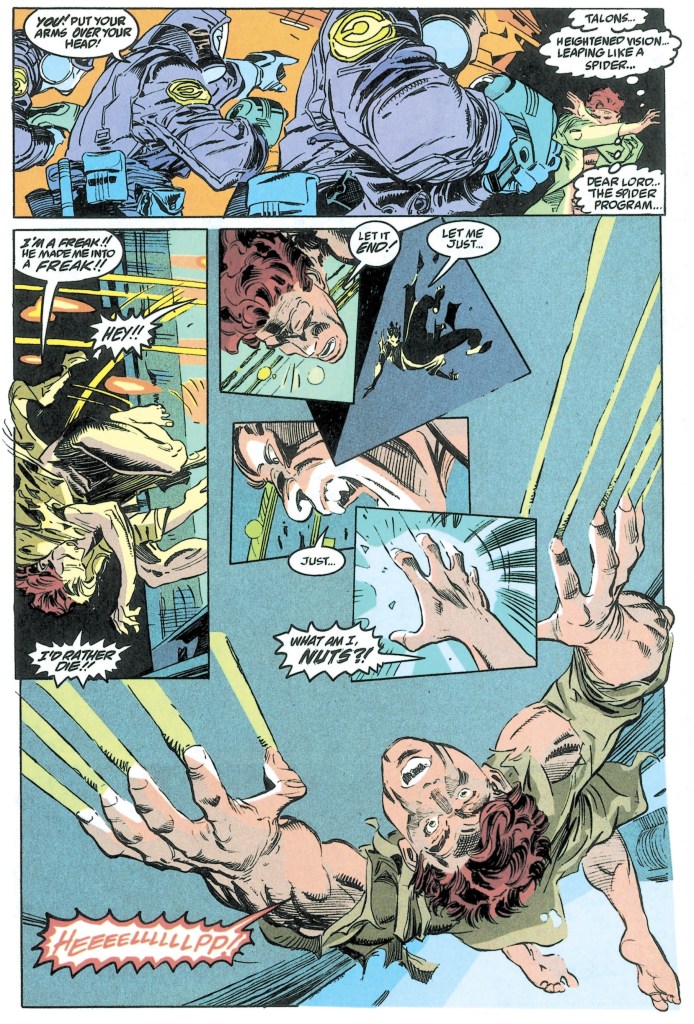
The story begins at one of the Alchemax towers. Miguel O’Hara is standing naked in front of a shocked Aaron Delgato, a corporate rival of his who tried to kill him. As he noticed Miguel (with fangs) looking at him, he reacts by firing his gun. With fast reflexes, Miguel (whose DNA has been altered already at this point) dodges all of the shots and tries to get close to his rival. One of the bullets hit a tank which causes a large explosion at the tower. The tremendous force pushed them both to the exterior.

Miguel grabs Aaron’s arm not realizing that his talons are hurting his rival. The skin of Aaron’s arm got ripped off causing him to fall to his death below. Miguel gets dressed as armed personnel arrive. As shots were fired, Miguel falls off the edge…

Quality

The costume!

This is a very well-written story by Peter David. While the first issue established Miguel O’Hara’s personality and corporate standing, this one established his becoming Spider-Man 2099 by means of mutation. Not only does he have talons (which retract automatically when he touches his own skin) and sharp teeth, he also gains heightened vision, enhance leaping ability, and most notably his costume (backed with a reasonable explanation it exists). The scenes of corporate intrigue and the introduction of the cyber cowboy named Venture easily added a detective story element into the plot which was quite gripping. No doubt about it, I found the story in this comic book more satisfying than the first issue.

Conclusion

Spider-Man 2099’s talons save him from falling further.

Spider-Man 2099 (1992) is a great read and this is the one comic book that fully establishes the title character as we know him.

If you are seriously planning to buy an existing hard copy of Spider-Man 2099 (1992), be aware that as of this writing, MileHighComics.com shows that the near-mint copy of the regular edition costs $15 while the near-mint copy of the newsstand edition costs $45.

Overall, Spider-Man 2099 (1992) is highly recommended!

+++++

Thank you for reading. If you find this article engaging, please click the like button below and also please consider sharing this article to others. If you are looking for a copywriter to create content for your special project or business, check out my services and my portfolio. Feel free to contact me as well. Also please feel free to visit my Facebook page Author Carlo Carrasco and follow me at HavenorFantasy@twitter.com

A Look Back at Spider-Man 2099 #37 (1995)

Disclaimer: This is my original work with details sourced from reading the comic book and doing personal research. Anyone who wants to use this article, in part or in whole, needs to secure first my permission and agree to cite me as the source and author. Let it be known that any unauthorized use of this article will constrain the author to pursue the remedies under R.A. No. 8293, the Revised Penal Code, and/or all applicable legal actions under the laws of the Philippines.

If you’re looking for a powerful, dramatic tale of Spider-Man 2099 from the 1990s, you will find it right here in this retro review.

Before getting to the review, it is important to remember that Spider-Man 2099 was mainly driven by Peter David, who is one of the best-ever writers in the history of superhero comics in America. Many geeks I know admired his work on other Marvel titles, most notably The Incredible Hulk.

So how did he get involved in Marvel’s 2099 universe that was first launch in 1992? Check out Peter David’s words from an online interview in Doom2099.com:

The Marvel editors approached me, as they did a number of free lancers, and said we’re going to be doing a 2099 line. And we would like you [meaning me and other writers] to submit a proposal on how you would do Spider-Man 2099. We knew he was Spider-Man 2099. We knew he worked for a company called Alchemax. Beyond that there was nothing about him established. So I sat down and I thought, the last thing I want to do is have him be a relative of Peter Parker. Because that’s the obvious thing. So I created someone completely from scratch. I made him of mixed ethnicity, because I felt that by the end of the 21st century mixed ethnicity is going to be more common than it is now. So I made him half-Irish and half-Mexican because I thought that was the most combustible combination I could come up with. And I decided I would zig wherever Stan and Steve zagged when they created Spider-Man. Peter Parker was a white bred WASP. So Miguel O’Hara was a combined ethnicity. Peter was an orphan. Miguel would have a living mother. Peter was alone. I gave Miguel a brother. Peter had no idea how to handle girls and was a teenager. Miguel was in his 20s and had a fiancée. I just made the contrary move all the way. And I submitted my proposal. A week later I get a call from the Marvel editors and they said ‘we love your take on Spider-Man 2099. For starters, it’s the only one that doesn’t start with a relative of Peter Parker.’ And I went ok, that’s interesting. They asked me if I would be interested in writing. I said, sure. And that’s how I became involved in it.

Right from the start of the Spider-Man 2099 series, Peter David and illustrator Rick Leonardi established 2099’s New York City society and went on to develop Miguel O’Hara/Spider-Man 2099 deeply as well as his relationships with his family and companions, complete with his struggle working for a sinister boss at Alchemax. Things escalated further personally for the futuristic Spider-Man during my last review and we will find out what happens next.

Here is my retro comic book review of Spider-Man 2099 #37, published in 1995 by Marvel Comics with a story by Peter David and art by Andrew Wildman.

Cover
The cover of the regular edition.

Early story

The comic book opens with a quick flashback in the past when Miguel O’Hara, his then girlfriend Xina and his brother Gabe spend time at a club talking about relationships. Eventually Gabe’s date Dana arrives late. Miguel could not help but react with his mouth open.

In the present day, Miguel faces Venom 2099 who has Xina and Dana wrapped with his symbiote. In reaction to Venom’s ploy, Miguel frees Dana which broke of Venom’s right arm. Miguel and Dana moved quickly to the next room and the door shut provided them temporary refuge from Venom. Before the two separated (Miguel to fight and Dana to leave for safety), they kissed.

Even without his costume, Miguel decides to go after Venom to free Xina…

Quality

14
Venom 2099 is truly dangerous.

Another well-crafted comic book carrying the same strong creative energy since Venom 2099’s debut in issue #35. While it is no surprise that Peter David’s writing remains top-notch and highly compelling in showing the continued conflicts between Spider-Man and Venom of the future, he inserted some flashbacks into the past showing how Miguel O’Hara got romantically involved with Dana and how it complicated matters in his family given the fact that Dana was the GF of his brother Gabe. Those flashbacks, which some might think served as padding, are actually helpful to not only inform readers about the Miguel-Xina-Dana triangle but also give readers a new look at Miguel’s personality. All of that added in the build-up leading to the very powerful ending. After being absent in issue #36, Andrew Wildman returned strongly in visualizing this comic book. His art on the ending is something I will keep remembering for a very long time.

Conclusion

11
A flashback…

The first time I read Spider-Man 2099 #37 when it was initially released, its story and ending proved to be powerful. In this review, I do confirm it still maintains that powerful impact by today’s standards. This comic book is not only great on its own, it also showed how much Venom 2099 made life for Spider-Man 2099 go upside-down. By the time this comic book got published, Miguel O’Hara transformed a whole lot since the first issue reaching the corporate leadership of Alchemax. Clearly, this means that Spider-Man 2099 carried tremendous power with him to go against his era’s Venom (who in turn really proved to be a very dangerous menace not only to the superhero but the public as well).

If you are seriously planning to buy an existing hard copy of Spider-Man 2099 #37, be aware that as of this writing, MileHighComics.com shows that the near-mint copy of the regular edition costs $34. The near-mint copies of the “Venom 2099” regular edition and the “Venom 2099” newsstand edition cost $85 and $255 respectively.

Overall, Spider-Man 2099 #37 (1995) is highly recommended!


Thank you for reading. If you find this article engaging, please click the like button below and also please consider sharing this article to others. If you are looking for a copywriter to create content for your special project or business, check out my services and my portfolio. Feel free to contact me as well. Also please feel free to visit my Facebook page Author Carlo Carrasco and follow me at HavenorFantasy@twitter.com
A Look Back at Spider-Man 2099 #36

Disclaimer: This is my original work with details sourced from reading the comic book and doing personal research. Anyone who wants to use this article, in part or in whole, needs to secure first my permission and agree to cite me as the source and author. Let it be known that any unauthorized use of this article will constrain the author to pursue the remedies under R.A. No. 8293, the Revised Penal Code, and/or all applicable legal actions under the laws of the Philippines.

It has been months since I last reviewed a Spider-Man 2099 comic book. In recent times, I’ve been reviewing the final issues of X-Men 2099 so I figured now is a good time to revisit Spidey of the far future.

To put things in perspective, my review of Spider-Man 2099 #35 explored the introduction of Venom 2099. Here we get to explore the super villain and discover more about him and how he impacts the this old monthly series.

Here’s a look back at Spider-Man 2099 #36, published in 1995 by Marvel Comics with a story written by Peter David and illustrated by Keith Pollard.

Cover
The cover drawn by Jae Lee.

Early story

Picking right after the end of issue #35, the comic book opens with a charging Venom 2099 hitting Spider-Man 2099, crashing out of a high level of a hospital. As they fall down, hospital personnel enter the hospital room to provide assistance to Dana and a recovering Tyler Stone. Dana urged the personnel to move Tyler to a new location fearing that Venom will return.

While falling down, Spider-Man hits Venom, manages to stop falling down and watches him hit the ground hard. To his shock, Venom survived and proved to be much stronger than he thought. Venom climbs up the building’s wall to go after Spider-Man…

Quality

10
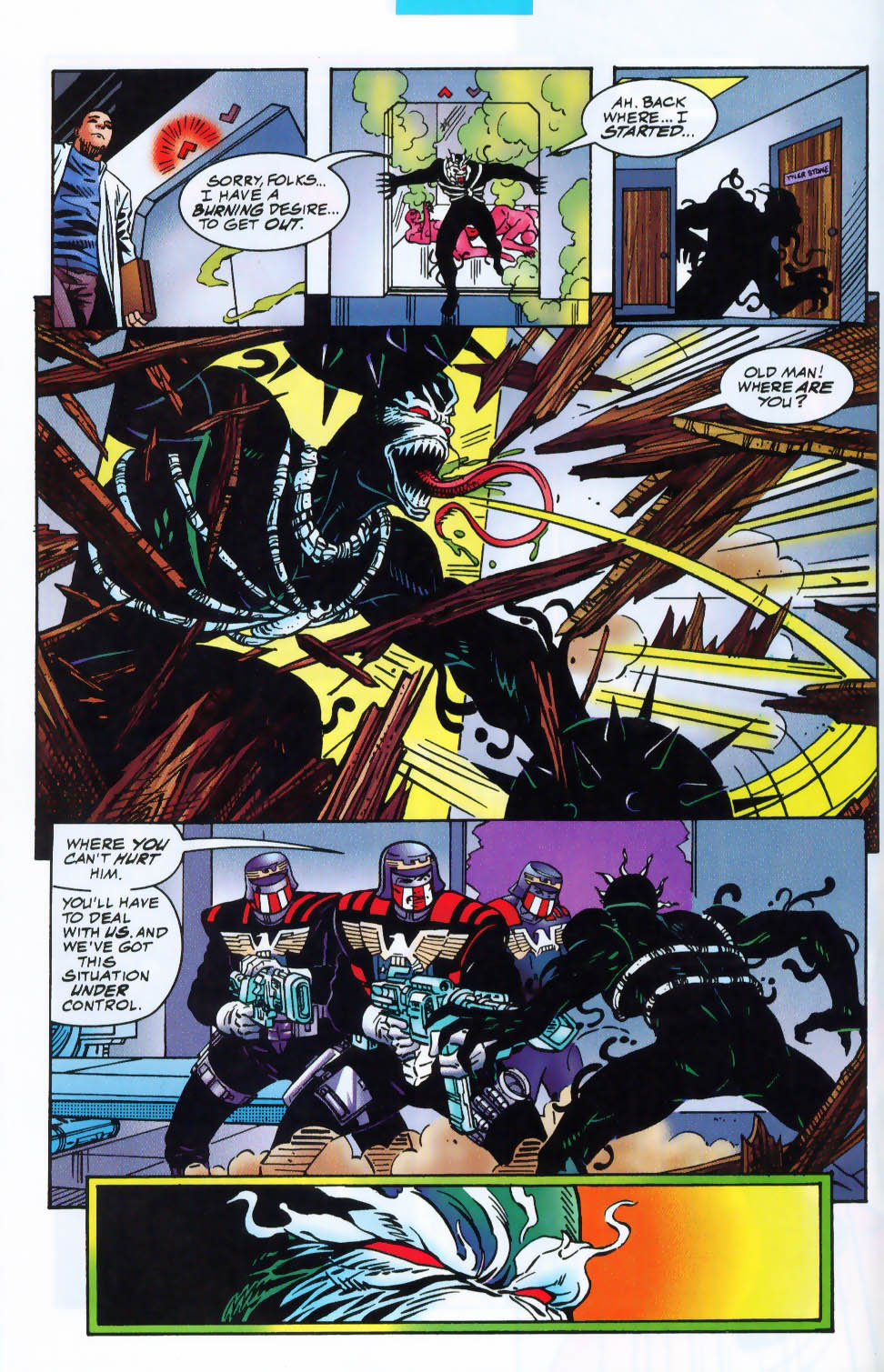
Venom 2099 and the armed personnel.

Dramatic and gripping. That is how I describe the tone of Peter David’s script here. As this is Spider-Man’s first encounter with Venom (which started at the end of the last issue), David not only crafted a very compelling conflict between them but also maintained consistency on developing the supporting cast members. Unsurprisingly, the sufficient focus on Venom made clear to reader that he is not only very dangerous but also uncompromising with his acts which make him a menace not only to people but even to armed personnel. His obsession with Tyler Stone is really something.

Regarding the comic book’s art, guest illustrator Keith Pollard did a fine job capturing the looks of the characters and also maintained the storytelling pace that started with issue #35. He also scored nicely on making the action look dynamic and fun to see. He also paid close attention to key details on the costumes of Spider-Man and Venom. I also like the way Pollard drew Spider-Man when it comes to swinging positions, wall-crawling, etc.

Conclusion

3
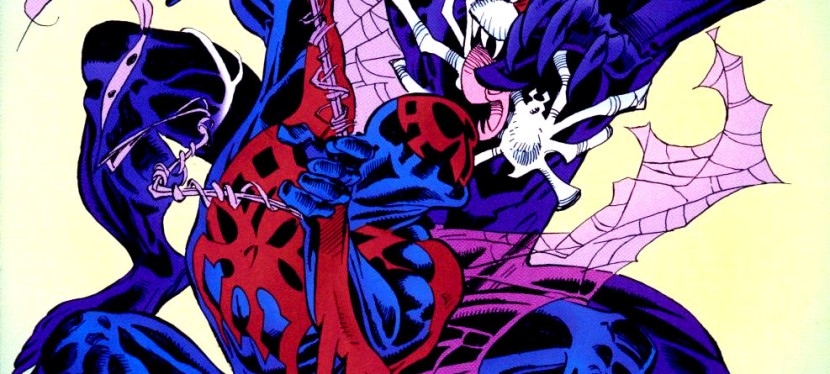
Spider-Man hits Venom while falling down.

Spider-Man 2099 #36 is a very good, old comic book! As this is one of the early comic book appearances of Venom 2099, it is significant not just in terms of financial value but also in terms of developing Spider-Man as a character. Partly helped by the massive popularity of the mainstream Venom (Eddie Brock), Venom of 2099 become one of the most significant super villains of Marvel 2099.

If you are seriously planning to buy an existing hard copy of Spider-Man 2099 #36, be aware that as of this writing, MileHighComics.com shows that the near-mint copy of the regular edition (Spider-Man 2099 cover), the “Venom 2099” titled cover regular edition, and the “Venom 2099” titled newsstand edition cost $34, $85 and $255 respectively.

Overall, Spider-Man 2099 #36 is highly recommended!


Thank you for reading. If you find this article engaging, please click the like button below and also please consider sharing this article to others. If you are looking for a copywriter to create content for your special project or business, check out my services and my portfolio. Feel free to contact me as well. Also please feel free to visit my Facebook page Author Carlo Carrasco and follow me at HavenorFantasy@twitter.com


A Look Back at Spider-Man 2099 #35 (1995)

Disclaimer: This is my original work with details sourced from reading the comic book and doing personal research. Anyone who wants to use this article, in part or in whole, needs to secure first my permission and agree to cite me as the source and author. Let it be known that any unauthorized use of this article will constrain the author to pursue the remedies under R.A. No. 8293, the Revised Penal Code, and/or all applicable legal actions under the laws of the Philippines.

When Marvel Comics first launched the 2099 imprint of comic books showcasing many futuristic versions of their present-day characters – like Spider-Man, Ravage and Dr. Doom – it was inevitable that the same treatment will be applied to their popular supervillains.

In 1993, the 2099 version of Vulture was introduced and he sure proved to be one tough opponent for Spider-Man 2099. Even back then, there already was clamor for a futuristic version of Venom which at the time was riding high with readers being the featured anti-hero in several limited series (starting with Lethal Protector) of comic books.

Then in 1995, after doing a creative teaser in issue , Marvel formally introduced Venom 2099 by releasing Spider-Man 2099 #35. This is my review of the comic book written by Peter David and drawn by Andrew Wildman (X-Men Adventures).

Cover
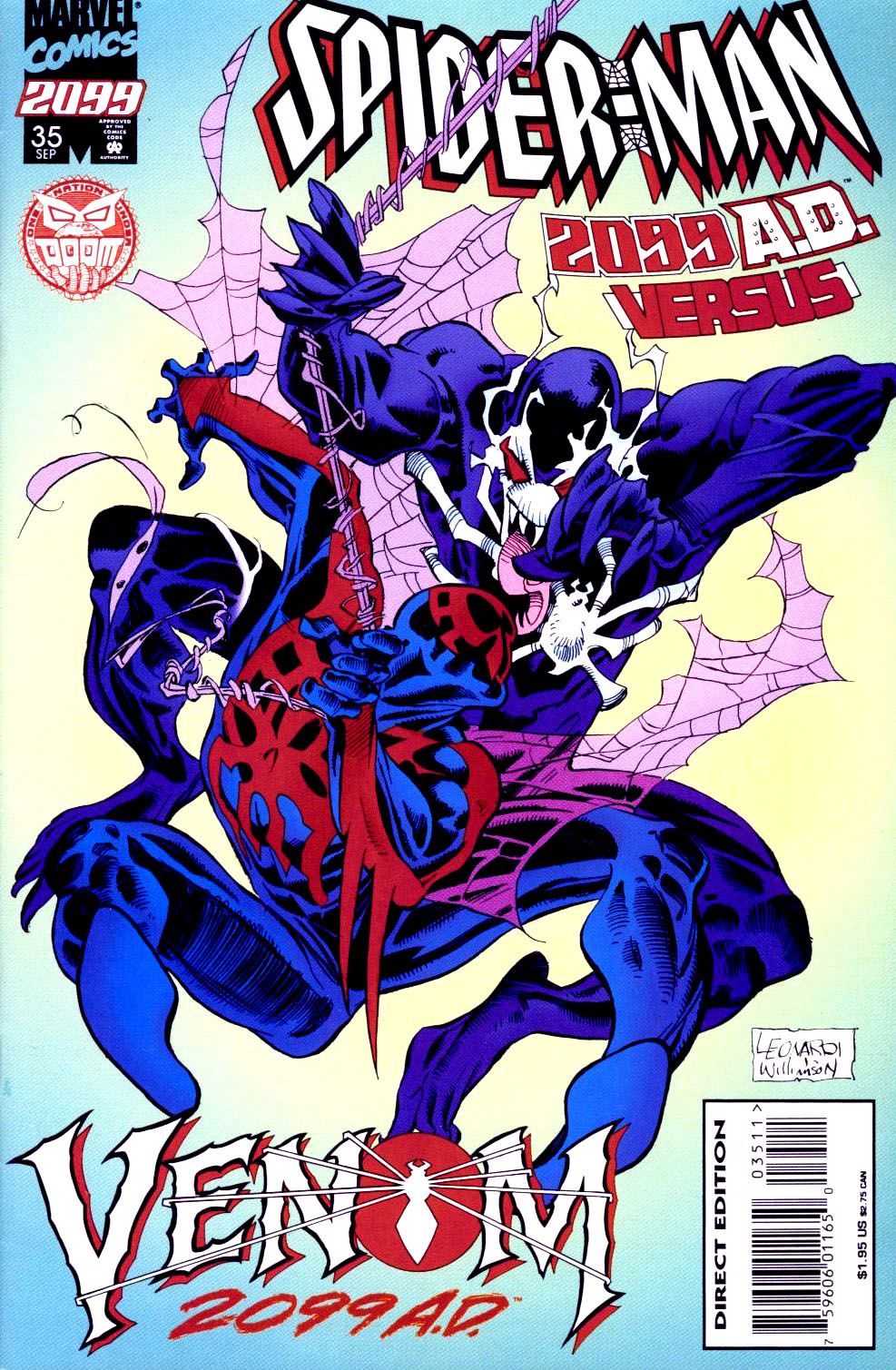
The cover drawn by Rick Leonardi.

Early story

Picking up from the events of issue , the story begins in Washington, DC with Dana freeing herself only to find out that Alchemax’s CEO Tyler Stone was down suffering from a gun shot and losing blood. Minutes later, emergency personnel take Stone’s body for immediate treatment.

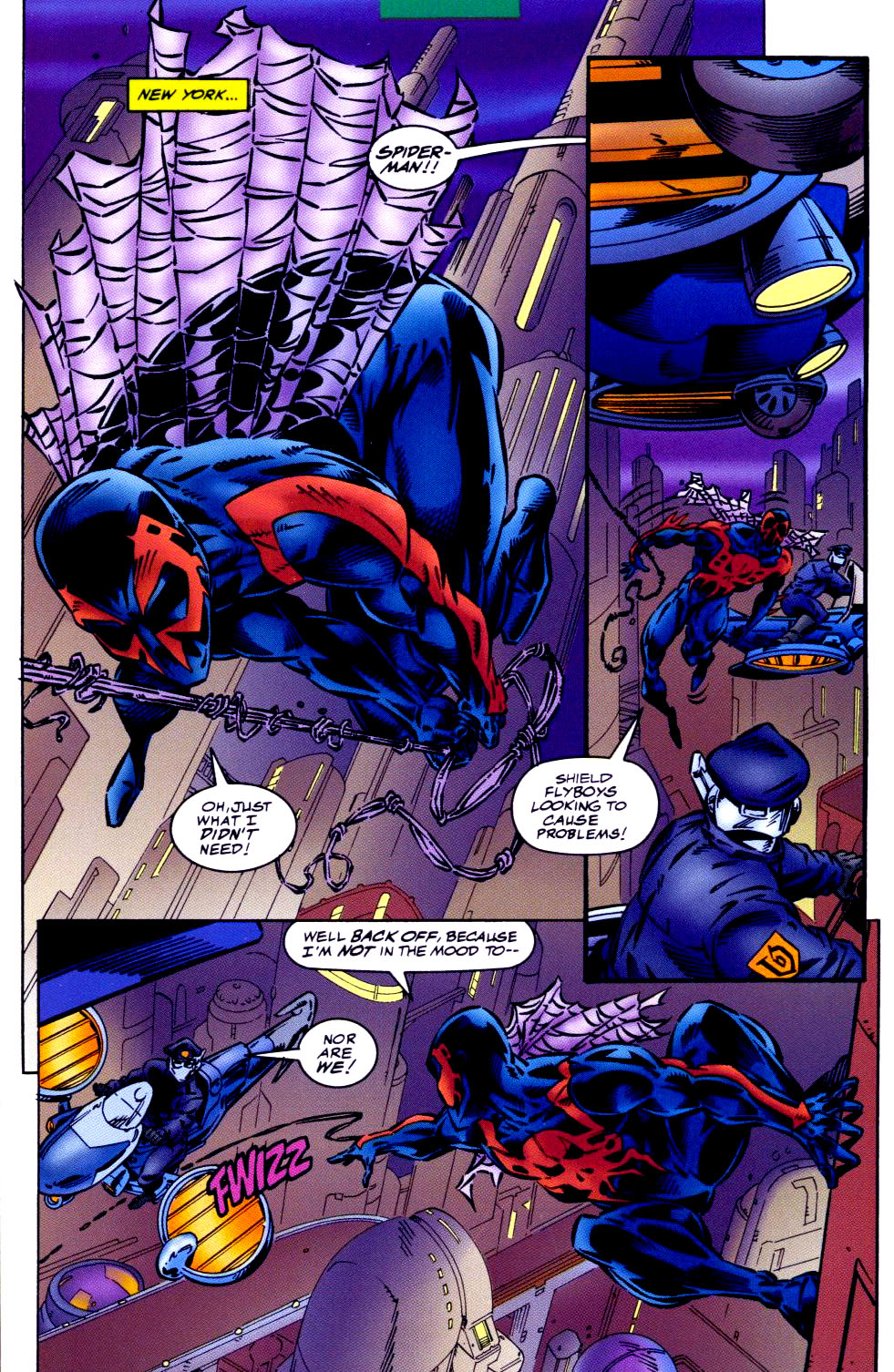
Meanwhile, Spider-Man 2099 (Miguel O’Hara) encounters the SHIELD flyboys in New York. After almost getting into trouble together, Spidey gets informed that US President Doom 2099 ordered them to leave him alone for a period of seventy-two hours while he considers a cabinet offer. Back in Washington, Dana gets interrogated by one of the authorities. President Doom enters the scene telling Dana that she will join Tyler Stone immediately in the medical center.

3
Andrew Wildman’s take on Spider-Man 2099 and the future was really nice to look at.

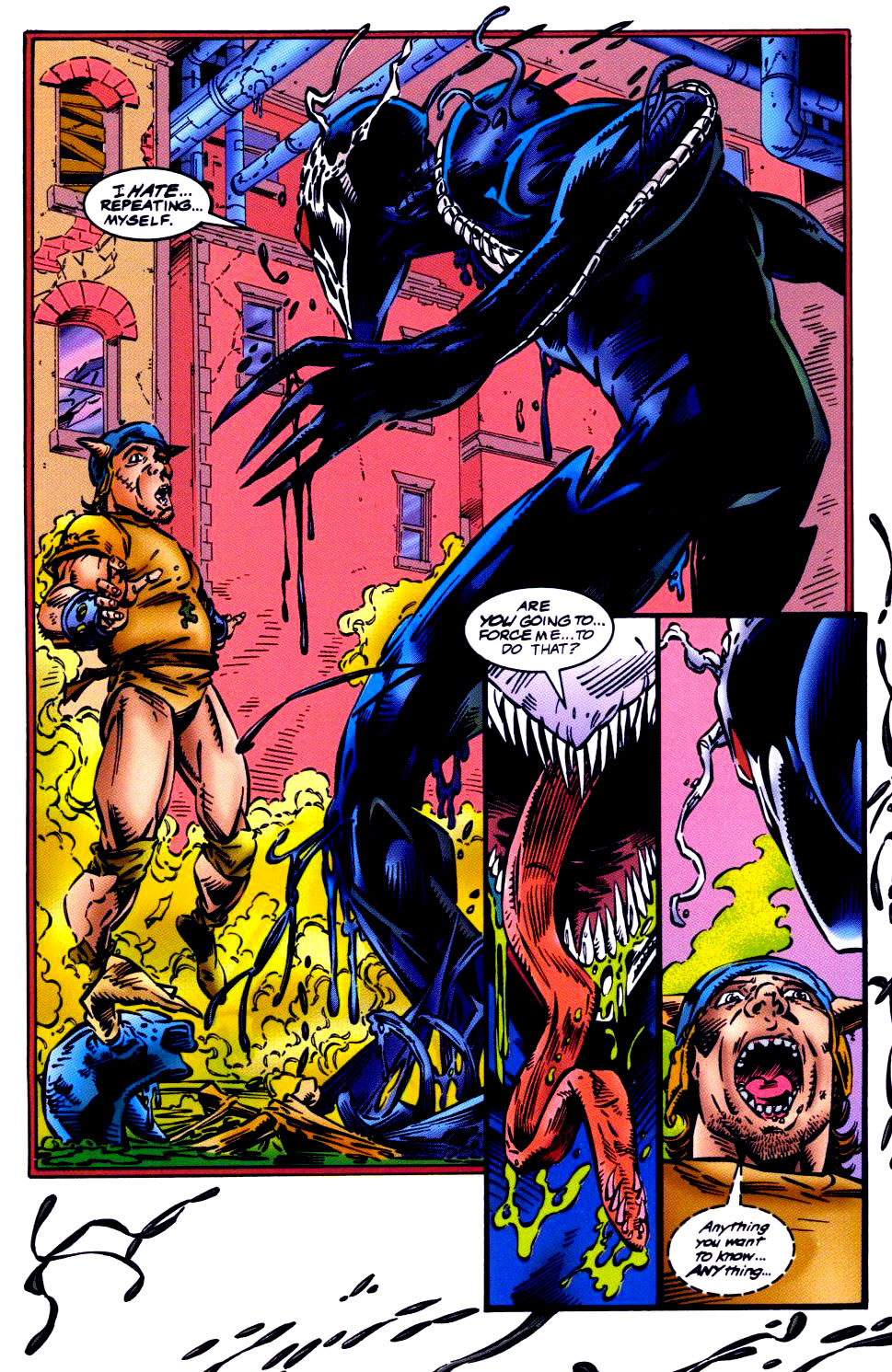
In New York, two guys sitting on the sidewalk witness a moving black liquid coming out of the sewer. The thing turns out to be a living symbiote (or alien costume) forming into a human-like shape – Venom 2099!

Quality

As with other comic books of this particular series, the writing by Peter David is pretty deep and engaging. The usual balance between dramatization, character development, plotting and spectacle is here once again but with a slight touch of horror in relation to the introduction of Venom of 2099. Speaking of dramatization, the portrayal of Venom 2099 as a vicious villain is similar to the 20th century Venom (Eddie Brock) but with a very powerful obsession to kill Miguel O’Hara and Tyler Stone.

Here’s an excerpt from the dialogue of Venom of 2099: Miguel O’Hara…and Tyler Stone…together again. We…I get to kill you…at the same time…how awfully…awfully…considerate. To show my appreciation…I’ll kill you slowly.

What makes this comic book unique is the artwork by Andrew Wildman who temporarily replaced regular illustrator Rick Leonardi. For comparison, I find Wildman’s art style a welcome thing in this comic book mainly because he draws with a lot more detail per panel and per page than Leonardi ever could. Instead of seeing the usual sketch-like art style of Leonardi, Wildman’s style is livelier and more expressive to look at. I also enjoyed Wildman’s visual take on Spider-Man 2099/Miguel O’Hara, Lyla, Tyle Stone, and the other established characters. Their facial expressions are also livelier to see.

9
Venom 2099 appears! Take note of the “liquid” at the edges of the page.

More on visuals, Wildman’s take on Venom 2099 is unforgettable. Like 20th century Venom, he has a dark suit, elongated jaw with rows of sharp teeth and an elongated tongue but with green acid dripping all the time. There are also those tentacles-like things that stretch from his body until the arms. Also his white-colored mask with large eyes make him look horrific.

Conclusion

Despite being shorter than the usual 22-pages, Spider-Man 2099 #35 is still a very engaging and fun old comic book to read. Its purpose was to build-up anticipation leading to the introduction of Venom 2099 was achieved nicely and the respective qualities of the writing and visuals are very good even by today’s standards. More on the presentation of Venom of 2099, it seems like Peter David took inspiration from movie director James Cameron on building-up tension and suspense before showing the villain. That’s a move I enjoyed in this comic book.

Overall, Spider-Man 2099 #35 is highly recommended. If you plan to acquire an existing and legitimate hard copy, be aware that the near-mint copy of it is over $100 for the newsstand version while the Rich Leonardi-drawn “Venom 2099 AD” cover version is priced at over $80 at MileHighComics.com as of this writing.


Thank you for reading. If you find this article engaging, please click the like button below and also please consider sharing this article to others. Also my fantasy book The World of Havenor is still available in paperback and e-book format. If you are looking for a copywriter to create content for your special project or business, check out my services and my portfolio. Feel free to contact me as well. Also please feel free to visit my Facebook page Author Carlo Carrasco and follow me at HavenorFantasy@twitter.com
A Look Back At Spider-Man 2099 Meets Spider-Man

When Marvel Comics launched its 2099 franchise back in 1992 with Spider-Man 2099, clamor for having the futuristic hero meet up with the classic Spider-Man (Peter Parker) quickly followed.

Back in those days, crossovers were already popular and sold nicely with collectors. The Infinity Gauntlet of 1991 was an epic, universe-wide crossover done nicely by Jim Starlin, George Perez and Ron Lim. That limited series sold well, Marvel followed it up with The Infinity War (1992) and The Infinity Crusade (1993).  Even the disjointed The X-cutioner’s Song crossover of the X-Men comic books of 1992 kept the fans coming back for more.

For the 2099 universe, the franchise had strong launches with the respective first issues of Spider-Man 2099, Doom 2099, Punisher 2099, Ravage 2099 and even the first latecomer series X-Men 2099. Back in 1993, having the said 2099 heroes mix together was realized in the 5-part crossover The Fall of the Hammer.

1
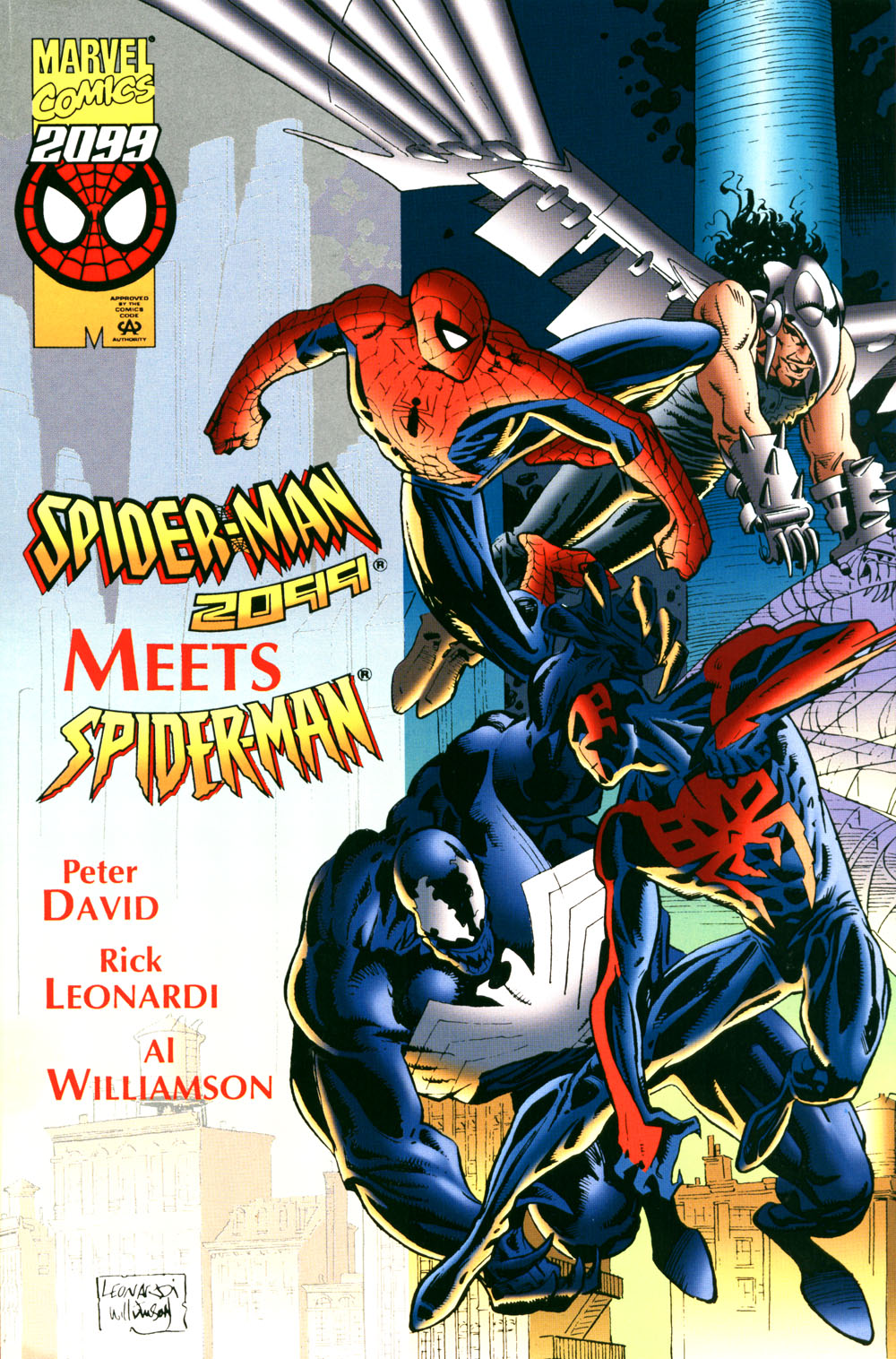
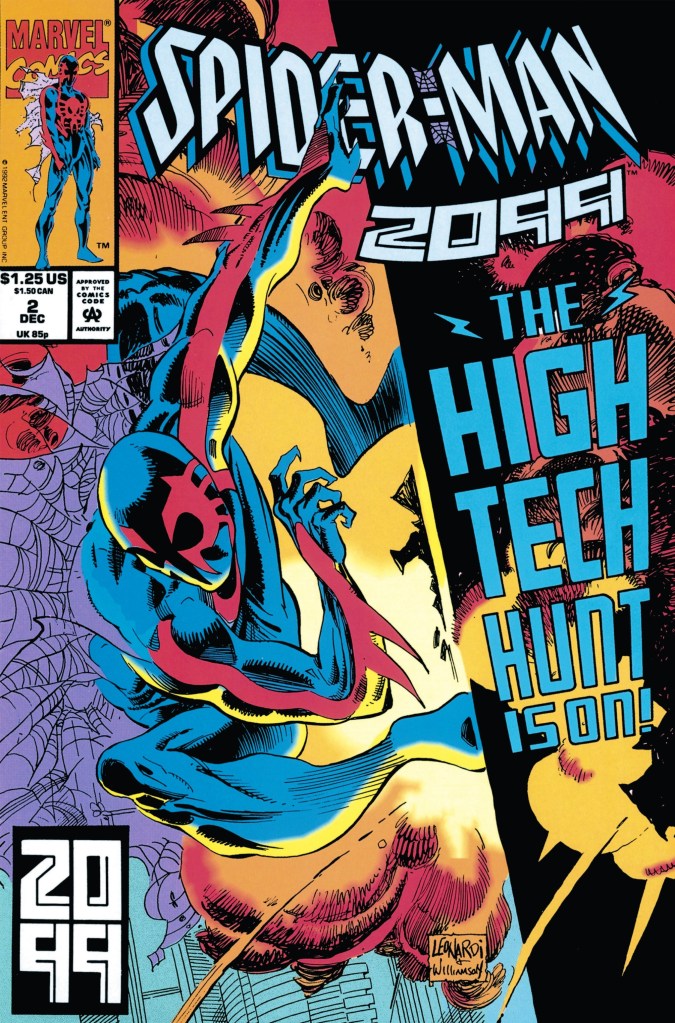
The cover by Rick Leonardi with ink work by Al Williamson. 

No matter what the trends back then, Spider-Man 2099 proved to be the most engaging series of the 2099 line of comic books arguably due to the in-depth storytelling of Peter David. Back in the 1980s, David worked at the direct sales team of Marvel Comics before moving into the editorial team as a writer. And, yes, he got to write for the Spectacular Spider-Man (originally titled Peter Parker, The Spectacular Spider-Man). Early on, Peter David made quite an impact with readers with the 4-part story The Death of Jean DeWolff in the said monthly series.

Many years later, David joined other comic book creators – including the late Stan Lee – on launching the 2099 franchise with Spider-Man 2099. He created a lot from scratch to establish the futuristic Spidey and made his mark on the 2099 universe.

“I don’t remember exactly which aspects of the 2099 were already part of the initial setup when I came aboard. I do know, though, that there was almost nothing specific for Spider-Man other than that he was, well, Spider-Man and (I think this was part of what I was handed) an employee of Alchemax. I was the one, though, who came up with his identity, the way his powers worked, the supporting cast, all of that. I even had a hand in designing the costume; not that I could draw a lick, but I sat there with Rick Leonardi during the first 2099 get together and described to him what I wanted, and he executed it perfectly, building upon what I suggested and improving it. I watched that costume come to life for the first time under Rick’s pencil. It was one of the single best collaborative moments in my life,” David said in a CBR.com interview.

This brings us back to the year 1995 when Marvel published the one-shot special crossover comic book designed to attract Spider-Man 2099 fans and the many millions of followers of the classic Peter Parker Spider-Man. That comic book was Spider-Man 2099 Meets Spider-Man written by Peter David and drawn by Rick Leonardi.

Let’s take a close look.

The comic book

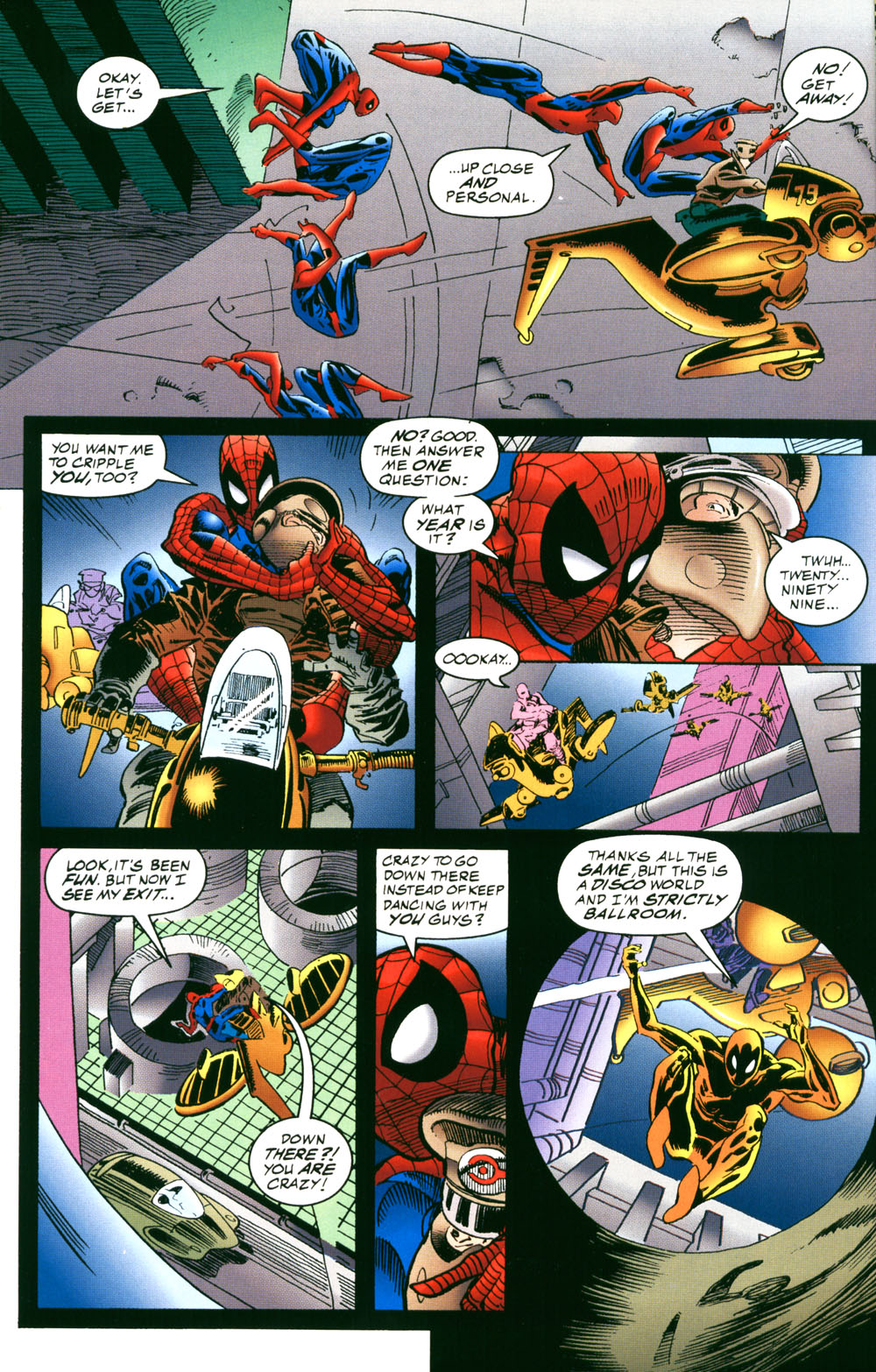
The story begins in the far future of 2099 wherein Spider-Man (Peter Parker) from the 20th century finds himself lost in time and chased by the floating law enforcers who saw him as a danger to the public. Even though his costume is different, one of the law enforcers mistook him for Spider-Man 2099. Predictably, Spider-Man struggles to overcome and get away from them.

8
Spider-Man in 2099!

13
Spider-Man 2099 inside the Daily Bugle.

Meanwhile in the 20th century, Miguel O’Hara mistakenly arrives “home” only to find himself (naked no less) on the same bed as Mary Jane Parker (Spidey’s wife) who is also naked. This only confirms to him that he is lost in time. He immediately decides to get away from MJ and explore the city of New York which does not have the futuristic society he grew up with.

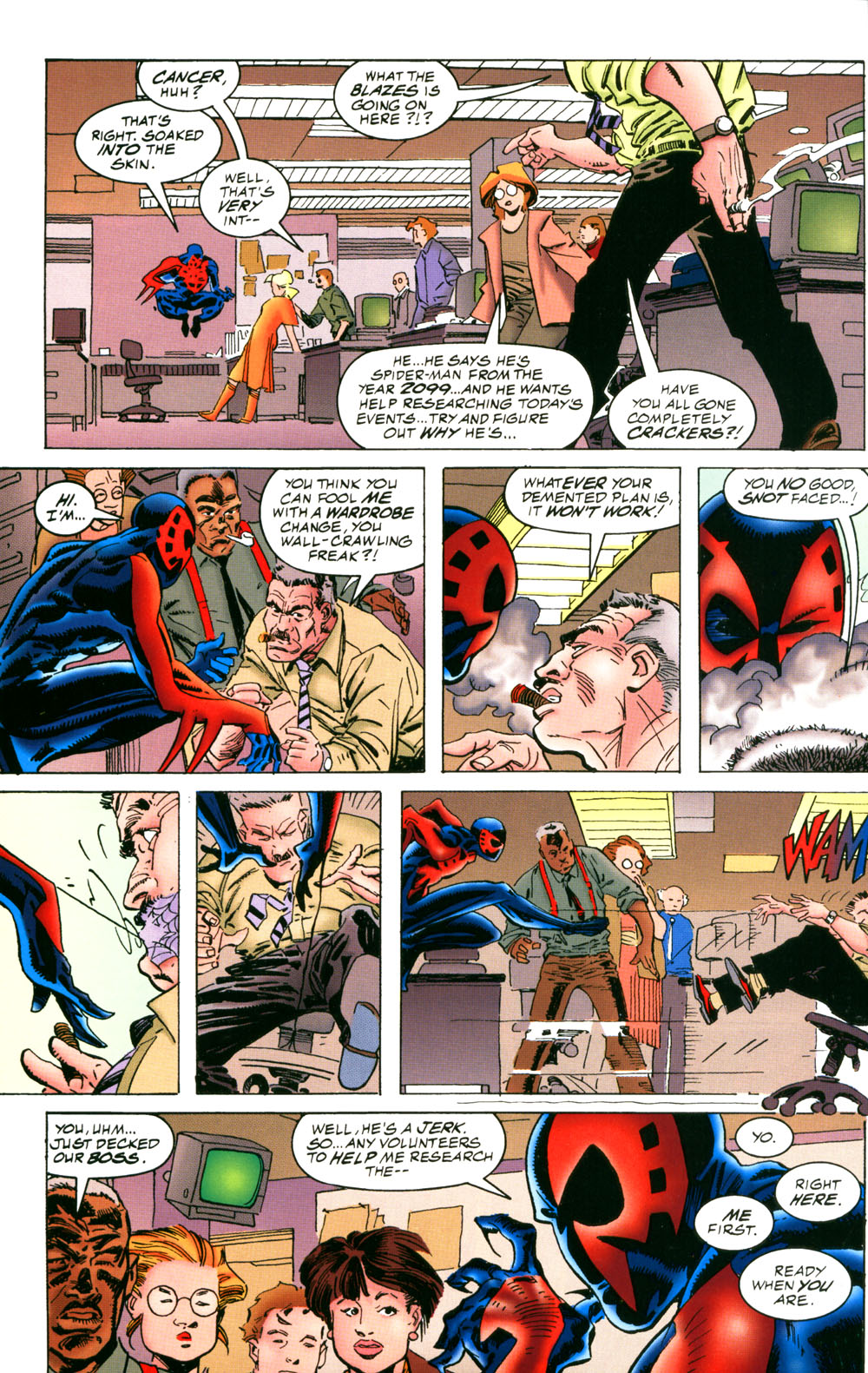
In an attempt to deal with the new reality, Spider-Man 2099 visits Peter Parker’s workplace – The Daily Bugle. He encounters Peter’s boss J. Jonah Jameson who mistook him as their time’s Spider-Man just wearing a new suit.

“You think you can fool me with a wardrobe change, you wall-crawling freak? Whatever your demented plan is, it won’t work,” Jameson told the disguised Miguel O’Hara who reacts by putting web on his mouth in front of the employees.

While the two superheroes struggle with being lost in time, Tyler Stone of Alchemax and Hikaru-Sama discuss something sinister.

Quality

25
Spider-Man with Miguel O’Hara’s brother and Layla.

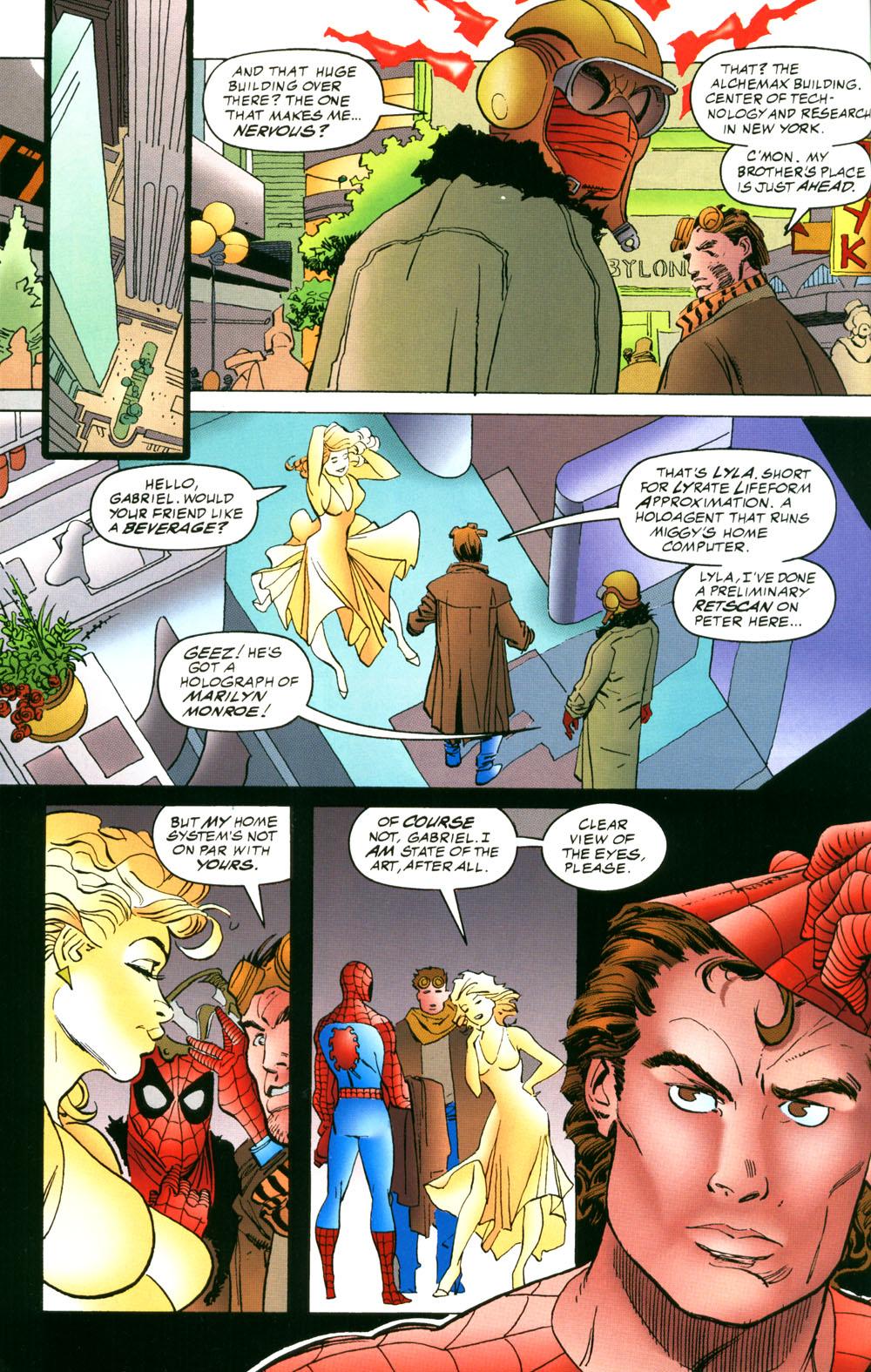
In terms of storytelling, Spider-Man 2099 Meets Spider-Man is messy even though there were efforts to have the two superheroes switch time settings that would allow them to explore different societies and mix up with their past supporting characters (example: Peter Parker Spidey meeting with Miguel’s brother and artificial intelligence Layla). What also hurt the storytelling was the lack of a very engaging antagonist. The futuristic Green Goblin the creators came up with was very lame.

The art by Rick Leonardi was barely satisfying and the sad thing is that none of his visuals – including the 2-page shot of the two superheroes together – delivered any impact. As Leonardi worked regularly on Spider-Man 2099, his art style of 20th century New York did not give me much immersion. J. Jonah Jameson was barely recognizable with Leonardi’s drawing.

To get straight to the point, this comic book is a major disappointment. It failed miserably to bring the two main characters together in a satisfying manner as there was an overabundance of build-up. By the time the two superheroes met, it was way too late for the comic book to be engaging and fun to read. With only seven pages available for the anticipated encounter, there was way too little of having Spider-Man and his 2099 counterpart together. So much could have been done to make the two superheroes interact and work together with a lot of impact but I suppose Marvel did not give the creative team enough time (and pages) to work with which resulted this disappointment.

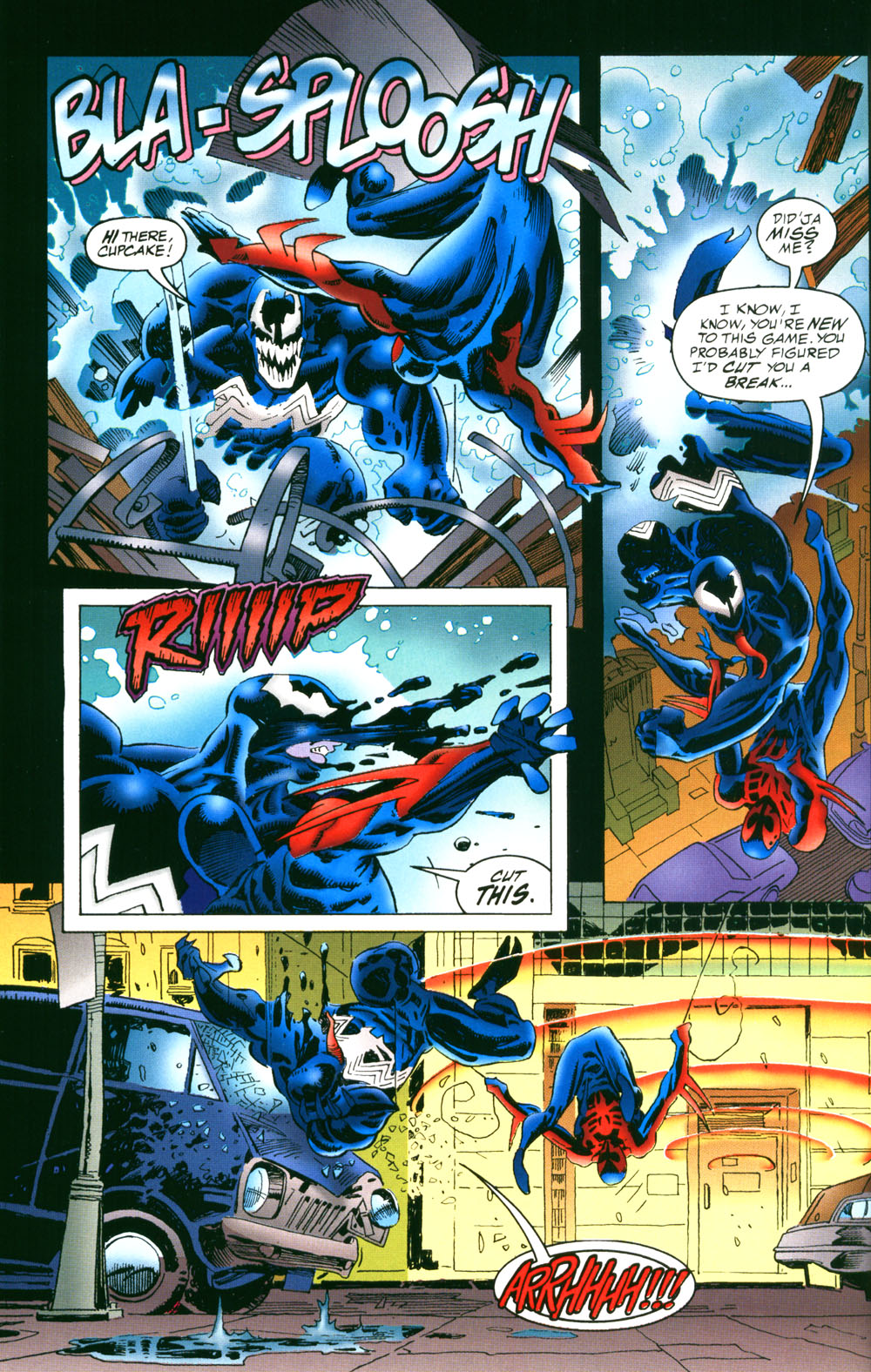
By comparison, I found Spider-Man 2099’s encounter with Venom much more satisfying to read. Spider-Man’s encounter with Vulture 2099, meanwhile, was satisfying. Sometimes I felt that it would have been better for Marvel to publish a Spider-Man 2099 versus Venom standalone crossover comic book than this 1995 crossover disappointment!

31
This is the BEST thing about this disappointing comic book. 

If you are determined to risk wasting your money by actually getting a physical copy, then be aware that a near-mint copy of Spider-Man 2099 Meets Spider-Man will cost you, believe it or not, over $40 at MileHighComics.com

Financial value aside, this comic book’s entertainment value is pretty low. It’s not a badly made crossover comic book but it sure remains a big disappointment considering its concept. Ultimately, Spider-Man 2099 Meets Spider-Man is not recommended. You have been warned.


Thank you for reading. If you find this article engaging, please click the like button below and also please consider sharing this article to others. Also my fantasy book The World of Havenor is still available in paperback and e-book format. If you are looking for a copywriter to create content for your special project or business, check out my services and my portfolio. Feel free to contact me as well. Also please feel free to visit my Facebook page Author Carlo Carrasco and follow me at HavenorFantasy@twitter.com
A Look Back At Spider-Man 2099 #25

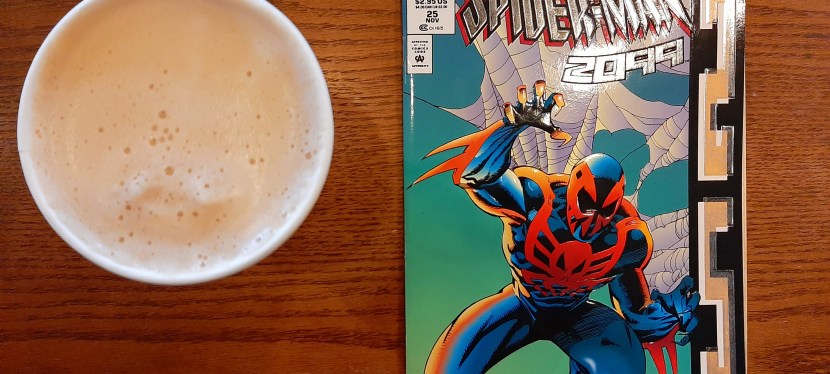
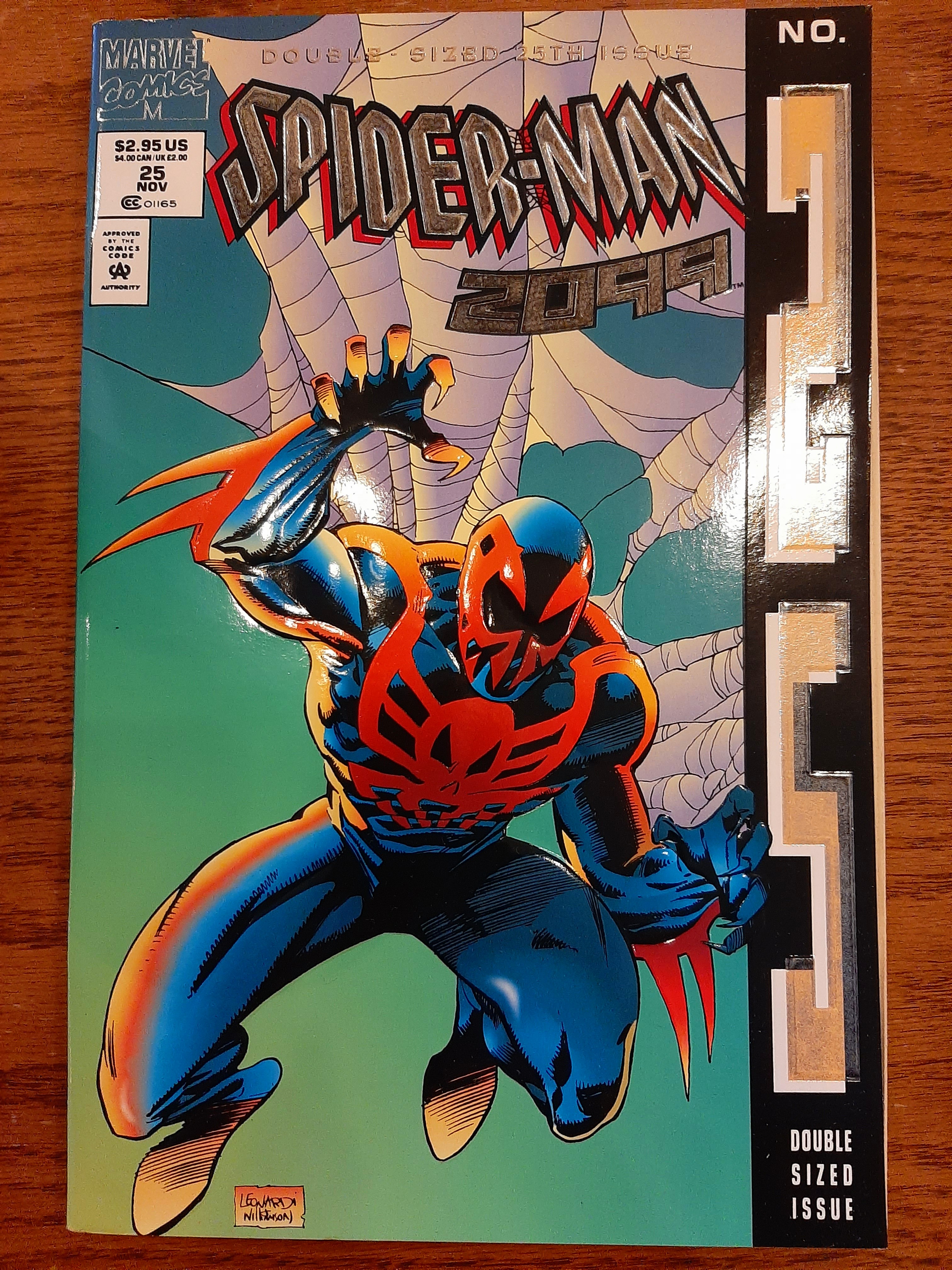
Released in late 1994 by Marvel Comics, Spider-Man 2099 had a double-sized issue with an embossed cover that shined as it was laced with foil. The number 25 on the edge of the cover was stylized to capture people’s attention on the shelves of comic book specialty stores.

20190617_075338.jpg
The cover of Spider-Man 2099 .

Back in the 1990s, Marvel had a “tradition” of releasing comic books with gimmick covers with anniversaries in mind. Notably the 25th, the 50th, the 75th and 100th issue and more got released with covers that came with foil or chromium or hologram or simply a hard embossed material. In other times, the anniversaries of the featured superhero/superheroes were celebrated with gimmick covers on comic books marking the celebration.

With regards to Spider-Man 2099 , the 2099 universe of Marvel had reached its 2nd year. By that point of time, the Marvel’s 2099 line of comics was already at full publishing blast with several monthly series (Spider-Man 2099, Ravage 2099, Punisher 2099, Doom 2099, X-Men 2099 and Ghost Rider 2099) plus a quarterly comic book (2099 Unlimited).

Written by Peter David and drawn by Rick Leonardi (with ink work by Al Williamson), the comic book begins with a short scene about Miguel O’Hara’s (Spider-Man 2099) mother moving on her way to meet someone. The spotlight then shifts into the heat of the rematch between Spider-Man and the cyborg Venture.

Later Miguel’s mother meets a certain tycoon at his mansion…

20190617_075448.jpg
Spider-Man of 2099 fights with Venture.

When it comes to quantity, this comic book has a Spider-Man story of 22 pages, a Hulk 2099 story with 8 pages (a prequel to Hulk 2099 specifically) and a story called Net Loss with 10 pages. The first time I read this comic book back in 1994, I anticipated more Spider-Man 2099 content but got surprised with the other two being part of it. Marvel decided back then to use Spider-Man ’s content to expand and emphasize the 2099 universe.

When it comes to quality, I find the Spider-Man 2099 story here a worthy read not simply because Peter David wrote it but because he crafted a story that connects and relates well with what happened in Spider-Man 2099 . When I reached the end of the story, I really felt compelled to go back to the very first issue to re-examine what happened.

As this was the 25th issue of the series, Peter David and Rick Leonardi were more proficient as a creative team. The aesthetics of Leonardi’s art (inked by Williamson) is pretty much the same but I noticed that the illustrator added more power on key moments of the action. Ultimately this story is worthy of the 25th issue anniversary treatment.

The Hulk 2099 short story by Gerard Jones and Malcolm Davis meanwhile serves only to build up the mean green monster for its monthly series. Hulk 2099 was never an interesting character to me and this one did not change my view of him.

The final short story Net Loss was rather weird. Even though I read a lot of 2099 comic books, the story by Peter David and Tom Grindberg just did not captivate me.

Overall, I find Spider-Man 2099 a worthy comic book to add to your collection and Spidey’s story alone is worth it.

Spider-Man 2099 is recommended.


Thank you for reading. If you find this article engaging, please click the like button below and also please consider sharing this article to others. Also my fantasy book The World of Havenor is still available in paperback and e-book format. If you are looking for a copywriter to create content for your special project or business, check out my services and my portfolio. Feel free to contact me as well. Also please feel free to visit my Facebook page Author Carlo Carrasco and follow me at HavenorFantasy@twitter.com
A Look Back At Spider-Man 2099 #1

I remember decades ago when superhero comic book collecting was exciting with trends of comic creators unleashing their newest owned projects and comic book publishers publishing new comic books expanding their existing universe.

In 1992, Marvel Comics announced the launch of the 2099 universe which highlights a far, futuristic possible universe of their comic book universe laced with visual inspiration from Blade Runner and an emphasis of what the future would be like had private corporations had more control over people and society.

What kicked off interest with the 2099 imprint was the announcement of Spider-Man 2099 which is obviously a far future counterpart of the famous Peter Parker Spider-Man people knew.

Here is my look back at the comic book Spider-Man 2099 .

Spia
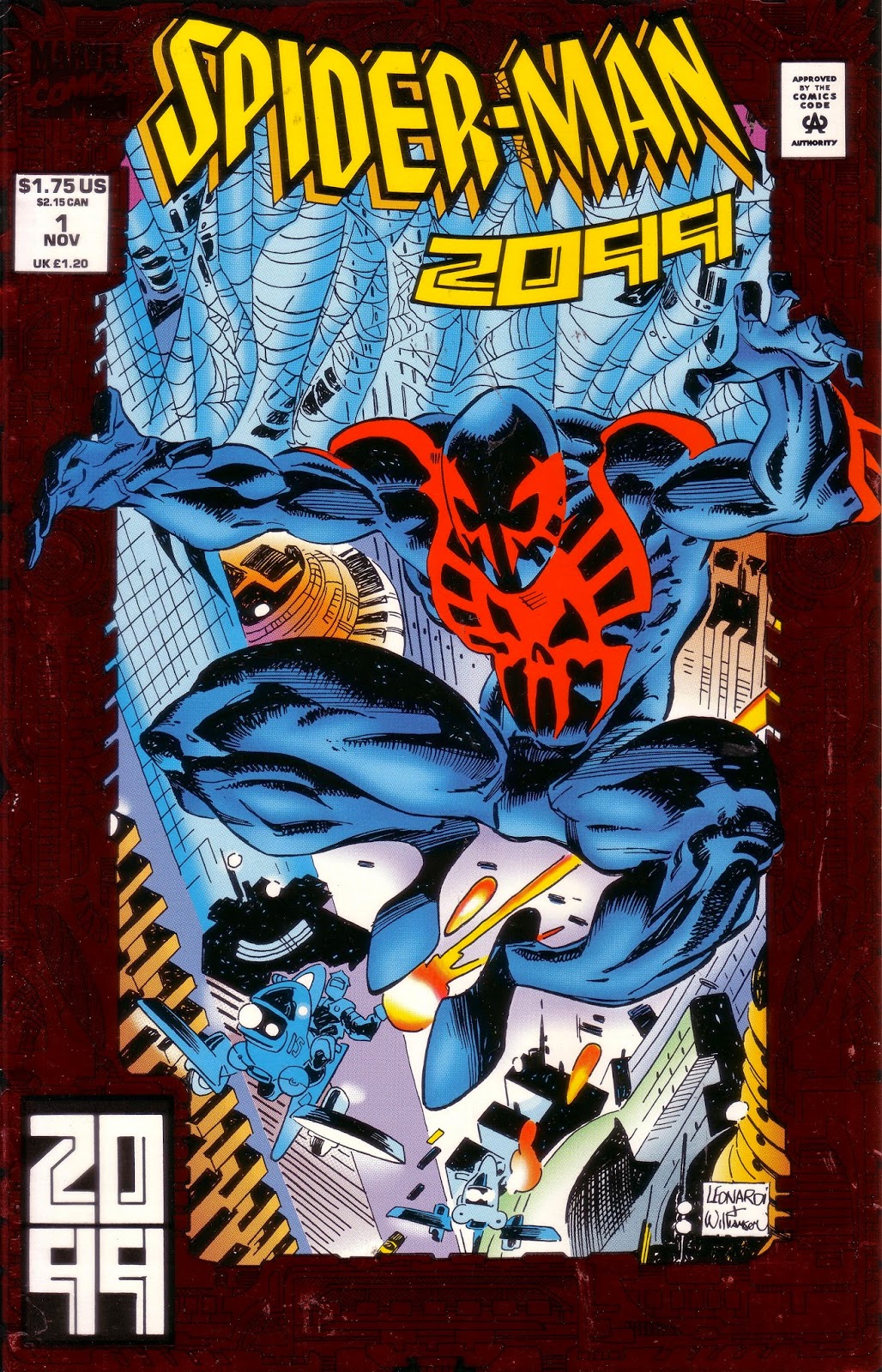
Cover of Spider-Man 2099 .

Released in late-1992 by Marvel Comics, Spider-Man 2099 came with a hard cover laced with red foil and in the middle was art of the superhero chased by flying police officers. The image easily reminded me of Peter Parker Spider-Man escaping from police officers who thought he committed crime.

With its story written by the legendary Peter David and drawn by Rick Leonardi (who drew some Spider-Man comics previously), the comic book introduced readers to Miguel O’Hara who is a very talented geneticist working for Alchemax with an interest on the original Spider-Man (Peter Parker). As head of the company’s genetics project (working under Aaron Delgado who answers to R&D Vice President Tyler Stone), the Latino O’Hara planned to create new and powerful beings called “corporate raiders” (which reflects Alchemax’s planned control over them).

O’Hara intends to create a new being with abilities and specialties similar to that of the classic Spider-Man and it is clear in the story that he has vested interest with him having existing records from the past.

Spib
The classic Spider-Man referenced in this page.

Even with very high-tech equipment and resources, a genetic experiment using a living person went horribly wrong which brought way down O’Hara’s morale and spirit. Discouraged and filled with guilt he visits Stone’s office to express his desire to resign. Seeking to calm O’Hara down, Tyler offers him a drink and at this point of the story things really start taking twists leading to how O’Hara becomes Spider-Man of his era. You’ll just have to read the comic book.

From a visual standpoint, Rick Leonardi did a nice job bringing 2099’s society to life with those high-tech machines, floating vehicles, buildings with very futuristic designs, nice looking action, etc. On pages 2 and 3 you’ll see Spider-Man 2099’s first-ever appearance literally coming straight at you which is to say the least memorable. Oh yes, the late Al Williamson inked the art.

Storytelling was nicely paced. The chase and action scenes in the start were pretty fast and clearly Peter David took his time controlling the pace when it came down to emphasizing characters and telling the back story. He really defined Miguel O’Hara’s personality and within a few minutes any reader will realize that the protagonist is not the “typical and likable” hero some would expect.

In fact Miguel O’Hara is somewhat arrogant and even had the guts to stand up to Tyler Stone. He’s a lonely guy as well and spends a lot of time interacting and depending on Lyla, a holographic aid with artificial intelligence.

Spic
Spider-Man of 2099 in action!

With regard to the presentation of genetics, Peter David was clearly influenced by the 1986 movie The Fly directed by David Cronenberg. Even that movie’s title was mentioned in the comic book. That being said the story shed light on the risks and possible unethical approach to scientific experiments that involved the manipulation of human genetics. Along the way it clearly dramatizes the complete power and freedom (and abuse perhaps) Alchemax enjoys with its operations and that nothing could stop them.

Overall Spider-Man 2099 is worth looking for and collecting even though it is decades old. Sure it has that 1990s vibe in terms of visuals but it is indeed refreshing to read especially after reading many of today’s “modern” art in comics (especially with the recent Spider-Man 2099 comics). As far as importance is concerned, Spider-Man of 2099 is truly valued by Marvel and clearly the character truly defines the 2099 imprint. It is no surprise that Spider-Man 2099 was brought back when Marvel launched a new line of 2099 comic books back in 2015.

Even until now Spider-Man 2099 is still one of the very best 2099 comic books ever released. It is a classic in its own right. I suggest visiting your local comic book store to find an existing copy of it.


Thank you for reading. If you found this article to be engaging, please click the like button below and also please consider sharing this article to others. Also my fantasy book The World of Havenor is still available in paperback and e-book format. If you are looking for a copywriter to create content for your special project or business, check out my services and my portfolio. Feel free to contact me as well. Also please feel free to visit my Facebook page Author Carlo Carrasco.

Author’s Note: This article was originally published at my old Geeks and Villagers blog. What you read on this website was an updated and expanded version. In other words, this newest version you just read is the most definitive version