A Look Back at Mantra #15 (1994)

Disclaimer: This is my original work with details sourced from reading the comic book and doing personal research. Anyone who wants to use this article, in part or in whole, needs to secure first my permission and agree to cite me as the source and author. Let it be known that any unauthorized use of this article will constrain the author to pursue the remedies under R.A. No. 8293, the Revised Penal Code, and/or all applicable legal actions under the laws of the Philippines.

Welcome back, superhero enthusiasts, comic book collectors and fans of the Ultraverse! As you might have seen in my most recent retro reviews of Mantra comic books, I’ve been following the Archimage Quest which really brought the title character (Lukasz occupying the body of Eden Blake whose soul he displaced) to a several places and situations. She got to be with The Strangers temporarily (The Strangers #13 and Mantra #12) in pursuing the wicked Boneyard, went into the fantasy realm where men and women are divided, and more.

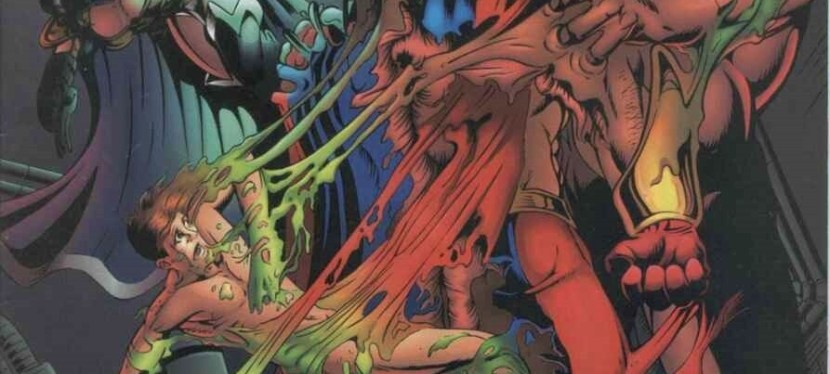
While issue #14 marked the end of the said quest, there is still more to come in the next Mantra issue I recently reviewed. In fact it is the aftermath of the Archimage Quest and we can all find out more in Mantra , published in 1994 by Malibu Comics with a story written by Mike W. Barr and drawn by Mark Heike.

The cover.

Early story

The story begins with Mantra surprised by Boneyard while being bothered mentally by Eden who warns that they may end up both getting killed. Appearing in a misty form, Boneyard enjoys the fact that Mantra killed her superior Archimage (whom she thought was Boneyard). As the wicked man fades away, he tells her, “I shall return to take my revenge on our wedding night…”

Right then, Boneyard’s troops arrive led by Notch who at this point of time is very determined to defeat Mantra. Mantra makes short work of the troops until Notch is the one left standing. In response to Notch’s arrogance that he will be brought back to life by Boneyard as before, Mantra tells him that his leader abandoned him and notices him getting fearful suddenly. Mantra kills him successfully.

Mantra and Eden communicate with each other. The armed sorceress tells her that the war will never end until Boneyard is killed and she becomes a man again. As far as Eden is concerned the war is pointless…

Quality
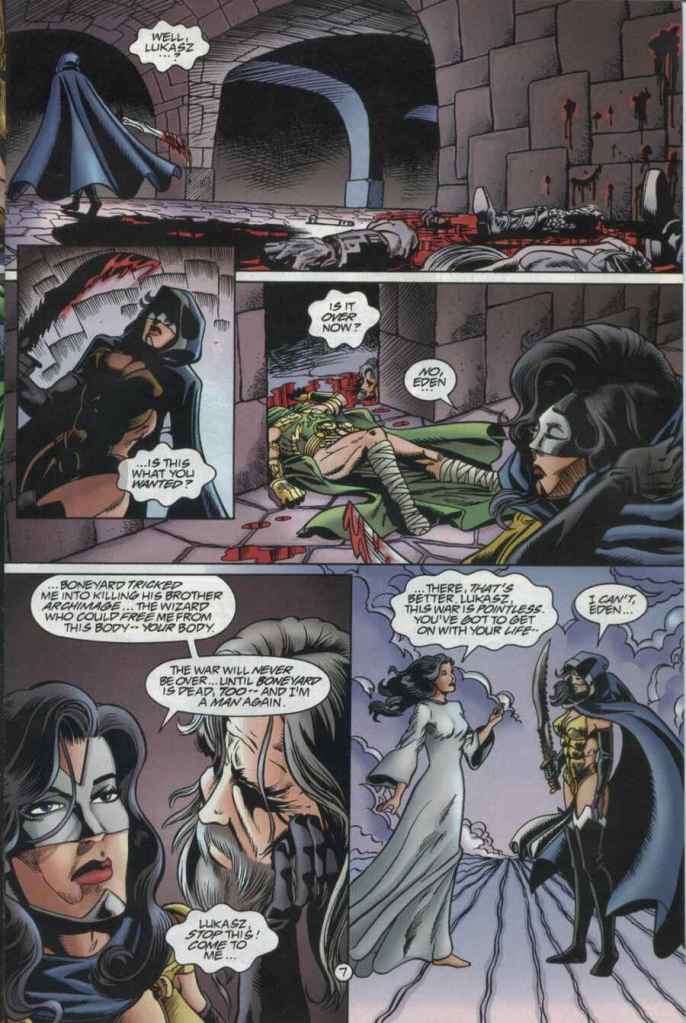
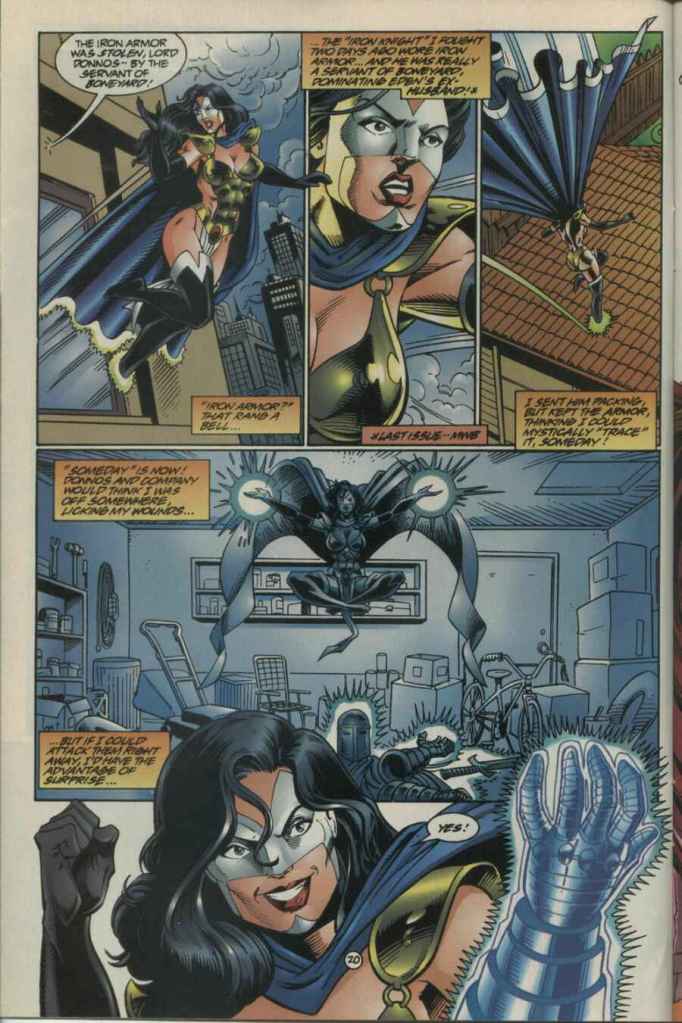
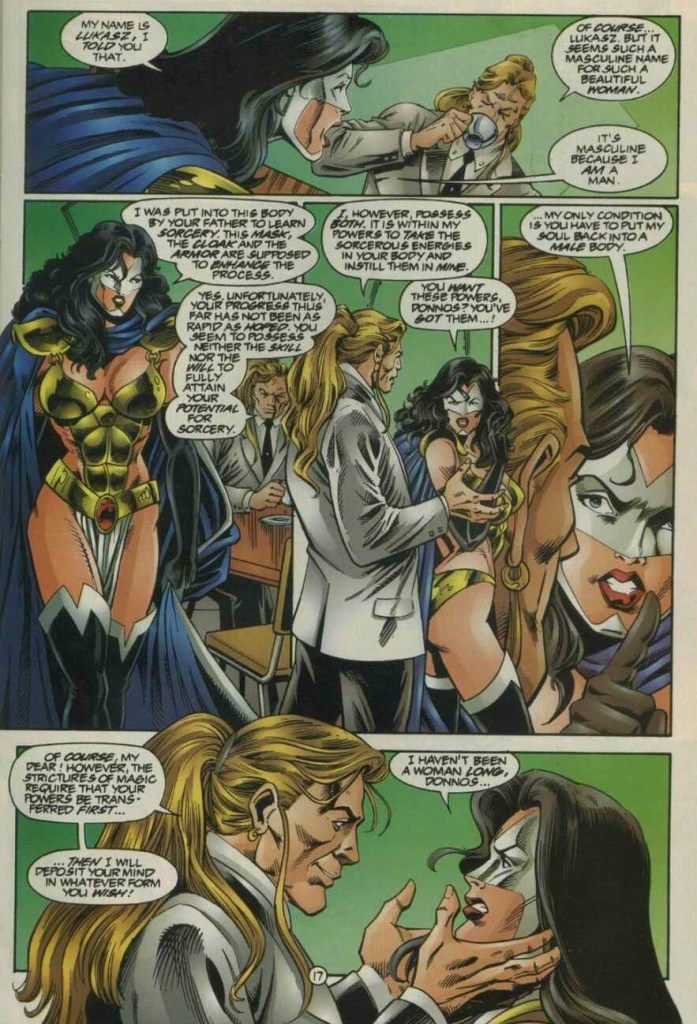
Mantra (Lukasz inside) interacts with Eden Blake.

As before, Mike W. Barr continues to deliver very solid writing. To break it down, the aftermath of the Archimage Quest was done with nice care filled with lots of relevant details to read not to mention the lively portrayal of Mantra making an impact on the people in the fantasy realm especially in the absence of Topaz who, at this point in the story, was on her way to the contemporary world where she was destined to join UltraForce.

The 2nd half of the story is set in the contemporary world. While Mantra spent days in the fantasy realm, a certain Eden Blake returned to the lives of Evie, Gus, Jr. and former husband Gus. The Blake family, combined with Prime getting involved with Mantra in the contemporary world, were also nicely dramatized.

For the most part, Mark Heike’s art is good although his take on Prime looks awkward.

Conclusion
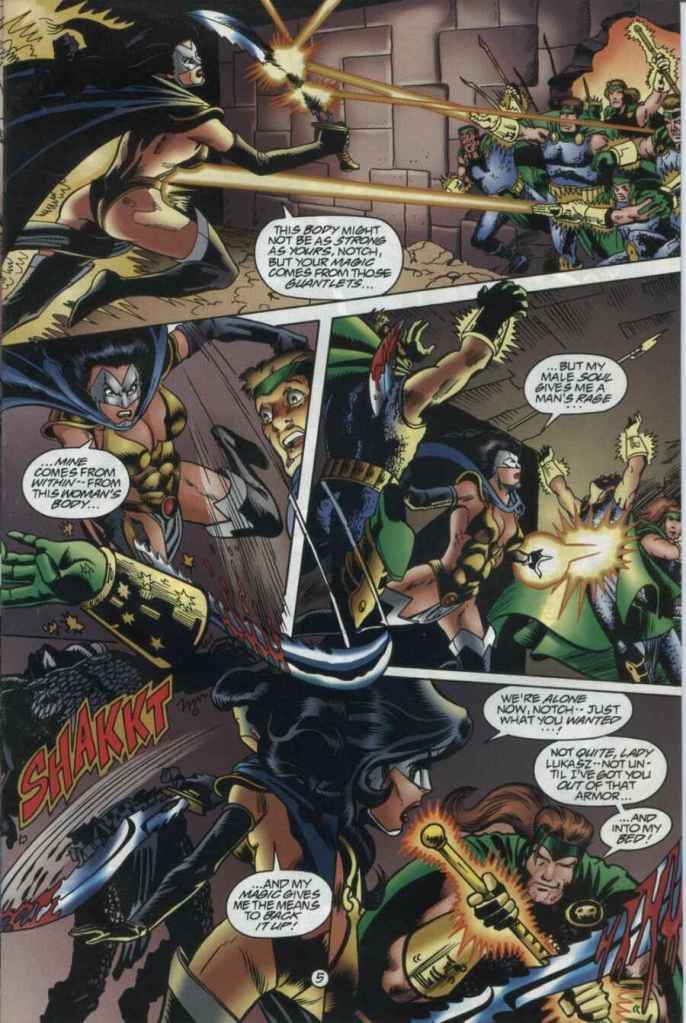
Mantra takes on Notch and other troops of Boneyard.

Mantra (1994) is a fun comic book to read and it is more layered this time mainly due to the settings and the character developments that happened in between. The Archimage Quest, in my opinion, ended satisfactorily and this aftermath added more punch to it.

If you are seriously planning to buy an existing hard copy of Mantra (1994), be aware that as of this writing, MileHighComics.com shows that the near-mint copy of the comic book costs $8.

Mantra (1994) is recommended.

+++++

Thank you for reading. If you find this article engaging, please click the like button below and also please consider sharing this article to others. If you are looking for a copywriter to create content for your special project or business, check out my services and my portfolio. Feel free to contact me as well. Also please feel free to visit my Facebook page Author Carlo Carrasco and follow me at HavenorFantasy@twitter.com
A Look Back at Prime #13 (1994)

Disclaimer: This is my original work with details sourced from reading the comic book and doing personal research. Anyone who wants to use this article, in part or in whole, needs to secure first my permission and agree to cite me as the source and author. Let it be known that any unauthorized use of this article will constrain the author to pursue the remedies under R.A. No. 8293, the Revised Penal Code, and/or all applicable legal actions under the laws of the Philippines.

Welcome back, superhero enthusiasts, comic book collectors and fans of the Ultraverse! Did you guys and gals have a restful Christmas weekend? I sure did! Anyway, we are about to return to the Ultraverse through the eyes of Prime. The catch here is that Prime will face not one but two guys to battle with.

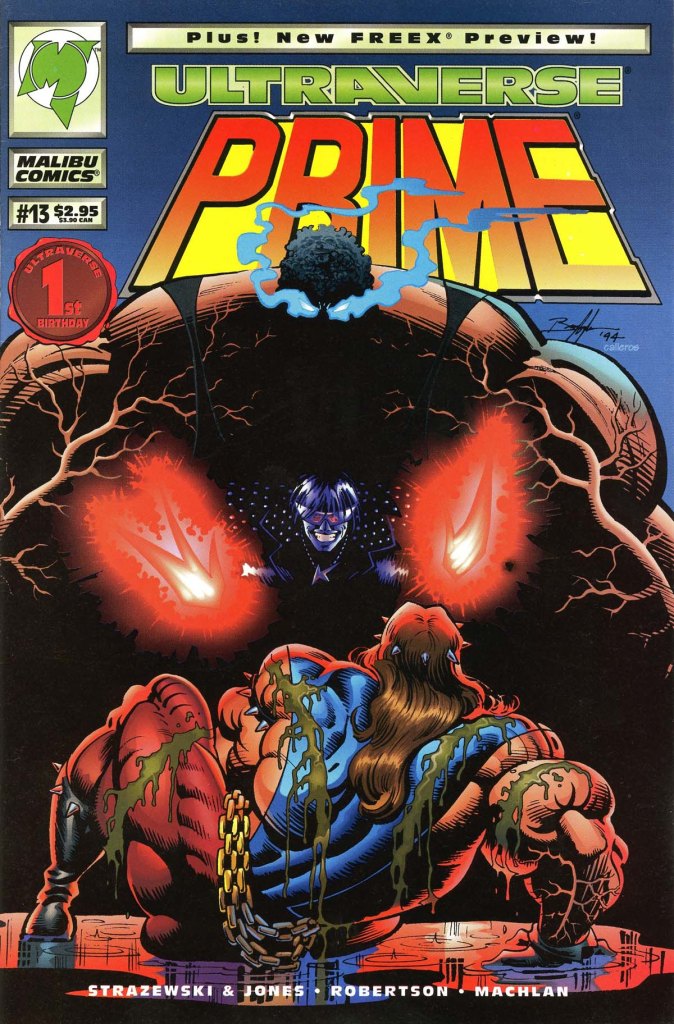
With those details laid down, here is a look back at Prime , published in 1994 by Malibu Comics with a story written by Len Strazewski and Gerard Jones, and illustrated by Darick Robertson. This is another one of those Ultraverse 1st anniversary comic books.

The cover.

Early story

The story begins with Kevin Green hitchhiking alone by the road. A man driving a car allows him to come in and ride. Just a few moments after, the man reaches for Kevin’s left thigh which convinces him that the one driving is a pervert. Kevin hits the man’s face and gets off the car. He struggles to find a ride going home in the evening.

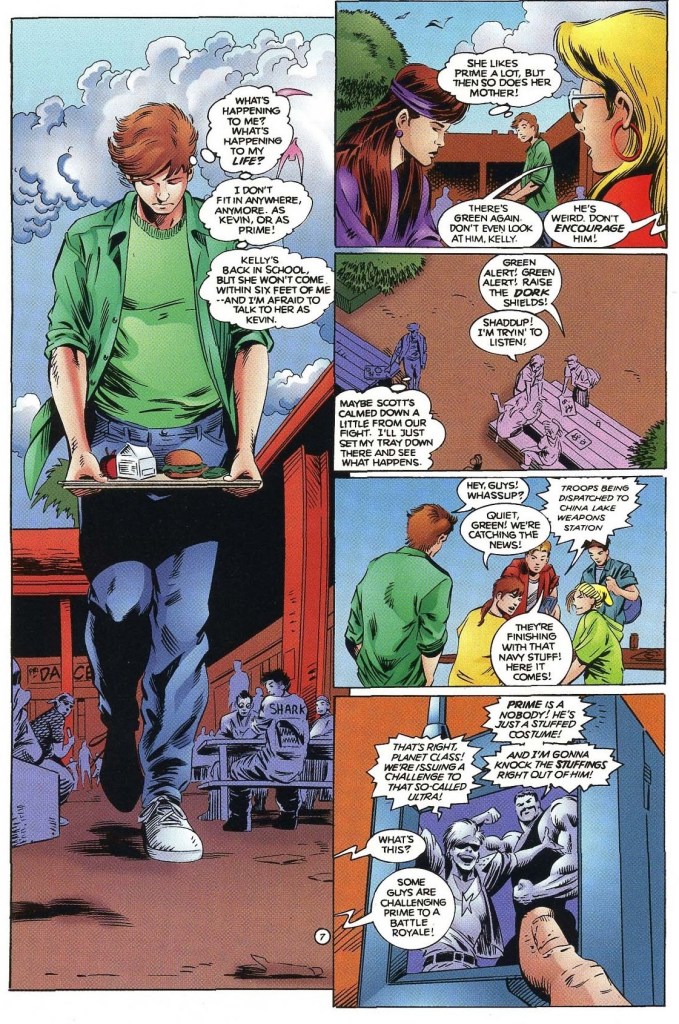
At home, Kevin wakes up from a nightmare as his mother tries to help him. His mom can easily tell that her son is troubled. During lunch break at school, realizes he is having trouble fitting in with the students and reminds himself that Kelly likes Prime a lot, and so does her mother. The students stare at him as he walks on. Eventually, Kevin meets some guys watching a portable TV showing news broadcast of two guys – the washed-up celebrity Kuttner and a certain bodybuilder – whom he previously encountered as Prime.

The said two guys are challenging Prime to a battle royale…

Quality

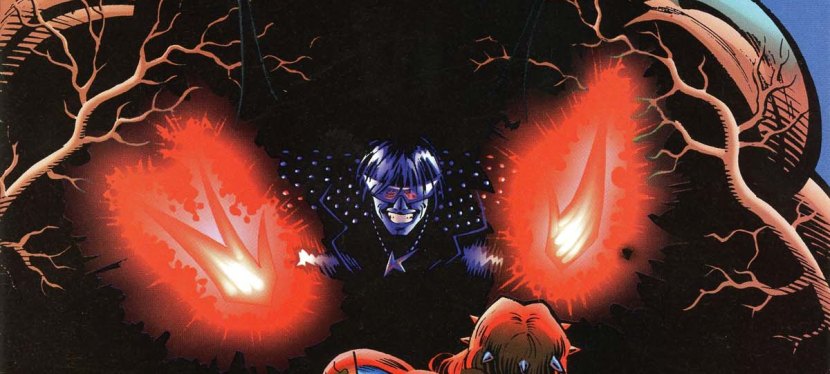
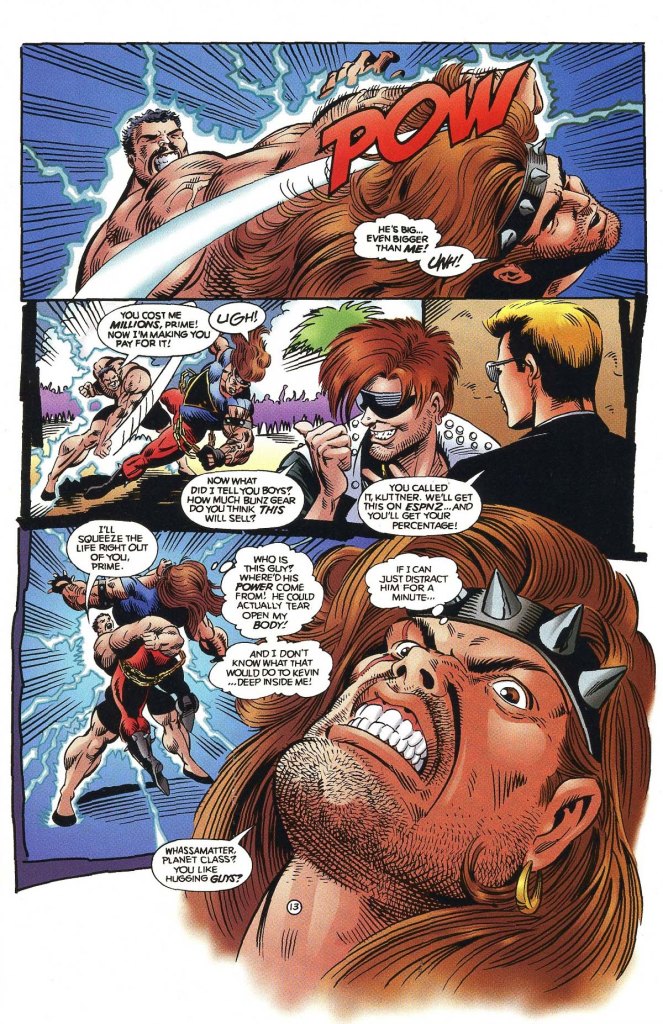
The battle royale itself is the highlight and alone makes this comic book worth buying.

As usual, the writing duo of Strazewski-Jones created another engaging story about Kevin and his superhero secret identity as Prime. Kevin shown struggling with his personal life? Check! Great superhero action with Prime? Check! In-depth characterization? Check!

What makes this comic book stand out is the battle royale between Prime and the two guys mention earlier, who each have very strong reasons and determination to defeat Prime. As it is indeed a very high-octane battle royale in the truest sense of the words, there was still sufficient room for readers to understand what Prime thought as he fights and dodges in the battle. Very clearly defined are the intentions of Kuttner and Planet Class, and the personalities of each plus Prime really gave their conflict a very unique flavor of its own. The battle royale is not a mindless event but rather very colorful and character-driven.

As for the art, I find Darick Robertson’s work here pretty good and many times he seemed to try to emulate the unique style and approach the late Norm Breyfogle defined the Prime series with. Although Kevin looks more like a college student, most characters were still recognizable. This one looks good!

Conclusion

It sure is hard for any teenager to be perceived as a social outcast.

Prime (1994) is a very entertaining read. It does not use the typical good-versus-evil formula of superhero comic books but it sure is loaded with a lot of personality following Prime, Kuttner and Planet Class.

If you are seriously planning to buy an existing hard copy of Prime (1994), be aware that as of this writing, MileHighComics.com shows that the near-mint copy of the regular edition costs $8 while the near-mint copies of the variant edition and the variant newsstand edition cost $8 and $26 respectively.

Overall, Prime (1994) is highly recommended!

+++++

Thank you for reading. If you find this article engaging, please click the like button below and also please consider sharing this article to others. If you are looking for a copywriter to create content for your special project or business, check out my services and my portfolio. Feel free to contact me as well. Also please feel free to visit my Facebook page Author Carlo Carrasco and follow me at HavenorFantasy@twitter.com
A Look Back at Prime #7 (1993)

Disclaimer: This is my original work with details sourced from reading the comic book and doing personal research. Anyone who wants to use this article, in part or in whole, needs to secure first my permission and agree to cite me as the source and author. Let it be known that any unauthorized use of this article will constrain the author to pursue the remedies under R.A. No. 8293, the Revised Penal Code, and/or all applicable legal actions under the laws of the Philippines.

Welcome back superhero enthusiasts, comic book collectors and geeks! Today we will take another journey back into the Ultraverse touching on their first major crossover event Break-Thru but told through the exploits of Prime.

For the newcomers reading this, Break-Thru was a 2-part crossover that involved all the Ultraverse characters in multiple ways. There were Break-Thru crossover spinoff issues of Mantra, Hardcase, Prototype, The Strangers, Solitaire and The Solution to name some. This time, we will find out Break-Thru in an issue of Prime.

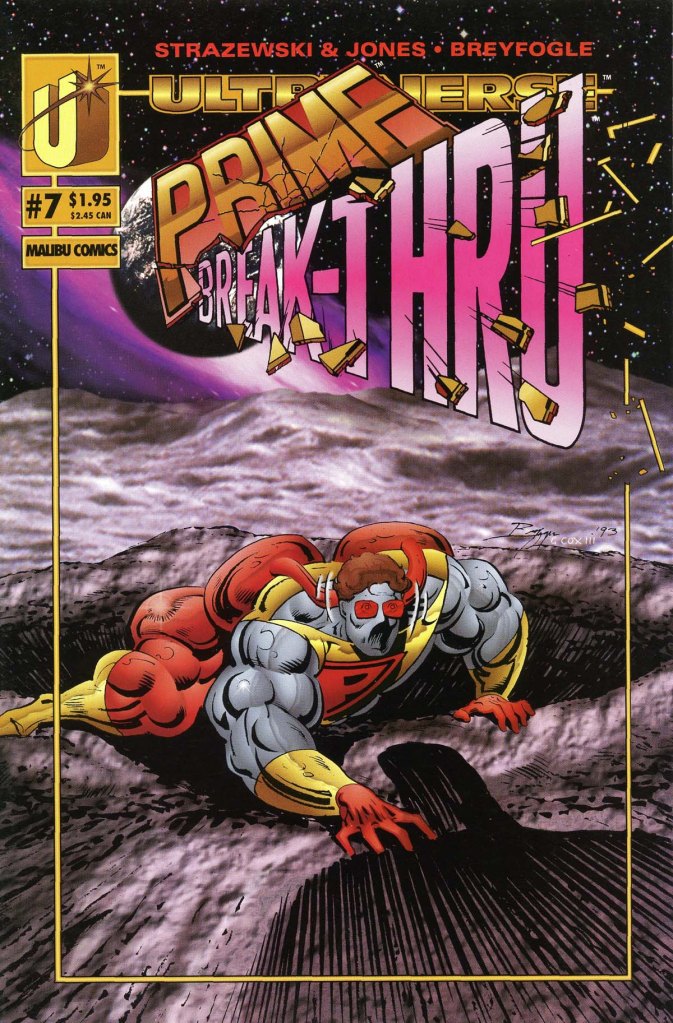
What exactly happened to Prime in relation to Break-Thru? We can find out together in this look back at Prime , published by Malibu Comics in 1993 with a story written by Gerard Jones and Len Strazewski, and drawn by the late Norm Breyfogle.

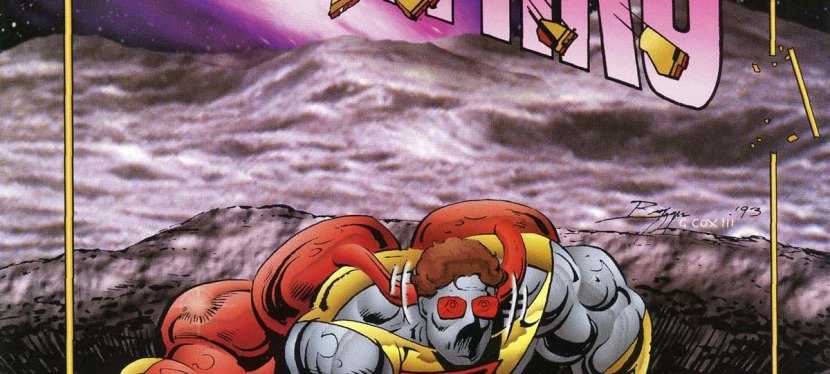
The cover.

Early story

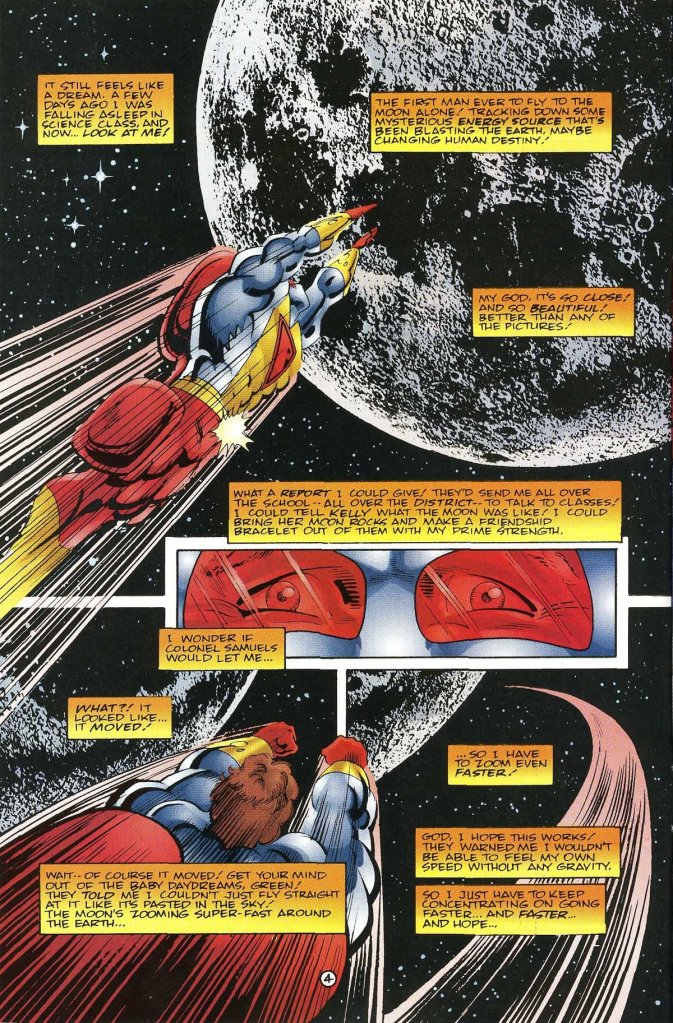
The story begins with Prime, wearing a special suit with air tanks, flying into space for a mission on the moon. Even as he is struggling with breaking through the atmosphere, he knows he cannot afford any setbacks knowing that US President Bill Clinton and military officials are counting on him. It has been some time since he was picked up by Colonel Samuels and his team after the big fight with Max-Man. As he approaches the moon, Prime expressed how much has changed over the past few days from attending science class to working secretly for the government.

After struggling long, Prime finally arrives on the moon’s surface albeit roughly. As he flies around searching for clues, a solid structure of rock suddenly rises from the surface leaving Prime no room to dodge it…

Quality

Prime on to something on the moon.

After going through lots of stories about superhero action, misadventures, intrigue and personal struggles as recorded in the first six issues of Prime, this particular story has a more unpredictable story which is refreshing to read. For one thing, this one has a whole lot of twists that actually test Prime’s sanity and keeps the narrative interesting throughout. Similar to what happened in Mantra , Prime encounters images of several people he knew while on the moon. This thing happens to be one of the capabilities of the entity on the moon.

As expected from the creative team of Jones and Strazewski, the writing is of high-quality. For his part, Norm Breyfogle continued to deliver striking visuals and in this issue he really showed off Prime’s modified look to the full extent.  

Conclusion

Prime and his thoughts as he travels to the moon.

Prime (1993) is a pretty good comic book to read. Ultimately it is a worthy build-up to the Break-Thru crossover and more importantly it continues to show why Prime is truly one of the major characters of the Ultraverse.

If you are seriously planning to buy an existing hard copy of Prime (1993), be aware that as of this writing, MileHighComics.com shows that the near-mint copy of the regular edition costs $8 while the near-mint copy of the newsstand edition costs $26.

Overall, Prime (1993) is recommended.

+++++

Thank you for reading. If you find this article engaging, please click the like button below and also please consider sharing this article to others. If you are looking for a copywriter to create content for your special project or business, check out my services and my portfolio. Feel free to contact me as well. Also please feel free to visit my Facebook page Author Carlo Carrasco and follow me at HavenorFantasy@twitter.com
A Look Back at Mantra #13 (1994)

Disclaimer: This is my original work with details sourced from reading the comic book and doing personal research. Anyone who wants to use this article, in part or in whole, needs to secure first my permission and agree to cite me as the source and author. Let it be known that any unauthorized use of this article will constrain the author to pursue the remedies under R.A. No. 8293, the Revised Penal Code, and/or all applicable legal actions under the laws of the Philippines.

Welcome back, superhero enthusiasts, comic book collectors and fans of 1990s comics! This is another examination of the Ultraverse as told through the exploits of Mantra, the pretty armored lady whose body is occupied by the soul of the male warrior Lukasz.

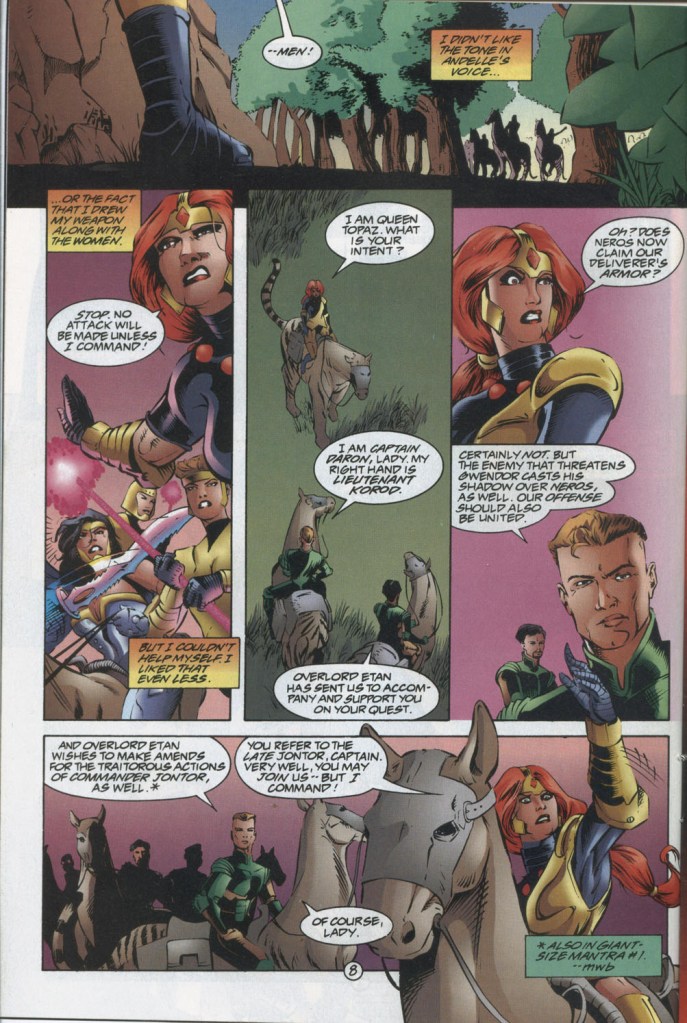
Previously I reviewed Giant Size Mantra, which was a one-shot comic book that was part of the Archimage Quest storyline and it was indeed a well-made Mantra story that fit in nicely with the monthly series. That same comic book is notable for having the debut of Gwendor’s queen Topaz who went on to become a member of the memorable superhero team UltraForce.

With the details made clear, we can find out what happens next in the Archimage Quest in this look back at Mantra , published in 1994 by Malibu Comics with a story written by Mike W. Barr and drawn by Jason Armstrong.

The cover.

Early story

The story begins in an unknown realm. Mantra (wearing her usual mask and armor) and Eden Blake are walking together and talking. After exchanging some words about the displacement of souls, Eden clings to Mantra and apologizes from now realizing what a shock the situation is to Mantra on top of everything else that happened. Eden tells Mantra there is something she wants from her and addresses Lukasz by name.

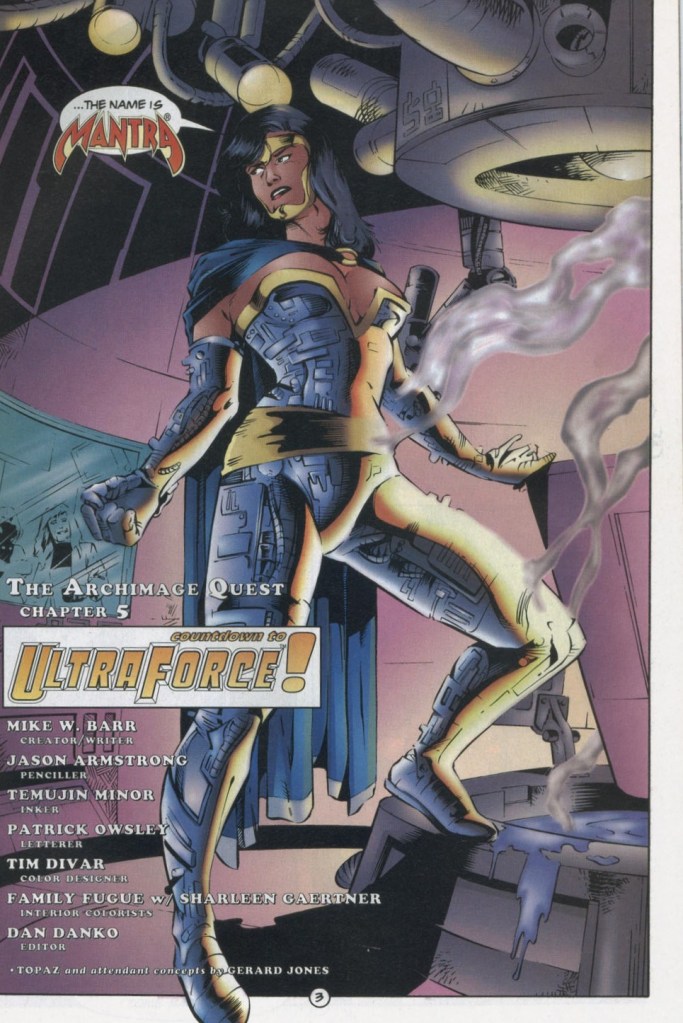
Suddenly Mantra/Eden Blake/Lukasz wakes up to the call of a technician. She is still in Gwendor and being completely naked, she goes through the process of armoring which is done with highly advanced technology. With her new armor on, Mantra is approached by queen Topaz who brings to her a notable sword to use. They discuss some matters as they walk together.

Meanwhile back in the United States, Eden’s daughter Evie visits a shop and talks to the old lady behind the counter. The young girl asks her about magic…

Quality

In the realm Mantra is in, it’s difficult for men and women to work together.

This is one very unique story of Mantra. Carrying over the elements from Giant Size Mantra, you will get to see the protagonist still spending time in the women-filled Gwendor (note: opposite it is another city filled with men) and starts her alliance with queen Topaz who is a very hands-on type of leader, willing to take risks going into battle. As Mantra does not have her mask and armor, she learns to use the magic power within her to make things happen. This is kinda like seeing Marvel’s Tony Stark adjusting and taking action without his Iron Man suit of armor.

Events aside, this story shows a significant development of Lukasz/Mantra’s personality as she adjusts to the ways of the men and women in their realm. The science fantasy elements of the story gave this comic book a unique style of visual presentation nicely pulled off by the illustrator. When it comes to the Archimage Quest, both Mantra and Boneyard are respectively struggling with disadvantages which is a nice storytelling touch. I should state that in this particular story, the complexities between males and females in the new realm is explored.

Conclusion

Yet another new thing worn by Mantra.

Mantra (1994) is another solid story to read. As it continues the quest for Archimage, it explores more of the science fantasy world Mantra finds herself in as well as the differences between the two local societies separated by gender.

If you are seriously planning to buy an existing hard copy of Mantra (1994), be aware that as of this writing, MileHighComics.com shows that the near-mint copy of the regular edition costs $8 while the near-mint copy of the variant edition costs $12.

Overall, Mantra (1994) is recommended.

+++++

Thank you for reading. If you find this article engaging, please click the like button below and also please consider sharing this article to others. If you are looking for a copywriter to create content for your special project or business, check out my services and my portfolio. Feel free to contact me as well. Also please feel free to visit my Facebook page Author Carlo Carrasco and follow me at HavenorFantasy@twitter.com
Fans of the Ultraverse are encouraged to visit the Ultraverse Facebook group at https://www.facebook.com/groups/73184525691

A Look Back at Mantra #11 (1994)

Disclaimer: This is my original work with details sourced from reading the comic book and doing personal research. Anyone who wants to use this article, in part or in whole, needs to secure first my permission and agree to cite me as the source and author. Let it be known that any unauthorized use of this article will constrain the author to pursue the remedies under R.A. No. 8293, the Revised Penal Code, and/or all applicable legal actions under the laws of the Philippines.

Welcome back, superhero geeks, comic collectors and fans of the Ultraverse! We are about to return to the Ultraverse through the view of Mantra. Since the story of issue #9 and issue #10, the stakes have been raised as Mantra not only found herself in bigger danger as well as revelations from the past related to the long-time war between Archimage and Boneyard. Not only is Mantra still being targeted by Boneyard (who is so evil he wants to marry Mantra and make love to her body even though he knows the soul of the male warrior Lukasz is occupying it) but also by sorcerers from the Earth’s realm. In other words, Mantra/Lukasz really has trouble in different realms.

Will something unexpected turn out in the next story of Mantra? We can find out in this look back at Mantra , published in 1994 by Malibu Comics with a story written by Mike W. Barr and drawn by Robb Phipps.

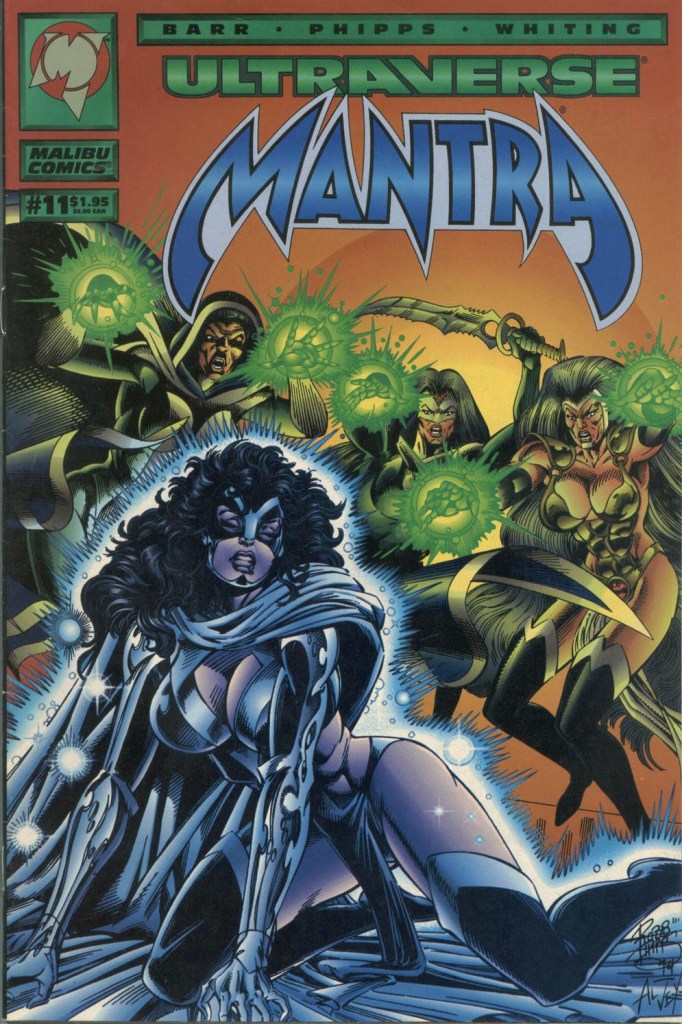
The cover.

Early story

The story begins with Mantra standing completely naked in the full view of Boneyard, his three wives and the four other thugs (who hunted Mantra). Boneyard states, “Your choices are clear, Lukasz—surrender to me and become first among equals in my harem…or be destroyed by my wives—whose powers now equal yours!”

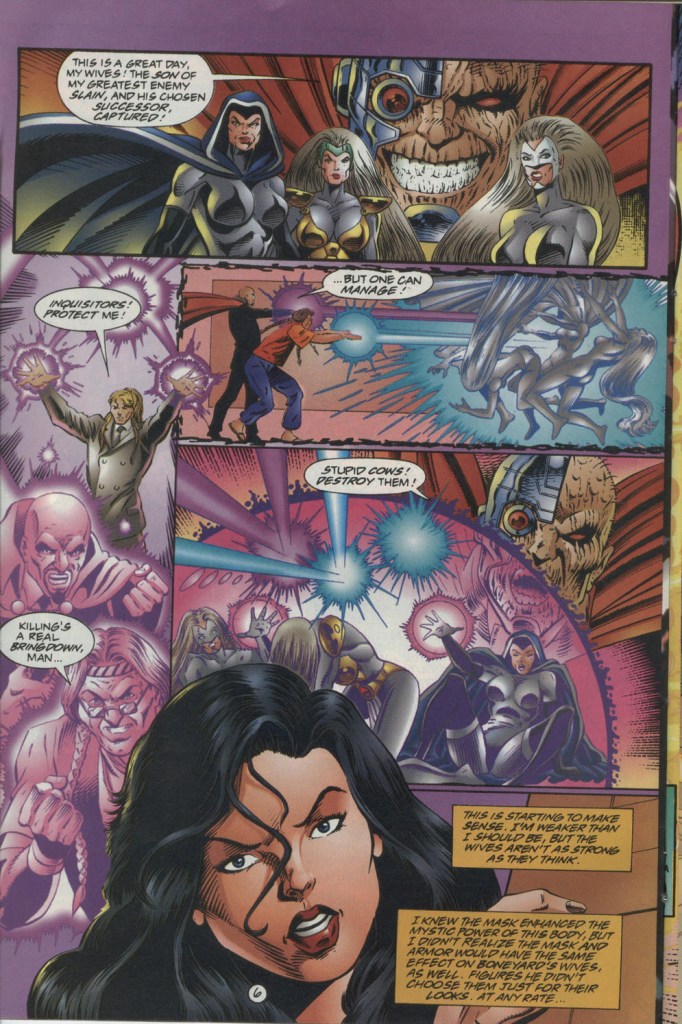
Suddenly the three wives fire beams of energy towards Mantra who successfully blocks them using magic to create a transparent shield. Very quickly, Mantra sees an opportunity to get the other thugs involved as targets of the three wives so she moves toward her previous attackers. The three wives’ attacks cause the thugs to retreat. Boneyard recognizes one of the thugs as the son of his rival Archimage.

Suddenly, the thugs attack Boneyard’s three wives with energy causing them to fall down on the floor. As the conflict shifted, Mantra begins to realize something.

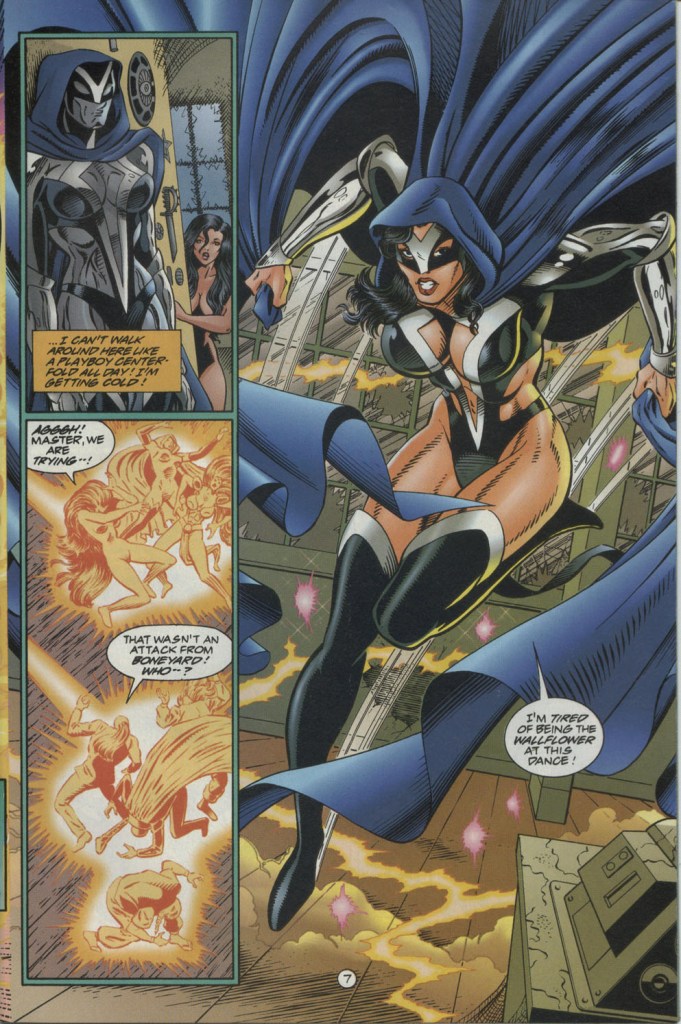
“I knew the mask enhance the mystic power of this body, but I didn’t realize the mask and armor would have the same effect on Boneyard’s wives as well. Figures he didn’t choose them just for their looks. At any rate…I can’t walk around here like a Playboy centerfold all day! I’m getting cold,” Mantra thought.

Quality

This is the first time Mantra wore a new costume which was carried over to issue .

No surprise, Mike W. Barr successfully kept the story engaging not only maintaining the engagement carried over from the few previous issues but by raising the stakes for Mantra personally while pulling off some pretty notable revelations that date back before the events of issue . Going beyond Boneyard and his three wives, there is a lot of fantasy related stuff waiting to be discovered which further adds depth to Mantra’s struggle (finding a male body to occupy and the ways to leave Eden Blake’s body). The plot really thickened with the revelations and how they turned out is something that you yourselves must pick up a copy of this comic book and read.

Of course, having reviewed issue #12 recently, it is no surprise that the build-up of engagement and suspense in this comic book contributed to its successor. More importantly, by the time you reach the end of this comic book, you will get a deeper understanding of what has been going and what preceded them. Clearly Mike W. Barr made solid preparations and took his time with the revelations just as he kept on telling the present-day story of Mantra.

Like the previous issue, I enjoyed Robb Phipps’ artwork here. If you were disappointed with the cartoony aesthetic of Terry Dodson’s work in issue , you will like the expressions as well as the overall style of Phipps.

Conclusion

With a male soul inside the body of Eden Blake, Mantra quickly analyzes the messy situation to find an advantage.

Mantra (1994) is indeed a pretty entertaining and compelling Ultraverse comic book. There is nothing like watching the spectacle happen in between moments of Mantra realizing answers to her questions, and learning new details (including stuff that emphasized how rotten, how wicked and twisted Boneyard truly is as the major villain of not only this particular series but also of the Ultraverse itself) that deepened the narrative for readers.

If you are seriously planning to buy an existing hard copy of Mantra (1994), be aware that as of this writing, MileHighComics.com shows that the near-mint copy of the comic book costs $8.

Overall, Mantra (1994) is recommended.

+++++

Thank you for reading. If you find this article engaging, please click the like button below and also please consider sharing this article to others. If you are looking for a copywriter to create content for your special project or business, check out my services and my portfolio. Feel free to contact me as well. Also please feel free to visit my Facebook page Author Carlo Carrasco and follow me at HavenorFantasy@twitter.com
A Look Back at The Solution #7 (1994)

Disclaimer: This is my original work with details sourced from reading the comic book and doing personal research. Anyone who wants to use this article, in part or in whole, needs to secure first my permission and agree to cite me as the source and author. Let it be known that any unauthorized use of this article will constrain the author to pursue the remedies under R.A. No. 8293, the Revised Penal Code, and/or all applicable legal actions under the laws of the Philippines.

Welcome back, superhero geeks, comic book collectors and fans of the Ultraverse! Some time ago, I reviewed the sixth issue of The Solution and it turned out to be a pretty compelling and fun comic book to read. I was pleasantly surprised by its high quality and presentation, and by the end I found Lela Cho/Tech (the leader of The Solution) to be a very interesting character of the Ultraverse. Clearly the creative duo of James Hudnall (who also wrote Hardcase) and John Statema literally scored a home run with The Solution .

As The Solution focused on the background story of Tech, its portrayal of the current-day events was laced with suspense, drama and intrigue that only teased what could happen in the next moment. What else could be told about Lela Cho’s past and what might happen next in the present day? We can find out in this look back at The Solution , published in 1994 by Malibu Comics with a story written by Hudnall and drawn by Statema.

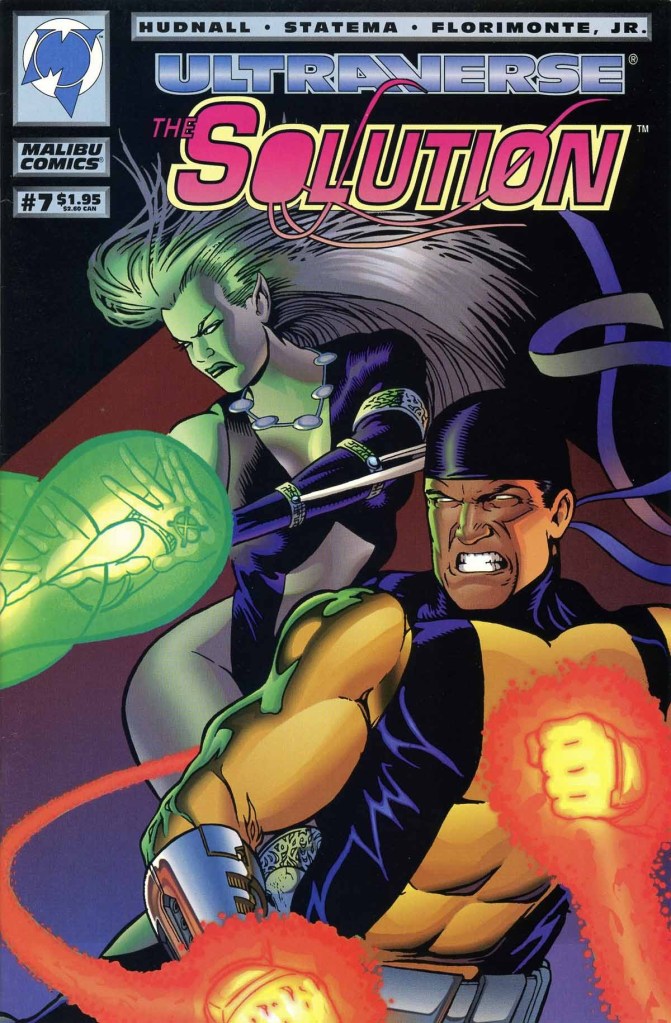
The cover.

Early story

The story begins with Lela Cho accompanied by Troy Wilde standing in front of her father’s grave. The two don’t seem to know that they are being spied on from a distance. A group has set up snipers to take them down.

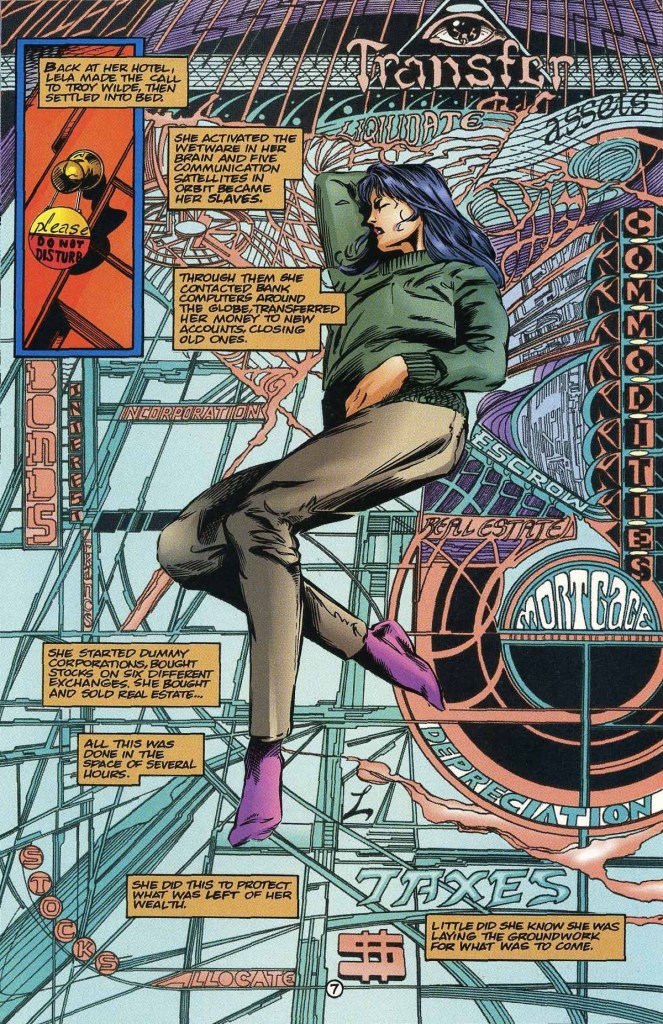
As the two begin to talk, Lela tells Troy details from her past. She recalls that after the sudden death of her father, she could not fully gain the inheritance from her father – the corporation – as its board of directors refused to accept her. As it turned out, a crime gang anticipated her every move and stole her company. To enhance herself, she paid specialists to install wetware implants into her body to make her the mistress of electronic devices.

She arrived in the city of New York already aware that she has been marked by her enemies, and she knew they would come for her. In New York, she meets with Peter Bazinni to seek help. Not only is he a man with many powerful connections, he was also her old flame. While Peter admitted he could not help her in her conflict with the international crime gang, she gives her a reference to another professional who is her best bet. His name was Troy Wilde…   

Quality

Discovering the secret locations.

James Hudnall delivered another pretty solid story. It’s got a nice mix of elements here and there. From time to time, I felt like I was reading a detective story, then a murder tale, then a hard action tale and then a hard-edged superhero tale. While this comic book continued on telling the origin of Lela Cho, it shifted focus on the background of Troy Wilde who would eventually join the team with the codename Dropkick. How Lela and Troy first interacted with each other was very carefully crafted with believable dialogue and well-defining personalities from each (as reflected in the way they talked with each other). Another member of The Solution appeared in here is as well.

What surprised me here was the revelation of a certain villainess. At first, she looked like a probably disposable villainess but proved to be more significant than meets the eye. If you get to read the succeeding issues of The Solution, you will realize what I just stated.

As with his past works, John Statema’s art here is pretty good. The good stuff he delivered in issue continued to shine here.

Conclusion

Lela Cho’s ultra ability to hack systems and alter digital stuff would help her fit in nicely with this age of social media and streaming.

The Solution (1994) is not only a worthy follow-up to its predecessor, it is one of the stronger origin-type comic books of the Ultraverse as a whole. While the previous issue was focused mainly on Lela Cho, this one shows Troy Wilde/Dropkick making his first involvement with her as well as the eventual formation of their team. At this stage, the story of how The Solution got formed really took shape here. I should state, however, that the level of engagement fell down a bit compared to the previous issue.

If you are seriously planning to buy an existing hard copy of The Solution (1994), be aware that as of this writing, MileHighComics.com shows that the near-mint copy of the comic book costs $8.

Overall, The Solution (1994) is recommended.

+++++

Thank you for reading. If you find this article engaging, please click the like button below and also please consider sharing this article to others. If you are looking for a copywriter to create content for your special project or business, check out my services and my portfolio. Feel free to contact me as well. Also please feel free to visit my Facebook page Author Carlo Carrasco and follow me at HavenorFantasy@twitter.com
A Look Back at Mantra #10 (1994)

Disclaimer: This is my original work with details sourced from reading the comic book and doing personal research. Anyone who wants to use this article, in part or in whole, needs to secure first my permission and agree to cite me as the source and author. Let it be known that any unauthorized use of this article will constrain the author to pursue the remedies under R.A. No. 8293, the Revised Penal Code, and/or all applicable legal actions under the laws of the Philippines.

Welcome back superhero enthusiasts, comic book collectors and fans of the Ultraverse! We are about continue the retro review of comics from the Mantra monthly series. Previously, details and a close friend of Eden Blake from her past came back which obviously caught Lukasz (the male warrior occupying Eden’s body since issue #1) off-guard and added further pressure on him. And then something happened during the wedding of that close friend which compelled Mantra to fight someone in armor which eventually led to some revelations.

What will happen next to Mantra? We can all find out in this look back at Mantra , published in 1994 by Malibu Comics with a story written by Mike W. Barr and illustrated by Rob Phipps (who illustrated Mantra #4). This comic book is another one of those flip-side comics with the other side being Ultraverse Premiere which contains short stories within the Ultraverse.

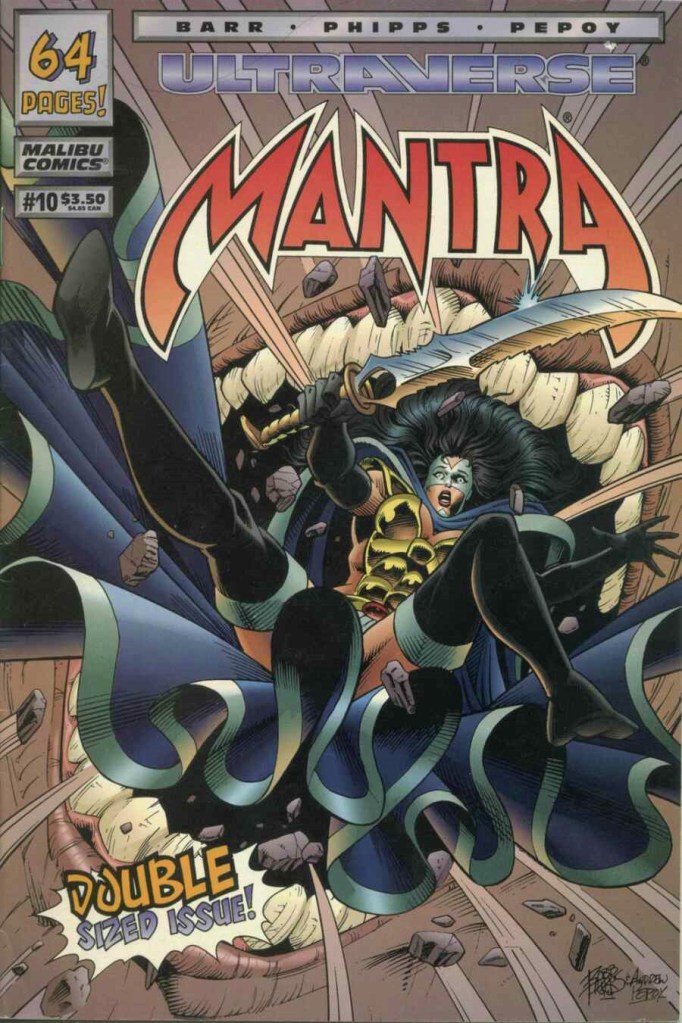
The cover.

Early story

The story begins in the middle of a city when a man arrives at his office at a place called the Conjurirs’ Club. Upon entering, he is surprised to see three sinister looking men and one of them identifies him by his name – Edgar Strauss. Refusing to give in to them, Strauss puts up a seraphic shield. One of the magic users hits Strauss with force pushing him into his office chair. A servant of Strauss comes into the office but is confronted by another man with a hideous looking chest. Strauss suddenly gets overwhelmed with visions. In response to his question, the three men wanted information about Mantra whom they describe to be a witch.

Over at the Blake residence, Lukasz/Eden wakes up after having a very disturbing dream. It turns out, the dream had been repeating. Looking at the mirror, he sees Eden’s face and thought to himself: Still, it’s not much worse than my life which is a nightmare. I’m a warrior. I should be fighting the foes of Archimage with broadswords and mace…instead I was reincarnated as a woman – Eden, a housewife…worse, a housewife with kids!

After going through the morning traditions of feeding Eden’s son and daughter, sending them to school and getting dressed for work, he reports to work at the office inside the highly secured facility of Aladdin in southern California. While working as Eden, Lukasz uses magic to access the digital files via the computer. Suddenly, someone touches his shoulder from behind…

Quality

Mantra using a piece of the armor that the antagonist in issue used.

I’ll start first with the art. Robb Phipps, like his previous Mantra work, delivered a fine job visualizing the script with a smooth pace, drawing spectacle nicely and making Mantra and the established characters look recognizable. I also like the way the artist drew facial expressions.

When it comes to the story, this one is even more intriguing and surprising than issue . The startling revelations from Lukasz’s past and his history with his tribe under Archimage expanded further here and this added more to the conflict with Boneyard. These revelations confirmed that not everything in the Archimage-Boneyard war is as simple as black and white. When it comes to characterization, Mike W. Barr really developed Lukasz in Eden’s body further and it was pretty notable to see Lukasz (who was oriented to fight with weapon instead of magic) become more adjusted using magic more proficiently while getting around the physical weakness of the lady’s body he is occupying.

As mentioned before, sorcery is an abomination in Christianity and this comic book further adds elements of the occult into the narrative. There was even a short scene of Boneyard (himself an abomination) in a location that looks like Hell.

Conclusion

Homosexuality hinted on the part of the man? Insanity perhaps?

If I were to describe Mantra (1994), it’s an obvious shift to more fantasy and sorcery elements than the previous issues. It certainly is not a tale about good-versus-evil because Mantra is not exactly innocent (note: Lukasz is an established killer and has displaced so many people’s lives) even when compared to Boneyard. Technically, Boneyard is pretty much the Ultraverse version of Satan.

If you are seriously planning to buy an existing hard copy of Mantra (1994), be aware that as of this writing, MileHighComics.com shows that the near-mint copy of the comic book costs $12.

Overall, Mantra (1994) is satisfactory.

+++++

Thank you for reading. If you find this article engaging, please click the like button below and also please consider sharing this article to others. If you are looking for a copywriter to create content for your special project or business, check out my services and my portfolio. Feel free to contact me as well. Also please feel free to visit my Facebook page Author Carlo Carrasco and follow me at HavenorFantasy@twitter.com

A Look Back at Prototype #13 (1994)

Disclaimer: This is my original work with details sourced from reading the comic book and doing personal research. Anyone who wants to use this article, in part or in whole, needs to secure first my permission and agree to cite me as the source and author. Let it be known that any unauthorized use of this article will constrain the author to pursue the remedies under R.A. No. 8293, the Revised Penal Code, and/or all applicable legal actions under the laws of the Philippines.

Welcome back superhero geeks, comic book collectors and fans of the Ultraverse. In this latest Ultraverse-related retro comic book review, we will check out what happened to Prototype and his companions after the events that took place in issue #12. I personally enjoyed that particular comic book and it has been almost three months since I last reviewed an issue of Prototype.

Now we can start this look back at Prototype , published in 1994 by Malibu Comics with a story written by Len Strazewski and drawn by Dean Zachary.

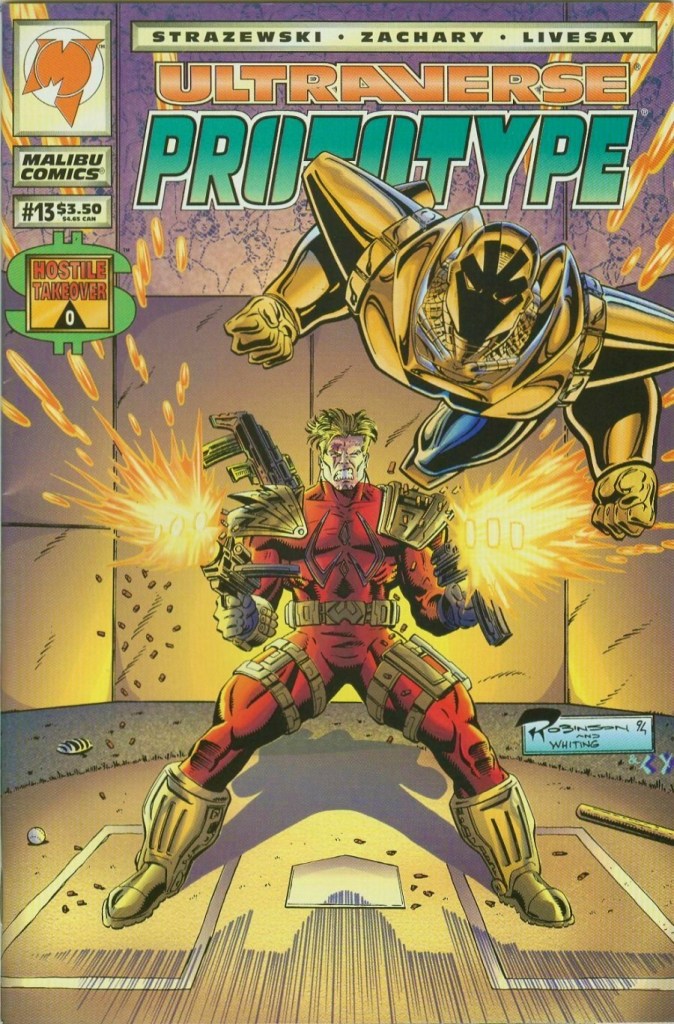
The cover.

Early story

The story begins with TV news coverage of an explosion that happened at one of the buildings along Wall Street. The TV newscaster reports that another battle between ultras rocked the headquarters of Ultratech in downtown Manhattan which sparks rumors of corporate infighting.

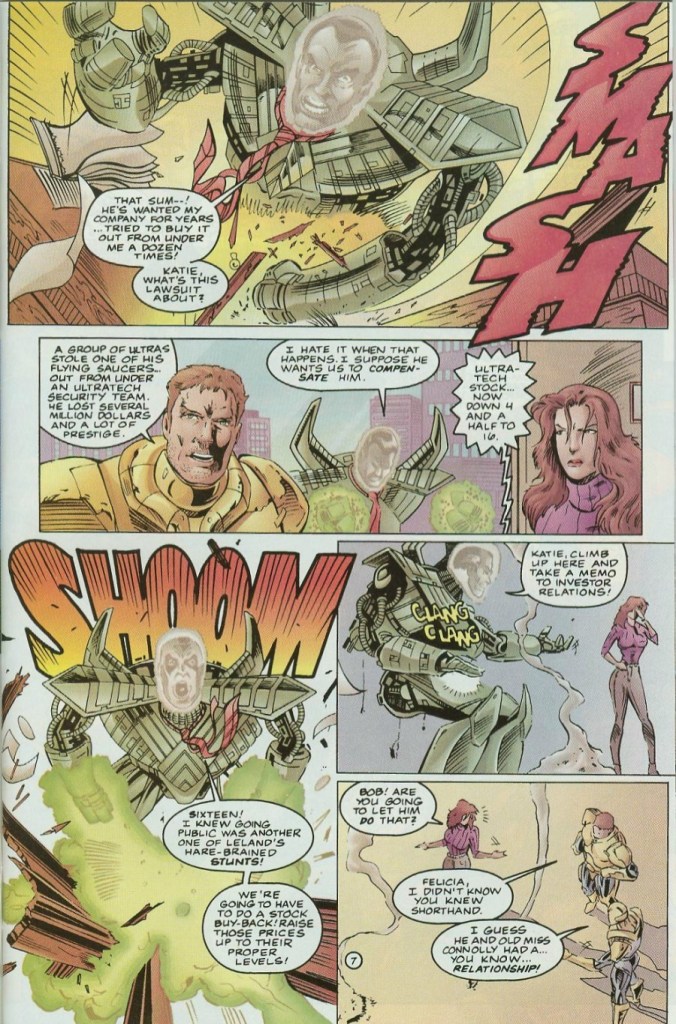
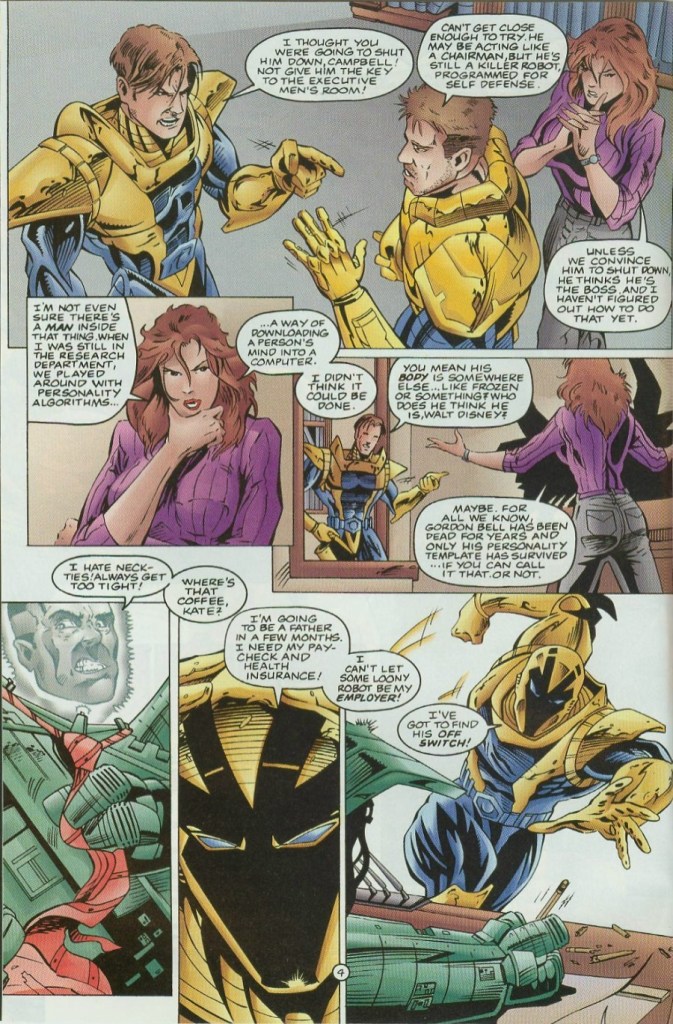
Behind the scenes at the corporate tower, Jimmy Ruiz/Prototype, Bob Campbell/Ranger and Felicia Campbell discuss matters in front of the robot Prototype 2000 (the same machine responsible for the loss of Bob’s arm) which projects an image of Ultratech chairman Gordon Bell as its head. They noticed that the robot thinks and acts like Gordon Campbell, even going as far as calling the name of a secretary who left the company some years back. Felicia believes the robot has some sort of body detachment syndrome. For Bob, it does not matter as Gordon Bell still owns a controlling interest in the corporation.

After some intense talk, Jimmy uses his Prototype armor switch off Prototype 2000 but got blasted by energy which pushed him back to Bob and Felicia. Prototype 2000 then shows the virtual Gordon Bell telling “Katie” to turn the TV on so he can see how the company stock is performing…

Quality

How do you you deal with a machine that actually thinks and acts like a human?

I can declare that Len Strazewski really ramped up the corporate intrigue several notches high in this particular issue. There is a lot of corporate world talk and the good news here was that nothing ended up being boring. The most notable aspect of the story was the presence of Prototype 2000 with the mind of Gordon Bell really reacting to the corporate developments. Of course, there was still sufficient focus on the protagonist Prototype piloted by Jimmy Ruiz. At this stage of the Prototype series, Jimmy has gone through not only many battles using the powered suit of armor but several setbacks in his personal life. Apart from the turmoil at Ultratech, Jimmy not only has to keep his job but also save his reputation. Not to be outdone is Bob Campbell (the original Prototype pilot) whose relationship with Felicia got developed a bit more and their exchange of dialogue was nicely written.

Within the story is a major twist that really added a whole lot of depth into the narrative. It’s a twist that I did not anticipate and I strongly recommend you discover it yourselves once you read this comic book. Oh, and there is a certain supporting character from the Mantra series who also appeared here.

As for the art, Dean Zachary did a descent job visualizing Len Strazewski’s script and capturing the typical smooth sequencing of Prototype in action scenes. There is enough scenes of spectacle here to keep you entertained.

Conclusion

Jimmy Ruiz, Bob Campbell and Felicia discuss matters in the presence of virtual Gordon Bell.

I can say that I had a blast reading Prototype (1994). To put things in perspective, this one is just a part of the Hostile Takeover storyline that eventually connected with other characters of the Ultraverse such as the Night Man and The Solution (a heroes-for-hire team). The writing of Len Strazewski is so good, this one is worth reading all over again. It should be noted that topics like corporate intrigue or business world internal affairs got presented with a strong flavor of superhero stuff that prevented the story from turning into a bore. This is one intriguing and compelling read. Lastly, I should state that this comic book is one of those Ultraverse Premiere flipside issues, the other side of which contained short stories about Iron Clad, Pixx of UltraForce, Flood and Lady Killer of The Strangers.

If you are seriously planning to buy an existing hard copy of Prototype (1994), be aware that as of this writing, MileHighComics.com shows that the near-mint copy of the comic book costs $8.

Overall, Prototype (1994) is highly recommended!

+++++

Thank you for reading. If you find this article engaging, please click the like button below and also please consider sharing this article to others. If you are looking for a copywriter to create content for your special project or business, check out my services and my portfolio. Feel free to contact me as well. Also please feel free to visit my Facebook page Author Carlo Carrasco and follow me at HavenorFantasy@twitter.com
A Look Back at WildC.A.T.s: Covert Action Teams #1 (1992)

Disclaimer: This is my original work with details sourced from reading the comic book and doing personal research. Anyone who wants to use this article, in part or in whole, needs to secure first my permission and agree to cite me as the source and author. Let it be known that any unauthorized use of this article will constrain the author to pursue the remedies under R.A. No. 8293, the Revised Penal Code, and/or all applicable legal actions under the laws of the Philippines.

Before he became the co-publisher of DC Comics, the great Jim Lee made his debut in the comic book industry as an illustrator for Marvel Comics. Just a few short years after that, he became a fan-favorite of X-Men fans and was a major factor in the massive sales success of 1991’s X-Men #1 (Volume 2). Not only did that particular comic book established a long-lasting sales record for all comic books, Lee’s designs and visual concepts for the X-Men were adapted by the producers and creators of the fan-favorite X-Men: The Animated Series (1992-1997).

For the newcomers reading this, Jim Lee’s tenure with Marvel Comics ended in December 1991 when he, Rob Liefeld and Todd McFarlane met with the publisher and expressed that Marvel’s policies toward them were unfair and they were not rewarded well for their work. To put things in perspective, Jim Lee’s X-Men , Rob Liefeld’s X-Force and Todd McFarlane’s Spider-Man were respectively million-sellers. As such, Lee, Liefeld, McFarlane plus some more creators left Marvel and went on to establish Image Comics (which involved a production and distribution deal with Malibu Comics).

In 1992, Jim Lee’s dream project – with concepts first created in 1986 – came through free from the constraints he endured from Marvel’s editorial team and strict policies. That’s dream project was WildC.A.T.s: Covert Action Teams , which is the feature of this retro comic book review.

But before we start the review, here’s a quick look back at the conceptual history of WildC.A.T.s as written by Jim Lee himself.

“I created my first ‘professional’ comic book submission in the summer of 1986 entitled The Wild Boys involving an espionage agency called International Operations. The co-writer of that sublime piece of work was coincidentally enough – Brandon Choi – who at the time was still in college getting a double major in history and politics,” Lee wrote in the comic book’s intro.

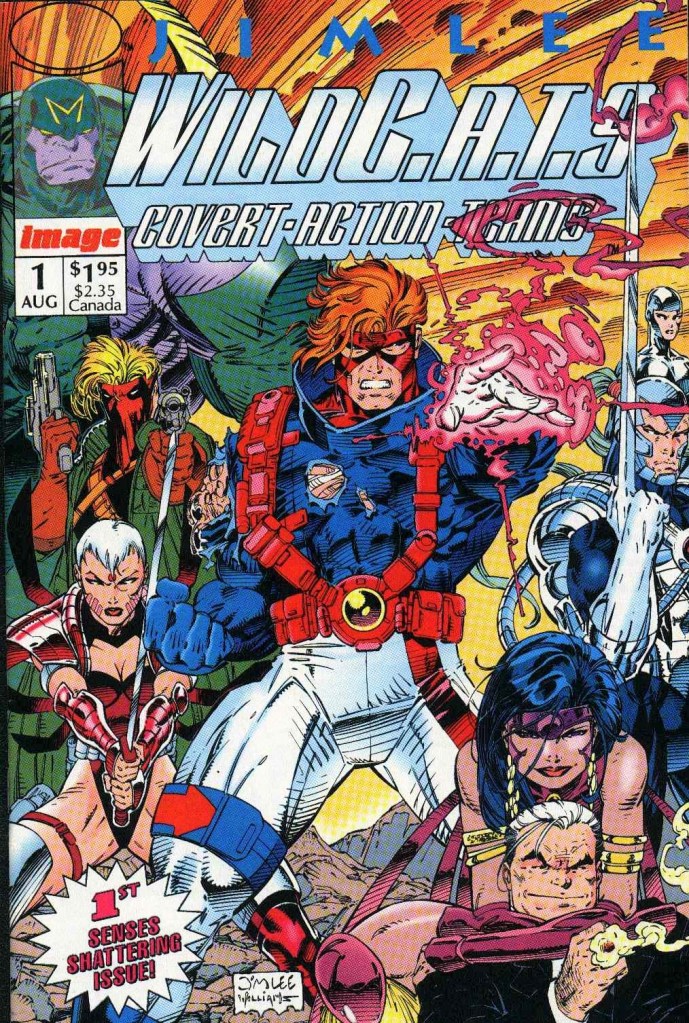
Now that we’re done with the history, here is a look back at WildC.A.T.s: Covert Action Teams , published in 1992 through Image Comics with a story co-written by Jim Lee and Brandon Choi. Lee illustrated the comic book with ink work done by Scott Williams.

The cover.

Early story

The story begins in Antarctica in 1986. There, two men braved the cold weather searching for something with information they learned from IO (International Operations). Suddenly an orb rises from the snow and then an image of a lady wearing silver tights and wielding energy appears in front of them. After demanding them to let her have the orb, she and the energy field fade away.

In 1992, at the crisis control facility of IO in Virginia, IO’s executives carefully view video footage of Georgetown which was hit by an explosion. They suspect rogue C.A.T.s (covert action teams) could have been involved. Suddenly, the same energy field from six years earlier forms in their presence with the same lady appearing for a few moments. The energy field fades away.

In the present day, a dwarf named Jacob Marlowe wakes up in the middle of garbage in an alley. After getting hurt by two troublemakers, the same silver lady from the past appears and uses her energetic power to save Jacob. She introduces her to him as Void, claiming he came for him and she knows he was once a lord named Emp. She tells him the Cabal is a threat to humans on Earth…

Quality

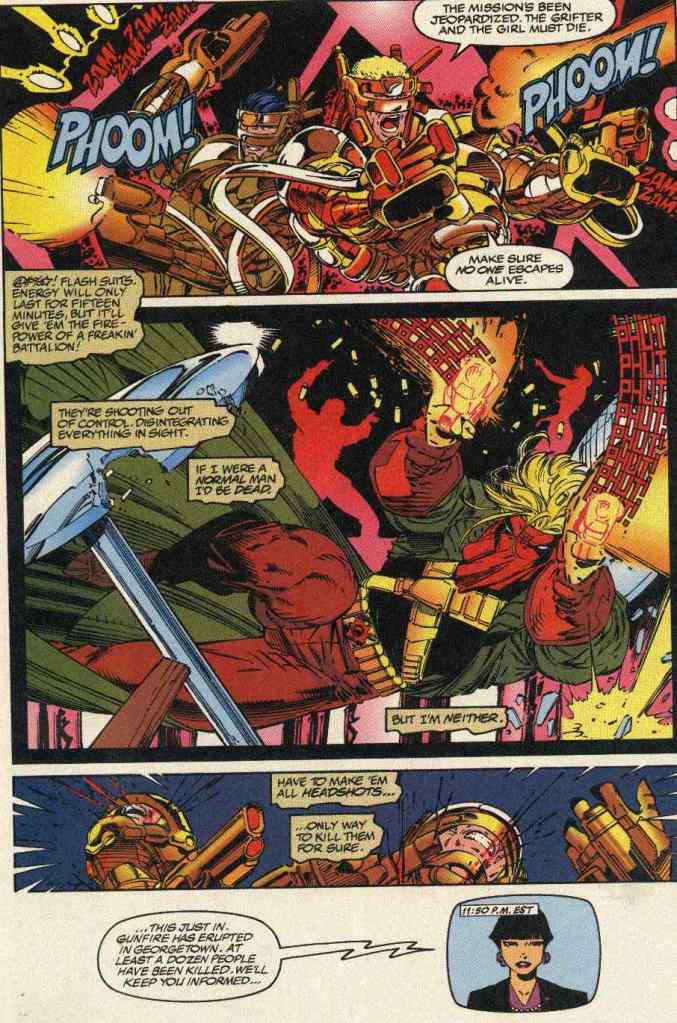
Clearly Jim Lee took inspiration from John Woo’s action movies.

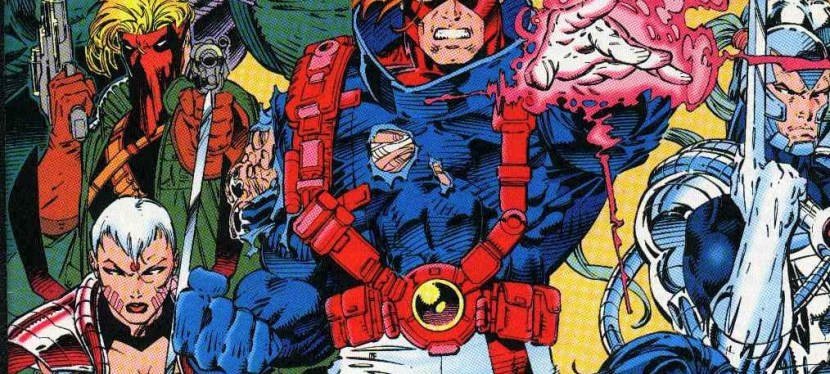
When it comes to the presentation of the story, the comic book starts in a deliberately cryptic way. It’s like having very short prologues back to back and, fortunately, it works well to capture attention while building up slowly its concept. The story really begins when Jacob Marlowe arrives at his headquarters with Void as his enduring advisor and executor. The introductions of each of the team’s members – Spartan, Warblade, Maul, Grifter, Zealot and Voodoo – were decently done and never felt rushed as Jim Lee and Brandon Choi carefully paced the storytelling and really tried to balance exposition and spectacle. That being said, similar results happened with regards to the comic book’s spotlight on the Cabal and its evil leader.

With regards to the presentation of the classic conflict between good and evil, Lee and Choi came up with the concept of planet Earth being slowly infiltrated by Daemonites (who originated in outer space) with the Cabal serving like an anchor with an organized set-up for domination. Over at the WildC.A.T.s, Marlowe formed a team to fight and stop the Cabal since the lives of the people of Earth are at stake. This is a really nice concept serving as the foundation, and the irony is that, in this comic book specifically, IO was on the sideline.

When it comes to the visuals, Jim Lee must have enjoyed the liberty he had in illustrating this comic book…free from the editorial interference from Marvel and free too from the restrictions of the Comics Code Authority (CCA). The result here is a visual presentation showing more Lee’s creativity and a style different somewhat from his final works on X-Men. He clearly took more inspiration from action movies and the violence is somewhat more mature to look at. It should be noted that Scott Williams helped Lee’s art shine.

Conclusion

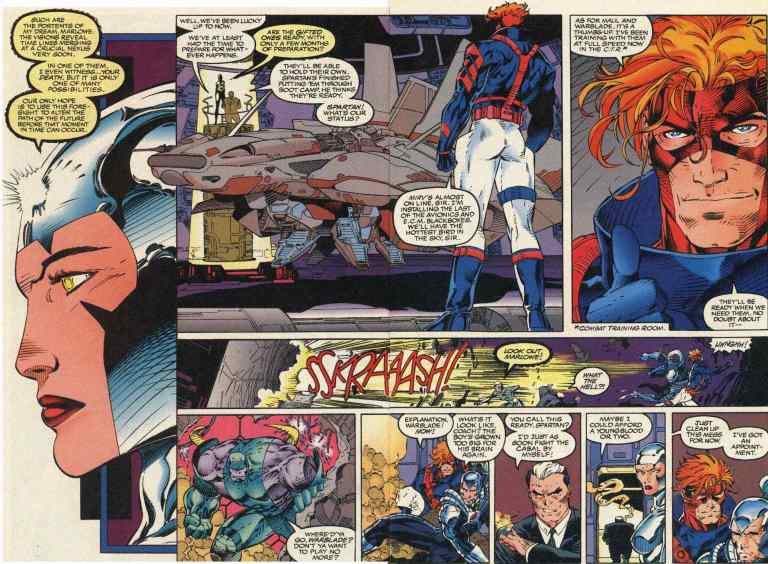
These two pages remind me somewhat of the X-Men, their jet and the Danger Room.

By today’s standards, WildC.A.T.s: Covert Action Teams is surprisingly still a good superhero team comic book to read. It’s not a literary classic but it proved to be compelling and fun enough to read from start to finish. It has a decent amount of action here and there which is understandable since Choi and Lee had to build up the concepts and the plot. If there were any weak spots, this comic book is almost devoid of character development and the clear lack of a lead character (which is still needed even for a superhero team comic book).

If you are seriously planning to buy an existing hard copy of WildC.A.T.s: Covert Action Teams (1992), be aware that as of this writing, MileHighComics.com shows that the near-mint copy of the regular edition costs $5 while the near-mint copy of the newsstand edition is priced at $16. The near-mint copy of the 3D edition costs $9 while the near-mint copy of the gold cover edition is priced at $42.

Overall, WildC.A.T.s: Covert Action Teams (1992) is recommended.

+++++

Thank you for reading. If you find this article engaging, please click the like button below and also please consider sharing this article to others. If you are looking for a copywriter to create content for your special project or business, check out my services and my portfolio. Feel free to contact me as well. Also please feel free to visit my Facebook page Author Carlo Carrasco and follow me at HavenorFantasy@twitter.com
A Look Back at Prime #8 (1994)

Disclaimer: This is my original work with details sourced from reading the comic book and doing personal research. Anyone who wants to use this article, in part or in whole, needs to secure first my permission and agree to cite me as the source and author. Let it be known that any unauthorized use of this article will constrain the author to pursue the remedies under R.A. No. 8293, the Revised Penal Code, and/or all applicable legal actions under the laws of the Philippines.

Is Prime your favorite caped hero among the many heroes of the Ultraverse? For the newcomers reading this, Prime is an overly muscular hero of the Ultraverse who is actually a kid deep inside his fake flesh. Prime was one of the major heroes of the Ultraverse and was part of UltraForce alongside Hardcase and Prototype (two other major heroes).

In late 1993, a 2-part Ultraverse crossover was published titled Break-Thru and, with the art of the legendary George Perez, it was a big mix of characters from the UV. Prime had a role in Break-Thru and we can see what happened to him after the end of the said crossover in this look back at Prime published in 1994 by Malibu Comics and written by Len Strazewski and Gerard Jones with art done by the late Norm Breyfogle.

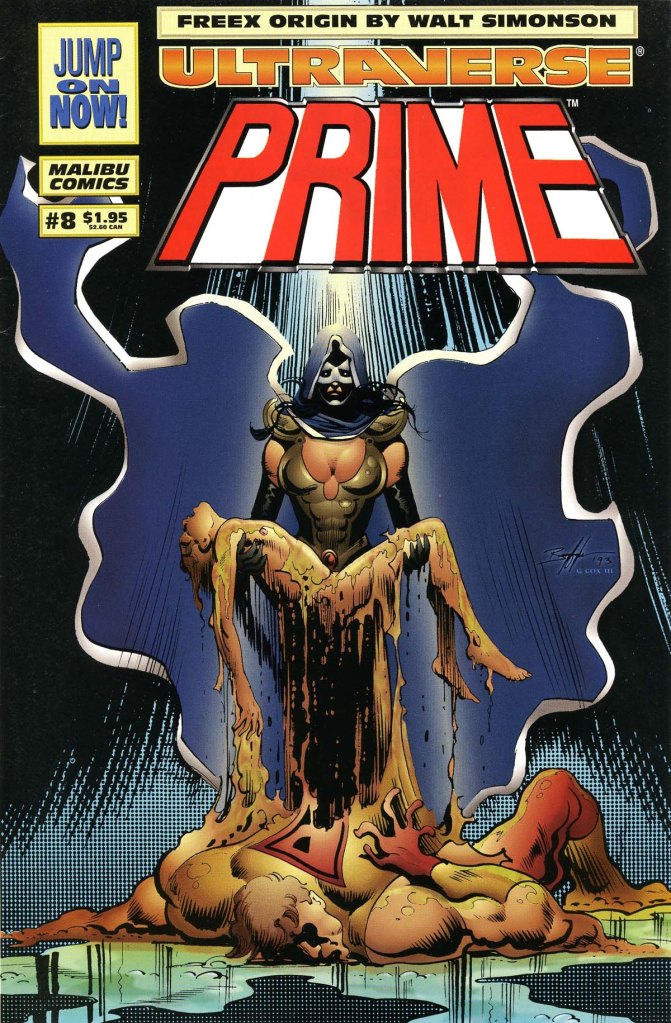
The cover.

Early story

The story begins in outer space with Prime and Prototype re-entering planet Earth. With the heat intensifying, Prime is worried that he won’t be able to make it safely on earth. Prototype, who is flying behind him, wonders if Prime knows what he is doing by leading the way. Prototype’s life is at stake as he relies on Prime to be his flying front shield (note: for the way the flight turned out in Prototype’s perspective, read Prototype #6).

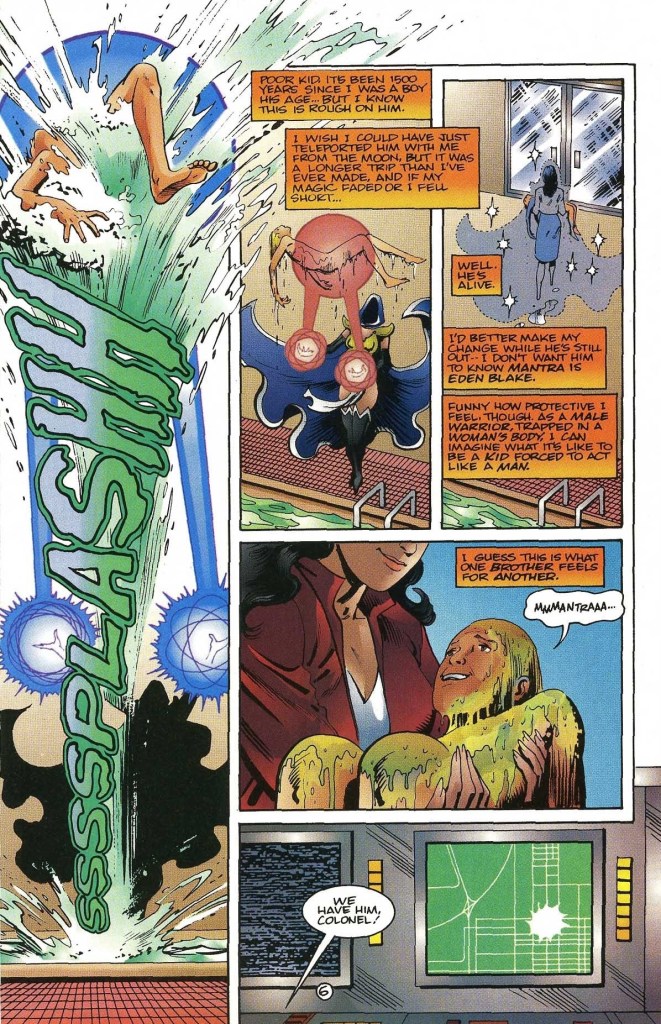
Due to the instability and intense heat, the two ultras got separated flying down. Remembering the strip of Mantra’s cape, Prime uses it and manages to receive faint communication with Mantra. Prime eventually crashes into a swimming pool. With Prime’s flesh quickly dissolving, teenage Kevin Green is exposed naked underwater and struggles. Suddenly, water pushes him up several feet and finds himself being assisted by Mantra.

The naked Kevin is carried by Mantra who transform herself into Eden Blake…

Quality

The pressure on the parents of Kevin.

Storywise, this one is a solid follow-up to the Break-Thru crossover and it succeeds in developing Prime further thanks to the combined efforts of Len Strazewski and Gerard Jones. With the narrative shifted away from Break-Thru, the story emphasizes the actions of the covert operations led by Colonel Samuels who simply won’t let Prime go free given the US government’s interests. What Samuels does not know is that someone sinister and hidden is spying on their operations. That someone is also interested in Prime and this alone added a lot of intrigue into the story.

As usual, the character development is very solid. I love the way Strazewski and Jones raise the stakes on the parents of Kevin and made them more troubled knowing their son’s involvement with the military. Kevin’s father, meanwhile, is living with the guilt of keeping the big secrets of the past.

When it comes to crossovers and interactions, the exchange between Kevin/Prime and Eden/Mantra is very compelling to read. Mantra, who knows Prime’s secret, tries to keep her identity secret. Already working for Aladdin under her Eden Blake identity, she sees an opportunity to learn more about Colonel Samuels through Kevin. For his part, Kevin wants to go home instead of getting involved again with the colonel. As their dialogue goes on, the tension really strengthened and added to the plot.   

Without revealing too much, I should state that the introduction of a new character really shook the story and the big fight that followed was a great payoff to all the build-up.

Conclusion

Kevin and Mantra together.

Prime is an excellent superhero comic book! The creative team of Strazewski-Jones-Breyfogle really crafted a post-Break-Thru story that did not slowed down and kept raising the stakes and the intrigue. Suspense, excitement, drama and intrigue made a great mix here.

If you are seriously planning to buy an existing hard copy of Prime (1994), be aware that as of this writing, MileHighComics.com shows that the near-mint copy of the regular edition costs $8 while the near-mint copy of the newsstand edition costs $26.
Overall, Prime (1994) is highly recommended!

+++++

Thank you for reading. If you find this article engaging, please click the like button below and also please consider sharing this article to others. If you are looking for a copywriter to create content for your special project or business, check out my services and my portfolio. Feel free to contact me as well. Also please feel free to visit my Facebook page Author Carlo Carrasco and follow me at HavenorFantasy@twitter.com