A Look Back at Harbinger #10 (1992)

Disclaimer: This is my original work with details sourced from reading the comic book and doing personal research. Anyone who wants to use this article, in part or in whole, needs to secure first my permission and agree to cite me as the source and author. Let it be known that any unauthorized use of this article will constrain the author to pursue the remedies under R.A. No. 8293, the Revised Penal Code, and/or all applicable legal actions under the laws of the Philippines.

Welcome back superhero enthusiasts, 1990s culture enthusiasts and comic book collectors! Today we go back to the early 1990s and explore a part of the Valiant Comics shared universe through the Harbinger monthly series.

In my previous retro review, Sting, Faith, Kris and Flaming were still on a faraway world as the Unity crossover storyline went on. Things really changed drastically for Kris as she gave birth to a baby boy whose father was none other than the late Torque. Sting, who is still living with the false sense of maturity, dedicates himself to Kris (whom he fornicated a lot with by this time) and their child even though he still had parts to do in the middle of the destructive battles with Erica Pierce.

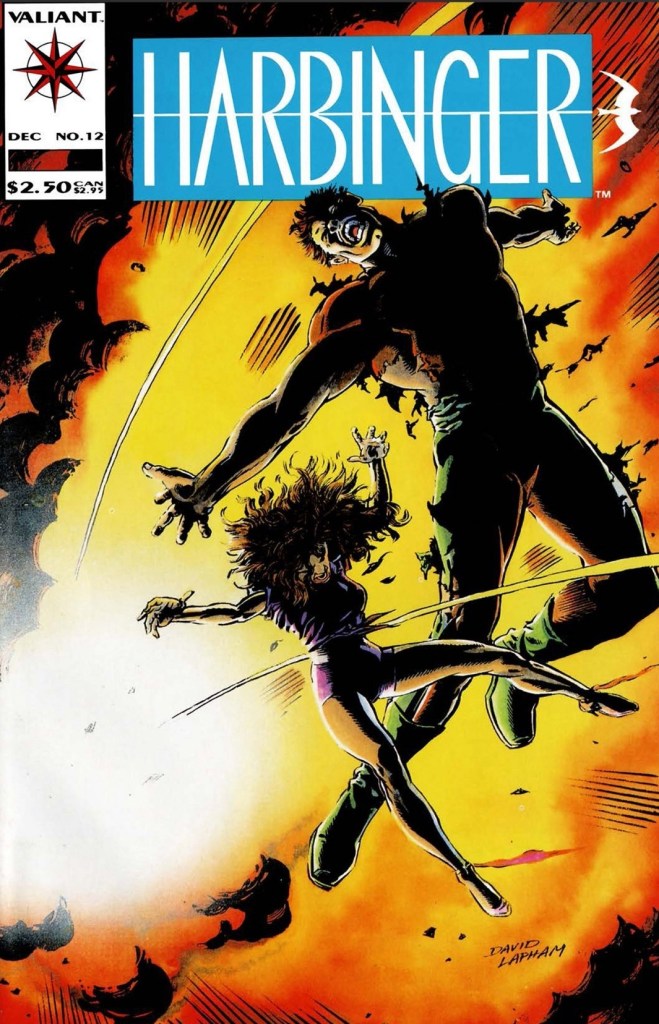
With those details laid down, here is a look back at Harbinger , published in 1992 by Valiant Comics with a story written by Jim Shooter and drawn by David Lapham. This comic book marks takes place after the end of Unity.

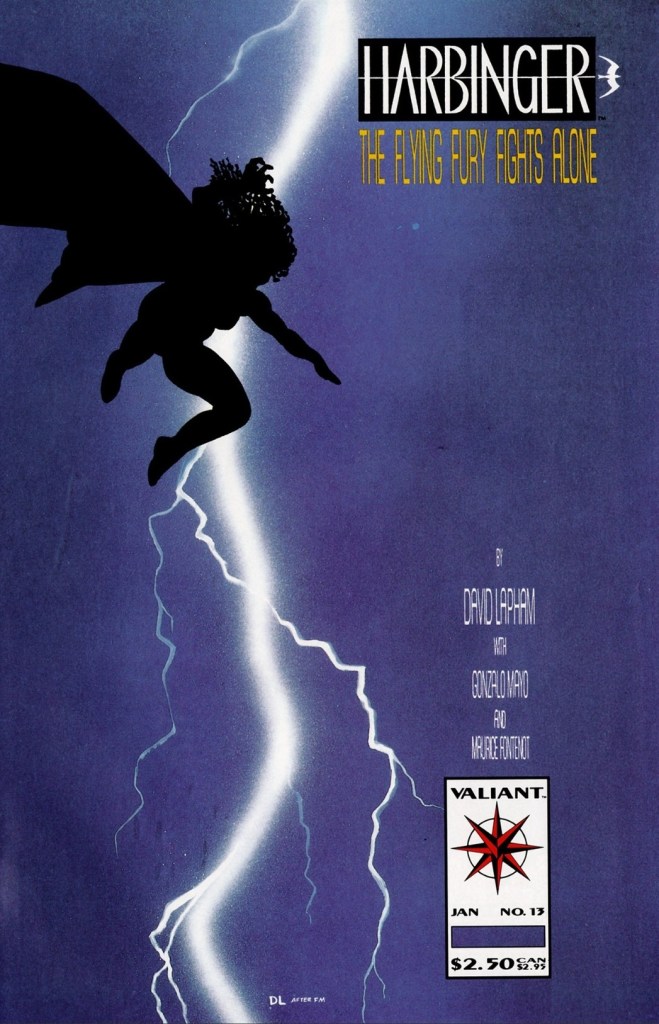
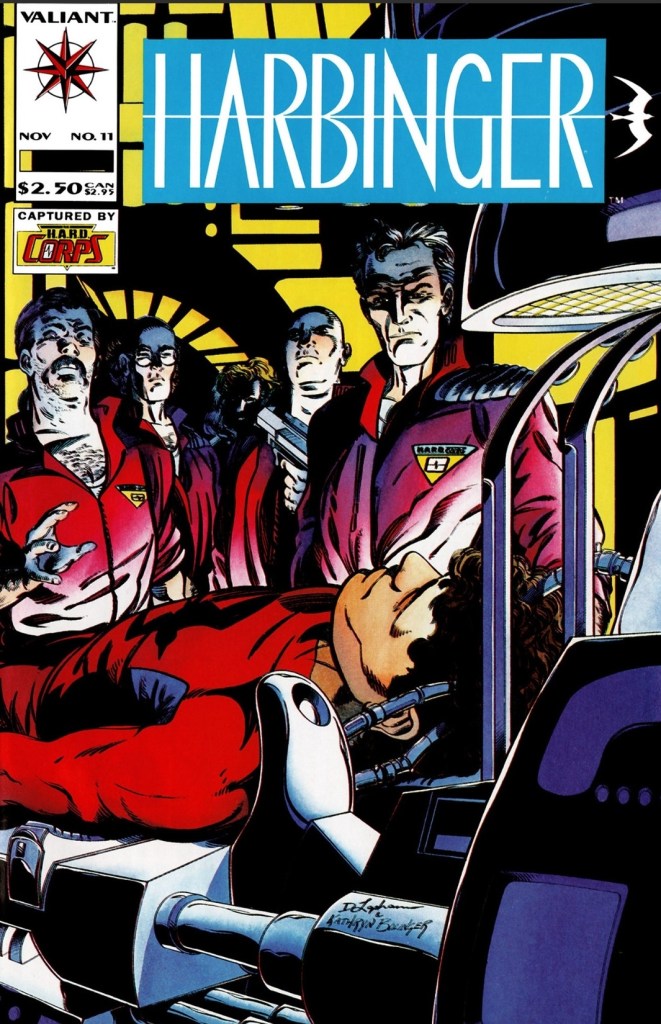
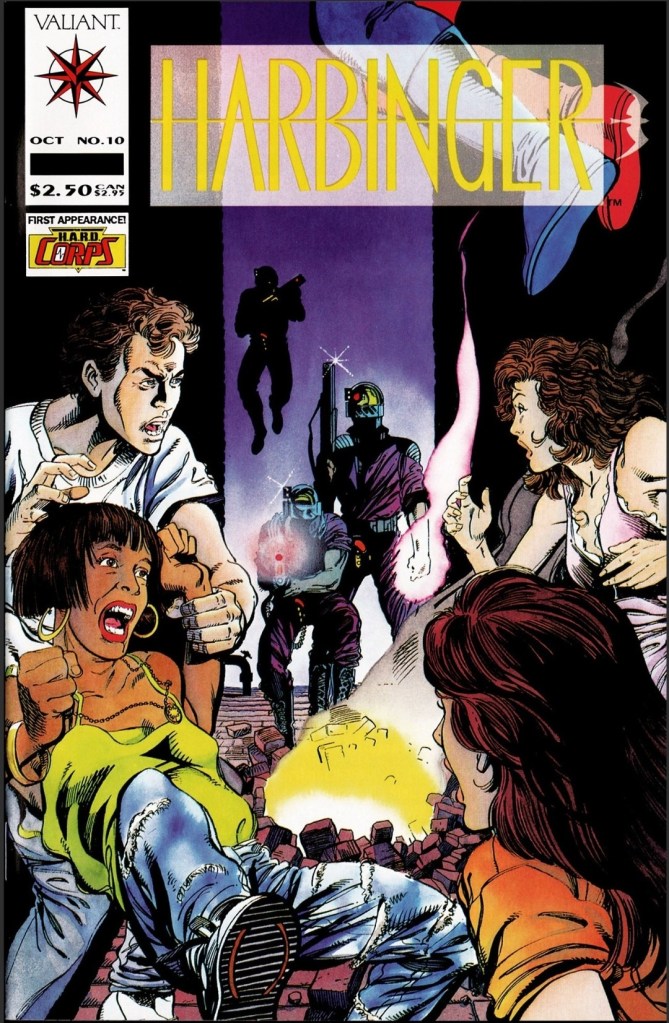
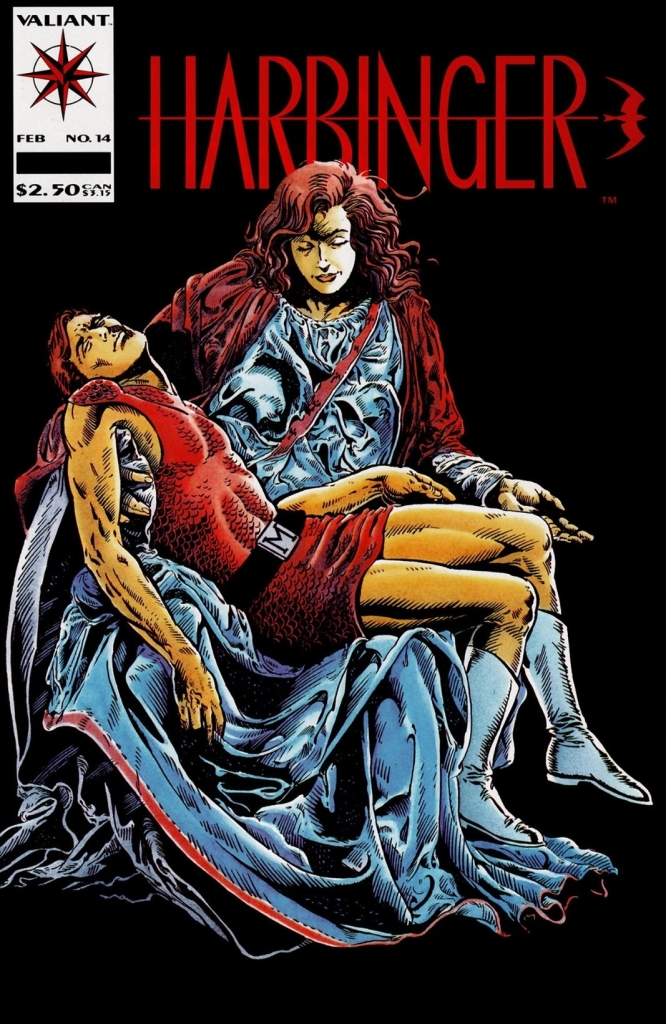
The cover.

Early story

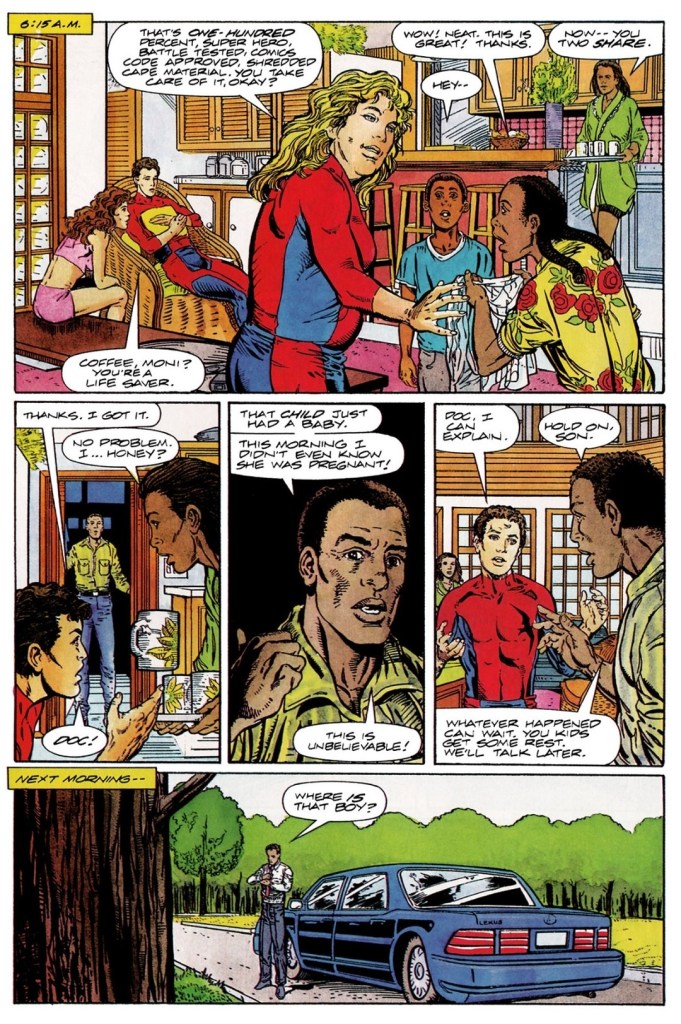
The story begins on April 5, 1992, at 1:15 AM. Sting, Kris, Faith and Flamingo are instantly brought back into the home of Dr. Heyward and his family. Sting finds himself disoriented from the travel while Kris, who no longer has her baby by this point, feels very weak and hot.

The next morning outdoors, Sting meets with Dr. Heyward and reveals to him that he and his three female companions were away for about six months. For Dr. Heyward and everyone else, not too much time passed at all. To help him understand their experiences during Unity, Sting puts several images and memories into Dr. Heyward’s mind. When asked by the doctor what happened to Kris’ baby, Sting claims he does not know at all.

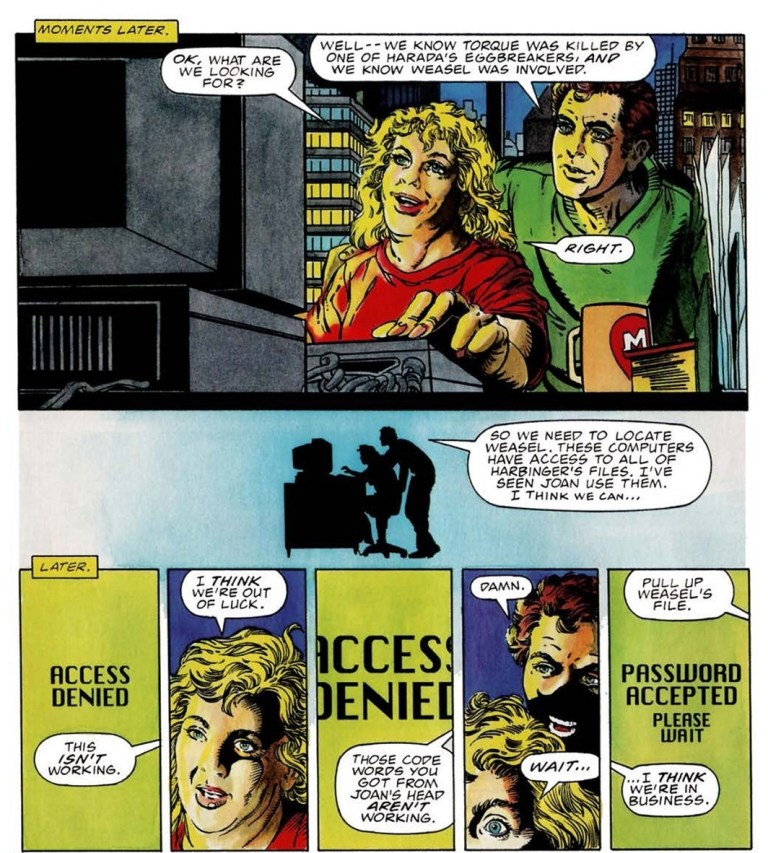
Meanwhile from somewhere, someone is using electronic surveillance…

Quality

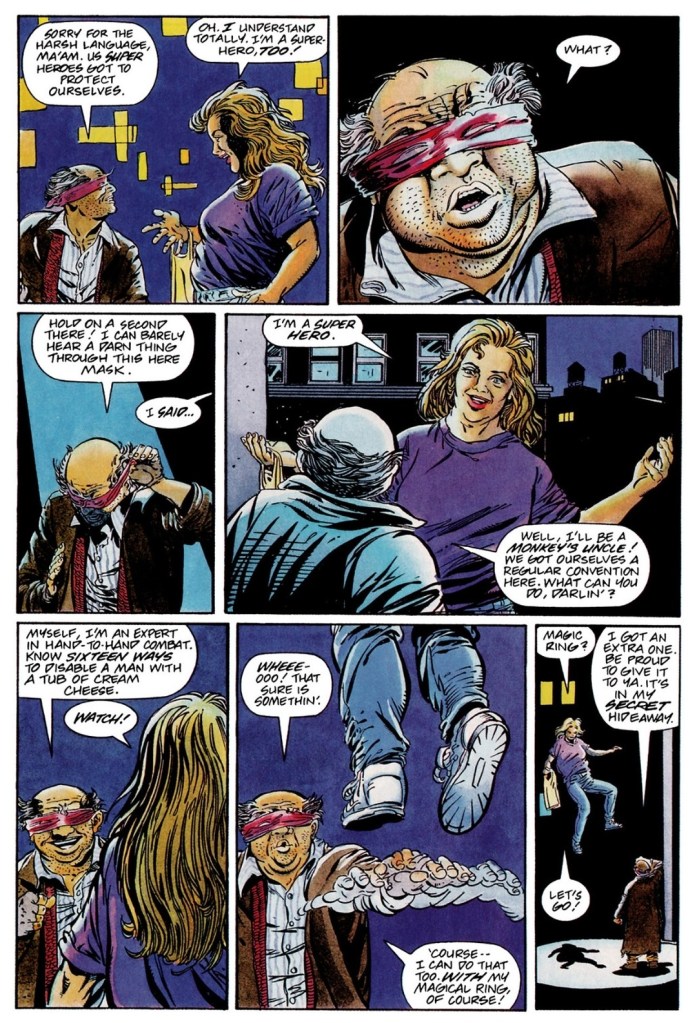
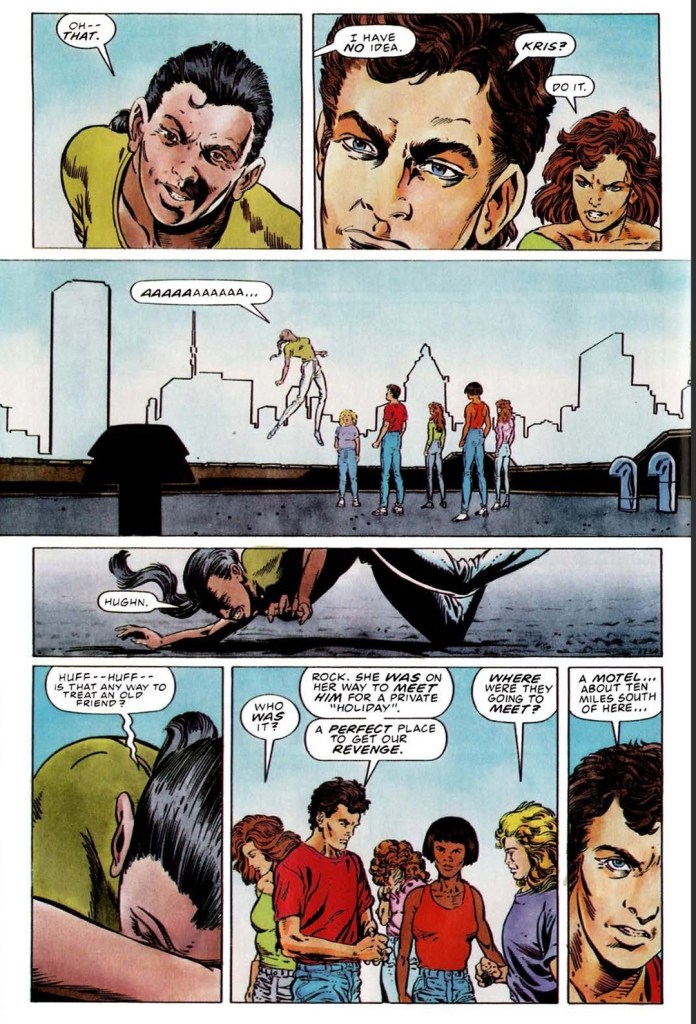
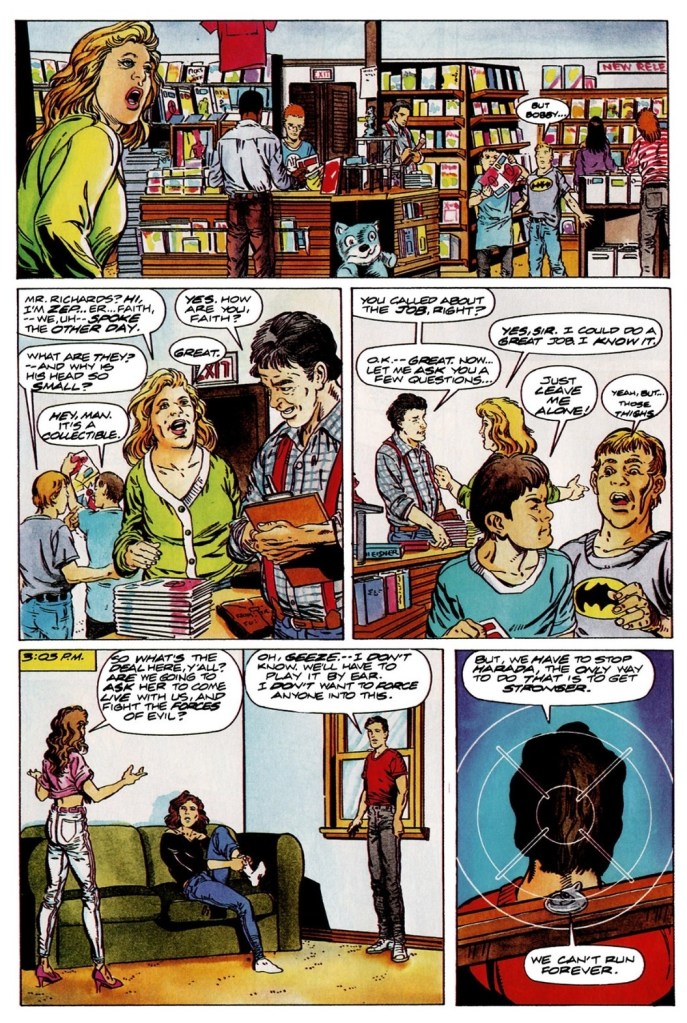
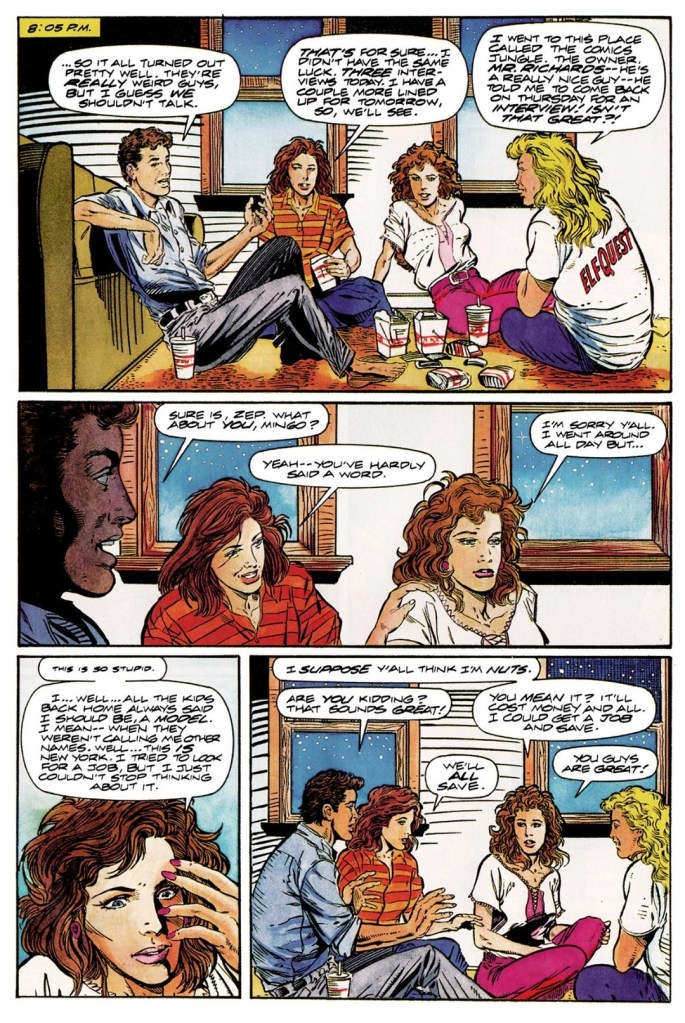
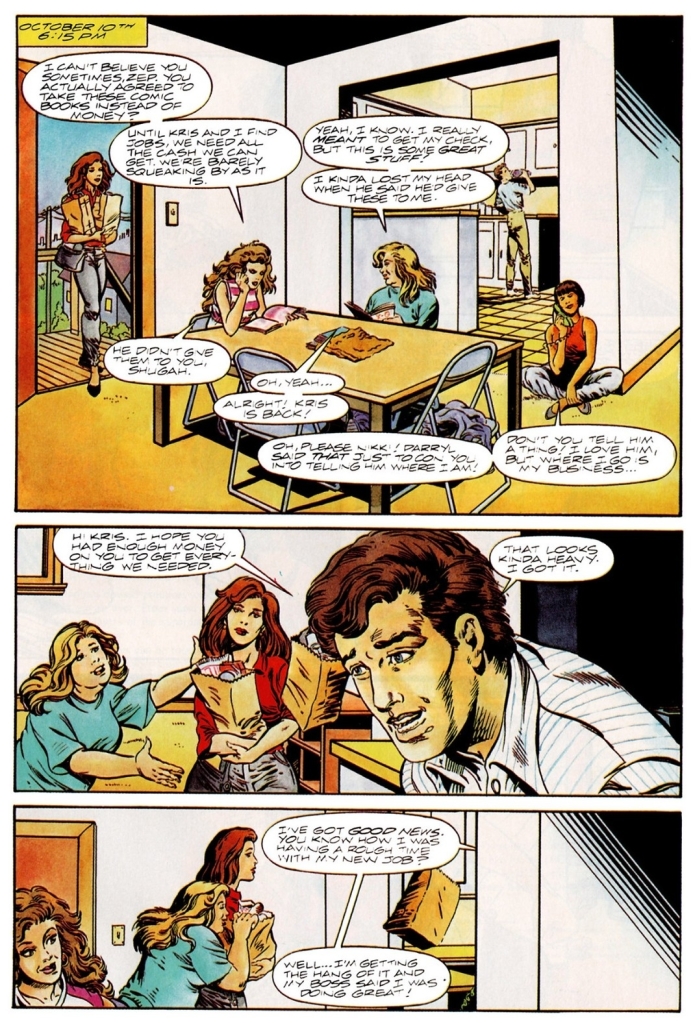
This private scene of Sting, Kris, Flamingo and Faith eerily reminds me of some 1980s Hollywood movies about teenagers.

From a storytelling viewpoint, the wild fantasy that was Unity which had Sting and his team spend time with other major figures of Valiant Comics has indeed ended and this comic book smoothly follows their return to Earth, the sudden shift of their living and keeping up with reality. As such, you will get to see Sting, Faith, Flamingo and Kris think and act like teenagers which is a notable change of presentation after seeing them as nomads during their time in Unity.

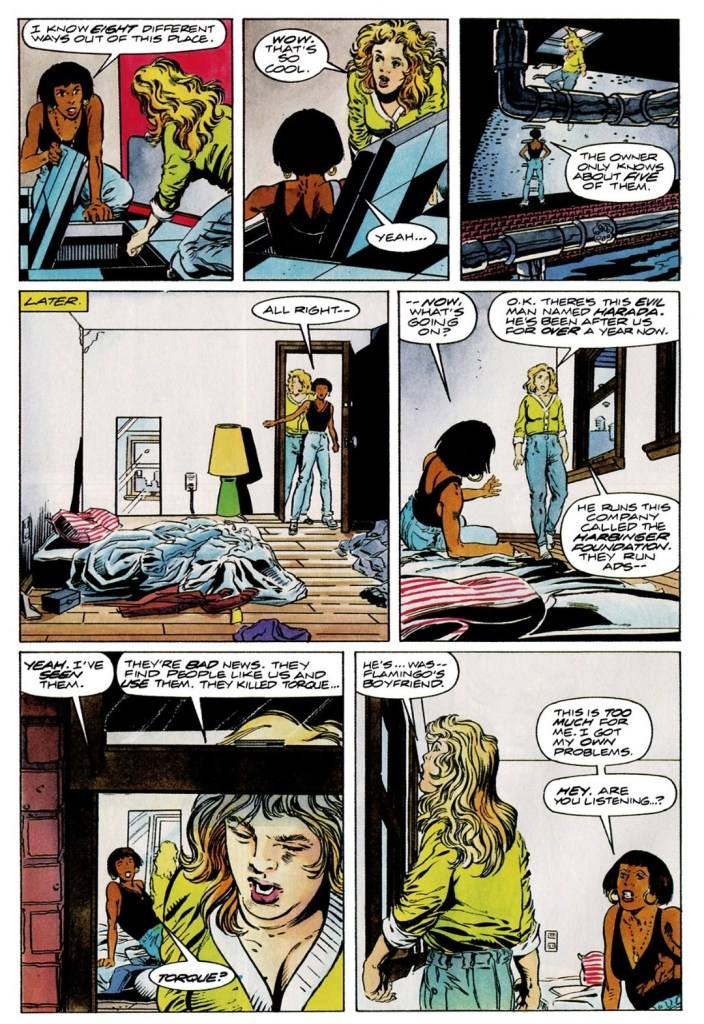
Normalcy of living is a clear theme explored in this story and Jim Shooter really had the characters and events move on while being grounded in reality. In relation to that, there is this really dramatic scene between Kris and Sting as they talked about their relationship and what happened to the baby. The said scene was only seven panels long but you can see and feel the emotion flow through the two characters.

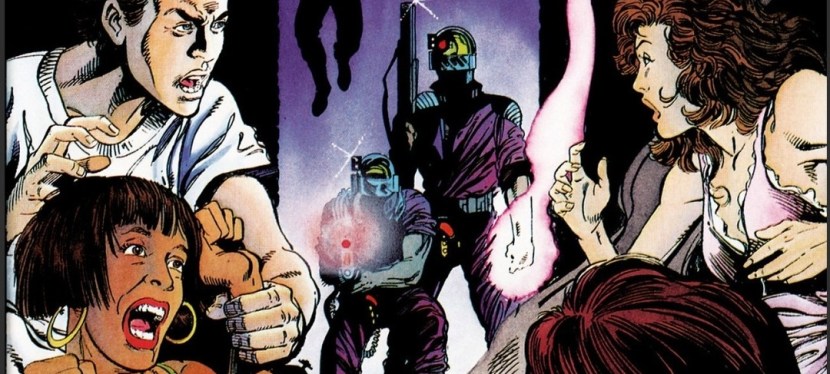
With the massive conflict of Unity over, Sting and his team start pursuing a new goal – to find other young super-powered beings like themselves before Toyo Harada and his powerful Harbinger organization make another move. Along the way, a new form of opposition awaits Sting, Faith, Flamingo and Kris. What was told in this comic book is engaging and refreshing to read.

Conclusion

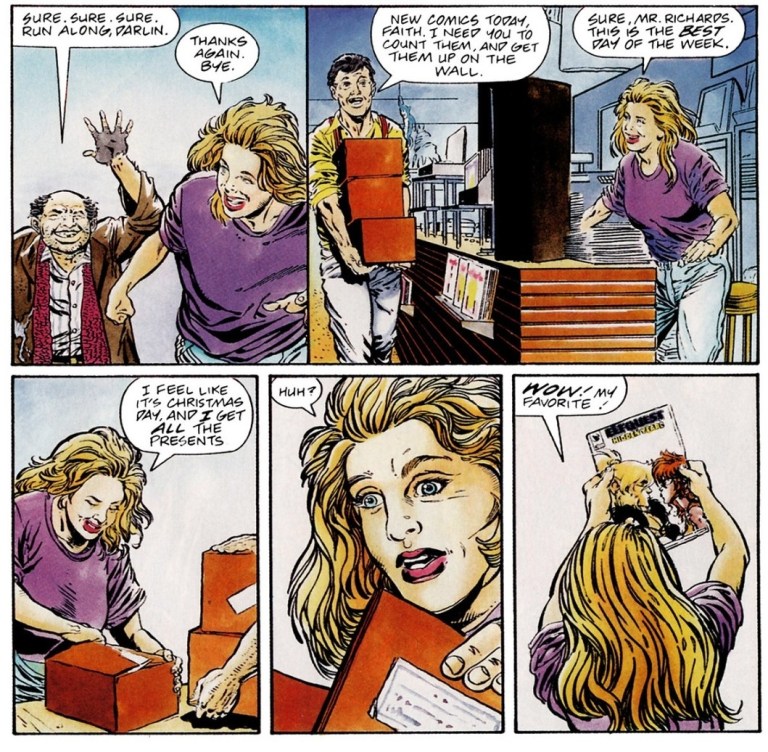
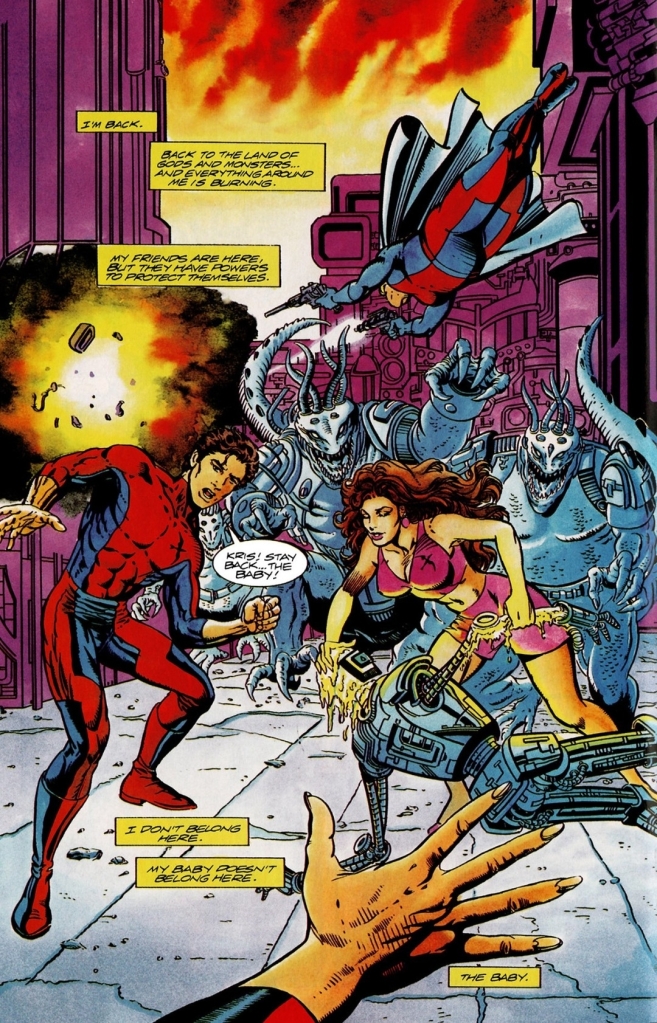
Nothing like being at home after spending many months away even though time on Earth did not move too much.

When you think about the high-quality stories Jim Shooter wrote for the Harbinger monthly series, Harbinger (1992) is clearly another winner. The portrayal of the powered teenagers is believable and very notably, the creators left space for some superhero spectacle for readers to be entertained with as Sting and his teammates start pursuing their new goal. Of course, the new pursuit happened after Sting, Faith, Flamingo and Kris tackled reality first as they returned from spending many months away in Unity while time on Earth moved forward very little. How Jim Shooter and David Lapham managed to emphasize their new story concepts while remaining tight and strong with the storytelling is indeed amazing. I should also state that this comic book marks the start of a new chapter for Sting, Faith, Flamingo and Kris.

Overall, Harbinger (1992) is highly recommended!

+++++

Thank you for reading. If you find this article engaging, please click the like button below, share this article to others and also please consider making a donation to support my publishing. If you are looking for a copywriter to create content for your special project or business, check out my services and my portfolio. Feel free to contact me with a private message. Also please feel free to visit my Facebook page Author Carlo Carrasco and follow me on Twitter at  @HavenorFantasy as well as on Tumblr at https://carlocarrasco.tumblr.com/ and on Instagram at https://www.instagram.com/authorcarlocarrasco
A Look Back at What If #47 (1993)

Disclaimer: This is my original work with details sourced from reading the comic book and doing personal research. Anyone who wants to use this article, in part or in whole, needs to secure first my permission and agree to cite me as the source and author. Let it be known that any unauthorized use of this article will constrain the author to pursue the remedies under R.A. No. 8293, the Revised Penal Code, and/or all applicable legal actions under the laws of the Philippines.

Welcome back superhero enthusiasts, 1990s arts and culture enthusiasts, Marvel Comics fans and comic book collectors! Today we go back to the year 1993 and explore a part of Marvel Comics’ universe through the reimagined tales emphasized in the What If monthly series.

Back in 2021, I reviewed What If #46 (1993) which told a compelling story about division between the mutants, the clash of beliefs between Professor X and Cable, and how terrorism affects everyone. The comic book was also a mesmerizing portrayal of how the X-Men would have organized themselves without Charles Xavier, Jean Grey and Cyclops.

Considering all the chaos that happened in What If (1993), the time was just right for Magneto – the X-Men’s most dangerous enemy of all time – to come in and make an impact not only on mutants but on the world.

With those details laid down, here is a look back at What If , published in 1993 by Marvel Comics with a story written by Kurt Busiek and drawn by Tod Smith.

The cover.

Early story

The story begins with Magneto leading a huge legion of mutants to take overwhelm the remaining resistance – including Spider-Man, the Fantastic Four, Captain America, the Avengers and the dedicated American soldiers – in Washington, D.C.

A fierce battle then took place with both sides hitting each other hard. After noticing Magneto’s lack of presence during the battle, Captain America then realizes that the long-time enemy of the X-Men took advantage of the fighting to penetrate the U.S. Capitol’s bomb shelters and got the nation’s leaders hostage. After easing some of his fellow heroes, Captain America decides not to escalate the fight against Magneto in consideration of the lives of America’s top officials…

Quality

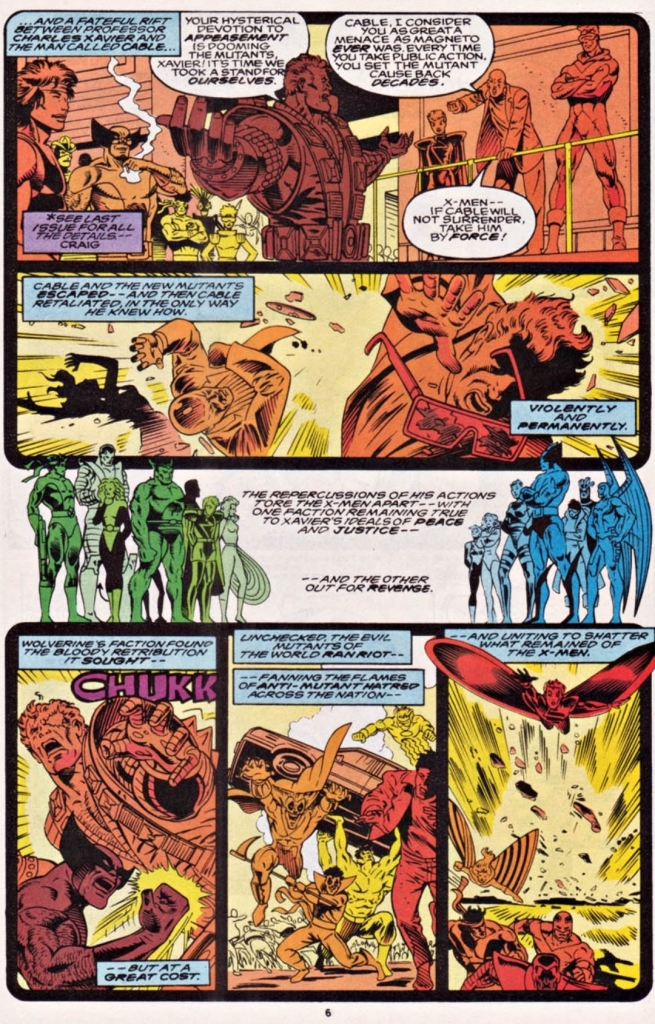
A recap of the events in issue .

To begin with, I can say that this story is a well-planned follow-up to the events of issue . While Magneto’s presence has been magnified a lot here, there are still strong story connections to the previous issue.

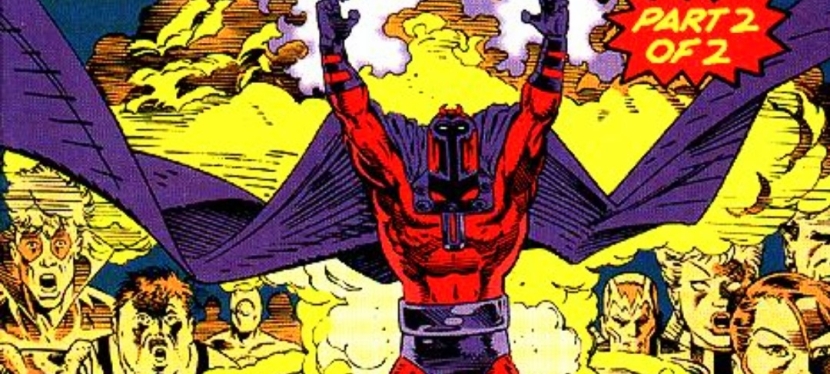
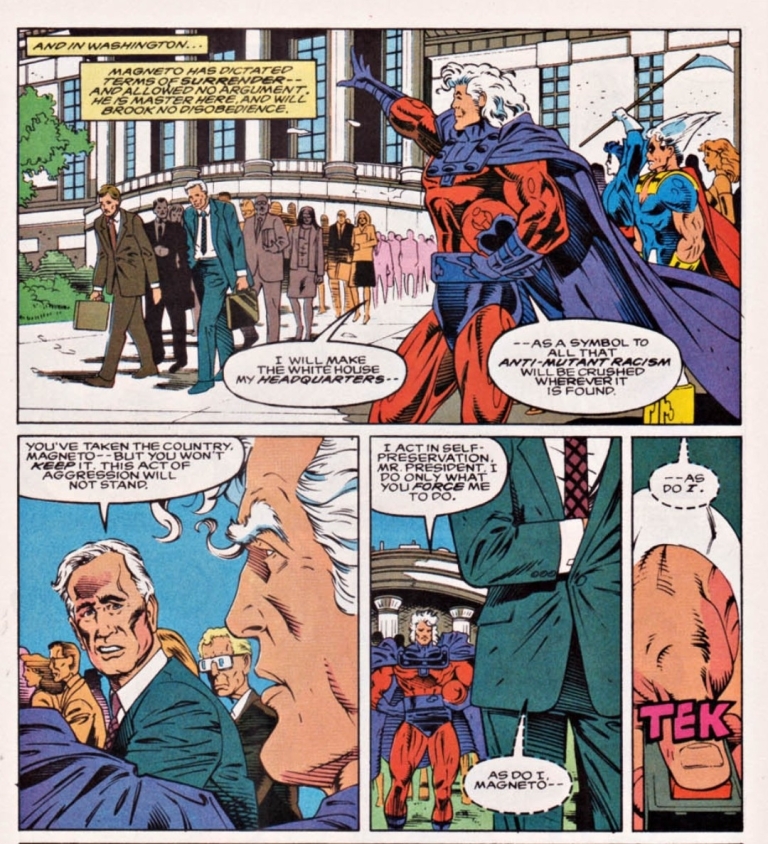
With regards to what was emphasized on the front cover of the comic book, this story explores what would happen if Magneto took power to control the entire United States while leading a group of mutants with a platform focused on crushing anti-mutant racism even though it includes pushing the non-mutant people (which is the great majority of America’s people) as well as the dissenting mutants out of the way.

For one thing, this superhero fantasy concept is actually socially relevant with today’s geopolitics and the way America has turned out under the fake leadership of Joe Biden (who is NOT leading as US President but only following the modern-day American Communists and reckless SJWs dictating him to do their evil bidding. Biden also arrogantly denies reality when it goes against the desires of his administration and his Satanic Democrats) It should be noted that the US President visualized in this comic book eerily looks like Joe Biden complete with that absent-minded facial expression.

Next, a clear theme in this What If story is absolute power and why groups who crave for it would sacrifice so much and hurt others just to acquire it. Magneto, who carries deep hatred towards people he perceives to be obstacles or opposition for his quest of uplifting mutants, takes advantage of mutants who have lost hope and are depending on someone to lead them. Indeed, the long-time X-Men nemesis gains power to control America but finds himself facing a new force of opposition which leads the nation into a drastic series of change that clearly do not alight with his vision of a better future for mutants.

Still on the theme of absolute power, the US government in this story was portrayed to have developed technologies designed to overwhelm its citizens, as well as the means to establish infrastructure and protocols to transform America into an automated dictatorial state that enslaves its citizens and violate their rights without restraint. Once again, this aspect of the story makes it socially relevant.  

Considering the epic concept and the dark turn of events the creative team prepared, this comic book does not have a clear good-versus-evil approach but rather it emphasizes chaos that comes with the pursuit and abuse of absolute power over the nation. You will see key elements from the classic X-Men storyline Days of Future Past here in relation to America’s deformation.

Conclusion

Wow! The US President in this comic book eerily looks so much like Joe Biden whose leadership led America into a lot of problems and hardship. Sky high inflation is just one of the problems that happened under Biden.

What If (1993) is truly a very captivating read mainly because of its core concept which goes way beyond the scenario of Magneto taking control of America. Considering its portrayal of America and the exploration of dark themes about people getting overwhelmed by power abusers, the story is a warning about the fall of America told in superhero fantasy form. Considering the intense social degradation that rocked America the past few years (note: riots by the Black Lives Matter terrorists, SJWs disturbing the peace, Democrats allowing more illegal immigrants into the country, socialists in colleges continuing to brainwash students and more), this story is very socially relevant. It will keep you thinking and reflecting deeply, even if you strongly desire whatever superhero entertainment you seek in this comic book.

Overall, What If (1993) is highly recommended!

+++++

Thank you for reading. If you find this article engaging, please click the like button below, share this article to others and also please consider making a donation to support my publishing. If you are looking for a copywriter to create content for your special project or business, check out my services and my portfolio. Feel free to contact me with a private message. Also please feel free to visit my Facebook page Author Carlo Carrasco and follow me on Twitter at  @HavenorFantasy as well as on Tumblr at https://carlocarrasco.tumblr.com/ and on Instagram at https://www.instagram.com/authorcarlocarrasco
A Look Back at Harbinger #9 (1992)

Disclaimer: This is my original work with details sourced from reading the comic book and doing personal research. Anyone who wants to use this article, in part or in whole, needs to secure first my permission and agree to cite me as the source and author. Let it be known that any unauthorized use of this article will constrain the author to pursue the remedies under R.A. No. 8293, the Revised Penal Code, and/or all applicable legal actions under the laws of the Philippines.

Welcome back superhero enthusiasts, 1990s culture enthusiasts and comic book collectors! Today we go back to the early 1990s and explore a part of the Valiant Comics shared universe through the Harbinger monthly series.

In my previous retro review, things got totally wild as Sting, Faith, Flamingo and a pregnant Kris made their way into the middle of a war in an unknown, far-away place within the Unity crossover storyline. Even though Sting and Kris already have major challenges ahead of them related to an upcoming birth of a child, they have no choice but to help their side of powered figures (including Magnus the robot fight, Solar, X-O Manowar and others) win against Erica Pierce.

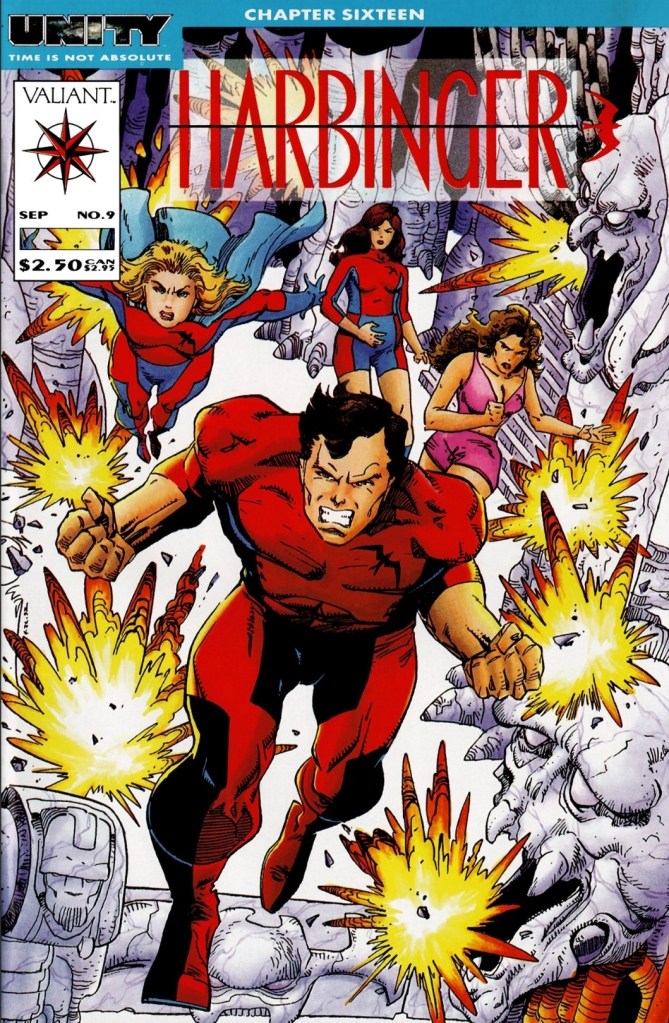
With those details laid down, here is a look back at Harbinger , published in 1992 by Valiant Comics with a story written by Jim Shooter and drawn by David Lapham. This comic book marks the 16th chapter of the Unity storyline.

The cover.

Early story

The story begins on day number 157 of Unity. Needing immediate help for his girlfriend Kris who is about to give birth, Sting flies to Armstrong who is about to acquire a bottle of liquid painkiller. Minutes later, Sting and Armstrong arrive at a high-tech place where the pregnant Kris is waiting.

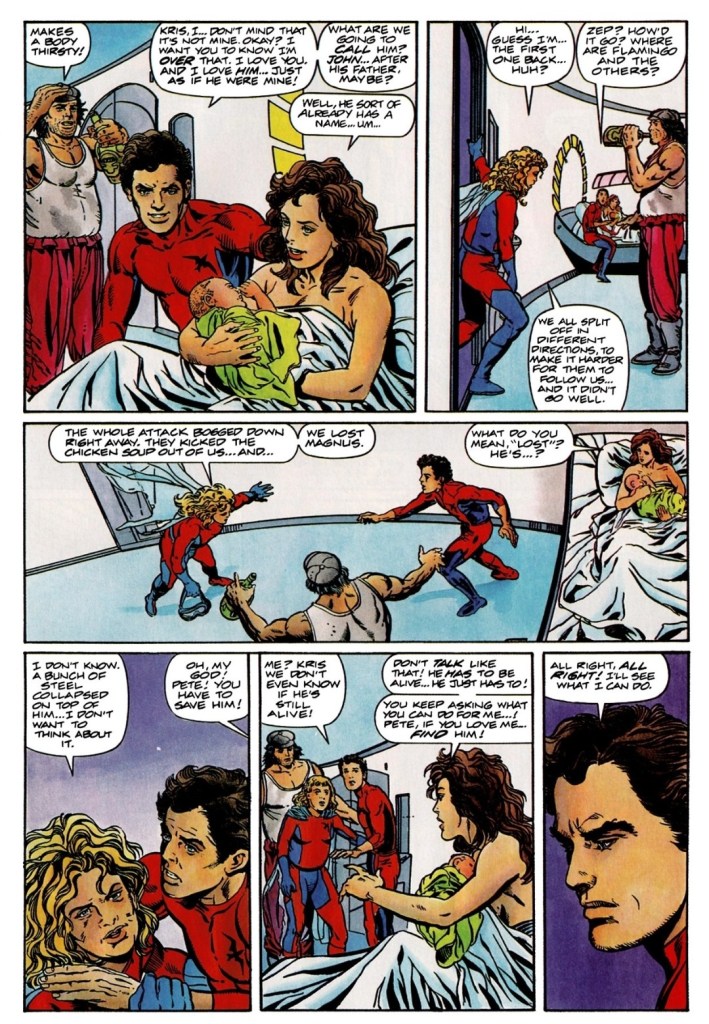
Supported by Armstrong and touched by Sting, Kris eventually gives birth to a baby boy. Even though he knows that the baby is not biologically related to him, Sting still expresses his love to Kris and the child.

Suddenly, Faith arrives feeling exhausted. She said she came from battle and their group lost Magnus…

Quality

Sting, Flamingo and Faith with the other major Valiant Comics figures on a mission.

To cite the obvious, this is another high-quality story crafted by Jim Shooter who successfully told the exploits of Sting and his teammates while also highlighting crucial developments on the heroes’ campaign against Erica Pierce within the Unity storyline.

When compared to the events of issue , the stakes are much higher this time around not only for Sting, Faith, Kris and Flamingo but also for the other major figures of Valiant’s comic book universe of the time. This is very fitting as Erica Pierce, the so-called Mothergod, took steps closer on achieving her goal that would mean complete disaster for everyone. The notable thing about the way Jim Shooter crafted the narrative within this comic book is that tension gradually rises as the story goes on which leads to something really powerful happening on the final page (note: you must read it yourselves).

On character development, Sting and Kris are the ones who got characterized most. Through Sting, you will realize that even though he is very powerful, his immaturity added to his struggle on achieving goals and setting his priorities straight. Also the way he expressed his love to Kris knowing that the father of the newly born baby was none other than their late teammate Torque, I felt he said it half-heartedly mainly to give her assurance (which he could fail to give). Kris also gets her own share of the spotlight as she embraces her new role as a teenage mother.

More on the Unity story, fans of Magnus, Archer and Armstrong, Rai and Eternal Warrior will have something to enjoy here.

Conclusion

Kris is now a mother and Sting is not the father of the child.

Harbinger (1992) maintains many powerful elements that made the previous issue a great read. The difference is that this comic book has not only the stakes raised higher, but also the drama and the progressive development of Sting and Kris. In here, you will see Sting not only as a powerful teenager struggling with his priorities, but also as a key player in the struggle against Erica Pierce. Those who follow the Unity story will see a lot of engaging stuff from start to finish here.

Overall, Harbinger (1992) is highly recommended!

+++++

Thank you for reading. If you find this article engaging, please click the like button below, share this article to others and also please consider making a donation to support my publishing. If you are looking for a copywriter to create content for your special project or business, check out my services and my portfolio. Feel free to contact me with a private message. Also please feel free to visit my Facebook page Author Carlo Carrasco and follow me on Twitter at  @HavenorFantasy as well as on Tumblr at https://carlocarrasco.tumblr.com/ and on Instagram at https://www.instagram.com/authorcarlocarrasco

A Look Back at Harbinger #8 (1992)

Disclaimer: This is my original work with details sourced from reading the comic book and doing personal research. Anyone who wants to use this article, in part or in whole, needs to secure first my permission and agree to cite me as the source and author. Let it be known that any unauthorized use of this article will constrain the author to pursue the remedies under R.A. No. 8293, the Revised Penal Code, and/or all applicable legal actions under the laws of the Philippines.

Welcome back superhero enthusiasts, 1990s culture enthusiasts and comic book collectors! Today we go back to the early 1990s and explore a part of the Valiant Comics shared universe through the Harbinger monthly series.

In my previous retro review, Sting, Faith, Kris and Flamingo struggled with the completely unexpected new reality that their teammate Torque had died. As they mourned, Toyo Harada and his foundation just kept on operating and preparing themselves for a future conflict with the protagonists. Harada specifically perceives Sting as the most dangerous object for his organization to deal with.  

With those details laid down, here is a look back at Harbinger , published in 1992 by Valiant Comics with a story written by Jim Shooter and drawn by David Lapham.

The cover.

Early story

The story begins on April 4, 1992 inside the nice home of Dr. Heyward. There, Heyward, his wife and their two kids are enjoying the company of Faith, Sting and Flamingo. Upstairs, Kris could not fit jeans as she has gained weight. Heyward’s wife Moni arrives, offers her new clothes to wear and shares with her some insight about being in a relationship.

After dinner, Sting and Dr. Heyward have a nice chat with drinks. At the kitchen, Kris and Moni begin to talk about pregnancy with Flamingo present. As soon as Kris says that she is thinking about asking Dr. Heyward about getting an abortion, Flamingo tells her not to do it as the baby inside her all that is left of their dead teammate Torque.

Just as Kris begins to play dumb and divert attention away, a weirdly dressed teenager suddenly appears inside the home. He identifies himself as Geoff McHenry the geomancer…

Quality

Faith collects and then flies high for a grand view.

To get straight to the point, this issue of Harbinger is easily the wildest story I’ve read in this series and for a very obvious reason – it is part of the Unity crossover storyline that established the Valiant Comics universe’s overall concept. For the newcomers reading this, Unity was published in 1992 composed of eighteen chapters – beginning with Unity – which saw story parts told in issues of other Valiant titles like Eternal Warrior, Archer & Armstrong, Magnus Robot Fighter, X-O Manowar, Rai and Solar Man of the Atom.

That being said, the story here is not only wilder than ever but also really went higher with its flight of fantasy which really impacted the protagonists. In her, Sting, Faith, Flamingo and even the pregnant Kris get recruited to join what turned out to be a major battle waged by a group of adult heroes (Solar, Eternal Warrior, Archer & Armstrong, X-O Manowar, Rai and others) against Erica Pierce (the Mothergod) who is obsessed with destroying the universe as she wield immense power.

More on the plot, the transition of Sting and his teammates going into battle on an unknown realm progressed very smoothly which surprised me. As there are lots of battle scenes and other forms of superhero spectacle to see, the creative team managed to maintain a compelling narrative that moved at a medium pace which makes following the exploits of the powered teenagers easy to do. Sure, you get to see the other Valiant Comics heroes share the spotlight in this comic book but Sting and his teammates are the clear protagonists.

Even though there are lots of battle scenes, Jim Shooter still succeeded in setting up a good amount of character development scenes which resulted in clear development of Sting and Kris. Not only that, Shooter convincingly captured the impulse of youth and the false sense of maturity on the part of Sting who at this point has to take special care of Kris, think about the future of becoming a father while dealing with pressure from the other Valiant superheroes who need him to really advance against Erica Pierce. This comic book’s script is very strong and richly layered!

Conclusion

Sting and his teammates stand along with the other heroes of the Valiant Comics universe.

Being the eight chapter of the Unity crossover storyline, Harbinger (1992) has this almost perfect mix of the epic superhero conflict, spectacle and characterization while maintaining sufficient focus on the exploits Sting, Faith, Kris and Flamingo. At this point of the monthly series, Sting (note: whose immense power was portrayed here) and Kris are preparing themselves for the future while failing to realize they are not really mature enough to deal with both the anticipated parenthood and the Unity conflict at hand. This comic book is a must-read as it works excellently both as a standalone story as well as a chapter of Unity. That being said, I’m looking forward to the next issue already.

Overall, Harbinger (1992) is highly recommended!

+++++

Thank you for reading. If you find this article engaging, please click the like button below, share this article to others and also please consider making a donation to support my publishing. If you are looking for a copywriter to create content for your special project or business, check out my services and my portfolio. Feel free to contact me with a private message. Also please feel free to visit my Facebook page Author Carlo Carrasco and follow me on Twitter at  @HavenorFantasy as well as on Tumblr at https://carlocarrasco.tumblr.com/ and on Instagram at https://www.instagram.com/authorcarlocarrasco
A Look Back at The Solution #14 (1994)

Disclaimer: This is my original work with details sourced from reading the comic book and doing personal research. Anyone who wants to use this article, in part or in whole, needs to secure first my permission and agree to cite me as the source and author. Let it be known that any unauthorized use of this article will constrain the author to pursue the remedies under R.A. No. 8293, the Revised Penal Code, and/or all applicable legal actions under the laws of the Philippines.

Welcome back superhero fans, 1990s arts and culture enthusiasts, Ultraverse fans and comic book collectors! Today we revisit the Ultraverse through the monthly series of The Solution.

Under the direction of the late James Hudnall, issues #9, #10, #11 and #12 told a very wild and compelling story about The Solution that literally was out of this world and gave readers a wide view of the vastness of the Ultraverse. Issue #13 meanwhile saw The Solution involved in a crossover storyline that involved Prototype, Solitaire and the Night Man. Just what happened next in The Solution series?

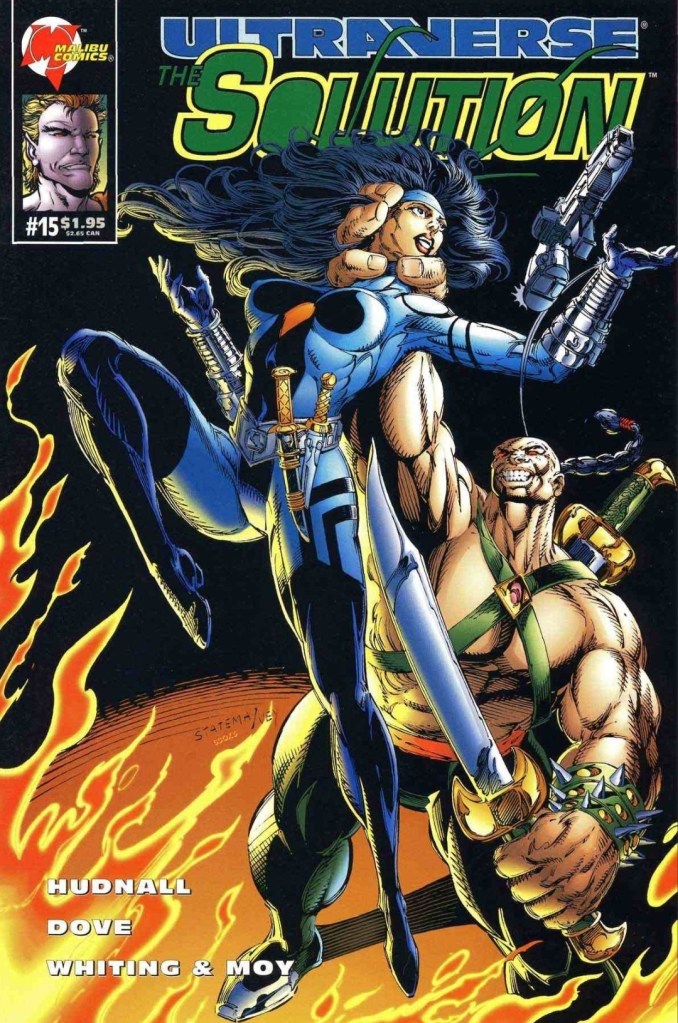
With those details laid down, here is a look back The Solution , published by Malibu Comics in 1994 with a story written by the late James Hudnall and drawn by Huang Nguyen.

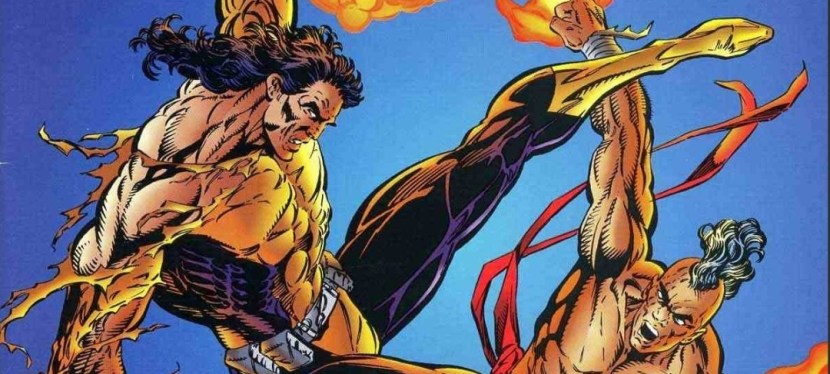
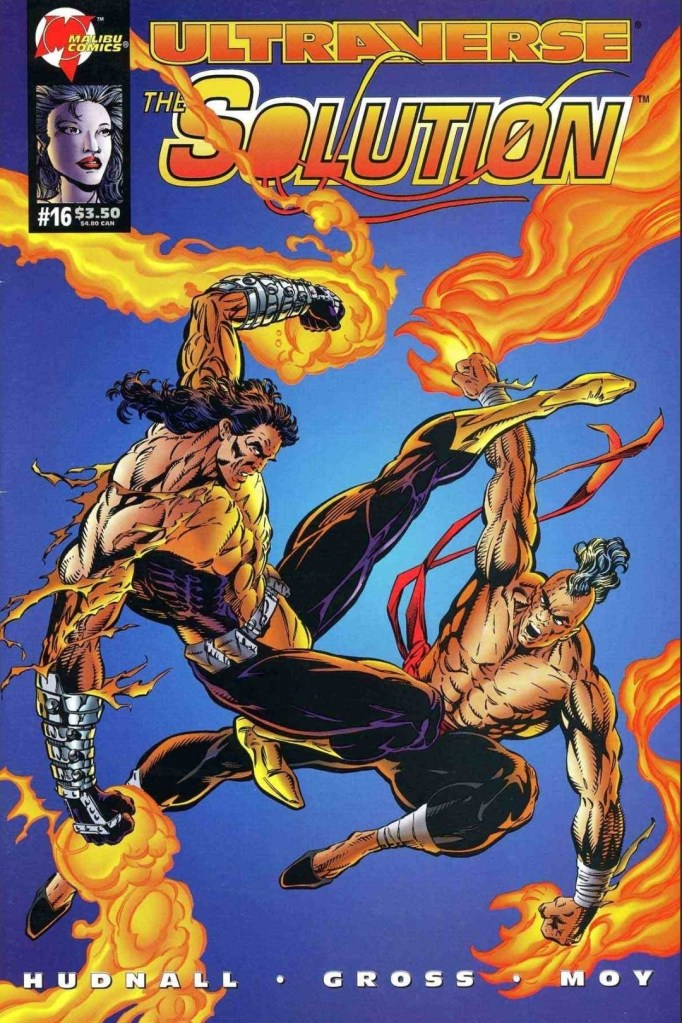
The cover.

Early story

The story begins when an armed, muscular man carrying two large guns sees Dropkick. He immediately fires at him. Then he sees Shadowmage and Tech and then fires at them. It turns out they are just non-moving physical models. The aggressive use of weapons is called Incoming. He is a Communist Cambodian man who was hardened by the events in his native country and he served the tyrant Pol Pot by killing others. He is living with brutality and unstoppable rage which makes him dangerous to The Solution.

In New York, Black Tiger anticipates the arrival of a van carrying heroin set to be released to buyers. Suddenly a gang of thugs serving the Pump appear heading attacking the van. Black Tiger suddenly comes in and kills many of the thugs.

On a far-away location in Hong Kong, a fighter called Bloodshed finds himself surrounded by five other fighters who are determined to kill him…

Quality

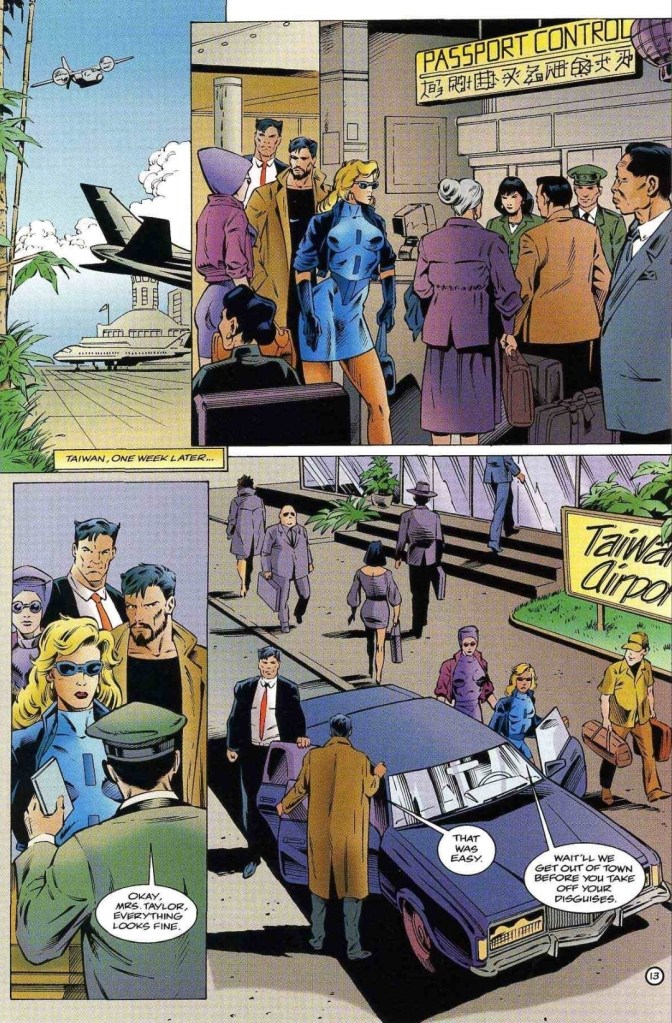
The three assassins in a meeting for a mission against The Solution.

I’ll get straight to the point here. This comic book has the most jarring story I have read about this series and even among all the Ultraverse comic books I have read so far. The story was truly a build-up of an opposing force composed of assassins who are serving one powerful boss who really targets The Solution. It’s so alienating to read this tale that never really had Tech, Outrage, Dropkick, and Shadowmage at all.

More on what was presented here, Hudnall exerted effort to build up the three assassins (note: they all appeared in issue ) not merely as villains but as characters with background details that emphasize their personalities. Incoming is a veteran Communist who lives with intense violence which is connected to the events that happened in his past. Considering his background and how he appears, Incoming looks like a fantasized version of Rambo but in Asian form that modern day Communists in America (read: SJWs, diversity freaks, inclusion freaks and socialists) would love to have in their Satanic Leftist movement. Black Tiger, who has this uncanny offensive capability, is similarly violent as he witnessed lots of killing, rapes, robbery and drug deals in his life and went on to join the Dragon Fang gang. Bloodshed meanwhile grew up with opium acquired by his family, joined a gang at a young age and got trained with violence to rise up.

As the three assassins were being prepared for an anticipated rematch with The Solution, the story here really looked like it was crafted to be a direct follow-up to issue . That being said, The Solution’s impact against crime was also emphasized with some interesting details told.

On the visual side of things, Huang Nguyen gave this comic book a new but not so polished look. There’s not enough visual detail on his art on the characters. In fact, the three assassins were not that recognizable to me when I first read this comic book and I had to go back to issue to view how they looked in it. On action, Nguyen’s work looks sub-par in quality and presentation. There were even some cartoonish moments along the way.

Conclusion

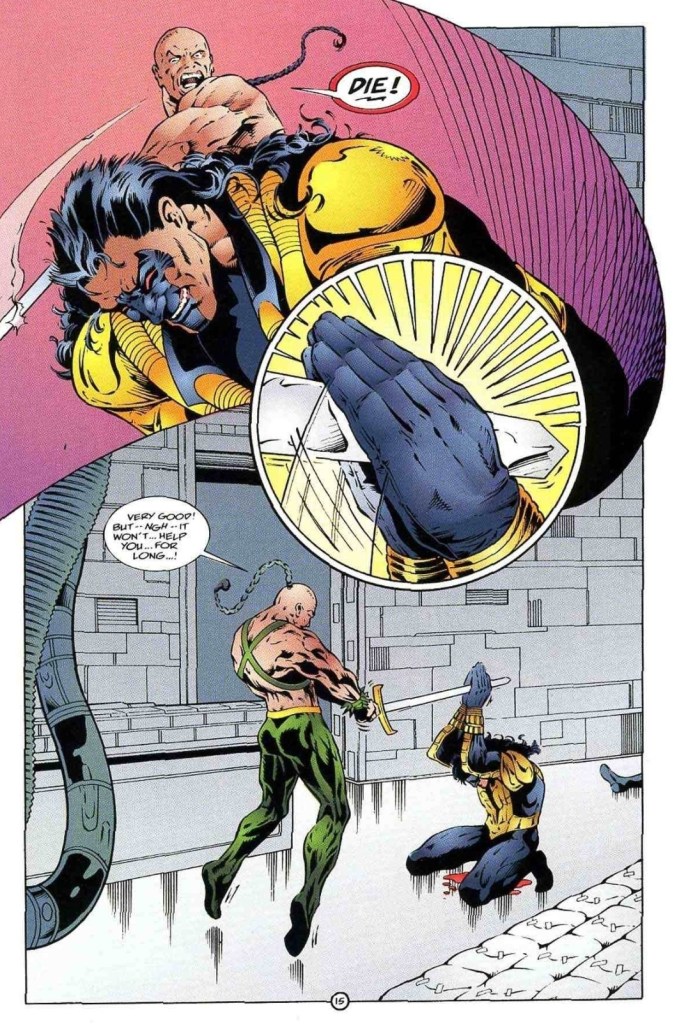
Five against Bloodshed.

The Solution (1994) is so far the weakest story I’ve read in this series as well as one of the weakest Ultraverse stories I’ve read so far. It is truly a build-up for an upcoming conflict with The Solution which so happens to focus mainly on the villains. You won’t find The Solution themselves here at all and this for me is a turn-off. Ultimately, the story feels hollow and the assassins Incoming, Black Tiger and Bloodshed are themselves not too interesting as Ultraverse villains.

Overall, The Solution (1994) is unsatisfactory.

+++++

Thank you for reading. If you find this article engaging, please click the like button below and also please consider sharing this article to others. If you are looking for a copywriter to create content for your special project or business, check out my services and my portfolio. If you want to support my website, please consider making a donation. Feel free to contact me with a private message. Also please feel free to visit my Facebook page Author Carlo Carrasco and follow me on Twitter at  @HavenorFantasy as well as on Tumblr at https://carlocarrasco.tumblr.com/ and on Instagram athttps://www.instagram.com/authorcarlocarrasco/.

A Look Back at The Night Man #10 (1994)

Disclaimer: This is my original work with details sourced from reading the comic book and doing personal research. Anyone who wants to use this article, in part or in whole, needs to secure first my permission and agree to cite me as the source and author. Let it be known that any unauthorized use of this article will constrain the author to pursue the remedies under R.A. No. 8293, the Revised Penal Code, and/or all applicable legal actions under the laws of the Philippines.

Welcome back superhero enthusiasts, 1990s culture enthusiasts and comic book collectors! Today we go back to the mid-1990s which was a pretty wild time for comic collectors. To be more specific, this newest retro comic book review revisits the Ultraverse through The Night Man monthly series.

In my previous retro review, the Teknight armor remotely controlled by J.D. Hunt and his son broke into a prison to free the defeated Apocaloff. Unsurprisingly, the Night Man arrived to stop Teknight’s operation even though the police were not willing to get involved with the vigilante. Eventually, Teknight and Apocaloff were defeated thanks to a masked man who fired a canister from a distance. The Night Man approached the masked man and discovered that he is someone essential in life.

With those details laid down, here is a look back The Night Man , published in 1994 by Malibu Comics with a story written by Steve Englehart and drawn by Kyle Hotz.  

The cover.

Early story

The story begins one week in the past with the shooting of a man witnessed by his lady companion in the presence of three men wearing dark clothes. As the lady agonizes over the injured man, the three men move away, got chased by police officers, and escaped after climbing over a fence.

Moments later, the police isolated the scene of the crime and Johnny Domingo’s father Eddie (the head of Playland security) talks with one of the police officers about what happened. At 3AM the next morning, Eddie returns to the scene of the crime and looks at the blood and the white outline where the victim was marked. At 4:25 AM, with Eddie no longer present, the white outline begins to move and leave the scene of the crime.

In the present day, Eddie and his son Johnny (still in costume as the Night Man) enter an office at Playland…

Quality

J.D. Hunt calls for the production of a new and improved Teknight armor.

After reading back-to-back issues that had Apocaloff as the main opposition for the Night Man, this comic book not only made a drastic change of storytelling direction but also came up with something could change the way readers perceive the titular hero.

For one thing, having Eddie know that his son and Night Man are one and the same person is quite striking and this became even more evident when they have this very meaningful private talk early in the story. That exchange of dialogue is a must-read. Next, while Night Man made clear he prefers to continues his vigilante acts against evil without his father’s involvement, he accepts the suggestion of moving into Playland as he knew the place a lot since childhood and found it advantageous for his covert operations.

Along the way, a brand new and highly unusual villain got introduced here and provided the Night Man a new form of challenge. The battle between the titular hero and the new villain was well executed and the special attention to detail during key moments were amusing to read.

With regards to the killing that took place at the start of this comic book, there is a sub-plot related to it and it includes a reference to a key event in the past within the Ultraverse which itself is connected with Night Man’s origin.

Conclusion

Kyle Hotz’s art made the images look creepy. Even the Night Man himself looks creepy.

The creative team of Englehart and Hotz set the stage for the new direction of storytelling while succeeded in telling an engaging standalone story in The Night Man (1994). The Night Man fans and Ultraverse fans will have a lot of things to enjoy in this comic book. I personally liked the way the creative team executed story twists and added depth to the plot.

Overall, The Night Man (1994) is recommended.

+++++

Thank you for reading. If you find this article engaging, please click the like button below, share this article to others and also please consider making a donation to support my publishing. If you are looking for a copywriter to create content for your special project or business, check out my services and my portfolio. Feel free to contact me with a private message. Also please feel free to visit my Facebook page Author Carlo Carrasco and follow me on Twitter at  @HavenorFantasy as well as on Tumblr at https://carlocarrasco.tumblr.com/ and on Instagram at https://www.instagram.com/authorcarlocarrasco
A Look Back at Harbinger #7 (1992)

Disclaimer: This is my original work with details sourced from reading the comic book and doing personal research. Anyone who wants to use this article, in part or in whole, needs to secure first my permission and agree to cite me as the source and author. Let it be known that any unauthorized use of this article will constrain the author to pursue the remedies under R.A. No. 8293, the Revised Penal Code, and/or all applicable legal actions under the laws of the Philippines.

Welcome back superhero enthusiasts, 1990s culture enthusiasts and comic book collectors! Today we go back to the early 1990s and explore a part of the Valiant Comics shared universe through the Harbinger monthly series.

In my previous retro review, Sting, his teammates and Solar left the Harbinger facility in Texas after having an intense talk. As far as Solar is concerned, Sting is dangerous and irresponsible. He also advises the powered teenagers to abandon their mission of crushing Toyo Harada. As soon as Solar leaves, Sting decides to lead his teammates back to the Harbinger facility to resume their quest without any real preparation nor analysis. This led to a series of unfortunate events.

With those details laid down, here is a look back at Harbinger , published in 1992 by Valiant Comics with a story written by Jim Shooter and drawn by David Lapham.

The cover.

Early story

The story begins late one evening on a road in Louisiana. Sting, Kris, Faith and Flamingo are agonizing over the sight of Torque who was just been killed by an insider while inside an ambulance.

As Flamingo starts the model prayer, Sting reveals to them that he was inside Torque’s mind and witnessed him bidding goodbye. As the police suddenly arrive, Sting and his teammates quickly climb up a tree and watched from a distance. As the cops check on the wreckage and Torque’s dead body, Sting says that the ambulance was probably registered to Eight Day or some phony front for Harbinger. Faith, Sting, Flamingo and Kris discreetly fly away to get some rest and reorganize themselves.

Elsewhere, a team of powered young adults receive much-needed assistance from the Eight Day crew and truck that arrived. They have a few teammates who got seriously injured during their battle with Sting’s team. Harada’s limousine arrives and the head of Harbinger talks with Weasel and Rock. While the two young adult tell Harada they eliminated Torque whom they identified as priority number two, the powerful boss tells them of their personal weak points and that they lost their focus on eliminating Sting who is the number one priority as he is perceived to be the greatest threat to Harbinger. Harada declares Weasel and Rock placed on probation…  

Quality

Sting and his team commit another crime for the sake of their departed friend Torque.

The best way to describe this story is that it is essentially the aftermath of the hard battles they went through in issues #5 and . The main theme in this comic book is the loss of a friend (as opposed to the loss of a super human) and Jim Shooter used the loss to redevelop the main characters in varying ways. That being said, Shooter showed what the false sense of maturity among teenagers is like and why such young people lose self-control and let their emotions overwhelm their ability to reason. The pain of Torque’s death conveniently kept Sting, Faith, Flamingo and Kris from feeling any guilt about the crimes they committed (as seen in issue #2) as their leader’s obsession with beating Harada remained unchallenged. For those who love dramatics, the funeral scene is a must-see.

Apart from the story of Sting and his teammates, this comic book sheds light further on the Harbinger foundation’s use of powered young adults who were trained to use violence without any regret nor restraint. In relation to this, I find the dialogue of Toyo Harada during his interaction with Weasel and Rock to be richly layered as it emphasizes his authority and insight about priorities as well as his own in-depth knowledge on each member of his personnel. This makes Harada even more intimidating as this series’ primary super villain.

Conclusion

The impact of Torque’s death is felt strongly.

While it lacks spectacle as it was focused more on character development related to the loss of an established main character, Harbinger (1992) is a dramatic character study that was compelling to read from start to finish. While the previous few issues subtly showed that the boundary between good and evil was blurred away, this comic book dramatized Sting, Faith, Flamingo and Kris to be more human and emotional. The death of Torque in the previous issue really showed its impact on his teammates realistically. Readers who enjoy dramatics will enjoy this.

Overall, Harbinger (1992) is highly recommended!

+++++

Thank you for reading. If you find this article engaging, please click the like button below, share this article to others and also please consider making a donation to support my publishing. If you are looking for a copywriter to create content for your special project or business, check out my services and my portfolio. Feel free to contact me with a private message. Also please feel free to visit my Facebook page Author Carlo Carrasco and follow me on Twitter at  @HavenorFantasy as well as on Tumblr at https://carlocarrasco.tumblr.com/ and on Instagram at https://www.instagram.com/authorcarlocarrasco
A Look Back at Tomb Raider #1 (1999)

Disclaimer: This is my original work with details sourced from reading the comic book and doing personal research. Anyone who wants to use this article, in part or in whole, needs to secure first my permission and agree to cite me as the source and author. Let it be known that any unauthorized use of this article will constrain the author to pursue the remedies under R.A. No. 8293, the Revised Penal Code, and/or all applicable legal actions under the laws of the Philippines.

Welcome back superhero enthusiasts, 1990s culture enthusiasts and comic book collectors! Today we go back to 1999 which was the year when the wildly popular Tomb Raider video game franchise made its debut in comic books handled by Top Cow Productions with Image Comics as publisher.

To put things in perspective, Tomb Raider started as a video game in 1996 which astounded millions of gamers worldwide resulting in huge sales for game publisher Eidos Interactive. This, of course, led to sequels which impacted console gaming and established Lara Croft as a video gaming and pop culture icon. From 1996 to 1999, Eidos Interactive released one new Tomb Raider game on consoles selling many millions of copies. Given the tremendous video game success achieved, Tomb Raider’s expansion into the comic book industry was inevitable.

With those details laid down, here is a look back at Tomb Raider , published in 1999 by Image Comics with a story written by Dan Jurgens and drawn by Andy Park.

The cover.

Early story

The story begins in Iran, a nation that remains hostile to Westerners due to their government being led by fundamentalists with vested interest in terrorism. Two vehicles arrived at a very laid back town and immediately several armed men forcibly unmask the local women searching for a certain Westerner.

One Iranian soldier approaches a lady clothed and masked in black. Upon unmasking the said lady, the Iranian soldier discovers a lady from the West…the Tomb Raider herself – Lara Croft – wearing an extravagant looking necklace. The Iranian soldier puts his gun on Lara’s face and demands she takes the necklace off.

Lara Croft answers by firing her two guns at the Iranian soldiers hitting some while also forcing other soldiers to run away. Knowing she has to get out of Iran, Lara runs away from the soldiers and gets into a jeep forcing the man to drive the vehicle and move away. As the jeep moves out of the town, a truck full of enemy soldiers chases them…

Quality

Lara Croft relaxing as her assistant gets updates about the business dealings.

To get straight to the point, this comic book debut of Tomb Raider and its iconic Lara Croft was clearly written to build up the initial concept the creative team came up with for the series. That being said, Dan Jurgens came up with the clever move to make Lara’s literary introduction action-packed and fast-paced, and his portrayal of Iran remains highly relevant to this day. Lara’s debut is a lively portrayal of the icon’s bravery, determination and special talent on acquiring treasure or items of tremendous value.

In relation to what I stated earlier, the rest of the comic book is a detailed build-up for Lara’s next mission which shows how she deals with powerful clients and why she still accepts million-dollar tasks even though she inherited her family’s huge wealth. While there is a lot of build-up and some exposition here and there, the script by Jurgens is not a bore Jurgens captured Lara Croft’s personality well and there is a good amount of spectacle that balanced well with the wordy exposition that came with the story build-up.

On the art, Andy Park’s work here is pretty good to look at. His visual take of Lara Croft does not involve realism at all as he gave her a look that make her look familiar with how women in comic books looked like in the 1990s. Park clearly is aware of Lara’s iconic status which explains his implementation of dynamism on the action scenes and the unexpected turnout of events that involved her. Still related to the protagonist’s iconic status, it is unsurprising to see Park show off Lara as a sexy action hero dedicated on her risky work.

Conclusion

After getting threatened, Lara Croft fights back against the Iranians! This is symbolic as even until now in real life, Iran’s government is still full of fundamentalists who are causing terror in the Middle East.

As it was the debut issue of a monthly series, Tomb Raider (1999) served its purpose to build up the comic book vision the creators came up with while managing to introduce Lara Croft in her illustrated literature form complete with enough pages of action and spectacle. Even though there is no grand event, this is still an entertaining comic book to read and its build-up never created a single boring moment. By the time I reached the end of this comic book, I got to familiarize myself with literary Lara Croft and more importantly, I got interested enough with this small showcase of what Jurgens and Park prepared. I got interested enough to find out what happens next.

Overall, Tomb Raider (1999) is recommended.

+++++

Thank you for reading. If you find this article engaging, please click the like button below, share this article to others and also please consider making a donation to support my publishing. If you are looking for a copywriter to create content for your special project or business, check out my services and my portfolio. Feel free to contact me with a private message. Also please feel free to visit my Facebook page Author Carlo Carrasco and follow me on Twitter at  @HavenorFantasy as well as on Tumblr at https://carlocarrasco.tumblr.com/ and on Instagram at https://www.instagram.com/authorcarlocarrasco
A Look Back at Harbinger #6 (1992)

Disclaimer: This is my original work with details sourced from reading the comic book and doing personal research. Anyone who wants to use this article, in part or in whole, needs to secure first my permission and agree to cite me as the source and author. Let it be known that any unauthorized use of this article will constrain the author to pursue the remedies under R.A. No. 8293, the Revised Penal Code, and/or all applicable legal actions under the laws of the Philippines.

Welcome back superhero enthusiasts, 1990s culture enthusiasts and comic book collectors! Today we go back to the early 1990s and explore a part of the Valiant Comics shared universe through the Harbinger monthly series.

In my previous retro review, Peter and his teammates took a vacation together in New Orleans, Louisiana. That vacation was immediately cut short when Peter senses the presence of their deadliest rival Toyo Harada who himself was present in the same city before he traveled to Dallas, Texas to attend to an emergency. That incident in Texas eventually caught the attention of Peter, Faith, Kris, Flamingo and Torque who eventually encountered Solar.

With those details laid down, here is a look back at Harbinger , published in 1992 by Valiant Comics with a story written by Jim Shooter and drawn by David Lapham.

The cover.

Early story

The story begins 12:41 AM of March 6, 1992 at the sub-basement of the Harbinger Foundation’s building in Texas. Toyo Harada and his armed personnel cornered the group of Sting and Solar with Harbinger’s own Puff and Thumper standing nearby.

Sting’s team are clearly not in tandem with Solar in the conflict with Harada. Solar finds Sting a dangerous and irresponsible person. Realizing that Solar is indeed a very powerful figure that he could not bring down mentally, Sting decides that their team should abandon their goal of defeating Harada. After Solar tells the powered teenagers to move out, Harada decides to let them all go even though their sides fought with each other.

After flying away from the facility altogether, Sting’s team and Solar have a small discussion. After trying to make Sting, Faith, Flamingo, Kris and Torque realize their recklessness and their ill-conceived goal of defeating Harada, Solar leaves them by vanishing. Sting then decides that they resume their quest to go back and defeat Harada…

Quality

In this issue, you will see Sting, Faith, Kris, Torque and Flamingo really struggle with the newer forces unleashed by the Harbinger foundation.

Now that build-up of plot and character development in the previous issue have been established, the story here works as a major pay-off complete with twists and turns that I found compelling and intriguing to read. For one thing, this story has lots of superhero action and for the first time in this particular monthly series, the lead characters have really been pushed to the edge and became truly vulnerable as the Harbinger foundation unleashed its might against Sting and his teammates. Fortunately, the action did nothing to overwhelm the narrative which remained solidly written. This is not a brainless form of superhero entertainment but rather a progressive development of the Sting’s team just as Harada’s force became a tremendous opposition towards them.

The crossover with Solar was noticeably short but every moment the said major character had in this comic book was wisely executed by the team of Shooter and Lapham. Solar did not just appear to showcase his powers as he tries to talk sense with Sting and team while showing restraint on dealing with powerful figures like Harada. That being said, Solar’s dialogue with Sting and the team is very insightful and the words expressed easily reminded me that Sting, Faith, Kris, Torque and Flamingo themselves are guilty of crime (note: look what they did in issue #2) and are bad like Harada. I can also state that this comic book will make you speculate if Sting and his teammates have been consumed by evil or have decided to become evil while believing in their survival and their goal of defeating the Harbinger foundation’s leader.

Furthermore, this comic book has very notables twists with its storytelling and the action presented. Those you must see by getting a copy of this comic book!

Conclusion

Read the dialogue of Solar closely and observe how reckless Sting is on leading his team.

If there is anything to be said about Harbinger (1992), it is the fact that Jim Shooter and David Lapham did not let the high quality storytelling down a bit, not even for a second. The continued progression of the main characters, the further emphasis on the danger the Harbinger foundation has against them kept growing, and other elements established in this particular comic book series just kept getting deeper and more intriguing to read. In addition, the boundary between good and evil was blurred out creatively which will challenge how readers will perceive Sting and his teammates with their continued struggles. Without spoiling anything, I can say that the end of this comic book convinced me to anticipate what will follow next.

Overall, Harbinger (1992) is highly recommended!

+++++

Thank you for reading. If you find this article engaging, please click the like button below, share this article to others and also please consider making a donation to support my publishing. If you are looking for a copywriter to create content for your special project or business, check out my services and my portfolio. Feel free to contact me with a private message. Also please feel free to visit my Facebook page Author Carlo Carrasco and follow me on Twitter at  @HavenorFantasy as well as on Tumblr at https://carlocarrasco.tumblr.com/ and on Instagram at https://www.instagram.com/authorcarlocarrasco
A Look Back at Harbinger #5 (1992)

Disclaimer: This is my original work with details sourced from reading the comic book and doing personal research. Anyone who wants to use this article, in part or in whole, needs to secure first my permission and agree to cite me as the source and author. Let it be known that any unauthorized use of this article will constrain the author to pursue the remedies under R.A. No. 8293, the Revised Penal Code, and/or all applicable legal actions under the laws of the Philippines.

Welcome back superhero enthusiasts, 1990s culture enthusiasts and comic book collectors! Today we go back to the early 1990s and explore a part of the Valiant Comics shared universe through the Harbinger monthly series.

In my previous retro review, Peter/Sting, Kris, Faith/Zephyr, Charlene/Flamingo and John/Torque plus Ax returned from space. Due to his traitorous act against them, Ax was dropped by the team with a sense of rejection. It turns out, months had passed by on Earth which really shocked Sting and his teammates.

With those details laid down, here is a look back at Harbinger , published in 1992 by Valiant Comics with a story written by Jim Shooter and Janet Jackson, and drawn by David Lapham.

The cover.

Early story

The story begins on March 5, 1992 in New Orleans, Louisiana. Sting, Fatih, Flamingo, Kris and Torque are on vacation together. With hours to spare before having a group dinner, the team decide to split up and have fun discovering the local places individually.

That evening, while having a nice dinner together, Kris notices Sting looking tense. Sting reveals that he senses the presence of Toyo Harada and moments later, he and his teammates saw the TV news about the terrible explosion on a building in Dallas, Texas.

Over at the airport in Dallas, Toyo Harada arrives from Louisiana. He and his personnel travel together to the site of the explosion…

Quality

Harada arrives in Dallas, Texas.

I really liked the story here. Without spoiling the plot, the writers crafted a tale about a major incident that affected not only Sting and his teammates but also the Harbinger foundation  (including Toyo Harada himself) and even Valiant’s major figure Solar. Along the way, the creative team slightly expanded the lore of Harbinger within Valiant’s shared comic book universe further (specifically through the Harbinger foundation) before the crossover with Solar happened.

The story started in a really interesting way. I really enjoyed the way Sting, Faith, Kris, Torque and Flamingo were portrayed when they were not doing any superhero-related stuff as they enjoyed their vacation New Orleans. That being said, I felt like I was watching scenes of American teenagers from the 1980s movies written or directed by John Hughes. The scene in which Faith surprised Torque in the city zoo was amusing and believable to read.

Conclusion

Flamingo, Kris, Torque and Faith on vacation in New Orleans.

With a fine balance of spectacle, characterization, exposition and the obvious crossover with Solar, Harbinger (1992) is yet another solid Valiant comic book to read. The progression of the development of Sting and his teammates moved forward some more while simultaneously building up the presence of the Harbinger foundation as the most antagonistic non-military organization in the entire Valiant comic book universe of the era. This is a must-read!

Overall, Harbinger (1992) is highly recommended!

+++++

Thank you for reading. If you find this article engaging, please click the like button below and also please consider sharing this article to others as well as making a donation to support my publishing. If you are looking for a copywriter to create content for your special project or business, check out my services and my portfolio. Feel free to contact me with a private message. Also please feel free to visit my Facebook page Author Carlo Carrasco and follow me on Twitter at  @HavenorFantasy as well as on Tumblr at https://carlocarrasco.tumblr.com/ and on Instagram at https://www.instagram.com/authorcarlocarrasco