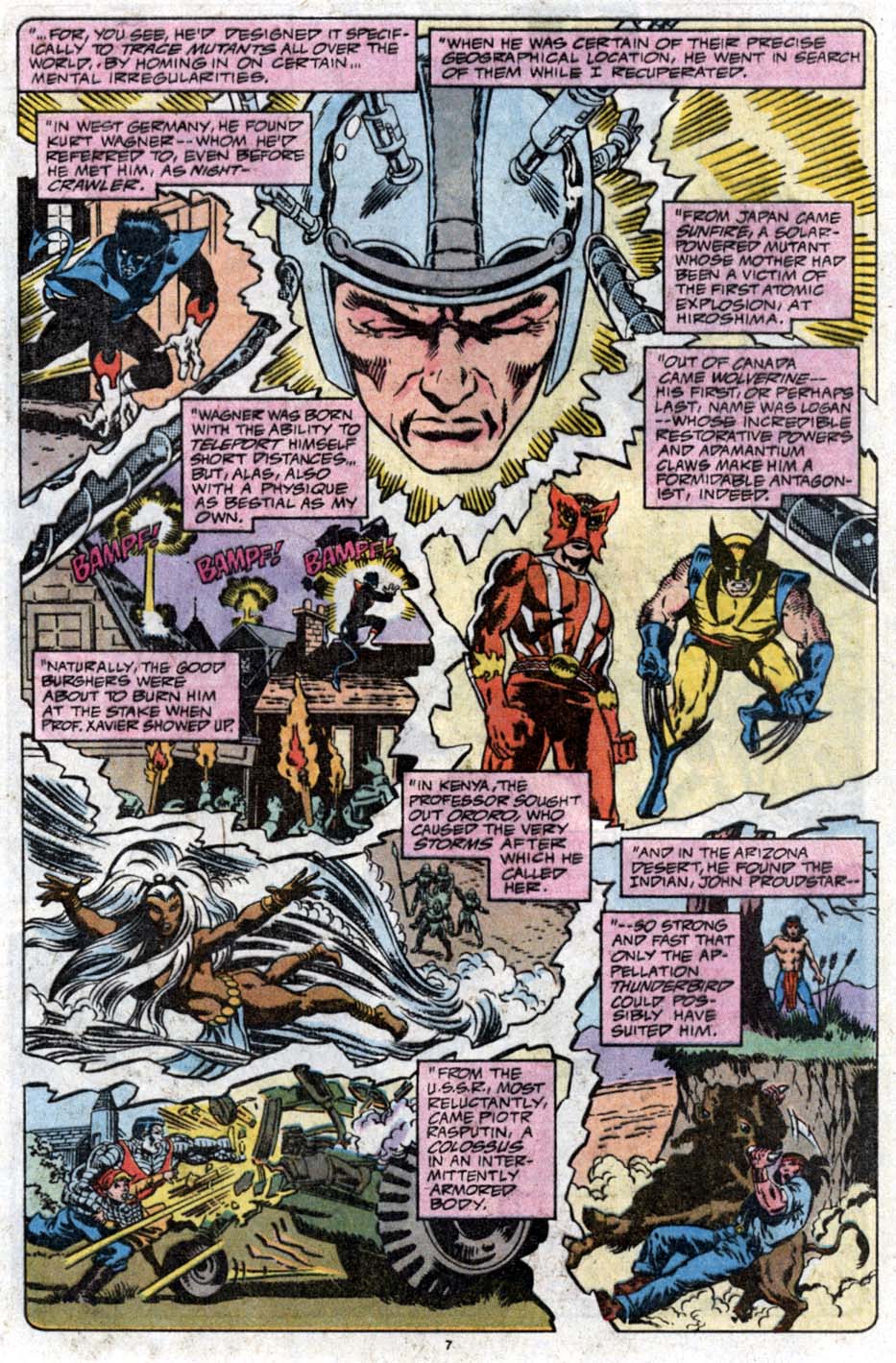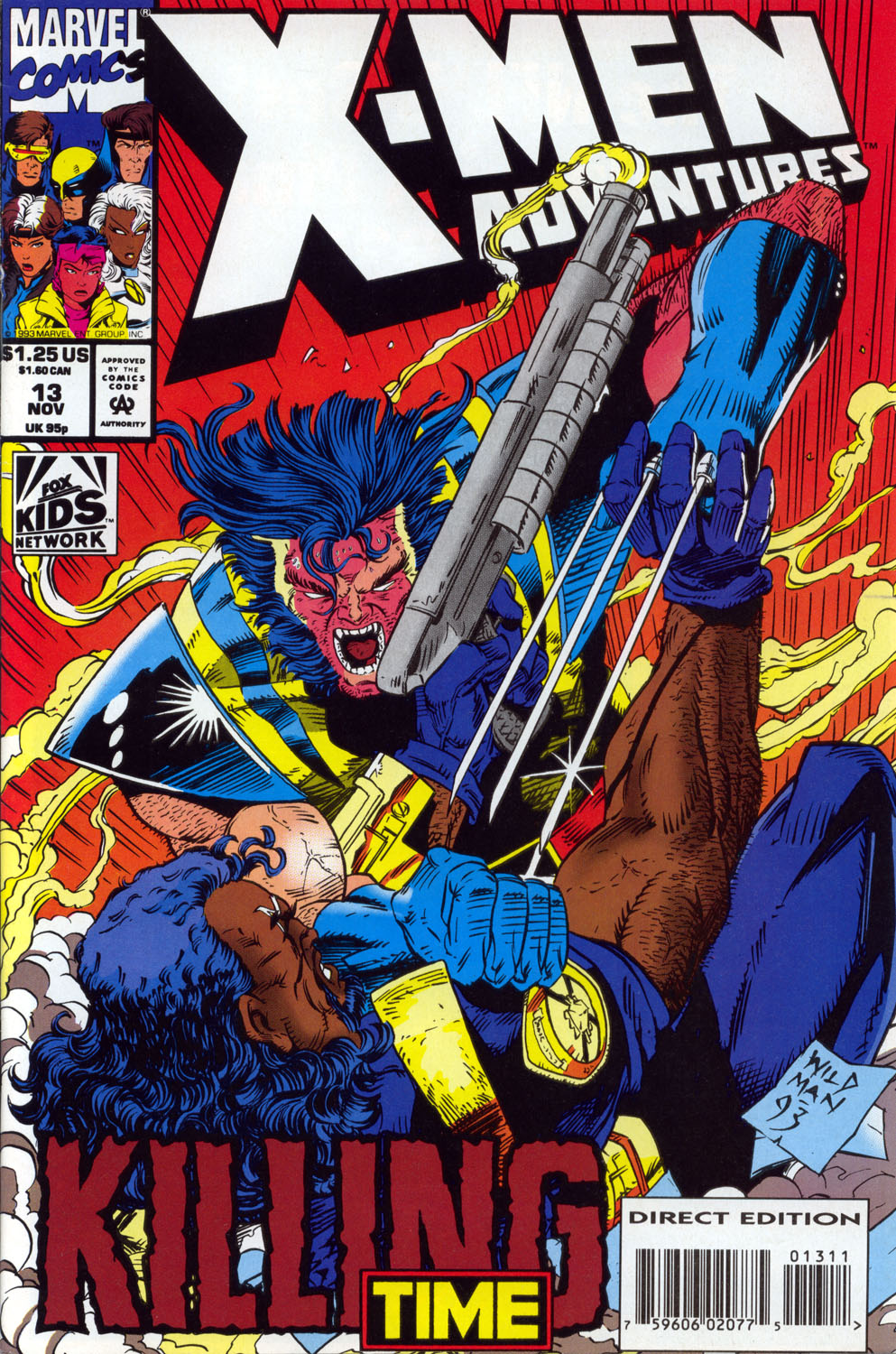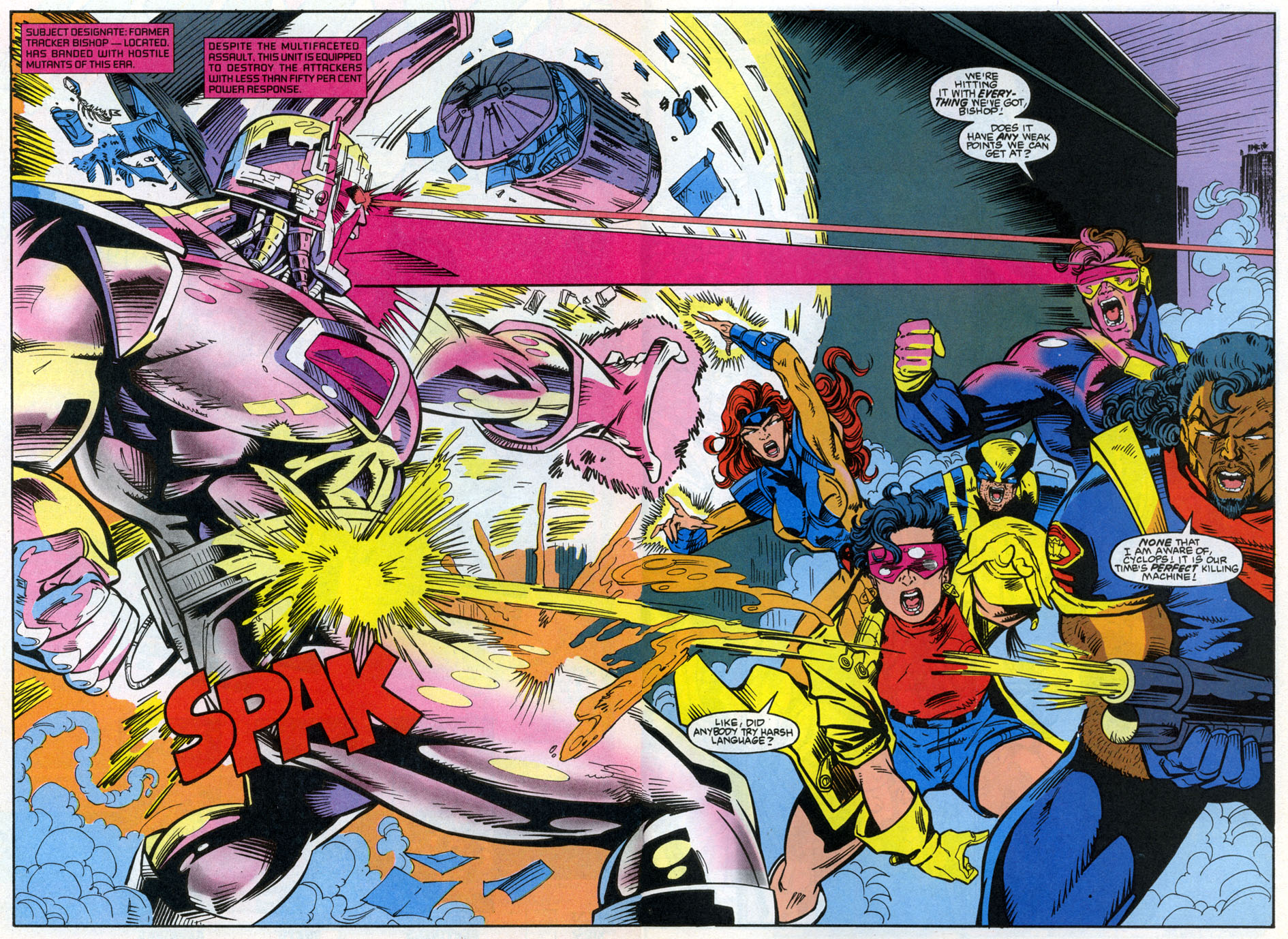
A Look Back at X-Men #3 (1991)

Disclaimer: This is my original work with details sourced from reading the comic book and doing personal research. Anyone who wants to use this article, in part or in whole, needs to secure first my permission and agree to cite me as the source and author. Let it be known that any unauthorized use of this article will constrain the author to pursue the remedies under R.A. No. 8293, the Revised Penal Code, and/or all applicable legal actions under the laws of the Philippines.

Welcome back, X-Men fans, superhero enthusiasts and comic book collectors! Today I’m about to review another Chris Claremont-Jim Lee comic book of the X-Men from 1991.

Before getting to the retro comic book review, let’s take a look back at history. Marvel Comics started publishing comic book of the X-Men in 1963 which involved the combined talents of Stan Lee and Jack Kirby. The original X-Men members were Cyclops, Beast, Marvel Girl, Angel and Iceman all under the mentorship of Charles Xavier (AKA Professor X). That monthly series was not a strong seller and was weak compared to the other monthly titles of Marvel. Although Roy Thomas and Neal Adams were brought in to reinvigorate the X-Men series with new characters, success in sales did not materialize and eventually the series was turned into a reprint series (from issues #67 to #93).

In 1975, Len Wein and Dave Cockrum made Giant-Size X-Men #1 which introduced a new team. Along the way, Wein (who was also the editor-in-chief of Marvel at the time) hired Chris Claremont to become the lead writer of the X-Men series starting issue #94 which was released that same year. Claremont redefined the X-Men by developing the characters deep inside and emphasized their respective personalities. As the years passed by, Claremont wrote notable X-Men storylines such as The Dark Phoenix Saga, Days of Future Past, Mutant Massacre, and Fall of the Mutants to name some. Not only did Claremont write The New Mutants, he also co-created many other characters that became part of the X-Men franchise.

Then came the year 1991. The launch of the new X-Men monthly series (focused on the Blue Team led by Cyclops) saw sales tremendous success with issue #1 and by that time Jim Lee was established as one hot new creators under Marvel. Behind the scenes, however, Claremont clashed with then X-Men books editor Bob Harras. Eventually, issue #3 of the 2nd X-Men monthly series marked the end of the X-Men era of 1975-1991.

I should say that I enjoyed reading issue #2 in which Claremont wrote a story that not only raised the stakes but also pushed the entire group of mutants to the edge. We will find out soon enough if Claremont’s X-Men era of 1975-1991 will end strongly in this retro review of X-Men #3, published in 1991 by Marvel Comics with a story by Claremont and Jim Lee (who also illustrated).
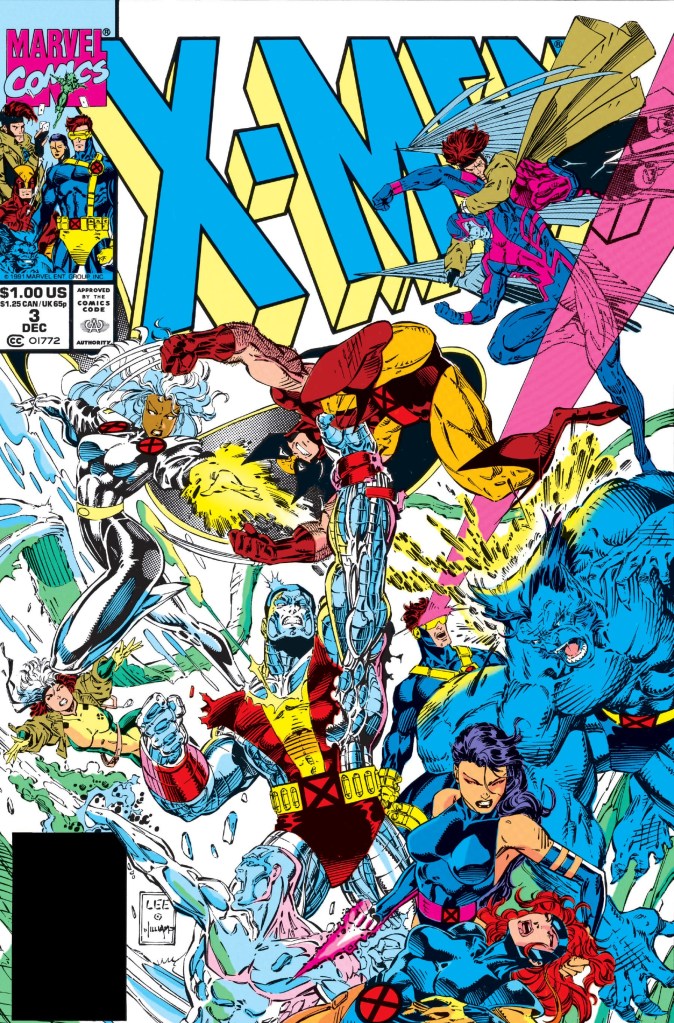
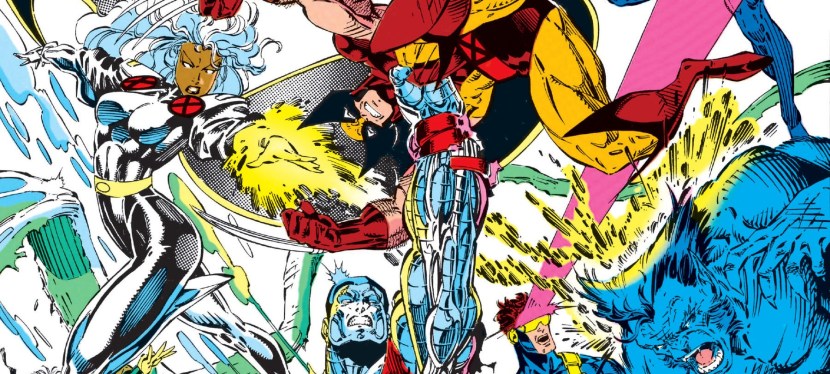
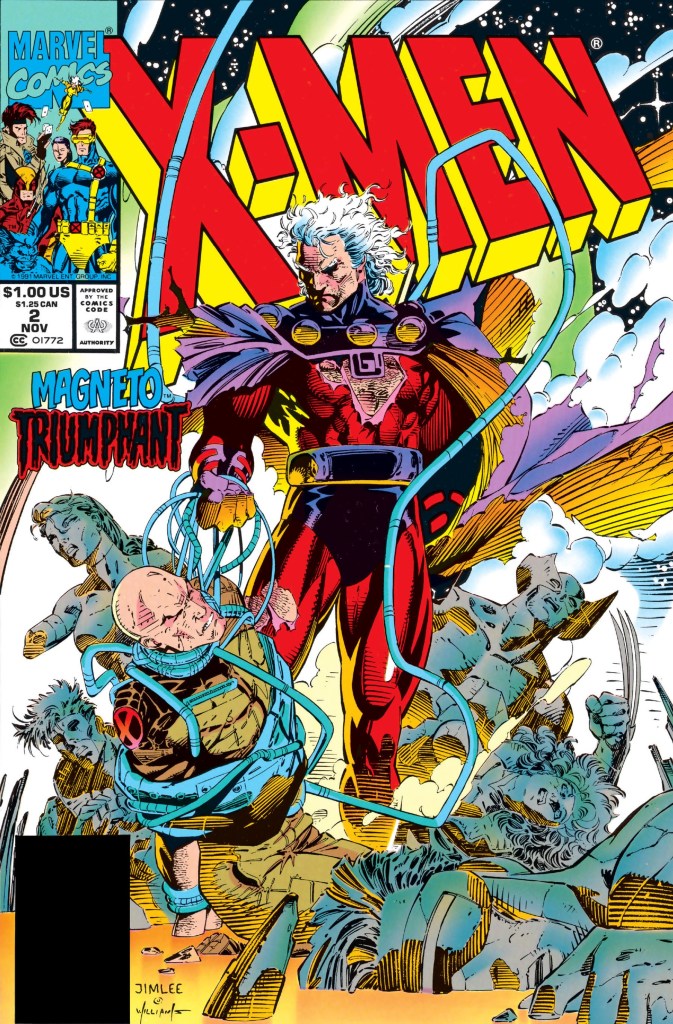
The cover.

Early story

The story begins in outer space. Members of X-Men’s Gold Team (composed of Archangel, Storm, Jean Grey, Forge, Iceman, Colossus and Banshee) fly stealthily towards Asteroid M where Magneto and his Acolytes are with Charles Xavier and Moira MacTaggert held captive. With the exception of a few, members of the X-Men Blue Team were brainwashed by MacTaggert to follow Magneto.

On Earth, the plasma cannon is being prepared to destroy Asteroid M. Nick Fury warns his colleagues about the possibility of tremendous damage if ever Asteroid M hits the surface of the planet. Valerie Cooper tells him that the firing trajectory has been calculated to blast the target away and into deep space. An exchange of words follows over diplomacy and following orders issued by the leaders.

Over at Asteroid M, Charles Xavier is alone in a room with a wide view of the Earth and space. Behind the scenes, Fabian Cortez points to Xavier as Magneto’s deadliest enemy. He asked his master why not use Moira MacTaggert’s procedure (to brainwash and turn) on Xavier. Magneto, already suffering physically, does not want Xavier turned but be broken…

Quality
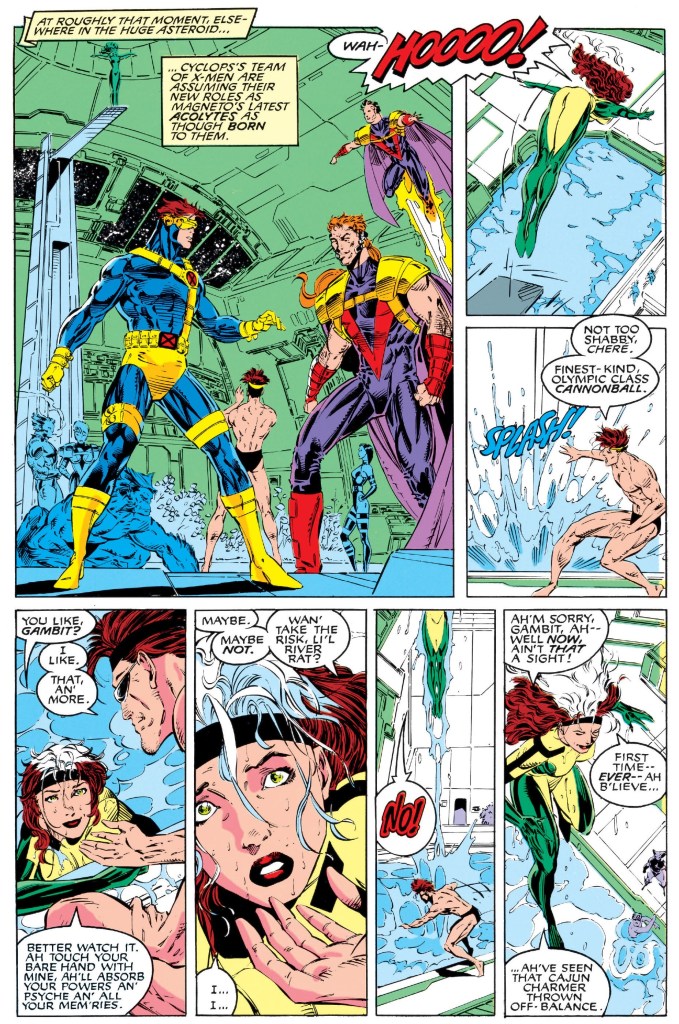
X-Men Blue Team members relaxing at Asteroid M in the presence of the Acolytes.

Like in issue #2, the story here is very engaging and highly dramatic. While it paid close attention to Magneto’s ruthlessness as well as his rage towards Moira who committed something unethical to him in the past, the story managed to focus enough on the X-Men which involves both the Blue Team and Gold Team mixed up. While this comic book’s cover shows a battle royale between the Blue and Gold teams, there is a lot of substance beyond the action. I’m talking about moments spent on the mutants of Xavier which was done in a satisfying manner (never felt crammed nor forced) considering the page limits of this comic book. Not only were the X-Men moments executed smoothly, there were pulled off efficiently and orderly.

More on the story, what adds intrigue is the group of Acolytes whose field leader Fabian Cortez has not only gotten very close with Magneto but also does something significant to him along the way. By this issue, the Acolytes led by the master of magnetism have gotten more established as a worthy opposition against Xavier’s mutants. This story also showed that the Acolytes were here to stay, and Fabian Cortez himself is very led by wickedness and ambition. Cortez is also an example about the distortion of righteousness

When it comes to defining the characters, Xavier and Magneto clashing together about their respective dreams about mutants is unsurprisingly epic to read. In this particular conflict, both Marvel icons were portrayed very dramatically and their respective expressions were indeed intense. Adding further intrigue to their clash is Moira’s long-past act of manipulating the very genetics of Magneto which itself raises serious questions about her perception, decision-making and ethics. In some ways, Moira looked more villain-like.

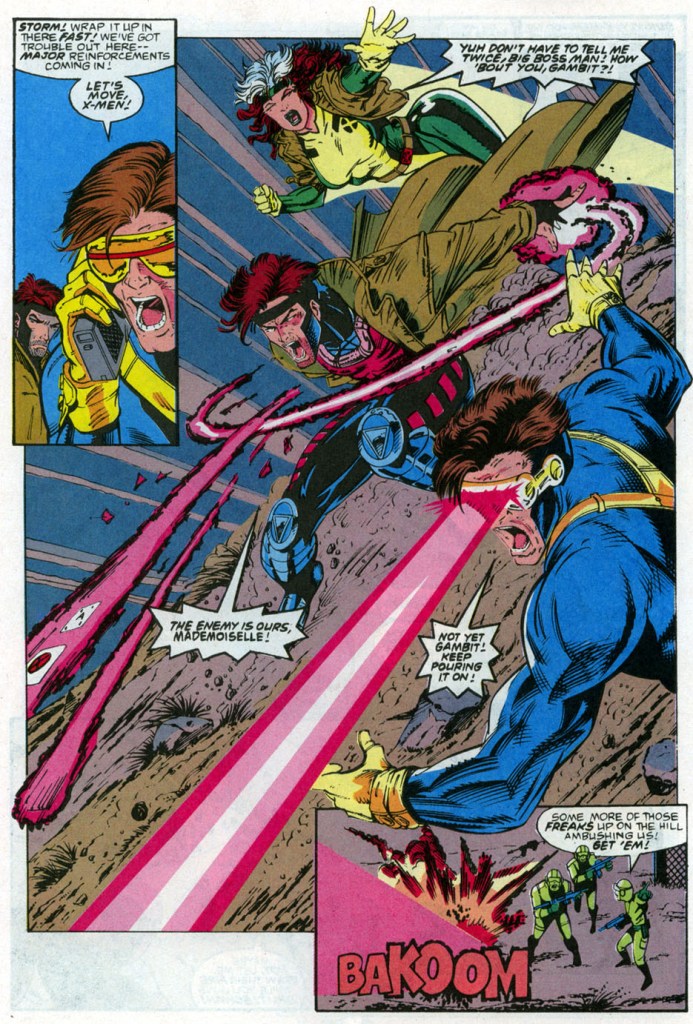
As expected, the art of Jim Lee is great to look at. There were some signs, however, that the very wordy script resulted an increased numbers of panels per page. Fortunately, the art did not look rushed and maintained a clear narrative. Also the action scenes are great to look at which is not surprising.

Conclusion
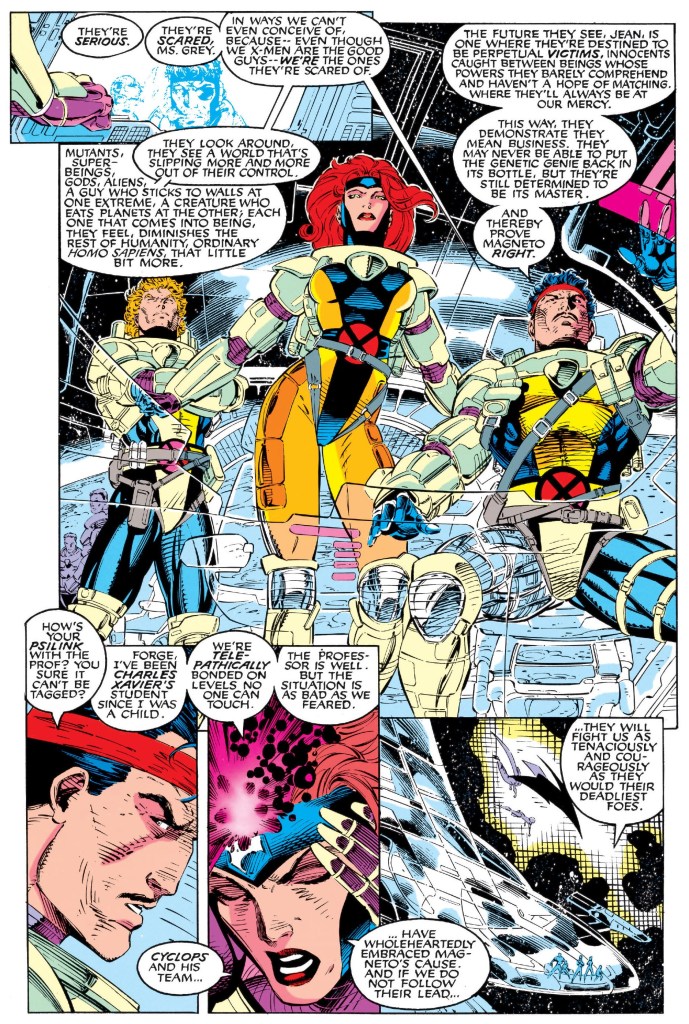
The Gold Team of the X-Men travel towards Asteroid M in a cloaked vehicle.

To put it straight, X-Men #3 (1991) is an epic read highlighting the very conflict between Magneto and Xavier over the course of mutants and their place in the world of humans. This comic book, which has a very powerful ending, was indeed a very satisfying way to conclude the Xavier-Magneto conflict as well as Chris Claremont’s long-term stint with the X-Men comic book franchise. Back in 1991, this one really looked like the end of an era both in-story and in real life. Of course, what this comic book achieved ultimately became temporary because Magneto was revived for the Fatal Attractions storyline in 1993 (celebrating X-Men’s 30th anniversary) and Chris Claremont himself returned to Marvel Comics some years later. Still, on its own, this comic book is worth reading and adding to your collection, even if you are not an X-Men fan. It is significant enough as a piece of X-Men history from the time when Jim Lee was with Marvel.

If you are seriously planning to buy an existing hard copy of X-Men #3 (1991), be aware that as of this writing, MileHighComics.com shows that the near-mint copy of the regular edition costs $9 while the near-mint copies of the Chris Claremont-signed edition, the signed newsstand edition, the newsstand edition and the Toy Biz edition cost $16, $26, $16 and $21 respectively.

Overall, X-Men #3 (1991) is highly recommended!

+++++

Thank you for reading. If you find this article engaging, please click the like button below and also please consider sharing this article to others. If you are looking for a copywriter to create content for your special project or business, check out my services and my portfolio. Feel free to contact me as well. Also please feel free to visit my Facebook page Author Carlo Carrasco and follow me at HavenorFantasy@twitter.com
A Look Back at X-Men #2 (1991)

Disclaimer: This is my original work with details sourced from reading the comic book and doing personal research. Anyone who wants to use this article, in part or in whole, needs to secure first my permission and agree to cite me as the source and author. Let it be known that any unauthorized use of this article will constrain the author to pursue the remedies under R.A. No. 8293, the Revised Penal Code, and/or all applicable legal actions under the laws of the Philippines.

There is so much said about X-Men #1 of 1991 which was launched to major success by Marvel Comics selling at least eight million copies worldwide. That launch issue, written by Chris Claremont and drawn by Jim Lee, had multiple covers and a version with gatefold covers and high-quality paper which made it an instant hit with collectors chasing profit. In 2011, Marvel even released the so-called 20th anniversary edition of X-Men #1 which was digitally recolored.

In terms of substance, X-Men #1 marked the new era of the X-Men. Charles Xavier returned to his mansion to lead the X-Men which was so large as a group, it had to be divided into two team with Cyclops leading the Blue Team and Storm heading the Gold Team. In terms of publishing, Marvel published tales of the Gold Team in the Uncanny X-Men monthly series while the Blue Team’s stories were published in the adjective-less X-Men monthly series.

With all the attention paid to X-Men #1, I noticed that not too many people cared to talk about what happened after the end of that comic book. Without spoiling plot details, the massive seller of 1991 had its story end in a cliffhanger. To find out what followed and determine the quality of the creative team’s work, here is a look back at X-Men #2 published in 1991 by Marvel Comics with a story co-written by Chris Claremont and Jim Lee (who illustrated).

The cover.

Early story

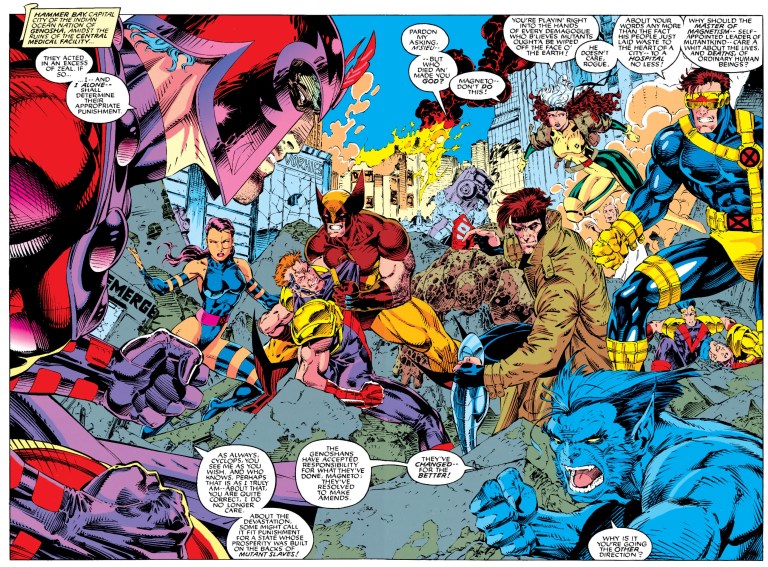
The story begins in the fictional island nation of Genosha which has a legacy of mutant slavery. Having fought with the Acolytes (led by Fabian Cortez), the X-Men now face Magneto who arrived and tells them that he will not abandon the Acolytes.

“They acted in an excess of zeal. If so…I..and I alone..shall determine their appropriate punishment,” Magneto tells the team of Cyclops, Gambit, Beast, Wolverine, Psylocke and Rogue. Near them are other Acolytes members down on the ground.

After words spoken by Gambit, Rogue and Cyclops, Magneto referred to the devastation of the city hospital as fitting for punishing a state (Genosha) whose prosperity was built on the backs of mutant slaves. Beast answered back saying that the Genoshans have accepted responsibility for what they have done and resolved to make amends.

While Magneto replies to Beast, a military Genoshan helicopter gunship fires missiles at them from above which the X-Men’s archvillain intercepts. Using his magnetic power, Magneto lifts steal beams and destroys the helicopter with them. He then turns against the X-Men restarting the chaos in the city…

Quality

Magneto, Psylocke and Rogue in the middle of the chaos.

Being the middle of a 3-part story, this comic book pushes the entire X-Men group to the edge thanks to strong writing by Chris Claremont. I’m not simply referring to the traditional good-versus-evil formula of superhero storytelling as the story here emphasized themes about sanity, loyalty, legacy, idolatry and even diplomacy. It just so happens that there is a lot of superhero spectacle to enjoy here and there.

The stakes have been raised significantly in this story as Magneto is shown leading the Acolytes who in turn went ahead with their first mission which explains the chaos in Genosha. Magneto’s condition also deteriorates and gets himself healed by Fabian Cortez who is more sinister than what he seems. For his part, Charles Xavier of the X-Men gets to interact with his long-time friend Dr. Moira MacTaggert who is struggling with guilt from something she committed in the past. Through Magneto, Xavier and MacTaggert, there is this solid build-up of tension that led to a very powerful revelation in the 2nd half of the story which, ironically, put the X-Men on the sideline temporarily. There is high drama, deep tension and high intensity involving Magneto and MacTaggert, and their scene together is the highlight of the story.  

Conclusion

The face-off!

To put it straight, as much as I loved X-Men #1 (1991), I find X-Men #2 (1991) more compelling to read. For one thing, it rewards X-Men fans who dedicatedly followed the events of not only the X-Men but also of that of the life of Magneto. It’s really great that Chris Claremont literally dug up the past for details that proved to be useful in this comic book. It also nicely sets up anticipation of the next issue by involving the X-Men’s Gold Team. Unsurprisingly, with the combined talents of Claremont and Jim Lee, this is an excellent read that really looks great.

If you are seriously planning to buy an existing hard copy of X-Men #2 (1991), be aware that as of this writing, MileHighComics.com shows that the near-mint copy of the regular edition costs $4 while the near-mint copies of the Chris Claremont-signed regular edition, the Chris Claremont-signed newsstand edition and the newsstand edition cost $9, $19 and $13 respectively.

Overall, X-Men #2 (1991) is highly recommended!

+++++

Thank you for reading. If you find this article engaging, please click the like button below and also please consider sharing this article to others. If you are looking for a copywriter to create content for your special project or business, check out my services and my portfolio. Feel free to contact me as well. Also please feel free to visit my Facebook page Author Carlo Carrasco and follow me at HavenorFantasy@twitter.com
A Look Back at X-Men #25 (1993)

Disclaimer: This is my original work with details sourced from reading the comic book and doing personal research. Anyone who wants to use this article, in part or in whole, needs to secure first my permission and agree to cite me as the source and author. Let it be known that any unauthorized use of this article will constrain the author to pursue the remedies under R.A. No. 8293, the Revised Penal Code, and/or all applicable legal actions under the laws of the Philippines.

As an X-Men fan, 1993 was a memorable year for me during my time of collecting comic books and enjoying what was believed to be the modernization of superhero comics in America. Gimmick covers of comic books, the post-event effects of the Death of Superman, the launch of the Ultraverse and then there was the 30th anniversary celebration of the X-Men which was wild.

To put things in perspective, Marvel Comics organized the celebration of the 30th anniversary of Spider-Man releasing lots of merchandise and, most notably, special issues of comic books that came with covers with holograms, more pages for content and a cover price that was more than double than what was normal (note: read my review of one of them). Such comic books were hot stuff for not only Spider-Man fans but also comic collectors who were often hunting for the next great collector’s item that would ensure them great wealth.

Marvel had the same business approach with the 30th anniversary of the X-Men, and there were multiple X-Men-related monthly series of comic book back then. X-Factor #92, X-Force #25, Uncanny X-Men #304, Wolverine #75 and Excalibur #71 all were released with covers with hologram cards on the front, more pages of content and inflated cover prices.

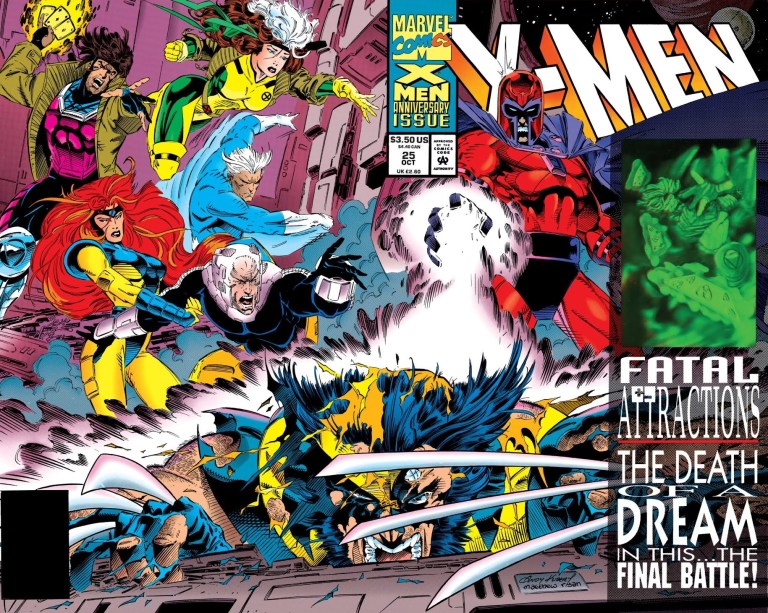
The one 30th anniversary celebration comic book of the X-Men that was most memorable to me was X-Men #25 (Volume 2) and to this day, its plot remains very memorable for its shock value. I bought my copy of this comic book at a store in BF Homes. With the history lesson over, he is my retro review of X-Men #25, published in 1993 by Marvel Comics with a story written by Fabian Nicieza and drawn by Andy Kubert.

The cover.

Early story

The story begins with the United Nations Security Council’s approval to initiate the alpha and beta parameters of the Magneto Protocols which literally sent waves from the White House to the Kremlin. A short time later, several satellites orbiting the Earth activate and linked with each other to form a protective mesh of electro-magnetic fire. This provokes Magneto (accompanied by Acolytes and Exodus at Avalon) to react by generating a massive pulse wave that affects the entire world. Even the Fantastic Four and Excalibur were not spared.

At the School of Gifted Children, Charles Xavier organizes an urgent meeting with the X-Men. Together they discussed the impact of Magneto’s pulse wave which not only rendered world’s mechanical and technological resources useless but also caused trouble (plane crashes, medical equipment failure, etc.) and deaths. For Xavier, the mere fact their team survived (aided by Shi’ar technology) is a mistake on the part of Magneto considering his capability to wipe out life around the world.

In response to Wolverine’s question, Xavier stated, “We do not have the luxury of time, nor the occasion for nobility…at this point, we are not fighting for the philosophy of a cause, a hope, or a dream, we are fighting for our very survival and if we do not win this fight, this planet will be irrevocably lost to us!”

Quality

The X-Men during their daring mission.

I can clearly declare that when it comes to the combined works done by Fabian Nicieza and Andy Kubert with the X-Men, this particularly story was not only the most ambitious collaboration of theirs but also their most compelling and finest work at the time of publishing. Very strong writing (top-notch characterization, plotting and pacing) and great art really defined this comic book!

Characterization is spot-on! Wolverine is arrogant and gritty as usual, Gambit is still the smooth-talker, Cyclops is the focused leader serving under Xavier, etc.

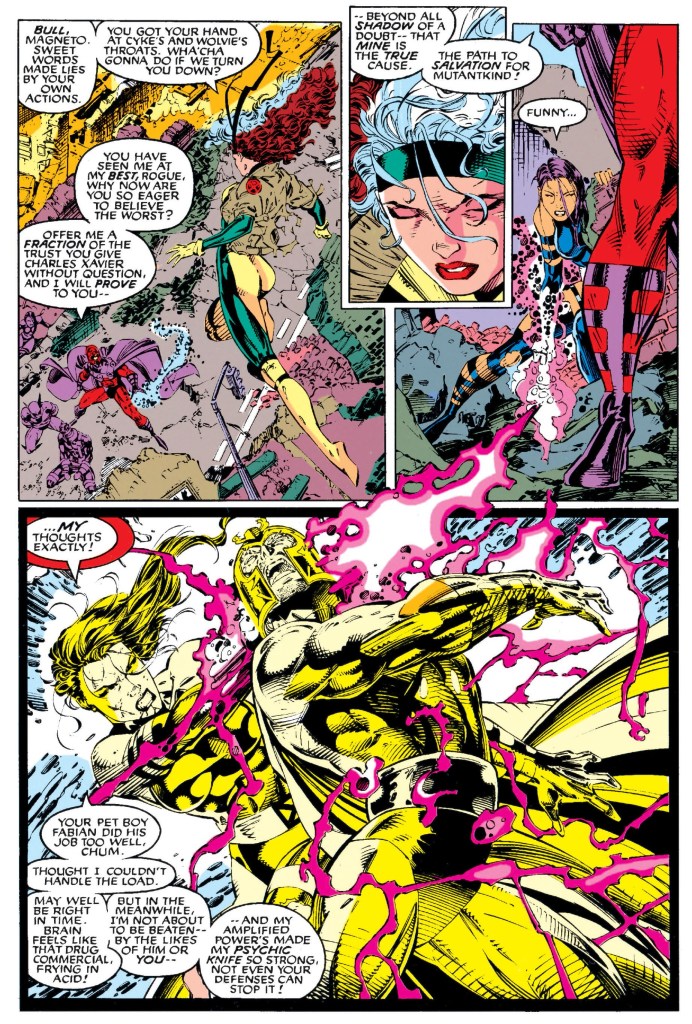
Without spoiling the major details, I can say that the shocking moments executed were greatly done not for the mere intention of shocking but to break new ground with regards to the characters of Wolverine and Charles Xavier. The first time I read this comic book back in 1993, I was really stunned with those particular scenes and I started to question Wolverine’s durability as well as Xavier’s sanity. And then there was the state of Magneto at the end of the story. The thing about the shocking moments was that there was an adequate amount of build-up leading to them and the pay-off was excellently done.

Conclusion

The immense power of Magneto.

There is no doubt in my mind that X-Men #25 (1993) is the true gem of the entire X-Men 30th anniversary celebration. The creative team led by Nicieza and Kubert really outdid themselves and what happened in this comic book had consequences that lasted for a good number of years. The creative team took big risks and pulled them off nicely as the impact of the story was eventually felt in the years that followed. Lastly, unlike Uncanny X-Men #304 (supposed to be the highlight of X-Men’s 30th anniversary celebration), this comic book is more focused and really had no creative baggage nor filler that got in the way of the storytelling.

If you are seriously planning to buy an existing hard copy of X-Men #25 (1993), be aware that as of this writing, MileHighComics.com shows that the near-mint copy of the regular edition costs $50 while the near-mint copy of the newsstand edition is priced at $150. The near-mint copies of the signed-and-numbered edition and the gold edition cost $210 and $368 respectively.

Overall, X-Men #25 (1993) is highly recommended!

+++++

Thank you for reading. If you find this article engaging, please click the like button below and also please consider sharing this article to others. If you are looking for a copywriter to create content for your special project or business, check out my services and my portfolio. Feel free to contact me as well. Also please feel free to visit my Facebook page Author Carlo Carrasco and follow me at HavenorFantasy@twitter.com
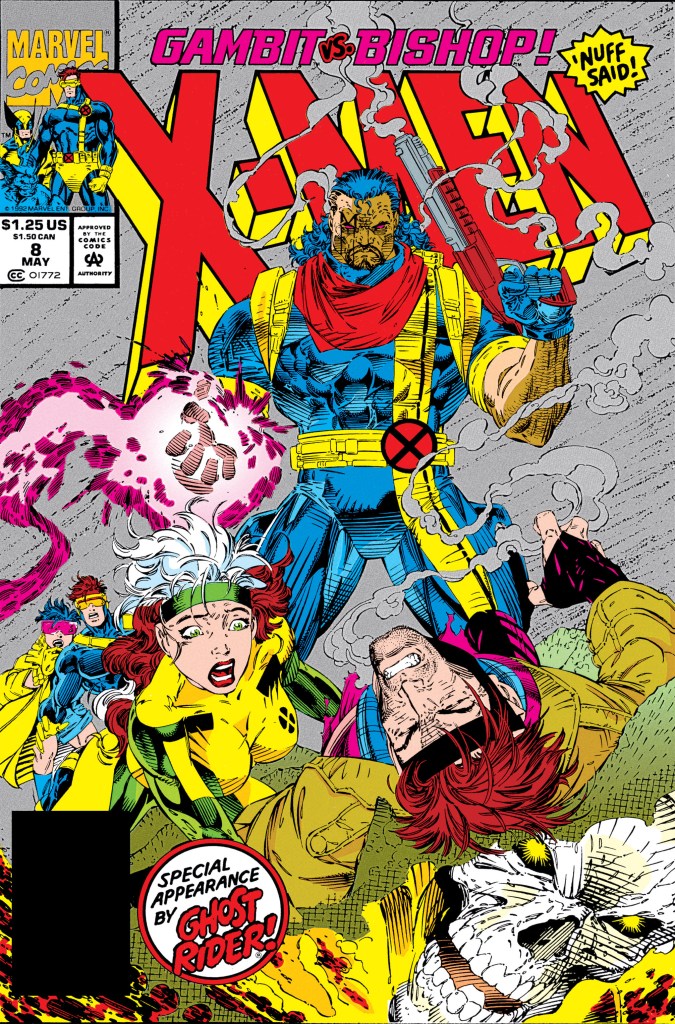
A Look Back at X-Men #8 (1992)

Disclaimer: This is my original work with details sourced from reading the comic book and doing personal research. Anyone who wants to use this article, in part or in whole, needs to secure first my permission and agree to cite me as the source and author. Let it be known that any unauthorized use of this article will constrain the author to pursue the remedies under R.A. No. 8293, the Revised Penal Code, and/or all applicable legal actions under the laws of the Philippines.

Do you remember the X-Men animated TV series episode – an adaptation of Days of Future Past – wherein Bishop (who came from the dark future) claimed that Gambit would betray the X-Men and lead them all to darkness? You will see Bishop and Gambit in conflict in this retro review of a Jim Lee-drawn X-Men comic book from the 1990s.

To put things in perspective, back in 1991 Bishop was formally introduced in the Uncanny X-Men monthly series. By that time, Gambit was already wildly popular with X-Men fans. It made sense back then to have the two conflict each other in comic book format as it would add variety and some freshness with the X-Men franchise of the time.

With the short history lesson over, here is a look back at X-Men #8, published in 1992 by Marvel Comics with a story done by Jim Lee and Scott Lobdell. The art was handled by Lee and Art Thibert.

The cover.

Early story

The story begins at the X-Men’s headquarters with Wolverine using the computer to gain access into something until he got interrupted by Jubilee who is accompanied by Cyclops. She tells him that Charles Xavier is about to introduce Bishop to their teammates. Wolverine tells them to go away.

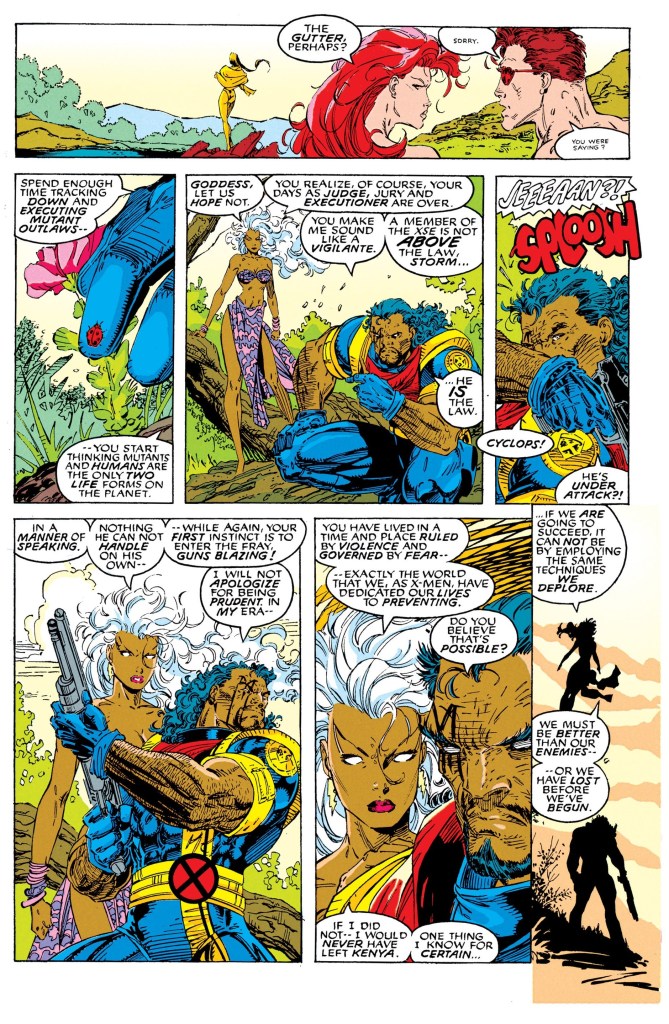
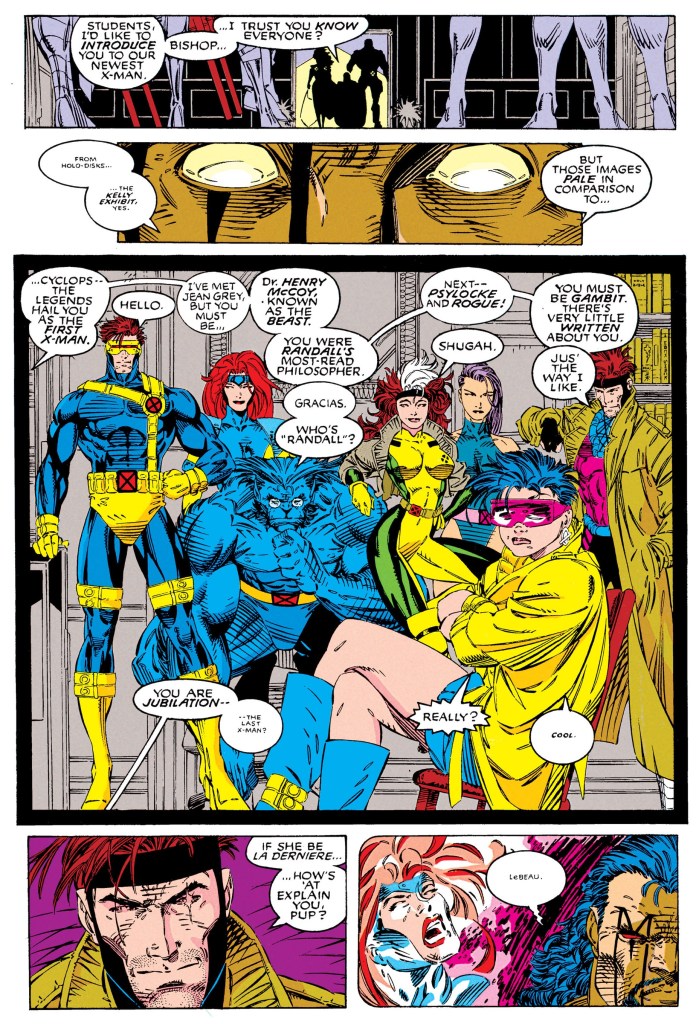
At the mansion, Storm welcomes Bishop in the presence of Xavier who explains to her that the newcomer is from the far future. Slowly Xavier and Storm guide Bishop around the mansion and introduce him to their members. Bishop, who still remembers the legends of the X-Men from his time in the far future, referred to Forge as Genesis. Moments later, Bishop meets Cyclops, Jean Grey, Beast, Rogue, Psylocke, Jubilee and Gambit.

After expressing that there was little know about Gambit, Bishop then claims that a certain someone was the last person to see the X-Men alive before they got betrayed by one of their own. Bishop then tells Xavier to scan Gambit’s thoughts…

Quality

The interaction between Storm and Bishop is great!

What really defines this comic book apart from having art by Jim Lee and the lack of villains are the storytelling and characterization. The good news is that the respective qualities of the plotting (by Lee) and scripting (by Lobdell) were very solid. While there is a lack of a good-versus-evil plot element, characterization alone made this an engaging comic book to read. Without spoiling the plot, the story has a lot more than the promised Bishop-Gambit conflict (I’ll describe it as a short yet sweet part of the story). I also love the big twist that happened in the 2nd half of the story.

More on characterization, I love the fact that Gambit got more developed here complete with a few threads from his past that got visualized efficiently. I also enjoyed the interactions between Gold Team leader Storm and Bishop. Bishop comes from a future filled with violence and desperation which explains why he is always on the edge often thinking of action whenever something happens. Storm meanwhile tried hard to explain to Bishop that their present day society is more peaceful and that he could take things a bit easier, be more reasonable and try to level with others as he became a new part of the X-Men.

As for Jim Lee’s art, his work here is really beautiful to look at which is not surprising at all. As expected, he made the action scenes look dynamic and managed to draw some emotions from certain characters in key scenes.

Conclusion

Bishop meeting the X-Men.

X-Men #8 (1992) is a pretty good comic book to read. At the time of its publication, the integration of Bishop into the X-Men was done months after Chris Claremont’s departure and was clearly an effort by the X-Men creators to modernize the superhero team and keep it fresh. This comic book is not exactly a landmark read but it is pretty entertaining and engaging.

If you are seriously planning to buy an existing hard copy of X-Men #8 (1992), be aware that as of this writing, MileHighComics.com shows that the near-mint copy of the regular edition costs $50 while the near-mint copy of the newsstand edition costs $150.

Overall, X-Men #8 (1992) is recommended.

+++++

Thank you for reading. If you find this article engaging, please click the like button below and also please consider sharing this article to others. If you are looking for a copywriter to create content for your special project or business, check out my services and my portfolio. Feel free to contact me as well. Also please feel free to visit my Facebook page Author Carlo Carrasco and follow me at HavenorFantasy@twitter.com
A Look Back at X-Men Adventures #3 (1993)

Disclaimer: This is my original work with details sourced from reading the comic book and doing personal research. Anyone who wants to use this article, in part or in whole, needs to secure first my permission and agree to cite me as the source and author. Let it be known that any unauthorized use of this article will constrain the author to pursue the remedies under R.A. No. 8293, the Revised Penal Code, and/or all applicable legal actions under the laws of the Philippines.

Who is the most definitive X-Men villain ever? That is none other than Magneto! Co-created by Stan Lee and Jack Kirby, Magneto made his literary debut alongside Marvel’s heroic mutants in The X-Men #1 way back in 1963. Magneto is capable of generating and controlling magnetic fields which make him dangerous since he has the power to manipulate metal and even use them as weapons against others, plus he can even cause destruction to buildings by moving the metal in them to bring them down.

What even makes Magneto more dangerous is his very strong belief that his fellow mutants are genetically superior over humans and he does not believe in the concept of mutants and humans co-existing. Character-wise, Magneto is the complete opposite of Charles Xavier/Professor X of the X-Men.

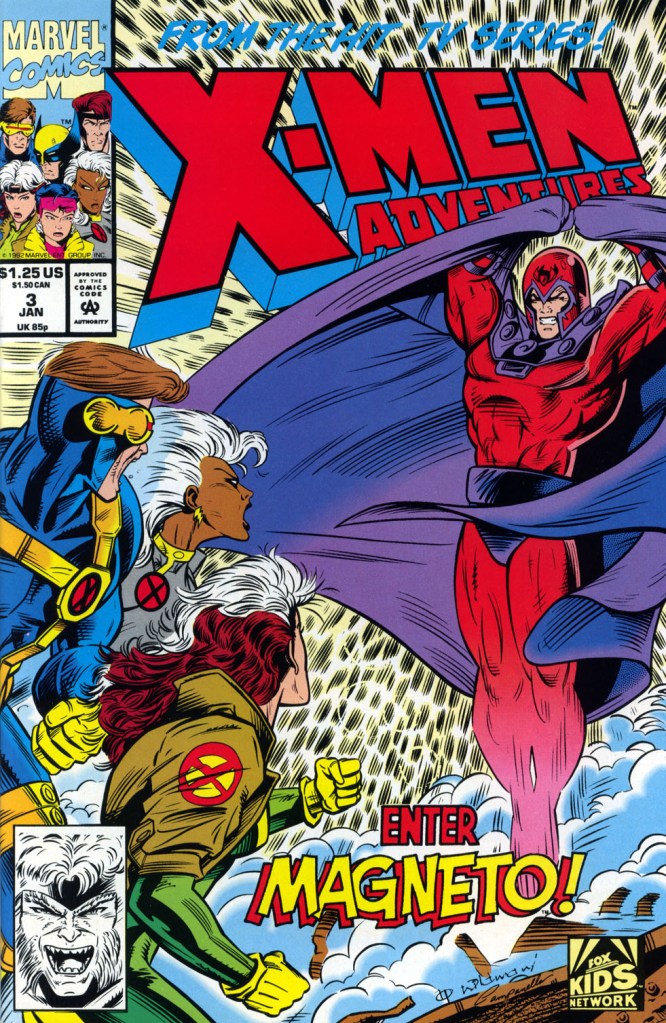
When it comes to pop culture influence, GamesRadar+ declared Magneto as the #1 best X-Men villain of all time. Even more intriguing was the super villain topping IGN’s Top 100 Comic Book Villains List. Beyond comic books, Magneto also appeared in the X-Men arcade game of 1992 made by Konami. On November 27, 1992, Magneto made his debut in the Enter Magneto episode of the popular X-Men animated series on TV. The said episode was, unsurprisingly, adapted into comic book form in issue #3 of the X-Men Adventures monthly comic book series.

How was Magneto’s debut in the said monthly series? We can find out in this look back at X-Men Adventures #3, published in 1993 by Malibu Comics with a story written by Ralph Macchio and drawn by Andrew Wildman.  

The cover.

Early story

The story begins in outer space where Asteroid M is orbiting above planet Earth completely undetected. As a meteor is on-course to collide with Asteroid M, the operator of the asteroid activates its guns and hits it. While Asteroid M got spared, a smaller meteor found itself falling into Earth’s atmosphere. As it burns through the atmosphere, Charles Xavier spots it from inside his mansion.

Xavier turns his attention to Jean Grey. As they travel together, the doors open and Sabretooth enters landing on the floor. The two have yet to know him.

Over at a prison, the captured Hank McCoy/Beast thinks deeply inside his prison cell only to suddenly witness one of the walls get smashed by some powerful force. Magneto arrives and tells him he came for him…

Quality

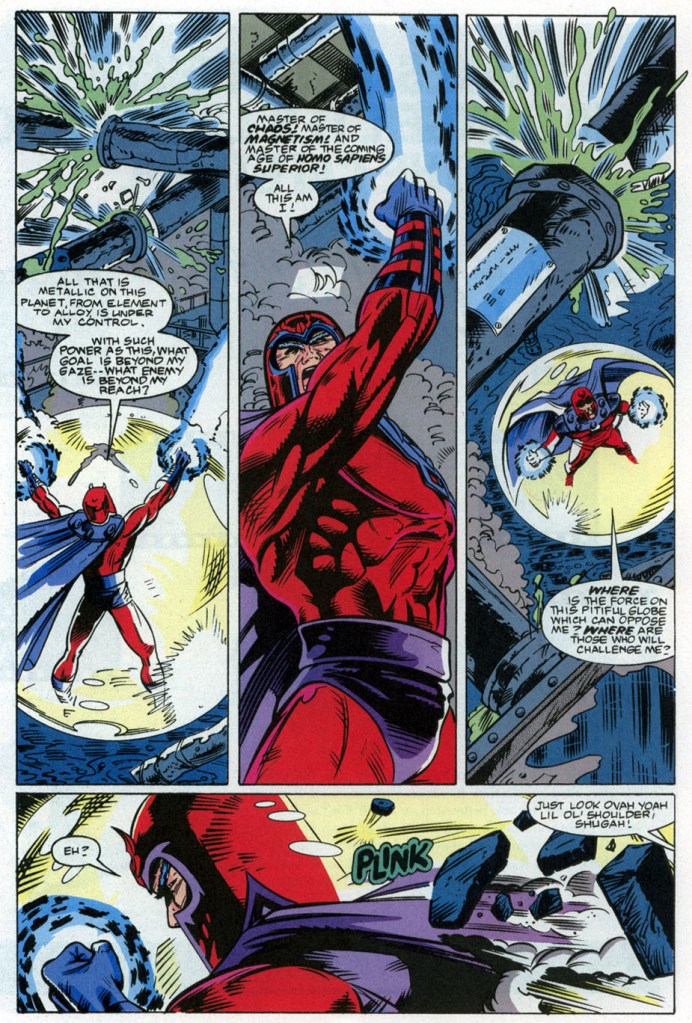
The power of Magneto.

The writing, with credit to the screenwriters behind the animated episode, is pretty solid and the essence of the said episode was very well adapted into this comic book. As this is Magneto’s debut in the X-Men Adventure series reflecting his debut in animated series, his character is portrayed very accurately and it only made perfect sense for him to approach Beast first to try to convince him join his pro-mutant movement. More on the writing, Beast’s restraint brought out more of Magneto’s hardcore beliefs and his complete opposition towards humans.

Of course, the creators did not let down their efforts to portray the struggle mutants have under the laws of human society which is strongly reflected in Beast’s court hearing with Wolverine and Cyclops (in civilian forms) observing powerlessly. The court room drama and arguments were intense.

I should also state that there really was a nice build-up leading to the first battle (first half, actually) between the X-Men and Magneto. Unlike the battles in issues #1 and #2, the conflict here showed the X-Men more in danger which is only fitting considering how great the villain is.

Conclusion

Magneto and Beast.

X-Men Adventures #3 is a strong adaptation of the Enter Magneto episode. There is no doubt about that and most notably, the comic book creators did another good job making the TV animated episode’s concept engaging and fun to read. This comic book should be part of the collection of anyone who is passionate about Magneto.

If you are seriously planning to buy an existing hard copy of X-Men Adventures #3 (1993), be aware that as of this writing, MileHighComics.com shows that the near-mint copy of the regular edition costs $8 while the near-mint copy of the newsstand edition costs $17.

Overall, X-Men Adventures #3 (1993) is highly recommended!

+++++

Thank you for reading. If you find this article engaging, please click the like button below and also please consider sharing this article to others. If you are looking for a copywriter to create content for your special project or business, check out my services and my portfolio. Feel free to contact me as well. Also please feel free to visit my Facebook page Author Carlo Carrasco and follow me at HavenorFantasy@twitter.com
A Look Back at X-Men Adventures #2 (1992)

Disclaimer: This is my original work with details sourced from reading the comic book and doing personal research. Anyone who wants to use this article, in part or in whole, needs to secure first my permission and agree to cite me as the source and author. Let it be known that any unauthorized use of this article will constrain the author to pursue the remedies under R.A. No. 8293, the Revised Penal Code, and/or all applicable legal actions under the laws of the Philippines.

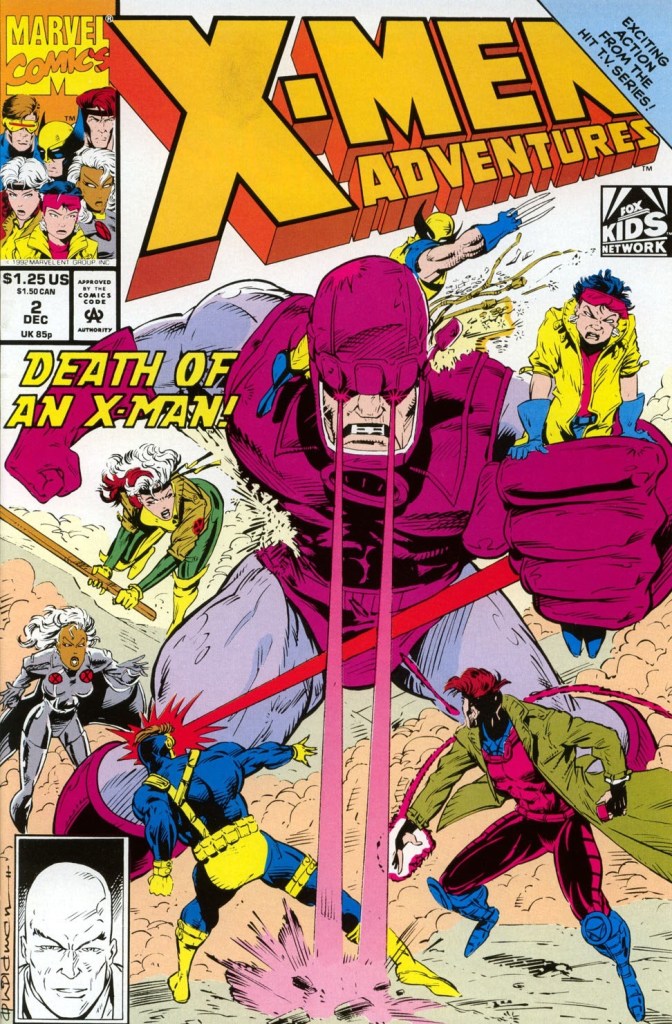
Having read lots of X-Men comic books, I should say that I always find the Sentinels (first appearance in The X-Men #14 in 1965) to be more memorable as enemies of Marvel’s mutants. On face value, they only look like oversized, human-like robots but I always find them to be formidable opponents of the X-Men. These machines are not only built with sophisticated technologies, they are able to push the X-Men to their limits during battle.

These anti-mutant robots, by the way, were ranked by IGN at #38 in their Greatest Comic Book Villains chart. Long before that, the Sentinels were the featured anti-heroes in the classic X-Men comic book storyline Days of Future Past and it was no surprise that they were also featured in the 2014 movie X-Men: Days of Future Past.

And then in the early 1990s, the Sentinels were shown in the first episode of the X-Men animated series on television. The said series was also adapted into an “as seen on TV” comic book series by Marvel called X-Men Adventures.

This brings me to this look back at X-Men Adventures #2, published in 1992 by Marvel Comics with a story by Ralph Macchio and drawn by Andrew Wildman.  

The cover.

Early story

The story begins with Morph suffering from a nightmare. As he emerged from the vision, he finds himself with Storm, Beast and Wolverine. Together they work to infiltrate a federal government facility which houses the Mutant Affairs Department. Outside the walls of the facility, Rogue Gambit and Cyclops watch from a distance. Cyclops fires his optic blast at the vehicle that just dropped reinforcements that he believes were sent to stop their teammates.

Storm and her teammates break through a door instantly pushing off the security personnel followed by Beast knocking an additional guard. At the room containing the computer, Beast begins to access key information their team has been seeking…

Quality

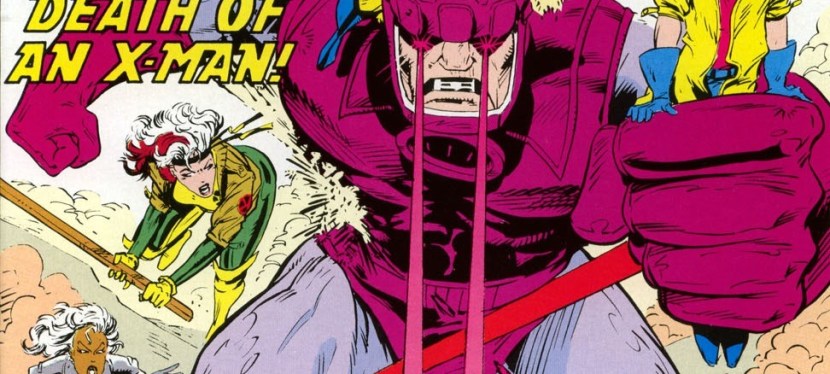
The Sentinels and the X-Men!

Let me start with the storytelling. As an adaptation of one of the early episodes of the animated series, this comic book does a fine job of recapturing its essence complete with a nice balance between plot, exposition and spectacle. Considering the fact that the animated series was aimed for children, it’s quite intriguing to see the TV episode carrying really heavy themes – apart from the prejudice the mutants suffer from – like top federal government operations, expensive defense and weapons programs, government intrusion into people’s private lives, attempts to require minorities to get registered, etc. Those themes also made it in this comic book which made it feel like it was part of the mainstream X-Men comics of the time.

Compared to the first episode as well as its literary adaptation, this one emphasizes the Sentinels as tools of the government as part of their very expensive program to seek and monitor mutants among their citizens. Mutant Affairs director Peter Gyrich is clearly the villain who has no super powers but has the resources of the federal government and their authority to take action on mutants he perceived to be dangerous.

On the visuals, Andrew Wildman performed a solid job making each page look interesting and detailed enough. While his drawings made each character recognizable to me, it is in the spectacular scenes where he really shines. Wildman’s drawing of the Watcher on the final page of the comic book, however, looks laughable.

Conclusion

Andrew Wildman’s dynamic drawing of the X-Men in action.

While X-Men Adventures #2 is not exactly a literary classic, it is indeed a very solid adaptation of one of the earliest episodes of the animated series of the 1990s. It succeeded on telling a compelling and enjoyable story even though it emphasized the above-mentioned serious themes. As for the iconic Sentinels, this one succeeded in explaining what they are and their place in Marvel’s universe is.

If you are seriously planning to buy an existing hard copy of X-Men Adventures #2 (1992), be aware that as of this writing, MileHighComics.com shows that the near-mint copy of the regular edition costs $8 while the near-mint copy of the newsstand edition costs $26.

Overall, X-Men Adventures #2 (1992) is recommended.

+++++

Thank you for reading. If you find this article engaging, please click the like button below and also please consider sharing this article to others. If you are looking for a copywriter to create content for your special project or business, check out my services and my portfolio. Feel free to contact me as well. Also please feel free to visit my Facebook page Author Carlo Carrasco and follow me at HavenorFantasy@twitter.com
A Look Back at X-Men Adventures #14 (1993)

Disclaimer: This is my original work with details sourced from reading the comic book and doing personal research. Anyone who wants to use this article, in part or in whole, needs to secure first my permission and agree to cite me as the source and author. Let it be known that any unauthorized use of this article will constrain the author to pursue the remedies under R.A. No. 8293, the Revised Penal Code, and/or all applicable legal actions under the laws of the Philippines.

Last time I reviewed an issue of X-Men Adventures, it was the 13th issue which served as the first half of a two-part adaptation of the animated series’ adaptation of the literary X-Men classic storyline Days of Future Past. It was a compelling and fun comic book to read.

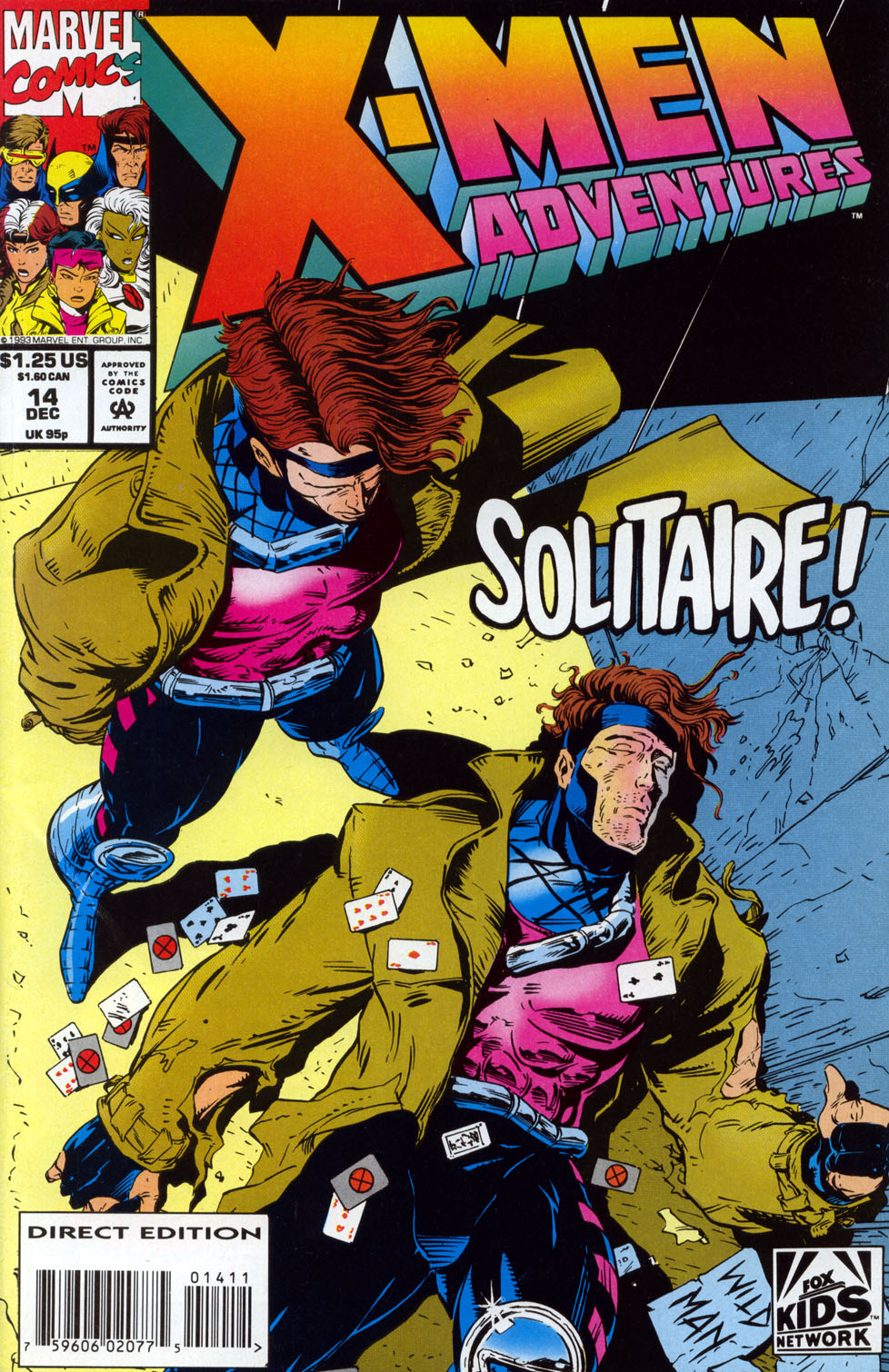
Then I saw the cover of X-Men Adventures #14 which had a nicely drawn cover but instantly spoiled key elements of the 2nd part of the Days of Future Past adaptation. What does the comic book have left to show?

We can all find out in this look back at X-Men Adventures #14, published in 1993 by Marvel Comics with a story written by Ralph Macchio and drawn by Nick Napalitano.

Cover
The spoileriffic cover.

Early story

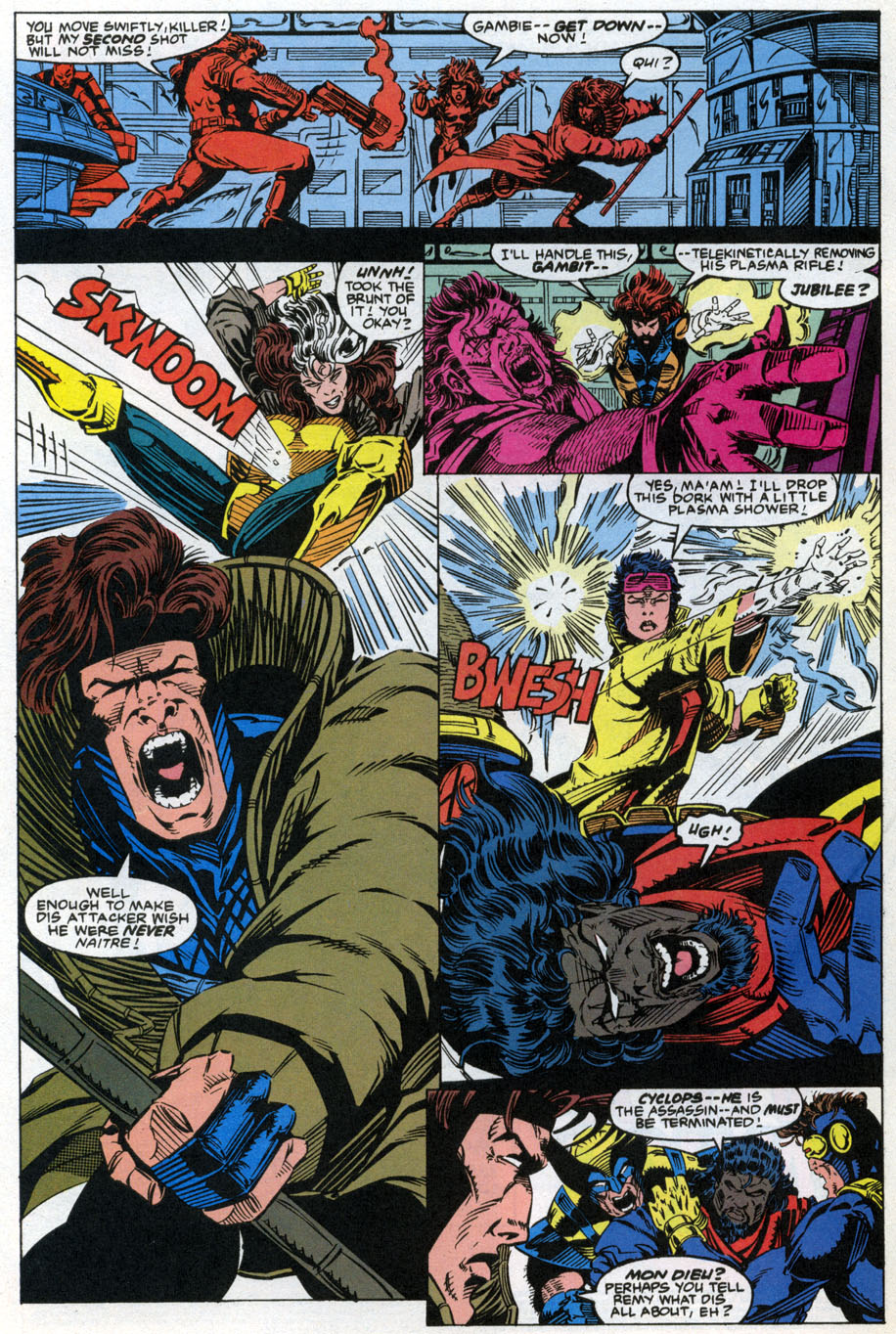
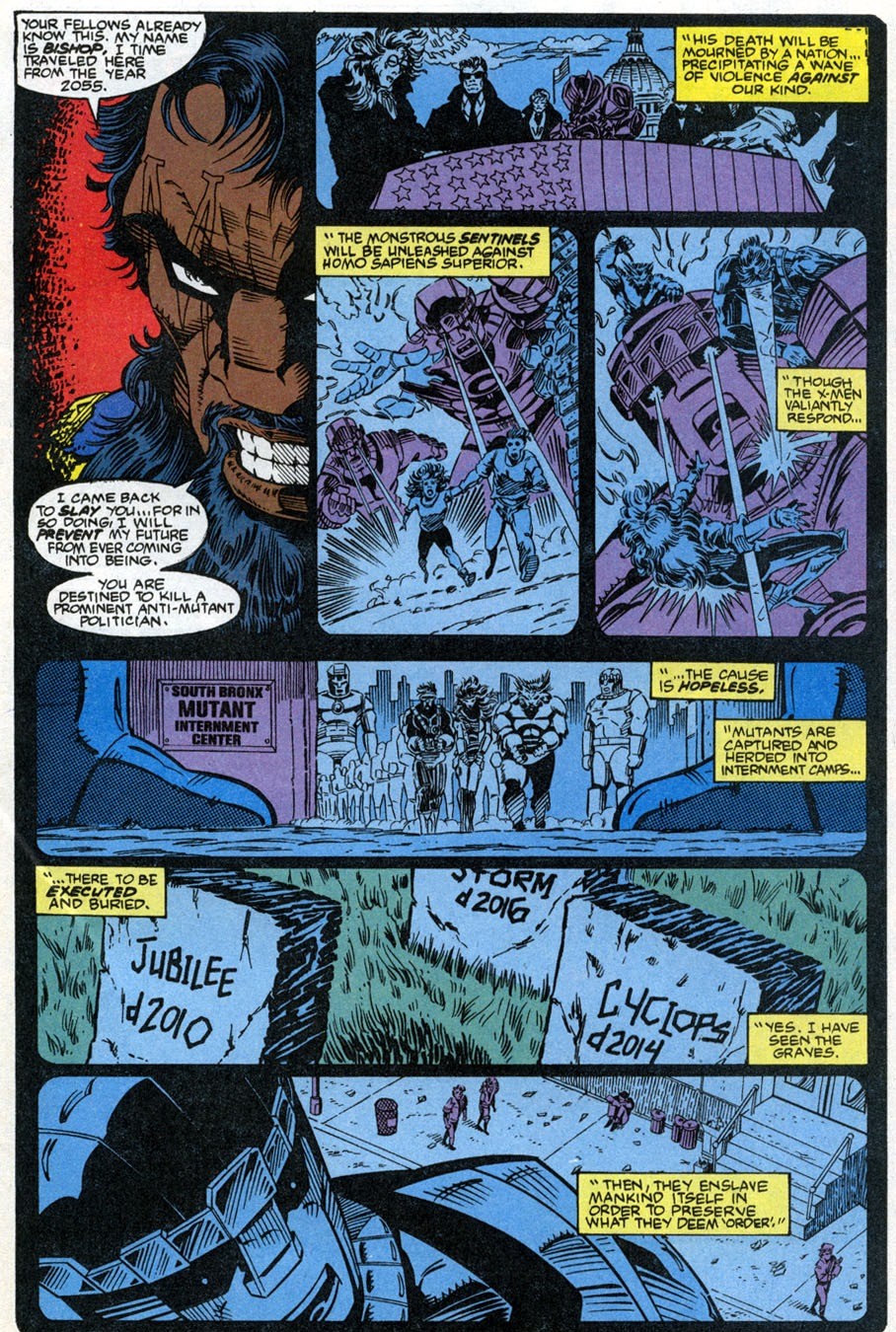
The story begins with Bishop (who came from the dark future on a mission to change events and prevent the darkness from taking over by aligning himself with the X-Men) attacks Gambit whom he identifies as the traitor responsible for the downfall of the X-Men and society. In response, Rogue, Jean Grey and Jubilee intervene to disrupt the conflict paving the way for Wolverine and Cyclops to restrain Bishop.

Bishop insists that everything will change for the worse if Gambit lives to fulfill his destiny: to kill a prominent politician who opposed mutants.

After some squabbling between the X-Men, the situation cools down and Professor X/Charles Xavier announces that he and some members will travel to Washington, D.C. where he will address the senate committee on mutant affairs…

Quality

2
Chaos in the headquarters of the X-Men!

In terms of writing, this comic book carries a lot of punch on its own. It’s a compelling read and like the animated series episode that served as its source, it took its time to build up tension before a twist or a scene of spectacle happens. As expected, it is not a scene-per-scene recreation compared with the animated episode and that’s just fine for me. I only wished the comic book creators retained the animated episode scene in which Bishop tells Wolverine that Gambit’s destined act was the Canadian’s fault, which led to Wolverine memorably saying: “I still can’t believe it.”

More importantly, the story offers readers a nice exploration about how the public and the Federal Government of the United States would react with mutants. To see US Senator Robert Kelly harshly question Professor X if his school functioned for pro-mutant propaganda is quite striking.

When it comes to the art, Napalitano’s work here is a drop in quality and style when compared to Andrew Wildman’s art. His art is not terrible and he exerted effort on translating the script into images but the work looks rushed. There were some weirdly drawn faces of Rogue, Xavier and Wolverine to name some. The action scenes meanwhile lacked punch.

Conclusion

3
The dark future of the X-Men and their society.

While X-Men Adventures #14 served its purpose on completing the adaptation of Days of Future Past, it failed to deliver the great stuff even though the script was strong. The sub-par art of Napalitano really dragged the presentation down making the comic book end with a whimper.

If you are seriously planning to buy an existing hard copy of X-Men Adventures #14, be aware that as of this writing, MileHighComics.com shows that the near-mint copy of the regular edition costs $6 while the near-mint copy of the newsstand edition costs $21.

Overall, X-Men Adventures #14 (1993) is satisfactory.


Thank you for reading. If you find this article engaging, please click the like button below and also please consider sharing this article to others. If you are looking for a copywriter to create content for your special project or business, check out my services and my portfolio. Feel free to contact me as well. Also please feel free to visit my Facebook page Author Carlo Carrasco and follow me at HavenorFantasy@twitter.com
A Look Back at What If #9 (1990)

Disclaimer: This is my original work with details sourced from reading the comic book and doing personal research. Anyone who wants to use this article, in part or in whole, needs to secure first my permission and agree to cite me as the source and author. Let it be known that any unauthorized use of this article will constrain the author to pursue the remedies under R.A. No. 8293, the Revised Penal Code, and/or all applicable legal actions under the laws of the Philippines.

Long before the renaissance of Hollywood-produced superhero movies even started, the X-Men established itself as one of the most popular franchises of Marvel Comics. What some readers do not know was that while the X-Men indeed started in 1963 under Stan Lee and Jack Kirby, Marvel’s mutants actually started getting successful in the mid-1970s with the 2nd X-Men team (Cyclops, Wolverine, Storm, Sunfire, Nightcrawler, Colossus, Banshee and Thunderbird) handled by Len Wein and Dave Cockrum.

That new team literally made a splash with readers with the release of Giant-size X-Men #1 in 1975. That comic book, which is very valuable now, saw Charles Xavier recruiting new mutants to form a new team with Cyclops being the only pioneer remaining. Subsequently the X-Men monthly series of that era saw lots of stories of this particular team solving problems and fighting evil. Along the way, Chris Claremont got hired as the new writer and then the rest was history.

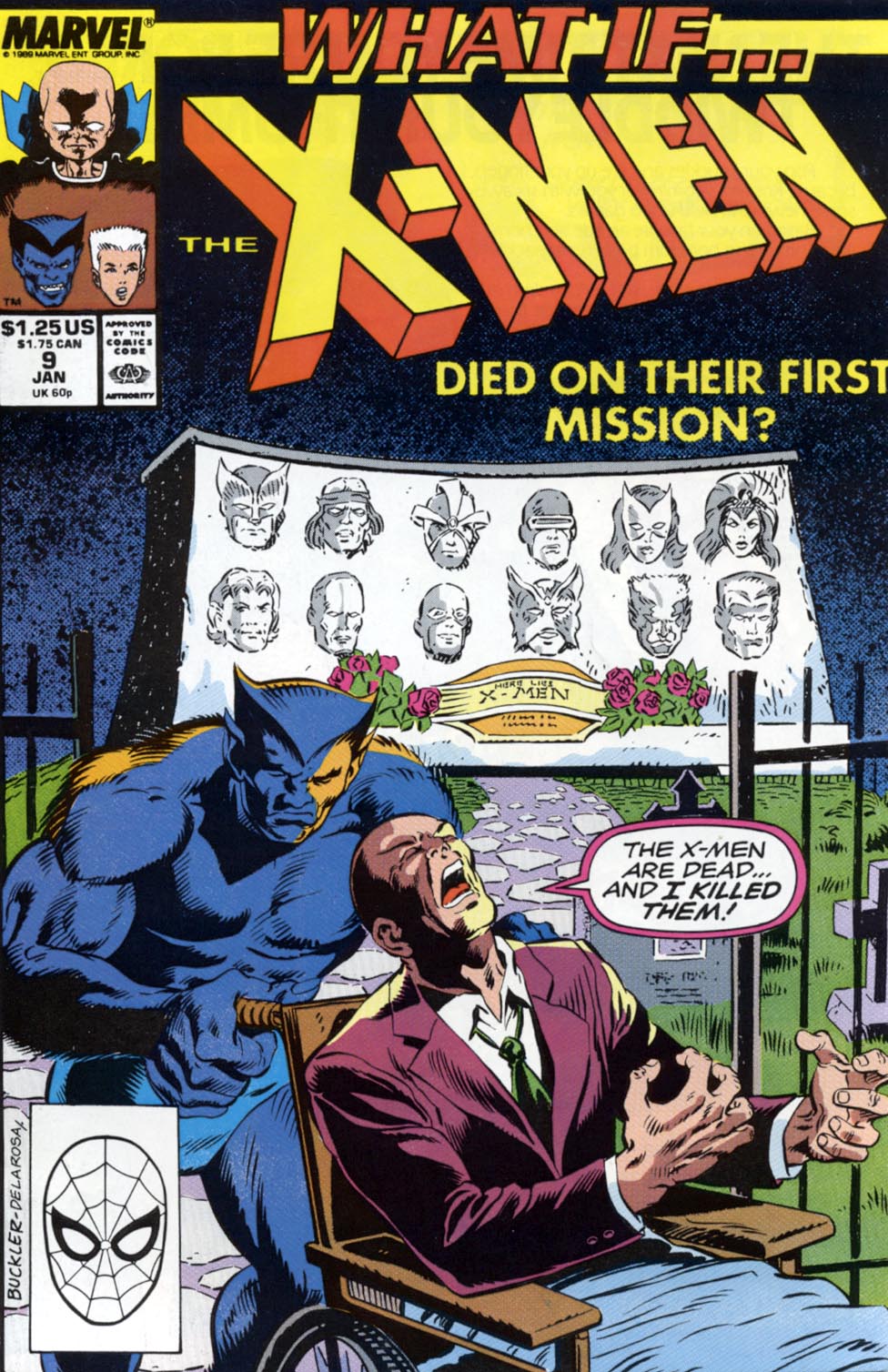
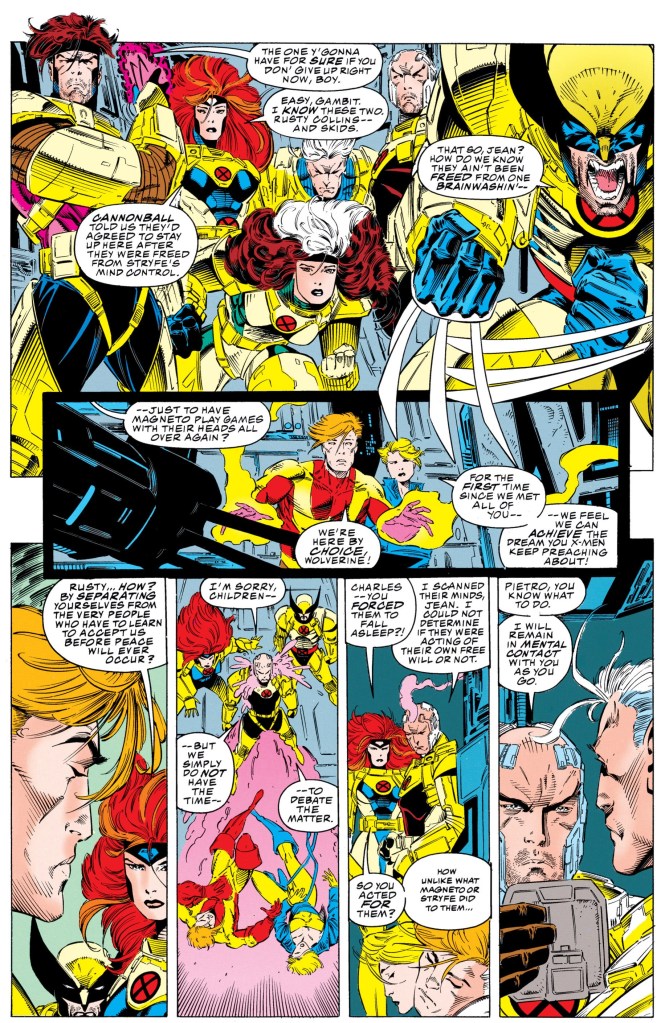
In this retro comic book review, we will take an interesting look at what would have happened had the 2nd team of the X-Men died on their first mission.

This is What If #9 written by Roy Thomas, drawn by Rich Buckler and published by Marvel Comics in 1990.

Cover
The cover.

Early story

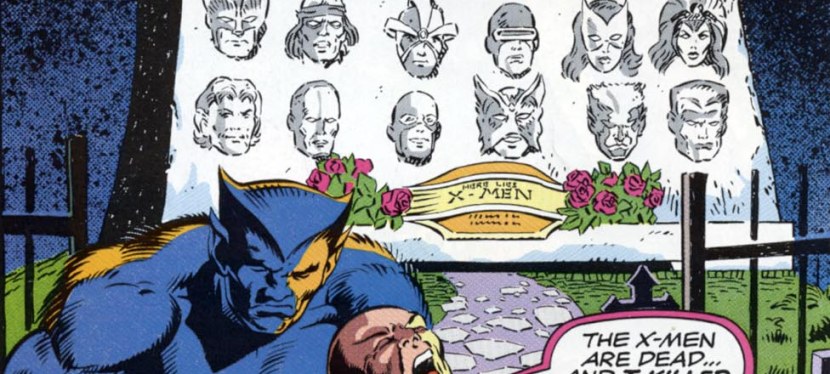
The comic book begins with the Watcher of Marvel’s universe explaining what actually happened during the X-Men’s mission in Giant-size X-Men #1. Then he offers an alternate version of the events asking “What if…the new X-Men had died on their very first mission?”

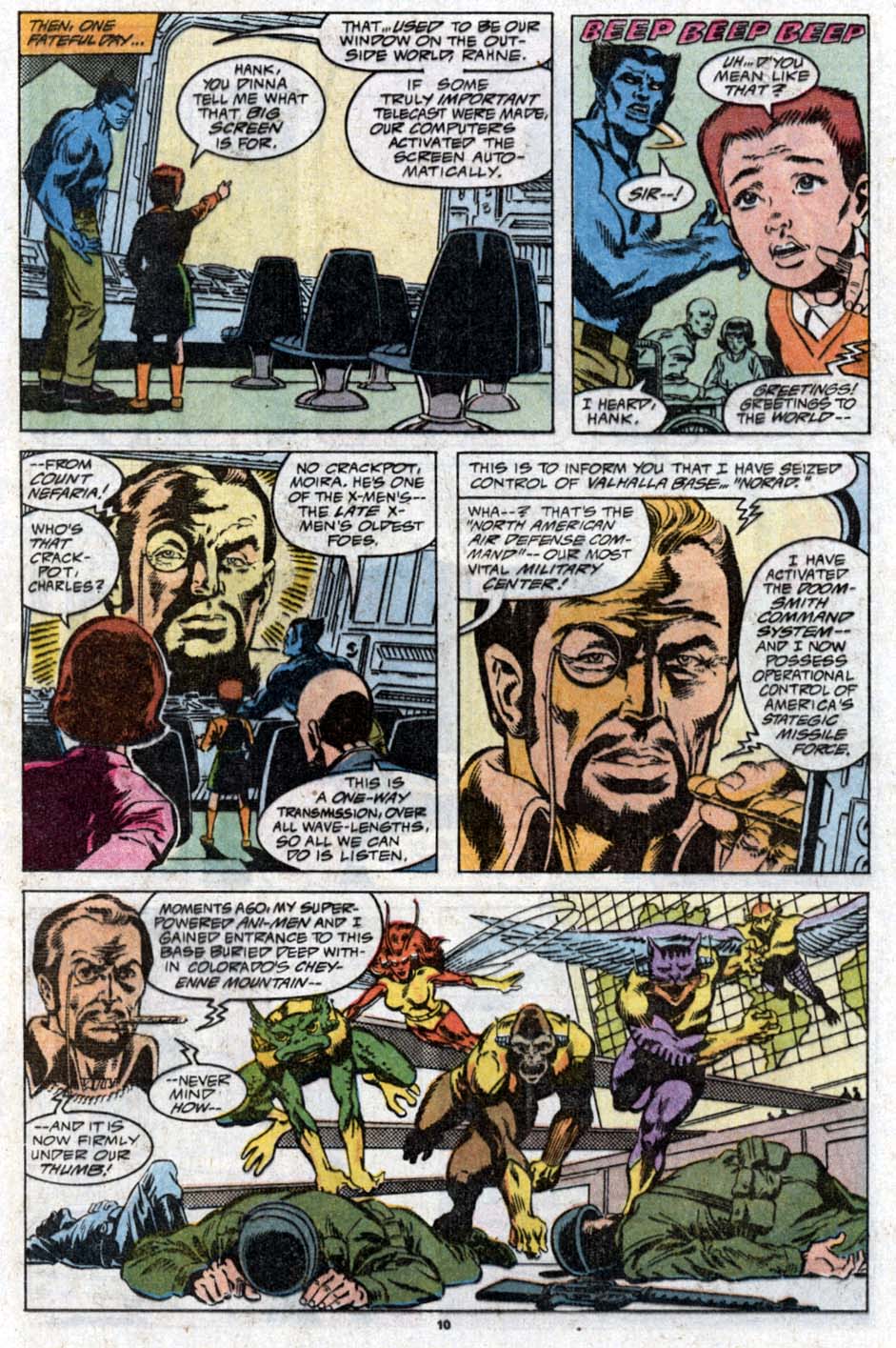
The new reality begins in Scotland where Moira McTaggert receives a telegram from the United States. The message read that her friend Charles Xavier is ill which compels her to leave immediately. Before leaving, a little girl named Rahne comes to Moira followed by Craig who asserts his authority on her. Subsequently Moira and Rahne arrive at Salem Center, New York, greeted by Hank McCoy/Beast who confirmed that he was the one who sent the telegram to her.

Moira finally meets Xavier who expressed surprise to see her. As it turned out, Xavier had isolated himself in a room using Cerebro. After separating from Xavier, Beast explains to Moira what happened previously to Cyclops, Jean Grey, Havoc, Polaris and Ice Man on a far away island (read Giant-size X-Men #1). Cyclops was fortunate enough to survive and return to Xavier who was compelled to use Cerebro to trace mutants around the world (note: the 2nd X-Men team).

2
When trouble hits the world…

This leads to events told in Giant-size X-Men #1 but something drastic happened…

Quality

Storytelling is easily the strongest and most defining element of this comic book, especially if you are fortunate enough to read what happened in Giant-size X-Men #1 from 1975. The alternate plot by Roy Thomas is pretty intriguing and highly dramatic, and yet it still manages to add some spectacle to maintain balance.

What If #9 strongly delivered on what it promised what would have happened had the 2nd X-Men team died on their first mission complete with the narrative shifting dramatically through the eyes of Moira McTaggert, Xavier and Beast.

In terms of characterization, I really enjoyed the dramatization of the close friendship between Xavier and McTaggert. Having read lots of X-Men comic books through the decades, I should say that McTaggert was often limited to supporting roles or guest appearances. As seen in this comic book, she and Xavier made a solid pair of mentors. Lastly, the portrayal of Xavier being somewhat broken and regretful is wonderfully executed. Adding to that, the portrayal of McTaggert as a strong provider of direction and support for a fragile Xavier is memorable.

When it comes to the visuals, Rich Buckler scored nicely. The characters are all recognizable (with Beast looking a bit more visceral than how he actually appeared in the 1970s to 1980s) and their facial expressions were nice to see. Buckler also proved to be good with visualizing the action and the suspenseful parts.

Conclusion

1
Very nice artistic presentation by Rich Buckler. Readers of 1975’s Giant-size X-Men #1 will be able to relate with this.

Overall, What If #9 is a great comic book to read. It is the closest thing you can get when it comes to seeing Marvel’s mutants led by Xavier with McTaggert working behind the scenes together. Roy Thomas and Rich Buckler really scored a homerun with this non-canon X-Men story!

For the comic collectors reading this, based on the rates at MileHighComics.com as of this writing, a near-mint copy of this comic book’s regular version is $24 while the near-mint copy of the newsstand edition is priced at $51.

What If #9 (1990) is highly recommended!


Thank you for reading. If you find this article engaging, please click the like button below and also please consider sharing this article to others. If you are looking for a copywriter to create content for your special project or business, check out my services and my portfolio. Feel free to contact me as well. Also please feel free to visit my Facebook page Author Carlo Carrasco and follow me at HavenorFantasy@twitter.com
A Look Back at X-Men Adventures #13 (1993)

Disclaimer: This is my original work with details sourced from reading the comic book and doing personal research. Anyone who wants to use this article, in part or in whole, needs to secure first my permission and agree to cite me as the source and author. Let it be known that any unauthorized use of this article will constrain the author to pursue the remedies under R.A. No. 8293, the Revised Penal Code, and/or all applicable legal actions under the laws of the Philippines.

It’s funny how adaptations of adaptations turn out in real life. Long before the first live-action X-Men movie was released, an animated TV series (popularly referred to as X-Men: The Animated Series or X-Men TAS) was produced and arguably brought together the fans of both the X-Men comic books along with the animated X-Men followers.

Along the way, Marvel Comics went on to publish a monthly comic book series called X-Men Adventures which themselves were adaptations of the animated series (which itself adapted stories and concepts from the comic books).

The adaptation-of-an-adaptation approach went deep further when the animated series adapted loosely the story of the classic X-Men comic book storyline Days of Future Past (by legends Chris Claremont and John Byrne) which resulted a story told in two episodes on TV. And then there was also a comic book adaptation that followed starting with X-Men Adventures #13 which is the subject of this retro comic book review.

1
The cover.

Early story

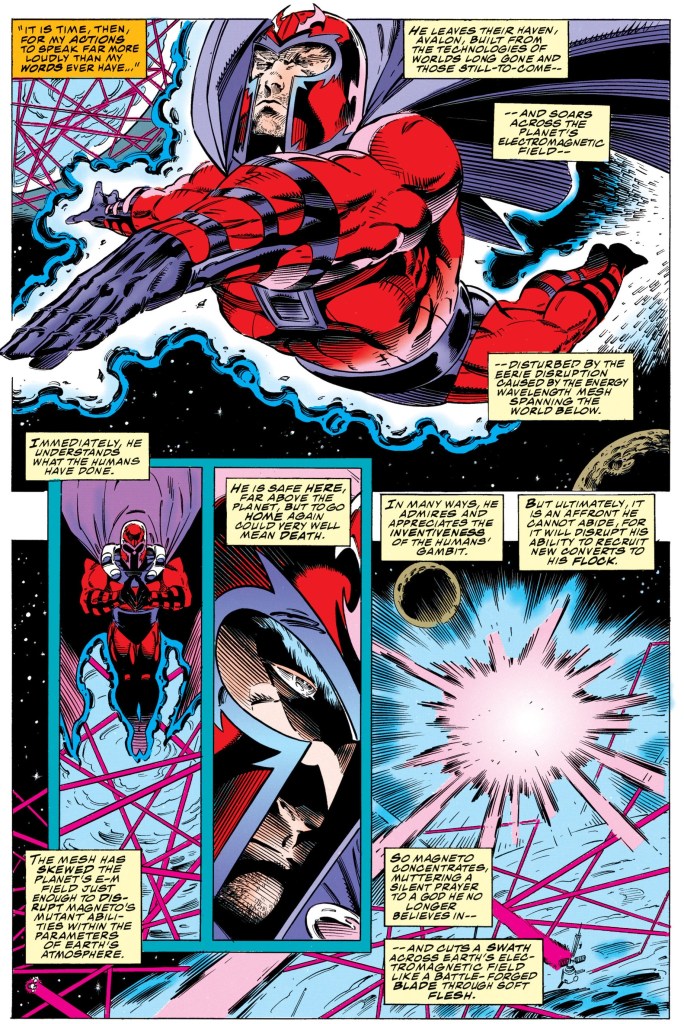
Written by Ralph Macchio and drawn by Andrew Wildman, the comic book begins in the dark future of 2055 in New York. The city is in ruins and mutants on the loose are being hunted by Sentinels. A very old Wolverine appears to help two loose mutants but ends up getting stunned with them by Bishop who turns out to be helping the automated authority of the Sentinels.

As he turns over the captured mutants, the Sentinels betray Bishop telling him that they no longer required him. Afterwards, Bishop and Wolverine (who woke up) each carry a person under the watch of a Sentinel. Suddenly, the two other mutants use their powers to attack the Sentinel and Wolverine followed to back up their efforts. The Sentinel however grabbed Wolverine.

Quality

3
A very old Wolverine in the dark future of 2055.

With the exception of some liberties, this comic book closely followed what was told in the first of the 2-episode Days of Future Past animated adaptation. As a comic book story, the story was heavily loaded with details and exposition designed to orient readers about the setting and why the future became a time of darkness in relation to the rise of machines having ultimate power over people.

While the time travel concept of the literary classic involved the mind of Kitty Pryde going into the past, this comic book used the more common concept of having Bishop travel back through time physically which easily reminds me of Kyle Reese arriving from the future in 1984’s The Terminator.

The build-up leading to Bishop’s move to travel back through time was nicely done by the creative team. There was a lot of exposition followed by an incoming attack complete with explosions happening just as Bishop is about to leave. In short, the pay-off was worth it.

The engagement did not end there. In fact, it continued nicely as Bishop meets the X-Men in 1993 with the details of his mission carefully unveiled. Professor Charles Xavier’s reaction to future history (Sentinels taking control of the world) was dramatic and worth re-reading.

As with his other works in the X-Men Adventures comic book series, Andrew Wildman’s art is very good to look at and he knows how to make each scene look engaging whether it’s just an exchange of dialogue between characters or an action scene loaded with a lot of impact.

Conclusion

While it is only half of a 2-issue adaptation of a 2-episode animated adaptation of the Days of Future Past literary classic, X-Men Adventures #13 is still a fun-filled reading experience complete with a lot of engaging moments.

19
The money shot by Andrew Wildman!

If you are a serious collector of comic books, be aware that, as of this writing, a near-mint copy of X-Men Adventures #13 costs $6 while its newsstand edition copy is worth $21 in near-mint condition according to Mile High Comics.

Overall, X-Men Adventures #13 is highly recommended. Both dedicated X-Men fans as well as newcomers will have something a lot to enjoy with it.


Thank you for reading. If you find this article engaging, please click the like button below and also please consider sharing this article to others. If you are looking for a copywriter to create content for your special project or business, check out my services and my portfolio. Feel free to contact me as well. Also please feel free to visit my Facebook page Author Carlo Carrasco and follow me at HavenorFantasy@twitter.com
A Look Back At Batman vs. The Incredible Hulk

Disclaimer: This is my original work with details sourced from reading the comic book and doing personal research. Anyone who wants to use this article, in part or in whole, needs to secure first my permission and agree to cite me as the source and author. Let it be known that any unauthorized use of this article will constrain the author to pursue the remedies under R.A. No. 8293, the Revised Penal Code, and/or all applicable legal actions under the laws of the Philippines.

I love reading a crossover comic book that was made by very talented creators to be a whole lot of fun from start to finish. Back in the early 1980s, rivals Marvel Comics and DC Comics collaborated temporarily with inter-company crossover comic books that were made to be entertaining to fans of their respective properties.

What I’m going to review here is the 3rd superhero crossover comic book between Marvel and DC titled Batman vs. The Incredible Hulk.

Cover
The cover.

Background

Before I start, let me clarify that this particular comic book was specifically published as issue number 27 of the DC Special Series which was a series of one-shot comic books. By comparison, the 1981 crossover comic book Superman and Spider-Man (which I reviewed previously) was published under the Marvel Treasury Edition line of Marvel Comics as issue number 28.

Going back to Batman vs. The Incredible Hulk, the comic book was the final issue of the DC Special Series line and it carried a cover price of $2.50 which was quite high for its time.

The people at DC Comics made sure that the crossover was handled by the best talents they had back then. The late Len Wein (best know for creating Wolverine) was assigned to write the script (and ensure that elements from both the Hulk and Batman would mix nicely) while José Luis García-López was hired to illustrate. Dick Giordano was the embellisher and editor while Allen Milgrom and then Marvel editor-in-chief Jim Shooter were the consulting editors. In return for their assistance, Marv Wolfman and Mike DeCarlo were acknowledged with thanks.

Now we can begin with this retro review of Batman vs. The Incredible Hulk.

The early story

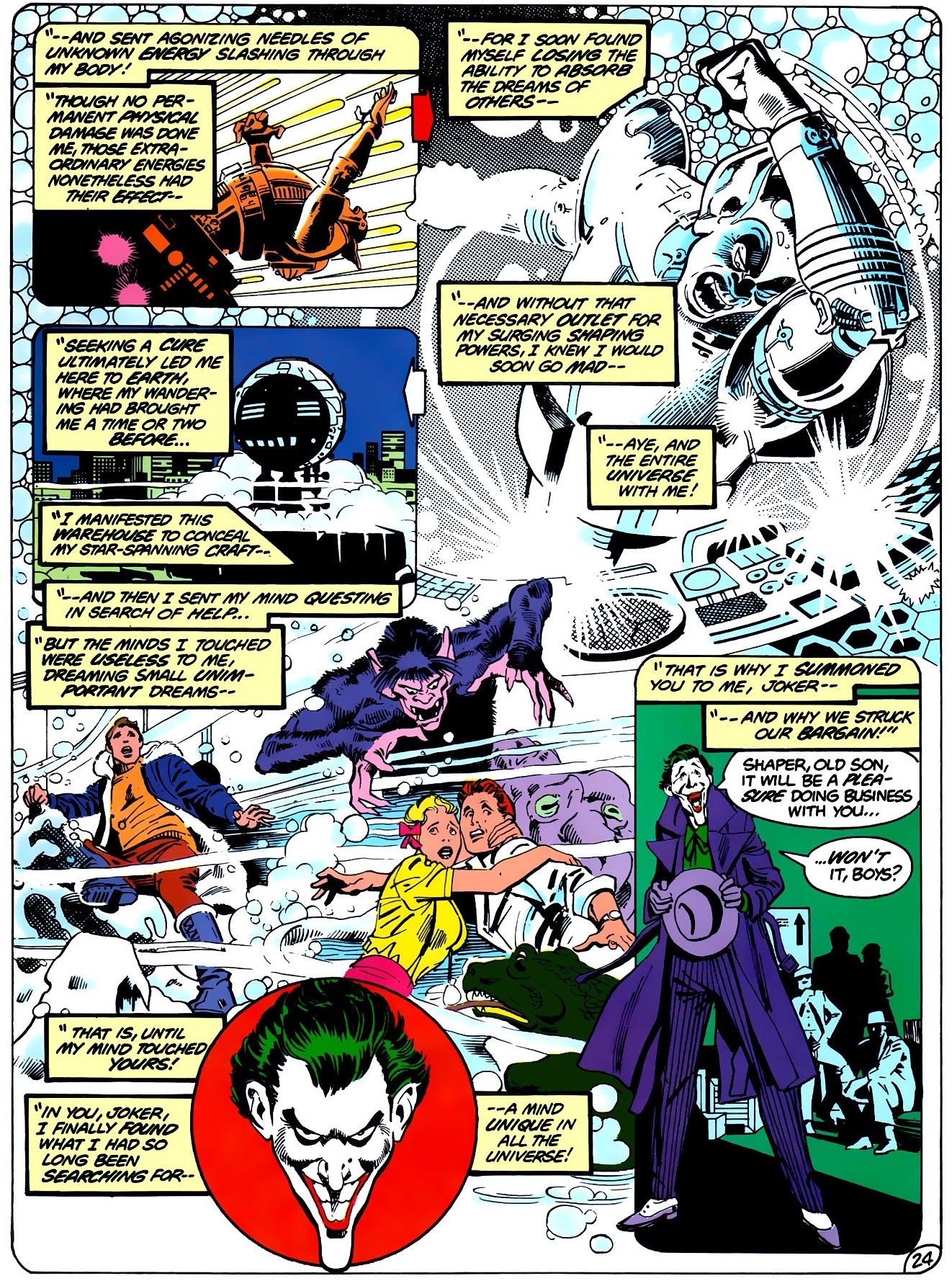
The story begins when a few persons in Gotham City witness their dreams turning real beyond logic. A man dreamed he was in the arctic hunting and wakes up to discover his room was filled with snow. In a cinema where a horror movie was shown, a couple kissing each other discover, to their shock, that monsters of different sizes surrounded them out of thin air.

At the waterfront of the city, the Joker (accompanied by his gang members) talks to an unseen being (Shaper of Worlds). He gives his assurance to the being that he and his gang will acquire a specific item (needed by the being). For the Joker, what was discussed was a simple business arrangement.

A short time later inside a high-tech facility of Wayne Research, Bruce Banner (the Hulk) secretly works under the false identity as David Banks. He works along with the scientists but not on the scientific projects. Rather, he works odd tasks such as lifting hardware and putting them into places that need them. Of course, Banner did not get hired for a salary but for something much essential to him and his condition with Gamma Rays.

“I had to get a job here somehow so I could get close to the experimental Gamma-gun they’re working on,” he thought to himself.

Suddenly the facility gets filled with laughing gas incapacitating all the people inside. Banner fortunately manages to wear a radiation suit for protection. Moments later, the Joker and his gang enter searching for the Gamma-gun. From this point on, Banner decides to act.

Quality

When it comes to the selection of characters from Marvel and DC, having the mismatch of Batman and the Hulk was a very splendid idea. Not only was having the large green brute and the world’s greatest detective together as temporary rivals a fascinating concept, having them work together as a duo turned out to be a really great move. When it comes to the selected villains of the Joker and the Shaper of Worlds as the anti-hero figures of the story, the two looked like an odd pair but if you focus on the details of the story, you will realize that it made a lot of sense having them two together. The Shaper needs something which requires him to depend on the Joker who in turn brings his gang with him to cause chaos to acquire what the alien needs

All of the above details would not have worked had it not been for the excellent writing by Len Wein. Clearly Wein knew a whole lot about the defining elements of the Hulk and Batman (and the same with the Joker and Shaper), and he carefully blended those elements together to make a story that is thrilling, intriguing, engaging and at the same time still made sense. More on crossing over, there are other characters connected to Batman and the Hulk that made appearances and a few of them fit in nicely into the story.

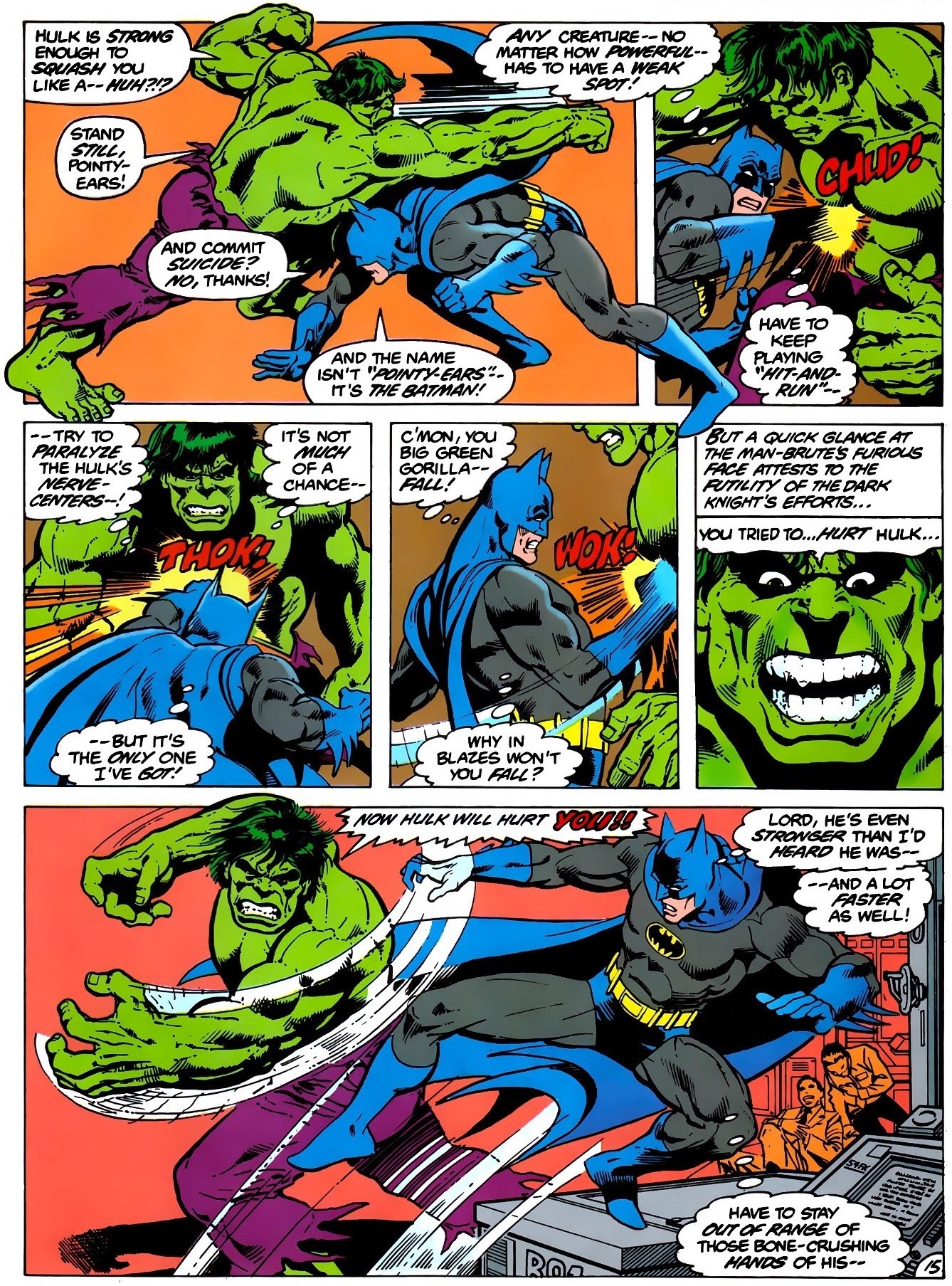
As this was released in 1981, it was typical of the time for writers to use thought balloons to help readers understand what the characters were thinking. The use of thought balloons in this comic book truly defined Batman who not only had to fight the bad guys but also manage his way with the Hulk and do a lot of detective work.

Going back to the Hulk and Batman, this comic book has a lot of fun stuff. More than once did the two superheroes engage in action-packed encounters and their exchange of words was very nicely done. Their match-up (or mismatch) really works.

Prev1
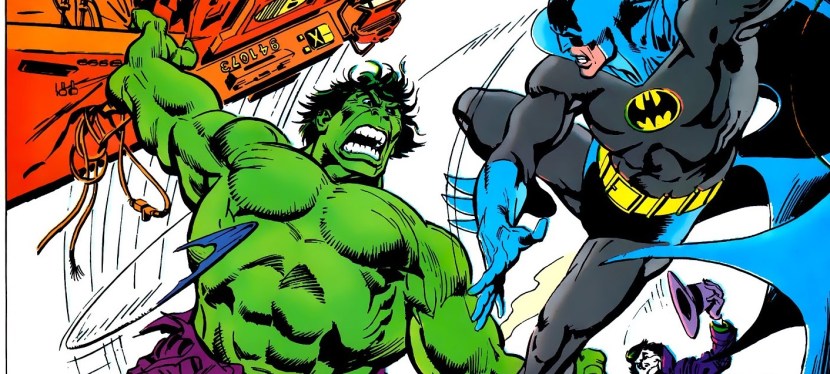
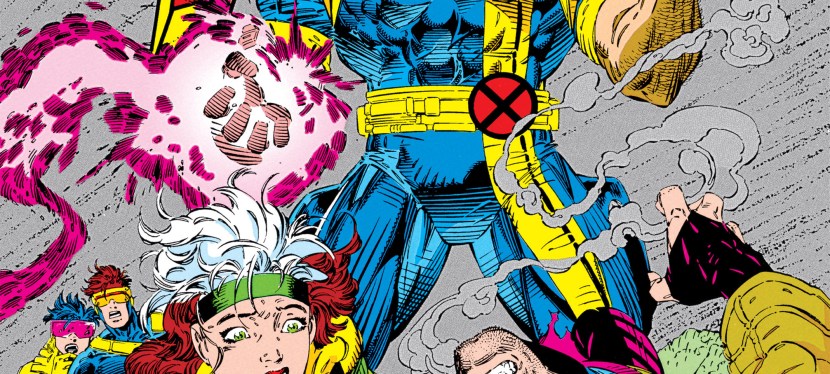
A perfectly crafted action scene between the Hulk and Batman, complete with accurate depictions of each character! 

When it comes to the common complaint by some readers out there that the comic book was more of a Batman story and made the Hulk less prominent, I should say that the slight imbalance is not a problem at all. In fact, for me it makes perfect sense that Batman has more spotlight than the Hulk. Why? Because Batman is a detective and he performed a lot of researching, information gathering and other moves to solve problems. His detective work in the story made perfect sense for the narrative. As for the Hulk, his character really has very limited options other than causing destruction and disturbing the public. Since early on, the Hulk was best known for attracting the attention of the American military (led by General Ross) and huge destruction defined the encounters. For this crossover, the creators did not show the Hulk engaging with the military (save for the phonies) but rather he struggled to figure things out whenever he encountered Batman or the Joker. There is no way the Hulk could do detective work like Batman and having him fight the military would have weakened this comic book’s presentation. Clearly, having the story slightly slanted towards Batman is still the right move.

Prev2
Very highly imaginative and dynamic artwork by José Luis García-López.

The artwork done by José Luis García-López is excellent! He really captured the looks and details of each and every character Marvel and DC that appeared in this comic book. Back in the early 1980s, I got to read several comic books that showed Batman, the Hulk, the Joker and others and the way they appeared in this comic book was indeed accurate of the time. José Luis García-López also knew how to balance spectacle with character development and expository dialogue in terms of visual pacing and framing shots. Also his work becomes even more imaginative during the final conflict. Undoubtedly this is still a great looking comic book!

Conclusion

Overall, Batman vs. The Incredible Hulk is a great comic book and easily it is one of the greatest intercompany superhero crossover comic books ever published! From start to finish, this comic book proved to be highly engaging and there never was a single boring moment. The creators led by Len Wein (he is sorely missed) made the best possible story anyone can make involving Batman and the Hulk.

You can read a hard copy of this comic book by getting Volume 1 of Crossover Classics or, if you can afford to, hunt for a copy of this in its DC Special Series form which now sells for $280 for a very fine copy to as much as $400 for a near mint copy as of this writing according to MileHighComics.com
In ending this, I declare that Batman vs. The Incredible Hulk is highly recommended!


Thank you for reading. If you find this article engaging, please click the like button below and also please consider sharing this article to others. Also my fantasy book The World of Havenor is still available in paperback and e-book format. If you are looking for a copywriter to create content for your special project or business, check out my services and my portfolio. Feel free to contact me as well. Also please feel free to visit my Facebook page Author Carlo Carrasco and follow me at HavenorFantasy@twitter.com