A Look Back at WildC.A.T.S: Covert Action Teams #7 (1994)

Disclaimer: This is my original work with details sourced from reading the comic book and doing personal research. Anyone who wants to use this article, in part or in whole, needs to secure first my permission and agree to cite me as the source and author. Let it be known that any unauthorized use of this article will constrain the author to pursue the remedies under R.A. No. 8293, the Revised Penal Code, and/or all applicable legal actions under the laws of the Philippines.

Welcome back superhero enthusiasts, 1990s culture enthusiasts and comic book collectors! Today we continue revisiting Jim Lee’s flagship title under the Image Comics label – WildC.A.T.S: Covert Action Teams!

While the 3rd and 4th issues of the WildC.A.T.S: Covert Action Teams mini-series had Lee’s superhero team crossing over with Rob Liefeld’s Youngblood, a bigger crossover was agreed upon with Image Comics co-founder Marc Silvestri – Killer Instict! This marked a creative collaboration between Lee and Silvestri resulting a multiple issue crossover between WildC.A.T.S and Cyber Force. For clarification, I already mentioned in my retro review of WildC.A.T.S: Covert Action Teams #6 (1993) that its story was the first chapter of the 4-part Killer Instinct crossover. For your reference, Killer Instinct’s 2nd and 4 chapters were published as Cyber Force issues #2 and #3 of its regular series under Marc Silverstri. This WildC.A.T.S retro review is about the 3rd chapter of Killer Instinct.

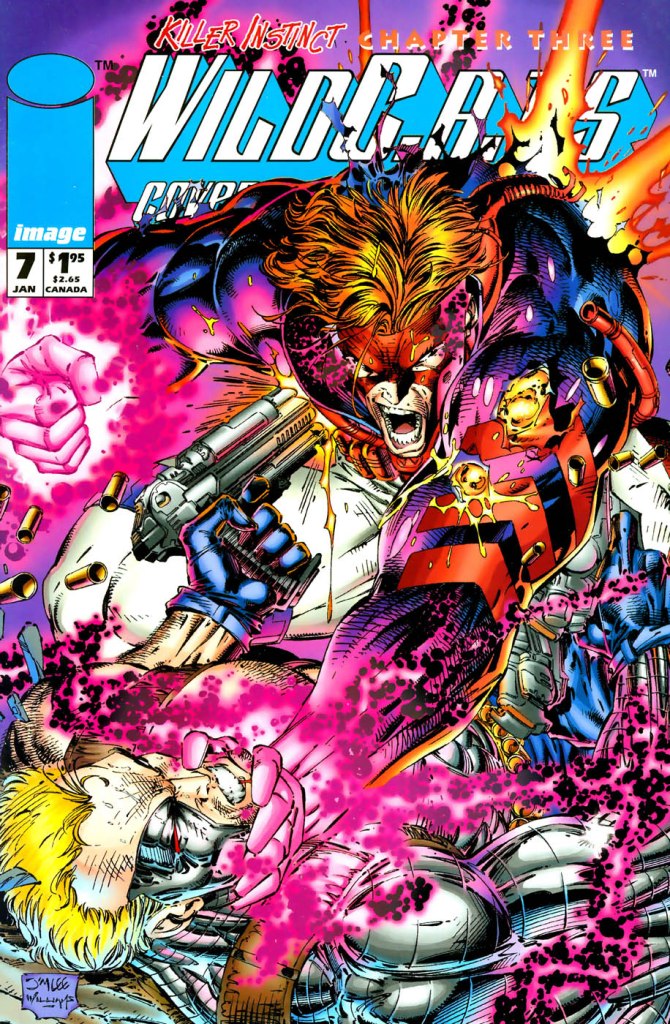
With those details laid down, here is a look back WildC.A.T.S: Covert Action Teams #7, published by Image Comics in 1994 with a story written by Brandon Choi and Jim Lee. Lee did the art.

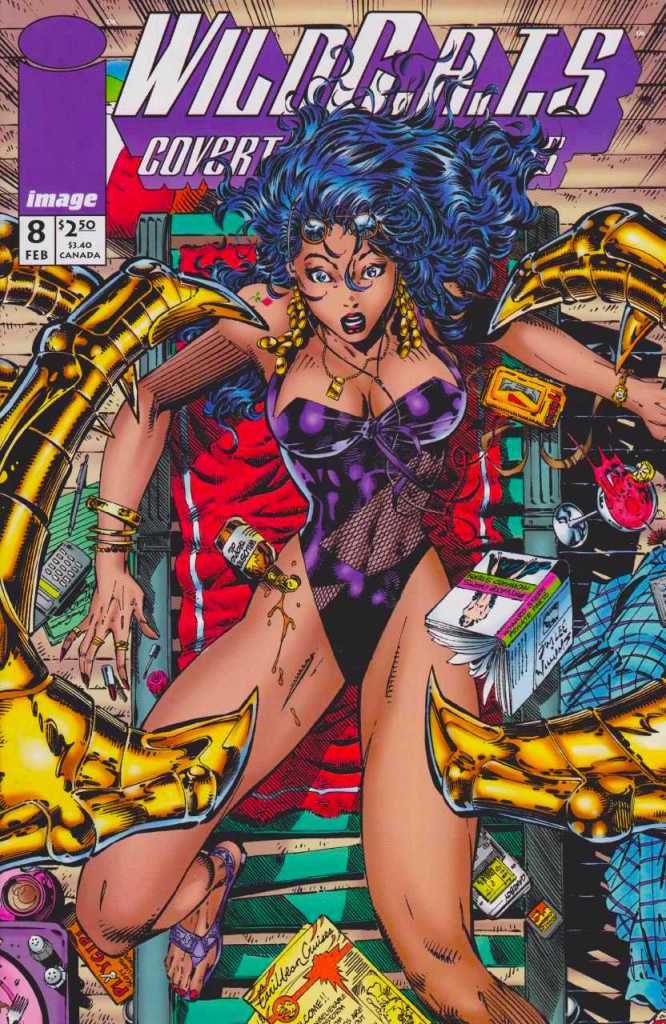
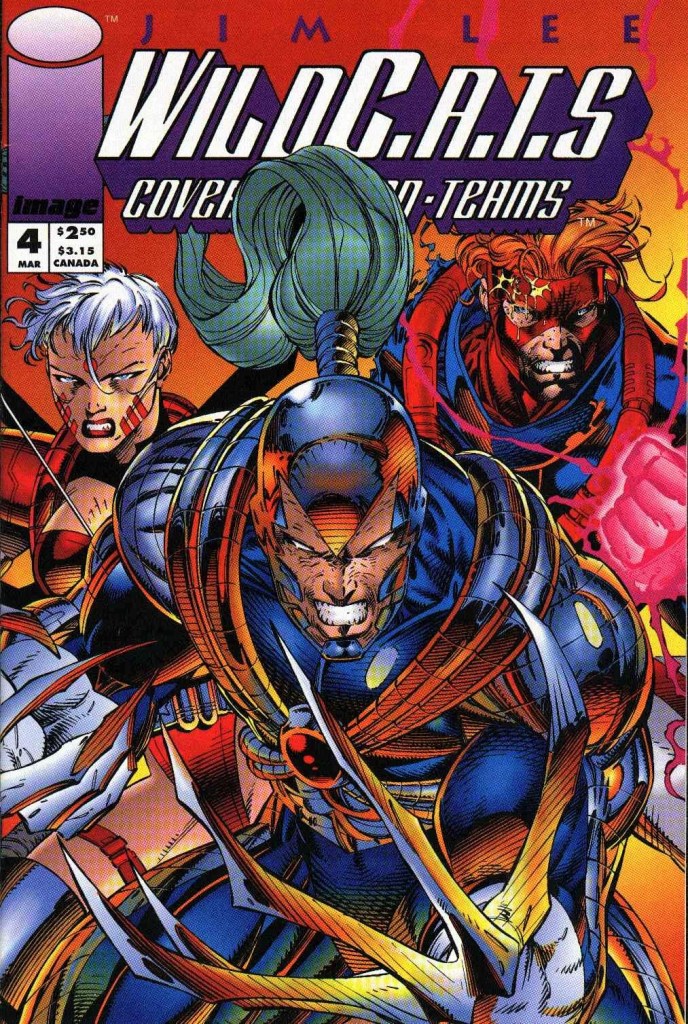
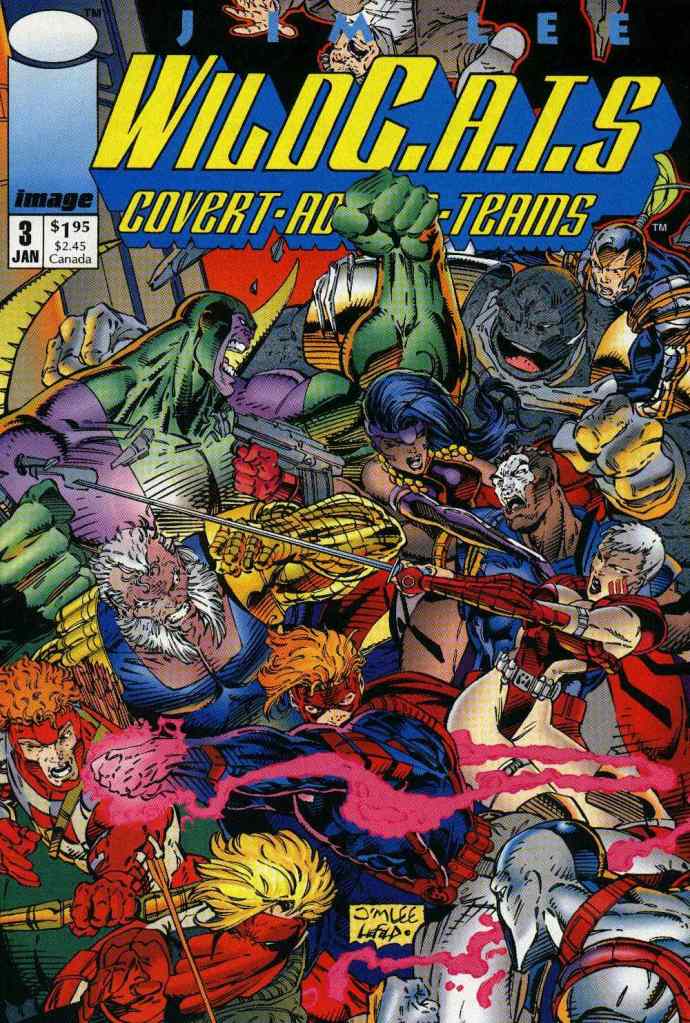
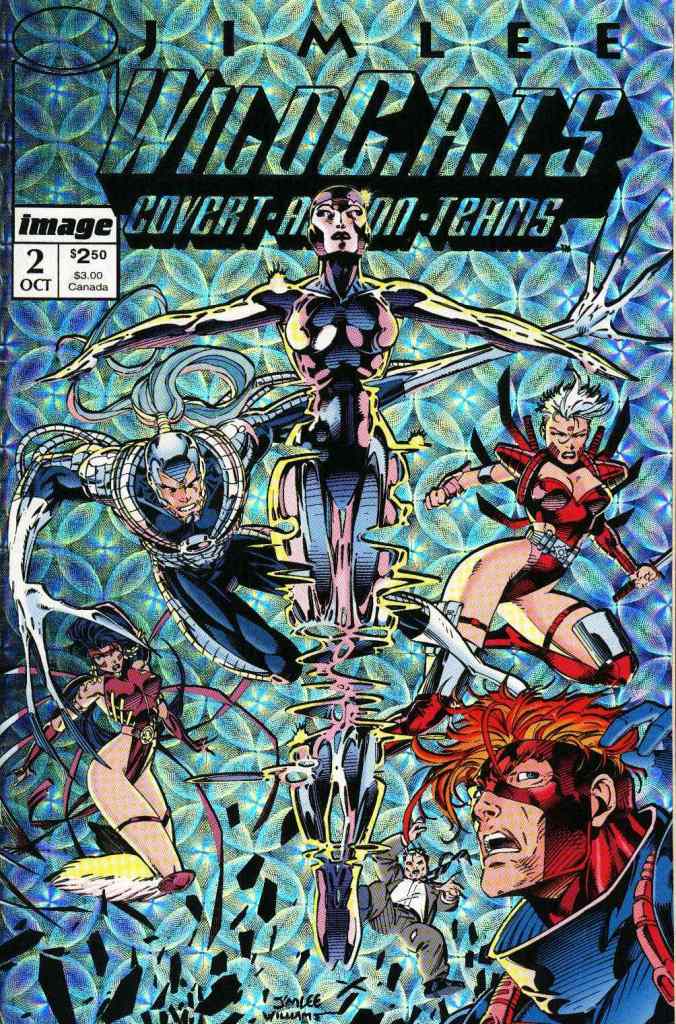
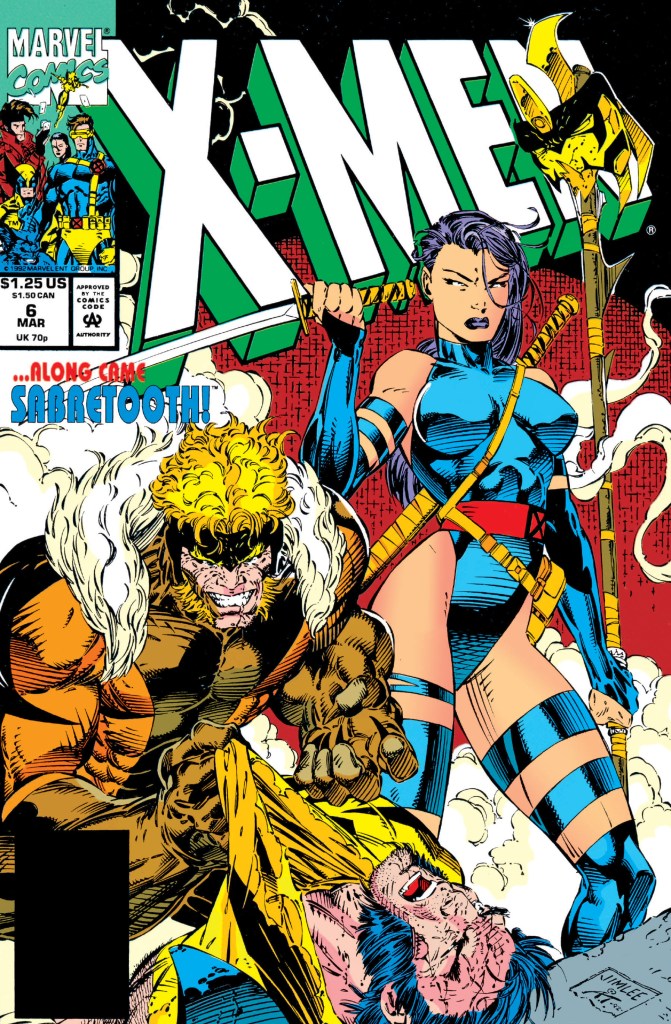
The cover.

Early story

The story begins somewhere in the skies above Gamorra, off the coast of the Philippines! Stryker, the Cyber Force member with three cybernetic right arms, communicates with his teammates and tells them that if half of what Misery said is true about the new Cyberdata S.H.O.C.S., they’re in for a nasty fight and they have to hit the ground.

Stryker, Impact, Heatwave, Velocity and Ripclaw jump off their high-tech jet (which has Cyblade and Misery inside) and land safely. Using his enhanced ability of smell, Ripclaw begins detecting tracks of what they are look for.

Meanwhile at the back of the Isle of the Dead, a high-tech craft arrives with three passengers who are prepared to do a drug deal. Slowly, someone bleeding and with blades on his hands climbs into the craft surprising the passengers. He takes control of the craft, throws the passengers off and leaves.

As Cyber Force starts its ground search with Misery advising them while carefully using her telepathy on them. As Stryker enters a ravaged high-tech place, his sensors detect nothing and yet his instincts tell him something is present nearby. Standing near him is Spartan of WildC.A.T.S…

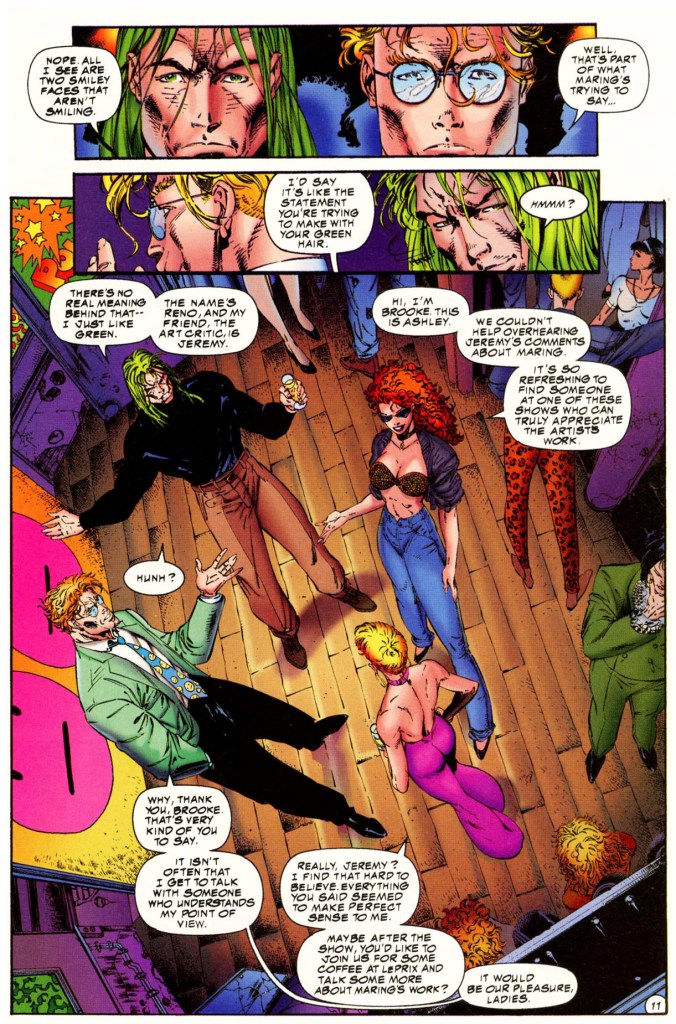
Quality

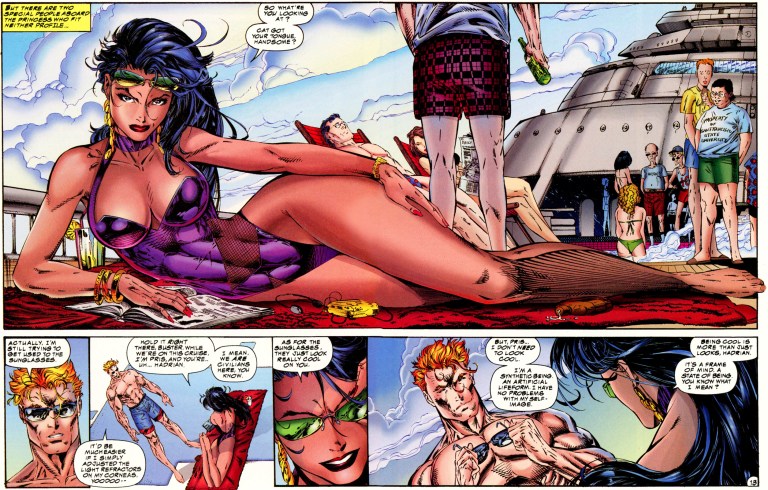
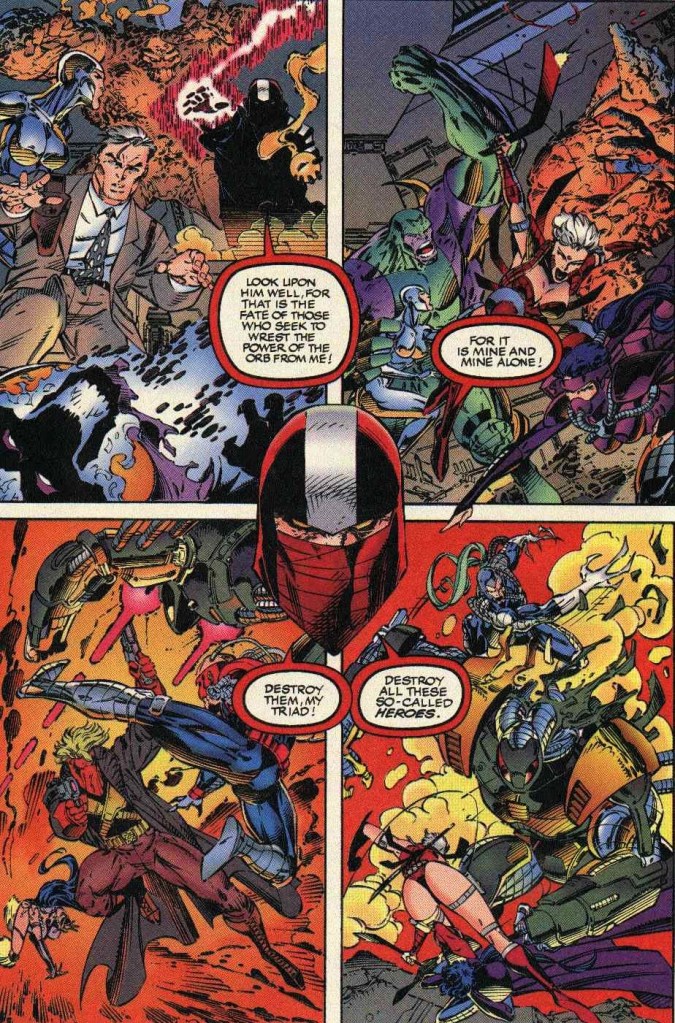
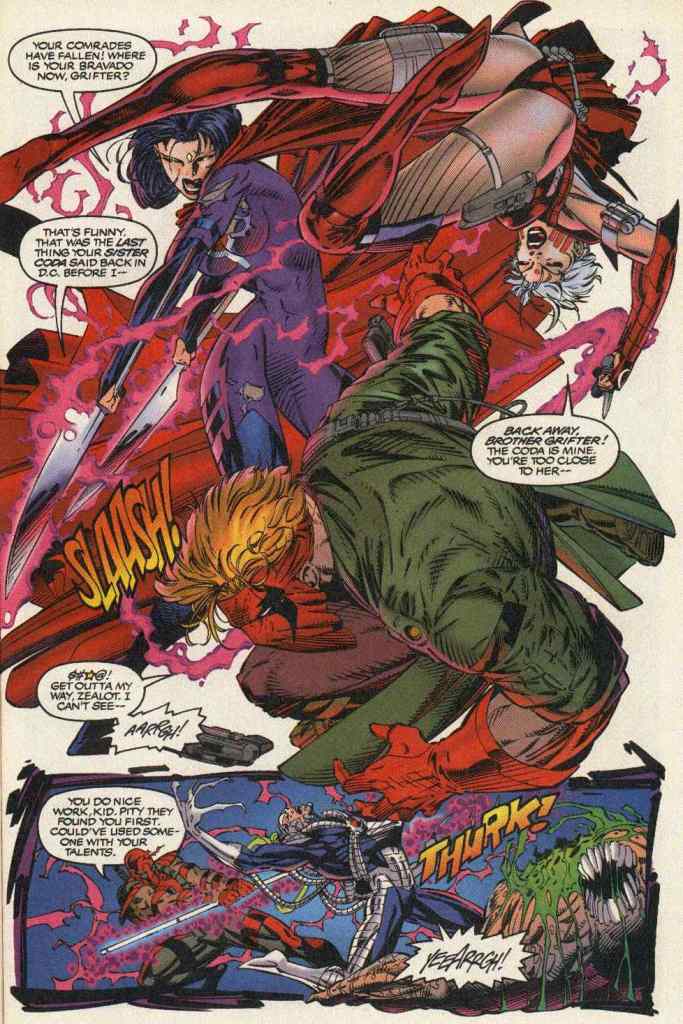
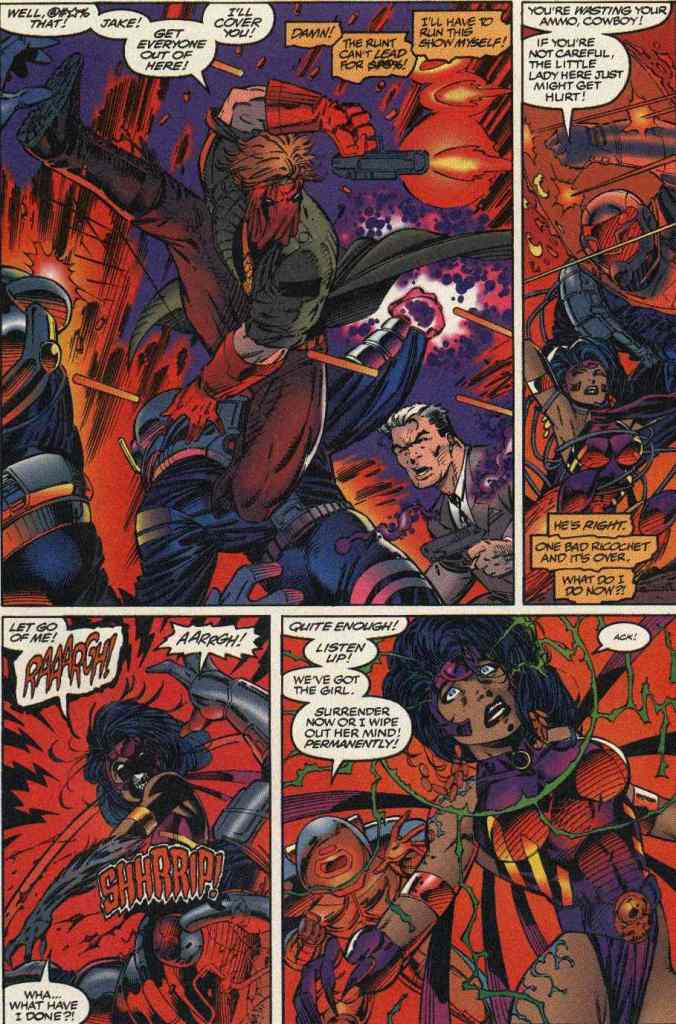
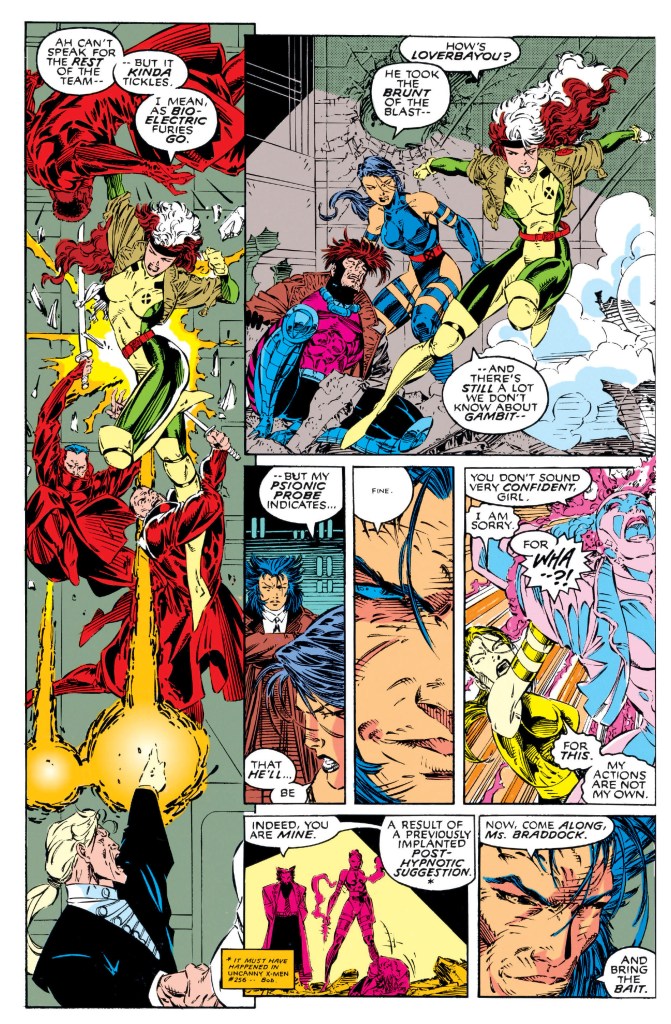
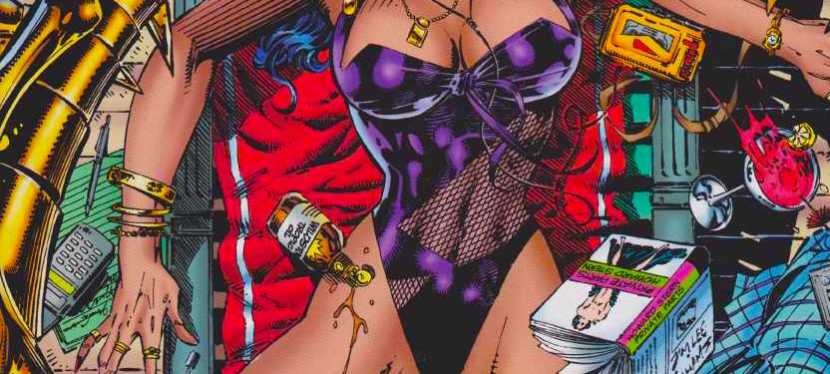
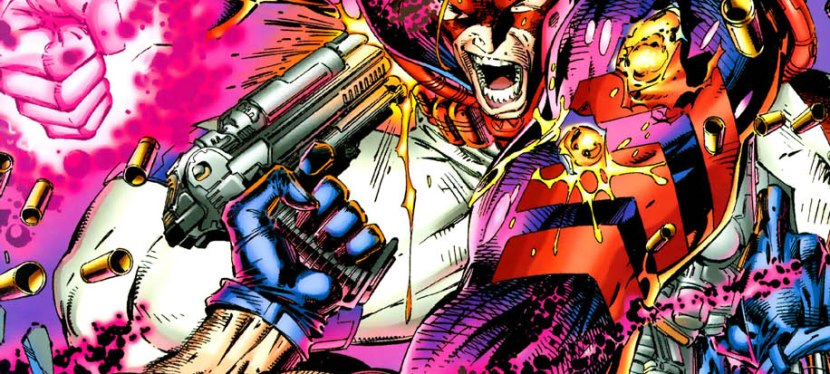
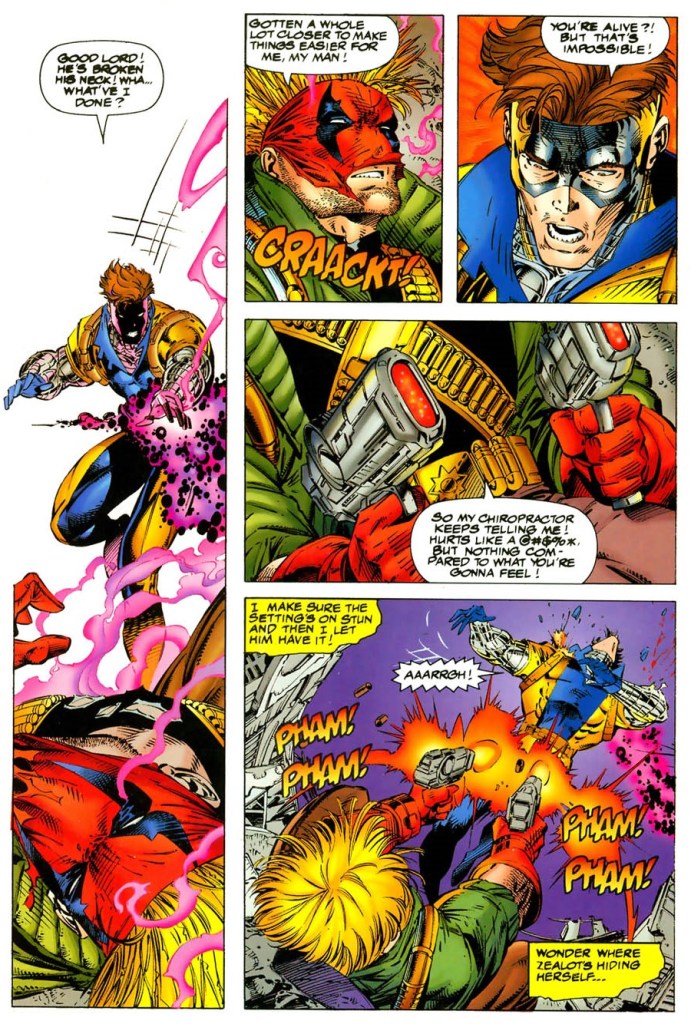
In this encounter between Grifter and Heatwave, do you notice something lacking visually?

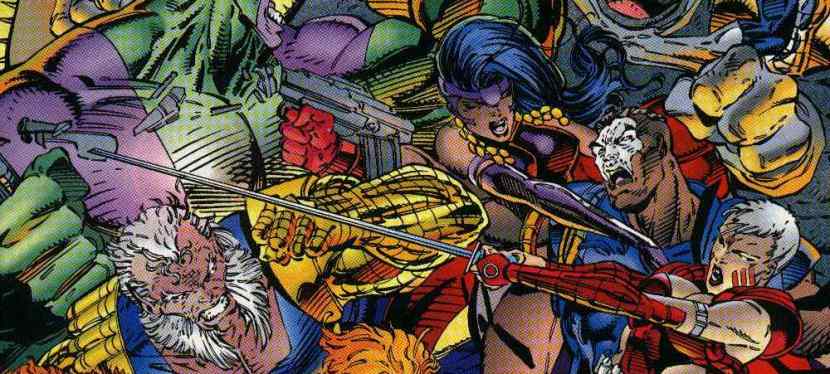
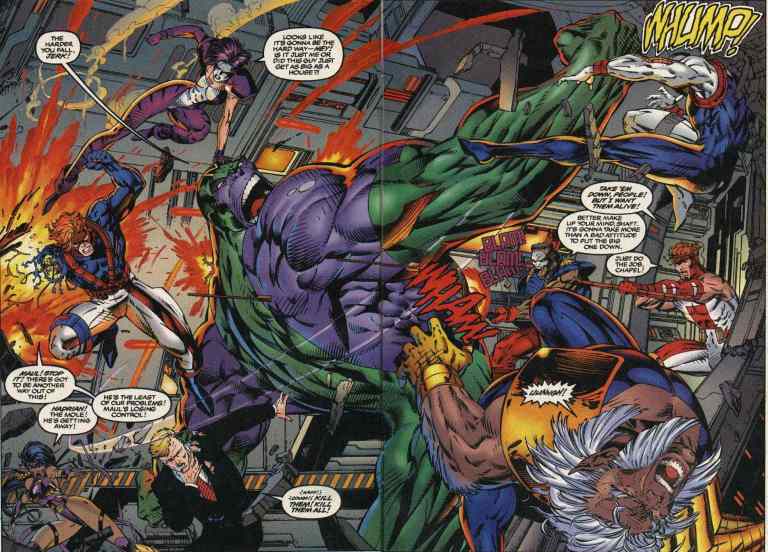
I’ll start with the very obvious purpose of this comic book. After the build-up done in the first two chapters of the Killer Instinct storyline, this story serves as the start of what turned out to be the big pay-off as WildC.A.T.S and Cyber Force members finally got together with an action-packed battle to kick things off. From a storytelling view point, this one is mainly a WildC.A.T.S versus Cyber Force tale with really nice match-ups between their members such as Spartan-Stryker, Cyblade-Zealot and Maul-Impact to name a few. These match-ups and fights are excellently drawn by Jim Lee and I really enjoyed his own artistic visuals of Marc Silvestri’s Cyber Force.

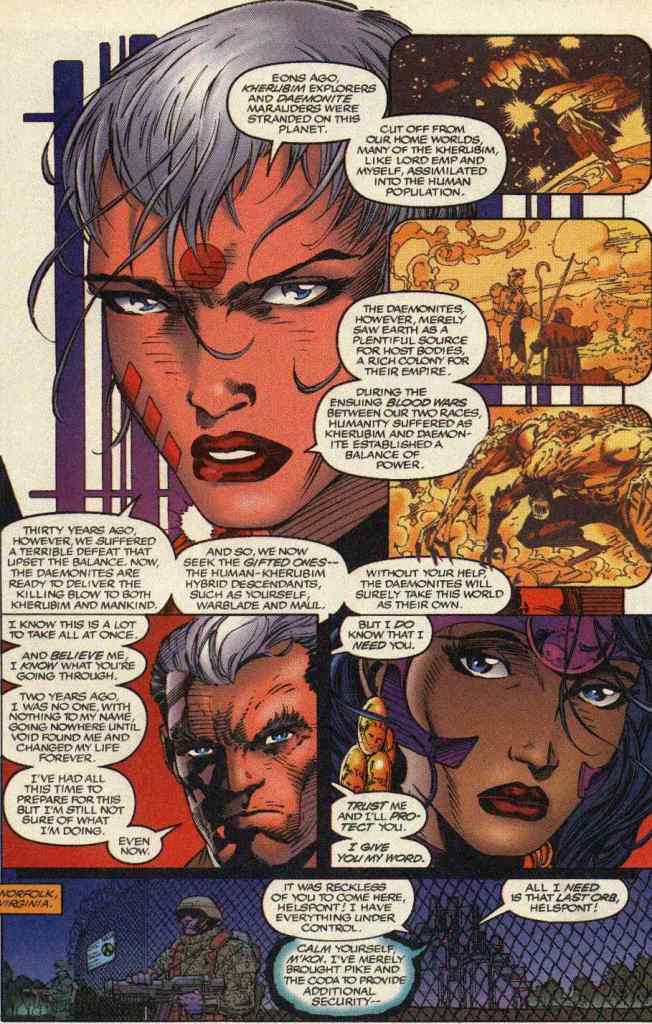
More on the plot, it is pretty simple in concept and structure. The members of the two teams get to fight each other which gets the attention of Skywatch which itself has vested interest with the operations of Stormwatch (note: this is within the WildStorm lore) and the secret facility on that blew up (as seen in WildC.A.T.S #5). Misery remains the key factor in the story and in this tale, she gets to guide and manipulate Cyber Force to find something valuable while Warblade remains mostly absent. Apart from the battles, the absent Voodoo, Void and Jacob Marlowe have their respective spotlights mainly for the character developments as well as reminding readers about the continuing Kherubim-Daemonite conflict.

The quality of the writing is serviceable and the way I look at this comic book, it is mainly driven by spectacle and match-ups. The amount of crossover action is of top-notch quality (note: Jim Lee apparently missed out on key details while drawing Heatwave in a scene with Grifter) and clearly Jim Lee planned the visuals carefully. While there is little character development here, the ironic thing is that Misery (note: visually she is a wicked version of Jean Grey of the X-Men) is the one who gets a good chunk of the said development. Not only does she become a force in the minds of Cyber Force members, she also has her intimate moments with Ripclaw which is a reminder to readers that they have a shared past together (note: this will resonate more with those who read Cyber Force #2 of the regular series).

Conclusion

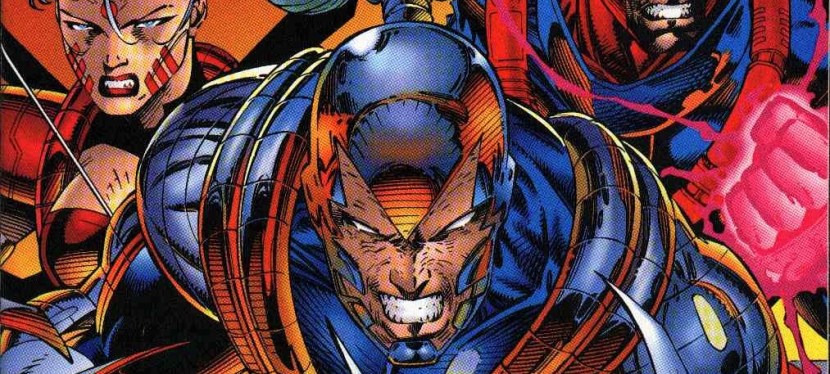
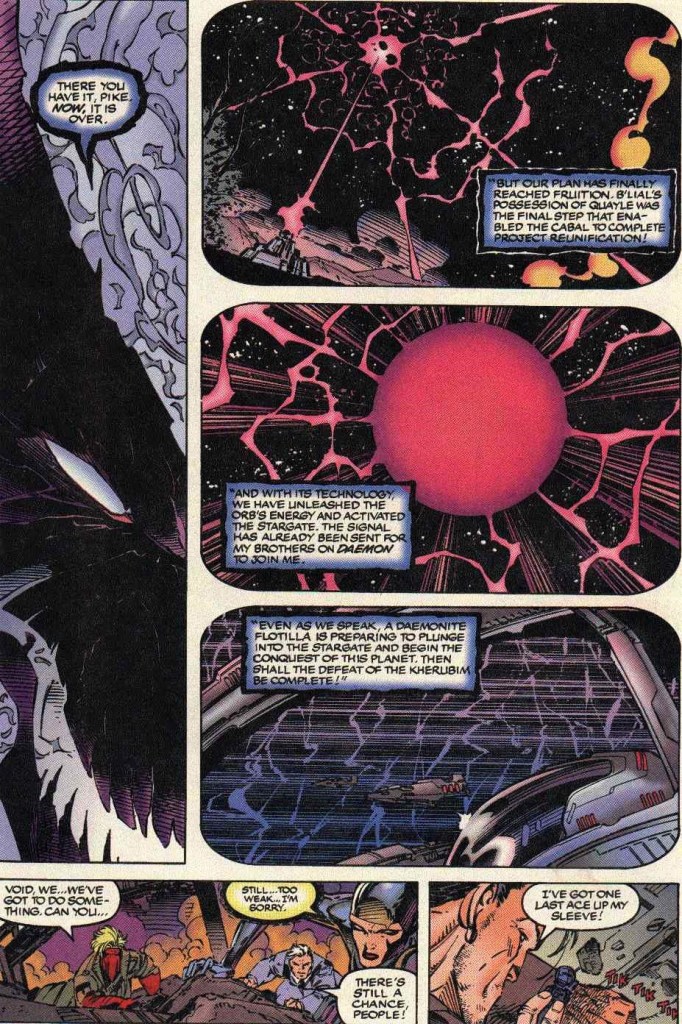
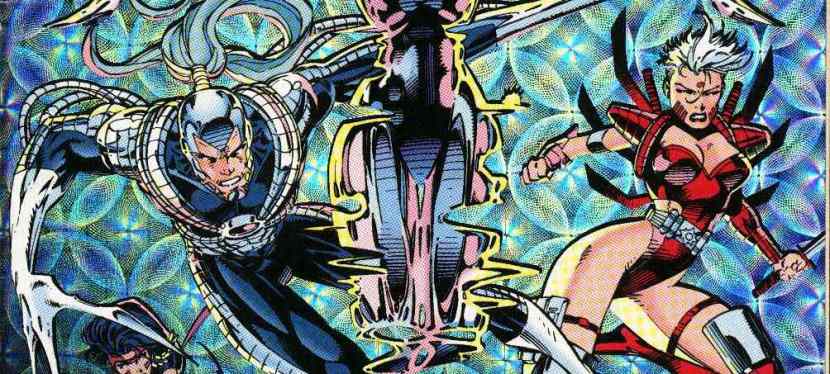
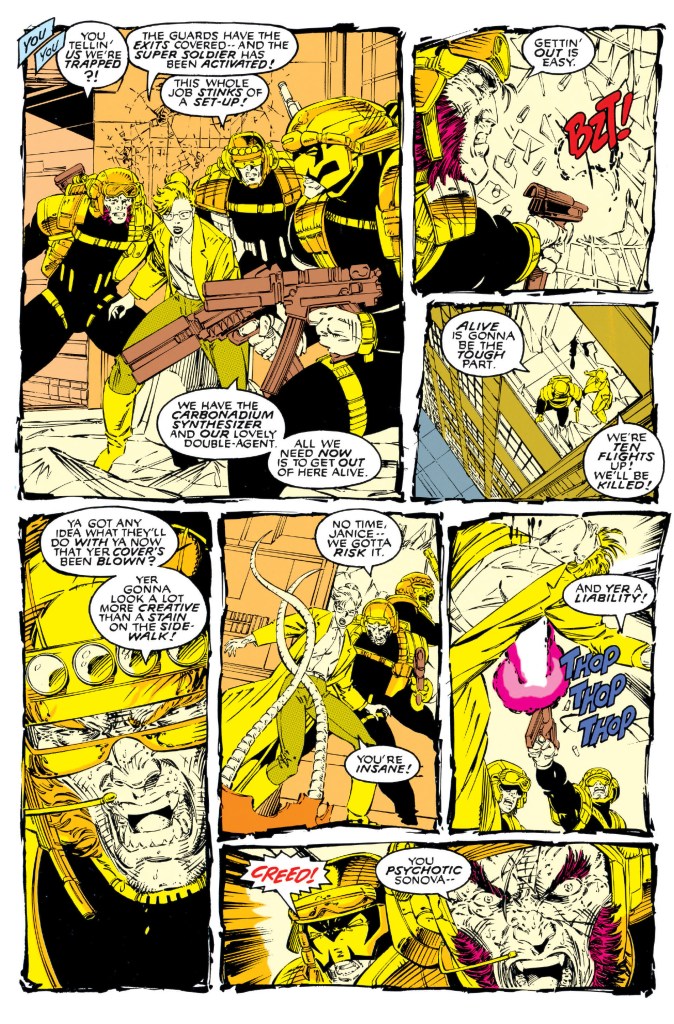
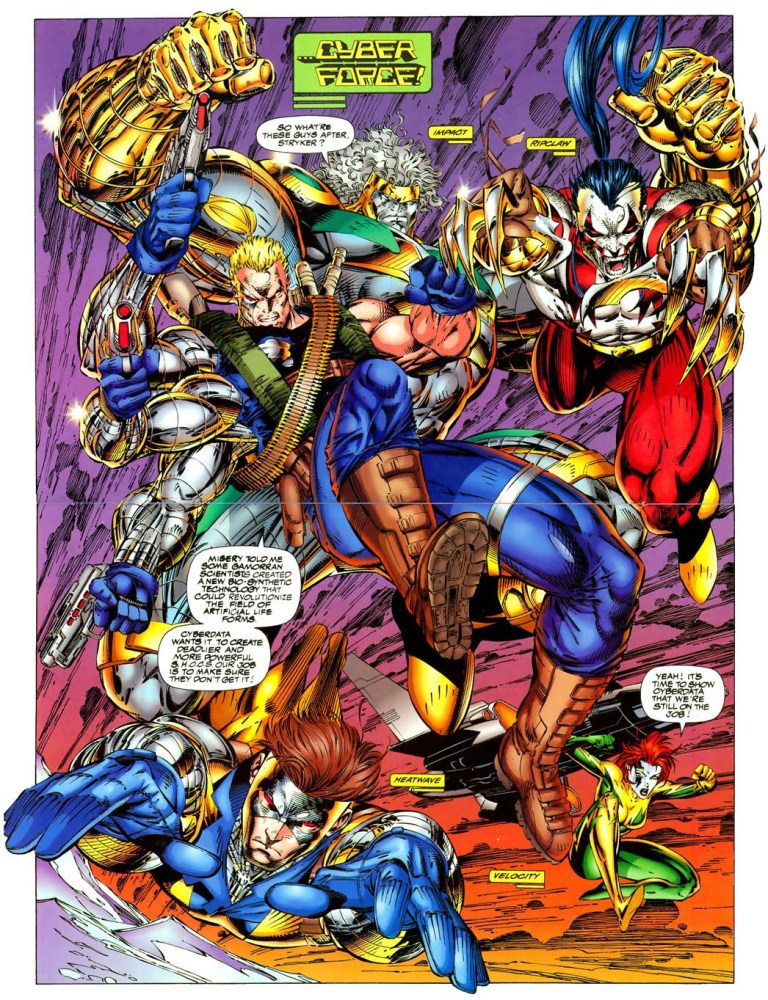
This is how Cyber Force looks like as drawn by Jim Lee.

To make things clear, WildC.A.T.S: Covert Action Teams #7 (1994) will strongly appeal to the respective fans of WildC.A.T.S and Cyber Force, to the readers who love high-quality superhero action, and to those who simply enjoy superhero crossover stories. While it is not a surprise that this comic book has great visuals, the writing this time clearly lacks depth and I really felt that the dialogue and text descriptions were done mainly to fit the obvious spectacle-led concept. If you are the kind of reader who wants storytelling and characterization prioritized in an action-packed crossover comic book, this one might not satisfy you. Ultimately, this one is a fun read even though the quality of the writing does not even come close to the quality of the visuals.  

If you are seriously planning to buy an existing hard copy of WildC.A.T.S: Covert Action Teams #7 (1994), be aware that as of this writing, MileHighComics.com shows that the near-mint copy of the regular edition costs $30 while the near-mint copy of the newsstand edition costs $90. The near-mint copy of the silver cover edition costs $300.

Overall, WildC.A.T.S: Covert Action Teams #7 (1994) is recommended.

+++++

Thank you for reading. If you find this article engaging, please click the like button below and also please consider sharing this article to others. If you are looking for a copywriter to create content for your special project or business, check out my services and my portfolio. Feel free to contact me with a private message. Also please feel free to visit my Facebook page Author Carlo Carrasco and follow me on Twitter at  @HavenorFantasy as well as on Tumblr at https://carlocarrasco.tumblr.com/
A Look Back at WildC.A.T.S: Covert Action Teams #4 (1993)

Disclaimer: This is my original work with details sourced from reading the comic book and doing personal research. Anyone who wants to use this article, in part or in whole, needs to secure first my permission and agree to cite me as the source and author. Let it be known that any unauthorized use of this article will constrain the author to pursue the remedies under R.A. No. 8293, the Revised Penal Code, and/or all applicable legal actions under the laws of the Philippines.

Welcome back superhero enthusiasts, 1990s culture enthusiasts and comic book collectors! Today we revisit the early days of Image Comics through Jim Lee’s WildC.A.T.S: Covert Action Teams comic book franchise which was one of the launch titles of the said company.

Last time around, I reviewed the third issue of the WildC.A.T.S mini-series and its quality was good enough for me. Other than the visual candies delivered by Jim Lee, WildC.A.T.S: Covert Action Teams #3 featured a crossover with Rob Liefeld’s very own Youngblood which was really surprising and intriguing back in those times.

With those details laid down, here is a look back at the final issue of the mini-series…WildC.A.T.S: Covert Action Teams #4, published by Image Comics through Malibu Comics in 1993 with a story written by Brandon Choi and Jim Lee. Lee did the art.

Jim Lee drew this cover very similarly to his cover art work on X-Men #4 (1992).

Early story

The story begins with Helspont already declaring victory as well as the beginning of his operation called Reunification which involves the use of the orb to activate a stargate which would allow his brethren of Daemonites to come to Earth to not only overwhelm the Kherubim but also to conquer the whole world. In his presence are two of his deadly companies standing with him and certain members of WildC.A.T.S – including their leader Jacob Marlowe – who are down on the rough surface having been hit hard moments earlier.

Suddenly a group composed of the six Youngblood members, Vice President Dan Quayle and WildC.A.T.S’ members Voodoo and Maul approach Helspont and his companions in an attempt to make them surrender.

As Voodoo realizes her power does not affect Helspont, the vicious Daemonite strikes the group with an energy blast aided by the orb and the high technology of the place. As this happens, Grift, Void and Jacob slowly make their moves. Jacob uses his communicator to send a signal to the heavily damaged Spartan…

Quality

WildC.A.T.S face strong opposition from the Gnome and his dangerous companions.

As the final tale of the mini-series, I can say that the script made for this comic book is a pretty satisfying read from start to finish. Like in issue #3, the pace here moves fast and there is a lot of spectacle that got executed while never overwhelming its narrative. More on the narrative, the conflict between the Kherubim and Daemonites is strongly symbolized by the WildC.A.T.S and Helspont’s forces going head to head. There are some pretty notable character moments that added to the fun factor such as Jacob sarcastically telling Helspont he could not access the back-up systems for his dreaded operation to bring the Daemonites to Earth.

Of course, this is not simply a WildC.A.T.S versus Helspont story in the good-versus-evil type of way. Apart from the inclusion of Rob Liefeld’s Youngblood, there is also the other dangerous party led by the Gnome who also have a strong interest in the orb. While their participation in the story happens pretty late, they do provide serious opposition against Jacob Marlowe and his team.

As mentioned earlier, there is a lot of action that expresses the intensity of the conflicts. While there is almost no room left for any real character development, the creators managed to craft a story that never felt brainless or unintelligent. As such, there is a lot of entertaining stuff to enjoy here and I personally find the establishment of WildC.A.T.S’ core concept to be solid and worth following.

Conclusion

As Helspont emphasizes his evil plan, Jacob Marlowe makes his move.

WildC.A.T.S: Covert Action Teams #4 (1993) is a not just a fun comic book to read. It is also a worthy conclusion to its mini-series and also it succeeded in establishing the WildC.A.T.S as both Jim Lee’s passion project and as one of the most worthy early titles of Image Comics. By the time I reached the end of this comic book, it became clear to me back in 1993 that Jim Lee was moving forward to a new territory on superhero comic book creations leaving behind his legacy with Marvel and their X-Men franchise. While this comic book ended the 4-issue mini-series, the funny thing was that Jim Lee and his team went on to start a regular comic book series of WildC.A.T.S: Covert Action Teams by actually publishing issue #5 (in late 1993) instead of starting with a brand new issue #1.

If you are seriously planning to buy an existing hard copy of WildC.A.T.S: Covert Action Teams #4 (1993), be aware that as of this writing, MileHighComics.com shows that the near-mint copy of the regular edition costs $20 while the near-mint copies of newsstand edition (without card) and the numbered-and-signed edition cost $48 and $160 respectively.

Overall, WildC.A.T.S: Covert Action Teams #4 (1993) is recommended.

+++++

Thank you for reading. If you find this article engaging, please click the like button below and also please consider sharing this article to others. If you are looking for a copywriter to create content for your special project or business, check out my services and my portfolio. Feel free to contact me with a private message. Also please feel free to visit my Facebook page Author Carlo Carrasco and follow me on Twitter at  @HavenorFantasy as well as on Tumblr at https://carlocarrasco.tumblr.com/
A Look Back at WildC.A.T.S: Covert Action Teams #3 (1993)

Disclaimer: This is my original work with details sourced from reading the comic book and doing personal research. Anyone who wants to use this article, in part or in whole, needs to secure first my permission and agree to cite me as the source and author. Let it be known that any unauthorized use of this article will constrain the author to pursue the remedies under R.A. No. 8293, the Revised Penal Code, and/or all applicable legal actions under the laws of the Philippines.

Welcome back superhero enthusiasts, 1990s culture enthusiasts and comic book collectors! Today we revisit the early days of Image Comics through Jim Lee’s WildC.A.T.S: Covert Action Teams comic book franchise which was one of the launch titles of the said company.

Last time around, I reviewed the 2nd issue of WildC.A.T.S. which literally had more meat in its storytelling as the required introductions of the core characters were over. Issue #2 had some really nice revelations as it helped expand the WildStorm universe a bit more and it was intriguing to see International Operations (I/O) emphasized more as the mini-series established the Kherubim-Daemonite conflict.

With those details laid down, here is a look back at WildC.A.T.S: Covert Action Teams #3, published by Image Comics through Malibu Comics in 1993 with a story written by Brandon Choi and Jim Lee. Lee did the art.

The cover.

Early story

The story begins inside the top-secret research facility of SDI with Maul holding a Daemonite disguised as US Vice President Dan Quayle off the ground with Spartan and Voodoo near him. The problem they have, however, is that the Youngblood team is facing them ready to fight. Shaft of Youngblood demands the release of the Vice President.

With his massive build, Maul lets go of the Vice President and hits Diehard sparking a battle between his team and Youngblood. Shaft tells his teammates that as they fight the three WildC.A.T.S, he wants them alive. The impostor Vice President Quayle tells Youngblood to kill them all.

After Diehard and Badrock knock off Maul, Chapel fires several blasts at Spartan to separate him from the impostor. Shaft then fires an arrow that generates disruptive sound which prevents Voodoo from executing her power.

Elsewhere within the facility, Grifter, Jacob Marlowe, Warblade, Void and Zealot quietly make their way to the control center where the Daemonite leader Helspont is overseeing secret operations…

Quality

You love Jim Lee-style action, you will find a lot to enjoy in this comic book.

Starting with the storytelling, this one is expectedly a natural progression from issue #2 but the key difference is that the pace moved much faster as there was more emphasis on action and visual splendor. Along the way another sub-plot was dramatized complete with the showing of additional characters Attica, Slag, HARM and their superior who are after a key object that happens to be a crucial part of Helspont’s operation. The way the script was written, the narrative was told in a disciplined manner even though the pace was faster and the creators had to integrate Rob Liefeld’s Youngblood which resulted one of the earliest Image Comics crossovers that unfortunately did not justify the fancy cover art. Given the addition of Youngblood, the mentioned sub-plot and the way the script was made, there was clearly no room left for character development. In my experience, re-reading this comic book’s story was fun and engaging enough.

As this story was action-packed, fans of Jim Lee will surely enjoy what he presented here. Even by today’s standards, the art and presentation of the spectacle is great to see! Personally, I like Jim Lee’s visual take on Youngblood (except that I still find Rob Liefeld’s drawing of Chapel more detailed) and the short-but-sweet battle between the two superhero teams is quite a spectacle. In terms of visual details, Lee drew the characters and environment with a lot of detail all throughout. There were no signs of rushed art here.

Conclusion

The battle between three WildC.A.T.S members and Youngblood begins!

As mentioned earlier, WildC.A.T.S: Covert Action Teams #3 (1993) is pretty entertaining and engaging. Compared to issue #2, this one has a lot more action and the narrative moved at a faster pace without becoming brainless. At the same time, there is a clear feeling that the stakes were raised as the WildC.A.T.S made their moves in what is clearly their final objective as a team. Also a factor here is the continued emphasis on the Kherubim-Daemonite war which was executed well. More on Rob Liefeld’s Youngblood being involved in the story, this results the illusion that Image Comics back then had a shared universe (note: read the legal stuff on the bottom of the credits). The crossover done here was more of an experiment done to emphasize the cooperation between Jim Lee and Liefeld as they were co-founders of Image.

If you are seriously planning to buy an existing hard copy of WildC.A.T.S: Covert Action Teams #3 (1993), be aware that as of this writing, MileHighComics.com shows that the near-mint copy of the gimmick cover edition costs $20 while the near-mint copies of newsstand edition and the signed editions cost $60 each.

Overall, WildC.A.T.S: Covert Action Teams #3 (1993) is recommended.

+++++

Thank you for reading. If you find this article engaging, please click the like button below and also please consider sharing this article to others. If you are looking for a copywriter to create content for your special project or business, check out my services and my portfolio. Feel free to contact me with a private message. Also please feel free to visit my Facebook page Author Carlo Carrasco and follow me on Twitter at  @HavenorFantasy as well as on Tumblr at https://carlocarrasco.tumblr.com/
A Look Back at WildC.A.T.S: Covert Action Teams #2 (1992)

Disclaimer: This is my original work with details sourced from reading the comic book and doing personal research. Anyone who wants to use this article, in part or in whole, needs to secure first my permission and agree to cite me as the source and author. Let it be known that any unauthorized use of this article will constrain the author to pursue the remedies under R.A. No. 8293, the Revised Penal Code, and/or all applicable legal actions under the laws of the Philippines.

Welcome back superhero enthusiasts, 1990s culture enthusiasts and comic book collectors! Today we revisit the early days of Image Comics through Jim Lee’s WildC.A.T.S: Covert Action Teams comic book franchise which was one of the launch titles of the said company.

For the newcomers reading this, Jim Lee is one of the co-founders of Image Comics and during his previous stint with Marvel Comics, he was instrumental in modernizing the X-Men both visually and creatively (note: look at all the paramilitary elements implemented during his X-Men days). WildC.A.T.S was his independent superhero team project which went on to not only grow as a comic book franchise in the 1990s, but also became an animated TV series. WildC.A.T.S dealt with conspiracy as well as aliens from outer space.

With those details laid down, here is a look back at WildC.A.T.S: Covert Action Teams #2, published by Image Comics in 1992 with a story written by Brandon Choi and Jim Lee. Lee did the art.

The cover.

Early story

The story begins in the headquarters of International Operations (I/O) whose officials have been monitoring a situation far away. Suddenly a portal appeared inside I/O which surprised director Lynch and his fellow officials. Seen through the portal – which appeared for only seconds in front I/O’s people – were Jacob Marlowe, Spartan, Grifter, Maul, Zealot, Voodoo, Void and Warblade who just escaped from certain death which is connected to the explosion monitored by I/O.

The WildC.A.T.S instantly arrived inside their highly advanced aircraft safe and sound. After some talk, they begin to move to a safehouse of Grifter’s near Quantico…

Quality

An efficient exposition about the science fiction concept of WildC.A.T.S.

As far as storytelling goes, this comic book has more depth to its plot. While the first issue was filled with introductions of characters and story concepts as well starting its narrative in cryptic fashion, there was more freedom in this issue for the writers to properly structure their story, gradually build-up tension, execute payoffs satisfactorily while still managing to insert spectacle to complete the work. The story moved with a moderate pace and things moved fast when it was needed. I find re-reading this WildC.A.T.S tale a more satisfying experience than before and it is also an improvement over the first issue.

More on the core concept about Daemonites infiltrating human societies on Earth with the involvement of the Cabal to enhance their efforts, there literally more meat to chew here as Jim Lee and Brandon Choi came up with clever and efficient ways on executing exposition. The I/O meanwhile literally jumped from being background decoration into the main story as a connection was made between one of the top officials of the organization and WildC.A.T.S leader Marlowe.

More on the WildC.A.T.S themselves, you will get to know more about each member and how their respective personalities differ from each other as they all struggle to keep up with the changes around them. Voodoo here is still the witness of a conflict she never anticipated would involve her and many times she is clueless and really struggling to figure out what has been happening. While Marlowe has the strong tycoon mentality all throughout, Spartan is the dedicated and focused operator while Grifter is the cocky gunslinger and Zealot is the battle-hardened warrior whose perception about life and survival could make readers wonder if she is truly brave or truly reckless. With the introductions of each character already done, in issue #1 it was no surprise that there was a bit more space for the creators to define each team member with limited space (pages) they had during comic book production.

Conclusion

In the heat of the action, something visceral happened with Voodoo who is not even a fighter.

The best way to describe WildC.A.T.S: Covert Action Teams #2 (1992) is that its core concept as well as its mini-series plot really started to take shape as Brandon Choi and Jim Lee got over all the creative hurdles in issue #1. The result was not only more focus on plotting but executing payoff for story build-up, characterization and putting enough action in a rather disciplined way. There was no sign of creative rush by Choi and Lee here. I should also state that it is in this same comic book where you will see more interesting traits of the WildC.A.T.S members which, in my experience, made me anticipate the next issue.

As one of the very early comic books of Image Comics, this one had one of the first, if not the first, gimmick covers of the said publisher and I can say that its content was good enough to justify the flashy cover and its rather high cover price of $2.50 (note: back in 1992 many of Marvel’s and DC’s comic books had cover prices of $1.25 while WildC.A.T.S: Covert Action Teams #1 had a $1.95 cover price). I could not forget the day in 1992 when I visited a local comic book specialty store in Makati that had WildC.A.T.S: Covert Action Teams #2 (1992) displayed with its cover really shining under a strong light source. I also remember there were others in the store staring at it.

If you are seriously planning to buy an existing hard copy of WildC.A.T.S: Covert Action Teams #2 (1992), be aware that as of this writing, MileHighComics.com shows that the near-mint copy of the gimmick cover edition costs $20 while the near-mint copies of the signed gimmick cover edition and the newsstand edition cost $60 each.

Overall, WildC.A.T.S: Covert Action Teams #2 (1992) is recommended.

+++++

Thank you for reading. If you find this article engaging, please click the like button below and also please consider sharing this article to others. If you are looking for a copywriter to create content for your special project or business, check out my services and my portfolio. Feel free to contact me with a private message. Also please feel free to visit my Facebook page Author Carlo Carrasco and follow me on Twitter at  @HavenorFantasy as well as on Tumblr at https://carlocarrasco.tumblr.com/
A Look Back at X-Men #6 (1992)

Disclaimer: This is my original work with details sourced from reading the comic book and doing personal research. Anyone who wants to use this article, in part or in whole, needs to secure first my permission and agree to cite me as the source and author. Let it be known that any unauthorized use of this article will constrain the author to pursue the remedies under R.A. No. 8293, the Revised Penal Code, and/or all applicable legal actions under the laws of the Philippines.

Welcome back, superhero enthusiasts, fans of the 2099 universe of Marvel Comics, 1990s culture enthusiasts and comic book collectors! Today we revisit the adjective-less X-Men comic book series that first launched in 1991 and it has been quite some time since my last retro review of one of the early issues drawn by Jim Lee got published. For the newcomers reading this, my retro review of X-Men #5 (1992) had Wolverine encountering Omega Red.

With those details laid down, here is a look back at X-Men #6, published by Marvel Comics in 1992 with a story plotted and drawn by Jim Lee, scripted by Scott Lobdell and inked by Art Thibert.

The cover.

Early story

The story begins inside a facility in Berlin. Cyclops and Beast easily knocked out the armed guards there with Jubilee following them. As they slowly walk and talk, Omega Red suddenly appears out of nowhere surprising them and hitting Beast directly on the head.

As Omega Red quickly subdues Cyclops with his coils, Jubilee tries to use her power to help her teammate. The Russian, however, unleashes his lethal pheromones into the air which weakens Jubilee. After Omega Red knocks her out, he communicates with Matsuo. It turns out Wolverine still could not be located since he escaped from them.

Elsewhere, Wolverine is being revived by someone…

Quality

Members of the Blue Team in action.

Being the 3rd issue published after the departure of Chris Claremont (last work was X-Men #3), this comic book daringly continues to expand the lore of X-Men with paramilitary concepts, the further exploration of the untold story from Wolverine’s past as a special operative, and the growing threat against the X-Men posed by Omega Red and the organization that revived him. This was clearly Jim Lee’s vision and his way of modernizing the X-Men into the 1990s. It is unsurprisingly grittier in presentation when compared to how the X-Men were presented during Claremont’s time and fortunately the story was told satisfyingly.

I say satisfyingly because this comic book even made room to bring back Dazzler, Longshot and the monstrous Mojo all modernized by Jim Lee. Their insertion into the story really came out of nowhere and felt really jarring after getting myself immersed into the current X-Men story. At this point in the series, the creative team led by Lee really wanted to shake the X-Men storytelling and keep things fresh, if not interesting, for the fans. Speaking of Dazzler, the character made her first appearance way back in 1980’s Uncanny X-Men #130, was featured in her own monthly series and became a regular in the X-Men in the mid-1980s. As such, her sudden return in this comic book was pretty much an opportunity by the creative team to link the present-day X-Men with the X-Men from the mid-1980s which resulted added variety.

Conclusion

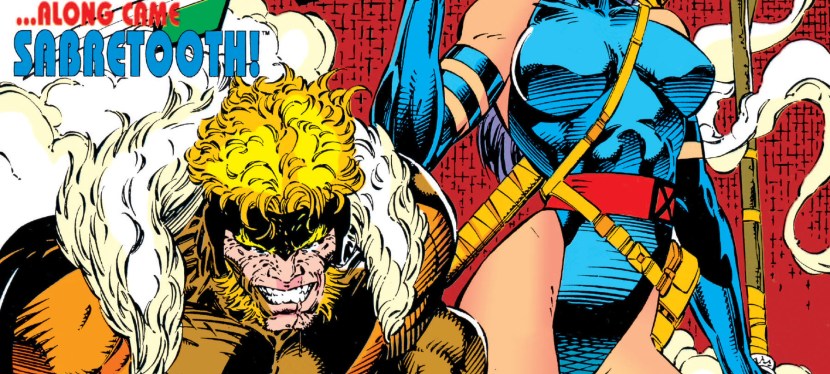
When Wolverine and Sabretooth were CIA operatives.

While X-Men #6 (1992) indeed has a more bloated narrative as more characters were crammed in, more flashback scenes and attempts to add moments of twists and intrigue, I still had fun reading it. Unlike the previous two issues under the direction of Jim Lee, this comic book requires a more concentrated reading in order to fully grasp the narrative while also paying attention to the return of Longshot, Dazzler and the others. More on the X-Men themselves, you will get to see the Blue Team in action and really struggle against the group that has Omega Red. When it comes to intriguing character moments, you will see here the start of the build-up on the respective stories of the Psylocke-Kwannon storyline as well as Gambit’s connection with Sabretooth.

If you are seriously planning to buy an existing hard copy of X-Men #6 (1992), be aware that as of this writing, MileHighComics.com shows that the near-mint copy of the regular edition costs $40 while the near-mint copies of the newsstand and Toy Biz editions cost $120 and $100 respectively.

Overall, X-Men #6 (1992) is recommended.

+++++

Thank you for reading. If you find this article engaging, please click the like button below and also please consider sharing this article to others. If you are looking for a copywriter to create content for your special project or business, check out my services and my portfolio. Feel free to contact me as well. Also please feel free to visit my Facebook page Author Carlo Carrasco and follow me at HavenorFantasy@twitter.com

A Look Back at Uncanny X-Men #304 (1993)

Disclaimer: This is my original work with details sourced from reading the comic book and doing personal research. Anyone who wants to use this article, in part or in whole, needs to secure first my permission and agree to cite me as the source and author. Let it be known that any unauthorized use of this article will constrain the author to pursue the remedies under R.A. No. 8293, the Revised Penal Code, and/or all applicable legal actions under the laws of the Philippines.

Welcome back, X-Men fans, superhero enthusiasts, 1990s culture enthusiasts and comic book collectors! Today we go back to the 30th anniversary celebration of the X-Men which took place in 1993. Back then, Marvel Comics went full blast with the anniversary celebration of their mutants by releasing related merchandise, posters and comic books with gimmick covers (note: read my retro review of 1993’s X-Men #25) that came with high prices.

To put things in perspective regarding 1993, Marvel’s X-Men line of comics had monthly series of Uncanny X-Men, X-Men (Volume 2), X-Force, X-Factor, Excalibur, Wolverine and Cable. X-Factor #92 marked the start of the Fatal Attractions storyline which was the basis for the X-Men 30th anniversary celebration. X-Force #25 was released and it not only brought Cable back but also Magneto.  

Then came the 3rd chapter of the Fatal Attractions storyline which was published in Uncanny X-Men #304. Not only did that particular comic book bring together many mutants and moved the storyline forward to a crucial stage (note: tension leading to it was built up in Uncanny X-Men #300, Uncanny X-Men #303 and also in X-Men Unlimited #1), it also served as the very celebration of the 30th anniversary of the X-Men (although it was not the storyline’s conclusion as the plot continued in X-Men #25, Wolverine #75 and Excalibur #71).

So did this particular, anniversary celebrating issue of the Uncanny X-Men succeed with its objectives? Has it aged well through the decades? We can all find out in this look back at Uncanny X-Men #304, published in 1993 by Marvel Comics with a story written by Scott Lobdell and drawn by John Romita, Jr., Jae Lee, Chris Sprouse, Brandon Peterson and Paul Smith.

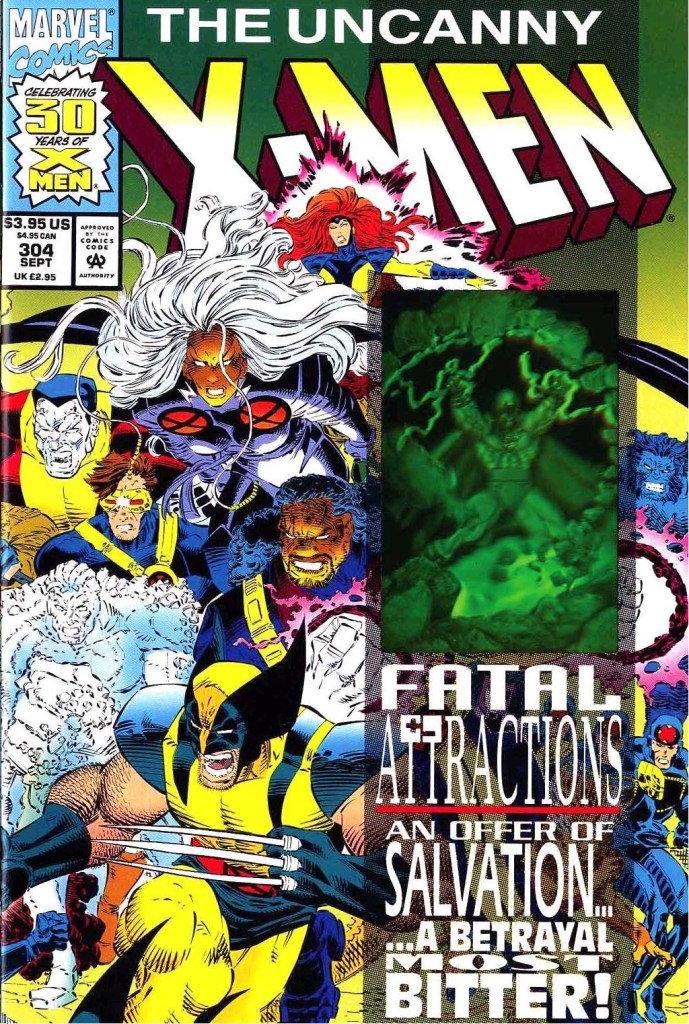
The cover.

Early story

The story begins with division among the Acolytes who learned that their lord Magneto actually survived (note: refer to 1991’s X-Men #3 by Chris Claremont and Jim Lee). They ganged up against their leader Fabian Cortez for betraying Magneto. After pushing his now rebellious team members away, Cortez reminds them that for several months already, they have been continuing Magneto’s work on behalf of mutantkind. Suddenly Exodus appears to them and describes himself as the voice of Magneto and will guide mutants to rise and mentions paradise for the faithful mutants. After subduing Cortez and tempering the tension among the Acolytes, Exodus tells them to prepare themselves for ascension. This frustrates Cortez who realizes that he no longer holds leadership.

Over at the X-Men’s headquarters, Charlez Xavier is personally disturbed over the death of Illyana Rasputin, the sister of Colossus. He starts questioning himself as Illyana’s death under his watch makes his years-long mission (of convincing his fellow mutants to leave their old lives to take risks to fight for a world that fears and hates them) doubtful and tries to figure out how he could present himself in front of them. A holographic image of Lilandra appears to him.

In outer space, inside the space station called Avalon, Magneto stares at planet Earth. With nobody around him, he speaks apologizing to his followers for he cannot save them all. He also mentions that he was wrong in previously believing that he could rescue each and every one of them from humanity as he recently realized that Earth, for the moment, is doomed.

After walking an unspecified distance inside Avalon, Magneto picks up his old helmet and wears it…

Quality

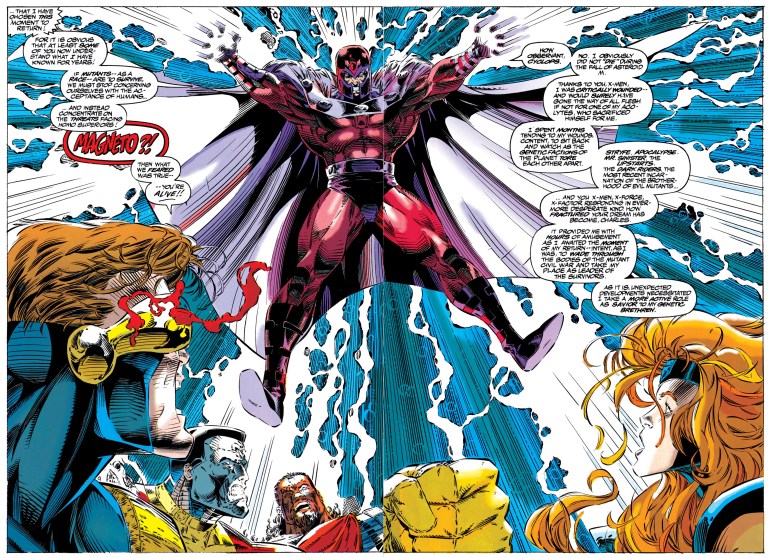
This 2-page art by Brandon Peterson is easily the best looking part of the comic book.

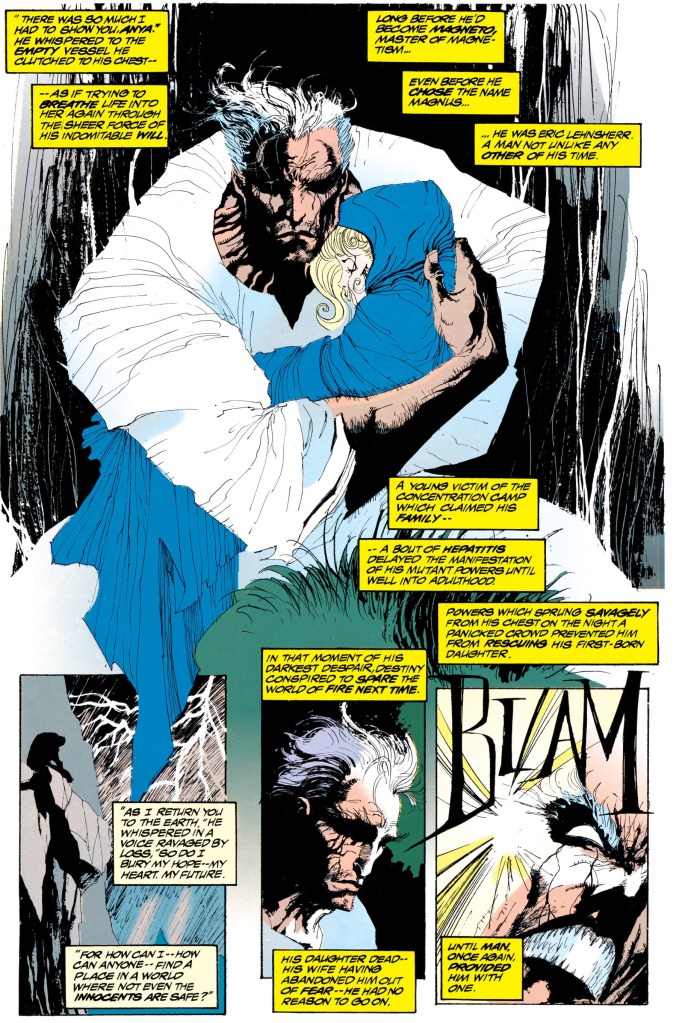
I will start with the visual aspect of this comic book. The artistic quality ranges from fine to weird which should not be surprising since this one involved five artists. The 4 pages drawn by Brandon Peterson (who was once a regular artist on Uncanny X-Men) made the X-Men, Magneto and the Acolytes look not only good but also intense. The Peterson art here is artistically similar to the respective styles of Marc Silvestri and Jim Lee of that particular time. Jae Lee’s art on the flashback of Magneto’s life (during the time of the Nazi occupation in Europe) is undoubtedly very stylized. While his art brings out the intensity of Magneto’s painful past, certain images can be a little challenging to understand especially to readers who focus strongly only following the plot and details. John Romita, Jr.’s art, for me personally, often looks rough and there were times I hardly recognized the characters. The other artworks by Paul Smith and Chris Sprouse have cartoonish aesthetics.

This is Jae Lee’s artistic contribution to the comic book. I found it weird that Magneto’s hair was shown as white during his past with the Nazis.

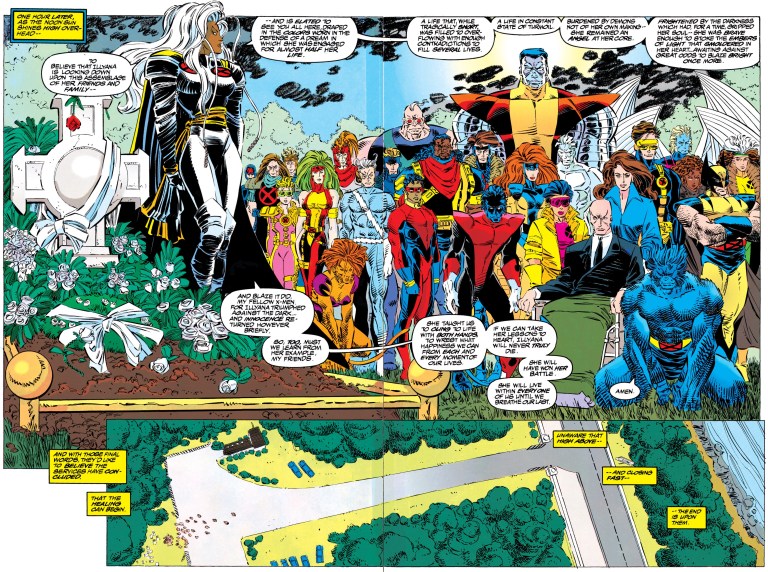
As for the plot, I can clearly see that a hard effort was made to compose a story that would push the Fatal Attractions storyline forward, establish a turning point and still become worthy of celebrating the 30th anniversary of the X-Men franchise. I can say that the storytelling is somewhat bloated. Early in the story, it was made clear that the respective sections showing Exodus with the Acolytes, Charles Xavier and Magneto pointed to an eventual confrontation that happened during the funeral of Illyana Rasputin.

As the build-up continued with the flashback of Magneto’s life, the fan service short scene of Kitty Pryde and the unfeeling Colossus (note: their romance was highlighted in Uncanny X-Men many years prior), and the talk scene between Bishop and Banshee, the pace of the story slowed down dramatically. By the time the attempt to move the narrative back to the core plot was made with the funeral scene (composed of the X-Men, X-Force and X-Factor), the pace was still really way down. By the time the conflict with Magneto, Exodus and the Acolytes stated, the pace recovery was incomplete and as such, seeing the scene unfold was very jarring (and not even the pages of Colossus’ frustration towards Professor X could solve the narrative pacing problem).

Unsurprisingly, the conflict was written to be overly dramatic complete with lengthy pieces of dialogue here and there. That being said, references to past comic books were established as Magneto once again emphasizes his beliefs about the human-mutant conflict using violence (while also side-stepping Jean Grey’s psionic powers to allow the Acolytes to come in undetected).

Human-mutant conflict aside, themes about faith, religion, idolatry salvation are clearly used. Magneto, who has a tremendous record of villainy and his previous leadership of the X-Men proved useless, was portrayed to be a walking wicked idol whose followers cannot do anything except idolize him and cause violence out of dedication to him. They really could not realize that idolatry is foolish and unholy which further adds to chaos on the world. As Magneto deceived himself to be the savior and lord of mutants, he further causes more pain and destruction to others around him. In short, Magneto will always be stuck with his wicked nature and clearly does not deserve heavenly authority no matter how hard he believes himself to be a savior.

The classic rivalry between Xavier and Magneto here was portrayed dramatically and yet I cannot help but think that their conflict was nothing more than a repeat of past encounters with the state and future of mutants at stake. To be fair, what happened here served as a logical build-up for the shocking encounter between Professor X and Magneto in X-Men #25.

Conclusion

Nobody among the X-Men (except Charles Xavier), X-Force, Excalibur and X-Factor cared to dress properly for the funeral.

To be clear, even though I am an avid X-Men fan, I find Uncanny X-Men #304 (1993) hard to be engaged with and hard to enjoy. Efforts to make it a worthy celebration of the X-Men are very clear but it’s just not entertaining nor compelling to read. As for the X-Men traitor scene, the revelation was not that shocking as the foreshadowing made it too obvious. At best, this comic book served as a warm-up for X-Men #25 which itself paid-off nicely. Being more than sixty pages long (including the advertisement and bulletins), this comic book has too much creative baggage which ultimately hampered its storytelling. It’s not terrible. It’s really not that great to read. What I experienced way back in 1993 with this comic book is just the same as I re-read it. It has not aged well.

If you are seriously planning to buy an existing hard copy of Uncanny X-Men #304 (1993), be aware that as of this writing, MileHighComics.com shows that the near-mint copy of the regular edition costs $20, while the near-mint copies of the signed-and-numbered edition and the newsstand edition cost $120 and $60 respectively.

Overall, Uncanny X-Men #304 (1993) is satisfactory.

+++++

Thank you for reading. If you find this article engaging, please click the like button below and also please consider sharing this article to others. If you are looking for a copywriter to create content for your special project or business, check out my services and my portfolio. Feel free to contact me as well. Also please feel free to visit my Facebook page Author Carlo Carrasco and follow me at HavenorFantasy@twitter.com

A Look Back at X-Men #5 (1992)

Disclaimer: This is my original work with details sourced from reading the comic book and doing personal research. Anyone who wants to use this article, in part or in whole, needs to secure first my permission and agree to cite me as the source and author. Let it be known that any unauthorized use of this article will constrain the author to pursue the remedies under R.A. No. 8293, the Revised Penal Code, and/or all applicable legal actions under the laws of the Philippines.

Welcome back, superhero enthusiasts, comic book collectors, fans of 1990s culture and fans of Marvel Comics! Today we revisit the adjective-less X-Men monthly series (Volume 2) that started in 1991 with the combined talents of Chris Claremont and Jim Lee. For those who are unaware, Chris Claremont had his conflict behind the scenes with then X-Men comics editor Bob Harras which led to him departing the X-Men series with issue #3.

Previously I reviewed X-Men #4 which by today’s standards is highly significant and very expensive to acquire as it marked the literary debut of Omega Red who made quite an impact with X-Men fans. It should be noted that Wolverine and Omega Red had encountered each other far back in time and issue #4 marked the renewal of their rivalry.

With those details laid down, here is a look back at X-Men #5, published in 1992 by Marvel Comics with a story written by Jim Lee (plot) and John Byrne (script), The art was done by Lee with ink work done by Scott Williams, Art Thibert, Bob Wiacek and Joe Rubinstein.

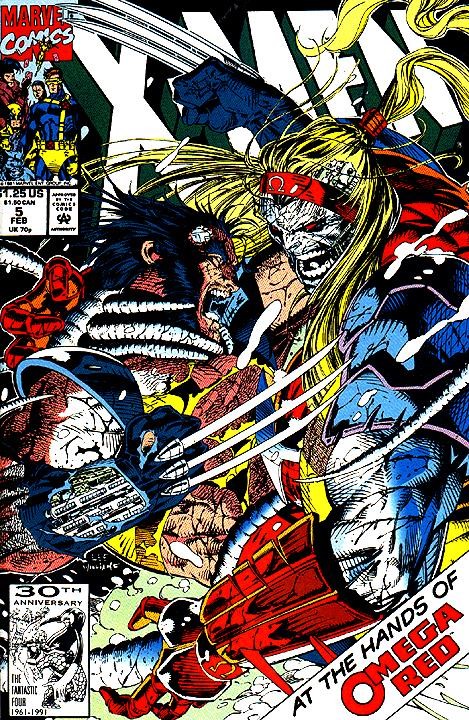
The cover.

Early story

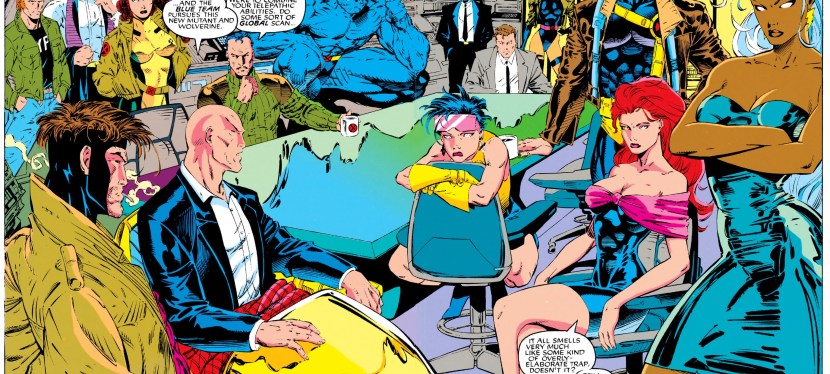
This for me is the money shot of the comic book. Although Wolverine is absent, you get to see the entire Blue and Gold teams with Charles Xavier as drawn by Jim Lee.

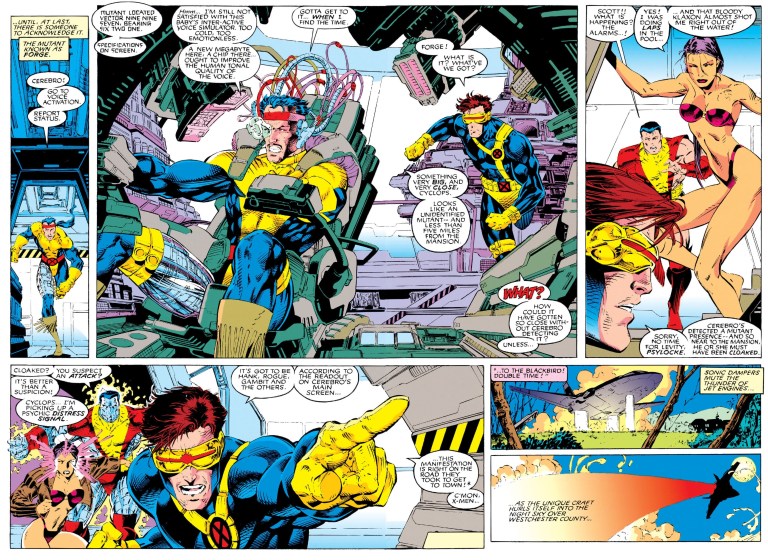
The story begins with Cerebro detecting an unidentified mutant signature in the presence of X-Men members who were out of the mansion. Forge tells Cyclops about the disturbance happening less than five miles away from their mansion. Colossus and Psylocke join in and quickly they leave the mansion with Cyclops using the Blackbird.

Not too far away, Gambit, Rogue, Jubilee and Beast are held captive inside a vehicle with an armed man in their presence. Gambit starts the effort to free his teammates using one of his charged cards.

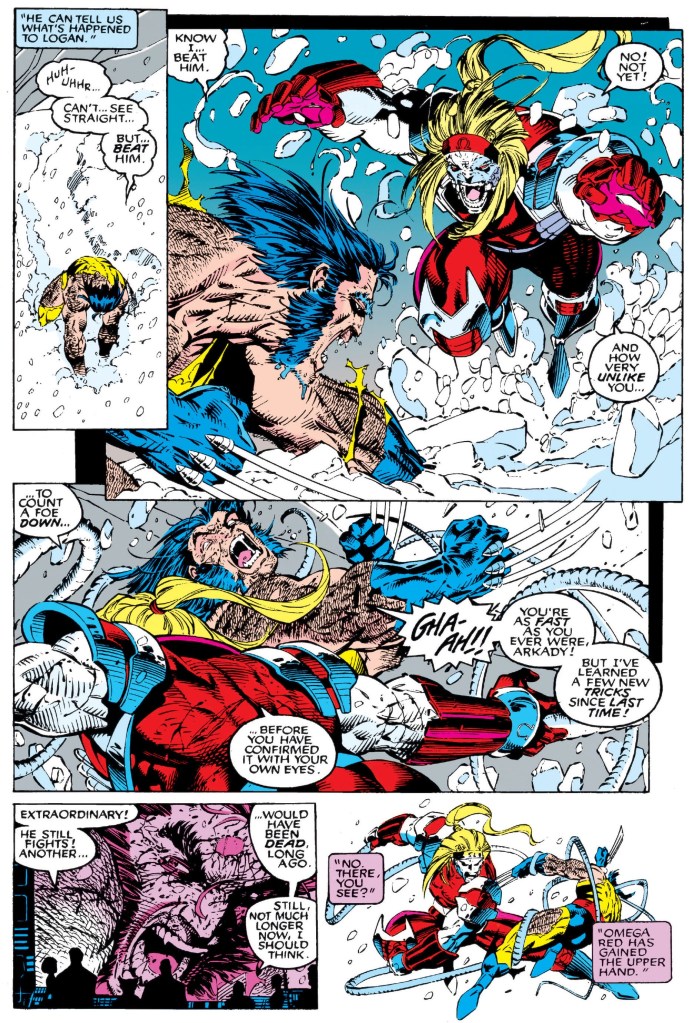
Elsewhere in a snowy place, Wolverine is seen struggling thinking he defeated his old rival Omega Red. Suddenly the Russian mutant jumped at him and the two resumed fighting. Their fight is being monitored from a distance…

Quality

The Wolverine-Omega Red rivalry is a must-see.

When it comes to storytelling, it is obvious that the writing duo of Jim Lee and John Byrne did their best to push the envelope and break new ground as far as telling an X-Men story goes. For one thing, there is the presence of paramilitary elements which are common with Jim Lee’s creations. There are even flashbacks into the past in which Wolverine (then called Logan) actually took part in a special forces operation with a few notable others. These flashbacks expands further the personal history of Wolverine in a really intriguing way. With the way the story was presented, it is clear that the new creative team pulled off serious moves in modernizing the way X-Men stories were told in comparison to the way Chris Claremont told all those many such stories during his long run.

When it comes to the visuals, Jim Lee did another great job as each page looks great and he proved to be clever with the way he visualized the script. As this comic book was inked by more than one inker, there were subtle differences with regards to contrast as well as ink intensity.

Conclusion

Cyclops and his teammates move out.

X-Men #5 (1992) is another great comic book that involved Jim Lee’s art. Apart from the modernizing of the storytelling, this comic book further expanded the past of Wolverine while successfully giving readers more of Omega Red who is now a major supervillain of Marvel’s.

If you are seriously planning to buy an existing hard copy of X-Men #5 (1992), be aware that as of this writing, MileHighComics.com shows that the near-mint copy of the regular edition costs $27 while the near-mint copy of the newsstand edition costs $79.

Overall, X-Men #5 (1992) is highly recommended!

+++++

Thank you for reading. If you find this article engaging, please click the like button below and also please consider sharing this article to others. If you are looking for a copywriter to create content for your special project or business, check out my services and my portfolio. Feel free to contact me as well. Also please feel free to visit my Facebook page Author Carlo Carrasco and follow me at HavenorFantasy@twitter.com

A Look Back at X-Men #4 (1992)

Disclaimer: This is my original work with details sourced from reading the comic book and doing personal research. Anyone who wants to use this article, in part or in whole, needs to secure first my permission and agree to cite me as the source and author. Let it be known that any unauthorized use of this article will constrain the author to pursue the remedies under R.A. No. 8293, the Revised Penal Code, and/or all applicable legal actions under the laws of the Philippines.

Welcome back, superhero enthusiasts, comic book collectors and X-Men fans! Previously, I reviewed X-Men #3 (1991) which, at the time of its release, marked the end of the era of Chris Claremont who spearheaded the development and storytelling of the X-Men since the mid-1970s. Along the way, he clashed with X-Men books editor Bob Harras behind the scenes at the headquarters of Marvel Comics which was a factor to his departure. It is notable that Claremont returned to Marvel in 1997 as editorial director.

Going back to 1991, Marvel had Jim Lee as their top-notch talent to sell loads of X-Men comic books to buyers. Inevitably as Claremont departed, Marvel bet big on Lee and supported his move to set a new creative direction for the X-Men.

With those details laid down, here is a look back at X-Men #4, published in 1992 by Marvel Comics with a story by Jim Lee and John Byrne. Lee drew the comic book with Scott Williams as the inker.

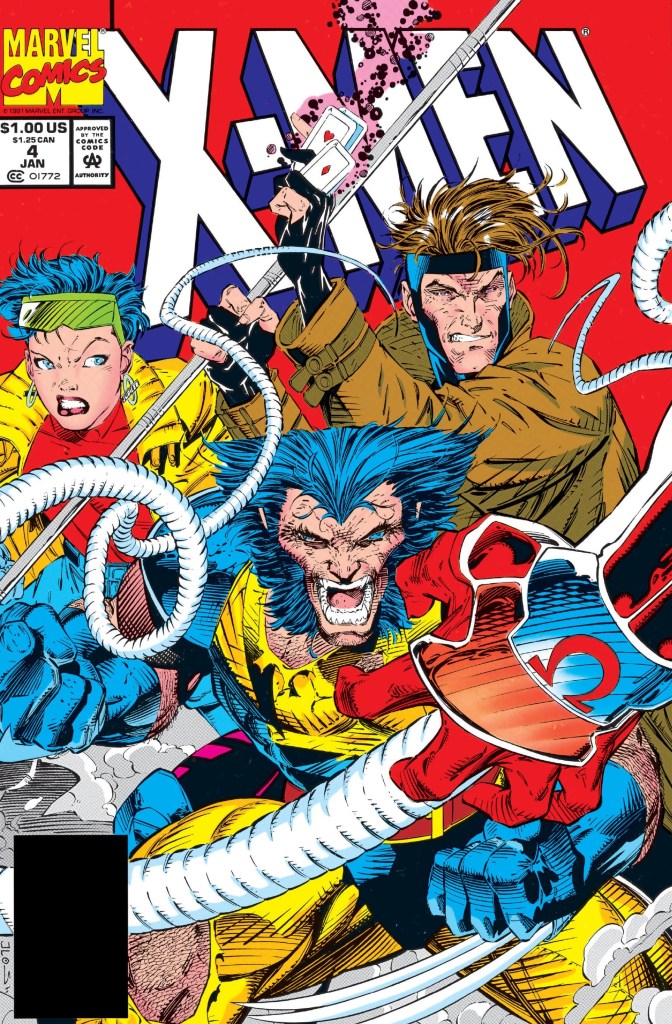
The cover.

Early story

The story begins in a secret facility in the South Pacific. A sleeping figure wakes up and the men wearing protective suits near him carefully observe his moves. Suddenly, the men died horribly. The figure, with white-colored skin and long blond hair, says, “Who has brought me back from the dark domain of death? Who has summoned Omega Red?”

Behind a protective window, a man starts talking to Omega Red and he shows him a picture of Wolverine (in his civilian identity). Omega Red recognizes Logan…

Quality

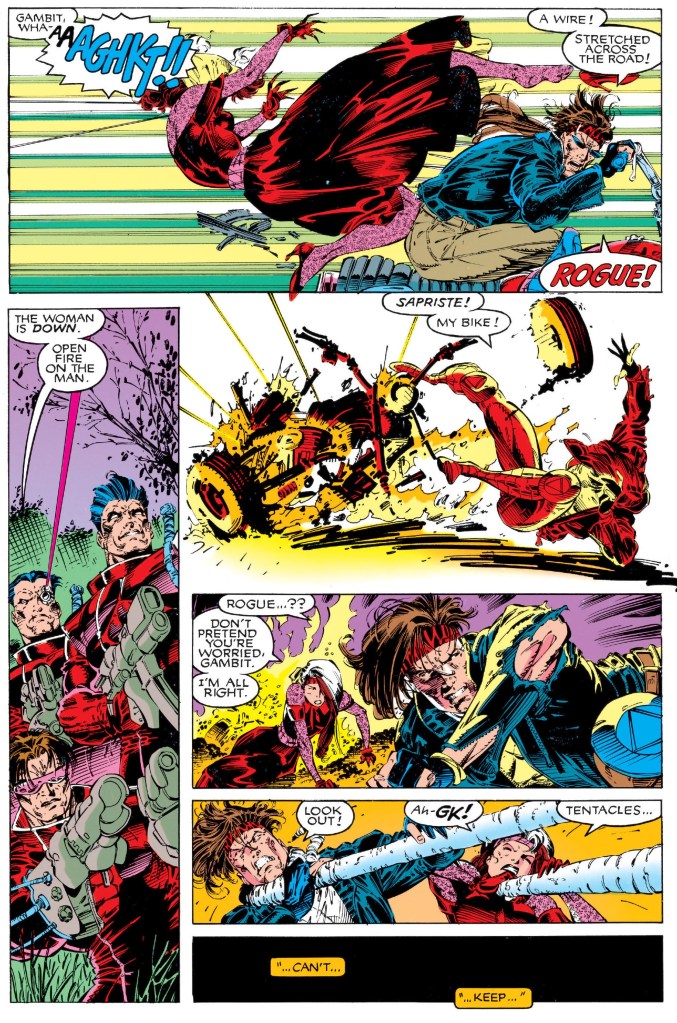
Gambit and Rogue in the heat of action.

Being one of the first X-Men comic books published in the so-called post-Claremont era, this comic book has a solid story and a lively presentation of the X-Men’s Blue Team members. I figured that John Byrne delivered the solid dialogue given his previous experience of working on X-Men comics (as an illustrator) as well as being the writer and artist of the memorable The Man of Steel mini-series (with DC Comics, rebooting Superman in the post-Crisis era).

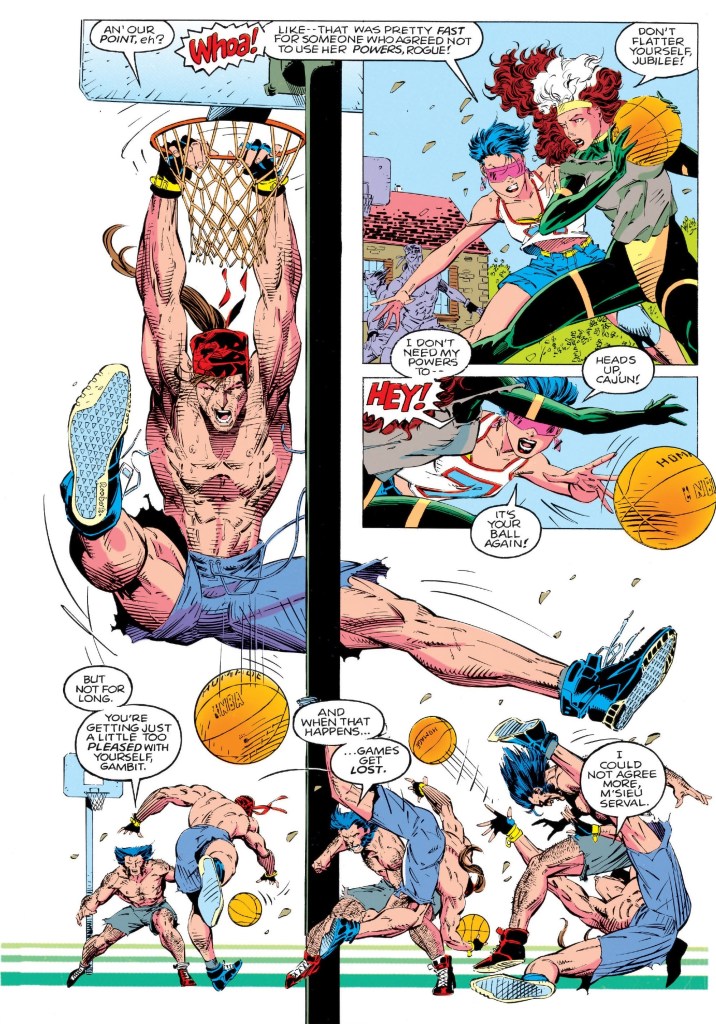
While the basketball scene had true-to-character portrayals of Wolverine, Gambit, Psylocke and Jubilee complete with stylish dialogue per character, there is consistency on the portrayal of Moira MacTaggert who is understandably struggling to recover given the events of X-Men #1 to #3. The same goes with Charles Xavier. The way the script was written with strong focus on the established characters, it’s almost as if Chris Claremont never left.

The biggest feature of this comic book is the debut of the deadly mutant Omega Red who is of Russian heritage and Russia’s own parallel to the United States’ own super soldier Captain America. In pop culture, Omega Red is one of the top villains in comic books ever and this comic book sets up his sudden rise to prominence. Symbolically, Omega Red is a co-creation of Jim Lee and John Byrne and it is pretty fitting for this comic book of the post-Claremont era to feature him.

Conclusion

You love basketball?

There is no doubt that even by today’s standards, X-Men #4 (1992) is a great read and a landmark issue in X-Men comic book history. Given its content, this one will always be remembered as the start of Omega Red who later on proved to be one of the deadliest villains Marvel’s mutants ever encountered. The villain went on to appear in the video games X-Men: Children of the Atom, Marvel Super Heroes vs. Street Fighter and Marvel vs. Capcom 2.

If you are seriously planning to buy an existing hard copy of X-Men #4 (1992), be aware that as of this writing, MileHighComics.com shows that the near-mint copy of the regular edition costs $125 while the near-mint copy of the newsstand edition costs $375.

Overall, X-Men #4 (1992) is highly recommended!

+++++

Thank you for reading. If you find this article engaging, please click the like button below and also please consider sharing this article to others. If you are looking for a copywriter to create content for your special project or business, check out my services and my portfolio. Feel free to contact me as well. Also please feel free to visit my Facebook page Author Carlo Carrasco and follow me at HavenorFantasy@twitter.com

A Look Back at What If #13 (1990)

Disclaimer: This is my original work with details sourced from reading the comic book and doing personal research. Anyone who wants to use this article, in part or in whole, needs to secure first my permission and agree to cite me as the source and author. Let it be known that any unauthorized use of this article will constrain the author to pursue the remedies under R.A. No. 8293, the Revised Penal Code, and/or all applicable legal actions under the laws of the Philippines.

Welcome back superhero enthusiasts, comic book collectors and X-Men fans. I’m about to review an issue of Marvel Comics’ What If monthly series which was published 1990 and was related to the X-Men as the central figure of the comic book is Charles Xavier (AKA Professor X).

To put things in perspective, Charles Xavier is forever known as the founder and leader of the X-Men. Within the Marvel Comics universe, he is one of the most powerful telepaths as well as a genius in science and genetics. He is a paraplegic who can do quite a lot and make an impact on the delicate relationship between his fellow mutants and the humans. In the movies, Xavier was portrayed by Patrick Stewart (first performance as Xavier in X-Men) and James McAvoy (first performance as Xavier in X-Men: First Class). Given his legacy of helping mutants gain rights through peaceful means, Charles Xavier has been compared with Martin Luther King, Jr. Going back to the comics, Xavier has a step brother named Cain Marko who became the X-Men villain Juggernaut.

With the background lesson done, we can now take a look back at What If #13, published by Marvel Comics in 1990 with a story written by Kurt Busiek and drawn by Vince Mielcarek.

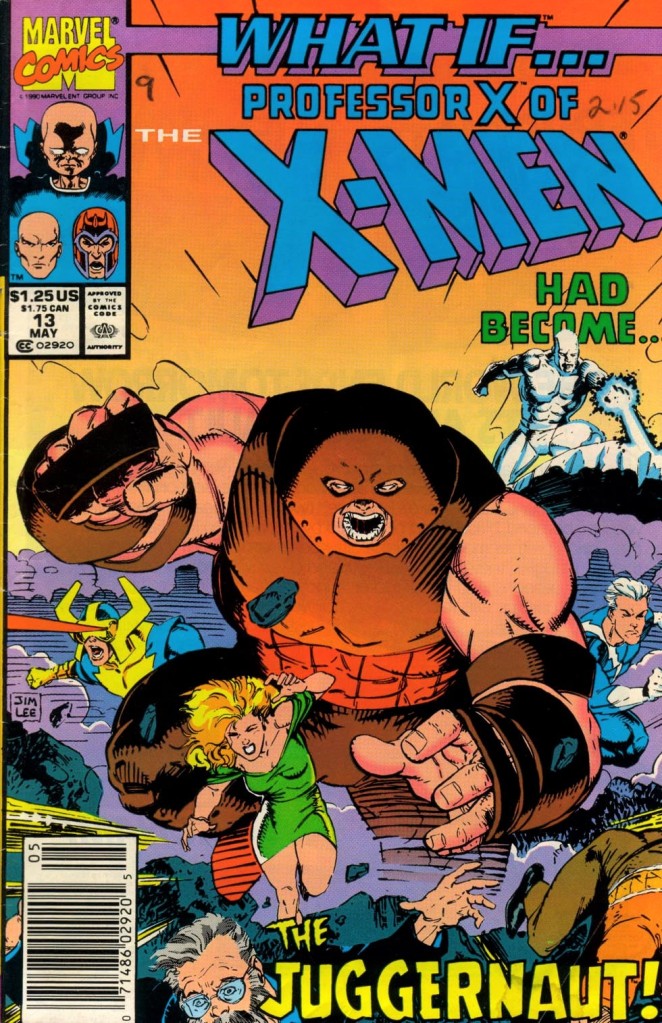
The cover drawn by Jim Lee.

Early story

The story begins in New York in the so-called near future. Graffiti artists attempt to run away from a team of mutants riding a floating vehicle. As Thunderbird is about to hit one of the humans, Cyclops stops him. Suddenly the mutants receive a telepathic message from their big boss who turns out to be Charles Xavier the Juggernaut.

Xavier is leading the effort against a group of humans who have been conspiring against them. Xavier declares, “They must be stopped—for the good of mutantkind!”

The X-Men in this particular story are fascist storm troopers policing a wretched, helpless humanity…

Quality

Xavier-Juggernaut with the X-Men and the invading Fantastic Four.

I can start by say that this comic book written by Kurt Busiek has one of the most compelling what-if scenarios that reflect not only its concept (of Charles Xavier becoming Juggernaut) but also the Marvel Comics universe as we know it. As dedicated X-Men fans know, Cain Marko was the one who touched the ruby in the cave which made him the mainstream Juggernaut. In here, the scenario was altered to make Charles Xavier become Juggernaut and the radical changes did not end there. Without spoiling the great stuff, I can say that this is one great exploration of an alternate version of events that affect not only the X-Men and their villains but also the many other superheroes of the Marvel universe as Xavier-Juggernaut went all-out with his dedication to mutantkind. I can say that in this story, symbolically speaking, Xavier easily outclasses the extreme Magneto on prioritizing mutants over humans.

Comic book concept aside, Kurt Busiek’s writing here is really excellent. Not only did he capture the traits of Xavier as he turned him into the alternate Juggernaut, Busiek also emphasized the many twisted events in the Marvel shared universe with sufficient details. The details implemented made the scenarios really believable. His script for this comic book was brought to life by Vince Mielcarek who did a good job making the characters recognizable (note: there were a lot of superheroes and villains here), showcasing the wide scope of changes made on people and places (in relation to Xavier-Juggernaut’s actions) and there was good pacing with the visuals.

Conclusion

Charles Xavier as you’ve never seen him before.

What If #13 (1990) is great to read and it is a must-have with its story alone. Apart from showing the concept’s deep impact on the Marvel Comics universe, I also enjoyed the way Kurt Busiek blurred the boundaries that separated good and evil. If you are an X-Men and you want to see something different with the mutants – especially Professor X – then you you will find a lot to enjoy here. This is a great alternate superhero story and definitely more people should be aware of this.

If you are seriously planning to buy an existing hard copy of What If #13 (1990), be aware that as of this writing, MileHighComics.com shows that the near-mint copy of the regular edition costs $30 while the near-mint copy of the newsstand edition costs $60.

Overall, What If #13 (1990) is highly recommended!

+++++

Thank you for reading. If you find this article engaging, please click the like button below and also please consider sharing this article to others. If you are looking for a copywriter to create content for your special project or business, check out my services and my portfolio. Feel free to contact me as well. Also please feel free to visit my Facebook page Author Carlo Carrasco and follow me at HavenorFantasy@twitter.com

A Look Back at X-Men #3 (1991)

Disclaimer: This is my original work with details sourced from reading the comic book and doing personal research. Anyone who wants to use this article, in part or in whole, needs to secure first my permission and agree to cite me as the source and author. Let it be known that any unauthorized use of this article will constrain the author to pursue the remedies under R.A. No. 8293, the Revised Penal Code, and/or all applicable legal actions under the laws of the Philippines.

Welcome back, X-Men fans, superhero enthusiasts and comic book collectors! Today I’m about to review another Chris Claremont-Jim Lee comic book of the X-Men from 1991.

Before getting to the retro comic book review, let’s take a look back at history. Marvel Comics started publishing comic book of the X-Men in 1963 which involved the combined talents of Stan Lee and Jack Kirby. The original X-Men members were Cyclops, Beast, Marvel Girl, Angel and Iceman all under the mentorship of Charles Xavier (AKA Professor X). That monthly series was not a strong seller and was weak compared to the other monthly titles of Marvel. Although Roy Thomas and Neal Adams were brought in to reinvigorate the X-Men series with new characters, success in sales did not materialize and eventually the series was turned into a reprint series (from issues #67 to #93).

In 1975, Len Wein and Dave Cockrum made Giant-Size X-Men #1 which introduced a new team. Along the way, Wein (who was also the editor-in-chief of Marvel at the time) hired Chris Claremont to become the lead writer of the X-Men series starting issue #94 which was released that same year. Claremont redefined the X-Men by developing the characters deep inside and emphasized their respective personalities. As the years passed by, Claremont wrote notable X-Men storylines such as The Dark Phoenix Saga, Days of Future Past, Mutant Massacre, and Fall of the Mutants to name some. Not only did Claremont write The New Mutants, he also co-created many other characters that became part of the X-Men franchise.

Then came the year 1991. The launch of the new X-Men monthly series (focused on the Blue Team led by Cyclops) saw sales tremendous success with issue #1 and by that time Jim Lee was established as one hot new creators under Marvel. Behind the scenes, however, Claremont clashed with then X-Men books editor Bob Harras. Eventually, issue #3 of the 2nd X-Men monthly series marked the end of the X-Men era of 1975-1991.

I should say that I enjoyed reading issue #2 in which Claremont wrote a story that not only raised the stakes but also pushed the entire group of mutants to the edge. We will find out soon enough if Claremont’s X-Men era of 1975-1991 will end strongly in this retro review of X-Men #3, published in 1991 by Marvel Comics with a story by Claremont and Jim Lee (who also illustrated).

The cover.

Early story

The story begins in outer space. Members of X-Men’s Gold Team (composed of Archangel, Storm, Jean Grey, Forge, Iceman, Colossus and Banshee) fly stealthily towards Asteroid M where Magneto and his Acolytes are with Charles Xavier and Moira MacTaggert held captive. With the exception of a few, members of the X-Men Blue Team were brainwashed by MacTaggert to follow Magneto.

On Earth, the plasma cannon is being prepared to destroy Asteroid M. Nick Fury warns his colleagues about the possibility of tremendous damage if ever Asteroid M hits the surface of the planet. Valerie Cooper tells him that the firing trajectory has been calculated to blast the target away and into deep space. An exchange of words follows over diplomacy and following orders issued by the leaders.

Over at Asteroid M, Charles Xavier is alone in a room with a wide view of the Earth and space. Behind the scenes, Fabian Cortez points to Xavier as Magneto’s deadliest enemy. He asked his master why not use Moira MacTaggert’s procedure (to brainwash and turn) on Xavier. Magneto, already suffering physically, does not want Xavier turned but be broken…

Quality

X-Men Blue Team members relaxing at Asteroid M in the presence of the Acolytes.

Like in issue #2, the story here is very engaging and highly dramatic. While it paid close attention to Magneto’s ruthlessness as well as his rage towards Moira who committed something unethical to him in the past, the story managed to focus enough on the X-Men which involves both the Blue Team and Gold Team mixed up. While this comic book’s cover shows a battle royale between the Blue and Gold teams, there is a lot of substance beyond the action. I’m talking about moments spent on the mutants of Xavier which was done in a satisfying manner (never felt crammed nor forced) considering the page limits of this comic book. Not only were the X-Men moments executed smoothly, there were pulled off efficiently and orderly.

More on the story, what adds intrigue is the group of Acolytes whose field leader Fabian Cortez has not only gotten very close with Magneto but also does something significant to him along the way. By this issue, the Acolytes led by the master of magnetism have gotten more established as a worthy opposition against Xavier’s mutants. This story also showed that the Acolytes were here to stay, and Fabian Cortez himself is very led by wickedness and ambition. Cortez is also an example about the distortion of righteousness

When it comes to defining the characters, Xavier and Magneto clashing together about their respective dreams about mutants is unsurprisingly epic to read. In this particular conflict, both Marvel icons were portrayed very dramatically and their respective expressions were indeed intense. Adding further intrigue to their clash is Moira’s long-past act of manipulating the very genetics of Magneto which itself raises serious questions about her perception, decision-making and ethics. In some ways, Moira looked more villain-like.

As expected, the art of Jim Lee is great to look at. There were some signs, however, that the very wordy script resulted an increased numbers of panels per page. Fortunately, the art did not look rushed and maintained a clear narrative. Also the action scenes are great to look at which is not surprising.

Conclusion

The Gold Team of the X-Men travel towards Asteroid M in a cloaked vehicle.

To put it straight, X-Men #3 (1991) is an epic read highlighting the very conflict between Magneto and Xavier over the course of mutants and their place in the world of humans. This comic book, which has a very powerful ending, was indeed a very satisfying way to conclude the Xavier-Magneto conflict as well as Chris Claremont’s long-term stint with the X-Men comic book franchise. Back in 1991, this one really looked like the end of an era both in-story and in real life. Of course, what this comic book achieved ultimately became temporary because Magneto was revived for the Fatal Attractions storyline in 1993 (celebrating X-Men’s 30th anniversary) and Chris Claremont himself returned to Marvel Comics some years later. Still, on its own, this comic book is worth reading and adding to your collection, even if you are not an X-Men fan. It is significant enough as a piece of X-Men history from the time when Jim Lee was with Marvel.

If you are seriously planning to buy an existing hard copy of X-Men #3 (1991), be aware that as of this writing, MileHighComics.com shows that the near-mint copy of the regular edition costs $9 while the near-mint copies of the Chris Claremont-signed edition, the signed newsstand edition, the newsstand edition and the Toy Biz edition cost $16, $26, $16 and $21 respectively.

Overall, X-Men #3 (1991) is highly recommended!

+++++

Thank you for reading. If you find this article engaging, please click the like button below and also please consider sharing this article to others. If you are looking for a copywriter to create content for your special project or business, check out my services and my portfolio. Feel free to contact me as well. Also please feel free to visit my Facebook page Author Carlo Carrasco and follow me at HavenorFantasy@twitter.com