Recently a survey conducted by OCTA Research and commissioned by the Embassy of Japan in the Philippines revealed that almost eight out of ten Filipinos trust Japan, according to a news article by the Philippine News Agency (PNA).
To put things in perspective, posted below is an excerpt from the news article of the PNA. Some parts in boldface…
A survey of a private polling and research firm, OCTA Research, released on Monday showed that eight in 10 adult Filipinos trust Japan.
The survey, commissioned by the Embassy of Japan in the Philippines and conducted from December 3 to 11, 2025, among 1,200 respondents aged 18 and above, asked the question: “How much does the Philippines trust Japan?”
A total of 79 percent of the respondents answered they “strongly trust/somewhat trust” Japan, while at least 17 percent responded “can’t say if I trust or not”, and 4 percent have shown distrust.
This result suggests that positive perceptions of Japan are deeply embedded in Philippine public opinion.
Filipinos also trust the Japanese people, with 74 percent expressing trust and 6 percent expressing distrust. About 20 percent answered that they are undecided.
This indicates that goodwill toward Japan extends to interpersonal perceptions of Japanese citizens, according to OCTA Research.
Most or 70 percent of the respondents said they view the relationship between the Philippines and Japan as “very good” while 24 percent view it as neither good nor poor.
These favorable perceptions of Japan were observed across Metro Manila, Balance (of) Luzon, the Visayas, and Mindanao, as well as across socioeconomic classes.
“Cultural exchanges, tourism, educational cooperation, and the growing Filipino community in Japan contribute to familiarity and mutual goodwill between the two societies,” OCTA Research said.
Let me end this piece by asking you readers: What is your reaction to this development? Do you think the governments of Japan and the Philippines should engage more with each other diplomatically, economically and militarily? Do you think Filipinos see the Japanese as an ally while the Philippines remains in conflict with Communist China at the West Philippine Sea? Are you one of the hundreds of thousands of Filipinos who traveled to Japan yearly?
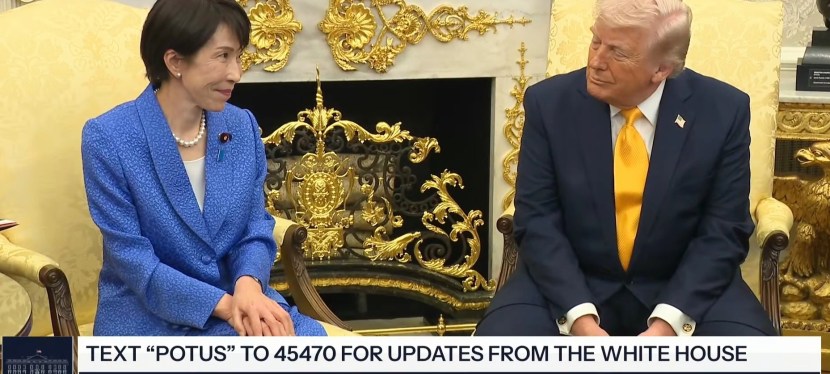
Japanese Prime Minister Takaichi Sanae visited Washington for the first time as the head of her nation and met with US President Donald Trump at the White House where they discussed very important matters in front of the media and officials, according to a news report by Kyodo News. Takaichi also praised the President for his peace efforts.
To put things in perspective, posted below is an excerpt from the news report of Kyodo News Some parts in boldface…
Prime Minister Sanae Takaichi told U.S. President Donald Trump on Thursday that Japan is ready to contribute to the safety of the Strait of Hormuz as the U.S.-Israeli war on Iran intensifies, while explaining Tokyo’s legal constraints on sending ships from its defense forces to the region.
Takaichi told reporters after her meeting at the White House with Trump that she told the U.S. leader “in detail what Japan can do and cannot do” from a legal perspective under the country’s war-renouncing Constitution.
Trump, for his part, reiterated his expectation that Japan would be engaged, while saying during the part of their talks open to media that he believes Japan has been “stepping up to the plate” in recent days over the Iran war, “unlike NATO.”
The U.S. leader has made public his dissatisfaction with Washington’s allies, including Tokyo and members of the trans-Atlantic alliance, over their reluctance to pitch in to help secure the Hormuz strait, a vital waterway for global oil transportation now largely blocked by Iran.
“I expect Japan to step up, because, you know, we have that kind of relationship,” he said. “We have 45,000 soldiers in Japan. We have, we spend a lot of money on Japan…so I expect, I’m not surprised that they would step up.“
Noting also that more than 90 percent of Japan’s crude oil imports normally pass through the strait, Trump said Japan has a “big reason” to do more.
In affirming Japan-U.S. collaboration on expanding U.S. energy production, Takaichi said she proposed to Trump a joint oil-reserve project to ease supply concerns driven by the Middle East conflict.
At the talks, Takaichi praised Trump’s “peace” efforts, expressing readiness to assist by reaching out to other countries. “Donald is the only person who can bring peace and prosperity across the world,” she said.
Takaichi emphasized that the prospect of Iran developing nuclear weapons is unacceptable. Trump alluded earlier to Iran’s nuclear program to explain the U.S. decision to launch its military campaign against the country.
Facing an increasingly assertive China, Takaichi also reminded Trump that the security environment remains severe in the Indo-Pacific, at a time when reports have emerged that some U.S. military assets are being moved from the region to the Middle East.
The two leaders “committed to peace and stability across the Taiwan Strait as an indispensable element of regional security and global prosperity” and “opposed any attempts to unilaterally change the status quo, including by force or coercion,” the White House said in a press release without naming China.
They confirmed that their nations oppose measures threatening critical mineral supplies such as export controls, senior Japanese government officials told reporters, apparently referring to Beijing’s tighter regulations on rare earths exports.
They agreed to advance broad defense cooperation, including joint missile development and production, and promote a free and open Indo-Pacific, according to Takaichi. The White House said the production of the interceptor Standard Missile-3 Block 2A in Japan will be quadrupled.
“We were able to affirm many concrete forms of cooperation that will further enhance the quality of our alliance in wide-ranging fields,” Takaichi said, adding that she and Trump are aiming to elevate bilateral ties to “a higher level” together.
Trump welcomed Japan buying “a lot of” U.S. military equipment. He further stressed that he has a “very fine relationship” with Takaichi, describing her as “a very special person” who is doing a “fantastic job.”
The U.S. side did not bring up fresh demands for Japan to spend more on its defense, the officials said.
Takaichi’s main goals in her first trip to the United States since taking office in October were to strengthen the personal trust in her ties with Trump and reaffirm the U.S. security commitment to the Indo-Pacific region as China’s influence grows.
The meeting came amid increasing concerns within Japan that the U.S. focus in terms of policy and military assets could shift from the Indo-Pacific to the Middle East if the U.S.-Israeli war with Iran drags on, a development that would work in China’s favor.
The U.S. military has reportedly begun relocating the amphibious assault ship Tripoli and over 2,000 Marines from their bases in southwestern and southern Japan to the Middle East.
Takaichi got off to a positive start in building personal ties with Trump when they met in person for the first time in October in Tokyo, shortly after she became Japan’s first female prime minister.
Since the outbreak of the Middle East conflict, Tokyo has sought to strike a delicate balance between maintaining its strong alliance with Washington and its friendly relations with Tehran.
For more insight about the Trump-Takaichi meeting, watch the videos below.
Let me end this piece by asking you readers: What is your reaction to this development? What is your impression about the many matters and announcements that happened during the Trump-Takaichi meeting at the White House? Were you surprised when it was announced that US allies Japan, Italy, England, Netherlands, Germany, and France jointly agreed to secure the Strait of Hormuz in response to Trump’s demand? With Japan having a close relationship with Trump’s America now, do you think Communist China and North Korea will feel intimidated at their side of the Pacific?
To put things in perspective, posted below is an excerpt from the news report of Kyodo News Some parts in boldface…
Prime Minister Sanae Takaichi is considering expressing Japan’s desire to cooperate on the U.S. “Golden Dome” next-generation missile defense system at her upcoming meeting with President Donald Trump, Japanese government sources said Tuesday.
The envisaged missile defense collaboration is among the expected agreements, covering various areas from the long-standing Japan-U.S. alliance to the fields of economic security and cutting-edge technology, at the summit slated for Thursday in Washington, the sources said.
Revealed by Trump in May, the Golden Dome scheme is intended to detect and destroy hypersonic missiles, which can fly at above five times the speed of sound, in outer space in mid-flight. The total costs are estimated at $175 billion.
The trajectories of hypersonic weapons are irregular and low-altitude, making them difficult to shoot down or track by radar. China, North Korea and Russia have been aggressively pursuing such arms.
In August 2023, Tokyo and Washington agreed to develop a new type of missile to intercept hypersonic weapons, with the goal of completing it by the 2030s. It is intended that Aegis destroyers of the U.S. Navy and the Japan Maritime Self-Defense Force will be equipped with the missile.
To enhance the missile defense system’s detecting and tracking capabilities, the U.S. military has been building a “satellite constellation” system that allows it to capture incoming missiles with high accuracy by linking multiple small satellites.
Japan’s Defense Ministry, which has also been conducting research on technologies necessary for detecting projectiles from outer space, is eyeing information sharing with the United States, the sources said.
During the summit talks, which will take place amid the Middle East conflict following U.S. and Israeli attacks on Iran, Takaichi also plans to ask Trump about purchasing crude oil produced from Alaska, according to the sources.
Japan, which relies heavily on the Middle East for its crude oil imports, has once again had its energy vulnerability exposed in the wake of the war in the region, with the effective closure of the Strait of Hormuz disrupting oil flows.
Takaichi and Trump, meanwhile, are expected to agree on a $100 million joint project in shipbuilding, a sector both countries are keen on enhancing amid dominance by Chinese makers.
Let me end this piece by asking you readers: What is your reaction to this development? Do you think the US-Japan summit this week will result in big breakthroughs with regards to defense, economics and energy? What do you hope to see happen after President Trump and Prime Minister Takaichi meet in Washington? Do you think the Golden Dome missile defense project will be fully realized and operational in the years to come?
Even as the United States is busy working alongside Israel on the war against the Islamic terrorist state of Iran, the Trump administration announced that it will launch tariff investigations on several countries including trade partners like Japan, according to a news report by Kyodo News. The probes are meant to find out if unfair trading practices exist.
To put things in perspective, posted below is an excerpt from the Kyodo News report. Some parts in boldface…
U.S. President Donald Trump’s administration said Wednesday it will launch tariff investigations into what it sees as unfair practices by China, Japan and over a dozen other American trading partners.
According to U.S. Trade Representative Jamieson Greer, the move is intended to “uncover a variety of unfair trading practices related to excess capacity in production” in the manufacturing sector, and replace Trump’s sweeping tariff regime that was invalidated by the Supreme Court in February.
“Our view is that key trading partners have developed production capacity that is really untethered from the market incentives of domestic and global demand,” Greer told reporters.
The other trading partners facing the investigations, carried out under Section 301 of the Trade Act of 1974, are the European Union, Bangladesh, Cambodia, India, Indonesia, Malaysia, Mexico, Norway, Singapore, South Korea, Switzerland, Taiwan, Thailand and Vietnam, Greer said.
The statute, which allows the U.S. government to impose tariffs in response to a foreign country’s alleged unfair practices, was a favorite tool of Trump for justifying higher tariffs on Chinese imports when he started a trade war with Beijing during his first term as president.
After the U.S. top court on Feb. 20 struck down a large chunk of Trump’s far-reaching tariff agenda as imposed under the International Emergency Economic Powers Act, his administration introduced a new 10 percent global duty.
However, the new 10 percent surcharge, relying on a different legal framework, can only last 150 days unless Congress approves an extension.
Greer said the Trump administration seeks to complete the investigations as quickly as possible and prepare for new Section 301 tariffs within the 150-day period.
The statute requires consultations with the governments of the targeted trading partners before tariffs can be imposed.
Let me end this piece by asking you readers: What is your reaction to this development? Do you think the United States is doing the right thing with the multiple trade investigations? How do you think the Trump administration will adjust its tariff policy once the 150-day period expires?
Since the first strikes happened on February 28, the joint military operations of the United States and Israel have heavily damaged the military, energy and government sites of the Islamic terrorist state of Iran. As the war with Iran has impacted the global economy and a new so-called supreme leader of Iran was selected, US President Donald Trump stated that the war is expected to end “very soon” but not at the end of this week, according to a news report by Kyodo News.
To put things in perspective, posted below is an excerpt from the Kyodo News report. Some parts in boldface…
U.S. President Donald Trump said Monday the ongoing war with Iran is expected to be over “very soon” but ruled out the possibility of it coming to an end this week.
“We’re winning very decisively. We’re way ahead of schedule,” Trump, who had initially predicted the conflict could last four to five weeks, claimed during a press conference in Florida.
Trump’s remarks came after Iran selected Mojtaba Khamenei as its new supreme leader after his father was killed in the first wave of U.S.-Israeli strikes.
Khamenei, the late leader’s second son, is known for his close ties with the Islamic Revolutionary Guard Corps. His rise to power has raised concern among many countries that the war, entering its second week, could further destabilize the Middle East and quickly ripple through the global economy.
While insisting that the United States has achieved an “unprecedented” military success, Trump said he was “disappointed” with Iran’s choice of supreme leader.
“We think it’s going to lead to just more of the same problem for the country,” he said.
Sending conflicting messages, Trump also warned that the United States will aggressively attack Iran if it attempts to block the world’s energy supply.
“We will hit them so hard that it will not be possible for them or anybody else helping them to ever recover that section of the world,” he said.
But he struck an optimistic note on oil prices, saying they would be much lower after the war ends. On disruption to oil shipments through the Strait of Hormuz, Trump said the United States was less affected than China.
It seems that the joint Israel-America operations have achieved more than what was previously expected. The Islamic regime’s navy has been demolished, the air force crushed, and the oil refineries destroyed. It has also been reported that more military personnel of the regime have left their posts and moved out of the country using fake passports. The oppressed Iranians, meanwhile, should get more motivated to go out and protest as the regime’s military and police forces weaken.
Looking at the bigger picture, the massive devastation on the Islamic terrorist state made the leaders of Russia and Communist China worried. China needs oil from Iran while Russia needs Iranian-made weapons. Geopolitically, it’s like Trump’s America stuck two birds with one stone. In the case of Israel, Islamic terrorist groups are weakening now that the Islamic regime of Iran cannot support them. Going back to Iran, there are opportunities for the affected Iranians to move out of the country and enter Armenia as refugees. Already there are groups at the Armenian side of the border who intend to help Iranian refugees.
For more updates about what happened lately, watch the videos below.
Let me ending this post by asking you readers to pray to the Lord for victory, for the protection of the American and Israeli forces, for the safety of civilians everywhere, for the end of the Islamic terrorist regime of Iran to happen soon, and for the liberation of the oppressed Iranian people. Pray to Him to also bless US President Trump and Prime Minister Benjamin Netanyahu, as well as their respective administrations. Pray to God for more peace and stability in the Middle East and for the stability of the global economy.
The Bureau of Immigration (BI) apprehended in Batangas a Chinese national who posed as a Filipino citizen, according to a news report by the Manila Bulletin. The suspect has a history of acquiring Philippine passports and a driver’s license in the country.
To put things in perspective, posted below is an excerpt from report of the Manila Bulletin. Some parts in boldface…
A foreigner has been arrested by the Bureau of Immigration (BI) in Batangas for posing as a Filipino and for “fraudulently acquiring” Philippine documents.
Immigration Commissioner Joel Anthony M. Viado presented before the media on Tuesday, Feb. 24, the arrested foreigner who was identified as Chinese national Zhi Ling Guan. He said that Zhi admitted he is not a Filipino.
Viado said that Zhi also uses the aliases Shis Nengyuan and Mike Sy. The “fake” Filipino was arrested last Feb. 20 at the Batangas port, he also said.
Viado said that the Chinese national was using fraudulently his acquired Philippine passports and driver’s license using the name Mark Sy.
“Philippine citizenship is not a commodity that can be fabricated or acquired through deception,” Viado declared.
He warned: “Any foreign national who falsely claims to be Filipino and manipulates our systems to secure official documents will face arrest, detention, and deportation.”
He said the BI acted on the information it received from the Intelligence Service of the Armed Forces of the Philippines (ISAFP) which sought the verification of the identity of the person.
“Biometric checks and inter-agency verification established that the fingerprints appearing in identification documents under the name ‘Mike Sy’ matched those of Zhi Ling Guan, a Chinese national,” he also said.
Let me end this post by asking you readers: What is your reaction to this recent development? What do you think is the main reason the suspect used a fake identity and pretend to be a Filipino? Do you think the government should come up with stronger measures to prevent fraud committed by foreigners?
Indonesia, the 2nd largest economy of Southeast Asia, successfully attracted 15.39 million foreign visitors in 2025 and it is already looking forward to attracting even more this year, according to a news report by VnExpress.
To put things in perspective, posted below is an excerpt from the news report of VnExpress. Some parts in boldface…
Indonesia, the largest economy in Southeast Asia, welcomed 15.39 million foreign visitors in 2025, exceeding its target of 14-15 million arrivals.
“We have exceeded our target and performed better than our previous projections,” Tourism Minister Widiyanti Putri Wardhana said at a meeting in Jakarta on Wednesday, as quoted by Antara News Agency.
Government figures show that average spending per foreign visitor reached US$1,267 in 2025, surpassing the target of $1,220.
Malaysia remained the biggest contributor to Indonesia’s tourism revenue, while the United Arab Emirates posted the fastest growth in visitor numbers.
Arrivals from China rose sharply, reaching 1.34 million in 2025, the highest level in six years, according to Xinhua News Agency. The data indicates that travel from China to Indonesia has not only recovered but has also exceeded pre-pandemic levels.
By doing the math of the numbers revealed in the above news report, US$1,267 multiplied with 15.39 foreign tourists is equal to roughly US$19.5 billion in foreign tourism revenue. That is a huge economic boost for Indonesia.
Let me end this piece by asking you readers: What is your reaction to this development? Have you ever toured Indonesia? If you have visited Indonesia, what did you enjoy the most while touring there?
Vietnam, which is already one of the leading players of Southeast Asia on foreign tourism, is off to a powerful start as it successfully attracted 2.5 million foreign tourists in January 2026 alone, according to a news report by VnExpress. The relaxed visa policies and enhanced tourism campaigns were factors behind the early success.
To put things in perspective, posted below is an excerpt from the news report VnExpress. Some parts in boldface…
Vietnam received 2.5 million foreign visitors in January, its highest monthly number ever, thanks to relaxed visa policies and increased tourism campaigns.
It represents an increase of more than 21% from the previous month, data released Tuesday by the General Statistics Office shows.
The composition of Vietnam’s top source markets changed during the month. South Korea overtook mainland China to become the top market with nearly 490,000 visitors, and China was next with 460,000.
Cambodia emerged as the most notable mover with more than 223,000 arrivals to rise to third place overtaking Taiwan. The rest of top 10 comprised Taiwan, Japan, the U.S, Australia, Russia, India, and Malaysia.
Industry insiders attribute the jump to ground-breaking visa policies, strong innovation in tourism promotion and marketing, greater product diversification, and improved service quality.
Let me end this piece by asking you readers: What is your reaction to this development? Have you ever toured Vietnam? With the strong start, do you think Vietnam will be able to attract more than 30 million foreign tourists this year? What is the first thing that comes to your mind when it comes to tourism in Vietnam?
Under the leadership of US President Donald J. Trump, America’s new defense strategy urged its allies and partner to increase their defense spending to 5% of their gross domestic product (GDP), according to a news report by Kyodo News. This latest development could result in a chain of events in which American allies will not only spend more but also act more responsibly when it comes to securing their respective nations.
To put things in perspective, posted below is an excerpt from the Kyodo News report. Some parts in boldface…
A new U.S. defense strategy released Friday urges all American allies and partners to increase defense spending to 5 percent of their gross domestic product and be more responsible for their own national security.
Highlighting President Donald Trump’s “America First” and “peace through strength” agenda, the Pentagon’s policy document says they have a bigger role to play, but not as “the dependencies of the last generation,” as the United States needs to prioritize defending its homeland and its interests throughout the Western Hemisphere.
“We will advocate that our allies and partners meet this standard around the world, not just in Europe,” says the first National Defense Strategy since Trump’s return to the office a year ago, referring to the 5 percent defense target.
“As our allies do so, together with the United States, they will be able to field the forces required to deter or defeat potential adversaries in every key region of the world, even in the face of simultaneous aggression,” it says.
NATO members have already pledged to meet Trump’s demand to increase defense spending from 2 percent to 5 percent of GDP by 2035. The new NATO target is composed of 3.5 percent for core military spending and an additional 1.5 percent for security-related spending.
As the document praises Europe and South Korea for committing to raising their defense expenditures since Trump’s return to office, it appears inevitable that other major U.S. allies, including Japan, will face increased pressure from his administration to follow suit.
On par with the National Security Strategy, released by the White House in December, the key defense document touches on China and its fast-paced military buildup.
But the tone is softer compared to previous versions.
It says the second Trump administration’s approach is to deter China in the Indo-Pacific region through strength, “not confrontation.”
In the 34-page document, there is also no mention of Taiwan, the self-ruled island that China regards as its own territory and around which it has been stepping up military pressure.
“President Trump seeks a stable peace, fair trade and respectful relations with China, and he has shown that he is willing to engage (Chinese) President Xi Jinping directly to achieve those goals,” the document says, adding that Washington’s goal is not to dominate China.
“Rather, our goal is simple: To prevent anyone, including China, from being able to dominate us or our allies,” it says.
As part of efforts to meet that end, the U.S. military will erect a “strong denial defense” along the first island chain in line with the security strategy, according to the defense blueprint.
The island chain runs from the Japanese archipelago, through Taiwan, the Philippines and on to Borneo, encircling China’s coastal waters.
Let me end this piece by asking you readers: What is your reaction to this development? Do you think the new American strategy will create a huge impact on how the allies will defend their respective nations? Do you think this will lead to the containment of Communist China’s aggression on the Indo-Pacific? Do you think the new strategy could lead to more stability in both Asia and Europe?
Thailand, the 2nd most visited nation of Southeast Asia in 2025, has set ambitious tourism targets for itself for 2026 and it includes achieving US$95 billion in tourism revenue, according to a VnExpress news release. Thailand attracted over thirty million international arrivals last year which was actually a decline of more than 7% compared to 2024.
To put things in perspective, posted below is an excerpt from the news report VnExpress. Some parts in boldface…
The Tourism Authority of Thailand (TAT) has expressed confidence that the country’s tourism sector will earn 3 trillion THB (US$95.35 billion) in revenue this year through its “Amazing 5 Economy” strategy.
The plan targets an 11% increase in international visitors, enhanced domestic tourism, and a focus on sustainable, high-quality growth despite global challenges.
TAT aims for 36.7 million international arrivals and about 210 million domestic trips in 2026. Meanwhile, the revenue target includes 2 trillion THB from international markets, with an expected 11% increase in international tourist arrivals, and 1 trillion THB from domestic tourism, projected to grow by 4%, said TAT Governor Thapanee Kiatphaibool.
In 2026, TAT plans to reignite quality tourism growth by addressing challenges such as geopolitical tensions, increasing global competition, and domestic factors like the strong baht, household debt, safety concerns, and natural disasters. The key to success lies in the “Amazing 5 Economy” framework, which includes life economy, sub-culture economy, night economy, circular economy, and platform economy.
In 2025, Thailand recorded total tourism revenue of approximately 2.7 trillion THB. International arrivals reached 32.97 million, down 7.23% year-on-year.
It saw declines in short-haul markets such as Malaysia and China. However, long-haul markets showed strong momentum, with visitors from Europe, the Americas, the Middle East and Africa reaching a record 10.8 million.
Notably, arrivals from the U.K. and the U.S. each surpassed one million for the first time. Domestic tourism also expanded, with more than 202 million trips, up 2.7%.
Let me end this piece by asking you readers: What is your reaction to this development? Have you ever toured Thailand before? If you did, how long did you stay in Thailand and how was your overall travel experience there? Do you think Thailand will be to achieve its ambitious tourism targets this year?







 Author Carlo Carrasco