A Look Back at Batman Returns: The Official Comic Adaptation of the Warner Bros. Motion Picture (1992)

Welcome back superhero enthusiasts, 1990s culture enthusiasts and comic book collectors! Today we go back to the early 1990s and look at the official comic book adaptation of the 1992 superhero movie Batman Returns.  

Way back in 1992, I managed to watch Batman Returns in a movie theater here in the Philippines. It was entertaining but I noticed it had an even darker tone, more violence (although the quality of physical action went down) and was more adulterated compared, at least, with its 1989 predecessor. What really stood out for me in the Tim Burton-directed movie were the great performances of Danny DeVito as the Penguin and Michelle Pfeiffer as Catwoman.

Even though I was already visiting comic book stores back then, I was not even aware that an official comic book adaptation of the movie was released by DC Comics. It was only recently I finally got to read a copy.

With those details laid down, here is a look back at Batman Returns: The Official Comic Book Adaptation of the Warner Bros. Motion Pictured published in 1992 by DC Comics with the adapted story written by Dennis O’Neil and drawn by Steve Erwin.
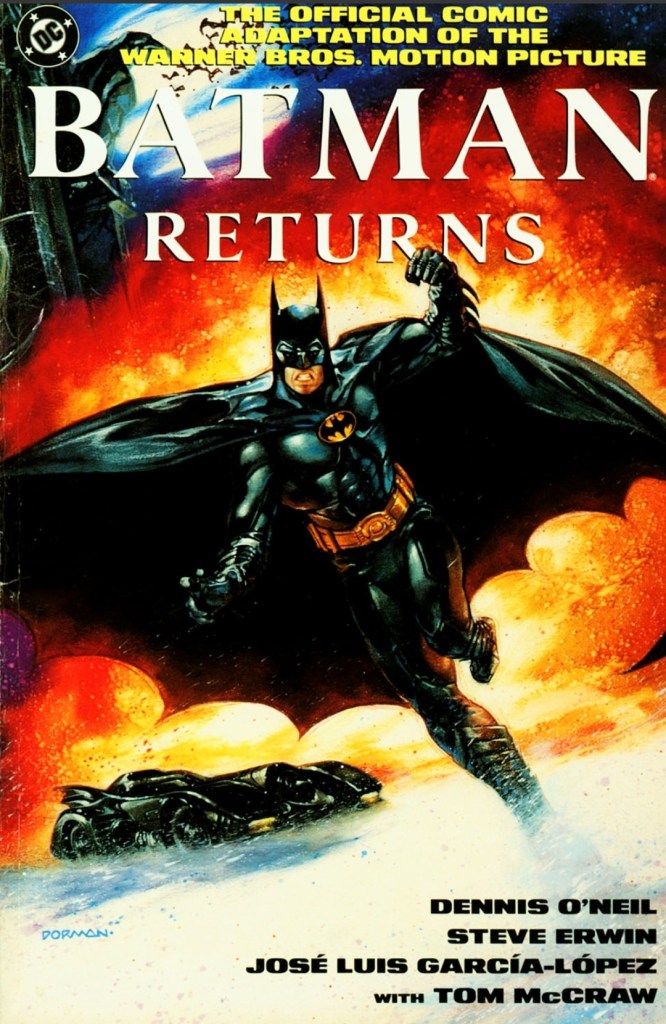
The cover.

Early story

The story begins decades into the past in Gotham City. A wealthy couple (Cobblepot family) decide to reject and abandon their infant son (Oswald/Penguin) as he was born with freakish features. They placed their son into a metal container (which itself is contained in a large makeshift basket) and dropped it on a local waterway that leads deep into the city’s sewers. At the end of the journey, large penguins find the container.

Decades later in Gotham City, tycoon Max Schreck talks to the mayor about his planned power plant project that needs permits and tax incentives from the local government to be realized. The mayor is doubtful about the project as he believes that the city has more than enough energy sources to sustain growth into the next century. Schreck insists that the local government’s analysts don’t realize the big picture about energy and economic growth. Then Chip Schreck (Max’s only heir) arrives with Selina Kyle (Catwoman) carrying coffee near him.

Minutes later, Max, Chip and the mayor arrive at Gotham Plaza for the local Christmas tree lighting. Even though he forgot to bring his speech, Max Schreck delivers remarks pretending to be caring and charitable to others. As his speech ends, two over-sized objects looking like giant gift boxes arrived nearby giving the mayor the false impression that those are clever gimmicks by Schreck.

As soon as Schreck says that those objects were not his, the oversized gift box opens violently as thugs wearing circus costumes and masks suddenly come out causing violence and hysteria to the unprepared people.

The local police activate the Bat Signal to call Batman for his assistance. Nearby, the Penguin sees it and says, “Ooh, Batman. I’m trembling…”

Quality
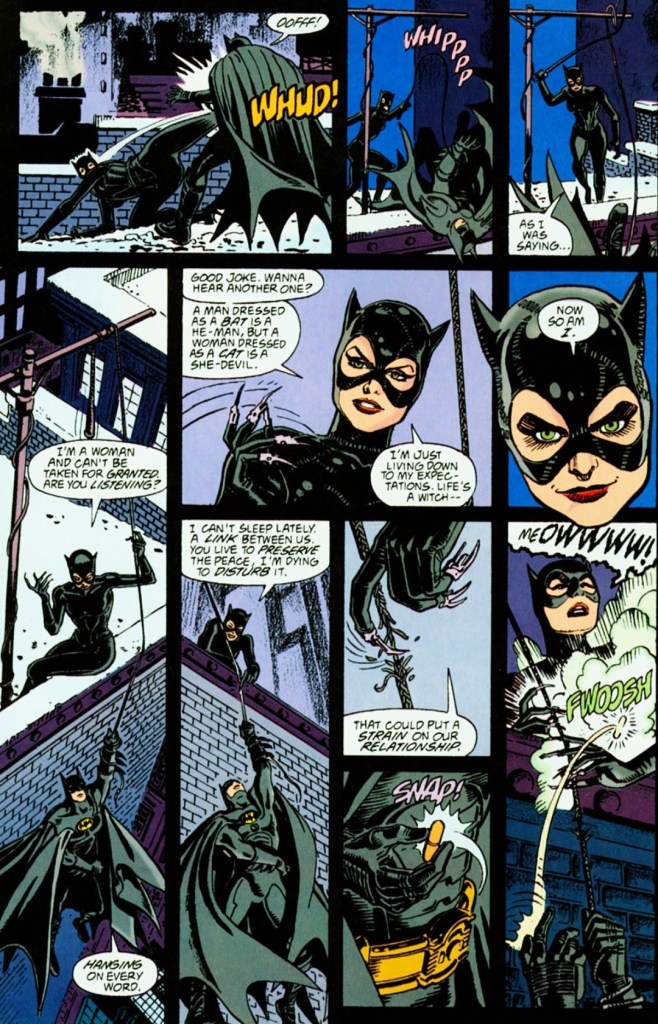
Moments from Batman’s first fight with Catwoman.

To get straight to the point regarding the narrative, this comic book adaptation does have the same basic plot and concept of the movie but with noticeable differences (whether technical or creative) that happened here and there. For the most part, Dennis O’Neil captured the concept of the movie but with less of the flavor of Tim Burton’s creative touches (which should not be surprising).

Having seen the movie, it is clear that the comic book creators reduced the dialogue and took shortcuts on adapting scenes from the film not just for the sake of brevity but to ensure they could fill the limited amount of pages to work with. That being said, I can say that the reduced dialogue from the first conversation between Penguin and Max Schreck severely weakened the impact when compared to what was executed in the film. Speaking of dialogue, the comic creators had to down key words (think of it as creative censorship) to avoid offending readers.

This is a unique, alternate portrayal at the aftermath of Selina Kyle’s fall from the high window. When compared to the movie itself, this adaptation emphasizes how far the Schrecks would go to avoid being held accountable for crimes committed.
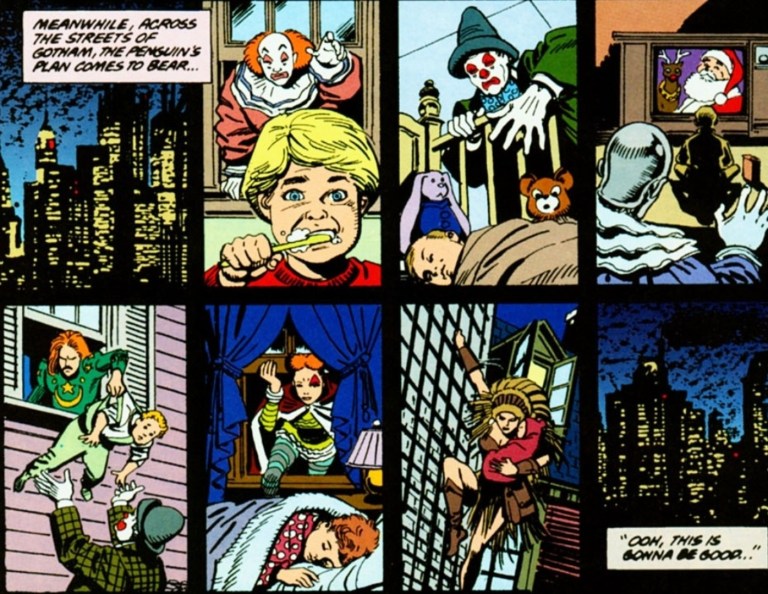
This particular scene did not appear in the movie at all. Perhaps it was based on an older version of the film script.

When it comes to scenes between the film and this comic book adaptation, I can say that the date between Bruce Wayne and Selina Kyle inside Wayne Manor does not appear in literary form at all. Ironically, there is one scene that appeared in this adaptation (the Penguin plotting chaos in Gotham while Catwoman mentions “An orgy of sex and violence,”) that never made the final cut in the movie itself. With regards to the aftermath of Max Schreck’s violent push of Selina Kyle through the high window, this adaptation showed Max’s son Chip present (implying he witnessed his father’s act just steps away) and he goes along with his father to ensure that none of them would be held accountable for Kyle’s fall (caused by “stress” and being “depressed”).  

With the way the narrative was completed, this adaptation works well but much less of the theatrical touches of Tim Burton and without the power of the respective performances of Danny DeVito, Michelle Pfeiffer and Christopher Walken (Max Schreck). Ironically, I can easily imagine Bruce Wayne/Batman sounding like Michael Keaton through dialogue.
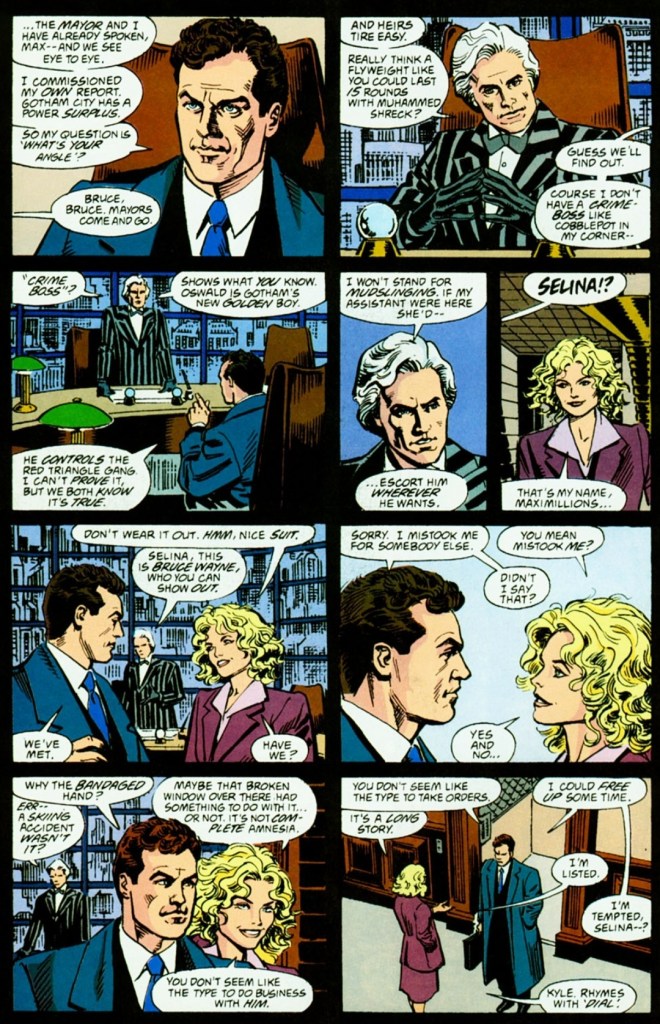
While artist Steve Erwin did not come close to capturing the likenesses of Christopher Walken as Max Schreck, and Michael Keaton as Bruce Wayne, his take on Selina Kyle is better as she somewhat resembles Michelle Pfeiffer.

With regards to the visuals by Steve Erwin, he does a good job drawing the locations and help establish geography (albeit in limited scopes) for readers to grasp. In fact, there were drawings in which Erwin literally copied location spots, objects and even camera angles from the film which suggests he had confidential access to the footage. When it comes to visualizing action, Erwin’s approach is pretty simplistic and limited. There simply was no dynamism with the action which theoretically means he had no artistic freedom (sticking closely to script while working within the limits of images per page) or he simply had no intention to make the action look spectacular.

With regards to violence connected with the action, the comic creators had to resort to creative censorship apparently to make this adaptation more acceptable with younger readers. The fall of Selina Kyle from the high window had severely reduced intensity in comic form and the horrific moments of her being surrounded by cats in the film were completely gone. Oh yes, Batman’s use of the Batarang against multiple thugs on the street was executed with a simplistic and not-so-violent (read: little impact) manner by Erwin.
Consider this as a late-20th century portrayal of diversity and inclusion in America. By today’s standards, there are hordes of SJWs (social justice warriors), woke nuts, socialists, Communists, Marxists, and liberals who believe in diversity (racism in reverse) and inclusion (exclusion actually) so much, they intend to destroy families starting with the children.

When it comes to drawing the major characters, Erwin really falls short here. His Bruce Wayne never came close to resembling Michael Keaton and the same can be said about Max Schreck (does not look much like Walken) and the Penguin (does not resemble Danny DeVito at all and with reduced facial details, he looks nowhere as scary as the cinematic villain). Ironically, Erwin’s take on Selina Kyle comes a bit close to looking like Michelle Pfeiffer. Erwin does, however, did a good job drawing Batman and Catwoman in their fully costumed, masked appearances.

Conclusion
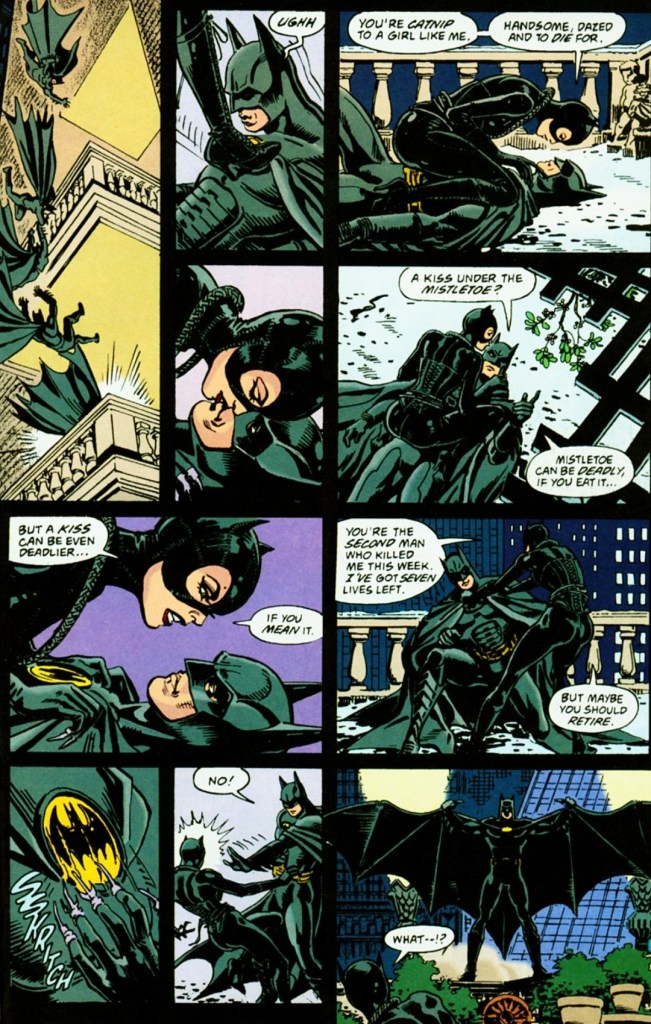
Very clearly, Steve Erwin had access to footage of the movie when making this adaptation.

Considering its flaws and compromises, Batman Returns: The Official Comic Adaptation of the Warner Bros. Motion Picture (1992) still works as an entertaining read and I myself have seen the movie many times. It captures the plot and several shots of the 1992 movie, but it certainly lacks Burton’s theatrical flavor and the powerful performances of DeVito and Pfeiffer. To its credit, this adaptation has several visual and literary differences compared with the movie which adds to its entertainment value. If you really want the full impact, full fun factor and artistry of Batman Returns at all, watching the movie itself is the best way. That being said, consider this adaptation as a cheaper accessible counterpart.

Overall, Batman Returns: The Official Comic Adaptation of the Warner Bros. Motion Picture (1992) is satisfactory.

+++++

Thank you for reading. If you find this article engaging, please click the like button below, share this article to others and also please consider making a donation to support my publishing. If you are looking for a copywriter to create content for your special project or business, check out my services and my portfolio. Feel free to contact me with a private message. Also please feel free to visit my Facebook page Author Carlo Carrasco and follow me on Twitter at  @HavenorFantasy as well as on Tumblr at https://carlocarrasco.tumblr.com/ and on Instagram at https://www.instagram.com/authorcarlocarrasco
A Look Back at Detective Comics #575 (1987)

Welcome back superhero enthusiasts, 1980s culture enthusiasts and comic book collectors! Today we go back to the late 1980s to explore a part of the DC Comics shared universe through a tale of the iconic Batman.

After DC Comics published the maxi-series Crisis on Infinite Earths, the publisher rebooted their entire comic book universe and that meant reintroducing their superheroes, villains and supporting characters with a touch of 1980s modernization. Frank Miller led the reintroduction of Batman as a new crime fighter in the Batman: Year One storyline in 1987. Also that same year, DC Comics went on to publish a sequel storyline through four issues of the Detective Comics series. That sequel was titled Batman: Year Two.

With those details laid down, here is a look back at Detective Comics , published in 1987 by DC Comics with a story written by Mike W. Barr (the same guy who did Mantra for Malibu Comics) and drawn by Alan Davis. This is the first chapter of the Batman: Year Two storyline.

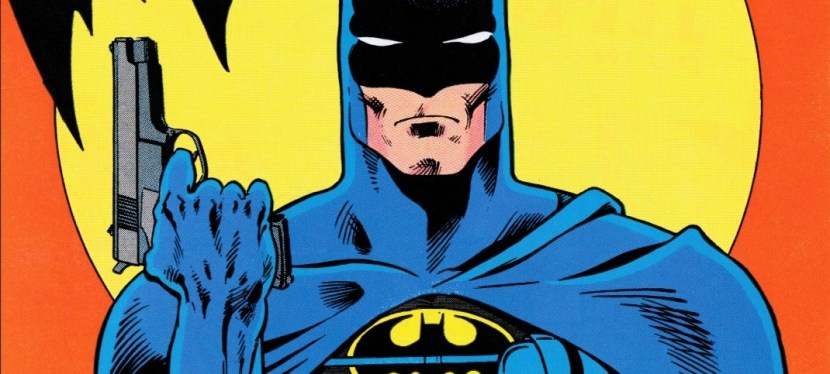
The cover.

Early story

The story begins in Gotham City where the newly appointed police commissioner Gordon participates in a TV talk show. The talk show host is aggressive towards Gordon cutting him off verbally and pointing out that Batman – who is working with the police fighting crime – is no better than the Reaper, a costumed vigilante who caused trouble and killed many people on Gotham’s streets twenty years prior. Gordon emphasizes that Batman works with the city police and he operates strictly on his own.

As the TV talk show goes on, a group of armed thugs carrying varied items enter an apartment that is dark. Outside the Bat Signal (coming from the machine Gordon recently got) flashes, and soon Batman himself appears inside the apartment and cleverly took the gang down. He leaves the place going to do other things.

The next day, Rachel Caspian is pleasantly surprised to see her father arrive earlier than expected…

Quality

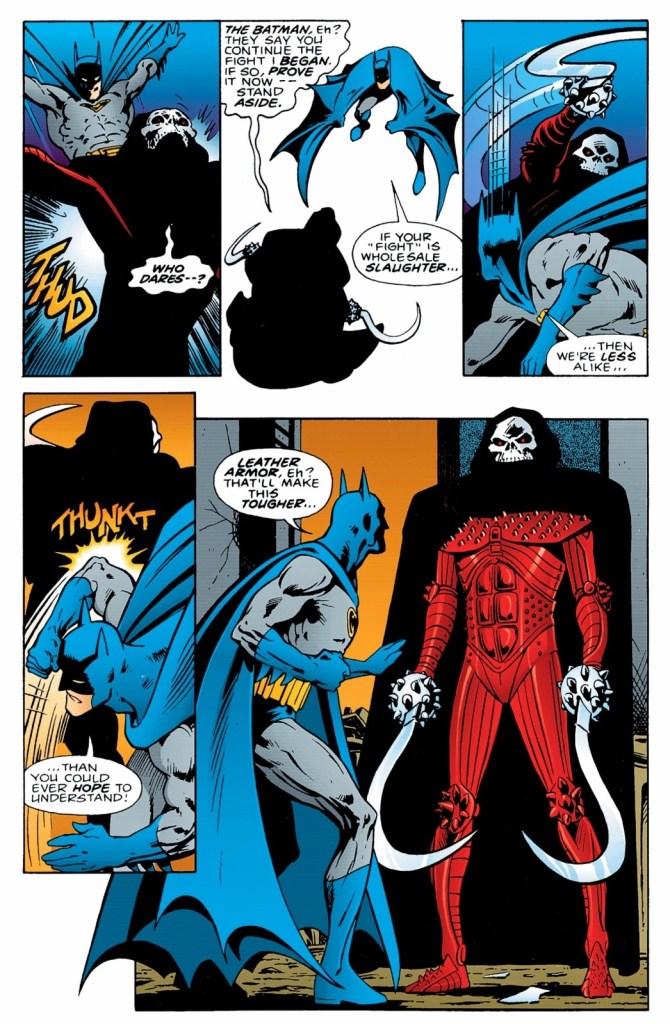
Batman strikes first in his encounter with the Reaper.

Set during the 2nd year of Batman engaging in crime-fighting in coordination with the Gotham City police force, this comic book dramatically portrays the city having a long-running disease and legacy of crime. The references to Gotham’s embarrassing past of being filled with thugs and wicked activities literally paved the way for the return of a masked vigilante who fights criminals with uncompromising violence (including killings). That vigilante’s legacy affects the way the public perceives Batman and why they have trouble seeing the differences between them. The writing and build-up here are very solid.

When it comes to portrayals, you will get to see a younger Bruce Wayne who is clearly pushing himself hard between engaging in business matters and secretly fighting crooks. This is a Batman who is only gaining more experience in the war against crime and he clearly is not the very tactical and very resourceful hero he would become. In his fight against the Reaper, you will really see Batman struggle hard and make really flawed moves that cost him a lot.

The introduction of the Reaper, who became the definitive vigilante of Gotham City long before Batman even started, is very engaging. This vigilante is also very intimidating to see and he clearly overshadows the Caped Crusader both visually and in action.

Conclusion

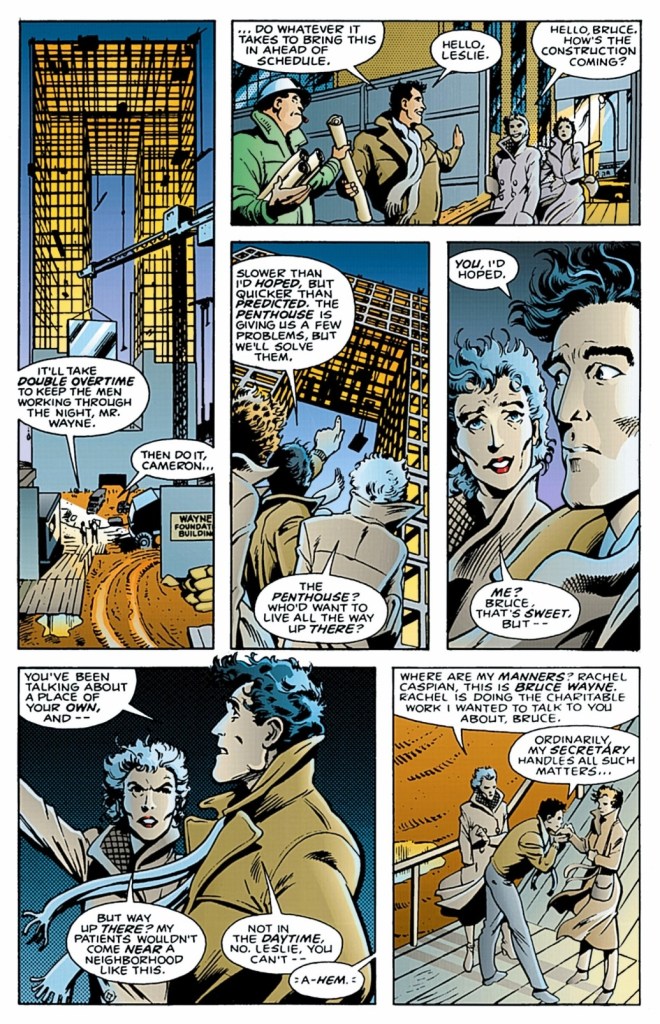
Bruce Wayne attending to business on-site.

As the first chapter of the Batman: Year Two storyline, Detective Comics (1987) is a very solid tale to read. The narrative moved at a medium pace and there were these balanced pay-offs to the build-up (that took place in the first half). The Reaper’s reputation as Gotham’s past blood-thirsty vigilante literally dwarfed that of Batman (the modern vigilante). I should also state that Mike W. Barr symbolized the common traits and differences between Batman and the Reaper which alone are worth reading.

Overall, Detective Comics (1987) is recommended.

+++++

Thank you for reading. If you find this article engaging, please click the like button below, share this article to others and also please consider making a donation to support my publishing. If you are looking for a copywriter to create content for your special project or business, check out my services and my portfolio. Feel free to contact me with a private message. Also please feel free to visit my Facebook page Author Carlo Carrasco and follow me on Twitter at  @HavenorFantasy as well as on Tumblr at https://carlocarrasco.tumblr.com/ and on Instagram at https://www.instagram.com/authorcarlocarrasco
A Look Back at Batman versus Predator II #3 (1995)

Disclaimer: This is my original work with details sourced from reading the comic book and doing personal research. Anyone who wants to use this article, in part or in whole, needs to secure first my permission and agree to cite me as the source and author. Let it be known that any unauthorized use of this article will constrain the author to pursue the remedies under R.A. No. 8293, the Revised Penal Code, and/or all applicable legal actions under the laws of the Philippines.

I am currently enjoying the Batman versus Predator II mini-series of the mid-1990s which was a joint effort between DC Comics and Dark Horse Comics. The first issue was great and nicely built up the energy for the first encounter between Batman and the Predator in issue #2. Along the way, I do enjoy the adulterated tone that came with the presentation. This made each issue look and feel like an R-rated cinematic segment.

Will the strong quality of this crossover continue in the third issue? Find out with me in this look back at Batman versus Predator II , published in 1995 by DC Comics and Dark Horse Comics with a story written by Doug Moench and drawn by Paul Gulacy.

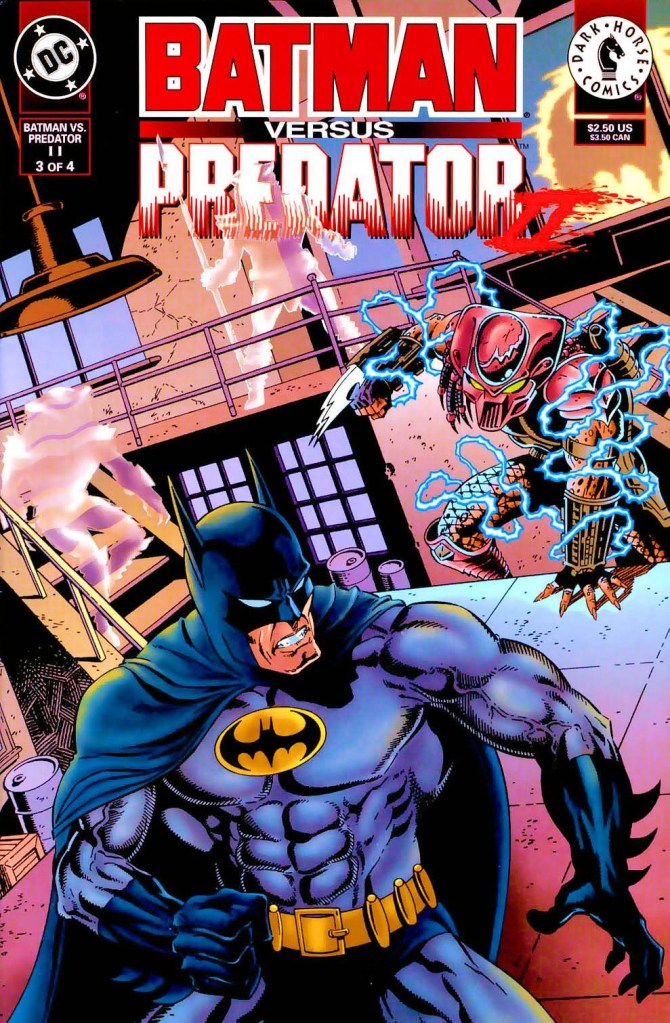
The cover.

Early story

The story begins with Batman emerging from the sewer. He finds himself alone in the middle of a city street and senses danger is around him. Suddenly someone from one of the nearby buildings fires at Batman who dodges and takes cover by a car. He grabs a tool and throws it at the window which hits the rifle. And then, on the street, a man throws a grenade at the caped crusader who deflects it. The grenade enters a nearby establishment and explodes. Batman kicks the antagonist and then encounters a speeding vehicle heading towards him.

The detective fires his weapon which causes the car’s windshield to get smashed. He dodges the car and sees it crash. Suddenly the floor beneath him opens which compels him to use his grapnel to avoid falling down to spikes below.

Meanwhile at another location, the Predator dissolves the decapitated head of a man (killed in issue ) with hot liquid and keeps the skull for his collection of trophies.

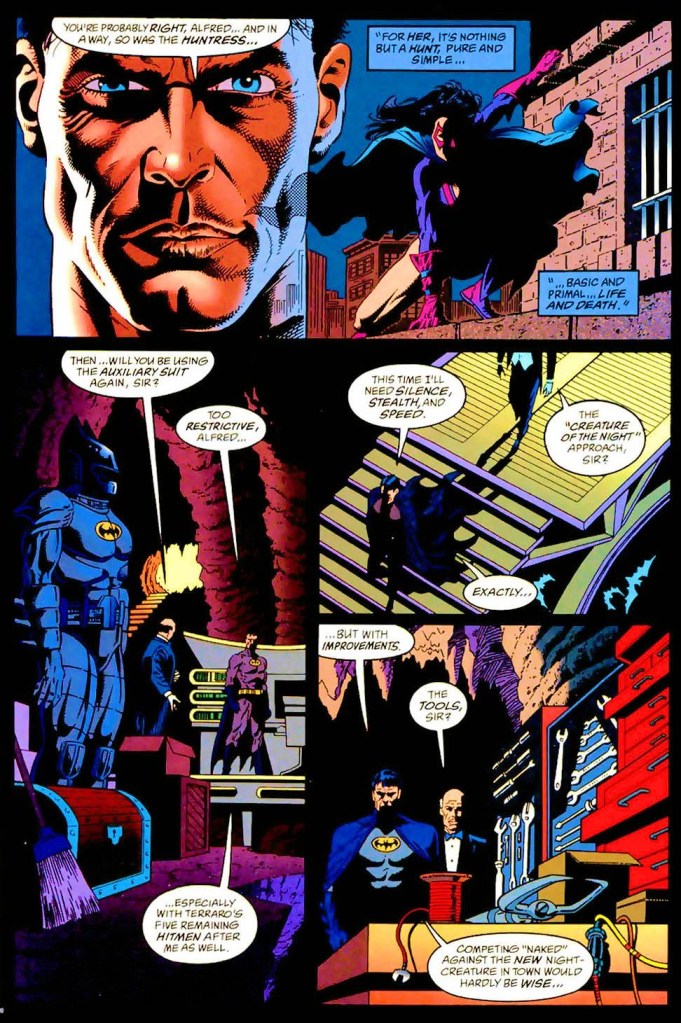
Back at the Bat Cave, Batman and Alfred analyze what happened recently. Alfred states that the Predator killed two of the seven assassins hired by Terraro to kill Batman. The great detective wonders why…

Quality

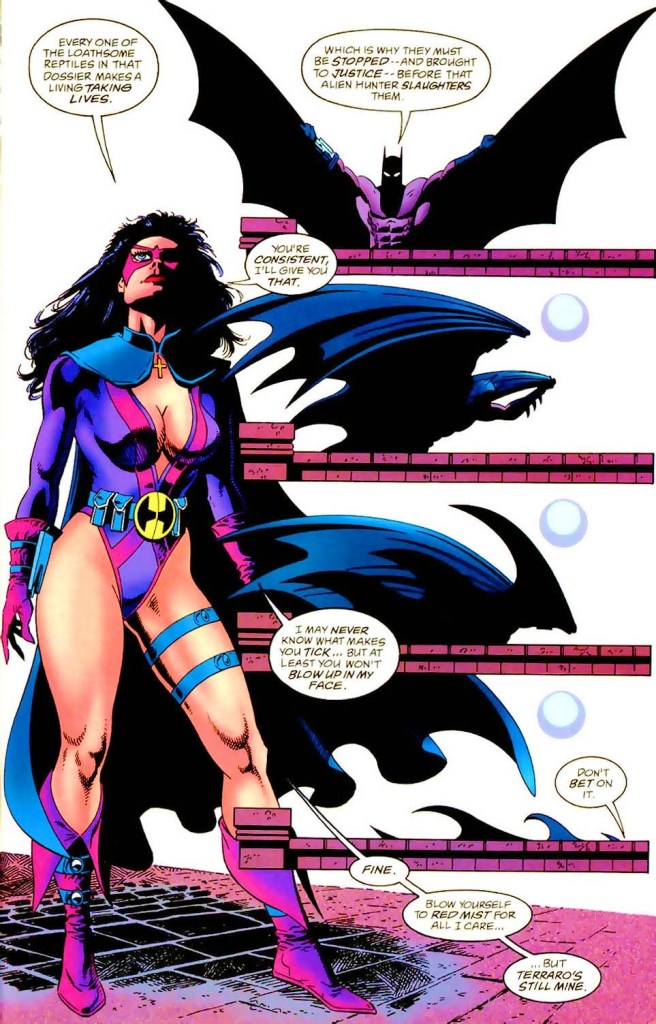
The Huntress and Batman.

Let me start with the storytelling. The writing by Doug Moench is solid and, more importantly, there is a nice payoff here in relation what was gradually built up in the first two issues – Terraro’s assassins and operations getting more lively within the plot. This alone adds some nice variety into the ongoing Batman-Predator rivalry, and symbolically the Huntress (who is after Terraro) is involved with the mafia plot and the said rivalry between Gotham’s detective and the hunter from space.

More on Batman and the Huntress, I like the way Moench wrote these two heroes as being divided even though they both face threats from the crime gang and from the Predator. Both characters are vigilantes but Batman has justice in mind while the Huntress is focused on hunting the powerful crime boss. Adding more depth to the story is the subplot about Commissioner Gordon being helpless and recovering in the hospital which complicates matters for the Gotham City police department.

Another thing that makes this issue more unique is the in-depth presentation of Batman doing detective work in the Bat Cave with Alfred providing insight. This alone makes this issue an improvement over issue .

When it comes to the visuals, artist Paul Gulacy continues to provide really nice artwork backed with strong support by the colorists. Gulacy took his time pacing the story by following the script closely and made key action scenes look dynamic visually when needed.

Conclusion

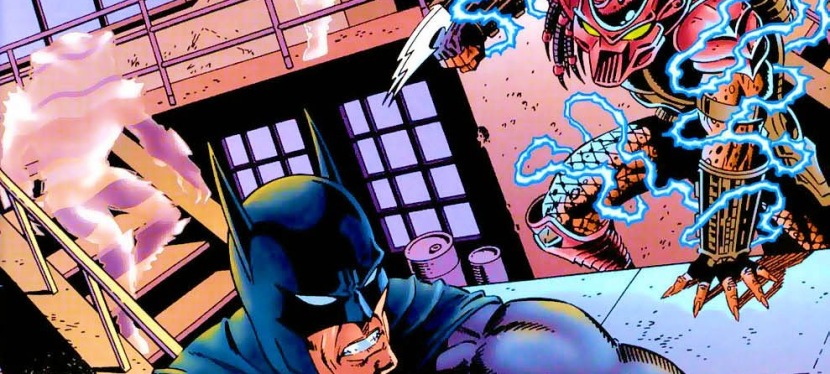
Remember the armor Batman wore in the previous crossover story against the Predator?

Considering all the good stuff I enjoyed in it, Batman versus Predator II is a great read. It has a better balance on plotting, detective work, spectacle and intrigue. In fact, this comic book has a much more powerful ending than issues and , and the ironic thing is that this only leads to the 4th and final issue which I’ll review soon.

If you are seriously planning to buy an existing hard copy of Batman versus Predator II (1995), be aware that as of this writing, MileHighComics.com shows that the near-mint copy of the comic book costs $40.

Overall, Batman versus Predator II (1995) is highly recommended!

+++++

Thank you for reading. If you find this article engaging, please click the like button below and also please consider sharing this article to others. If you are looking for a copywriter to create content for your special project or business, check out my services and my portfolio. Feel free to contact me as well. Also please feel free to visit my Facebook page Author Carlo Carrasco and follow me at HavenorFantasy@twitter.com