Disclaimer: This is my original work with details sourced from reading the comic book and doing personal research. Anyone who wants to use this article, in part or in whole, needs to secure first my permission and agree to cite me as the source and author. Let it be known that any unauthorized use of this article will constrain the author to pursue the remedies under R.A. No. 8293, the Revised Penal Code, and/or all applicable legal actions under the laws of the Philippines.
Welcome back superhero enthusiasts, 1980s arts and culture enthusiasts, Marvel Comics fans and comic book collectors! Today we go back to the year 1984 to examine a small part of the Marvel Comics universe through a tale of the Wolverine monthly series.
This particular tale shows were Wolverine went and what he has been doing since he decided to leave the X-Men in Wolverine #75 (1993). Since Magneto removed the Adamantium out of him in X-Men #25 (1993) and Wolverine discovered that his claws were made of pure bones (part of him all along), he has been very determine to search for answers and the truth about himself.
With those details laid down, here is a look back at Wolverine #87, published in 1994 by Marvel Comics with a story written by Larry Hama and drawn by Adam Kubert.
The cover.
Early story
The story begins in the Southeast Asian city of Madripoor (fictional) where Wolverine and his former teammate Gambit are reunited. As they walk, Gambit tells him that Sabretooth (Wolverine’s long-time rival) is staying in Charles Xavier’s mansion (refer to X-Men #28 and #29). As they talk, Wolverine notices something odd at the Princess Bar which he previously visited and there seems to be something wrong. The two decided to break in, causing damage and expecting the worst. It turns out, a lot of people are inside (including those who became friends of Logan) who prepared a surprise celebration for Wolverine.
As the celebration goes on, ninjas at the top of the building watch Wolverine carefully as they prepare to go down and kill him…
Quality
Amazingly, Wolverine managed to slash the two falling guys with his bone claws and impressed Gambit.
If you are familiar with Team X (revealed in flashbacks in X-Men #5 and X-Men #6) composed of Wolverine, Sabretooth and Maverick as black ops operatives, then the story of this comic book will really become relevant with you. In fact, reading the mentioned comic books is a must.
Without spoiling the plot, I can say that creative duo of Hama and Kubert came up with their own contribution to the Team X mythos (with flashbacks visualized in similar style to those in the above-mentioned X-Men comic books of 1992) while emphasizing how the past affects Wolverine, Sabretooth and Maverick in the present day.
What Hama-Kubert came up with was not the typical good-versus-evil superhero tale but rather a believable expansion of the Team X legacy, what the three former members have in common, and what uncertainties are they dealing with as surviving mutants. In the case of Wolverine, this tale adds depth to his solo exploits since leaving his team behind in search for answers.
Conclusion
Wolverine dancing with a pretty lady while two guys above watch them.
Wolverine #87 (1994) is a fine character exploration and also a nice revelation about Team X. Considering how good the contributions from Hama and Kubert are, they would not be so relevant if you have never read Team X’s flashbacks in the two specific X-Men comic books published in 1992 and that alone makes this one a tricky read.
Disclaimer: This is my original work with details sourced from reading the comic book and doing personal research. Anyone who wants to use this article, in part or in whole, needs to secure first my permission and agree to cite me as the source and author. Let it be known that any unauthorized use of this article will constrain the author to pursue the remedies under R.A. No. 8293, the Revised Penal Code, and/or all applicable legal actions under the laws of the Philippines.
Welcome back, superhero enthusiasts, comic collectors, 1990s culture enthusiasts and fans of the X-Men! We go back to the year 1993 when the 30th anniversary of the X-Men was celebrated with the 6-part Fatal Attractions storyline. Already I reviewed Uncanny X-Men #304 (Part 3) which was not worthy of the X-Men’s 30th anniversary celebration. X-Men #25 (Part 4) meanwhile was not only great but also shocking and had a years-long impact on X-Men comics.
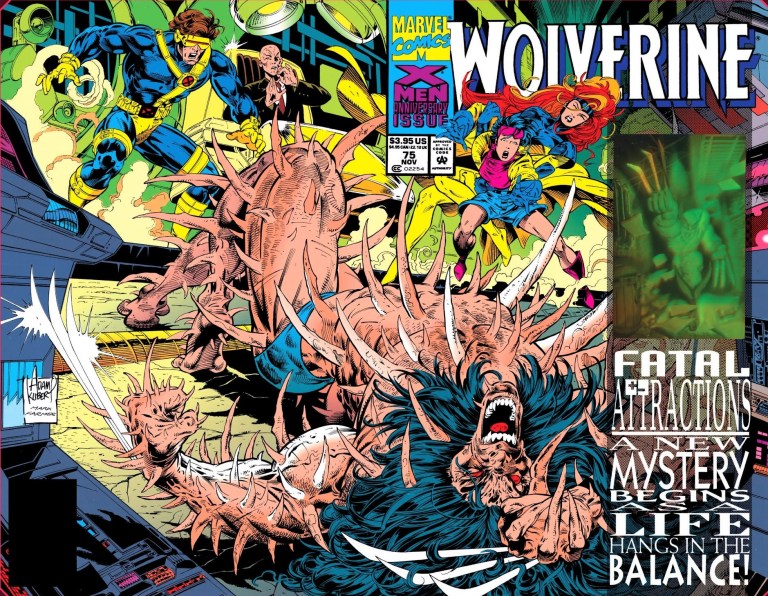
So now the focus is on the 5th chapter of the Fatal Attractions storyline handled by the Larry Hama-Adam Kubert team on the Wolverine monthly series of the time. With those details laid down, here is a look back at Wolverine #75, published by Marvel Comics in 1993 with a story written by Larry Hama and drawn by Adam Kubert.
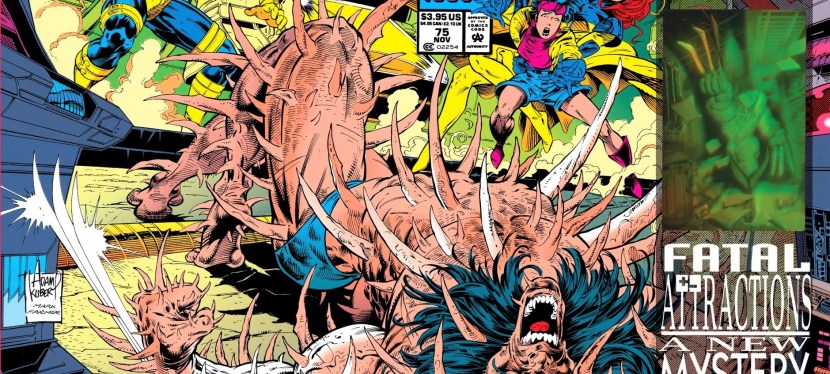
The cover.
Early story
The story begins in outer space. Carrying Charles Xavier, Wolverine, Gambit, Jean Grey, Rogue and Quicksilver (who participated in the dangerous mission in X-Men #25), the X-Men’s jet (piloted by Bishop) struggles mechanically as it was not designed for space travel. Worse, Wolverine is under very serious condition and the medical unit has been operating in full capacity dealing with his intense trauma.
In an attempt to alleviate Wolverine’s psychic trauma, Charles Xavier and Jean Grey enter his mind and discover that there is a world full of pain and horror. They see visions of a restrained Wolverine (from his Weapon X days) being attacked by Sabretooth and Lady Deathstrike. Xavier explains that they are at the epicenter of Logan’s most suppressed cataclysmic memories which were clearly triggered by the physical damage Magneto inflicted on him (see X-Men #25).
As the X-Men’s jet attempts to enter Earth’s atmosphere, its exteriors heat up dramatically shaking everyone inside. This complicates the situation on stabilizing Wolverine…
Quality
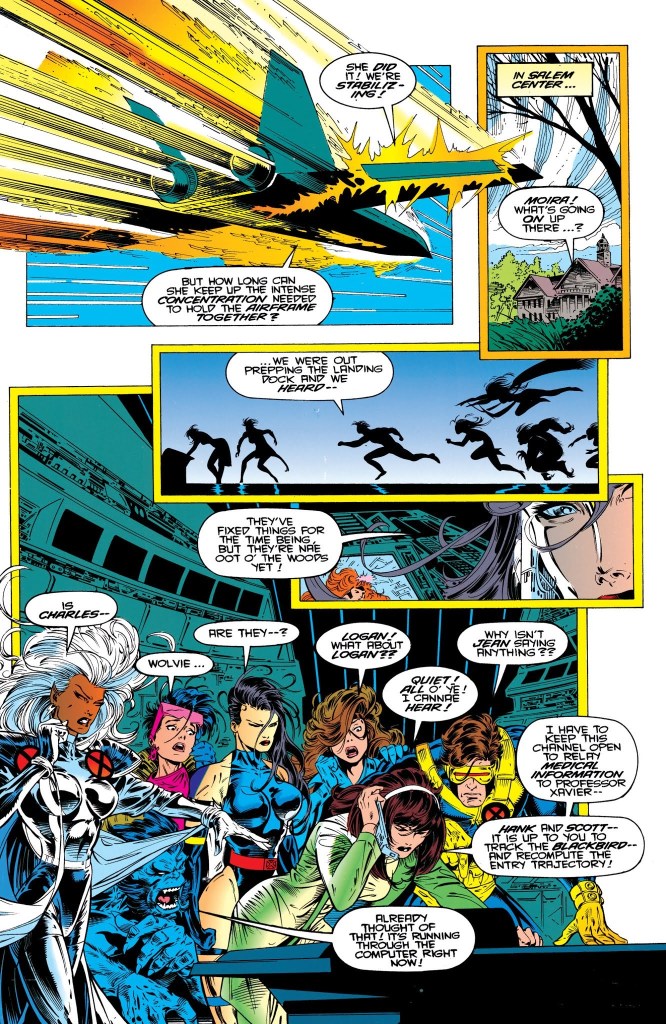
The other X-Men team members at their headquarters expressing worry and concern about the situation of their teammates struggling to come back home from space.
To be clear, this story continues the events of Fatal Attractions but with a bit more focus on Wolverine (compared to the earlier chapters of the storyline that is). There is no real battle between good and evil at all. It’s really all about Wolverine struggling to survive just as his teammates struggle to arrive home.
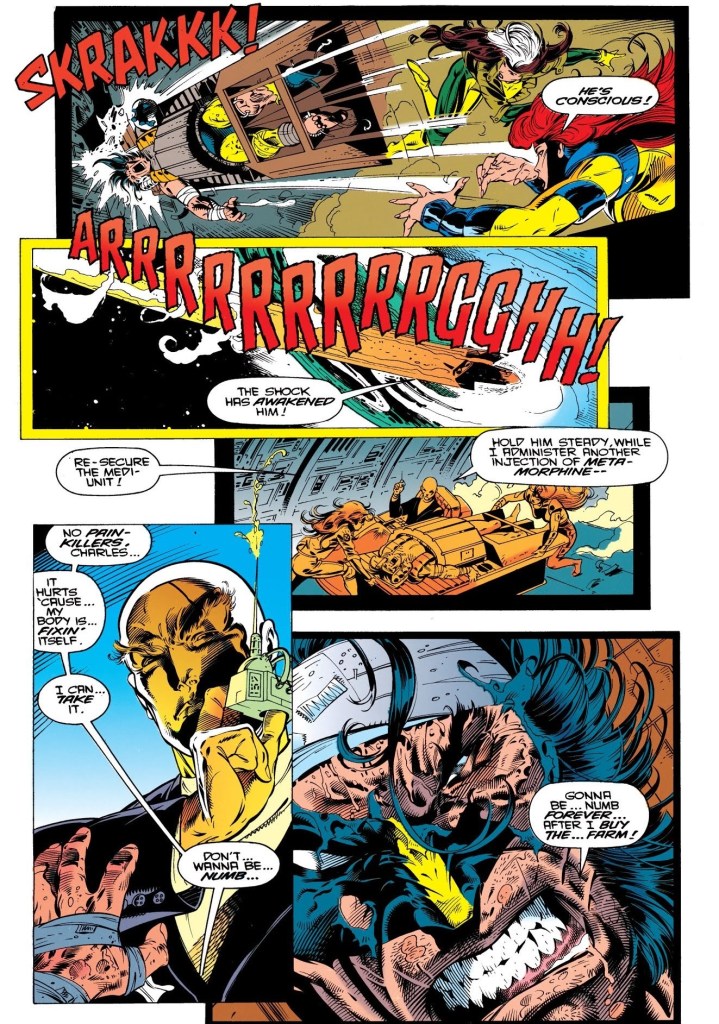
Before the stories of this comic book and X-Men #25 happened, Wolverine has often been portrayed to be very tough, brave and a walking machine of violence which has been reflected in other X-Men stories told in video games and movies. In this very comic book, Wolverine has been presented to coming close to death. This means Logan, at this particular stage of the history of the literary X-Men, was at his most vulnerable state. In my experience, this was both alienating and shocking to see.
With regards to the writing, Larry Hama did an excellent job with pacing the story from start to finish. Right from the beginning, the story pulls you into the X-Men’s tough situation and as each page gets turned, the tension as well as the suspense builds up until the execution of the climax. Along the way, the comic book not only portrays Wolverine struggling on the edge, it also works to make you care more or be more concerned towards him. Oh yes, the shocking moment near the end of this comic book remains very powerful and you who read this retro review should read Wolverine #75 and see it for yourselves.
Conclusion
Wolverine at his most vulnerable state.
By today’s standards, Wolverine #75 (1993) is still a very great comic book to read. In fact, I can say it is not only one of most defining chapters of the Fatal Attractions storyline as well as one of the most significant X-Men comic books of the 1990s, it is indeed a true illustrated literature classic ever published by Marvel Comics. In retrospect, this comic book marks a major turning point in the life of Wolverine who is still one of the most iconic characters in all of superhero literature. All of these were achieved thanks to the creative team of Larry Hama and Adam Kubert (whose are here was great and stylized at the same time). Hama succeeded in writing the continuation of the Fatal Attractions storyline while balancing all of the exposition and still putting Wolverine in the center. That itself is a very great work of writing.
If you are seriously planning to buy an existing hard copy of Wolverine #75 (1993), be aware that as of this writing, MileHighComics.com shows that the near-mint copy of the regular edition costs $60 while the near-mint copies of the signed-and-numbered edition and the newsstand edition cost $300 and $180 respectively.
Overall, Wolverine #75 (1993) is highly recommended!
+++++
Thank you for reading. If you find this article engaging, please click the like button below and also please consider sharing this article to others. If you are looking for a copywriter to create content for your special project or business, check out my services and my portfolio. Feel free to contact me as well. Also please feel free to visit my Facebook page Author Carlo Carrasco and follow me at HavenorFantasy@twitter.com
Disclaimer: This is my original work with details sourced from reading the comic book and doing personal research. Anyone who wants to use this article, in part or in whole, needs to secure first my permission and agree to cite me as the source and author. Let it be known that any unauthorized use of this article will constrain the author to pursue the remedies under R.A. No. 8293, the Revised Penal Code, and/or all applicable legal actions under the laws of the Philippines.
As an X-Men fan, 1993 was a memorable year for me during my time of collecting comic books and enjoying what was believed to be the modernization of superhero comics in America. Gimmick covers of comic books, the post-event effects of the Death of Superman, the launch of the Ultraverse and then there was the 30th anniversary celebration of the X-Men which was wild.
To put things in perspective, Marvel Comics organized the celebration of the 30th anniversary of Spider-Man releasing lots of merchandise and, most notably, special issues of comic books that came with covers with holograms, more pages for content and a cover price that was more than double than what was normal (note: read my review of one of them). Such comic books were hot stuff for not only Spider-Man fans but also comic collectors who were often hunting for the next great collector’s item that would ensure them great wealth.
Marvel had the same business approach with the 30th anniversary of the X-Men, and there were multiple X-Men-related monthly series of comic book back then. X-Factor #92, X-Force #25, Uncanny X-Men #304, Wolverine #75 and Excalibur #71 all were released with covers with hologram cards on the front, more pages of content and inflated cover prices.
The one 30th anniversary celebration comic book of the X-Men that was most memorable to me was X-Men #25 (Volume 2) and to this day, its plot remains very memorable for its shock value. I bought my copy of this comic book at a store in BF Homes. With the history lesson over, he is my retro review of X-Men #25, published in 1993 by Marvel Comics with a story written by Fabian Nicieza and drawn by Andy Kubert.
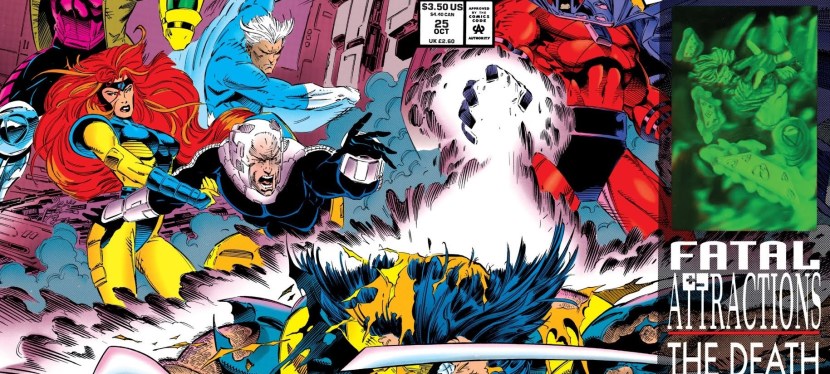
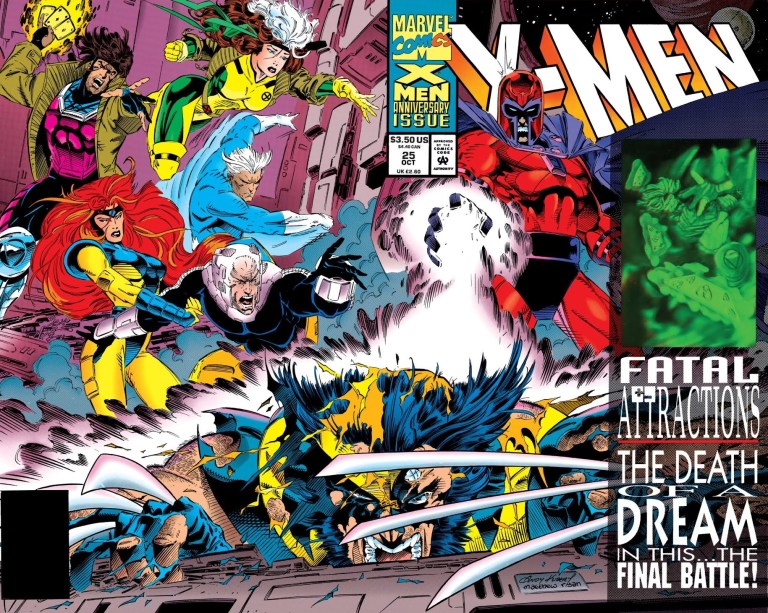
The cover.
Early story
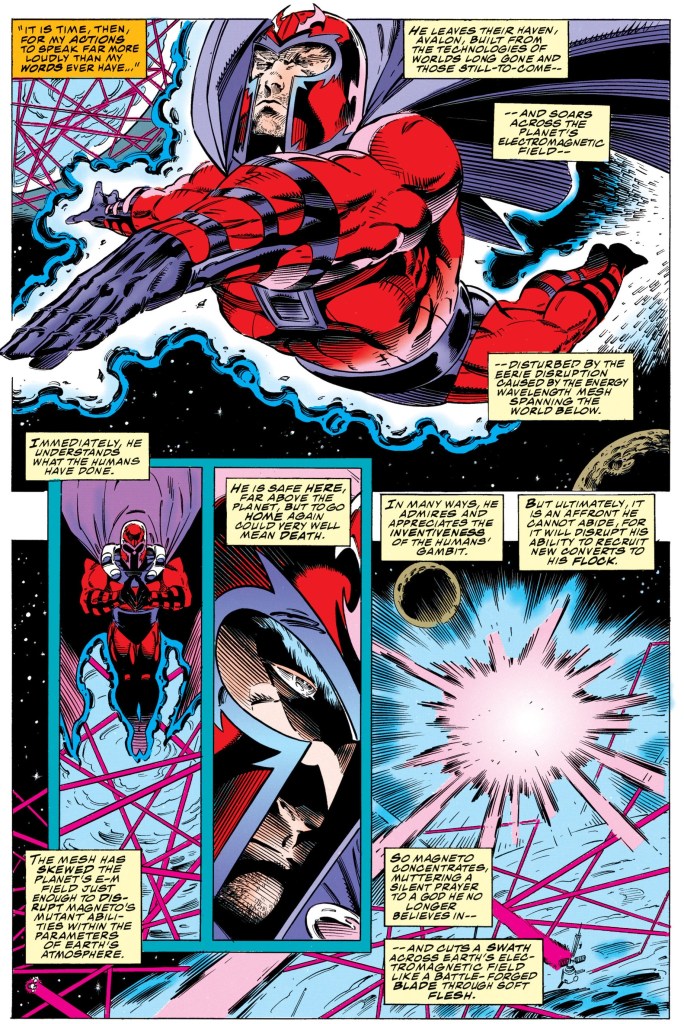
The story begins with the United Nations Security Council’s approval to initiate the alpha and beta parameters of the Magneto Protocols which literally sent waves from the White House to the Kremlin. A short time later, several satellites orbiting the Earth activate and linked with each other to form a protective mesh of electro-magnetic fire. This provokes Magneto (accompanied by Acolytes and Exodus at Avalon) to react by generating a massive pulse wave that affects the entire world. Even the Fantastic Four and Excalibur were not spared.
At the School of Gifted Children, Charles Xavier organizes an urgent meeting with the X-Men. Together they discussed the impact of Magneto’s pulse wave which not only rendered world’s mechanical and technological resources useless but also caused trouble (plane crashes, medical equipment failure, etc.) and deaths. For Xavier, the mere fact their team survived (aided by Shi’ar technology) is a mistake on the part of Magneto considering his capability to wipe out life around the world.
In response to Wolverine’s question, Xavier stated, “We do not have the luxury of time, nor the occasion for nobility…at this point, we are not fighting for the philosophy of a cause, a hope, or a dream, we are fighting for our very survival and if we do not win this fight, this planet will be irrevocably lost to us!”
Quality
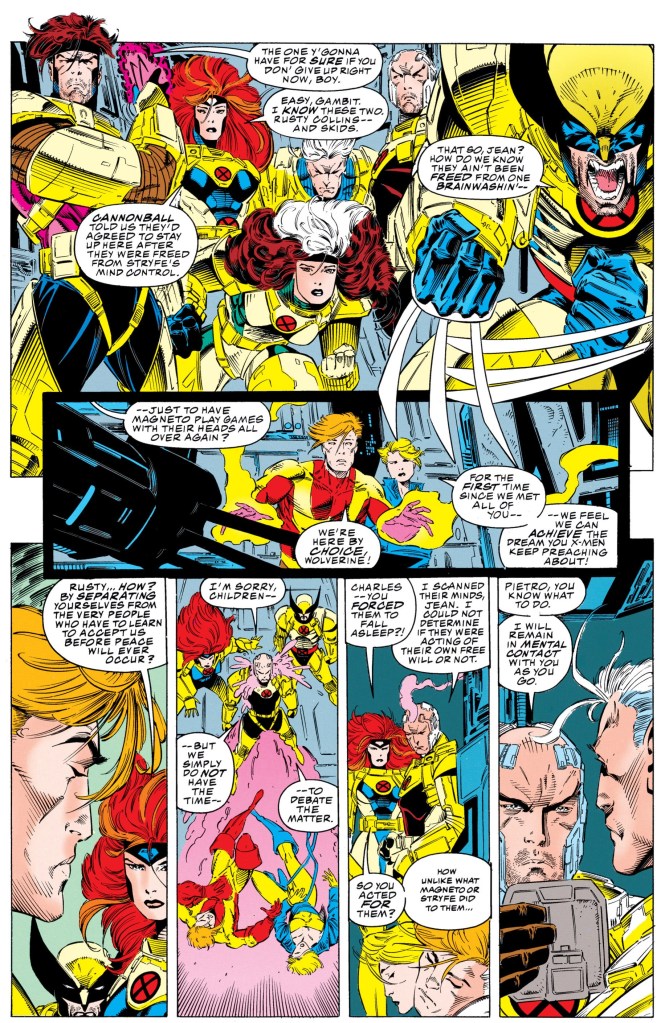
The X-Men during their daring mission.
I can clearly declare that when it comes to the combined works done by Fabian Nicieza and Andy Kubert with the X-Men, this particularly story was not only the most ambitious collaboration of theirs but also their most compelling and finest work at the time of publishing. Very strong writing (top-notch characterization, plotting and pacing) and great art really defined this comic book!
Characterization is spot-on! Wolverine is arrogant and gritty as usual, Gambit is still the smooth-talker, Cyclops is the focused leader serving under Xavier, etc.
Without spoiling the major details, I can say that the shocking moments executed were greatly done not for the mere intention of shocking but to break new ground with regards to the characters of Wolverine and Charles Xavier. The first time I read this comic book back in 1993, I was really stunned with those particular scenes and I started to question Wolverine’s durability as well as Xavier’s sanity. And then there was the state of Magneto at the end of the story. The thing about the shocking moments was that there was an adequate amount of build-up leading to them and the pay-off was excellently done.
Conclusion
The immense power of Magneto.
There is no doubt in my mind that X-Men #25 (1993) is the true gem of the entire X-Men 30th anniversary celebration. The creative team led by Nicieza and Kubert really outdid themselves and what happened in this comic book had consequences that lasted for a good number of years. The creative team took big risks and pulled them off nicely as the impact of the story was eventually felt in the years that followed. Lastly, unlike Uncanny X-Men #304 (supposed to be the highlight of X-Men’s 30th anniversary celebration), this comic book is more focused and really had no creative baggage nor filler that got in the way of the storytelling.
If you are seriously planning to buy an existing hard copy of X-Men #25 (1993), be aware that as of this writing, MileHighComics.com shows that the near-mint copy of the regular edition costs $50 while the near-mint copy of the newsstand edition is priced at $150. The near-mint copies of the signed-and-numbered edition and the gold edition cost $210 and $368 respectively.
Overall, X-Men #25 (1993) is highly recommended!
+++++
Thank you for reading. If you find this article engaging, please click the like button below and also please consider sharing this article to others. If you are looking for a copywriter to create content for your special project or business, check out my services and my portfolio. Feel free to contact me as well. Also please feel free to visit my Facebook page Author Carlo Carrasco and follow me at HavenorFantasy@twitter.com
Disclaimer: This is my original work with details sourced from reading the comic book and doing personal research. Anyone who wants to use this article, in part or in whole, needs to secure first my permission and agree to cite me as the source and author. Let it be known that any unauthorized use of this article will constrain the author to pursue the remedies under R.A. No. 8293, the Revised Penal Code, and/or all applicable legal actions under the laws of the Philippines.
According to the online edition of Merriam-Webster Dictionary, an oasis is something that provides refuge, relief, or pleasant contrast. In the case of X-Men 2099, the open areas of the southwestern region of the United States is a dangerous place to be in even though they are free from oppressive systems of control that dominate cities. As such, it is the southwestern region in 2099 can be compared to the Old West in history where there are lots of desolate places as well as lots outcasts and outlaws. Unlike their mainstream counterparts, the X-Men of the far future are nomads and they don’t have a long-term place of residence they could call home. Considering how dangerous the region is for the mutants, a haven of peace, security and prosperity is always ideal to them but only if it is indeed real.
That is what we will explore in the one-shot comic book X-Men 2099: Oasis here.
But before proceeding with the review, it has to be emphasized first that the one-shot comic book which was made special with the painted art of the Hilderbrandt brothers Greg and Tim. For long-time X-Men 2099 scribe John Francis Moore, Oasis was like a big dream come true. When asked during an online interview about his recollections on making X-Men 2099: Oasis and working with the Hildebrandt Brothers, Moore stated:
I was a fan of the Hildebrandt’s fantasy illustration, and I was blown away when Joey told me that they wanted to do an X-men 2099 project. I met with them in Joey’s office and they were both really great guys. I think they said they really liked Bloodhawk, so I knew he’d be a major player in whatever story we developed. They didn’t enter the project with a lot of conditions. They seemed genuinely happy to get to play in this corner of the Marvel universe.
I can’t remember ever writing a full script for any of my Marvel work. I gave them a plot and sometime later received Xeroxes of pencil art (Hildebrant art!) to dialogue. Then it went back for them to paint, and they did a phenomenal job. I only wish that it could’ve been published before the 2099 line was axed. It was a beautiful book that I think was sadly under promoted.
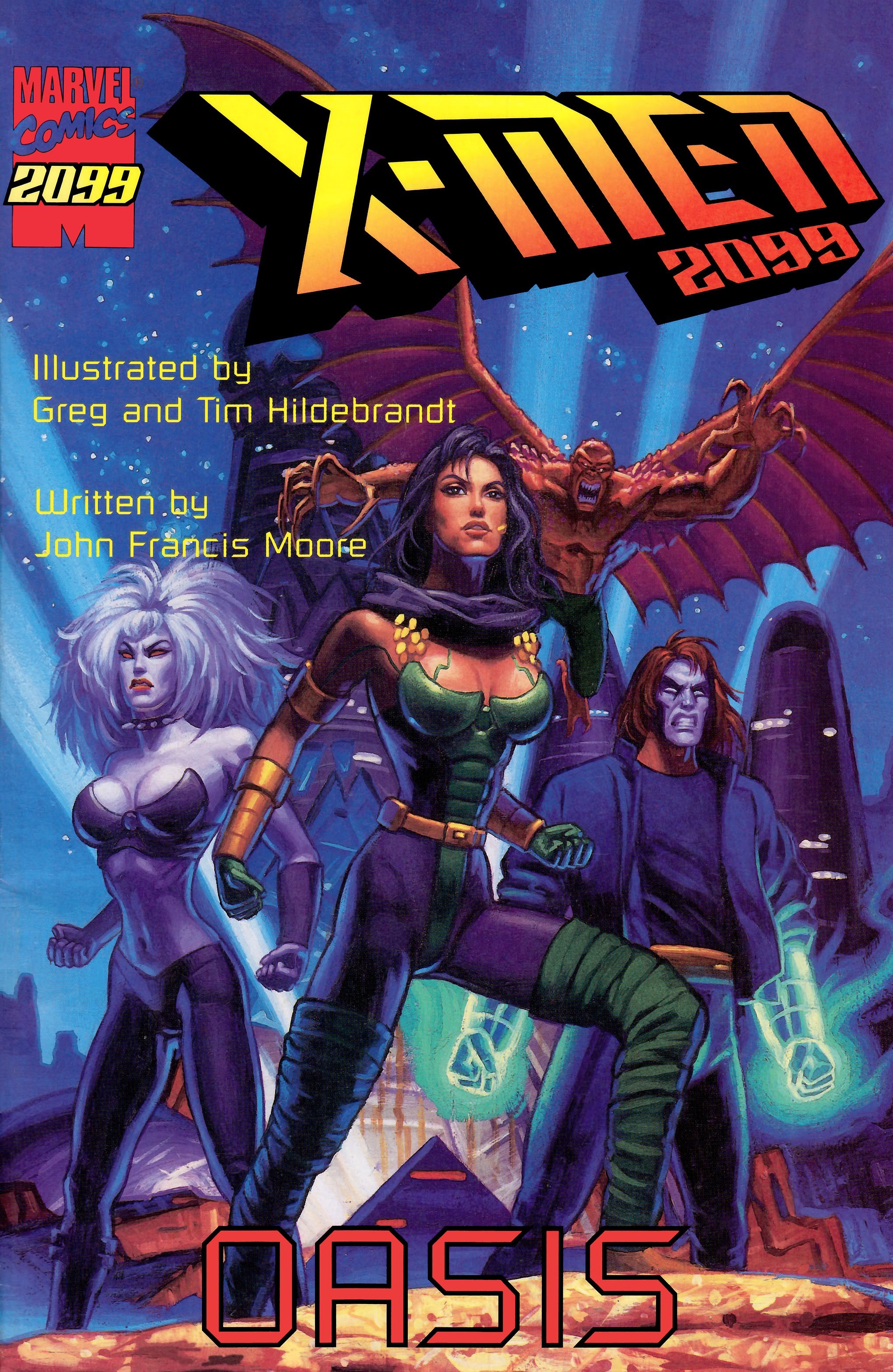
To find out if it is any good, here is a look back at X-Men 2099: Oasis published in 1996 by Marvel Comics with a story written by John Francis Moore and painted art done by Greg and Tim Hildebrandt.
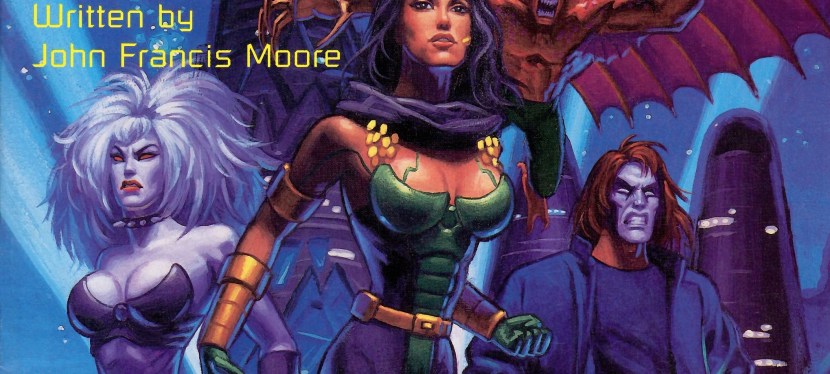
The cover.
Early story
The comic book begins with a flashback set in Hong Kong in the year 2090. A much younger Shakti/Cerebra is on the loose trying to reach a ferry to Kowloon with a plan to hide in the back alleys of Tsimshatsui. Suddenly Lokjaw intercepts her and grabs her. They had a short history together and Lokjaw insists that Shakti should be grateful to her father who raised her to run his bio-shops. After a brief chase, something hits Lokjaw who fell into the water. It turns out Ryu Kobolt helped Shakti, and he has been instructed by his boss to offer her asylum.
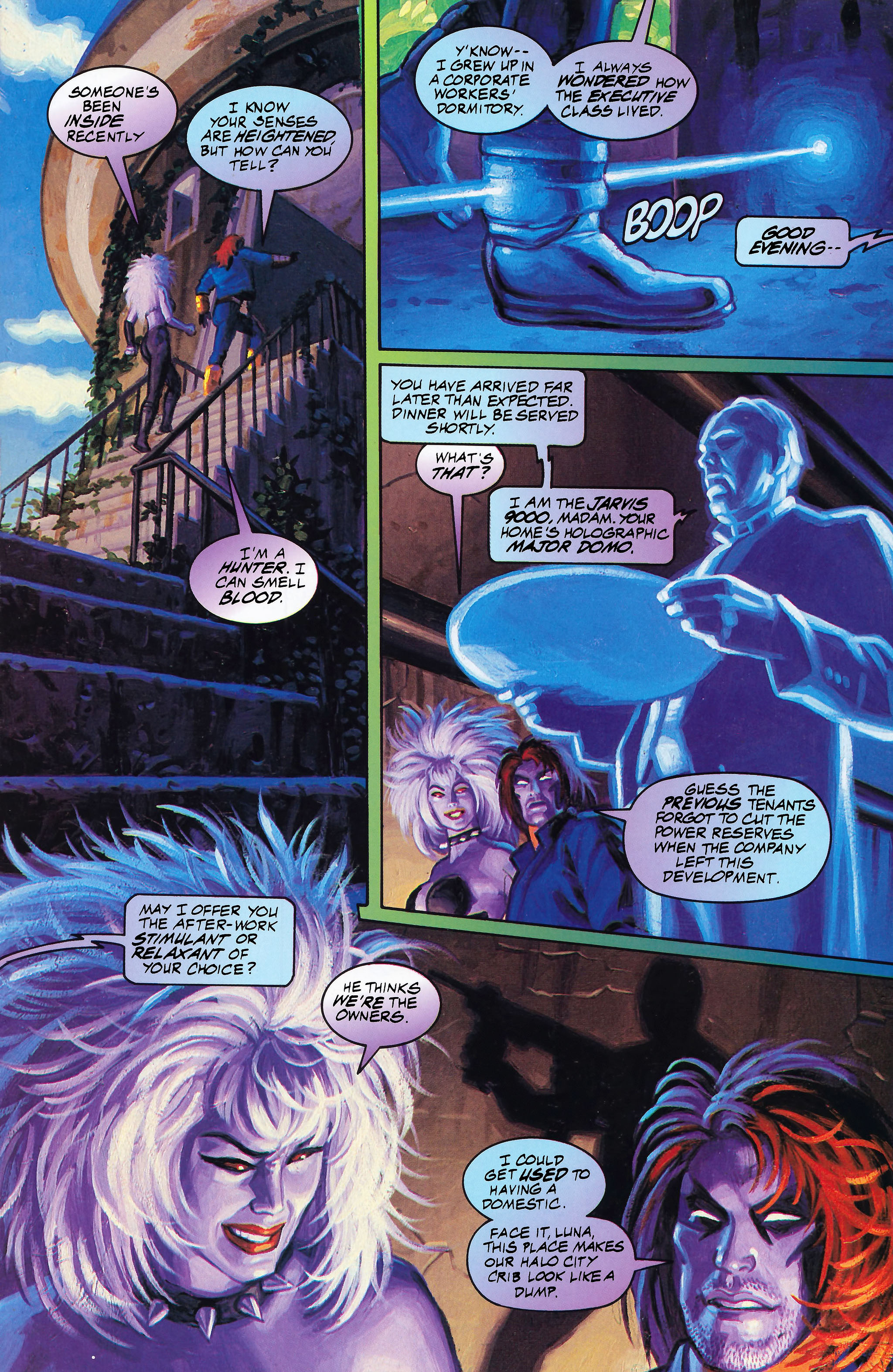
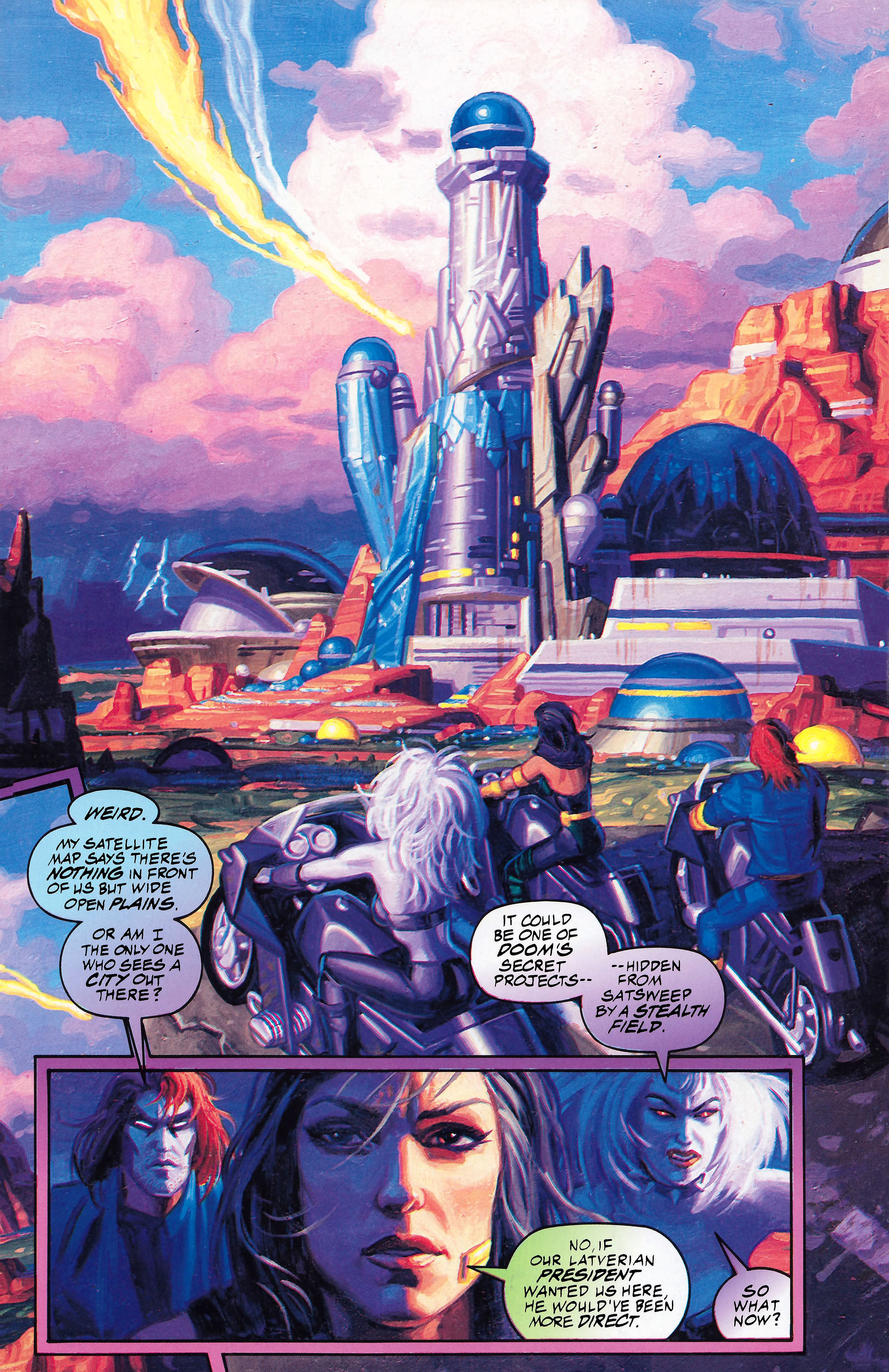
Luna and Skullfire explore a place.
In the present day of 2099 in New Mexico, Bloodhawk flies to his desert home not knowing he is being monitored. Two people, an old man with white hair and a lady, work together to stun the X-Men member and take him with them. A short time later, inside a high-tech facility, Bloodhawk wakes up finding himself restrained and being watched over by the lady and the old man. They tell him he is in the Promised Land, a place where the sins of the old world will be washed away. Using her powers, she touches Bloodhawk’s head and slowly turns him into his normal human form.
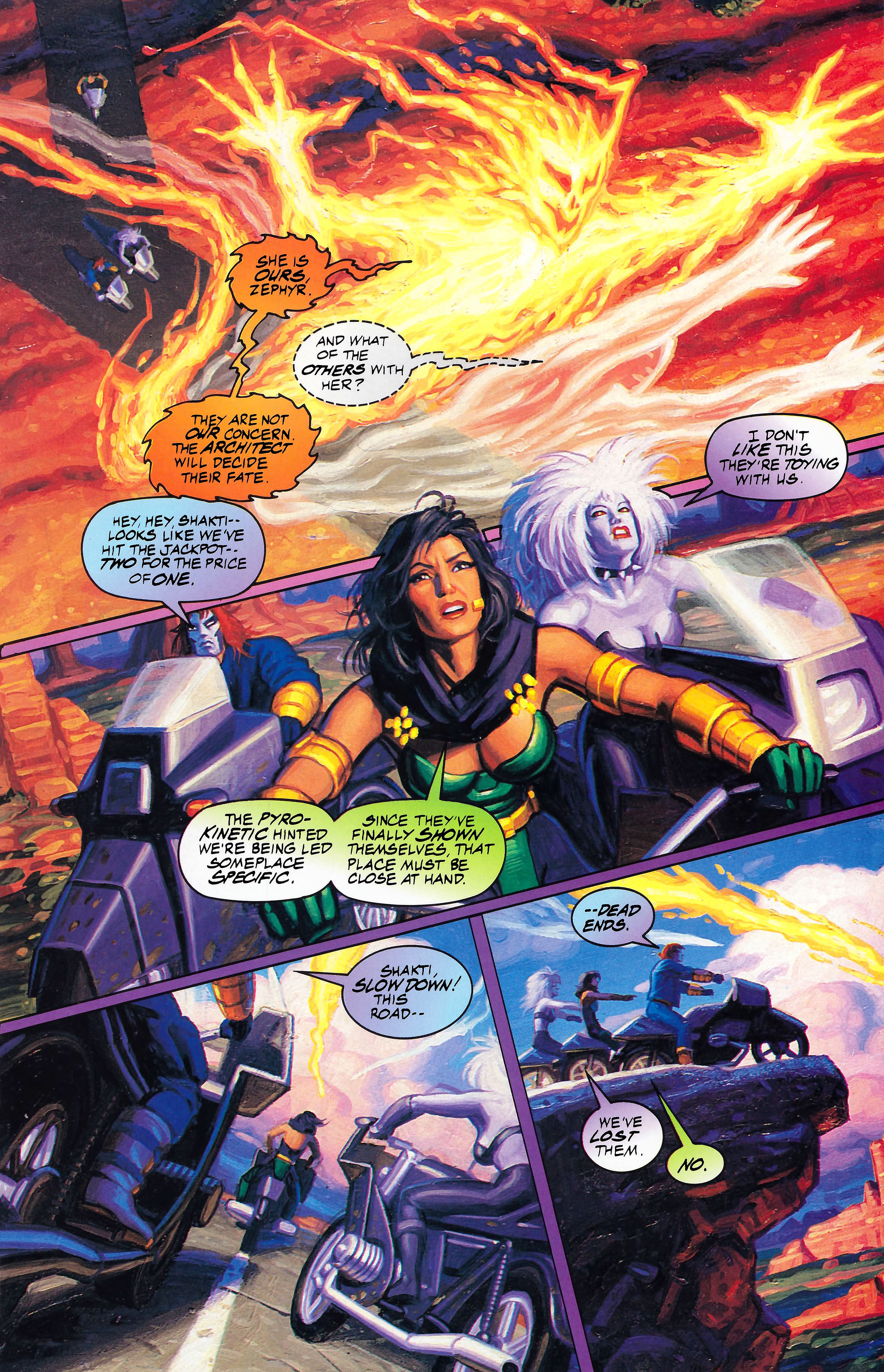
Meanwhile outside a deserted town near the border between Colorado and Kansas, Shakti, Tim/Skullfire and Luna arrive riding motorcycles. They are checking the potential presence of a mutant nearby…
Quality
Really great visuals by the Hildebrandt brothers!
It is very safe to say that this is one very ambitious X-Men 2099 story ever told by John Francis Moore. It sure has an epic concept showing that Oasis in the open region not only exists, but also serves as the closest thing humanity in America has to imitating Heaven built on top of the land. Oasis is the indoor paradise where mutants and humans gather together, live in peace and work together in tremendous ways that the X-Men could only hope to achieve in Halo City (note: this story is set some time after X-Men 2099 #25).
The titular place is clearly the centerpiece of the story backed with characters and threads from the past that explain how it got established. Part of the creation of Oasis is connected with Ryu Kobolt whom Shakti got close with many years back. Of course, someone else got involved with Ryu which directly connects with the creation of Oasis.
While it is also clear that the story took some inspiration from Christianity, I should say that the approach was done by rehashing old storytelling concepts like emphasizing a charismatic person who looks godly or messianic, people getting converted with ways that are not holy, false prophets misleading those seeking salvation, etc. With the ages-old concept of the mad scientists added, then there is conflict here for the X-Men to engage with. The story touches on themes like destiny, conversion, having the power to judge people and committing genocide.
As for the characters, John Francis Moore made the right move to utilize Shakti, Bloodhawk, Skullfire and Luna of the X-Men, however the other new characters such as Memphis, Pandora and Ryu pale in comparison with regards to importance (even though Memphis and Ryu each had a good amount of the spotlight and even some character development).
When it comes to the artwork, this is one great looking superhero, sci-fi story in painted form thanks to the Hildebrandt brothers! Not only is their painted art beautiful to look at, there are also eye-catching shots of scenery, very detailed facial expressions and a very lively presentation of the action scenes and explosions! Each and every character painted – specifically Shakti, Skullfire, Bloodhawk, Luna, Memphis, Pandora and Ryu – has that touch of visual realism (note: not photo realism) that make them look more human to the eyes (especially the X-Men members when compared to how they were drawn by Ron Lim and Jan Duursema in the monthly series). This is one great looking comic book and easily one of the very best of the X-Men of 2099!
Conclusion
The Oasis!
X-Men 2099: Oasis is a one-shot comic book that did not match its high ambition. While it has some of the best painted superhero art of the 1990s ever, the storytelling just did not engage me that much. For one thing, its approach on taking inspiration from Christianity is very flawed not only due to rehashing storytelling concepts but also due to the fact that everything – including the titular Oasis – had to be concluded already. Even though there was a build-up leading to a final conflict, the payoff was not that great and ultimately there was a sense of rush in the 2nd half of the story.
What is also disappointing is the fact that the events told here did not really impact Shakti, Skullfire, Luna and Bloodhawk at all, nor was there anything added to the narrative of the X-Men 2099 monthly series. This is too bad because the existence of a haven where people can live in and be protected from the prejudice and violence in the region fits nicely with the concept of X-Men 2099 in the first place. Even though there was a reference to issue #25 during the first half, this comic book ended up looking like a dream story or a parallel universe tale with a $5.95 cover price! It seems to me like this was more like a cash-grab attempt to exploit comic collectors and the fans of X-Men 2099.
If you are seriously planning to buy an existing hard copy of X-Men 2099: Oasis, be aware that as of this writing, MileHighComics.com shows that the near-mint copy costs $14.
Overall, X-Men 2099: Oasis is a serviceable one-shot comic book. That being said, if you really intend to buy it, you should not pay more than $5 for it.
Thank you for reading. If you find this article engaging, please click the like button below and also please consider sharing this article to others. If you are looking for a copywriter to create content for your special project or business, check out my services and my portfolio. Feel free to contact me as well. Also please feel free to visit my Facebook page Author Carlo Carrasco and follow me at HavenorFantasy@twitter.com




 Author Carlo Carrasco