A Look Back at Sludge #4 (1994)

Disclaimer: This is my original work with details sourced from reading the comic book and doing personal research. Anyone who wants to use this article, in part or in whole, needs to secure first my permission and agree to cite me as the source and author. Let it be known that any unauthorized use of this article will constrain the author to pursue the remedies under R.A. No. 8293, the Revised Penal Code, and/or all applicable legal actions under the laws of the Philippines.

Welcome back, superhero enthusiasts, 1990s culture enthusiasts and comic book collectors! Today we revisit the Ultraverse of Malibu Comics and examine one of its many stories through an issue of the Sludge comic book series.

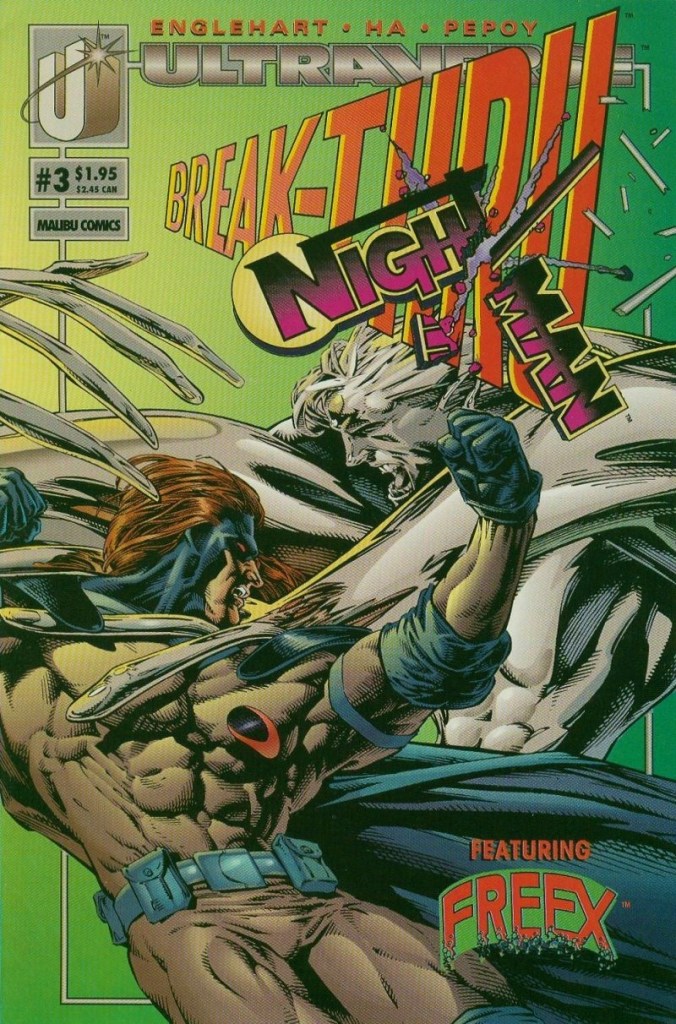
Previously, I reviewed Sludge #3 which was a tie-in comic book to the first big crossover event of the entire Ultraverse – Break-Thru. In that issue, he encountered the “lord” Pumpkin who himself became a notable super villain in the UV. That story also showed the first major test of Sludge when it comes to resisting temptation and evil.

With those details laid down, here is a look back at Sludge #4, published by Malibu Comics in 1994 with a story written and drawn by Aaron Lopresti, and scripted by Steve Gerber.

The cover.

Early story

The story begins when two black teenagers go down the city sewer to look for something as part of a job of them agreed to do for someone named Gordy. They accidentally find Sludge whose appearance and ability to talk scares them away. As the two keep running to another direction, a reptilian monster sees them. The monster grabbed and killed the taller youth, leaving the shorter one scared.

A short time later, a police officer finds the scared teenager hiding behind plants at Central Park. The survivor is in a state of shock repeating his friend’s name a lot. The police update about the boy eventually reaches the office of the New York Daily Globe and an attractive reporter named Shelley intends to follow what could be a hot scoop…

Quality
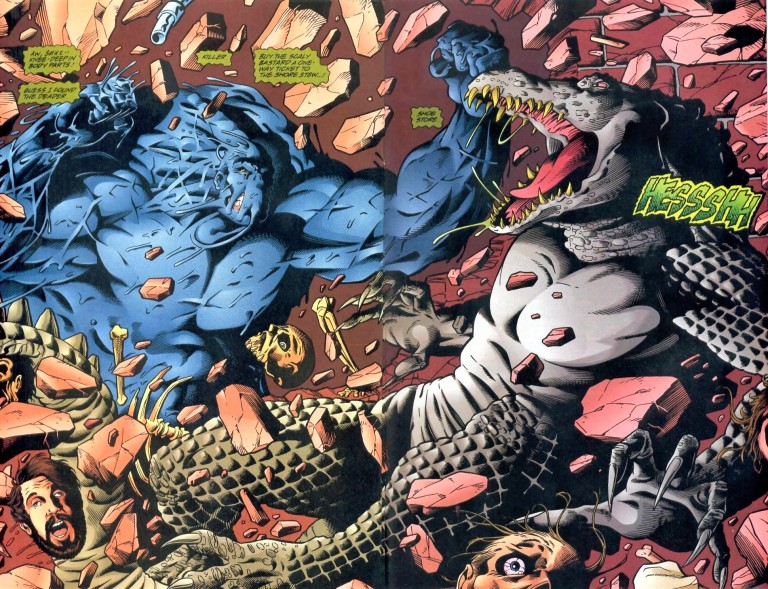
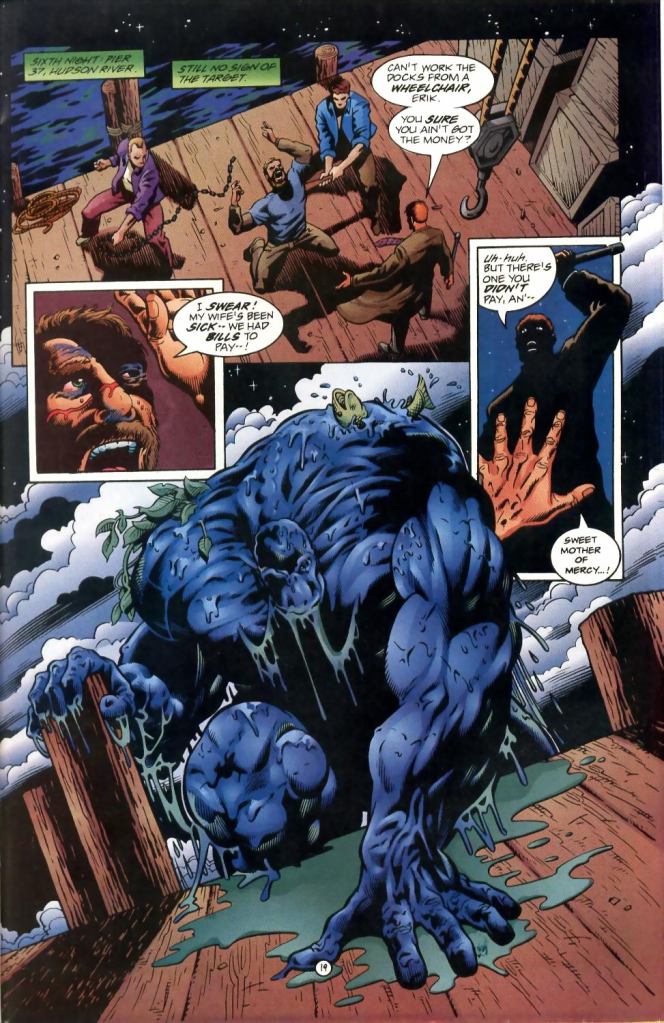
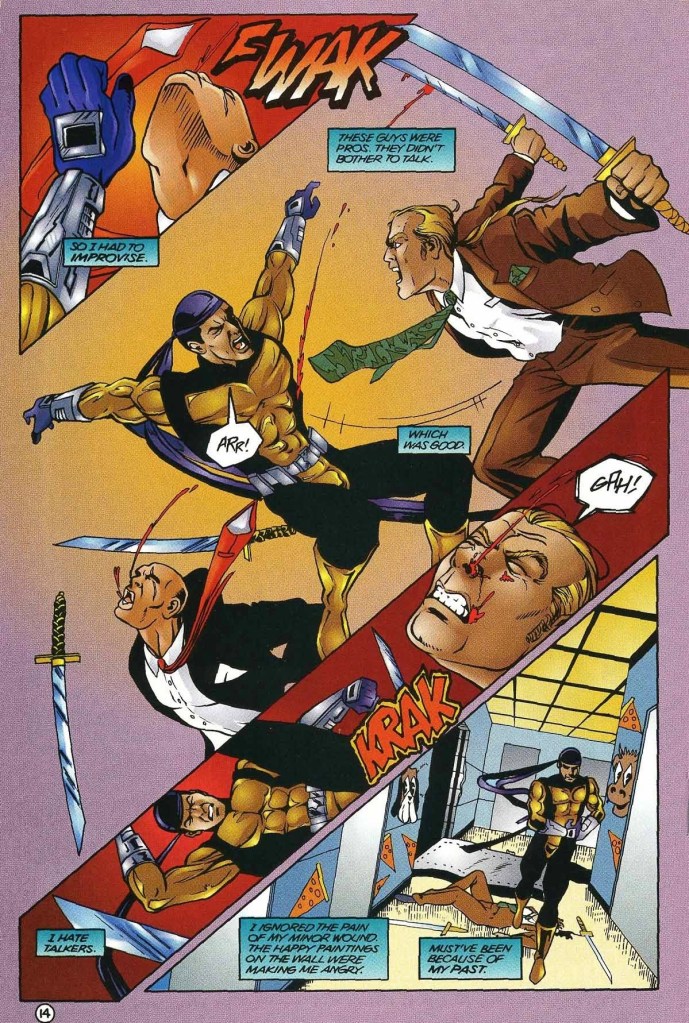
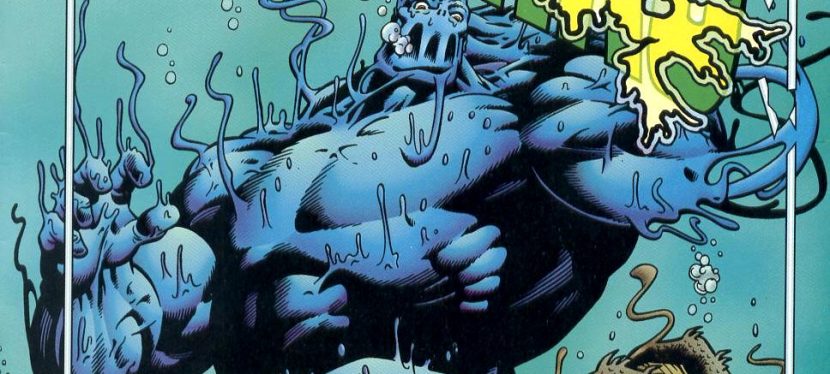
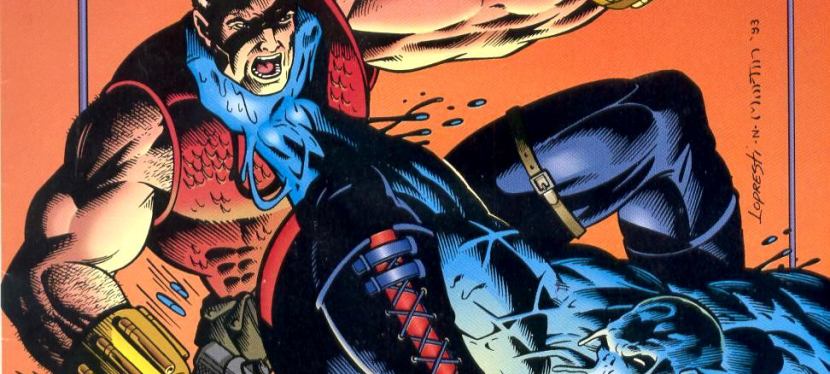
The battle between these two has a lot of stuff that should be seen.

In this comic book, I can see that the creative team of Steve Gerber and Aaron Lopresti decided to shake things up a bit when it comes to telling a new story of Sludge laced with elements of society, urban legends and journalism. The good news here is that this story is well-written and the visuals really brought the script to life for readers to be engaged with.

When it comes the elements that inspired this particular story, the concept about alligators occupying the sewers instantly reminds me of the 1980 film Alligator and along the way, Gerber-Lopresti went on pounce on the concept resulting in the introduction of a brand new Ultraverse villain in the form of a monstrous, human-like alligator named Veffir Voon Iyax which can also talk and reason like humans. This new villain is really interesting and its background about being part of a species of alligators worshipped by people from long ago sheds light on the idolatry which is both unholy and foolish.  

On the aspects of society and journalism, the story sheds light on how some people – even minors – would go to really unsafe places and do very risky jobs for a variety of reasons. The journalistic aspect of this comic book emphasizes how far journalists would go to write stories based on questionable data and that a newspaper would recklessly publish such stories even though they lacked solid evidence to prove the unbelievable is true. The newspaper journalist Shelley had quite an amount of the spotlight, she became a clear supporting character in this comic book.

In keeping up with the superhero flavor of the Ultraverse, there is a good amount of spectacle here as it has a big battle between Sludge and the monstrous alligator which is nicely presented. This is a battle between monsters that was carefully structured and executed well.

Conclusion

A look at what happens behind the scenes at a city newspaper.

Sludge #4 (1994) is both an intriguing and enjoyable read. The Gerber-Lopresti team succeeded in telling another Sludge tale that is fresh as it took inspiration from pop culture and society. At the same time, this comic book show that Sludge is clearly not the only monster in New York City’s sewers. As such, his place within the Ultraverse is really unique.

If you are seriously planning to buy an existing hard copy of Sludge #4 (1994) be aware that as of this writing, MileHighComics.com shows that the near-mint copy of the regular edition costs $16 while the near-mint copy of the newsstand edition costs $48.

Overall, Sludge #4 (1994) is recommended.

+++++

Thank you for reading. If you find this article engaging, please click the like button below and also please consider sharing this article to others. If you are looking for a copywriter to create content for your special project or business, check out my services and my portfolio. Feel free to contact me with a private message. Also please feel free to visit my Facebook page Author Carlo Carrasco and follow me on Twitter at  @HavenorFantasy as well as on Tumblr at https://carlocarrasco.tumblr.com/
A Look Back at Sludge #3 (1993)

Disclaimer: This is my original work with details sourced from reading the comic book and doing personal research. Anyone who wants to use this article, in part or in whole, needs to secure first my permission and agree to cite me as the source and author. Let it be known that any unauthorized use of this article will constrain the author to pursue the remedies under R.A. No. 8293, the Revised Penal Code, and/or all applicable legal actions under the laws of the Philippines.

Welcome back, superhero enthusiasts, 1990s culture enthusiasts and comic book collectors! Today we revisit the Ultraverse of Malibu Comics and examine one of its many stories through the Sludge comic book series.

Previously I reviewed issue #2 of the series which was a surprising and fun comic book to read as the creative team took the risk of emphasizing the violent character Bloodstorm over Sludge himself. Ultimately, this move served as a way to not just build up tension but to expand the specific place of Sludge and the dark forces within the Ultraverse. For this retro review, issue #3 is set during the events of the memorable Ultraverse crossover story Break-Thru.

With those details laid down, here is a look back at Sludge #3, published by Malibu Comics in 1993 with a story written by Steve Gerber and drawn by Aaron Lopresti.

The cover.

Early story

The story begins with Sludge still lying down at the dock after just being defeated by Bloodstorm. Suddenly a mob of chaotic people (driven mad by the effects of Break-Thru that just happened) lift him up and throw him into the water without any regrets whatsoever. In hiding, Bloodstorm witnesses their act and thought to himself that he should avoid the madness happening. Suddenly, other mad people ganged up on him forcing him to react by firing his gun and set himself free from their grip. He safely makes it to his car and speeds away, even bumping off a few people on the way.

As Bloodstorm speeds away, another man in hiding who knew him and the boss Marcello was found by the mad people. Out of desperation he runs away and jumps into the water. He realizes that the people are so obsessed with going up to the sky (the Break-Thru effect), they did not bother to follow him at all.

Deep down the water, Sludge finds himself alone and getting relieved of the pain he experienced above. Feeling hopeless, he waits for the river to wash him away…

Quality

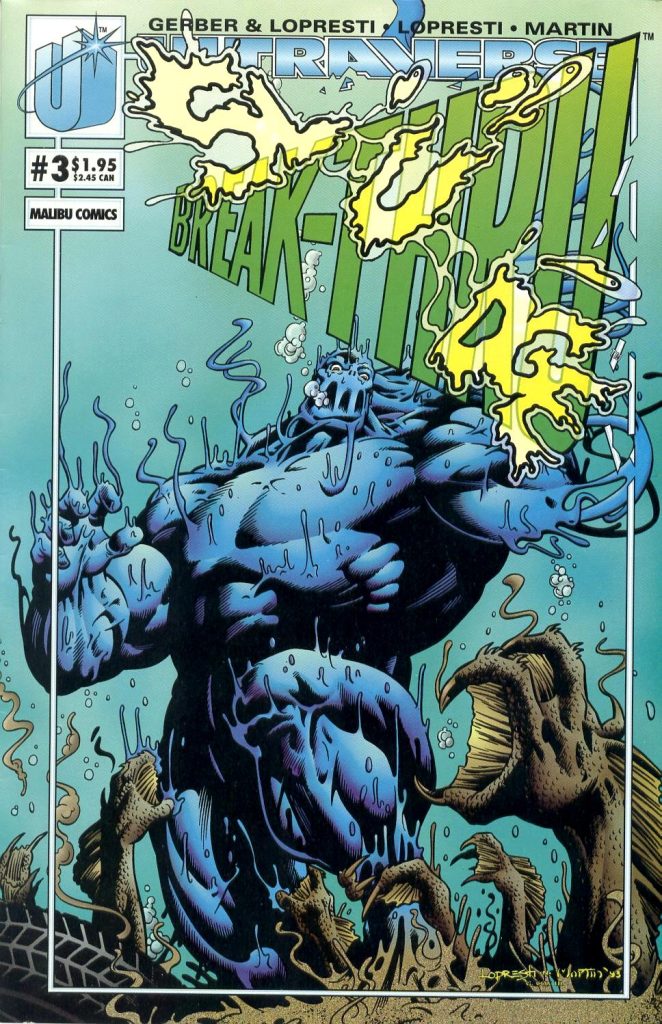
Sludge in trouble!

Being a standalone story set during the events of Break-Thru, this comic book focuses more on the protagonist while simultaneously raising the stakes with regards to the evil forces as the elements of crime gang combined with the supernatural took effect. To be clear, fantasy elements were added to this series which had darkness and grit dominating the plot of the first two issues.

This comic book has an early appearance of “lord” Pumpkin (AKA The Pump) who is the element of sorcery and, more notably, serves as the Ultraverse’s very own Satanic figure. Not only does the Pump have vast powers to take life away from others and has evil pawns to wield, he also leads and guides an apprentice (the kid gangster called Pistol) with pure wickedness, crafted plans of evil, is cunning in his ways of manipulating others to do evil, and he makes promises or deals with others who will receive some rewards but ultimately will be disregarded and lose a lot. This Ultraverse super-villain, as recorded in Malibu Comics’ publishing history, went on to become a walking symbol of pure evil, corruption, sins and danger in other UV comic books.

While there is indeed more focus on Sludge in this issue, it is the Pump who overshadows him. As for Bloodstorm, his presence has been drastically reduced here which is kind of jarring to read as he was the dominant and heavily emphasized in issue #2. Speaking of characters, the gang boss Marcello (who is Bloodstorm’s client) makes a short appearance but his connections not only with criminals but also with para-military forces emphasized his influence in the city.

More on the plot itself, this comic book is pretty loaded and the stakes were really raised high. In key scenes, Sludge finds himself in the middle of gangsters, the people driven mad by the Break-Thru effect, the para-military forces and the Pump’s ugly and evil pawns. Steve Gerber crafted a story that expectedly built up a lot and paid of strongly since the stakes were raised. I should state that Aaron Lopresti’s art here showed signs of improved creativity

Conclusion

The gang boss Marcello and Bloodstorm talk during the events of Break-Thru.

Sludge #3 (1993) is a more engaging and more intense comic book on its own complete with the literary debut of the Pump who is clearly the Ultraverse’s most evil villain. If issue #2 was twisting with the way it presented its characters, this comic book has more of its protagonist who went on to face new elements of evil while the story of Break-Thru transpired. I also noticed the Pump’s offer to Sludge symbolizes Satan offering a troubled soul a place in his force of evil. How did Sludge react to the offer from the evil one? You will have to read this comic book.

If you are seriously planning to buy an existing hard copy of Sludge #3 (1993) be aware that as of this writing, MileHighComics.com shows that the near-mint copy of the regular edition costs $16.

Overall, Sludge #3 (1993) is recommended!

+++++

Thank you for reading. If you find this article engaging, please click the like button below and also please consider sharing this article to others. If you are looking for a copywriter to create content for your special project or business, check out my services and my portfolio. Feel free to contact me with a private message. Also please feel free to visit my Facebook page Author Carlo Carrasco and follow me on Twitter at  @HavenorFantasy as well as on Tumblr at https://carlocarrasco.tumblr.com/
A Look Back at Sludge #2 (1993)

Disclaimer: This is my original work with details sourced from reading the comic book and doing personal research. Anyone who wants to use this article, in part or in whole, needs to secure first my permission and agree to cite me as the source and author. Let it be known that any unauthorized use of this article will constrain the author to pursue the remedies under R.A. No. 8293, the Revised Penal Code, and/or all applicable legal actions under the laws of the Philippines.

Welcome back, superhero enthusiasts, 1990s culture enthusiasts and comic book collectors! Today we revisit the Ultraverse of Malibu Comics and examine one of its many stories through the Sludge comic book series.

For the newcomers reading this, I published my retro review of Sludge #1 back in December of 2020. I really enjoyed that Ultraverse comic book and now is a good time to revisit that series and find out what will happen next to Sludge, the UV’s most notable monster protagonist. I should state that Steve Gerber (Man-Thing) and Aaron Lopresti made a solid creative duo in Sludge #1.

With those details laid down, here is a look back at Sludge #2, published by Malibu Comics in 1993 with a story written by Steve Gerber and drawn by Aaron Lopresti.

The cover.

Early story

The story begins with a quick flashback of a young blonde boy who got bullied by other kids due to his unusual appearance and the way he expresses himself. Fast forward to the present day, an armed man (the same kid in the flashback) fires his guns on a man who was on his bed inside his residence.

After finishing the killing, the armed man enters his unusual looking car and leaves in high speed. After passing through the city streets, he drives his vehicle into his secret hideout filled with several weapons. Shortly after cleaning himself, he takes his seat in his private study and starts communicating with Mr. Barnett who tells him that bad news that something happened to his father. The killer then states, “Payment is due.”

Somewhere in lower Manhattan, a man is being beaten by two men who are enforcers of a man wearing a trench coat in their presence. The beaten man named Mikey swears he will get the money to pay off his debt but the coated man tells him that he is a week late and will be penalized.

Suddenly out of nowhere, Sludge comes out and grabs the two enforcers which frees Mike whose ear just got cut off by the coated man. Sludge then calls the coated man by his nickname…

Quality

The situation only gets more intense whenever Sludge comes in.

I’ll go straight to the point on the storytelling by Steve Gerber. The biggest surprise is here is that the focus was shifted from the titular protagonist Sludge in favor of the first appearance of Bloodstorm who is more than just a typical villain. Gerber heavily emphasized Bloodstorm’s personality as one who enjoys inflicting violence or death to others (and get paid for it) as a result of his painful childhood and his eventual acceptance of the beliefs that violence itself is always part of life. Even so, this comic book shows that Bloodstorm does not believe in inflicting misery for money and he calls it a cowardly way of earning money. Even as he finds his client’s business appalling, he still proceeds to do the dirty work to make money. This, of course, puts Bloodstorm in the dark work organized, target-focused mobbing which also puts him on the same course as Sludge. 

As with issue #1, the violence here is pretty intense and adulterated which goes along almost perfectly with the story’s dark and gritty tone. There is a fine mix of suspense, shock moments and the revealing of key details. I assure you all reading that that even though Sludge himself was not so dominant as the centerpiece of the story, the payoff for all the build-up was still worth reading.

Conclusion

Get to know Bloodstorm through this comic book.

Sludge #2 (1993) is a pretty surprising comic book. One might think that it would become the natural progression of what was established in issue #1 (which itself was the first appearance and origin of Sludge) but ultimately it took a completely different approach. I should also state that the duo of Steve Gerber and Aaron Lopresti continued to deliver compelling stuff in this comic book. While the fact that Sludge is not the dominating force in the story might turn off some readers, I can say to you that Sludge #2 (1993) is still a very worthy read and it builds up on something waiting to be revealed in succeeding issues.

If you are seriously planning to buy an existing hard copy of Sludge #2 (1993) be aware that as of this writing, MileHighComics.com shows that the near-mint copy of the regular edition costs $16 while the near-mint copy of the newsstand edition costs $48

Overall, Sludge #2 (1993) is recommended!

+++++

Thank you for reading. If you find this article engaging, please click the like button below and also please consider sharing this article to others. If you are looking for a copywriter to create content for your special project or business, check out my services and my portfolio. Feel free to contact me with a private message. Also please feel free to visit my Facebook page Author Carlo Carrasco and follow me on Twitter at  @HavenorFantasy as well as on Tumblr at https://carlocarrasco.tumblr.com/

A Look Back at The Night Man #5 (1994)

Disclaimer: This is my original work with details sourced from reading the comic book and doing personal research. Anyone who wants to use this article, in part or in whole, needs to secure first my permission and agree to cite me as the source and author. Let it be known that any unauthorized use of this article will constrain the author to pursue the remedies under R.A. No. 8293, the Revised Penal Code, and/or all applicable legal actions under the laws of the Philippines.

Welcome back, superhero enthusiasts, 1990s culture enthusiasts and comic book collectors! Today we revisit the Ultraverse and focus on the Night Man who is one of the most intriguing heroes of the UV ever created. Having read the first four issues, it is clear that the storytelling with Night Man was done with darkness and grit in mind plus the villains introduced were unconventional. The good news is that each of the first four issues were actually enjoyable to read.

With those details laid down, here is a look back at The Night Man #5, published by Malibu Comics in 1994 with a story written by the Steve Englehart and drawn by Kyle Hotz.

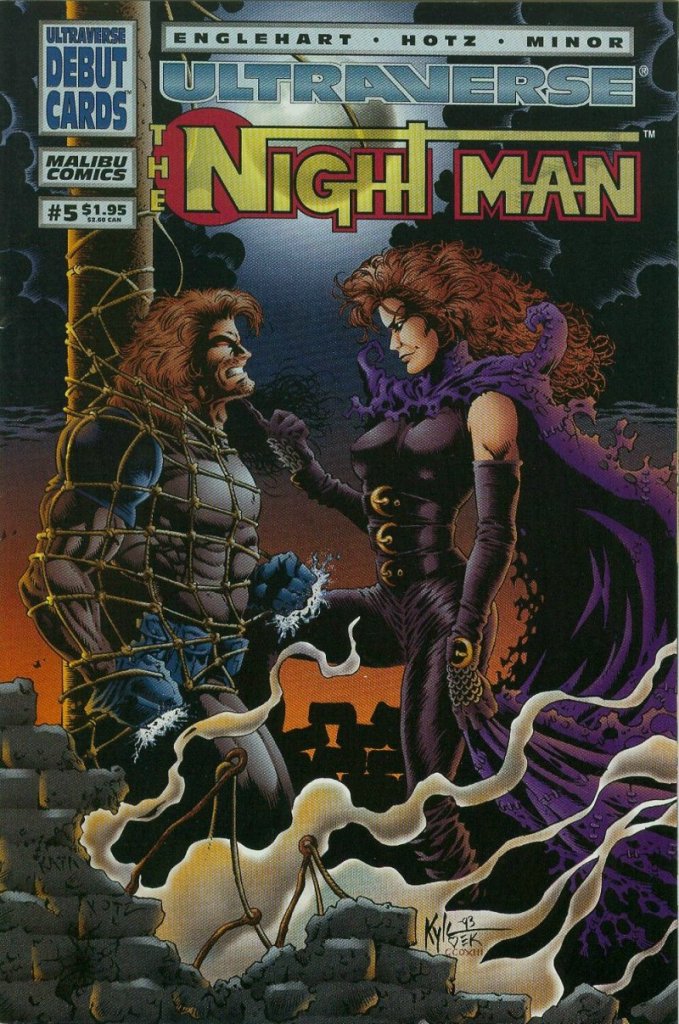
The cover.

Early story

The story begins with a private investigation being done by a detective and a police officer over a dead man whose chest was ripped open. While the two discuss who could be responsible for the victim’s death, Night Man appears and showed no fear when guns were pointed at him.

He tells the police officer and the detective that he is searching for a murderer responsible for the kidnap of two ladies and the extraction of their respective glands. Night Man explains that he rescued the two said ladies and victim right in front of them must be the first substitute victim…

Quality

Getting answers is tough for the Night Man.

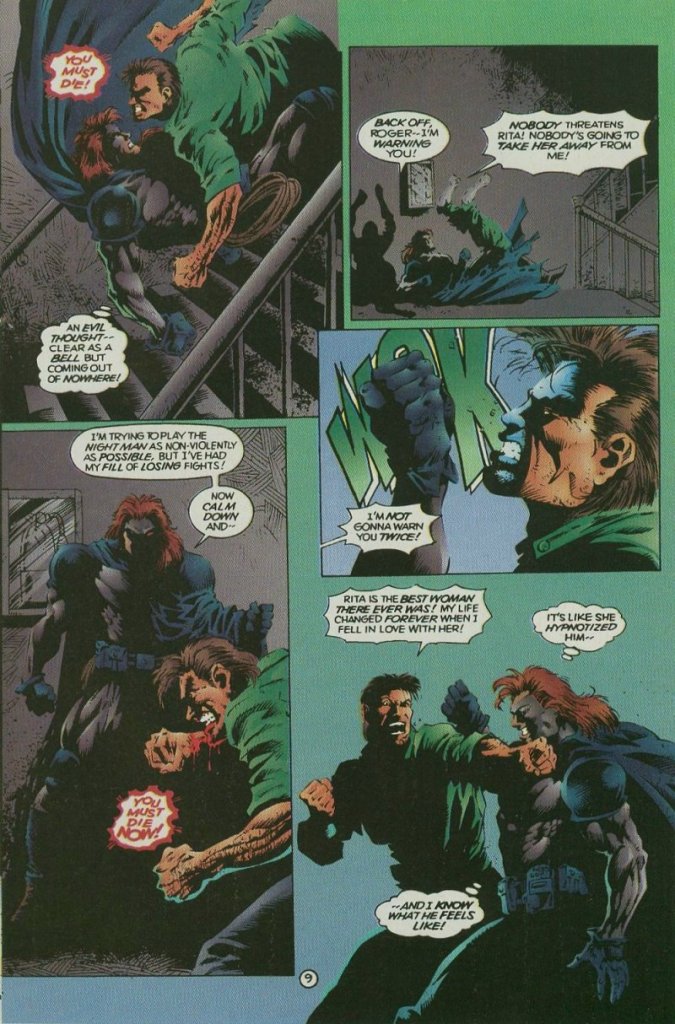
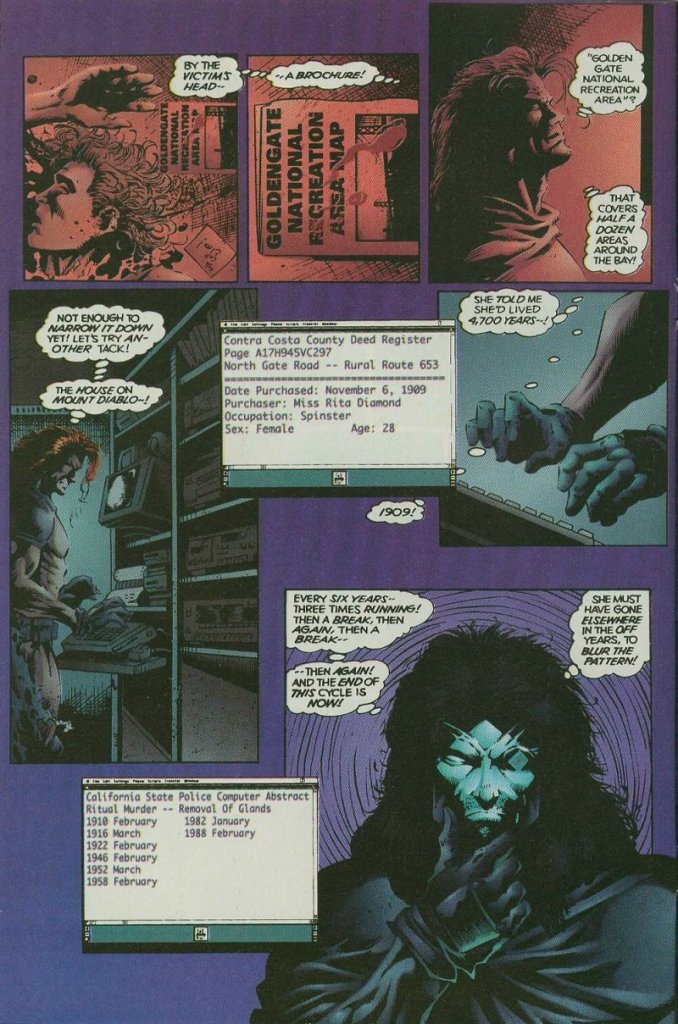
To cut through the chase, I can say that this comic book has a very strong detective story element in it told through Night Man. In fact, seeing Night Man doing detective work made him look and feel like DC Comics’ own Batman but with the Ultraverse touch still maintained.

While telling a detective story, Steve Englehart also took time to humanize Night Man and the scene in which the protagonist questions what being the Night Man has gotten him into was a really nice touch.

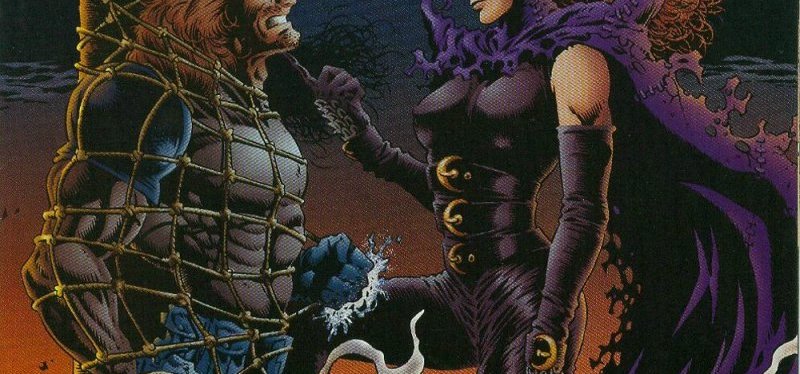
Serving as the highlight of this comic book was the rematch between Night Man and antagonist from issue #4. The rematch was not much about spectacle or hard-hitting action but rather more about intrigue and shock value expressed through dialogue (which the Night Man and the villainess engaged a lot with). The villainess is absolutely not the typical comic book antagonist but someone who has a legacy of not just taking people’s lives away but also living through the decades without aging nor anyone from local society opposing her. The villainess is pretty much an ideological opposite of the Night Man.  

Conclusion

The Night Man doing detective work and research.

With its continued approach on darkness, grit and shock value on its storytelling, The Night Man #5 (1994) is another engaging read and it is best enjoyed when you focus on the dialogue and the details in text. As for the Night Man himself, he got developed as a person even more here even though key storytelling elements were used that made the comic book feel like a Batman comic book. Lastly, I should say that Night Man really has his own unique place within the Ultraverse.

If you are seriously planning to buy an existing hard copy of The Night Man #5 (1994), be aware that as of this writing, MileHighComics.com shows that the near-mint copy of the regular edition costs $16.

Overall, The Night Man #5 (1994) is recommended.

+++++

Thank you for reading. If you find this article engaging, please click the like button below and also please consider sharing this article to others. If you are looking for a copywriter to create content for your special project or business, check out my services and my portfolio. Feel free to contact me with a private message. Also please feel free to visit my Facebook page Author Carlo Carrasco and follow me on Twitter at  @HavenorFantasy as well as on Tumblr at https://carlocarrasco.tumblr.com/

A Look Back at The Solution #5 (1994)

Disclaimer: This is my original work with details sourced from reading the comic book and doing personal research. Anyone who wants to use this article, in part or in whole, needs to secure first my permission and agree to cite me as the source and author. Let it be known that any unauthorized use of this article will constrain the author to pursue the remedies under R.A. No. 8293, the Revised Penal Code, and/or all applicable legal actions under the laws of the Philippines.

Welcome back, superhero enthusiasts, 1990s culture enthusiasts and comic book collectors! Today we revisit the Ultraverse and focus on The Solution, which remains as one of the most entertaining and intriguing team comic book series ever published by Malibu Comics! For the newcomers reading this, I previously published reviews of some The Solution comic books such as issue #6 (a great origin story of Lela Cho), issue #4 (a part of the Break-Thru crossover storyline), and issue #13 (part of a crossover storyline involving Night Man).

With those details laid down, here is a look back at The Solution #5, published by Malibu Comics in 1994 with a story written by the late James Hudnall and drawn by Alan Jacobsen.

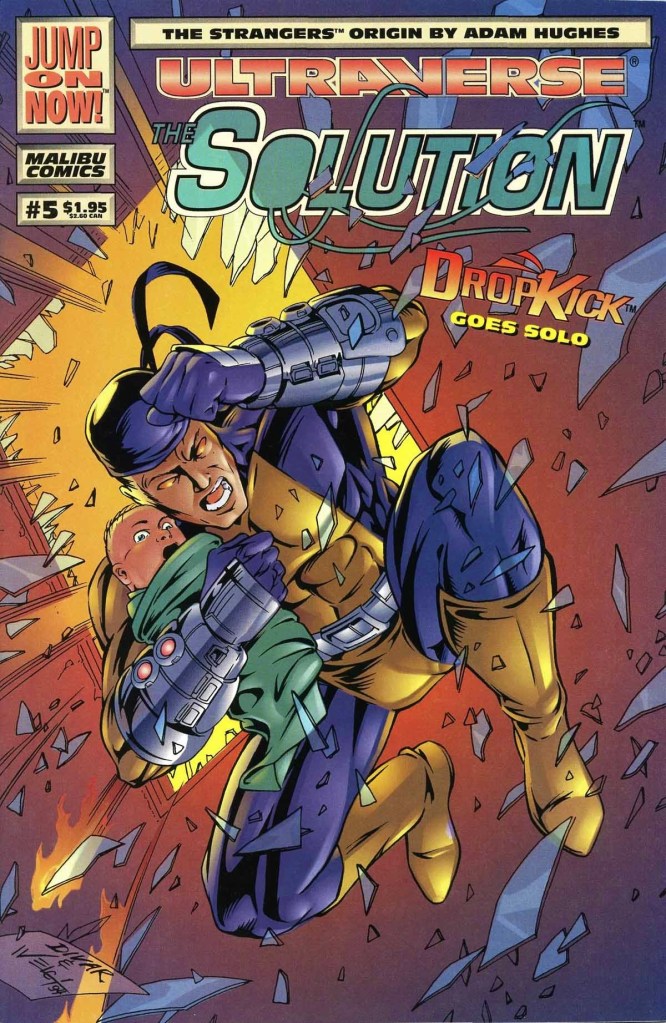
The cover.

Early story

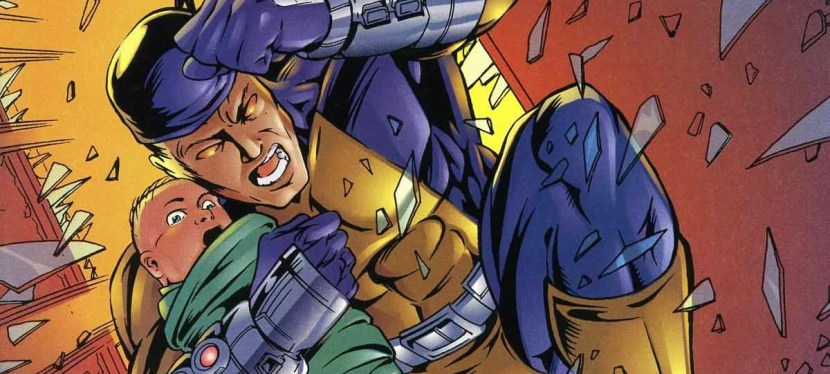
The story begins with The Solution’s member Dropkick trying to save an infant by carrying him strategically through the burning interior of a tall building. Dropkick jumps out through a window falling down with the infant still with him….

Quality

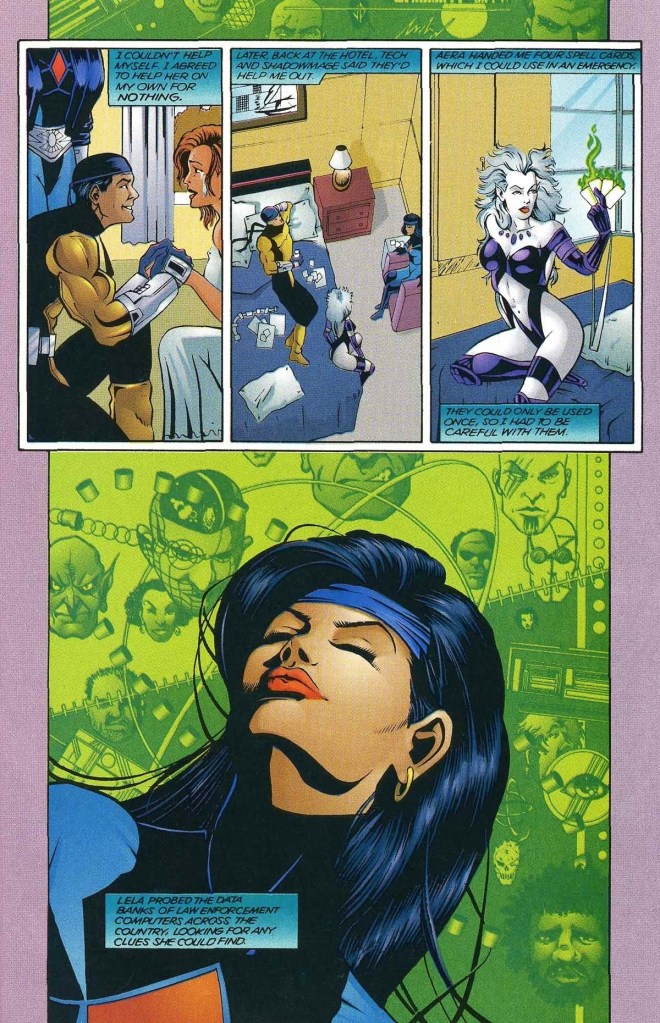
Before the mission starts, here is what happened.

To make things clear, this The Solution comic book is actually a solo story focused on Dropkick. You will get to see members of the team together but only for a few pages. More on Dropkick himself, this story was written to show not only the team member’s capabilities but also provide readers insight on his personality, specifically about how he thinks and reacts when he is under the heat of a dangerous mission. As there are no scenes showing his personal life as a civilian, James Hudnall wrote the script to emphasize Dropkick as the determined yet vulnerable action hero which somehow reminds me of John McClane in the action classic Die Hard.

Apart from the solid storytelling, you must be wondering if Dropkick himself is interesting enough as one of the many action-oriented characters within the Ultraverse. I can say yes.

Conclusion

Dropkick in action!

Being on the first solo stories of The Solution series, I can say that The Solution #5 (1994) is entertaining enough and the creative team succeeded in defining Dropkick as an essential member of the group he belongs to. Speaking of solo stories, in retrospect this comic book is almost like a warm-up to prepare readers for The Solution #6 which had a really great story focused on Lela Cho and her origin as well as the events that led to forming the team.

If you are seriously planning to buy an existing hard copy of The Solution #5 (1994), be aware that as of this writing, MileHighComics.com shows that the near-mint copy of the regular edition costs $16 while the near-mint copy of the newsstand edition costs $48.

Overall, The Solution #5 (1994) is recommended.

+++++

Thank you for reading. If you find this article engaging, please click the like button below and also please consider sharing this article to others. If you are looking for a copywriter to create content for your special project or business, check out my services and my portfolio. Feel free to contact me with a private message. Also please feel free to visit my Facebook page Author Carlo Carrasco and follow me on Twitter at  @HavenorFantasy as well as on Tumblr at https://carlocarrasco.tumblr.com/
A Look Back at X-Men 2099 #9 (1994)

Disclaimer: This is my original work with details sourced from reading the comic book and doing personal research. Anyone who wants to use this article, in part or in whole, needs to secure first my permission and agree to cite me as the source and author. Let it be known that any unauthorized use of this article will constrain the author to pursue the remedies under R.A. No. 8293, the Revised Penal Code, and/or all applicable legal actions under the laws of the Philippines.

Welcome back, superhero enthusiasts, fans of the 2099 universe of Marvel Comics, 1990s culture enthusiasts and comic book collectors! Today we revisit the X-Men 2099 comic book series by focusing on its ninth issue. Since issue #1, the connection between the mutants of 2099 with the original team founded by Charles Xavier was vague. Sure, Xi’an made verbal references to Charles Xavier and Magneto but there was nothing concrete with regards to his team adapting the team name of the classic X-Men.

With those details laid down, here is a look back at X-Men 2099 #9 (1994), published by Marvel Comics in 1993 with a story written by John Francis Moore and drawn by Ron Lim.

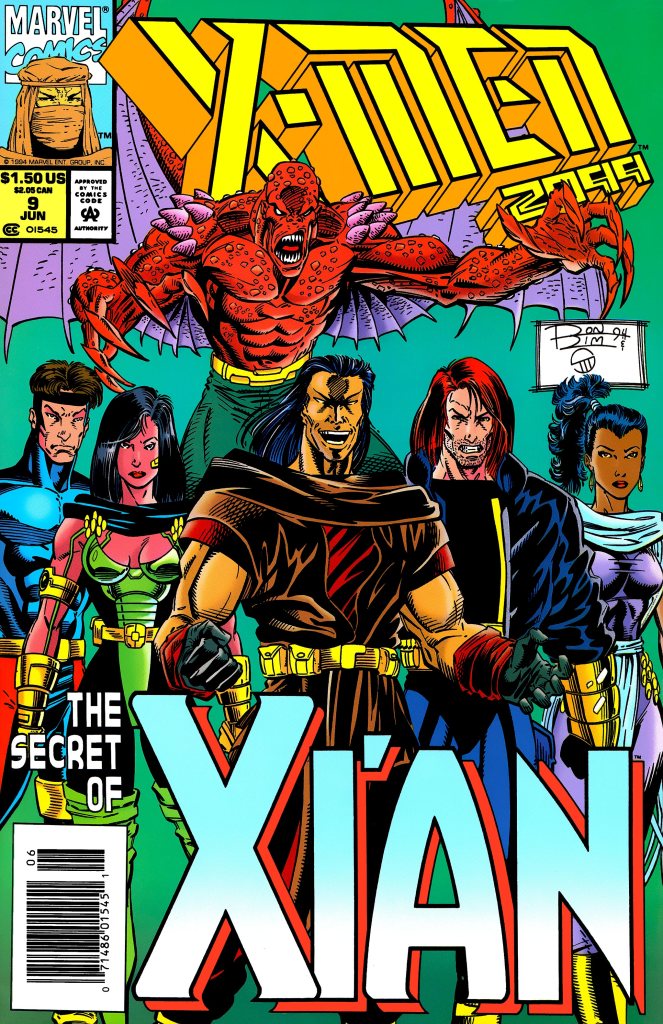
The cover.

Early story

The story begins shortly after the X-Men left the town. Without Eddie/Metalhead (who chose to be left behind), Xi’an and his team arrive at a facility in the middle of nowhere. It turns out, they have been following the coordinates in relation to Krystalin’s assignment to investigate and Xi’an determined there was something odd about her voice during their last communication.

Krystalin suddenly appears to her teammates with Victor Ten Eagles right behind her. Victor was a companion of Xi’an’s during their days together with the group referred to as the Lawless. While the two former Lawless members talk, Skullfire, Shakti and Meanstreak notice there is something very odd with Krystalin. Xi’an notices something is definitely wrong and he remembers that when the Lawless disbanded, he and Ten Eagle never parted on friendly terms.

Suddenly, a very old Asian man appears in front of them floating in the air. He reveals his name as Zhao and he refers to them as his X-Men…

Quality

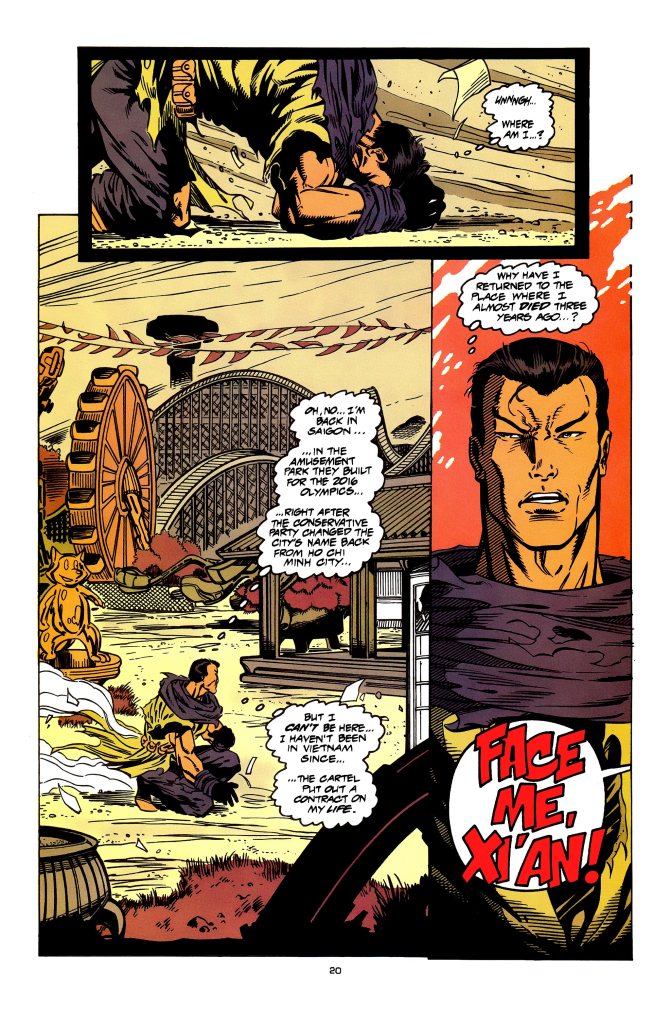
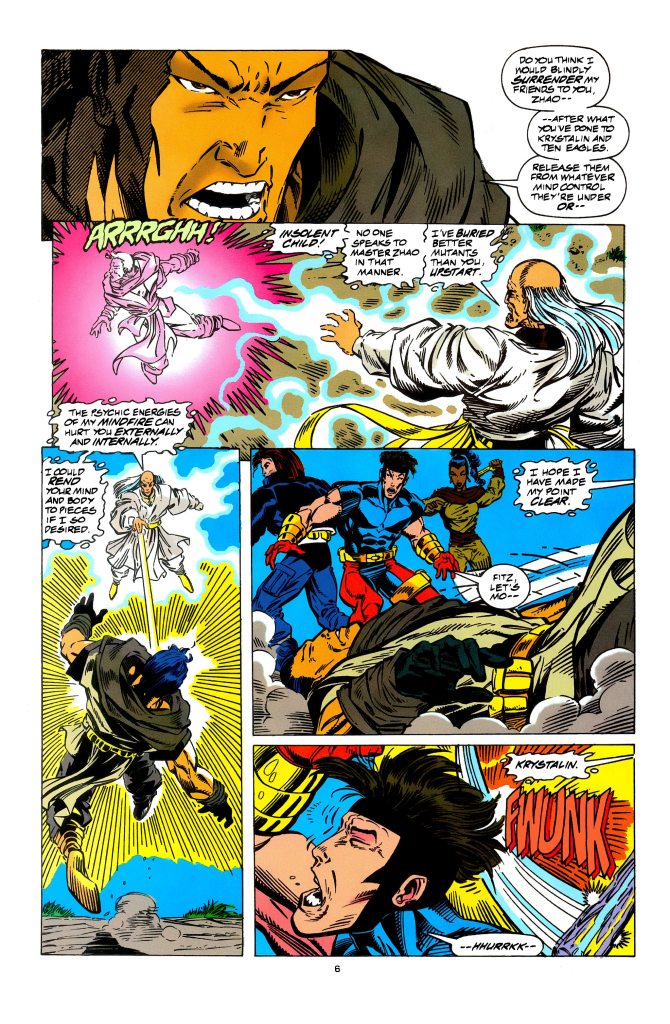
X-Men 2099’s leader Xi’an in trouble. This page reveals some threads from his past and the concept that Saigon in Vietnam hosted the 2016 Olympics.

Starting with the storytelling, the script was clearly written with a lot of confidence on the part of John Francis Moore as he expands further the lore of America of 2099 through the team of mutants. For one thing, it uses its own version of Marvel Comics universe history (note: one possible history since 2099 was one possible future of the Marvel universe) to establish the link between Charles Xavier’s original X-Men with the mutants of 2099 complete with what happened in between. While I won’t spoil what exactly happened, I can assure all of you reading this that something very intriguing happened and Zhao is not just a mere 2099 character. I also liked the concept about the sad state of mutants in the far future and why extremists emerge claiming to be their hope and tell them to join the movement without hesitation. The pacing of the story was smooth and there was sufficient build-up with the X-Men history that led to a nice payoff when the big revelation was made.

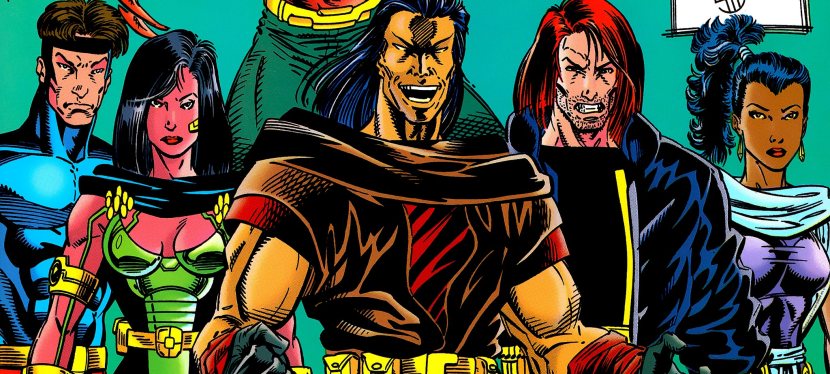
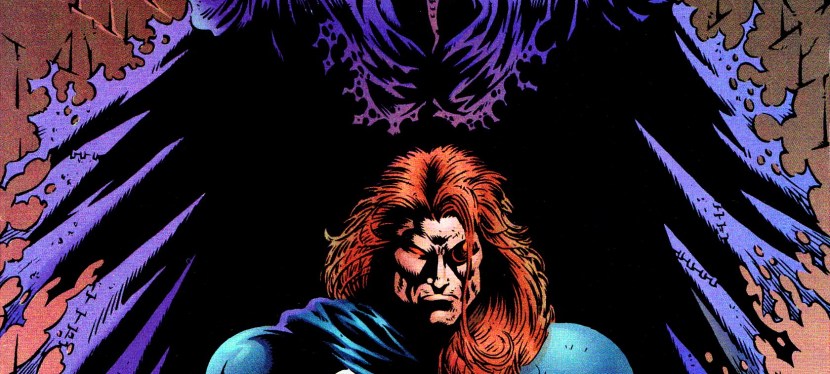
As the art on the cover symbolizes, there is something really wrong with the X-Men 2099 leader. In the previous issues, there were signs of Xi’an getting haunted by his past with the Lawless and this comic book marks a significant change in his portrayal. He also tried to be strong as team leader even though he kept some really undesirable secrets away from them. All of that build-up paid off well here. Clearly, this was one of John Francis Moore’s strongest scripts on the X-Men of 2099.

When it comes to spectacle, there is some superhero action here visualized in both the present-day story and the historical flashbacks. Artist Ron Lim paced the flow of the images properly and was creative with the way he framed what happened.

Conclusion

The X-Men and Zhao.

X-Men 2099 #9 (1994) has a great story concept which successfully and clearly establishes the connection between the original X-Men of Xavier with Xi’an’s X-Men. At the same time, this comic book starts a new chapter in the life of the 2099 mutants’ leader whose dark and painful past keeps disturbing him deeply. At the time of its release, the X-Men of far future were portrayed to be nomadic trying to survive and search for other mutants. This makes them distinct from the mainstream X-Men of the time and ironically they become similar with Freex of the Ultraverse.

If you are seriously planning to buy an existing hard copy of X-Men 2099 #9 (1994), be aware that as of this writing, MileHighComics.com shows that the near-mint copy of the regular edition costs $30 while the near-mint copy of the newsstand edition costs $90.

Overall, X-Men 2099 #9 (1994) is highly recommended!

+++++

Thank you for reading. If you find this article engaging, please click the like button below and also please consider sharing this article to others. If you are looking for a copywriter to create content for your special project or business, check out my services and my portfolio. Feel free to contact me as well. Also please feel free to visit my Facebook page Author Carlo Carrasco and follow me at HavenorFantasy@twitter.com

A Look Back at Freex #12 (1994)

Disclaimer: This is my original work with details sourced from reading the comic book and doing personal research. Anyone who wants to use this article, in part or in whole, needs to secure first my permission and agree to cite me as the source and author. Let it be known that any unauthorized use of this article will constrain the author to pursue the remedies under R.A. No. 8293, the Revised Penal Code, and/or all applicable legal actions under the laws of the Philippines.

Welcome back, Ultraverse fans, superhero enthusiasts, comic book collectors, enthusiasts of 1990s pop culture and all other geeks! Today, we revisit the Ultraverse for more 1990s comic book nostalgia through another tale of Freex, the team of super-powered social outcasts!

Last time around, Plug’s origin story was told just as Freex had a very notable encounter with Contrary and her super-powered students (with ex-teammate Ray on their side) at the headquarters of the Academy for The New Elite. After going through some hard struggles, Freex left losing Ray but gained a scaley new member who left Contrary’s school.

To find out what happens next, here is a look back at Freex #12, published in 1994 by Malibu Comics with a story written by Gerard Jones and drawn by Scott Kolins.

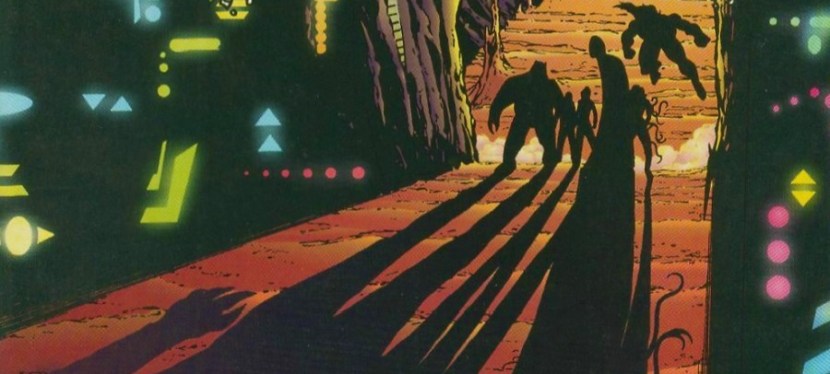
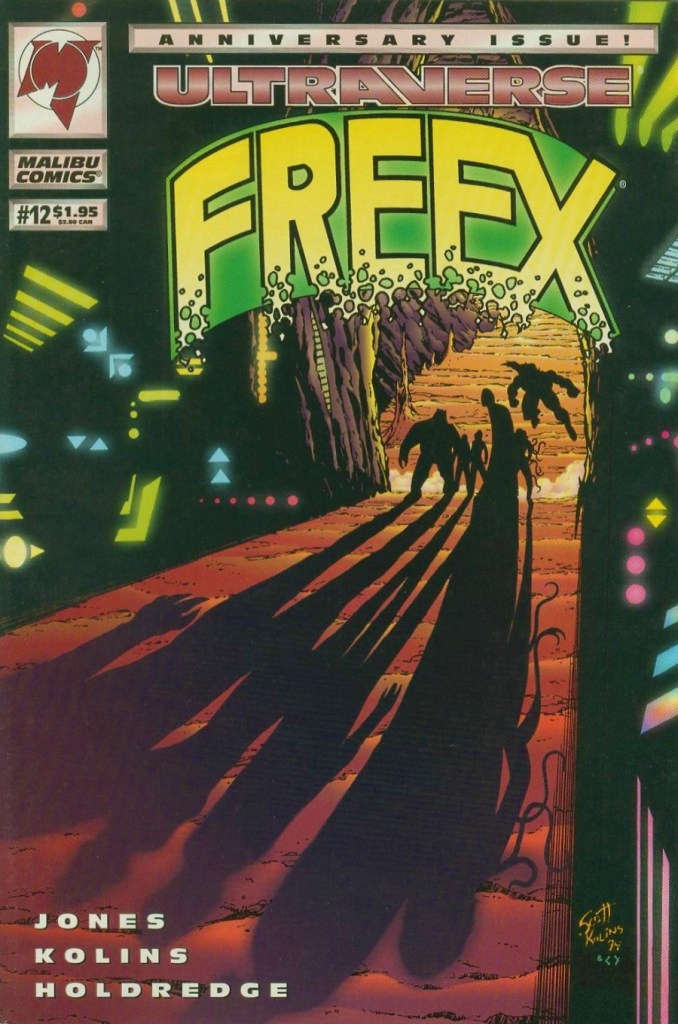
The cover.

Early story

The story begins in the middle of an ongoing misadventure (note: started with Giant Size Freex #1) with the Freex, Prime, and Old Man together beneath the Earth. To the shock of Freex, there are statues of them. The Old Man claims that more than a thousand years prior, he saw people with powers very much like those of Freex. Legend has it that they came from underground and got chased back by some scared fools. What Valerie and her teammates realize is that the cavern they are in is a place of retreat for super-powered freaks that existed before them.

Suddenly, an oversized deformed creature walks through them and grabs Valerie. Prime tries to help by punching the creature but this only made his body deteriorate into green liquid matter. Freex’s newest teammate jumps to strike the creature’s head which helps Valerie get free.

After noticing a hole on the ground, Lewis calls his teammates to escape. He forms his body into a makeshift slide to pave the way for escaping…

Quality

Angela takes action!

To begin with, I should state that this comic book really had a very wild and ambitious concept for its plot. Something really big with adventuring in mind which, in my opinion, was meant to be made to make the 12th issue anniversary of the Freex series stand out. The good news here is that the script if well-written and continues to deliver the good stuff that dedicated Freex readers and superhero enthusiasts will enjoy.

As this is the continuation of the story that started in Giant Size Freex #1, the team of misfits went on to travel and work together with Old Man and Prime (whose spotlight is lessened in this comic book) in a wild misadventure that brought them deep underground which reveals the existence of creatures and remnants of creation that the whole world has not seen. What was conceptualized here significantly expanded Earth’s realm within the Ultraverse and quite intriguingly, there are connections between the new places and Wetware.

When it comes to character development, new team member Cayman’s fitting in was portrayed nicely and his interactions with the other members were pretty interesting. What stood out most, however, are the interactions between Kevin Green (Prime) and Angela (Sweet-face) which I encourage you to read as it will open up a new dimension within his personality (and his being a teenager).

Conclusion

How would you react if you discovered all of that deep underground?

Freex #12 (1994) has a fine mix of grand misadventure, discovery, as well as memorable interactions between Freex and Prime. This is definitely not a throw-away story of Freex, nor is it generic when compared to other superhero comic book tales. This comic book also expands the Ultraverse in a really solid way just as it also moved smoothly on redefining the Freex themselves.

If you are seriously planning to buy an existing hard copy of Freex #12 (1994), be aware that as of this writing, MileHighComics.com shows that the near-mint copy of the comic book costs $16.

Overall, Freex #12 (1994) is highly recommended!

+++++

Thank you for reading. If you find this article engaging, please click the like button below and also please consider sharing this article to others. If you are looking for a copywriter to create content for your special project or business, check out my services and my portfolio. Feel free to contact me as well. Also please feel free to visit my Facebook page Author Carlo Carrasco and follow me at HavenorFantasy@twitter.com

A Look Back at The Night Man #4 (1993)

Disclaimer: This is my original work with details sourced from reading the comic book and doing personal research. Anyone who wants to use this article, in part or in whole, needs to secure first my permission and agree to cite me as the source and author. Let it be known that any unauthorized use of this article will constrain the author to pursue the remedies under R.A. No. 8293, the Revised Penal Code, and/or all applicable legal actions under the laws of the Philippines.

Welcome back, superhero enthusiasts, comic book collectors, 1990s pop culture enthusiasts and fans of Malibu Comics! Are you ready for another retro review of The Night Man?

Last time around, Night Man pursued the group Freex during the events of the Break-Thru crossover. By the time the story ended, there were these intriguing details about the powerful J.D. Hunt and his son Guy Hunt.

To find out what happens next to the Ultraverse vigilante after the end of Break-Thru, here is a look back at The Night Man #4, published in 1993 by Malibu Comics with a story written by Steve Englehart and drawn by Kyle Hotz.

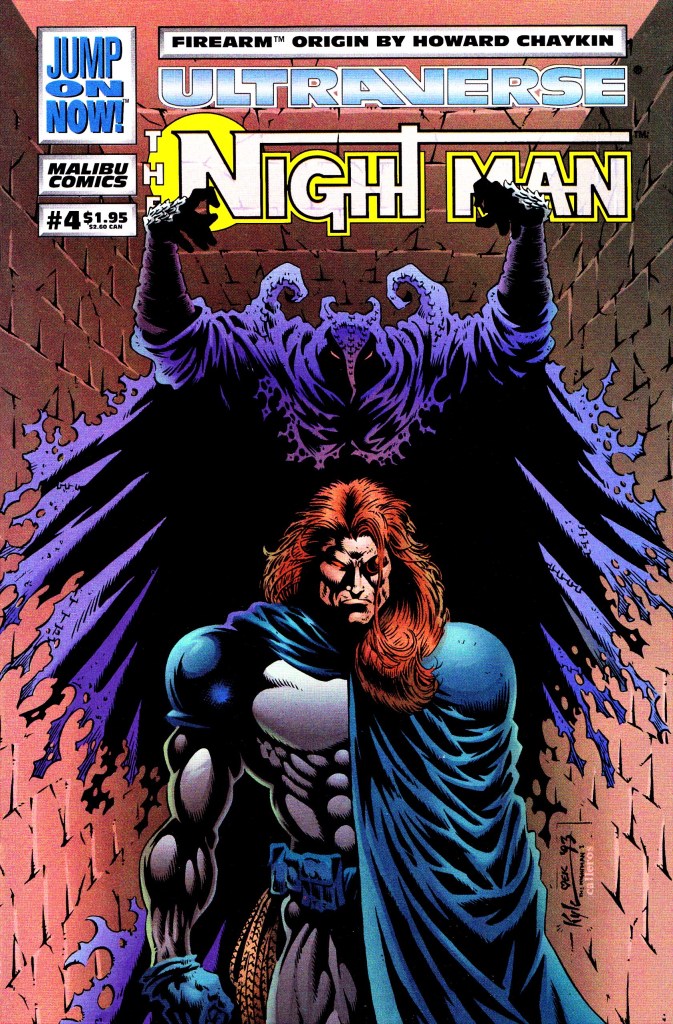
The cover.

Early story

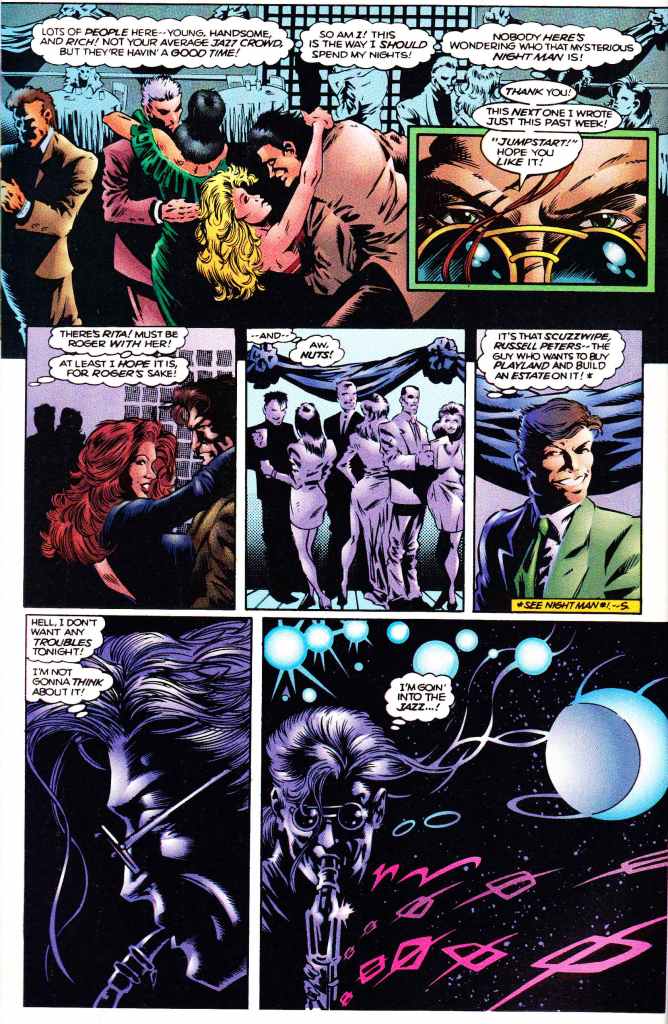
The story begins with newspaper coverage of the Night Man (pictured with Mangle) whose acts caught the attention of people at the Bay Area. Johnny Domino (Night Man) carefully listens to people around him commenting about his published acts and his radio transmissions as the vigilante. Even driving around San Francisco does not spare him from the continued public chatter of the Night Man. He then remembers a lady named Ginger and visits a unique place.

There, he notices a lady approach him. She introduces herself as Rita Diamond and recognizes him for his work with the saxophone. Rita tells him that she and her fiancé Roger Carrington are sponsoring a benefit event and that Johnny’s music would be fabulous for it.

After expressing some hesitation, he then accepts and plays at the event…  

Quality

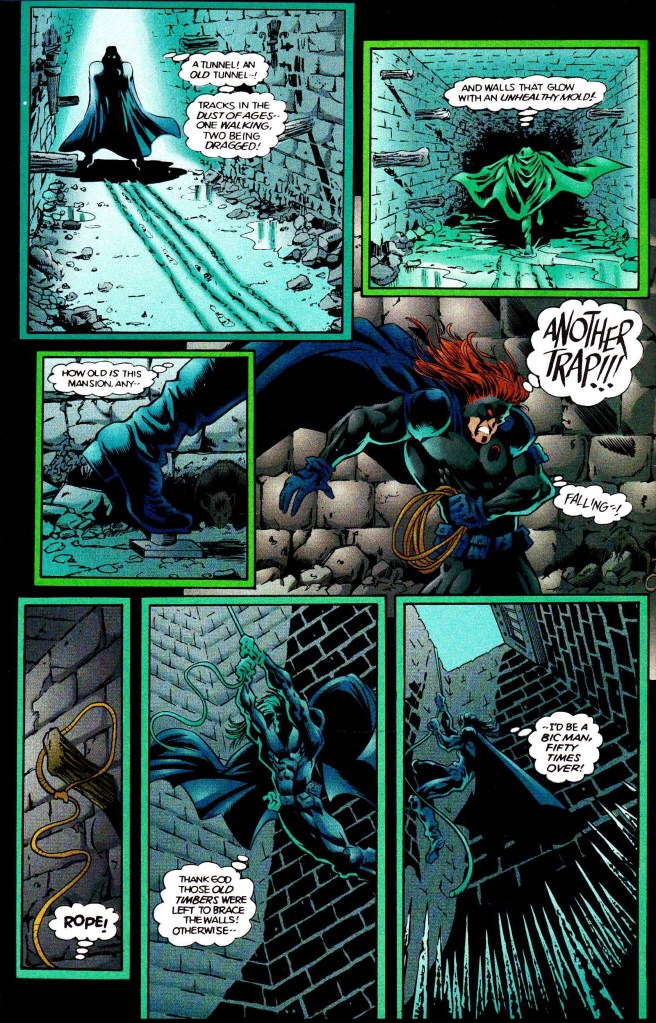
The Night Man on his unexpected exploration.

Another solid story crafted by Steve Englehart here, only this time without the extra baggage of Freex and Break-Thru. I really enjoyed the way the build-up was staged during the first nine pages of the comic book (note: complete with key references to issue #1) leading to an encounter with the new villain.

Before the encounter started, Englehart developed Johnny’s personality even more and took time examining him as a person and as a member of local society (as opposed to being a vigilante) of the Bay Area. When he changes into Night Man, he is portrayed to be reactive and very observant which I found enjoyable to read.

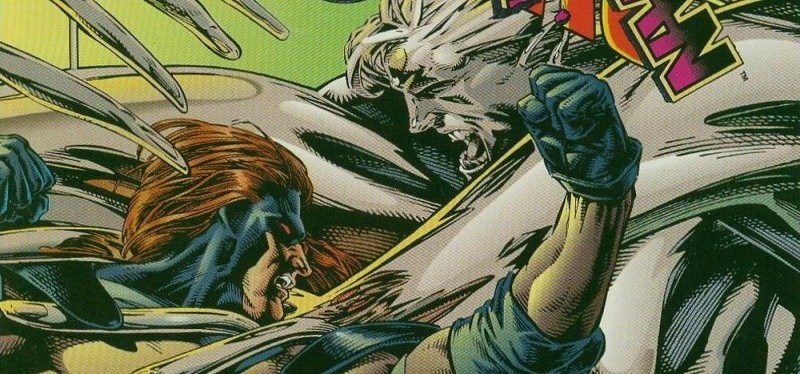
As for the new villain, I don’t want to emphasize details given the structure of the plot. This is something you readers should find out for yourselves.

The art done by Kyle Hotz is pretty good. There was this nice contrast of the art style between the day-time scenes and the night-time scenes. I also liked Hotz’s gritty look not only on Night Man himself but also on the villain and the many other characters in general.

Conclusion

Johnny Domino’s personal observations are nice to read.

The Night Man #4 (1993) is very enjoyable to read and intriguing as well. It has a very good concept, more in-depth development of the protagonist, a solid twist and its references to issue #1 should encourage you to revisit it. Adding value to this comic book is a short story about Firearm which should attract fans of the character.

If you are seriously planning to buy an existing hard copy of The Night Man #4 (1993), be aware that as of this writing, MileHighComics.com shows that the near-mint copy of the comic book costs $16.

Overall, The Night Man #4 (1993) is recommended.

+++++

Thank you for reading. If you find this article engaging, please click the like button below and also please consider sharing this article to others. If you are looking for a copywriter to create content for your special project or business, check out my services and my portfolio. Feel free to contact me as well. Also please feel free to visit my Facebook page Author Carlo Carrasco and follow me at HavenorFantasy@twitter.com

A Look Back at The Night Man #3 (1993)

Disclaimer: This is my original work with details sourced from reading the comic book and doing personal research. Anyone who wants to use this article, in part or in whole, needs to secure first my permission and agree to cite me as the source and author. Let it be known that any unauthorized use of this article will constrain the author to pursue the remedies under R.A. No. 8293, the Revised Penal Code, and/or all applicable legal actions under the laws of the Philippines.

Welcome back, superhero enthusiasts, comic book collectors, 1990s pop culture enthusiasts and fans of Malibu Comics! Today we return to the Ultraverse through the 3rd issue of The Night Man series. While the Night Man continues his pursuit of a rather deformed rival, this comic book is a spin-off of the Ultraverse crossover Break-Thru and it also marks the protagonist’s continuing crossover with Freex (which officially started in Freex #6).

With those details laid down, here is a look back at The Night Man #3, published in 1993 by Malibu Comics with a story written by Steve Englehart and drawn by Gene Ha.

The cover.

Early story

The story begins with Night Man overlooking a portion of a major city from a high tower. He wonders how he could find five kids, referring to Freex who have gotten involved with his rival Mangle. For Night Man, the team of teenagers think Mangle is a freak like them and he knows that his rival targets kids as victims.

After acquiring almost a thousand Dollars worth of new equipment, he goes on the air reaching out to Freex. Freex, meanwhile, are with Mangle hiding inside am unknown place. After a news report was aired revealing that the Strangers used a rocket to go to the moon and mentioned J.D. Hunt’s name, Mangle reacts loudly and states that the said business tycoon will be at Moffett Field.

Freex, believing that Hunt can cure them, leave with Mangle by car…

Quality

Night Man, Mangle and Freex!

With regards, Steve Englehart raised the stakes and added a lot of intrigue throughout the story. Without spoiling the plot, I can say that I enjoyed the pay-off executed here in relation to what was built up in Freex #6 and The Night Man #2.

The biggest selling point of the story is not the crossover between Night Man and Freex, but rather the presentation of JD Hunt and his young but wicked son Guy, as well as their involvement with Mangle. Themes explored in this comic book include manipulating a person to actually believe what evil acts he commits are not evil, and the manipulation of helpless youth to join a wrongful cause.

As for the title character himself, Night Man does more than just action and solving problems. You will see a more ethical side of his personality and his insistence on doing what is right without ever going overboard.  

Conclusion

Night Man learning something from the people on the street.

The Night Man #3 (1993) is an enjoyable and compelling part of the Break-Thru crossover (with creative connections to what happened in Prototype #5 and The Strangers #7) that also succeeds in developing Night Man further while showing more personality from JD Hunt and his son. The crossover between Freex and the title hero, again, did not last long but this is understandable considering the focus on the Hunts and Mangle. Lastly, I should state that artist Gene Ha’s dark and gritty style worked nicely in this comic book.

If you are seriously planning to buy an existing hard copy of The Night Man #3 (1993), be aware that as of this writing, MileHighComics.com shows that the near-mint copy of the comic book costs $16.

Overall, The Night Man #3 (1993) is recommended.

+++++

Thank you for reading. If you find this article engaging, please click the like button below and also please consider sharing this article to others. If you are looking for a copywriter to create content for your special project or business, check out my services and my portfolio. Feel free to contact me as well. Also please feel free to visit my Facebook page Author Carlo Carrasco and follow me at HavenorFantasy@twitter.com

A Look Back at The Strangers #24 (1995)

Disclaimer: This is my original work with details sourced from reading the comic book and doing personal research. Anyone who wants to use this article, in part or in whole, needs to secure first my permission and agree to cite me as the source and author. Let it be known that any unauthorized use of this article will constrain the author to pursue the remedies under R.A. No. 8293, the Revised Penal Code, and/or all applicable legal actions under the laws of the Philippines.

Wow! What a journey it has been! Back in the 1990s, I could never forget the first time I read The Strangers #1 which was so captivating, I decided to follow its monthly series and it was easily my favorite superhero team of the Ultraverse. It was also my first time to see the collaboration of Steve Englehart and Rick Hoberg leading the creativity which, as the many months and issues went on, resulted a series that was never boring and often satisfying and fun to read. I should state that the literary team of strangers composed of Atom Bob, Grenade, Lady Killer, Yrial, Spectral, Zip-Zap and Electrocute was memorable. Truly Malibu Comics had very talented creators for the Ultraverse which eventually lasted just a few years (read: Marvel Comics acquired Malibu Comics).

This brings me to my next point…this retro comic book review is about the last issue of The Strangers monthly series ever published. As I love the Ultraverse, it is sorrowful to see the end of an enjoyable monthly series. In recent times, I reviewed the final issue of the Prototype monthly series (which itself was fun overall) which ended in a rather unsatisfying manner. Prototype’s final issue was not even written by the original creators of the series!

How will this final issue of The Strangers series turn out? We can all find out in this look back at The Strangers #24, published in 1995 by Malibu Comics with a story written by Steve Englehart and drawn by Rick Hoberg with inkwork done by Barbara Kaalberg.

The cover.

Early story

The story begins with Teknight, Spectral, Grenade, Lady Killer, Yrial, Zip-Zap and Electrocute back together (note: Lady Killer and Yrial went somewhere far in the previous issue). They talked about Electrocute’s codition, Atom Bob being in a comatose state at the Clinique de Parsival, and the dangerous encounter with Taboo.

Meanwhile inside a passenger jet flying above the North Atlantic, a man expresses his passion and fondness of the Strangers to the passenger sitting to his left. The said passenger wants to learn more about the team.

The following night at Union City in California, the same passenger knocks on the window of a van with a man and a lady kissing passionately inside. As the man comes out of the van feeling very annoyed, the passenger introduces himself to him as Taboo. A new team of TNTNT is being formed…  

Quality

Pay close attention to the details on the words of Lady Killer.

To start with, I confirm that the usual high quality of writing and art by the Englehart-Hoberg duo is evident in this comic book. Not a single part of it looks rushed to me. The plot is very well structured and the visuals are great to see!

While the story is not as conclusive as I hoped it would be, it is still a lot of fun to read. For one thing, it’s nice to see the Strangers together again (note: Teknight has been with the team for some time already) and it was entertaining to see them face worthy opposition in the form of a new team of their rival TNTNT (with an obsessed Taboo as the new addition). The Strangers-TNTNT battle was not an all-out brawl but the match-ups were nicely done complete with really fun action scenes. I should state that not only did Rick Hoberg frame the action scenes greatly, he pushed his imagination up a few notches with regards to adding a lot of flair to the battle between Teknight and Taboo.  

As mentioned earlier, this comic book was unfortunately the last of the series and clearly it was not written to be the end (note: the comic book ended with the anticipation of the celebration of the Jumpstart). There was a part in which Lady Killer told her teammates about using the funds they made from licensing to build for themselves their own headquarters and Grenade even mentioned having a room for Atom Bob in anticipation of a return. There was also a sub-plot about J.D. Hunt and his very rebellious son who clearly wants to do more while he exists. More on the battle between the Strangers and TNTNT, it’s clearly not decisive and in my own view, a rematch was needed.

Conclusion

The updated TNTNT.

As the final issue of its monthly series, The Strangers #24 (1995) is pretty entertaining on its own. It was definitely not a conclusive story and in fact, art was made for what could have been the 25th, the 26th and 27th issues of The Strangers (see the A Fond Farewell excerpt below). It’s too bad those conceptualized issues did not materialize because there was a lot of good and enjoyable stuff to read in this comic book. This only shows that Steve Englehart and Rick Hoberg still had more great and new stuff to tell through The Strangers.

If you are seriously planning to buy an existing hard copy of The Strangers #24 (1995), be aware that as of this writing, MileHighComics.com shows that the near-mint copy of the comic book costs $50.

Rick Hoberg’s farewell message plus art for what would have been The Strangers #25, #26 and #27.

Overall, The Strangers #24 (1995) is highly recommended!

+++++

Thank you for reading. If you find this article engaging, please click the like button below and also please consider sharing this article to others. If you are looking for a copywriter to create content for your special project or business, check out my services and my portfolio. Feel free to contact me as well. Also please feel free to visit my Facebook page Author Carlo Carrasco and follow me at HavenorFantasy@twitter.com