Welcome back, my readers, YouTube viewers and all others who followed this series of articles focused on YouTube videos worth watching. Have you been searching for something fun or interesting to watch on YouTube? Do you feel bored right now and you crave for something to see on the world’s most popular online video destination?
I recommend you check out the following topics and the related videos I found.
#1Woke Disney’s discriminatory practices confirmed and caught on camera – Being woke means being foolish and wicked. What was discussed before about the woke Disney Company’s distorted approach on hiring workers as well as promoting their current workers was confirmed to be true as a Disney executive confirmed it openly on camera. A lot of footage has been recorded of him talking about Disney’s discrimination against white males as they empower people of minorities (colored people, the under-represented ethnic groups, etc.). You should watch the two videos I selected from Midnight’s Edge ad RK Outpost. Woke Disney should be brought to justice!
#2 Video documentary about Sega’s Streets of Rage franchise – YouTuber PatmanQC recently published another informative and entertaining look at the history of Sega’s popular Streets of Rage game franchise. This includes the behind-the-scenes development of the first game that hit the arcades, as well as the different versions that appeared on multiple platforms.
#3 Somewhere in Time videos – Somewhere in Time (1980) was a film that starred the late Christopher Reeve, Jane Seymour and Christopher Plummer. While it was never successful in movie theaters, it became a big hit on cable TV, public TV and home video. As its legacy lived on, it is not surprising that there are several movie reaction videos, video reviews and other features about it on YouTube. Posted below are some selected videos for those of you who wish to discover more of Somewhere in Time.
#4 A look at the rise and fall of the Orlando Magic – Back in the mid-1990s, a lot of my friends (who love basketball) became fans of the Orlando Magic which had Shaquille O’Neal, Penny Hardaway, Nick Anderson (the guy who missed 4 crucial free throws in specific NBA Finals game), Horace Grant and Dennis Scott. Their excitement really went overboard when the Magic of 1994-95 successfully won the Eastern Conference Finals and entered the NBA Finals to face off with the defending champion Houston Rockets. Of course, as recorded by history, the Magic got swept away by the Rockets even though they had the home court advantage. If you are nostalgic about 1990s NBA action or if you want to see how different the Orlando Magic was back in the 1990s, then you should watch the video below.
#5 Stockton to Malone (but still no NBA championship) – Still on the topic of basketball, do you remember the so-called golden age of the Utah Jazz when they had Karl Malone and John Stockton who together were among the very best players in the NBA back then? For the newcomers reading this, the Utah Jazz made it to the NBA Finals of 1997 and 1998 but lost each time to Michael Jordan and the Chicago Bulls. Long before those championship series happened, the Utah Jazz became a serious playoff contender in 1988 (pushing the LA Lakers to seven games in the Western Conference Semifinals) and went on to struggle in the years that followed. As for Stockton and Malone, they each had great basketball achievements but never won a championship. To learn more with a lot of details plus in-depth analysis, watch the video below.
#6 Heart of Darkness retrospective video – Way back in 1998, I played the video game Heart of Darkness on the PlayStation console but never got to finish it. While the cinematic cutscenes are not outstanding, the graphics used for gameplay was eye-catching thanks to the developers’ artistic and technical approach. This should not be surprising as the game was supervised by Eric Chahi who was best known for Another World. To learn more about Heart of Darkness’ production history, watch the video below.
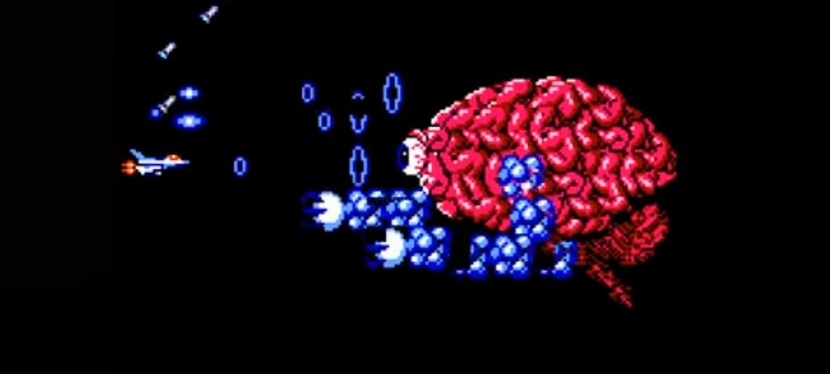
#7 A look at Salamander (AKA Life Force) – Still on the topic of retro gaming, I had fun memories playing Salamander (titled Life Force in North America) on the Family Computer (Famicom) back in the late-1980s. It was a sci-fi 2D scrolling shooter that not only featured side-scrolling levels but also vertical levels. Developed and published by Konami, Salamander was a spin-off of Gradius (an acclaimed 2D side-scrolling shooter on its own) but it became successful in entertaining players with the two-player mode, unique challenges, fine gameplay features and outstanding visuals. To learn more about Salamander, watch the selected videos below.
#8 Friday The 13th Part 3 videos – If there is anything significant about Friday The 13th Part 3 (1982) other than being filmed in 3D, it is the fact that it marked a creative turning point for the franchise. It was in this movie that the film series really started to take shape with Jason Voorhees as its feature antagonist. That being said, it is not surprising that there are lots of retro reviews/reactions and feature videos about it. Watch the selected videos below.
Welcome back readers, fellow geeks and electronic gaming fans!
In this edition of the Retro Gaming Ads Blast (RGAB) series, we will examine print ads of Sega from the 1990s which was a notable period of time when they went from being a prominent video game company into a desperate, struggling entity by the end of the decade. All the Sega ads in this edition are promotions of their own video games that were exclusive to their consoles during the 1990s.
For the newcomers reading this, Retro Gaming Ads Blast (RGAB) looks back at the many print ads of games (console, arcade, computer and handheld) that were published in comic books, magazines, flyers and newspapers long before smartphones, social media, the worldwide web and streaming became popular. To put things in perspective, people back in the 1980s and 1990s were more trusting of print media for information and images about electronic games and related hardware.
With those details laid down, here is the newest batch of retro gaming print ads for you to see and enjoy…
1. Phantasy Star IV print ad
This was the last single-player Phantasy Star game released. There is no sign of Sega revisiting the franchise for another single-player experience.
Long before the emergence of online console gaming that involved a high number of players, Sega released Phantasy Star IV for the Genesis console in America in 1994 which was praised by gamers and critics. This one also turned out to be the last single-player role-playing game (RPG) of the Phantasy Star series as Sega eventually turned it into a series of online RPGs since the year 2000.
This print ad is significant because a lot of gamers today are not aware that Phantasy Star started as a series of single-player RPGs the same year Final Fantasy debuted in Japan. Anyone interested to play Phantasy Star IV on a modern console should buy the Sega Genesis Classics collection.
2. Eternal Champions print ad
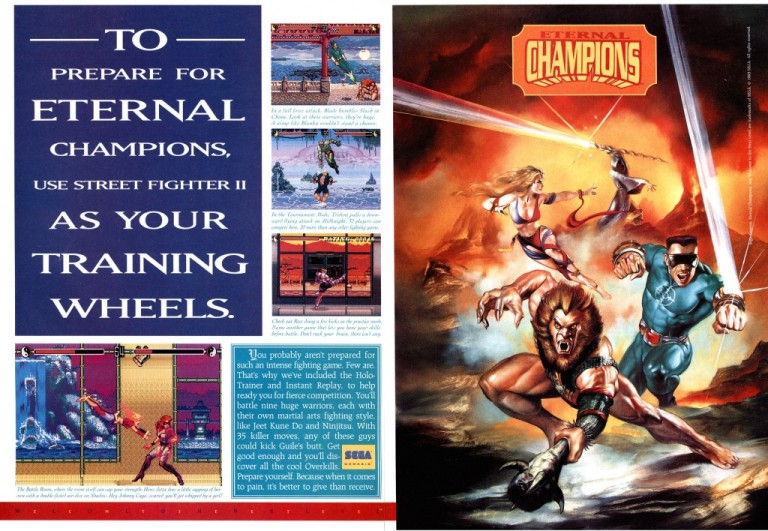
This 2-page print ad appeared in many comic books and some magazines that I read long ago.
Back in the 1990s, the fighting game genre became wildly popular with gamers at the arcades and on consoles at home. Capcom literally sparked a wild fire with the Street Fighter II game and its upgraded editions, and other companies went on to make their own 2D fighting games to cash in. Sega was one of them and they released their own 2D fighting game Eternal Champions for the Sega Genesis console.
Unsurprisingly, the game was marketed aggressively and this 2-page print ad really stood out as it had the great looking painted art on the right, screenshots and details of the game, and most notably made a sarcastic reference to Street Fighter II. Eternal Champions sold enough copies, it led to the release of the sequel Eternal Champions: Challenge from the Dark Side and two spin-off games. I can only guess that referencing Street Fighter II was helpful in achieving commercial success.
3. Streets of Rage 3 print ad
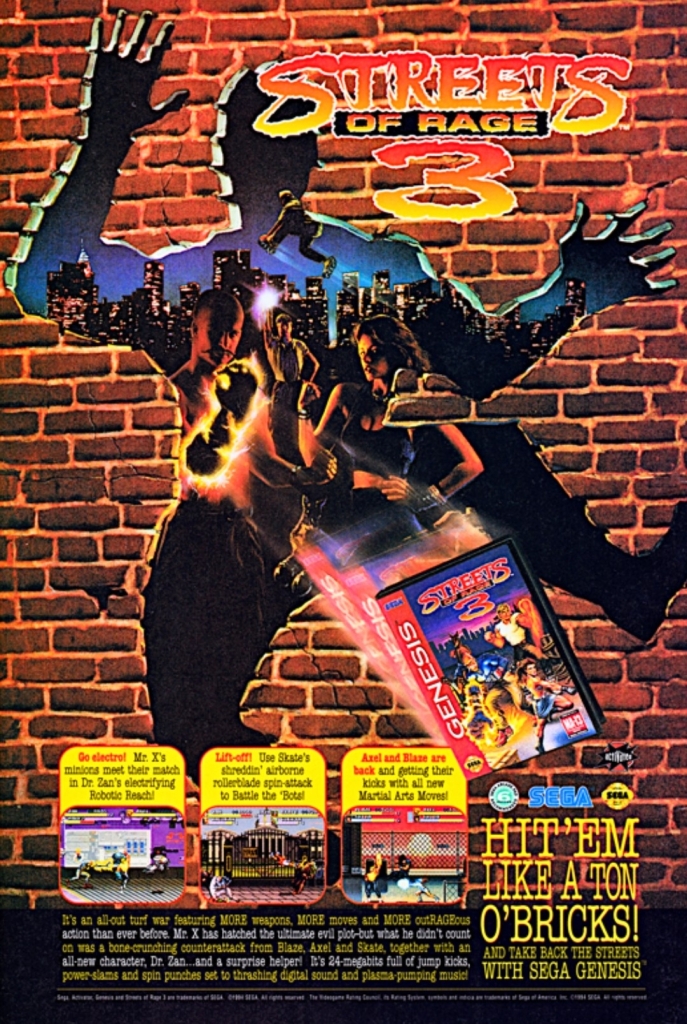
This ad caught my attention easily when I saw it in comic books I read.
Streets of Rage (Japanese title: Bare Knuckle) was one of the most defining game franchises Sega came up with and it started on the Sega Genesis console. It was a series of side-scrolling, 2D beat-them-up games that ensured action and excitement for gamers. As the first two games were critically and commercially successful, Sega was confident in aggressively marketing Streets of Rage 3 and the print ad seen had a very attention-grabbing artwork.
The artistic style emphasized power and intensity as it shows a damaged wall with the shape of a human body (symbolizing that someone was thrown through it) and then there were images of people on the other side. The game went on to attract mostly positive reviews although it paled in comparison to its predecessors in terms of sales.
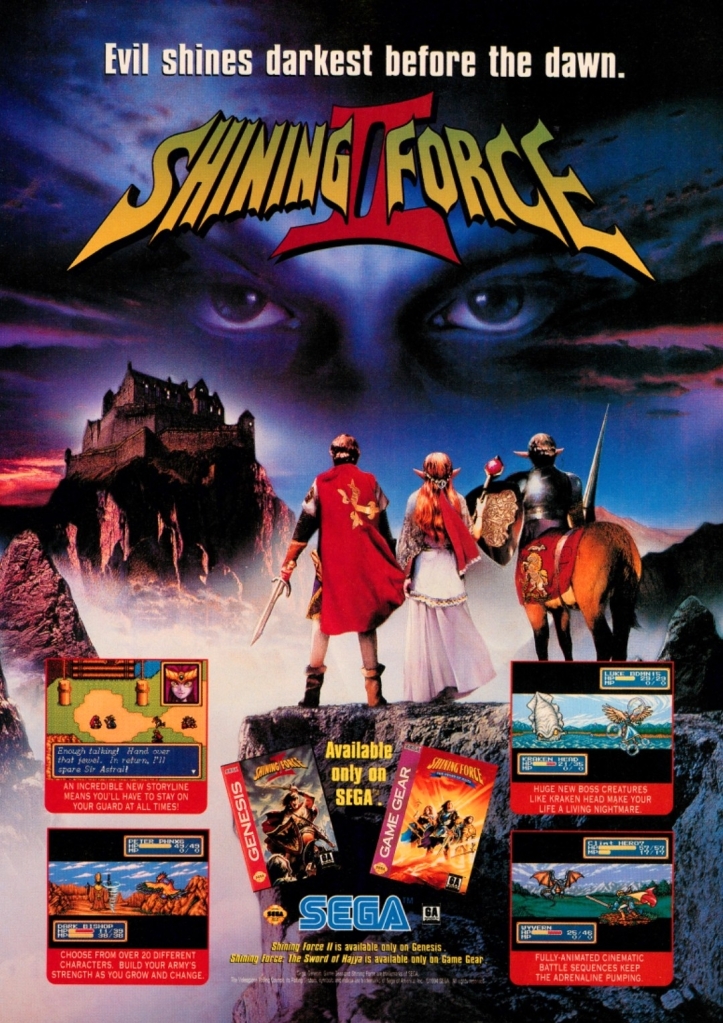
4. Shining Force II print ad
The first time I saw this ad, it made me interested to buy a Sega Genesis console to play it.
As Sega was so prolific with making and releasing games across different genres, they had their own tactical role-playing game series with Shining Force and the first game released on the Sega Genesis was a critical and commercial success. That being said, the company was confident with releasing Shining Force II on the same console more than a year later achieving critical and commercial success.
The North American print ad of the game had a visual presentation that closely captured the foreground-background style (characters facing the distance) used in-game, and the advertising team use photographic imagery to achieve a fantasy look. Very cleverly, Sega inserted the Sega Game Gear title Shining Force Shining Force: The Sword of Hajya into the ad. This print ad made me interested in acquiring a Sega Genesis for Shining Force II.
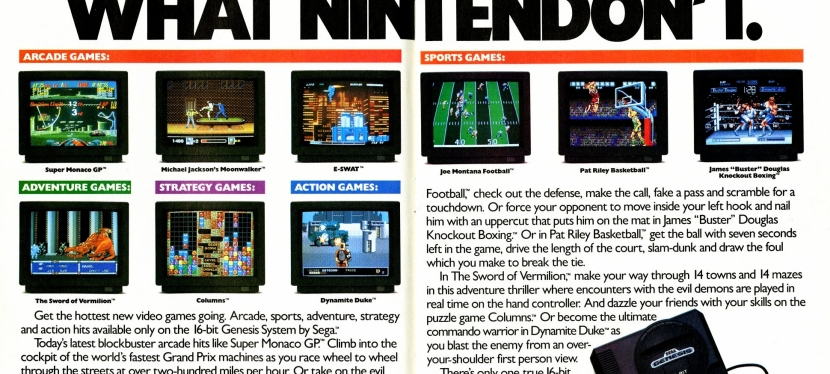
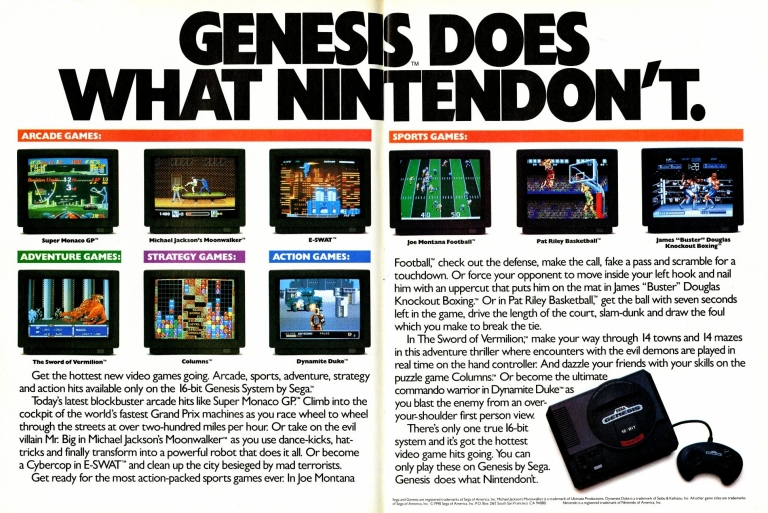
5. Genesis does what Nintendon’t print ad
With the famous line heavily emphasized, this print ad showed how bullish Sega really was in competing with Nintendo.
Now this print ad of Sega’s has the most definitive and best-known advertising line in the so-called 16-bit console generation: Genesis does what Nintendon’t. This was Sega’s aggressive marketing push to convince gamers to buy the Genesis console to play games and experience thrills of fun that they would not find on a Nintendo console at the time. Genesis was launched in America in 1989 with “16-bit” emphasized a lot, and the technological rival Super Nintendo Entertainment System (SNES) was released in the same market more than two years later.
The 2-year advantage helped Sega establish the Genesis as the next-gen machine for gaming at home and there were years in the 1990s when Sega’s console outsold Nintendo’s in America during the so-called 16-bit war. The Genesis also had lots of exclusive games plus strong software support from third-parties. While the SNES would eventually outsell the Genesis in other parts of the world, it was in America where Sega proved to be very competitive and successful.
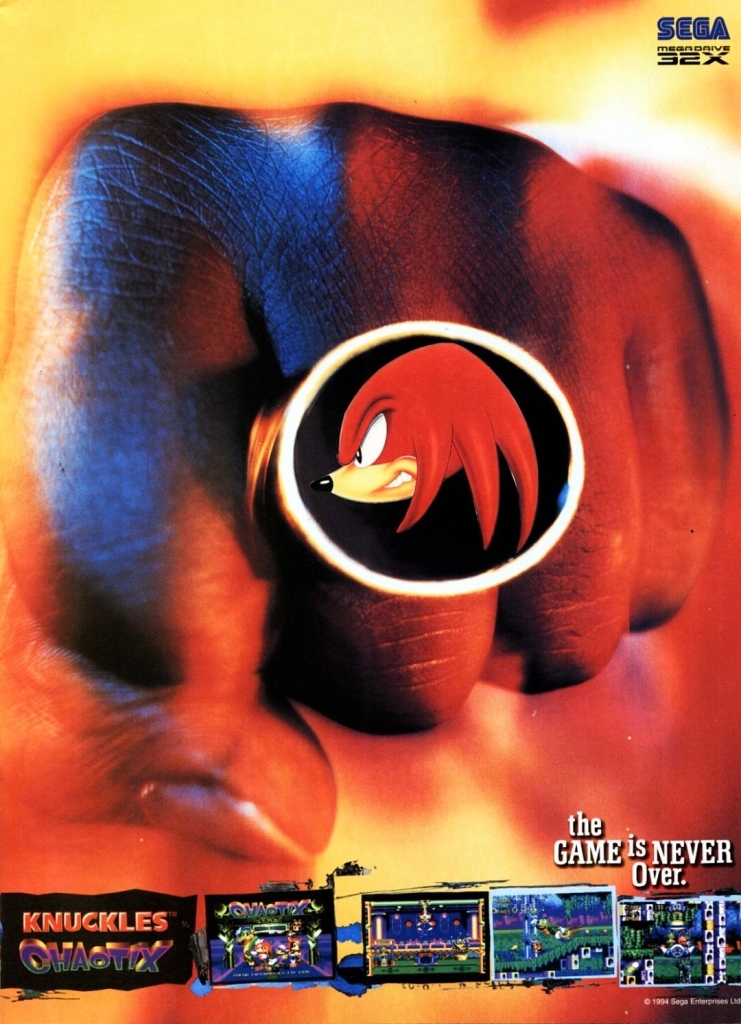
6. Knuckles’ Chaotix print ad
Sega was aggressive with marketing this game for the 32X.
In late 1994, Sega released in America and in Japan the 32X which was an add-on device for the Sega Genesis designed enhance its power while serving as a transition (a warm-up) into the so-called 32-bit era of console gaming. The 32X was the result of corporate decisions involving the American and Japanese executives of the company.
To keep 32X customers happy and boost hardware sales, Sega adjusted the development of Knuckles’ Chaotix (a Sonic spin-off) from being a Sonic project 32-bit console Sega Saturn into a standalone game for the add-on device. Even though Sega knew the game’s development was rushed, they went on to strongly promote the game and the print ad shown here was quite eye-catching.
The image of a fist with a ring showing the character Knuckles (a character from the Sonic games) emphasizes power and the colors used seem to express intensity. Then there were the selected screenshots shown without descriptive text. Although Sega tried hard, Knuckles’ Chaotix (launched in 1995) received mixed-to-positive reviews and sadly sold poorly. Unsurprisingly, the sales of the 32X dropped further and by then a lot of consumers knew that the Sega Saturn (the true successor to the Genesis) was all set to launch in America and Europe within 1995.
7. Sonic 3D Blast for Sega Saturn print ad
Too bad Sega and its teams failed to make the true Saturn Sonic game.
Back in the 1980s and 1990s, having a high-quality, console-exclusive game featuring a company mascot was crucial to sell game consoles while keeping dedicated fans happy. Like what Nintendo did with their icon Mario, Sega achieved great commercial success with the three Sonic the Hedgehog games they released exclusively on the Sega Genesis console and this naturally created expectations they would make new Sonic games on the Saturn console. Unfortunately, Sega and its teams failed to complete development of the Saturn-exclusive game Sonic X-treme and the company cancelled it which sent shockwaves through the games industry news.
With the 1996 holiday shopping season too crucial to ignore, Sega commissioned a Saturn version of the game Sonic 3D Blast which was originally made for the Genesis console. Sonic 3D Blast on the Saturn took seven weeks to make and there were some graphical enhancements implemented. While Sonic 3D Blast’s Genesis version attracted a positive reception from critics (and sold 700,000 copies), the reception for the Saturn version was mixed. This print ad of Sonic 3D Blast on Sega Saturn is a reminder of the company’s failed attempt to take their icon to the next-generation. They never replicated the big success they had with Sonic on the Genesis.
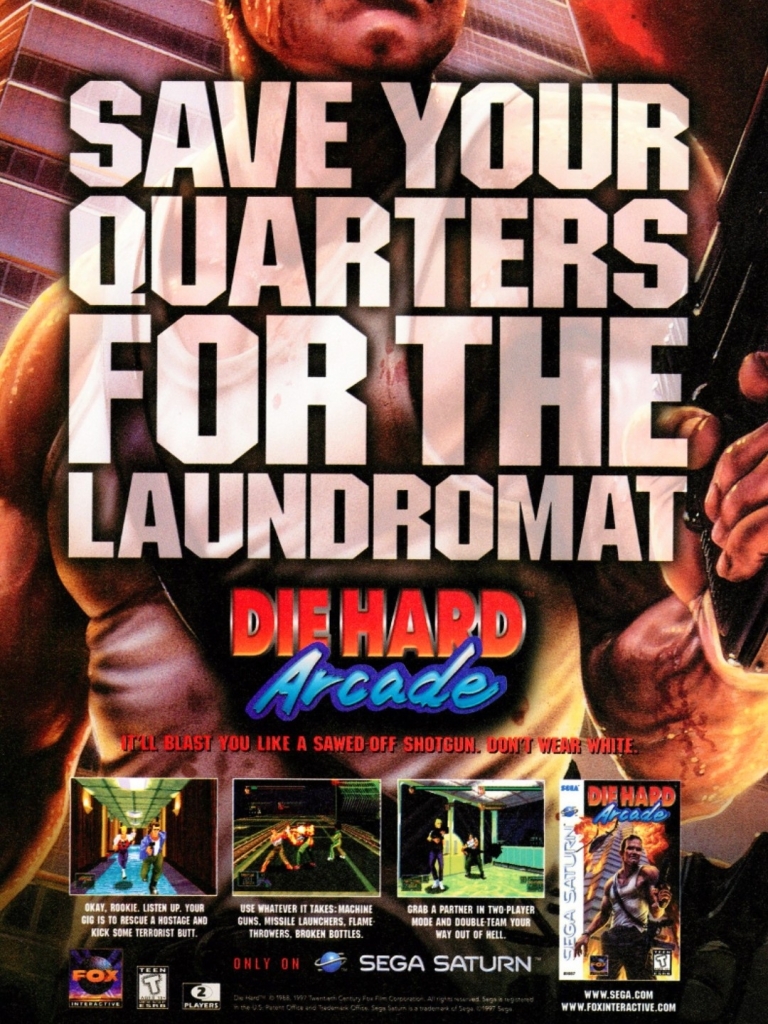
8. Die Hard Arcade print ad
Each time I saw this print ad, it easily reminded me of the classic action film of 1988.
Like many other movie franchises, Die Hard has many video game adaptations released through the decades. In 1997, Sega released Die Hard Arcade (Japanese title: Dynamite Deka) on the Sega Saturn and the game critics praised it for its fun gameplay as well as its flawless conversion of the arcade version (released in 1996). To say the least, the development history of Die Hard Arcade is not as straightforward as many would think. To get the details and explanations of the development of the game, click here.
As for the print ad itself, this one cleverly used official game art as the background with imagery which instantly reminded me of what I saw in the classic 1988 movie that starred Bruce Willis. This ad made me interested to buy a Sega Saturn or find a place to rent it to play the game.
9. Shenmue Japanese print ad
Simplistic with presentation and yet engaging to look at. The Dreamcast-exclusive Shenmue sold over a million copies in Japan alone.
When Shenmue was released exclusively on the Sega Dreamcast in Japan on December 29, 1999, it turned out to be a very mind-blowing experience for many gamers due to its ambitious game design, the intense attention to detail implemented, very high production values, in-depth exploration and very immersive gameplay.
It was the open-world game released at a time when “open-world” was not even a standard gaming term. Often called the masterpiece of the legendary game designer Yu Suzuki, Shenmue sold over 1.2 million copies in Japan and went on to be released worldwide in the months that followed. Sadly, the game failed to make a profit due to its very high budget of $70 million (which Suzuki himself said in English during an interview) and the fact that the number of Dreamcast units already sold to gamers was not massively high.
The Japanese print ad of Shenmue had a simplistic looking visual concept and yet it was engaging to look at because the way the characters appeared was how they appeared in the game during gameplay which was astounding. Take note that back in the 1990s, it was common for video game marketing materials to show human characters in high detail but in reality the polygonal models of those characters appeared looking blocky and much less detailed during gameplay.





 Author Carlo Carrasco