A Look Back at The Man of Steel #2 (1986)

Welcome back superhero enthusiasts, 1980s culture enthusiasts and comic book collectors! Today we go back to the mid-1980s to explore a part of the DC Comics shared universe through a tale of the iconic Superman.

Previously, I reviewed the first issue of The Man of Steel mini-series written and drawn by John Byrne. Using a unique structure for storytelling, Byrne gradually told how the post-Crisis version of Superman came to be while also retaining specific classic elements that made DC’s icon inspirational. That very comic book had its influences on other portrayals of Superman beyond comic books such as he Lois & Clark: The New Adventures of Superman TV series and even the very divisive Man of Steel movie.

With those details laid down, here is a look back at The Man of Steel , published in 1986 by DC Comics with a story written and illustrated by John Byrne.
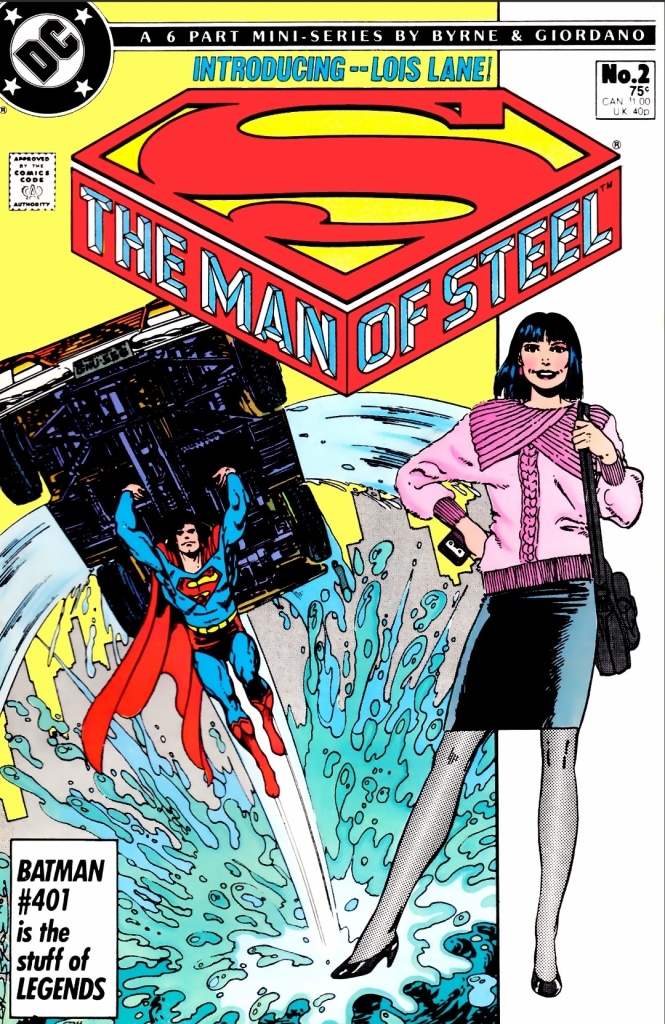
The cover.

Early story

The story begins in the middle of Metropolis when the newly established hero Superman (now in full costume) flies just above the busy road which distracted Daily Planet editor-in-chief Perry White (who was having a coffee break with reported Lois Lane inside a coffee shop). Remembering how the space plane and its crew got saved by Superman (Clark Kent in civilian clothes) sometime prior, White tells Lane (who first encountered Superman immediately after the space plane was saved) to go after him to get the hot scoop.

While Lane crosses the road, a limousine’s opens with the driver telling her that Mister L (Lex Luthor the tycoon) wants to her. Lane declines and proceeds with her chase for Superman…

Quality

An act of help by Superman for someone who was in trouble.

This story is set during the early days of Superman as the new, randomly appearing hero of Metropolis whose impact on local society is just growing stronger. At the same time, this shows Clark Kent being a very new resident of the city still looking for a job. This is inspired work by Byrne on building up the Man of Steel for what was back then the modern age.

That being said, the most intriguing fact here is that this Superman story has Lois Lane as the actual protagonist. While Lane’s literary presence here is slightly stronger than DC’s icon, this tale is clearly all about her unrelenting approach with newspaper journalism, her use of the Daily Planet’s valuable connections and resources, and how much risk she would take to get the facts, the statements and other details all for the sake of getting the hot story. This is Byrne’s modernization of Lois Lane highlighting the concept that Clark Kent will have serious competition with her within the Daily Planet.  

That being said, there is no romance between Clark and Lois here. This is after all their 2nd encounter (the saving of the space plane in issue was shown in flashback with Lois Lane already present) and Byrne took a careful approach on establishing the first lengthy encounter and interactions between the two. Their encounter here is really engaging.

More on Superman himself, the writer kept the pace of developing him flow smoothly and steadily. You will see how Superman keeps himself in control whenever he talks with normal people or when he encounters criminals who cause danger on others. While he has a priority to help others in need using his powers, he does not neglect his actual identity (and personal life) as Clark Kent and this includes moderating or limiting the use of his special abilities as he levels himself with the rest of the civilian population.

Conclusion

Lois Lane portrayed as the unrelenting and very determined newspaper reporter. Even though Superman always flew away, she just won’t give up.

The Man of Steel (1986) is clearly a very solid follow-up to issue . The continued development of Superman remains solid and the dramatization of Lois Lane as the strongly determined newspaper journalist is compelling to see. With regards to the build-up of the post-Crisis DC Comics shared universe, this particular Superman tale is one of essential parts of it.

Overall, The Man of Steel (1986) is highly recommended!

+++++

Thank you for reading. If you find this article engaging, please click the like button below, share this article to others and also please consider making a donation to support my publishing. If you are looking for a copywriter to create content for your special project or business, check out my services and my portfolio. Feel free to contact me with a private message. Also please feel free to visit my Facebook page Author Carlo Carrasco and follow me on Twitter at  @HavenorFantasy as well as on Tumblr at https://carlocarrasco.tumblr.com/ and on Instagram at https://www.instagram.com/authorcarlocarrasco
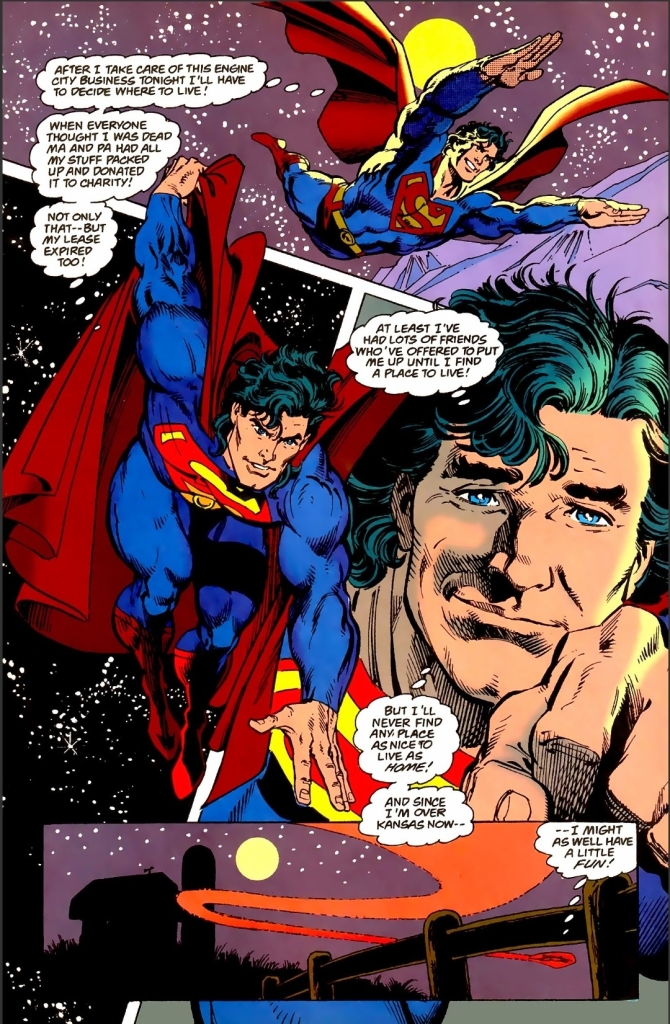
A Look Back at Superman #83 (1993)

Welcome back superhero enthusiasts, 1990s culture enthusiasts and comic book collectors! Today we go back to the year 1993 to take a close look at one of the many tales published through the Superman monthly series.

For the newcomers reading this, DC Comics published the Funeral for a Friend storyline set after Superman’s death (Superman ). Funeral for a Friend explored the impact Superman’s death had on local society, the civil and political stakeholders, as well as DC’s many superheroes who were connected with the icon (read my retro reviews here, here, here and here). Of course, DC brought the Man of Steel back to life which led to the Reign of the Supermen storyline. This obviously meant concluding the Funeral for a Friend storyline.

With those details laid down, here is a look back at Superman #83, published in 1993 by DC Comics with a story written and drawn by Dan Jurgens with ink work by Joe Rubinstein. This is the epilogue of Funeral for a Friend.

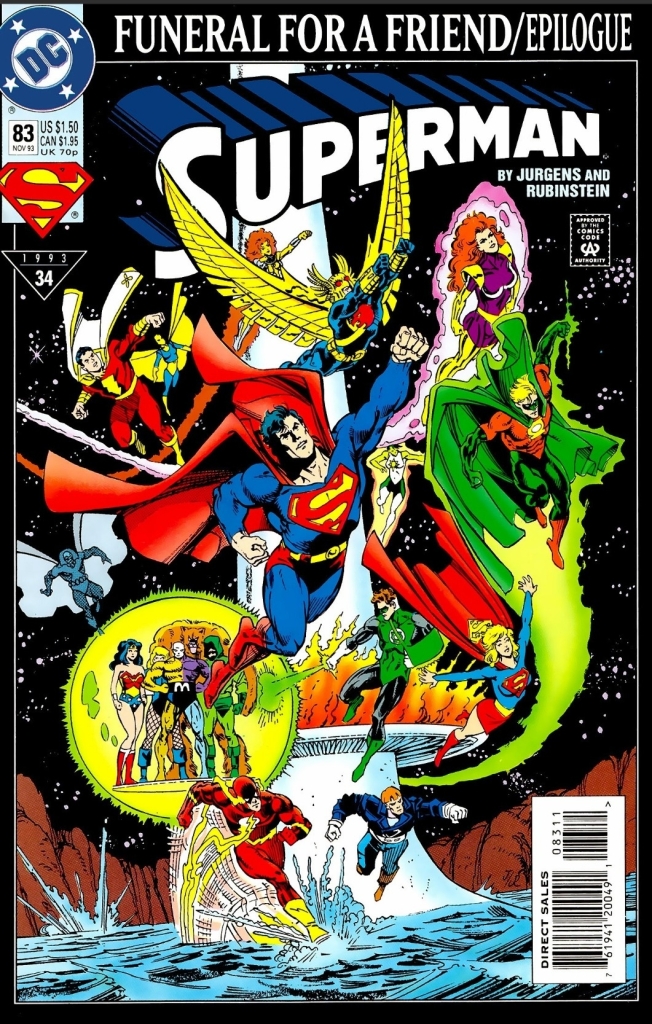
The cover.

Early story

The story begins with Superman meeting an arriving Batman (note: Azrael playing the role as Bruce Wayne had been paralyzed by Bane) in the presence of Commissioner Gordon in Gotham City. He tells Batman that it was time for them to go to a certain ceremony which catches Azrael knowing nothing about it all forcing him to just play along. Batman resorts to making an excuse and turns Superman down, even though he learns that the entire Justice League will be involved to take care of the Engine City problem. Not wanting to spark Superman’s suspicion, Batman leaves Superman and Gordon behind. Superman then flies away.

Meanwhile, Lex Luthor, Supergirl and personnel fly towards Engine City. Luthor is obsessed with accumulating Kyptonite at the site…

Quality

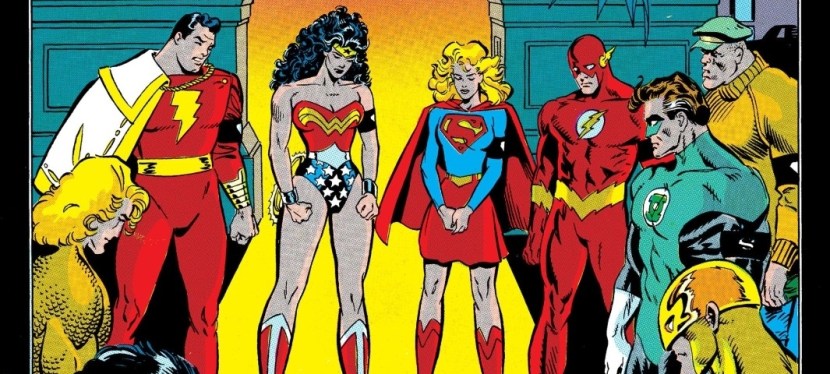
Superman, Wonder Woman, Green Lantern and the Flash with Lex Luthor and Supergirl (in the background).

As the conclusion of the Funeral for a Friend storyline, this is a mixed bag of creative concepts. It has scenes that developed established supporting characters such as Lois Lane, Jimmy Olsen, Cat Grant and Superman’s parents Jonathan and Martha Kent. The main story of this comic book has a lot more to do with the Justice League than Superman himself as a result of a huge crisis in which an actual coastal city could collapse, fall into the sea and potentially poison the aquatic life.

That’s not to say that Superman does not have sufficient presence in this comic book. In fact, the Man of Steel has scenes that highlight his humanity, his leadership role among the Justice League and how he is still adjusting to life after getting killed by Doomsday. What Superman fans won’t find here is superhero action versus an enemy.

Still on the Superman relevance of this comic book, Lex Luthor’s obsession with accumulating as much Kryptonite as he could reflects his diabolic nature as well as his cunning moves with distorting people’s perception. Even though he does not commit any acts of violence, Luthor’s manipulative tactics even in the presence of many superheroes showed that he simply won’t stop at anything to get what he wants and what benefits him.  

Speaking of more characters, Green Lantern (Hal Jordan) here got a good piece of the spotlight as he emphasized why Engine City should fall into the Pacific Ocean which he relates to the destruction of Coast City. Through his dialogue, you can feel his bitterness and the impact that the Coast City tragedy had on his worldview. You will also see Aquaman, Wonder Woman, Guy Gardner and others participate in the talks.

Conclusion

Pay close attention to the details, Superman fans.

Superman #83 (1993) is a nicely crafted story that happens to be more about the Justice League dealing with a big problem with Superman present. As the epilogue to the Funeral for a Friend storyline, this comic book tied up certain loose ends but ultimately focused more on building up details and tension for future events. As this story took place a short time after Superman physically returned from the dead, readers will see a still-adjusting Man of Steel here and this clearly shows that the funeral is indeed over.

Overall, Superman #83 (1993) is recommended.

+++++

Thank you for reading. If you find this article engaging, please click the like button below, share this article to others and also please consider making a donation to support my publishing. If you are looking for a copywriter to create content for your special project or business, check out my services and my portfolio. Feel free to contact me with a private message. Also please feel free to visit my Facebook page Author Carlo Carrasco and follow me on Twitter at  @HavenorFantasy as well as on Tumblr at https://carlocarrasco.tumblr.com/ and on Instagram at https://www.instagram.com/authorcarlocarrasco

A Look Back at Superman vs. Aliens #1 (1995)

Disclaimer: This is my original work with details sourced from reading the comic book and doing personal research. Anyone who wants to use this article, in part or in whole, needs to secure first my permission and agree to cite me as the source and author. Let it be known that any unauthorized use of this article will constrain the author to pursue the remedies under R.A. No. 8293, the Revised Penal Code, and/or all applicable legal actions under the laws of the Philippines.

Welcome back superhero enthusiasts, 1990s culture enthusiasts and comic book collectors! Today we go back to the year 1995 to examine what was back then one of the most unthinkable comic book crossovers to ever happen – Superman vs. Aliens (also referred to as Superman/Aliens).

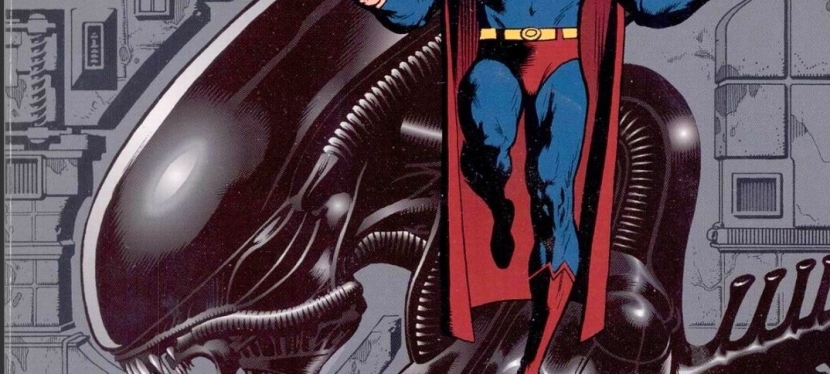
I remember sometime back in 1994, I bought a new superhero comic book from the local comic book retailer and what caught my attention was the print ad on the back – an Alien chestburster crashing through the iconic Superman S logo. A few of my friends who saw the same print ad chuckled at the concept of having the Man of Steel together with the monsters from the movie franchise that first started in 1979 with Ridley Scott’s Alien. Then came 1995 and eventually the first issue of the Superman vs. Aliens mini-series made it on the shelves of local comic book stores. Its cover easily attracted the attention of many and I saw the image of Superman being smaller to the Xenomorph alien in the background, the concept of the crossover started to intrigue me.

With those details laid down, here is a look back at Superman vs. Aliens , published in 1995 by Dark Horse Comics and DC Comics with a story written and drawn by Dan Jurgens with ink work done by Kevin Nowlan.

The cover.

Early story

The story begins in space when a fast moving object from nowhere heads towards Earth which was detected by a satellite of Lex Luthor’s corporation. Behind the scenes, personnel initiated an alert for a certain Dr. Kimble.

Clark Kent (Superman) and Lois Lane arrive at the headquarters of Lexcorp. It turns out they were suddenly called for by the corporation due to what happened in space. As they ride the elevator heading towards the rooftop, Clark and Lois talk about Lexcorp’s space program and Dr. Kimble who happens to lead the said program.

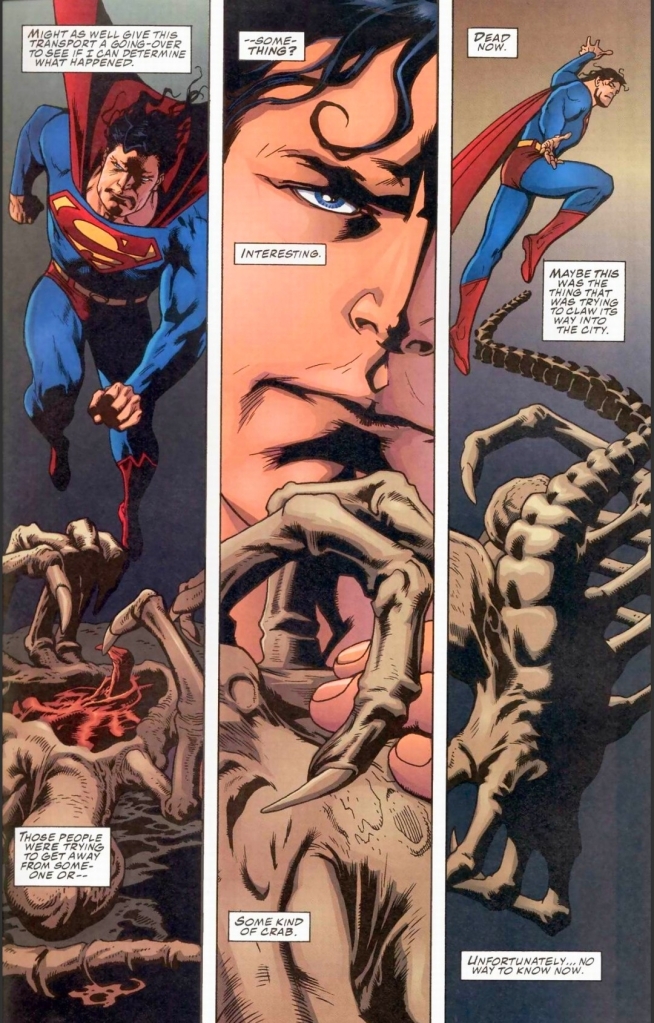
At the roof, they meet Dr. Cheryl Kimble and immediately ride with her in the helicopter going to a certain destination in anticipation of the probe’s estimated arrival. During the trip, Kimble reveals that they received radio signals from the incoming probe which were garbled almost unintelligible. She then plays an excerpt of the radio signals for Clark and Lois to listen to.

For Clark, he cannot help but feel shocked as he finds the audio sounding like Kryptonian…

Quality

Superman finds a dead Facehugger alien.

Firstly, I can say without any hesitation that the creative team succeeded in making the crossover between Superman and the Aliens believable within this very comic book. For one thing, Dan Jurgens came up with a script and visual design that radically different from what was shown in Superman comic books of the time. The script had this somewhat adulterated tone that made the comic book move away from superhero fantasy and move into the realm of cinematic science fiction. For setting the tone and the look, the creative team scored a home run.

Secondly, the script was properly structured to immerse readers with the tale initially following Superman, Lois Lane and Dr. Kimble which ultimately served as a build-up. The good news here is that readers don’t have to wait too long for the pay-off to be executed. In fact, the pay-off itself (which happens when the Man of Steel finally encounters the Xenomorph for the first time) is huge and immediately the tension and depth of the plot really shifted into high-gear which I enjoyed. Along the way, the expository dialogue or the presentation of details (to help readers understand) was nicely balanced.

Thirdly, I love the way how Dan Jurgens presented Superman as being more troubled and more vulnerable than usual. To see the American icon go into personal obsession over the Kryptonian details was a really unique way to presenting his human side. Also having Superman deep in space far away from any sun or star (the essential source for his powers) really made him truly vulnerable as he actually got weaker even before facing off with a Xenomorph. Being in a vulnerable state, you will see the Man of Steel in real danger which truly goes against type (note: being super strong and invulnerable all the time). As such, the danger of the Aliens against him is believable and intense. What I do find weird, however, is how awkward it is for me to see Superman actually trying to reason with the first Xenomorph he encounters. Of course, he has no previous knowledge about the violent nature of the Aliens but we readers – and millions of people who saw any of the movies – know better than him.

As part of the build-up, Dan Jurgens inserted details and flashbacks that recalled previous tales that were published during the early stage of the post-Crisis era of DC Comics. This not only includes Superman’s arrival on Earth but also his strategic killing of General Zod, Zaora and  Quex-Ul using green Kryptonite (as published in Superman #22 of 1988). As such, Superman’s deep regret of taking life away from others serves as a build-up for his avoidance of killing in this crossover. This actually races the stakes for his upcoming encounters with the Aliens.

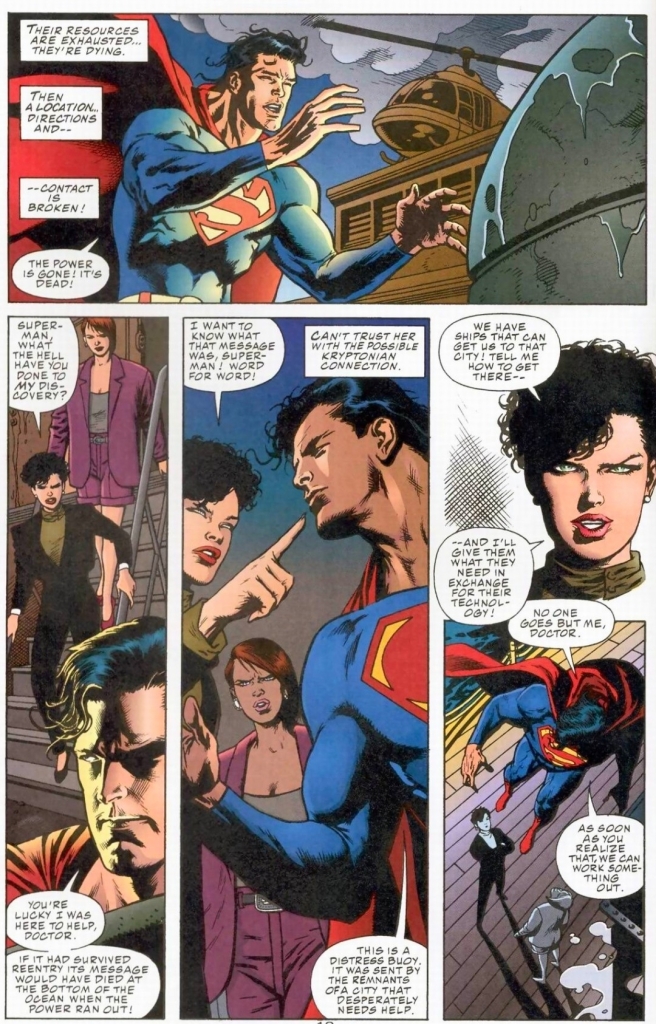
Even though the story is told through Superman, Dan Jurgens still had enough room to develop Lois Lane and Dr. Kimble. Kimble symbolizes the driven corporate executive who is in-charge of operations that could help her make claims on scientific discoveries and new technologies. Lois Lane here served as the intellectual opposite of Kimble without ever going into the extremes of gaining something for her journalistic career.

Conclusion

Superman with Lois Lane and Dr. Kimble.

Very clearly, Superman vs. Aliens (1995) is indeed a great comic book as well as great opener for its mini-series. Dan Jurgens established a tale that had sufficient build-up and when the pay-off started, the crossover aspect really made the story more compelling to read. Ultimately, this one made the crossover between Superman and the Xenomorphs believable, engaging and intriguing. This comic book is a great start and I am eager to find out what happens next.

Overall, Superman vs. Aliens (1995) is highly recommended!

+++++

Thank you for reading. If you find this article engaging, please click the like button below, share this article to others and also please consider making a donation to support my publishing. If you are looking for a copywriter to create content for your special project or business, check out my services and my portfolio. Feel free to contact me with a private message. Also please feel free to visit my Facebook page Author Carlo Carrasco and follow me on Twitter at  @HavenorFantasy as well as on Tumblr at https://carlocarrasco.tumblr.com/ and on Instagram at https://www.instagram.com/authorcarlocarrasco
A Look Back at Superman vs. The Amazing Spider-Man (1976)

Disclaimer: This is my original work with details sourced from reading the comic book and doing personal research. Anyone who wants to use this article, in part or in whole, needs to secure first my permission and agree to cite me as the source and author. Let it be known that any unauthorized use of this article will constrain the author to pursue the remedies under R.A. No. 8293, the Revised Penal Code, and/or all applicable legal actions under the laws of the Philippines.

Welcome back superhero enthusiasts, 20th century arts and culture enthusiasts, fans of Marvel and DC Comics, and comic book collectors! Today we go back to the year 1976 to examine what is truly a landmark event in the history of superhero comic book publishing – the first-ever superhero crossover event of Marvel Comics and DC Comics with Superman vs. The Amazing Spider-Man (also referred to as Superman vs. Spider-Man for short).

For the newcomers reading this, I previously reviewed the 2nd Superman-Spider-Man crossover comic book titled Superman and Spider-Man. That was released in 1981 and was handled by a different creative team (led by Jim Shooter as writer) compared to the 1976 crossover of the two icons of Marvel and DC. Going back to the 1970s, a crossover between Marvel and DC looked like an impossible dream as the idea of the two companies coming into agreements over the legal, creative and financial aspects was perceived to be unachievable. Indeed there were headaches and challenges during the negotiations but ultimately Marvel and DC came into an agreement to publish a special comic book featuring Superman, Spider-Man and the related supervillains and supporting characters from both sides. Take note that the two publishing giants worked together previously with publishing an official comic book adaptation of the movie The Wizard of Oz (1939).

With those details laid down, here is a look back at Superman vs. The Amazing Spider-Man, published in 1976 by Marvel Comics and DC Comics with a story written by Gerry Conway and Ross Andru. This crossover event was described as the battle of the century.

The cover.

Early story

The story begins at the World News Conference in New York City. Separated by several feet apart, Clark Kent (Superman) and Peter Parker (Spider-Man) arrive with their respective companions and associates. What the two heroes do not know is that Lex Luthor and Doctor Octopus recently escaped from prison.

Peter Parker gets berated by his boss J. Jonah Jameson for not being good enough as a photographer while Clark Kent learns the bad news from Edge Morgan that he is not wanted for the coverage of a national convention.

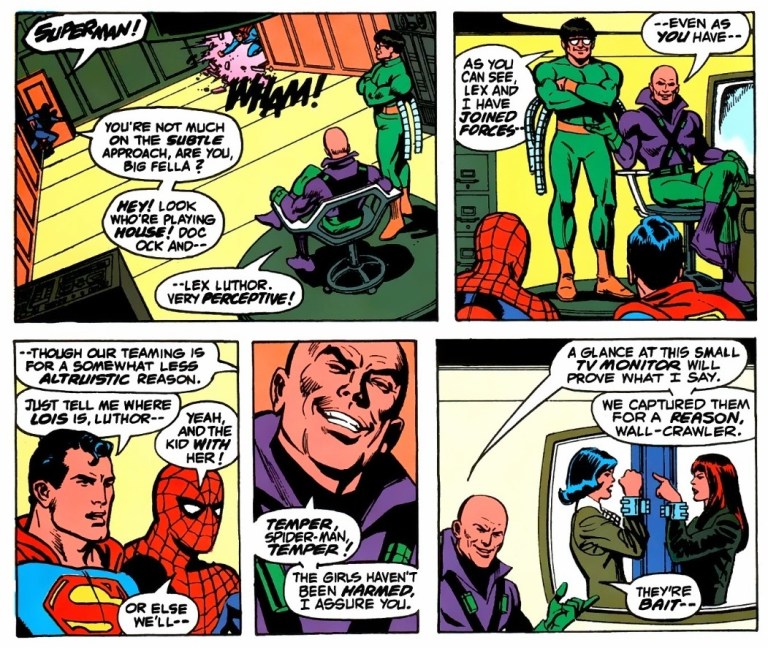
Shortly after, Lois Lane climbs up a scaffold to get a good view for some photography. Just as she is about to fall down, Peter Parker suddenly grabs her and pulls her to safety. After an exchange of pleasantries, Peter introduces Lois to Mary Jane Watson. Just as MJ and Lois start conversing, Superman suddenly arrives. The Superman figure then fires beams of light from eyes to Lois and MJ, causing them to vanish into thin air. It turns out, the caped figure is an impostor as Peter Parker and Clark Kent react in shock.

Peter quickly runs to the roof of the building and changes into Spider-Man. As soon as he leaps into action, he comes face to face with Superman himself…

Quality

Superman, Spider-Man, Luthor, Dr. Octopus, Lois Lane and Mary Jane Watson shown in this scene.

I can loudly say that this is one pretty enjoyable crossover tale that not only featured Superman and Spider-Man, but also gave their respective mortal enemies Luthor and Dr. Octopus a good share of the spotlight. To be very clear, the story and set-up of scenes do have a somewhat restrictive structure as the creators clearly did their best to make the spotlight on the characters more or less equal in terms of imagery, dialogue amount and the sharing of dynamic shots. While some may easily complain about the so-called old and tired formula of the major characters getting into fighting each other due to a misunderstanding followed by setting aside their differences to work together, take note that the said formula worked really well in this story written by Gerry Conway.

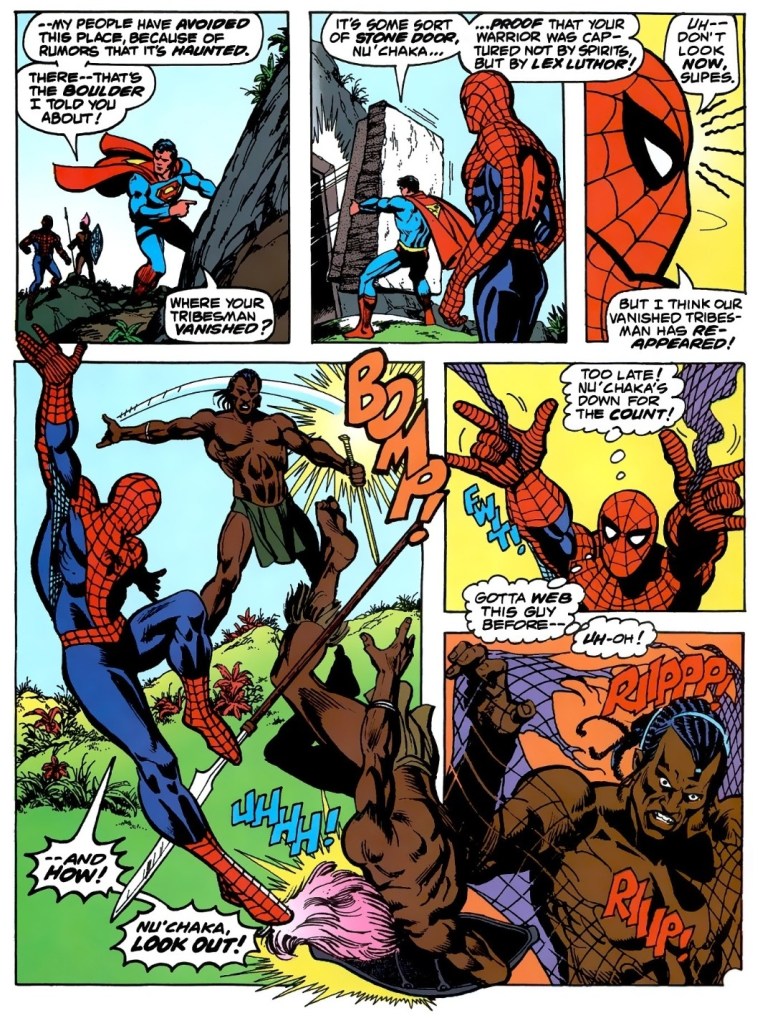
The story concept Conway came up was clearly made to justify Superman and Spider-Man encountering each other (note: the same goes with the super villains and supporting characters) and the way he wrote the two interacting with each other worked seamlessly and convincingly. There are lots of nice exchanges of dialogue between the Man of Steel and the webslinger.

Even the superiors of Clark Kent and Peter Parker had their own crossover.
Don’t let the woke and socialists fool you. There is nothing racist in this comic book. Wokeness is foolishness. Political correctness distorts perception of reality.

Even though the script has this set of creative restrictions to ensure fairness on both Marvel and DC’s sides, the synergy of friendship and cooperation between Superman and Spider-Man is fantastic to read. Similar qualities are also evident with the scenes of Luthor and Dr. Octopus. Very clearly, the creative team did intense research on the Marvel and DC characters and found ways to create a unique mix that resonates with the fans of Superman and Spider-Man.

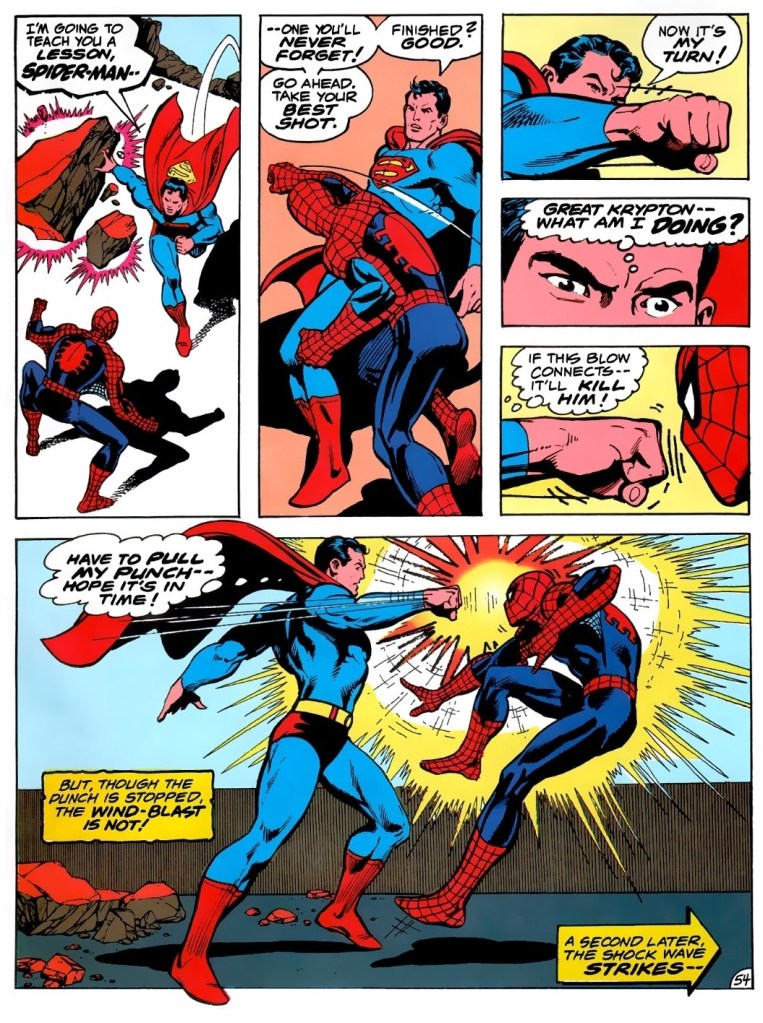
As expected, this comic book has lots of superhero spectacle for readers to enjoy. The superhero violence is not intense but the action scenes were entertaining to look at. In my opinion, the highlights of the spectacle here is when Superman and Spider-Man literally exchanged mortal enemies to fight with. As for the fight between the two icons as emphasized in the title, it definitely is a special event that really kicked the story into high gear.

While this is indeed a fun superhero crossover to read, there are some notable weak points here. For one thing, the plot itself lacks a strong concept and Luthor’s evil plan is very flawed and unconvincing. That being said, as I read and re-read this comic book, there never was a sense of danger building up nor was the Luthor-Dr. Octopus team ever a grave threat.

Conclusion

This is only a small sample of the fun in the battle between Superman and Spider-Man.

By today’s standards, Superman vs. The Amazing Spider-Man (1976) is still a fun superhero crossover comic book to read and it remains as a significant part of not just Marvel and DC’s history of collaboration but also that of inter-company superhero crossover comic book publishing in general. While it is better than many other inter-company superhero crossover comic books I have read through the decades, this one is certainly not the best one from Marvel and DC. For me, Superman and Spider-Man (1981) has a more elaborate plot, higher fun factor and deeper impact than this comic book. Meanwhile, Batman vs. The Incredible Hulk (1981) exceeded this comic book in terms of plotting, character interactions, super villain portrayals and establishing a real sense of danger that requires the super heroes to solve. Still, Superman vs. The Amazing Spider-Man (1976) remains an enjoyable read and it definitely is worthy as the strong beginning of Marvel-DC superhero crossover projects of the 1970s and 1980s. It also has more dynamic visuals than its 1981 sequel. This one is also part of the Crossover Classics: The Marvel-DC Collection paperback.

Overall, Superman vs. The Amazing Spider-Man (1976) is recommended!

+++++

Thank you for reading. If you find this article engaging, please click the like button below, share this article to others and also please consider making a donation to support my publishing. If you are looking for a copywriter to create content for your special project or business, check out my services and my portfolio. Feel free to contact me with a private message. Also please feel free to visit my Facebook page Author Carlo Carrasco and follow me on Twitter at  @HavenorFantasy as well as on Tumblr at https://carlocarrasco.tumblr.com/ and on Instagram at https://www.instagram.com/authorcarlocarrasco
A Look Back at Superman #77 (1993)

Disclaimer: This is my original work with details sourced from reading the comic book and doing personal research. Anyone who wants to use this article, in part or in whole, needs to secure first my permission and agree to cite me as the source and author. Let it be known that any unauthorized use of this article will constrain the author to pursue the remedies under R.A. No. 8293, the Revised Penal Code, and/or all applicable legal actions under the laws of the Philippines.

Welcome back, superheo enthusiasts, 1990s culture enthusiasts, DC Comics fans and comic book collectors! Today we revisit the post-death period of post-Crisis era Superman comic books as published in the early 1990s by DC Comics. Specifically, this is about a tale that took placed between Superman (1993) and the hyped return of the American icon in Adventures of Superman #500 (1993).

What you are about to see is a mix of drama and intrigue that took place sometime after Superman’s death as envisioned by Dan Jurgens. As with other post-death comics of the time, the supporting characters connected to Superman as well as his arch enemy Lex Luthor got their fair share of the spotlight.

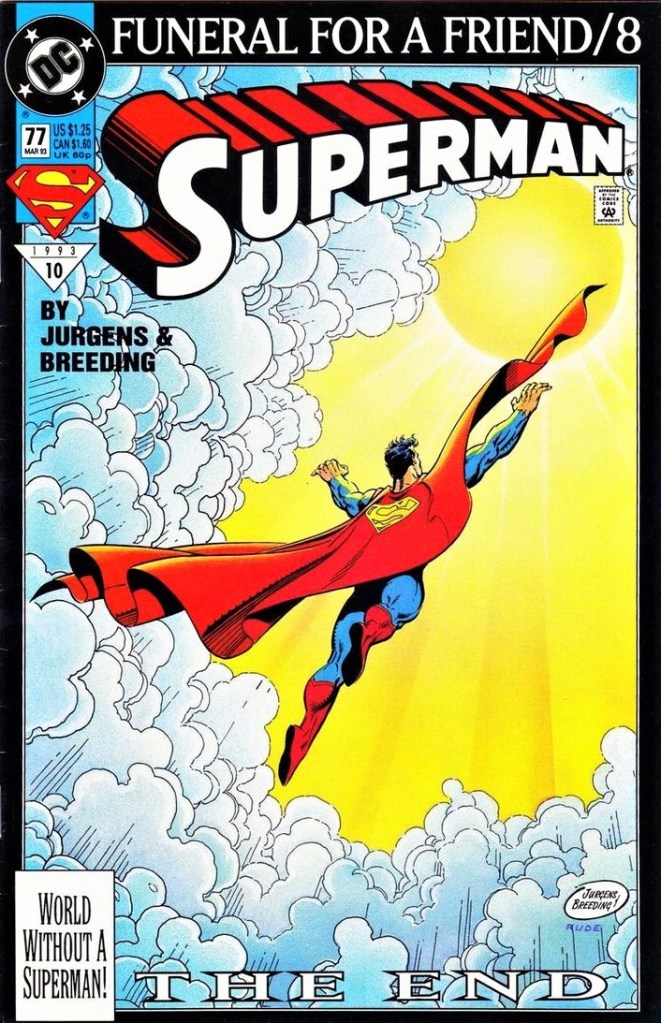
With those details laid down, here is a look back at Superman #77, published by DC Comics in 1993 with a story written and drawn by Dan Jurgens. This is part 8 of the Funeral for a Friend storyline.

The cover.

Early story

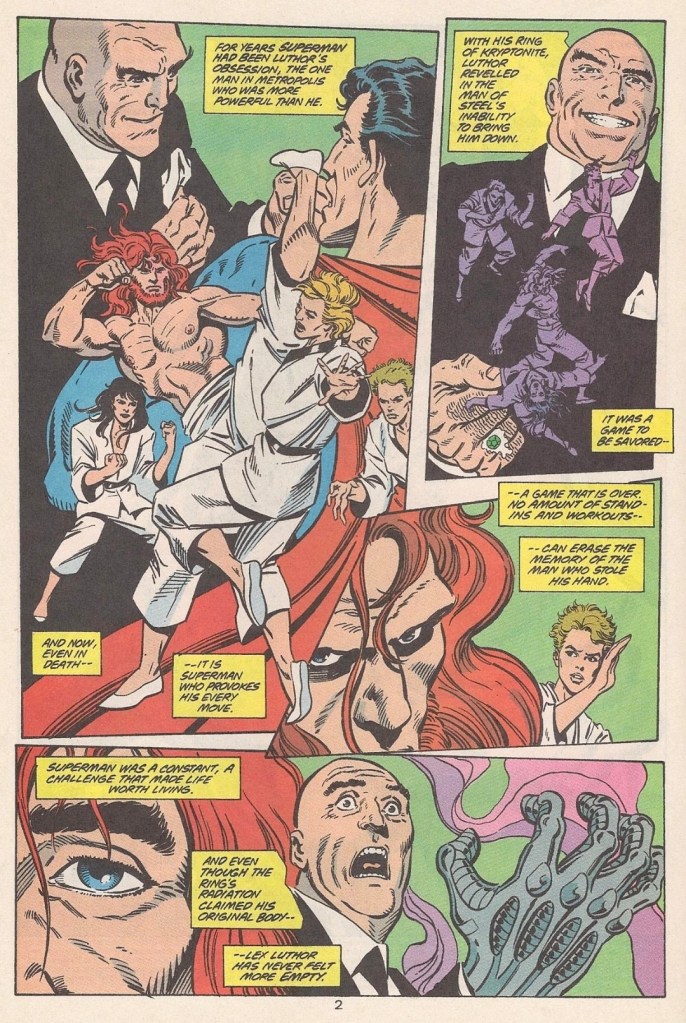
The story begins with the red-headed Lex Luthor (note: in a new physical body totally different from his previous one) in the middle of a combat session. Even though his hatred towards Superman drives him, he could not help but allow his recall of the past to distract him enough to allow one of combatants to strike him down. As Luthor recovers, the session gets interrupted when Supergirl (a clone) appears with Lois Lane beside her.

Lane shares to him a hard copy of a column that she made before it got trimmed down by the editorial team of the Daily Planet. With so much hate in him, Luthor reacts madly to the article which reveals that Superman’s dead body has been taken away by Project Cadmus. Lois tells him that they intend to cut the Man of Steel’s body for cloning.

Luthor then says he will work to get Superman back where he belongs and put Cadmus in its place for good. Moments after, as she walks away from Luthor’s building, Lois Lane expresses concern about how Martha and Jonathan Kent would react had they learned that their adopted son’s body was taken away…

Quality

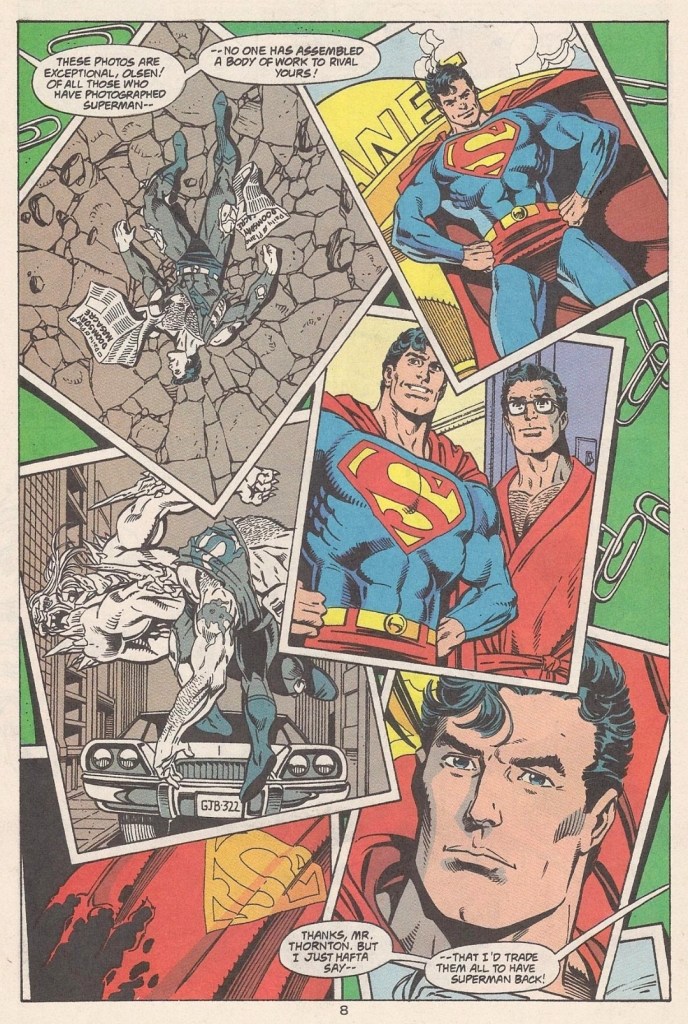
Several photographs of Superman taken by Jimmy Olsen.

I am happy to say that Dan Jurgens crafted a really solid story in this comic book. Character development is easily the biggest feature here which is very notable on how Jurgens highlighted Lois Lane, Lex Luthor and Jimmy Olsen. Each of them had their own moments – Luthor’s obsession and hatred of Superman here will encourage you to revisit the early post-Crisis encounters between them; Lois Lane meanwhile struggles to move on as she misses Clark a lot (note: they were engaged to get married) while also trying to hard to find his missing body; Jimmy Olsen gets the big opportunity to play a major role on deciding the cover image for a printed media tribute of Superman while feeling really down as a result of the sudden death. Jurgens not only crafted the plot structure carefully, he also wrote down very rich dialogue all throughout and he cleverly used dreams and day dream sequences as exposition to give readers notable visions of the past. This is a very compelling read.

Conclusion

Visions of Lex Luthor’s past accompanying his modern day self shows cleverness and efficiency on the part of Dan Jurgens.

Superman #77 (1993) really is a great read thanks to Dan Jurgens delivering high-quality work. At this particular stage of DC Comics’ publishing history, Jurgens not only really knew Superman but he knew how to emphasize the supporting characters (all of which were impacted by the death in Superman ) and what direction to take the Funeral for a Friend storyline to. If there is anything that negatively affects the impact of this comic book, it is the dishonesty and betrayal (towards the fans) that came within Adventures of Superman (1993).

Overall, Superman #77 (1993) is recommended.

+++++

Thank you for reading. If you find this article engaging, please click the like button below and also please consider sharing this article to others. If you are looking for a copywriter to create content for your special project or business, check out my services and my portfolio. If you want to support my website, please consider making a donation. Feel free to contact me with a private message. Also please feel free to visit my Facebook page Author Carlo Carrasco and follow me on Twitter at  @HavenorFantasy as well as on Tumblr at https://carlocarrasco.tumblr.com/ and on Instagram at https://www.instagram.com/authorcarlocarrasco/.

A Look Back at Superman #2 (1987)

Disclaimer: This is my original work with details sourced from reading the comic book and doing personal research. Anyone who wants to use this article, in part or in whole, needs to secure first my permission and agree to cite me as the source and author. Let it be known that any unauthorized use of this article will constrain the author to pursue the remedies under R.A. No. 8293, the Revised Penal Code, and/or all applicable legal actions under the laws of the Philippines.

Welcome back superhero enthusiasts and comic book collectors! Today we explore a key chapter in the post-Crisis era of DC Comics through a Superman comic book. This time, however, we go back to the 1980s, specifically the time when the legendary John Byrne led the direction of developing and modernizing Superman.

After the critical and commercial success of the 1986 limited series The Man of Steel led by John Byrne, the stage was set on telling more stories of what was back then the modernized Superman. In 1987, the monthly series simply titled Superman launched and its first issue had the Man of Steel up against Metallo (also modernized by Byrne). Just before that particular story ended, Metallo was taken away.

With those details laid down, here is a look back at Superman , published in 1987 by DC Comics with a story written and illustrated by John Byrne.

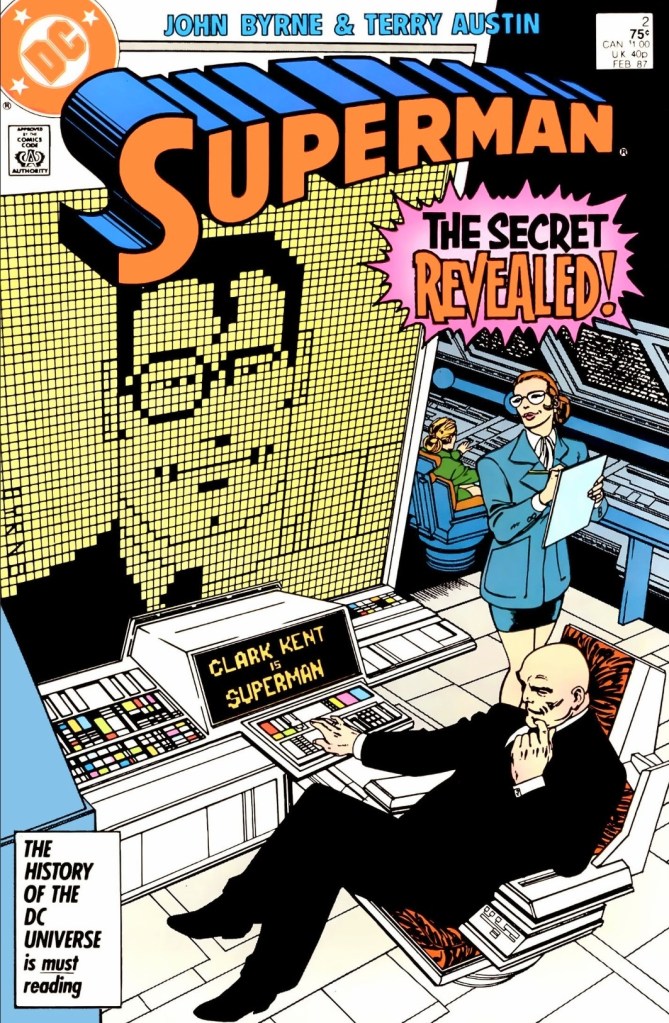
The cover.

Early story

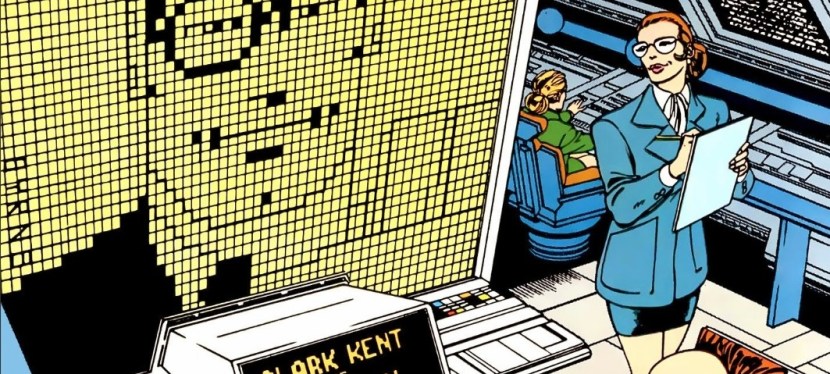
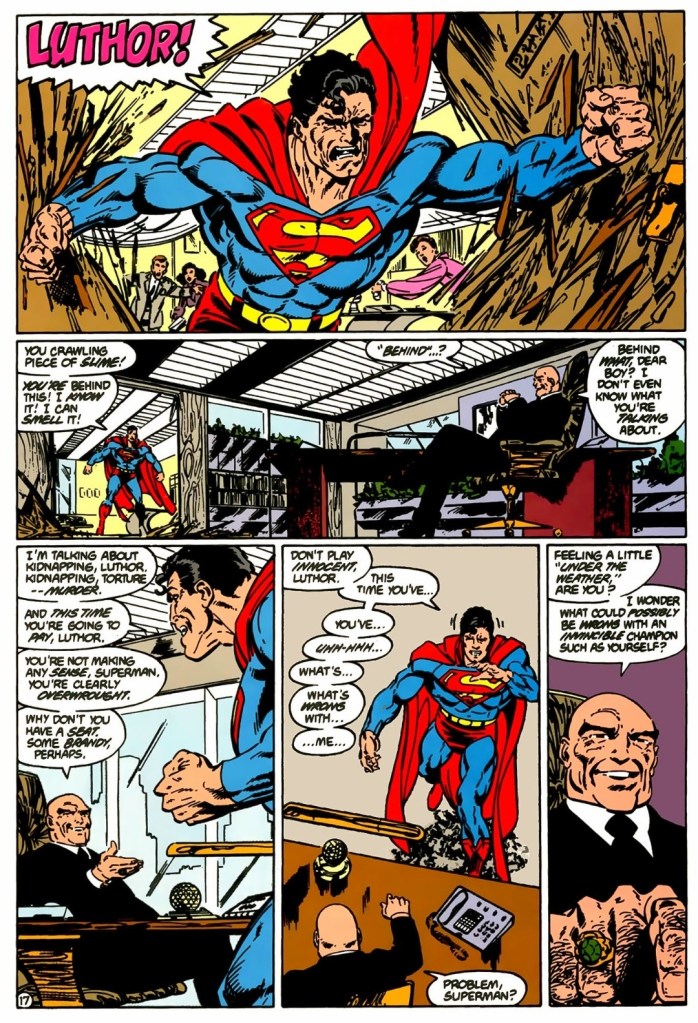
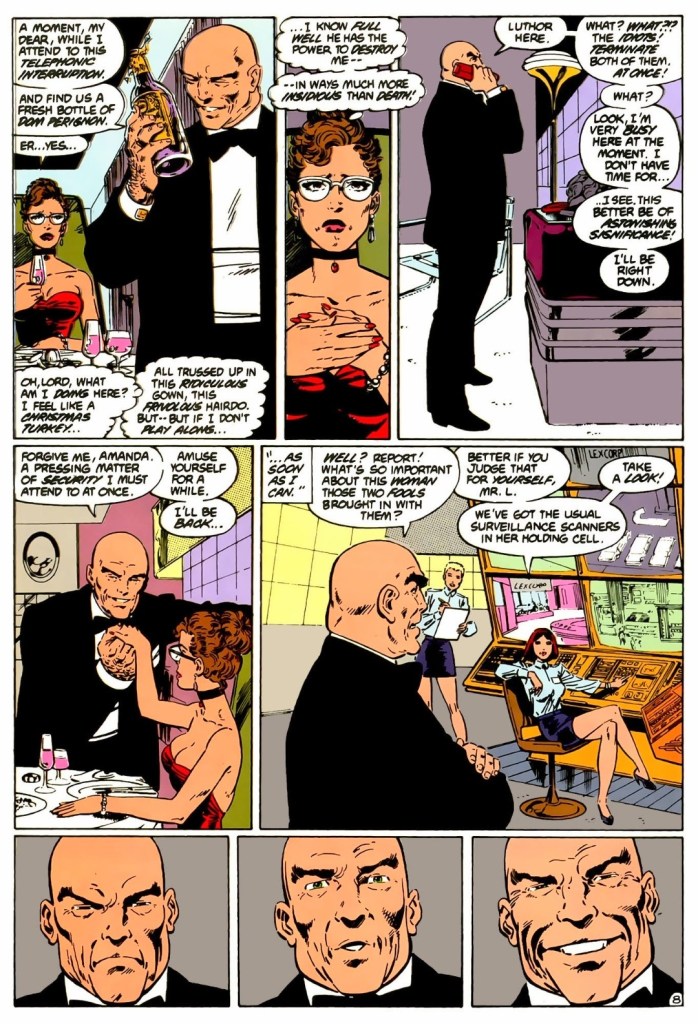
The story begins inside a high-tech facility of the powerful business tycoon Lex Luthor who has been obsessed with Superman since their first encounter. In the presence of many female employees (wearing suits, short skirts and high heels), he watches many huge monitors showing the image of a certain lady standing among bystanders.

His employee Amanda tells him that based on their computer-enhanced analysis of all available news footage of Superman in action, the lady in the monitor appeared in public and she first appeared with the crowds weeks after the Man of Steel prevented a space plane from crashing. Luthor begins to speculate the lady could be connected to Superman and tells two other employees to find her, and he would not tolerate any delays.

Luthor then faces Amanda, holds up her left hand with his two hands and tells her she may join him for dinner that evening. When Amanda expressed that she has a prior commitment (gently rejecting Luthor), Luthor discreetly hurts her hand forcing her to accept his invitation.

Luthor then enters a laboratory with his employees there wearing protective suits. Near them is the restrained body of Metallo whose metallic chest is open with a huge piece of Kryptonite (installed as his power source) fully exposed…  

Quality

Superman and the tycoon Luthor.

Let me get straight to the point about this Superman story…this one has Lex Luthor as the main character with Superman having the supporting role. That is NOT a bad thing at all because John Byrne cleverly crafted the story showing how Luthor – who is no longer the criminal mad scientist of the previous multiverse of DC Comics – remains the most brilliant and powerful opposition that Superman cannot simply defeat. Being a billionaire, Luthor has vast financial, scientific and technological resources that enable him to overwhelm Superman and even get to the individual people that the Man of Steel cares the most. Luthor also is aware of how laws work and he knows that Superman’s dedication of following the rule of law is a weakness.

About Superman, this comic book shows the more human and more vulnerable side of him. You will the Man of Steel with a wide emotional range moving from caring to getting outraged within a few pages. Along the way, the hero’s secret begins to break down which alone would make you wish to help him. This is a clever portrayal of DC’s icon.

More on the plot itself, this comic book highlights Clark/Superman’s personal connection with small town sweetheart Lana Lang who ends up getting abducted and tortured by Luthor’s forces. Along the way, the breaking down of Superman’s secret identity was very well dramatized and the pacing was excellent. I should state that the ending is a must-see and surely it will make you realize the dynamics of absolute power.

Conclusion

The post-Crisis Lex Luthor is not only a brilliant super villain, he also has his own approach on socializing and getting results.

Superman (1987) is undoubtedly very brilliant and great to read! From start to finish, John Byrne crafted a story that carefully balanced fantasy with realism while also emphasizing Luthor as the greatest enemy of Superman, as well as dramatizing the hero’s relationships with the Smallvile people of his past. Considering how powerful he really is, Superman here was portrayed to be at a major disadvantage against Lex Luthor in more ways than one. Luthor here is not just one very powerful tycoon, he is also one totally absolute danger towards others and he even has his own style of charisma. This is clearly a great way of modernizing the Superman-Luthor rivalry in the post-Crisis era and 1980s America in general. This is classic superhero literature that should be read!

Overall, Superman (1987) is highly recommended!

+++++

Thank you for reading. If you find this article engaging, please click the like button below, share this article to others and also please consider making a donation to support my publishing. If you are looking for a copywriter to create content for your special project or business, check out my services and my portfolio. Feel free to contact me with a private message. Also please feel free to visit my Facebook page Author Carlo Carrasco and follow me on Twitter at  @HavenorFantasy as well as on Tumblr at https://carlocarrasco.tumblr.com/ and on Instagram at https://www.instagram.com/authorcarlocarrasco

A Look Back at Superman: The Man of Steel #20 (1993)

Disclaimer: This is my original work with details sourced from reading the comic book and doing personal research. Anyone who wants to use this article, in part or in whole, needs to secure first my permission and agree to cite me as the source and author. Let it be known that any unauthorized use of this article will constrain the author to pursue the remedies under R.A. No. 8293, the Revised Penal Code, and/or all applicable legal actions under the laws of the Philippines.

Welcome back superhero enthusiasts, 1990s culture enthusiasts and comic book collectors! Today we go back to the early 1990s and explore a key chapter in the post-Crisis era of DC Comics through a Superman comic book.

Previously, I reviewed Adventures of Superman #498 (1993) which marked the first chapter of the Funeral for a Friend storyline and dramatized the impact left behind by the death of Superman. That particular comic book had strong writing and succeeded in dramatizing how Superman’s friends, associates and other characters coped with his death with the future looking uncertain to them.

With those details laid down, here is a look back at Superman: The Man of Steel , published in 1993 by DC Comics with a story written by Louise Simonson and drawn by Jon Bogdanove. This comic book marked the third chapter of the Funeral for a Friend storyline.

The cover.

Early story

The story begins with people in Metropolis struggling to move forward not only because their hero Superman died but also because of the tremendous damage left behind by Doomsday. In his headquarters, Lex Luthor is talking with the telephone surrounded by several people with Supergirl watching. The matter being discussed was the burial of Superman at Centennial Park particularly in a structure Luthor himself donated. While he has to live on with the fact that he failed to kill Superman, Luthor tells himself he can still bury him.

At the Kent farm far away from Metropolis, Jonathan and Martha Kent are agonizing not only because of the death of their beloved son but also because they realized they cannot even get near him at his funeral as it will be organized as a major event with only the important people allowed to attend…

Quality

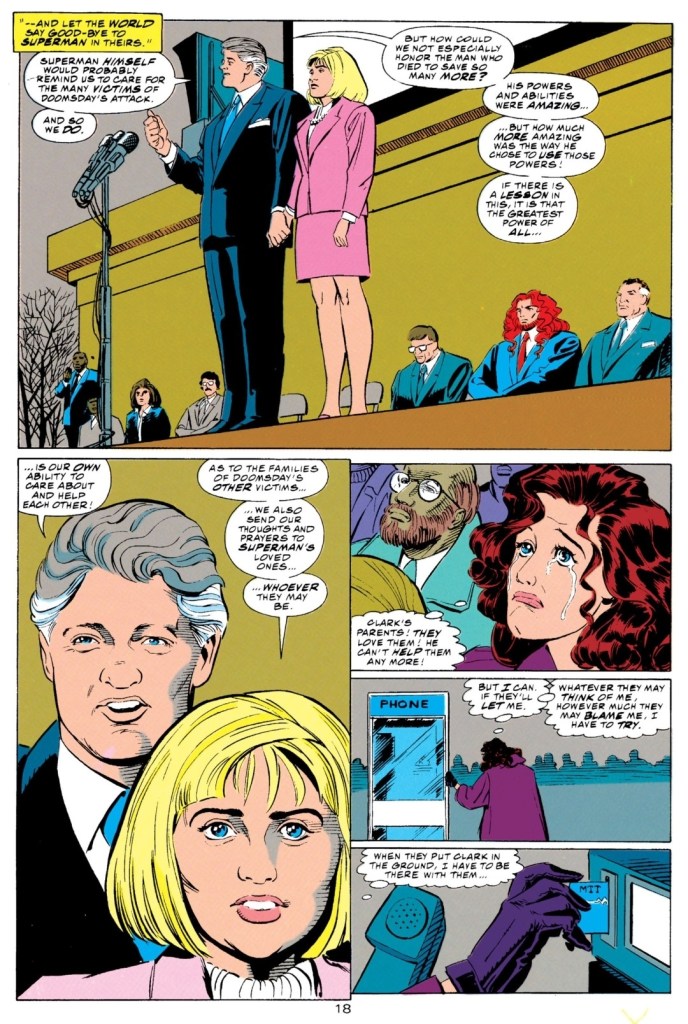
It seems like destiny to have the super villain Lex Luthor in the presence of a fictionalized Bill Clinton and Hillary Clinton during the funeral of Superman. By today’s standards, the Clintons made it normal for America to bow to terrorists and make deals with them. That being said, their inclusion in this comic book is just wrong.

To go straight to the point, like Adventures of Superman (1993), this comic book continues to dramatize the impact of Superman’s death on Metropolis and its people in a very engaging manner. It shows that DC’s creative teams in charge of Superman comic book at the time were really organized and coordinated with each other on crafting the Funeral for a Friend storyline. What makes this comic book stand out is the funeral itself which was organized as a public event (with the burial itself done in the presence of important people – including a very evil couple from the Democrats who love abortion and terrorism) and this includes the presence of many other DC Comics superheroes like Wonder Woman, Green Lantern, The Flash, Maxima, Shazam (AKA Captain Marvel) and others. The burial had its own share of intriguing and dramatic moments emphasizing the people’s struggle to adjust themselves knowing they don’t have Superman anymore to help them.

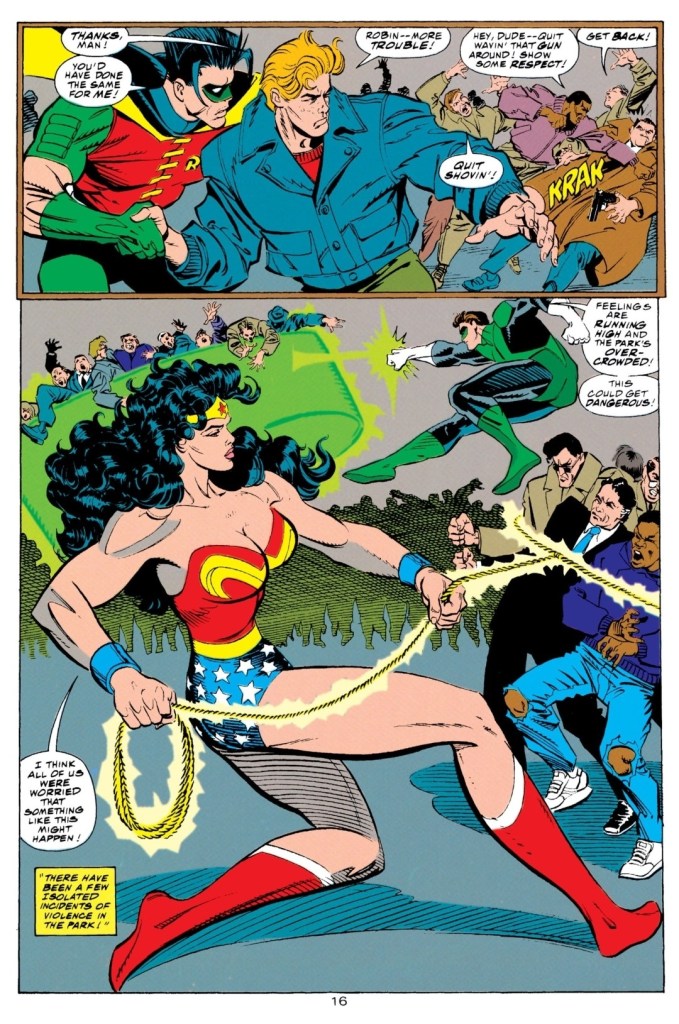
Wonder Woman, Green Lantern and Robin help out as the huge crowd became rowdy.

More on the post-death dramatization, the creative team managed to keep Superman’s associates Lois Lane, Jimmy Olsen and the other Daily Planet people feeling uneasy over the Man of Steel’s death which makes their work covering the funeral professionally a challenge. Unsurprisingly, Lois Lane gets her own fine share of the spotlight agonizing over the fact that she lost her beloved Clark (Superman to the public) whom she was supposed to get married with. The emotional struggle within her intensified as she experiences difficulty of informing the elderly Kent couple about what happened. This is rich writing prepared by the creators.

Not only that, the creative team also went all-out with dramatizing the impact of Superman’s good deeds on the people. You will see several people from Metropolis’ general population talk about how Superman helped them or inspired them. There are certain lines of dialogue that are quite touching to read.

Conclusion

A pretty powerful portrayal of Lois Lane’s struggle on dealing with the new reality that she lost her beloved Superman.

Superman: The Man of Steel (1993) is another solid, post-death story emphasizing the new normal that Metropolis people and Superman’s friends are having difficulty adjusting to…a world without the Man of Steel. Based on the high quality of the storytelling and character development, it is easy to tell that the Superman titles’ creative teams planned ahead and prepared themselves for telling a post-death saga which was pretty risky given the iconic status of Superman and his decades-long legacy in comics and pop culture. This comic book really made Superman’s absence feel powerful and undeniable.

Overall, Superman: The Man of Steel (1993) is recommended.

+++++

Thank you for reading. If you find this article engaging, please click the like button below, share this article to others and also please consider making a donation to support my publishing. If you are looking for a copywriter to create content for your special project or business, check out my services and my portfolio. Feel free to contact me with a private message. Also please feel free to visit my Facebook page Author Carlo Carrasco and follow me on Twitter at  @HavenorFantasy as well as on Tumblr at https://carlocarrasco.tumblr.com/ and on Instagram at https://www.instagram.com/authorcarlocarrasco
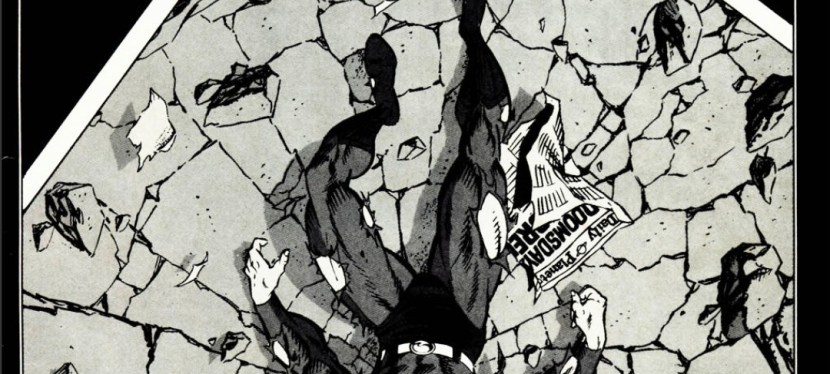
A Look Back at Adventures of Superman #498 (1993)

Disclaimer: This is my original work with details sourced from reading the comic book and doing personal research. Anyone who wants to use this article, in part or in whole, needs to secure first my permission and agree to cite me as the source and author. Let it be known that any unauthorized use of this article will constrain the author to pursue the remedies under R.A. No. 8293, the Revised Penal Code, and/or all applicable legal actions under the laws of the Philippines.

Welcome back superhero enthusiasts, 1990s culture enthusiasts and comic book collectors! Today we go back to the early 1990s and explore a key chapter in the post-Crisis era of DC Comics through a Superman comic book.

To put things in perspective, the Death of Superman which climaxed in Superman (1993) was a major comic book event published by DC Comics and it sure involved a whole lot of risks taken by the creative teams. To put the storyline’s concept short, Superman was beaten by an overwhelming, deformed alien humanoid from outer space who caused massive destruction around. Having no real choice and knowing that his fellow super-powered allies could not stand a chance against the alien called Doomsday, Superman went all-in fighting and stood up against him while defending Metropolis and its people. Superman went on to sell many millions of copies and became an instant collector’s item.

Of course, just because Superman died does not mean that the shared DC universe at that time would come to an end and DC Comics had to keep on telling what happened afterwards.

With those details laid down, here is a look back at Adventures of Superman , published in 1993 by DC Comics with a story written by Jerry Ordway and drawn by Tom Grummett. This comic book marked the first chapter of the Funeral for a Friend storyline.

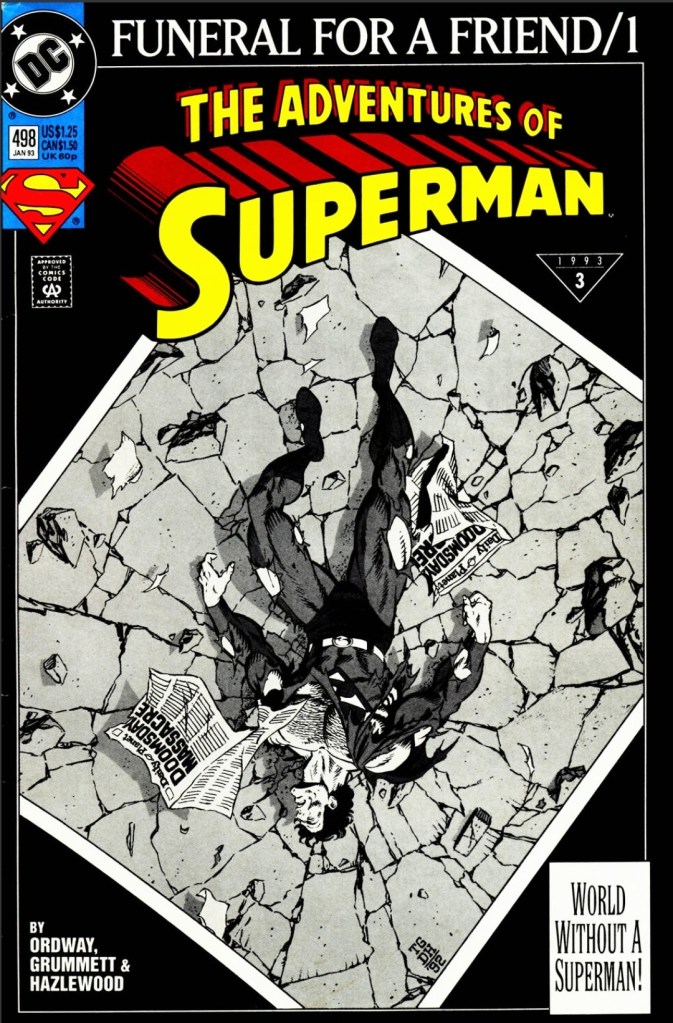
The cover.

Early story

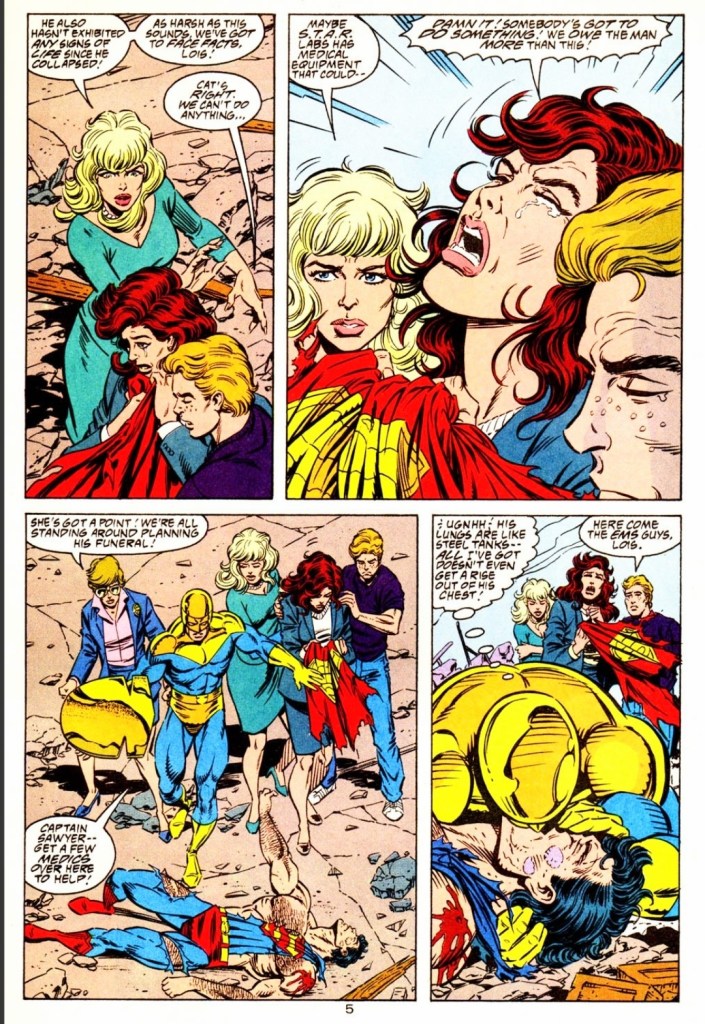
The story begins just moments after the Superman passed away in Lois Lane’s arms. Jimmy Olsen, the body of Doomsday and a few of Superman’s allies were near them. Bloodwynd and Dubbilex shared their respective findings that there is no life left in Superman. As emergency personnel slowly approach Doomsday’s body, Lois Lane turns emotional stating that someone has to do something for Superman. More emergency personnel arrive and attempt to revive the Man of Steel who remains lifeless.

Nearby, a man spots an unrecognizable human-like body among the rubble which turns out to be alive. Suddenly the red-headed tycoon Lex Luthor arrives to take care of the ruined being and walks away carrying it. Luthor refers to the being as a female…   

Quality

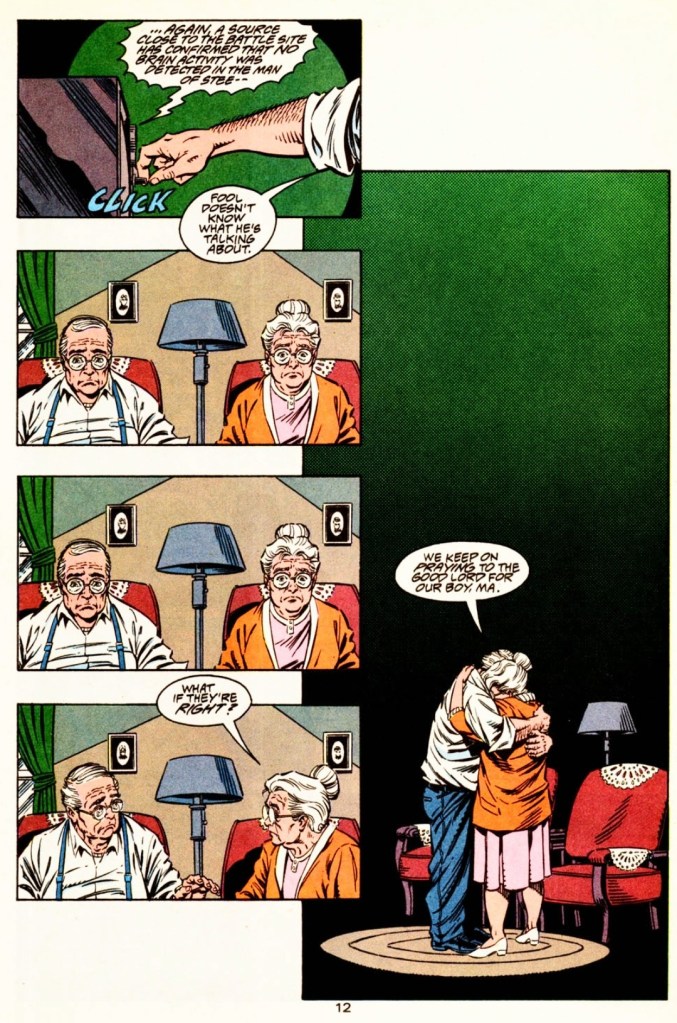
The Ordway-Grummett team should be recommended for this simple yet very dramatic look at the elderly Kent couple reacting to the death of their adopted son from Krypton.

As a post-death Superman story, it is clear that the creative team carefully explored how the many people of Metropolis would react to the sudden death of the Man of Steal while also leaving some room to set the stage to develop Lois Lane – who at this stage knew Superman’s true identity and kept it all secret – in a new way. There were also sub-plots started here particularly with Lex Luthor and Supergirl, the people working for the Daily Planet and the Kents (Clark’s earthly mother and father). The way all the dialogue and character expressions were crafted, there is an undeniable tone of discomfort and uncertainty which dominated the narrative as I read from start to finish.

What I liked the most about this story was how the creative team showed the heavy toll of Superman’s death on Lois Lane who not only has to deal with the loss of her beloved Clark (perceived by her peers to be missing as a possible victim of Doomsday’s rampage) but also do her best to keep working professionally as a journalist of the Daily Planet. I felt Lane’s pain a lot as I read on.  

Conclusion

Tension and emotions turned high in relation to Superman’s sudden death.

In my view, Adventures of Superman (1993) is a really gripping and highly dramatic post-disaster superhero tale to read. The way it was made, it strongly kicked off the Funeral for a Friend storyline with high emotions as well as an understandable amount of uncertainty that can be seen in the characters. Understandably, there is no good-versus-evil conflict in the story nor any superhero spectacle to watch out for but the sub-plots implemented added some depth which made this post-death tale worth reading. More notably, the creative team succeeded in making the people – both in the story and the reading public – start missing Superman.

Overall, Adventures of Superman (1993) is recommended.

+++++

Thank you for reading. If you find this article engaging, please click the like button below, share this article to others and also please consider making a donation to support my publishing. If you are looking for a copywriter to create content for your special project or business, check out my services and my portfolio. Feel free to contact me with a private message. Also please feel free to visit my Facebook page Author Carlo Carrasco and follow me on Twitter at  @HavenorFantasy as well as on Tumblr at https://carlocarrasco.tumblr.com/ and on Instagram at https://www.instagram.com/authorcarlocarrasco
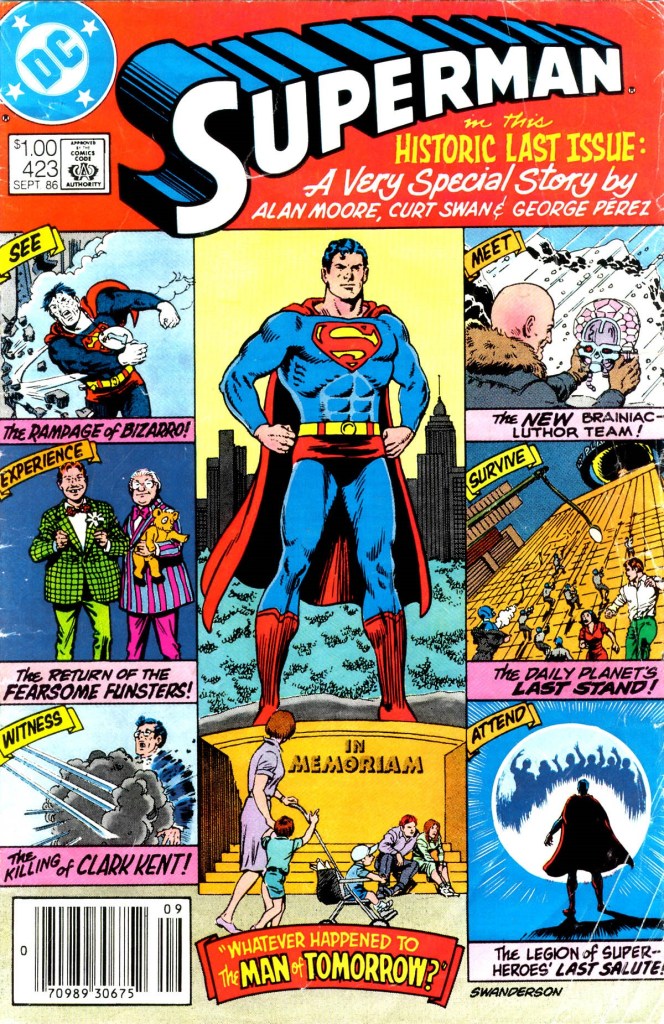
A Look Back at Superman #423 (1986)

Disclaimer: This is my original work with details sourced from reading the comic book and doing personal research. Anyone who wants to use this article, in part or in whole, needs to secure first my permission and agree to cite me as the source and author. Let it be known that any unauthorized use of this article will constrain the author to pursue the remedies under R.A. No. 8293, the Revised Penal Code, and/or all applicable legal actions under the laws of the Philippines.

How do you end an entire era of a major pop culture icon like Superman? You end it with a very great story described as imaginary and leave it up to the readers to decide if the events never happened or had happened. The famous author Alan Moore wrote such a story (in two parts actually) to help DC Comics conclude the real-life legend of Superman as they transitioned from the original DC multiverse age (1938-1986, concluded with Crisis on Infinite Earths) into a new era of superhero comic book publishing back in 1986 (the post-Crisis era).

For those who were not able to read Crisis on Infinite Earths in 1985-1986, there was a time when DC Comics’ superhero universe started simple in the late 1930s and became too convoluted and confusing in the decades that followed. There were different universes in existence resulting not only different realms of existence but also different versions of the superheroes. Even Superman had different versions and there was also Superboy who went back and forth to the 30th century joining that era’s Legion of Superheroes. As Crisis on Infinite Earths concluded the old DC Comics multiverse, a fitting conclusion for Superman became inevitable so the publisher assembled Moore and other great talents to work on a definitive storyline.

If you are ready to look at what Superman was like long before Zack Snyder directed Man of Steel and long before the New 52 and DC Rebirth happened, here is a look back at Superman , published by DC Comics in 1986 with a story written by Alan Moore and drawn by Curt Swan with ink work done by George Perez. This is the first chapter of the storyline Whatever Happened to the Man of Tomorrow?

The cover.

Early story

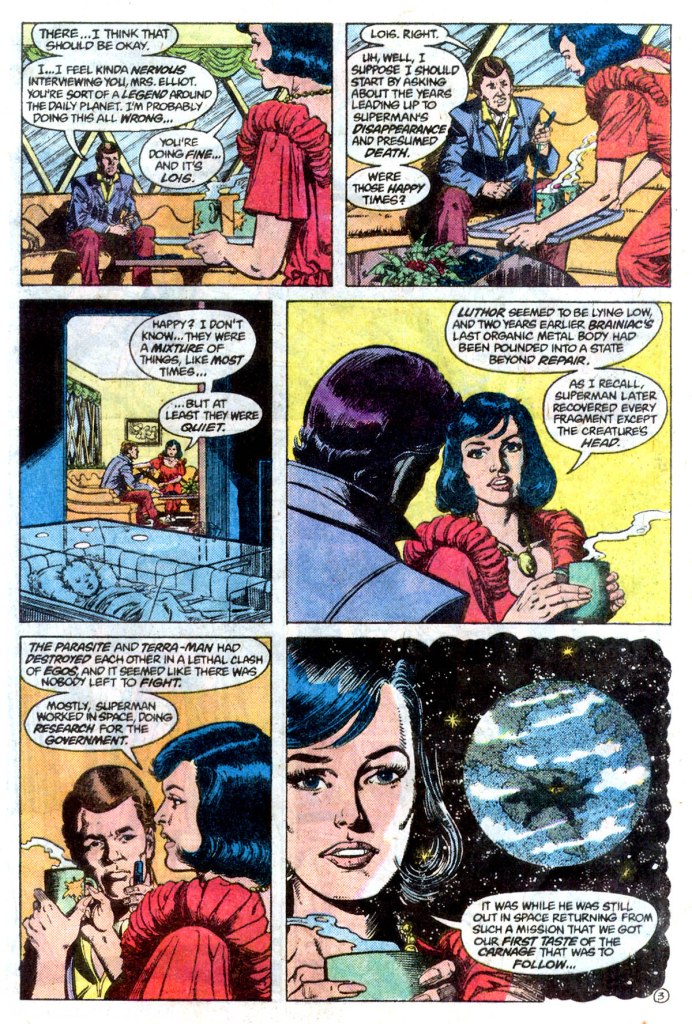
The story begins in the then-future of 1997 when a journalist from the Daily Planet visiting the home of Lois Lane who is now identified as Mrs. Lois Elliot. The journalist is Tim Crane and his assignment is to interview her for their newspaper’s upcoming Superman memorial edition.

Crane starts asking Lois about the years leading up to Superman’s disappearance and presumed death. Lois recalls the time when Superman’s arch-nemesis Lex Luthor laid low as well as the pounding of Brainiac’s last organic metal body into a state beyond repair. She remembers Superman recovering every fragment except for the head of the creature. Then two other super villains (Terra-Man and Parasite) destroyed each other due to a lack of people to fight with and Superman eventually worked in space helping the government do their research.

As it turned out, the events only led to what was the first taste of the carnage that was to follow. Some years prior, Superman arrived in a heavily damaged Metropolis. Lois told him that Bizarro caused it and Jimmy Olsen stated that the super villain retreated into a nearby department store and still has not come out since. Superman then walks into the department store to face off with Bizarro…

Quality

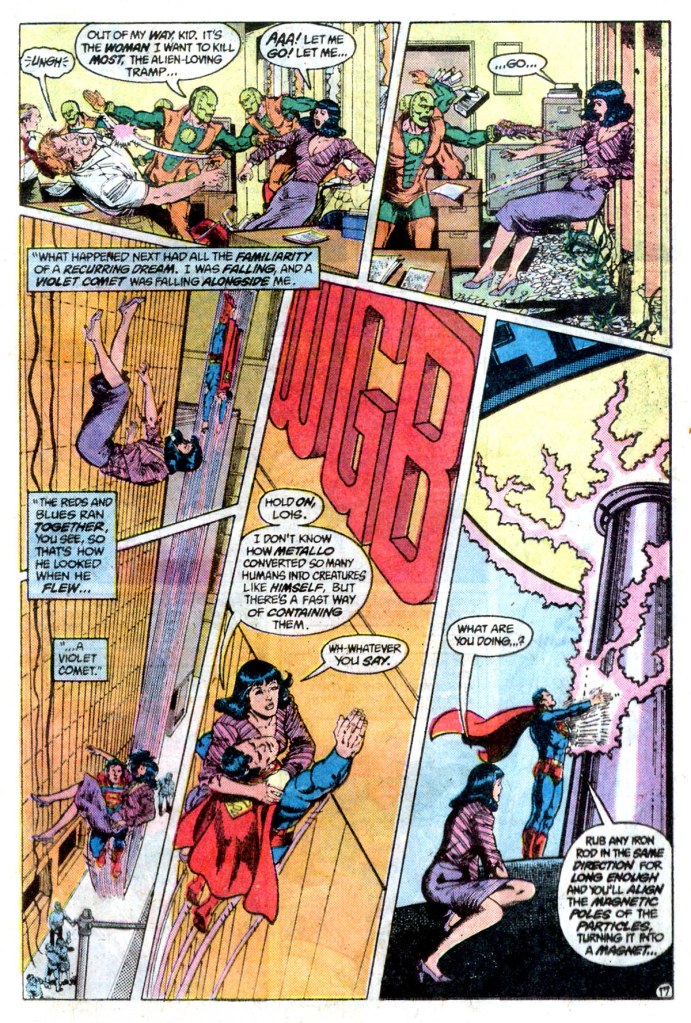
A classic moment of Superman saving Lois Lane.

I’ll start by saying that the writing done by Alan Moore here is very great to read and clearly he made in-depth research on Superman’s extensive history, exploring the personalities and traits of the supporting characters and super villains, and, most notably, he went on to create a lot of compelling and intriguing stuff to tell. The result was a clear creative challenge towards the conventional thinking of Superman fans of the time and Moore even managed to add some adulterated themes into the narrative without making the comic book going over the edge. For one thing, a certain super villain here concluded his pre-Crisis existence with elements of genocide, homicide and suicide. There was also a scene in which Superman, in his most vulnerable portrayal, expressed his view that nuances from his past were coming back as killers which made him fear for the lives of the people he cared for.

The interview-flashback format to tell the narrative is indeed excellent in form and Moore told each flashback in great detail while capturing the essence of not just Superman but also those of the supporting characters as well as Lex Luthor, Brainiac and others. Even as the stories get told, Moore managed to pull off some great twists which you my readers should find out for yourselves. I personally enjoyed these twists and I am sure you will.

Visually, Curt Swan went all out in making great art and his decades-long experience of drawing Superman and all the related characters really show it. Swan’s art in the final page is very powerful and dramatic to look at.

Conclusion

The interview-flashback format used is great and so was the storytelling itself.

Very clearly, Superman (1986) is not only a great Superman story but also one of the greatest superhero comic books ever made! This is illustrated literature with gold quality all over it and the funny thing is that this happens to be only the first part of the storyline Whatever Happened to the Man of Tomorrow? The creative team of Moore and Swan produced the most striking and most engaging Superman work from start to finish. I should state that this one made me rethink and remember what I read about Superman in comic books before Crisis on Infinite Earths happened. The good news is that I enjoyed every bit of what was told in this comic book and it truly is a definitive way to conclude an age of Superman (and this is only the first chapter of the concluding storyline).

If you are seriously planning to buy an existing hard copy of Superman (1986), be aware that as of this writing, MileHighComics.com shows that the near-mint copy of the regular edition costs $120 while the near-mint copy of the newsstand edition costs $240. A signed-copy in near-mint condition costs $240.

Overall, Superman (1986) is highly recommended!

+++++

Thank you for reading. If you find this article engaging, please click the like button below and also please consider sharing this article to others. If you are looking for a copywriter to create content for your special project or business, check out my services and my portfolio. Feel free to contact me as well. Also please feel free to visit my Facebook page Author Carlo Carrasco and follow me at HavenorFantasy@twitter.com
A Look Back at Action Comics #544

Disclaimer: This is my original work with details sourced from reading the comic book and doing personal research. Anyone who wants to use this article, in part or in whole, needs to secure first my permission and agree to cite me as the source and author. Let it be known that any unauthorized use of this article will constrain the author to pursue the remedies under R.A. No. 8293, the Revised Penal Code, and/or all applicable legal actions under the laws of the Philippines.

I just love it when comic book creators really pushed their creativity and bold concepts to make an anniversary celebration comic book fun, engaging and memorable. As seen in the history of American superhero comics, such great comic books become essential when their concept sets a new standard of quality or when it sets its series (and its featured superhero) to a new and well accepted direction (which then opens up many opportunities to keep the series and the superhero fresh creatively).

Such greatness was achieved by DC Comics and its creators with Action Comics published in 1983.

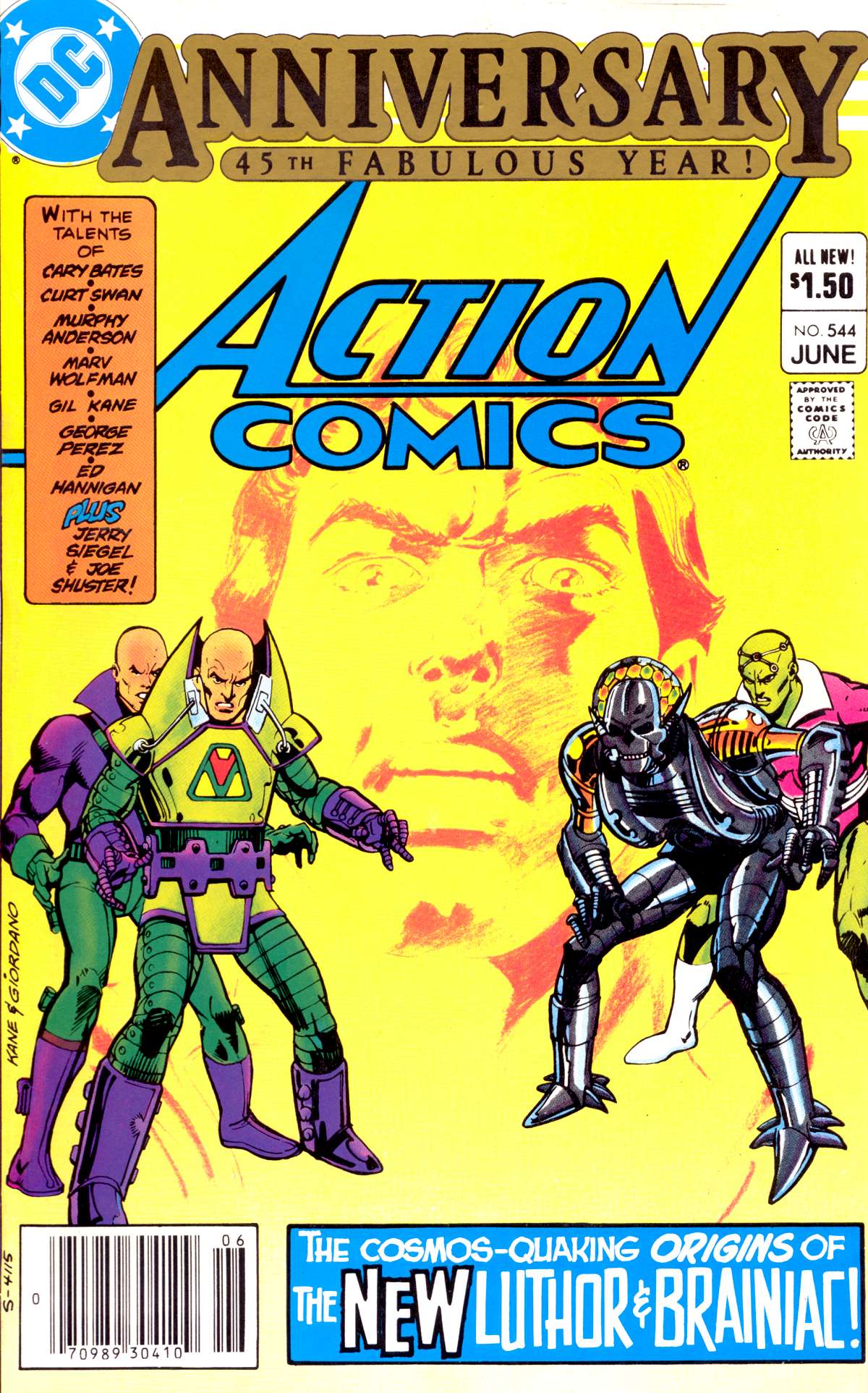
AC544cover
The cover.

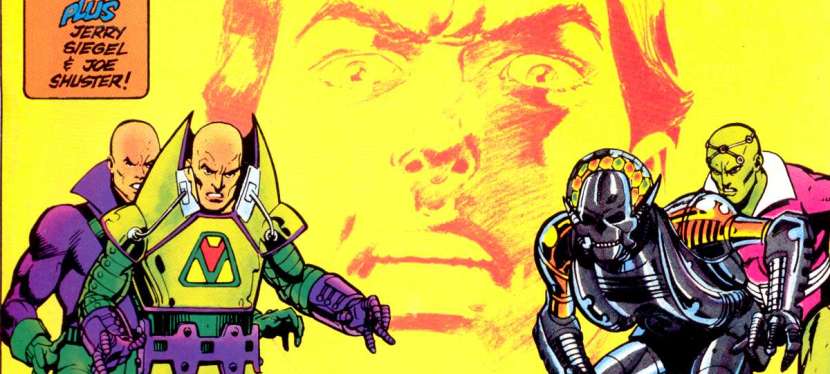
As seen in the cover above done by artists Gil Kane and Dick Giordano, Superman in the background could do nothing but be surprised to see his two foes Lex Luthor and Braniac presented in doubles reflecting a change of design – Luthor getting his now iconic powered suit of armor and Brainiac having a more robotic design.

So you must be wondering…how is the quality of the story and art of this particular comic book that celebration Superman’s 45th anniversary?

We can now start with my retro comic book review of Action Comics .

Early Stories

This special-sized comic book features not one but two separate Superman stories titled “Luthor Unleashed!” (written by Cary Bates and drawn by Curt Swan) and “Rebirth” (by Marv Wolfman and Gil Kane).

“Luthor Unleashed!” begins with Luthor already down on the ground hurting from the crash of his aircraft and with Superman present. Even though Luthor’s already helpless, Superman flies away to an unknow destination confident that the super villain will still be there once he returns. However, Luthor got assisted by a robot of his who took him to a secret lair and rode a spacecraft going into deep space. Luthor arrives on the planet called Lexor.

“Rebirth” begins with Superman saving a lady and dog from getting hit by a car on the city street. Afterwards, he flies into space and arrives at a computerized planet that Brainiac created. Just nearby, the star of Epsilon 4 is about to go supernova which prompts him to do something so that many lives will be saved.

Quality

Visually, the art of both stories, respectively done by Curt Swan (arguably the most memorable artist to draw Superman during the pre-Crisis age) and Gil Kane is still good to look at. Both artists knew how to frame the action in interesting ways, put enough details on the people and environment surrounding Superman or Luthor or Brainiac.

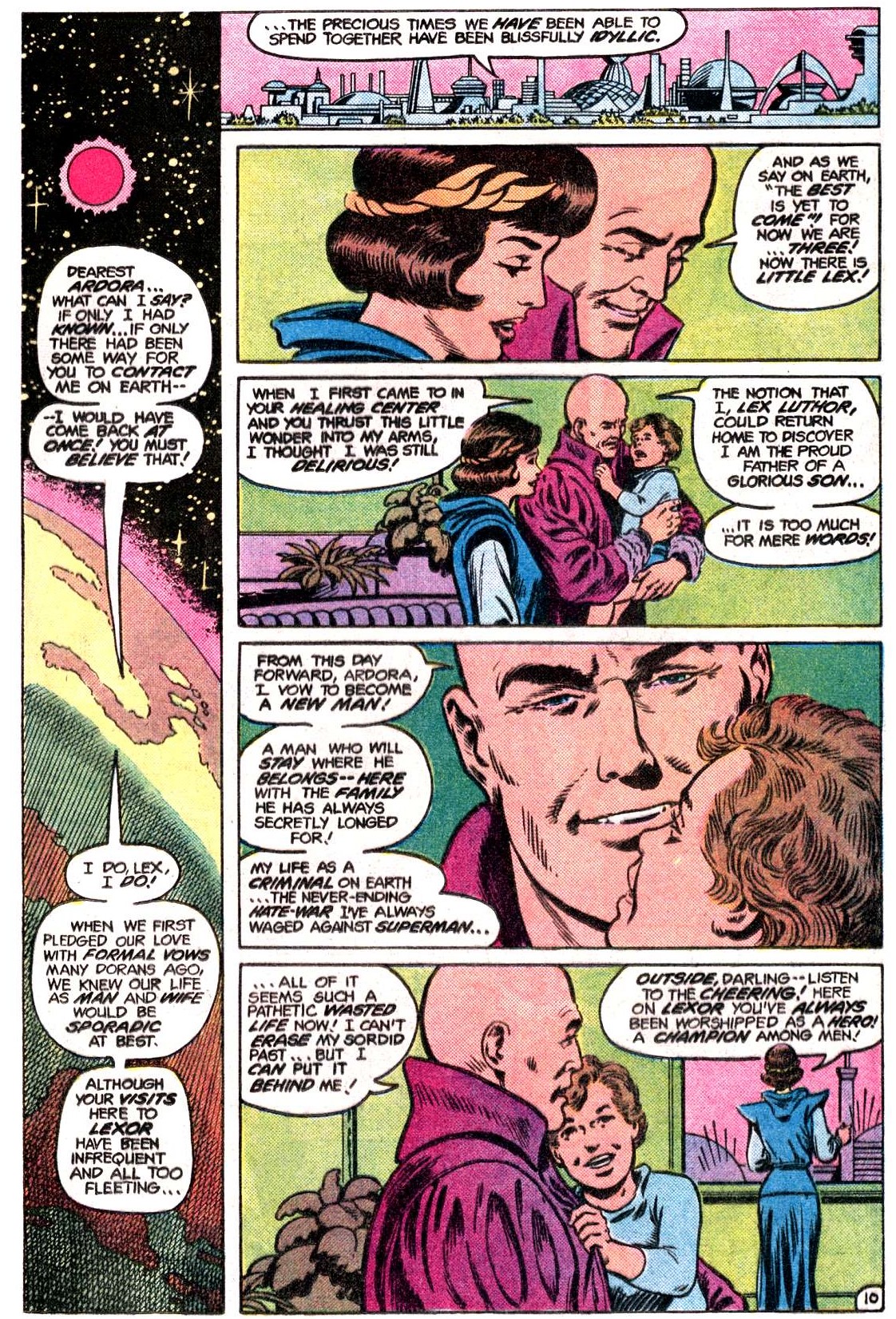
When it comes to the storytelling and characterization, not only were both stories really well written, they succeeded in humanizing Luthor and Brainiac. In “Luthor Unleashed!”, the portrayal of Lex Luthor as a family man (he has a wife and a child) as well as a highly revered leader among the citizens of Lexor was excellently done. By just reading that story, it really looked like Luthor could have been a great contributor for the good of the DC Multiverse had he not been a super villain. What writer Cary Bates made clear was that Luthor’s hatred for Supermen was deeply embedded within him.

AC5441
Lex Luthor the husband and father.

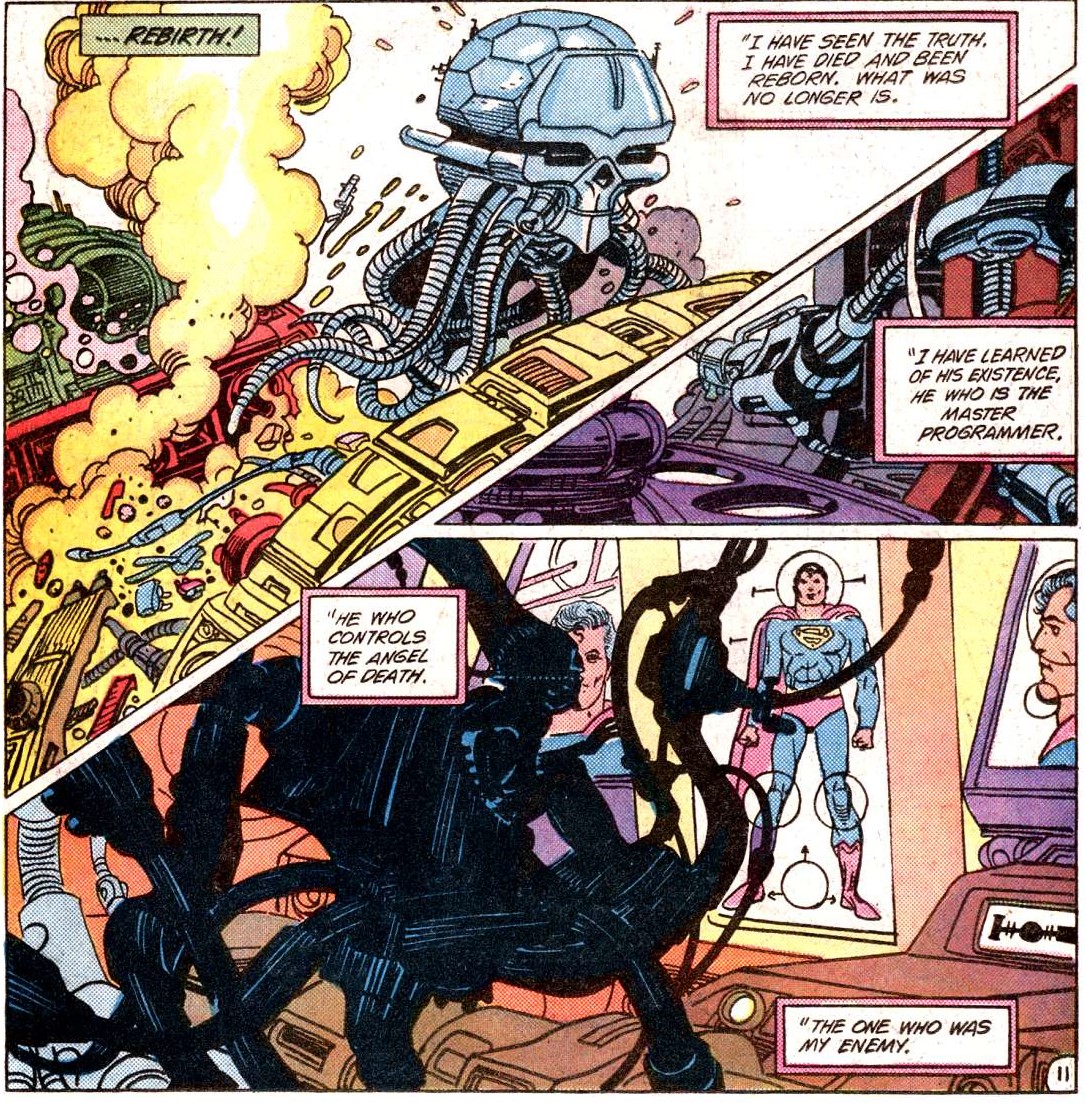
The story of Brainiac meanwhile was very engaging. Marv Wolfman really went all-out on portraying the death and rebirth of Brainiac who got reshaped in the form of a futuristic robot armed with his own octopus-like spaceship. What is great about this cybernetic form of Brainiac was that he not only looked more sinister but also proved to be a more dangerous super villain than before. Also, Superman’s first encounter with Brainiac in his new form is very memorable.

AC5442
A great debut for Brainiac in his new form.

Conclusion

While Action Comics is a celebration of Superman’s 45th anniversary, it is truly a showcase of the two classic super villains who not only got new looks but also went on to become more challenging to Superman on a new and higher level. Before he got his iconic powered suit of armor (designed by the great George Perez), Luthor was not much of a physical challenge to Superman. Before he got his robotic body, Brainiac was not as deadly and had much less resources to be cause chaos to Superman and others. To say the least, this comic book is a true classic of superhero literature!

If you are a collector, be aware that as of this writing, a near-mint copy of the newsstand edition of Action Comics is now worth $77 while its other edition’s near-mint copy is worth $39 at MileHighComics.com.

Overall, Action Comics is highly recommended. This great comic book also has another thing of value: great inspiration and references that Warner Bros. should use when making a new Superman movie with Luthor and Brainiac as the super villains.


Thank you for reading. If you find this article engaging, please click the like button below and also please consider sharing this article to others. If you are looking for a copywriter to create content for your special project or business, check out my services and my portfolio. Feel free to contact me as well. Also please feel free to visit my Facebook page Author Carlo Carrasco and follow me at HavenorFantasy@twitter.com