Vietnam, which is already one of the leading players of Southeast Asia on foreign tourism, is off to a powerful start as it successfully attracted 2.5 million foreign tourists in January 2026 alone, according to a news report by VnExpress. The relaxed visa policies and enhanced tourism campaigns were factors behind the early success.
To put things in perspective, posted below is an excerpt from the news report VnExpress. Some parts in boldface…
Vietnam received 2.5 million foreign visitors in January, its highest monthly number ever, thanks to relaxed visa policies and increased tourism campaigns.
It represents an increase of more than 21% from the previous month, data released Tuesday by the General Statistics Office shows.
The composition of Vietnam’s top source markets changed during the month. South Korea overtook mainland China to become the top market with nearly 490,000 visitors, and China was next with 460,000.
Cambodia emerged as the most notable mover with more than 223,000 arrivals to rise to third place overtaking Taiwan. The rest of top 10 comprised Taiwan, Japan, the U.S, Australia, Russia, India, and Malaysia.
Industry insiders attribute the jump to ground-breaking visa policies, strong innovation in tourism promotion and marketing, greater product diversification, and improved service quality.
Let me end this piece by asking you readers: What is your reaction to this development? Have you ever toured Vietnam? With the strong start, do you think Vietnam will be able to attract more than 30 million foreign tourists this year? What is the first thing that comes to your mind when it comes to tourism in Vietnam?
Thailand, the 2nd most visited nation of Southeast Asia in 2025, has set ambitious tourism targets for itself for 2026 and it includes achieving US$95 billion in tourism revenue, according to a VnExpress news release. Thailand attracted over thirty million international arrivals last year which was actually a decline of more than 7% compared to 2024.
To put things in perspective, posted below is an excerpt from the news report VnExpress. Some parts in boldface…
The Tourism Authority of Thailand (TAT) has expressed confidence that the country’s tourism sector will earn 3 trillion THB (US$95.35 billion) in revenue this year through its “Amazing 5 Economy” strategy.
The plan targets an 11% increase in international visitors, enhanced domestic tourism, and a focus on sustainable, high-quality growth despite global challenges.
TAT aims for 36.7 million international arrivals and about 210 million domestic trips in 2026. Meanwhile, the revenue target includes 2 trillion THB from international markets, with an expected 11% increase in international tourist arrivals, and 1 trillion THB from domestic tourism, projected to grow by 4%, said TAT Governor Thapanee Kiatphaibool.
In 2026, TAT plans to reignite quality tourism growth by addressing challenges such as geopolitical tensions, increasing global competition, and domestic factors like the strong baht, household debt, safety concerns, and natural disasters. The key to success lies in the “Amazing 5 Economy” framework, which includes life economy, sub-culture economy, night economy, circular economy, and platform economy.
In 2025, Thailand recorded total tourism revenue of approximately 2.7 trillion THB. International arrivals reached 32.97 million, down 7.23% year-on-year.
It saw declines in short-haul markets such as Malaysia and China. However, long-haul markets showed strong momentum, with visitors from Europe, the Americas, the Middle East and Africa reaching a record 10.8 million.
Notably, arrivals from the U.K. and the U.S. each surpassed one million for the first time. Domestic tourism also expanded, with more than 202 million trips, up 2.7%.
Let me end this piece by asking you readers: What is your reaction to this development? Have you ever toured Thailand before? If you did, how long did you stay in Thailand and how was your overall travel experience there? Do you think Thailand will be to achieve its ambitious tourism targets this year?
Under the leadership of US President Donald J. Trump, America’s new defense strategy urged its allies and partner to increase their defense spending to 5% of their gross domestic product (GDP), according to a news report by Kyodo News. This latest development could result in a chain of events in which American allies will not only spend more but also act more responsibly when it comes to securing their respective nations.
To put things in perspective, posted below is an excerpt from the Kyodo News report. Some parts in boldface…
A new U.S. defense strategy released Friday urges all American allies and partners to increase defense spending to 5 percent of their gross domestic product and be more responsible for their own national security.
Highlighting President Donald Trump’s “America First” and “peace through strength” agenda, the Pentagon’s policy document says they have a bigger role to play, but not as “the dependencies of the last generation,” as the United States needs to prioritize defending its homeland and its interests throughout the Western Hemisphere.
“We will advocate that our allies and partners meet this standard around the world, not just in Europe,” says the first National Defense Strategy since Trump’s return to the office a year ago, referring to the 5 percent defense target.
“As our allies do so, together with the United States, they will be able to field the forces required to deter or defeat potential adversaries in every key region of the world, even in the face of simultaneous aggression,” it says.
NATO members have already pledged to meet Trump’s demand to increase defense spending from 2 percent to 5 percent of GDP by 2035. The new NATO target is composed of 3.5 percent for core military spending and an additional 1.5 percent for security-related spending.
As the document praises Europe and South Korea for committing to raising their defense expenditures since Trump’s return to office, it appears inevitable that other major U.S. allies, including Japan, will face increased pressure from his administration to follow suit.
On par with the National Security Strategy, released by the White House in December, the key defense document touches on China and its fast-paced military buildup.
But the tone is softer compared to previous versions.
It says the second Trump administration’s approach is to deter China in the Indo-Pacific region through strength, “not confrontation.”
In the 34-page document, there is also no mention of Taiwan, the self-ruled island that China regards as its own territory and around which it has been stepping up military pressure.
“President Trump seeks a stable peace, fair trade and respectful relations with China, and he has shown that he is willing to engage (Chinese) President Xi Jinping directly to achieve those goals,” the document says, adding that Washington’s goal is not to dominate China.
“Rather, our goal is simple: To prevent anyone, including China, from being able to dominate us or our allies,” it says.
As part of efforts to meet that end, the U.S. military will erect a “strong denial defense” along the first island chain in line with the security strategy, according to the defense blueprint.
The island chain runs from the Japanese archipelago, through Taiwan, the Philippines and on to Borneo, encircling China’s coastal waters.
Let me end this piece by asking you readers: What is your reaction to this development? Do you think the new American strategy will create a huge impact on how the allies will defend their respective nations? Do you think this will lead to the containment of Communist China’s aggression on the Indo-Pacific? Do you think the new strategy could lead to more stability in both Asia and Europe?
2025 is officially a year of tremendous tourism breakthroughs for Japan as a record 42.7 million foreign visitors were counted along with more than US$60 billion in related revenue, according to a news article by Kyodo News.
Overtourism has been going on in Japan for some time now and it does not seem to be slowing down even though there was a sharp drop of tourists from Communist China which was the result of increased tensions between China and Japan. As a lot more foreign tourists explored Japan, local businesses benefited in different ways but overcrowding, increased littering and acts of bad behavior by foreigners were reported.
To put things in perspective, posted below is an excerpt from the news article of Kyodo News. Some parts in boldface…
Foreign visitors to Japan reached a record estimated 42.7 million in 2025, the government said Tuesday, with their spending also at a new all-time high of 9.5 trillion yen ($60.1 billion), thanks to a weaker yen and increased flights to Japan.
The preliminary figures also showed, however, a 45 percent drop in Chinese tourists in the month of December from a year prior to 330,000, tourism minister Yasushi Kaneko told a press conference. The fall came as an ongoing row between Japan and China appears likely to weigh on inbound travel trends in 2026.
The decline in Chinese visitors was the first fall since January 2022 during the COVID-19 pandemic, the minister of land, infrastructure, transport and tourism said, adding the government is monitoring the situation around Chinese visitors.
Overall visitors surpassed 40 million for the first time, and the estimated total was around 6 million people higher than for 2024. Kaneko said Japan will “engage in strategic Japan tourism promotion” amid a diversifying inbound market, highlighted by rising arrivals from Australia, Europe and the United States.
Relations between Tokyo and Beijing have soured since Japanese Prime Minister Sanae Takaichi’s remarks in early November on a Taiwan contingency infuriated China.
The fallout has seen economic measures from China, including urging its people to refrain from visiting Japan, and some airlines reduced flights on Japan-China routes.
While the Japanese government has set a target of attracting 60 million foreign visitors a year by 2030, some popular sightseeing destinations are facing problems such as overcrowding and misbehavior by some tourists.
For added insight about tourism-related attractions, activities and trends in Japan, watch the Nippon TV videos below.
Let me end this piece by asking you readers: What is your reaction to this development? Do you think Japan will be able to attract even more foreign tourists and be able to collect better revenues this year without China? If you plan to visit Japan this year, what is the purpose of the trip and where do you plan to visit?
Due to lease violations on the part of GFTG Holdings Corp., the Subic Bay Metropolitan Authority (SBMA) repossessed Grand Island in Subic Bay, according to a news report by the Philippine Daily Inquirer.
Grande Island is a historic island located several kilometers away from the shores of the Subic Bay Freeport Zone. The island used to be Fort Wint (American military defense point) and through the decades, it became a US naval resort and even as a processing site for foreign refugees. Grande Island today is a tourism location accessible by boat. For the Philippines, Grande Island is considered strategically important as it provides a clear view of sea lanes in the West Philippine Sea.
To put things in perspective, posted below is an excerpt from news report of the PDI. Some parts in boldface…
Grande Island has been repossessed by the Subic Bay Metropolitan Authority (SBMA) following the pre-termination of its lease with GFTG Holdings Corp., an SBMA official confirmed on Tuesday.
Lawyer Melvin Varias, SBMA deputy administrator for legal affairs, said the takeover stemmed from the SBMA Board’s October decision to cancel GFTG’s lease for failure to meet development obligations. A notice of pre-termination was served, giving the company 60 days to vacate the property.
The notice of repossession was issued on Jan. 5, and the actual takeover took place on Jan. 9, Varias said, noting the schedule was adjusted due to the holidays.
GFTG has since sought reinstatement of its lease, with its appeal now under review by an SBMA board committee.
Grande Island drew national attention last year after Chinese nationals were arrested there for alleged surveillance activities involving drones and naval monitoring. Authorities seized firearms, fake documents, and electronic devices containing photos and videos of Philippine and US naval assets in Subic Bay.
Following the arrests, the Department of National Defense proposed converting Grande Island and nearby Chiquita Island into military reservations, citing national security concerns. The SBMA, however, opposed the move, noting the presence of existing tenants and locators on the islands.
Let me end this post by asking you readers: What is your reaction to this recent development? Are you glad that the SBMA took back Grand Island given its high value as a tourism spot as well as being a highly strategic site related to developments in the West Philippine Sea? Were you surprised that Chinese nationals were caught in Grande Island for spying on Philippine and American naval assets?
In what is clearly a bid to enhance tourism, investments and trade, the Department of Foreign Affairs (DFA) announced that Chinese nationals are being granted visa-free entry into the Philippines and they are allowed to stay up to fourteen days, according to a GMA Network news report.
To put things in perspective, posted below is an excerpt from news report of GMA News. Some parts in boldface…
The Philippines is granting visa-free entry to Chinese nationals starting January 16 in its bid to increase Chinese trade, investments and tourists, the Department of Foreign Affairs said Thursday.
Under the new policy, Chinese nationals may enter the Philippines without the requirement of obtaining a visa for a stay of up to 14 days.
“This is in line with the President’s directive to facilitate trade, investments, and tourism, as well as strengthen people-to-people exchanges between the Philippines and China,” the DFA said in a statement.
Such visa-free entry arrangement will be in effect for one year and will be reviewed accordingly before it expires.
The visa-free privilege will be valid for entry only through the Ninoy Aquino International Airport (NAIA) in Metro Manila and the Mactan-Cebu International Airport (MCIA) in Cebu.
Upon arrival, Chinese nationals need to present a passport valid for at least six months beyond the intended stay, confirmed hotel accommodation/booking, and a return or onward ticket to the next country of destination.
“Chinese nationals traveling to the Philippines strictly for tourism or business purposes may avail of the new visa-free entry privilege,” the DFA said.
However, the DFA said visas (cannot) be extended beyond the allowable 14-day stay and is non-convertible to any other type of Philippine visa category.
For added context about the potential risks that come with attracting Chinese tourists, watch the video below.
Let me end this post by asking you readers: What is your reaction to this recent development? Do you think this new policy by the national government is the right move even though there is tension between Communist China and the Philippines? Does this new policy make the Philippines look very desperate to attract money from Chinese visitors? Are you concerned that criminal activities here in the Philippines will get worse as more Chinese tourists enter the country?
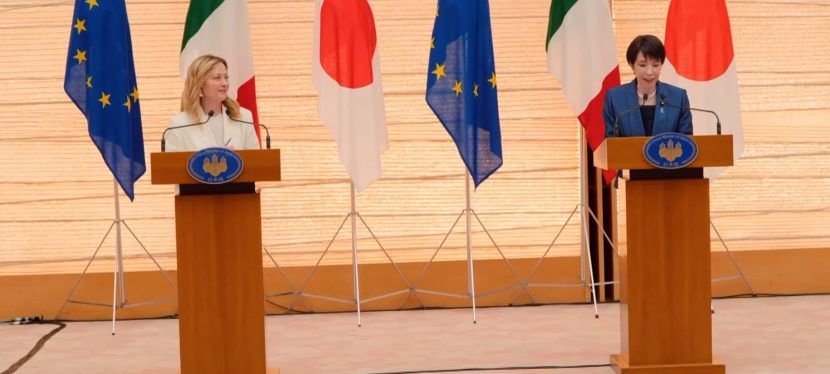
Japanese Prime Minister Sanae Takaichi met with Italian Prime Minister Giorgia Meloni and they agreed to cooperate with each other on enhancing economic security, according to a report by Kyodo News. Meloni is on her first official visit to Japan since taking office in 2022.
For the newcomers reading this, Japan is currently dealing with the aggression of Communist China not only diplomatically but also economically. Prime Minister Takaichi will soon meet US President Donald Trump in America.
To put things in perspective, posted below is an excerpt from the news article of Kyodo News. Some parts in boldface…
Japanese Prime Minister Sanae Takaichi and her Italian counterpart Giorgia Meloni agreed Friday to cooperate in strengthening economic security including supply chains of critical minerals as they aligned their nations more closely in the face of China’s growing clout.
The two countries upgraded their “strategic partnership” to a “special strategic partnership” to boost ties in “all sectors” including security and culture, Takaichi and Meloni said in a joint statement released after their meeting in Tokyo.
The leaders “shared grave concern for all forms of economic coercion and for use of nonmarket policies and practices and use of export restrictions which disrupt global supply chains for key goods and components,” they said, in an apparent reference to China.
Japan and Italy will also establish a consultative body to promote cooperation in space technology and will advance collaboration in areas such as artificial-intelligence robotics and semiconductors, the statement said.
“As the international community faces a complex crisis and the strategic environment surrounding the Indo-Pacific region has become severe, close collaboration between like-minded countries has become more important than ever,” Takaichi told a joint press appearance with Meloni after the talks.
Japan and Italy, both Group of Seven members, will also work together on securing liquefied natural gas in case of emergencies, among other infrastructure and energy issues, Takaichi said.
Meloni said that the alliance between Japan and Italy has “high potential” and that she discussed with Takaichi diversifying critical mineral providers and reinforcing the resilience of their supply chains.
Japan and Italy share concerns over China, a dominant producer of rare earths essential for cutting-edge products whose trade practices are often criticized as coercive.
Beijing imposed stricter controls on exports to Japan of dual-use items last week, escalating a bilateral spat sparked by Takaichi’s remarks in November suggesting an attack on Taiwan could trigger a response by her nation’s defense forces. The targeted goods may include rare earths.
Japan and Italy are heavily dependent on imports from China for their rare earth supplies.
Finance ministers from the G7 nations and some other countries agreed Monday to accelerate the reduction of their overreliance on China for critical minerals during their gathering in Washington.
Tokyo and Rome have also been ramping up defense collaboration against the background of China’s growing military reach in the Indo-Pacific region and Russia’s invasion of Ukraine, taking the view that security in the Indo-Pacific and Euro-Atlantic is inseparable.
The two countries have a joint trilateral project with Britain to develop a next-generation fighter jet they aim to deploy by 2035.
For added insight, watch the Nippon TV videos below.
Let me end this piece by asking you readers: What is your reaction to this development? Do you think big developments will happen once Japan and Italy start a new series of cooperation tackling economics and military matters? Do you think Italy and Japan will be able to find alternative sources of rare earth supplies and heavily cut their dependence on China? Do you think China will react angrily at Japan and Italy?
Vietnam, a nation ravaged by war decades ago, has emerged as a major tourism magnet in both Southeast Asia and Asia as a whole after successfully attracting more than twenty-one million foreign tourists in 2025, according to a VnExpress International news report. The figure is a new all-time high. What Vietnam achieved was more than 20% higher than its 2024 foreign tourist numbers. For 2026, Vietnam is aiming high with a target of 25 million foreign visitors.
To put things in perspective, posted below is an excerpt from the news report VnExpress. Some parts in boldface…
Vietnam welcomed a record number of foreign tourists in 2025 with 21.2 million, up 20.4% from the previous year and the highest ever, according to General Statistics Office.
Mainland China was Vietnam’s biggest source of visitors last year with 5.2 million arrivals, up 41% year-on-year, followed by South Korea with 4.3 million and Taiwan with 1.23 million.
The U.S. ranked fourth with 848,000, followed by Japan with 814,000. The rest of the top 10 were India (746,000), Russia (689,000), Cambodia (687,000), Malaysia (573,000) and Australia (548,000).
Tourism industry insiders attributed Vietnam’s strong performance to visa reforms.
Foreign tourists welcomed in Vietnam. (photo credit: Ho Chi Minh City Department of Tourism)
In March the government decided to extend visa exemptions until 2028 for citizens of 12 countries: Denmark, Finland, France, Germany, Italy, Japan, Norway, Russia, South Korea, Spain, Sweden, and the U.K.
In August it waived visa requirements for stays of up to 45 days for citizens of 12 more countries: Belgium, Bulgaria, Croatia, Czechia, Hungary, Luxembourg, the Netherlands, Poland, Romania, Slovakia, Slovenia, and Switzerland.
This expanded the unilateral visa waiver list to 24 countries and the total number including bilateral waivers to 39.
Let me end this piece by asking you readers: What is your reaction to this development? Considering the strong international tourism momentum it has right now, do you think Vietnam will succeed in attracting 25 million foreign tourists this year? Do you think a lot more visitors from Europe will come to Vietnam this year?
Following the capture of socialist dictator Nicolas Maduro, US President Donald Trump announced that Venezuela will turn over to America thirty million to fifty million barrels of oil which will benefit people of both nations, according to a news report by Newsmax.
For the newcomers reading this, Maduro ruled Venezuela for more than a decade and his predecessor was none other than the demon Hugo Chavez. Maduro brutalized his fellow Venezuelans and is responsible with the intense deterioration of their national economy. Under Maduro, Venezuela cooperated with the terrorist state of Iran, Communist China and Putin’s Russia. Maduro is also involved in drug trafficking and narco-terrorism.
To put things in perspective, posted below is an excerpt from a Newsmax report. Some parts in boldface…
President Donald Trump said Tuesday that Venezuela is turning over 30 million to 50 million barrels of oil to the United States, with proceeds he said will benefit both the Venezuelan people and Americans.
Trump made the announcement in a post on Truth Social, just days after he authorized U.S. military action to remove socialist strongman Nicolas Maduro from power in Venezuela.
“I am pleased to announce that the Interim Authorities in Venezuela will be turning over between 30 and 50 MILLION Barrels of High Quality, Sanctioned Oil, to the United States of America,” Trump said in the post.
“This Oil will be sold at its Market Price, and that money will be controlled by me, as President of the United States of America, to ensure it is used to benefit the people of Venezuela and the United States!” he added.
Delcy Rodriguez was sworn in as Venezuela’s interim president Monday. Rodriguez indicated she would cooperate with Washington.
“I have asked Energy Secretary Chris Wright to execute this plan, immediately. It will be taken by storage ships, and brought directly to unloading docks in the United States,” Trump concluded his post.
Before the arrest of Maduro, Venezuela’s oil sector was a shadow of its former self despite holding the world’s largest proven oil reserves — estimated at over 300 billion barrels.
Decades of socialist mismanagement, expropriation of foreign assets, and U.S. sanctions decimated output, which fell from over 3 million barrels per day in the early 2000s to roughly 1 million barrels per day by 2025.
Sanctions forced much of the crude trade underground and shifted exports mainly to China, with Petróleos de Venezuela, S.A. (PDVSA) struggling to generate cash revenue. Production bottlenecks, lack of investment, and aging infrastructure kept Venezuela’s oil influence weak on global markets.
For additional insight about Venezuelan oil and what it means to America and the world, watch the selected videos below.
Let me end this piece by asking you readers: What is your reaction to this development? With Maduro on trial in America, are you confident that he will be found guilty on each and every charge against him? Do you think the announced high amount of barrels of Venezuelan oil will be a big economic boost for America? Do you think China, Russia and terrorist state Iran are panicking now that they lost their access to Venezuela’s oil? Do you think it is a matter of time before the military hardware of Russia, China and Iran in Venezuela will get dismantled?
What happened this past weekend was very surprising, was executed very efficiently and the result is the fall and capture of Venezuela’s dictator Nicolas Maduro. This is the latest US military operation executed by President Donald Trump and his administration. Maduro is now in America and will be tried in court. The justice that the people of Venezuela have been dreaming of will eventually manifest. Trump also announced that America will run Venezuela until a transition of power can occur.
For the newcomers reading this, Maduro and his very wicked predecessor Hugo Chavez are collectively responsible for the downfall of Venezuela. Having ruled Venezuela for more than a decade, Maduro brutalized his fellow Venezuelans and is responsible with the intense deterioration of their national economy. Under Maduro, Venezuela cooperated with the terrorist state of Iran, Communist China and Putin’s Russia. Maduro is also involved in drug trafficking and narco-terrorism. Months ago, America started encountering vessels from Venezuela filled with illegal drugs. The dangerous gang Tren de Aragua was eliminated at sea.
To put things in perspective, watch the YouTube videos posted below and pay close attention to the details.
Already Venezuelans are cheerful and relieved with the fall of the dictator. It easily the most positive turn of events in their lives. Venezuelans are also thankful to President Trump. Watch and learn from the video below.
With Maduro and his wife in US custody, the effort for justice will begin soon. For insight, posted below is an excerpt from a Newsmax report. Some parts in boldface…
President Donald Trump said Saturday that U.S. forces captured Venezuelan leader Nicolas Maduro and his wife during a military operation, announcing they are being transported to the United States to face criminal prosecution in what he described as a decisive blow against international drug trafficking and regional instability.
Speaking at a Saturday afternoon press conference aired live on Newsmax and Newsmax2, Trump accused Maduro of overseeing a massive criminal enterprise responsible for drug trafficking, violence and instability affecting the United States.
“The illegitimate dictator, Maduro was the kingpin of a vast criminal network responsible for trafficking colossal amounts of deadly and illicit drugs into the United States, as alleged in the indictment, he personally oversaw the vicious cartel known as cartel de las Olas, which flooded our nation with lethal poison, responsible for the deaths of countless Americans, the many, many Americans, hundreds of thousands over the years of Americans died because of him,” Trump said.
Trump said Maduro and his wife were taken into custody during a U.S. operation in Venezuela and are currently being transported by ship.
“Maduro and his wife will soon face the full might of American justice and stand trial on American soil.”
In the same Newsmax report, Trump also mentioned that there is overwhelming evidence of Maduro’s crimes which will be presented in court.
Overseas, Israel commended America for the successful operation that led to Maduro’s capture. This is not surprising as Venezuela is allied with the terrorist regime of Iran and other Islamic terrorists. To put things in perspective, posted below is an excerpt from the news report of The Jerusalem Post. Some parts in boldface…
Israel lauded the American operation that resulted in the capture of Venezuelan President Nicolas Maduro on Saturday.
In a post on X/Twitter, Foreign Minister Gideon Sa’ar wrote, “Israel commends the United States’ operation, led by President Trump, which acted as the leader of the free world. At this historic moment, Israel stands alongside the freedom-loving Venezuelan people, who have suffered under Maduro’s illegal tyranny.“
Sa’ar added that the Jewish state “welcomes the removal of the dictator who led a network of drugs and terror” and that it hopes democracy would return to Venezuela and that the two countries would be able to resume friendly relations.
“The people of Venezuela deserve to exercise their democratic rights. South America deserves a future free from the axis of terror and drugs,” Sa’ar concluded.
Netanyahu congratulates Trump on capture of Maduro – Later, Prime Minister Benjamin Netanyahu also congratulated US President Donald Trump.
“Congratulations, President [Donald Trump] for your bold and historic leadership on behalf of freedom and justice. I salute your decisive resolve and the brilliant action of your brave soldiers,” the Prime Minister’s Office quoted Netanyahu as saying in a post to X.
Israeli NGO of retired senior security officials see Venezuela op. as warning to Iran’s regime –Earlier, the Commanders for Israel’s Security, an NGO of more than 550 retired senior officials from the IDF, the Mossad, the Shin Bet, the police, and the Foreign Service, also welcomed the operation, seeing it as a warning to the Iranian regime, Israeli outlet Maariv reported.
Let me end this piece by asking you readers: What is your reaction to this development? What is your reaction to the American military operation in Venezuela that resulted in the capture of dictator Maduro? Do you think it is only a matter of time before the remnants of Maduro’s administration will collapse and get overwhelmed by the Venezuelans who have long been hungry for freedom and the return of democracy? What do you think Iran, Russia and China will do now that their ally Maduro has fallen?