In the views of the First Metro Investment Corporation (FMIC) and the University of the Asia and the Pacific (UA&P), the economy of the Philippines could grow by 5.5% for the year, according to a news article by Philippine News Agency (PNA). 2023 has been an economically challenging year and many anticipated that the national economy won’t grow as high as it did in 2022.
To put things in perspective, posted below is an excerpt from the PNA news report. Some parts in boldface…
The Philippine economy is projected to grow by 5.5 percent this year, driven by the growth in government spending, a report released by the First Metro Investment Corporation (FMIC) and the University of the Asia and the Pacific (UA&P) said.
In the September issue of The Market Call released on Wednesday, FMIC and UA&P said Philippine economic growth in the third quarter of the year will likely reach 5.0 to 5.2 percent.
For the fourth quarter of this year, FMIC and UA&P project the country’s gross domestic product (GDP) to grow by 6 percent.
This would bring the full year GDP growth to 5.5 percent which is slightly below the government’s 6 to 7 percent target for this year.
“Despite the weak July-August, we think the NG will accelerate further its spending on infrastructure and transportation for the rest of the year, and employment will have strong rebound in September,” the report said.
The Philippine economy grew by 4.3 percent in the second quarter of this year. During the quarter, government expenditure contracted by 7.1 percent.
FMIC and UA&P however expect government spending to accelerate in the second half of the year.
“National Government took up the slack in July spending as it ramped up expenditures by 16.2 percent year-on-year in July through higher social protection and infrastructure outlays,” the report said.
Aside from government spending, FMIC and UA&P also expect manufacturing and construction to drive growth.
Let me end this piece by asking you readers: What is your reaction to this recent development? Do you think the national economy can do better than the 5.5% growth foreseen by the First Metro Investment Corporation (FMIC) and the University of the Asia and the Pacific (UA&P)?
In a new attempt to provide jobs in the Philippines and boost the economy, President Ferdinand “Bongbong” Marcos, Jr., recently signed into law the Trabaho Para sa Bayan Act, according to a news article by the Philippine News Agency (PNA).
To put things in perspective, posted below is an excerpt from the PNA news report. Some parts in boldface…
The passage of the Trabaho Para sa Bayan Act will help the government achieve the goal of the Philippine Development Plan to provide more jobs to Filipinos, the National Economic and Development Authority (NEDA) said Wednesday.
President Ferdinand R. Marcos Jr. signed on Wednesday the Trabaho Para sa Bayan Act which seeks to, among others, address the challenges in the labor market.
“We support the Trabaho Para sa Bayan Act as it contributes to the Philippine Development Plan 2023-2028, which aims to increase employability, expand access to employment opportunities and achieve shared labor market governance,” NEDA Secretary Arsenio Balisacan said in a statement.
The law mandates the formulation of the Trabaho Para sa Bayan Plan (TPB) to address unemployment, underemployment, the informality of working arrangements, the reintegration of Overseas Filipino Workers and other challenges in the labor market.
It will also focus on improving the employability and competitiveness of Filipino workers through upskilling and reskilling initiatives and will provide support for micro, small and medium enterprises, and industry stakeholders.
The TPB Inter-Agency Council, chaired by the NEDA Secretary, will conduct a comprehensive analysis of the employment situation and labor market in the country.
The Council will also ensure the effective use of resources, harmonizing and complementing all governmental efforts and assisting local government units in planning, devising and implementing employment generation and recovery plans and programs within their respective localities.
Let me end this piece by asking you readers: What is your reaction to this recent development? Do you think the Trabaho Para sa Bayan Act will create positive results over the next few years if it succeeds? Do you think that more could be done to help local job hunters find opportunities and get employed soon?
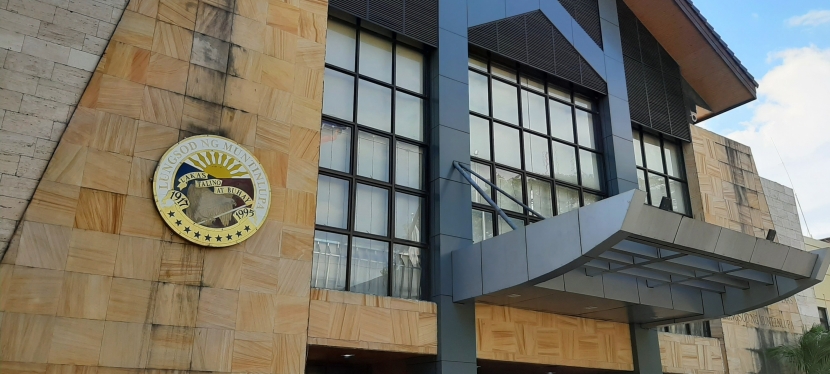
Recently in the progressive City of Muntinlupa, the local sellers of rice grain received temporary relief as the City Government implemented a moratorium on the collection of rental payments, according to a Manila Bulletin news report.
To put things in perspective, posted below is an excerpt from the Manila Bulletin news report. Some parts in boldface…
The Muntinlupa City government has imposed a moratorium on the collection of rental payment from stall holders engaged in the selling of rice as assistance to them following President Marcos’ decision to put a price cap on regular and well-milled rice.
Marcos issued Executive Order No. 39 on Aug. 31 imposing a mandated price ceiling of P41 per kilo for regular milled rice and P45 per kilo for well-milled rice. The rice price cap took effect on Sept. 5.
To assist the affected rice retailers, the Muntinlupa City Council passed Ordinance 2023-120 “imposing moratorium on rental payment for public stall holder in the retail business of selling rice during the effectivity of Executive Order No. 39 or the imposition of mandated price ceiling on rice.”
Mayor Ruffy Biazon signed the ordinance on Sept. 26, which became “effective immediately upon its approval.”
According to the ordinance, the President issued E.O. 39 “with an end view to put a price cap on rice in the effort to ease off the increasing price of the staple caused by illegal price manipulation such as hoarding by opportunistic traders and collusion among industry carters in the light of the lean season, as well as global events taking place beyond the Philippines’ control, such as the Russia-Ukraine conflict, India’s ban on rice exportation, and the unpredictability of oil prices in the world market, among other factors, have caused an alarming increase in the retail prices of rice/”
The Department of Interior and Local Government (DILG) issued Memorandum Circular No. 2023-131 for mayors to assist and ensure the effective regulation of the price of rice through “regular inspections of public and private markets, as well as rice warehouses; activation of hotlines, consumer complaints desk, and Timbangan ng Bayan; and deputation of barangay officials and non-government organizations to monitor abnormal price increases,” the ordinance added.
Let me end this piece by asking you readers: What is your reaction to this recent development? Do you approve of the City Government’s moratorium on the collection of rental payments with regards to the local sellers of rice grain?
For more South Metro Manila community news and developments, come back here soon. Also say NO to fake news, NO to irresponsible journalism, NO to misinformation, NO to plagiarists, NO to reckless publishers and NO to sinister propaganda when it comes to news and developments. For South Metro Manila community developments, member engagements, commerce and other relevant updates, join the growing South Metro Manila Facebook group at https://www.facebook.com/groups/342183059992673
To put things in perspective, posted below is an excerpt from the PNA news article. Some parts in boldface…
The Philippines is close to hitting its 2023 arrival target after recording more than 3.87 million foreign tourists as of Sept. 19, Tourism Secretary Christina Frasco said Wednesday.
At the opening of the 2023 Philippine Travel Exchange (PHITEX) in Cebu, Frasco said the country logged 3,877,183 inbound arrivals or at least 80.77 percent of the 4.8 million foreign tourists that the DOT targets to reach by the end of the year.
In the same period, the Philippines generated PHP316.9 billion in revenue from tourists coming mostly from South Korea, the United States and Japan.
Frasco is optimistic these figures will increase as business-to-business meetings between sellers and buyers at the PHITEX commence on Sept. 20.
She said the Marcos administration would continue working to transform the Philippines as a “tourism powerhouse in Asia”.
She shared the DOT’s plans and programs aimed at promoting ecotourism, the development of tourism communities across the country, fostering robust private sector participation to promote heritage protection, diversification of the country’s tourism portfolio and other initiatives to benefit tourism stakeholders.
Let me end this piece by asking you readers: What do you think about this recent development? With the likelihood that the Philippines will be able to surpass its 2023 foreign tourist arrivals target of 4.8 million, do you think the number could reach 6 million by the end of the year? Did you notice any positive economic impact from the rising foreign tourist arrivals? If you own a business, did you benefit from foreign tourists’ spending?
In connection to next month’s Barangay and Sangguniang Kabataan Elections (BSKE), the Commission on Elections (COMELEC) turned to operators of digital wallets and online banking and warned them about digital vote-buying, according to a Manila Times news report.
To put things in perspective, posted below is an excerpt from the Manila Times news report. Some parts in boldface…
THE Commission on Elections (Comelec) warned electronic wallet operators they could be involved in vote-buying cases if they allow candidates in the Barangay and Sangguniang Kabataan Elections (BSKE) to use their apps to buy votes.
Comelec Chairman George Garcia said over the weekend that the agency has already informed GCash, Maya and other companies involved in mobile payment services that they may face charges for conspiracy to commit vote-buying.
Garcia said they advised the companies to monitor high-volume transactions, especially in the days prior to election day.The companies were also told to be suspicious when money is sent to 50 to 200 people in one day.
“A red flag would be if someone sent a certain amount of money to a large number of recipients,” Garcia pointed out.
He said companies involved in digital wallets and online banking have vowed to support Comelec’s efforts against vote-buying.
The poll body intends to sign a memorandum of agreement with e-wallet companies, Garcia said.
Let me end this piece by asking you readers: What is your reaction to this recent development? Do you think the COMELEC did the right thing to ensure the credibility of the BSKE? Do you think this new move by the COMELEC will prevent vote-buying from happening?
Recently in the progressive City of Muntinlupa, more than forty local rice retailers received cash assistance from the national government, according to a Manila Bulletin news report.
To put things in perspective, posted below is an excerpt from the Manila Bulletin news report. Some parts in boldface…
A total of 44 rice retailers received cash assistance or “ayuda” from the national government in Muntinlupa following the imposition by President Marcos of a rice price cap on regular milled and well-milled rice.
The Muntinlupa City government headed by Mayor Ruffy Biazon assisted in the distribution of the cash assistance of P15,000 for each of the 44 rice retailers, or a total of P660,000.
The cash assistance is part of the President’s program to help rice retailers affected by his Executive Order No. 39, which imposed a price ceiling of P41 for regular milled rice and P45 for well-milled rice starting on Sept. 5.
“Ang ginawa ng Pangulo ay nagpadala ng assistance sa mga retailers para makabawi sila sa losses nila dulot ng Executive Order 39. Patuloy ang coordination natin sa mga ahensya ng pamahalaan tulad ng DTI, DA at DSWD. Hopefully matapos na ang problema natin sa nalalapit na panahon (What the President did was to send assistance to the retailers so they can offset the losses caused by Executive Order 39. Our coordination with government agencies like DTI, DA and DSWD continues. Hopefully we can end the problem soon),” said Biazon.
The cash assistance was distributed by the Department of Social Work and Development, together with the verification teams from the Department of Trade and Industry, Department of the Interior and Local Government, Local Economic Investment and Promotion Office (LEIPO), and Business Processing and Licensing Office (BPLO), which submitted the list of micro rice retailers.
Let me end this piece by asking you readers: What is your reaction to this recent development? Do you know anyone who sells rice for a living struggling right now? Do you think the current problem of rice grain pricing will continue to last over the next six to twelve months? How much did your household spend on rice grain over the last two months?
For more South Metro Manila community news and developments, come back here soon. Also say NO to fake news, NO to irresponsible journalism, NO to misinformation, NO to plagiarists, NO to reckless publishers and NO to sinister propaganda when it comes to news and developments. For South Metro Manila community developments, member engagements, commerce and other relevant updates, join the growing South Metro Manila Facebook group at https://www.facebook.com/groups/342183059992673
Starfield, the epic sci-fi role-playing game (sci-fi RPG) from Bethesda Game Studios (Oblivion, Skyrim and Fallout 4), tremendously boosted the sales of Xbox Series X and Xbox Series S (including the newer version) in the United Kingdom (UK) shortly after its very strong launch there, according to a report published by GamesIndustry.biz. Also available on Windows PC and Windows PC plus Xbox Game Pass (XGP), it is not surprising to see many gamers making decisions to buy the game brand new which helped it top the UK software sales chart.
To put things in perspective, posted below is the excerpt from the GamesIndustry.biz report. Some parts in boldface…
The launch of Starfield and a new version of the Xbox Series S significantly boosted sales of Microsoft consoles.
GfK data reveals that Xbox Series S and X sales jumped 76% week-on-week for the seven days ending September 2nd.
GfK games boss Dorian Bloch says that the week is the biggest this year (so far) for Xbox Series S and X hardware sales in the UK. Meanwhile, the week ending September 9th is currently the second best week.
This was partially due to the launch of the new Xbox Series S 1TB edition, which accounted for 24% of all Xbox consoles sold during that week. The new version of Xbox Series S is roughly £50 more expensive than the standard Series S model.
Starfield is filled with a lot of quests, activities, exploration and sci-fi action that really engaged millions of people worldwide as I write this. The scope of the game is very immense.
But the jump in Xbox console sales was also due to the launch of Starfield. The Bethesda game officially launched on September 6th, but it was available on September 1st to those who were willing to pay for the Premium Edition. As a result, the standard Xbox Series X console posted a 46% increase in sales for the week ending September 2nd in the UK.
“It is currently the best week this year for Series X,” Bloch says. “And the following week [ending September 9th] is the fourth best for X. In-between is week one and week six, which were early year blips.”
Bloch says that the Xbox consoles overall had a decent showing for the week ending September 9th, with the new Series S 1TB model accounting for 20% of sales.
As mentioned earlier, Starfield is also a software sales success in the UK which GamesIndustry.biz also reported separately. Check out the excerpt below…
Starfield has topped the UK physical charts this week.GfK’s report showed that the space-action RPG sold more physical copies on Xbox than it did on PC.
Sarah Morgan is one of the key characters in Starfield. Interacting with her added a lot to the gameplay and engagement. Take note that Morgan is just one of the Constellation characters you will interact with.
Starfield’s premium upgrade (a box with a code that provided early access to the digital version) has fallen to No.34 after debuting at No.7 last week. This version experienced a 71% decrease in sales due to the game’s wider release on September 6.
As confirmed by the news above, the Xbox-exclusive Starfield succeeded big-time at retail in the UK and as Bethesda’s biggest launch of all-time (on a worldwide scale). Think deeply about those huge achievements that were realized without PlayStation at all. While lots of gamers in the UK spent a lot of money on the sci-fi RPG and Xbox Series consoles, there are also many Starfield players enjoying it on Xbox Game Pass. In fact, a lot of XGP subscribers paid for the early access to the game and that only showed how heavily anticipated Starfield really is as Bethesda’s newest intellectual property (IP). Apart from that, there is still a long way to go before the month of September 2023 ends.
The way the Xbox-exclusive game is succeeding as I write this, it is very likely that Starfield will grow into a franchise of in-depth RPGs in the years to come. Like Halo and the Forza Motorsport, Starfield will be an Xbox-exclusive franchise of games that fans and RPG-loving gamers can look forward to.
Even without PlayStation, Starfield became a massive success at launch in terms of software sales, Xbox Game Pass subscriptions and Xbox hardware sales.
On my part, I have been playing Starfield on my Xbox Series X for more than a week now and the more I played it, the more enjoyable and even intriguing the gameplay experience turned out to be. There is just so much to have fun with this sci-fi RPG and by now, I have gotten myself more oriented with the user interface and the functions laid out.
With regards to the shooting (specifically with on-foot activities), the precision and response here are comparable with those in Fallout 4. Flying spaceships and using the controls for flight and weapons are really good and responsive enough.
While I won’t be spoiling plot details here, I can say that the gameplay experience has been pretty varied when I do the main quests, side quests, activities and when I freely explore the many in-game environments from one planet to another across different star systems. Check out the images and their descriptions below…
There is nothing like spotting Ecliptic mercenaries marching together in the middle of nowhere followed by my character and companion taking them out by surprise. If you encounter a random situation like this, engage with it.
I love the high-level of visual details as well as the impressive physics Bethesda prepared for space battles.
After defeating several armed bad guys and some dangerous turrets at a very discreet location, I got myself a brand new space ship! I now have four space ships as of this writing!
There is nothing like being able to board an enemy space ship, defeating all the bad guys and taking the valuables (including the opportunity to claim the ship as your own if your pilot skill is high enough). Starfield allows such opportunities to happen during space ship battles. Don’t just focus on destroying the enemy ship entirely as you will miss out on the opportunity to board it.
Starfield is very enjoyable and I believe that it still has a lot more to offer. I finished several side quests and activities, and still there is a lot more to discover and engage with! Of all the Xbox-exclusive games released in this current console generation, Starfield is already the most engaging one I have been playing, even more so than Halo Infinite.
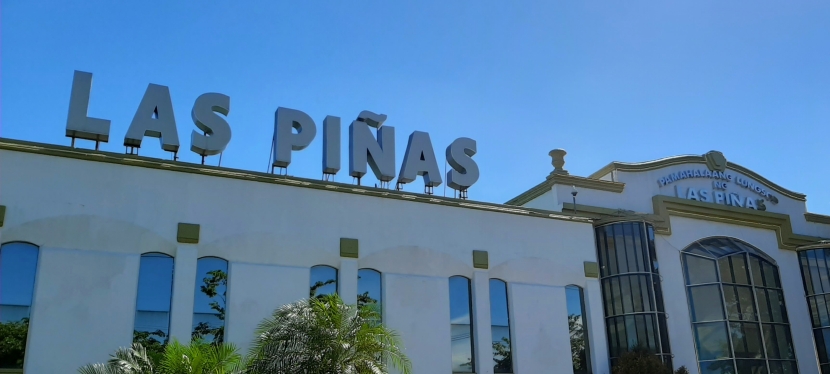
Recently in Las Piñas City, the City Government released cash aid to the local rice retailers to support them in coping with the rising costs in their line of business, according to a Manila Bulletin news report. The distribution was led by Mayor Imelda Aguilar.
To put things in perspective, posted below is an excerpt from the Manila Bulletin news report. Some parts in boldface…
Las Piñas City Mayor Imelda Aguilar led the distribution of cash assistance to 139 rice retailers at Las Piñas City Café in the City Hall grounds on Tuesday, Sept. 12.
The mayor said the City Agriculture Office (CAO), in coordination with the City Social Welfare and Development Office (CSWDO), distributed P15,000 cash assistance to each of the beneficiaries.
Aguilar took a decisive stance in response to the rising prices of rice to safeguard the city’s small-scale rice retailers, traders, and vendors.
The cash assistance is just the beginning of the city government’s initiatives to help its small rice business owners, said Aguilar, showing her commitment to aiding local businesses and prioritizing community welfare.
The mayor also revealed that the city government is in the process of developing a more comprehensive plan to support local rice traders and vendors.
The cash assistance aims to provide immediate relief to small businesses in the city, empower them to continue their operations and contribute to stabilizing rice supplies in the community since the livelihoods of rice retailers are under severe strain due to the surging price of rice.
Let me end this piece by asking you readers: If you are a resident of Las Piñas City, what is your reaction to this development? Are you struggling to buy rice grain for your family now? Do you think this newest action by the City Government will benefit consumers as well? Are the local rice retailers in your community been struggling a lot lately?
For more South Metro Manila community news and developments, come back here soon. Also say NO to fake news, NO to irresponsible journalism, NO to misinformation, NO to plagiarists, NO to reckless publishers and NO to sinister propaganda when it comes to news and developments. For South Metro Manila community developments, member engagements, commerce and other relevant updates, join the growing South Metro Manila Facebook group at https://www.facebook.com/groups/342183059992673
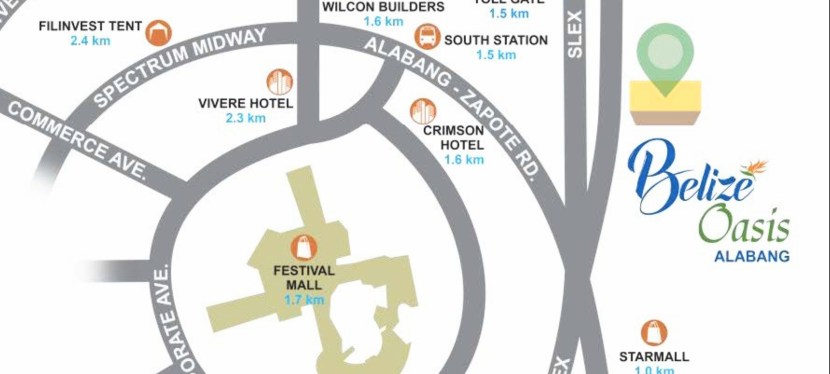
Recently in the progressive City of Muntinlupa, developer Filinvest Land, Inc. (FLI) had a ceremonial topping-off at one of the key buildings of the Belize Oasis Alabang community, according to a BusinessWorld news report. Belize Oasis Alabang is the company’s resort-inspired, mid-rise residential community accessible by the East Service Road within Muntinlupa.
To put things in perspective, posted below is an excerpt from the BusinessWorld news report. Some parts in boldface…
LISTED property developer Filinvest Land, Inc. (FLI) recently topped off the first building in its Belize Oasis community in Alabang, Muntinlupa City.
FLI said in a statement that the Building Azul is a low-density tower with only 25 units per floor. It is part of Belize Oasis, the company’s first mid-rise development in Muntinlupa City under the Aspire by Filinvest brand.
FLI said Building Azul has a “Venti-lite” design that incorporates sky gardens, allowing natural light and ventilation to the hallways.
“Soon, the future residents of Belize Oasis will have the privilege of enjoying the attractive features that this project has to offer. Nestled in a highly accessible area, Belize Oasis can be easily reached through major thoroughfares such as C5, South Luzon Expressway, and the Skyway,” FLI First Vice-President for Brand/Product and Regional Project Head for Medium-Rise Buildings Aven D. Valderrama said.
Belize Oasis is only a few minutes away from Filinvest City, FLI’s 244-hectare township in Alabang.
“Belize Oasis presents a golden opportunity to invest in a prime location with a ready rental market. Alabang has long been coveted due to its strategic positioning, excellent connectivity, and thriving commercial and business districts,” the company said.
Let me end this piece by asking you readers: What is your reaction to this recent development? If you are a Muntinlupa resident, do you think Belize Oasis Alabang will attract a lot of new residents and add significantly to the economic dynamism of Alabang?
For more South Metro Manila community news and developments, come back here soon. Also say NO to fake news, NO to irresponsible journalism, NO to misinformation, NO to plagiarists, NO to reckless publishers and NO to sinister propaganda when it comes to news and developments. For South Metro Manila community developments, member engagements, commerce and other relevant updates, join the growing South Metro Manila Facebook group at https://www.facebook.com/groups/342183059992673
GCash, a very popular electronic wallet (e-wallet) here in the Philippines, will soon be charging a fee of P5 each time a user cashes in (loading money into his or her GCash account) via the Bank of the Philippine Islands (BPI) or Union Bank of the Philippines, according to a business news story by the Philippine Star. For the newcomers reading this, GCash users can put money into their respective accounts in other ways such as doing it over-the-counter at recognized convenience stores, the cash-in kiosks and other types of businesses that accept GCash cash-in.
To put things in perspective, posted below is an excerpt from the Philippine Star business news report. Some parts in boldface…
E-wallet giant GCash will start charging a convenience fee of P5 for every time a user cashes in from its major partners Bank of the Philippine Islands (BPI) and Union Bank of the Philippines in the fourth quarter.
In an interview with reporters, GCash president and CEO Martha Sazon said the convenience fee remains to be one of the lowest compared to the transaction charges imposed by traditional banks that run as high as P25.
“As GCash continues to scale, we still subsidize most of the charges as well as heavily invest on upgrading our infrastructure and reinforcing security services,” Sazon said.
Sazon said GCash has to slap a convenience fee for cashing in to cover its rising costs. However, Sazon said the fee only reduces the subsidies that GCash pays to keep its financial services affordable.
“This also ensures that our operations will remain seamless for all customers. Even with this fee, we will continue to subsidize part of the operating cost for our cash-ins as we remain committed to keeping our services affordable to many Filipinos,” Sazon said.
Sazon is encouraging GCash customers to compute how much they have to spend for every time they load their accounts through BPI and Union Bank.
For instance, Sazon said a user can cash in P10,000 in one go rather than top up P500 in tranches to minimize getting charged P5 every time.
Users can add cash to their GCash platform by linking it into their bank accounts. Likewise, they can cash-in via convenience stores, dedicated machines, department stores, gas stations, sari-sari stores, among others.
Last week, GCash announced that it would waive for the rest of the year the transaction charges on merchants for payments accepted through QR Ph. The e-wallet leader expects that through this, micro, small and medium enterprises will book extra earnings from cashless transactions.
GCash offers merchants access to e-wallet with a limit of up to P500,000 per month, waiving the transaction fee of 1.5 percent for P100,000 in gross sales.
GCash is one of the largest finance apps in the Philippines with a nationwide presence in more than 1,600 billers.
Let me end this piece by asking you readers: What is your reaction to this recent development? If you are a GCash user who often loads money using the respective apps or systems of BPI and Union Bank, does the above business story discourage you a lot?