A Look Back at X-Men 2099 #2 (1993)

Welcome back, superhero enthusiasts, 1990s culture enthusiasts, X-Men fans and comic book collectors! Today we revisit the Marvel Comics shared universe to examine one of the many tales of the X-Men 2099 monthly series.  

Way back in 1993, I had a fun reading X-Men 2099 #1 as soon as it was released in the local comic book specialty store here in the Philippines. Back then, I was already into the 30th anniversary celebration of the X-Men while also reading more comic books about Marvel’s science fiction 2099 franchise of comic books. I love the way X-Men 2099 #1 ended as it was a powerful way of building up the tension and excitement that comes with waiting another 30 days for issue #2 to come out.

With those details laid down, here is a look back at X-Men 2099 #2, published by Marvel Comics in 1993 with a story written by John Francis Moore and drawn by Ron Lim.

The cover.

Early story

The story begins with the X-Men desperately trying to escape as the arcology has been invaded by enforcers (also referred to as the Greater Nevada Syndicate) of the Synge casino. Their leader Xi’an is in critical condition after getting shot during an assassination attempt that happened moments earlier. The X-Men are inside their van speeding away and Meanstreak (Henri Huang) uses his super speed to run ahead of them to quickly check what awaits them all. During the ride, Krystalin learned of the news that Noah Synge has died and Xi’an has been blamed for murder. Cerebra confirmed that Xi’an expressed hatred towards Synge.

When the van finally reaches the outdoor area, the X-Men find themselves facing a large tank and a helicopter of the syndicate which anticipated their arrival. The syndicate tells them to surrender Xi’an…

Quality
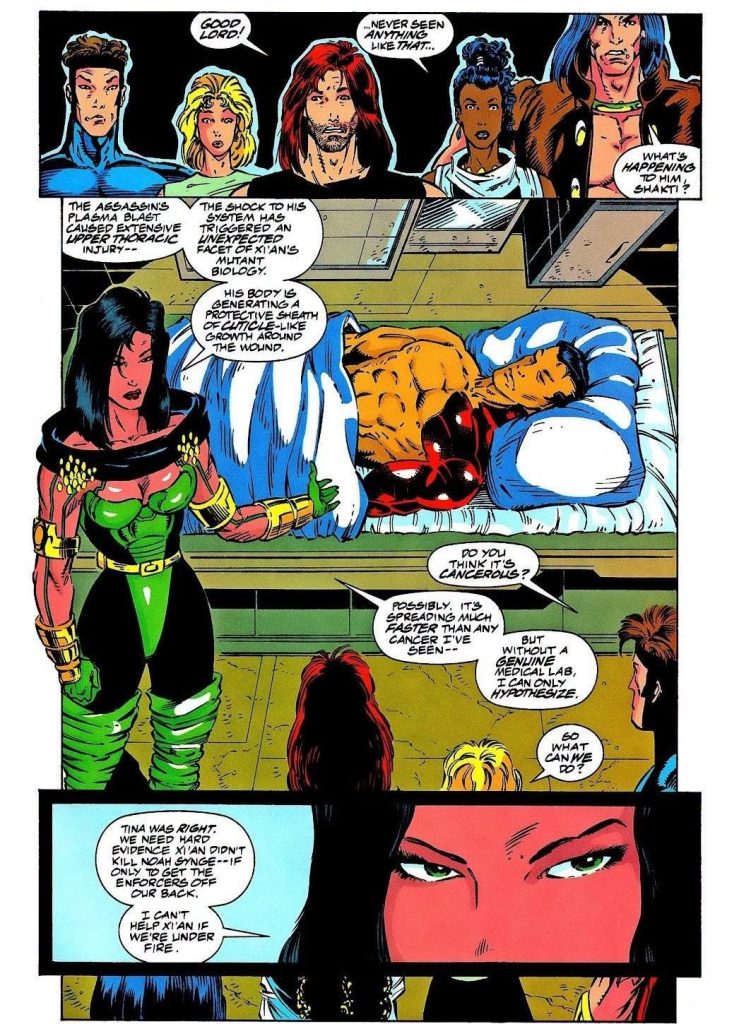
Cerebra shows their leader Xi’an with a biological cocoon forming over his body. Pay attention to the details.

As a follow-up to the impressive first issue, this one remains a very good read after all these decades. It is clear to me that John Francis Moore had carefully planned an engaging tale of the futuristic X-Men with Tim Fitzgerald (who will later be called Skullfire) as the symbolic reflection of the readers who get to discover more about the team, the situation they are in and why they exist in the first place.

As expected, the creative stuff that started in issue #1 progressed naturally as the story went on in this comic book. The X-Men of 2099 got away to find safety and get themselves organized as their leader remains in critical condition. Along the way, the syndicate itself gets adjusted as it has the son and daughter of Noah Synge taking over their evil empire suddenly. The syndicate is responsible for seven deaths, the wounding of nineteen people and the capture of over forty people as a result of their sudden invasion of the arcology and their attempt to assassinate Xi’an in retaliation of the death of Noah Synge. This was the creative duo’s way of telling readers who the bad guys are and why the X-Men are at a great disadvantage.

What I find engaging here is how the Moore-Lim duo emphasized Xi’an’s significance through flashbacks and background details (which further revealed more of the founding of the futuristic X-Men). This creative gamble worked wonders and clearly more than made up for the lack of dialogue and interactions from the X-Men’s leader. At the same time, the narrative has this flavor of conspiracy when the Synge empire was emphasized.

Conclusion
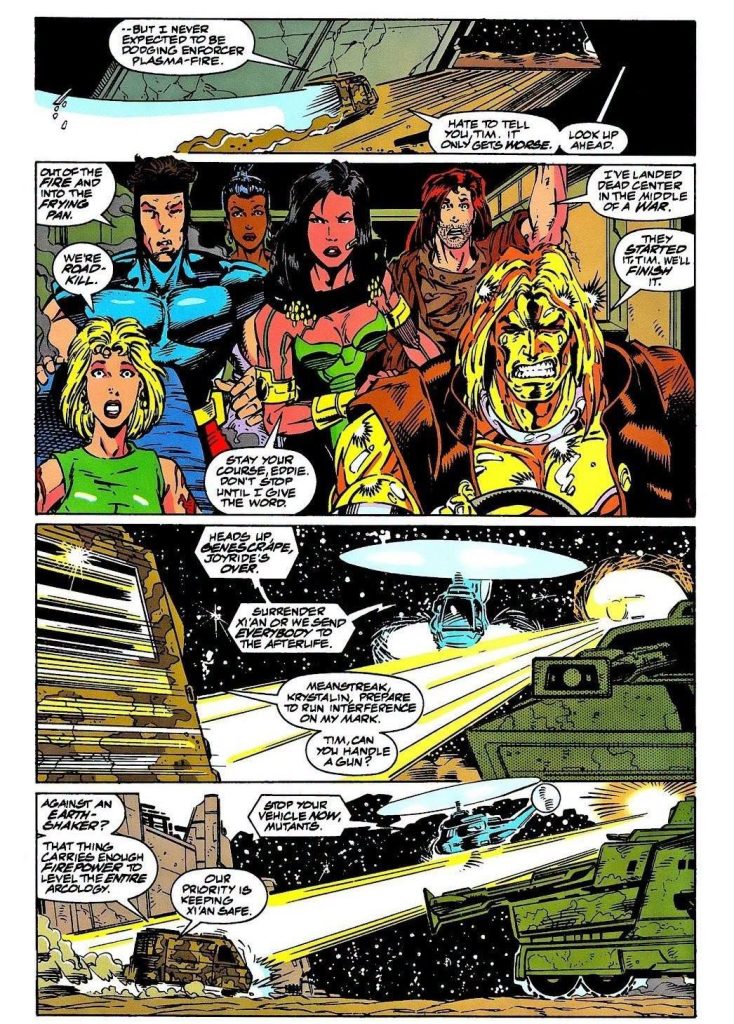
The futuristic X-Men encounter strong opposition from the syndicate.

X-Men 2099 #2 (1993) is clearly a very good read. As a follow-up to the very solid issue #1, it added to the build-up emphasizing the futuristic X-Men a lot more while still having enough room to develop the Synge empire and its syndicate. Along the way there were some nice pay-offs to certain build-ups in issue #1 and there was a fine balance between action scenes and the plot/character development scenes. That said, this comic book is a solid bridge between issue #1 and the conclusion in issue #3.

Overall, X-Men 2099 #2 (1993) is highly recommended.

+++++

Thank you for reading. If you find this article engaging, please click the like button below and also please consider sharing this article to others. If you are looking for a copywriter to create content for your special project or business, check out my services and my portfolio. If you want to support my website, please consider making a donation. Feel free to contact me with a private message. Also please feel free to visit my Facebook page Author Carlo Carrasco and follow me on Twitter at  @HavenorFantasy as well as on Tumblr at https://carlocarrasco.tumblr.com/ and on Instagram at https://www.instagram.com/authorcarlocarrasco/.
A Look Back at Universal Soldier #1 (1992)

Welcome back comic book readers, 1990s arts and culture enthusiasts, movie fans and comic book collectors! Today we go back to the year 1992 to take a close look at the official comic book adaptation of the action movie Universal Soldier.

Universal Soldier stood out among Hollywood action films in 1992 as it had Jean-Claude Van Damme and Dolph Lundgren as the main stars and both of them were established action movie stars each with huge followings of fans. As it grossed almost $100 million worldwide on a budget of less than $25 million, the movie was successful and eventually sparked its of franchise of movies, TV shows, video games and comic books. NOW Comics was in-charge of making and publishing the comic book adaptation of the 1992 film.  

With those details laid down, here is a look back at Universal Soldier #1 published in 1992 by NOW Comics with a story written by Clint McElroy and drawn by Lenin Delsol. This was the first chapter of a 3-issue mini-series.

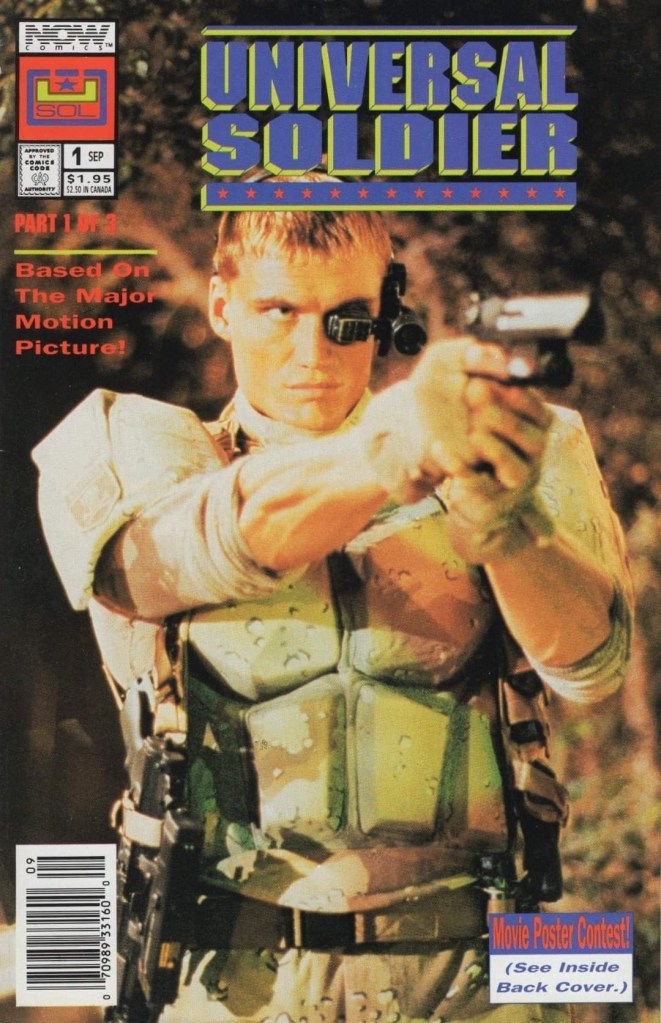
The cover showing a photographic image of star Dolph Lundgren.

Early story

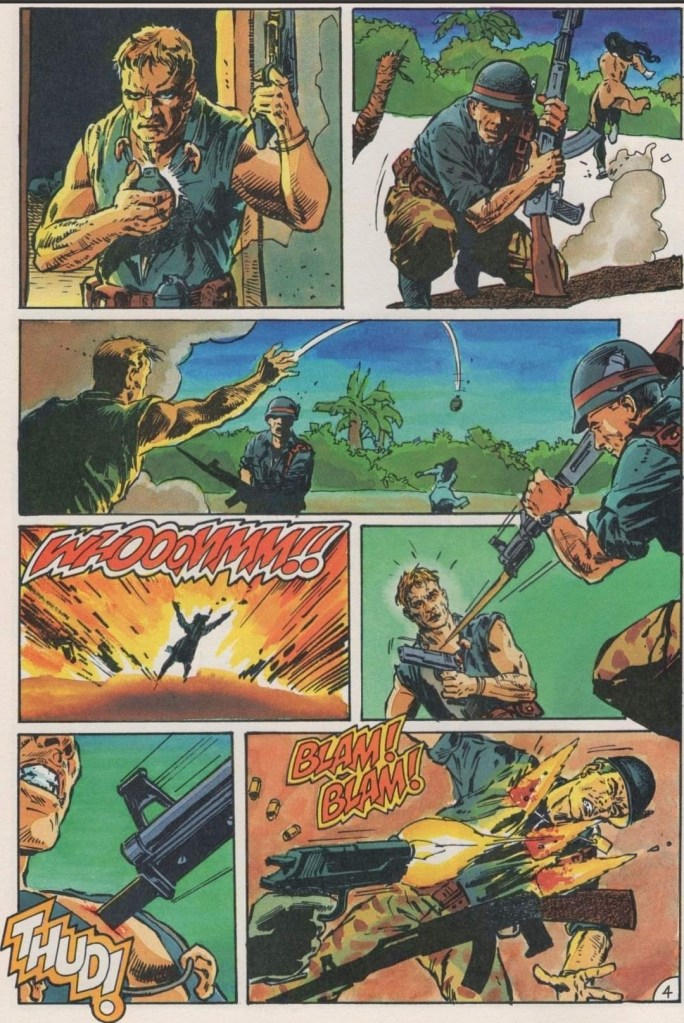
The story begins in Vietnam in 1969. The American soldier Luc Deveraux arrives at a village that was secured by the U.S. Army. To his shock, he finds several dead bodies of his squad members and villagers, then encounters Sergeant Andrew Scott with two Vietnamese individuals (male and female) tied together near him. It turns out that Scott, who made a necklace composed of severed ears, has gone insane and executes the Vietnamese man. As Deveraux refuses to follow Scott’s order to shoot the Vietnamese female, the sergeant kills he. Deveraux and Scott shot each other to death and eventually their corpses were recovered by another squad to be cryogenically frozen.

A few decades later in Nevada, the elite counter-terrorism unit of the UniSol (Universal Soldier) arrives and among the members are Deveraux (identified as GR44) and Scott (GR13) who have been reanimated by the government with their past memories fully suppressed. Their team gets deployed to the Hoover Dam (Mackinley Dam in the comic book) to resolve a hostage situation…

Quality

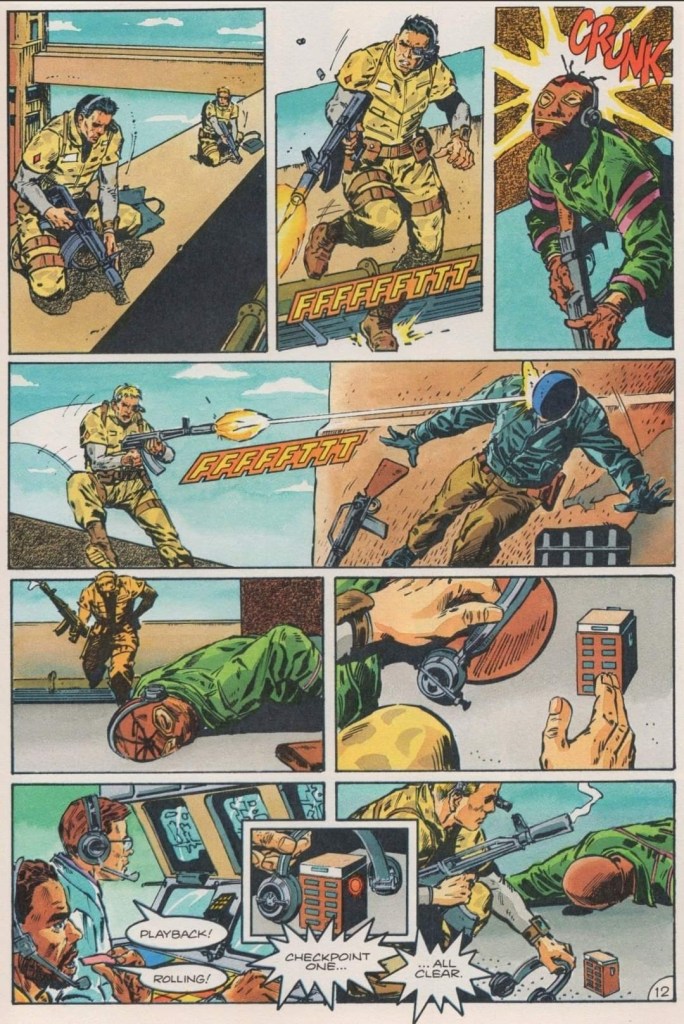
Operating very much like robots, two Universal Soldiers take down terrorists and manipulated their communication as they make their way through to save the hostages from the remaining terrorists.

As an adaptation, I find this comic book a surprisingly accurate translation of the movie’s early part of the story (note: the literary narrative ends when Deveraux leaves with the female reporter). While not 100% of the film’s plot and visual details were captured, this comic book still succeeded in replicating the look, feel and tone of the movie. It is clear that the comic book team had access to the footage of the film and a copy of the screenplay (written by Richard Rothstein, Christopher Leitch and Dean Devlin).

Clint McElroy really stuck close to the film’s plot, the dialogue and the way the characters were portrayed. Again, not 100% of the relevant details were adapted and some liberties were taken but McElroy managed to craft a comic book narrative that was solidly structured, had sufficient details to keep readers oriented and engaged, and ensured the story moved at a satisfying pace. By the time I reached the end of this comic book, I got oriented with the story, the characters and the details shown in between.

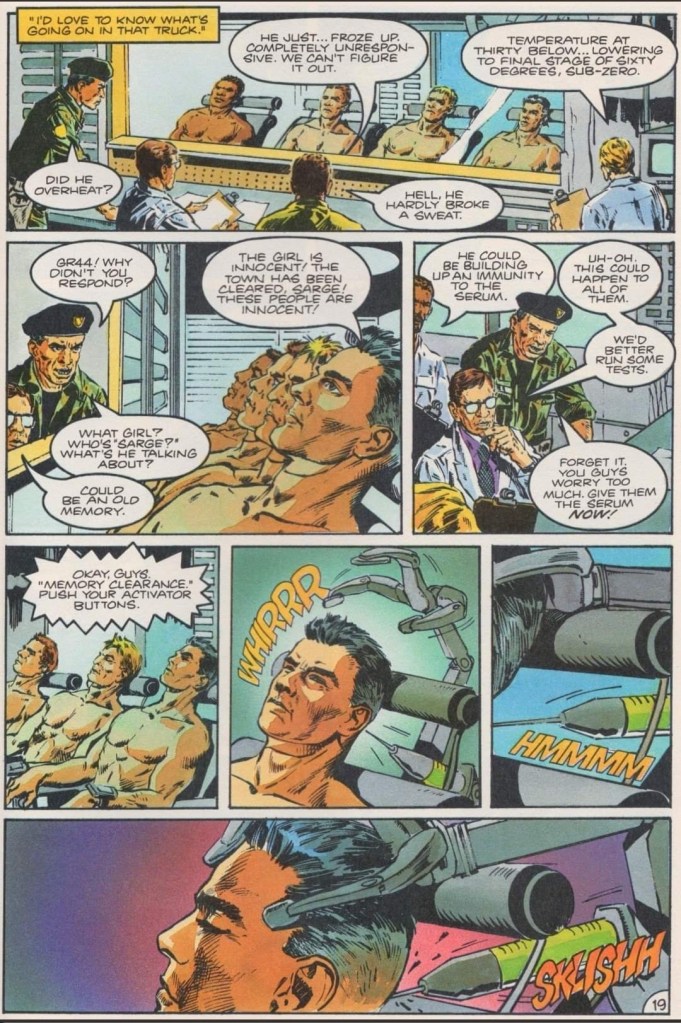
Like in the movie, this comic book emphasizes the government’s very cold and heartless approach on handling their Universal Soldiers who are treated more like tools instead of people.

Lenin Delsol’s artwork here is really good. It is clear that he had access to the film’s production footage as several images of locations and characters here very closely resembled what was shown in the movie most of the time. When it comes to the action scenes, Delsol did not go for visual dynamism (note: the dynamic action style was common with superhero comics of the 1990s) but rather he portrayed the action with realism and varying degrees of brutality.

When it comes to visualizing the characters, it is clear that the creative team was not authorized to use the likenesses of the actors. Luc Deveraux looks absolutely nothing like Jean-Claude Van Damme while journalist Veronica Roberts does not look like Ally Walker. Ironically, there are a few images of Scott’s face that somewhat resembles Dolph Lundgren. The way I see it, it is not problematic to see the characters not resembling the actors from the film. In fact, I like the new character designs Delsol came up with for the characters.

Conclusion

This early scene sets the tone of the entire comic book. As for the characters, Deveraux look nothing like Jean-Claude Van Damme and Sergeant Scott does not look like Dolph Lundgren (note: in other images of Scott shown later in the comic book, he looked a bit like the actor).

Even though I was not a fan of the 1992 movie, Universal Soldier #1 (1992) succeeded in keeping me engaged and entertained until the end. This is a really good adaptation of the early part of the film and I like the approach the Elroy-Densol team took on establishing the literary experience. Of course, if you want more dynamic visuals of the Hoover Dam scene or if you want that strong rated-R vibe when it comes to hard action, you should watch the movie. As of now, I am convinced to look forward to the next issue of this 3-part mini-series adaptation.

Overall, Universal Soldier #1 (1992) is recommended.

+++++

Thank you for reading. If you find this article engaging, please click the like button below, share this article to others and also please consider making a donation to support my publishing. If you are looking for a copywriter to create content for your special project or business, check out my services and my portfolio. Feel free to contact me with a private message. Also please feel free to visit my Facebook page Author Carlo Carrasco and follow me on Twitter at  @HavenorFantasy as well as on Tumblr at https://carlocarrasco.tumblr.com/ and on Instagram at https://www.instagram.com/authorcarlocarrasco