A Look Back at Action Comics #456 (1976)

Welcome back superhero enthusiasts, 1970s arts and culture enthusiasts, DC Comics fans and comic book collectors! Today we go back to the year 1976 to take a close look at a part of the DC Comics universe through a tale of the Action Comics monthly series.

If you know your entertainment history, you should be aware that Steven Spielberg’s Jaws made a tremendous impact on millions of people who saw the film in cinemas in the mid-1970s. The massive success of the movie caused some people to become afraid of sharks which in turn convinced them to avoid swimming alone at sea. Over at DC Comics, it just so happens that they have a super villain who is actually a highly evolved shark called The Shark (Karshon).

With those details laid down, here is a look back at Action Comics , published in 1976 by DC Comics with a story written by Cary Bates and illustrated by Curt Swan.
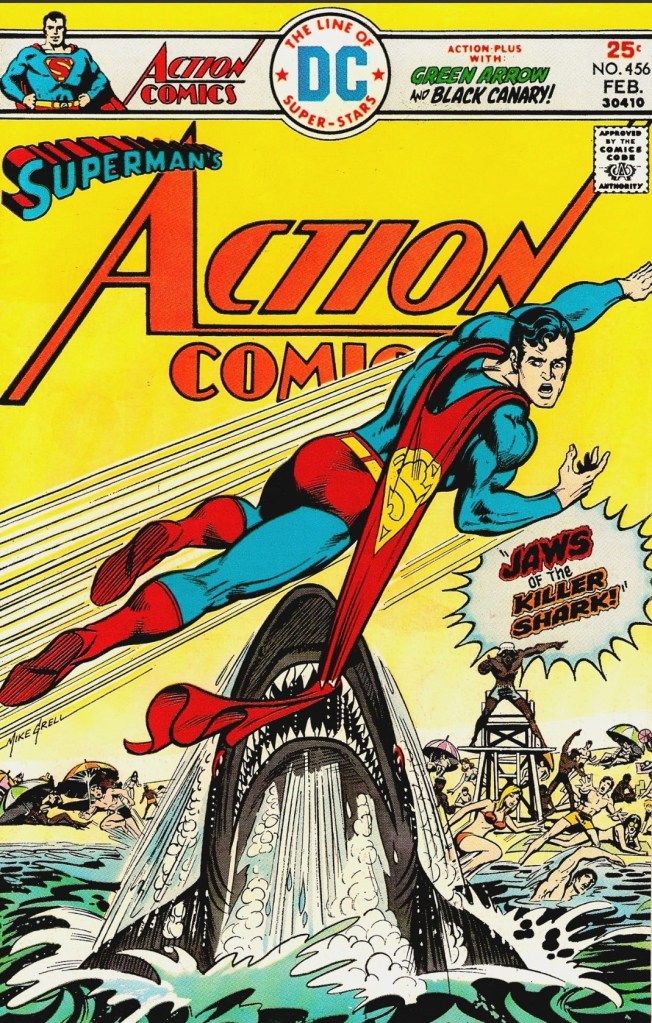
The cover inspired by Steven Spielberg’s Jaws.

Early story

The story begins inside the Metropolis Aquarium where Captain Strong, young boy Jayson, young girl Jill and others closely watch a tiger shark swimming. What the viewers do not realize is that the tiger shark they are watching is a super shark (The Shark) whose evolution jumped by eons as a result of a freak nuclear accident from the previous years.

The Shark is a highly evolved mutant (half-fish and half-human) endowed with fantastic mental powers. The Shark previously encountered Green Lantern (Hal Jordan) who caused him to devolve back to his primitive form as a tiger shark.

At the aquarium, The Shark moves closely towards Captain Strong and Jayson with strong glass separating them. Suddenly, Jayson is turned into a pool of jelly on the floor and The Shark uses its power to form a large stream of water to break the way out of the Metropolis Aquarium and into the air.

Meanwhile, Lois Lane and Clark Kent are riding the metro-island ferry. A giant water sprout emerges near them…  

Quality
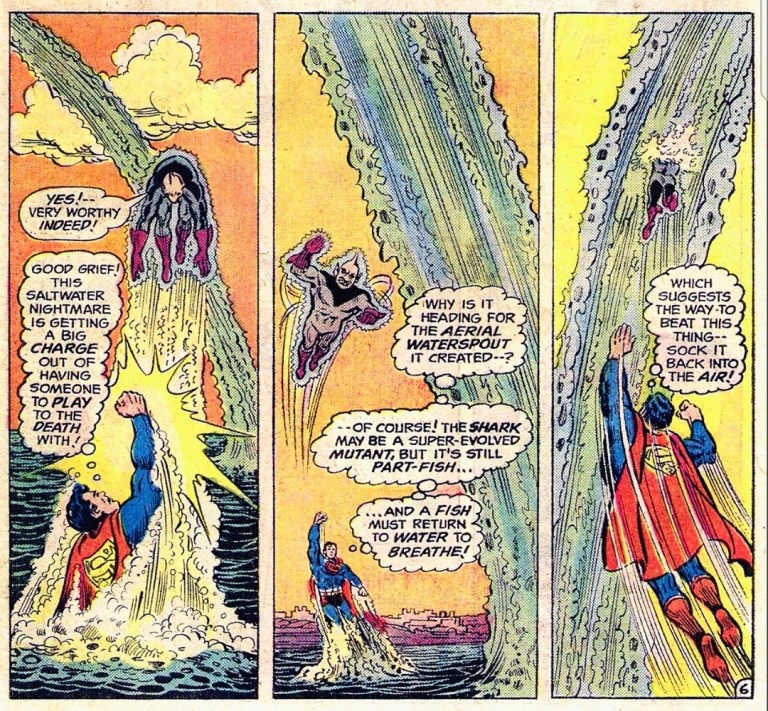
The struggle between Superman and The Shark starts.

While it was clear that DC Comics took a creative stab on people’s awareness of the movie Jaws, the Bates-Swan duo came up with a rather fantastic way of having Superman deal with The Shark. For one thing, the creators efficiently came up with exposition to keep readers informed about who The Shark is, why he exists and what his background was within the DC Comics shared universe. Next, the creators managed to make The Shark an actual threat to the people of Metropolis which serves as an efficient build-up for the inevitable conflict with Superman. The good news here is that Bates-Swan combined efforts turned out to be gripping and believable.

When compared to the many battles Superman had against the other powerful villains, the traditional collateral damage is pretty light in this story. This is because the creators used science fiction concepts and a little bit of real-world science to explain The Shark’s powers, how the water streams used by him got formed and why he has key advantages over Superman. These creative methods more than made up for the lack of hard action and there are explanations that made sense just before the story ends.

This comic book also contains a short, standalone Black Canary tale that ultimate served as added amusement that is not related with the Superman story at all. It should interest fans of Green Arrow.

Conclusion
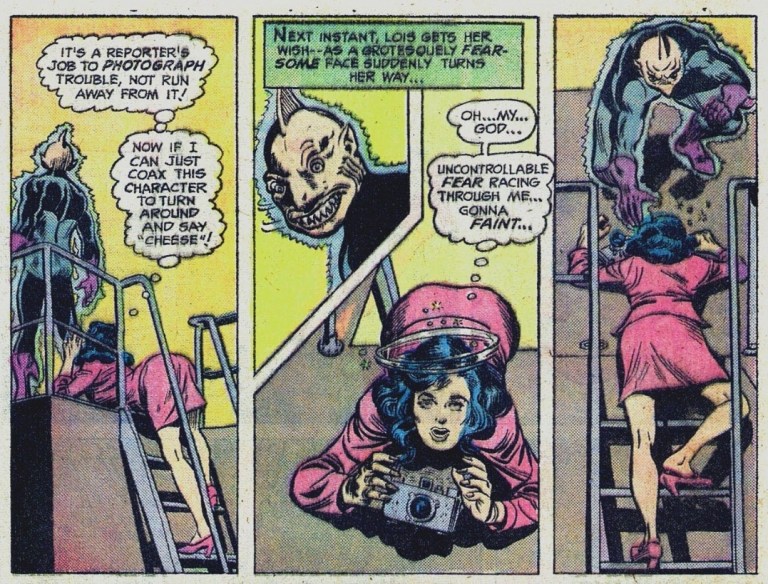
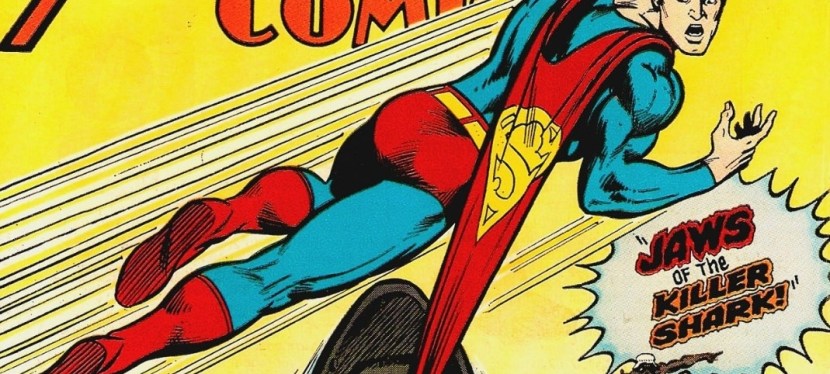
The Shark’s menacing face and power overwhelms Lois Lane.

Do not let the Jaws-inspired cover art fool you. Action Comics (1976) is actually an entertaining read thanks to the combined efforts of the Bates-Swan team. The Shark was a believable threat and the story was well written. To say that this comic book was just a cheap way of exploiting the popularity of Jaws by coming up with shark-related tale of Superman is not true. This old tale is a fun ride free from the politicized science and woke garbage that dominate modern-day entertainment.

Overall, Action Comics (1976) is recommended.

+++++

Thank you for reading. If you find this article engaging, please click the like button below, share this article to others and also please consider making a donation to support my publishing. If you are looking for a copywriter to create content for your special project or business, check out my services and my portfolio. Feel free to contact me with a private message. Also please feel free to visit my Facebook page Author Carlo Carrasco and follow me on Twitter at  @HavenorFantasy as well as on Tumblr at https://carlocarrasco.tumblr.com/ and on Instagram at https://www.instagram.com/authorcarlocarrasco
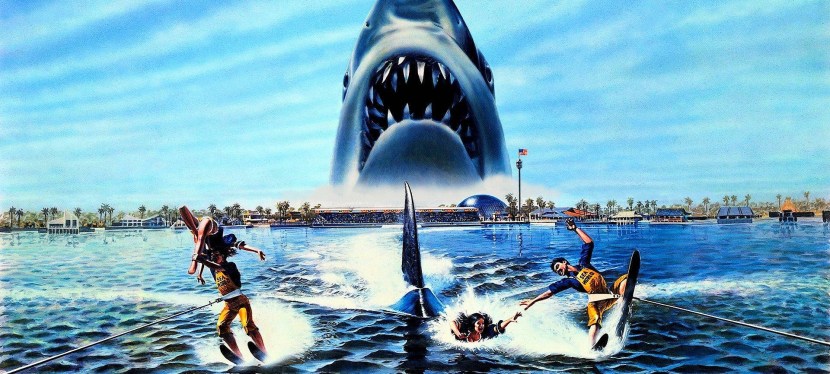
Are you nostalgic about Jaws 3-D (AKA Jaws 3) right now?

Way back in 1983, I had my first-ever 3D viewing experience inside the movie theater here in the Philippines. I saw the movie Jaws 3-D (AKA Jaws 3) on the big-screen using disposable 3D glasses and the theater was packed with lots of moviegoers who screamed from time to time.

If you are not familiar with movie history, Jaws 3-D was the 3rd movie of the Jaws movie franchise which itself started with the classic 1975 movie directed by Steven Spielberg. While the 1978 sequel Jaws 2 did not come close to matching the commercial success of its predecessor, it still managed to gross over $200 million worldwide and arguably influenced Hollywood movie studios to invest in making sequels to achieve summer box office success. Jaws 2 also propelled the rise of movie-related merchandising which paved the way for deals between movie studios and business entities.

When the 2nd Jaws sequel was proposed, producers David Brown and Richard Zanuck had the concept of spoof titled Jaws 3, People 0. National Lampoon writers were even commissioned to make the script. The Jaws 3 comedy project was shot down by Universal Pictures as a result of Steven Spielberg’s threat that he would never work with them again if they approved it.

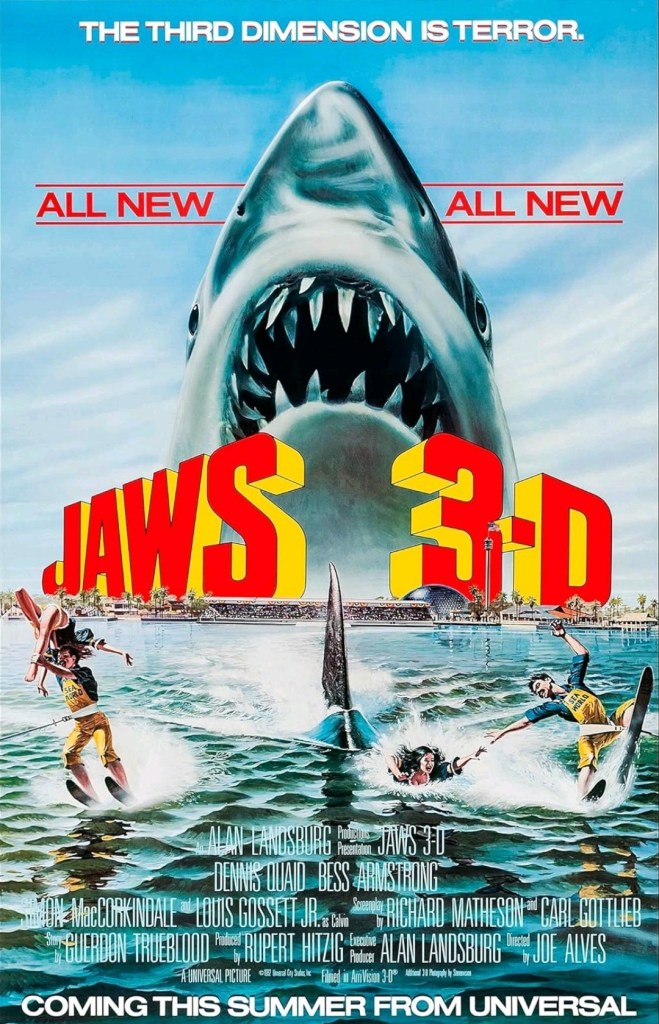
Along the way, there were technological breakthroughs for cinematic 3D viewing which led to the short revival of showing movies in 3D in movie theaters. The Jaws 3 project was turned into a 3D-focused cinematic experience with a concept about an aquatic amusement park that falls into chaos as a result of a large great white shark that infiltrated it. Prolific production designer Joe Alves was hired as director and the cast includes Dennis Quaid, Bess Armstrong, Louis Gossett, Jr., Lea Thompson and Simon MacCorkindale. Even SeaWorld got involved and allowed the filmmakers to use their brand.

The movie poster.

Jaws 3-D was released in cinemas on July 22, 1983 and had a franchise-best opening weekend with $13.4 million. Its global box office gross was around $88 million.

When I first saw Jaws 3-D inside the movie theater, I was a young boy and simply enjoyed it for what it was. I occasionally replayed the movie through the years on cable TV and home video, and I eventually realized that the film was indeed very flawed and clearly inferior to its predecessors with regards to quality and storytelling. Jaws 3-D was simply made to give moviegoers a thrill ride inside the cinema with 3D viewing in mind as the moviegoers followed the 3D viewing revival trend of the early 1980s. When it was released on cable TV and home video, the movie was re-titled as Jaws 3 to reflect the lack of 3D effects.  

Even though it was inferior to the first two Jaws movies, Jaws 3-D remains a popular movie subject to explore and there are several videos on YouTube that reflect that. If you are interested in Jaws 3-D but you don’t want to spend precious time and money watching it entirely, then you should watch the movie reaction video by You, Me and the Movies below.

If you want to learn more about how the movie was made, how it all started and what kind of technologies were used to make the 3D effects happen, watch the two retrospective videos below from Oliver Harper and Layton Eversaul.

If you are into movie trivia, then Minty Comedic Arts’ video below is recommended.

By the way, you must have heard that Jaws 3-D is now available in 4K Blu-ray format. Before you make the decision to purchase it, be aware that Universal used artificial intelligence (AI) to make it. Depending on how you want your movies to appear in 4K resolution, the results could turn you off. Watch the videos below from Jeff Rauseo and MidLevelMedia.

Let me end this piece by asking you readers: Have you ever seen Jaws 3-D? If you did, were you able to watch it inside the cinema or at home? Did the movie inspire you to watch movies in 3D? Do you think that the current 4K Blu-ray of Jaws 3-D is not worth purchasing?

You may answer in the comments below. If you prefer to answer privately, you may do so by sending me a direct message online.

+++++

Thank you for reading. If you find this article engaging, please click the like button below, share this article to others and also please consider making a donation to support my publishing. If you are looking for a copywriter to create content for your special project or business, check out my services and my portfolio. Feel free to contact me with a private message. Also please feel free to visit my Facebook page Author Carlo Carrasco and follow me on Twitter at  @HavenorFantasy as well as on Tumblr at https://carlocarrasco.tumblr.com/ and on Instagram athttps://www.instagram.com/authorcarlocarrasco
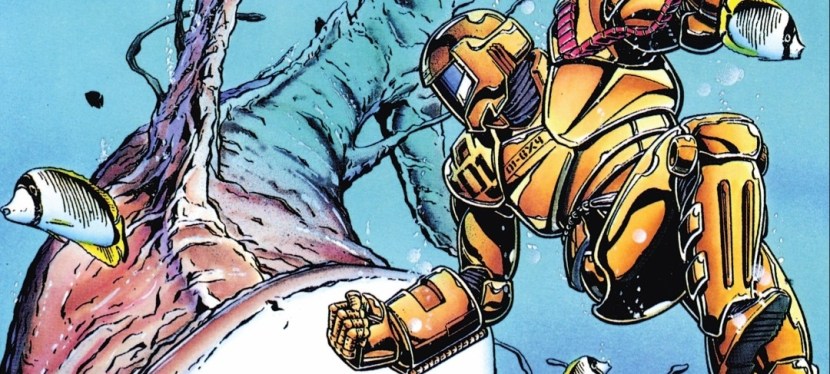
A Look Back at Armorines #2 (1994)

Disclaimer: This is my original work with details sourced from reading the comic book and doing personal research. Anyone who wants to use this article, in part or in whole, needs to secure first my permission and agree to cite me as the source and author. Let it be known that any unauthorized use of this article will constrain the author to pursue the remedies under R.A. No. 8293, the Revised Penal Code, and/or all applicable legal actions under the laws of the Philippines.

Welcome back superhero enthusiasts, 1990s culture enthusiasts and comic book collectors! Today we go back to the early 1990s and explore a part of the Valiant Comics shared universe through the Armorines monthly series.

In my previous retro review, the comic book introduced us to the armored U.S. Marines (composed of members who go out on the field with armored suits and other members who serve as co-pilots via virtual reality) and their superiors. Their mission took them very deep down the ocean where they have to enter a sunken nuclear-powered submarine not knowing that something dangerous lurks there.

With those details laid down, here is a look back at Armorines , published in 1994 by Valiant Comics with a story written by Jorge Gonzalez and drawn by Jim Calafiore.

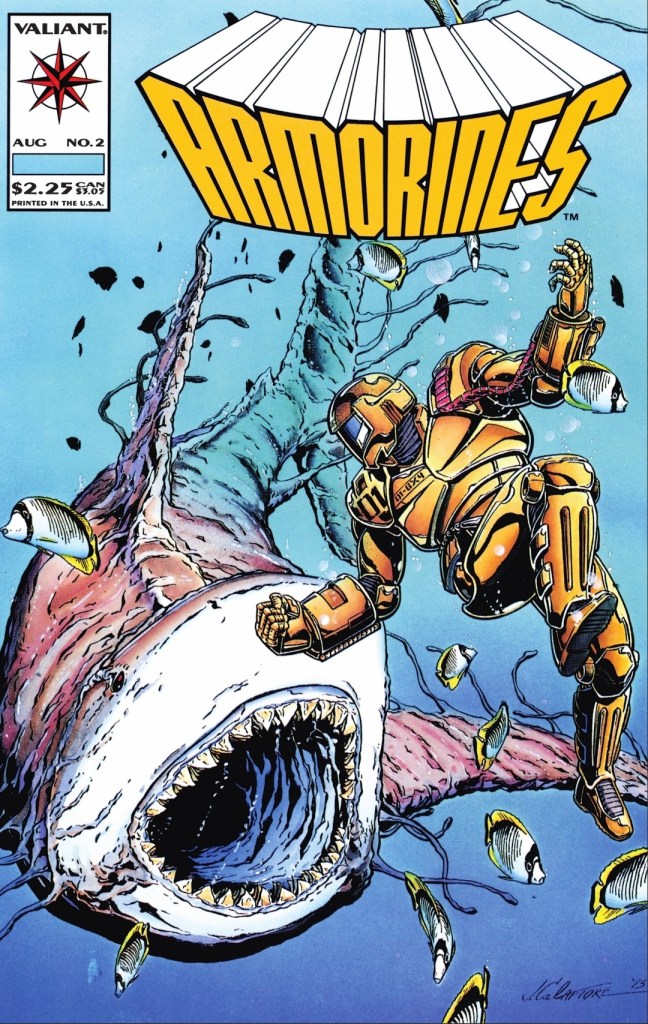
The cover.

Early story

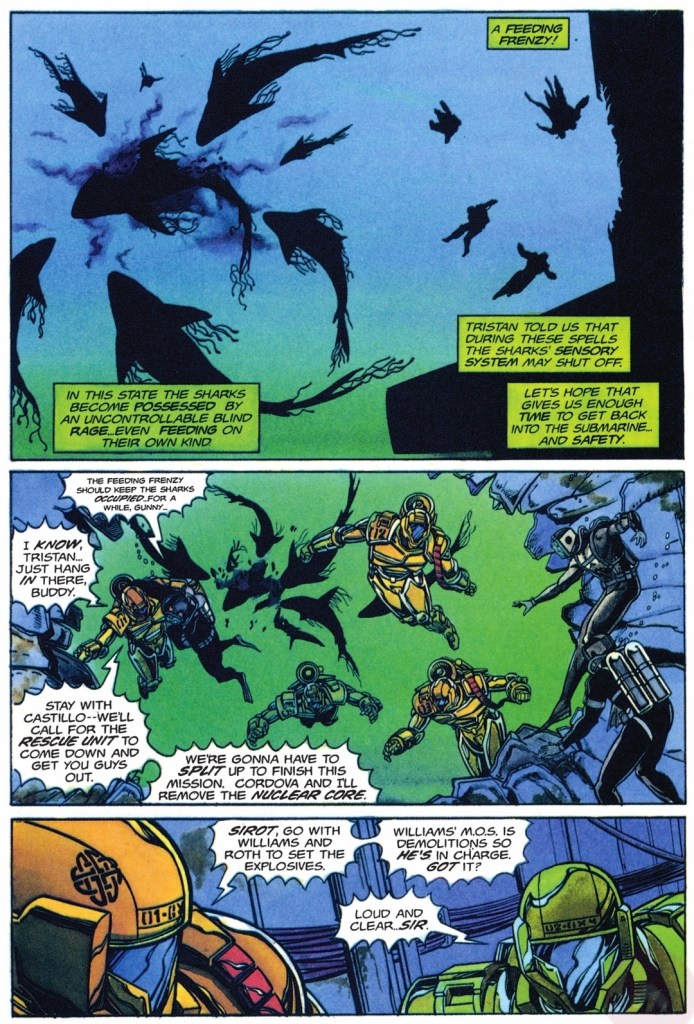
The story begins five hundred kilometers off the coast of Australia. Gunny, his armored teammates and the Navy SEALs are deep underwater on a mission at the sunken nuclear-powered submarine. They are being attacked by several large sharks that all have freakish and ruined surfaces. While the sharks don’t have any exceptional intelligence, they have lateralis systems that alert them to low-frequency vibrations and are able to detect the minute electric fields generated by the prey.

While the Armorines have energy weapons that can easily cut through flesh and hard objects, the sharks remained challenging to hit. They and the Navy SEALs struggle to keep together and focus on their mission…

Quality

Can you just imagine yourself working on a mission deep under the sea with lots of sharks swimming nearby?

As a direct follow-up to issue , this comic book shows more of what the Armorines can do on a mission even though their spotlight had to be shared with the Navy SEALs who are their partners on the mission involving the sunken submarine. The spectacle readers can look forward to here are the action scenes of the Armorines using their high-tech weapons against sharks that are many times larger than each of them. The focus of the story, unsurprisingly, is the mission inside the sunken submarine and the coordination between the armored US marines with the Navy SEALs. While there is no clear villain yet, this comic book’s script has effective writing behind it and the result is a plot that turned out to be engaging enough. If you are looking for character development, you won’t find it here.

Meanwhile, Jim Calafiore’s art really shines as he successfully implemented enough visual details on the characters, the sharks, the underwater environment and the interiors of the submarine. His art on the sharks are really monstrous to look at!

Conclusion

While the Armorines did not have to worry about being shot back, the huge size, speed and the unrelenting aggression by the freaking sharks still proved to be big challenges for them.

Armorines (1994) is indeed a solid continuation and progression to what came before it. While issue was mainly a build-up and introductory story, this one shows the Armorines in action on the line of duty while working in tandem with their Navy SEAL brothers. While the mission is the main subject of the story leaving no real room left for any character development, there were two twists (note: science fiction in nature) that added to the depth of the story. Safe to say, I am motivated enough to look forward to the next issue.

Overall, Armorines (1994) is recommended.

+++++

Thank you for reading. If you find this article engaging, please click the like button below, share this article to others and also please consider making a donation to support my publishing. If you are looking for a copywriter to create content for your special project or business, check out my services and my portfolio. Feel free to contact me with a private message. Also please feel free to visit my Facebook page Author Carlo Carrasco and follow me on Twitter at  @HavenorFantasy as well as on Tumblr at https://carlocarrasco.tumblr.com/ and on Instagram at https://www.instagram.com/authorcarlocarrasco