A Look Back at Sludge #11 (1994)

Disclaimer: This is my original work with details sourced from reading the comic book and doing personal research. Anyone who wants to use this article, in part or in whole, needs to secure first my permission and agree to cite me as the source and author. Let it be known that any unauthorized use of this article will constrain the author to pursue the remedies under R.A. No. 8293, the Revised Penal Code, and/or all applicable legal actions under the laws of the Philippines.

Welcome back, superhero fans, 1990s arts and culture enthusiasts and comic book collectors! Today we revisit the Ultraverse of Malibu Comics and examine one of its many stories told through an issue of the Sludge comic book series.

In my previous retro review, a more character-driven story about Sludge was told as the city crime war story has ended. What made issue #10’s story standout was the unexpected physical change Sludge goes through which is something he had desired apart from wanting death. Ironically, this made him more vulnerable to physical attacks. Needing help on something, he reaches out to the New York Daily Globe’s reporter Shelley Rogers.

With those details laid down, here is a look back at Sludge , published by Malibu Comics in 1994 with a story written by Steve Gerber and drawn by Robb Phipps.
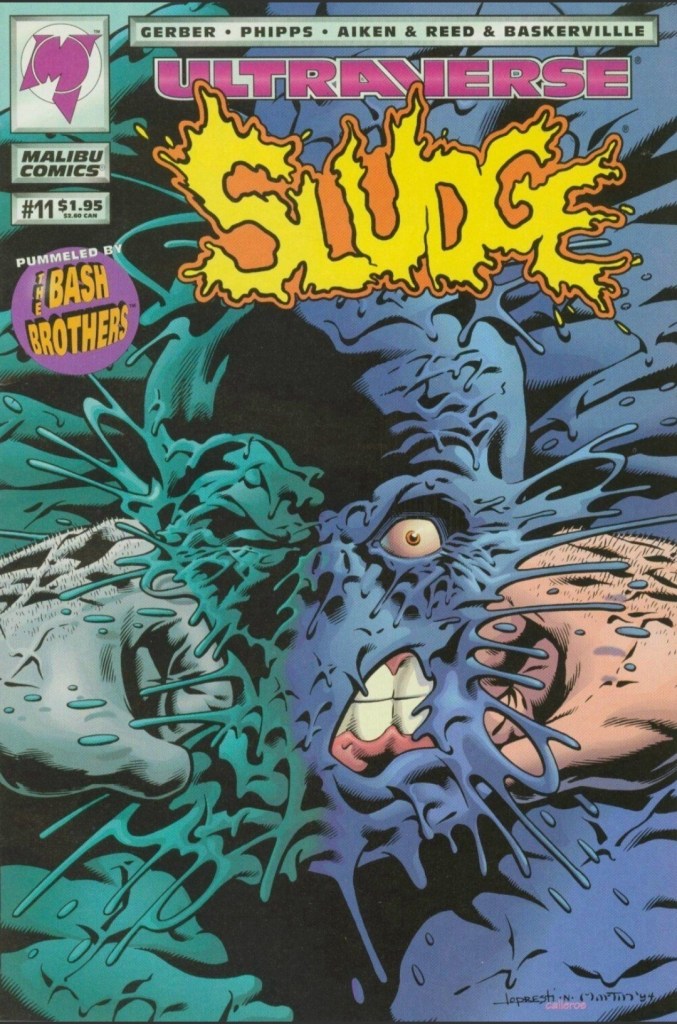
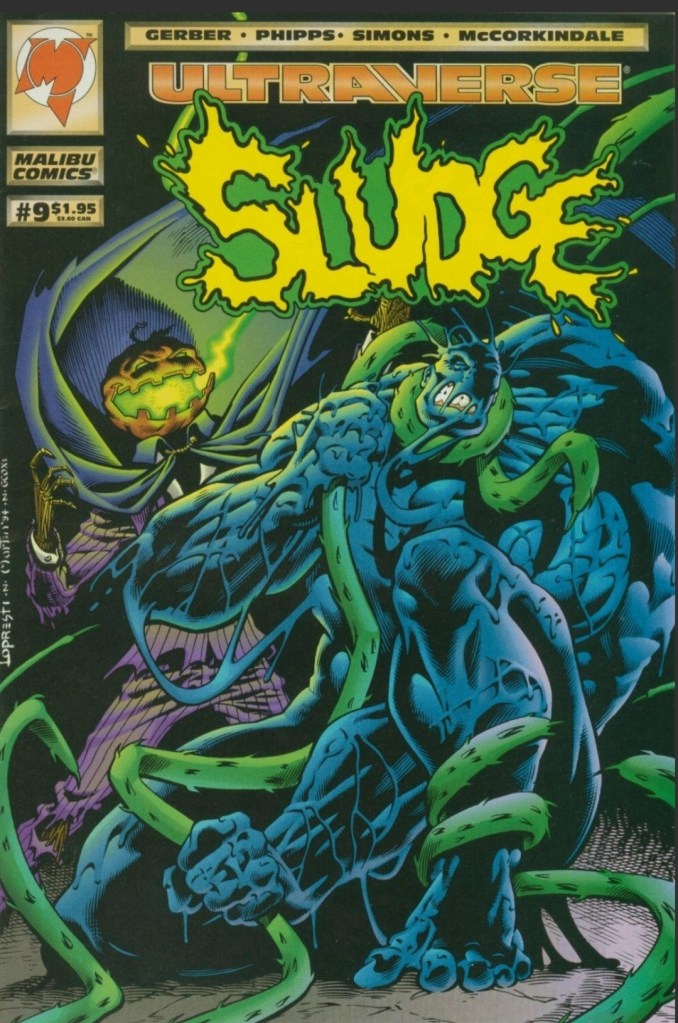
The cover.

Early story

The story begins with Sludge about to engage in a physical battle with the Bash Brothers just outside the Lalama Clinic. Shelley Rogers is just standing nearby. The Bash Brothers proved to be troublesome for Sludge until Shelley explains to one of them that their mother was not harmed. The said mother comes out and after an exchange of talk between them all, they realize Sludge needs the help of Dr. Ferdinand Lalama who was involved with the Caldwell Pharmaceuticals which itself was responsible for the stuff that affected Sludge in the first place.

Shelley then notices that Sludge is reverting back to his previous gooey state. At the same time, Dr. Lalama made no communication for almost a week…

Quality

Something wild is about to happen.

As a story that started with Sludge needing to find a specialist to help treat him, this one went wild with the fantasy concepts. Without spoiling the plot, this wild ride has strong science fiction elements such as energy streaming and traveling to another dimension through a portal. The sci-fi elements are indeed a factor that made this tale of the search of Dr. Lalama a really intriguing read.

With regards to the titular hero, this story encourages researching details of his origin (how he went from human into a chemical being) as well as reading issue . Sludge himself is more vulnerable than before and the unpredictable changes with him added suspense to the narrative. This story also contains themes of scientific experimentation and molecular manipulation which were nicely planted into the story’s sci-fi aspect. That being said, I can say that what was explained near the end of the comic book was both intriguing and worth reading.

Conclusion
A really interesting discussion here.

Sludge (1994) is indeed a really intriguing and entertaining read. Without spoiling anything, I can say that it cleverly answered questions about how Sludge came to be, what Zuke and a regeneration formula did to his state and what forces behind the pharmaceutical company took place that affected the titular character. This is really fitting as this comic book was the 2nd-to-the-last issue ever published. That being said, I can say that I am looking forward to what will be told in issue .

Overall, Sludge (1994) is highly recommended.

+++++

Thank you for reading. If you find this article engaging, please click the like button below, share this article to others and also please consider making a donation to support my publishing. If you are looking for a copywriter to create content for your special project or business, check out my services and my portfolio. Feel free to contact me with a private message. Also please feel free to visit my Facebook page Author Carlo Carrasco and follow me on Twitter at  @HavenorFantasy as well as on Tumblr at https://carlocarrasco.tumblr.com/ and on Instagram at https://www.instagram.com/authorcarlocarrasco
A Look Back at Exiles #2 (1993)

Disclaimer: This is my original work with details sourced from reading the comic book and doing personal research. Anyone who wants to use this article, in part or in whole, needs to secure first my permission and agree to cite me as the source and author. Let it be known that any unauthorized use of this article will constrain the author to pursue the remedies under R.A. No. 8293, the Revised Penal Code, and/or all applicable legal actions under the laws of the Philippines.

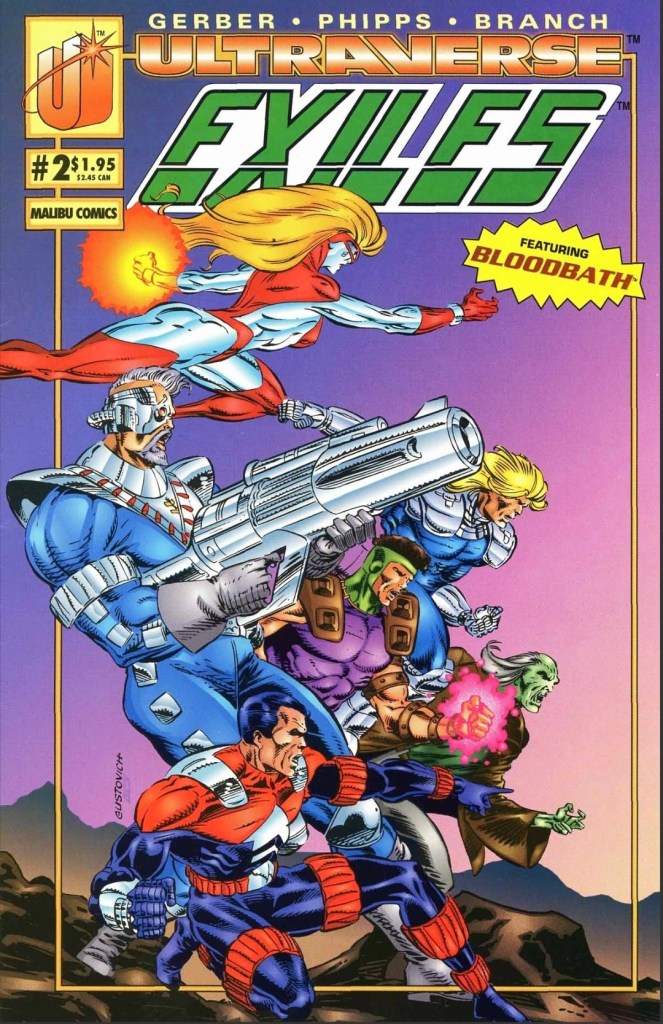
Welcome back superhero enthusiasts, 1990s culture enthusiasts and comic book collectors! Today we go back to the mid-1990s which was a really wild time for comic collectors. To be more specific, this newest retro comic book review revisits Ultraverse through the very short series titled Exiles.

It has been years since I reviewed Exiles #1 (1993). Since after, I reviewed a lot of Ultraverse comic books and went through notable storylines such as the Atalon Saga in UltraForce, the Hostile Takeover in Prototype, The Solution, The Night Man and Solitaire, and more. That being said, it was just right that I returned to Exiles for retro reviewing.

With those details laid down, here is a look back Exiles , published in 1993 by Malibu Comics with a story written by Steve Gerber and drawn by Robb Phipps.

The cover.

Early story

The story begins with Exiles members Catapult and Mustang staring at two bodies (a large man and a lady) on the floor. It turns out their mission was a failure as Timmy Halloran (the young guy they tried to save) went missing while his mother just died.

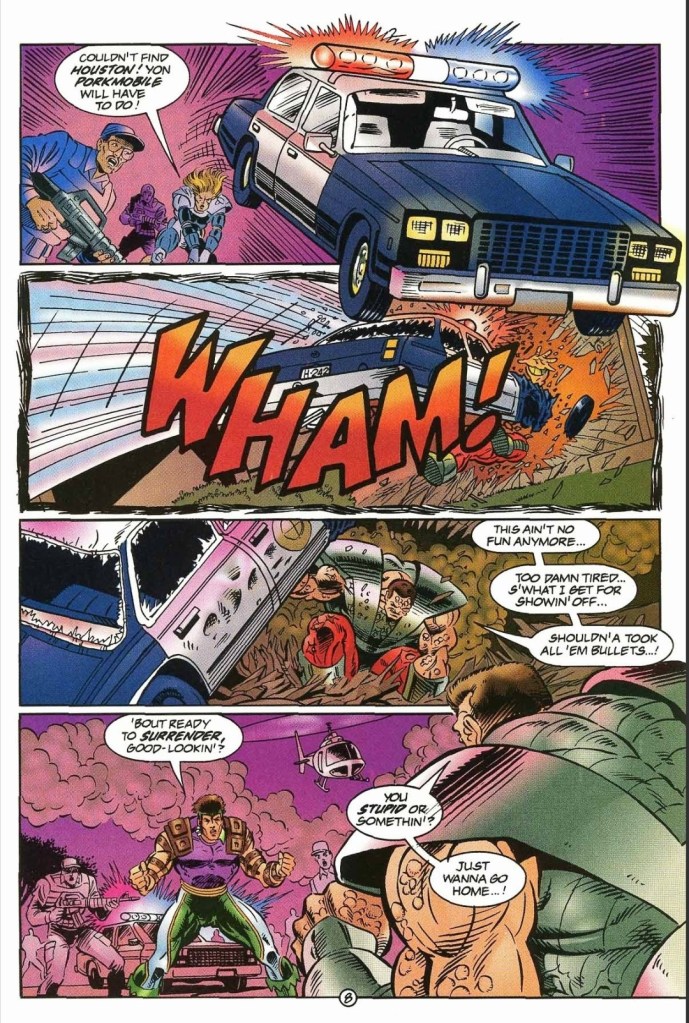
As soon as the two step out of the house feeling bad about their failure, they suddenly find themselves confronted by several police officers. Police cars and a helicopter have surrounded the place. Just as Catapult and Mustang turned themselves in, the large man named Bruut suddenly regains consciousness and attacks the police.

The police officers respond by firing several bullets at Bruut which slowed him down. After noticing that Bruut was only regaining his strength, the two Exile members made their moves before the large man strikes the police…

Quality

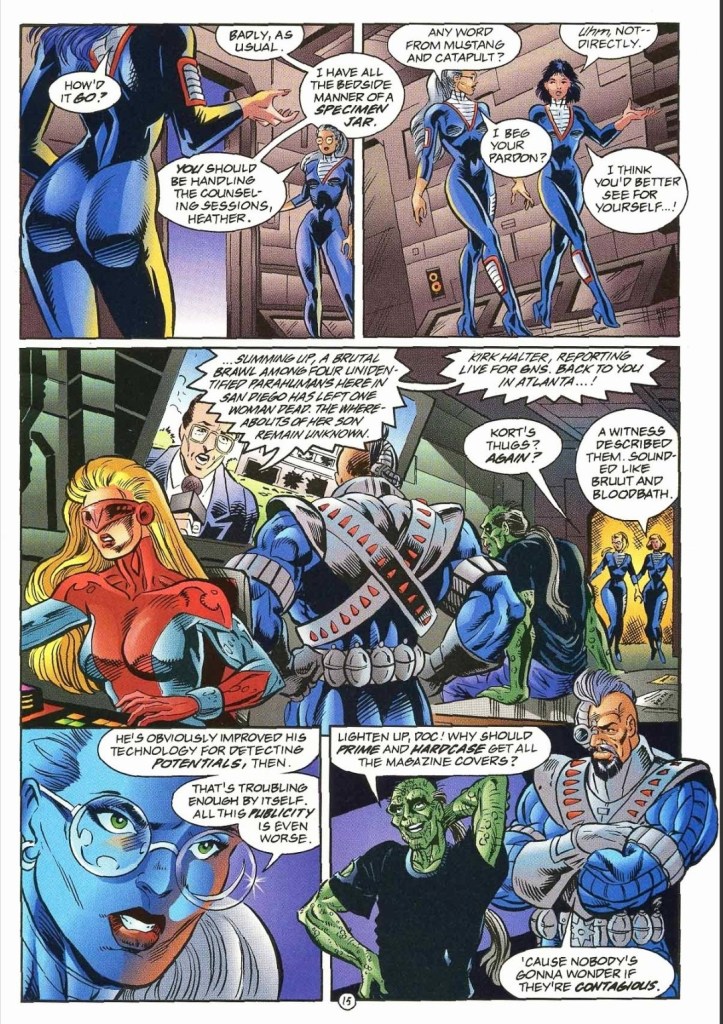
Inside the headquarters of Exiles. Ghoul’s mentioning of Prime and Hardcase seems to foreshadow his eventual part in UltraForce.

As expected, the storytelling in this comic book really progressed and paid off some of the build-up that happened in issue . Here, the conflict between the Exiles and the enhanced forces of business tycoon Victor Kort got clearly defined and what they have in common other than having enhanced beings is their pursuit of individuals who carry within their bodies the Theta virus which unlocks unexpected powers or capabilities. Such developments could impact the people and the world around them when left unguarded or deliberately developed with assistance of guidance.

Amber, who was a key figure in issue , appears much less in this comic book but her purpose with the Exiles gets more elaborated. The lack of spotlight on Amber is not surprising as the creators had to emphasize the conflict between the titular team and Kort’s forces while also introducing Timmy Halloran as a new Theta-carrying individual.

There is a good amount of superhero spectacle here and along the way, the dialogue is good and got witty as well. By the time I reached the end, I found myself anticipating what would come next in issue .

Conclusion

The two Exiles members take on Bruut right in the presence of police officers.

Exiles (1993) is a worthy follow-up to its predecessor and the creators succeeded in making the conflict more engaging while cleverly releasing new details that defined what is at stake and what could follow. In retrospect, Amber Hunt later became a key figure in the 2-part Break-Thru crossover storyline (which was memorably drawn by the late George Perez) and the story here defined how much impact super beings can have on societies filled with mostly people who don’t have super powers or special talents. The conflict between the Exiles and Kort’s forces not only got emphasized a lot, their respective agendas and resources are also well defined.

Overall, Exiles (1993) is recommended.

+++++

Thank you for reading. If you find this article engaging, please click the like button below and also please consider sharing this article to others. If you are looking for a copywriter to create content for your special project or business, check out my services and my portfolio. Feel free to contact me with a private message. Also please feel free to visit my Facebook page Author Carlo Carrasco and follow me on Twitter at  @HavenorFantasy as well as on Tumblr at https://carlocarrasco.tumblr.com/ and on Instagram at https://www.instagram.com/authorcarlocarrasco/

A Look Back at Sludge #10 (1994)

Disclaimer: This is my original work with details sourced from reading the comic book and doing personal research. Anyone who wants to use this article, in part or in whole, needs to secure first my permission and agree to cite me as the source and author. Let it be known that any unauthorized use of this article will constrain the author to pursue the remedies under R.A. No. 8293, the Revised Penal Code, and/or all applicable legal actions under the laws of the Philippines.

Welcome back, superhero fans, 1990s arts and culture enthusiasts and comic book collectors! Today we revisit the Ultraverse of Malibu Comics and examine one of its many stories told through an issue of the Sludge comic book series.

In my previous retro review, the “Street Wars” storyline came to a solid and even shocking end which ultimately left Sludge free and yet desperate and unfulfilled. At this stage, Sludge is clearly a very lost soul and this opens another opportunity for readers to follow him and see where he will go next.

With those details laid down, here is a look back at Sludge , published by Malibu Comics in 1994 with a story written by Steve Gerber and drawn by Robb Phipps.

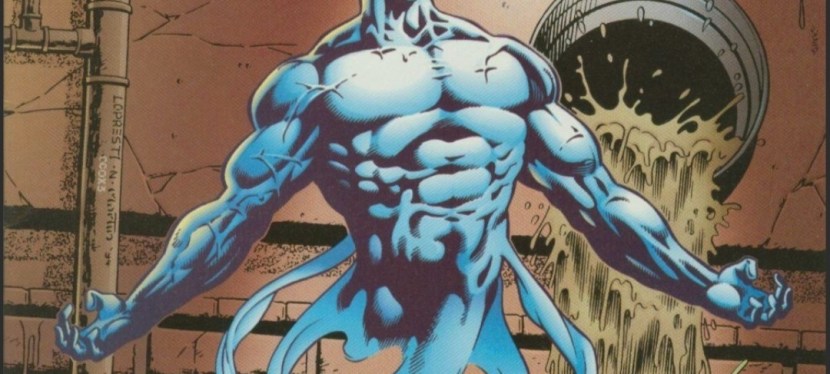
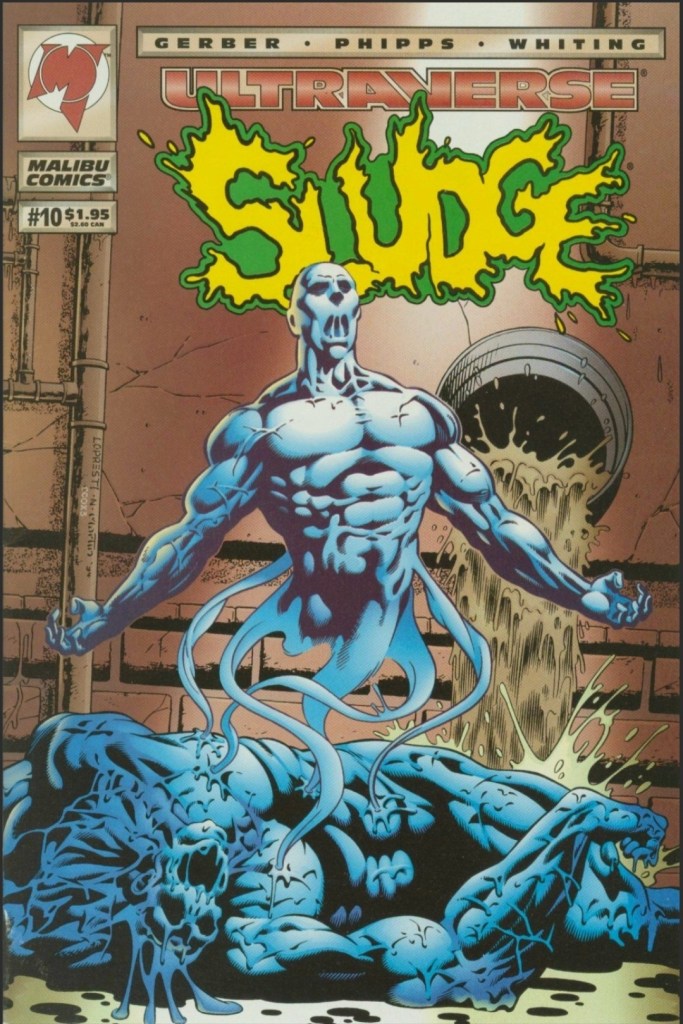
The cover.

Early story

The story begins with Sludge once again alone in the sewers. This time, he holds large quantities of the illegal substance Zuke which he believes will help him achieve something he desires in relation to his existence. Life has been very hard for him since he became a slimy creature.

Then he remembers when the mercenary Bloodstorm was forced fed with Zuke. Afterwards, he consumes the large Zuke containers expecting them to fix him. Nothing happened. No instant results whatsoever which frustrates him. Sludge then walks into the darkness.

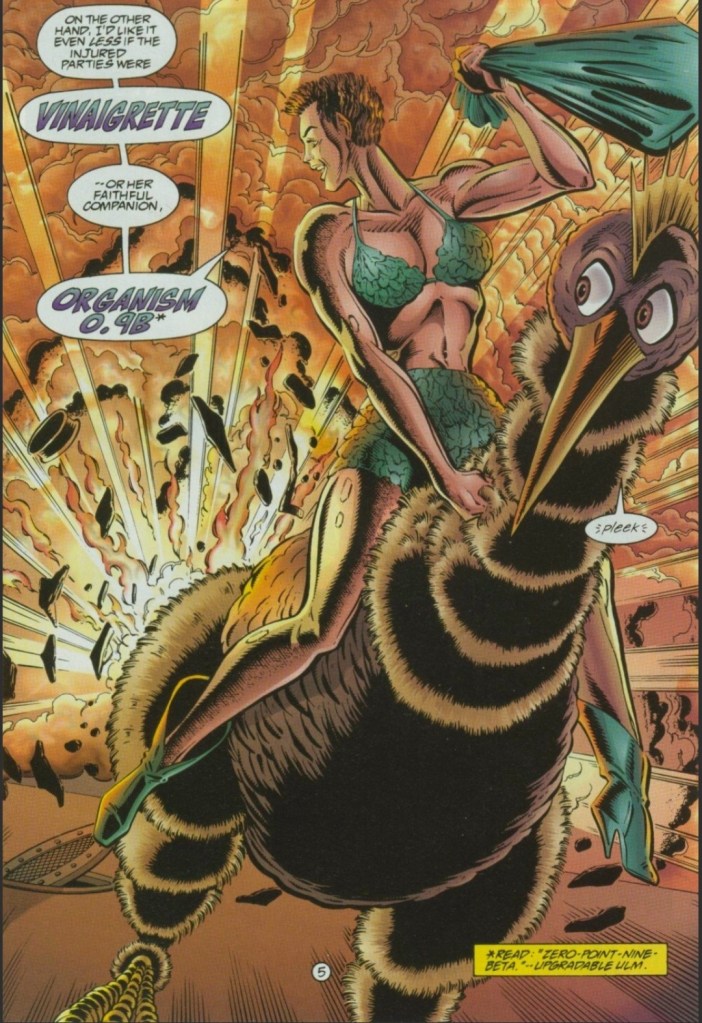
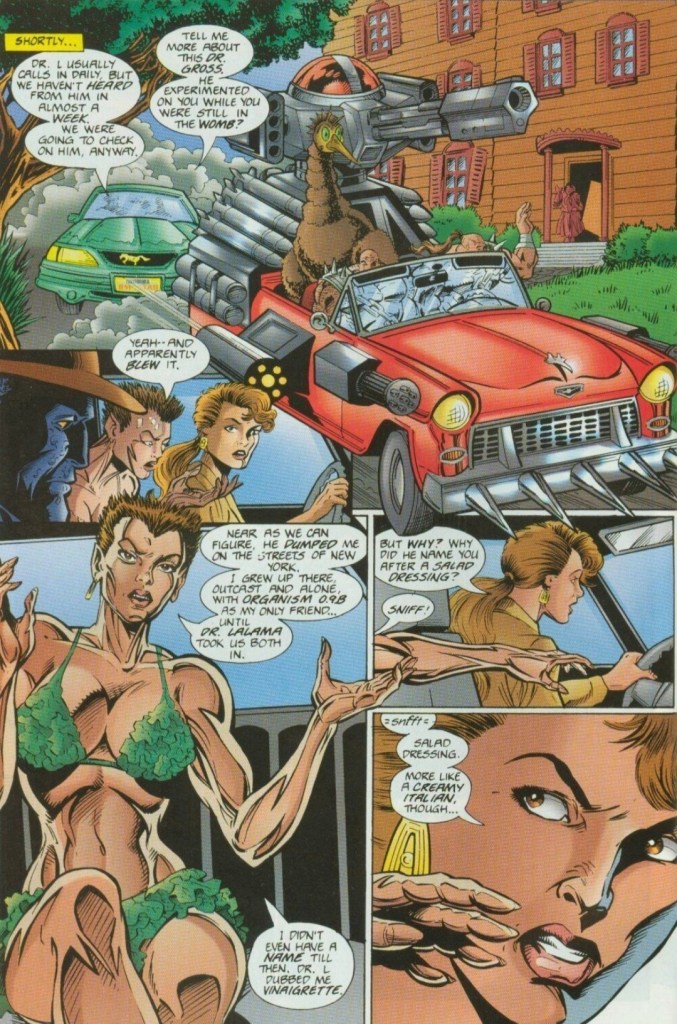
On the city street, police officers in cars chase an unusual target…a lady riding a large bird of unknown species. After causing her pursuers to crash and explode, the lady rider reveals herself to be Vinaigrette.

Just as Vinaigrette and her speedy bird move into an alley, Sludge sees them…

Quality

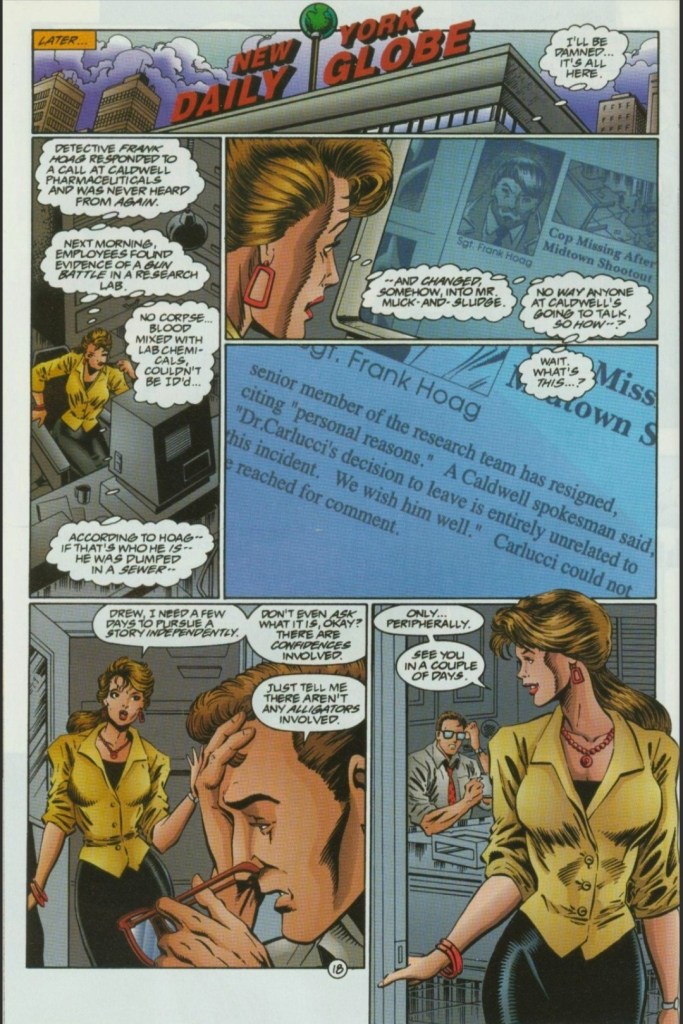
Investigative journalism being done.

When it comes to the story, I can say that the Sludge series really made a serious turn towards a different direction here. Without spoiling the rest of the plot, I can say that very significant changes await readers, so much so their usual expectations towards Sludge become unnecessary. Are you so used to seeing Sludge think or talk inconsistently? Be ready for something really new about him, something that makes him more human moving a bit closer to his past life as a civilian.

Moreover, with the gang war aspect of New York already out of the narrative, this comic book not only follows Sludge more significantly, its story is also more character-driven than before. What Steve Gerber wrote here is very nicely structured and it is also clear he also adjusted his portrayal of the titular character to give readers something fresh and yet familiar to follow.

So what kind of story does this comic book present other than being a more character-driven piece? Definitely it’s not a monster story nor a superhero tale but something more of a misadventure mixed with elements of detective story plus a bit of investigative journalism (mainly due to the series’ notable lady journalist).

Conclusion

A lady and her speedy ride.

In my view, Sludge (1994) is a successful attempt by the creative team to emphasize Sludge’s exploits and personality even more while taking a new direction without ever feeling alienating. I should state that after reading back-to-back issues about the New York gang war which had the titular character caught in the middle, this comic book’s character-driven approach with Sludge is literally like a breath of fresh air. Not only will you see even more of Sludge, you will also enjoy the creators’ attempt on exploring his past life while showing lots of significant new things in connection to the changes he goes through. The story is nicely paced, the storytelling is creatively stylized and there are nice pay-offs for each build-up.

Overall, Sludge (1994) is highly recommended.

+++++

Thank you for reading. If you find this article engaging, please click the like button below and also please consider sharing this article to others. If you are looking for a copywriter to create content for your special project or business, check out my services and my portfolio. Feel free to contact me with a private message. Also please feel free to visit my Facebook page Author Carlo Carrasco and follow me on Twitter at  @HavenorFantasy as well as on Tumblr at https://carlocarrasco.tumblr.com/ and on Instagram at https://www.instagram.com/authorcarlocarrasco/

A Look Back at Sludge #9 (1994)

Disclaimer: This is my original work with details sourced from reading the comic book and doing personal research. Anyone who wants to use this article, in part or in whole, needs to secure first my permission and agree to cite me as the source and author. Let it be known that any unauthorized use of this article will constrain the author to pursue the remedies under R.A. No. 8293, the Revised Penal Code, and/or all applicable legal actions under the laws of the Philippines.

Welcome back, superhero fans, 1990s arts and culture enthusiasts and comic book collectors! Today we revisit the Ultraverse of Malibu Comics and examine one of its many stories told through an issue of the Sludge comic book series.

In my previous Sludge retro review, the conflict between the crime organizations intensified as the titular character continued to struggle with achieving his desired goal which includes getting involved with the Pump’s evil schemes. Eventually something unexpected happened Sludge which involved Zuke, the potent illegal substance the Pump keeps on unleashing to the public.

With those details laid down, here is a look back at Sludge , published by Malibu Comics in 1994 with a story written by Steve Gerber and drawn by Robb Phipps.

The cover.

Early story

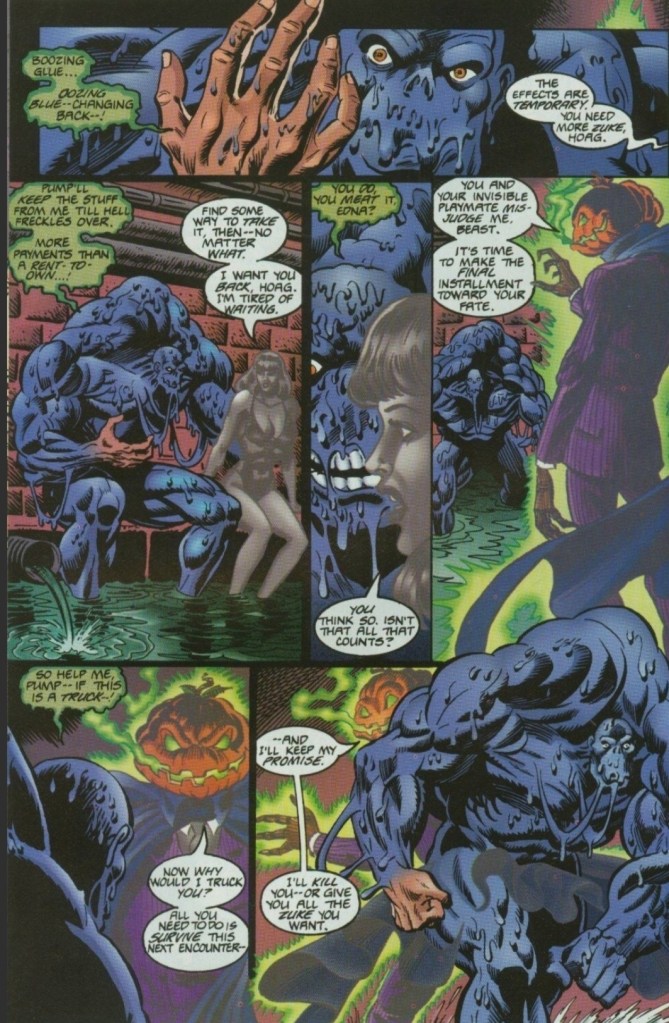
The story begins with Sludge in pain as he pulls out a long spike from his right hand which became flesh again. This was the result of his holding Zuke which his right hand somehow absorbed. Wanting answers, he calls out to the Pump who (along with his teenage protégé) was no longer present in the room. A female ghost appears to Sludge and tells him that the crime boss is downstairs.

It turns out, the Pump has an evil plan in mind which would involve the mercenary Bloodstorm. The crime boss puts a very large capsule of Zuke into the mouth of the restrained Bloodstorm. Just as Sludge arrives, Bloodstorm becomes very enraged as a result of absorbing a high quantity of the illegal substance. Shortly after Pump quells the drugged mercenary, Sludge approaches him for more Zuke as he is convinced that the drug will turn him to normal just like how it turned his right hand back to normal.

The Pump orders Sludge to take Bloodstorm’s body back to his employer Sabatini then return. He reminds him that he has the Zuke and is capable of eradicating him…

Quality

Sludge has yet to realize he could really go up against the very evil Pump.

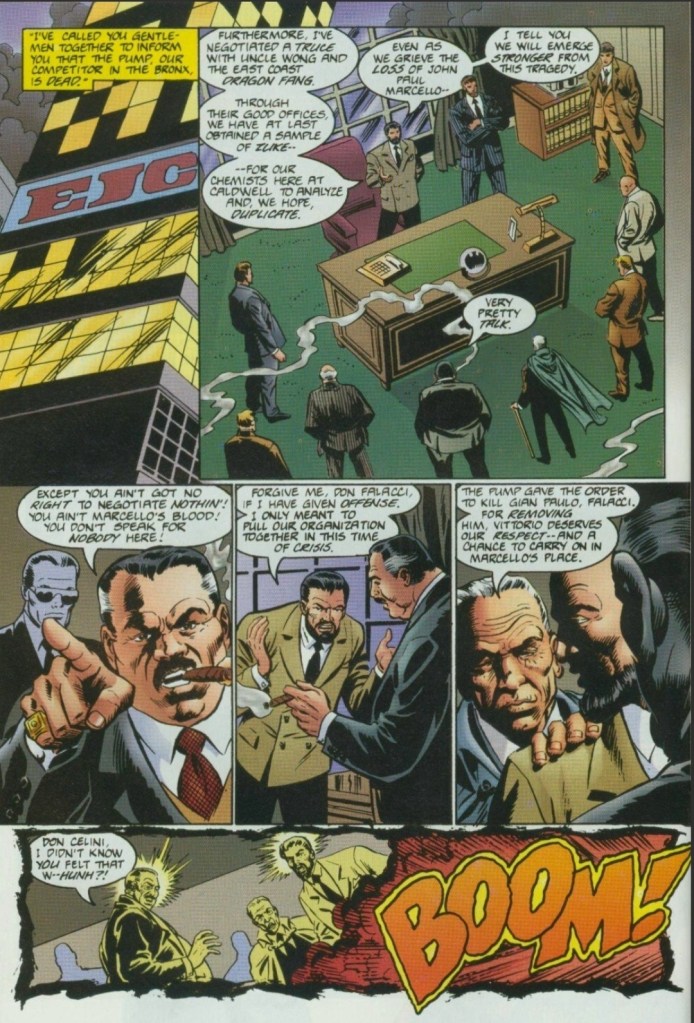
Now this is the most intriguing tale of Sludge in relation to the unstable relations between the gangs of New York. Vittorio, the one trusted assistant of the late crime boss Marcello, leads the gang and tries to craft a new direction with emergence in mind by negotiating a truce with the Dragon Fang while also starting efforts to duplicate the very addicting substance called Zuke which has long been an asset to the Pump’s gang. Unsurprisingly, Vittorio encounters trouble trying to win the trust of the more established crime bosses and he is also unaware that they are all being targeted by the Pump.

Once the Pump unleashes his newest move against the gangs, the situation intensifies and gets twisted which makes this a really solid reading experience. Steve Gerber crafted this story to be intense and unpredictable at the same time, while also showing how Sludge deals with his situation being powerless under the Pump. There is one notable addition to the plot which involves violent action which you must discover for yourselves.

When it comes to the visuals, Robb Phipps take on Sludge is vastly different compared to Aaron Lopresti’s Sludge. The result is that Phipps’ art style made Sludge and the other characters have that cartoony aesthetic and yet they are still recognizable. What visual style and elements Phipps had on certain issues of Mantra he illustrated (click here, here and here) are pretty much present in this comic book.  

Conclusion

A high-stakes meeting disrupted.

Sludge (1994) is another solid read and one of the most intriguing stories of the Sludge series. As the concluding chapter of the “Street Wars” storyline, this comic book has the usual elements that defined Sludge stories while also succeeding in moving the plot forward (note: the storyline conclusion is engaging, even shocking) complete with twists and noticeable intensified violence. At this point in the monthly series, Sludge is off on a path of despair and he is clearly lost. This element alone should compel readers to examine Sludge’s personality closely and analyze where he is heading to and what purpose does he have left.

Overall, Sludge (1994) is recommended.

+++++

Thank you for reading. If you find this article engaging, please click the like button below and also please consider sharing this article to others. If you are looking for a copywriter to create content for your special project or business, check out my services and my portfolio. Feel free to contact me with a private message. Also please feel free to visit my Facebook page Author Carlo Carrasco and follow me on Twitter at  @HavenorFantasy as well as on Tumblr at https://carlocarrasco.tumblr.com/ and on Instagram at https://www.instagram.com/authorcarlocarrasco/

A Look Back at Mantra #11 (1994)

Disclaimer: This is my original work with details sourced from reading the comic book and doing personal research. Anyone who wants to use this article, in part or in whole, needs to secure first my permission and agree to cite me as the source and author. Let it be known that any unauthorized use of this article will constrain the author to pursue the remedies under R.A. No. 8293, the Revised Penal Code, and/or all applicable legal actions under the laws of the Philippines.

Welcome back, superhero geeks, comic collectors and fans of the Ultraverse! We are about to return to the Ultraverse through the view of Mantra. Since the story of issue #9 and issue #10, the stakes have been raised as Mantra not only found herself in bigger danger as well as revelations from the past related to the long-time war between Archimage and Boneyard. Not only is Mantra still being targeted by Boneyard (who is so evil he wants to marry Mantra and make love to her body even though he knows the soul of the male warrior Lukasz is occupying it) but also by sorcerers from the Earth’s realm. In other words, Mantra/Lukasz really has trouble in different realms.

Will something unexpected turn out in the next story of Mantra? We can find out in this look back at Mantra , published in 1994 by Malibu Comics with a story written by Mike W. Barr and drawn by Robb Phipps.

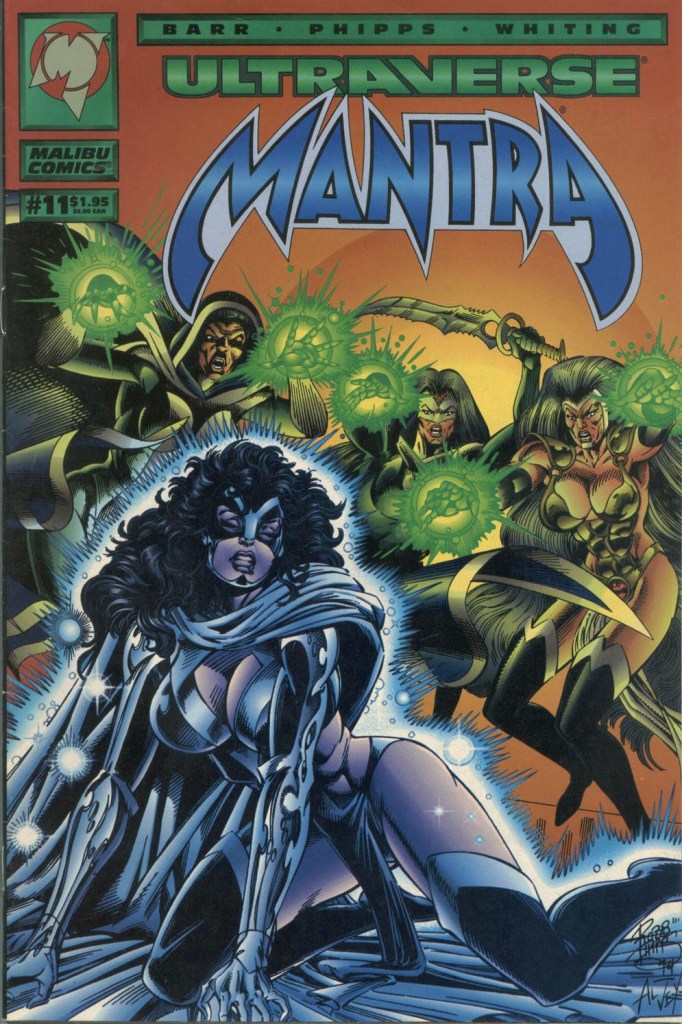
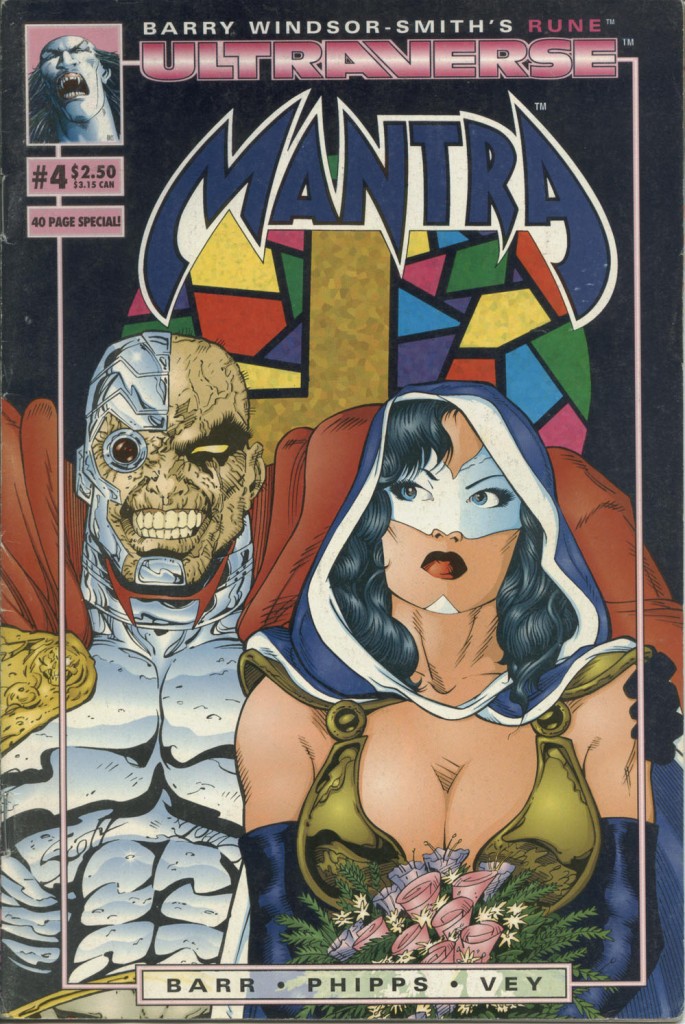
The cover.

Early story

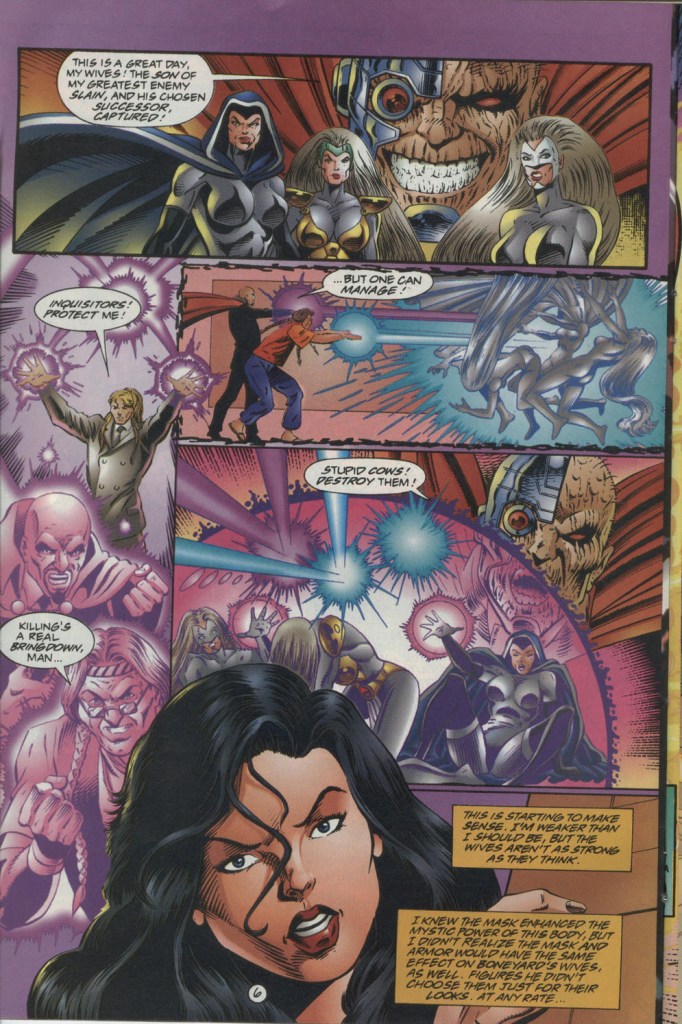
The story begins with Mantra standing completely naked in the full view of Boneyard, his three wives and the four other thugs (who hunted Mantra). Boneyard states, “Your choices are clear, Lukasz—surrender to me and become first among equals in my harem…or be destroyed by my wives—whose powers now equal yours!”

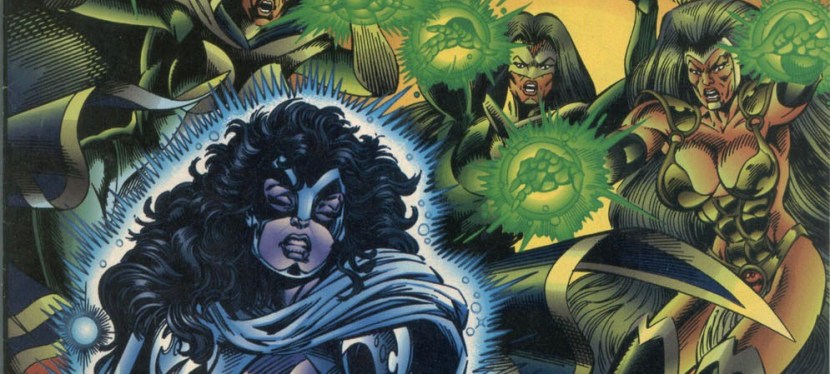
Suddenly the three wives fire beams of energy towards Mantra who successfully blocks them using magic to create a transparent shield. Very quickly, Mantra sees an opportunity to get the other thugs involved as targets of the three wives so she moves toward her previous attackers. The three wives’ attacks cause the thugs to retreat. Boneyard recognizes one of the thugs as the son of his rival Archimage.

Suddenly, the thugs attack Boneyard’s three wives with energy causing them to fall down on the floor. As the conflict shifted, Mantra begins to realize something.

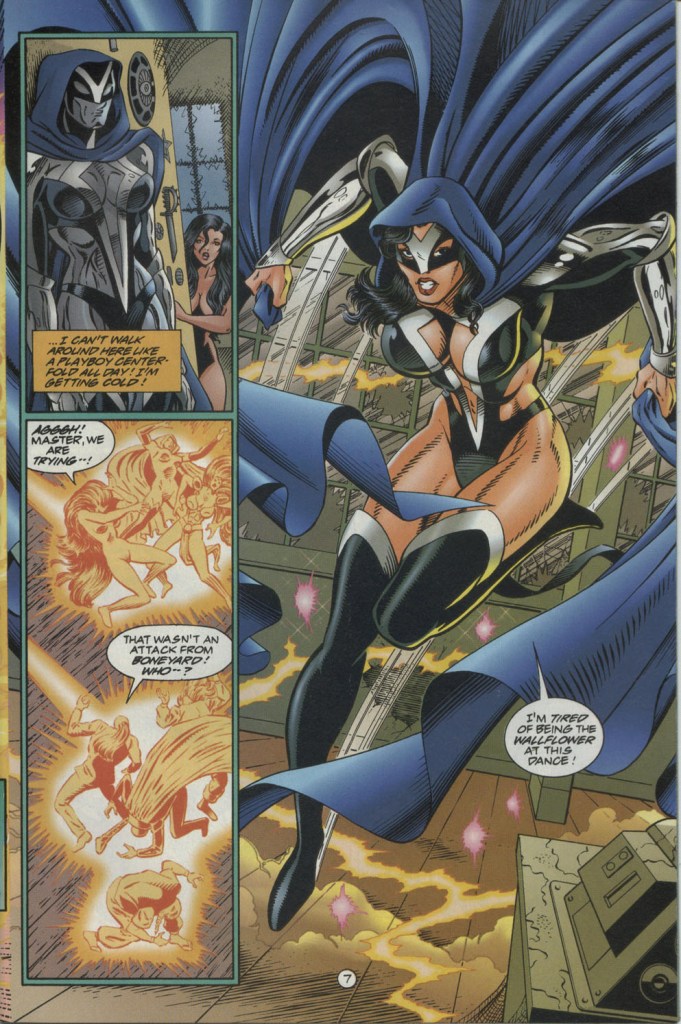
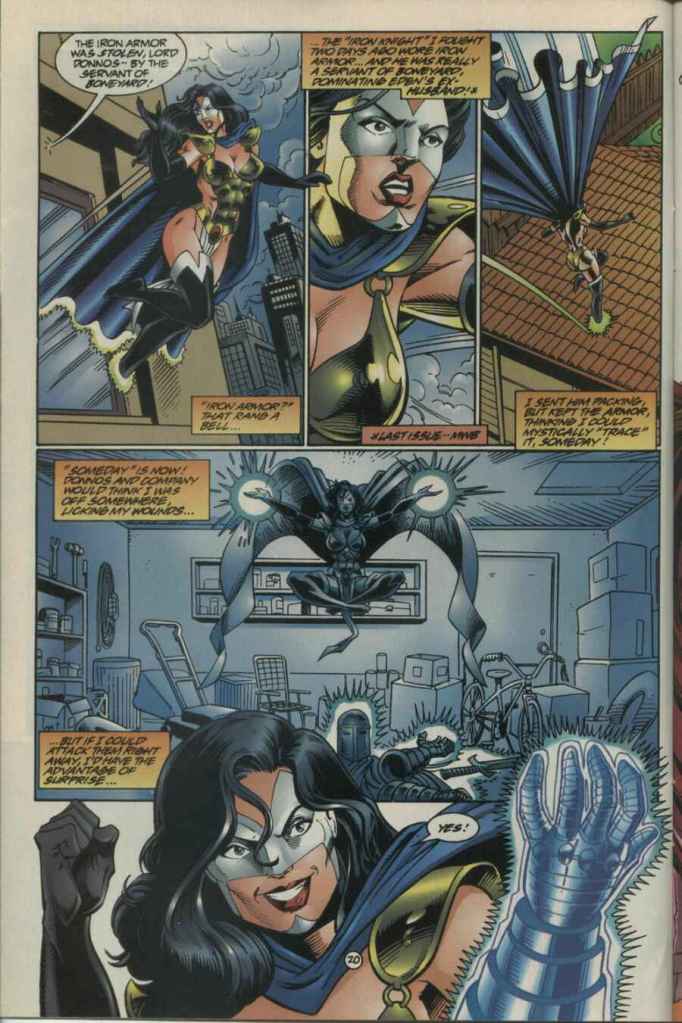
“I knew the mask enhance the mystic power of this body, but I didn’t realize the mask and armor would have the same effect on Boneyard’s wives as well. Figures he didn’t choose them just for their looks. At any rate…I can’t walk around here like a Playboy centerfold all day! I’m getting cold,” Mantra thought.

Quality

This is the first time Mantra wore a new costume which was carried over to issue .

No surprise, Mike W. Barr successfully kept the story engaging not only maintaining the engagement carried over from the few previous issues but by raising the stakes for Mantra personally while pulling off some pretty notable revelations that date back before the events of issue . Going beyond Boneyard and his three wives, there is a lot of fantasy related stuff waiting to be discovered which further adds depth to Mantra’s struggle (finding a male body to occupy and the ways to leave Eden Blake’s body). The plot really thickened with the revelations and how they turned out is something that you yourselves must pick up a copy of this comic book and read.

Of course, having reviewed issue #12 recently, it is no surprise that the build-up of engagement and suspense in this comic book contributed to its successor. More importantly, by the time you reach the end of this comic book, you will get a deeper understanding of what has been going and what preceded them. Clearly Mike W. Barr made solid preparations and took his time with the revelations just as he kept on telling the present-day story of Mantra.

Like the previous issue, I enjoyed Robb Phipps’ artwork here. If you were disappointed with the cartoony aesthetic of Terry Dodson’s work in issue , you will like the expressions as well as the overall style of Phipps.

Conclusion

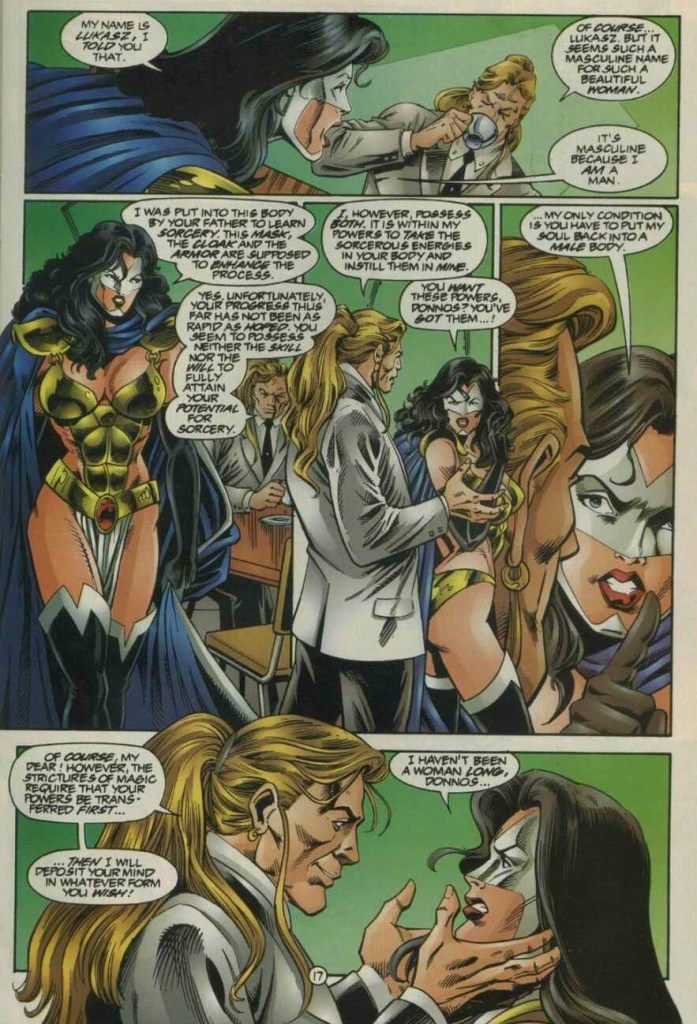
With a male soul inside the body of Eden Blake, Mantra quickly analyzes the messy situation to find an advantage.

Mantra (1994) is indeed a pretty entertaining and compelling Ultraverse comic book. There is nothing like watching the spectacle happen in between moments of Mantra realizing answers to her questions, and learning new details (including stuff that emphasized how rotten, how wicked and twisted Boneyard truly is as the major villain of not only this particular series but also of the Ultraverse itself) that deepened the narrative for readers.

If you are seriously planning to buy an existing hard copy of Mantra (1994), be aware that as of this writing, MileHighComics.com shows that the near-mint copy of the comic book costs $8.

Overall, Mantra (1994) is recommended.

+++++

Thank you for reading. If you find this article engaging, please click the like button below and also please consider sharing this article to others. If you are looking for a copywriter to create content for your special project or business, check out my services and my portfolio. Feel free to contact me as well. Also please feel free to visit my Facebook page Author Carlo Carrasco and follow me at HavenorFantasy@twitter.com

A Look Back at Mantra #10 (1994)

Disclaimer: This is my original work with details sourced from reading the comic book and doing personal research. Anyone who wants to use this article, in part or in whole, needs to secure first my permission and agree to cite me as the source and author. Let it be known that any unauthorized use of this article will constrain the author to pursue the remedies under R.A. No. 8293, the Revised Penal Code, and/or all applicable legal actions under the laws of the Philippines.

Welcome back superhero enthusiasts, comic book collectors and fans of the Ultraverse! We are about continue the retro review of comics from the Mantra monthly series. Previously, details and a close friend of Eden Blake from her past came back which obviously caught Lukasz (the male warrior occupying Eden’s body since issue #1) off-guard and added further pressure on him. And then something happened during the wedding of that close friend which compelled Mantra to fight someone in armor which eventually led to some revelations.

What will happen next to Mantra? We can all find out in this look back at Mantra , published in 1994 by Malibu Comics with a story written by Mike W. Barr and illustrated by Rob Phipps (who illustrated Mantra #4). This comic book is another one of those flip-side comics with the other side being Ultraverse Premiere which contains short stories within the Ultraverse.

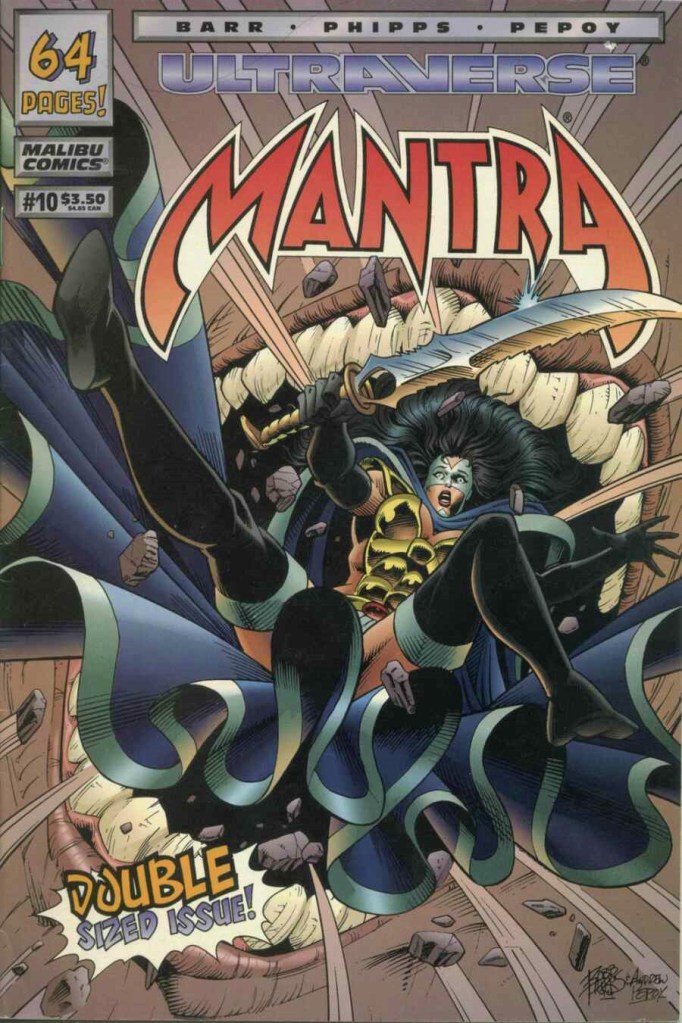
The cover.

Early story

The story begins in the middle of a city when a man arrives at his office at a place called the Conjurirs’ Club. Upon entering, he is surprised to see three sinister looking men and one of them identifies him by his name – Edgar Strauss. Refusing to give in to them, Strauss puts up a seraphic shield. One of the magic users hits Strauss with force pushing him into his office chair. A servant of Strauss comes into the office but is confronted by another man with a hideous looking chest. Strauss suddenly gets overwhelmed with visions. In response to his question, the three men wanted information about Mantra whom they describe to be a witch.

Over at the Blake residence, Lukasz/Eden wakes up after having a very disturbing dream. It turns out, the dream had been repeating. Looking at the mirror, he sees Eden’s face and thought to himself: Still, it’s not much worse than my life which is a nightmare. I’m a warrior. I should be fighting the foes of Archimage with broadswords and mace…instead I was reincarnated as a woman – Eden, a housewife…worse, a housewife with kids!

After going through the morning traditions of feeding Eden’s son and daughter, sending them to school and getting dressed for work, he reports to work at the office inside the highly secured facility of Aladdin in southern California. While working as Eden, Lukasz uses magic to access the digital files via the computer. Suddenly, someone touches his shoulder from behind…

Quality

Mantra using a piece of the armor that the antagonist in issue used.

I’ll start first with the art. Robb Phipps, like his previous Mantra work, delivered a fine job visualizing the script with a smooth pace, drawing spectacle nicely and making Mantra and the established characters look recognizable. I also like the way the artist drew facial expressions.

When it comes to the story, this one is even more intriguing and surprising than issue . The startling revelations from Lukasz’s past and his history with his tribe under Archimage expanded further here and this added more to the conflict with Boneyard. These revelations confirmed that not everything in the Archimage-Boneyard war is as simple as black and white. When it comes to characterization, Mike W. Barr really developed Lukasz in Eden’s body further and it was pretty notable to see Lukasz (who was oriented to fight with weapon instead of magic) become more adjusted using magic more proficiently while getting around the physical weakness of the lady’s body he is occupying.

As mentioned before, sorcery is an abomination in Christianity and this comic book further adds elements of the occult into the narrative. There was even a short scene of Boneyard (himself an abomination) in a location that looks like Hell.

Conclusion

Homosexuality hinted on the part of the man? Insanity perhaps?

If I were to describe Mantra (1994), it’s an obvious shift to more fantasy and sorcery elements than the previous issues. It certainly is not a tale about good-versus-evil because Mantra is not exactly innocent (note: Lukasz is an established killer and has displaced so many people’s lives) even when compared to Boneyard. Technically, Boneyard is pretty much the Ultraverse version of Satan.

If you are seriously planning to buy an existing hard copy of Mantra (1994), be aware that as of this writing, MileHighComics.com shows that the near-mint copy of the comic book costs $12.

Overall, Mantra (1994) is satisfactory.

+++++

Thank you for reading. If you find this article engaging, please click the like button below and also please consider sharing this article to others. If you are looking for a copywriter to create content for your special project or business, check out my services and my portfolio. Feel free to contact me as well. Also please feel free to visit my Facebook page Author Carlo Carrasco and follow me at HavenorFantasy@twitter.com

A Look Back at Mantra #4 (1993)

Disclaimer: This is my original work with details sourced from reading the comic book and doing personal research. Anyone who wants to use this article, in part or in whole, needs to secure first my permission and agree to cite me as the source and author. Let it be known that any unauthorized use of this article will constrain the author to pursue the remedies under R.A. No. 8293, the Revised Penal Code, and/or all applicable legal actions under the laws of the Philippines.

Welcome back Ultraverse fans, geeks and fellow comic book collectors! If you want to discover more of the fantasy elements within the Ultraverse through Mantra – the pretty sorceress whose body is occupied by the soul of a male warrior named Lukasz – then you are in for something rather different.

To put things in perspective, the fantasy-swords-magic concept was made clear in Mantra #1 and that Lukasz and his band of warriors (led by an elder sorcerer) as well as their enemies (led by Boneyard) were definitely from another world. That other world will be explored at last in this look back at Mantra , published in 1993 by Malibu Comics with a story written by Mike W. Barr and drawn by Robb Phipps.

The cover.

Early story

The story begins in the world of Boneyard, at his castle specifically. Down on her knees, Mantra is just in front of the villain Boneyard who says, “So this is Archimage’s last, best hope. Just a woman!!”

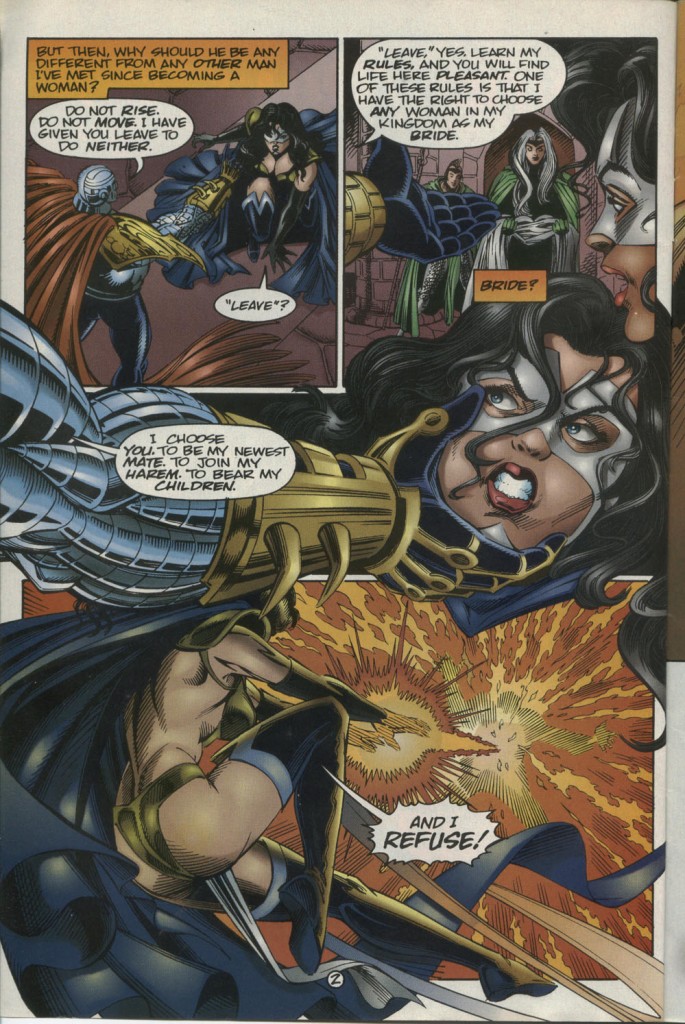
Boneyard tells Mantra not to rise nor move. As he does not yet know that Lukasz is inside Mantra’s body, Boneyard welcomes her and states that it is his right to choose any woman in his kingdom as his bride. In reaction to being selected as Boneyard’s newest mate with a purpose to potentially give birth to his children, Mantra strikes him with an energy blast symbolically rejecting him.

Boneyard then says, “Enough. I tolerate this dissent because your body carries much potential for magic, woman. It is only your body that saves you from death. Your bewildering loyalty to my defeated brother, Archimage, would ordinarily be enough to condemn you. Your genes, combined with mine will yield children to whom magic comes as easily as taking breath.”

As the villain talks, Mantra notices the sword pointed at her was the same one used to kill her when she was man (as Lukasz). She then makes moves to get Boneyard off-balanced and try to leave the castle…

Quality

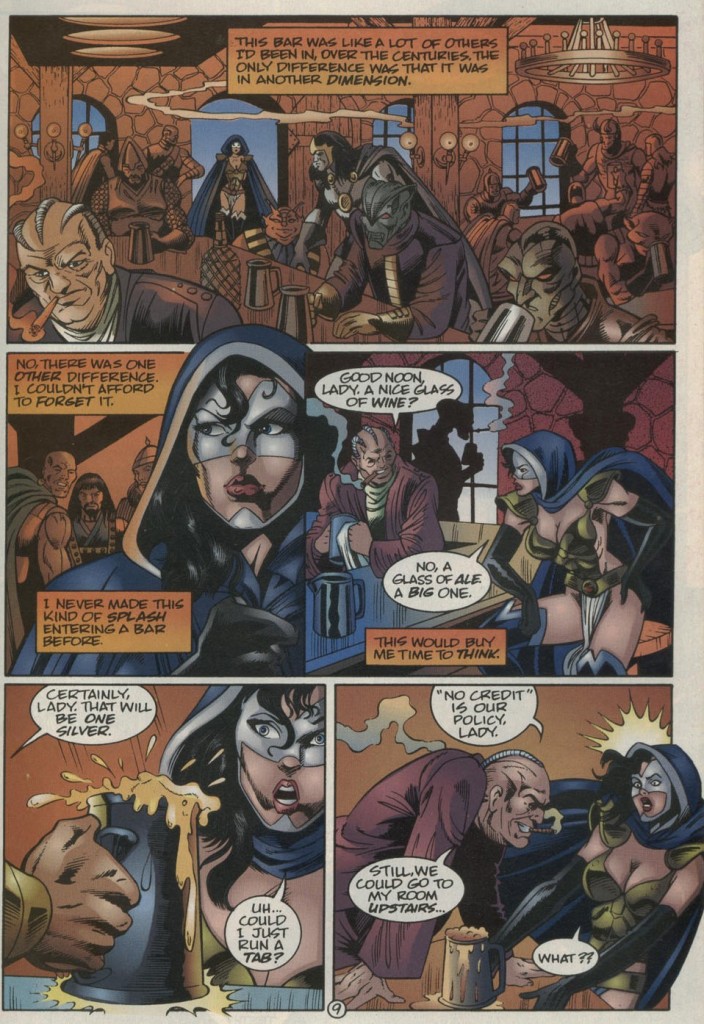
Mantra visits the tavern in the kingdom controlled by Boneyard.

I’ll start with the writing. What Mike W. Barr did here successfully was raising the stakes for Mantra which involves the drastic change of location and setting from the modern society of Earth into the fantasy realm where Boneyard and his army are based in. The mentioned change literally opened new opportunities to develop Mantra’s personality while at the same time offered readers a lot of new things and places for their exploration.

With the all-new setting, lots of fantasy genre tropes are present. There is the ever-present tavern filled with lots of people that include humans and non-human beings that go beyond dwarves and elves. There is also the slave auction of both men and women standing almost nakedly in front of the bidders. There also were people wearing capes, hoods, swords, spears and armor which Mantra smoothly blends in with.

Along the way, there is a lot spectacle here mainly acts of magic alternated with hard action moves. The way the spectacle is presented fits in excellently with the fantasy setting and I should state that Robb Phipps did a very solid job visualizing such elements while succeeding in making Mantra, Boneyard, Archimage and Warstrike look recognizable.

Back to the writing, Mike W. Barr prepared a lot of details in the story that explained Boneyard’s nature and even his status as the husband of multiple wives. This comic book also reveals that Boneyard is likely bisexual since, apart from being married to multiple women, he kissed Mantra and lusts for her even AFTER he learned that Lukasz is occupying the woman’s body. His intention to marry Mantra symbolizes homosexuality as well. To put things in perspective, this makes Boneyard very guilty of sexual immorality on top of his wickedness. Refer to 1 Corinthians 6:9-10 (sexual immorality and homosexuality), Galatians 5:19-21 (sorcery and sexual immorality) and Deuteronomy 17:17 (polygamy) in the Holy Bible.

Conclusion

Boneyard’s intention to marry Mantra (whose body is occupied by the soul of the male eternal warrior Lukasz) and impregnate her to produce his children is disgusting, even more so when the villain knows Lukasz is in Mantra.

To say the least, Mantra (1993) is entertaining enough mainly due to its fantasy setting and exposing key elements about the rivalry between Archimage and Boneyard. This was a daring and refreshing change of pace for Mantra series since the first three issues already emphasized Lukasz’s struggles on living in the body of Eden Blake (note: reincarnation is false and goes against the Holy Bible, read Hebrews 9:27 and Psalm 78:39 for insight) and living with her family as Eden’s soul was pushed into limbo. More notably, this issue shows more of how evil and wicked Boneyard is not simply because of his leading his army of evildoers but also because of his evil-filled nature. By comparison, Lukasz/Mantra is the lesser evil to Boneyard under the pretense of good-versus-evil in the story (which itself concluded in a predictable and underwhelming fashion).

If you are seriously planning to buy an existing hard copy of Mantra (1993), be aware that as of this writing, MileHighComics.com shows that the near-mint copy of comic book costs $8.

Overall, Mantra (1993) is satisfactory.

+++++

Thank you for reading. If you find this article engaging, please click the like button below and also please consider sharing this article to others. If you are looking for a copywriter to create content for your special project or business, check out my services and my portfolio. Feel free to contact me as well. Also please feel free to visit my Facebook page Author Carlo Carrasco and follow me at HavenorFantasy@twitter.com