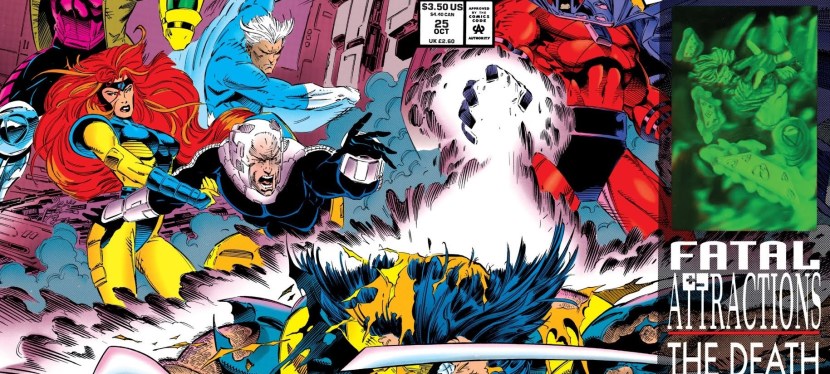
Released in late 1994 by Marvel Comics, Spider-Man 2099 #25 had a double-sized issue with an embossed cover that shined as it was laced with foil. The number 25 on the edge of the cover was stylized to capture people’s attention on the shelves of comic book specialty stores.
The cover of Spider-Man 2099 #25.
Back in the 1990s, Marvel had a “tradition” of releasing comic books with gimmick covers with anniversaries in mind. Notably the 25th, the 50th, the 75th and 100th issue and more got released with covers that came with foil or chromium or hologram or simply a hard embossed material. In other times, the anniversaries of the featured superhero/superheroes were celebrated with gimmick covers on comic books marking the celebration.
With regards to Spider-Man 2099 #25, the 2099 universe of Marvel had reached its 2nd year. By that point of time, the Marvel’s 2099 line of comics was already at full publishing blast with several monthly series (Spider-Man 2099, Ravage 2099, Punisher 2099, Doom 2099, X-Men 2099 and Ghost Rider 2099) plus a quarterly comic book (2099 Unlimited).
Written by Peter David and drawn by Rick Leonardi (with ink work by Al Williamson), the comic book begins with a short scene about Miguel O’Hara’s (Spider-Man 2099) mother moving on her way to meet someone. The spotlight then shifts into the heat of the rematch between Spider-Man and the cyborg Venture.
Later Miguel’s mother meets a certain tycoon at his mansion…
Spider-Man of 2099 fights with Venture.
When it comes to quantity, this comic book has a Spider-Man story of 22 pages, a Hulk 2099 story with 8 pages (a prequel to Hulk 2099 #1 specifically) and a story called Net Loss with 10 pages. The first time I read this comic book back in 1994, I anticipated more Spider-Man 2099 content but got surprised with the other two being part of it. Marvel decided back then to use Spider-Man #25’s content to expand and emphasize the 2099 universe.
When it comes to quality, I find the Spider-Man 2099 story here a worthy read not simply because Peter David wrote it but because he crafted a story that connects and relates well with what happened in Spider-Man 2099 #1. When I reached the end of the story, I really felt compelled to go back to the very first issue to re-examine what happened.
As this was the 25th issue of the series, Peter David and Rick Leonardi were more proficient as a creative team. The aesthetics of Leonardi’s art (inked by Williamson) is pretty much the same but I noticed that the illustrator added more power on key moments of the action. Ultimately this story is worthy of the 25th issue anniversary treatment.
The Hulk 2099 short story by Gerard Jones and Malcolm Davis meanwhile serves only to build up the mean green monster for its monthly series. Hulk 2099 was never an interesting character to me and this one did not change my view of him.
The final short story Net Loss was rather weird. Even though I read a lot of 2099 comic books, the story by Peter David and Tom Grindberg just did not captivate me.
Overall, I find Spider-Man 2099 #25 a worthy comic book to add to your collection and Spidey’s story alone is worth it.
Spider-Man 2099 #25 is recommended.
Thank you for reading. If you find this article engaging, please click the like button below and also please consider sharing this article to others. Also my fantasy book The World of Havenoris still available in paperback and e-book format. If you are looking for a copywriter to create content for your special project or business, check out my services and my portfolio. Feel free to contact me as well. Also please feel free to visit my Facebook page Author Carlo Carrascoand follow me at HavenorFantasy@twitter.com
Released in 2006, X-Men: The Last Stand was the third movie of Marvel’s mutants which made $459,359,555 worldwide establishing new box office records at the time including the Memorial Day weekend opening and a single-day record for Friday openings. It was also the highest grossing X-Men movie until X-Men: Days of Future Past exceeded it in 2014.
While the first two flicks were directed by Bryan Singer (who literally abandoned this movie in favor of the big letdown Superman: Returns), this one was done by Brett Ratner who is best known for Rush Hour films. For the superhero concept of the film, Ratner clearly depended on the script by Simon Kinberg (who directed X-Men: Dark Phoenix) and Zak Pen (X2: X-Men United).
The story begins some time in the past with Charles Xavier and Magneto visiting the house of a little girl named Jean Grey whose power of telepathy and telekinesis make her dangerous. Her own father thinks she has an illness. In another scene, a young boy desperately tries shaving off something on his back which turned out to be a mutation. To put it short, the prologue establishes the two concepts this movie tried to emphasize – the Dark Phoenix (from the classic comic book storyline by Chris Claremont and John Byrne) and the Mutant Cure (in reference to one particular episode of the 1990s X-Men animated series).
The result? A rather unfocused narrative that bogged the movie throughout. In the present day, Charles Xavier and the X-Men are no longer hiding from the federal government (which in turn has Hank McCoy/Beast as part of the US President’s cabinet). A cure that can neutralize the mutant gene has been revealed and eventually Jean Grey suddenly returns back to life in front of Scott Summers/Cyclops. Then trouble in the story (and for this film in particular) sets in.
Dark Phoenix and Professor X.
On storytelling, the lack of focus on a central concept really dragged this movie down even though the filmmakers made attempts to link them together. This is a very unfaithful adaptation of the Dark Phoenix Saga – instead of showing the Phoenix Force as a cosmic entity the filmmakers used the dual-personality concept in Jean Grey. There are no alien civilizations (read: no Lilandra) involved nor anything related to outer space (a key element in the comic book storyline). With regards to the cure concept, Rogue in this film makes a move to be cured loosely following what was shown in the animated series.
Having these two concepts connect to each other showed Magneto getting motivated to rally the mutants to oppose the humans. Jean Grey meanwhile gets controlled by the Phoenix personality and gets very destructive with power which makes her an asset to Magneto and his brotherhood of evil mutants.
As the filmmakers struggled to tell the story, the social relevance and symbolism emphasized in the first two films got weakened. The core concept of mutants getting isolated and discriminated by humanity simply because they are so different became much less relevant here.
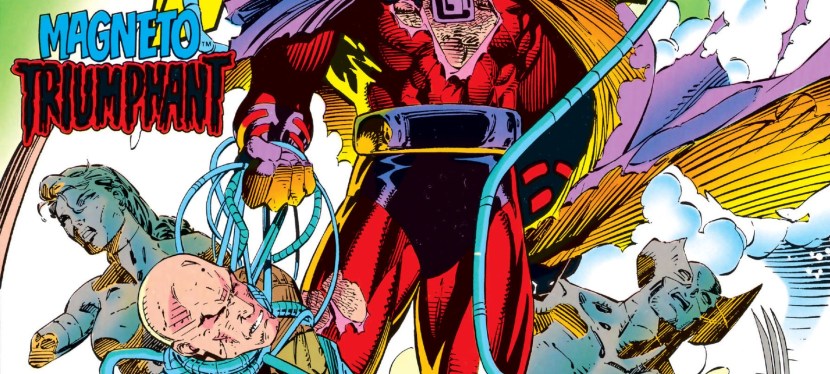
As if that was not bad enough, the characterization also changed for the worse. Magneto here became one-dimensional as a villain and the way he reacted to Charles Xavier’s destruction in front of him and Jean Grey reflected bad screen writing. Any true X-Men fan would know that even though he and Xavier were adversaries with a past friendship, Magneto should have been outraged over his old rival’s destruction and strike at Jean Grey (even if it is suicidal for him to fight a more powerful entity, the Phoenix).
For his part, Charles Xavier turned out to be a manipulator of Jean Grey’s mind making him look as evil and manipulative as Magneto. Jean Grey, despite actress Famke Jansen getting more screen time than before, ended up as a visual tool and was clearly NOT the central figure of the story rather she ended up being a tool of power by Magneto. By today’s standards, Jansen’s portrayal of Jean Grey/Dark Phoenix pales in comparison with Sophie Turner’s performance in X-Men: Dark Phoenix.
More on characterization, the triangle between Iceman, Rogue and Kitty Pryde was executed with no real depth and only served to show Anna Paquin’s character search for the means to be normal (because Rogue absorbs the power and life of people she touches) which ended up being not so meaningful for viewing. Young adult Angel’s (one of the original X-Men in the comics) minutes-long presence in the movie only served to showcase special effects. Storm’s prospect of succeeding Xavier as leader of the X-Men and the school was sloppily done. Oh yes, the showing of multiple mutants (in supporting roles, non-speaking roles or as mere background characters) that weakened the narrative of the first two films was even worse here. As a result, there’s quite a lot of fan service in this movie.
Going back to storytelling, I should say that the early demise of Cyclops (played by James Marsden for too little screen time due to his work with Bryan Singer on Superman Returns) and Charles Xavier were attempts by the filmmakers to raise the stakes and even shock viewers. The problem is that the third act of the film became more of an action and CGI bonanza ultimately failing to justify the loss of Cyclops and Xavier. The story ended with not much impact on me as a viewer and the late scenes showing Magneto recovering a little of his power (plus the post-credit scene about Xavier’s survival) were unsatisfactory. By comparison, X-Men: Dark Phoenix concluded with satisfaction.
Performances? The actors did what they could with the weak screenplay. Patrick Stewart played Charles Xavier managing his school but gets burdened heavily as Jean Grey returns with the Phoenix in her (which makes Xavier feeling guilty over his past manipulation of Jean’s mind). Ian McKellen played a one-dimensional Magneto (forget about the reasonable fighter for mutants you saw in the first two films) and really had little room to flesh him out. Clearly this version of Magneto, even though he has a lot of screen time here, is rubbish when compared to the cinematic Magneto in X-Men: Dark Phoenix.
Hugh Jackman as Wolverine is clearly the hero of this movie and was given a lot to do showing a deeply concerned Wolverine as well as showing him with lots of action on-screen. His emotional reaction towards Jean Grey near the end of the movie was believable. Halle Berry meanwhile failed yet again to capture the leader in Storm from the comic books.
Another thing to mention regarding the weak script is the lame attempt at humor in the film. Just look at the exchanges of words between Wolverine and Beast which only made me frown instead of laughing.
Exchange 1
Dr. Hank McCoy: Wolverine. I hear you are quite an animal.
Logan: Look who’s talkin’.
Exchange 2
Logan: Well, for all we know, the government helped cook this up.
Dr. Hank McCoy: I can assure you, the government had nothing to do with this.
Logan: I’ve heard that before.
Dr. Hank McCoy: My boy, I have been fighting for mutant rights since before you had claws.
Logan: [to the Professor] Did he just call me boy?
If there is anything positive at all with this movie, it is the spectacle (action, stunts and special effects). If you want to watch an X-Men movie without thinking too much and just enjoy the spectacle, The Last Stand is heavily loaded! The scope of destruction (including the major showcase of Magneto’s power with the Golden Gate Bridge) is also great and helped this weak movie look epic (even more epic than the better film X-Men: Dark Phoenix). There is also a big battle of multiple members of Magneto’s brotherhood attacking the soldiers at the Alcatraz facility. Action is where director Brett Ratner is good at and it temporarily helped this film feel fun to watch. The visual design and special effects are of good quality as well.
One last positive thing to mention here is the casting of Kelsey Grammer as Hank McCoy/Beast and his performance was, indeed, superb. I really saw the scientist, the intellect and the fighter of Beast from the comics translated nicely in cinematic form.
A striking shot as a result of Magneto’s power.
By today’s standards of superhero movies, X-Men: The Last Stand unsurprisingly went from big-budget disappointment to what is now an overall bad movie that just happens to have some fun action sequences. As far as adapting the Dark Phoenix Saga from the comics, this film is definitely inferior to X-Men: Dark Phoenix. X-Men: The Stand does look good when compared to the terrible X-Men Origins: Wolverine.
If you are a true fan of the X-Men or if you are moviegoer who wants the best superhero cinematic experience, I won’t recommend watching X-Men: The Last Stand.
But then if you are a moviegoer who cannot do anything except hate and uncontrollably bash the new movie X-Men: Dark Phoenix, then maybe The Last Stand will be your bout of fun.
Thank you for reading. If you find this article engaging, please click the like button below and also please consider sharing this article to others. Also my fantasy book The World of Havenoris still available in paperback and e-book format. If you are looking for a copywriter to create content for your special project or business, check out my services and my portfolio. Feel free to contact me as well. Also please feel free to visit my Facebook page Author Carlo Carrascoand follow me at HavenorFantasy@twitter.com
I’ll get straight to the point here. X-Men: Dark Phoenix (or Dark Phoenix in North America) is a better superhero film than I expected (and at the same time I never expected a faithful adaptation of the classic comic book storyline the Dark Phoenix Saga by Chris Claremont and John Byrne) and Simon Kinberg‘s feature film directorial debut turned out to be a surprisingly solid effort. I really enjoyed this.
X-Men: Dark Phoenix is the 2nd attempt by 20th Century Fox to adapt the Dark Phoenix saga for the big screen and I can say it is a brave effort. While it never attempted to fully and faithfully adapt all the elements of the classic storyline (note: that would require hundreds of millions of dollars more budget, more production time and at least two whole films to produce), the new movie is absolutely a better adaptation than X-Men: The Last Stand (which is an even worse movie by today’s standards).
As far as the current X-Men Cinematic Universe (starting with 2011’s X-Men: First Class), Dark Phoenix is very character-driven even though it has a huge cast. There was tremendous pressure behind the scenes on the part of Sophie Turner to portray Jean Grey struggling with her added powers and the good news is that she delivered very nicely! This new movie is clearly focused on Jean Grey whose emotions, struggles and acts of power are magnificently pulled off by Turner each time the screenplay requires her to act.
Turner is clearly more comfortable with playing as Jean Grey and it seems she paid close attention to the Dark Phoenix comics. Unlike Famke Jansen’s Jean Grey/Dark Phoenix in X-Men: The Last Stand, Turner cinematic act is more believable, more emotional and even more terrifying. There were moments to feel sorry for Jean Grey as her life turns upside-down plus there were times that she would be better off going far away into the deep void of the galaxy so that nobody else would get harmed by her. If you pay very close attention to Turner’s act, you will feel varied emotions along the way.
Turner is not the only standout. Nicholas Hoult, James McAvoy and Tye Sheridan each played their respective roles (Beast, Charles Xavier and Cyclops) with more heart, more drama and more intensity. Through Hoult and McAvoy, you will relate more with them as the film makes gentle connections back to X-Men: First Class (why the time was formed, who was supposed to remain or go away, etc.). The conflict between Beast and Xavier that happened later (combined with the revelations from the past) dramatically blurs away the boundary that separates good and evil. As for Tye Sheridan, I see a lot more of the literary Cyclops in him this time and thanks to the script, he exceeds James Marsden’s Cyclops by a hundred a miles. Sheridan and Turner also have better on-screen chemistry as Cyclops and Jean Grey.
James McAvoy’s Xavier deserves everyone’s attention. He not only looks and feels like his comic book counterpart, he also clearly displayed how much the character has matured. McAvoy also successfully captured the on-screen aura of authority Patrick Stewart had in the first X-Men movies.
Michael Fassbender’s Magneto appears rather late into the film but that does not make him any less significant. As before, Fassbender is intense with playing his character and, more importantly, he contributed nicely into the story. Jennifer Lawrence portrayal of Mystique is the shortest one yet but before leaving the film, she delivered some nice lines (with some reconnecting to X-Men: First Class) and acted nicely. Fans of Nightcrawler and Storm will be happy to know that their roles become more significant in the late stage of the film. Lastly, Jessica Chastain‘s addition as Vuk was a nice addition. While others put her down as one-dimensional, which is true, it does not detract from the film at all. Even with lacking variety of character, Vuk still makes a strong villainess and she really acts alien. Vuk would stop at nothing to achieve her goals.
This is one of many great looking visual effects of the Cerebro scenes.
When it comes to storytelling, this movie did not try to make an in-depth adaptation of all the elements of the Dark Phoenix Saga of comics. Instead, the filmmakers adapted a few elements of the literary classic (and even a few selected elements from X-Men: The Last Stand), focused on the present day X-Men (story is set in 1992), looked back occasionally at X-Men: First Class and made the most with what they have.
The result is a cinematic story about the X-Men now publicly recognized as legitimate mutants (and youths) with Charles Xavier having fully established a direct link with the President of the United States. After the rescue mission in space involving the solar flare, a race of shape-shifting aliens arrive on Earth with a secret agenda of their own. As mentioned earlier, Simon Kinberg surprised me with his directing. The storytelling, even with the slowest moments played, never felt dragging to me at all. The pace, in my experience, was between medium to fast. As this movie was written by Kinberg, Dark Phoenix is clearly his vision for the X-Men Cinematic Universe and he stamped his mark on it despite the fact that reshoots and story revising had to be done. If you are looking for humor, you really won’t find much as the story’s tone is intensely dramatic.
You want fun? X-Men: Dark Phoenix delivered solidly! This movie has more than enough spectacular content (action scenes, stunts, visual effects, etc.) that any moviegoer can enjoy! Very clearly the filmmakers consciously worked hard to deliver entertaining stuff to bounce back from the heavy drama. There was a lot of physical damage caused by Phoenix in her conflict with her teammates which is a solid start of her causing trouble to others. Cyclops, Storm, Nightcrawler, Xavier, Beast and Magneto used their respective abilities VERY EXTENSIVELY combined with high-octane stunt coordination which results several minutes of on-screen fun leading into the finale! The spectacle of X-Men: Dark Phoenix, which was extensively done with a blistering pace, easily exceeds what was showcased in First Class, Apocalypse and even that of Days of Future Past!
As for those blink-and-you-will-miss-it visual moments, there were times that images shown on the big screen reminded me of Jim Lee’s X-Men. I won’t point out where they are or when they will come out but anyone who extensively read the X-Men comic books drawn by Jim Lee (who co-founded Image Comics and now works as DC Comics’ co-Publisher) will spot the technical fan service.
Last but not least is the music provided by the great Hans Zimmer and this film marks his return to the superhero movie genre. While the music he and his team provided here is nowhere as energetic nor as intense as that of Batman v. Superman: Dawn of Justice, the music is still steps above that of X-Men: Apocalypse, X-Men: The Last Stand and even the popular X2: X-Men United. The highlight of Zimmer’s music is the tune played during the moments when Jean Grey’s tremendous power as Dark Phoenix was realized in that day-time encounter with the X-Men. That particular music really emphasized the danger she poses to others.
There were some issues about the movie that might be problematic or annoying to moviegoers, particularly superhero movie fans. For one thing, Simon Kinberg re-used certain elements from X-Men: The Last Stand for this new movie and that includes Jean Grey having a childhood problem and Charles Xavier getting involved to solve it only to be blamed for it many years later. There were even a few lines from the 2006 movie repeated.
Also questionable was the lack of an explanation regarding Jean Grey’s Phoenix Power in this film and the one we saw in X-Men: Apocalypse. If what she unleashed in the final battle with Apocalypse was not the Phoenix force, then that’s a major blunder by the creators in relation to this movie. Perhaps an extended cut of X-Men: Dark Phoenix will solve that.
Lastly there was the use of shaky camera photography during some moments with the action sequences. While they were temporary, they prevented the film’s strong spectacle from achieving perfection.
Overall, X-Men: Dark Phoenix is a thrilling, heavily dramatic and very solid superhero movie worthy of being the conclusion of the X-Men Cinematic Universe that 20th Century Fox first launched in 2000. From this point on, there is no guarantee we will see McAvoy and the gang return as the cinematic X-Men now that 20th Century Fox is fully controlled by the Walt Disney Company through Marvel Studios. X-Men: Dark Phoenix is not perfect but it strongly resonates with me as I am a long-time X-Men comic book reader. While others out there would bash this movie for not having the common elements of Marvel Cinematic Universe films, X-Men: DP has its own flavor and the filmmakers utilized what they had established in the X-Men Cinematic Universe since 2011. The reported reshoots may have prevented Kinberg and team from fully realizing their original vision of the Dark Phoenix story but still they succeeded in making a better Dark Phoenix adaptation captured on film.
If Marvel Studios would launch the X-Men through the Marvel Cinematic Universe and attempt a new and more ambitious Dark Phoenix adaptation of their own, it will take much longer and will cost them more time and money to do so. That’s something we may not see in the next decade. All the more reason to enjoy X-Men: Dark Phoenix now.
X-Men: Dark Phoenix is highly recommended.
Thank you for reading. If you find this article engaging, please click the like button below and also please consider sharing this article to others. Also my fantasy book The World of Havenoris still available in paperback and e-book format. If you are looking for a copywriter to create content for your special project or business, check out my services and my portfolio. Feel free to contact me as well. Also please feel free to visit my Facebook page Author Carlo Carrascoand follow me at HavenorFantasy@twitter.com
While I barely enjoyed the original X-Men movie back in 2000, I still had hope that its sequel would be better, more engaging and more entertaining. That hope of mine was realized on April 30, 2003 when I saw X2: X-Men United (or X-Men 2 in some countries around the world) in a cinema here in the Philippines.
Commercially X2 grossed $407,711,549 worldwide and that is 37.58% more than what its predecessor made. It also gathered several positive reviews from movie critics back then and its overall success proved that there was indeed more room for artistic and commercial growth for further superhero movies. I remember leaving the cinema happy and satisfied, looking forward to more X-Men films.
Kelly Hu’s screen time as Lady Deathstrike was short but she really stood out in her fight with Hugh Jackman’s Wolverine.
So how did it all come to such an outcome in 2003? In my honest opinion, director Bryan Singer and his creative team learned from their shortcomings in the previous movie, create an engaging story without necessarily faithfully adapting elements of the graphic novel X-Men: God Loves, Man Kills (a rather unholy story) and ramp up the enjoyment factor.
The story opens with Nightcrawler cleverly breaking through the security in the White House in an attempt to attack the President of the United States. That opening clearly showed how clever and creative the filmmakers got to not only deliver the thrills but also emphasize visually the gap between humans and mutants. To put it short, that opening sequence is still awesome to watch.
Wolverine (Hugh Jackman) returns to the mansion and tells Charles Xavier (Patrick Stewart) he found nothing in Canada. Wolverine wanted to know more about his unknown past but Xavier refuses to help him even though he set the deadly loner on a path.
In Washington D.C., military scientist William Stryker meets with the President (along with a fake Senator Robert Kelly who is actually Mystique in disguise) and gets authority to launch a secret operation on the mutants. Along the way, Mystique learns about the location of not only the plastic prison containing Magneto but also that of a secret base. The secret attack on Xavier’s mansion and the escape of Magneto then sets of the crucial events for the rest of the movie.
X2 can be described as a film laced with lots of improvements over its predecessor technically and creatively. I see more of the literary Wolverine in Hugh Jackman this time around while Patrick Stewart and Ian McKellen showed even more traits of the literary versions of Charles Xavier and Magneto respectively. Anna Paquin showed more confidence in playing Rogue while Halle Berry and Famke Jansen showed similar results with their characters. Allan Cumming and Brian Cox are solid additions as Nightcrawler and Stryker (who is not a military scientist in the present day of the graphic novel) and they mixed well with the returning cast members.
Mystique and the soldiers.
Like its predecessor, symbolism was used to emphasize the gap between humans and mutants on the big screen. The scene wherein Bobby Drake/Iceman showed to his parents his uncanny ability to freeze emphasizes his reluctance to show the truth about himself…something that could potentially break the family. William Stryker, meanwhile, keeps mutants company for as long as he has control over them and combined with the fact that he bore a hatred for mutants (note: something unfortunate happened to his family), he can be compared to a slave owner from centuries ago.
When it comes to spectacle, X2 is definitely more thrilling and more action-packed. The filmmakers knew how to balance the screenplay’s exposition and dramatization with action when it is needed on the right time. The standout action sequence is undoubtedly the fight between Wolverine and Lady Deathstrike (played by Kelly Hu).
The script is stronger this time. With key members of the X-Men separated during the first half of the film, character development sets in nicely. The link between Wolverine and Jean Grey got emphasized somewhat while Cyclops is away. Also Magneto delivered the film’s most memorable line: You should have killed me when you had the chance!!!That line is a nice throwback to the past friendship between Xavier and Magneto.
Like the 2000 movie, liberties from comics were implemented for “cinematic presentation.” Anyone who read Wolverine’s origin with Weapon X can tell that William Stryker was never part of it. As for adapting the 1982 graphic novel, this film is clearly unfaithful and the filmmakers decided to take the easy route on selecting certain elements to make a screenplay that can be deemed bankable by the movie studio.
Unsurprisingly there are flaws here and there. Freezing people’s movements done by Xavier is unbelievable. As a telepath he can read people’s minds, manipulate their perception, make himself invisible to others by warping their perception and even reprogram minds but freezing people is not one of those abilities. Also considering Xavier’s persistent use of his telepathy, he failed to detect before entering the plastic prison (to meet Magneto) that a trap was set up for them.
As for Jean Grey’s heroic sacrifice near the end of the film, that one took me out of the movie. She left the jet without anyone noticing, stands in front then uses her power to prevent the rushing water from touching them while slowly lifting the jet (which for some reason could not operate properly) to let X-Men survive. It sure is dramatic and it is one of Famke Jansen’s most notable moments in cinema (apart from her erotic acts in GoldenEye) but it goes against what X-Men fans know. Any X-Men fan can tell that Iceman could have used his power to freeze the water and Storm could have manipulated the weather to help out. Heck, Cyclops could have gone out and launch a massive optic blast at the water.
Another obvious flaw is the large cast of characters which prevented the film from further implementing anymore character development. The love triangle aspect continued from the previous movie barely moved forward as James Marsden’s Cyclops (a leader in the comics) was literally set aside. Kitty Pryde/Shadowcat in this movie was only used to emphasize a seconds-long chase and show off the filmmakers’ visual effects.
By today’s standards, X2: X-Men United is no longer the great superhero film it was in twenty-o-three. It is, overall, a good movie and clearly it is a major improvement over its predecessor. The many improvements on the overall quality, engagement and fun factor of X2 made 2000’s X-Men look more like a dress rehearsal.
Thank you for reading. If you find this article engaging, please click the like button below and also please consider sharing this article to others. Also my fantasy book The World of Havenoris still available in paperback and e-book format. If you are looking for a copywriter to create content for your special project or business, check out my services and my portfolio. Feel free to contact me as well. Also please feel free to visit my Facebook page Author Carlo Carrascoand follow me at HavenorFantasy@twitter.com
For more X-Men insight, check out my latest article about X-Men: Dark Phoenix and my review of Logan.
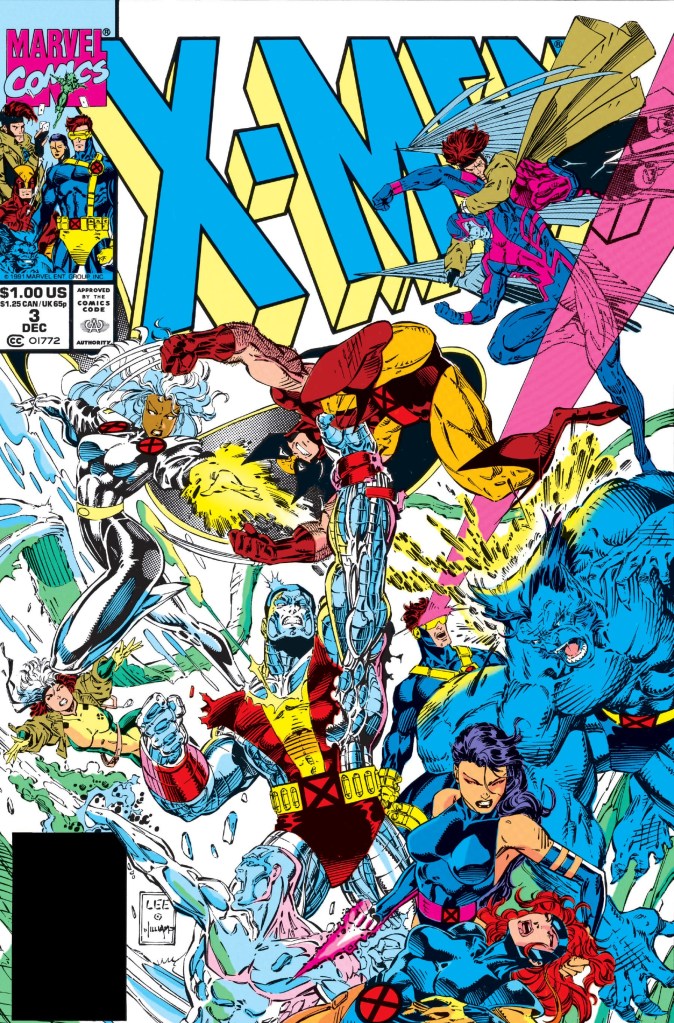
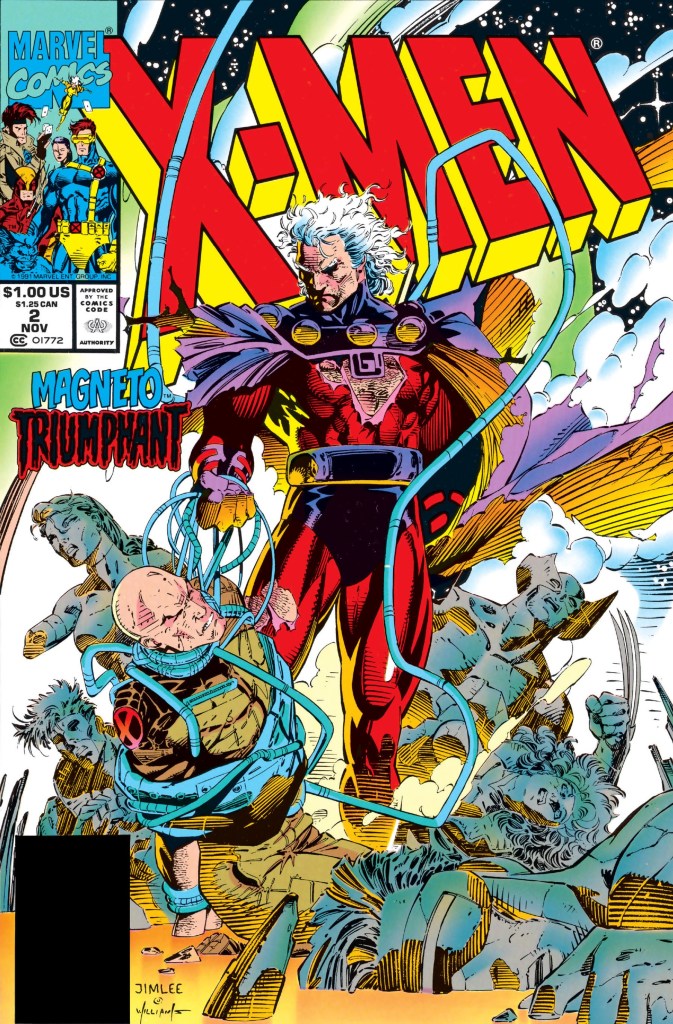
When I was in high school, Marvel Comics launched the comic book X-Men #1(Volume 2, 1991) which sold an estimated eight million copies worldwide. The times back then were very exciting as the comic book had great art by Jim Lee (inked by Scott Williams and colored by Joe Rosas) combined with the writing of Chris Claremont.
For this retro review, I have the gatefold cover edition of X-Men #1 which has the complete set of covers and a cover price of $3.95. The comic book used high-quality paper (or glossy paper) for its content. To put things in perspective, X-Men #1 was released with multiple editions. The comic books carrying cover prices of $1.50 had individual covers and lower quality paper.
The front cover.The back cover.
So what was X-Men #1 all about? Was it deserving of the tremendous sales success it achieved for Marvel? Did the combined talents of Claremont and Lee create something super special?
To begin with, X-Men #1 marked the beginning of a new chapter of the X-Men. In the events that happened prior to this comic book, the X-Men founder Charles Xavier had been away for many years and along the way the team went through several changes with its members. At one point, the classic villain Magneto even became the head of the X-Men. The pioneering X-Men members of Jean Grey, Cyclops, Iceman and Beast meanwhile found their temporary place outside by forming X-Factor. Eventually the Muir Island saga which incidentally reunited Xavier with his mutants.
So in this comic book, the X-Men got reformed and Xavier returned to his mansion for the first time in many years. The stakes are much higher this time because Xavier needs to adjust to the dynamics of the X-Men whose membership has grown so much two teams (Gold and Blue) had to be used. As if that was not challenging enough, the world, as Xavier noticed, is more hostile towards mutants than ever before.
In out space, two groups of people engaged in a spaceships chase which triggered Magneto (now living in a new headquarters orbiting Earth) to take action. He tells them he is no longer interested in their cause and simply wanted to be left alone.
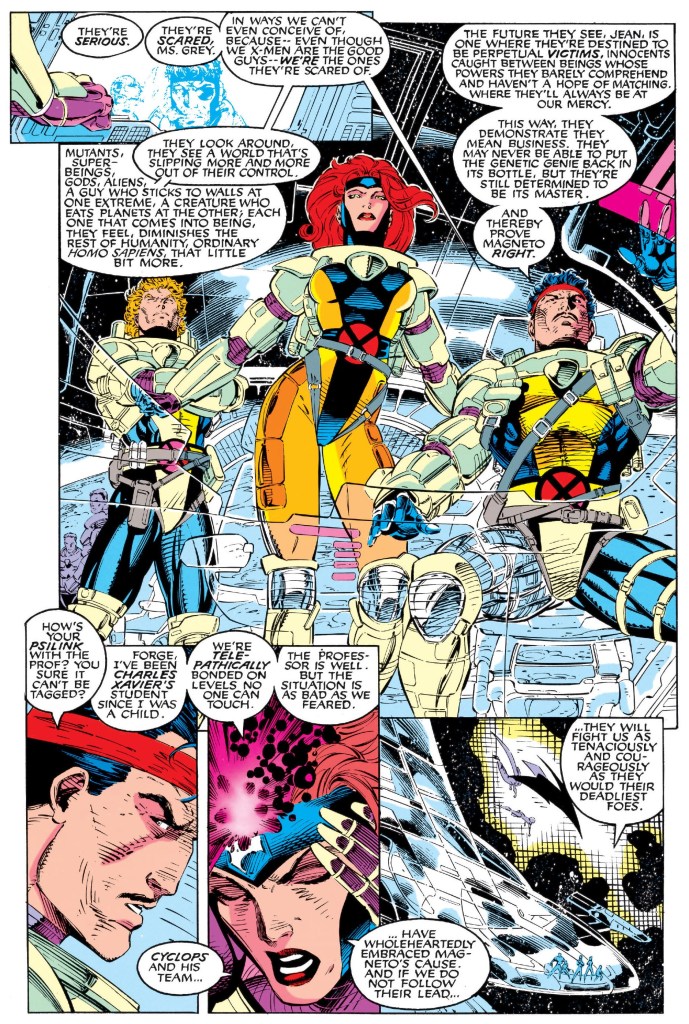
Magneto’s presence and energy signature alerts authorities on Earth.Charles Xavier shares to Jean Grey his observations as he tries to adjust with his return to his mansion. He was away for so many years and so was Jean Grey and her pioneering teammates.
Because he made his presence felt (his energy signature was detected and so was his floating headquarters), authorities on Earth had no choice but to launch the first stage of the Magneto Protocols.
In Washington DC, Col. Nick Fury meets with the President of the United States who expressed his concern about the incident in outer space which involved American shuttles that got destroyed.
US President: It’s my understanding, in fact, that the terrorists who hijacked our vehicle look to him (Magneto) as their inspiration. Suppose he makes their cause his own?
Nick Fury: If the Soviets act like hotheads, Mister President, they could make things worse.
US President: You have an alternative?
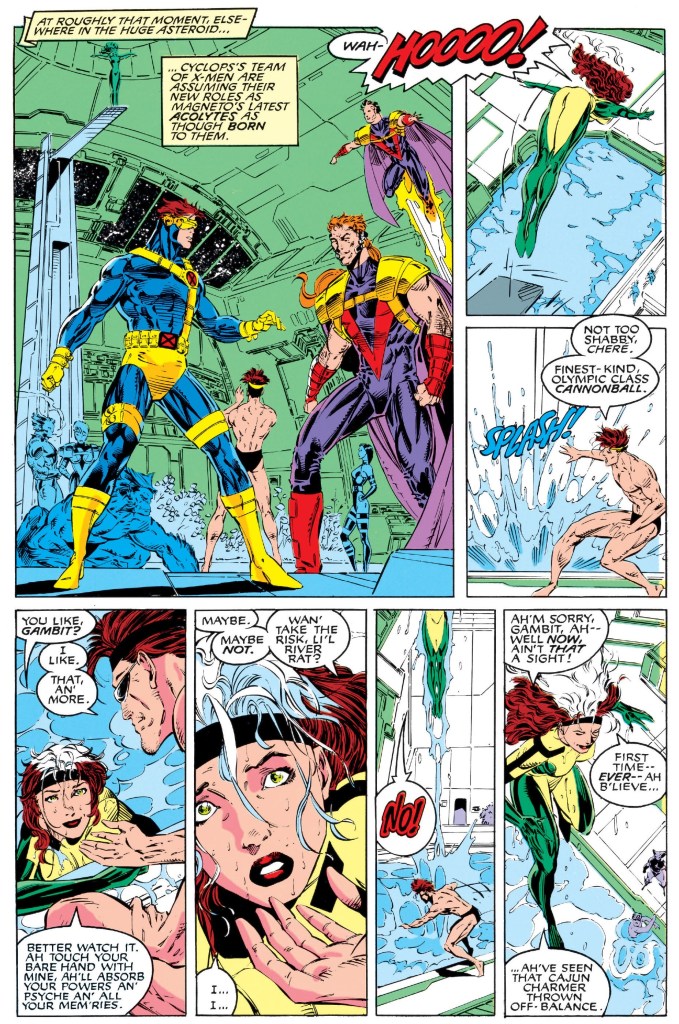
Meanwhile at the Xavier mansion, the X-Men participate in an training session with Cyclops (blue team leader) and Storm (gold team leader) watching and coordinating from the control room. Charles Xavier, who is still adjusting upon returning, closely watches the large team.
Sarcasm by Cyclops annoyed Xavier who preferred him to keep focus on the exercise.
Of course, with the team so large, conflicting personalities and problems with bonding with each other was inevitable. Clearly the newly revamped X-Men had a long way to go before achieving true solidarity.
And then Nick Fury contacted the X-Men with the Magneto situation…
For a comic book released in 1991, this one was quite a grand product. Sure it did not have a gimmick cover of foil nor hologram nor chromium but having a gatefold cover with art of the X-Men and Magneto drawn by the great Jim Lee was itself a big luxury at the time.
Very clearly, Jim Lee and Scott Williams did their best ensuring great art for the comic book. The X-Men all look very fit (as if they all regularly spent time in the gym), their redesigned costumes were meant to look cool (although the many pouches and “suspender” of Cyclops’ costume look really silly), Magneto looks ageless and the Acolytes were designed to be the new nemesis of the X-Men.
And then there was the action…..
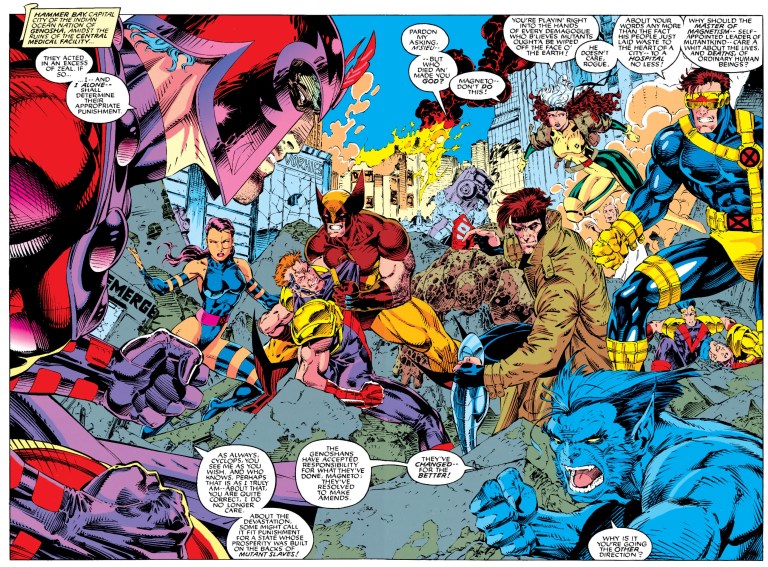
Action between the X-Men and Magneto.
Jim Lee has a great vision for high-octane action designed to show impact while at the same time give readers something great to look at. In my view, Lee was influenced by action movies and he developed ways to not only make comic book action flow nicely but also deliver impact.
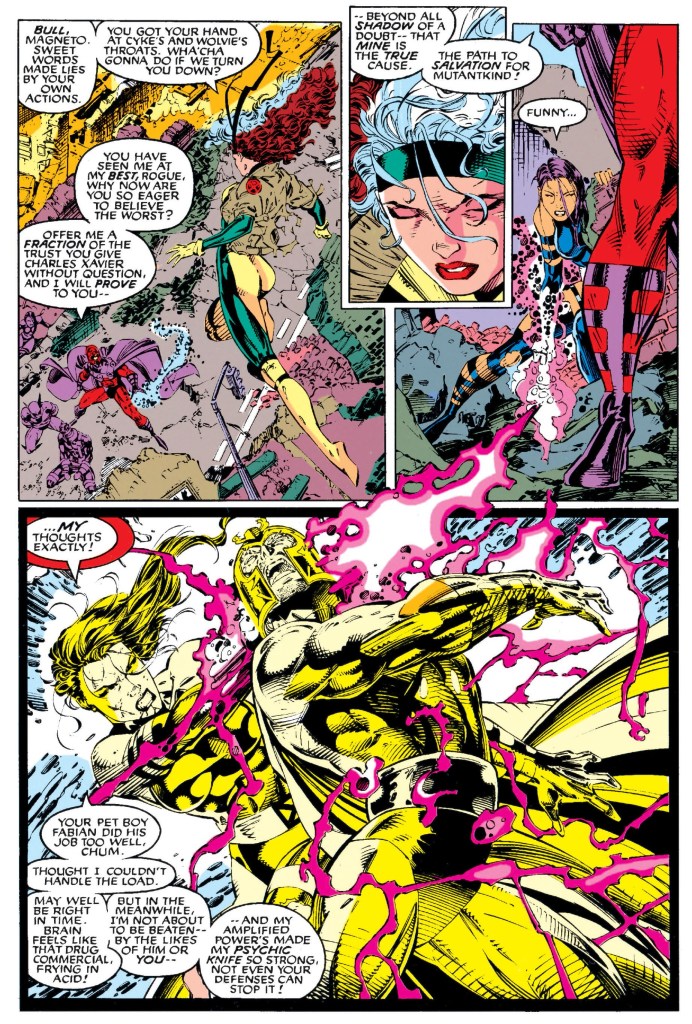
This comic book has a lot of action and Jim Lee cleverly visualized the capabilities of the X-Men with striking visuals. The way Wolverine looked striking at an enemy was pretty intense. Cyclops’ use of his Optic Blast to separate Magneto from Wolverine showed a lot of power. Psylocke’s physical strike against Magneto reminds me hard action scenes from Hollywood flicks.
With regards to the writing, Chris Claremont managed to redefine the X-Men for the new age while at the same time did his best to balance the story, establish the threat and build up the tension for the inevitable conflict with Magneto. In this particular comic book, it is the blue team taking on the classic villain.
Apart from the main story, X-Men #1 also came with extra stuff like behind-the-scenes sketches by Jim Lee, a preview of things to come (notably the post-Claremont concepts), a 2-page image of the X-Men enjoying the pool side of the mansion, and a villains gallery! All these extras were drawn by Jim Lee!
Overall, X-Men #1 is still a compelling comic book to read even by today’s standards. The comic book speculator boom has long been over but if you are looking for the modernizing of the X-Men for the 1990s, this one really is a milestone. Clearly, X-Men #1 was made to start the new age of the mutants with the 1990s in mind while at the same time it took the bold move of gathering Xavier and the pioneering X-Men members and putting them back into Xavier’s mansion forming a much larger team than ever. This move of mixing classic X-Men members with newer ones resulted a nice variety of personalities.
When it comes to getting this for your collection focused on Marvel’s mutants, X-Men #1 is highly recommended. Remember, you should look at this comic book as a piece of X-Men history and don’t focus on making a profit with it. Just enjoy it for what it is.
By the way, X-Men: Dark Phoenix is opening very soon in cinemas. You bought a ticket already?
Thank you for reading. If you find this article engaging, please click the like button below and also please consider sharing this article to others. Also my fantasy book The World of Havenoris still available in paperback and e-book format. If you are looking for a copywriter to create content for your special project or business, check out my services and my portfolio. Feel free to contact me as well. Also please feel free to visit my Facebook page Author Carlo Carrascoand follow me at HavenorFantasy@twitter.com
Disclaimer: This is my original work with details sourced from reading the comic book and doing personal research. Anyone who wants to use this article, in part or in whole, needs to secure first my permission and agree to cite me as the source and author. Let it be known that any unauthorized use of this article will constrain the author to pursue the remedies under R.A. No. 8293, the Revised Penal Code, and/or all applicable legal actions under the laws of the Philippines.
It’s funny how time moves. The year we live in now is twenty-nineteen (2019). That means eighty years from now, the year will be twenty ninety-nine (2099). As a long time geek, the year 2099 reminds me a lot about the short-lived lineup of superhero comics published by Marvel Comics popularly referred to as Marvel 2099 which had a far future, sci-fi setting.
Back in 1992, the comic book industry was riding high on the spending of collectors who seek profit through the trading of comic books. During those days, Marvel released several comic books with special covers (foil, hologram, etc.) which looked so pretty, a lot of people bought those (normally double the prices of regular comic books) believing it would make a collector’s item (instead of reading and enjoying the comic book).
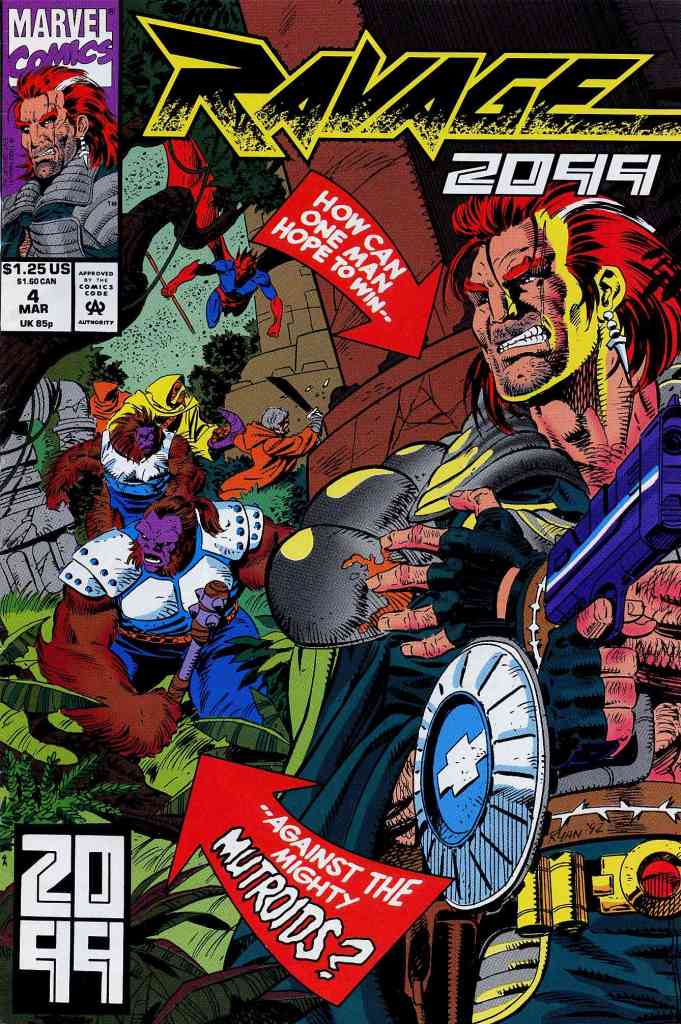
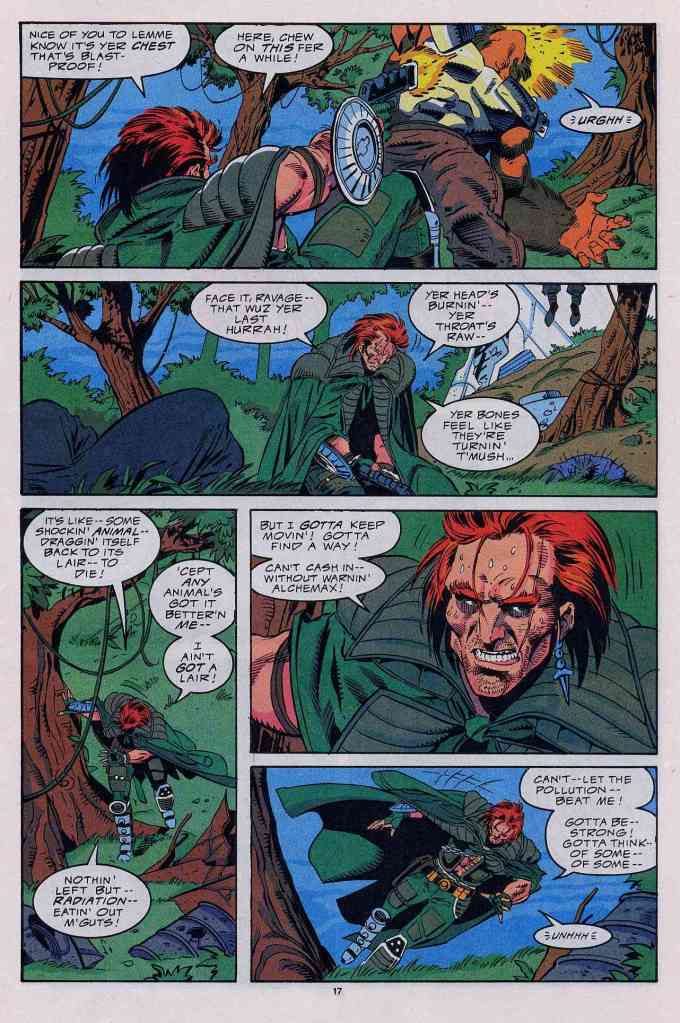
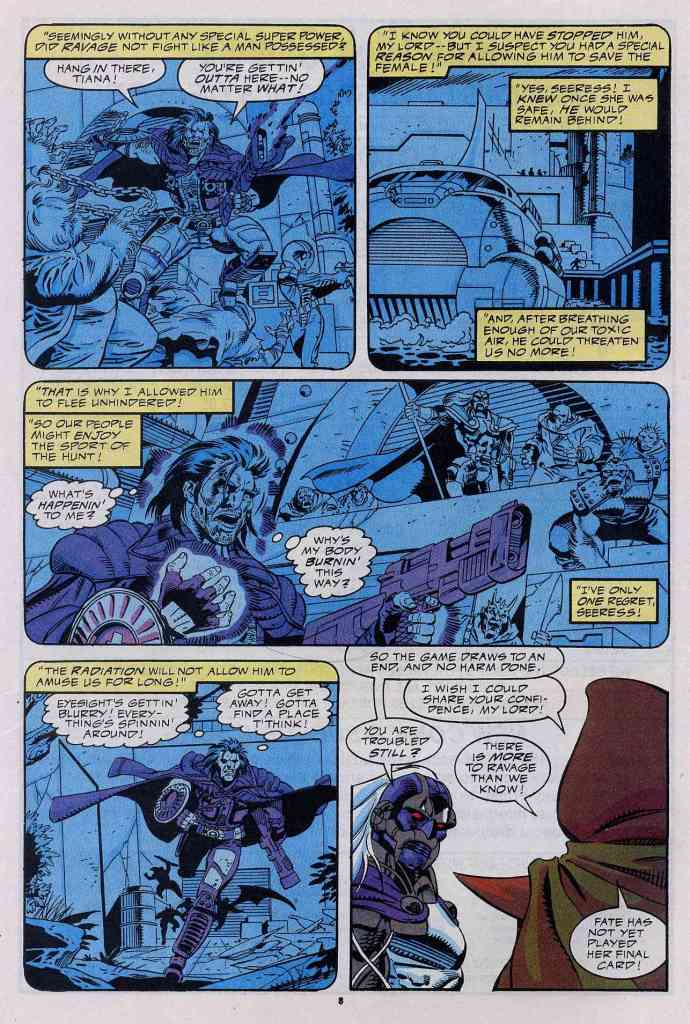
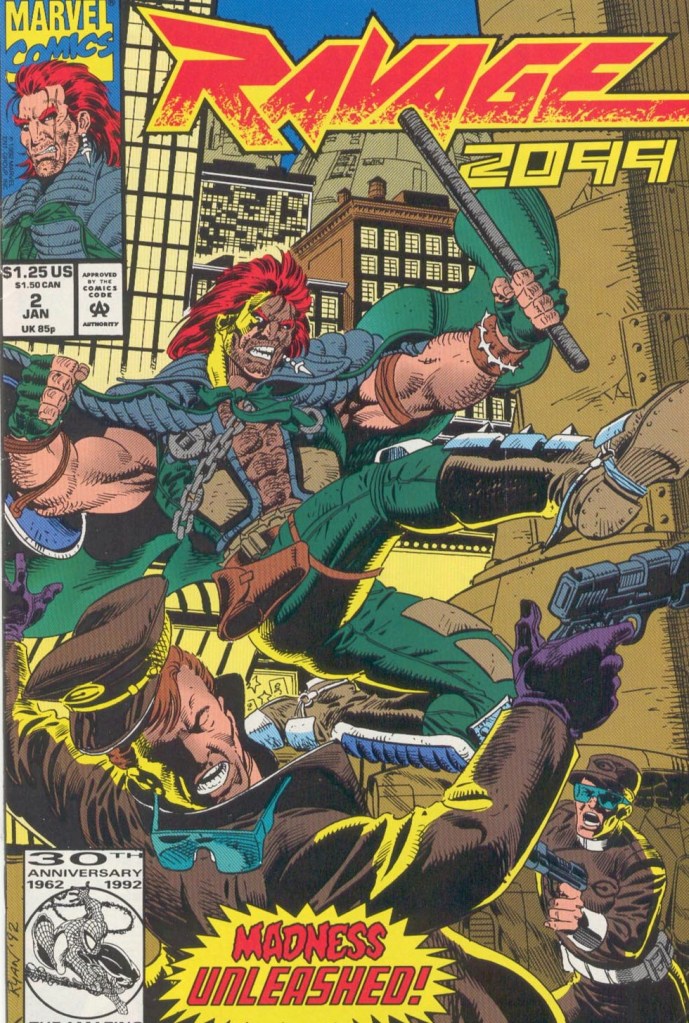
Marvel added more to the comic book speculation frenzy by launching their 2099 series starting with Spider-Man 2099 #1. Shortly after that, they launched the Ravage 2099 monthly series highlighting a protagonist that was original and co-created by the legendary Stan Lee with artist Paul Ryan. There was also hype accompanying Ravage 2099 #1 as it marked Stan Lee’s return as a regular writer. Here is my review of the comic book Ravage 2099 #1.
Ravage 2099 #1 and a few other comic books beside my mug of coffee.
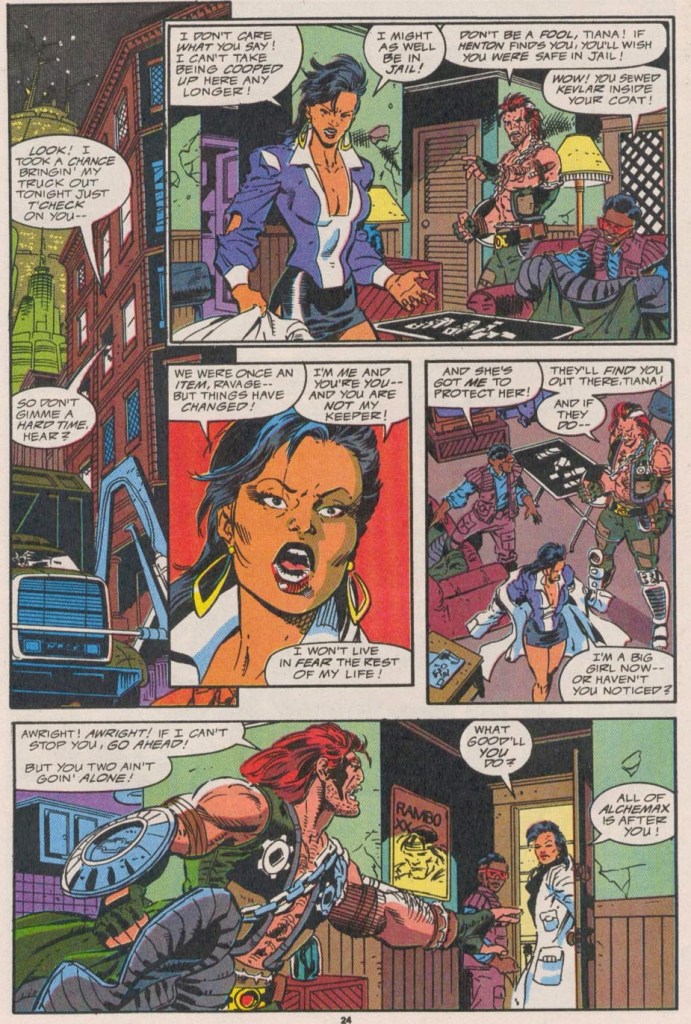
The story opens with a man chased by local authorities. Labeled a polluter, the armed personnel killed him instead of taking him in alive. This bothers Paul-Phillip Ravage who is the head of ECO Central (under mega corporation Alchemax). His assistant Tiana warned him that there is greater danger and Alchemax can bring down anyone. Of course, Ravage dismisses her concern as he believed in the system he is part of.
Ravage said to her, “If we can’t trust the system, if we can’t trust Alchemax, then we revert back to anarchy!”
Shortly after, Ravage encounters three young guys who approached him with weapons. After scaring away two of them, the last guy – a teenage boy – said words that made Ravage think. It turns out the young guy is the son of the man who got killed in the beginning.
Even though no compelling evidence was presented to him, Ravage had the teenager come with him to go high at Alchemax. There they meet with Anderthorp Henton, the director general of the corporation. After listening to their concerns, Henton reacts to investigate.
“That’s the most shocking thing I’ve heard! If there’s the slightest shred of truth to your accusation, I’ll move heaven and earth to punish the one’s responsible. You have my word on that, commander and you too, young man!”
Ravage, the teenager and Henton.
After separating from the teenager, Ravage decides to go back to his office. Tiana warned him that Henton has targeted him for elimination. Suddenly a mutroid (creature brought in from a forbidden place) appears in front of them starting Alchemax’s move to frame and kill Ravage.
Ravage 2099 #1 was released on October 1992 (cover dated December 1992) for $1.75 with a gold-colored foil cover and it sold well for Marvel that month arguably due to the collector craze as well as die hard fans of Stan Lee. In terms of art, Paul Ryan did a good job visualizing the sci-fi, distant future of 2099 laced with futuristic technology (example: vehicles hovering above ground). He clearly made Ravage look mature while Tiana looked too erotic to be in the office. Ryan’s art on Henton, meanwhile, lacked subtlety and right from the start, he obviously looked evil. When it comes to action, Ryan did a decent job.
As for the writing, I can honestly say that Stan Lee’s style lacked precision and engagement. Clearly his style of writing ended up being outdated by the time this comic book got published. Had Ravage 2099 #1 been released in, let’s say in 1975, then the comic book would have felt more engaging and even futuristic. The dialogue is somewhat lousy as well.
I also noticed how Ravage and the villain Henton looked idiotic with their respective acts. While the culture of impunity in 2099 is undeniable, it still does not justify Henton’s knee-jerk decision to order the elimination of Ravage who in turn failed to notice anything suspicious as head of his department. Tiana ends up being the informer for him.
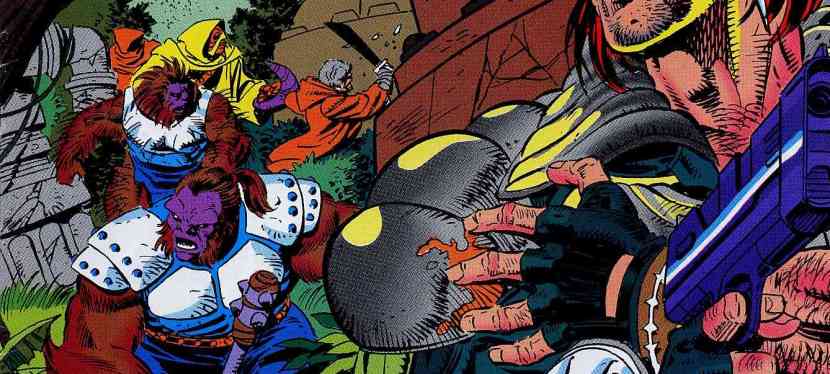
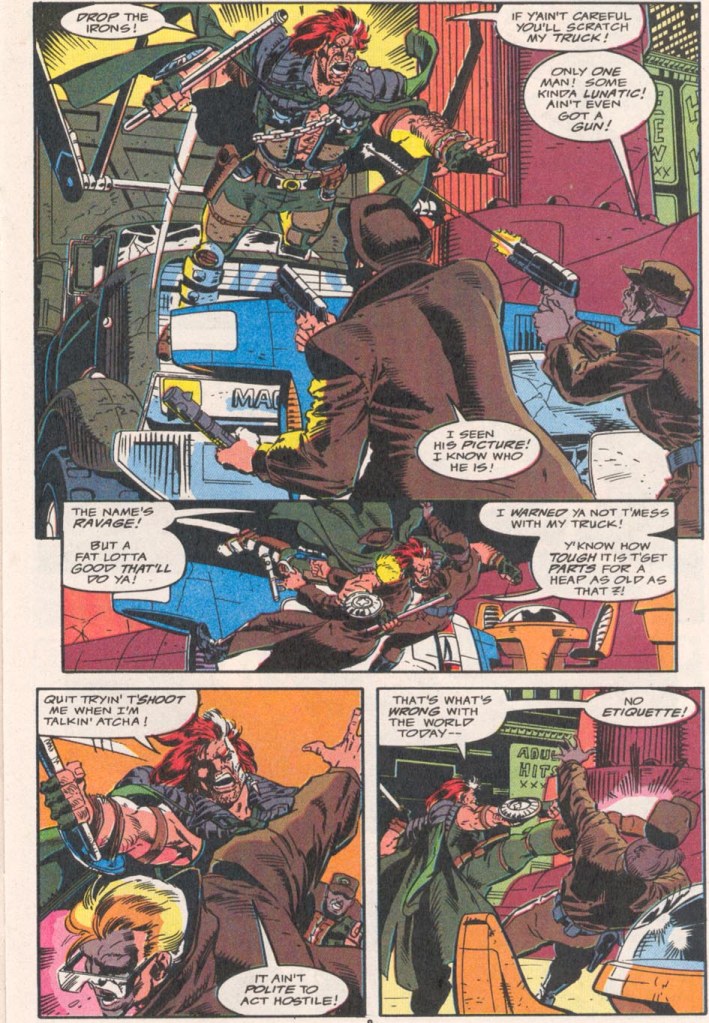
Ravage starts fighting back at his company’s security personnel.
Another sign of Ravage being not too smart (or at least the lack of precision and intelligence on the script written by Stan Lee) is how unrealistically easy it was for the teenager to convince him that his father was killed WITHOUT PRESENTING ANY COMPELLING EVIDENCE of the incident at all! The teenager only had words…no video, no photos, nothing as evidence!
For a mature man, Ravage was pretty foolish. He never asked the teenager to present any evidence to prove his claims. Instead, he went ahead going to Henton at Alchemax even bringing the young guy with him.
More on Ravage, it was clear that he was doomed as a comic book character even though Stan Lee was involved in creating him. Considering the fact that there were many Hollywood action movies released throughout the 1980s often having a macho guy armed with guns (or capable of doing hard action) as the hero, Ravage ended up looking generic.
It is no surprise that even though Marvel Comics revived somewhat the 2099 universe with new comic books over the past few years, Ravage was not revived. There was simply nothing special with the character nor was his part of the 2099 universe deemed important.
Ultimately, Ravage 2099 #1 is a comic book worth getting way below its cover price. In my view, it is worth fifty cents at best. Ravage is truly a failed hero of Stan Lee’s.
Thank you for reading. If you find this article engaging, please click the like button below and also please consider sharing this article to others. Also my fantasy book The World of Havenoris still available in paperback and e-book format. If you are looking for a copywriter to create content for your special project or business, check out my services and my portfolio. Feel free to contact me as well. Also please feel free to visit my Facebook page Author Carlo Carrascoand follow me at HavenorFantasy@twitter.com
The first time I saw the first live-action movie of the X-Men was on August 30, 2000, here in the Philippines. Back then my interest in comic books had waned but I was still an X-Men fan by heart. I enjoyed reading the comic books written by Chris Claremont, the early 1990s comic books drawn by Jim Lee and Whilce Portacio, and the X-Men animated series.
Prior to its Philippine opening, X-Men was released in the cinemas in the United States on July 14, 2000, and in the weeks leading to August 30, there were several pirated copies of the movie in video CD format made available here in the Philippines. I resisted the temptation of watching a pirated copy in favor of the cinema experience.
Arguably the one superhero movie that sparked the 21st century wave of superhero movies which we moviegoers enjoy now.
Back on August 30, 2000, it was a rather intriguing experience for me to see the X-Men and the villains portrayed by actors on the big screen (and there were no IMAX cinemas back then). While I felt Hugh Jackman (then a newcomer) lacked impact on portraying Wolverine, Patrick Stewart captured the essence and look of Professor X/Charles Xavier. Halle Berry’s half-baked foreign accent ruined the cinematic Storm while James Marsden and Famke Jansen really had no chemistry as Cyclops and Jean Grey. Ian McKellen was passable as Magneto while I found Rebecca Romjin’s Mystique a distorted version of the character. On the side, the supporting role of Bruce Davison as Senator Kelly was very solid and it was too bad he did not have enough screen time.
More on the storytelling, I noticed back then that X-Men really felt more like a build-up laced with some spectacle rather than a complete standalone story. Of course, the filmmakers really had to do lots of build-up and they could not just expect moviegoers to be fully aware of the X-Men comics and mythos. At least the movie did a decent job of assembling the characters, emphasizing the theme of public fear of mutants as well as the struggle of mutants, and establishing the elements of good and evil.
Magneto and Charles Xavier.
There is also symbolism with how the filmmakers translated Charles Xavier and Magneto from the comic books to film. Xavier strives for helping mutants use their powers for good purposes while trying to help them survive in human society that fears them….plus help humans understand mutants in order to accept them. Magneto, who as a boy lived through the Holocaust and witnessed how brutal humans are to his people, strives for the rise of the mutant race even if it means harming innocent humans.
Wolverine and Rogue, in their own ways, are the lost people who have yet to realize their true purpose. They symbolize the mutants struggling in society and in the case of Rogue, played by a very young Anna Paquin, she is the lost youth whose future is clouded with uncertainty since her mutant ability makes her a danger to others by simply touching them. Wolverine/Logan, for the newcomers reading this, has been lost for decades and what makes his plight painful is that he could not remember his past nor is he aware he is over a hundred years old living with claws and a healing factor that delays his aging.
A young Hugh Jackman as Wolverine. He came into the film as a replacementfor Dougray Scott, the guy originally hired to play the superhero icon. Fortunately for Jackman, he became a superstar and a movie icon.
When it comes to spectacle, X-Men is satisfactory. There is enough action to balance with the storytelling and character development but for the most part they lack impact even back in 2000. The standout action sequence is the fight between Wolverine and Mystique which is a mix of martial arts and stunts (aided by wires). The next best sequence is Wolverine’s fight with Sabretooth at the Statue of Liberty. The fight between Toad and the other X-Men meanwhile would have looked better had there been none of those silly moments pulled of by Ray Park (Toad). Special effects that emphasize Cyclop’s optic blast and the Liberty Island energy generation looked tame.
Flaws in the movie? Apart from the uneven quality of cinematic performances and use of cheesy dialogue, not to mention the half-baked use of a foreign accent for Storm, the presentation of Xavier’s estate as a school filled with multiple students remains alienating (note: the “school for gifted children” in the comics had only the X-Men members living and learning in comfortable privacy). Next, Magneto showed carelessness over the handling of his machine designed to mutate humans and his plan to use Rogue as a source and handler for the Liberty Island incident was illogical.
As there were so many characters in the story, the key element of Cyclops as a mature and calculating leader in the comics was absent in the film. James Marsden ended up playing a Cyclops who really did not have much to do other than looking cool with his visor.
Mystique in action.
And then there was the scene in which Magneto kidnapped Rogue only to face several police officers outside. During that scene, Charles Xavier mentally controlled, temporarily, Toad and Sabretooth to try to push Magneto into submission (with Sabretooth’s large hand holding his neck). Magneto answered back by threatening to kill the police officers with their guns and bullets (controlled by Magneto) forcing Xavier to just give up. Knowing that Magneto’s helmet protects him from mental control by Xavier, I said to myself – why didn’t Xavier have Sabretooth or Toad remove the helmet so that he can control Magneto? That scene took me out of the film.
Overall, by today’s standards, X-Men of 2000 is a satisfying superhero flick. Directed by Bryan Singer, it was fairly good in 2000 but did not age well. Really, the film was more of a build-up and set-up for expanding the X-Men Cinematic Universe. Fortunately for Singer and 20th Century Fox, this movie was successful and justified the plan to release sequels (best sequel: X-Men: Days of Future Past) and spin-offs (the best is Logan) which not only made billions of dollars in ticket sales for the studio but also helped make the superhero movie genre wildly popular today.
If you plan to watch this movie, don’t set your expectations too high. Try to enjoy X-Men for what it is and see if you can tolerate the flaws. Definitely this one is no classic.
Thank you for reading. If you find this article engaging, please click the like button below and also please consider sharing this article to others. Also my fantasy book The World of Havenoris still available in paperback and e-book format. If you are looking for a copywriter to create content for your special project or business, check out my services and my portfolio. Feel free to contact me as well. Also please feel free to visit my Facebook page Author Carlo Carrascoand follow me at HavenorFantasy@twitter.com
For more X-Men insight, check out my latest article about X-Men: Dark Phoenix and my review of Logan.
Previously I expressed concern as to why X-Men: Dark Phoenix (opening in the Philippines on June 5 and in the United States on June 7) could end up as a disappointment just as the Walt Disney Company finally took over 20th Century Fox (which led people into believing that integration of the X-Men Cinematic Universe into the Marvel Cinematic Universe could be done instantly).
For one thing, the new movie is the first film of Simon Kinberg as director and to date his credentials include screenwriting, producing and working as a 2nd unit director in the very poor 2015 Fantastic Four movie. Also this movie is the 2nd cinematic adaptation of the classic comic book storyline and the first one from 2006 was bad and there were a few visual elements that the two films shared.
Still there are good reasons to watch this movie whether you are an X-Men fan or not. By now, Avengers: Endgame has satisfied moviegoers which easily makes X-Men: Dark Phoenix the superhero film to anticipate.
Why should you care about this? Here are my reasons (and, yes, I will watch it).
1). This new adaptation is looking more faithful to the Dark Phoenix Saga storyline than how X-Men: The Last Stand ever did – While it is unwise to expect a 100% faithful adaptation of the literary classic, X-Men: Dark Phoenix’s trailer showed the mutants fly into space for a mission, Jean Grey did something desperate and then something happened that changes her. This scene is very similar to what was shown in the comic books decades ago and considering the fact that the cinematic Jean Grey (played by Sophie Turner) unleashed her phoenix power in 2016’s X-Men: Apocalypse, things are making sense. I also liked the shots in the trailers showing Cyclops getting very concerned with Jean Grey which parallels the comic book story.
If there are enough storytelling elements that link this new movie with the literary classic and they get executed nicely, it could make a satisfying experience to moviegoers who are familiar with the classic storyline as well as those who are unfamiliar.
2) Simon Kinberg just might have pulled-off a Dances With Wolves. What do I mean? I mean to say that Kinberg may have prepared himself a lot and somehow managed to not just direct the film efficiently (reminder: this is his directorial debut) but probably outdid himself on executing the scenes strongly, getting strong performances from his actors, carefully crafting the spectacle while maintaining focus on storytelling. As seen in Hollywood history, directorial debuts are often weak efforts of career movie directors so naturally the odds are against Kinberg. Still, Kinberg may have made a very solid directorial debut in comparison to Kevin Costner’s own first directorial effort with Dances With Wolves which grossed over $400 million worldwide and won several Academy Awards including Best Picture and, yes, Best Director! Of course, I’m not a filmmaker myself nor do I have access in Hollywood productions but I did my film research a lot and my Hollywood mentor Rusty Lemorande enlightened me on the history of directorial debuts. Very soon we will find out the true results of Kinberg’s directorial debut.
Surely enough, the executives of 20th Century Fox had their own reasons to hire Kinberg as director despite his lack of movie directing experience.
3) This could be the end of the X-Men Cinematic Universe as we know it. Believe it or not, this film franchise that 20th Century Fox launched is almost twenty years old! Never mind the fact that 20th Century Fox was acquired at last by the Walt Disney Company. I have this strong feeling that the filmmakers did their best to make X-Men: Dark Phoenix a solid film on its own and, possibly, worthy of being the final film of the current cinematic universe. If you love the X-Men cast of Sophie Turner, Jennifer Lawrence, Nicholas Hoult, Michael Fassbender and James McAvoy, then you should watch them perform in this new movie because there is no guarantee that you will see them reprise their roles in future movies under the umbrella of the Walt Disney Company through Marvel Studios.
X-Men: Dark Phoenix is a few weeks away from opening in cinemas worldwide. Watch out for it as well as my review.
For your viewing enjoyment, here’s the movie poster.
Thank you for reading. If you find this article engaging, please click the like button below and also please consider sharing this article to others. Also my fantasy book The World of Havenoris still available in paperback and e-book format. If you are looking for a copywriter to create content for your special project or business, check out my services and my portfolio. Feel free to contact me as well. Also please feel free to visit my Facebook page Author Carlo Carrascoand follow me at HavenorFantasy@twitter.com
What a journey it has been! When I first saw then newcomer Hugh Jackman play Wolverine in the first X-Men movie back in 2000, I was not that impressed. In X2: X-Men United, Jackman outdid himself and established Wolverine as a very defining action hero for 21st century Hollywood cinema that moviegoers can keep coming back for more.
Then Jackman played Wolverine (referred to as Logan) several more times in the X-Men movies plus the standalone Wolverine movies. His most defining performance as the cinematic icon happened in 2017 with the release of Logan directed by James Mangold.
Hugh Jackman delivered his best superhero movie performance in Logan.
Set in what is the near future, Logan takes place in a time (note: the X-Men cinematic universe timeline was revised as a result of X-Men: Days of Future Past) when mutants are dying off as a human species. Wolverine/Logan works as a limousine driver and lives at a smelting plant in Mexico with Cabal and a very old Charles Xavier (Patrick Stewart) who has dementia and has been unstable with his telepathic powers which make him a danger.
The future is bleak for them. Logan is very old and his healing factor has weakened a whole lot and the adamantium coating of his skeleton has poisoned him. Xavier meanwhile needs be provided with medication to prevent him from having a seizure which, combined with his telepathic powers, affects all others around them negatively. It has also been confirmed that an incident was caused by Xavier’s seizure which killed off several X-Men members leaving them three. Logan has to work and earn as much money as he could to keep providing the medication.
One day, a lady approaches Logan to try to hire him to drive her and a young girl named Laura (X-23 in the comics, played by Dafne Keene) to a refuge in North Dakota to escape from danger. Logan accepts reluctantly but discovers that the lady got killed. He returned to the smelting plant and learned that Laura stowed away by discreetly riding his limo. Eventually mercenaries led by Donald Pierce (who met Logan early in the film) arrive at the smelting plant. From this point, Logan realizes why the lady and Laura are targets and then mayhem begins when the little girl fights the mercenaries.
When it comes to storytelling, Logan emphasizes the violent and bitter journey of Wolverine who, at a very late stage in his life, has to accept the reality that he has to make another hard adjustment as a key element from his past comes into his life which is Laura who is actually a clone of him produced from an extracted sample of his DNA. The movie has some parallels with the 1950s cowboy movie Shane (which has some scenes in the film) which added depth to the story.
Logan also emphasizes the element of aging which has not been fully explored in the superhero movie genre until now. Wolverine lived lonely, had no people to love and his personal journey has been marked with violence and death. He could only move forward with whatever opportunities he could find but no matter what he does, happiness will always be unreachable to him. For Charles Xavier, age really tore him down and being almost 100-years-old in the story, he really has nowhere else to go to but death. Not even his legacy of brilliance and teaching mutants to use their powers for good could make any profound changes.
The long journey of Logan, Xavier and Laura in the film is where the character developments really set in. Along the way, there is a scene in which Logan, holding X-Men comic books (made specifically for the story), expressed his displeasure about how people perceive the X-Men and that the pharmaceutical company fed their young cloned mutants with fantasy and lies. Also striking to me as a viewer and a geek were the scenes showing how unethical the company has been with developing the young mutants (X-23’s pals) who decide to fight to escape.
In terms of presentation, Logan was rated R and for good reasons. It was rated R not simply because of very brutal violence and swearing but because its concepts are clearly meant for adults to see. If you combine the concepts of unethical science experiments, mercenary brutality, human rights violations and unchecked destruction, clearly Logan is NOT the superhero movie made for parents and their little kids to watch together. When it comes to action and spectacle, this movie has more than enough stuff to keep viewers entertaining while at the same time it has this particular 1980s R-rated Hollywood action film feel to it.
Dafne Keene as X-23/Laura. Her great act will be remembered for a very long time.
Performances of the actors were top-notch, specifically Jackman, Stewart and Dafne Keene. Hugh Jackman as a superhero cinematic artist truly evolved! If you disregard the timeline alteration of the X-Men films, you will realize how Jackman’s Wolverine gradually changed in terms of style and expression. In 2000’s X-Men, Wolverine was trying to figure out his place among the mutants as Charles Xavier helped him. In X2, he decided to be with the X-Men and help them out in their situation. In X-Men: The Last Stand, he has to deal with helping the X-Men tackle Magneto who has Dark Phoenix/Jean Grey (the lady Logan has feelings for). In X-Men Origins: Wolverine, he struggles morally and dealt with his relationship with his “brother” Sabretooth. In The Wolverine, he moves away from the X-Men and got himself involved with a conflict (plus an old friend) in Japan. In X-Men: Days of Future Past, Wolverine of the dark future goes back through time to his younger self with the pressure to alter history.
Patrick Stewart’s dying Xavier in Logan shows a new dimension to the cinematic art of the actor. He really makes Xavier look hopeless and yet he successfully made viewers more sympathetic to his character than ever before. Last but not least, Dafne Keene as Laura/X-23 proved how talented she really is when it comes to dramatic scenes. Even though she got yelled at by Hugh Jackman, Keene still moved on with her strong performance. Definitely her performance is something to be remembered for a very long time in cinema.
Conclusion
I have seen a whole lot of superhero movies in my life. Just over a week ago I managed to watch Avengers: Endgame and it was a true epic like Infinity War. Even by today’s standards, Logan is a standout superhero movie that delivers spectacle, action, solid performances, some humor and the distinct vibe of 1980s R-rated Hollywood action cinema combined. In fact, I should say that Logan is a modern day classic among all superhero movies.
As such, Logan is highly recommended and I urge you readers to watch it on Blu-ray disc format to get the best visual and R-rated viewing experience.
Thank you for reading. If you find this game review engaging, please click the like button below and also please consider sharing this article to others. Also my fantasy book The World of Havenoris still available in paperback and e-book format. If you are looking for a copywriter to create content for your special project or business, check out my services and my portfolio. Feel free to contact me as well. Also please feel free to visit my Facebook page Author Carlo Carrascoand follow me at HavenorFantasy@twitter.com
Orient Cable has been ordered by the Optic Media Board or OMB (the national government’s arm on regulating the production, use and distribution of recording media) to explain to them why they should not be charged over the piracy of the mega blockbuster film Avengers: Endgame.
According to a report by Philippines News Agency (PNA), a “show-cause order” was served by the regulator to the Dipolog City-based company on May 6. The action was the result of a formal complaint issued by Teatro de Dapitan, a movie house that was authorized to show Avengers: Endgame to paying customers.
Atty. Hywel Vergara of the OMB’s legal division was assisted by police officers when the order was served to Orient Cable. It was reported that the company’s officials were reluctant to receive the order.
“With it is an order for the owners (of Orient Cable) to attend hearings at OMB in Manila on May 7 and 14,” said Vergara, referring to the show-cause directive.
For his part, OMB Chairman Ansel Adriano warned establishments and individuals to respect the intellectual rights of the film industry, especially local productions.
The movie opened around the Philippines on April 24 along with many other countries that same day. There were people who claimed to have seen the illegal airing of Avengers: Endgame on April 25 through Orient Cable. Subsequently Teatro de Dapitan complained to the local police the same day the airing happened.
As of this writing, the management of the cable firm is still silent over the issue.
Whatever questions the OMB has for them, it would be nice for the cable TV operator to answer the following questions:
Who within Orient Cable had the capability (or connections) of getting a pirated copy of the movie and make adjustments to show it publicly?
Where did the pirated copy come from?
What could the company gain from showing Avengers: Endgame in pirated form?
How is the financial health of Orient Cable and just how many paid subscribers do they have now?