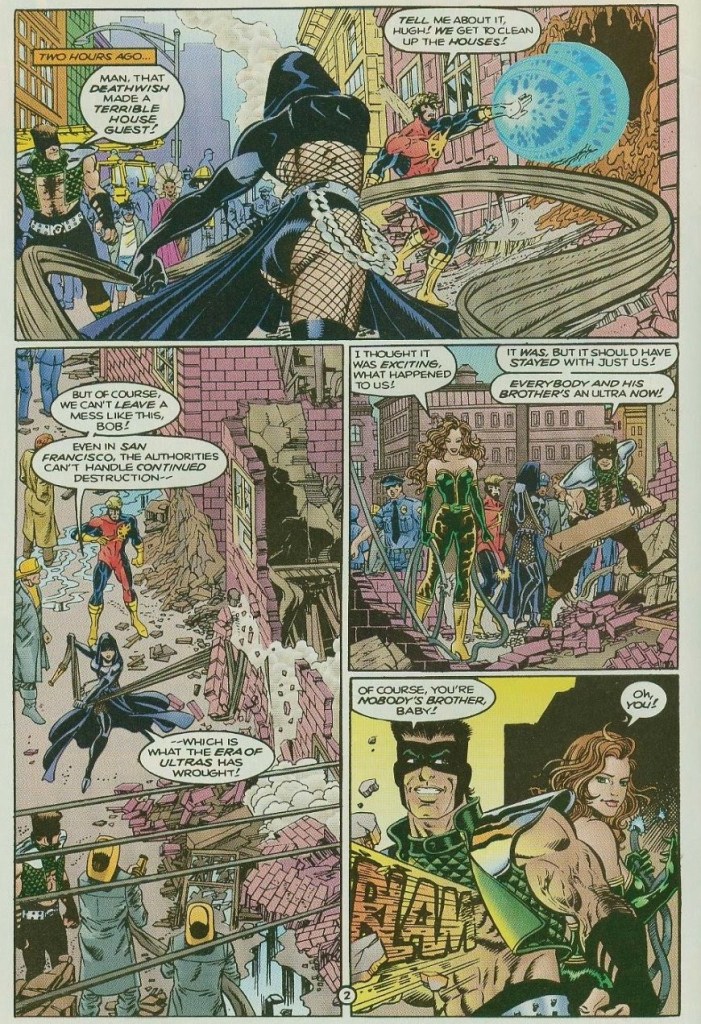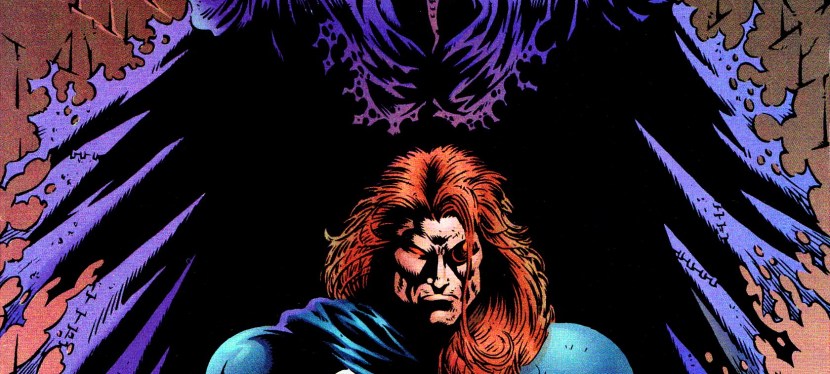
A Look Back at Prototype #18 (1995)

Disclaimer: This is my original work with details sourced from reading the comic book and doing personal research. Anyone who wants to use this article, in part or in whole, needs to secure first my permission and agree to cite me as the source and author. Let it be known that any unauthorized use of this article will constrain the author to pursue the remedies under R.A. No. 8293, the Revised Penal Code, and/or all applicable legal actions under the laws of the Philippines.

Welcome back, superhero fans, comic book collectors, fans of 1990s culture and fans of Malibu Comics! After going through reviewing seventeen issues of the Prototype monthly series that started with the 1993 launch of the Ultraverse, the end of the said series is here.

Before doing the retro review of the 18th and final issue of Prototype, I should state that the armored hero is indeed one of the most significant Ultraverse heroes of them all. Other than having a standalone monthly series (which includes issue #0) plus a giant size one-shot comic book, Prototype also was part of UltraForce and his presence and overall contribution in that short-lived series were undeniably good. Prototype is also memorable for his conflicts with Prime (read my review of Prime #4). As a series, Prototype also sheds light on the concept about how society would react to an actual functioning, flying armored hero who was also marketed for commercial purposes.

You must be wondering…is the 18th issue a conclusive story of the monthly series? What were the effects of Marvel’s acquisition of Malibu Comics on the creative team? We can all find out in this look back at Prototype #18, published in 1995 by Malibu Comics with a story written by R.A. Jones and drawn by Paul Abrams.

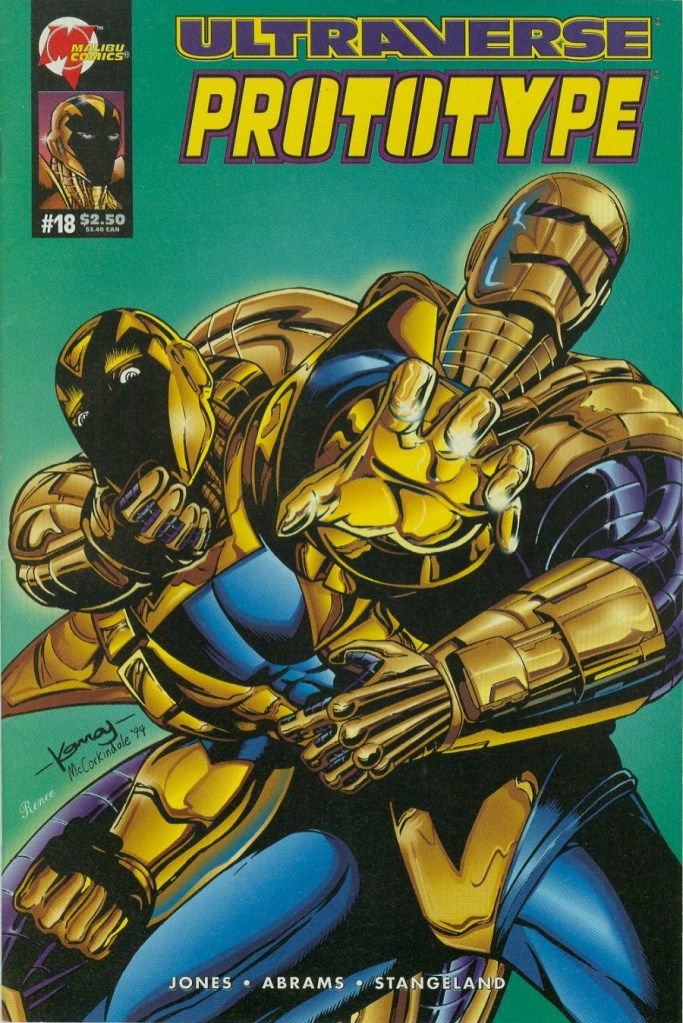
The cover.

Early story

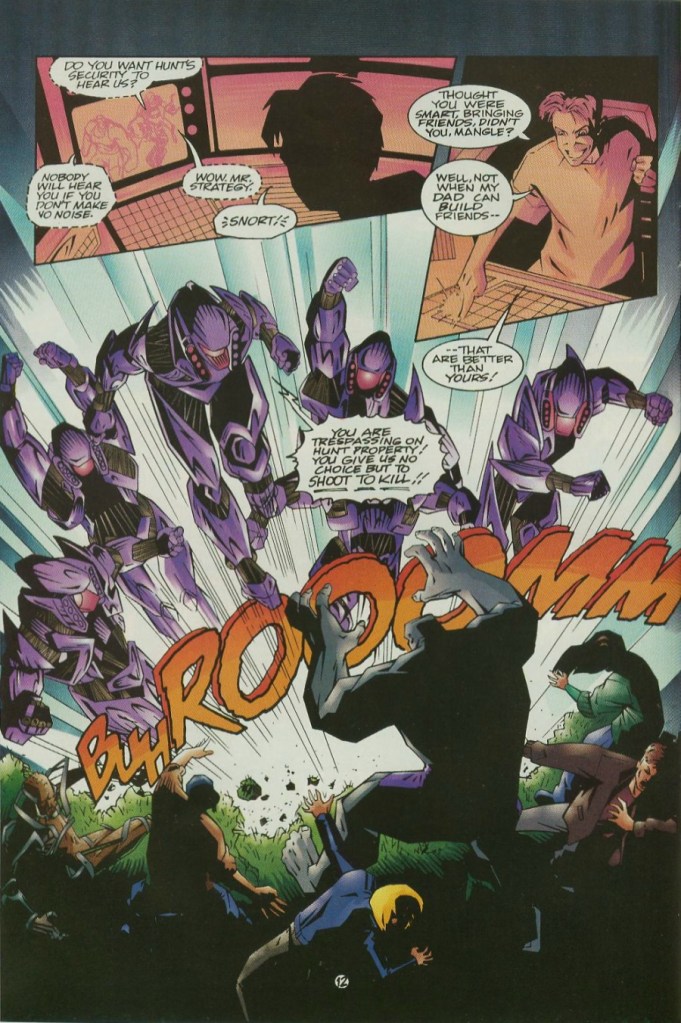
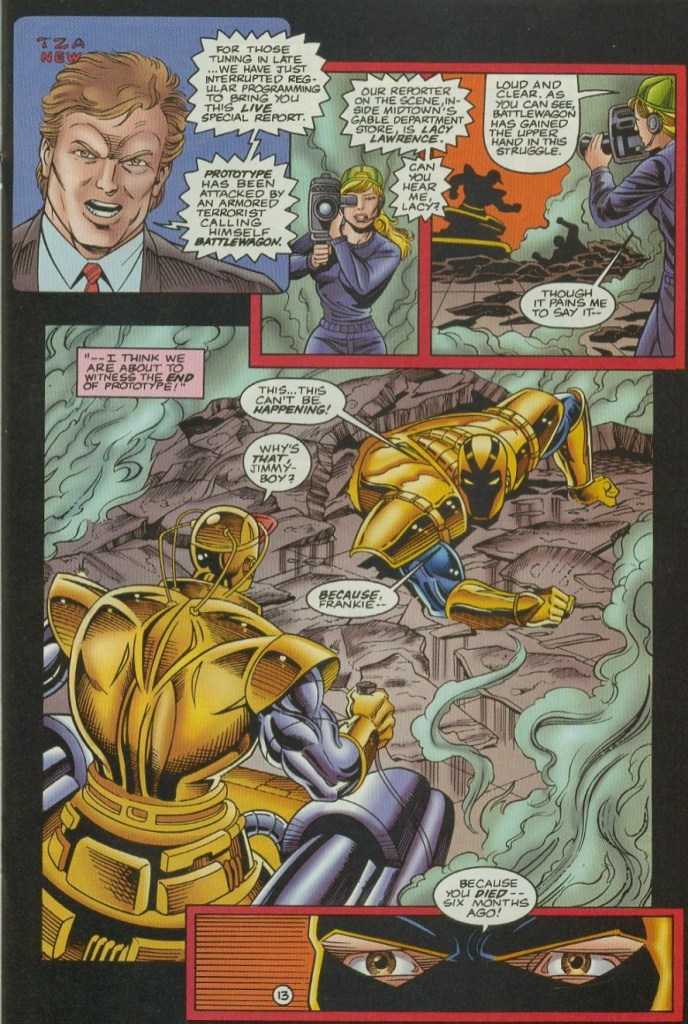
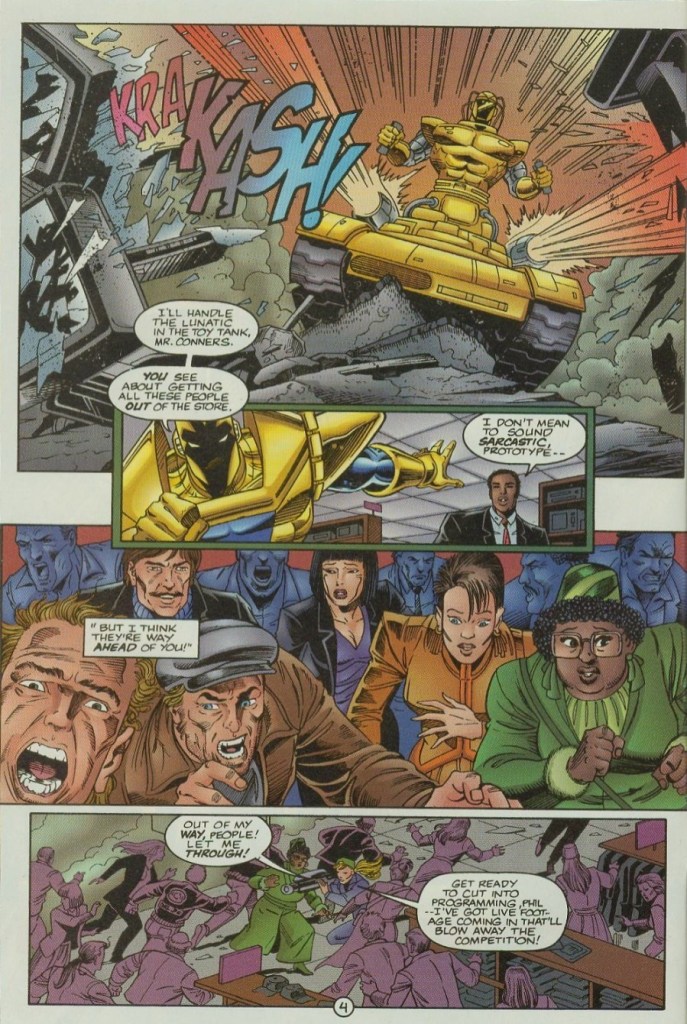
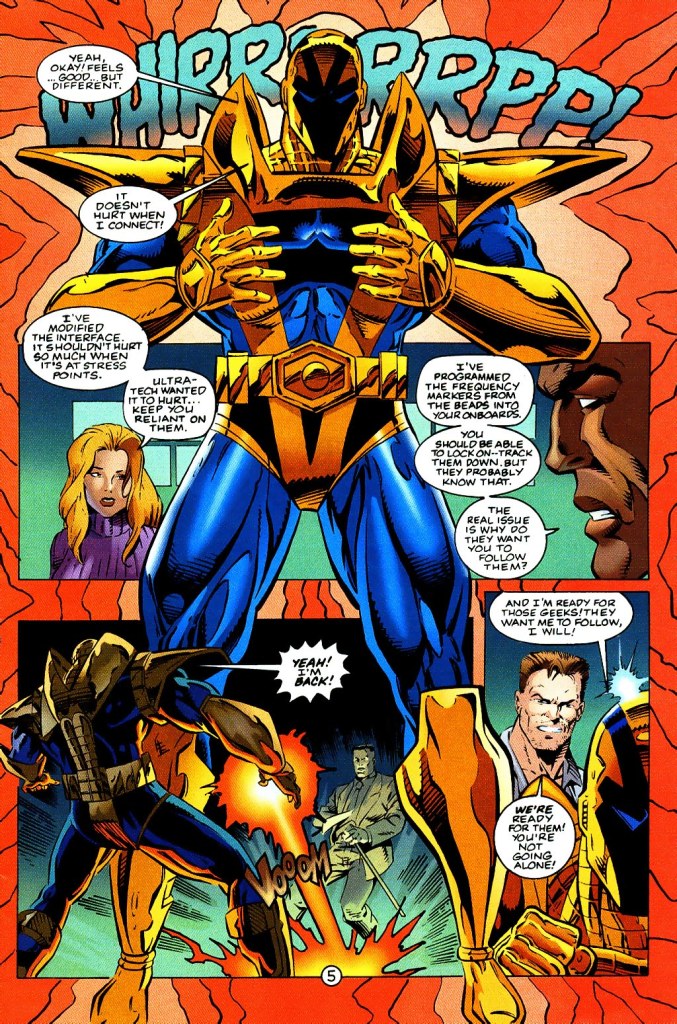
The story begins in a certain department store in Manhattan where a special anniversary celebration is being held and Prototype (piloted by Jimmy Ruiz) is the special guest. The affair turns out to be an assignment for him from his employer. Suddenly an armored figure (human-like above the belt, mechanical below the belt) breaks into the store causing a major disturbance. He calls himself Battlewagon.

Battlewagon suddenly opens fire and hits many items around, causing people to panic. Prototype decides to take action and their conflict causes even more damage.

As Battlewagon speaks out against him, Prototype notices the use of a word which was a reference to the gang that he (Jimmy Ruiz) used to hang out with. Prototype also realizes that his new foe is after him in a rather personal way…

Quality

Does this scene remind you of today’s manipulative and irresponsible news media coverage?

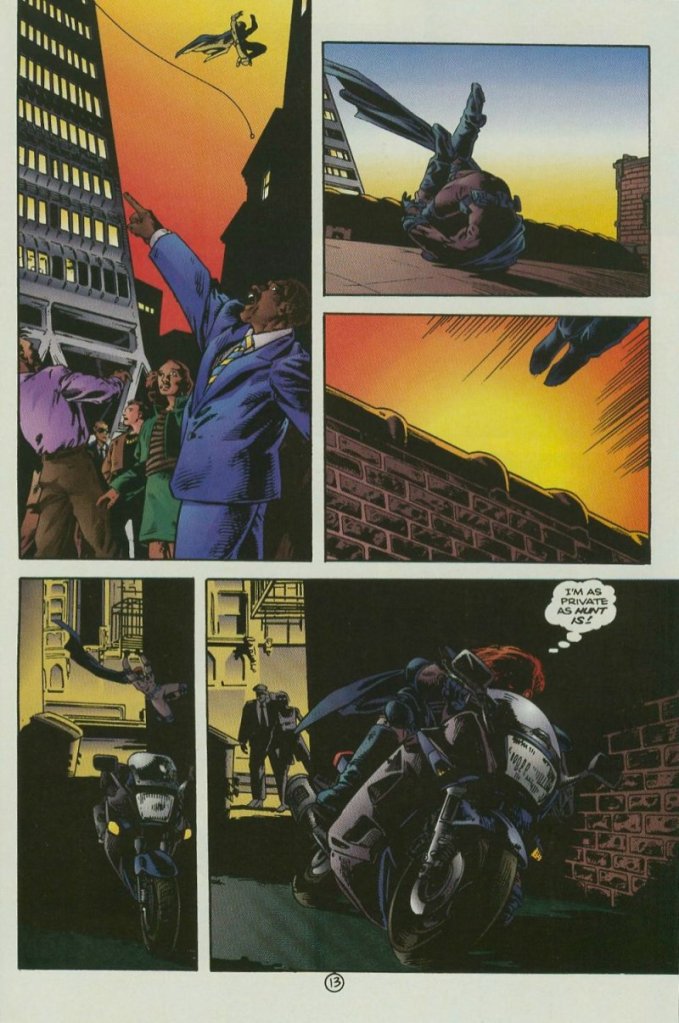
To put it straight to the point, this comic book is not as conclusive as what Prototype fans would hope for. Sure the words “The end.” were written on the last page but, without fully spoiling the story of the comic book, sub-plots that started building up in the few previous issues were left unresolved. You hoped to see Jimmy reunited with Angella in this issue? You hoped to what happened to the deformed Stanley Leland? You will be disappointed.

More on the comic book itself, the conflict between Prototype and Battlewagon is actually written to be intense in terms of dialogue and interaction between the two. While that is a good thing, it does not hide the fact that Battlewagon, as a villain, felt more like an afterthought in terms of character introduction and the flashback relating to collateral damage in Prototype #7 does not really add much to the him. What I liked most in the script written by R.A. Jones was the look back at the past of Jimmy Ruiz when he was younger and was a thug on the streets.

Conclusion

Chaos inside the department store.

While it is not strong enough to be a worthy conclusion to its series, Prototype #18 (1995) managed to tell its own tale in a satisfying manner by adding another villain for the hero to fight with, and also expanding Jimmy Ruiz’s past as a gang member. Of course, I don’t have the details about what happened behind the scenes at Malibu Comics as a result of getting acquired by Marvel Comics, and how all that impacted the creators working on Prototype. I can only speculate that there were planned stories of Prototype that did not get published. In fact, there was a short announcement of Prototype: Turf War shown.

If this comic book is any indication, its story really felt more like a substitution as it had no references to the plot elements of the immediate few issues before it. Considering what happened at the end of issue , Jimmy Ruiz really acted out of character in this story.   

If you are seriously planning to buy an existing hard copy of Prototype #18 (1995), be aware that as of this writing, MileHighComics.com shows that the near-mint copy of the comic book costs $35.

Overall, Prototype #18 (1995) is satisfactory. As a series’ final issue, however, it is a disappointment.

+++++

Thank you for reading. If you find this article engaging, please click the like button below and also please consider sharing this article to others. If you are looking for a copywriter to create content for your special project or business, check out my services and my portfolio. Feel free to contact me as well. Also please feel free to visit my Facebook page Author Carlo Carrasco and follow me at HavenorFantasy@twitter.com
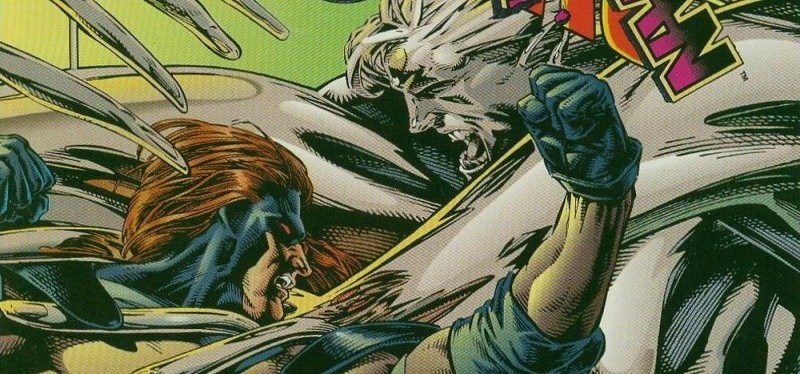
A Look Back at The Strangers #11 (1994)

Disclaimer: This is my original work with details sourced from reading the comic book and doing personal research. Anyone who wants to use this article, in part or in whole, needs to secure first my permission and agree to cite me as the source and author. Let it be known that any unauthorized use of this article will constrain the author to pursue the remedies under R.A. No. 8293, the Revised Penal Code, and/or all applicable legal actions under the laws of the Philippines.

Welcome back, superhero enthusiasts, comic book collectors, 1990s culture enthusiasts and fans of Malibu Comics! Today we return to the Ultraverse through another tale of The Strangers which has been a pretty solid monthly series that I’ve been reviewing. As of this writing, I’m getting closer to finishing all 24 issues of this particular series and I can say that it has been a lot of fun doing retro comic book reviews of it. I’ve got a retro review about the 11th issue of The Strangers right here.

Before going to it, I should state a recap of the events in issue #10. That story had the Strangers (without Yrial who by then was held captive by her black tribe) doing a search by the sea in the Caribbean and they eventually discover a portal that sent them to another realm filled with monsters. After a big battle, the team attempted to get away only to fall over a cliff.

With those details laid down, here is a look back at The Strangers , published in 1994 by Malibu Comics with a story written by Steve Englehart and drawn by Rick Hoberg.

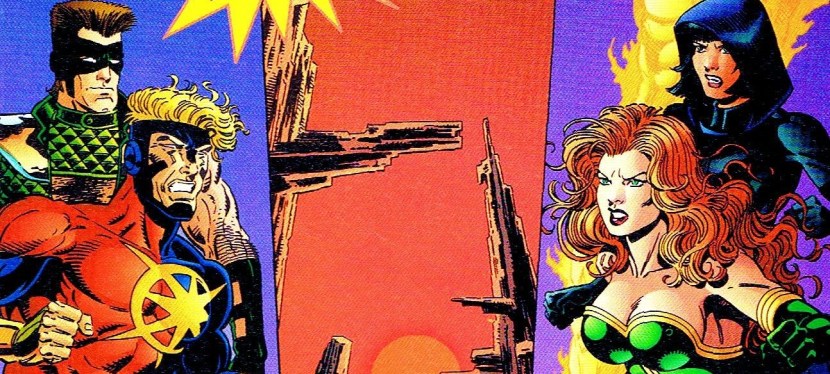
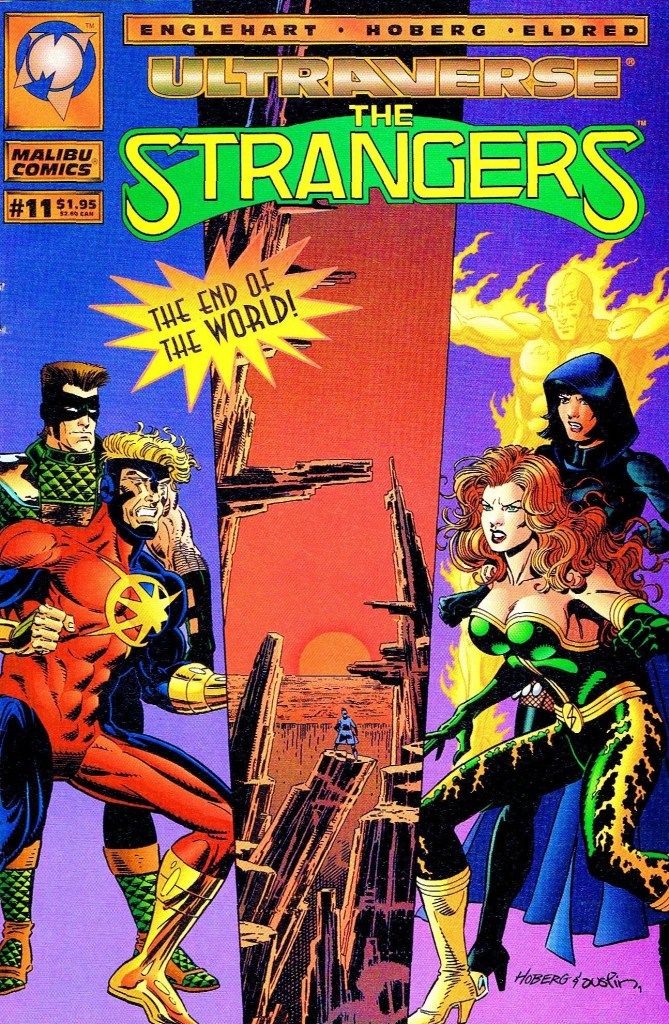
The cover.

Early story

The story begins with the Strangers falling down from what turned out to be a very great height. While his teammates could not do anything, Zip-Zap uses his power to make the air whirl around them and land safely on the ground below.

As they are in the middle of nowhere, searching for the way back seemed like an impossibility. Electrocute realizes there is an answer sensing the something is present in that lost world they are in and she points to some far-away direction. Zip-Zap then proceeds to run towards it leaving the team behind…

Quality

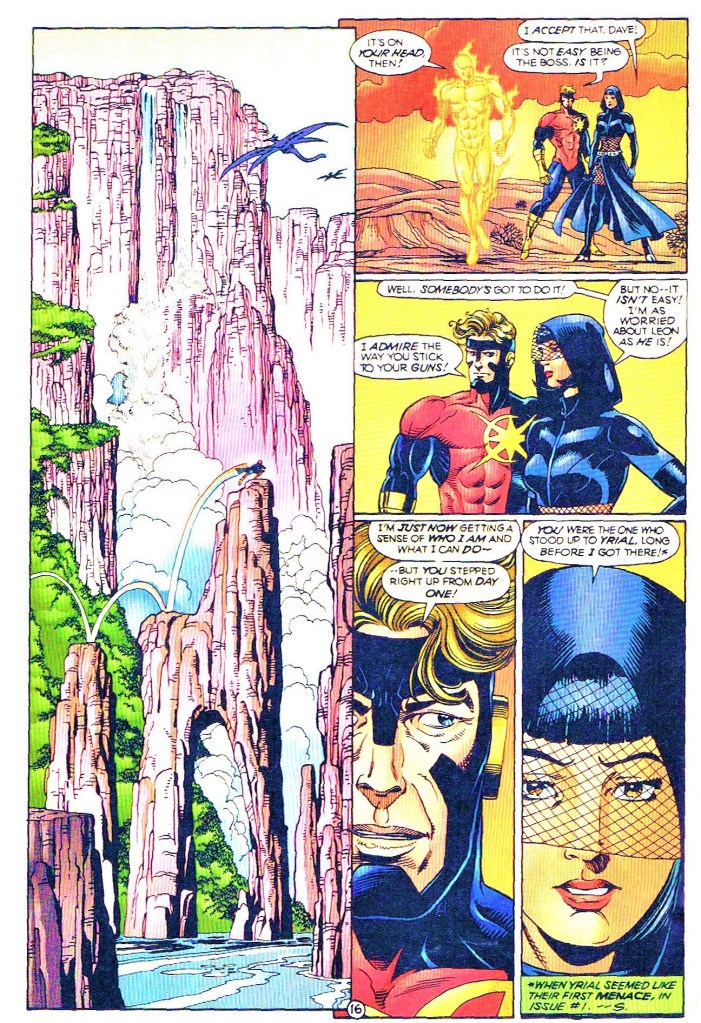
A nice display of fine art and character development.

Starting with the writing, I should say that this comic book’s plot is very simplistic with its concept and clearly lacks the richness of the story told in issue . Technically, this story is more like a filler serving as a build-up to issue #12 (which itself has a deeper story filled with spectacle and lots of intrigue). That’s not to say this is a disappointing issue of The Strangers in relation to the overall quality of the series as a whole. It’s just different with its plot structuring. Along the way, there were some short but sweet character development moments that took place most notably with regards to the romance between Atom Bob and Lady Killer.

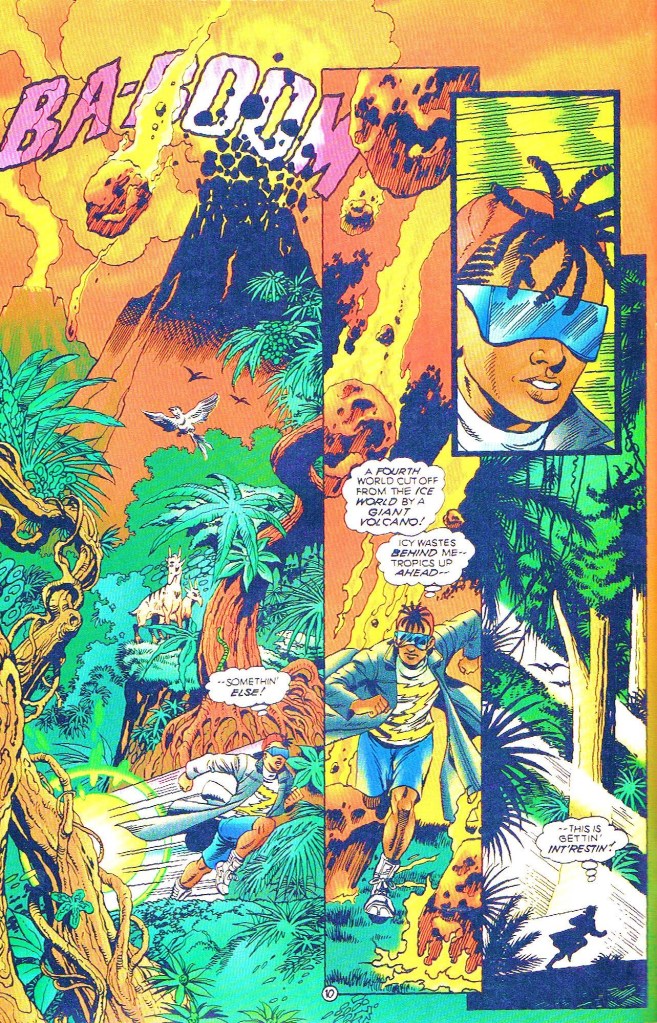
What this comic book excels at is the really fine and varied artwork done by Rick Hoberg. Through the scenes in which Zip-Zap runs and explores the unknown realm they are lost in, you will really see Hoberg’s great talent with visual details as well as his creativity with regards to making varied locations filled with creatures that are truly out of this world. For the lack of superhero action, Hoberg’s visuals are the true spectacle here.

Conclusion

Really great art by Rick Hoberg.

Even though its plot lacked depth and its execution in storytelling is very different, The Strangers (1994) succeeds in expanding the lost realm and zones within the Ultraverse. As for building up suspense or excitement for issue , this comic book achieved it as well. For a comic book that lacked superhero action, this one did not end up boring and that’s quite an achievement by the creators.

If you are seriously planning to buy an existing hard copy of The Strangers (1994), be aware that as of this writing, MileHighComics.com shows that the near-mint copy of the comic book costs $14.

Overall, The Strangers (1994) is recommended.

+++++

Thank you for reading. If you find this article engaging, please click the like button below and also please consider sharing this article to others. If you are looking for a copywriter to create content for your special project or business, check out my services and my portfolio. Feel free to contact me as well. Also please feel free to visit my Facebook page Author Carlo Carrasco and follow me at HavenorFantasy@twitter.com
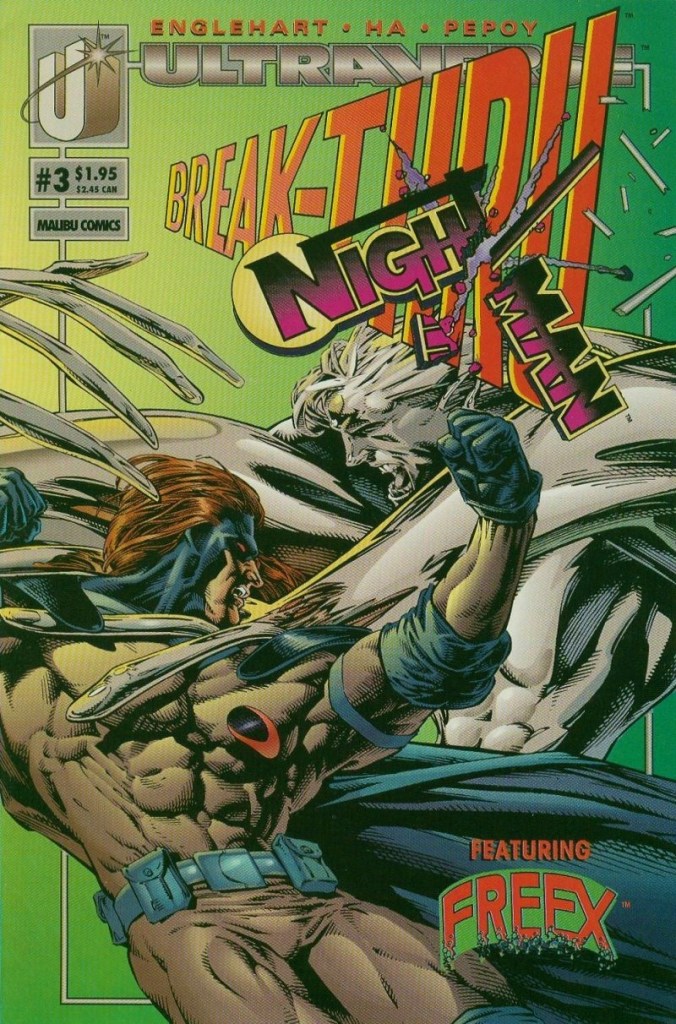
A Look Back at Prototype #17 (1995)

Disclaimer: This is my original work with details sourced from reading the comic book and doing personal research. Anyone who wants to use this article, in part or in whole, needs to secure first my permission and agree to cite me as the source and author. Let it be known that any unauthorized use of this article will constrain the author to pursue the remedies under R.A. No. 8293, the Revised Penal Code, and/or all applicable legal actions under the laws of the Philippines.

Welcome back, superhero enthusiasts, comic book collectors, fans of 1990s culture and fans of Malibu Comics. Today we return to the Ultraverse and I should say that I am getting very close to closing my retro review run on the Prototype monthly series. So far, I found Prototype to be a really enjoyable and engaging series. It is too bad that the Ultraverse did not last too long because as far as armored superheroes go, Malibu Comics’ armored hero concept is very unique and fun to read. Had the Ultraverse lasted long, Prototype would have been explored a whole lot more and writers Tom Mason and Len Strazewski would have created more new stories of him.

Last time around, Jimmy Ruiz (who no longer has the high compensation and big-time perks of his original employer) got into trouble and had to use his armor as he was the target of another huge and powerful armored rival. The battle ended costly for Prototype.

What will happen next to him? We can all find out in this look back at Prototype , published by Malibu Comics in 1995 with a story written by Len Strazewski and drawn by George Dove.

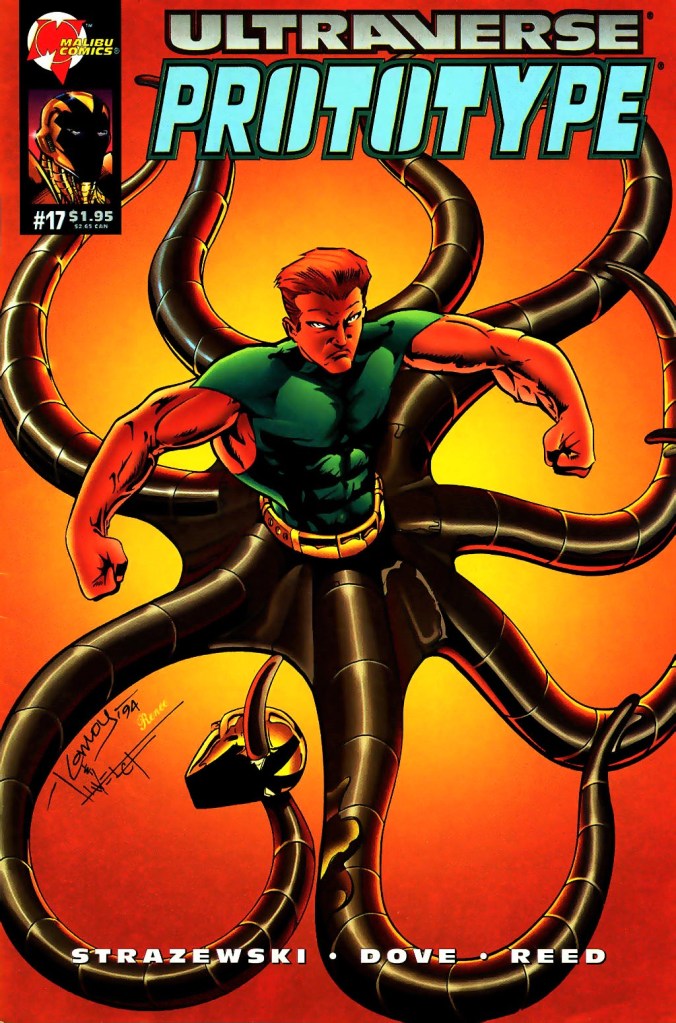
The cover.

Early story

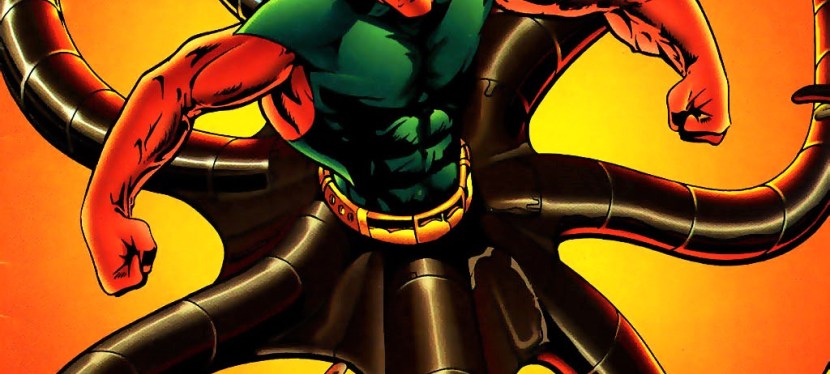
The story begins inside a top-secret facility. A man realizes that all the flesh below his waste are gone, completely replaced with metallic tentacles which make him look like a human octopus. The man in shock is none of other than Stanley Leland and his is welcomed to Terrordyne. Terrordyne makes clear they do not want to hurt him but have him as their new CEO  and they know he desires revenge against Prototype.

Elsewhere, the Prototype armor is being repaired by Bob Campbell (Ranger). Jimmy, who is desperate to get Angella back, is eager to get back into action but the repair of his armor is not moving as fast as he wanted. Fortunately, Bob’s wife arrives with a man who believes he can help them. She tells Jimmy that the Prototype armor’s power coupling will be improved by forty percent.

Soon enough, the armor gets enhanced and Jimmy could sense the differences already. Soon enough, he goes on a mission with Ranger accompanying him…

Quality

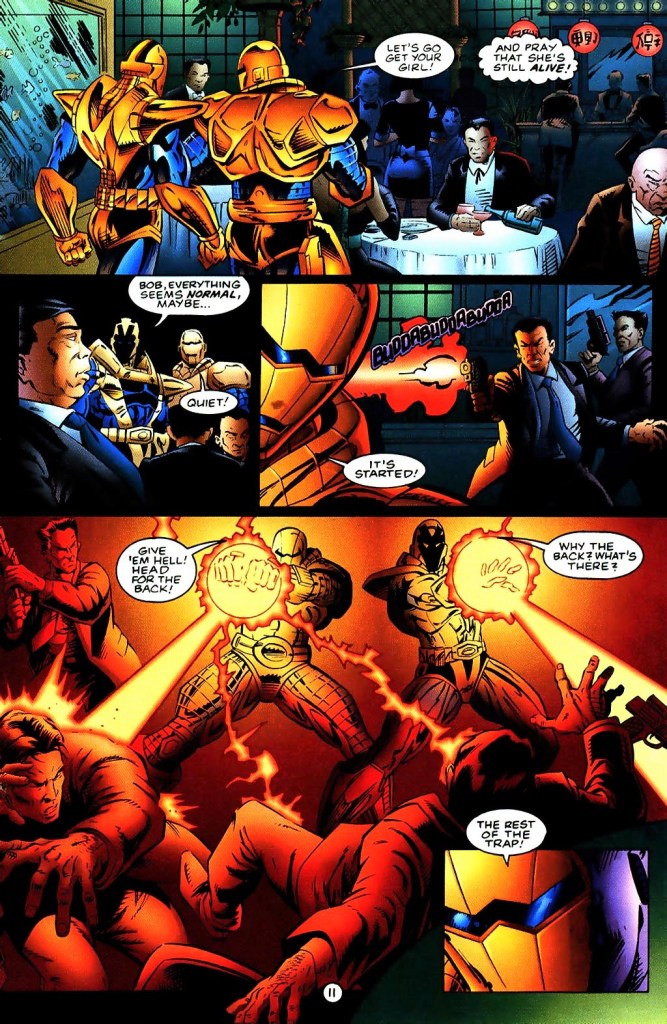
Prototype and Ranger inside a restaurant.

Starting with the story, I’m happy to say that the writing here is stronger, the dialogue has more depth and the plot is much more intriguing to read compared to the previous few issues. The concept of this comic book is about the effort to find and save Angella but with Ranger getting involved not only to add assist Prototype on the field but also provide him insight on dealing with a serious matter like the kidnapping done by very powerful opponents. In a way, having upgraded armor and weapons are not sufficient and even though he fought lots of enemies before, Jimmy Ruiz lacks the maturity, the self-control and strategy needed to do his mission. The scenes showing Ranger providing Prototype assistance in the form of strategies related to past experiences (that Bob Campbell went through) were done cleverly and never hampered the pace of the story.

As for the art, George Dove did a good job visualizing the armors of Prototype and Ranger. He also was good with drawing the action scenes.

Conclusion

Really nice art by George Dove.

To be clear, Prototype (1995) is a two-heroes-in-one type of story that is character-led. For one thing, Jimmy is desperate, impatient and does things recklessly while Bob Campbell does his best to keep him stable and to prevent him from screwing up everything due to recklessness. It shows that the protagonist is not only humanly fragile, but also getting close to his breaking point. The emotional element makes the story worth reading.

If you are seriously planning to buy an existing hard copy of Prototype #17 (1995), be aware that as of this writing, MileHighComics.com shows that the near-mint copy of the comic book costs $27.

Overall, Prototype (1995) is recommended.

+++++

Thank you for reading. If you find this article engaging, please click the like button below and also please consider sharing this article to others. If you are looking for a copywriter to create content for your special project or business, check out my services and my portfolio. Feel free to contact me as well. Also please feel free to visit my Facebook page Author Carlo Carrasco and follow me at HavenorFantasy@twitter.com
A Look Back at The Strangers #6 (1993)

Disclaimer: This is my original work with details sourced from reading the comic book and doing personal research. Anyone who wants to use this article, in part or in whole, needs to secure first my permission and agree to cite me as the source and author. Let it be known that any unauthorized use of this article will constrain the author to pursue the remedies under R.A. No. 8293, the Revised Penal Code, and/or all applicable legal actions under the laws of the Philippines.

Welcome back, superhero enthusiasts, comic book collectors, fans of 1990s culture and fans of Malibu Comics! Do you want to see another fight against evil within the Ultraverse? You will find it right here through The Strangers.

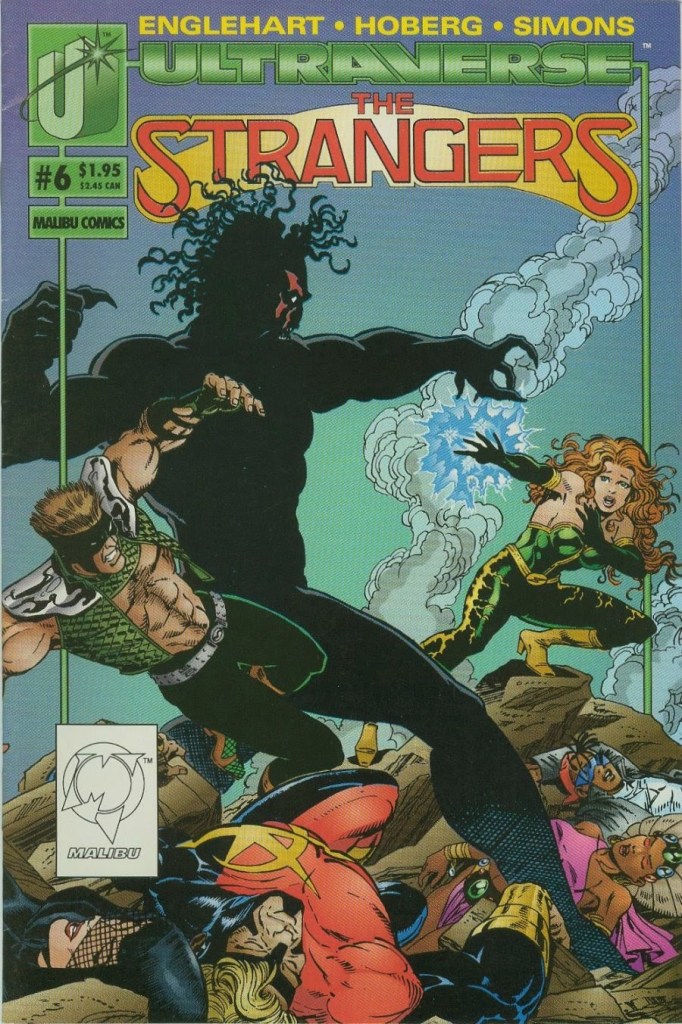
Last time around, The Strangers had to cut short their return to private life because they were need to deal with a new force of evil called Deathwish. What was revealed was that the person behind Deathwish turned out to be one of the many people who rode the very same San Francisco cable car with the members of The Strangers (when they were still civilians without powers) that was hit by energy from the sky.

With those details laid down, here is a look back at The Strangers , published by Malibu Comics in 1993 with a story written by Steve Englehart and drawn by Rick Hoberg.

The cover.

Early story

The story begins with the impact of Deathwish still felt by The Strangers and the locals. Deathwish left behind a lot of physical damage and the team does what it can to repair it even though some emergency personnel are already present.

A short time later, an old survivor was found and was brought to a hospital for treatment. Yrial, Zip-Zap and Lady Killer decide to go to the hospital and observe the emergency procedure. Suddenly, a loud voice from somewhere was heard and Zip-Zap speedily went around to find the source. He found a hospital room which had a patient warning others that darkness has arrived.

Back inside the emergency room, something happens to the old survivor and Deathwish suddenly emerges out of thin air. Lady Killer is stunned with the sight of the monster’s return…

Quality

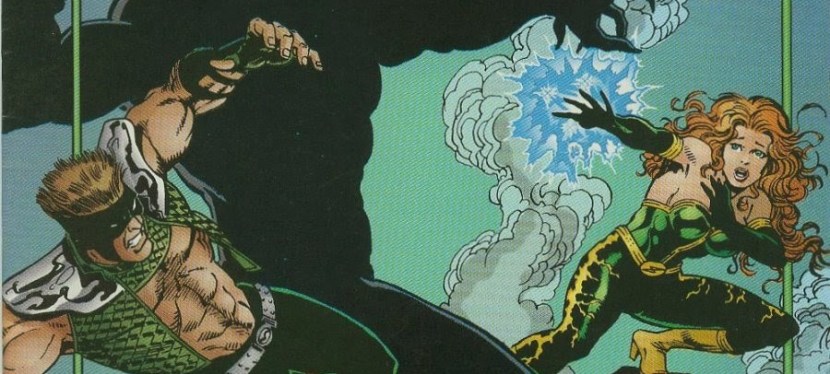
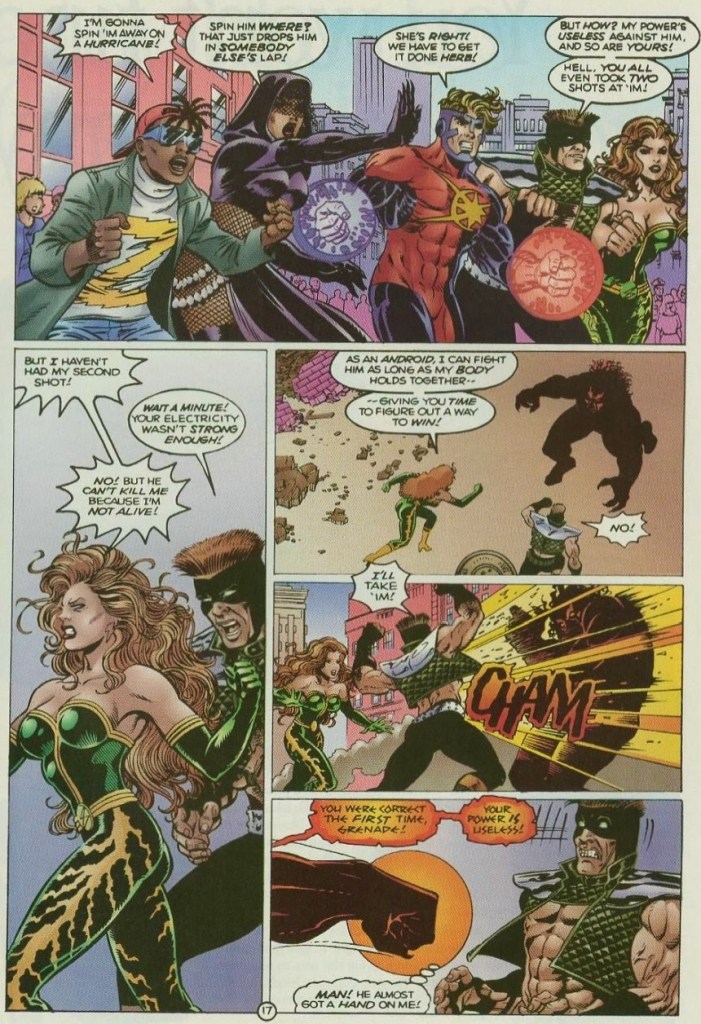
The Strangers fight Deathwish again.

Without spoiling important plot details, this story marks the second conflict between The Strangers and Deathwish. The good news here is that the script is well written and the creative duo found new ways to keep the rematch fresh and fun to read. What the Strangers did the previous time to beat Deathwish did not work anymore which forced their members to find new ways and tactics overcome the challenges. As for the villain, this comic book showed more of his personality (as opposed to his desire for power and absorbing life).

When it comes to character development, it’s pretty much non-existent here. The scene showing Yrial working with her magic does not count as character development but more of exposition of what she could do. It feels hollow but the visuals are nice to look at.

Conclusion

The Strangers helping with cleaning up the mess.

While The Strangers (1993) is a fun read and really nice art drawn by Rick Hoberg, it still is a step down from its predecessor in terms of engagement and depth. The rematch between The Strangers and Deathwish was fun but it ended in a way that felt like a creative way of cheating readers who preferred to see a more engaging conclusion.

If you are seriously planning to buy an existing hard copy of The Strangers (1993), be aware that as of this writing, MileHighComics.com shows that the near-mint copy of the comic book costs $14.

Overall, The Strangers (1993) is satisfactory.

+++++

Thank you for reading. If you find this article engaging, please click the like button below and also please consider sharing this article to others. If you are looking for a copywriter to create content for your special project or business, check out my services and my portfolio. Feel free to contact me as well. Also please feel free to visit my Facebook page Author Carlo Carrasco and follow me at HavenorFantasy@twitter.com
A Look Back at The Solution #3 (1993)

Disclaimer: This is my original work with details sourced from reading the comic book and doing personal research. Anyone who wants to use this article, in part or in whole, needs to secure first my permission and agree to cite me as the source and author. Let it be known that any unauthorized use of this article will constrain the author to pursue the remedies under R.A. No. 8293, the Revised Penal Code, and/or all applicable legal actions under the laws of the Philippines.

Welcome back, superhero enthusiasts, comic book collectors, 1990s culture enthusiasts and fans of Malibu Comics! Are you ready for another return to the Ultraverse? I’ve got another retro review of The Solution.

Last time around, The Solution went to Japan on a mission that involved a secret meeting between leader Lela Cho/Tech and a man referred to as Kronstein. However, something unfortunate happened that led to violence. What The Solution encountered was a force of opposition in the form of another team (that was introduced also in issue ).

With those details laid down, here is a look back at The Solution , published in 1993 by Malibu Comics with a story by the late James Hudnall and drawn by Darick Robertson (with ink work done by Barbara Kaalberg).

The cover.

Early story

The story begins in Los Angeles. A lady is struggling with finding her car key as two monstrous figures approach her. One of them is holding her set of keys. They fully transform into over-sized monsters with razor sharp teeth right in front of her. The monsters’ focus gets disrupted when they hear the sound of a harmonica being played by a man sitting on top of a car. As they approach him, the man grabs his rod and fights them fearlessly.

The next day in nearby Hollywood, Lela/Tech and her teammates have a meeting in a hotel room. Dropkick and Vurk express concern about Lela engaging in media interviews that could undercut what they have been trying to do. Lela does not see anything wrong about it and she reminds Dropkick that their team is a business and they could use the free advertising.

Apart from the media talk, The Solution is preparing to meet their new client at 9PM. Vurk, seeking some fresh air and use the free time, decides to head out for a while. Discreetly, Lela asks Aera to use her magic to put a trace on him…

Quality

Vurk in his monster form during his fight with the hunter of his race.

Like issue , this one continues to build-up the team but with one notable difference…more focus on the creepy looking Vurk (also referred to as Outrage). While it was established in issue that, like Aera/Shadowmage, he is not human. Rather he belongs to a race called the Darkurians which are oversized monsters in their true forms. In this story, you get to see more of Vurk’s nature as a Darkurian as well as his personality complete with how much he has learned to walk along the many people around him.

This comic book also introduces readers to a new character who hunts Darkurians as part of his campaign to rid the world of them. As it turns out, that man has a history of conflict with Vurk and this issue reignites their conflict. This easily produces the spectacle of this comic book which is filled with hard-hitting action, collateral damage and action moves that Vurk could pull off only in his monster form. It’s pretty entertaining stuff.

Conclusion

The team in their private meeting.

The Solution (1993) is a fun Ultraverse story that succeeded in building up the series’ concept but with more focus on Vurk. Vurk is not exactly an appealing character on face value but at least his background details and his rivalry with the hunter of his race added a good amount of depth into the story. It is also interesting to see Vurk trying his best to be good with the good guys (his team). Having read his incidental involvement with the team in issue #8, this comic book makes more sense out of him.

If you are seriously planning to buy an existing hard copy of The Solution (1993), be aware that as of this writing, MileHighComics.com shows that the near-mint copy of the regular edition costs $14 while the near-mint copy of the newsstand edition costs $42.

Overall, The Solution (1993) is recommended.

+++++

Thank you for reading. If you find this article engaging, please click the like button below and also please consider sharing this article to others. If you are looking for a copywriter to create content for your special project or business, check out my services and my portfolio. Feel free to contact me as well. Also please feel free to visit my Facebook page Author Carlo Carrasco and follow me at HavenorFantasy@twitter.com

A Look Back at The Strangers #5 (1993)

Disclaimer: This is my original work with details sourced from reading the comic book and doing personal research. Anyone who wants to use this article, in part or in whole, needs to secure first my permission and agree to cite me as the source and author. Let it be known that any unauthorized use of this article will constrain the author to pursue the remedies under R.A. No. 8293, the Revised Penal Code, and/or all applicable legal actions under the laws of the Philippines.

Welcome back, superhero enthusiasts, comic book collectors, 1990s culture enthusiasts and fans of Malibu Comics! As of this writing, I am coming close to finally reviewing all issues of The Strangers series of comic books under the Ultraverse line of Malibu Comics. If you have been following my retro reviews, I reviewed issue which was the 2nd-to-the-last of all published issues of The Strangers.

Then I checked for issues I have not reviewed. I went on to review issues #14 and #15. Now I am about to review a few more issues that were published during the first six months of The Strangers.

With those details laid down, here is a look back at The Strangers , published in 1993 by Malibu Comics with a story written by Steve Englehart and drawn by Rick Hoberg.

The cover.

Early story

The story begins somewhere in California (shortly after parting ways with Hardcase and Choice). It was decided by the team to take a break from being the Strangers and return to their respective private lives.

Bob Hardin/Atom Bob returns to his parents at home and learns that not only were he and his teammates publicized in the local news, there are many reporters who arrived and stayed just outside their home seeking him.

Zip-Zap arrives in his old neighborhood and immediately encounters a local gang of his fellow black people. Grenade and Electrocute, who are in the same neighborhood as Atom Bob, walk down the street and start to get close with each other. Elena/Lady Killer goes back to her business while Yrial finds herself unable to return to her private life (at the floating island). Suddenly, someone on the sidewalk calls out to Yrial for help…

Quality

Suspense and tension builds up for the Strangers.

Given how hectic times were for The Strangers in the first four issues, this story is a welcome change of pace. The pacing was adjusted to give readers some much needed breathing space to help them focus on the characterization moments, to get to know each team member better and to realize what their place in the entire Ultraverse truly is. For one thing, it is nice to see Atom Bob with his folks and it is quite something to see Yrial finding herself somewhat lost and lonely in the middle of the city as she is unable to come back to her tribe on the floating island.

More on storytelling, this comic book still has a good amount of space left for spectacle which was structured in a way to be a pay-off for all the character development scenes that preceded it. That being said, the new villain introduced here is Deathwish who turns out to be quite powerful (powerful enough kill and make corpses rot faster than usual) and easily challenged the Strangers a lot. The encounter results some pretty interesting character moments for each team member. Deathwish also is one of the many other people who rode the same cable car with the Strangers on the day they got hit by energy from above.

More on the spectacle, I just love the way Steve Englehart and Rick Hoberg presented the teamwork dynamics of The Strangers in their fight with Deathwish.

Conclusion

Elena/Lady Killer as the very busy businesswoman.

The Strangers (1993) is another entertaining read from the Englehart-Hoberg duo. This comic book further developed the characters and even gave readers a look at their private lives before resuming the superhero spectacle. It also tried to be socially relevant for the 1990s with insertions about AIDS, cancer and homosexuality (an abomination as clearly written in 1 Corinthians 6:9-10 in the Holy Bible) which are channeled through one particular team member. More notably, it sheds light on the cable car incident from issue to point out that the Strangers are truly not the only ones who got affected by the energy blast from the sky.

If you are seriously planning to buy an existing hard copy of The Strangers (1993), be aware that as of this writing, MileHighComics.com shows that the near-mint copy of the comic book costs $14.

Overall, The Strangers is recommended.

+++++

Thank you for reading. If you find this article engaging, please click the like button below and also please consider sharing this article to others. If you are looking for a copywriter to create content for your special project or business, check out my services and my portfolio. Feel free to contact me as well. Also please feel free to visit my Facebook page Author Carlo Carrasco and follow me at HavenorFantasy@twitter.com

A Look Back at The Solution #2 (1993)

Disclaimer: This is my original work with details sourced from reading the comic book and doing personal research. Anyone who wants to use this article, in part or in whole, needs to secure first my permission and agree to cite me as the source and author. Let it be known that any unauthorized use of this article will constrain the author to pursue the remedies under R.A. No. 8293, the Revised Penal Code, and/or all applicable legal actions under the laws of the Philippines.

Welcome back, superhero enthusiasts, comic book collectors, 1990s culture enthusiasts and fans of Malibu Comics! Some time ago, I posted my first review of The Solution comic book series. My further retro reviews of the said series were not that many but I had a lot of fun reading one of its character origin stories, the crossover with Hardcase, and most recently their participation in the Hostile Takeover crossover storyline.

For the newcomers reading this, The Solution is a team of specialists that renders varied services for their paying clients.

With those details laid down, we can find more about the team in The Solution , published in 1993 by Malibu Comics with a story written by the late James Hudnall and drawn by Darick Robertson.

The cover.

Early story

The story begins in a secret place where a meeting is being held in. Rex Mundi, the elusive man with power, is very angry. He is fuming mad about The Solution and he tells the people in front of him that he wants them all killed.

On the streets of Tokyo, Japan, Vurk walks down and his unusual appearance caught the attention of a few people near him. It turns out The Solution is preparing for a meeting with their leader Lela Cho/Tech entering a building while coordinating secretly with her teammate Dropkick (thanks to the biochip implanted in her brain). Dropkick is on the rooftop of a building carefully monitoring the situation while Lela climbs up to find a room to meet Kronstein. Their other teammate, Shadowmage, is inside a room located next to the one where the meeting will take place. She is using her magic skills to sense any trouble.

As soon as the door opens, Lela begins her meeting with Kronstein and tells him that he might a leak somewhere on his side. Suddenly, her teammates begin to sense danger. Dropkick turns to see someone carrying swords approaching to strike at him…

Quality

You will see how The Solution reacts when things go wrong.

The concept of this comic book is pretty simple. What is notable is the way the storytelling was executed. While the plot is very simplistic, this comic book’s script was structured to show The Solution’s members in action with match-ups in mind, while managing to emphasize their respective personalities and how they think and act during tense moments.

When it comes to presenting the respective traits of the team members, this comic book succeeded. You will get to see how Lela works not only with leading the team but also being strategic with her business talk and on-field action. Shadowmage, Vurk and Dropkick all had their moments and got developed more.

Beyond the titular team, this comic book also emphasized how deadly Rex Mundi is as a mastermind and recruiter of deadly villains. The match-ups and conflicts here are short but still enjoyable.

Conclusion

Team leader Lela/Tech makes her move knowing that her teammates have set themselves in place.

There is not much depth with the plot of The Solution (1993), but it served its purpose on developing the main characters while giving readers some interesting match-ups through the implementation of the classic good-versus-evil element of comic book storytelling. This comic book technically is a preview of things to come while showing the tremendous influence of Rex Mundi who also appeared in other Ultraverse comic books.

If you are seriously planning to buy an existing hard copy of The Solution (1993), be aware that as of this writing, MileHighComics.com shows that the near-mint copy of the regular edition costs $14 while the near-mint copy of the newsstand edition costs $42.

Overall, The Solution (1993) is satisfactory.

+++++

Thank you for reading. If you find this article engaging, please click the like button below and also please consider sharing this article to others. If you are looking for a copywriter to create content for your special project or business, check out my services and my portfolio. Feel free to contact me as well. Also please feel free to visit my Facebook page Author Carlo Carrasco and follow me at HavenorFantasy@twitter.com

A Look Back at Prototype #16 (1994)

Disclaimer: This is my original work with details sourced from reading the comic book and doing personal research. Anyone who wants to use this article, in part or in whole, needs to secure first my permission and agree to cite me as the source and author. Let it be known that any unauthorized use of this article will constrain the author to pursue the remedies under R.A. No. 8293, the Revised Penal Code, and/or all applicable legal actions under the laws of the Philippines.

As many of you know by now, I’ve reviewed lots of Ultraverse comic books and that includes a whole lot of issues of Prototype. In recent times, I reviewed the Hostile Takeover storyline that involved not only Prototype but also The Solution, Night Man and even Solitaire. To put things in order, my previous review of Prototype was issue which took place after Hostile Takeover ended. What I enjoyed about it so much is that even though Jimmy Ruiz still has the powered suit of armor with him, his life has changed drastically and he no longer has the high salary and big-time perks that he had from his previous employer.

What will happen next to him? We can all find out in this look back at Prototype , published in 1994 by Malibu Comics with a story written by Len Strazewski and drawn by Roger Robinson.

The cover.

Early story

The story begins right in the middle of a battle on a city street between Prototype against a large armored enemy (that intends to kill him) piloted by a man named Donovan Jones. This was supposed to be the night of Jimmy Ruiz getting engaged with Angella.

As his intensity grows, Prototype fires a powerful blast against Jones causing his armored suit to fall back hard and get damaged heavily. Jones finds himself exposed and Angella only hopes that Prototype does not kill him. Jones surprises him by showing his armor magnetically reassembles itself and makes him even more powerful…

Quality

The is one nice shot!

When it comes to plot, this comic book is more about the continuing battle between Jimmy and Donovan Jones. It really pushed aside the development of Jimmy’s new life which is not necessarily a problem as it paved the way for a lot more spectacle for readers to enjoy by means of two armored figures fighting each other hard while trying to outsmart each other. This one has a lot action scenes as well as energy blasts. What I find intriguing and creative here is how Donovan Jones was presented to be a walking, healing factor with improving his physical shell dramatically.

Although filled with spectacle, Len Strazewski still saved some space for character development and exposition. Without spoiling it, I can say that a certain flashback that got dramatized through Angella’s recall of the past adds a new layer into the life of Jimmy Ruiz. It was short but still worthy to read.

As far as Jimmy’s new life goes, the big battle of this comic book is itself a reflection of the impact that the Hostile Takeover storyline had on him. There is not too much corporate intrigue in this story, but the effects of the mentioned crossover storyline can still be felt.

Conclusion

This comic book has a lot of robot-inspired action.

I can say that Prototype (1994) is another good Ultraverse comic book to read. In fact, you will relate with its plot and spectacle a lot more if you managed to read the entire Hostile Takeover storyline. Otherwise, it should be able to satisfy you.

If you are seriously planning to buy an existing hard copy of Prototype (1994), be aware that as of this writing, MileHighComics.com shows that the near-mint copy of the comic book costs $27.

Overall, Prototype (1994) is recommended!

+++++

Thank you for reading. If you find this article engaging, please click the like button below and also please consider sharing this article to others. If you are looking for a copywriter to create content for your special project or business, check out my services and my portfolio. Feel free to contact me as well. Also please feel free to visit my Facebook page Author Carlo Carrasco and follow me at HavenorFantasy@twitter.com

A Look Back at The Strangers #15 (1994)

Disclaimer: This is my original work with details sourced from reading the comic book and doing personal research. Anyone who wants to use this article, in part or in whole, needs to secure first my permission and agree to cite me as the source and author. Let it be known that any unauthorized use of this article will constrain the author to pursue the remedies under R.A. No. 8293, the Revised Penal Code, and/or all applicable legal actions under the laws of the Philippines.

Welcome back, superhero enthusiasts, comic book collectors, 1990s culture enthusiasts and fans of Malibu Comics! Are you ready for another return to the Ultraverse as seen through another tale of The Strangers?

Last time around, I had a lot of fun reading the debut and origin story of Powerhouse who turned out to be an ultra whose powers were realized in 1938 (coincidentally the same year DC Comics launched Action Comics which introduced Superman in real life) and ended up spending more than fifty years of his life in containment. As for the Strangers, only Atom Bob and Grenade were featured but their encounter with Powerhouse (an ultra who was rejected for his being powerful  during his youth and eventually witnessed how modern-day ultras like the two mentioned Strangers were received positively by the public which knew of their powers) proved to be fun and memorable to read.

Now we can go on to another tale of The Strangers but with focus on two other members. To find out, here is my look back at The Strangers , published by Malibu Comics in 1994 with a story written by Steve Englehart and drawn by Rick Hoberg.

Early story

The story begins with the Strangers doing a review of their own members (6) plus ten others who happened to have been on the very same cable car with them the day they all got struck by energy from the sky which turned them into ultra beings. Their leader Lady Killer noted that there are still 43 others unaccounted for who may or may not have realized the got powers. The first ten they verified as ultras were all bad guys they fought with in recent times.

After the end of their discussion, the Strangers decide to take time off to go back to their respective private lives. Yrial asked Leon/Zip-Zap if she could join him. Zip-Zap tells her that his local community is very different from the floating island community she came from. Even so, Yrial stressed she wants to come with him and he accepts.

Some time later at another part of town, Yrial and Zip-Zap (both wearing civilian clothes) walk together. A few people somewhat recognized Yrial which reflects the public’s knowledge of her team. As they move on, a gang of tough-looking black people calls Zip-Zap by his real name. It turns out that Colvin (the apparent gang leader) and Leon had a conflict some time back and he knows Leon is with the Strangers.

Colvin introduces Yrial and Zip-Zap to Gangsta and Brazen. This prompts the teenage Leon to warn Yrial that Gangsta is dangerous. Gangsta then unleashes an energy blast on the two Strangers…  

Quality

Yrial and Zip-Zap plus the gang.

I like this story and the way it developed Yrial and Zip-Zap. To be clear, this story is not a typical, good-versus-evil superhero presentation. You won’t see the entire Strangers engage with another group of bad guys nor go against one powerful villain. It’s really all about Zip-Zap and his black lady friend who find trouble at a time when they are supposed to have a restful and easy time together. In other words, what happened to Atom Bob and Grenade in the previous issue also happened to the two black members of the team.

There clearly is a strong visual element of black people here and the story even touches on racial barriers. The new villain Gangsta openly stated that he got his powers from the ancient Egyptian pharaohs which he also described as the direct ancestors of the black race. He even tells Zip-Zap to honor Colvin’s gang, otherwise he will die.

The match-ups here are strategic. Yrial and Gangsta fight each other using magic, and they represent different cultures even as they are both black. For his part, Zip-Zap fights with a gang of black people led by a rival from his past. Their respective conflicts were portrayed in compelling ways.

Going back to Zip-Zap being reluctant in having Yrial with him on his return to his old neighborhood, the teenage member of the Strangers admits that his life has been uneasy. His father died before he was born and his mother died a few years before the day he and his teammates gained their powers while riding the cable car. Zip-Zap also was the littlest kid in a gang. Then life in the neighborhood became harder for him when Gangsta showed up. I should state that the way Steve Englehart emphasized Zip-Zap’s background is really compelling and also believable.   

Conclusion

Visually, having Yrial and Zip-Zap in civilian clothing is a fresh change from the usual.

Thanks to the creative duo of Englehart-Hoberg, The Strangers (1994) is another fun-filled story that succeeded in developing Yrial and Zip-Zap while also keeping the series’ storytelling fresh. It touches on black people and the different cultures that brought the characters together. It even touches on the stereotypes of black gangsters as well as black youth who grew up without a father. That being said, it is a wonder as to how Black Lives Matter (BLM) activists would react if they read this comic book.

If you are seriously planning to buy an existing hard copy of The Strangers (1994), be aware that as of this writing, MileHighComics.com shows that the near-mint copy of the regular edition costs $14.

Overall, The Strangers (1994) is recommended!

+++++

Thank you for reading. If you find this article engaging, please click the like button below and also please consider sharing this article to others. If you are looking for a copywriter to create content for your special project or business, check out my services and my portfolio. Feel free to contact me as well. Also please feel free to visit my Facebook page Author Carlo Carrasco and follow me at HavenorFantasy@twitter.com

A Look Back at The Strangers #14 (1994)

Disclaimer: This is my original work with details sourced from reading the comic book and doing personal research. Anyone who wants to use this article, in part or in whole, needs to secure first my permission and agree to cite me as the source and author. Let it be known that any unauthorized use of this article will constrain the author to pursue the remedies under R.A. No. 8293, the Revised Penal Code, and/or all applicable legal actions under the laws of the Philippines.

Welcome back, superhero enthusiasts, comic book collectors and fans of Malibu Comics! Previously, I reviewed an issue of The Strangers which happened to be the 2nd-to-the-last issue of its monthly series (which itself was mostly spearheaded by the dynamic duo of Steve Englehart and Rick Hoberg).

I was about to do a retro review of The Strangers #24 but realized that there are still some other comic books of the series that I have not reviewed yet. As such, I decided to read those other issues before reviewing the final issue.

With those details laid down, here is a look back at The Strangers , published by Malibu Comics in 1994 with a story written by Englehart and illustrated by Hoberg.

The cover.

Early story

The story begins when a strong, muscular man with long blonde hair strikes a huge rock formation high in the hills to the east of San Francisco Bay in California. While talking to himself (most likely a way to deal with his isolation), he continues to lift very large piece of rock, smashes more rocks and throws a tractor as if it was just a ball.

“I am…Powerhouse! I am Powerhouse! I…am Powerhouse,” he said to himself.

Still talking to himself, Powerhouse realizes that the world must never know about him as it has done its best to destroy him. He quietly changes into civilian clothes and drives away into the distance in his car.

On the streets of East Bay Hills in Berkeley, Hugh/Grenade and Bob/Atom Bob walk down the fancy commercial zone as they enjoy the time-off Elena/Lady Killer gave them. Soon enough, people started recognizing the two as members of The Strangers even though they are not in costume. This community buzz catches the attention of an executive at a local radio station who then picks Powerhouse (in civilian form) to go to East Bay Hills to report about Hugh and Bob…

Quality

When Powerhouse first gained super abilities.

I’ll got straight to the point about what this comic book is all about. This is the story of an ultra who gained powers very long before The Strangers, Mantra, Prime, Hardcase, The Solution and all the other Ultraverse heroes even started. That being said, Powerhouse is an old man (who really does not look like in his sixties or seventies) whose life turned upside-down as a result of gaining super powers as a teenager in the year 1938 (note: this was the year Superman debuted in comics in real life). Having lost DECADES of his time in the world, Powerhouse became a man who found himself lonely and having trouble adjusting into the modern world (1993 in the Ultraverse specifically). What bothers him even more is the fact that super beings like The Strangers members Atom Bob and Grenade are gladly accepted and celebrated by the public which is the complete opposite of how he was perceived when he became a super being.

The writing done by Steve Englehart is very rich to read and through it all, you will feel the pain, frustration and anguish of Powerhouse. As usual, Rick Hoberg’s art is always great to look at and you can see in this comic book how he adjusts his style when the narrative shifts from the talk scenes into the action scenes and the like.

Conclusion

Really, you only see two of The Strangers in this comic book which contradicts what was shown on the cover art.

Fundamentally, The Strangers (1994) highlights Powerhouse (both his present-day self and his origin) with Atom Bob and Grenade literally pushed out of the spotlight. Powerhouse is clearly inspired by the old ages of superhero comics and the creative team cleverly presented him as a super-powered man who finds himself struggling to fit in the 1990s. While this super being debut story is fun and engaging, its only weakness is that The Strangers have little real presence in the story (note: the cover art looks great but is really misleading).

If you are seriously planning to buy an existing hard copy of The Strangers (1994), be aware that as of this writing, MileHighComics.com shows that the near-mint copy of the comic book costs $14.

Overall, The Strangers (1994) is recommended!

+++++

Thank you for reading. If you find this article engaging, please click the like button below and also please consider sharing this article to others. If you are looking for a copywriter to create content for your special project or business, check out my services and my portfolio. Feel free to contact me as well. Also please feel free to visit my Facebook page Author Carlo Carrasco and follow me at HavenorFantasy@twitter.com