A Look Back at X-Men Adventures #9 (1993)

Disclaimer: This is my original work with details sourced from reading the comic book and doing personal research. Anyone who wants to use this article, in part or in whole, needs to secure first my permission and agree to cite me as the source and author. Let it be known that any unauthorized use of this article will constrain the author to pursue the remedies under R.A. No. 8293, the Revised Penal Code, and/or all applicable legal actions under the laws of the Philippines.

Welcome back, superheo enthusiasts, 1990s culture enthusiasts, X-Men fans and comic book collectors! Today we revisit the X-Men Adventures monthly series which was the literary adaptation of the popular X-Men animated series of the 1990s.  

Within the lore of the X-Men, Juggernaut is a significant supervillain who not only gave the X-Men a lot of trouble but also did the same with other heroes within the Marvel Comics shared universe. In the 2006 movie X-Men: The Last Stand, Juggernaut made his first-ever cinematic appearance. In 2018’s Deadpool 2, a new cinematic version of Juggernaut appeared. In my retro comic book review of What If #13 (1990), a different version of Juggernaut was featured by the creators.

With those details laid down, here is a look back at X-Men Adventures , published by Marvel Comics in 1993 with a story written by Ralph Macchio and drawn by Andrew Wildman.
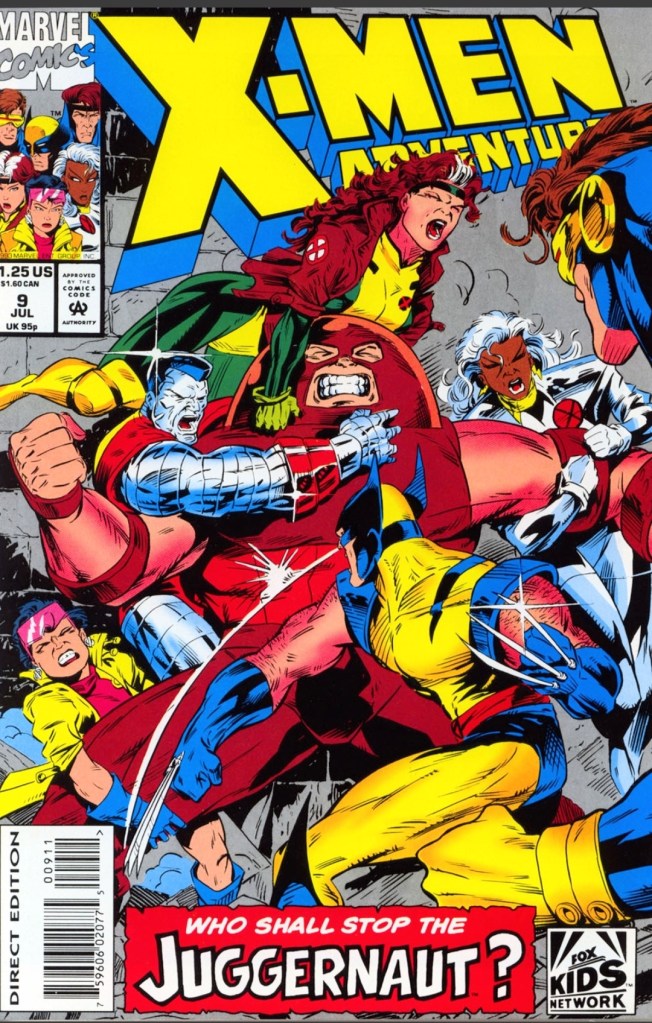
The cover.

Early story

The story begins with the X-Men (riding their jet) arriving from Genosha only to see a part of Professor X’s mansion destroyed. After landing, Cyclops, Wolverine and Jean Grey immediately searched through the rubble and found a path into the War Room. Using Cerebro, they uncovered a prepared video message of Professor X who tells them that he is taking a journey whose results may change their lives forever. After apologizing for the cryptic nature of the message, Xavier tells them that he trusts they will continue with their training and look after the School of Gifted Children in his absence.

The X-Men could not determine if their mentor left the mansion before the destruction took place. In response to Gambit’s question related to detection, Wolverine senses big foot prints and there was a familiar smell left behind. Wolverine decides to go out to keep following the scent which causes Cyclops to insist that the situation at hand is not the time for the team members to separate from each other.

After telling Cyclops he has places to go to, Wolverine then leaves his teammates with a motorcycle. Cyclops tells Storm to take Rogue and Jubilee with her to track Wolverine and stay close to him…

Quality
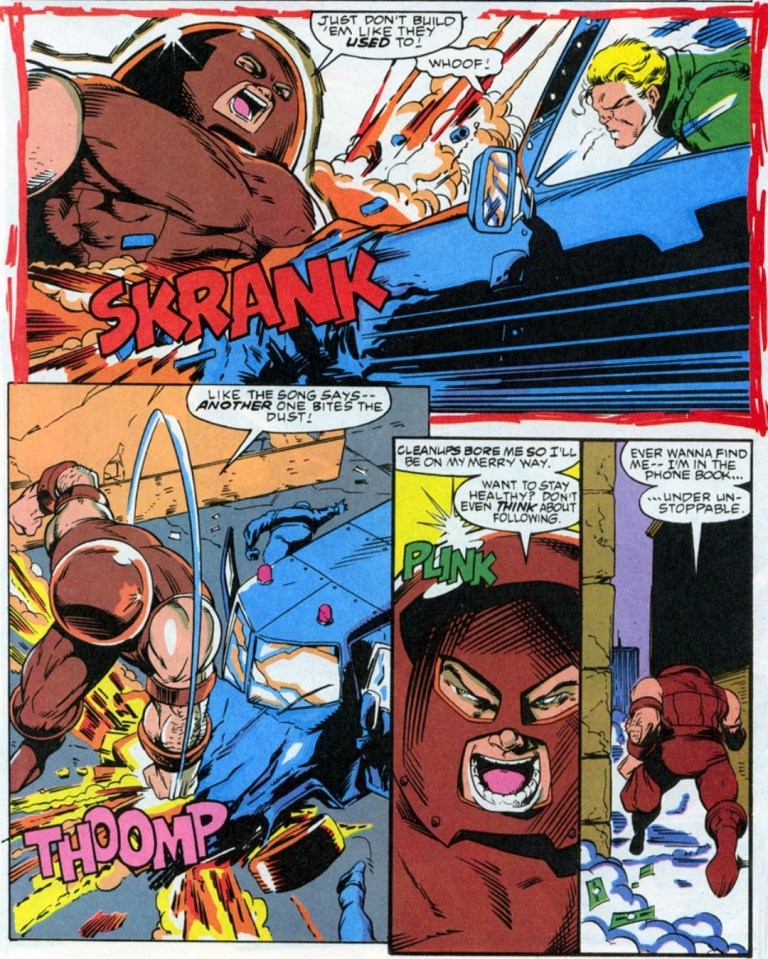
The sheer power of Juggernaut.

To describe this comic book’s story, I can say it was a fine mix of suspense, mystery and superhero spectacle. As the X-Men struggled to figure out how the damage on the mansion happened and where exactly did Charles Xavier go to, I felt this sense of dread backed with strong mystery. As the plot continued, there were these short-yet-notable character moments among the X-Men such as Gambit getting closer with Jean Grey who believes that she should be helping others on the field as her beloved Cyclops made a decision that kept her with him at the mansion.

The search for who is responsible for the mansion’s big damage creatively took notable paths in the story. One strong figure appeared and became a target of some X-Men members while another one became Wolverine’s target.

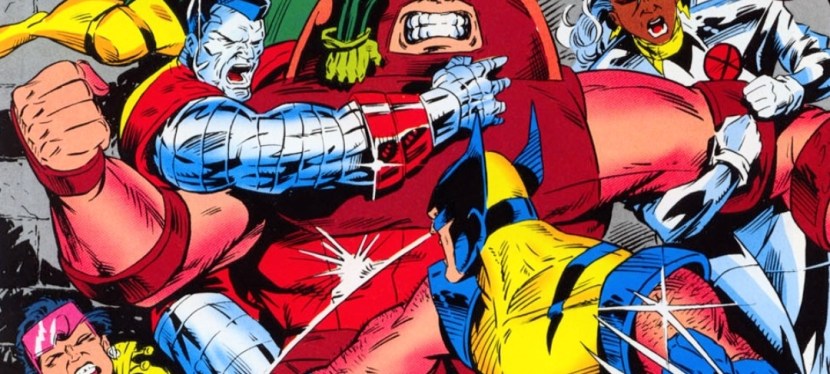
As expected, the highlight of this tale is Juggernaut himself and to say that he his huge and powerful is a big understatement. At this point of the X-Men Adventures monthly series, this is the one notable conflict that has multiple X-Men members struggling really hard fighting one single powerful enemy. In some ways, Juggernaut here looks like a much more dangerous foe than Magneto within this series. How the conflict in the story ended in a really intriguing yet sensible way which should resonate with X-Men fans. 

Conclusion
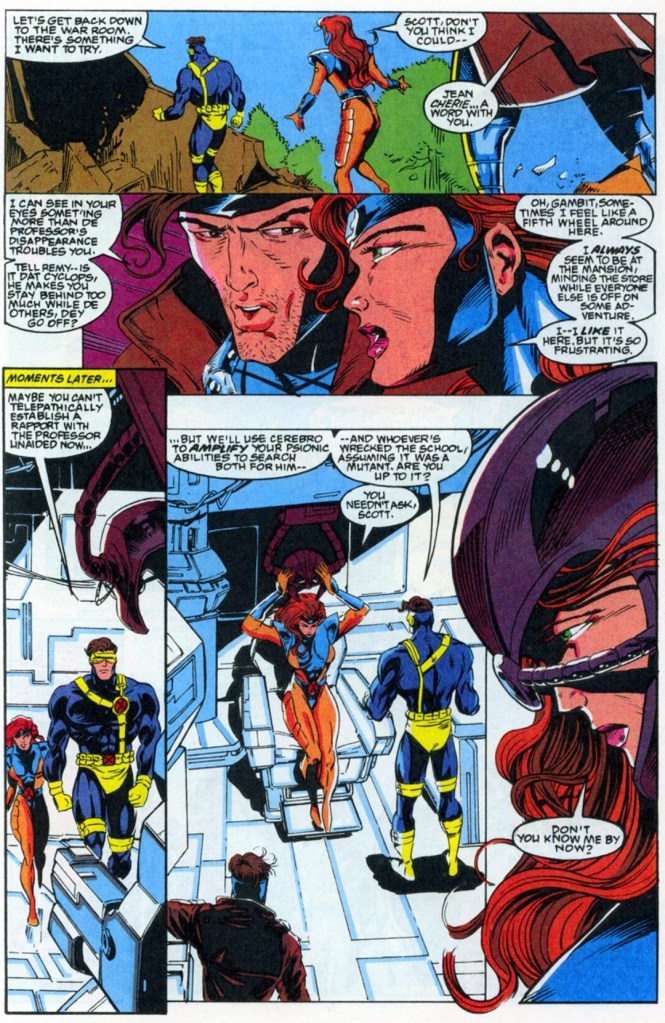
Only Cyclops, Gambit and Jean Grey (who wanted to do more) remained at the mansion.

X-Men Adventures (1993) is fun and intriguing to read. At the stage of this monthly series, the X-Men are not only more developed but are also challenged deeply as their mentor is no longer around to lead them. This makes the path ahead look more enticing to anticipate.

Overall, X-Men Adventures (1993) is recommended.

+++++

Thank you for reading. If you find this article engaging, please click the like button below and also please consider sharing this article to others. If you are looking for a copywriter to create content for your special project or business, check out my services and my portfolio. If you want to support my website, please consider making a donation. Feel free to contact me with a private message. Also please feel free to visit my Facebook page Author Carlo Carrasco and follow me on Twitter at  @HavenorFantasy as well as on Tumblr at https://carlocarrasco.tumblr.com/ and on Instagram at https://www.instagram.com/authorcarlocarrasco/.

A Look Back at What If #13 (1990)

Disclaimer: This is my original work with details sourced from reading the comic book and doing personal research. Anyone who wants to use this article, in part or in whole, needs to secure first my permission and agree to cite me as the source and author. Let it be known that any unauthorized use of this article will constrain the author to pursue the remedies under R.A. No. 8293, the Revised Penal Code, and/or all applicable legal actions under the laws of the Philippines.

Welcome back superhero enthusiasts, comic book collectors and X-Men fans. I’m about to review an issue of Marvel Comics’ What If monthly series which was published 1990 and was related to the X-Men as the central figure of the comic book is Charles Xavier (AKA Professor X).

To put things in perspective, Charles Xavier is forever known as the founder and leader of the X-Men. Within the Marvel Comics universe, he is one of the most powerful telepaths as well as a genius in science and genetics. He is a paraplegic who can do quite a lot and make an impact on the delicate relationship between his fellow mutants and the humans. In the movies, Xavier was portrayed by Patrick Stewart (first performance as Xavier in X-Men) and James McAvoy (first performance as Xavier in X-Men: First Class). Given his legacy of helping mutants gain rights through peaceful means, Charles Xavier has been compared with Martin Luther King, Jr. Going back to the comics, Xavier has a step brother named Cain Marko who became the X-Men villain Juggernaut.

With the background lesson done, we can now take a look back at What If , published by Marvel Comics in 1990 with a story written by Kurt Busiek and drawn by Vince Mielcarek.

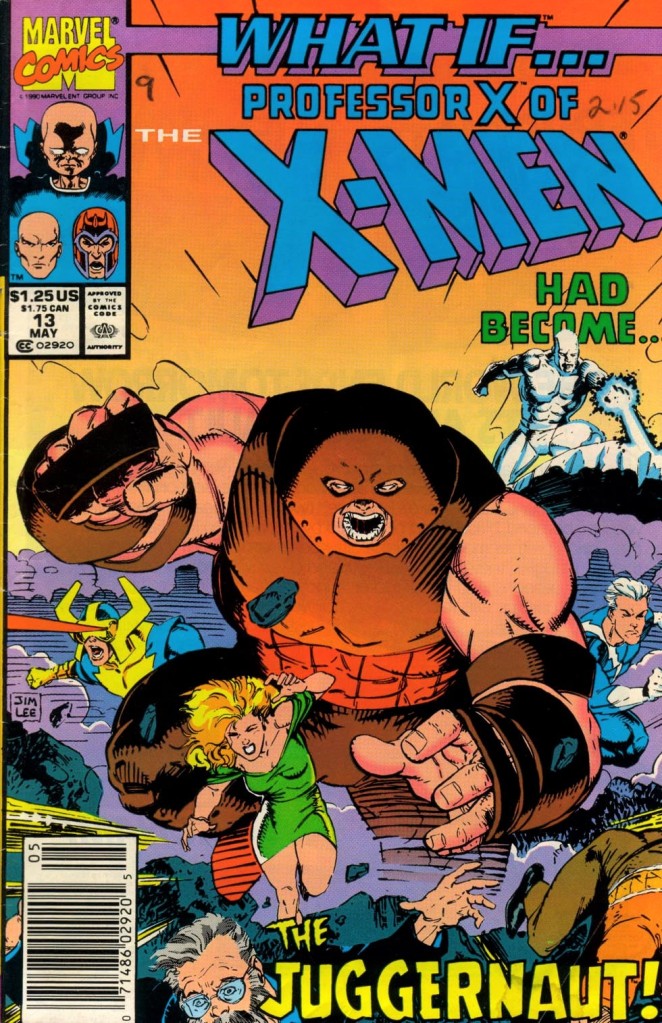
The cover drawn by Jim Lee.

Early story

The story begins in New York in the so-called near future. Graffiti artists attempt to run away from a team of mutants riding a floating vehicle. As Thunderbird is about to hit one of the humans, Cyclops stops him. Suddenly the mutants receive a telepathic message from their big boss who turns out to be Charles Xavier the Juggernaut.

Xavier is leading the effort against a group of humans who have been conspiring against them. Xavier declares, “They must be stopped—for the good of mutantkind!”

The X-Men in this particular story are fascist storm troopers policing a wretched, helpless humanity…

Quality

Xavier-Juggernaut with the X-Men and the invading Fantastic Four.

I can start by say that this comic book written by Kurt Busiek has one of the most compelling what-if scenarios that reflect not only its concept (of Charles Xavier becoming Juggernaut) but also the Marvel Comics universe as we know it. As dedicated X-Men fans know, Cain Marko was the one who touched the ruby in the cave which made him the mainstream Juggernaut. In here, the scenario was altered to make Charles Xavier become Juggernaut and the radical changes did not end there. Without spoiling the great stuff, I can say that this is one great exploration of an alternate version of events that affect not only the X-Men and their villains but also the many other superheroes of the Marvel universe as Xavier-Juggernaut went all-out with his dedication to mutantkind. I can say that in this story, symbolically speaking, Xavier easily outclasses the extreme Magneto on prioritizing mutants over humans.

Comic book concept aside, Kurt Busiek’s writing here is really excellent. Not only did he capture the traits of Xavier as he turned him into the alternate Juggernaut, Busiek also emphasized the many twisted events in the Marvel shared universe with sufficient details. The details implemented made the scenarios really believable. His script for this comic book was brought to life by Vince Mielcarek who did a good job making the characters recognizable (note: there were a lot of superheroes and villains here), showcasing the wide scope of changes made on people and places (in relation to Xavier-Juggernaut’s actions) and there was good pacing with the visuals.

Conclusion

Charles Xavier as you’ve never seen him before.

What If (1990) is great to read and it is a must-have with its story alone. Apart from showing the concept’s deep impact on the Marvel Comics universe, I also enjoyed the way Kurt Busiek blurred the boundaries that separated good and evil. If you are an X-Men and you want to see something different with the mutants – especially Professor X – then you you will find a lot to enjoy here. This is a great alternate superhero story and definitely more people should be aware of this.

If you are seriously planning to buy an existing hard copy of What If (1990), be aware that as of this writing, MileHighComics.com shows that the near-mint copy of the regular edition costs $30 while the near-mint copy of the newsstand edition costs $60.

Overall, What If (1990) is highly recommended!

+++++

Thank you for reading. If you find this article engaging, please click the like button below and also please consider sharing this article to others. If you are looking for a copywriter to create content for your special project or business, check out my services and my portfolio. Feel free to contact me as well. Also please feel free to visit my Facebook page Author Carlo Carrasco and follow me at HavenorFantasy@twitter.com

A Look Back At X-Men: The Last Stand

X-Men: The Last Stand is better than X-Men: Dark Phoenix? What a joke driven by hatred and uncontrolled emotions of negativity towards the latter.

Screenshot_20190613-151706_YouTube.jpg
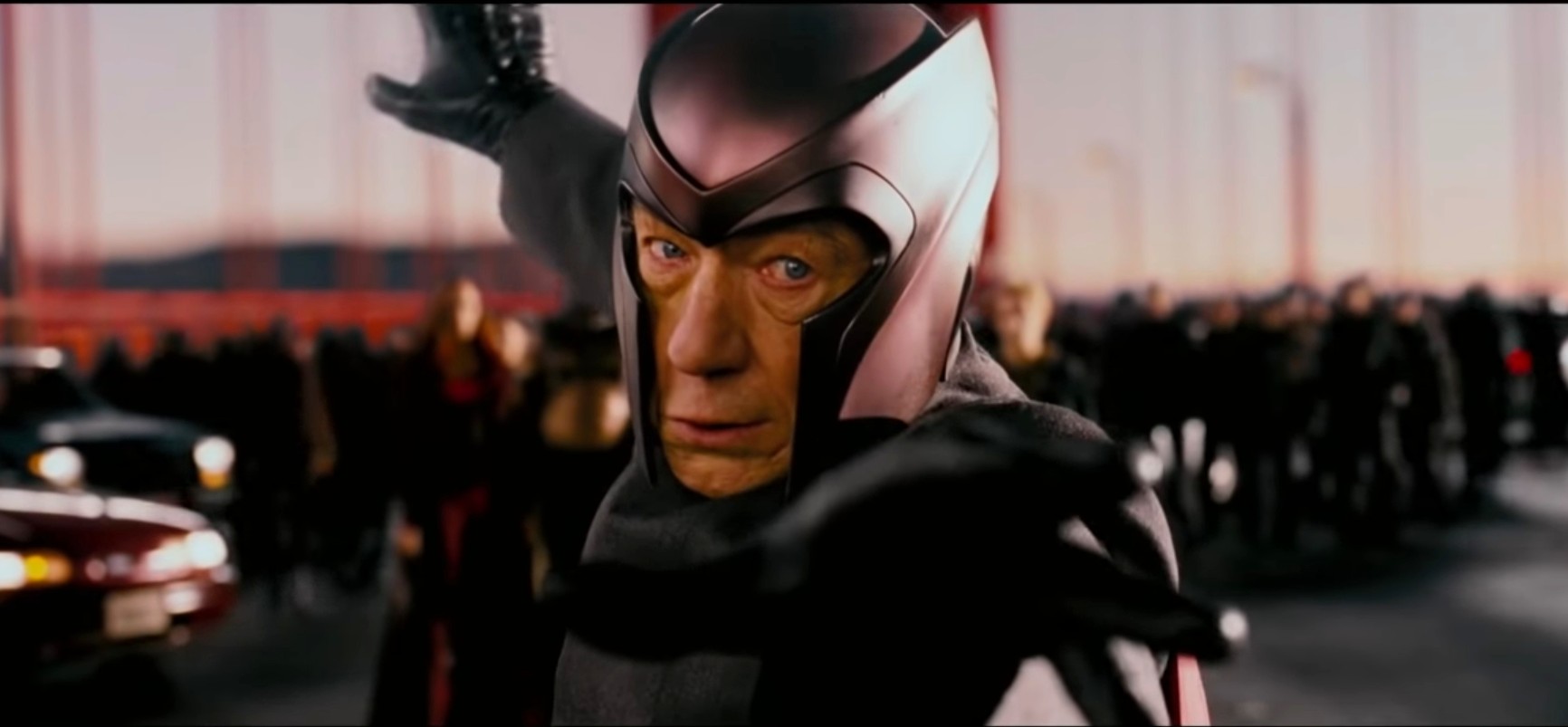
Ian McKellen as Magneto.

Released in 2006, X-Men: The Last Stand was the third movie of Marvel’s mutants which made $459,359,555 worldwide establishing new box office records at the time including the Memorial Day weekend opening and a single-day record for Friday openings. It was also the highest grossing X-Men movie until X-Men: Days of Future Past exceeded it in 2014.

While the first two flicks were directed by Bryan Singer (who literally abandoned this movie in favor of the big letdown Superman: Returns), this one was done by Brett Ratner who is best known for Rush Hour films. For the superhero concept of the film, Ratner clearly depended on the script by Simon Kinberg (who directed X-Men: Dark Phoenix) and Zak Pen (X2: X-Men United).

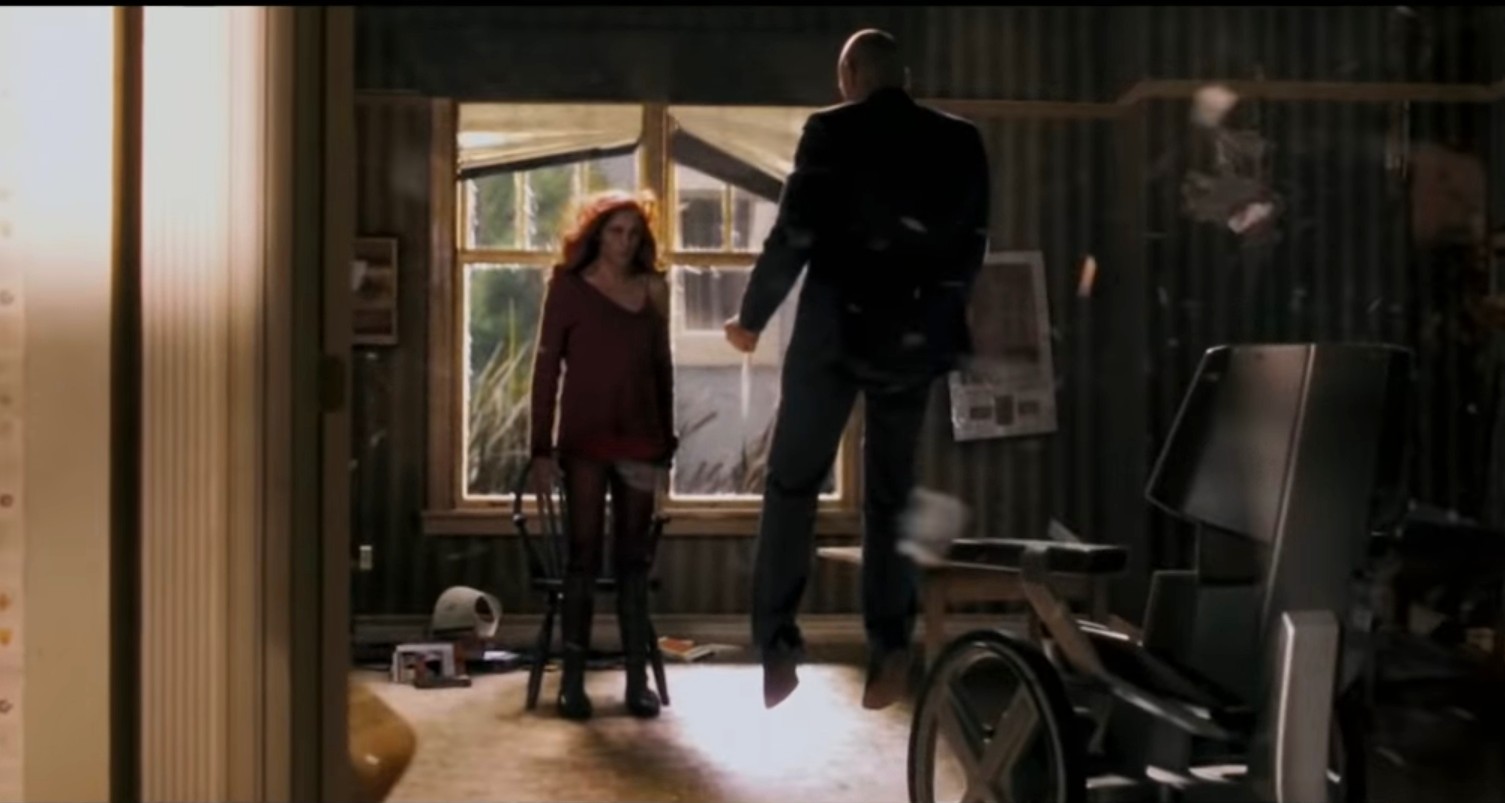
The story begins some time in the past with Charles Xavier and Magneto visiting the house of a little girl named Jean Grey whose power of telepathy and telekinesis make her dangerous. Her own father thinks she has an illness. In another scene, a young boy desperately tries shaving off something on his back which turned out to be a mutation. To put it short, the prologue establishes the two concepts this movie tried to emphasize – the Dark Phoenix (from the classic comic book storyline by Chris Claremont and John Byrne) and the Mutant Cure (in reference to one particular episode of the 1990s X-Men animated series).

The result? A rather unfocused narrative that bogged the movie throughout. In the present day, Charles Xavier and the X-Men are no longer hiding from the federal government (which in turn has Hank McCoy/Beast as part of the US President’s cabinet). A cure that can neutralize the mutant gene has been revealed and eventually Jean Grey suddenly returns back to life in front of Scott Summers/Cyclops. Then trouble in the story (and for this film in particular) sets in.

Screenshot_20190613-151113_YouTube.jpg
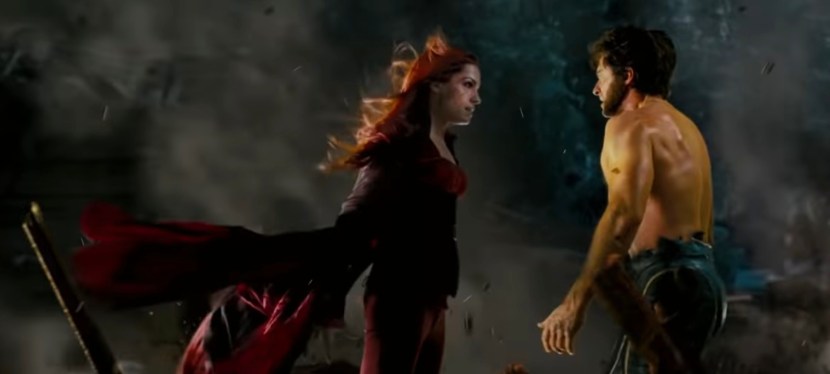
Dark Phoenix and Professor X.

On storytelling, the lack of focus on a central concept really dragged this movie down even though the filmmakers made attempts to link them together. This is a very unfaithful adaptation of the Dark Phoenix Saga – instead of showing the Phoenix Force as a cosmic entity the filmmakers used the dual-personality concept in Jean Grey. There are no alien civilizations (read: no Lilandra) involved nor anything related to outer space (a key element in the comic book storyline). With regards to the cure concept, Rogue in this film makes a move to be cured loosely following what was shown in the animated series.

Having these two concepts connect to each other showed Magneto getting motivated to rally the mutants to oppose the humans. Jean Grey meanwhile gets controlled by the Phoenix personality and gets very destructive with power which makes her an asset to Magneto and his brotherhood of evil mutants.

As the filmmakers struggled to tell the story, the social relevance and symbolism emphasized in the first two films got weakened. The core concept of mutants getting isolated and discriminated by humanity simply because they are so different became much less relevant here.

As if that was not bad enough, the characterization also changed for the worse. Magneto here became one-dimensional as a villain and the way he reacted to Charles Xavier’s destruction in front of him and Jean Grey reflected bad screen writing. Any true X-Men fan would know that even though he and Xavier were adversaries with a past friendship, Magneto should have been outraged over his old rival’s destruction and strike at Jean Grey (even if it is suicidal for him to fight a more powerful entity, the Phoenix).

For his part, Charles Xavier turned out to be a manipulator of Jean Grey’s mind making him look as evil and manipulative as Magneto. Jean Grey, despite actress Famke Jansen getting more screen time than before, ended up as a visual tool and was clearly NOT the central figure of the story rather she ended up being a tool of power by Magneto. By today’s standards, Jansen’s portrayal of Jean Grey/Dark Phoenix pales in comparison with Sophie Turner’s performance in X-Men: Dark Phoenix.

More on characterization, the triangle between Iceman, Rogue and Kitty Pryde was executed with no real depth and only served to show Anna Paquin’s character search for the means to be normal (because Rogue absorbs the power and life of people she touches) which ended up being not so meaningful for viewing. Young adult Angel’s (one of the original X-Men in the comics) minutes-long presence in the movie only served to showcase special effects. Storm’s prospect of succeeding Xavier as leader of the X-Men and the school was sloppily done. Oh yes, the showing of multiple mutants (in supporting roles, non-speaking roles or as mere background characters) that weakened the narrative of the first two films was even worse here. As a result, there’s quite a lot of fan service in this movie.

Going back to storytelling, I should say that the early demise of Cyclops (played by James Marsden for too little screen time due to his work with Bryan Singer on Superman Returns) and Charles Xavier were attempts by the filmmakers to raise the stakes and even shock viewers. The problem is that the third act of the film became more of an action and CGI bonanza ultimately failing to justify the loss of Cyclops and Xavier. The story ended with not much impact on me as a viewer and the late scenes showing Magneto recovering a little of his power (plus the post-credit scene about Xavier’s survival) were unsatisfactory. By comparison, X-Men: Dark Phoenix concluded with satisfaction.

Performances? The actors did what they could with the weak screenplay. Patrick Stewart played Charles Xavier managing his school but gets burdened heavily as Jean Grey returns with the Phoenix in her (which makes Xavier feeling guilty over his past manipulation of Jean’s mind). Ian McKellen played a one-dimensional Magneto (forget about the reasonable fighter for mutants you saw in the first two films) and really had little room to flesh him out. Clearly this version of Magneto, even though he has a lot of screen time here, is rubbish when compared to the cinematic Magneto in X-Men: Dark Phoenix.

Hugh Jackman as Wolverine is clearly the hero of this movie and was given a lot to do showing a deeply concerned Wolverine as well as showing him with lots of action on-screen. His emotional reaction towards Jean Grey near the end of the movie was believable. Halle Berry meanwhile failed yet again to capture the leader in Storm from the comic books.

Another thing to mention regarding the weak script is the lame attempt at humor in the film. Just look at the exchanges of words between Wolverine and Beast which only made me frown instead of laughing.

Exchange 1

Dr. Hank McCoy: Wolverine. I hear you are quite an animal.

Logan: Look who’s talkin’.

Exchange 2

Logan: Well, for all we know, the government helped cook this up.

Dr. Hank McCoy: I can assure you, the government had nothing to do with this.

Logan: I’ve heard that before.

Dr. Hank McCoy: My boy, I have been fighting for mutant rights since before you had claws.

Logan: [to the Professor] Did he just call me boy?

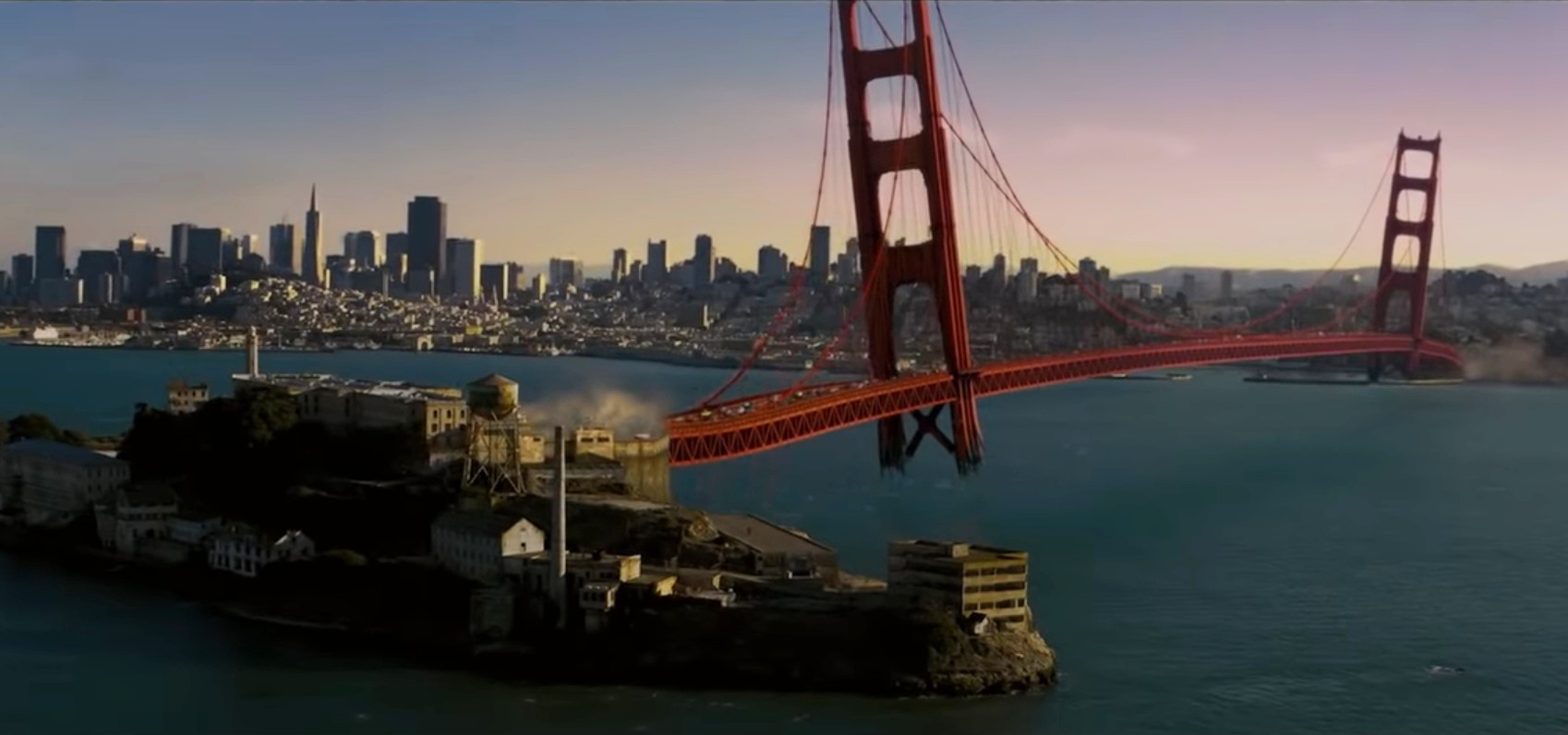
If there is anything positive at all with this movie, it is the spectacle (action, stunts and special effects). If you want to watch an X-Men movie without thinking too much and just enjoy the spectacle, The Last Stand is heavily loaded! The scope of destruction (including the major showcase of Magneto’s power with the Golden Gate Bridge) is also great and helped this weak movie look epic (even more epic than the better film X-Men: Dark Phoenix). There is also a big battle of multiple members of Magneto’s brotherhood attacking the soldiers at the Alcatraz facility. Action is where director Brett Ratner is good at and it temporarily helped this film feel fun to watch. The visual design and special effects are of good quality as well.


One last positive thing to mention here is the casting of Kelsey Grammer as Hank McCoy/Beast and his performance was, indeed, superb. I really saw the scientist, the intellect and the fighter of Beast from the comics translated nicely in cinematic form.

Screenshot_20190613-151905_YouTube.jpg

A striking shot as a result of Magneto’s power.

By today’s standards of superhero movies, X-Men: The Last Stand unsurprisingly went from big-budget disappointment to what is now an overall bad movie that just happens to have some fun action sequences. As far as adapting the Dark Phoenix Saga from the comics, this film is definitely inferior to X-Men: Dark Phoenix. X-Men: The Stand does look good when compared to the terrible X-Men Origins: Wolverine.

If you are a true fan of the X-Men or if you are moviegoer who wants the best superhero cinematic experience, I won’t recommend watching X-Men: The Last Stand.

But then if you are a moviegoer who cannot do anything except hate and uncontrollably bash the new movie X-Men: Dark Phoenix, then maybe The Last Stand will be your bout of fun.


Thank you for reading. If you find this article engaging, please click the like button below and also please consider sharing this article to others. Also my fantasy book The World of Havenor is still available in paperback and e-book format. If you are looking for a copywriter to create content for your special project or business, check out my services and my portfolio. Feel free to contact me as well. Also please feel free to visit my Facebook page Author Carlo Carrasco and follow me at HavenorFantasy@twitter.com