Disclaimer: This is my original work with details sourced from reading the comic book and doing personal research. Anyone who wants to use this article, in part or in whole, needs to secure first my permission and agree to cite me as the source and author. Let it be known that any unauthorized use of this article will constrain the author to pursue the remedies under R.A. No. 8293, the Revised Penal Code, and/or all applicable legal actions under the laws of the Philippines.
Welcome back superhero enthusiasts, 20th century pop culture enthusiasts and comic book collectors! Today we go back to the year 1980 to take a close look at one of the many tales published through the original Superman monthly series (first launched in 1939).
Before Crisis on Infinite Earths happened, the DC Comics multiverse had a lot of superhero stories that had outlandish fantasy elements. For example, Action Comics #454 showed Superman eating tons of food in order to survive. In Action Comics #456, the battles between Superman and The Shark had lots of outlandish looking forms of action. In short, the old multiverse and its tropes are looking fun to revisit.
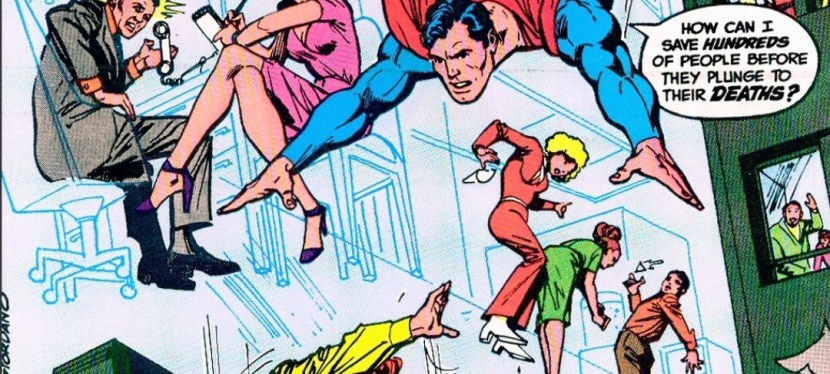
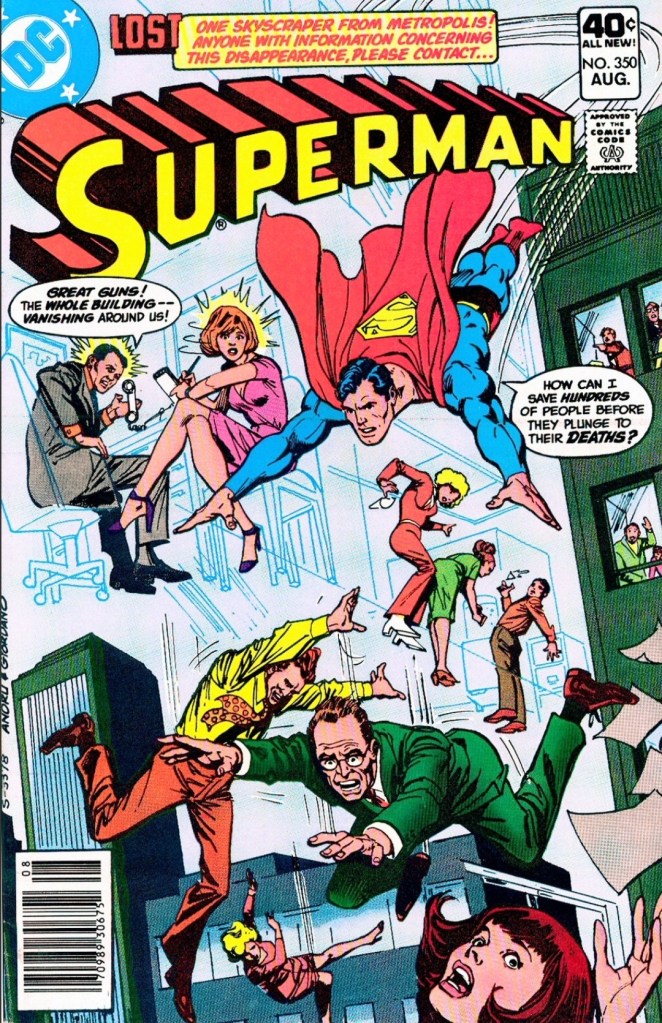
With those details laid down, here is a look back at Superman #350, published in 1980 by DC Comics with a story written by Gerry Conway and drawn by Curt Swan.
The cover.
Early story
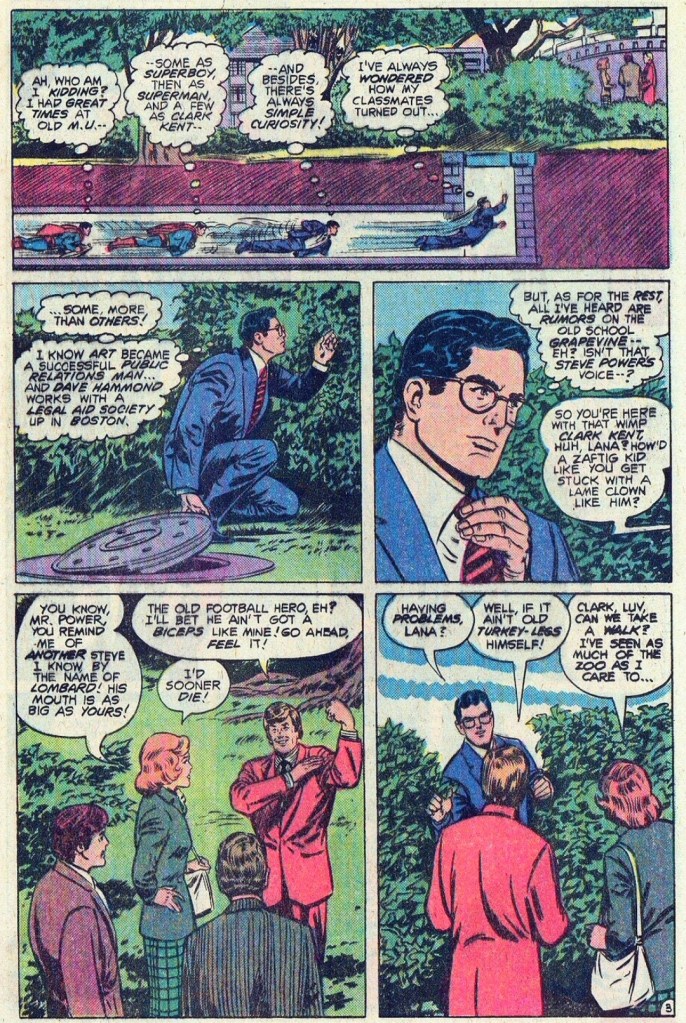
The story begins when Superman makes his move to prevent a punctured hot air balloon transport from crashing. It turns out the balloon was part of the promotion of a reunion event at Metropolis University and Superman really went there to attend it in his civilian identity as Clark Kent. Also attending the event is his long-time friend and colleague Lana Lang.
As the old professor Lemuel B. Tolkein – former superior of Clark and his classmates – speaks during the reunion, several attendees – including people Clark personally knew – begin to disappear into thin air. The remaining attendees and guests begin to panic…
Quality
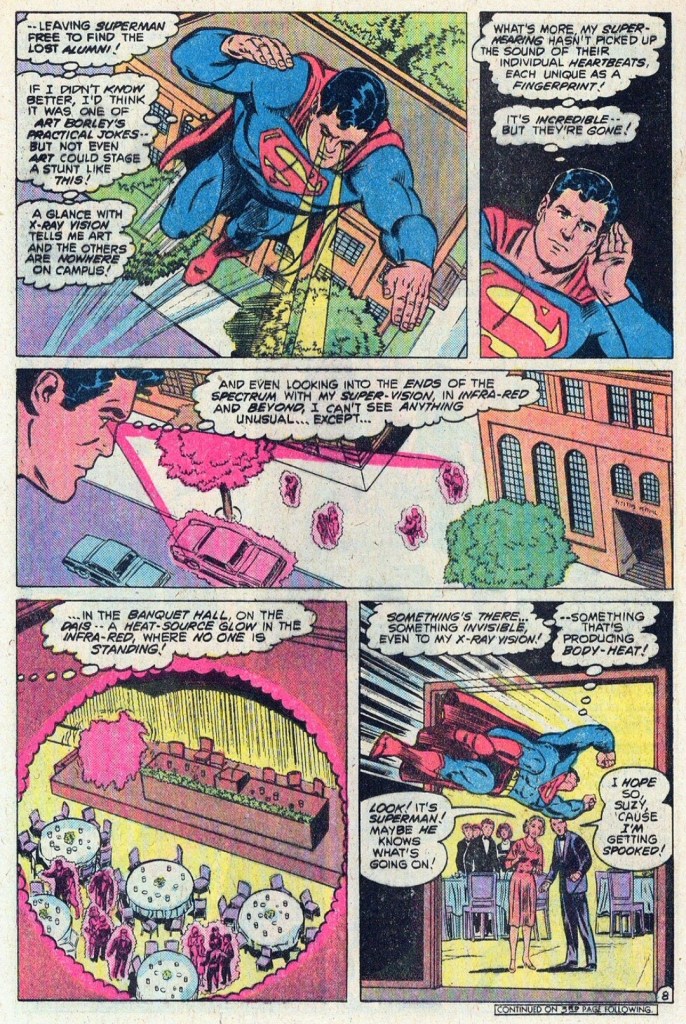
Superman uses his special abilities to solve problems here.
I really like this story. Without spoiling the plot, I can say that this tale written by Conway is actually a mystery that happens to take place during Clark Kent’s reunion with many people from his past. As there is no good-versus-evil concept, the story is solidly focused on mysterious happenings that challenge Superman’s ability to solve problems. Even though he already has many super powers, the Man of Steel still got challenged a lot by the disappearances of people and things.
Apart from the story, I also enjoyed Conway’s approach on developing Clark Kent/Superman, Lana Lang and Lois Lane. Seeing Clark reconnecting with people from his past at Metropolis University was a refreshing portrayal and it also sheds light on how he handled himself during his collegiate years. As for Lois Lane, she was portrayed to be hostile towards Clark with regards to journalistic competition between them, and yet she still has tenderness towards Superman deep inside.
Conclusion
Superman quickly changes into his Clark Kent identity to attend the reunion.
Superman #350 (1980) is enjoyable and the elements of the pre-Crisis multiverse of DC Comics added depth to it. The story is relaxing to follow and it managed to surprise me and keep me engaged until the very end. I am convinced to follow the next issue.
Disclaimer: This is my original work with details sourced from reading the comic book and doing personal research. Anyone who wants to use this article, in part or in whole, needs to secure first my permission and agree to cite me as the source and author. Let it be known that any unauthorized use of this article will constrain the author to pursue the remedies under R.A. No. 8293, the Revised Penal Code, and/or all applicable legal actions under the laws of the Philippines.
Welcome back superhero enthusiasts, 1970s arts and culture enthusiasts, Marvel Comics fans and comic book collectors! Today we go back to the year 1974 to examine a highly significant tale from Marvel Comics’ shared universe – the first appearance of the Punisher and his first-ever encounter with Spider-Man.
To put things in perspective, Punisher’s literary debut was told within the Amazing Spider-Man comic book series and it happened not too long after the legendary tragedy of Gwen Stacey. During the 1970s, Hollywood made and released several action movies and crime thrillers that were violent, gritty and highlighted vigilantes and assassins. Some of that influence somehow made it into Marvel’s shared universe which was symbolized creatively through the Punisher who debuted as an assassin.
With those details laid down, here is a look back at Amazing Spider-Man #129, published in 1974 by Marvel Comics with a story written by Gerry Conway and drawn by Ross Andru (the same creative duo behind Superman vs. The Amazing Spider-Man crossover).
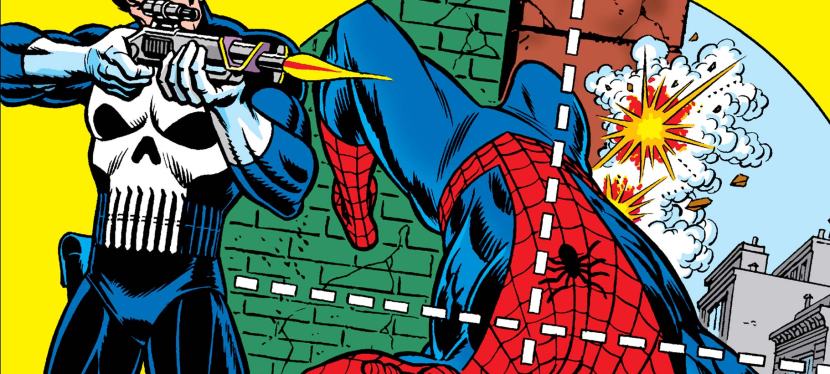
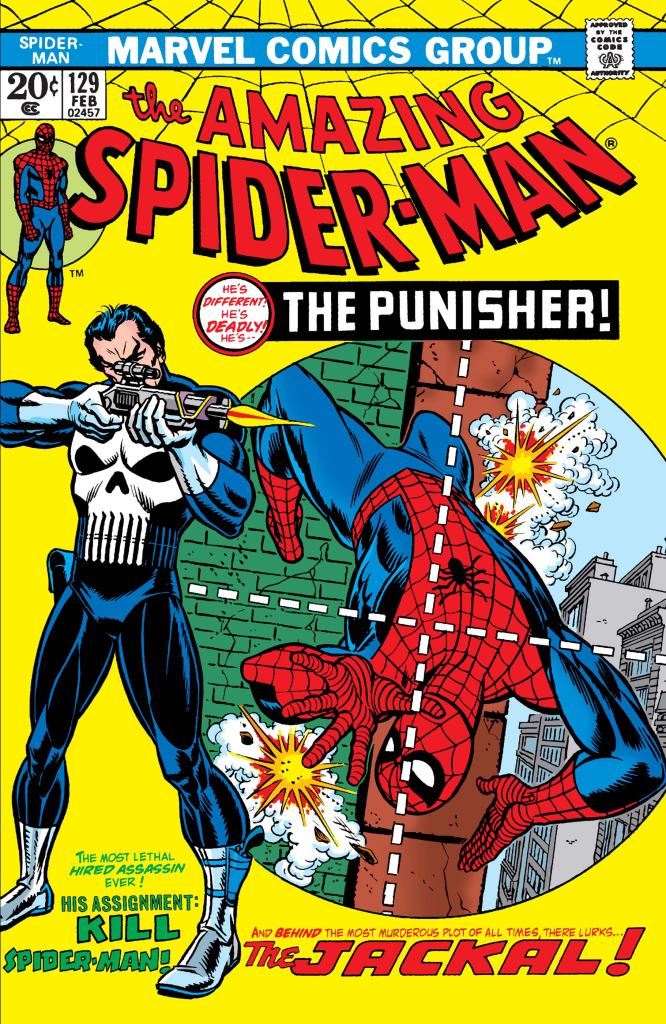
The cover.
Early story
The story begins inside a private facility an assassin wearing black with a huge skull on his upper body heavily damages a solid statue of Spider-Man using a powerful rifle. This impresses the hideous villain called the Jackal who tells him that if he does well with the real Spider-Man, he would have performed a great service for the world. Knowing he impressed the Jackal, the Punisher states that he will only kill those who deserve killing and he expresses his belief that the webslinger deserves to die.
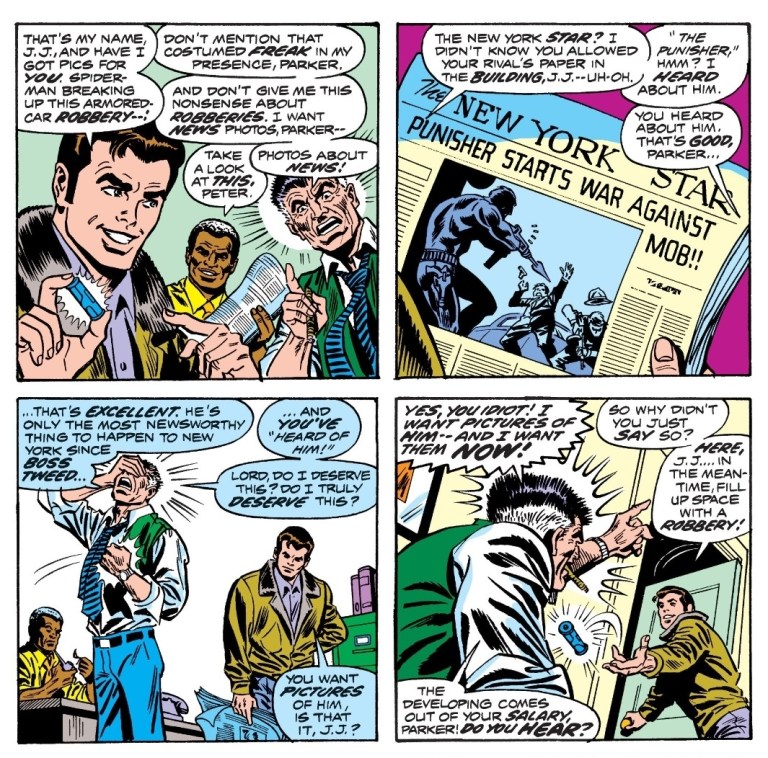
Elsewhere, Spider-Man swings into action and successfully stops an armed robbery from happening. Along the way he managed to capture photographs, changes into his civilian clothes and enters the Daily Bugle’s office ready to submit the roll of film as Peter Parker. Unfortunately, his superior J. Jonah Jameson disregards Parker’s submission and points out that the Punisher made waves with New York’s readers via the Bugle’s competitor The New York Star. For Jameson, the Punisher is only the most newsworthy thing to happen to New York and tells Parker he wants photos of the assassin…
Quality
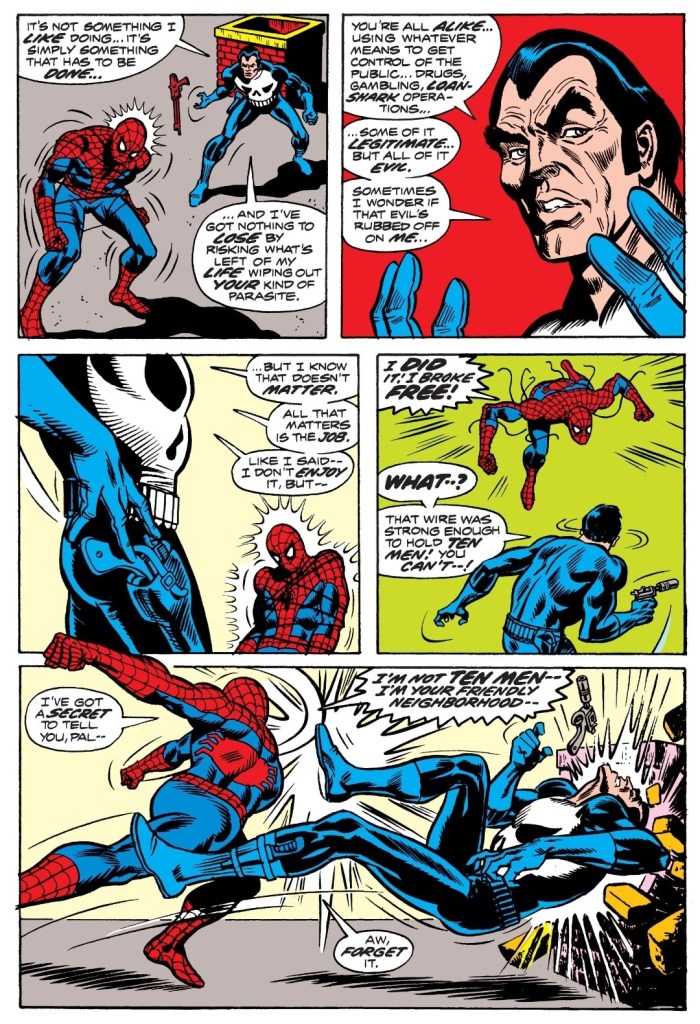
This is a scene from the first of two encounters between Spider-Man and the Punisher who was introduced as an assassin.
To make things very clear about storytelling without spoiling plot details, this is a tale about intrigue and the darker side of society that involves vigilantes and murdering. The Punisher here did not debut as a crime-busting vigilante but rather an assassin who accepts assignments from clients as long as the jobs fall in line with his personal philosophy that focuses on taking the lives of those who deserved to be killed. That being said, it is clear that Hollywood’s vigilante flicks of the 1970s influenced the presentation and I can say that whenever the story focuses on the Punisher, there definitely is a grim tone which contradicts the tone of Spider-Man’s scenes.
Spider-Man here continues to struggle somewhat with his personal life having recently lost Gwen Stacey while remaining disturbed about the identity of the Green Goblin. The webslinger also has to live with the heavy situation in which a lot of people in New York were convinced that he killed Norman Osborne which was the result of his own boss’ handling of the Daily Bugle. These elements along with his civilian involvement with his newspaper creatively added to the build-up of Spider-Man’s eventual encounters with the Punisher. The build-up was structured nicely and the pay-off was worth it.
There was also the introduction of Jackal. While he has a hideous appearance, his participation was more about scheming than action which contrasted him with the Punisher. For the newcomers reading this, Jackal is actually Miles Warren in a more monstrous form. From this comic book, it was clear that Jackal was created to be a recurring for of Spider-Man and this was strongly executed in the controversial Clone Saga of the 1990s.
Going back to the Punisher, he symbolically uses guns with designs that were more grounded in reality (inspired by real-life guns in looks) instead of taking influence from science fiction. As an assassin living with a strong code, the Punisher is truly determined to eliminate Spider-Man whom he even referred to as a murderer. The perception of Spider-Man as a criminal on the part of the Punisher clearly reflected the defamation caused by the Daily Bugle on the webslinger. Gerry Conway established the assassin to be a strong believer in fighting evil by using violence and killing.
The build-up of the Punisher is very solid and the pay-off in the form of battles with Spider-Man is tremendous and very satisfying to read. There is a lot of action to enjoy here and most notably Gerry Conway maintained a strong narrative throughout.
Conclusion
Have you ever worked in a newspaper before?
I can say out loud that Amazing Spider-Man #129 (1974) is truly a great read and a true illustrated literary classic of Marvel Comics. This tale alone added a touch of darkness and grit (in the form of vigilante and assassins cultures) into the Spider-Man legacy. Apart from its status as a comic book classic, this one paved the way for the rise of the Punisher in terms of more comic book appearances and the publishing of new comic book series featuring him. While the Punisher’s legacy as a killer is obviously not something worth believing in, Marvel Comics took the risk of having him as one of their primary characters in the decades that followed. This particular story is so significant, Marvel Comics revisited it with What If #58 (1994). Check out my other Punisher-related retro reviews by clicking here, here, here, here and here.
Overall, Amazing Spider-Man #129 (1974) is highly recommended!
Disclaimer: This is my original work with details sourced from reading the comic book and doing personal research. Anyone who wants to use this article, in part or in whole, needs to secure first my permission and agree to cite me as the source and author. Let it be known that any unauthorized use of this article will constrain the author to pursue the remedies under R.A. No. 8293, the Revised Penal Code, and/or all applicable legal actions under the laws of the Philippines.
Welcome back superhero enthusiasts, 20th century arts and culture enthusiasts, fans of Marvel and DC Comics, and comic book collectors! Today we go back to the year 1976 to examine what is truly a landmark event in the history of superhero comic book publishing – the first-ever superhero crossover event of Marvel Comics and DC Comics with Superman vs. The Amazing Spider-Man (also referred to as Superman vs. Spider-Man for short).
For the newcomers reading this, I previously reviewed the 2nd Superman-Spider-Man crossover comic book titled Superman and Spider-Man. That was released in 1981 and was handled by a different creative team (led by Jim Shooter as writer) compared to the 1976 crossover of the two icons of Marvel and DC. Going back to the 1970s, a crossover between Marvel and DC looked like an impossible dream as the idea of the two companies coming into agreements over the legal, creative and financial aspects was perceived to be unachievable. Indeed there were headaches and challenges during the negotiations but ultimately Marvel and DC came into an agreement to publish a special comic book featuring Superman, Spider-Man and the related supervillains and supporting characters from both sides. Take note that the two publishing giants worked together previously with publishing an official comic book adaptation of the movie The Wizard of Oz (1939).
With those details laid down, here is a look back at Superman vs. The Amazing Spider-Man, published in 1976 by Marvel Comics and DC Comics with a story written by Gerry Conway and Ross Andru. This crossover event was described as the battle of the century.
The cover.
Early story
The story begins at the World News Conference in New York City. Separated by several feet apart, Clark Kent (Superman) and Peter Parker (Spider-Man) arrive with their respective companions and associates. What the two heroes do not know is that Lex Luthor and Doctor Octopus recently escaped from prison.
Peter Parker gets berated by his boss J. Jonah Jameson for not being good enough as a photographer while Clark Kent learns the bad news from Edge Morgan that he is not wanted for the coverage of a national convention.
Shortly after, Lois Lane climbs up a scaffold to get a good view for some photography. Just as she is about to fall down, Peter Parker suddenly grabs her and pulls her to safety. After an exchange of pleasantries, Peter introduces Lois to Mary Jane Watson. Just as MJ and Lois start conversing, Superman suddenly arrives. The Superman figure then fires beams of light from eyes to Lois and MJ, causing them to vanish into thin air. It turns out, the caped figure is an impostor as Peter Parker and Clark Kent react in shock.
Peter quickly runs to the roof of the building and changes into Spider-Man. As soon as he leaps into action, he comes face to face with Superman himself…
Quality
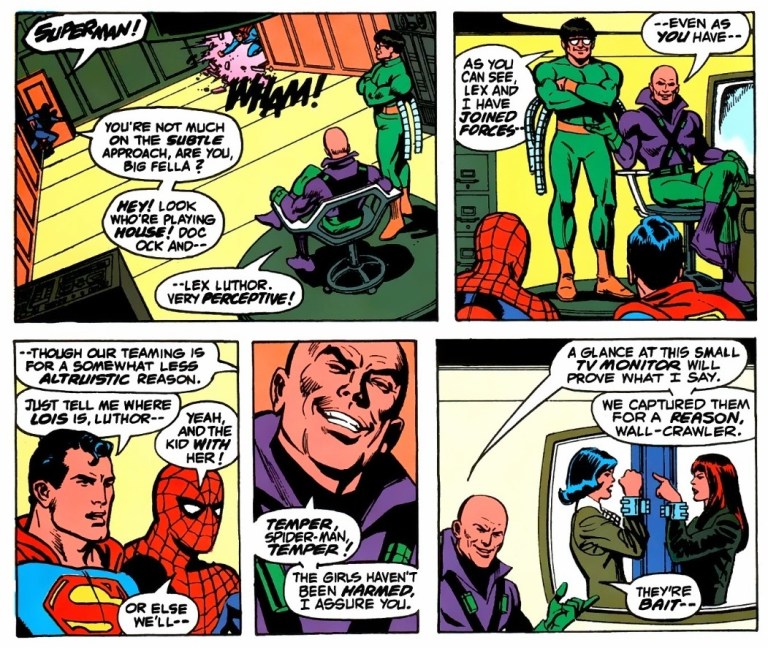
Superman, Spider-Man, Luthor, Dr. Octopus, Lois Lane and Mary Jane Watson shown in this scene.
I can loudly say that this is one pretty enjoyable crossover tale that not only featured Superman and Spider-Man, but also gave their respective mortal enemies Luthor and Dr. Octopus a good share of the spotlight. To be very clear, the story and set-up of scenes do have a somewhat restrictive structure as the creators clearly did their best to make the spotlight on the characters more or less equal in terms of imagery, dialogue amount and the sharing of dynamic shots. While some may easily complain about the so-called old and tired formula of the major characters getting into fighting each other due to a misunderstanding followed by setting aside their differences to work together, take note that the said formula worked really well in this story written by Gerry Conway.
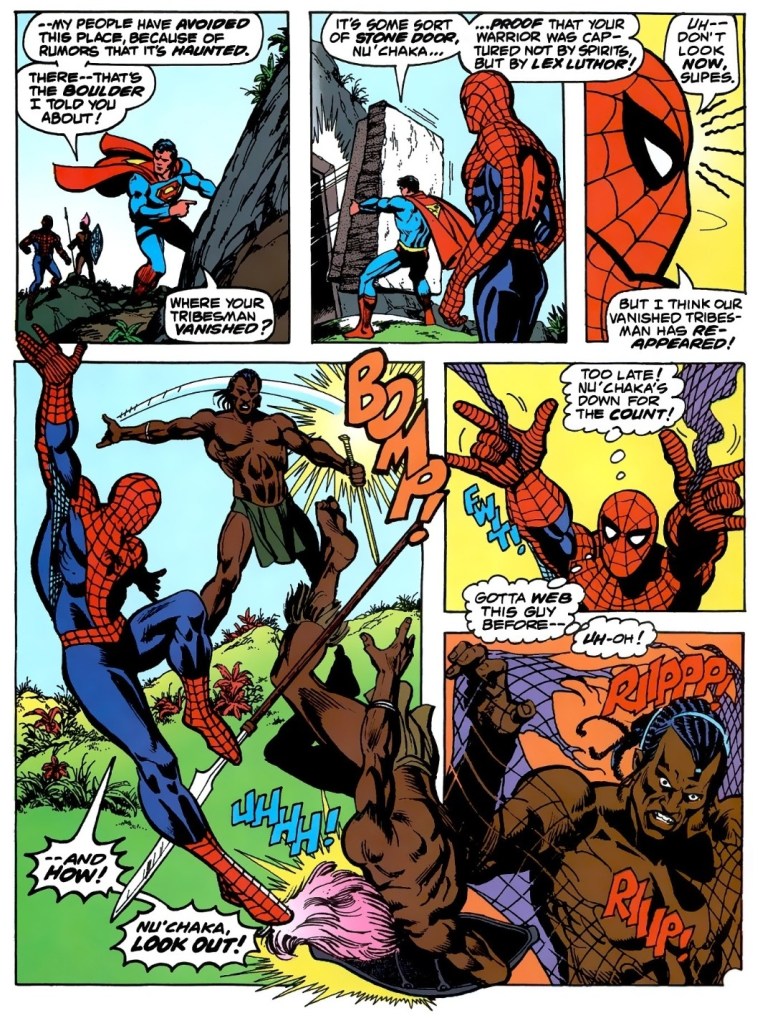
The story concept Conway came up was clearly made to justify Superman and Spider-Man encountering each other (note: the same goes with the super villains and supporting characters) and the way he wrote the two interacting with each other worked seamlessly and convincingly. There are lots of nice exchanges of dialogue between the Man of Steel and the webslinger.
Even the superiors of Clark Kent and Peter Parker had their own crossover.
Don’t let the woke and socialists fool you. There is nothing racist in this comic book. Wokeness is foolishness. Political correctness distorts perception of reality.
Even though the script has this set of creative restrictions to ensure fairness on both Marvel and DC’s sides, the synergy of friendship and cooperation between Superman and Spider-Man is fantastic to read. Similar qualities are also evident with the scenes of Luthor and Dr. Octopus. Very clearly, the creative team did intense research on the Marvel and DC characters and found ways to create a unique mix that resonates with the fans of Superman and Spider-Man.
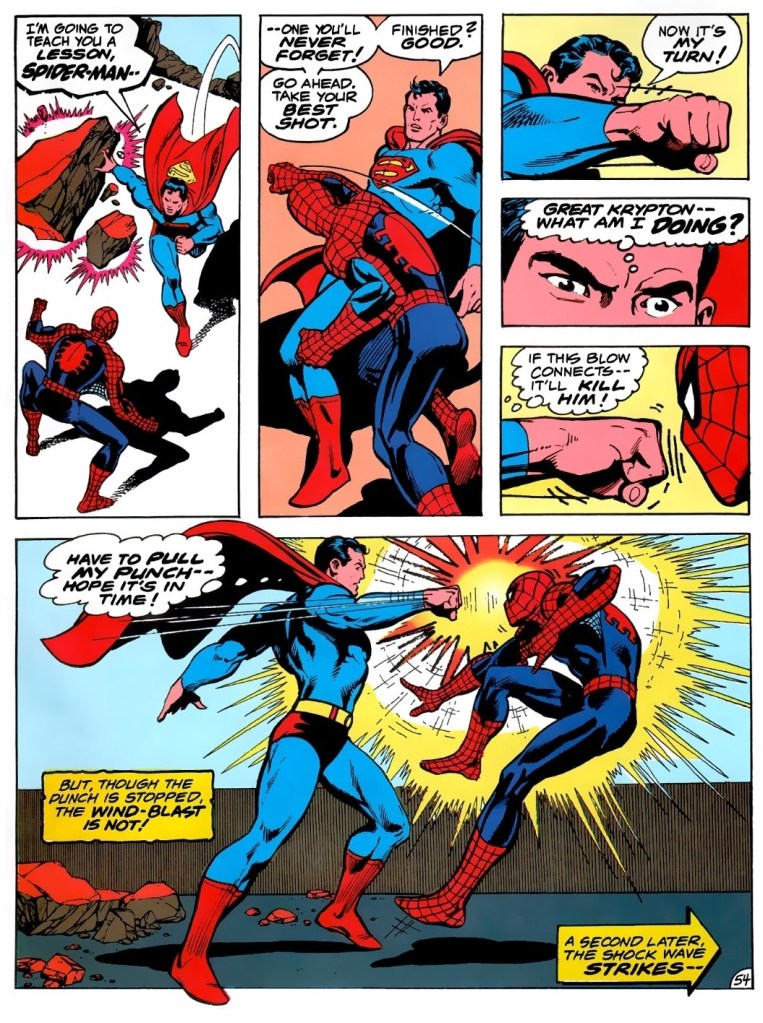
As expected, this comic book has lots of superhero spectacle for readers to enjoy. The superhero violence is not intense but the action scenes were entertaining to look at. In my opinion, the highlights of the spectacle here is when Superman and Spider-Man literally exchanged mortal enemies to fight with. As for the fight between the two icons as emphasized in the title, it definitely is a special event that really kicked the story into high gear.
While this is indeed a fun superhero crossover to read, there are some notable weak points here. For one thing, the plot itself lacks a strong concept and Luthor’s evil plan is very flawed and unconvincing. That being said, as I read and re-read this comic book, there never was a sense of danger building up nor was the Luthor-Dr. Octopus team ever a grave threat.
Conclusion
This is only a small sample of the fun in the battle between Superman and Spider-Man.
By today’s standards, Superman vs. The Amazing Spider-Man (1976) is still a fun superhero crossover comic book to read and it remains as a significant part of not just Marvel and DC’s history of collaboration but also that of inter-company superhero crossover comic book publishing in general. While it is better than many other inter-company superhero crossover comic books I have read through the decades, this one is certainly not the best one from Marvel and DC. For me, Superman and Spider-Man (1981) has a more elaborate plot, higher fun factor and deeper impact than this comic book. Meanwhile, Batman vs. The Incredible Hulk (1981) exceeded this comic book in terms of plotting, character interactions, super villain portrayals and establishing a real sense of danger that requires the super heroes to solve. Still, Superman vs. The Amazing Spider-Man (1976) remains an enjoyable read and it definitely is worthy as the strong beginning of Marvel-DC superhero crossover projects of the 1970s and 1980s. It also has more dynamic visuals than its 1981 sequel. This one is also part of the Crossover Classics: The Marvel-DC Collection paperback.
Overall, Superman vs. The Amazing Spider-Man (1976) is recommended!





 Author Carlo Carrasco