The United States and the Philippines formally opened this year’s edition of Balikatan (Exercise Balikatan 41-2026) which is their annual joint military exercise focused on readiness, unity and defense, according to a news report by GMA News. Several allied nations and seventeen thousand troops are expected to participate in the exercise which will have military drills across various parts of the Philippines.
To put things in perspective, posted below is an excerpt from the GMA News report. Some parts in boldface…
The Philippines and the United States on Monday formally opened their annual joint Balikatan Exercise for this year, with 17,000 troops and several other countries expected to join.
“I hereby declare Exercise Balikatan 41-2026 officially open starting today,” AFP chief General Romeo Brawner Jr. said during the opening ceremony.
“Let this exercise not only demonstrate our readiness but affirm our commitment to stand together, to act together, and when necessary, defend together,” he added.
More than 17,000 troops from the Philippines, the United States, and partner nations including Australia, Canada, France, Japan, and New Zealand. At least 18 more countries are expected to serve as observers in the exercise.
The drills will be conducted across various parts of the Philippines from Luzon to Mindanao.
Balikatan 2026 will cover multiple domains such as air and missile defense, maritime security, live-fire exercises, and joint readiness operations.
The exercises will also include humanitarian and civic assistance programs such as building schools, supporting healthcare initiatives, and enhancing disaster preparedness in local communities.
Brawner said the expanded scope of the exercise reflects the evolving security environment.
Balikatan 2026 will be transformed from a bilateral activity between the Philippines and US into a multilateral effort aimed at improving interoperability and collective defense capabilities.
Brawner pointed out that the drills are anchored on respect for international law, national sovereignty, and the goal of promoting a free and open Indo-Pacific.
Let me end this piece by asking you readers: What is your reaction to this development? Do you think transforming this year’s Balilkatan from a bilateral US-Philippines activity into a multilateral effort makes sense? Considering the number of allies and soldiers expected to participate in the 2026 Balikatan, do you think Communist China will feel intimidated?
Recently the World Bank (WB) revised its 2026 economy growth for the Philippines forecasting gross domestic product (GDP) growth of only 3.7%, according to a news report by BusinessWorld.
To put things in perspective, posted below is an excerpt from the BusinessWorld news report. Some parts in boldface…
THE WORLD BANK slashed its growth forecast for the Philippines to 3.7% this year, well below the government’s target, as the war in the Middle East weighs on economic activity.
The World Bank on Wednesday said it sees Philippine gross domestic product (GDP) growth at 3.7% for 2026, significantly slower than the previous projection of 5.3%
If realized, it will also be slower than the post-pandemic low of 4.4% in 2025 and below the Philippine government’s 5-6% GDP target range for 2026.
“Our main projection is that overall growth in the East Asia and Pacific region is going to decline in 2026,” Aaditya Mattoo, director of research of the World Bank Group, said in an online briefing on the World Bank’s East Asia and Pacific Economic Update.
“Most countries in the region are going to see slower growth in 2026 than they have in 2025. That is our projection,” he added, citing the impact of the conflict in the Middle East as well as trade disruptions.
“The good news is we are likely to see a bounce back in 2027,” Mr. Mattoo said.
The World Bank raised its GDP growth projection for the Philippines to 5.6% in 2027 from 5.4% previously. It is within the government’s 5.5-6.5% target for 2027.
However, Mr. Mattoo said the Middle East war will have an impact on remittances in the East Asia and Pacific region, particularly the Philippines.
“Countries like the Philippines, which depend strongly on remittances, will see remittances from the Gulf… diminish,” he said.
Ergys Islamaj, a senior economist at the World Bank, said the Philippine economy is mainly exposed to the Middle East conflict through remittances as well as energy and fertilizer imports.
“Eighteen percent of remittances to the Philippines in 2025 came from the Gulf. Longer conflict will hurt the economy further,” he said.
In 2025, cash remittances soared to an all-time high of $35.634 billion, accounting for 7.3% of the country’s GDP. Remittances from Saudi Arabia accounted for 6.6% of the total, while the United Arab Emirates made up 4.6% and Qatar made up 2.9%.
The Philippines is a net importer of crude oil and sources most of its supply from the Middle East, making the country vulnerable to global crude price swings.
Mr. Mattoo said that global oil prices are expected to be as much as $20 higher even a year from now compared to the prices before the war broke out.
Let me end this post by asking you readers: What is your reaction to this recent development? Do you think the economy of the Philippines will grow slower this year? Do you think the Philippines is highly vulnerable as it depends on the Middle East for a great majority of its oil imports? Do you think the Philippines will eventually make new deals with Communist China and the Islamic terrorist regime of Iran for economic needs?
With many nations in Asia already struggling with the very expensive prices of fuel related to the conflicts in the Middle East, their respective economic struggles are only getting worse. That said, they are very fortunate to have Japan on their side as Prime Minister Takaichi Sanae officially announced that her government will provide them financial support worth $10 billion, according to a Kyodo News report.
To put things in perspective, posted below is an excerpt from the news report of Kyodo News Some parts in boldface…
The Japanese government said Wednesday it will provide a total of $10 billion in financial support to other Asian nations to help them secure crude oil supplies as prices soar amid the Middle East conflict, aiming to ensure that petroleum-derived products made in those countries keep flowing into Japan.
The aid, announced by Prime Minister Sanae Takaichi following an online meeting with her counterparts mainly from the Association of Southeast Asian Nations, is aimed at beefing up energy supply chains across the region such as through loans for procuring crude oil and petroleum products as well as expansion of stockpiles.
“Japan is closely interconnected with each Asian country through supply chains and mutually dependent with them,” Takaichi told reporters, adding that oil shortages or supply disruptions in Asia could have a “significant negative impact” on her nation’s economy and society.
The planned financial aid is equivalent to up to 1.2 billion barrels — about one year of crude oil imports by ASEAN countries, she said.
Japan imports petroleum-derived products from Southeast Asia, including items used at medical facilities. Many countries in the region maintain limited oil reserves, so there have been concerns that supply shortages could eventually affect shipments to Japan.
The surge in oil prices on the back of the war that led to a blockade of the Strait of Hormuz, a key waterway for global energy transportation, has raised concerns in some Southeast Asian countries over their ability to pay for imports.
Tokyo aims to address the risks through financial support, including loans via the government-backed Japan Bank for International Cooperation, according to government sources.
The Japanese prime minister emphasized that the latest supportive scheme does not include direct crude oil provisions from Japan’s reserves and therefore will not negatively affect domestic supplies.
Given its high dependence on the Middle East for crude oil imports, Japan keeps abundant oil stockpiles in the country.
The other nations that joined the Japan-led, leaders-level virtual gathering were Australia, Bangladesh, Brunei, Cambodia, East Timor, India, Indonesia, Laos, Malaysia, the Philippines, Singapore, South Korea, Sri Lanka, Thailand and Vietnam.
Let me end this piece by asking you readers: What is your reaction to this development? Do you think the $10 billion assistance of Japan will be sufficient for the Asian nations for their oil and energy needs? Do you think the Islamic terrorist regime of Iran will eventually stop harming its neighbors now that American forces have blocked all the Iranian ports to allow other ships to pass through the Strait of Hormuz safely? Do you think the ASEAN member nations have learned their lessons about depending excessively on the Middle East for importing oil?
Now that the blockade on Iranian ports has been done by the United States, President Donald Trump told reporters at the White House that the Islamic terrorist regime reached out to them wanting to make a deal “very badly”, according to a news report by The Jerusalem Post. This happened not so long after the initial US-Iran negotiations failed and the Islamic regime has a history of lying and pretending when negotiating with America.
To put things in perspective, posted below is an excerpt from The Jerusalem Post news report. Some parts in boldface…
Iran called the United States, wanting “very badly” to make a deal, US President Donald Trump claimed to reporters at the White House on Monday.
Trump said he didn’t want to comment on what would happen if a deal wasn’t reached by the end of the ongoing ceasefire, but that “it won’t be pleasant for them, let me put it that way.“
Trump also said that Iran had refused to agree to having a nuclear weapon and that the US would get the nuclear material back.
“We can’t let a country blackmail or extort the world,” Trump said.
Vice President JD Vance had done a “very good job” on Iran, the president added.
Trump also threatened that the US might also visit Cuba after finishing with Iran.
Trump threatens Iranian ships in Strait of Hormuz – Trump warned that any Iranian vessels attempting to come close to the US’s blockade of the Strait of Hormuz will be “immediately ELIMINATED,” in a post to Truth Social on Monday.
“Iran’s Navy is laying at the bottom of the sea, completely obliterated – 158 ships,” Trump said.
Let me end this post by asking you readers: What is your reaction to this latest development? Do you think Iran is simply lying to America and is secretly collaborating with the anti-Trump forces from national leaders to the mainstream news media nations right down to civil groups in the United States? Do you hope that Trump, the US military and Israel will hit Iran very hard to finally bring down the Islamic terrorist regime in the event the ceasefire ends without a deal? Do you think Communist China and Russia are secretly sending weapons and money to the Iran?
Thank you for reading. If you find this article engaging, please click the like button below, share this article to others and also please consider making a donation to support my publishing. If you are looking for a copywriter to create content for your special project or business, check out my services and my portfolio. Feel free to contact me with a private message. Also please feel free to visit my Facebook page Author Carlo Carrasco and follow me on Twitter at @CarloCarrascoPH as well as on Tumblr at https://carlocarrasco.tumblr.com/ and on Instagram athttps://www.instagram.com/authorcarlocarrasco
To put things in perspective, posted below is an excerpt from the news article of VnExpress. Some parts in boldface…
Vietnam welcomed 6.76 million international visitors in the first three months of the year 2026, up 12% year-on-year and the highest quarterly figure ever recorded.
With nearly 2.1 million international visitors in March, Vietnam has for the first time achieved a new record of receiving over 2 million visitors for three consecutive months in a year, according to Vietnam National Administration of Tourism.
This result underscores the appeal, resilience, and growing strength of Vietnam’’s tourism sector amid an uncertain global environment, it added.
Of the total 6.76 million international visitors, 82.3% arrived by air, 15.5% by land, and 2.2% by sea.
The administration said that the dominance of air travel highlights Vietnam’s strong appeal to mid- and long-haul markets that are particularly sensitive to geopolitical shifts and fuel costs.
In the context of the Middle East conflict causing soaring oil prices and disrupting some international flights, the high number of visitors arriving by air reflects connectivity and affirms international tourists’ confidence in a safe, stable, and accessible destination, the administration added.
Mainland China and South Korea continue to be the two largest source markets for tourists to Vietnam, accounting for approximately 40% of the total international visitors.
Southeast Asian markets recorded strong growth, including Malaysia (up 21.5%), Singapore (30%), Cambodia (41%), Indonesia (44%), the Philippines (69%), and Thailand (6.5%).
Vietnam has set a target of receiving 25 million international tourists this year.
Let me end this piece by asking you readers: What is your reaction to this development? Have you thought about visiting Vietnam for vacation this year? What is the one location in Vietnam that you find attractive right now?
With a lot of economic disruptions connected with the conflicts in the Middle East, the Philippine Peso has been exposed as one of the most vulnerable currencies of Asia and already the nation is struggling with spiked fuel prices and rising inflation, according to a business news report by the Manila Bulletin.
To put things in perspective, posted below is an excerpt from the announcement by the Manila Bulletin. Some parts in boldface…
Singapore-based DBS Bank Ltd stated that the Philippine peso is emerging as one of Asia’s most vulnerable currencies as deepening global oil crisis exposes the nation’s heavy reliance on imported energy and the lack of government subsidies.
DBS wrote in a commentary published last Friday that the peso is expected to underperform in the foreign exchange (forex) market alongside the Indian rupee, which recently hit a record low against the United States (US) dollar. The peso also plummeted to another all-time low last Friday, finishing at P60.55 per dollar.
Like India, the Philippines is grappling with vulnerabilities from oil price shocks, which have led the peso to reach a new all-time low, according to DBS senior forex strategist Philip Wee and forex and credit strategist Chang Wei Liang.
“Similarly, the peso remains highly vulnerable,” Wee and Liang said. Last Friday, the peso breached the 60.5 level as geopolitical tensions in the Middle East intensified, and the central bank stood firm in its view that there is no immediate need to defend the currency.
Wee and Liang said the Philippines stands as “most exposed to oil price pass-through due to zero subsidies and a 90 percent energy reliance on Gulf energy.”
Japanese financial giant MUFG Bank Ltd. and think tank Capital Economics also emphasized the Philippines’ high exposure to external market volatility, which is hurting the peso amid investors’ risk-off sentiment.
MUFG analysts said the peso is among the “weakest performers in the region” last week, declining by a total of 4.9 percent since the Israel-Iran conflict flare-up. It was surpassed only by the Thai baht, which has dropped 5.9 percent month-to-date.
Following the peso are the declines in the South Korean won (4.7 percent), Indian rupee (4.1 percent), and Malaysian ringgit (three percent). Meanwhile, the Vietnamese dong and Chinese yuan have been the most resilient currencies, with only around a one percent decline each.
DBS said that the Bangko Sentral ng Pilipinas (BSP) is facing a dilemma: it must contain skyrocketing consumer prices while defending the peso amid extreme vulnerability to the worsening energy crisis, with the impacts more pronounced in heavy oil-importing economies.
Citing metrics from an Institute of International Finance (IIF) study, Wee and Liang labeled the currencies of the Philippines, South Korea, and Malaysia as “somewhat vulnerable” to oil price spikes stemming from the Middle East war.
Such metrics include direct trade exposure to oil imports, the growth impact of oil usage intensity, and vulnerability to agricultural and fertilizer supply shocks.
DBS assessed India, Thailand, and Vietnam as the most vulnerable to oil market shocks, while China and Indonesia are the least sensitive.
Despite the peso’s recent weakness, DBS projects the local currency to rebound toward 57.8 per dollar by the end of 2026. However, the pair is also seen climbing back to 59.9 by late 2027 and remaining within the 59 level through 2030.
Let me end this post by asking you readers: What is your reaction to this recent development? Do you think the government of the Philippines and its economic managers will be able to execute moves to prevent strengthen the Peso ensuring economic growth?
The total number of foreigners living in Japan has exceeded four million (as of 2025) based on the official numbers released by the government, according to a Kyodo News report.
To put things in perspective, posted below is an excerpt from the news report of Kyodo News Some parts in boldface…
The number of foreign nationals residing in Japan hit a record 4.13 million in 2025, topping 4 million for the first time, aided by a rise in permanent residents and foreign workers, government data showed Friday.
According to the Immigration Services Agency, 4,125,395 foreign nationals were residing in Japan at the end of 2025, up 9.5 percent from the previous year, hitting a record high for the fourth consecutive year.
They accounted for 3.36 percent of the country’s population, up from 3.04 percent last year. Around 947,000 were permanent residents, while 475,000 were holders of visas in specialized work fields such as engineering or the humanities.
By nationality, Chinese topped the list of foreign residents in Japan at 930,000. Vietnamese came second at around 681,000, followed by South Koreans at around 407,000.
Japan also had around 356,000 Filipinos and around 300,000 Nepalese. Sri Lankans, at around 79,000, ranked ninth, up from 12th place in 2024.
Known for its strict immigration policy, Japan has been gradually opening its doors to foreign workers in recent years as the country faces labor shortages due to the aging of society.
Its refugee recognition system is also seen as stringent. The agency announced that 187 foreigners were recognized as refugees last year, down 3 from the year before. The total includes 123 Afghans, 26 Yemenis and 11 Chinese.
Japan accepted a total of 474 people, mostly Ukrainians, under what is known as the complementary protection system that treats those fleeing conflict as equivalent to refugees. The number fell sharply, by 1,187 from 2024.
The government granted residential status to 525 people on humanitarian grounds.
The number of foreign nationals applying for refugee status dropped 8.7 percent to around 11,000. The figure has been on a downward trend since the agency introduced a plan to eliminate “illegal immigrants for the safety and security” of Japan in May last year.
Let me end this piece by asking you readers: What is your reaction to this development? Do you think Japan can solve its labor shortage problem without relying on foreign immigrants? Do you think any significant changes on immigration in Japan will happen under the administration of Prime Minister Takaichi Sanae over the next few years? Why do you think there are many foreigners who are applying for refugee status in Japan? Did you notice a high number of Muslim foreigners causing disturbances in Japan recently?
Recently a survey conducted by OCTA Research and commissioned by the Embassy of Japan in the Philippines revealed that almost eight out of ten Filipinos trust Japan, according to a news article by the Philippine News Agency (PNA).
To put things in perspective, posted below is an excerpt from the news article of the PNA. Some parts in boldface…
A survey of a private polling and research firm, OCTA Research, released on Monday showed that eight in 10 adult Filipinos trust Japan.
The survey, commissioned by the Embassy of Japan in the Philippines and conducted from December 3 to 11, 2025, among 1,200 respondents aged 18 and above, asked the question: “How much does the Philippines trust Japan?”
A total of 79 percent of the respondents answered they “strongly trust/somewhat trust” Japan, while at least 17 percent responded “can’t say if I trust or not”, and 4 percent have shown distrust.
This result suggests that positive perceptions of Japan are deeply embedded in Philippine public opinion.
Filipinos also trust the Japanese people, with 74 percent expressing trust and 6 percent expressing distrust. About 20 percent answered that they are undecided.
This indicates that goodwill toward Japan extends to interpersonal perceptions of Japanese citizens, according to OCTA Research.
Most or 70 percent of the respondents said they view the relationship between the Philippines and Japan as “very good” while 24 percent view it as neither good nor poor.
These favorable perceptions of Japan were observed across Metro Manila, Balance (of) Luzon, the Visayas, and Mindanao, as well as across socioeconomic classes.
“Cultural exchanges, tourism, educational cooperation, and the growing Filipino community in Japan contribute to familiarity and mutual goodwill between the two societies,” OCTA Research said.
Let me end this piece by asking you readers: What is your reaction to this development? Do you think the governments of Japan and the Philippines should engage more with each other diplomatically, economically and militarily? Do you think Filipinos see the Japanese as an ally while the Philippines remains in conflict with Communist China at the West Philippine Sea? Are you one of the hundreds of thousands of Filipinos who traveled to Japan yearly?
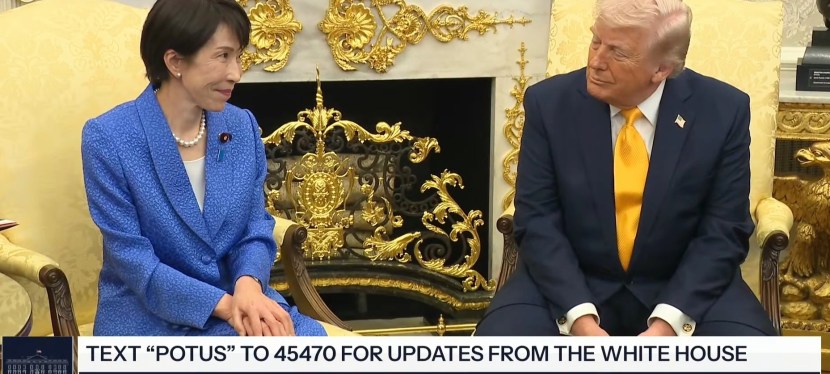
Japanese Prime Minister Takaichi Sanae visited Washington for the first time as the head of her nation and met with US President Donald Trump at the White House where they discussed very important matters in front of the media and officials, according to a news report by Kyodo News. Takaichi also praised the President for his peace efforts.
To put things in perspective, posted below is an excerpt from the news report of Kyodo News Some parts in boldface…
Prime Minister Sanae Takaichi told U.S. President Donald Trump on Thursday that Japan is ready to contribute to the safety of the Strait of Hormuz as the U.S.-Israeli war on Iran intensifies, while explaining Tokyo’s legal constraints on sending ships from its defense forces to the region.
Takaichi told reporters after her meeting at the White House with Trump that she told the U.S. leader “in detail what Japan can do and cannot do” from a legal perspective under the country’s war-renouncing Constitution.
Trump, for his part, reiterated his expectation that Japan would be engaged, while saying during the part of their talks open to media that he believes Japan has been “stepping up to the plate” in recent days over the Iran war, “unlike NATO.”
The U.S. leader has made public his dissatisfaction with Washington’s allies, including Tokyo and members of the trans-Atlantic alliance, over their reluctance to pitch in to help secure the Hormuz strait, a vital waterway for global oil transportation now largely blocked by Iran.
“I expect Japan to step up, because, you know, we have that kind of relationship,” he said. “We have 45,000 soldiers in Japan. We have, we spend a lot of money on Japan…so I expect, I’m not surprised that they would step up.“
Noting also that more than 90 percent of Japan’s crude oil imports normally pass through the strait, Trump said Japan has a “big reason” to do more.
In affirming Japan-U.S. collaboration on expanding U.S. energy production, Takaichi said she proposed to Trump a joint oil-reserve project to ease supply concerns driven by the Middle East conflict.
At the talks, Takaichi praised Trump’s “peace” efforts, expressing readiness to assist by reaching out to other countries. “Donald is the only person who can bring peace and prosperity across the world,” she said.
Takaichi emphasized that the prospect of Iran developing nuclear weapons is unacceptable. Trump alluded earlier to Iran’s nuclear program to explain the U.S. decision to launch its military campaign against the country.
Facing an increasingly assertive China, Takaichi also reminded Trump that the security environment remains severe in the Indo-Pacific, at a time when reports have emerged that some U.S. military assets are being moved from the region to the Middle East.
The two leaders “committed to peace and stability across the Taiwan Strait as an indispensable element of regional security and global prosperity” and “opposed any attempts to unilaterally change the status quo, including by force or coercion,” the White House said in a press release without naming China.
They confirmed that their nations oppose measures threatening critical mineral supplies such as export controls, senior Japanese government officials told reporters, apparently referring to Beijing’s tighter regulations on rare earths exports.
They agreed to advance broad defense cooperation, including joint missile development and production, and promote a free and open Indo-Pacific, according to Takaichi. The White House said the production of the interceptor Standard Missile-3 Block 2A in Japan will be quadrupled.
“We were able to affirm many concrete forms of cooperation that will further enhance the quality of our alliance in wide-ranging fields,” Takaichi said, adding that she and Trump are aiming to elevate bilateral ties to “a higher level” together.
Trump welcomed Japan buying “a lot of” U.S. military equipment. He further stressed that he has a “very fine relationship” with Takaichi, describing her as “a very special person” who is doing a “fantastic job.”
The U.S. side did not bring up fresh demands for Japan to spend more on its defense, the officials said.
Takaichi’s main goals in her first trip to the United States since taking office in October were to strengthen the personal trust in her ties with Trump and reaffirm the U.S. security commitment to the Indo-Pacific region as China’s influence grows.
The meeting came amid increasing concerns within Japan that the U.S. focus in terms of policy and military assets could shift from the Indo-Pacific to the Middle East if the U.S.-Israeli war with Iran drags on, a development that would work in China’s favor.
The U.S. military has reportedly begun relocating the amphibious assault ship Tripoli and over 2,000 Marines from their bases in southwestern and southern Japan to the Middle East.
Takaichi got off to a positive start in building personal ties with Trump when they met in person for the first time in October in Tokyo, shortly after she became Japan’s first female prime minister.
Since the outbreak of the Middle East conflict, Tokyo has sought to strike a delicate balance between maintaining its strong alliance with Washington and its friendly relations with Tehran.
For more insight about the Trump-Takaichi meeting, watch the videos below.
Let me end this piece by asking you readers: What is your reaction to this development? What is your impression about the many matters and announcements that happened during the Trump-Takaichi meeting at the White House? Were you surprised when it was announced that US allies Japan, Italy, England, Netherlands, Germany, and France jointly agreed to secure the Strait of Hormuz in response to Trump’s demand? With Japan having a close relationship with Trump’s America now, do you think Communist China and North Korea will feel intimidated at their side of the Pacific?
To put things in perspective, posted below is an excerpt from the news report of Kyodo News Some parts in boldface…
Prime Minister Sanae Takaichi is considering expressing Japan’s desire to cooperate on the U.S. “Golden Dome” next-generation missile defense system at her upcoming meeting with President Donald Trump, Japanese government sources said Tuesday.
The envisaged missile defense collaboration is among the expected agreements, covering various areas from the long-standing Japan-U.S. alliance to the fields of economic security and cutting-edge technology, at the summit slated for Thursday in Washington, the sources said.
Revealed by Trump in May, the Golden Dome scheme is intended to detect and destroy hypersonic missiles, which can fly at above five times the speed of sound, in outer space in mid-flight. The total costs are estimated at $175 billion.
The trajectories of hypersonic weapons are irregular and low-altitude, making them difficult to shoot down or track by radar. China, North Korea and Russia have been aggressively pursuing such arms.
In August 2023, Tokyo and Washington agreed to develop a new type of missile to intercept hypersonic weapons, with the goal of completing it by the 2030s. It is intended that Aegis destroyers of the U.S. Navy and the Japan Maritime Self-Defense Force will be equipped with the missile.
To enhance the missile defense system’s detecting and tracking capabilities, the U.S. military has been building a “satellite constellation” system that allows it to capture incoming missiles with high accuracy by linking multiple small satellites.
Japan’s Defense Ministry, which has also been conducting research on technologies necessary for detecting projectiles from outer space, is eyeing information sharing with the United States, the sources said.
During the summit talks, which will take place amid the Middle East conflict following U.S. and Israeli attacks on Iran, Takaichi also plans to ask Trump about purchasing crude oil produced from Alaska, according to the sources.
Japan, which relies heavily on the Middle East for its crude oil imports, has once again had its energy vulnerability exposed in the wake of the war in the region, with the effective closure of the Strait of Hormuz disrupting oil flows.
Takaichi and Trump, meanwhile, are expected to agree on a $100 million joint project in shipbuilding, a sector both countries are keen on enhancing amid dominance by Chinese makers.
Let me end this piece by asking you readers: What is your reaction to this development? Do you think the US-Japan summit this week will result in big breakthroughs with regards to defense, economics and energy? What do you hope to see happen after President Trump and Prime Minister Takaichi meet in Washington? Do you think the Golden Dome missile defense project will be fully realized and operational in the years to come?