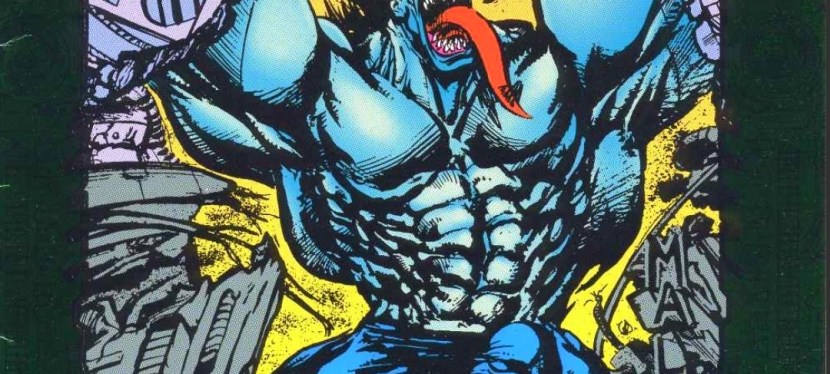
A Look Back at Hulk 2099 #1 (1994)

Disclaimer: This is my original work with details sourced from reading the comic book and doing personal research. Anyone who wants to use this article, in part or in whole, needs to secure first my permission and agree to cite me as the source and author. Let it be known that any unauthorized use of this article will constrain the author to pursue the remedies under R.A. No. 8293, the Revised Penal Code, and/or all applicable legal actions under the laws of the Philippines.

Welcome back superhero enthusiasts, 1990s arts and culture enthusiasts, Marvel Comics fans and comic book collectors! Today we go back to the wild 1990s by examining one of the many tales of Marvel Comics’ 2099 line of franchises, specifically through the Hulk 2099 monthly series.

For the newcomers reading this, Hulk 2099 first appeared in 2099 Unlimited #1 (1993) which also had his origin story told. Hulk 2099 was not a mere version of the classic Incredible Hulk with a futuristic touch. In fact, the futuristic green creature highlighted the protagonist John Eisenhart as a very selfish and obsessed Hollywood studio executive who happens to stumble upon the idolaters/worshipers of the classic Hulk Bruce Banner because he was searching for new properties and stories for his studio. Hulk 2099’s origin has notable similarities to that of the classic Hulk and gamma radiation exposure is one of them. As tales of the futuristic Hulk were told through the quarterly releases of 2099 Unlimited, Marvel decided it was time to give the green creature his own monthly series.

With those details laid down, here is a look back at Hulk 2099 #1 published in 1994 by Marvel Comics with a story written by Gerard Jones and drawn by Malcolm Davis.
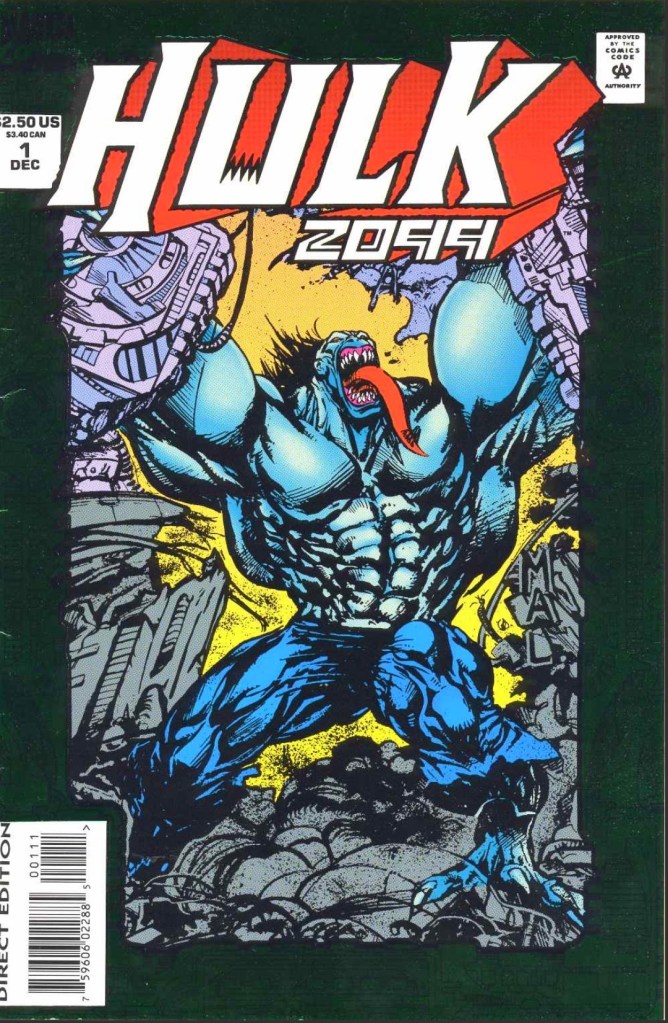
The cover.

Early story

The story begins with the Hulk of 2099 destroying security droids and verbally attacking civilization. As he retains the intellect of John Eisenhart, he expresses his opposition against civilization for keeping people out of the water reclamation zone.

The story then shifts to California where Lotus Entertainment (Eisenhart’s employer) and its crew work on producing a film which is a dishonest telling of Eisenhart’s dealings with the Knights of Banner (already eliminated in 2099 Unlimited #1). During the production, one of the executives notices the absence of Eisenhart.

Elsewhere, John Eisenhart drives his flying car with Knights of Banner youth survivor Gawain as his passenger. Already struggling with the guilt over the deaths of all the adult Knights of Banner members, Eisenhart intends to end his employment and cash out of his contract. Gawain remains hostile towards Eisenhart.

Quality

The creative team used flashback images that look really similar to what was told in 2099 Unlimited #1.

If there is anything that is very obvious to talk about, it is the fact that this tale shows a radically different John Eisenhart who wants to get out of Hollywood’s multiple mazes of crookedness as he feels very guilty over what happened to the Knights of Banner. This happens just as a new entity took corporate control of Eisenhart’s employer before he could leave the company. In many ways, Eisenhart’s distress and struggle with being guilty reminds me a lot about Hardcase of the Ultraverse and the way the creative dramatized him was engaging.

For the story, there is a lot of corporate intrigue going on and Eisenhart’s failure to quit quickly was inevitable because the new enemy he faces here has a lot to do with the sudden takeover of Lotus Entertainment. At least on face value, this looks like an attempt by the creative team to change the status quo and move Hulk 2099 to a new creative direction away from what was established in 2099 Unlimited. Without spoiling the details, I can say that something very significant happened before the comic book’s ending and it will impact readers who followed the futuristic Hulk’s stories closely in the 2099 Unlimited series.

Along the way, there is a lot of action and unfortunate physical happenings which symbolize the chaos concept of the script. The notable thing here is that you won’t see very much of Hulk 2099’s monstrous form as the script was specifically written to tell a tale that went beyond one issue. Clearly, the creative team were sparing Hulk 2099 for a conflict in the next issue.

Malcolm Davis’ art has that visceral aesthetic that fits the established look of Marvel’s 2099 universe of the time but there were instances when he showed so much happening, the visuals looked chaotic and even disorienting. In fairness, his take on Eisenhart, Quirk, Gawain and others made them looked recognizable.

Conclusion

The future of Commiewood, wokeness, and dishonesty.

While its story has little of the green monster in it, Hulk 2099 #1 (1994) does a decent job building up the tension on top of the guilt-filled Eisenhart while setting up events that looked like a bold new creative direction was coming. By the time this comic book was published, several Hulk 2099 tales were already published in the quarterly 2099 series. On its own, this comic book lightly builds up the lore of the 2099 universe as it was clearly focused on Hulk 2099’s creative concept and characters.

While Eisenhart was indeed determined to change, it is a turnoff to see him lie and exaggerate details to protect himself from a certain corporate psychologist who is after the truth. There is also a lot of anti-corporate expressions here which seems to suggest that someone within the creative team had been thinking with socialist concepts and decided to use the script as an outlet of expression. The weird but true thing is that by today’s standards, Hollywood is filled with Commies/socialists/Marxists/liberals/woke nuts from the film crew up to the executives that run studios and produce films or shows that are dumb, lies about reality, self-centered and extensions of their ideologies. This showed that this comic book was prophetic in some ways.

Overall, Hulk 2099 #1 (1994) is satisfactory.

+++++

Thank you for reading. If you find this article engaging, please click the like button below, share this article to others and also please consider making a donation to support my publishing. If you are looking for a copywriter to create content for your special project or business, check out my services and my portfolio. Feel free to contact me with a private message. Also please feel free to visit my Facebook page Author Carlo Carrasco and follow me on Twitter at  @HavenorFantasy as well as on Tumblr at https://carlocarrasco.tumblr.com/ and on Instagram at https://www.instagram.com/authorcarlocarrasco

A Look Back at Superman vs. The Amazing Spider-Man (1976)

Disclaimer: This is my original work with details sourced from reading the comic book and doing personal research. Anyone who wants to use this article, in part or in whole, needs to secure first my permission and agree to cite me as the source and author. Let it be known that any unauthorized use of this article will constrain the author to pursue the remedies under R.A. No. 8293, the Revised Penal Code, and/or all applicable legal actions under the laws of the Philippines.

Welcome back superhero enthusiasts, 20th century arts and culture enthusiasts, fans of Marvel and DC Comics, and comic book collectors! Today we go back to the year 1976 to examine what is truly a landmark event in the history of superhero comic book publishing – the first-ever superhero crossover event of Marvel Comics and DC Comics with Superman vs. The Amazing Spider-Man (also referred to as Superman vs. Spider-Man for short).

For the newcomers reading this, I previously reviewed the 2nd Superman-Spider-Man crossover comic book titled Superman and Spider-Man. That was released in 1981 and was handled by a different creative team (led by Jim Shooter as writer) compared to the 1976 crossover of the two icons of Marvel and DC. Going back to the 1970s, a crossover between Marvel and DC looked like an impossible dream as the idea of the two companies coming into agreements over the legal, creative and financial aspects was perceived to be unachievable. Indeed there were headaches and challenges during the negotiations but ultimately Marvel and DC came into an agreement to publish a special comic book featuring Superman, Spider-Man and the related supervillains and supporting characters from both sides. Take note that the two publishing giants worked together previously with publishing an official comic book adaptation of the movie The Wizard of Oz (1939).

With those details laid down, here is a look back at Superman vs. The Amazing Spider-Man, published in 1976 by Marvel Comics and DC Comics with a story written by Gerry Conway and Ross Andru. This crossover event was described as the battle of the century.

The cover.

Early story

The story begins at the World News Conference in New York City. Separated by several feet apart, Clark Kent (Superman) and Peter Parker (Spider-Man) arrive with their respective companions and associates. What the two heroes do not know is that Lex Luthor and Doctor Octopus recently escaped from prison.

Peter Parker gets berated by his boss J. Jonah Jameson for not being good enough as a photographer while Clark Kent learns the bad news from Edge Morgan that he is not wanted for the coverage of a national convention.

Shortly after, Lois Lane climbs up a scaffold to get a good view for some photography. Just as she is about to fall down, Peter Parker suddenly grabs her and pulls her to safety. After an exchange of pleasantries, Peter introduces Lois to Mary Jane Watson. Just as MJ and Lois start conversing, Superman suddenly arrives. The Superman figure then fires beams of light from eyes to Lois and MJ, causing them to vanish into thin air. It turns out, the caped figure is an impostor as Peter Parker and Clark Kent react in shock.

Peter quickly runs to the roof of the building and changes into Spider-Man. As soon as he leaps into action, he comes face to face with Superman himself…

Quality

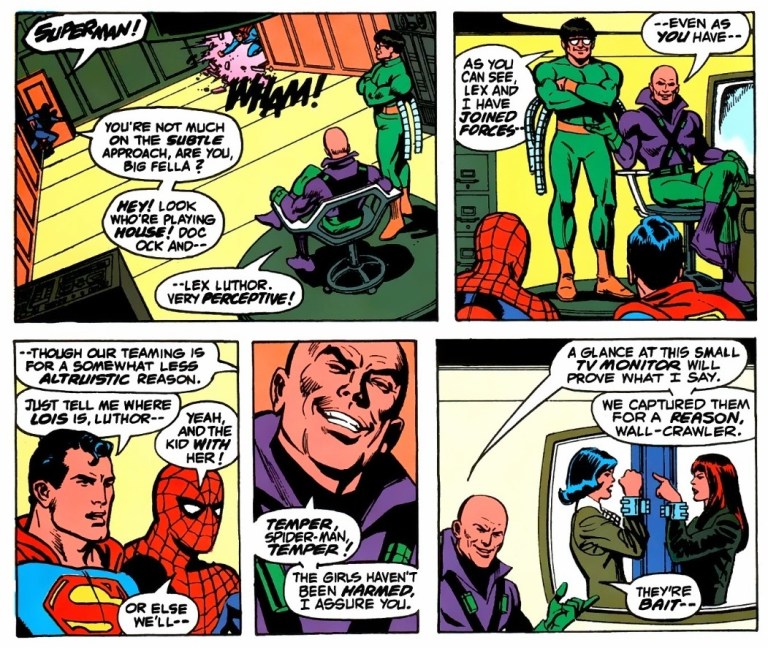
Superman, Spider-Man, Luthor, Dr. Octopus, Lois Lane and Mary Jane Watson shown in this scene.

I can loudly say that this is one pretty enjoyable crossover tale that not only featured Superman and Spider-Man, but also gave their respective mortal enemies Luthor and Dr. Octopus a good share of the spotlight. To be very clear, the story and set-up of scenes do have a somewhat restrictive structure as the creators clearly did their best to make the spotlight on the characters more or less equal in terms of imagery, dialogue amount and the sharing of dynamic shots. While some may easily complain about the so-called old and tired formula of the major characters getting into fighting each other due to a misunderstanding followed by setting aside their differences to work together, take note that the said formula worked really well in this story written by Gerry Conway.

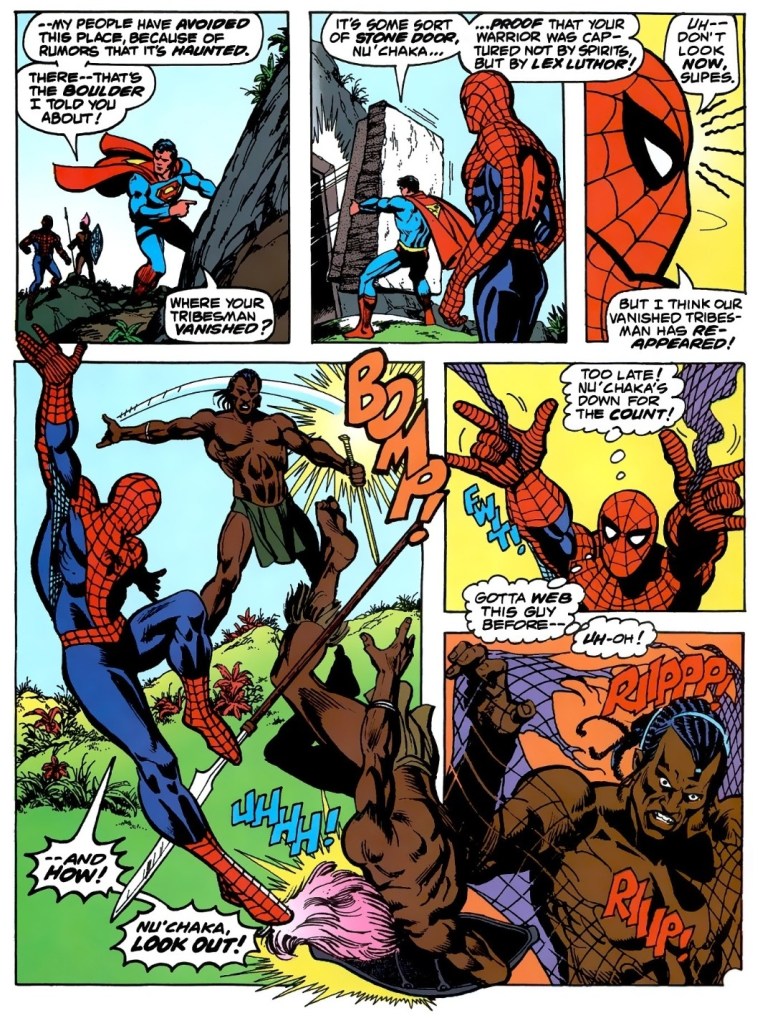
The story concept Conway came up was clearly made to justify Superman and Spider-Man encountering each other (note: the same goes with the super villains and supporting characters) and the way he wrote the two interacting with each other worked seamlessly and convincingly. There are lots of nice exchanges of dialogue between the Man of Steel and the webslinger.

Even the superiors of Clark Kent and Peter Parker had their own crossover.
Don’t let the woke and socialists fool you. There is nothing racist in this comic book. Wokeness is foolishness. Political correctness distorts perception of reality.

Even though the script has this set of creative restrictions to ensure fairness on both Marvel and DC’s sides, the synergy of friendship and cooperation between Superman and Spider-Man is fantastic to read. Similar qualities are also evident with the scenes of Luthor and Dr. Octopus. Very clearly, the creative team did intense research on the Marvel and DC characters and found ways to create a unique mix that resonates with the fans of Superman and Spider-Man.

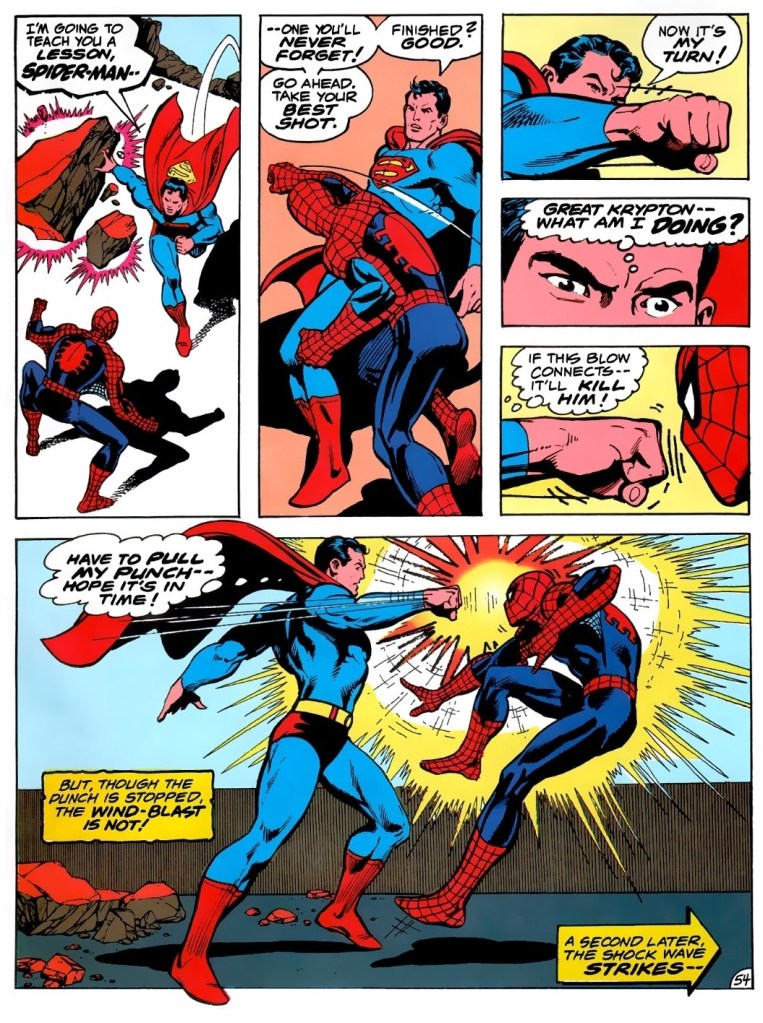
As expected, this comic book has lots of superhero spectacle for readers to enjoy. The superhero violence is not intense but the action scenes were entertaining to look at. In my opinion, the highlights of the spectacle here is when Superman and Spider-Man literally exchanged mortal enemies to fight with. As for the fight between the two icons as emphasized in the title, it definitely is a special event that really kicked the story into high gear.

While this is indeed a fun superhero crossover to read, there are some notable weak points here. For one thing, the plot itself lacks a strong concept and Luthor’s evil plan is very flawed and unconvincing. That being said, as I read and re-read this comic book, there never was a sense of danger building up nor was the Luthor-Dr. Octopus team ever a grave threat.

Conclusion

This is only a small sample of the fun in the battle between Superman and Spider-Man.

By today’s standards, Superman vs. The Amazing Spider-Man (1976) is still a fun superhero crossover comic book to read and it remains as a significant part of not just Marvel and DC’s history of collaboration but also that of inter-company superhero crossover comic book publishing in general. While it is better than many other inter-company superhero crossover comic books I have read through the decades, this one is certainly not the best one from Marvel and DC. For me, Superman and Spider-Man (1981) has a more elaborate plot, higher fun factor and deeper impact than this comic book. Meanwhile, Batman vs. The Incredible Hulk (1981) exceeded this comic book in terms of plotting, character interactions, super villain portrayals and establishing a real sense of danger that requires the super heroes to solve. Still, Superman vs. The Amazing Spider-Man (1976) remains an enjoyable read and it definitely is worthy as the strong beginning of Marvel-DC superhero crossover projects of the 1970s and 1980s. It also has more dynamic visuals than its 1981 sequel. This one is also part of the Crossover Classics: The Marvel-DC Collection paperback.

Overall, Superman vs. The Amazing Spider-Man (1976) is recommended!

+++++

Thank you for reading. If you find this article engaging, please click the like button below, share this article to others and also please consider making a donation to support my publishing. If you are looking for a copywriter to create content for your special project or business, check out my services and my portfolio. Feel free to contact me with a private message. Also please feel free to visit my Facebook page Author Carlo Carrasco and follow me on Twitter at  @HavenorFantasy as well as on Tumblr at https://carlocarrasco.tumblr.com/ and on Instagram at https://www.instagram.com/authorcarlocarrasco
A Look Back at Spider-Man 2099 #8 (1993)

Disclaimer: This is my original work with details sourced from reading the comic book and doing personal research. Anyone who wants to use this article, in part or in whole, needs to secure first my permission and agree to cite me as the source and author. Let it be known that any unauthorized use of this article will constrain the author to pursue the remedies under R.A. No. 8293, the Revised Penal Code, and/or all applicable legal actions under the laws of the Philippines.

Welcome back superhero enthusiasts, 1990s arts and culture enthusiasts, Marvel Comics fans and comic book collectors! Today we go back to the wild 1990s and explore the far future of 2099 within the Marvel Comics shared universe through one of the tales of Spider-Man 2099.

In my previous retro review, the futuristic Spider-Man got involved with his era’s version of Vulture (Vulture 2099 to us readers). It turns out, Vulture 2099 is not your typical evil supervillain but the leader of a group of violent radical people who are willing to dominate society with a destructive mindset even though there are other opposing groups around them. And then Spidey 2099 realized something very wrong about the Vulture which leads to a big battle between them.

With those details laid down, here is a look back at Spider-Man 2099 #8, published in 1993 by Marvel Comics with a story written by Peter David and drawn by Rick Leonardi.

The cover.

Early story

The story begins with Spider-Man 2099 and Vulture 2099 crashing into the interiors of the ancient St. Patrick’s Cathedral located in old New York City (underneath the modern city). Unsurprisingly, the people inside the cathedral got very surprised about the unexpected entry of the two fighters.

Elsewhere, Miguel O’Hara’s brother Gabriel helps Kasey with her head. She tells him that she saw Miguel but Gabriel does not believe her. Suddenly, members of a gang knock on the door and Kasey opens it.

Inside St. Patrick’s Cathedral, the fight between Spider-Man and Vulture continues. Spider-Man remembers that he has lapsed as a Catholic and he feels very uneasy about the trouble he and his enemy are causing inside the old church structure. Vulture suddenly throws a wooden bench at Spidey but breaks open a glass window and then goes outside. Upon looking outside, Spider-Man notices a group of Vulture’s gang…the Freakers.

Quality

The battle between Spider-Man 2099 and Vulture 2099 is intense and very compelling to read.

Here is the good news about this comic book…the story here is a fitting conclusion to what happened in issue #7. The conflict between Spider-Man and Vulture here was carefully crafted and there were several key moments or scenes the provided readers some breathing room to grasp and understand the society of 2099 New York as well as the conflict between the downtown social groups who are deprived of the higher standard of living many miles above them. In some ways, the social divisions portrayed in this comic book is a sad reminder about modern day America and the many radical groups or gangs of people who divide society on race, ethnicity, social class, gender and ideology.

As expected, there is a lot of action executed in the fight between Spider-Man and Vulture of 2099 but there were pauses in between. This is not surprising considering how Peter David crafted the action-packed battles Spidey 2099 had with other enemies in the comic books released before this one. Without spoiling what happened, I can say that the battle between the two was nicely built-up and the conclusion turned out very satisfying to see.

Still on the story, Peter David added some layers of complexity into the conflict that easily made things much more difficult for Spider-Man 2099 on a personal level. I’m talking about his brother Gabriel and Kasey getting involved in the gang war against the Freakers.

Vulture 2099 is once again a standout opposition figure here. Not only is his ability to fly and cause chaos above his obsessed Freakers below is symbolic, his distorted, hardcore beliefs are reflected with his unrelenting use of violence as he fights Spider-Man. Not only that, he turns out to be very philosophical thanks to the rich dialogue Peter David came up with. It is also here that the futuristic Vulture is opposed to God and being the socialist-indoctrinated person he is, he easily blames Alchemax for God’s absence. This should remind you that through Vulture 2099, evil comes with fatal attraction that people could not realize until it is too late. The futuristic Vulture has a lot of common with the evil leaders of Black Lives Matter, Antifa, the Democratic Socialists of America and the long-time regime of Iran. Lastly, I should state that radical socialists are always wrong about God and they often live with distorted perceptions about Him. Vulture 2099 qualifies as a woke figure of 2099 and ultimately wokeness is foolishness.

Speaking of sub-plots, this comic book emphasizes Tyler Stone on how he handles ambitious projects of Alchemax that he believes will benefit people. His interactions with Dana here also sheds light about his very own obsession about the future of humanity.

Conclusion

Spider-Man in trouble with the Vulture’s gang members.

With rich writing, notable in-story details and a very well designed conflict between the futuristic Spider-Man and Vulture, Spider-Man 2099 #8 (1993) is both very engaging and entertainting to read from start to finish. It is a great pay-off to what was built-up in issue #7. Very notably, the conflict between Vulture 2099 and the protagonist is great to see and it is clear that Vulture is not a disposable supervillain but one of the most definitive forces of opposition against Spider-Man 2099. Of course, as comic book history turned out, Vulture 2099 made it in the crossover comic book event between classic Spider-Man and Spidey of 2099. Along the way, the creative team succeeded with expanding the lore of 2099 and the social underclass of New York.

Overall, Spider-Man 2099 #8 (1993) is highly recommended.

+++++

Thank you for reading. If you find this article engaging, please click the like button below, share this article to others and also please consider making a donation to support my publishing. If you are looking for a copywriter to create content for your special project or business, check out my services and my portfolio. Feel free to contact me with a private message. Also please feel free to visit my Facebook page Author Carlo Carrasco and follow me on Twitter at  @HavenorFantasy as well as on Tumblr at https://carlocarrasco.tumblr.com/ and on Instagram at https://www.instagram.com/authorcarlocarrasco

A Look Back at Venom: Funeral Pyre #1 (1993)

Disclaimer: This is my original work with details sourced from reading the comic book and doing personal research. Anyone who wants to use this article, in part or in whole, needs to secure first my permission and agree to cite me as the source and author. Let it be known that any unauthorized use of this article will constrain the author to pursue the remedies under R.A. No. 8293, the Revised Penal Code, and/or all applicable legal actions under the laws of the Philippines.

Welcome back superhero enthusiasts, 1990s arts and culture enthusiasts, Marvel Comics fans and comic book collectors! Today we go back to the year 1993 and explore a part of Marvel Comics’ universe through the first-ever limited comic book series featuring one of Marvel’s most iconic supervillains – Venom.

Previously, I wrote about Venom with his appearances in What If comic books (click here and here) as well as in issues of Venom: Lethal Protector (click here and here). Venom also appeared in the disappointing crossover comic book Spider-Man Meets Spider-Man 2099.

Moving back to the year 1993, the Venom: Lethal Protector limited series ended and Marvel went on to release a 2nd limited series composed of three issues complete with an all-new creative team. That series was Venom: Funeral Pyre and the most notable thing is that Venom gets to be with the Punisher (read my other retro reviews that include the character here, here, here and here).

With those details laid down, here is a look back at Venom: Funeral Pyre #1 published in 1993 by Marvel Comics with a story written by Carl Potts and drawn by the late Tom Lyle.

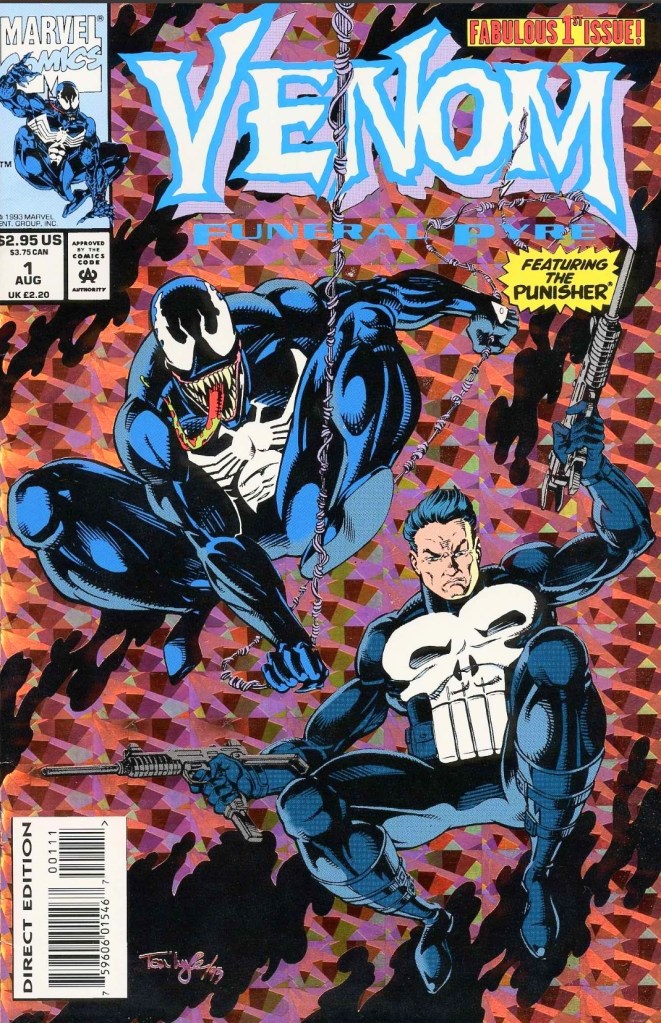
The cover.

Early story

The story begins on the streets of Oakland, California. There, a young guy named Gray Russell watches gang members severely beat up another guy which disturbs him deeply. He is part of the gang. A short time later, he rides with the gang in a car which hits a man (who managed to have his young nephew move out of harm’s way).

Somehow the man survived and moves to another direction deliberately to lure the gang away from his nephew. As the gangsters move towards a local building, Gray separates from his harsh companions to find a phone booth. Gray finds Calvin (the nephew of the man who got hit) nearby and decides to comfort him. From a distance, they heard the gangsters beat Calvin’s uncle to death.

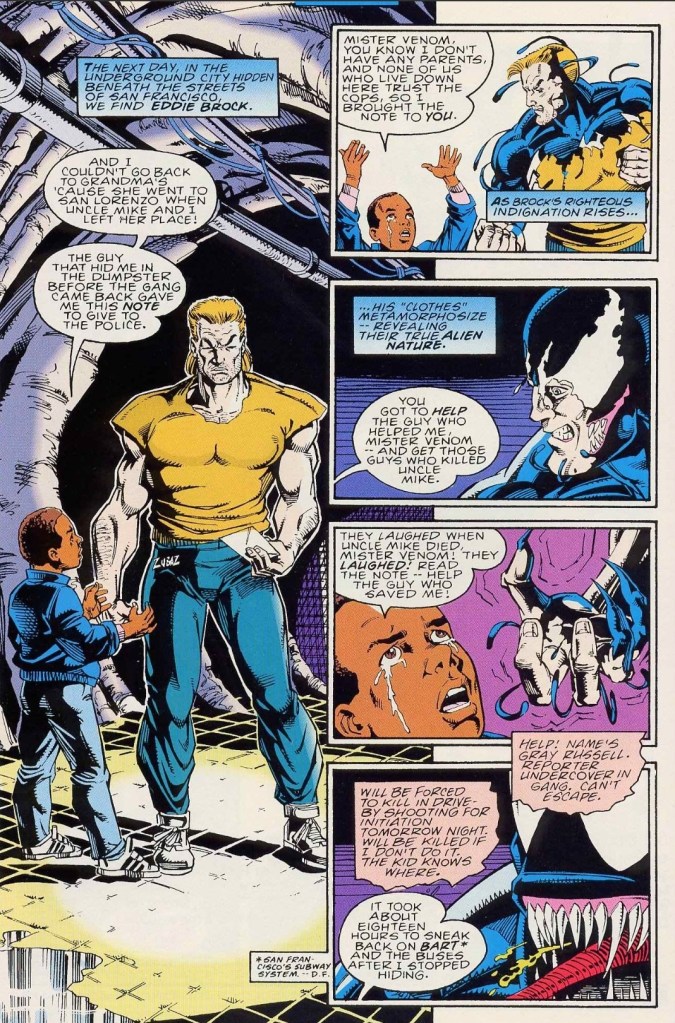
The next day in the underground city beneath San Francisco, Calvin meets Eddie Brock and hands him a note meant for the police. As Calvin reveals more details, Eddie gradually turns into Venom with his alien costume covering up his body. After learning of the death of Calvin’s uncle and hearing the young boy’s plea for help for Gray (an investigative reporter in secret within the gang), Venom agrees to help him as it is their mission to save the innocent and destroy the guilty…

Quality

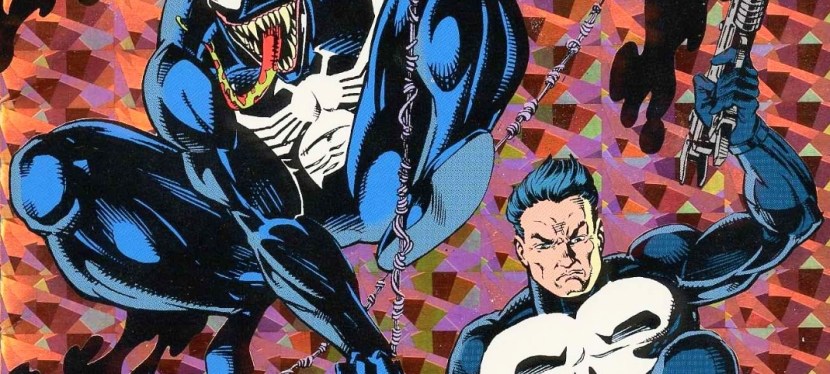
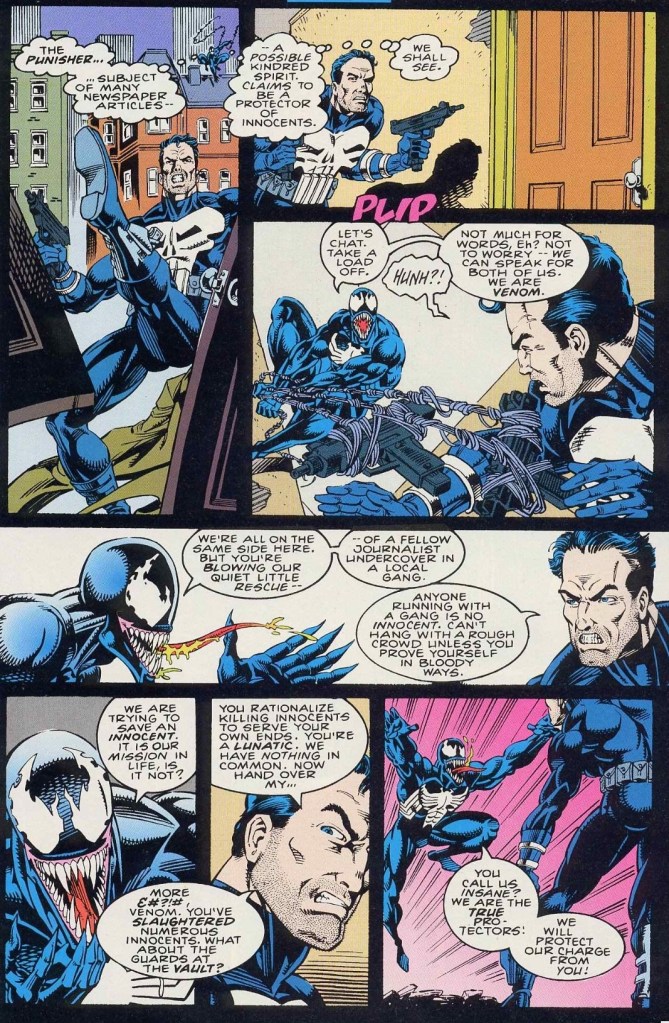
Punisher and Venom’s first-ever encounter with each other.

I want to start first the with the overall presentation crafted by the Potts-Lyle creative duo. In terms of story and setting, this comic book has a very strong urban crime vibe which is not a surprise given the fact that Carl Potts wrote lots of stories of the Punisher and his personal war against criminals. That being said, the tone is very different compared to what was shown in Venom: Lethal Protector and other Venom tales that got published before this comic book. Very clearly, this story is dark, gritty and even disturbing to read due to the subject matter of crime and senseless violence caused by people who are obsessed with violence. The fantasy elements of Venom: Lethal Protector are unsurprisingly absent here.

Carl Potts’ take on Venom’s personality is technically an extension of what was established previously. Venom, who is truly a murderer on the loose, continues to live with his very distorted code by helping the innocent by means of using violence and death on others he personally views as guilty. His getting involved in the turf of crime here is, however, a fresh approach on the super villain now acting “heroic” helping Calvin who lost his uncle. Being a former journalist himself, Eddie Brock “relates” with the investigative journalist involved with the gang.

The other major character – the Punisher – is his typical self in this story. He gets involved in the conflict in Oakland not purposely but accidentally as he was just passing by in his weapons-filled van as he heard the local police communication on local crime. The only thing notable about the way the Punisher is portrayed here is his first-ever interactions with Venom which is a crossover scene filled with a decent amount of hard action.  

Gray, the investigative journalist, is presented here as technically the third major character of the story. In some ways, he even overshadows Venom and the Punisher in key parts of this comic book. He is not really an interesting character himself but there are some interesting Marvel universe details shown from his personal memories. What is clear about this uninteresting character is that the creative team planned something with him in a key role within the core concept of this mini-series.

As for the plot itself, it clearly has a dark and gritty concept of street crime in 1990s Oakland which itself plays a big part of the build-up of the story and the eventual crossover between Venom and the Punisher. The problem is that the build-up has an uninteresting character with Gray involved and there is a lot of exposition to go through before the Venom-Punisher encounter.

The encounter between Venom and the Punisher here came with the superhero comics crossover trope of the players misunderstanding the situation and each other, and getting into a conflict very early on. Both characters have their respective obsessions and so-called codes of purposes, which predictably leads them into conflict as they stayed hard-headed towards each other. While it is flawed, the Venom-Punisher crossover here is the highlight as well as the relief from having to read all the exposition and build-up.

Conclusion

A scene like this could inspire Black Lives Matter terrorists, SJWs, woke activists and North American socialists to become violent and cause havoc around America.

Venom: Funeral Pyre #1 (1993) is a flawed comic book that happens to highlight the Punisher and Spider-Man’s greatest nemesis of the time. It delivered on its promise of showcasing the two characters – a cold-hearted anti-crime vigilante and an alien costume-equipped murderer – in a crossover but the pay-off was barely enough when you take into account the build-up, the exposition and the involvement of the uninteresting third player named Gray. Compared to what was shown in Venom: Lethal Protector, this comic book clearly has an urban crime flavor which Carl Potts strongly implemented. As for the art, Tom Lyle showed he is really good in visualizing Venom, the Punisher and street gang wars.

Overall, Venom: Funeral Pyre #1 (1993) is serviceable. Definitely this is not the fabulous 1st issue described on the foil cover.

+++++

Thank you for reading. If you find this article engaging, please click the like button below, share this article to others and also please consider making a donation to support my publishing. If you are looking for a copywriter to create content for your special project or business, check out my services and my portfolio. Feel free to contact me with a private message. Also please feel free to visit my Facebook page Author Carlo Carrasco and follow me on Twitter at  @HavenorFantasy as well as on Tumblr at https://carlocarrasco.tumblr.com/ and on Instagram at https://www.instagram.com/authorcarlocarrasco
A Look Back at What If #10 (1990)

Disclaimer: This is my original work with details sourced from reading the comic book and doing personal research. Anyone who wants to use this article, in part or in whole, needs to secure first my permission and agree to cite me as the source and author. Let it be known that any unauthorized use of this article will constrain the author to pursue the remedies under R.A. No. 8293, the Revised Penal Code, and/or all applicable legal actions under the laws of the Philippines.

Welcome back superhero enthusiasts, 1990s arts and culture enthusiasts, Marvel Comics fans and comic book collectors! Today we go back to the year 1993 and explore a part of Marvel Comics’ universe through the reimagined tales emphasized in the What If monthly series.

For those of you who have gotten very familiar with Marvel Comics’ vast lineup of superheroes, anti-heroes, super villains and supporting characters, the Punisher is one of the most notable characters as he is the most definitive vigilante the publisher ever has in its shared superhero universe. As a comic book protagonist, the Punisher does “good” in fighting crime but he sure is as bad as the bad guys as he commits torture, issued threats of violence, kidnapping, extortion, coercion and even murder towards them. A major factor in the Punisher’s origin (as Frank Castle) was the killing of his family (wife and two kids) committed by a mob as they witnessed acts of killing in Central Park in New York City. The tragic deaths led Castle to become the Punisher who not only relentlessly waged a personal war against criminals but also often wore dark clothes with a large white skull design on the front of his body. The skull symbolized punishment and death to his enemies.

With those details laid down, here is a look back at What If #10, published in 1990 by Marvel Comics with a story written by Doug Murray and drawn by Rik Levins.

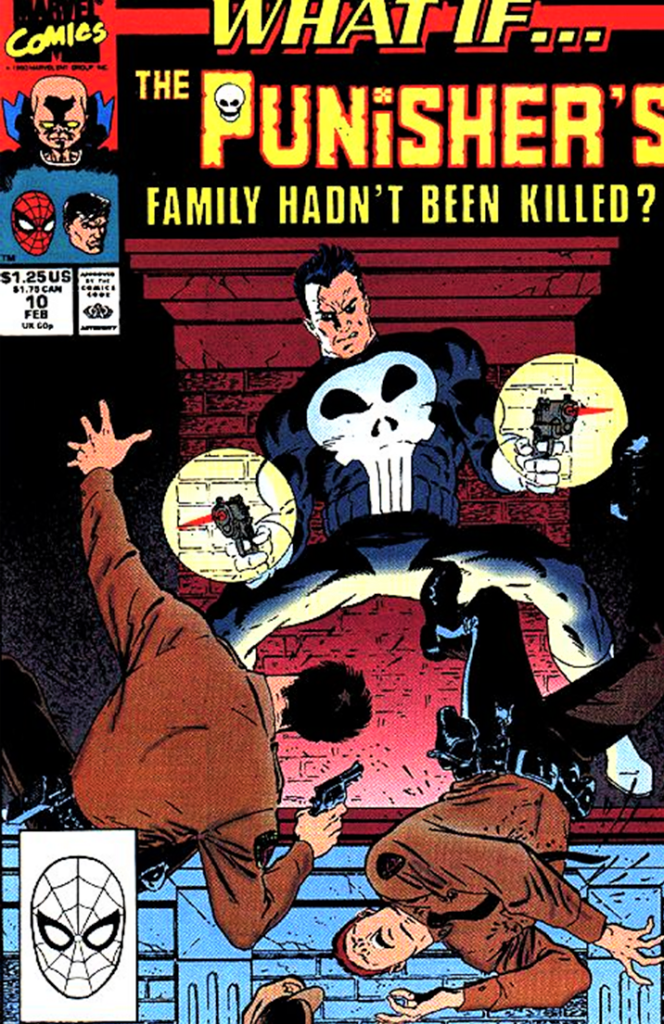
The cover.

Early story

The story begins with the Watcher recalling the time Frank Castle spent with his wife and the two kids at New York City’s Central Park. There, they have fun with their picnic. At this point in time, Frank Castle had previously served his country in the Vietnam War and he carries within him bravery, the experience of violence and vast skills to use weapons.

The weather suddenly worsens as rain starts to fall down causing some inconvenience on the Castle family. Frank’s son struggles as his kite got caught by the large plant nearby. On the other side of the said plant, four armed men and their captive (hanging upside down by the tree) are startled and prepare themselves to shoot anyone who appears.

Frank, who does not realize the mob on the other side of the plant, helps his son get the kite back. The Castle family then decide to go back home not realizing that they came close to discovering and witnessing the illegal activity of the armed men. As the family kept on moving, Frank hears gunfire from a distance…

Quality

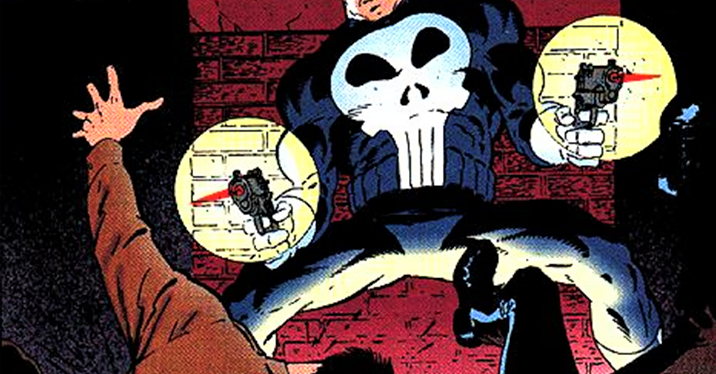
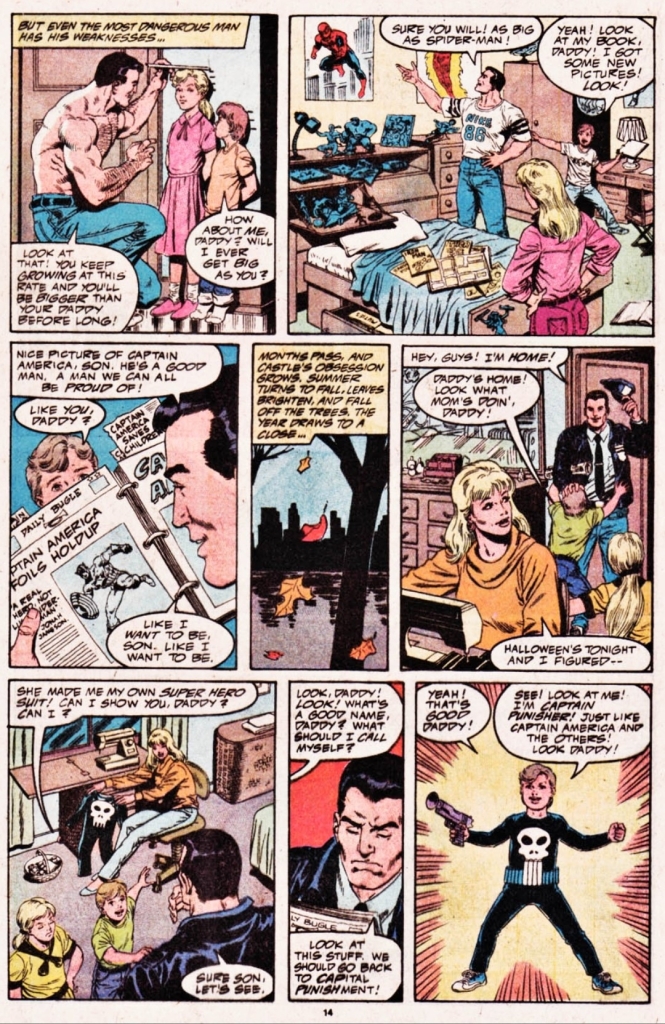
Frank Castle the family man.

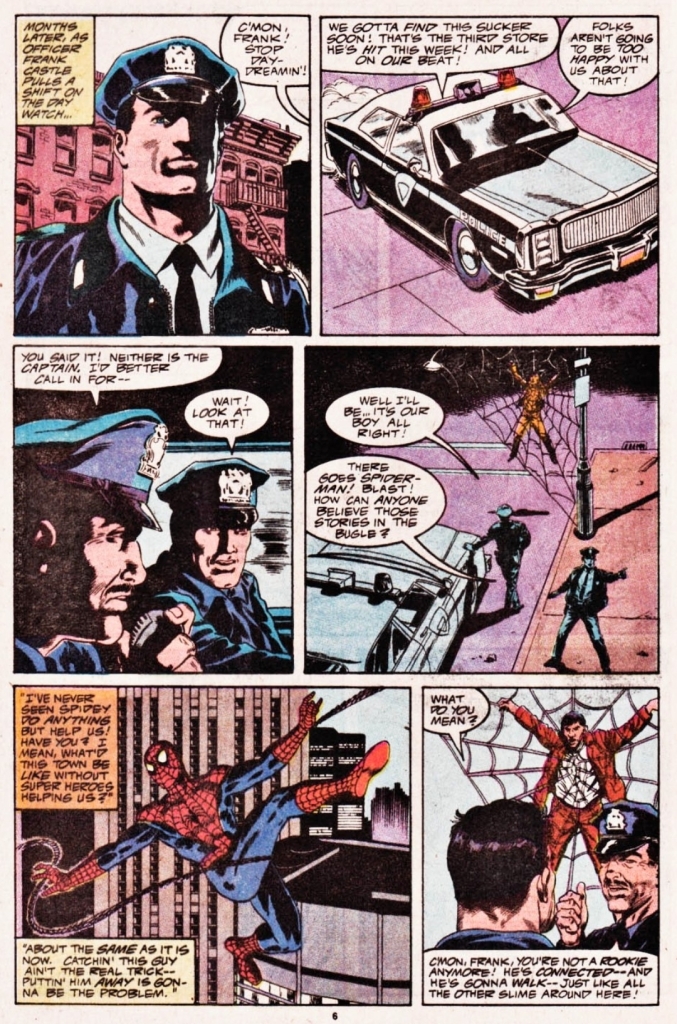
To get straight to the point about this comic book, it’s story is really engaging and it has noticeable amounts of darkness and grittiness without going overboard. While exploring what would happen had Frank Castle’s family not been killed, the comic book shows the Punisher getting involved in public safety as a New York patrolman which puts him in a unique position facing crime in radically different ways from what we comic book readers have been used to seeing. The story also explores corruption within the police and the justice system as well.

The way the events and action turned out showed the creative team focused on realism while also establishing the Punisher’s own place within the comic book’s alternate portrayal of the shared superhero universe. More on the subject matter of this comic book, there is a twist that surprised me a lot and it is something that you readers should see for yourselves.

Going back to Frank Castle, it is indeed very captivating to see him portrayed a lot more as a family man who really strives to support his wife and kids no matter how dangerous his occupation really is. The aspect of family in this comic book is very significant as it will make you realize that the definition of family in America in the 21st century has been distorted as a result of laws or court decisions that reflected wokeness, homosexuality and unrestrained feminism. In short, woke America’s believers reject the concept of the traditional family and the concept of a father leading the family is considered taboo because it goes against LGBT’s so-called values and principles.

Conclusion

Frank Castle as the police officer.

When you think about the legacy of the Punisher not only on comics but also in movies and other forms of entertainment media, you will often remember a one-man-army against criminals. What If #10 (1990) has is a really unique take on the Punisher and I can say it has a very captivating script brought to life with really good artwork. Not only does this alternate version of the Punisher shows how he affects criminals, but also how he impacts other parts of the fictional New York society within the shared universe of Marvel Comics (note: characters connected to Spider-Man and Daredevil are here). From start to finish, this Punisher tale by the Murray-Levins team turned out to be very engaging to read.

Overall, What If #10 (1990) is highly recommended!

+++++

Thank you for reading. If you find this article engaging, please click the like button below, share this article to others and also please consider making a donation to support my publishing. If you are looking for a copywriter to create content for your special project or business, check out my services and my portfolio. Feel free to contact me with a private message. Also please feel free to visit my Facebook page Author Carlo Carrasco and follow me on Twitter at  @HavenorFantasy as well as on Tumblr at https://carlocarrasco.tumblr.com/ and on Instagram at https://www.instagram.com/authorcarlocarrasco
A Look Back at Superman: The Man of Steel #20 (1993)

Disclaimer: This is my original work with details sourced from reading the comic book and doing personal research. Anyone who wants to use this article, in part or in whole, needs to secure first my permission and agree to cite me as the source and author. Let it be known that any unauthorized use of this article will constrain the author to pursue the remedies under R.A. No. 8293, the Revised Penal Code, and/or all applicable legal actions under the laws of the Philippines.

Welcome back superhero enthusiasts, 1990s culture enthusiasts and comic book collectors! Today we go back to the early 1990s and explore a key chapter in the post-Crisis era of DC Comics through a Superman comic book.

Previously, I reviewed Adventures of Superman #498 (1993) which marked the first chapter of the Funeral for a Friend storyline and dramatized the impact left behind by the death of Superman. That particular comic book had strong writing and succeeded in dramatizing how Superman’s friends, associates and other characters coped with his death with the future looking uncertain to them.

With those details laid down, here is a look back at Superman: The Man of Steel #20, published in 1993 by DC Comics with a story written by Louise Simonson and drawn by Jon Bogdanove. This comic book marked the third chapter of the Funeral for a Friend storyline.

The cover.

Early story

The story begins with people in Metropolis struggling to move forward not only because their hero Superman died but also because of the tremendous damage left behind by Doomsday. In his headquarters, Lex Luthor is talking with the telephone surrounded by several people with Supergirl watching. The matter being discussed was the burial of Superman at Centennial Park particularly in a structure Luthor himself donated. While he has to live on with the fact that he failed to kill Superman, Luthor tells himself he can still bury him.

At the Kent farm far away from Metropolis, Jonathan and Martha Kent are agonizing not only because of the death of their beloved son but also because they realized they cannot even get near him at his funeral as it will be organized as a major event with only the important people allowed to attend…

Quality

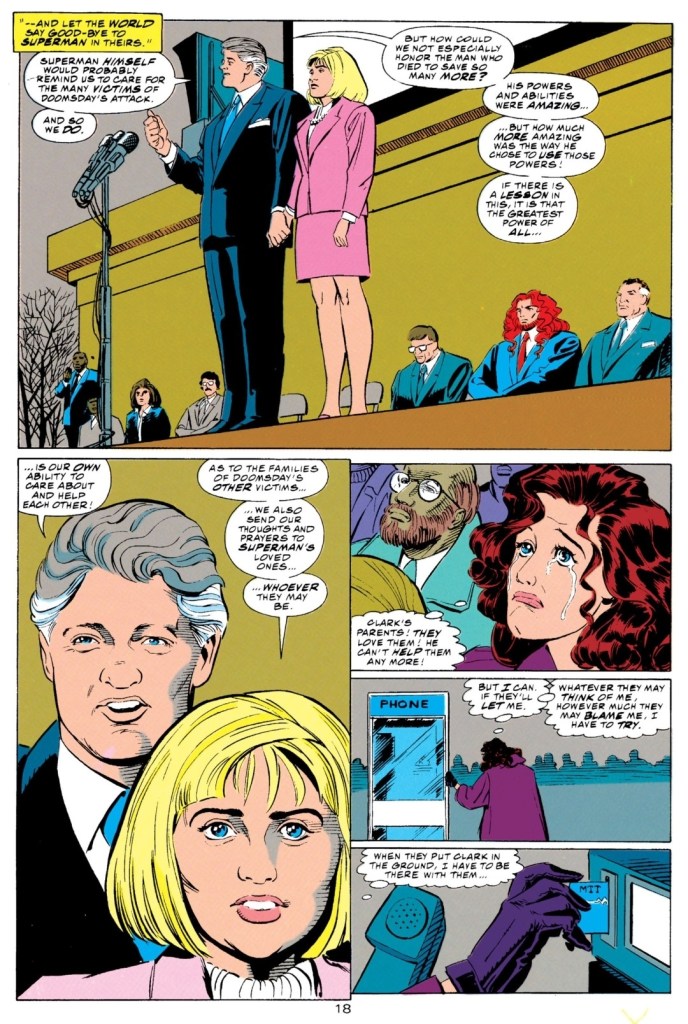
It seems like destiny to have the super villain Lex Luthor in the presence of a fictionalized Bill Clinton and Hillary Clinton during the funeral of Superman. By today’s standards, the Clintons made it normal for America to bow to terrorists and make deals with them. That being said, their inclusion in this comic book is just wrong.

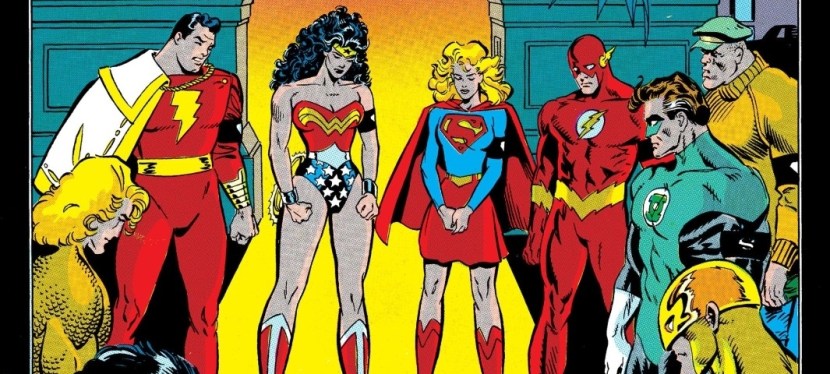
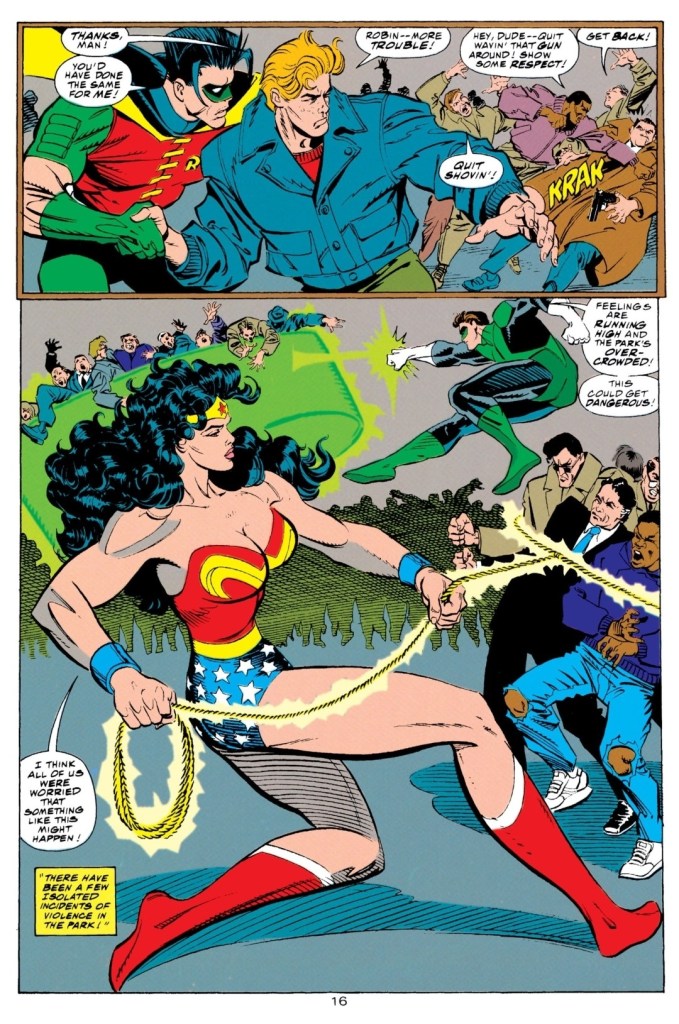
To go straight to the point, like Adventures of Superman #498 (1993), this comic book continues to dramatize the impact of Superman’s death on Metropolis and its people in a very engaging manner. It shows that DC’s creative teams in charge of Superman comic book at the time were really organized and coordinated with each other on crafting the Funeral for a Friend storyline. What makes this comic book stand out is the funeral itself which was organized as a public event (with the burial itself done in the presence of important people – including a very evil couple from the Democrats who love abortion and terrorism) and this includes the presence of many other DC Comics superheroes like Wonder Woman, Green Lantern, The Flash, Maxima, Shazam (AKA Captain Marvel) and others. The burial had its own share of intriguing and dramatic moments emphasizing the people’s struggle to adjust themselves knowing they don’t have Superman anymore to help them.

Wonder Woman, Green Lantern and Robin help out as the huge crowd became rowdy.

More on the post-death dramatization, the creative team managed to keep Superman’s associates Lois Lane, Jimmy Olsen and the other Daily Planet people feeling uneasy over the Man of Steel’s death which makes their work covering the funeral professionally a challenge. Unsurprisingly, Lois Lane gets her own fine share of the spotlight agonizing over the fact that she lost her beloved Clark (Superman to the public) whom she was supposed to get married with. The emotional struggle within her intensified as she experiences difficulty of informing the elderly Kent couple about what happened. This is rich writing prepared by the creators.

Not only that, the creative team also went all-out with dramatizing the impact of Superman’s good deeds on the people. You will see several people from Metropolis’ general population talk about how Superman helped them or inspired them. There are certain lines of dialogue that are quite touching to read.

Conclusion

A pretty powerful portrayal of Lois Lane’s struggle on dealing with the new reality that she lost her beloved Superman.

Superman: The Man of Steel #20 (1993) is another solid, post-death story emphasizing the new normal that Metropolis people and Superman’s friends are having difficulty adjusting to…a world without the Man of Steel. Based on the high quality of the storytelling and character development, it is easy to tell that the Superman titles’ creative teams planned ahead and prepared themselves for telling a post-death saga which was pretty risky given the iconic status of Superman and his decades-long legacy in comics and pop culture. This comic book really made Superman’s absence feel powerful and undeniable.

Overall, Superman: The Man of Steel #20 (1993) is recommended.

+++++

Thank you for reading. If you find this article engaging, please click the like button below, share this article to others and also please consider making a donation to support my publishing. If you are looking for a copywriter to create content for your special project or business, check out my services and my portfolio. Feel free to contact me with a private message. Also please feel free to visit my Facebook page Author Carlo Carrasco and follow me on Twitter at  @HavenorFantasy as well as on Tumblr at https://carlocarrasco.tumblr.com/ and on Instagram at https://www.instagram.com/authorcarlocarrasco

A Look Back at Harbinger #18 (1993)

Disclaimer: This is my original work with details sourced from reading the comic book and doing personal research. Anyone who wants to use this article, in part or in whole, needs to secure first my permission and agree to cite me as the source and author. Let it be known that any unauthorized use of this article will constrain the author to pursue the remedies under R.A. No. 8293, the Revised Penal Code, and/or all applicable legal actions under the laws of the Philippines.

Welcome back superhero enthusiasts, 1990s culture enthusiasts and comic book collectors! Today we go back to the early 1990s and explore a part of the Valiant Comics shared universe through the Harbinger monthly series.

In my previous retro review, some twists of events happened for Sting and his teammates during the Christmas season. The story was part of the continuing build-up and expansion of the Harbinger series’ own space within Valiant Comics’ shared universe under the direction of Maurice Fontenot. As of issue #17, another new character from outside of Sting’s group got introduced for them to interact with.     

With those details laid down, here is a look back at Harbinger #18, published in 1993 by Valiant Comics with a story written by Maurice Fontenot and illustrated by Howard Simpson.

The cover.

Early story

The story begins on January 1993. Within the city of New York, Faith, Shatiqua and Flamingo are being followed by a young man wearing a trench coat. They know they are being followed. They eventually found themselves just outside the same amusement joint where Shatiqua played a lot of arcade games and decide to enter.

Inside, many people recognized and greeted Shatiqua which reflects her outstanding reputation on arcade games. As Shatiqua, Faith and Kris approach a certain arcade game (that Shatiqua wants to play), they noticed the one playing it is the same little black boy (capable of disappearing) they encountered previously. Shatiqua then takes the first step to approach him and gain his attention.

The boy then disappears and reappears a short distance away from the three and right beside same trench coated man who earlier follow them. The boy then attempts to blow the place up with a hand grenade. The man in the trench coat reacts quickly revealing his power to Faith, Shatiqua and Flamingo.

Quality

Sting shows his ignorance and lack of maturity while getting checked by Dr. Hayward.

This is the latest build-up type of story Fontenot composed and like the previous issue, another new character unconnected to Sting’s team got introduced for them to interact with. The new character here is referred to as Screen and he clearly is a more interesting character than the one introduced in issue #17. Screen here is more impulsive and aggressive and he sure looks like he has what it takes to oppose Sting. I also liked the way the creative team showed the impulsiveness and lack of maturity of both Sting and Screen.

Within the script is the establishment of a new sub-plot which symbolizes the growing danger of the Harbinger foundation towards not only on Sting and teammates but also against the others that oppose Toyo Harada and his organization. In some ways, the sub-plot will make you speculate about the invisible yet sinister forces who wield tremendous power over the top government officials who are supposed to be serving their constituents within the republic.

With all of these details laid down, I can say they are all engaging to read as Fontenot’s writing continued to be really strong. For the art, I can say that Howard Simpson continued to pump out really solid visuals while successfully keeping the primary characters recognizable all the time.

Conclusion

This image is very symbolic as Bill Clinton and his wife Hillary made it normal for the United States to make deals with terrorists (notably Iran and Palestine) and betray the patriotic Americans. This makes this comic book socially relevant and what you see with the corrupt administration of Joe Biden reconnects strongly with the Clinton legacy.

Harbinger #18 (1993) is a very solid comic book to read. The build-up continues to happen and along the way, the titular characters got developed some more and this time around, the Harbinger foundation’s power continues to get stronger which convinced me to look forward to the next issue.   

Overall, Harbinger #18 (1993) is highly recommended!

+++++

Thank you for reading. If you find this article engaging, please click the like button below, share this article to others and also please consider making a donation to support my publishing. If you are looking for a copywriter to create content for your special project or business, check out my services and my portfolio. Feel free to contact me with a private message. Also please feel free to visit my Facebook page Author Carlo Carrasco and follow me on Twitter at  @HavenorFantasy as well as on Tumblr at https://carlocarrasco.tumblr.com/ and on Instagram at https://www.instagram.com/authorcarlocarrasco

Better than Streaming: Top Gun: Maverick 4K Blu-ray all set for November 1, 2022 release

Welcome back, fellow geeks, Blu-ray collectors and movie buffs! Whether you are a fan of Tom Cruise, or a fan of the 1986 classic Top Gun or if you want something new and exciting to add to your collection of 4K Blu-ray movies, November 1, 2022 will be an important for you as Top Gun: Maverick 4K Blu-ray will be released on that very day. Here are some good news…Top Gun: Maverick 4K Blu-ray will come with native 4K visuals and if you are convinced to go for it, you can order it in advance right now!

Top Gun: Maverick 4K Blu-ray cover.

To put things in perspective, posted below is the excerpt from the 4K Blu-ray announcement at Blu-ray.com. Some parts in boldface…

Paramount Home Media Distribution has officially announced that it will release on 4K Blu-ray and Blu-ray Joseph Kosinski’s Top Gun: Maverick (2022), starring Tom Cruise, Val Kilmer, Miles Teller, Jennifer Connelly, and Bashir Salahuddin. The two releases will be available for purchase on November 1.

Studio synopsis: Tom Cruise stars in the global phenomenon Top Gun: Maverick, the #1 film of 2022 with over $1.3 billion in worldwide box office and the highest grossing film of the producer/actor’s acclaimed career. Top Gun: Maverick has been hailed as “spectacular” (Brian Truitt, USA Today), “breathtaking” (Don Kaye, Den of Geek) and “jaw-dropping” (Sean O’Connell, Cinemablend).

After more than thirty years of service as one of the Navy’s top aviators, Pete “Maverick” Mitchell (Tom Cruise) is where he belongs, pushing the envelope as a courageous test pilot and dodging the advancement in rank that would ground him. When he finds himself training a detachment of Top Gun graduates for a specialized mission the likes of which no living pilot has ever seen, Maverick encounters Lt. Bradley Bradshaw (Miles Teller), call sign: “Rooster,” the son of Maverick’s late friend and Radar Intercept Officer Lt. Nick Bradshaw, aka “Goose.”

Posted below are the specs of Top Gun: Maverick 4K Blu-ray

Video

Codec: HEVC / H.265

Resolution: Native 4K (2160p)

HDR: Dolby Vision, HDR10

Aspect ratio: 2.39:1, 1.90:1

Original aspect ratio: 2.39:1

Audio

English: Dolby Atmos

English: Dolby TrueHD 7.1 (48kHz, 24-bit)

Subtitles – English SDH, French

Discs – 4K Ultra HD, Blu-ray Disc, Single disc (1 BD-100)

Digital – Digital copy included

Packaging – Slipcover in original pressing

Playback – 4K Blu-ray: Region free

As for the special features and technical specs, posted below are the details sourced from Blu-ray.com…

  • DOLBY VISION/HDR PRESENTATION OF THE FILM
  • DOLBY ATMOS AUDIO TRACK
  • Cleared For Take Off—Witness the most intense film training program as the cast prepare themselves for filming while pulling multiple G’s in a fighter plane.
  • Breaking New Ground – Filming Top Gun: Maverick—Prepare to take flight as you go behind-the-scenes with the cast and crew of Top Gun: Maverick on a journey to capture the most spectacular aerial sequences ever!
  • A Love Letter To Aviation – Tom Cruise shares his passion for aviation as he pilots his own aircraft, a vintage World War II P-51 Mustang, which would have been the Top Gun aircraft of its day.
  • Forging The Darkstar – Pushing the limits beyond Mach-10, the future of aviation is unveiled through an impressive experimental aircraft specially designed for the movie.
  • Masterclass with Tom Cruise – Cannes Film Festival—Tom Cruise discusses his incredible career at the flagship event of the 75th Cannes Film Festival.
  • “Hold My Hand” – Lady Gaga Music Video—Watch Lady Gaga’s music video for her standout lead single hit on the Top Gun: Maverick soundtrack.
  • “I Ain’t Worried” – OneRepublic Music Video—Check out the music video to the original new song from OneRepublic.
  • Mission: Impossible – Dead Reckoning Part One Teaser Trailer – We all share the same fate. Watch the official teaser trailer for Mission: Impossible – Dead Reckoning Part One starring Tom Cruise. Coming to theatres 2023.

Top Gun: Maverick was released more than thirty years after its predecessor first came out. The 1986 Top Gun itself did not just make a tremendous amount of money in terms of ticket sales as it also made its mark in American pop culture complete with a memorable soundtrack and having notable actors like Val Kilmer, Michael Ironside (note: check out my retro review of V: The Final Battle plus my article about its Blu-ray release), Meg Ryan and Tim Robbins as supporting cast members. To know more about the 1986 classic, watch Oliver Harper’s in-depth retrospective by clicking here.

More on Top Gun: Maverick, the movie’s success during this COVID-19 pandemic age is astounding as it grossed past $1 billion worldwide and literally it reinvigorated movie theaters around the world! For context, posted below is an excerpt from a recent Forbes.com article regarding the theatrical success. Some parts in boldface…

Top Gun: Maverick’s exceptional success supplied a giant lifeline to theaters and cover for studios willfully underdelivering regular theatrical products in an uncommonly sparse summer. Top Gun: Maverick accounted for 23% of the domestic summer movie line-up. That is partially because it earned around $500 million more than even the rosiest projections.

Top Gun: Maverick also came with the benefits of advanced cinematography technologies and methods which made its flight scenes very pleasing to watch. Practical effects and daring flying methods were used which added to the organic nature of the movie’s visuals which is something that computer-generate imaging (CGI) cannot do. The production team also used IMAX cameras and if the movie is still playing in the near IMAX cinema near you, I encourage you to go watch it while you still have time.

Another notable thing about Top Gun: Maverick is that it defied the wokeness of Commiewood (Communist Hollywood) and emphasized American patriotism. For the newcomers reading this, be aware that there are many millions of socialists, Marxists, Communists and unpatriotic people among young people in America who were brainwashed by the socialists who worked as so-called educators in colleges. Take note from the excerpt posted below sourced from The Daily Mail. Some parts in boldface…

Top Gun is a straightforward action movie that celebrates all that is good about our country and our military.

Add to that the handsome leading men, a romantic drama with Cruise’s love interest Jennifer Connelly, and a new generation of actors and ‘pilots,’ like Miles Teller, and you have darn sequel.

There is also a really moving scene between Maverick and Iceman (Cruise and Val Kilmer) and I am woman enough to admit I cried through it.

But above all else — the movie isn’t overly political, it isn’t depressing, it isn’t focusing on the flaws of the United States of America and why we suck and why our flag and national anthem aren’t worth honoring.

The filmmakers also took a stand against the sickening Hollywood trend of pandering to the demands of the totalitarian Chinese government.

In the 1986 original movie, there is a patch depicting the Taiwanese flag on Maverick’s flight jacket. But during 2019 previews, the patch had been removed to alleged appease Chinese censors.

Movie-goers were happy to see the flag had been restored in the film — a signal that neither the filmmakers nor Cruise are content with being lapdogs to the Chinese regime.

I absolutely loved the movie and I felt good leaving the theatre that evening.

Hollywood must wake up to the reality that ‘go woke, go broke’ is real.

Considering its major achievements that go beyond ticket sales, Top Gun: Maverick is the modern-day entertainment marvel just waiting to be discovered by a lot more people who still have not seen it. Expect Top Gun: Maverick to be among the most wanted titles on Blu-ray and 4K Blu-ray formats this coming Christmas shopping season. Watching the Tom Cruise-led movie in the cinemas, on 4K Blu-ray and Blu-ray is simply better than streaming.

Watch out for Top Gun: Maverick 4K Blu-ray on November 1, 2022.

In closing this Better than Streaming piece, posted below are Top Gun: Maverick-related videos and a few Top Gun videos for your viewing pleasure.

If you wish to join a group of movie enthusiasts and talk about cinema, visit the Movie Fans Worldwide Facebook group at https://www.facebook.com/groups/322857711779576

+++++

Thank you for reading. If you find this article engaging, please click the like button below and also please consider sharing this article to others. If you are looking for a copywriter to create content for your special project or business, check out my services and my portfolio. If you want to support my website, please consider making a donation. Feel free to contact me with a private message. Also please feel free to visit my Facebook page Author Carlo Carrasco and follow me on Twitter at  @HavenorFantasy as well as on Tumblr at https://carlocarrasco.tumblr.com/and on Instagram athttps://www.instagram.com/authorcarlocarrasco/.

A Look Back at What If #47 (1993)

Disclaimer: This is my original work with details sourced from reading the comic book and doing personal research. Anyone who wants to use this article, in part or in whole, needs to secure first my permission and agree to cite me as the source and author. Let it be known that any unauthorized use of this article will constrain the author to pursue the remedies under R.A. No. 8293, the Revised Penal Code, and/or all applicable legal actions under the laws of the Philippines.

Welcome back superhero enthusiasts, 1990s arts and culture enthusiasts, Marvel Comics fans and comic book collectors! Today we go back to the year 1993 and explore a part of Marvel Comics’ universe through the reimagined tales emphasized in the What If monthly series.

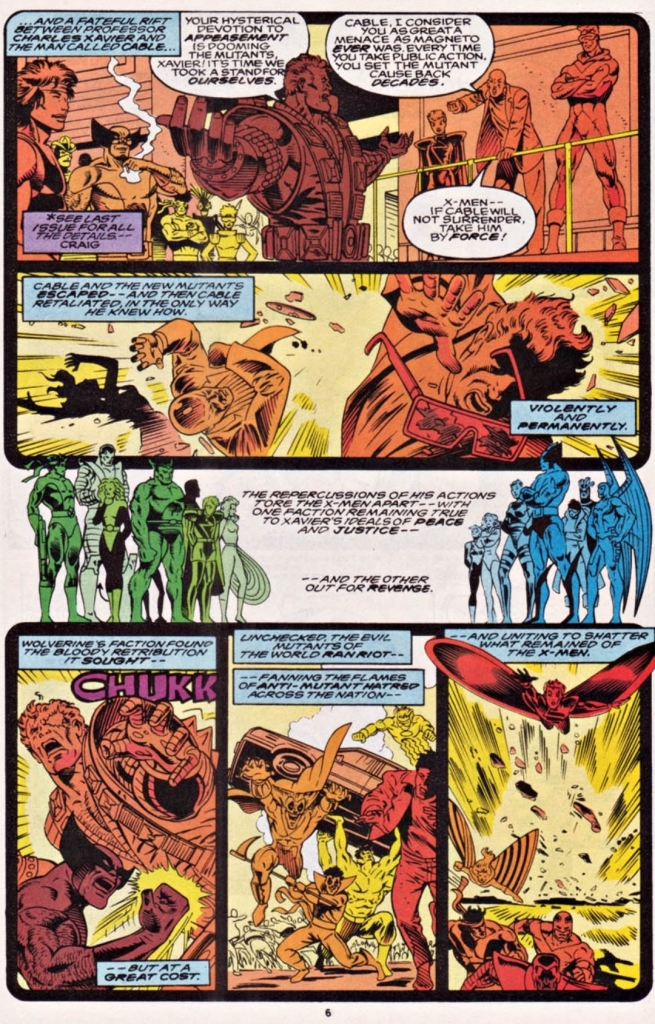
Back in 2021, I reviewed What If #46 (1993) which told a compelling story about division between the mutants, the clash of beliefs between Professor X and Cable, and how terrorism affects everyone. The comic book was also a mesmerizing portrayal of how the X-Men would have organized themselves without Charles Xavier, Jean Grey and Cyclops.

Considering all the chaos that happened in What If #46 (1993), the time was just right for Magneto – the X-Men’s most dangerous enemy of all time – to come in and make an impact not only on mutants but on the world.

With those details laid down, here is a look back at What If #47, published in 1993 by Marvel Comics with a story written by Kurt Busiek and drawn by Tod Smith.

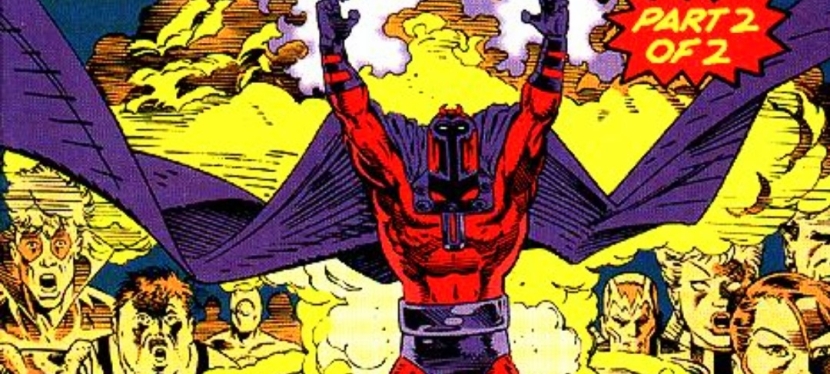
The cover.

Early story

The story begins with Magneto leading a huge legion of mutants to take overwhelm the remaining resistance – including Spider-Man, the Fantastic Four, Captain America, the Avengers and the dedicated American soldiers – in Washington, D.C.

A fierce battle then took place with both sides hitting each other hard. After noticing Magneto’s lack of presence during the battle, Captain America then realizes that the long-time enemy of the X-Men took advantage of the fighting to penetrate the U.S. Capitol’s bomb shelters and got the nation’s leaders hostage. After easing some of his fellow heroes, Captain America decides not to escalate the fight against Magneto in consideration of the lives of America’s top officials…

Quality

A recap of the events in issue #46.

To begin with, I can say that this story is a well-planned follow-up to the events of issue #46. While Magneto’s presence has been magnified a lot here, there are still strong story connections to the previous issue.

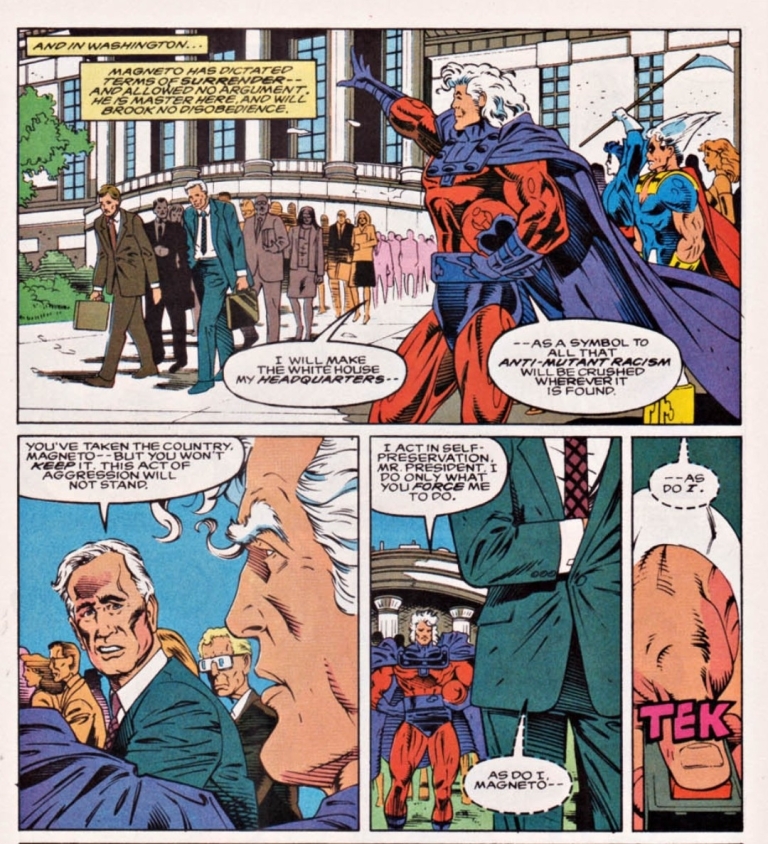
With regards to what was emphasized on the front cover of the comic book, this story explores what would happen if Magneto took power to control the entire United States while leading a group of mutants with a platform focused on crushing anti-mutant racism even though it includes pushing the non-mutant people (which is the great majority of America’s people) as well as the dissenting mutants out of the way.

For one thing, this superhero fantasy concept is actually socially relevant with today’s geopolitics and the way America has turned out under the fake leadership of Joe Biden (who is NOT leading as US President but only following the modern-day American Communists and reckless SJWs dictating him to do their evil bidding. Biden also arrogantly denies reality when it goes against the desires of his administration and his Satanic Democrats) It should be noted that the US President visualized in this comic book eerily looks like Joe Biden complete with that absent-minded facial expression.

Next, a clear theme in this What If story is absolute power and why groups who crave for it would sacrifice so much and hurt others just to acquire it. Magneto, who carries deep hatred towards people he perceives to be obstacles or opposition for his quest of uplifting mutants, takes advantage of mutants who have lost hope and are depending on someone to lead them. Indeed, the long-time X-Men nemesis gains power to control America but finds himself facing a new force of opposition which leads the nation into a drastic series of change that clearly do not alight with his vision of a better future for mutants.

Still on the theme of absolute power, the US government in this story was portrayed to have developed technologies designed to overwhelm its citizens, as well as the means to establish infrastructure and protocols to transform America into an automated dictatorial state that enslaves its citizens and violate their rights without restraint. Once again, this aspect of the story makes it socially relevant.  

Considering the epic concept and the dark turn of events the creative team prepared, this comic book does not have a clear good-versus-evil approach but rather it emphasizes chaos that comes with the pursuit and abuse of absolute power over the nation. You will see key elements from the classic X-Men storyline Days of Future Past here in relation to America’s deformation.

Conclusion

Wow! The US President in this comic book eerily looks so much like Joe Biden whose leadership led America into a lot of problems and hardship. Sky high inflation is just one of the problems that happened under Biden.

What If #47 (1993) is truly a very captivating read mainly because of its core concept which goes way beyond the scenario of Magneto taking control of America. Considering its portrayal of America and the exploration of dark themes about people getting overwhelmed by power abusers, the story is a warning about the fall of America told in superhero fantasy form. Considering the intense social degradation that rocked America the past few years (note: riots by the Black Lives Matter terrorists, SJWs disturbing the peace, Democrats allowing more illegal immigrants into the country, socialists in colleges continuing to brainwash students and more), this story is very socially relevant. It will keep you thinking and reflecting deeply, even if you strongly desire whatever superhero entertainment you seek in this comic book.

Overall, What If #47 (1993) is highly recommended!

+++++

Thank you for reading. If you find this article engaging, please click the like button below, share this article to others and also please consider making a donation to support my publishing. If you are looking for a copywriter to create content for your special project or business, check out my services and my portfolio. Feel free to contact me with a private message. Also please feel free to visit my Facebook page Author Carlo Carrasco and follow me on Twitter at  @HavenorFantasy as well as on Tumblr at https://carlocarrasco.tumblr.com/ and on Instagram at https://www.instagram.com/authorcarlocarrasco

Top Secret! Blu-ray coming out on May 17, 2022

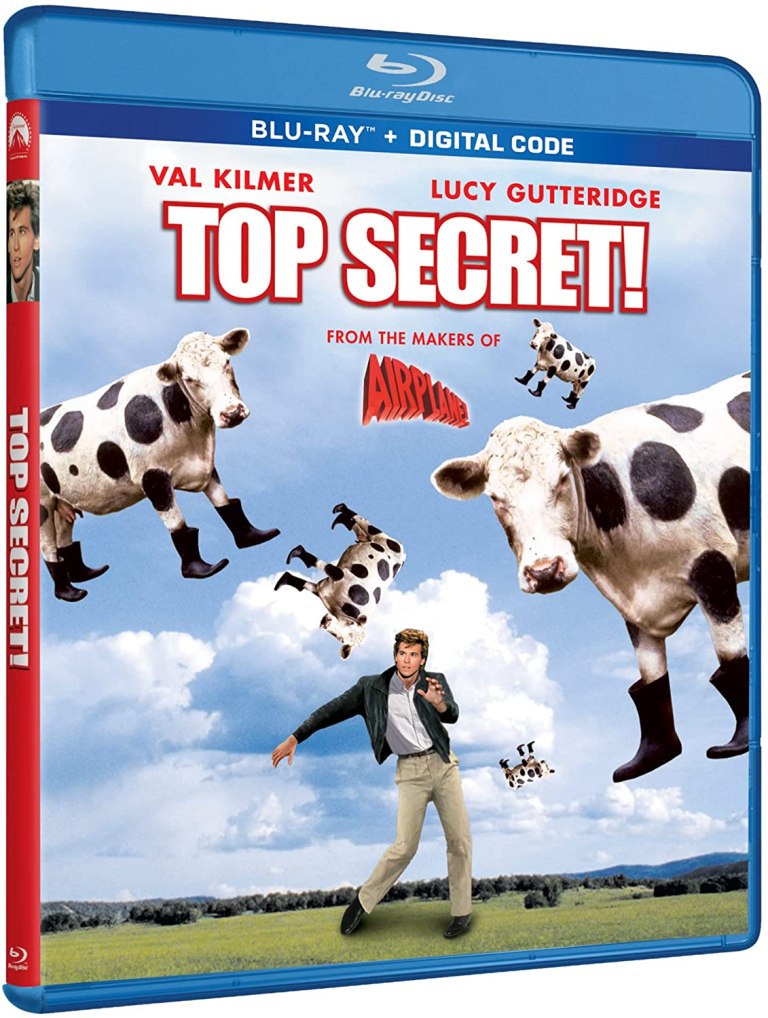
Welcome back, fellow geeks, Blu-ray collectors and movie buffs! If you are sick and tired of the modern-day comedy films and wokeness-filled garbage of Commie-filled Hollywood (AKA Commiewood), then something fun and entertaining from the past should interest you as the Blu-ray disc of the 1984 comedy Top Secret! will be released on May 17, 2022! In addition to that, pre-orders are already being accepted online!

For the newcomers reading this, Top Secret! was written and directed by the trio of Jim Abrahams, David Zucker, and Jerry Zucker. These are the same three guys responsible for the classic comedy Airplane! (note: you can order the Blu-ray disc here).

Top Secret! stars a very young Val Kilmer along with Lucy Gutteridge, Jeremy Kemp, Christopher Villiers and the late Peter Cushing. Top Secret! is a parody of spy movies of World War II and the Cold War, laced with creative references of Elvis Presley musicals. Below is the official description from the Blu-ray.com article…

Popular and dashing American singer Nick Rivers (Val Kilmer) travels to East Germany to perform in a music festival. When he loses his heart to the gorgeous Hillary Flammond (Lucy Gutteridge), he finds himself caught up in an underground resistance movement. Rivers joins forces with Agent Cedric (Omar Sharif) and Flammond to attempt the rescue of her father, Dr. Paul (Michael Gough), from the Germans, who have captured the scientist in hopes of coercing him into building a new naval mine. 

Personally, I’m glad that Top Secret! will be released on Blu-ray as I enjoyed watching that movie. I’m not a fan of Val Kilmer nor of any of the other actors, but I am an admirer of the comedy style of Jim Abrahams and the two Zuckers. This is comedy that is old and effectively amusing in my view.

In closing this Better than Streaming piece, posted below are Top Secret!-related videos for your viewing pleasure.

+++++

Thank you for reading. If you find this article engaging, please click the like button below and also please consider sharing this article to others. If you are looking for a copywriter to create content for your special project or business, check out my services and my portfolio. Feel free to contact me with a private message. Also please feel free to visit my Facebook page Author Carlo Carrasco and follow me on Twitter at  @HavenorFantasy as well as on Tumblr at https://carlocarrasco.tumblr.com/
If you wish to join a group of movie enthusiasts and talk about cinema, visit the Movie Fans Worldwide Facebook group at https://www.facebook.com/groups/322857711779576