Koshidaka Holdings, a leisure services firm based in Japan, will be investing P2.5 billion in the Philippines and plans to launch its first store this year, according to a Philippine News Agency (PNA) news article. This development is related with the Department of Trade and Industry’s (DTI) recent meetings with corporations in Japan. Kodaka Holdings has more than six hundred outlets in Japan and the Philippines is a key part of its planned expansion in Southeast Asia.
To put things in perspective, posted below is an excerpt from the PNA news article. Some parts in boldface…
Japanese leisure services firm Koshidaka Holdings Co. Ltd. will be investing PHP2.5 billion in the country, with its first store set to open this year, Department of Trade and Industry (DTI) Secretary Ma. Cristina Roque said.
In a virtual briefing Tuesday, Roque said Koshidaka is aggressive on its plans to expand in the country to bring its karaoke business and onsen-style (hot spring) spas as well as opening women’s fitness studios in Philippine malls.
The Japanese firm is scouting for 30 locations to establish its business here before growing to 100 sites nationwide.
Koshidaka is one of the 13 firms and business organizations that Roque met during her recent visit in Tokyo as a follow-through of the agency’s investment missions in Japan.
These firms include Nidec Corp., Ibiden Co., Ltd., Etoile Kaito & Co., Inc, Adastria Co., Ltd., Sumitomo, Fujifilm Holdings Corp., Chodai Co., Ltd. Taiheiyo Cement Corp., Fast Retailing, JR East, and Koshidaka Holdings Co., Ltd as well Keizai Doyukai and Keidanren.
“We also check on their plans, what their plans are in our country for expansion and also for growth,” Roque said.
Earlier, Koshidaka announced that it would establish a Philippine subsidiary to offer a new style of karaoke entertainment.
Koshidaka said its expansion in the Philippines is a key initiative in its Southeast Asia growth strategy, with the country’s large market and economic development.
“Aside from the entertainment, they also want to open a gym that’s really just focused on women all over the country, and they also want to focus on creating Japanese onsen in the malls or in different areas that are of interest to them,” Roque said.
“So they’re actually coming first quarter this year to really explore the different locations where they can open.”
Let me end this post by asking you readers: What is your reaction to this recent development? Do you find Koshidaka Holdings’ karaoke and onsen-style spas interesting? Have you tried any of Koshidaka Holdings’ businesses in Japan before?
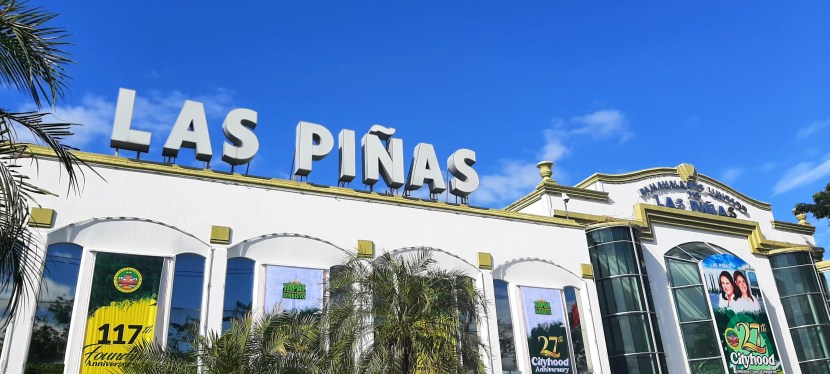
Recently in the City of Las Piñas, a new evacuation center in Barangay Zapote was inaugurated with the presence of Mayor Imelda Aguilar and other officials, the City Government announced via social media.
To put things in perspective, posted below is an excerpt from the social media post of the City Government. Some parts in boldface…
The City of Las Piñas formally inaugurated the newly constructed Santos Homes Evacuation Facility on Saturday, March 1 at the Santos Village III Covered Court in Zapote. The facility aims to provide a safe and secure shelter for residents during emergencies and calamities.
The evacuation center is equipped with essential amenities, including restrooms, wash areas, and designated spaces for evacuees to accommodate displaced families during typhoons, floods, and other disasters.
Present at the blessing and ribbon-cutting ceremony were Mayor Mel Aguilar, Vice Mayor April Aguilar, and City Councilor Mark Anthony Santos, together with other local officials and community leaders.
Mayor Mel highlighted the importance of the evacuation center in ensuring the well-being of Las Piñeros, especially during natural disasters.
Let me end this piece by asking you readers: If you are a resident of Las Piñas City, what is your reaction to this development? Is there a new evacuation center being constructed in your local community?
For more South Metro Manila community news and developments, come back here soon. Also say NO to fake news, NO to irresponsible journalism, NO to misinformation, NO to plagiarists, NO to reckless publishers and NO to sinister propaganda when it comes to news and developments. For South Metro Manila community developments, member engagement, commerce and other relevant updates, join the growing South Metro Manila Facebook group at https://www.facebook.com/groups/342183059992673
As far as one economist is concerned, spending related to this year’s national and local elections (scheduled for May 12, 2025) will not add much to the nation’s economic growth this year, according to a Manila Bulletin news report.
To put things in perspective, posted below is an excerpt from the Manila Bulletin news report. Some parts in boldface…
Elections and related spending no longer provide the same economic boost as they once did. As a result, an economist at Ateneo de Manila University expects the Philippine economy to grow below goal this year, despite the upcoming midterm elections in May.
Luis Dumlao, associate professor and senior research fellow at the university’s economic research arm, Ateneo Eagle Watch, forecasted that there won’t be any “extraordinary GDP [gross domestic product] spike” due to election-related activities during the first half of this year.
During Ateneo Eagle Watch’s 2025 economic briefing last Thursday, March 6, Dumlao projected that annual GDP growth could potentially accelerate from 5.6 percent in 2024 to 5.9 percent in 2025.
If Dumlao’s forecast proves accurate, it would mark the third consecutive year that economic growth falls short of the government’s target, following a peak of 7.6 percent in 2022—the year of the last presidential election, which President Ferdinand Marcos Jr. won.
The Marcos administration targets growth of six to eight percent for 2025.
In the past, elections—even midterm polls—bolstered the economy. GDP grew by 6.1 percent in 2019 and 6.8 percent in 2013 due to midterm election-related spending.
In 2016, when former President Rodrigo Duterte won the presidency, economic growth reached 7.1 percent. Back in 2010, when former President Benigno Aquino III was voted to the top position in the land, GDP expanded by 7.3 percent.
Despite his below-expectations GDP growth estimate for this year, Dumlao also projected that annual inflation would average 2.4 percent, falling within the Bangko Sentral ng Pilipinas’ (BSP) two- to four-percent target range for manageable price increases.
His headline inflation forecast for 2025 is lower than the 3.2 percent in 2024. As of end-February, inflation averaged 2.5 percent, mainly due to rice deflation or declining prices of the Filipino food staple.
With the election campaign season rolling in, Dumlao noted that the practice of politicians giving away dole-outs or “ayuda” may no longer be as feasible.
While such spending was effective as a band-aid solution during the Covid-19 pandemic, when there was a greater need for financial support to sectors badly hit by the health and socioeconomic crises it wrought, Dumlao emphasized that “there’s no excuse” for continuing such expenditures post-pandemic.
“Ayuda was excused during the pandemic… However, for some reason, the government’s expenditure [on dole-outs] grew” even after the pandemic.
“There’s still [ayuda] spending as if it’s still the pandemic,” he said.
As elections gradually lose their hefty contribution to economic output, Dumlao urged the government to focus on key industries that would foster long-term growth.
“The economic drivers right now are accommodation like hotels, retail, trade, and construction. Business process outsourcing (BPO), too. Those are the fastest-growing subsectors,” he said.
Dumlao also suggested a further push for privatization of certain infrastructures and utilities.
Let me end this post by asking you readers: What is your reaction to this recent development? Do you still think that election-related spending can still add a lot to the growth of the national economy this year? Do you think further privatization by the government will prove to be more crucial and helpful to enhancing economic growth? Did you notice how the local politicians and election candidate have been giving away assistance or ayuda to local communities recently?
Recently in the City of Las Piñas, more than six hundred residents – mostly children – of Barangay Pamplona Tres were served with food and drinks when the Auxiliary Feeding Program was held in their local community, the City Government announced via social media. Vice Mayor April Aguilar attended the program.
To put things in perspective, posted below is an excerpt from the social media post of the City Government. Some parts in boldface…
The City of Las Piñas held an Auxiliary Feeding Program on Wednesday, February 26, at the Hernandez Compound in Pamplona Tres, benefiting more than 600 residents, particularly children.
Participants received nutritious “Creamy Veggie Macaroni Soup” and bottled water, prepared by nutritionist-dietitians and barangay nutrition scholars. The program aims to promote proper nutrition and support the health of young residents.
Vice Mayor April Aguilar joined the event, alongside Las Piñas City Nutrition Office OIC Dr. Julio P. Javier II, and barangay nutrition workers who helped facilitate the feeding program.
Let me end this piece by asking you readers: If you are a resident of Las Piñas City, what is your reaction to this development? Has the City Government’s Auxiliary Feeding Program been held in your local community recently?
For more South Metro Manila community news and developments, come back here soon. Also say NO to fake news, NO to irresponsible journalism, NO to misinformation, NO to plagiarists, NO to reckless publishers and NO to sinister propaganda when it comes to news and developments. For South Metro Manila community developments, member engagement, commerce and other relevant updates, join the growing South Metro Manila Facebook group at https://www.facebook.com/groups/342183059992673
Based on the tourism revenue counted for the month of January 2025, Philippines tourism is off to a strong start with more than P65 billion, according to a Philippine News Agency (PNA) news article.
To put things in perspective, posted below is an excerpt from the news article of the PNA. Some parts in boldface…
The Philippines earned USD1.1 billion or PHP65.3 billion tourism revenues in January 2025, exceeding pre-pandemic levels in 2019, the Department of Tourism (DOT) said Thursday.
Data as of Feb. 28 showed that the earnings came from various activities, products, and services related to tourism, 136.1 percent higher than the USD821 million or 151.46 percent higher than the PHP43 billion recorded in January 2019.
“The recovery of Philippine tourism from the period of the pandemic in terms of revenues translates to thousands of jobs created for Filipinos, providing livelihood opportunities for many, especially in our rural and underserved areas,” Tourism Secretary Christina Garcia-Frasco said in a news release.
The country’s tourism income grew by 71.4 percent in terms of US dollars, compared to the USD652,255,773.51 recorded in January 2024.
Philippine peso revenues also soared by 78.81 percent from PHP36,508,238,043 in January 2024.
Frasco reported the Philippines achieved an all-time high tourism revenue of approximately PHP760 billion in 2024.
The DOT recorded the Philippines’ tourism revenues based on Visitor Sample Surveys, records from the previous arrival/departure cards, shipping manifests, and the current eTravel system.
A total of 1,167,908 foreign travelers visited the country in the first two months of 2025. Data as of March 1 showed that about 25.31 percent of the visitors came from South Korea.
South Korea has been the country’s top source of tourists since 2023, which is expected to boost further with the appointment of South Korean star Seo In-Guk as “celebrity tourism ambassador for the Philippines” last month.
While the P65.3 billion tourism revenue for January 2025 looks great for the Philippines, it remains to be seen if it could maintain the pace until the end of the year. In order to match the record P760.5 billion tourism revenue of 2024, the Philippines needs to attract P63.375 billion per month this year. If Philippine tourism can achieve P65 billion per month, that would translate to P780 billion by the end of the year.
Let me end this post by asking you readers: What is your reaction to this recent development? Do you think the Philippines will be able to gross more than P760.5 billion in tourism revenue this year? Has your local government unit (LGU) been active in promoting local tourism?
Recently, the Philippine Statistics Authority (PSA) announced that the inflation rate of February 2025 settled at 2.1% primarily due to the easing of rate of price increases on non-alcoholic beverages and food, according to a Philippine News Agency (PNA) news article.
To put things in perspective, posted below is an excerpt from the news article of the PNA. Some parts in boldface…
Inflation in February this year slowed down to 2.1 percent from 2.9 percent in January mainly due to the easing of rate of price increase of food and non-alcoholic beverages, the Philippine Statistics Authority (PSA) reported.
In a press briefing Wednesday, PSA Assistant Secretary Divina Gracia del Prado said the declaration of food security emergency by the Department of Agriculture (DA) to bring down cost of rice has been effective in taming the inflation last month.
Inflation of food and non-alcoholic beverages, which contributed 58.8 percent to the overall inflation last month, declined to 2.6 percent from 3.8 percent in January.
Cereal and cereal products, which include rice, had a deflation of 3 percent in February from a deflation of 1.1 percent in January.
“For me, I think, we are seeing the effect of food security emergency in our inflation… Because of this food security emergency, we have released the rice buffer from NFA (National Food Authority) to LGUs (local government units), and of course in Kadiwa Rice for All program,” del Prado said.
Rice alone had a sharper deflation of 4.9 percent, with prices decreasing since July 2024 due to easing international prices and tariff reduction. Vegetable inflation plunged to 7.1 percent in February from a 21.1 percent inflation in January.
Aside from food and non-alcoholic beverages, main contributors to the deceleration of inflation in February were housing, water, gas, and other fuels, which inflation eased to 1.6 percent from 2.2 percent in January, and transport, which recorded a deflation of 0.2 percent from 1.1 percent inflation rate
Meanwhile, major contributors to inflation in February were food and non-alcoholic beverages, mainly due to higher prices of pork, with inflation increasing to 12.1 percent in February from 8.4 percent in January; restaurants, café and the like; poultry meat; rentals; and higher cost of passenger transport by sea.
In a separate statement, National Economic and Development Authority (NEDA) Secretary Arsenio Balisacan said the government stands ready to combat high inflation through its policies and programs.
“The government will sustain its efforts to keep inflation low and manageable to protect the purchasing power of Filipinos. As we expect six to 13 typhoons to develop from March to August 2025, the Department of Agriculture (DA) will implement the La Niña action plan to restore agricultural productive capacity in areas likely to be affected by continuous rainfall, flooding, and landslides,” Balisacan said.
Let me end this post by asking you readers: What is your reaction to this recent development? Do you think the inflation rate will fall below 2% by the end of March 2025? If you have been shopping for food lately, did you notice significant movements on prices?
Recently in the City of Las Piñas, more than seven hundred residents of Barangay Almanza Dos got served when the Health and Wellness Caravan was held in their local community, the City Government announced via social media.
To put things in perspective, posted below is an excerpt from the social media post of the City Government. Some parts in boldface…
The City of Las Piñas, through the City Health Office, brought its Health and Wellness Caravan to the TS Cruz Covered Court in Barangay Almanza Dos on Thursday, February 18. More than 700 residents benefitted from the free health services provided during the event.
Residents availed themselves of a range of medical services, including consultations, FBS/RBS testing, cholesterol examinations, blood typing, chest X-rays, ECG, dental services, and nutrition counseling. Other essential services such as risk assessments for non-communicable diseases, pneumococcal vaccination for senior citizens, mobile birth registration, and assistance with Green Card and PhilHealth registration were also offered.
Vice Mayor April Aguilar led the event, accompanied by City Councilors Mark Anthony Santos and Henry Medina. Their presence underscored the city’s continuous commitment to ensuring accessible healthcare services for all residents.
Let me end this piece by asking you readers: If you are a resident of Las Piñas City, what is your reaction to this development? Has the Health and Wellness Caravan of the City Government arrived in your local community recently?
For more South Metro Manila community news and developments, come back here soon. Also say NO to fake news, NO to irresponsible journalism, NO to misinformation, NO to plagiarists, NO to reckless publishers and NO to sinister propaganda when it comes to news and developments. For South Metro Manila community developments, member engagement, commerce and other relevant updates, join the growing South Metro Manila Facebook group at https://www.facebook.com/groups/342183059992673
The Bangko Sentral ng Pilipinas (BSP) revealed online recently that the overall collection of its coin deposit machines (CoDMs) has surpassed P1.3 billion The latest statistics are accurate of as February 15, 2025.
Based on the latest statistics, a total of P1,308,208,203.18 (5.89% higher than the previous count of P1,235,393,307.96)in coins got deposited into BSP machines on 299,457 transactions from customers. In terms of physical quantity, 326,188,289coins were deposited.
Doing the math on the latest statistics, customers averaged P4,368.6012 per transaction at the machines (compared to the February 15, 2025 average of P4,335.1088 per transaction). As for the grand total Peso amount divided by the number of coins deposited, the average is P4.011 per coin deposited (previous average was P3.9764 per coin deposited)
When it comes to the number of coins involved with each transaction, 326,188,289 coins divided by 299,457 transactions resulted in an average of 1,089.2659 coins per transaction (a slight drop compared to the previous average was 1,090.2030 coins per transaction).
Let me end this piece by asking you readers: What is your reaction to this recent development? Do you think the BSP should install more coin deposit machines, especially in the Visayas and Mindanao regions? How was your experience the last time you tried to deposit your loose change into the nearest BSP coin deposit machine? Whenever you deposited your coins, do you transfer the value to GCash or Maya, or convert the value into shopping vouchers?
For the newcomers reading this, Suikoden I & II HD Remaster: Gate Rune and Dunan Unification Wars was released on March 6 and it contains Suikoden and Suikoden II (Japanese title: Genso Suikoden II). This is a cause for a celebration not only for fans of the Suikoden game franchise (created by the late Yoshitaka Murayama during his time at Konami) and JRPG enthusiasts but also for people who love retro gaming.
With Suikoden I & II HD Remaster: Gate Rune and Dunan Unification Wars now available on multiple platforms, gamers – both the veterans as well as the younger players – now have the golden opportunities to play the first two Suikoden games.
Suikoden on Xbox
A lot of characters got their share of the spotlight in short scenes like this in Suikoden.
As mentioned earlier, Suikoden is my most played game on my Xbox Series X since March 6. The release of Suikoden games on Xbox platforms is highly significant given the fact that the franchise has often been identified with PlayStation for so long. What many gamers do not know is the fact that Suikoden was also released on the Sega Saturn and Windows PC in Japan in the late-1990s.
As history showed, most Suikoden RPGs released by Konami from 1995 to 2006 mainly on the original PlayStation console (the first two games) and PlayStation 2 (the third, fourth and fifth games). Spin-off games were released on PlayStation, PS2, Game Boy Advance and Nintendo DS. That being said, there were absolutely no Suikoden games on the original Xbox console and Xbox 360.
The release of Suikoden I & II HD Remaster: Gate Rune and Dunan Unification Wars on Xbox Series X, Xbox Series S and the aging Xbox One is indeed a game-changer. There are lots of Xbox gamers who are fond of Japanese RPGs and there are also Suikoden fans who happen to own Xbox consoles. The Xbox ecosystem itself now has lots of role-playing games (RPGs) released in this current console generation and there are lots of Xbox players who love RPGs. As such, Konami made the right move bringing the Suikoden franchise to Xbox consoles.
Playing the first Suikoden again but in shinier form
The group battle in the game. The remastered work includes presentation in high-definition and a variety of visual enhancements. The frame rate is also stable.
Since the launch of Suikoden I & II HD Remaster: Gate Rune and Dunan Unification Wars, I have been playing the first Suikoden game a lot on my Xbox Series X. It has been a fun-filled nostalgic gaming experience on my part and I can also say that Konami – for the most part – did a good job remastering the game with high-definition visuals in mind.
Visually, this is the best the first Suikoden RPG ever looked! The in-game character sprites and creatures/monsters sprites from before have been preserved and because everything is in high-definition, the said sprites look larger and you can see the detailed pixels within them. When it comes to the visual effects to emphasize in-game magic and other spectacles, the new effects implemented resulted in a lot of pleasing eye candy.
Mini-games like this one added fun and variety to the game. If you keep winning in this one, you can make a lot of in-game money.
The occasional close-ups during group battles like this added to the spectacle of playing. The enhanced visuals also made this look better.
When it comes to the character portraits, they have been redrawn from scratch by Junko Kawano and each artwork per character looked clearer and more detailed than before. Some long-time Suikoden fans might find the new character portraits looking too clean and might make them miss the older artworks.
Suikoden’s story is about the Scarlet Moon Empire, political developments, corruption that goes beyond politics, and how they all affect the people. The playable protagonist is the son of the imperial general Teo McDohl, and through him you will witness political intrigue and unexpected twists that will compel you to stick closer with your family friends to escape the empire and form a new army of rebels by recruiting members across the land.
Even in subtle forms, the enhanced visuals made dramatic scenes like this look more lively.
While the storytelling is satisfactory at best, there is a wide variety of characters who collectively added colors to the narrative. This is due to the many types of personalities that the important characters have. Take for example Matthiu who is the calm and calculating strategist, Viktor is the brave and brash rebel, and Gremio is very dedicated to protecting the protagonist no matter what happens. Along the way, character development is truly limited which is not surprising because a lot of characters shared the spotlight.
In terms of game design and gameplay features, Suikoden has aged well. The battle systems – solo battle, group battle, army battle – are still functional, efficient and fun to do. While some grinding (leveling-up) is needed, it is not stressful to do because the auto-battle options make the group battles flow smoothly, especially when your characters (up to six) are collectively strong enough to overwhelm the enemies.
This is the formation of the members of your party. Those with short-range attacks should be placed on the front row but they need strong defense values to keep on fighting. Characters with long-range attacks are ideally placed in the back row.
Meet Odessa.
The gameplay is just as fun to do as before. I really like the fact that up to six characters can be part of my party/group as I went adventuring and focused on story scenes. The solo and army battles are understandably few but the payoff (in return to the build-up leading to them) was worth it. I should state that the unite attacks (limited to specific characters who are present in the party) are fun to watch and the creators’ approach on presenting the battle animations and spectacle are great to see.
A great, long border wall in the game.
While the gameplay is clearly fun, Konami’s remaster team did not fix one old problem the game had since the start – limited spacing of items per character. Each character has his/her/its own pieces of clothing to wear, specifically for the body, head and two accessories. The game counts those clothing items as part of the overall item spacing per character. Once you have the four items for a character to wear, the remaining spaces for carrying other items (examples: medicine, ore, anti-toxin) become severely limited for the character.
Along the way, there is the constant need for you to purchase stronger pieces of clothing to increase the defense value of the newest character who joined your army. That being said, you must earn a lot of money, take time to out purchase items, and equip them on new characters while dealing with limited storage per character. The item management problem is the one thing that prevented the gameplay from achieving perfection.
My long-time experience with the Suikoden franchise
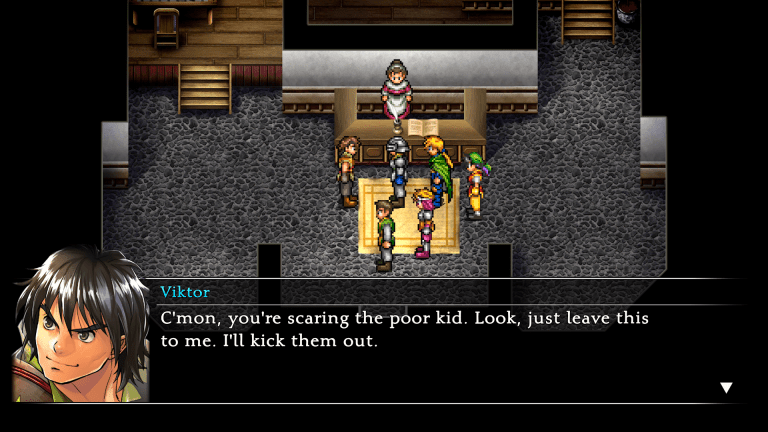
Viktor is the brash and brave fighter who becomes part of the Liberation Army. He is an important supporting character which you will easily realize.
In my personal gaming history, I played and finished the original game on PlayStation way back in 1996. While I really enjoyed the game and its unique gameplay features, I never replayed it as my taste on PlayStation gaming kept changing in 1997. When Wild ARMs and Final Fantasy VII landed on PlayStation, I forgot about Suikoden until its sequel was released in English in 1999.
Fortunately, Suikoden II was so much bigger and better than its predecessor and it remains the most defining game of the entire Suikoden franchise (read my retro review by clicking here). That being said, I will start playing the remastered Suikoden II on my Xbox Series X soon.
Having played the remastered first game on my Xbox console, I can say that it was a fun-filled trip on my end. At the same time, I remembered scenes and several small character moments in between that I have forgotten long ago. Although a lot of characters were presented, following the narrative was still easy to do since it was light compared to what Suikoden II told.
Conclusion
A shot of a feast within the army of rebels with their leader Tir McDohl. The young McDohl is the playable protagonist.
With the first Suikoden alone, I can say I got really good value and enjoyment with my purchase of the digital copy of Suikoden I & II HD Remaster: Gate Rune and Dunan Unification Wars for my Xbox Series X. This is a fine example about retro gaming literally saving the day when Team Xbox failed to deliver the promised great fun with their own games.
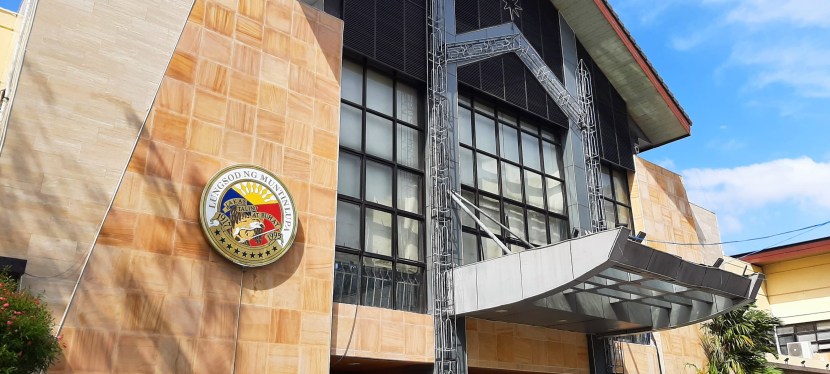
Recently in the City of Muntinlupa, the requirements and guidelines for the issuance of identification cards to persons with disabilities (PWD) will be set very soon as a result of newly signed legislation, according to a Manila Bulletin news report.
To put things in perspective, posted below is an excerpt from the Manila Bulletin news report. Some parts in boldface…
The Muntinlupa City government approved an ordinance setting the requirements and guidelines for the issuance of IDs to persons with disabilities (PWD).
Ordinance No. 2025-310, enacted by the Muntinlupa City Council on Feb. 17, was signed by Mayor Ruffy Biazon on March 3.
The ordinance states that “the Muntinlupa Persons with Disability Affairs Office advocates the digitalization, verification and streamlining of the Person with Disability Identification Card issuance to protect the welfare and privileges of the genuinely identified Muntinlupa Persons with Disability.”
Muntinlupa’s Persons with Disability Affairs Office (PDAO) will issue the PWD IDs to eligible applicants.
Under the ordinance, PWDs “refer to people suffering from restrictions or different abilities as a result of mental, physical or sensory impairment to perform an activity in the manner or within the range considered normal for human beings.”
Let me end this post by asking you readers: What is your reaction to this recent development? If you are a resident of Muntinlupa City, do you think the new guidelines and requirements for the issuance of PWD IDs make sense? Do you think the guidelines and requirements will prove to be effective in preventing fraud?
For more South Metro Manila community news and developments, come back here soon. Also say NO to fake news, NO to irresponsible journalism, NO to misinformation, NO to plagiarists, NO to reckless publishers and NO to sinister propaganda when it comes to news and developments. For South Metro Manila community developments, member engagement, commerce and other relevant updates, join the growing South Metro Manila Facebook group at https://www.facebook.com/groups/342183059992673














 Author Carlo Carrasco