

Disclaimer: This is my original work with details sourced from reading the comic book and doing personal research. Anyone who wants to use this article, in part or in whole, needs to secure first my permission and agree to cite me as the source and author. Let it be known that any unauthorized use of this article will constrain the author to pursue the remedies under R.A. No. 8293, the Revised Penal Code, and/or all applicable legal actions under the laws of the Philippines.
Welcome back movie enthusiasts, 1990s arts and culture enthusiasts, and comic book collectors! Today we go back to the year 1994 to examine the first issue of a comic book mini-series that served as the official adaptation of the movie Mary Shelley’s Frankenstein.
The 1994 film – starring and directed by Kenneth Branagh and produced by Francis Ford Coppola – had a huge marketing push through the local media and in the cinemas here in the Philippines. Robert De Niro’s name alone attracted a lot of moviegoers’ attention and there were some literature enthusiasts who had the impression (or were hopeful) that the film would be faithful to the 1818 Gothic novel by Mary Shelley.
Like many others here in the Philippines, I went to the local cinema (which was half-full) to watch Mary Shelley’s Frankenstein and ended up having a mixed opinion. The production values looked grand and the cinematography (specifically the location shots and vistas) was very impressive but I felt something was off with regards to the direction which brought the storytelling down.
As with some other Hollywood movies of the time, there was a comic book adaptation of Mary Shelley’s Frankenstein in the form of a mini-series from Topps Comics. I remember seeing issue #1 displayed at the local comic book specialty store shortly after seeing the movie but I was not interested on buying it. Recently, I finally secured a copy of the comic book and read it for the first time ever.
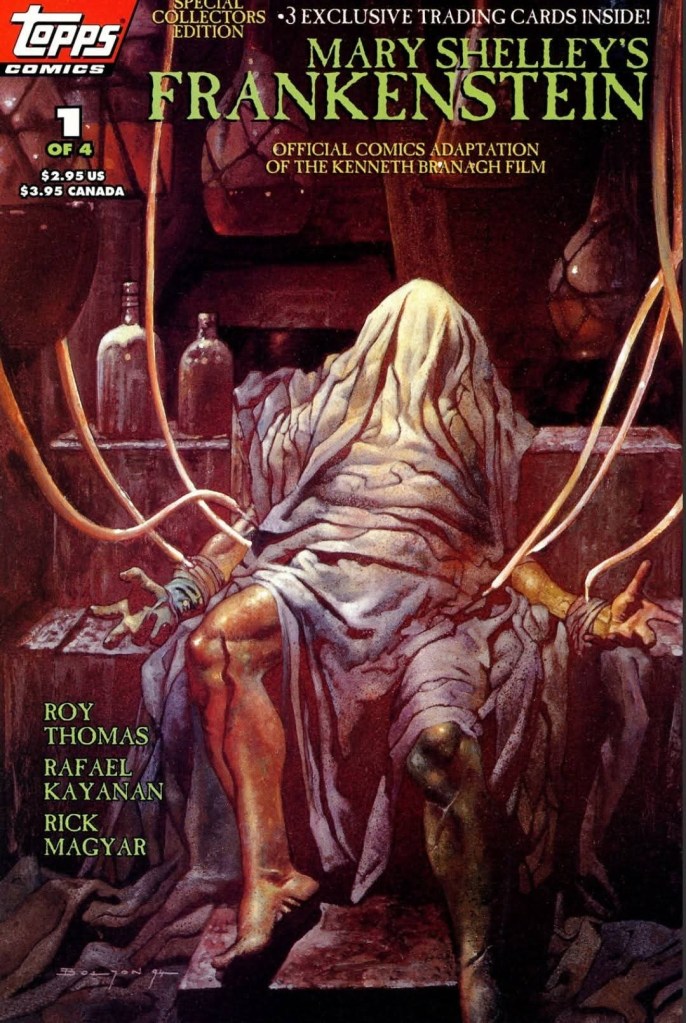
With those details laid down, here is a look back at Mary Shelley’s Frankenstein #1, published in 1994 by Topps Comics with a story written by Roy Thomas (based on the screenplay by Steph Lady and Frank Darabont) and drawn by Rafael Kayanan. This is the first of a 4-issue mini-series.
Early story
The story begins at sea in 1794 in the middle of very cold weather. The ship carrying Captain Walton and his crew crashed on to pack ice and became trapped. The captain refuses to give up on his quest to reach the north pole and he has the crew chopping the ice. Suddenly they hear a frightening noise as something approaches.
A cloaked man emerges from the mist and it turns out he was not the source of the frightening noise. Without hesitation and right in front of the captain, the cloaked man tells the crew to bring their weapons and follow him. The captain tells the newcomer that only he gives the orders. The crew’s dogs ran away moving towards the source of the noise in the mist.
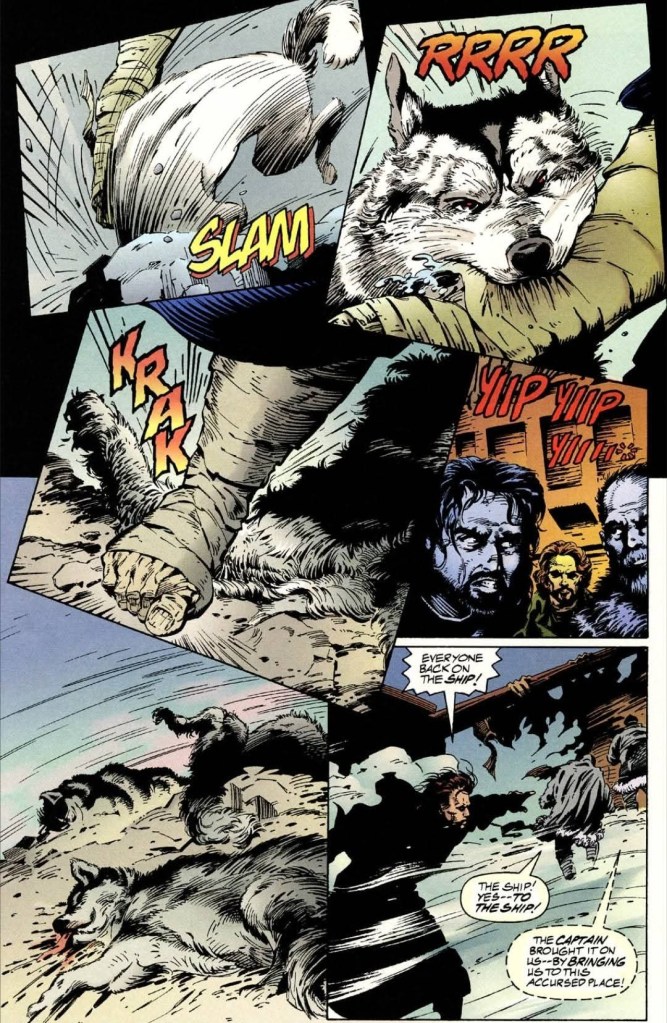
The dogs reached the source of the noise and attack it. The dogs were no match for it as they each got hit and eliminated. As the crew heard the dogs die, the captain tells everyone to move back to the ship.
Moments later, the captain and the cloaked man are inside the ship. A tall human figure slowly approaches the ship. After an exchange of words about what has been going on, the captain asked the cloaked man who he is. The man reveals he is Victor Frankenstein…
Quality
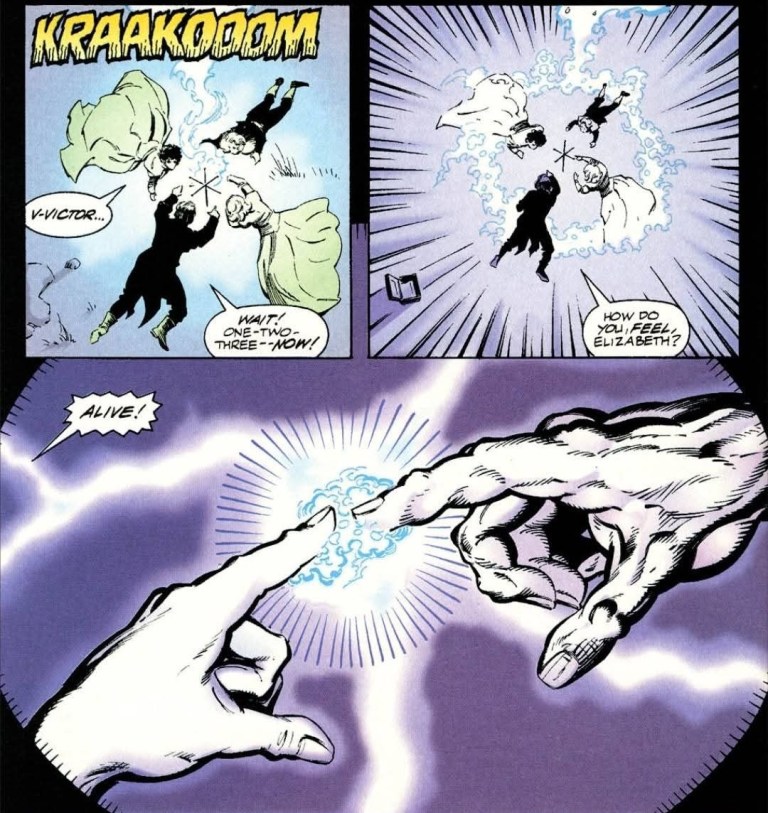
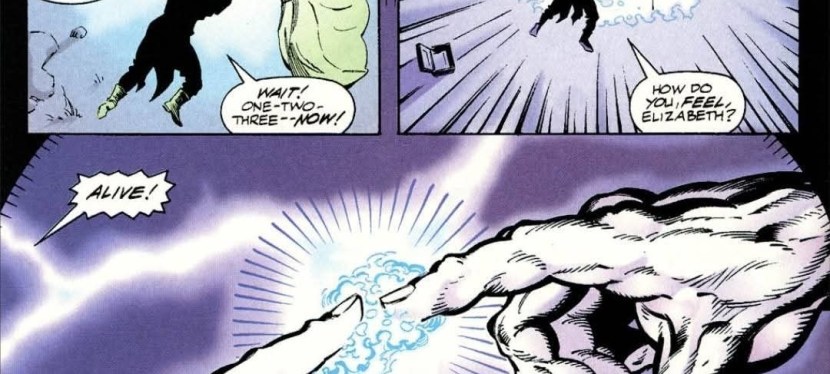
To make things clear, this comic book covers the film’s beginning until the scene in which Frankenstein attempts to give his creature life. As there were no printed advertisements, the comic book creators tried hard to cram several scenes into it complete with lots of details regarding the setting, the scientific thoughts of Frankenstein, experiment details and more. Indeed, a lot of the exposition in the film made it here and there were also cinematic sequences that simply could not be replicated in print format.
The illustrated opening scene replicated enough of the essence of the cinematic opening. Like the movie, the narrative moves back in time to explore Victor Frankenstein’s youth, his family, how Elizabeth became his adopted sister and how family tragedy started his path to becoming obsessed with overcoming death through science, medicine, chemistry and biology.
As it is clear that this illustrated version could never replicate the grand visuals of the film, such scenes were trimmed a lot with the readers in mind. The narrative moved between slow and medium pace similar to the film but for readers, it is a must to pay close attention to the details to truly understand the story and how Frankenstein develops.
Frankenstein here is portrayed not only as an obsessed scientist (who wants to conquer death by creating life with his own efforts) but also as a hurting man whose destiny has been altered with pain, struggle and darkness ahead. No matter what the odds were, Frankenstein believes he can achieve what is impossible while also believing he is not a mad man. Of course, Frankenstein’s own obsession blinded him so much, he fails to realize the truth that he has turned into a truly mad scientist who does not care at all about ethics, nature and morality. As such, Frankenstein is truly unlikable as the protagonist.
While a lot of effort was done to translate the film’s plot into comic book storytelling, Rafael Kayanan did a decent job with the visuals showing ranging quality throughout. Given the historical setting and European locations of the movie reflecting the novel, it is indeed difficult for any artist to replicate the looks, the environments and the many material objects of the period. Some illustrated scenes looked detailed while others showed some signs of rush. If you are hoping to see the characters looking like the actors in the movie, you won’t find much of that here. Ironically, there were a few shots that reflected that gore and violent movements of the film.
Apart from the story, there are two pages in this comic book that provided details about the history of Mary Shelley’s novel and how her creation impacted entertainment and pop culture in America (including the famous 1931 movie). Selected images were also included.
Conclusion
The way I look at Mary Shelley’s Frankenstein #1 (1994), it clearly follows the movie’s scenes visually rather than following closely the screenplay and that means translating Kenneth Branagh’s vision into comic book form here. As such, there definitely is something off with regards to pacing and storytelling. There really is not much enjoyment in this 1st issue of the comic book adaptation mini-series. In fact, this is more of a humanized portrayal of unethical science driven by one character’s obsession with conquering death.
Overall, Mary Shelley’s Frankenstein #1 (1994) should be avoided.
+++++
Thank you for reading. If you find this article engaging, please click the like button below, share this article to others and also please consider making a donation to support my publishing. If you are looking for a copywriter to create content for your special project or business, check out my services and my portfolio. Feel free to contact me with a private message. Also please feel free to visit my Facebook page Author Carlo Carrasco and follow me on Twitter at @HavenorFantasy as well as on Tumblr at https://carlocarrasco.tumblr.com/ and on Instagram at https://www.instagram.com/authorcarlocarrasco
 Author Carlo Carrasco