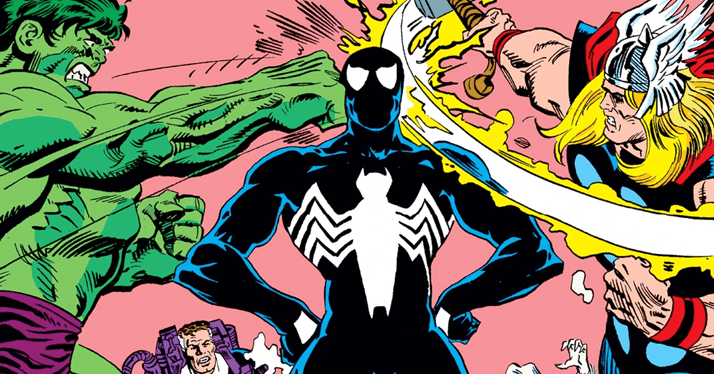
A Look Back at Venom: Lethal Protector #1 (1993)

Disclaimer: This is my original work with details sourced from reading the comic book and doing personal research. Anyone who wants to use this article, in part or in whole, needs to secure first my permission and agree to cite me as the source and author. Let it be known that any unauthorized use of this article will constrain the author to pursue the remedies under R.A. No. 8293, the Revised Penal Code, and/or all applicable legal actions under the laws of the Philippines.

Welcome back superhero enthusiasts, 1990s arts and culture enthusiasts, Marvel Comics fans and comic book collectors! Today we go back to the year 1993 and explore a part of Marvel Comics’ universe through the first-ever limited comic book series featuring one of Marvel’s most iconic villains – Venom.

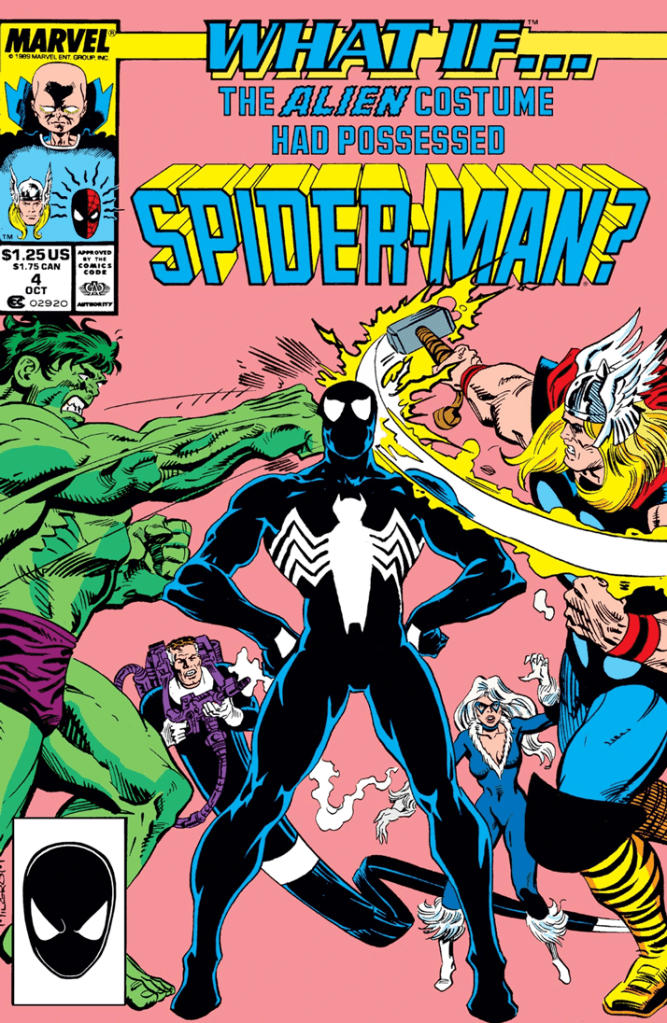
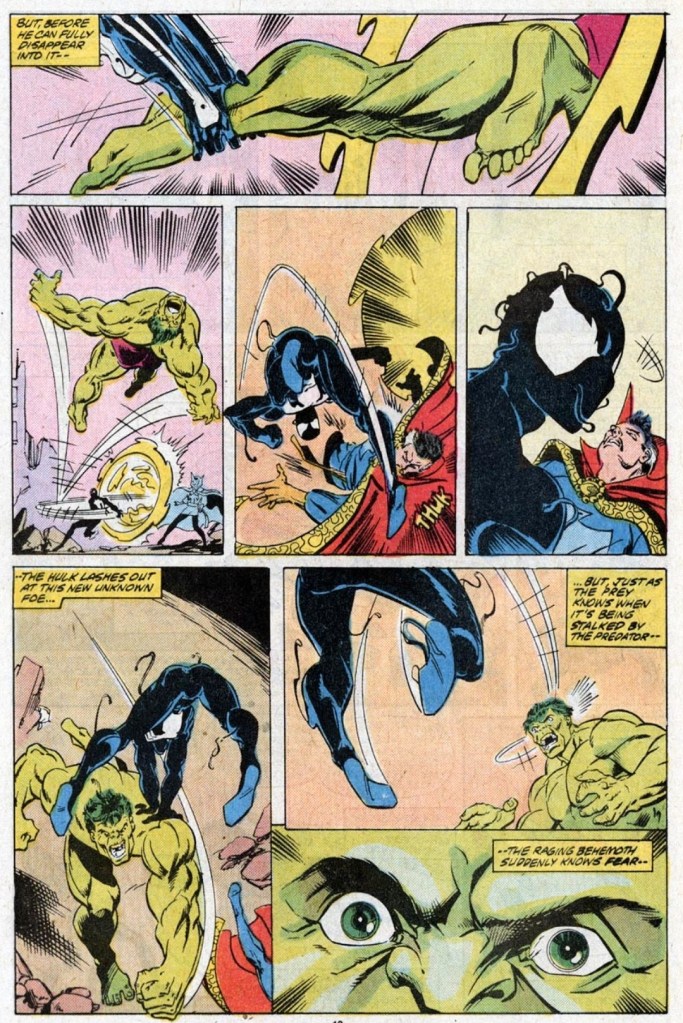
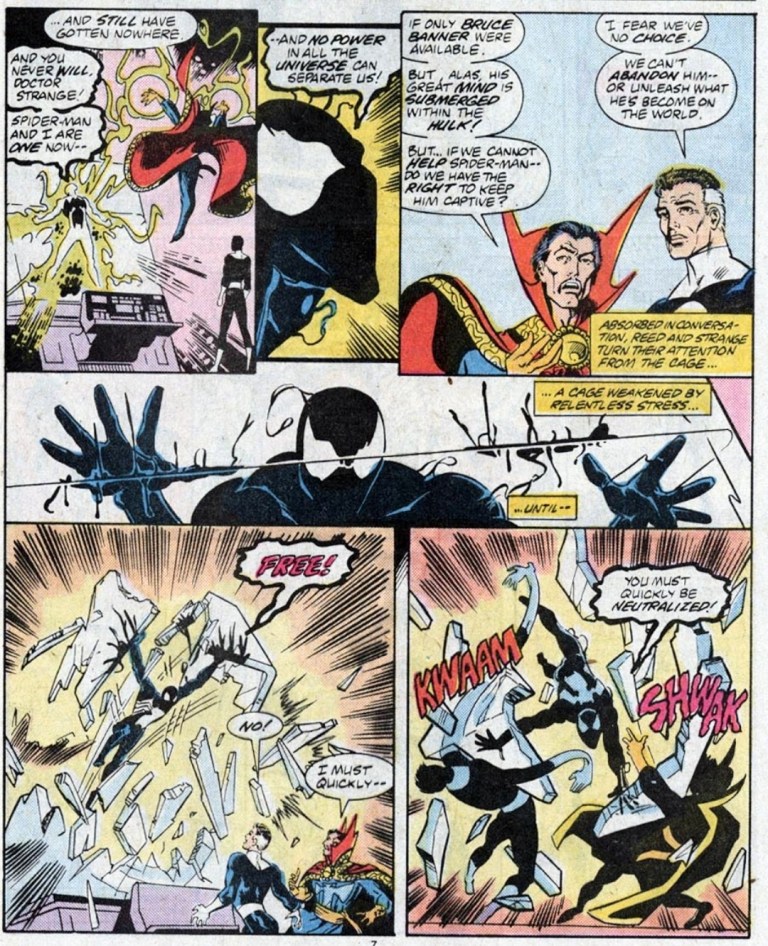
To put things in perspective, the origin of Venom started within the events of the 1980s series Secret Wars which took place in a far-away planet. As a result of that series, Spider-Man returned home wearing the alien symbiote as a costume which turns out to have a mind of its own. After Spider-Man successful separate himself from the symbiote (again) using the loud bells of a church, the living costume eventually found a desperate Eddie Brock and bonded with him to form Venom. In the late 1980s comics of Amazing Spider-Man, Venom became the deadliest enemy Spider-Man ever faced.

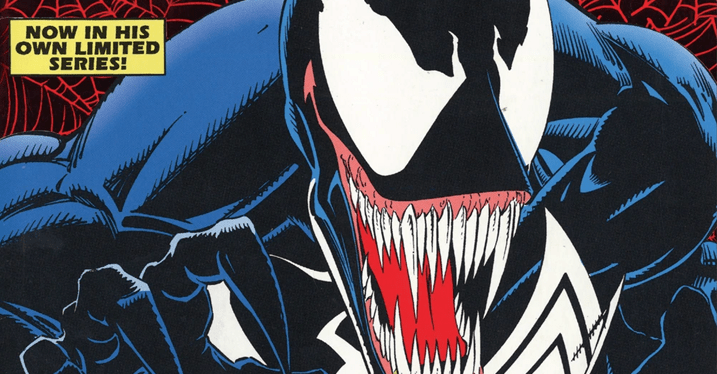
Going into the early 1990s, Venom’s popularity continued to grow tremendously. He became one of Marvel’s most popular non-hero type of characters and helped sell a lot of comics for the publisher. Knowing they had something to sell, Marvel approved a 6-issue limited series showcasing Venom. It was also the most anticipated comic book among collectors right after DC Comics killed Superman with Superman #75 (1993).

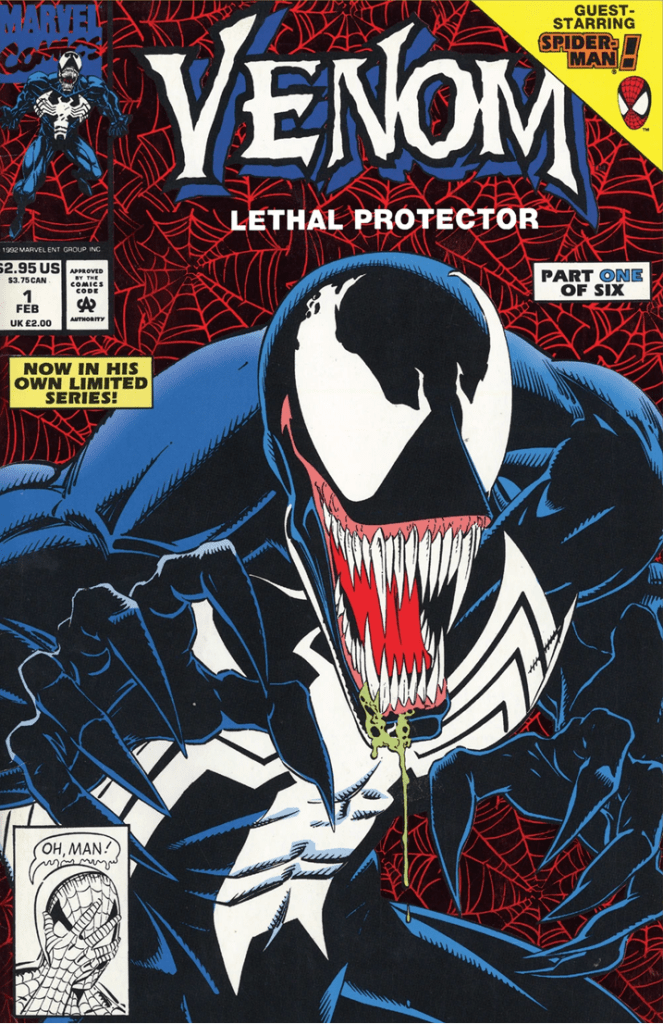
With those details laid down, here is a look back at Venom: Lethal Protector #1, published in 1993 by Marvel Comics with a story written by David Michelinie and drawn by Mark Bagley.

The cover.

Early story

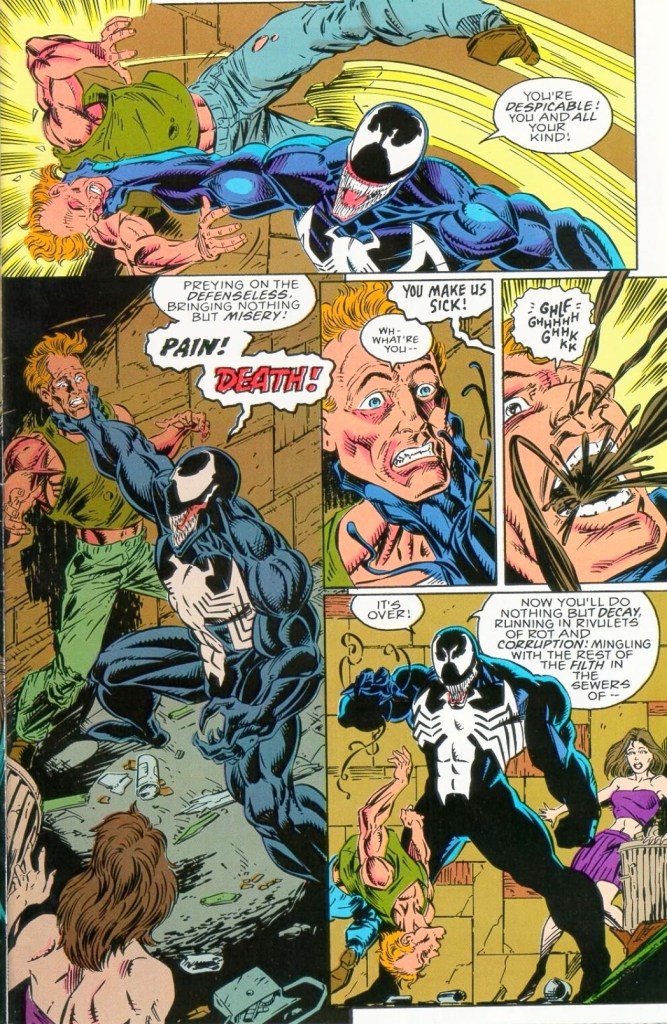
The story begins in San Francisco, California. Deep within the city, a man cornered a lady at the dead end of an alley. Just as he was about do something bad to her, Venom leaps in at them. Totally surprised, the man was easily grabbed by Venom who lifted him and hit the wall bodily. Using his costume, Venom then chokes the man to death through the mouth and nose. Venom then picks up the lady’s purse and gives it to her. As soon as Venom leaves, the shocked lady runs away screaming.

Venom swings and leaps as he travels through the city. While traveling, Eddie Brock tells his living costume that while their hatred towards Spider-Man got reconciled a bit, the said superhero also helps the innocent. Eddie then reveals that he was born in San Francisco and they can start a new life together in it. Secretly, Venom turns into Eddie Brock in his civilian form. As Brock walks down the sidewalk, police officers nearby recognize him. It turns out. Eddie Brock was listed by police as a wanted person…

Quality

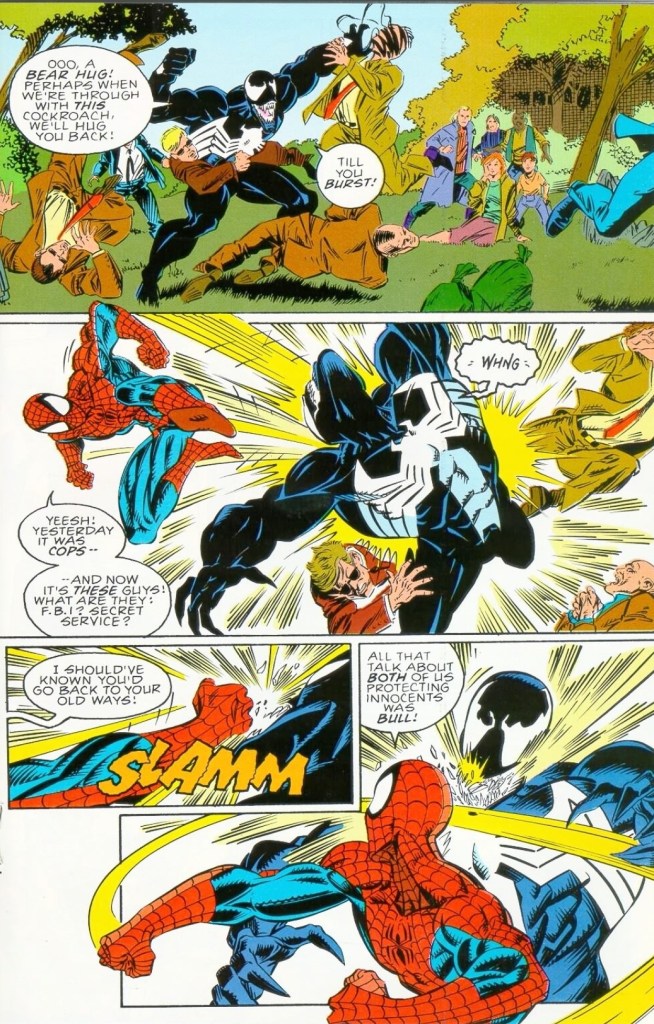
Spider-Man and Venom face each other unexpectedly.

Focusing on the plot, this story took place after the events in Amazing Spider-Man #375 (1993) which was released AFTER this particular comic book. As a standalone Venom story, this one clearly portrays him more of a vigilante in the sense that he goes up against a new force of evil that happens to be pouncing on people that Venom believes to be innocent and powerless. Unsurprisingly, Venom does not seek the help of law enforcers to help the innocent but rather he takes violent action to help the victims, going as far as to kill the so-called bad guys. The bad guys in this story work under a powerful man whose son was killed by Venom a few years prior. Within the context of this comic book, the new force of evil was introduced in subtle ways.

With extensive experience writing tales about Spider-Man and Venom, David Michelinie clearly redefined Venom’s beliefs here. Venom believes in protecting the innocent but he is much more violent and is relentless with cruelty which makes him a clear opposite of Spider-Man. Yet in a way, Venom sure talks and acts in a rather psychotic way and this alone makes him a very unlikable comic book protagonist.

Along the way, the iconic Spider-Man got a rather huge chunk of the spotlight in this comic book making him the 2nd lead next to Venom. I remember back in 1993 when there were Venom fans who complained about Spider-Man literally stealing the thunder away from his greatest enemy while there were a few Spider-Man fans who defended the icon’s guest participation in the story as he has always been linked with Venom’s origin. Considering the lack of depth in the plot, I can say Spider-Man appearance her served as a somewhat helpful filler.  

Conclusion

Helping victims does NOT justify killing. This makes Venom a major turn-off as a comic book protagonist.

Venom: Lethal Protector #1 (1993) is a comic book that can be alienating, especially when you are not a Venom fan. I find Venom too evil and too unbelievable to be a heroic figure even though he strong believes in protecting and helping the innocent. In my view, he is more of vigilante living with the delusion of achieving something worthwhile as he interacts with people who happen to be not assisted by the many, many Marvel Comics superheroes. It is not surprising that Venom definitely will never be a good role model. He is a murderer and the act of helping victims never justifies murder. The comic book’s plot lacks weight and Mark Bagley’s art looked a little rushed. What made this comic book interesting are Venom and Spider-Man themselves. Yes, there is a lot of superhero spectacle here but don’t expect anything new when you see Spider-Man and Venom resume their violent rivalry. This comic book is unsurprisingly a warm-up of things to come within its series. It is not a terrible literary work. It’s just not really good and it did not deserve the hype and sales of its time.

Overall, Venom: Lethal Protector #1 (1993) is serviceable.

+++++

Thank you for reading. If you find this article engaging, please click the like button below, share this article to others and also please consider making a donation to support my publishing. If you are looking for a copywriter to create content for your special project or business, check out my services and my portfolio. Feel free to contact me with a private message. Also please feel free to visit my Facebook page Author Carlo Carrasco and follow me on Twitter at  @HavenorFantasy as well as on Tumblr at https://carlocarrasco.tumblr.com/ and on Instagram at https://www.instagram.com/authorcarlocarrasco

A Look Back at Spider-Man and Batman: Disordered Minds (1995)

Disclaimer: This is my original work with details sourced from reading the comic book and doing personal research. Anyone who wants to use this article, in part or in whole, needs to secure first my permission and agree to cite me as the source and author. Let it be known that any unauthorized use of this article will constrain the author to pursue the remedies under R.A. No. 8293, the Revised Penal Code, and/or all applicable legal actions under the laws of the Philippines.

Welcome back, superhero enthusiasts, 1990s culture enthusiasts and comic book collectors! Today we will take a look back at a certain crossover comic book that involved both Marvel Comics and DC Comics published in the mid-1990s. On my part, it’s been some time since I last reviewed a Marvel-DC crossover comic book. That being said, you can read about my retro comic book reviews of Batman versus The Incredible Hulk and Superman and Spider-Man on this website.

For this new retro review, we will focus on the 1995 crossover that brought two of Marvel and DC’s icons together for the first time – Spider-Man and Batman! To put things in perspective, the 1990s still remembered as the decade when Bane broke Batman’s back while the publishing of Spider-Man comic books became highly controversial with the Spider-Clone Saga. In the 1995 crossover produced the two comic book giants, Spider-Man and Batman are presented in their classic identities as Peter Parker and Bruce Wayne.

With those details laid down, here is a look back at Spider-Man and Batman: Disordered Minds published in 1995 by Marvel Comics and DC Comics with a story written by J.M. DeMatteis and drawn by Mark Bagley.

The cover.

Early story

The story begins with a nightmare in which Peter Parker’s Uncle Ben got shot by an armed man in the presence of Aunt May inside their home. Immediately Spider-Man arrives and grabs the man by the neck. The armed man creepily laughs and his face suddenly turns into the Joker. Peter Parker wakes up in bed with Mary Jane on his side. After a short talk with his wife, Peter decides to leave their apartment and swing around the city as Spider-Man.

In another nightmare, a very young Bruce Wayne witnesses the death of his parents caused by a man with a gun. He suddenly turns into Batman and grabs the gunman by the neck. The gunman suddenly turns into the horrific Carnage. Bruce wakes up and decides to reflect. As soon as his butler Alfred opens the door to check on him, Bruce immediately leaves as Batman in the middle of the night.

Somewhere that same night inside a secret facility of the Ravencroft Institute, Cletus Kasady/Carnage is restrained in a secured chamber surrounded by armed security personnel with Spider-Man and psychotherapist Ashley Kafka watching him…

Quality

The two superhero icons together.

I’ll start first with the visual quality of this crossover comic book. Mark Bagley, who was the lead artist on Marvel’s Amazing Spider-Man comic book series, delivered an unsurprisingly stylized look at the two superhero icons, super villains and characters, as well as on DC’s Gotham City (which was the most prominent location in the story).

While Bagley’s work on Spider-Man and the characters associated with him were typical of his Amazing Spider-Man of the decade, I can say that his take on Batman, Joker, Alfred, the Bat Cave and others on the DC Comics side resulted a unique look. Bagley drew Joker looking sinister, maniacal, clueless and even tamed as the plot progressed. Bagley’s Batman has a larger yet familiar style of muscular body compared to Spider-Man, and the visual presentation of his cape ranged from dynamic to looking authoritarian. There were however a few moments wherein Bagley went over the limit on emphasizing the length of Batman’s cape which resulted a few inaccuracies. Remember how there were times that Bagley drew Marvel characters’ thighs to look excessive with muscle? You will see that too on Batman here.

When it comes to artistic dynamism, it is clear that Bagley pushed himself hard creating some mixed results. Some scenes (action scenes and talk scenes included) had the appropriate amount of flash and style, while other scenes had an excessive amount. When it came to spectacle, Bagley succeeded in making the action, hard-hitting moments and explosions look very lively. To be clear, this comic book is entertaining to look at but ultimately it will resonate best with readers who are best familiar to the way Bagley draws.

For the storytelling, J.M. DeMatteis crafted a script that did not reach its full potential as there were obvious limits imposed to ensure equality on presenting the characters and the situations. This explains why in the beginning Spider-Man and Batman each had nightmares related to their respective past and end up seeing their respective super villains interchanged (Spider-Man sees Joker, Batman sees Carnage). The characters of Ashley Kafka and Cassandra Briar are not only looking too similar to each other (just imagine their characters having no colors), they both feel like cardboard cut-outs of a single character who specializes on analyzing people with dangerous minds and coming up with solutions to help them. The more known supporting characters from the respective sides of the two icons – Mary Jane and butler Alfred – made short appearances but did not really contribute much to the plot.

The limitations are also felt on the way Spider-Man and Batman – plus Carnage and Joker – were presented, right down to their interactions with each other. While it was expected that Batman and Spider-Man would be brought together by an unfortunate development, the complete absence of a fight between the two superhero icons was itself the biggest surprise here effectively defying crossover superhero tradition. Even without a fight, you will see Batman and Spider-Man do things separately in accordance to their respective traditions or character traits before getting back together leading to the big conflict with the super villains.

As for Joker and Carnage being together, the spotlight on them in this comic book is pretty limited. There simply is not enough space in this comic book to bring out the full potential of the two super villains who each are known to be murderers and psychologically dangerous. What is interesting in their limited time together is that the story emphasized the differences between them when it comes harming people. The Joker has his own sadistic style of leading people to their deaths in time-consuming ways which is opposite of the quick deaths Carnage enjoys. Considering their respective reputations, it is just a shame that this comic book not only failed to bring out the full potential of Carnage-Joker, it also failed to establish them as clear and present dangers to the public.

More on the plot itself in relation to the comic book sub-title “Disordered Minds”, the elements of mental instability, psycho-therapy, psychology and rehabilitation are present but they are all thrown out by the time the second half of the story begins, clearly making space for the crossover dynamics of Batman, Spider-Man, Joker and Carnage.

Conclusion

Joker and Carnage.

Spider-Man and Batman: Disordered Minds (1995) is a flawed crossover event comic book that just so happens to have more positive stuff than negative ones. It is enjoyable but not great and certainly not memorable. The imposed limits on the presentation made this comic book’s story feel very staged and predictable. With what little creative space was left, it is quite an achievement for the creative team to tell a cohesive and stuffed story (note: there is a lot of filler and some psychology related stuff may not interest some readers) while featuring Batman and Spider-Man the best way they could. It has enough superhero spectacle to be enjoyed although the interactions between Batman and Spider-Man and between Joker and Carnage could have been better.

If you are seriously planning to buy an existing hard copy of Spider-Man and Batman: Disordered Minds (1995) be aware that as of this writing, MileHighComics.com shows that a near-mint copy costs $120 while the near-mint copy of the signed-and-numbered edition is at $120.

Overall, Spider-Man and Batman: Disordered Minds (1995) is satisfactory.

+++++

Thank you for reading. If you find this article engaging, please click the like button below and also please consider sharing this article to others. If you are looking for a copywriter to create content for your special project or business, check out my services and my portfolio. Feel free to contact me with a private message. Also please feel free to visit my Facebook page Author Carlo Carrasco and follow me on Twitter at  @HavenorFantasy as well as on Tumblr at https://carlocarrasco.tumblr.com/

A Look Back at X-Men Unlimited #1 (1993)

Disclaimer: This is my original work with details sourced from reading the comic book and doing personal research. Anyone who wants to use this article, in part or in whole, needs to secure first my permission and agree to cite me as the source and author. Let it be known that any unauthorized use of this article will constrain the author to pursue the remedies under R.A. No. 8293, the Revised Penal Code, and/or all applicable legal actions under the laws of the Philippines.

As mentioned before (refer to my reviews of X-Men 2099 #1 and X-Men #25), 1993 was the year when the 30th anniversary of the X-Men was celebrated. Back then, Internet connection was not very accessible to the public, social media had not been invented and streaming movies and TV shows was not yet the norm. How did Marvel Comic organize the celebration for X-Men fans? By publishing a lot of comic books and selling merchandise.

In the first quarter of 1993, Marvel Comics went on to feed the perceived high demand of X-Men fans by launching X-Men Unlimited which was an all-new comic book series with a schedule of quarterly releases per new comic book (initially with 64 pages of content using glossy paper). They released X-Men Unlimited #1 in March 1993 and I bought a copy for a hefty $3.95.

So what exactly did the said comic book feature? Was it good? We can all find out in this look back at X-Men Unlimited #1 published by Marvel Comics with a story written by Scott Lobdell and drawn by Chris Bachalo.

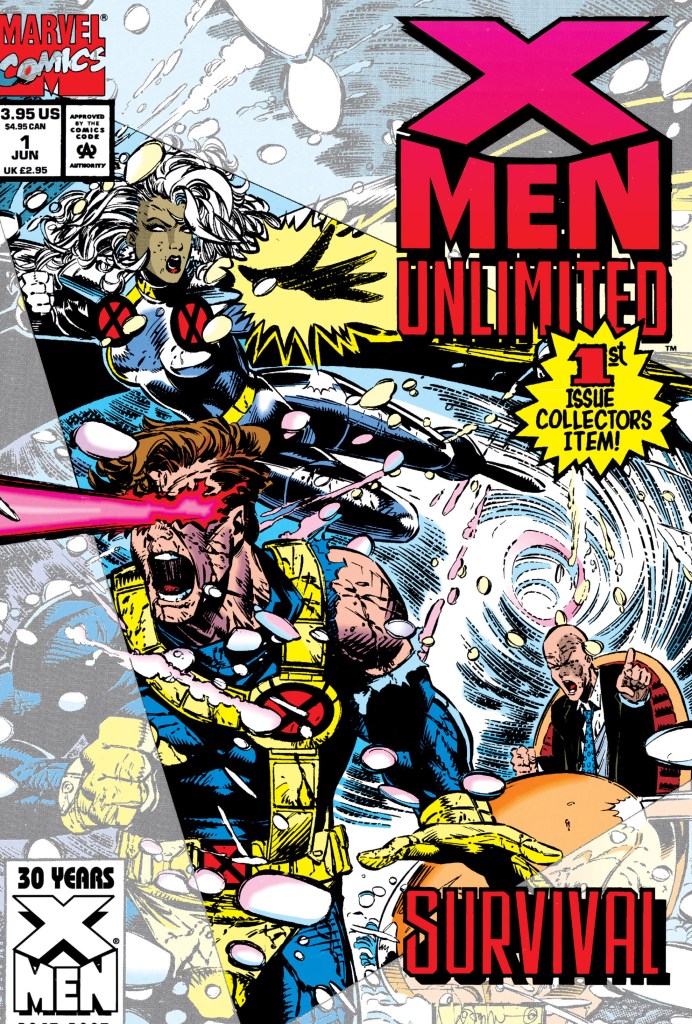
The cover.

Early story

The story begins on the snowy surface of Antarctica where the Blackbird (the X-Men’s jet) has crashed. Cyclops is outside the crashed jet already suffering from internal bleeding and other injuries. As his ruby quartz visor has been lost, he desperately keeps his eyes shut to avoid firing any optic blast. Even with tremendous odds against him, Cyclops concentrates very hard to reach out to Charles Xavier and successfully makes contact. Xavier is surprised.

With telepathic assistance provided by Xavier, Cyclops successfully reaches him and carries him. After some searching, they spot Storm alone on the snow. Elsewhere, a lady gets up from the snow and walks towards a facility. Upon entering, there are scientists working with computers and they called her Ms. Blaze. She asked them if she succeeded in killing Cyclops, Storm and Xavier…

Quality

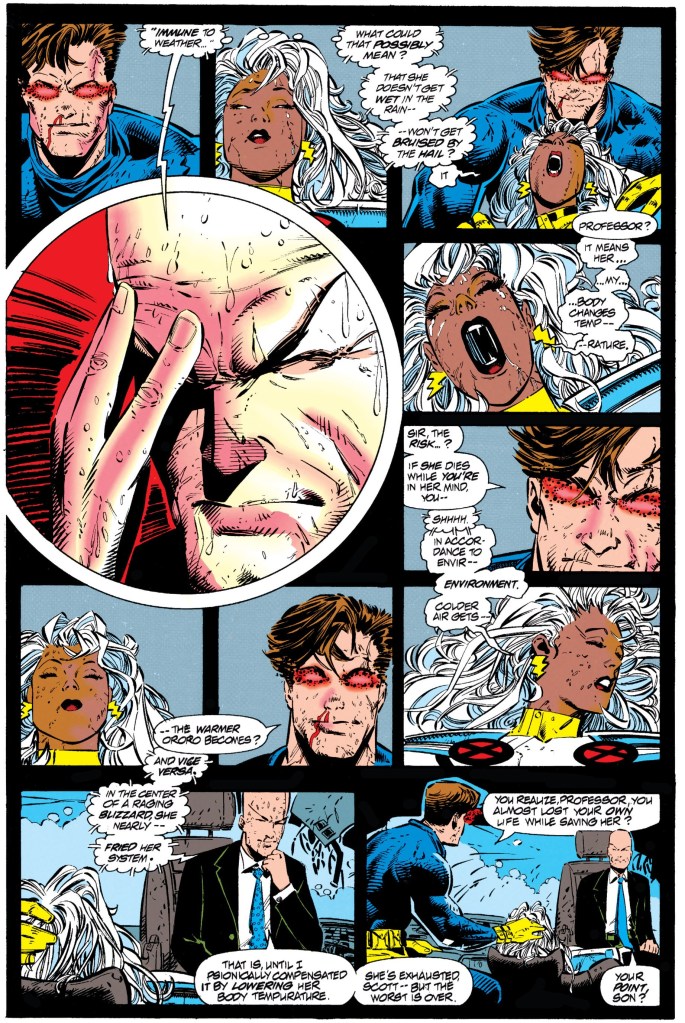
Artist Chris Bachalo failed to pace his art properly on this page.

To get to the point, I should state that the main lesson of this X-Men story written by Lobdell is about leadership mixed with responsibility and survival. Symbolically, the three leaders of the X-Men (Xavier the head with Blue Team leader Cyclops and Gold Team leader Storm) were placed in a situation of great odds and their respective powers cannot just help solve their problems nor help them get away easily. Here we get to see Cyclops, Storm and Xavier really struggling and having no choice but to use their wits as well as skills learned from the past in order to survive and progress. This is easily the comic book’s most unique feature and it is very rare to see Xavier and the two team leaders spend a lot of time together and work with each other. As far as emphasizing the leadership dynamics of the X-Men is concerned, Lobdell succeeded. I should also state that Lobdell really dramatized the respective personalities of the three.

Still there are some notable flaws. I should say the story had lots of dragging moments in between and the overall pace is between slow and medium. The dialogue is quite wordy and ultimately a lot of it felt like fillers than actual attempts to develop personalities and explain things. There were attempts to make the dialogue more philosophical but end up dragging the narrative. I should state that verbal descriptions or narrations in certain pages were quite excessive. If you are looking for superhero spectacle, there is actually little to enjoy here and by the time the final conflict is over, you will end up unsatisfied. Of course, there are also scenes of incidental moments (examples: explosions, the environment causing damage, etc.) that were emphasized as if to make up for the lack of superhero spectacle.  

The antagonist Sienna Blaze is not a compelling villainess. There is no justification as to why she tried to kill the X-Men. The way she is presented, Blaze is more like a reckless and impulsive teenager than a real opposing force against Xavier and his mutants.

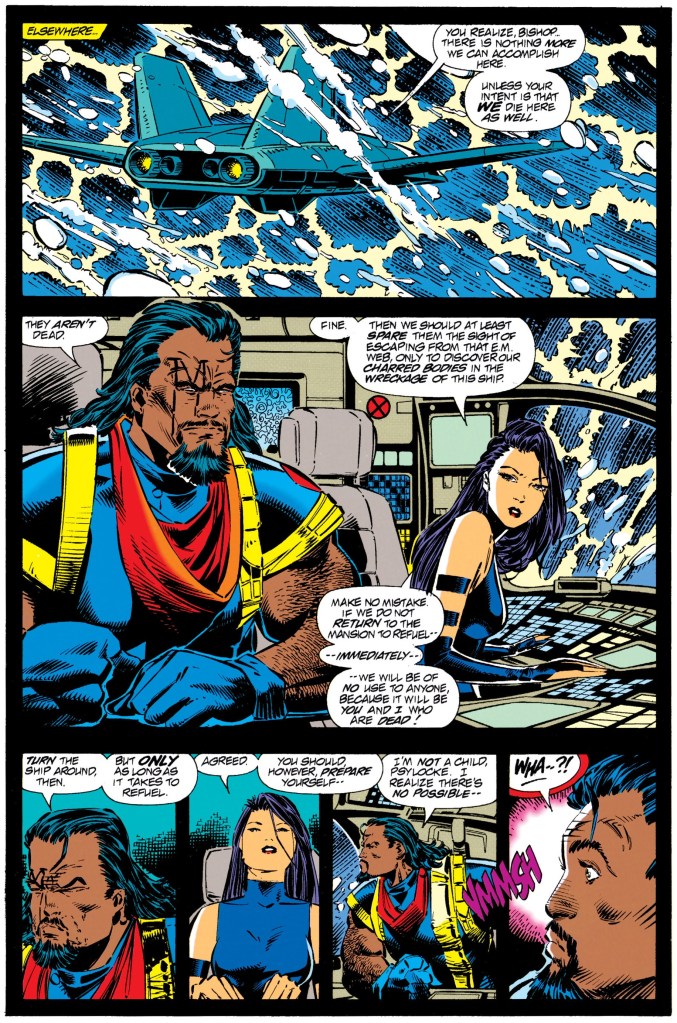
Psylocke and Bishop were the other X-Men members who appeared.

Lastly, there is the art by Chris Bachalo which has always been sub-par and disappointing to look at. While Bachalo did a decent job drawing disaster-related moments, his art on drawing the X-Men really sucked. There were many times when Charles Xavier LOOKED LIKE A DUMMY (think mannequin) than a living person as drawn by Bachalo. The art of this comic book was disappointing in 1993, and it has aged badly by today’s standards.

Apart from the main story, this comic book has a gallery of artworks highlighting the X-Men (including members who did not appear in the said story) done by varied illustrators. The quality of the art, unsurprisingly, is a mixed bag. Ultimately the art gallery served as convenient filler made to satisfy the cravings of X-Men fans.

Conclusion

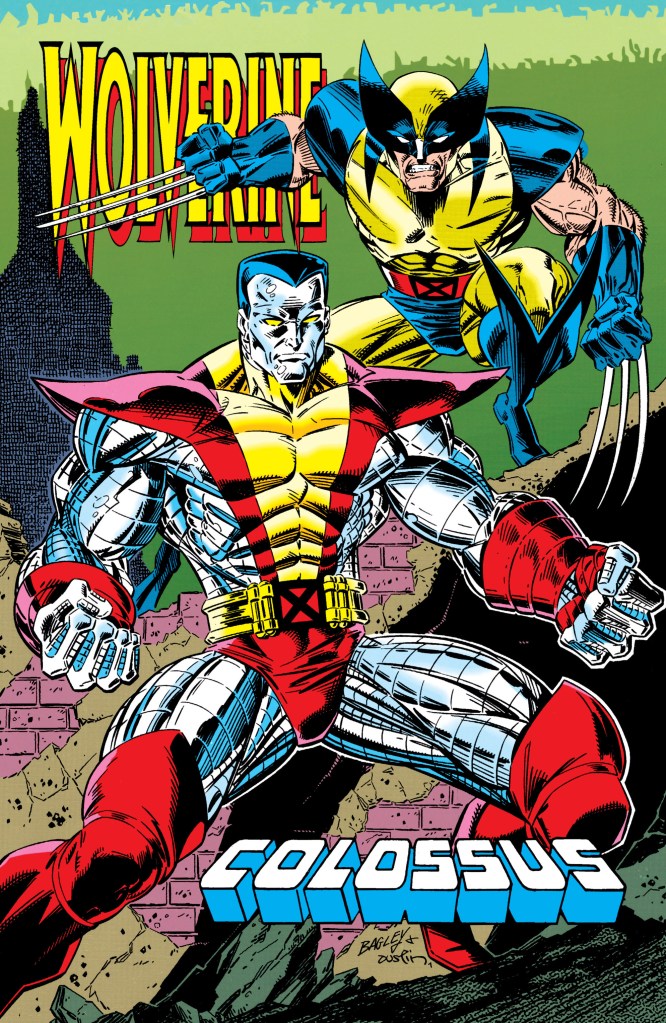
This is how Wolverine and Colossus look as drawn by Mark Bagley who was the Amazing Spider-Man artist of the time.

Apart from being made to sell a bunch of copies and take advantage of the comic book collector craze of the time, X-Men Unlimited #1 (1993) was an effort to keep defining the X-Men for fans and comic readers of the 1990s by adding depth to the bond between Xavier, Storm and Cyclops. The problem is with the execution as the story dragged a lot, and a whole lot of dialogue and text descriptions were made as if to ensure that enough content would fit the 64-pages of content of the comic book. As far as 1993 X-Men comic books go, this one has one of the worst looking artworks used in storytelling. When it comes to its connection with the 30th anniversary of the X-Men, what happened to Xavier in this comic book is connected to the events of Uncanny X-Men #304 and #310.

If you are seriously planning to buy an existing hard copy of X-Men Unlimited #1 (1993), be aware that as of this writing, MileHighComics.com shows that the near-mint copy of the regular edition costs $10 while the near-mint copies of the signed edition (without certificate), the newsstand edition and the signed edition (with certificate of authenticity) cost $105, $32 and $105 respectively.

Overall, X-Men Unlimited #1 (1993) is unsatisfying. If I were you, I would avoid spending any money above its cover price. Considering its quality, the near-mint copy of this comic book is really worth only $1.

+++++

Thank you for reading. If you find this article engaging, please click the like button below and also please consider sharing this article to others. If you are looking for a copywriter to create content for your special project or business, check out my services and my portfolio. Feel free to contact me as well. Also please feel free to visit my Facebook page Author Carlo Carrasco and follow me at HavenorFantasy@twitter.com

A Look Back at Spider-Man #26 (1992)

Disclaimer: This is my original work with details sourced from reading the comic book and doing personal research. Anyone who wants to use this article, in part or in whole, needs to secure first my permission and agree to cite me as the source and author. Let it be known that any unauthorized use of this article will constrain the author to pursue the remedies under R.A. No. 8293, the Revised Penal Code, and/or all applicable legal actions under the laws of the Philippines.

In 1992, Marvel Comics organized a big celebration of what was back then the 30th anniversary celebration of Spider-Man. Behind the scenes, the Spider-Man editorial team organized their creators to make something special worthy of the anniversary. Back then there were four monthly series of Spider-Man – Amazing Spider-Man, Spectacular Spider-Man, Web of Spider-Man and Spider-Man – and in keeping with the 30th anniversary bonanza, each of the monthly series would see one special issue with a hologram on the cover.

What I read recently was one of those 30th anniversary celebration special comic books – Spider-Man #26. This comic book had a green cover and a hologram of Spider-Man upside-down. Its cover price is $3.50.

Was this old comic book’s content really worth the high cover price and the hologram? Did the creative team at Marvel do their job on making something special in line with the 30th anniversary celebration? We can find out in this look back at Spider-Man #26, published in 1992 by Marvel Comics with the main story written by Tom DeFalco and drawn by Mark Bagley and Ron Frenz.

The cover with a hologram.

Early story

The story begins on the street of New York when a man wearing a device runs down the sidewalk distracting and unintentionally pushing a few people out of the way. He is glowing as he moves. Someone from behind him calls him Stewart.

Soon enough, Peter Parker/Spider-Man and Mary Jane cross paths with him. Peter immediately leaves Mary Jane behind and starts pursuing the glowing Stewart. In the middle of the street, Stewart sees a speeding motorcycle heading towards him. He dives for cover which incidentally shapes his glowing field into a makeshift ramp causing the motorcyclist go over him. Spider-Man sees the flying motorcycle and its driver, and struggles to decide which one to save…

Quality

From the 2nd story.

Let me start with the main story. It sure is heavily worded almost all throughout but that is understandable because Tom DeFalco really pushed hard to emphasize the theme of responsibility as Spider-Man struggles to tackle criminals while trying to find quality time for his wife. There was even a scene in which Peter Parker recalls key events from his past (his becoming Spider-Man, letting a certain criminal get away, the death of his Uncle Ben, etc.) which, in terms of presentation, was a clear attempt by the creative team to bring readers back to the recorded history of Marvel’s icon. The main story is a genuine, heart-filled attempt to go beyond showing Spider-Man beating the bad guys to do local society good. There was also effort exerted to show that there are a few guys who do bad things not because they are inherently evil but rather they are desperate and/or misguided. The problem with the main story is that the other characters – Stewart, Bill, the gang leader Maxwell and others – are not so interesting at all. Of course, we cannot expect to see Spider-Man go head-to-head with another one of his major villains but this story was part of the 30th anniversary celebration.

The 2nd story, if you can all it that, is pretty much an exposition-filled exercise designed to give readers – both new and old – a review of Spider-Man’s powers and capabilities. To prevent it from becoming a total bore, some characters from the Marvel Comics universe were visually added.

When it comes to the quality of the artwork, Ron Frenz’s work here is serviceable at best. Mark Bagley’s art here improves the quality but that’s not saying much.

Conclusion

From the main story.

As a 30th anniversary celebration issue, Spider-Man #26 does not have much when it comes to being truly special. You love spectacle? You won’t find much in it. You wanted to see something groundbreaking in terms of character development? There’s none. Gripping storytelling? None! There was also no conflict with any prominent villain from the Marvel universe here. What you will get here is nostalgic stuff plus exposition about key elements that define Spider-Man. Truly the only thing special here is the hologram on the gimmick cover.

If you are seriously planning to buy an existing hard copy of Spider-Man #26 (1992), be aware that as of this writing, MileHighComics.com shows that the near-mint copy of the regular edition costs $27 while the near-mint copy of the newsstand edition costs $90.

Overall, Spider-Man #26 (1992) is serviceable. If you really want to buy this old comic book, I recommend waiting for its price to fall below $5 and I’m referring to the near-mint copy.

+++++

Thank you for reading. If you find this article engaging, please click the like button below and also please consider sharing this article to others. If you are looking for a copywriter to create content for your special project or business, check out my services and my portfolio. Feel free to contact me as well. Also please feel free to visit my Facebook page Author Carlo Carrasco and follow me at HavenorFantasy@twitter.com

Carlo Carrasco’s Comic Book Review: True Believers: Absolute Carnage – Carnage #1

If there is anything I like most about Marvel Comics’ True Believers line of comic books, it’s that I get to read reprints of past stories without having to pay a whole lot of money to buy the original comic books or those pricey paperbacks.

A few years ago, out of curiosity, I bought a copy of True Believers which reprinted the first appearance of Deadpool in New Mutants #98.

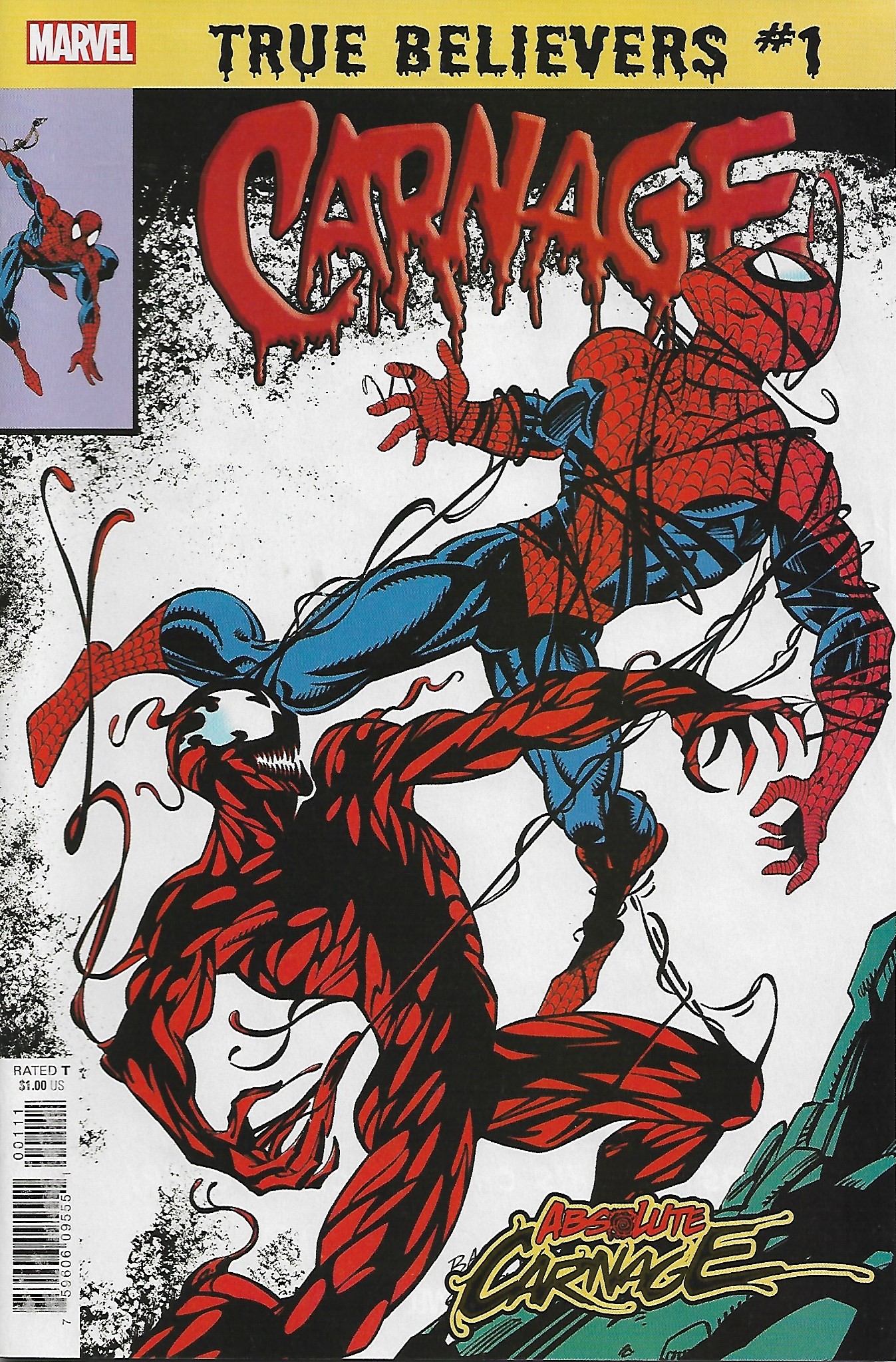
This time around I got to check on the first-ever encounter between Spider-Man and the vicious supervillain Carnage with True Believers: Absolute Carnage – Carnage #1 which is currently available for for only $1.

2019-07-20_013045~2.jpg
The cover.

2019-07-20_013250~2.jpg
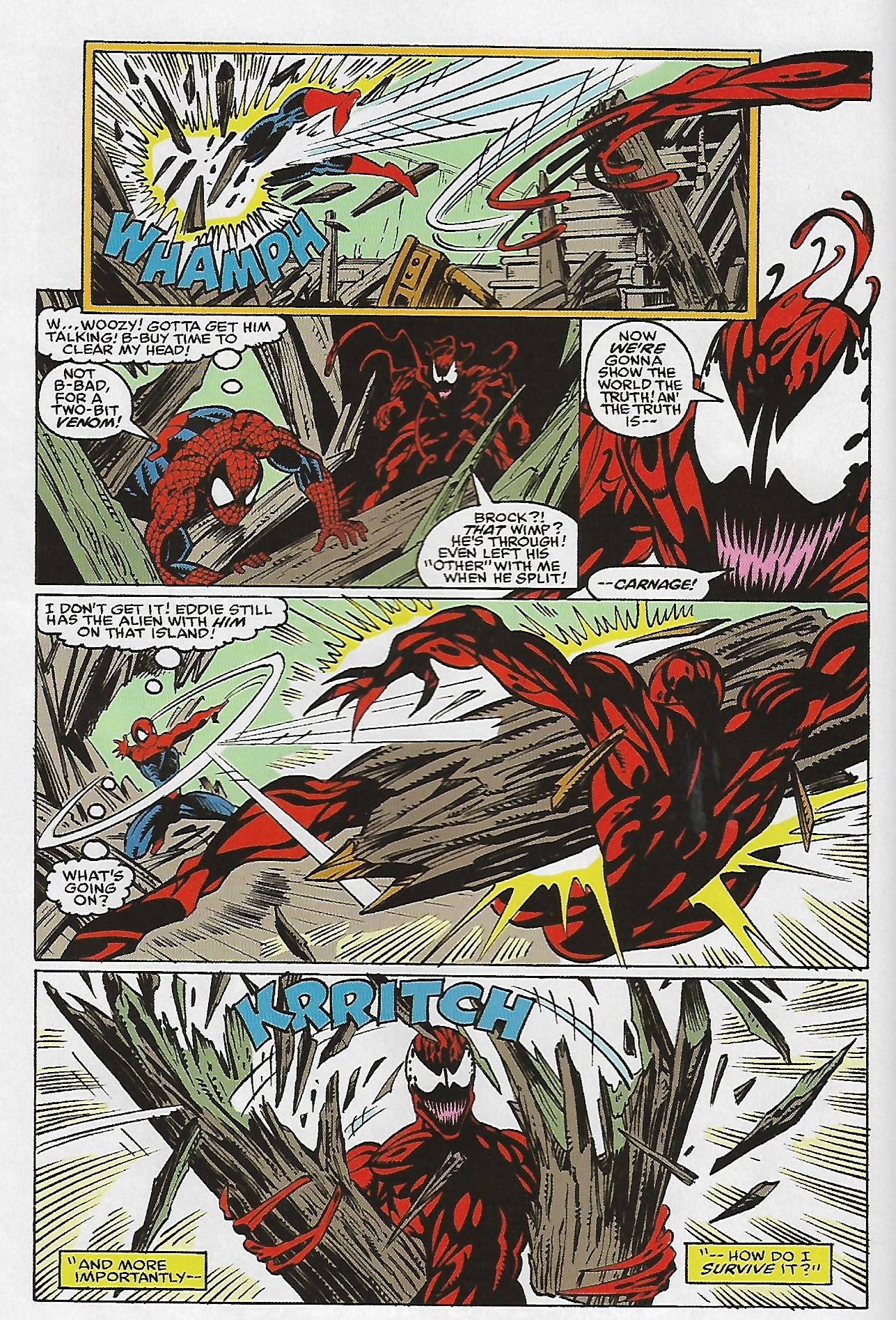
Hard-hitting action in the first encounter between Spidey and Carnage.

The comic book is a reprint of Amazing Spider-Man #361 which was released in 1992 just months before Marvel’s official celebration of the 30th anniversary of Spider-Man happened.

The story begins when Carnage causes trouble at the Agro-Lab Empire State University. He messes with a man named Chip (who claims to have done nothing wrong), cause property damage using his symbiote and eventually kills. This opening scene clearly shows that Carnage is a more troubling than Venom (who in turn was being turned into an anti-hero figure by Marvel’s creators).

Peter Parker/Spider-Man meanwhile spends quality time at home with his Aunt May. Unsurprisingly, a telephone call interrupts his private life causing him to go to the university to determine, secretly in costume, what happened. Peter personally knows Chip and the guy’s death only adds to his concern about the rise of brutal murders.

“Chip’s dead. And I’m worried that these serial killings may partly be my fault,” Peter told Mary Jane.

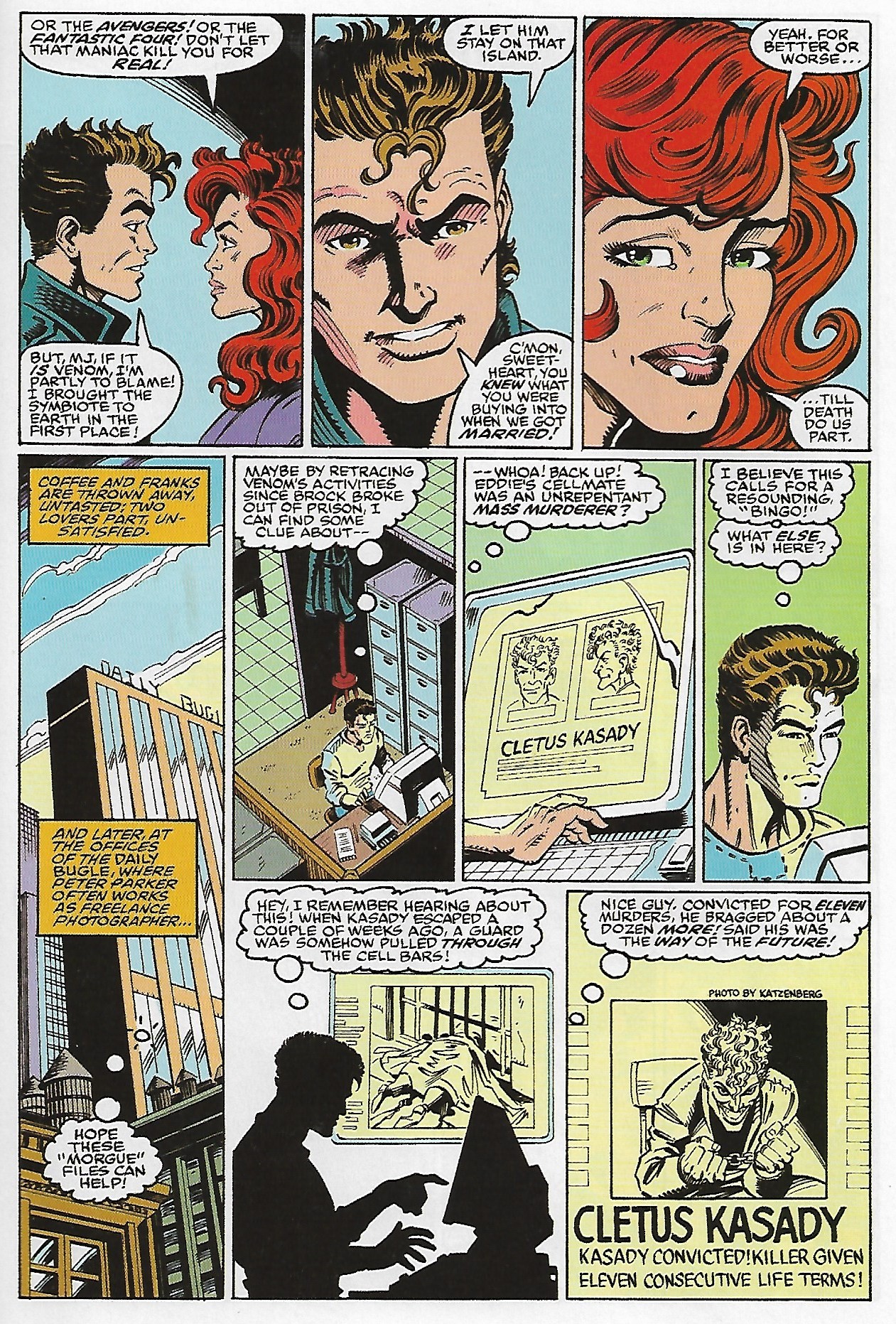
Using his access as a freelance photographer, Peter conducts computer research at the office of the Daily Bugle and discovers Cletus Kasady’s prison profile. Knowing that Kasady (Carnage) was a cellmate of Eddie Brock/Venom, he digs deeper and goes around the city to investigate. This sets up his first encounter with Carnage. What exactly happened between them? You just have to read to find out.

2019-07-20_013349~2.jpg
Tension builds up as Peter Parker researches Cletus Kasady.

Even by today’s standards, the story remains gripping, intriguing and entertaining at the same time. David Michelinie really knows how to balance spectacle, exposition and suspense with the Spidey-Carnage conflict as the highlight. Michelinie also showed Kasady’s insanity clearly and, even by his look, the villain is clearly a creative rip-off of DC Comics’ insane villain The Joker. Artist Mark Bagley’s art is still good to look at and he managed to pull off the daunting task of visualizing the present along with drawing images from Spidey’s past with original symbiote and Venom. The action scenes still have good visual impact.

Overall, if you are even a bit interested in Spider-Man, Carnage and 1990s comic book culture, then True Believers: Absolute Carnage – Carnage #1 is recommended. For only $1, this is one engaging and entertaining comic book to read.

Take note that there is a chance that Carnage will become the next popular supervillain in the movies once the character appears fully in the sequel to 2018’s Venom movie. Remember the mid-credits scene in Venom? Carnage could literally rise in pop culture.


Thank you for reading. If you find this article engaging, please click the like button below and also please consider sharing this article to others. Also my fantasy book The World of Havenor is still available in paperback and e-book format. If you are looking for a copywriter to create content for your special project or business, check out my services and my portfolio. Feel free to contact me as well. Also please feel free to visit my Facebook page Author Carlo Carrasco and follow me at HavenorFantasy@twitter.com