2025 is officially a year of tremendous tourism breakthroughs for Japan as a record 42.7 million foreign visitors were counted along with more than US$60 billion in related revenue, according to a news article by Kyodo News.
Overtourism has been going on in Japan for some time now and it does not seem to be slowing down even though there was a sharp drop of tourists from Communist China which was the result of increased tensions between China and Japan. As a lot more foreign tourists explored Japan, local businesses benefited in different ways but overcrowding, increased littering and acts of bad behavior by foreigners were reported.
To put things in perspective, posted below is an excerpt from the news article of Kyodo News. Some parts in boldface…
Foreign visitors to Japan reached a record estimated 42.7 million in 2025, the government said Tuesday, with their spending also at a new all-time high of 9.5 trillion yen ($60.1 billion), thanks to a weaker yen and increased flights to Japan.
The preliminary figures also showed, however, a 45 percent drop in Chinese tourists in the month of December from a year prior to 330,000, tourism minister Yasushi Kaneko told a press conference. The fall came as an ongoing row between Japan and China appears likely to weigh on inbound travel trends in 2026.
The decline in Chinese visitors was the first fall since January 2022 during the COVID-19 pandemic, the minister of land, infrastructure, transport and tourism said, adding the government is monitoring the situation around Chinese visitors.
Overall visitors surpassed 40 million for the first time, and the estimated total was around 6 million people higher than for 2024. Kaneko said Japan will “engage in strategic Japan tourism promotion” amid a diversifying inbound market, highlighted by rising arrivals from Australia, Europe and the United States.
Relations between Tokyo and Beijing have soured since Japanese Prime Minister Sanae Takaichi’s remarks in early November on a Taiwan contingency infuriated China.
The fallout has seen economic measures from China, including urging its people to refrain from visiting Japan, and some airlines reduced flights on Japan-China routes.
While the Japanese government has set a target of attracting 60 million foreign visitors a year by 2030, some popular sightseeing destinations are facing problems such as overcrowding and misbehavior by some tourists.
For added insight about tourism-related attractions, activities and trends in Japan, watch the Nippon TV videos below.
Let me end this piece by asking you readers: What is your reaction to this development? Do you think Japan will be able to attract even more foreign tourists and be able to collect better revenues this year without China? If you plan to visit Japan this year, what is the purpose of the trip and where do you plan to visit?
In what is clearly a bid to enhance tourism, investments and trade, the Department of Foreign Affairs (DFA) announced that Chinese nationals are being granted visa-free entry into the Philippines and they are allowed to stay up to fourteen days, according to a GMA Network news report.
To put things in perspective, posted below is an excerpt from news report of GMA News. Some parts in boldface…
The Philippines is granting visa-free entry to Chinese nationals starting January 16 in its bid to increase Chinese trade, investments and tourists, the Department of Foreign Affairs said Thursday.
Under the new policy, Chinese nationals may enter the Philippines without the requirement of obtaining a visa for a stay of up to 14 days.
“This is in line with the President’s directive to facilitate trade, investments, and tourism, as well as strengthen people-to-people exchanges between the Philippines and China,” the DFA said in a statement.
Such visa-free entry arrangement will be in effect for one year and will be reviewed accordingly before it expires.
The visa-free privilege will be valid for entry only through the Ninoy Aquino International Airport (NAIA) in Metro Manila and the Mactan-Cebu International Airport (MCIA) in Cebu.
Upon arrival, Chinese nationals need to present a passport valid for at least six months beyond the intended stay, confirmed hotel accommodation/booking, and a return or onward ticket to the next country of destination.
“Chinese nationals traveling to the Philippines strictly for tourism or business purposes may avail of the new visa-free entry privilege,” the DFA said.
However, the DFA said visas (cannot) be extended beyond the allowable 14-day stay and is non-convertible to any other type of Philippine visa category.
For added context about the potential risks that come with attracting Chinese tourists, watch the video below.
Let me end this post by asking you readers: What is your reaction to this recent development? Do you think this new policy by the national government is the right move even though there is tension between Communist China and the Philippines? Does this new policy make the Philippines look very desperate to attract money from Chinese visitors? Are you concerned that criminal activities here in the Philippines will get worse as more Chinese tourists enter the country?
To put things in perspective, posted below is an excerpt from news report of the Manila Bulletin. Some parts in boldface…
The Federation of Filipino Chinese Chambers of Commerce and Industry Inc. (FFCCCII) is sounding the alarm on the Philippines’ lagging tourism sector, urging the government to enact sweeping reforms as international arrival figures fall behind regional competitors.
In a statement on Sunday, Jan. 11, FFCCCII President Victor Lim described the current state of the industry as a “pivotal” moment, arguing that structural changes are now an urgent economic necessity.
While neighboring nations in the Association of Southeast Asian Nations are reporting a robust post-pandemic recovery, the Philippines is struggling to regain its footing.
“We, the Federation of Filipino Chinese Chambers of Commerce and Industry, Inc. (FFCCCII), urge immediate decisive and comprehensive tourism reforms,” Lim said.
Data from the first 11 months of 2025 showed that the Philippines recorded 5.24 million international arrivals, a 2.2 percent decrease from the same period a year earlier.
The end-November figure also remained 37 percent below the benchmark levels seen in 2019, before the pandemic disrupted global travel.
Lim said the decline posed a direct threat to the broader economy, noting that tourism is a critical engine of inclusive growth. The sector is a primary employer and a lifeline for micro, small, and medium enterprises across the archipelago.
The federation identified three systemic hurdles: a “hassle factor” caused by congested airports and poor digital connectivity, uncompetitive visa policies that act as a deterrent compared to the streamlined entry points of regional peers, and a fragmented marketing strategy that fails to capitalize on the country’s cultural heritage.
To reverse the trend, the FFCCCII proposed a “Blueprint for Immediate Reform.” The plan calls for an “ASEAN-competitive” visa regime and a “connectivity revolution” to modernize primary gateways and facilitate easier travel between islands.
Lim also cited the need to pivot promotional efforts toward “The Philippine Experience,” moving beyond traditional sightseeing to highlight the nation’s history and hospitality.
Let me end this post by asking you readers: What is your reaction to this recent development? Do you think the FFCCCII is correct about the current state of Philippine tourism? Do you find the FFCCCII’s proposal sensible and believable? Do you think the Department of Tourism (DOT) should take the FFCCCII’s proposal very seriously? Do you thinking it is inevitable that other business chambers from around the Philippines will push for tourism industry reforms?
To put things in perspective, posted below is an excerpt from the DOT announcement via the PIA. Some parts in boldface…
The Christmas long break underscored the strength of domestic tourism as Filipinos traveled across the country in large numbers, filling beaches, heritage sites, mountain retreats, and island destinations—cementing local travel as a vital pillar of the Philippine tourism industry during the holiday season.
Leading holiday destinations saw robust visitor turnout, with Boracay Island in Western Visayas recording the highest arrivals at 118,745 tourists from December 15 to 28, 2025, as Filipinos gathered to celebrate Christmas by the beach. The region also welcomed cruise passengers during the holidays, with Star Navigator and Norwegian Sun making multiple port calls and bringing in thousands of passengers and crew, further adding to local tourism activity.
Close behind, Cebu City welcomed 102,124 visitors, while Panglao Island in Bohol received 62,240 tourists, reflecting sustained domestic travel to Central Visayas despite the region having faced a series of natural calamities earlier in the year.
Meanwhile, Tacloban City in Eastern Visayas saw some 25,194 overnight guests. But the most visited tourist destination in the region was Malajog Beach in Calbayog City, Samar which registered some 56,543 tourists.
In the Cordilleras, Baguio City—long regarded as a favorite Christmas destination—recorded 117,137 visitors from December 15 to New Year’s Eve, drawn by its cool weather, festive lights, and seasonal sound-and-light shows.
In Bicol, Camarines Sur attracted 92,000 visitors over the holiday break, while neighboring Albay welcomed 45,000 tourists, many traveling along scenic routes framed by views of the iconic Mayon Volcano.
Northern Luzon destinations also saw steady holiday traffic. La Union recorded 47,338 foreign and local visitors seeking a beach escape, while Ilocos Sur welcomed 32,232 tourists drawn to its heritage streets and coastal landscapes. Meanwhile, Nueva Vizcaya received 10,012 visitors, many opting for nature-based and countryside travel during the break.
Island destinations remained popular for a “summer in December” experience. El Nido, Palawan welcomed 40,000 tourists, while Coron recorded 17,850 visitors. Puerto Galera also drew 13,204 holiday travelers.
In Mindanao, the Province of Sarangani in SOCCSKSARGEN welcomed 26,191 visitors, reflecting growing interest in the region’s diverse landscapes. Siargao Island attracted 32,742 tourists, while Bukidnon recorded 9,488 visitors drawn to its rolling mountains and cool climate. Camiguin Island likewise welcomed 6,558 tourists during the Christmas season.
In Metro Manila, the historic Walled City of Intramuros once again became a focal point for holiday visits, as Filipinos flocked to its illuminated streets, churches, and heritage landmarks. The area felt especially alive during the season, with families and groups attending Christmas masses at the Manila Cathedral and enjoying festive decorations in one of the country’s most celebrated heritage destinations.
“The strength of domestic tourism in the Philippines remains a driving force of our travel industry. The Christmas holidays once again showed how Filipinos continue to explore and support our own destinations,” said Secretary Christina Garcia Frasco.
“From ridge to reef, cities to heritage towns, domestic travel helps communities recover and thrive, boosts the economy, deepens national pride, and supports more equitable tourism development across our regions.”
Let me end this post by asking you readers: What is your reaction to this recent development? Do you think DOT is honest and transparent with its claims of surging domestic tourists during the 2025 Christmas season? Do you think the DOT should focus more on domestic tourism so that the nation’s tourism industry will grow better and become less dependent on tourists from abroad? Do you think the “Love the Philippines” should be replaced soon?
Vietnam, a nation ravaged by war decades ago, has emerged as a major tourism magnet in both Southeast Asia and Asia as a whole after successfully attracting more than twenty-one million foreign tourists in 2025, according to a VnExpress International news report. The figure is a new all-time high. What Vietnam achieved was more than 20% higher than its 2024 foreign tourist numbers. For 2026, Vietnam is aiming high with a target of 25 million foreign visitors.
To put things in perspective, posted below is an excerpt from the news report VnExpress. Some parts in boldface…
Vietnam welcomed a record number of foreign tourists in 2025 with 21.2 million, up 20.4% from the previous year and the highest ever, according to General Statistics Office.
Mainland China was Vietnam’s biggest source of visitors last year with 5.2 million arrivals, up 41% year-on-year, followed by South Korea with 4.3 million and Taiwan with 1.23 million.
The U.S. ranked fourth with 848,000, followed by Japan with 814,000. The rest of the top 10 were India (746,000), Russia (689,000), Cambodia (687,000), Malaysia (573,000) and Australia (548,000).
Tourism industry insiders attributed Vietnam’s strong performance to visa reforms.
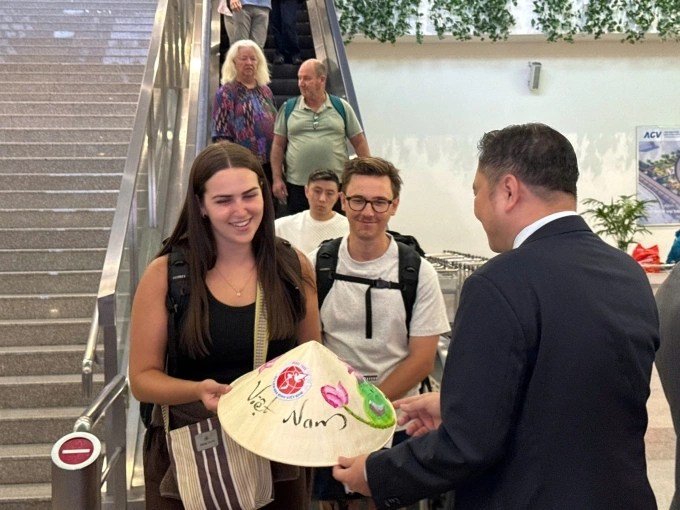
Foreign tourists welcomed in Vietnam. (photo credit: Ho Chi Minh City Department of Tourism)
In March the government decided to extend visa exemptions until 2028 for citizens of 12 countries: Denmark, Finland, France, Germany, Italy, Japan, Norway, Russia, South Korea, Spain, Sweden, and the U.K.
In August it waived visa requirements for stays of up to 45 days for citizens of 12 more countries: Belgium, Bulgaria, Croatia, Czechia, Hungary, Luxembourg, the Netherlands, Poland, Romania, Slovakia, Slovenia, and Switzerland.
This expanded the unilateral visa waiver list to 24 countries and the total number including bilateral waivers to 39.
Let me end this piece by asking you readers: What is your reaction to this development? Considering the strong international tourism momentum it has right now, do you think Vietnam will succeed in attracting 25 million foreign tourists this year? Do you think a lot more visitors from Europe will come to Vietnam this year?
With 2025 already behind us, one has to wonder how the Philippines performed when it comes to attracting foreign tourists and as of this writing, the final statistics have yet to be announced by the government. What is clear is that the Philippines really slumped on international tourism last year and the nation is behind many of its Southeast Asian neighbors, according to a recent news article by VnExpress International.
To put things in perspective, posted below is an excerpt from the news article of the VnExpress International. Some parts in boldface…
Vietnam and Malaysia are rising tourism stars in Southeast Asia thanks to relaxed visa policies and improving infrastructure while Thailand has lost its lead due to border clashes and safety concerns.
Vietnam received its 20th millionth foreign visitor in a year for the first time at the Phu Quoc International Airport on Dec. 15, marking a milestone for its tourism sector. The full-year is expected to exceed 21 million, surpassing the previous record of 18 million achieved in 2019 before Covid.
With its 21% growth rate this year, Vietnam is regarded by the United Nations World Tourism Organization as one of the fastest-growing markets in the world.
Malaysia attracted 28.2 million tourists in the first eight months of this year, a 14.5% increase year-on-year.
The industry will be supported by stronger Chinese tourist arrivals, improving flight connectivity and the government’s ambitious “Visit Malaysia 2026” campaign, according to HSBC Global Research.
“Malaysia is on track to easily exceed its 2025 tourism target of 31.4 million tourists, making it one of the few ASEAN economies to achieve its target.
“We estimate the number of tourists is likely to exceed 40 million.”
This year, both countries have strived to ease visa polices, enhance promotion campaigns and improve airport infrastructure.
Indonesia and Laos have also seen increasing tourist numbers.
Indonesia received over 12.76 million foreign visitors in the first 10 months, a 10% increase, with Malaysia, Singapore, Australia, and India being the leading source markets. Laos received 3.8 million, a 13% increase.
Challenging year for Thailand, Cambodia – Once a tourism powerhouse in Southeast Asia, Thailand has struggled with setback after setback this year.
The crisis began in January as many Chinese tourists canceled their trips to the country following the high-profile abduction of Chinese actor Xing Xing.
Two months later a deadly earthquake in Myanmar that sent tremors across Bangkok caused widespread damage to the tourism industry.
Escalating military clashes along the Thai-Cambodian border also triggered a surge in cancellations across provinces near the fighting. Some countries warned their citizens to postpone traveling to Thailand.
Arrivals as of early December declined by 7% to 30 million. Thailand had received 40 million tourists in 2019 and 35 million last year.
Meanwhile, Cambodia’s reputation took a beating in the eyes of South Koreans due to online scams and the disappearance of hundreds of their fellow citizens who entered that country.
The South Korean government has issued warnings to its citizens to cancel or postpone non-essential travel to the Cambodian capital Phnom Penh and areas like Sihanoukville and Bokor Mountain.
Cambodia attracted only 4.75 million tourists in January-October, a decrease of 11.6%.
The Philippines received 4.7 million foreign visitors in the first 11 months of the year, a 3.02% decline due to significantly lower arrivals from South Korea and China.
Let me end this post by asking you readers: What is your reaction to this recent development? Do you think the Philippines still has a lot of problems to solve regarding infrastructure, tourism promotions and domestic travel costs before it could become competitive with its Southeast Asian neighbors? If ever the Philippines fails to hit its 2025 foreign tourist arrivals target, do you think the Department of Tourism (DOT) will once again point to tourism revenues as a barometer for success? With its current standing on international tourism, do you consider the 2023-2028 National Tourism Development Plan (NTDP) of the Philippines a failure already?
For the newcomers reading this, the ACCC is the private entity that owns and operates ATC. Rockwell Land is the corporation known for the Power Plant Mall and Rockwell Center in Makati City. The Philippine Star news report mentions the ATC operator in the new acquisition.
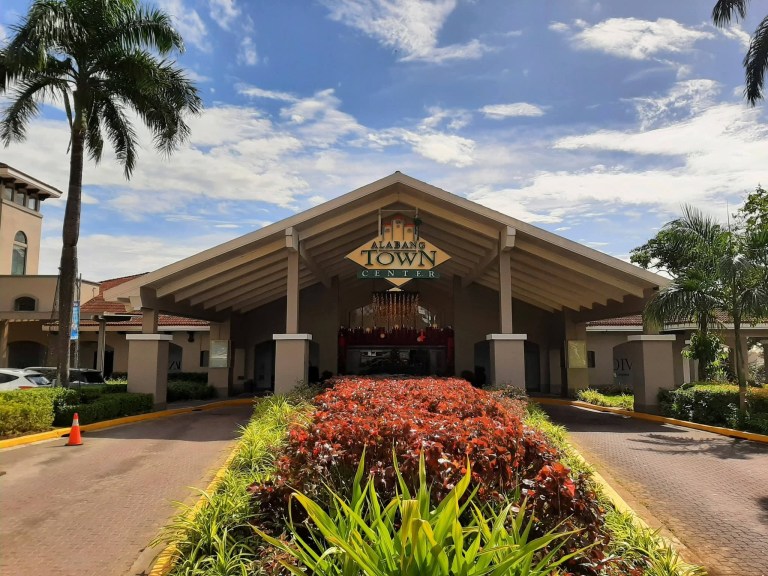
The front of Alabang Town Center along Madrigal Avenue.
To put things in perspective, posted below is the excerpt from the business news report of BusinessWorld. Some parts in boldface…
Lopez Family-led real estate developer Rockwell Land Corp. has acquired a 74.8% stake in the 17.5-hectare Alabang Town Center for P21.6 billion, expanding its commercial operations in the south.
“Earlier this year, Mr. Francisco ‘Jun’ M. Bayot invited us to consider redeveloping Alabang Town Center. It presented a compelling opportunity for Rockwell Land to further expand our presence in the south of Metro Manila, particularly given the scale and long-term potential of the property,” said Rockwell Land Chief Executive Officer Nestor J. Padilla in a statement on Monday.
“We are very grateful to Mr. Bayot and the Madrigal family for this opportunity. Our immediate focus is on ensuring a smooth transition and planning its redevelopment,” he added.
Alabang Town Center currently hosts more than 500 retail and office tenants, and its size offers significant redevelopment opportunities, the company said. Rockwell Land is known for its flagship mixed-use development, Rockwell Center Makati, anchored by the Power Plant Mall.
“Over the years, the company has enhanced its retail developments by integrating experiential and lifestyle-oriented spaces into its master planning, supported by curated tenant mixes. These efforts have enabled Rockwell Land to establish a strong track record in delivering a high-end retail experience,” it said.
Let me end this post by asking you readers: What is your reaction to this recent development? If you are a resident of Muntinlupa City, do you have any concerns about what would happen to Alabang Town Center under Rockwell’s control? Do you think the planned redevelopment of ATC will eventually make it better in the near future? What improvements do you hope to see at the ATC under Rockwell’s control?
For more South Metro Manila community news and developments, come back here soon. Also say NO to fake news, NO to irresponsible journalism, NO to misinformation, NO to plagiarists, NO to reckless publishers and NO to sinister propaganda when it comes to news and developments. For South Metro Manila community developments, member engagements, commerce and other relevant updates, join the growing South Metro Manila Facebook group at https://www.facebook.com/groups/342183059992673
Even though there already is a foreign tourism boom in Southeast Asia, the Philippines has literally been left behind by its neighbors as it attracted only 5.235 million international tourist arrivals for the period of January to November 2025, according to a news report by BusinessWorld.
To put things in perspective, posted below is an excerpt from the report of BusinessWorld. Some parts in boldface…
VISITOR ARRIVALS in the Philippines fell by 2.16% in the first 11 months, amid a decline in tourists from South Korea and China, Tourism department data showed.
Data from the Department of Tourism (DoT) showed international tourist arrivals dropped to 5.235 million in the January-to-November period from 5.35 million in the same period in 2024.
Of the tourist arrivals, the bulk or 4.918 million were foreign tourists, while the rest were overseas Filipinos.
South Korea remained the biggest source of tourists in the first 11 months, accounting for 21.66% of the total. While 1.134 million South Koreans visited the Philippines as of November, this was a 21% decline from the 1.436 million Korean tourists a year ago.
The US was the second-biggest source of tourists, at 894,835 or 17.09% of the total as of end-November. This was 6.57% higher than last year’s 839,635 tourist arrivals from the US.
Japan was the third-biggest source of tourists, accounting for 406,794 or 7.77% of the total, 15.36% up from 352,630 a year ago.
Tourist arrivals from Australia increased by 16.17% to 268,892 in the 11-month period. Meanwhile, tourists from China fell by 16.55% to 248,339 as of end-November.
The other top markets were Canada, Taiwan, the United Kingdom, Singapore, and Malaysia, which cumulatively accounted for 793,750 of the total arrivals.
“The weaker South Korean won amid a volatile political and economic situation over the past year and slower economic growth in China, which is the world’s second-biggest economy, on top of territorial disputes partly weighed on foreign tourism numbers,” Rizal Commercial Banking Corp. Chief Economist Michael L. Ricafort said in a Viber message.
Mr. Ricafort noted that the government should improve infrastructure to make it more convenient for tourists to travel around the country.
“Challenges include the need to further expand and develop tourism-related infrastructure such as airports, seaports, accommodation facilities, and train systems, including the Metro Manila subway and toll roads,” he added.
Despite the decline in the first 11 months, Mr. Ricafort said that it is still possible for the country to surpass the tourist arrivals last year, which reached 5.949 million.
“It is still possible, considering some seasonal increase in foreign tourists during the Christmas holiday season, especially overseas Filipino workers and balikbayans, to spend the most festive time of the year, while others escape winter,” he said.
“A higher US dollar-peso exchange rate would make it cheaper for foreign tourists to come to the Philippines,” he added.
Meanwhile, Mr. Ricafort noted the growth in tourist arrivals from India and other countries, which helped “offset the decline in major traditional sources such as South Korea and China.”
India was the 11th biggest source of tourist arrivals in the January-to-November period, accounting for 85,885 or 1.64% of the total. Tourists from India increased by 17.06% from 73,369 arrivals in the same period in the previous year.
Earlier this year, the Philippines and India signed the Implementation Program on Tourism Cooperation for the years 2025 to 2028.
For his part, Colliers Research Director Joey Roi H. Bondoc said that with only 5.235 million as of end-November, it will be difficult for the country to even surpass last year’s arrivals.
“I think it will be very difficult… We may not be able to beat that or even meet that, but of course we want to end the year stronger,” he said in a phone interview.
“We see a lot of foreign tourists still in December because of the holiday season. Definitely that optimism should spill over to next year,” he added.
As for the drop in arrivals from South Korea, Mr. Bondoc attributed this to the economic downturn and political crisis in the country.
“If you look at some integrated casinos, they were initially targeting Koreans… so they are experiencing the pinch of slower arrivals from South Korea,” he said.
Mr. Bondoc said the Philippines should try to attract tourists from other markets.
For further insight about the tourism industry problem of the Philippines, watch the CNA Insider video below.
Let me end this post by asking you readers: What is your reaction to this recent development? Did you think the Philippines can still beat its 2024 record of international visitor arrivals and generate huge revenues for the economy? Do you think the current administration will be able to improve the nation’s infrastructure and make travel more efficient and convenient for all tourists? Do you think the Philippines is too expensive when it comes to air travel?
A new age for the famous Alabang Town Center (ATC) in Muntinlupa City will soon begin as the developer Ayala Land Inc. (ALI) will sell its 50% stake in Alabang Commercial Center Corp. (ACCC) to the Madrigal family in a deal with P13.5 billion, according to a Manila Bulletin business news report.
For the newcomers reading this, the ACCC is the private entity that owns and operates ATC. Already, it has been reported that the Madrigal family is talking with Rockwell Land Corp. about redeveloping the high-end Alabang mall.
The front of Alabang Town Center along Madrigal Avenue.
To put things in perspective, posted below is the excerpt from the business news report of the Manila Bulletin. Some parts in boldface…
Ayala Land, Inc. (ALI) has agreed to sell its 50 percent stake in Alabang Commercial Center Corp. (ACCC), the entity that owns and operates the prominent Alabang Town Center mall in Muntinlupa City, back to the Madrigal family for ₱13.5 billion.
The real estate giant announced in a disclosure to the Philippine Stock Exchange that it executed a share purchase agreement with its existing joint-venture partner. The transaction is contingent on standard closing conditions.
“The unsolicited offer from our joint venture partner provided a premium, allowing ALI to recognize gains from the sale and monetize its stake in Alabang Town Center,” said ALI Chief Finance Officer and Treasurer Jose Eduardo A. Quimpo II.
He added that the “Proceeds from the sale will fuel further growth in our Leasing portfolio and provide our stakeholders with return of capital.”
In a separate statement, ALI said the deal allowed the company to realize “compelling value for the mature asset, crystallizing future earnings potential today.”
“This move is a deliberate execution of Ayala Land’s strategy to be a premier creator of value,” the company said. “It showcases a disciplined approach of developing assets, stabilizing their operations, and monetizing them at an optimal valuation to aggressively fund future growth and enhance shareholder returns.”
ALI President and Chief Executive Officer Meean B. Dy noted the firm’s strategic focus.
“Our strategy is focused on a dynamic cycle of value creation. We build, we stabilize, and we unlock value at the right time to fuel our next wave of innovation,” Dy said.
“This transaction is a prime example of that strategy in action. We are monetizing a legacy asset at peak valuation to accelerate the rollout of our expansive pipeline of commercial and retail spaces, which will define the Ayala brand of development for the next decade,” he added.
The proceeds from the sale are slated to be a key driver in funding ALI’s leasing pipeline, which includes nearly 700,000 square meters of new gross leasable area (GLA) over the next five years. This expansion is set to transform the commercial landscape in key growth centers across the Philippines.
Chinabank Capital Corp. Managing Director Juan Paolo Colet described the deal as “an opportunistic transaction that enabled Ayala Land to exit their joint venture with the Madrigal family at an attractive price. The company can readily use the cash for various projects in its growth pipeline.”
Colet noted that the future plans for the property remain uncertain.
“It remains to be seen what the Madrigal family will do with their prime commercial property. Given the price they paid, they would need to unlock more value from the asset. A major redevelopment might be on the table,” he said.
Situated adjacent to exclusive gated residential communities and active business developments, Alabang Town Center serves as a community anchor with multiple al fresco areas that contribute to a relaxed, homey atmosphere consistent with the local lifestyle.
Let me end this post by asking you readers: What is your reaction to this recent development? If you are a resident of Muntinlupa City, do you think the P13.5 billion deal will lead to a major redevelopment of Alabang Town Center in the near future? If you have visited the ATC before, how often do you visit the high-end shopping mall in Alabang? Do you feel confident the ATC will evolve and possibly expand under the control of the Madrigal family and Rockwell Land? Does Alabang Town Center’s current design and structure look old or outdated to you?
For more South Metro Manila community news and developments, come back here soon. Also say NO to fake news, NO to irresponsible journalism, NO to misinformation, NO to plagiarists, NO to reckless publishers and NO to sinister propaganda when it comes to news and developments. For South Metro Manila community developments, member engagements, commerce and other relevant updates, join the growing South Metro Manila Facebook group at https://www.facebook.com/groups/342183059992673
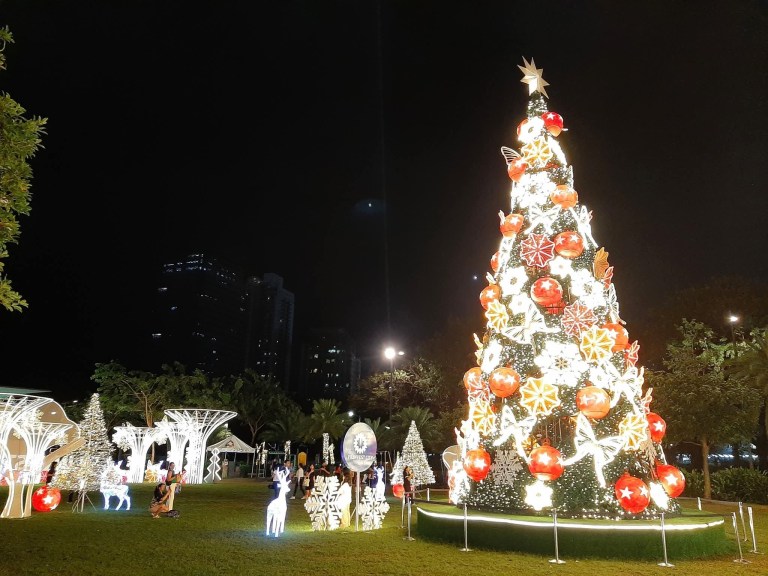
Recently, this year’s Christmas spectacle at the Filinvest City Central Park was launched by Filinvest with a special event that attracted special guests (including Muntinlupa City Mayor Ruffy Biazon and Olympic Gold Medalist Carlos Yulo).
A few nights ago, I personally visited Filinvest City Central Park (Google Maps location: https://maps.app.goo.gl/vzt8D9yLzRSVVhae9) and I saw the new decorations highlighting the Christmas season. They look very similar to what was set up in 2024, notably the tall Christmas tree and the permanent structures that only needed decorating.
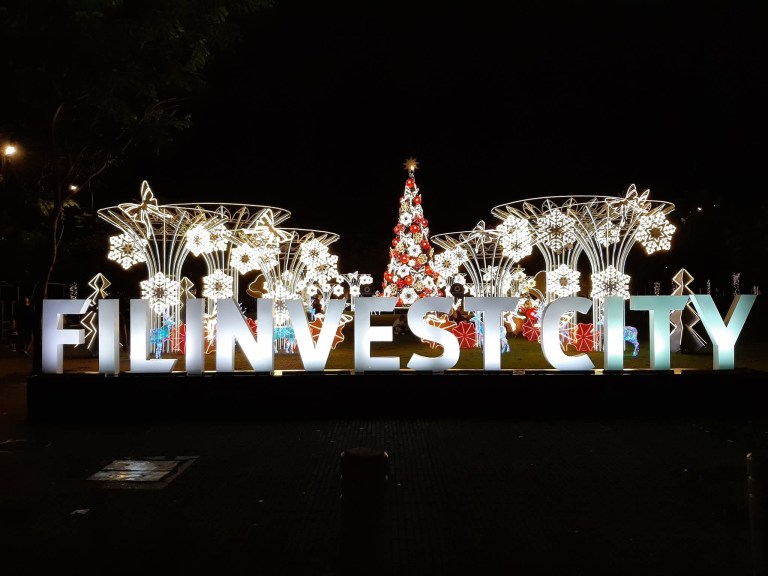
The Filinvest City sign at the Central Park.
Tall Christmas tree in the background, other decorations and lights in the foreground.
A short distance away from the tall Christmas tree was the park’s standout structure called The Tree (launched in late 2024) which has a very unique design that not only provides people cover from rain or intense sunlight but serves as a helpful place for special activities. At night, lights of different colors are projected towards The Tree which make a fine visual attraction.
As of this writing, I noticed there were lesser non-permanent structures (that were decorated with additional Christmas lights) during my visit at the park. Since Filinvest City still has a lot of activities scheduled at the central park, there is always the possibility that additional structure and lights will be set up soon. For reference about non-permanent structures and lights, click here for my 2024 Christmas Filinvest City Central Park article.
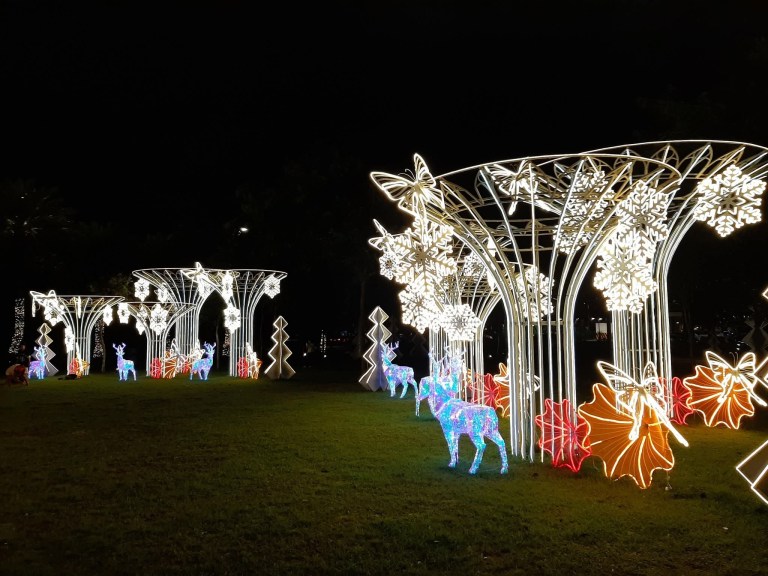
The permanent park structures plus added decorations and lights.
Visitors taking pictures at the tall Christmas tree.
Unsurprisingly, Filinvest City Central Park remains popular with families, visitors from other cities, some foreign tourists, and those who love the open-air environment of the CBD. It would be interesting to see if there will be more visitors coming to the park during the weekends leading to Christmas as the brand new Starbucks Filinvest branch with drive-thru has been attracting a lot of customers since it opened. That being said, Filinvest City announced through social media a schedule of events or activities happening at the central park.
Set to happen at Filinvest City Central Park are the following: Holiday Lights Symphony at The Tree on November 22, December 7 and December 20 starting 7PM; Fireworks Displace on November 22, December 7 and December 20 starting 8PM. Live musical performances on November 22-23, November 30, December 7, December 20-21 starting 6PM. To see the complete park activities schedule, click https://www.facebook.com/share/p/17aEHGaGX4/
Christmas is still all about Lord Jesus
The theme of Filinvest City’s Christmas campaign this year is titled as “Celebrate Magical Christmas Moments.”
First and foremost, Christmas is all about Lord Jesus, the Savior and hope of ALL nations. During the season, we remember not only His birth in Bethlehem in Israel, but also His overall significance and the hope He always bring to people. The world we live in is twisted and chaotic. While there are many who are indeed faithful to Lord Jesus, there are still many other people out there who remain lost and unsaved. A lot of people ended up lost as they allowed themselves to be manipulated by the secular, the worldly and other rebellious forces of the world we live in.
God sent His Son Jesus to us to pave the way for people to get saved and become part of His Kingdom. Realize how much God loves His creations and none of us would exist without Him. Learn from the bible verses below.
For here is the way God loved the world—he gave his only, unique Son as a gift. So now everyone who believes in him will never perish but experience everlasting life.
John 3:16 (TPT)
For unto us a Child is born,
Unto us a Son is given;
And the government will be upon His shoulder.
And His name will be called
Wonderful, Counselor, Mighty God,
Everlasting Father, Prince of Peace.
Isaiah 9:6 (NKJV)
Joseph also went up from Galilee, out of the city of Nazareth, into Judea, to the city of David, which is called Bethlehem, because he was of the house and lineage of David, to be registered with Mary, his betrothed wife, who was with child. So it was, that while they were there, the days were completed for her to be delivered. And she brought forth her firstborn Son, and wrapped Him in swaddling cloths, and laid Him in a manger, because there was no room for them in the inn.
Luke 2:4-7 (NKJV)
Now after Jesus was born in Bethlehem of Judea in the days of Herod the king, behold, wise men from the East came to Jerusalem, saying, “Where is He who has been born King of the Jews? For we have seen His star in the East and have come to worship Him.”
Matthew 2:1-2 (NKJV)
By honoring, praising and following Lord Jesus, we are connected with the Heavenly Father. When we are faithful to the Lord, it is clear that we do not let the worldly nor wickedness get in the way. It is essential that we must have uncompromising faith in the Lord. Learn from the bible verses below.
Then Jesus answered and said to them,
“Most assuredly, I say to you, the Son can do nothing of Himself, but what He sees the Father do; for whatever He does, the Son also does in like manner. For the Father loves the Son, and shows Him all things that He Himself does; and He will show Him greater works than these, that you may marvel. For as the Father raises the dead and gives life to them, even so the Son gives life to whom He will. For the Father judges no one, but has committed all judgment to the Son, that all should honor the Son just as they honor the Father. He who does not honor the Son does not honor the Father who sent Him.”
John 5:19-23 (NKJV)
Then Jesus said,
“I am light to the world, and those who embrace me will experience life-giving light, and they will never walk in darkness.”
For more South Metro Manila community news and developments, come back here soon. Also say NO to fake news, NO to irresponsible journalism, NO to misinformation, NO to plagiarists, NO to reckless publishers and NO to sinister propaganda when it comes to news and developments. For South Metro Manila community developments, member engagements, commerce and other relevant updates, join the growing South Metro Manila Facebook group at https://www.facebook.com/groups/342183059992673









 Author Carlo Carrasco