Retro Gaming Ads Blast – Part 34

Welcome back readers, fellow geeks and electronic gaming fans!

In this edition of the Retro Gaming Ads Blast (RGAB) series, we will take a look at another batch of retro gaming print ads – including arcade flyers – from the 1970s to the 1990s.

For the newcomers reading this, Retro Gaming Ads Blast (RGAB) looks back at the many print ads of games (console, arcade, computer and handheld) that were published in comic books, magazines, flyers, posters and newspapers long before smartphones, social media, the worldwide web and streaming became popular. To put things in perspective, people back in the 1980s and 1990s were more trusting of print media for information and images about electronic games and related products.

With those details laid down, here is the newest batch of retro gaming print ads for you to see and enjoy…

1. North American Pac-Mania arcade flyer
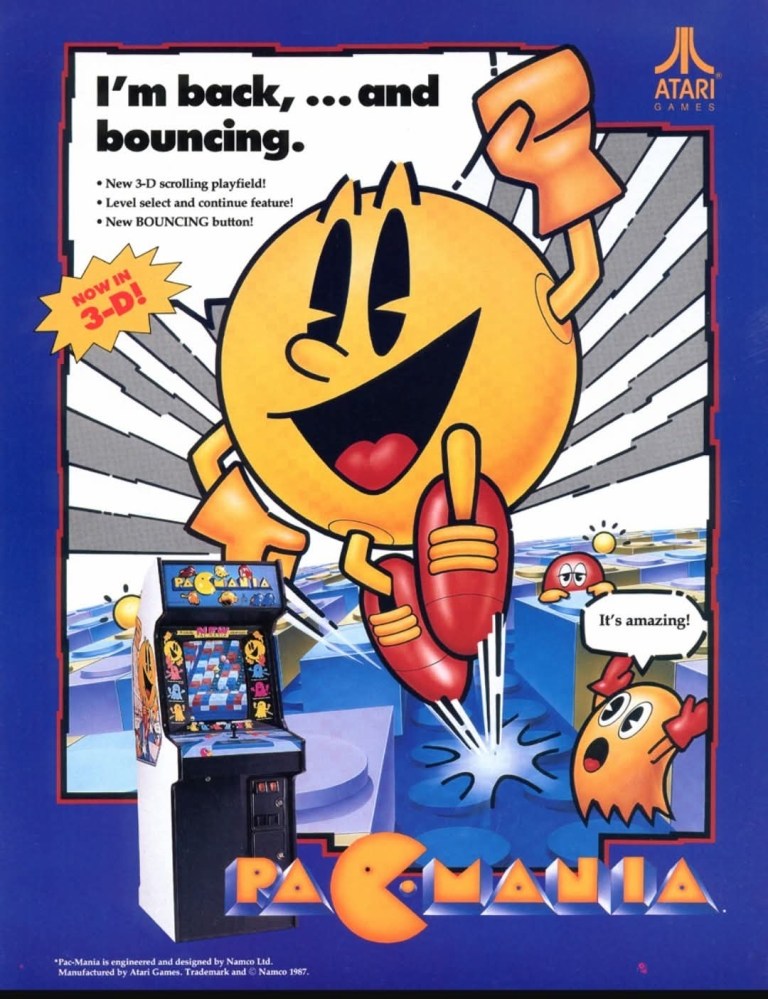
The front.
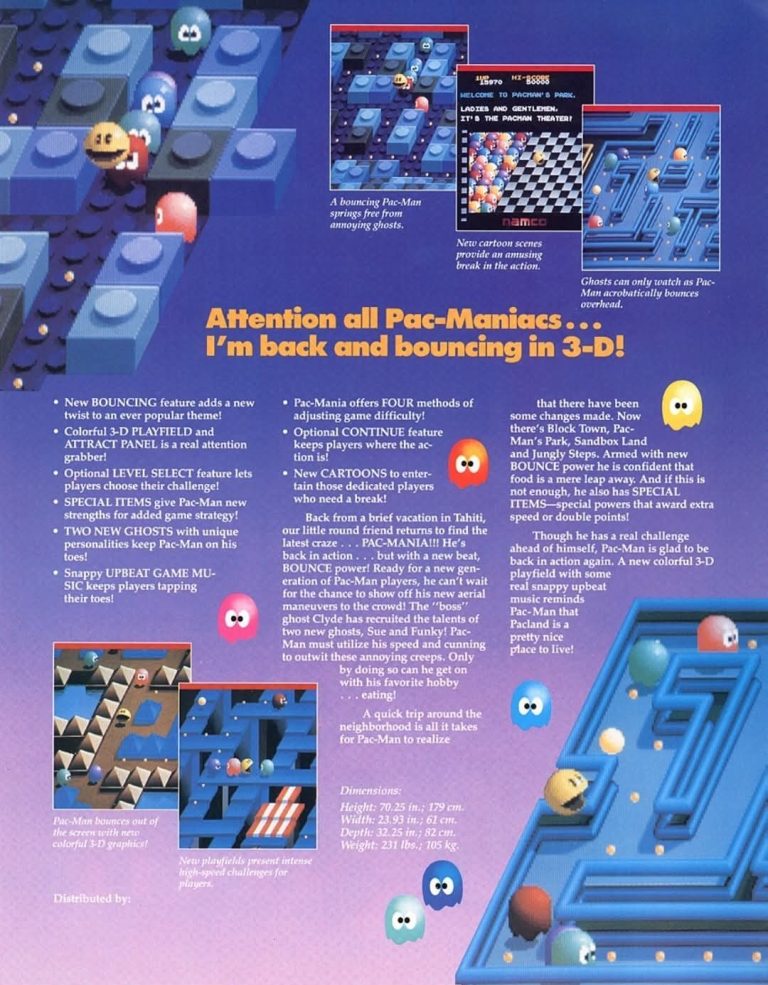
The rear.

Released in 1987, Pac-Mania became a big hit among critics, fans and casual arcade gamers which added a lot to the enduring popularity of the Pac-Man game franchise. As it featured a new game design with an oblique perspective and a more 3D feel, Pac-Mania was a very serious attempt on reinventing the Pac-Man formula. For the American market, Namco licensed the game to Atari which in turn came up with the above arcade flyer that had a pretty eye-catching front cover artwork showcasing the iconic Pac-Man jumping out from a maze with the line “I’m back,…and bouncing.” The arcade cabinet was also shown and a clear message about the 3D feature of the game was shown. The other side of the flyer showed screenshots and details that are worth reading. This arcade flyer still looks attractive and informative by today’s standards.

2. Japanese Missile Command arcade flyer
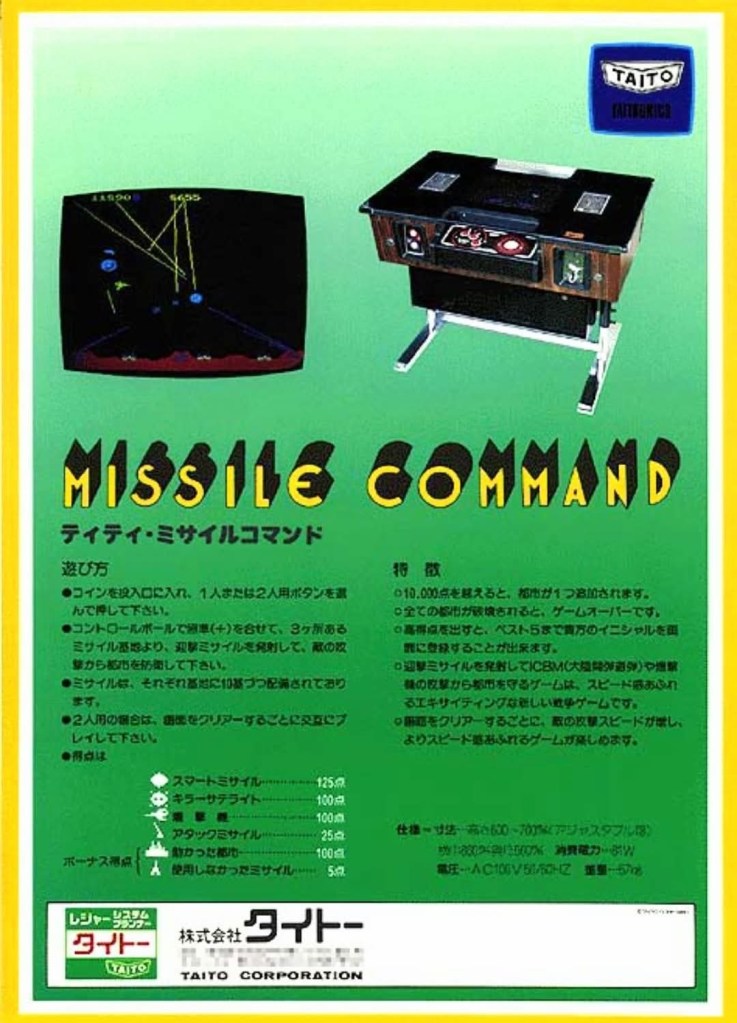
Cocktail arcade tables were popular in Japan and Taito brought Missile Command with the format.

Missile Command is a true arcade classic which I always enjoy replaying (read my retro review by clicking here). It was an instant hit in arcades in America and after Atari licensed the game to Sega and Taito for the arcades of Japan, it also achieved huge success there. Along the way, Taito released Missile Command with an cocktail arcade table format which is common in Japan. The arcade flyer Taito came up with had a very simplistic presentation of details, an image of the cocktail arcade table and one screenshot of the game. The Japanese arcade flyer clearly lacks excitement but at least it gave gamers and arcade operators a clear idea of what to expect with Missile Command.

3. Atari 2600 print ad
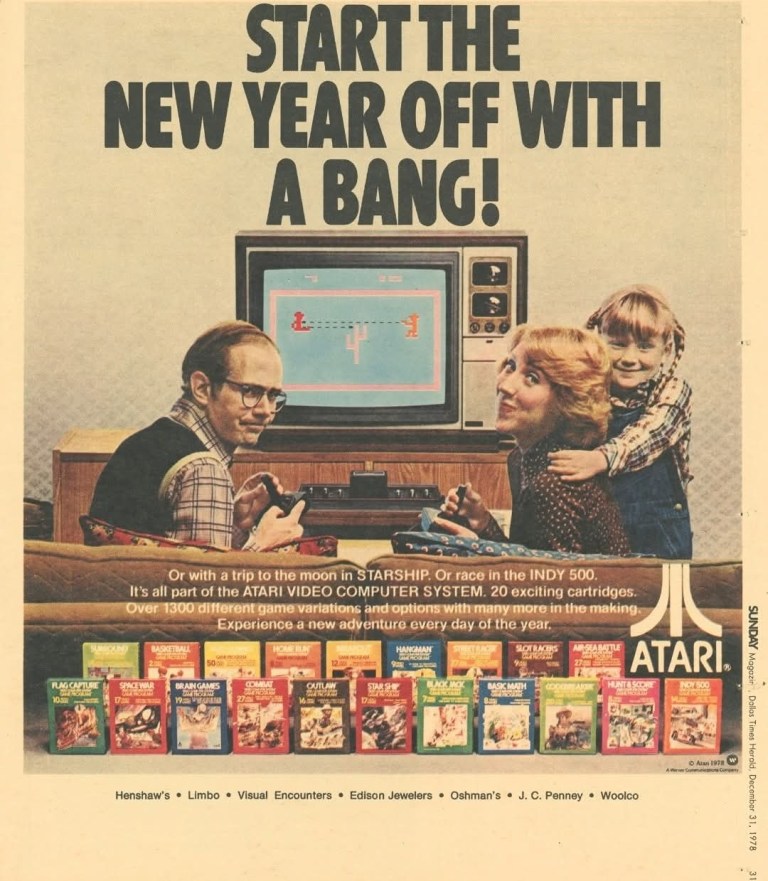
The 1978 print ad.

When the Atari 2600 was first launched in 1977, it was officially called the Atari Video Computer System (Atari VCS). The Atari company really aimed high to sell a lot of consoles to as many households as possible and they came up with a print ad like this one from 1978. While the Atari 2600 and its games were displayed, the image of a father, mother and daughter showed that the company not only targeted American families but also want to change home entertainment to be more interactive. This old ad is truly an inspired piece of work.

4. Kool-Aid Man video game print ad
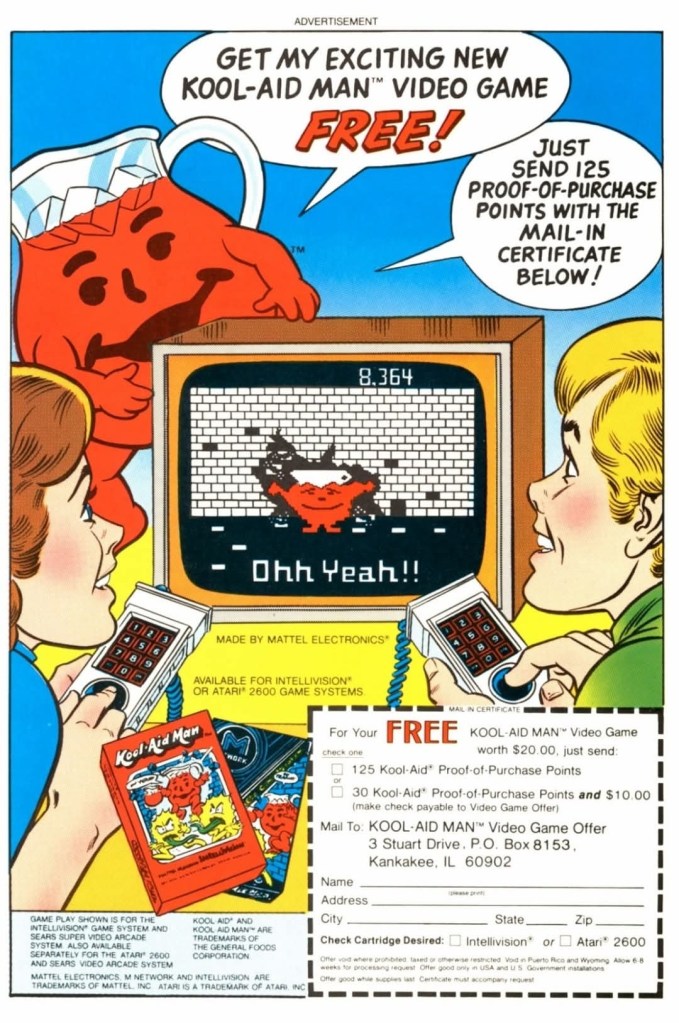
I never played the Kool-Aid Man video game.

There was a time when Kool-Aid was such a popular drink, the character Kool-Aid Man debuted in 1974 after initially starting as the Pitcher Man. A short time later, merchandising featuring the character followed and in 1983 the official Kool-Aid Man video game was released on the Atari 2600 and the Intellivision. This particular print ad appeared in some comic books I read a very long time ago and it offered customers the opportunity to get the game free by sending 125 proof-of-purchase points to the company by mail. This old ad was visually striking and was a creative way to boost sales of the drink.

5. Spider-Man Atari 2600 game print ad
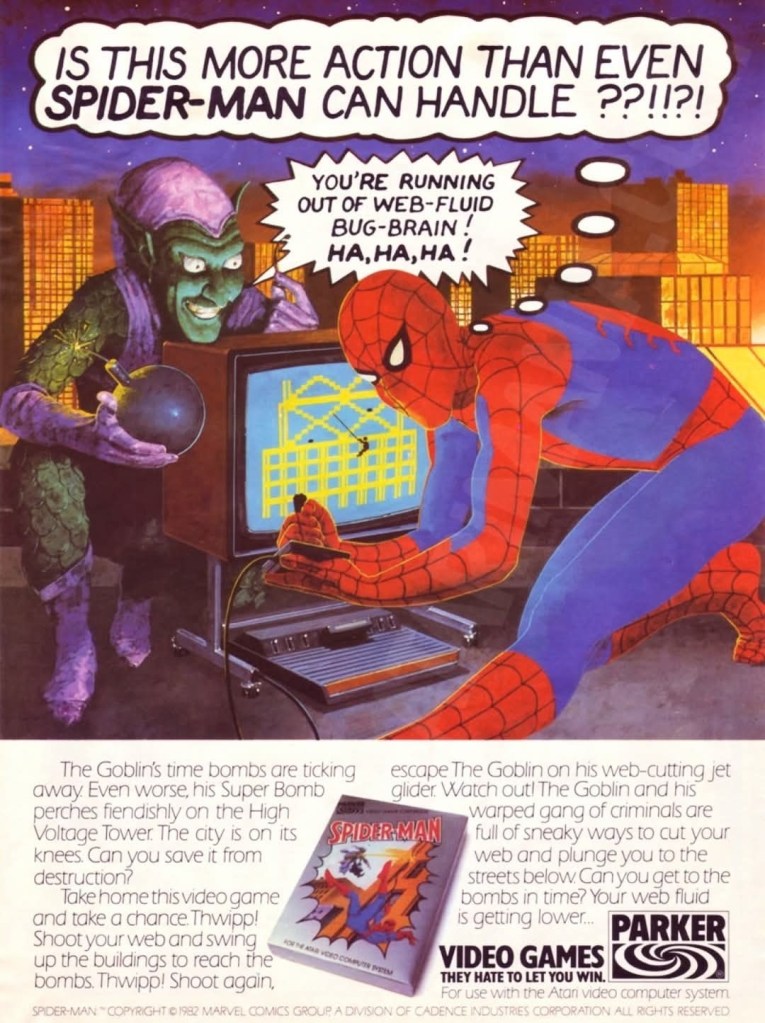
Spider-Man and Green Goblin with the Atari 2600 and the TV.

Even though the controls were rough and the game’s difficulty really went high with each new session, my friends and I still enjoyed playing the Spider-Man video game on Atari 2600 from Parker Brothers. Apart from the comic book-style print ads they came up with to promote the game, Parker Brothers went on to make this particular ad featuring Spider-Man and the Green Goblin with a TV set, the game and the Atari 2600 together all presented with a totally different art style. This is still a fun ad to look at.

6. Phoenix game print ad
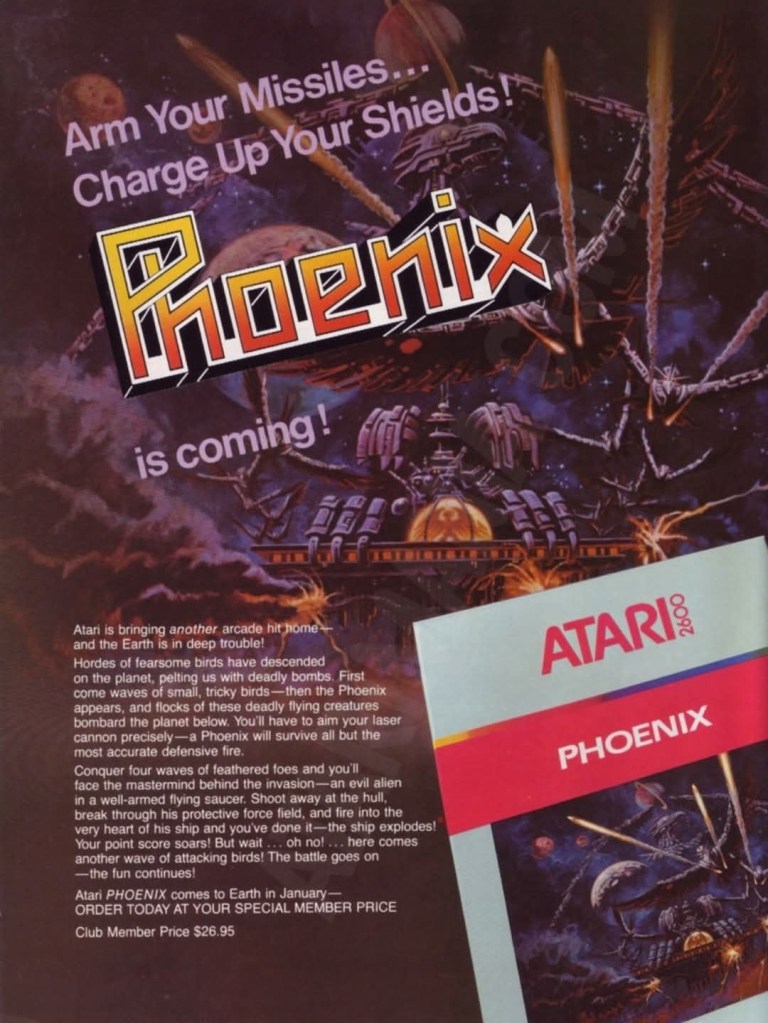
This is still an impressive print ad.

After playing shooter-type games like Space Invaders and Centipede on the Atari 2600, my friends and I experienced something familiar yet fresh with Phoenix. Atari secured from Taito the rights to make the Atari 2600 port of the game, and they came up with a dark print ad that showcased the official painted art work, a portion of the video game’s box and the line “Arm Your Missiles…Charge Up Your Shields! Phoenix is coming!” Having played the game many times, those highlighted words really captured the essence of Phoenix gameplay.

7. Sunset Riders North American arcade flyer
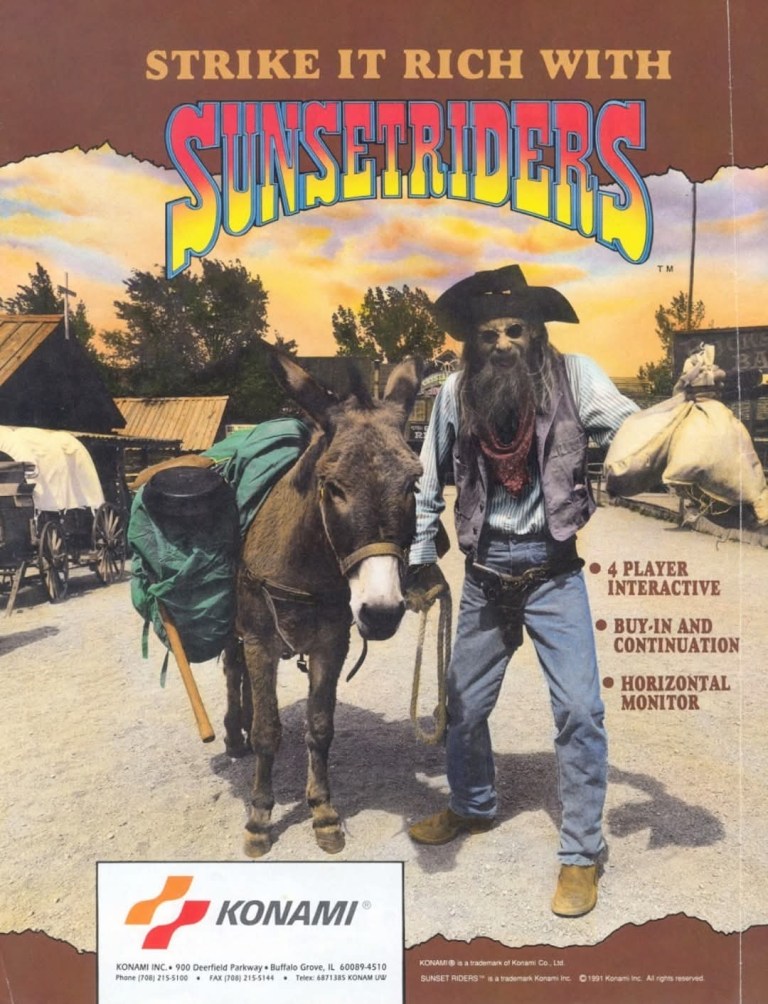
The front.
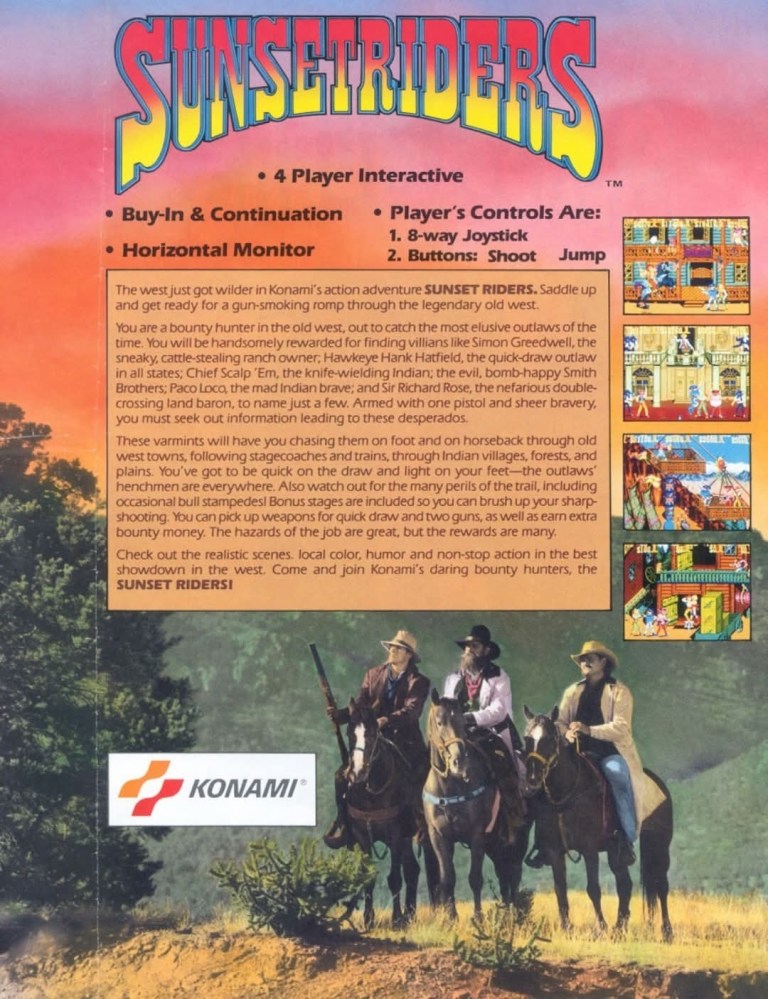
The rear.

Released in arcades in 1991, Sunset Riders was a critical and commercial hit raking in more success to Konami. For the American arcades, Konami came up with this print ad showing a creepy looking cowboy carrying a bag of money (related to the “strike it rich” line) with his donkey with him. The rear of the ad shows another photograph of 3 cowboys on their horses, the four screenshots and the creative text description. Too bad we don’t see flyers like this anymore.

8. Parker Brothers’ 6-game print ad
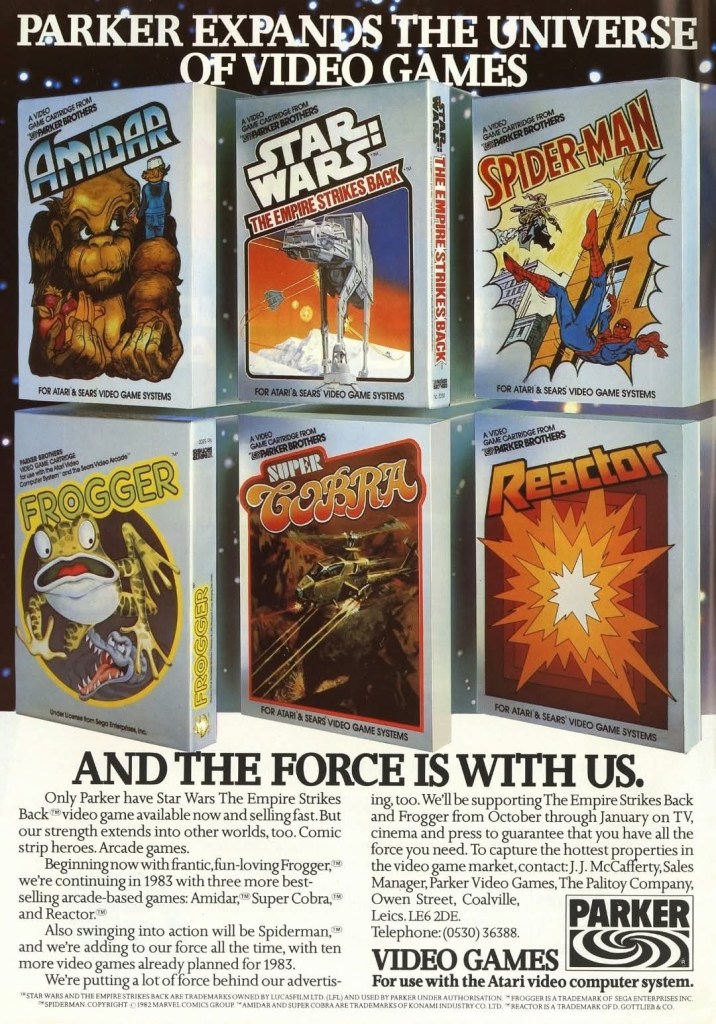
Parker Brothers 6-game print ad.

Quite arguably, Parker Brothers was the 2nd most prominent publisher of video games on the Atari 2600 console next to Atari itself. Out of the six games presented in this old print ad, I only played Spider-Man and Super Cobra. Each game’s box had a unique art style and collectively they made this ad look exciting. Times were really different back in the 1980s.

+++++

Thank you for reading. If you find this article engaging, please click the like button below, share this article to others and also please consider making a donation to support my publishing. If you are looking for a copywriter to create content for your special project or business, check out my services and my portfolio. Feel free to contact me with a private message. Also please feel free to visit my Facebook page Author Carlo Carrasco and follow me on Twitter at  @HavenorFantasy as well as on Tumblr at https://carlocarrasco.tumblr.com/ and on Instagram at https://www.instagram.com/authorcarlocarrasco
A Look Back at Spider-Man 2099 #44 (1996)

Welcome back superhero enthusiasts, 1990s culture enthusiasts and comic book collectors! Today we go back to the year 1996 and explore a part of the Marvel Comic shared universe through a tale of the Spider-Man 2099 monthly series.

To put things in perspective, the original Spider-Man 2099 monthly series that launched in 1992 lasted a total of 46 issues. The prolific author Peter David wrote the first 44 issues as he resigned from his duty in relation to the sudden firing of Marvel 2099 editor Joey Cavalieri in 1996. The previous issue was a great read.

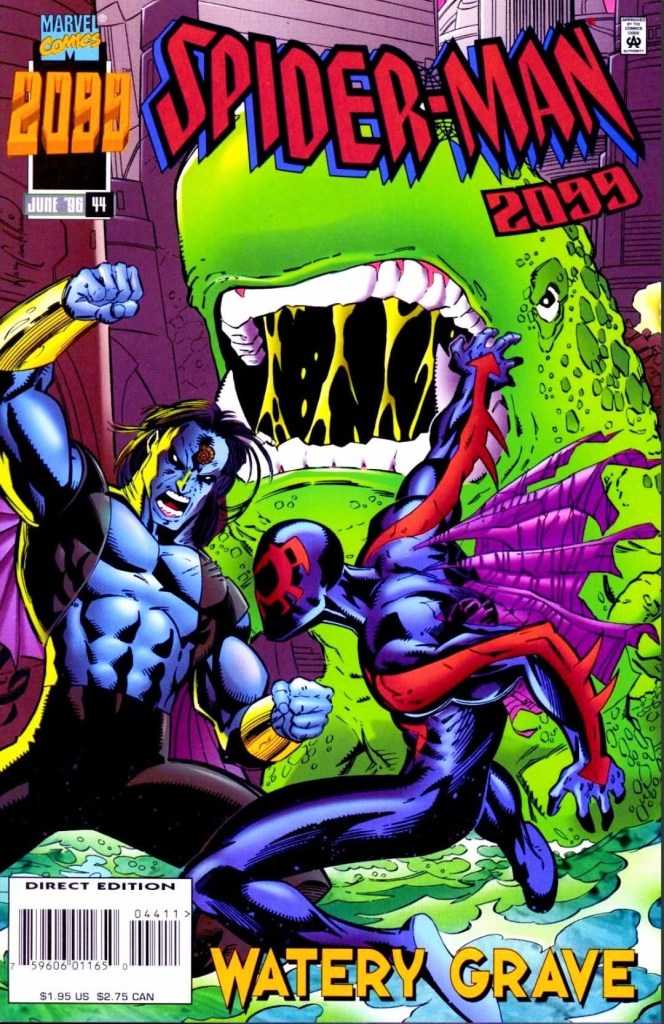
With those details laid down, here is a look back at Spider-Man 2099 , published in 1996 by Marvel Comics with a story written by Peter David and drawn by Ron Lim.

The cover.

Early story

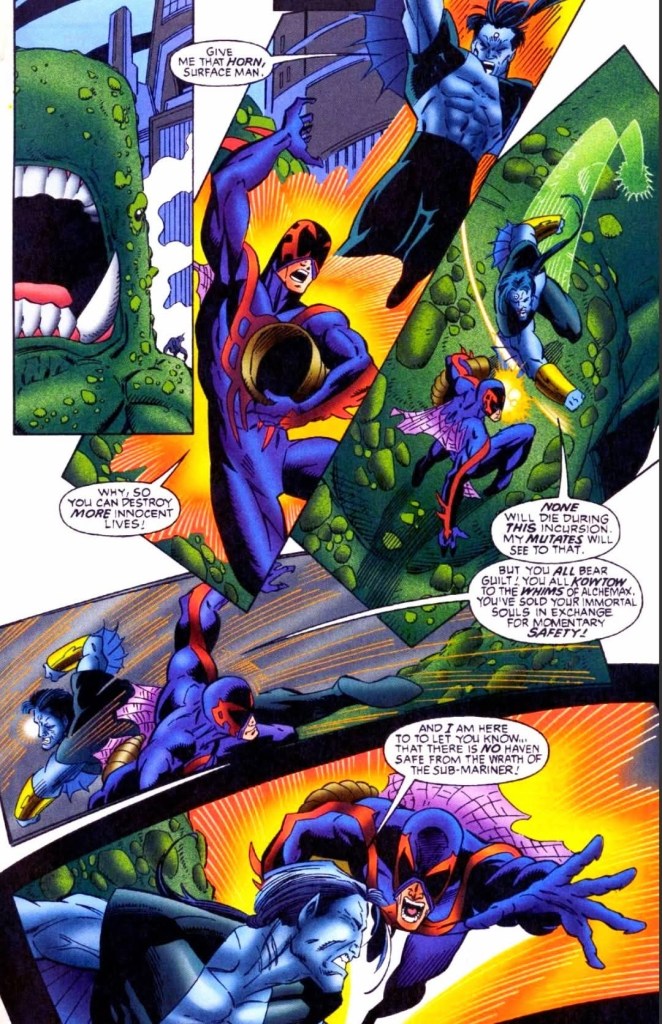
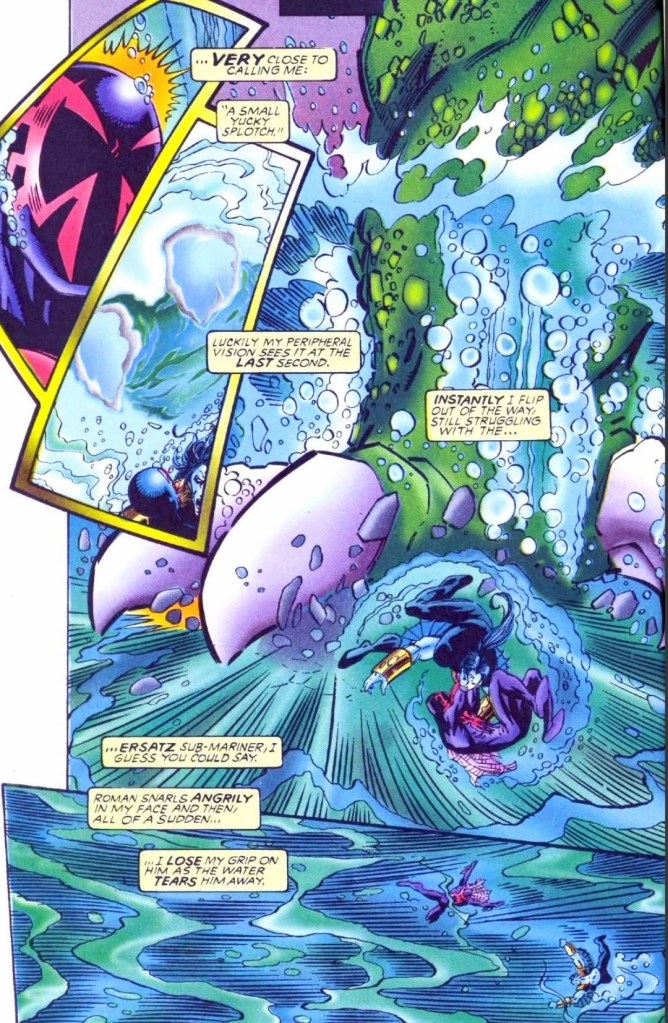
The story begins in the City of New York already flooded and infiltrated by lots of marine life. Under the water, Spider-Man and Roman the Sub-Mariner fight each other intensely as the foot of a gigantic sea monster is about to step in. At the last moment, Spider-Man saw the huge foot and instantly flipped away to survive with the Sub-Mariner.

After getting separated, Spider-Man gets out of the water to breath and immediately spots an organic-looking horn that the Sub-Mariner used to control the huge monster. Suddenly, on the aquatic humanoids appears to get the horn. Spider-Man then used his web to get the horn first which triggered the aquatic humanoid to move fast towards him.

Quality

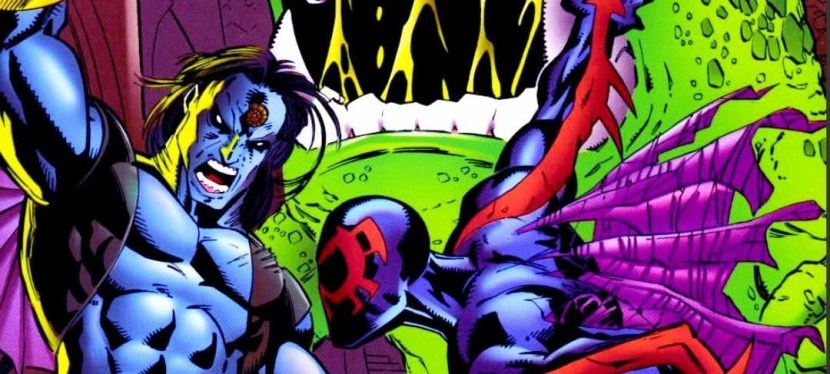
The intense battle between Sub-Mariner and Spider-Man went on even as the huge sea monster is very near them in the city.

Without spoiling the plot, this comic book is a tale about a massive disaster and also a tale about the complicated legacy of Miguel O’Hara whose personal life is even more connected with the corporation he works for.

The huge disaster of New York getting flooded (which started in the previous issue) and Spider-Man fighting the leader of the mutates (genetically designed sentient beings) concluded in a really satisfying way. The futuristic webslinger really found himself struggling with the determined Sub-Mariner (motivated by what Alchemax did to the aquatic world) while dealing with the fact that so many citizens got displaced or even got killed by not only the huge flood but also by the presence of the gigantic sea monster. The stakes were really raised high for Spider-Man and the pay-off was really good.

The rest of the comic book deals with the intense meeting between Conchata O’Hara and Tyler Stone, Xina’s time with the Net Prophet, Gabriel O’Hara’s time with “father” Jennifer. Among the three sub-plots, the conflict between Conchata and Tyler is very intense and dramatic to read. More importantly, it was crafted by Peter David to be really believable and it ultimately added tension to the background and even the future of Miguel O’Hara (now a powerful Alchemax executive). This particular sub-plot is easily the most important one this comic book has and it will compel fans to revisit the 25th issue of this monthly series as well as issue #10.

While the sub-plot of Xina and the Net Prophet does not generate enough depth for this comic book, there is a big revelation made in the sub-plot of Gabriel and “father” Jennifer which will compel fans to revisit issues #40 and #41. In fact, nothing is ever simple regarding the origin of a specific villain of the 2099 universe.

When it comes to the artwork, this comic book is a downgrade compared to what was presented in issue (drawn by Andrew Wildman). I’m not saying that Ron Lim’s art is bad, it’s just nowhere as good as that of Wildman’s art. In fairness, Ron Lim managed to make the city disaster look intense and he managed to make the characters look recognizable. In fact, Lim successfully made the Conchata-Tyler scenes look intense and dramatic.

Conclusion

The giant monster aspect of this comic book added intensity to the battle and the disaster. There were a few Godzilla vibes here and there.

As the final Peter David-written issue of this monthly series, Spider-Man 2099 (1996) is undeniably a very solid reading experience. There were strong pay-offs executed here to what was built-up in the previous issues, and in typical fashion, David kept building up the other sub-plots. The conclusion to the Conchata-Tyler sub-plot is actually more powerful than that of the city disaster. Clearly, Peter David kept track of the character developments and events that previously happened and dramatized them nicely here. In fact, you will feel some sympathy towards Miguel O’Hara knowing how unfortunately complicated his family legacy really is.  

Overall, Spider-Man 2099 (1996) is highly recommended!

+++++

Thank you for reading. If you find this article engaging, please click the like button below, share this article to others and also please consider making a donation to support my publishing. If you are looking for a copywriter to create content for your special project or business, check out my services and my portfolio. Feel free to contact me with a private message. Also please feel free to visit my Facebook page Author Carlo Carrasco and follow me on Twitter at  @HavenorFantasy as well as on Tumblr at https://carlocarrasco.tumblr.com/ and on Instagram at https://www.instagram.com/authorcarlocarrasco
A Look Back at Spider-Man 2099 #42 (1996)

Welcome back superhero enthusiasts, 1990s culture enthusiasts and comic book collectors! Today we go back to the year 1996 and explore a part of the Marvel 2099 comics universe through a tale of the Spider-Man 2099 monthly series.

In my previous retro review, the futuristic webslinger encountered a group of dangerous people who are convinced that he betrayed them by becoming a corporate tool (note: the result of Goblin 2099 poisoning people’s minds). Not only that, the still-recovering Tyler Stone came back at Alchemax, saw his captured son Kron (Venom 2099 himself) and cold heartedly ordered his execution.

With those details laid down, here is a look back at Spider-Man 2099 #42, published in 1996 by Marvel Comics with a story written by Peter David and drawn by Andrew Wildman.

The cover.

Early story

The story begins with Miguel O’Hara now wielding tremendous corporate power at Alchemax where he is surrounded by managers. Some time had passed since he prevented Tyler Stone from returning to power and he made it known to him that he is aware that they are biologically father-and-son. Miguel then played “duck, duck, goose” on the managers while he stood up on his desk. He made clear to them that he is aware of their so-called game of “who can jerk the new boost and get the most for himself?”

Miguel then tells them that he will review their requests and address their concerns in his own time and his own way. They get dismissed by him. Miguel then meets someone who just arrived for the post of office secretary.

Meanwhile in the downtown section of New York, Raff and Kasey watch a union group composed of construction guys, watchdogs, sewer workers and truckers marching down the street and making noise. As Kasey wonders where the group was heading, she notices a man named Boru whom she previously heard was dead…

Quality

Spider-Man 2099 faces a tough opponent.

Storywise, this tale by Peter David moved away from the themes of issues and by focusing more on Miguel’s newest rise in Alchemax’s corporate hierarchy and how this adds more tension to his already troubled living as a secret superhero, an executive and as a person. By this stage, he knows Tyler Stone is his true father and the man known as Venom 2099 is his half-brother and relationships within his family are far from being normal or ideal. Still on the corporate aspect, a very notable person gets to work as Miguel’s new secretary which I won’t spoil here because I can say that the build-up and pay-off are well worth reading. The new secretary also added to the further development of specific characters and what was dramatized here will compel you to revisit earlier issues of the Spider-Man 2099 series. As always, Peter David’s writing is rich here.

Outside of Alchemax, the group led by Boru (who is symbolically a leader of hardened and desperate labor union members) emerges as an intimidating force of opposition for Miguel, the corporation he leads and even in his Spider-Man identity. Boru himself is quite a strong opponent for Spidey and the way their battle ended is something can intrigue readers or even frustrate die-hard fans of the protagonist. These conflicts, combined with Miguel’s struggle with all the tension hitting him from all angles, made this tale very intriguing and compelling to read.

Conclusion

While walking through the city, Miguel O’Hara spots members of Fantastic Four 2099 in conflict with Stark-Fujikawa.

Spider-Man 2099 #42 (1996) may not look like the expected continuation of what was built up in the previous two issues but its standalone story combined with strong twists, in-depth character development and sheer intrigue in key points of the story made this a must-read. I can also say that I am motivated to find out what happens next, especially given how this particular tale ended.

Overall, Spider-Man 2099 #42 (1996) is highly recommended!

+++++

Thank you for reading. If you find this article engaging, please click the like button below, share this article to others and also please consider making a donation to support my publishing. If you are looking for a copywriter to create content for your special project or business, check out my services and my portfolio. Feel free to contact me with a private message. Also please feel free to visit my Facebook page Author Carlo Carrasco and follow me on Twitter at  @HavenorFantasy as well as on Tumblr at https://carlocarrasco.tumblr.com/ and on Instagram at https://www.instagram.com/authorcarlocarrasco
A Look Back at Spider-Man 2099 #40 (1996)

Welcome back superhero enthusiasts, 1990s culture enthusiasts and comic book collectors! Today we go back to the year 1996 and explore a part of the Marvel 2099 comics universe through a tale of the Spider-Man 2099 monthly series.

To put things in perspective, there were these notable changes with both the storytelling and the character development of the futuristic webslinger as a result of the Venom 2099 saga (read my retro reviews here, here, here, here and here) as well as Doom 2099 becoming the new President of the United States (click here). Issue #39 saw the return of Vulture 2099 and the sudden appearance of Green Goblin 2099 (AKA Goblin 2099).

With those details laid down, here is a look back at Spider-Man 2099 , published in 1996 by Marvel Comics with a story written by Peter David and drawn by Andrew Wildman.

The cover.

Early story

The story begins with the tycoon Tyler Stone helplessly on bed in a medical center’s room still recovering from the gun shot incident. He tells the doctor near him that he wants to speak to Dana and demands to know what has been going on. Stone also demanded to get into contact with President Doom. In response to Stone’s demand to know the truth, the doctor regretfully tells him that Dana is dead.

Meanwhile, a swinging Spider-Man gets hit from the back by Goblin 2099. As the webslinger asked who he is, the Goblin introduces himself and tells him that he intends to expose him as a fraud. As the green/purple colored mask freak keeps on attacking, Spider-Man moves out of the way. While in movement, Goblin tells Spidey that he has betrayed the good people of downtown New York and must be forced to confess.

As he falls down fast, the webslinger suddenly finds himself clamped and restrained by the Goblin…   

Quality

Goblin 2099’s main weapon against the futuristic Spidey is influence on people and being able to convince them to reject the webslinger.

This comic book has a very intriguing tale crafted by Peter David. While this marks the first ever encounter between the futuristic versions Spider-Man and Green Goblin, this one has a strong social theme that prevented the conflict from becoming a generic good-versus-evil match-up. Goblin 2099 went after the webslinger not for the satisfaction of killing, not for the intention of dominating the whole world but for achieving social change for the members of the downtown community by destroying Spider-Man’s credibility once and for all (by exposing him as a fraud and a tool of the corporate world who should not be trusted).

This version of the Green Goblin clearly has an agenda that he seems very willing to die for and the mere fact that he interacted with Kasey (an important person for both Miguel and Gabriel O’Hara) further adds to the complexity on both the new villain as well as the downtown community. Given his obsession of destroying the hero by blaming him as a corporate stooge, Goblin 2099 here is symbolically with the Satanic Left (Communist/Marxist/liberal). These factors effectively raise the stakes and risks for Spider-Man who already has a lot of problems to deal with.

Through the fight between Spider-Man and Goblin, you will see how the people of downtown react in accordance to their perception as well as their inability to realize the truth behind Spider-Man’s social standing. The way they reacted shows impact on Spidey who himself struggles to understand their collective thinking and why they allowed themselves to be strongly influenced by the Goblin.

Along the way, there was a scene that emphasized Xina showing how Dana’s death affected her and another scene that took place at a very old New York City cathedral that clearly was crafted to build up on something for future tales of this series.

Characterization and plot aside, this comic book has a good amount of superhero action that will keep you entertained and Andrew Wildman really knows how to make action attractive to your eyes.

Conclusion

Spotlight on Xina.

Spider-Man 2099 (1996) is another solid tale from the David-Wildman duo. Apart from the big impact Goblin 2099 had on Spider-Man and the people of just one community, this story successfully built-up the tension and complexity on the part of the protagonist while executing suitable pay-offs in relation to the build-up that started in the previous issue. Also I should state that it is very clear that the feature match-up in this comic book is not a rehash of classic Spider-Man and the Green Goblin. This is indeed a very intriguing Spidey 2099 tale that convinced me to look forward to the next issue.

Overall, Spider-Man 2099 (1996) is highly recommended!

+++++

Thank you for reading. If you find this article engaging, please click the like button below, share this article to others and also please consider making a donation to support my publishing. If you are looking for a copywriter to create content for your special project or business, check out my services and my portfolio. Feel free to contact me with a private message. Also please feel free to visit my Facebook page Author Carlo Carrasco and follow me on Twitter at  @HavenorFantasy as well as on Tumblr at https://carlocarrasco.tumblr.com/ and on Instagram at https://www.instagram.com/authorcarlocarrasco