A Look Back at Star Trek: Generations comic book adaptation (1994)

Welcome back superhero enthusiasts, 1990s culture enthusiasts and comic book collectors! Today we go back to the year 1994 to explore the official comic book adaptation of the movie Star Trek: Generations.

Star Trek: Generations was a cinematic production that symbolically served as the passing-of-the-torch from the original Star Trek crew (led by Captain Kirk) to the Star Trek: The Next Generation crew (led by Captain Picard). The most highlighted feature of the movie was the crossover between Kirk and Picard followed by working together to stop the villain. It was a crossover that fans wanted for some time prior to the film’s release.

In my experience, Star Trek: Generations was a disappointing movie as there were lots of flaws here and there. Most notably, the Kirk-Picard crossover (with William Shatner and Patrick Stewart in their most iconic roles) was nothing special as its payoff to all the build-up that preceded it was so small.

Unsurprisingly, there was comic book adaptation of Star Trek: Generations that appeared in the local comic book stores which I intentionally avoided reading back in 1994 as I anticipated the movie. Recently, I finally got to read it.

With those details laid down, here is a look back at the Star Trek: Generations comic book adaptation, published in 1994 by DC Comics with a story written by Michael Jan Friedman and drawn by Gordon Purcell based on the cinematic story by Rick Berman, Ronald D. Moore and Brannon Braga.

The cover.

Early story

The story begins with a retired James T. Kirk landing from his orbital skydiving activity in the presence of his long-time crew members and friends Pavel Chekov and Montgomery “Scotty” Scott. In response to Chekov’s reminder that they are to attend the launch ceremony of the USS Enterprise B (NCC-1701-B), Kirk as he is enjoying retirement and prefers to do other things like tri-elliptical jumping. Kirk also states that he swore he would never set foot on a starship again.

The next day, Kirk, Scotty and Chekov attend the ceremony at the Enterprise B greeted by journalists. Captain John Harriman personally tells Kirk that he read about his missions when he was in grade school.

Not so long after the Enterprise B launched into space, a distress call was received from a transport ship helplessly caught in some kind of energy distortion (with one other ship near it)…    

Quality

The crossover encounter between Star Trek’s two most iconic captains – Kirk and Picard.

As an adaptation, this comic book is surprisingly faithful to the source material for the most part. While this adaptation does not contain 100% of all the details and scenes of the movie and there were some scenes that were shortened for brevity but it certainly has quite a lot of content for readers to absorb. In fact, it will take two full readings to truly grasp the story, get to know the characters and understand the sci-fi details that Michael Jan Friedman brought from the movie script into literary format.

Like the movie, this adaptation tackles the themes of destiny, time and loss which were emphasized through Picard and Soran. While Picard would not dare to make alterations to cope with the deaths of two relatives he loved, Soran (who previously lost family members in a tragedy and temporarily made it to the a very desired realm) willingly makes tremendous acts to fulfill his goal even it means costing tremendous death and destruction along the way.

Worf, Riker, Troi and Data on the bridge of the Enterprise during their encounter with the Klingons’ Bird of Prey.

When it comes to storytelling, this one is more about the Star Trek: The Next Generation crew facing a crisis. The scenes of Kirk and his original crew members served as a glorified prologue designed to give moviegoers (as opposed to readers) one final act of heroism by the iconic captain. Kirk doing the heroic stuff early in the story was pretty much a tribute to his past while conveniently serving as a subtle build-up for the Picard-Soran conflict and the Nexus (Star Trek’s distorted version of Heaven) leaving not much left for the Kirk-Picard crossover.   

Anyone who loves Star Trek: TNG will be delighted to see their favorite characters like Picard, Data, Riker, Deanna Troi, Dr. Beverly Crusher,  Geordi La Forge and Worf here as they each had good chunks of the spotlight. If you saw the movie before reading this comic book adaptation, you will be able to spot the notable lines of dialogue they said on the big screen. As details from the movie had to be compressed for this adaptation, those who got turned off by the excessive screen comedy by Brent Spiner as Data (note: this reflects the emotion chip activated in the character) will be delighted to see the funny acts were heavily toned down in favor of maintaining the narrative. 

More on the quality, this adaptation also exposes many of the weakness and flaws of the movie itself. I am talking about the film’s lack of consistency when it comes to emphasizing the most important concepts of the story. Throughout the story, Kirk’s early heroic act had no real impact when the narrative focused on Star Trek: TNG nor was it a solid build-up for the crossover with Picard. The script emphasized the Nexus quite a lot but in different points as the narrative switched between focusing on Picard and Soran. That being said, the way the story was told made it easy to forget about Kirk and Picard coming together. Like in the movie, the Kirk-Picard crossover failed here too.

While the movie is indeed a very flawed source for this comic book, the adaptation spared readers from the monotony of the many pointless moments and sequences that moviegoers went through. This is understandable because brevity was needed to capture the cinematic story into literary format with the limited number of pages allocated.

If there is anything consistently good here, it is the art of Gordon Purcell who proved to be capable of capturing enough of the actors’ likenesses to make the characters recognizable. To be clear, the replication of the actors’ unique looks happened from time to time only.  

Purcell did a great job making Scotty (close-up at right) look so much like actor James Doohan.

You will see certain parts of the comic book showing Captain James T. Kirk looking like William Shatner and Captain Picard looking like Patrick Stewart. There were certain pages in which Soran had Malcolm McDowell’s face, Scotty looked so much like James Doohan and more. Ironically, Purcell fell short of capturing likenesses of Marina Sirtis as Troi and Gates McFadden as Dr. Crusher.

Apart from drawing the characters, Purcell nicely visualized the look of the film and his own take of the memorable saucer crash of the TNG crew’s Enterprise had a of power and impact worth seeing. Lastly, he the artist did a good job drawing the starships.

At the very end of this adaptation were a few pages that emphasized the challenges of adapting the movie into literary format which was worth reading. 

Conclusion

The scene of Picard revealing to Deanna Troi the deaths of his two relatives (obviously without Patrick Stewart’s emotional moment).

The Star Trek: Generations (1994) comic book adaptation is clearly flawed like the movie it was based on. Many of the movie’s weaknesses (including the ever disappointing Kirk-Picard crossover) made it in this comic book but the ironic thing is that the story in literary format flowed with a better pace and Gordon Purcell’s art was really attractive to look at. In fact, I can clearly say that Star Trek: Generations works better as a comic book than as a film.

Overall, the Star Trek: Generations (1994) comic book adaptation is satisfactory.

+++++

Thank you for reading. If you find this article engaging, please click the like button below, share this article to others and also please consider making a donation to support my publishing. If you are looking for a copywriter to create content for your special project or business, check out my services and my portfolio. Feel free to contact me with a private message. Also please feel free to visit my Facebook page Author Carlo Carrasco and follow me on Twitter at  @HavenorFantasy as well as on Tumblr at https://carlocarrasco.tumblr.com/ and on Instagram at https://www.instagram.com/authorcarlocarrasco
A Look Back at Prototype #0

Disclaimer: This is my original work with details sourced from reading the comic book and doing personal research. Anyone who wants to use this article, in part or in whole, needs to secure first my permission and agree to cite me as the source and author. Let it be known that any unauthorized use of this article will constrain the author to pursue the remedies under R.A. No. 8293, the Revised Penal Code, and/or all applicable legal actions under the laws of the Philippines.

If you are looking for a great origin story set within the Ultraverse, you can’t go wrong with Prototype #0. Before we explore the said comic book, let me remind you that during my review of Prototype , I stated that it was great and it had a nice balance between spectacle, storytelling and characterization. There were also references to some threads to the past with regards to Bob Campbell (the original Prototype pilot) who could not help but witness his replacement Jimmy Ruiz have the spotlight being the new Prototype.

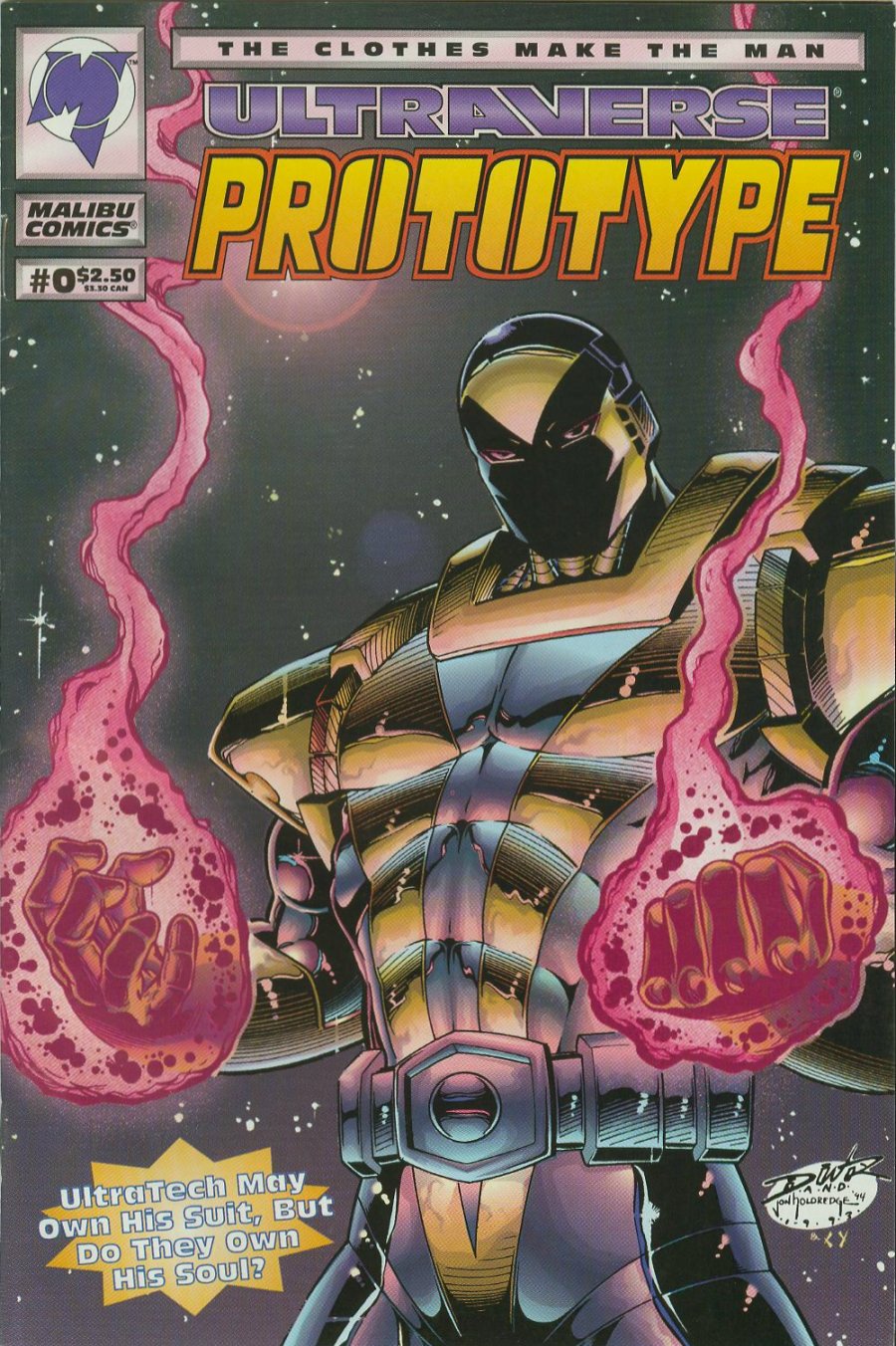
That being said, we can take a trip to the events that happened in the past with this look back at Prototype #0, published in 1994 by Malibu Comics with a story written by Tom Mason and Len Strazewski with illustrations done by Gordon Purcell and Keith Conroy.

Cover
The cover.

Early story

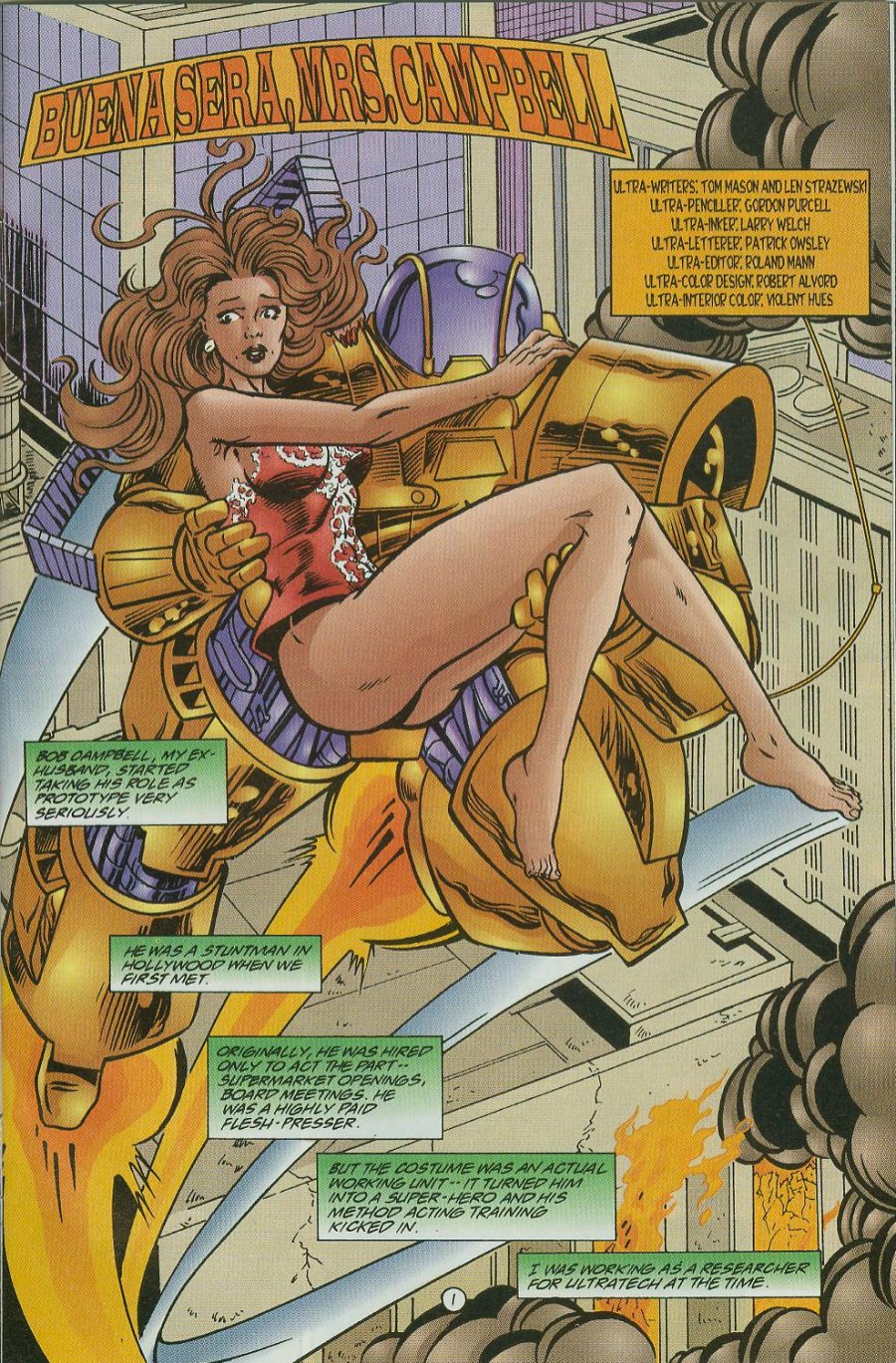
The story begins some time in the past with an interview with top executive Stanley Leland who recalls how Bob Campbell got involved with his corporation Ultratech. As it turned out, Campbell was working in Hollywood as a stunt performer in science fiction films. Campbell fit in nicely with Hollywood job having previously served as a member of the United States Army’s special forces and has been experienced with tactical weapons and hand-to-hand combat.

The advertising agency of Leland’s company hired Campbell to wear a multipurpose exoskeleton prototype armor for the filming of a promotional project meant for the military. Campbell used what turned out to be the original Prototype armor which was very bulky and had a dome-style metallic head (that reminds of Marvel’s Mysterio). Even though it was bulky, the armor was still loaded with weapons and enhanced the pilot’s physical strength by twenty times complete with artificial intelligence (AI) assisting with the operation.

21
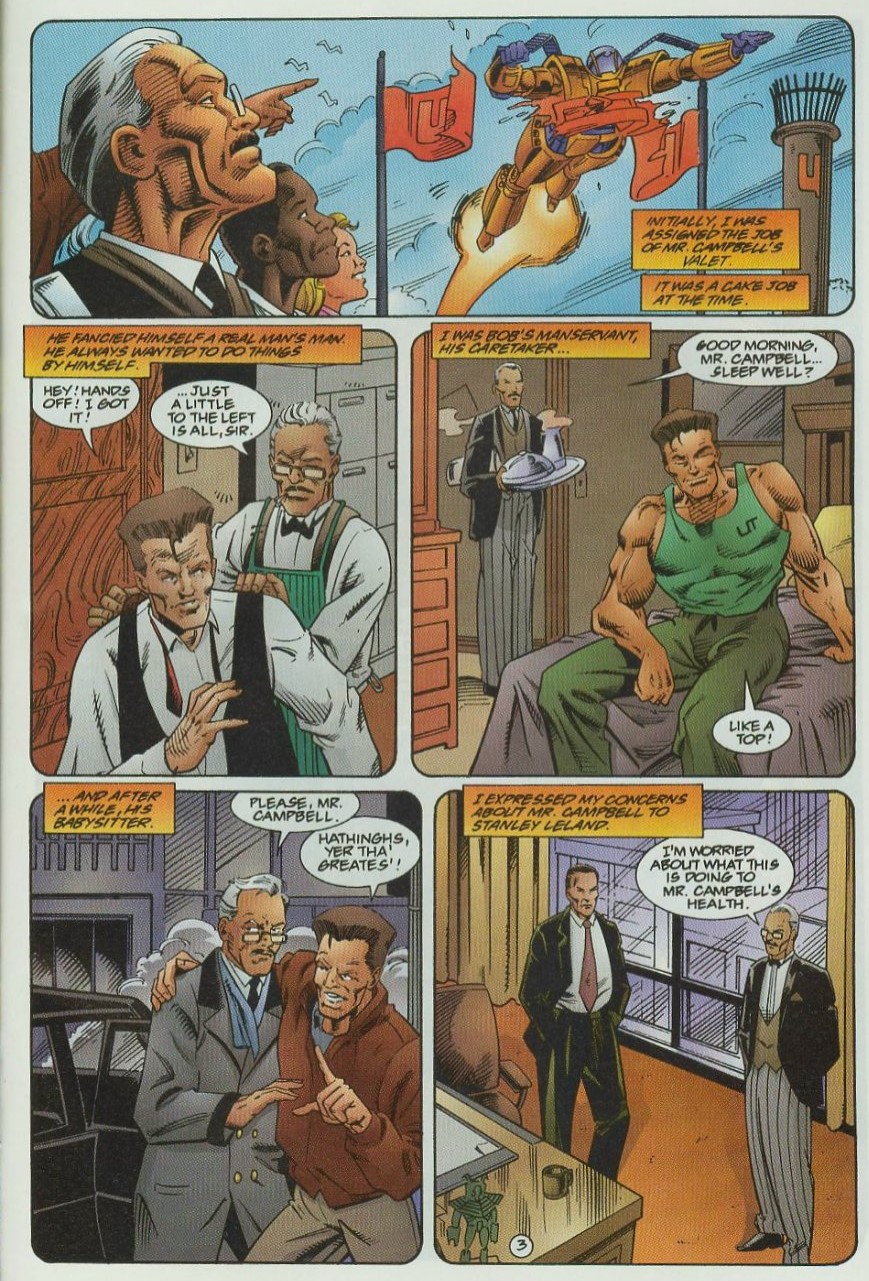
Taking care of Bob Campbell, the original Prototype pilot.

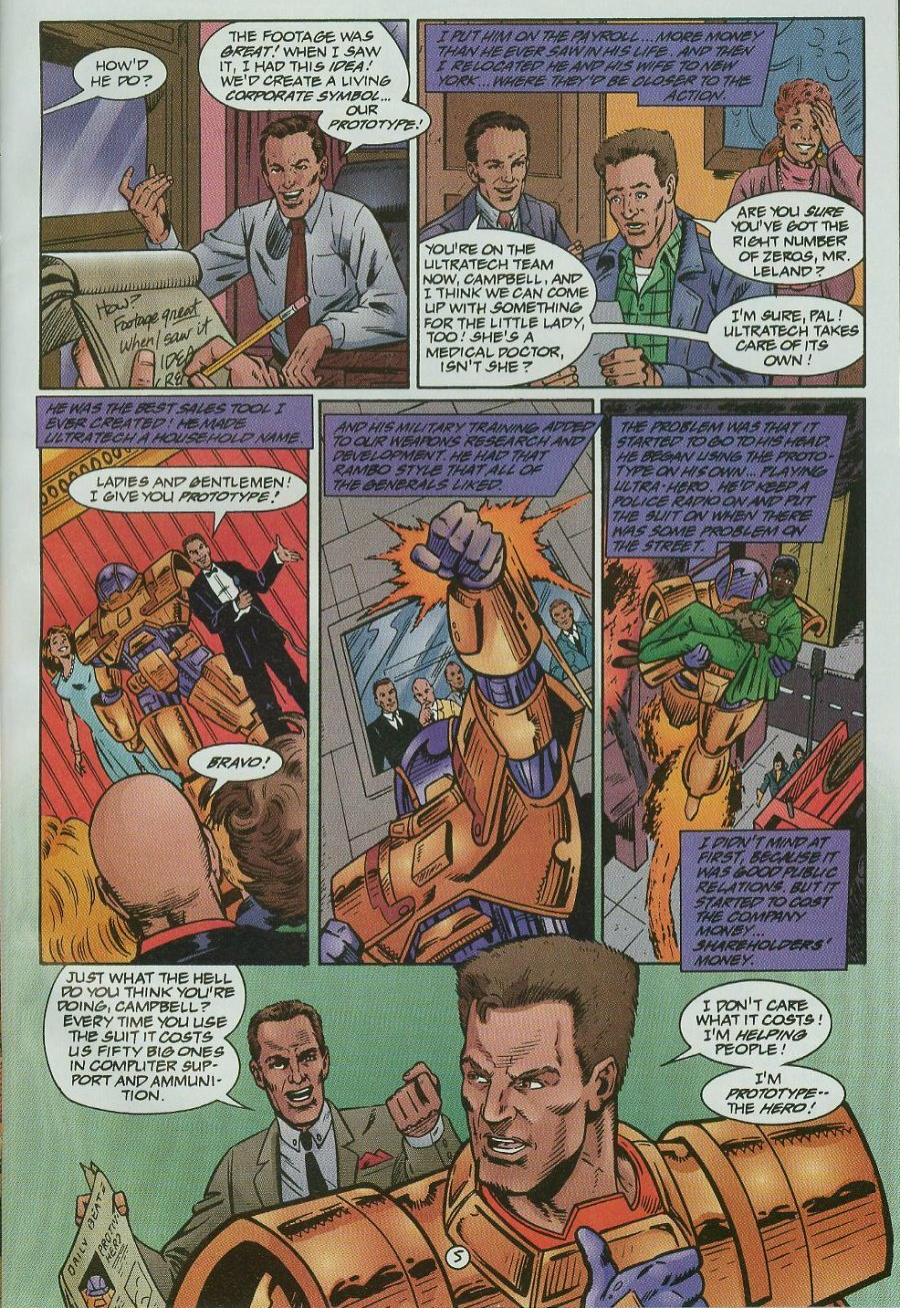
Even though there was a hitch (something went offline) during the filming, Bob Campbell still managed to make great use of the armor and delivered results so spectacular, Leland hired him with a high-paying contract to work officially as Prototype.

Ultratech benefited nicely in terms of sales with Prototype as their key figure and Campbell had that Rambo style which impressed the military. Shortly after, the success started entering Campbell’s head resulting more costs for Ultratech…

Quality

7
The original Prototype saved a pretty lady!

This is one great and very cleverly crafted superhero origin story! When it comes to the presentation, the exploration of past events by means of recollections and memories of different people interviewed is excellent! Having worked before as a reporter for a local community newspaper, I myself interviewed a lot of people to dig for information about the past and as such, this comic book’s approach is something I personally strongly relate with.

Through the words of Leland, Campbell’s ex-wife, Marjorie Fredericks and Hastings the caretaker, the details of what happened with Bob Campbell as the original Prototype are clearly defined. The same goes with the nature of Ultratech as a corporation and owner/developer of the powered suits of armor, not to mention how they affect the public’s perception and how they treat their employees. The last chapter focused on Jimmy Ruiz and how he became the present-day Prototype was handled in a more conventional way.

Along the way, the dialogue is very well written and the characters are nicely defined which is no surprise considering the combined high talents of Tom Mason and Len Strazewski. The art provided Gordon Purcelli and Keith Conroy is very good. Apart from the in-depth writing, the dynamic action and strong visuals, I should say that this comic book is a lot of fun to read and it perfect connects with issue .

Conclusion

5
Bob Campbell hired full-time as Prototype pilot.

Prototype #0 is undoubtedly a great comic book to read and easily one of the very best Ultraverse stories I read (apart from being one of the best superhero origin stories of the UV) so far. I was really engaged from start to finish, and I should state that Bob Campbell’s importance is real even as he became the has-been character in the later Prototype issues. This comic book successfully achieved its purpose on telling the origin of Prototype and made sense out of what Roland Mann said: the race has only just started!

If you are seriously planning to buy an existing hard copy of Prototype #0, be aware that as of this writing, MileHighComics.com shows that the near-mint copy of the comic book costs $4.

Overall, Prototype #0 is highly recommended!


Thank you for reading. If you find this article engaging, please click the like button below and also please consider sharing this article to others. If you are looking for a copywriter to create content for your special project or business, check out my services and my portfolio. Feel free to contact me as well. Also please feel free to visit my Facebook page Author Carlo Carrasco and follow me at HavenorFantasy@twitter.com

A Look Back at What If #58 (1994)

Disclaimer: This is my original work with details sourced from reading the comic book and doing personal research. Anyone who wants to use this article, in part or in whole, needs to secure first my permission and agree to cite me as the source and author. Let it be known that any unauthorized use of this article will constrain the author to pursue the remedies under R.A. No. 8293, the Revised Penal Code, and/or all applicable legal actions under the laws of the Philippines.

In early 1994, I was still in high-school. There was a time when I passed by a local comic book store that showed a new What If? comic book displayed among the many new titles. That particular comic book caught my attention because of its key question: What if the Punisher had killed Spider-Man?

That comic book was What If #58 published by Marvel Comics with a story by Chuck Dixon and art by Gordon Purcell. Check out the cover below.

Cover
The cover of this comic book took a lot of inspiration from that of Amazing Spider-Man .

To put things in perspective, Spider-Man and Punisher are both heroes in the universe of Marvel Comics but with very drastic differences between them. Spider-Man/Peter Parker fights crooks and other types of bad guys while maintaining a lawfully good nature even as he struggles to live a normal, personal life. Punisher, who is privately Frank Castle, is a killer who is driven to fight criminals beyond the boundaries of the law. The Punisher resorts to extreme forms of violence and guns are his main weapons. Due to the tragic loss of his wife and children, Punisher lives to wage a one-man war against criminals which only reflects the huge loss of his humanity.

Spider-Man and the Punisher first encountered each other in Amazing Spider-Man . Through the years, the two would face-off again and again. In the mid-1980s, the Punisher went on to rise in high popularity with comic book readers as Marvel Comics published three regular series: The Punisher, The Punisher War Journal and The Punisher War Zone.

That being said, we take a look back at What If #58.

Early story

Without involving Marvel’s galactic Watcher, the comic book begins with the Punisher aiming his gun at a man seated behind his desk. It turns out Punisher is waiting for the police to arrive at the place they are in.

From this point, the story is told in flashback with Punisher narrating. He is with the Jackal on the roof top of a building in New York City. Even as the Jackal pushes him to shoot a certain target already, the Punisher decides not to do it. He stressed he wants to study the target.

“It seemed right. Taking down a high profile outlaw like Spider-Man looked like the right way to go,” Punisher thought. “And Jackal promised unlimited funding of my war on crime if I succeeded.”

6
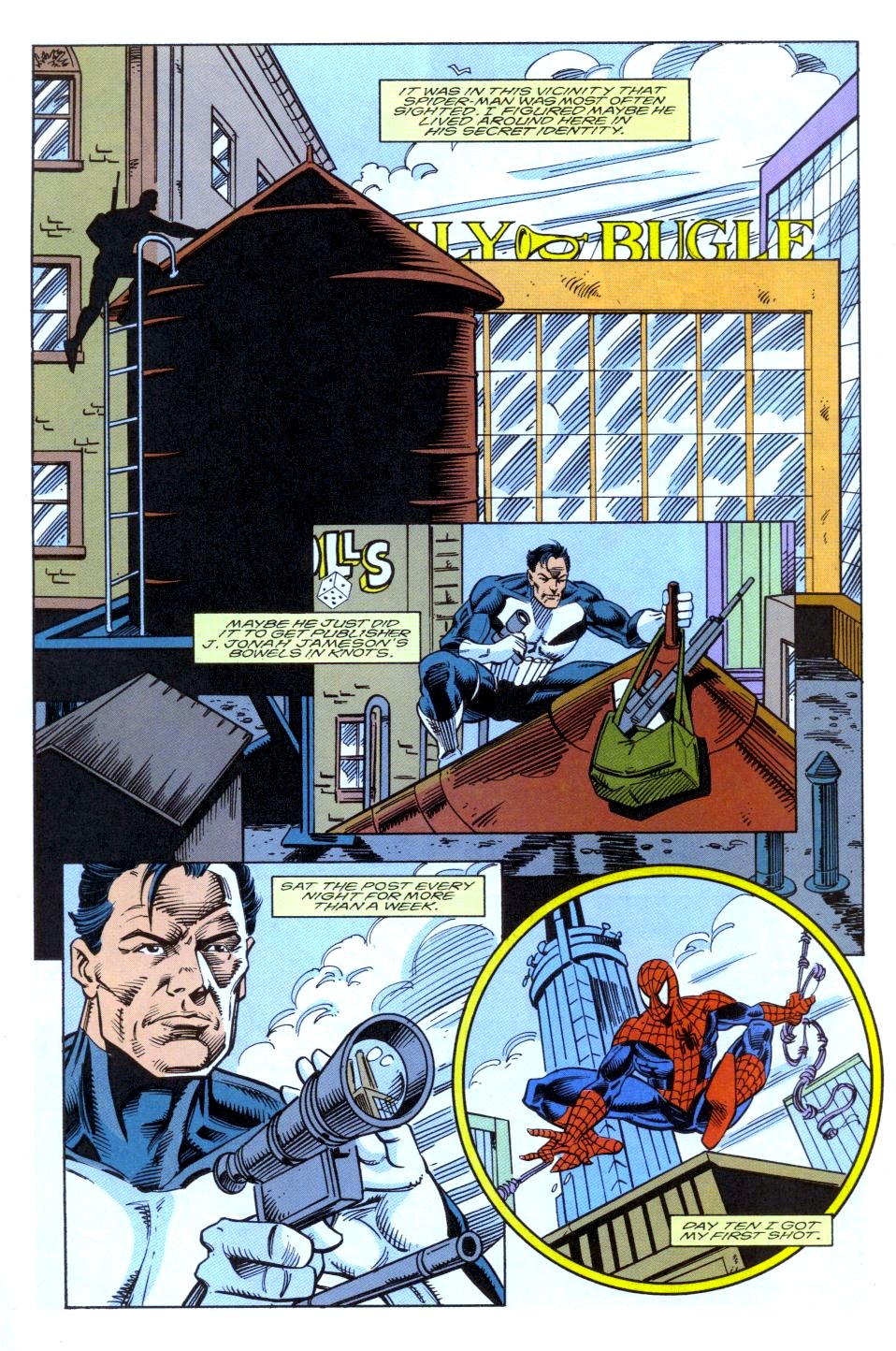
Punisher doing research.

Gradually, the Punisher prepares himself to kill Spider-Man…

Quality

Let me start with the concept of this comic book. Exploring what would happen had the Punisher actually killed Spider-Man (note: this is so obvious from the cover) is a bold and clever story to tell. To put things in perspective, the Punisher’s attempt to kill Marvel’s iconic superhero happened way back in Amazing Spider-Man which was published way back in 1974. Very clearly, Punisher failed and Spider-Man went on to live and fight for good.

When it comes to storytelling, Chuck Dixon delivered a strong script and carefully crafted a standalone story that looks at the Punisher’s first-ever attempt to shoot Spider-Man but the narrative was more on the vigilante’s point-of-view. The dialogue was solid and the narration gives readers a good look at the personality of Frank Castle. I also liked the way the story was paced.

What also makes this comic book really good is that it shows in convincing fashion what else would have happened after the successful assassination of Spider-Man. Without spoiling the surprise, you can ask yourself how would Punisher react once he learned who Spider-Man really was, how would the many people who personally knew Spider-Man (whether good or evil) would react and what the state of crime in New York would be like.

10
The Punisher anticipating Spider-Man outside The Daily Bugle.

As for the art, Gordon Purcell did a decent job. He captured what was back then modern day 1990s look of the Punisher (completely rejecting the way the character looked in Amazing Spider-Man ) and he knew how to present him from different angles regardless of what action was taken. On drawing Spider-Man, Purcell proved to be good. I noticed in some parts of the comic book, he tried hard to make Spidey look dynamic while traveling high above the streets of the city. The big money shot (in terms of illustration) for me was the moment Spider-Man got killed.

Conclusion

Overall, What If #58 is a good and fun comic book to read. Historically, this was released at a time when Spider-Man and the Punisher were both wildly popular. The decision to tell an alternate reality off Amazing Spider-Man was inevitable and ultimately was nicely pulled off.

If you are thinking about acquiring What If #58, as of this writing MileHighComics.com shows that a near-mint copy of the regular edition is at $26 while the near-mint copy of the newsstand edition is at $77.

What If #58 is recommended.


Thank you for reading. If you find this article engaging, please click the like button below and also please consider sharing this article to others. If you are looking for a copywriter to create content for your special project or business, check out my services and my portfolio. Feel free to contact me as well. Also please feel free to visit my Facebook page Author Carlo Carrasco and follow me at HavenorFantasy@twitter.com