

Welcome back readers, fellow geeks and electronic gaming fans!
In this edition of the Retro Gaming Ads Blast (RGAB) series, we will take a look at another batch of retro gaming print ads from the 1980s and 1990s.
For the newcomers reading this, Retro Gaming Ads Blast (RGAB) looks back at the many print ads of games (console, arcade, computer and handheld) that were published in comic books, magazines, flyers and newspapers long before smartphones, social media, the worldwide web and streaming became popular. To put things in perspective, people back in the 1980s and 1990s were more trusting of print media for information and images about electronic games and related hardware.
With those details laid down, here is the newest batch of retro gaming print ads for you to see and enjoy…
1. Enemy Zero print ad

The first time I saw this print ad of Enemy Zero in the late 1990s, I was intrigued by its visual concept and it got me interested to learning more about the game. Enemy Zero was a sci-fi video game developed by Warp and released as a console-exclusive on the Sega Saturn. Since I never owned a Saturn, I never got to play the game but I was inspired to learn more about Warp (which developed the hit game D). As it turns out, Enemy Zero started as a project for PlayStation but because of Sony’s failure to fulfill the pre-orders of D on PlayStation (100,000 copies ordered but less than 30,000 copies printed by Sony), Warp’s head Kenji Eno decided to make Enemy Zero exclusive to the Sega Saturn. Enemy Zero was published by Sega worldwide while Warp published it in Japan, and the game sold between 500,000 to 700,000 copies (based on Eno’s claim).
2. Bionic Commando print ad

Back in the late 1980s, I played Bionic Commando and managed to finish it after enduring lots of challenges along the way. It was a very unique adventure game as it used a highly unusual method of moving from one platform to the next by means of a futuristic grappling gun. This particular print ad showcased what the game’s actual box looked like (with cover artwork made for North America) and used two screenshots from the game. This ad hardly captures the excitement and intensity that awaited gamers and yet it manages to give people a clear look at the grappling concept. While the North American version of the game has certain content altered, it still had the same gory ending (and Adolf Hitler as the main villain) as the Japanese version.
3. RoboCop print ad

RoboCop made huge impact on moviegoers as well as people who love science fiction and the R-rated action films Hollywood studios released in the 1980s. That being said, it was not surprising that a video game of RoboCop was released on the Nintendo Entertainment System (Family Computer in Japan) by Data East and the print ad they came up with cleverly used imagery from the movie poster and the screenshots showed exactly what RoboCop fans expected to see such as the enemy robot ED-209 and thugs. This game strongly reflects the business trend of the 1980s when companies made merchandise and adaptations of R-rated blockbuster films to sell to kids and teenagers.
4. Gex 3: Deep Cover Gecko print ads
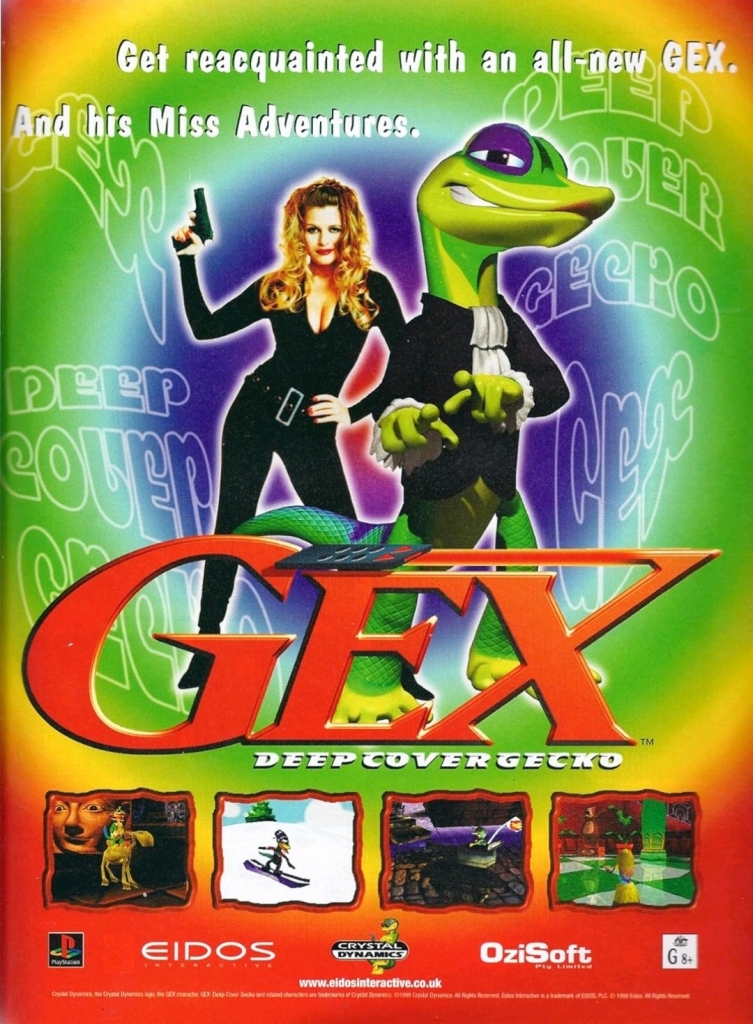


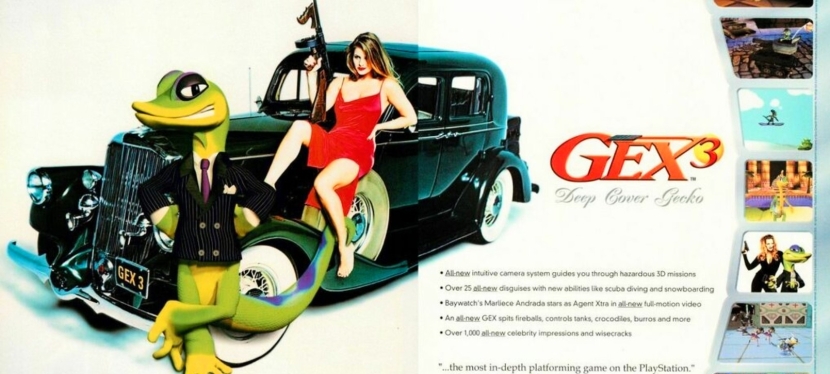
In 1999, Eidos Interactive – the company behind the wildly popular Tomb Raider games of the decade – became aggressive marketing Gex 3: Deep Cover Gecko for PlayStation and Nintendo 64. They were so aggressive, they featured actress and Playboy’s Playmate of the Month (March 1998) Marliece Andrada alongside their star character Gex in the marketing which was not limited to America. For the newcomers reading this, a multimedia approach was implemented on the narrative of the game’s PlayStation version which explains why it has full-motion video sequences featuring Andrada as the character Agent Xtra. As seen in these print ads, Eidos Interactive had Andrada looking pretty and sexy to really sell the game.
5. Barkley Shut Up and Jam! print ad

I remember the many types of basketball video games that were released on game consoles back in the 1990s. While there were NBA video games that had in-depth rosters of players with seasonal gaming in mind, there were other basketball-related video games that were not about the said league but featured an NBA star. In this print ad, publisher Accolade prominently featured NBA star Charles Barkley to promote the game Barkley Shut Up and Jam!, posted some words emphasizing sports intensity, and showed one screenshot to assure gamers that this is a basketball game. While the critical reception was mixed, the game must have sold enough to convince Accolade to release a sequel two years later with Barkley still the endorser.
6. The Death and Return of Superman print ad

Now this is one very eye-catching print ad that appeared in comic books and magazines in the 1990s. Anyone who knows comics would recognize the grey fist (with sharp bones protruding on the knuckles) belonging to Doomsday who killed Superman in Superman #75 (1993), and the bloody presentation on the famous S was very aggressive for its time. The game itself was an adaptation of the two storylines (published in 1992 and 1993 respectively) that saw Superman’s death, his return and the appearances of new Supermen. While sales figures are not available, The Death and Return of Superman eventually attracted mixed reviews from the critics.
7. Dragon Force print ad
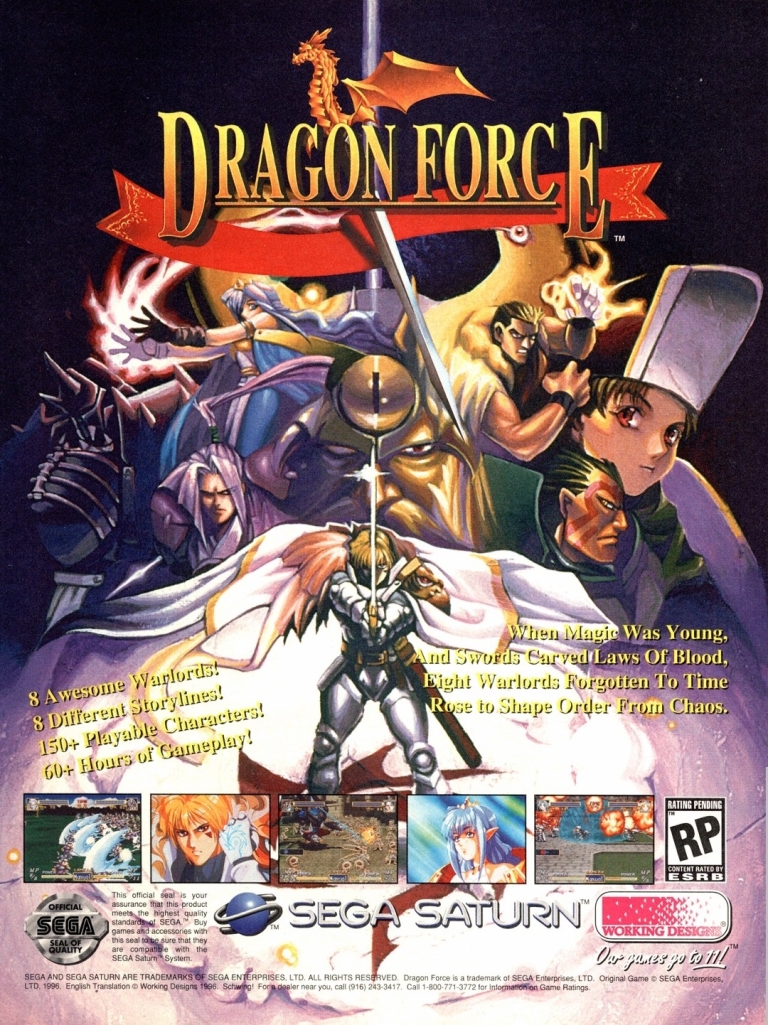
While the Sega Saturn was undeniably a huge commercial disappointment in North America, the console still had some great games that was widely praised by game critics and heavily bought by gamers. One of those outstanding games on the console was Dragon Force (developed by Sega and J-Force in Japan, localized in America by Working Designs) which received great critical acclaim and achieved commercial success both in Japan and in America. The popular magazine Electronic Gaming Monthly named Dragon Force as the Saturn Game of the Year as well as Strategy Game of the Year in 1996. As a Working Designs release, this print ad has an ambitious fantasy concept visually emphasized, detailed lines of descriptions and screenshots that strongly appealed to the gamers, anime enthusiasts and those who love fantasy. This ad is also a sad reminder that the business relationship between Sega and Working Designs went downhill afterwards (read: Bernie Stolar) and the sequel Dragon Force II was never released outside of Japan.
+++++
Thank you for reading. If you find this article engaging, please click the like button below, share this article to others and also please consider making a donation to support my publishing. If you are looking for a copywriter to create content for your special project or business, check out my services and my portfolio. Feel free to contact me with a private message. Also please feel free to visit my Facebook page Author Carlo Carrasco and follow me on Twitter at @HavenorFantasy as well as on Tumblr at https://carlocarrasco.tumblr.com/ and on Instagram at https://www.instagram.com/authorcarlocarrasco
 Author Carlo Carrasco