The economy of the Philippines grew almost 6% in the 3rd quarter (July-September 2023) which is a huge improvement over the 2nd quarter growth of 4.3%, according to a GMA Network news report.
To put things in perspective, posted below is an excerpt from the GMA Network news report. Some parts in boldface…
The Philippine economy regained its footing in the third quarter of 2023, following a slowdown seen in the previous quarter, the Philippine Statistics Authority (PSA) reported on Thursday.
The economy, as measured by gross domestic product (GDP) or the total value of goods and services produced in a period, grew by 5.9% during the July to September 2023 period, PSA chief and National Statistician Claire Dennis Mapa said at a press conference.
This is faster than the 4.3% growth rate seen in the second quarter of the year —its slowest pace in nine quarters since the country entered the positive territory in the middle of 2021 following a pandemic-induced recession.
“We are pleased to announce that the Philippine economy continues to grow despite several major headwinds that we have experienced and continue to experience,” National Economic and Development Authority (NEDA) Secretary Arsenio Balisacan said.
“This performance makes our economy the fastest among the major emerging economies in Asia that have released their third-quarter 2023 GDP growth: Vietnam at 5.3%, Indonesia and China at 4.9%, and Malaysia at 3.3%,” the NEDA chief said.
The third quarter economic performance brought the year-to-date or the January to September 2023 GDP growth rate to 5.5%.
Let me end this piece by asking you readers: What do you think about this recent development? Do you think there is still a chance for the Philippine economy to accelerate in the 4th quarter and achieve a full-year economic growth of at least 6%?
Recently the City Government of Muntinlupa was recognized and commended by the Philippine Chamber of Commerce and Industry (PCCI) and the Department of the Interior and Local Government (DILG), according to a Manila Bulletin news report.
To put things in perspective, posted below is an excerpt from the Manila Bulletin news report. Some parts in boldface…
The Muntinlupa City government earned recognition and commendations from the Philippine Chamber of Commerce and Industry (PCCI) and the Department of the Interior and Local Government (DILG).
The PCCI gave the Muntinlupa City government a special recognition at the 2023 Most Business-Friendly Local Government Unit Awards.
The city government also received eight major commendations at the 2023 Urban Governance Exemplar Awards organized by DILG.
“Indeed, we have many, many reasons to be proud of our city. But most of all, we are very grateful for the validation of our efforts to make life better for all Muntinlupeños. Mabuhay tayo!” said Mayor Ruffy Biazon.
The city government earned the special citation from the PCCI for its continuing commitment to excellence in business transactions, such as the multi-awarded Business One-Stop Shop (BOSS) system.
It can be recalled that Muntinlupa has been recognized several times by the PCCI as the Most Business-Friendly LGU in the country for its innovative and people-centric approach to business transactions.
Let me end this piece by asking you readers: What is your reaction to this recent development? If you are a resident of Muntinlupa City, are you delighted over what the City Government achieved with regards to public service, business-friendliness and efficiency?
For more South Metro Manila community news and developments, come back here soon. Also say NO to fake news, NO to irresponsible journalism, NO to misinformation, NO to plagiarists, NO to reckless publishers and NO to sinister propaganda when it comes to news and developments. For South Metro Manila community developments, member engagements, commerce and other relevant updates, join the growing South Metro Manila Facebook group at https://www.facebook.com/groups/342183059992673
To put things in perspective, posted below is an excerpt from the GMA Network news report. Some parts in boldface…
President Ferdinand “Bongbong” Marcos Jr. said Monday that the implementing rules and regulations of the Maharlika Investment Fund (MIF) have been finalized, weeks after he said its implementation was suspended.
“The Investment Rules and Regulations of Maharlika Investment Fund have been finalized,” Marcos said on Instagram.
“Upon our approval, we’ll swiftly establish the corporate structure, getting the MIF up and running,” he added.
The IRR, which would spell the beginning of MIF’s operationalization, was released in August. Marcos announced the suspension of its implementation “pending further study” on October 18.
Before leaving for Saudi Arabia last month, Marcos clarified that the MIF was not put on hold, saying the government was still working to have it operational within the year.
“We are, the organization of the Maharlika Fund proceeds apace, and what I have done though, is that we have found more improvements we can make, specifically to the organizational structure of the Maharlika Fund,” the President had said.
Marcos had said the suspension of the IRR should not be misinterpreted as a judgement of rightness or wrongness of the MIF.
he President also maintained that economic managers and “personalities who will actually be involved in the fund” had been consulted regarding the MIF.
Marcos signed into law Republic Act No. 11954 or the Maharlika Investment Fund (MIF) Act of 2023 in July, with the aim to tap state assets for investment ventures to generate additional public funds.
The law creates the Maharlika Investment Corp. (MIC), a government-owned company that will manage the MIF — a pool of funds sourced from state-run financial institutions that will be invested in high-impact projects, real estate, as well as in financial instruments.
Under the law, the initial capitalization of the MIF would be sourced from Landbank at P50 billion, DBP at P25 billion, and the national government at P50 billion.
Let me end this piece by asking you readers: What is your reaction to this recent development? Do you think that there is no stopping the implementation of the Maharlika Investment Fund in the near-future?
Even though it looks like that economic growth for the Philippines this year will end up short of 7%, the economic managers of the Marcos administration expect revenue collections to exceed the target for 2023, according to a GMA Network news report.
To put things in perspective, posted below is an excerpt from the GMA Network news report. Some parts in boldface…
The economic managers of the Marcos administration are expecting the government revenue collections this year to exceed target amid measures to improve tax administration and collection efficiency.
In a statement following a special coordination committee meeting on Friday, the Development Budget Coordination Committee (DBCC) said the “emerging total revenue collection for 2023 is estimated to be P3.84 trillion to P3.90 trillion.”
The projected revenue collection for the entire year is above the P3.73-trillion target set earlier by the DBCC.
In April, the economic managers set the revenue goal at P3.73 trillion this year, P4.184 trillion in 2024, P4.692 trillion in 2025, P5.255 trillion in 2026, P5.895 trillion in 2027, and P6.621 trillion in 2028.
The DBCC, chaired by the Budget chief, is composed of the secretaries of National Economic and Development Authority (NEDA), Finance (DOF), as well as the governor of the Bangko Sentral ng Pilipinas (BSP).
The DBCC, likewise, is expecting tax revenues to clock in at P3.50 trillion to P3.55 trillion, surpassing the target by about 15%.
The above-target revenue project resulted from the higher actual collections in the first nine months of 2023, which reached P2.84 trillion, up 6.8% year-on-year and exceeding the target for the period by 3%.
This, as both tax and non-tax revenues registered positive growth at 6.4% and 10.5%, respectively, “owing to the higher collections from the Bureau of Customs (BOC) and non-tax revenues of P152.57 billion.”
The DBCC said the Bureau of Internal Revenue (BIR) and the BOC are implementing several reforms to strengthen tax administration and enhance revenue collection, which include digitalization programs intended to eliminate corruption, increase transparency, and improve the ease of paying taxes.
Tax reform measures – Moreover, the economic managers said they will work closely with Congress for the passage of the previous administration’s remaining tax reforms on passive income and financial intermediaries taxation and real property valuation and assessment, as well as new tax measures.
“These include the excise tax on single-use plastics (SUPs), rationalization of the mining fiscal regime, motor-vehicle road users’ tax, excise tax on sweetened beverages and junk foods, tax on pre-mixed alcohol, value-added tax (VAT) on digital service providers, carbon taxation, capital market development bill, and the military and uniformed personnel (MUP) pension reform bill,” the DBCC said.
Meanwhile, the national government’s disbursement accelerated significantly from 93.4% of the program as of June 2023 to 98.9% as of September.
“This was mainly driven by the robust disbursement in the third quarter, reaching P3.82 trillion as of the end of September,” the economic managers said.
Let me end this piece by asking you readers: What is your reaction to this recent development? Do you think that government collections will exceed the 2023 revenue target?
Those of you who have been engaging with online selling, you better brace yourselves as the Bureau of Internal Revenue (BIR) hopes to begin imposing a creditable withholding tax before December 2023, according to a BusinessWorld news report. Specifically, this move applies on partner-merchants of online platforms.
To put things in perspective, posted below is an excerpt from the BusinessWorld news article. Some parts in boldface…
THE BUREAU of Internal Revenue (BIR) is hoping to start imposing a creditable withholding tax on partner-merchants of online platforms before the start of December, an official said.
“The process could be shorter, and we might just come up with it before the start of December. It will not be unreasonable to expect it before the start of December,” BIR Assistant Commissioner Jethro M. Sabariaga told reporters on the sidelines of the SGV Tax Symposium last week.
“The longer you withhold this release, you’re hobbling a significant portion of today’s economic transactions,” he added.
The BIR last week released the final draft of the amendments to Revenue Regulation No. 2-98 which currently does not cover income payments by online platform providers.
Under the final draft, the BIR would impose a withholding tax of 1% on one half of the gross remittances by domestic e-marketplace operators to the online merchants for the goods or services sold through their facility.
However, the withholding tax will not apply if annual total gross remittances to an online merchant for the past taxable year has not exceeded P250,000, or if the cumulative gross remittances to an online merchant in a taxable year has not yet exceeded P250,000.
Also exempted are online merchants who are part of a cooperative duly registered with the BIR with a valid Certificate of Tax Exemption.
Mr. Sabariaga said the BIR took note of the suggestions and objections to the draft rules raised by affected sectors. The BIR’s deadline for comments from stakeholders on the final draft ended on Oct. 27.
“This will all be taken into consideration and then be studied and then the final draft will be released and exposed,” he said.
Since then, Mr. Sabariaga said the agency consulted with various industries to come up with the latest version of the draft.
“It’s the first exposition of the draft, you have to consider the various industries, the applicability of the withholding (tax) on the various industries, the rates, the economic provisions of it,” he added
The BIR has been seeking ways to tax the digital economy, particularly as e-commerce surged during the pandemic.
In 2022, the digital economy contributed P2.08 trillion, equivalent to 9.4% of gross domestic product. Of this, e-commerce had the highest growth at 26.5%, with its share to the economy reaching 20% or P416.12 billion.
Let me end this piece by asking you readers: What is your reaction to this recent development? If you have been regularly selling online, do you think you will be covered by the planned withholding tax by the BIR? Do you have all financial and legal records prepared?
For decades now, I have been living in Alabang and I witnessed how much Muntinlupa City modernized along the way. Bordering Barangay Ayala Alabang is Filinvest City (formerly called Filinvest Corporate City) which itself is home to several business or facilities such as the Filinvest Tent, Commercenter, Acacia Hotel Manila, Crimson Hotel, Westgate and, of course, the wildly popular place to be in – Festival Mall.
For the newcomers reading this, Festival Mall opened in May 1998 with its initial name Festival Supermall. Way back then, out of pure curiosity, I entered the mall for the first-time ever during its soft opening on May 1, 1998 (Labor Day here in the Philippines) as I was already looking for a new place and new discoveries at a time when I got tired of Alabang Town Center (ATC).
Being very new back then, Festival Mall’s presence of retailers or tenants was not yet dynamic as there were still businesses inside that could not open in time for the mall’s opening. I do remember walking down seeing lots of vacant retail spots covered with signs such as “opening soon”, “coming soon” and the like. Back in those days, the Philippine economy and society itself were dampened by the 1997 Asian Financial Crisis.
As the months passed by, more businesses opened and Festival Mall’s early attractions include the X-Site Amusement Center (which already had the indoor roller coaster) and, of course, the brand new cinemas which had several screens operating at a very spacious area on the top floor. I still remember seeing lots of people lining up for tickets and seats to watch Armageddon which ended up as the highest grossing movie of the world in 1998.
Indeed, for more than a decade, Festival Mall’s original cinemas became a favorite destination of mine to watch movies in Alabang and I definitely was not alone. I also remember the times when the said cinemas attracted a whole lot of moviegoers when the annual Metro Manila Film Festival’s (MMFF) opening day (every December 25) happened resulting in long lines. Watch the YouTube videos below…
As you can see in the above videos, Festival Mall’s original cinemas was a hot spot for moviegoers. It should be noted that the mall is strategically located in close proximity to the Alabang Viaduct and the South Luzon Expressway (SLEX) which ensures visibility to motorists and accessibility to commuters on a daily basis. The old cinemas were also a hot spot for a variety of small businesses selling different kinds of food and drinks to moviegoers and others who just passed by.
Festival Mall at 25
This past May, Festival Mall turned 25 and its anniversary was highlighted with special events as well and publicity through the media. There were these Festival Mall 25th anniversary feature articles that got published in different newspapers almost simultaneously. In the commemorative article that got published in the Manila Bulletin, President and CEO of Filinvest Development Corporation Josephine Gotianun Yap was quoted which goes as follows in the excerpt below. Some parts in boldface…
“We would not be where we are today without the unwavering support of our customers, merchants, suppliers, and employees who have journeyed with us through the years. It is humbling to think that when we first opened the mall, we only had 30 stores and no anchor supermarket. But thousands of visitors came on our first day, attracted by our amusement centers, cinemas, and food court. And now the mall has 800 tenants and eight leading anchor stores. We value our collaboration with major retailers, which has enabled us to bring together SaveMore, Ace Hardware, Robinson’s Department Store, Handyman, Shopwise, H&M, Decathlon, and Landmark all under one roof. As we build on its strong foundations for the future, we see Festival Mall continuing to serve as a place where time stops for making memories with family and friends,”
As seen above, the Filinvest Development Corporation executive clearly referred to the original cinemas which was one of the early attractions of Festival Mall way back in 1998. As mentioned earlier, Festival Mall today has more modern cinemas located at the expanded area on the same floor but several meters away from the original cinemas. So how does Festival Mall’s original cinemas look like nowadays? Watch the video below…
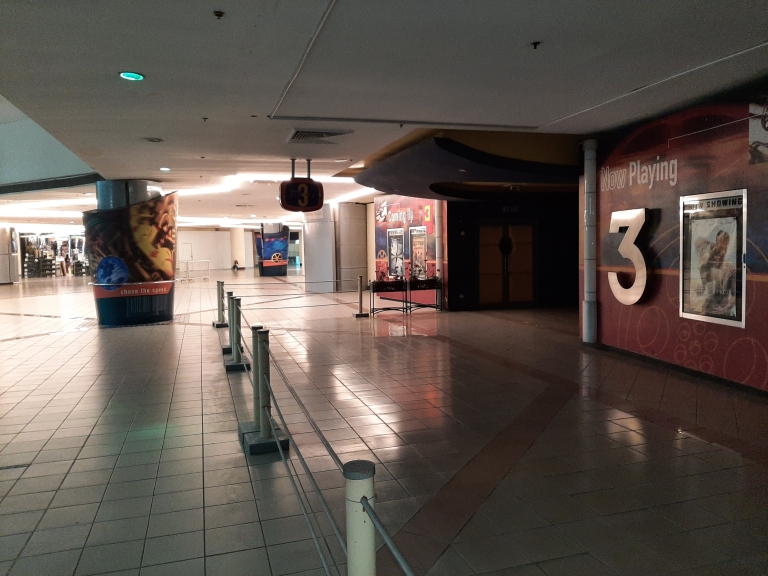
Yes, indeed the mall’s original cinemas have turned depressing. There are much less customers who pass by the area and many of the businesses that operated within have closed down! As I personally found out, Festival Mall is still using a few screens at the old cinemas for moviegoers while leaving the many others closed and left in the dark. If you think about it carefully, what does the mall management have in mind with regards to all of those cinema seats, sound systems, projectors, screens and other pieces of equipment inside each and every closed screen of the original cinemas?
A closed screen at one end of the original cinemas of Festival Mall. Just imagine what is left of all the hardware (examples: projectors and speakers) and seats inside.
This was a premium place to watch movies at. It had more comfortable seats and better equipment that made the cinematic experience more immersive. It was here where I saw 2001’s Final Fantasy: The Spirits Within.
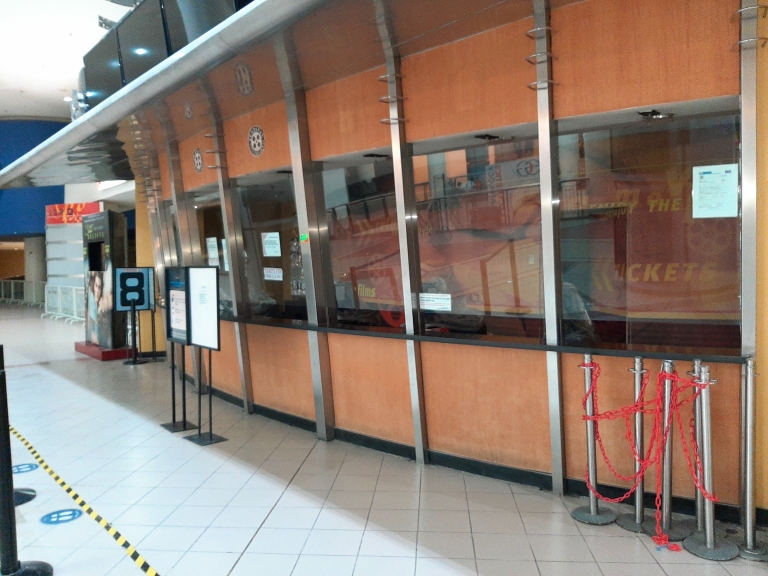
This is where I used to buy movie tickets for many years. For some time now, the selling of movie tickets here has stopped. To buy tickets, you have to go to the modern cinemas of the mall several meters away by foot at the same floor.
Apart from seeing more of the screens of the original cinemas closed down, the number of small-time businesses that sold different kinds of food and drinks are also gone which is depressing. Those businesses offered moviegoers different choices of what to eat or drink apart from the usual popcorn and drinks sold by the cinema’s concessionaires. I do remember a certain business joint that sold really good coffee (both hot and cold) that is also affordable.
There used to be different kinds of small business joints that sold a variety of food and drinks located on the floor spots at the original cinemas area. Those businesses have since closed down and left.
I remember the times I bought popcorn and drinks at this place before watching a movie. Now there are no food, no drinks and no people selling to customers anymore.
With the way things are right now, walking through the original cinemas area of Festival Mall is lonely and depressing to do. The area is almost lifeless and it easily is the saddest place inside the mall which itself has become a major attraction for shoppers and families. I can only wonder if Festival Mall’s management has any plan to revive the original cinemas area. Will they someday renovate at least a few of the screens and install brand new seats and other equipment to accommodate more moviegoers? Do they plan to attract new businesses to occupy the vacant commercial spaces and floor spaces near the old cinemas?
It would be nice to know if Festival Mall’s management or Filinvest itself has any plan to revive commerce at the original cinemas area which is now the saddest and loneliest part of the mall.
To be very clear with you all reading this, I never worked for a shopping mall nor have I ever worked in the movie theater business. I am a long-time resident of Alabang who often visits Festival Mall for purchasing needed items, dining and availing of services. Watching movies at Festival Mall used to be a big reason for me to spend time at the mall. I know for a fact that operating movie theaters is difficult and attracting people to watch movies on the big screen is tougher because of streaming. It does not help that the COVID-19 pandemic convinced people that watching new movies at home via streaming is the new standard which also made them think that movie theaters are unnecessary.
As a movie enthusiast, I can say out loud that watching a movie inside the cinema is still the best and most definitive way to enjoy watching. The movie theater experience can never be matched by streaming nor could the biggest HDTV at home could ever come close to the size and visual impact of a cinema screen. That being said, I can only hope that Festival Mall could someday revive the movie experience and commerce at their original cinemas area. They already have the modern cinemas at the expanded area but those are only 4 screens.
If you are living here in South Metro Manila and you have been to Festival Mall several times before, what do you think the mall management should do about their old cinemas? Is Festival Mall your favorite place to watch movies in? Do you think that hosting multiple film festivals – both foreign and domestic – each year would justify renovating the old cinemas of the mall?
In the views of the First Metro Investment Corporation (FMIC) and the University of the Asia and the Pacific (UA&P), the economy of the Philippines could grow by 5.5% for the year, according to a news article by Philippine News Agency (PNA). 2023 has been an economically challenging year and many anticipated that the national economy won’t grow as high as it did in 2022.
To put things in perspective, posted below is an excerpt from the PNA news report. Some parts in boldface…
The Philippine economy is projected to grow by 5.5 percent this year, driven by the growth in government spending, a report released by the First Metro Investment Corporation (FMIC) and the University of the Asia and the Pacific (UA&P) said.
In the September issue of The Market Call released on Wednesday, FMIC and UA&P said Philippine economic growth in the third quarter of the year will likely reach 5.0 to 5.2 percent.
For the fourth quarter of this year, FMIC and UA&P project the country’s gross domestic product (GDP) to grow by 6 percent.
This would bring the full year GDP growth to 5.5 percent which is slightly below the government’s 6 to 7 percent target for this year.
“Despite the weak July-August, we think the NG will accelerate further its spending on infrastructure and transportation for the rest of the year, and employment will have strong rebound in September,” the report said.
The Philippine economy grew by 4.3 percent in the second quarter of this year. During the quarter, government expenditure contracted by 7.1 percent.
FMIC and UA&P however expect government spending to accelerate in the second half of the year.
“National Government took up the slack in July spending as it ramped up expenditures by 16.2 percent year-on-year in July through higher social protection and infrastructure outlays,” the report said.
Aside from government spending, FMIC and UA&P also expect manufacturing and construction to drive growth.
Let me end this piece by asking you readers: What is your reaction to this recent development? Do you think the national economy can do better than the 5.5% growth foreseen by the First Metro Investment Corporation (FMIC) and the University of the Asia and the Pacific (UA&P)?
To put things in perspective, posted below is an excerpt from the Manila Bulletin news report. Some parts in boldface…
Muntinlupa City was named the No. 5 overall most competitive highly urbanized city in the Philippines and landed in the top three in resiliency and infrastructure.
Mayor Ruffy Biazon received the awards at the Philippine Creative Cities and Municipalities Competitiveness Congress held on Sept. 28 at the Manila Hotel.
Local government units were ranked based on the Cities and Municipalities Competitiveness Index by the National Competitiveness Council.
“Cities and municipalities are ranked on their competitiveness based on an overall competitiveness score. The overall competitiveness score is the sum of scores on five main pillars which pool data from several sub-indicators. The five main pillars are: economic dynamism, government efficiency, infrastructure, resiliency, and innovation. Scores are determined by the values of the actual data, as well as the completeness of the submitted data. The higher the score of a city or municipality, the more competitive it is,” according to the CMCI website.
Overall, Muntinlupa ranked fifth under the most competitive highly urbanized cities category in the country with a score of 49.59.
It is also No. 3 in the resilience and infrastructure pillars, and No. 6 in the innovation pillar.
“Infrastructure pertains to the physical assets that connect, expand, and sustain a locality and its surroundings to enable provision of goods and services,” according to CMCI.
Resilience, on the other hand, “applies to the capacity of a locality to build systems that can absorb change and disturbance and being able to adapt to such changes.
Let me end this piece by asking you readers: What is your reaction to this recent development? If you are a resident of Muntinlupa City, what is your reaction to what the city achieved in the latest CMCI rankings? Do you believe that Muntinlupa is a blossoming and highly competitive city among all highly urbanized cities of the nation?
For more South Metro Manila community news and developments, come back here soon. Also say NO to fake news, NO to irresponsible journalism, NO to misinformation, NO to plagiarists, NO to reckless publishers and NO to sinister propaganda when it comes to news and developments. For South Metro Manila community developments, member engagements, commerce and other relevant updates, join the growing South Metro Manila Facebook group at https://www.facebook.com/groups/342183059992673
To put things in perspective, posted below is an excerpt from the PNA news article. Some parts in boldface…
The Philippines is close to hitting its 2023 arrival target after recording more than 3.87 million foreign tourists as of Sept. 19, Tourism Secretary Christina Frasco said Wednesday.
At the opening of the 2023 Philippine Travel Exchange (PHITEX) in Cebu, Frasco said the country logged 3,877,183 inbound arrivals or at least 80.77 percent of the 4.8 million foreign tourists that the DOT targets to reach by the end of the year.
In the same period, the Philippines generated PHP316.9 billion in revenue from tourists coming mostly from South Korea, the United States and Japan.
Frasco is optimistic these figures will increase as business-to-business meetings between sellers and buyers at the PHITEX commence on Sept. 20.
She said the Marcos administration would continue working to transform the Philippines as a “tourism powerhouse in Asia”.
She shared the DOT’s plans and programs aimed at promoting ecotourism, the development of tourism communities across the country, fostering robust private sector participation to promote heritage protection, diversification of the country’s tourism portfolio and other initiatives to benefit tourism stakeholders.
Let me end this piece by asking you readers: What do you think about this recent development? With the likelihood that the Philippines will be able to surpass its 2023 foreign tourist arrivals target of 4.8 million, do you think the number could reach 6 million by the end of the year? Did you notice any positive economic impact from the rising foreign tourist arrivals? If you own a business, did you benefit from foreign tourists’ spending?
Philippine Tour Operators Association (PHILTOA), the organization composed of tour operators and allied members that are actively involved in the advocacy of responsible tourism, was commended by Department of Tourism (DOT) Christina Frasco during their 4th General Membership Meeting (4th GMM) held recently at Crimson Hotel in Filinvest City, Alabang, Muntinlupa, according to a Manila Bulletin article. Specifically they were commended for unwavering commitment to revitalizing Philippine tourism.
To put things in perspective, posted below is the excerpt from the Manila Bulletin news report. Some parts in boldface…
The Philippine Tour Operators Association (Philtoa) recently hosted its 4th General Membership Meeting at the Crimson Hotel Filinvest City in Muntinlupa, with the Department of Tourism Secretary Christina Garcia Frasco as keynote speaker. Led by Philtoa President Fe Abling-Yu, the meeting also highlighted Bacolod City as the featured destination, with Mayor Alfredo Abelardo “Albee” Benitez in attendance.
Secretary Frasco commended Philtoa for its unwavering commitment to revitalizing Philippine tourism, highlighting the association’s promotion of inclusive tourism development in both established and emerging destinations.
“We recognize that there are several emerging destinations across the country that, if given the right assistance, attention, development, and promotion, have the potential to become key destinations, as far as tourism is concerned,” the tourism chief said. “This is why I’m very grateful to Philtoa, because their focus has not been our world-famous destinations alone, but also in giving opportunities to emerging destinations. This is reflective of true shared tourism governance, where the private sector mobilizes the industry to assist the government to ensure inclusive tourism development.“
With this, Bacolod City also took center stage at the 4th GMM as a growing “super city” with exciting advancements in tourism, including infrastructure, art, culture, and culinary experiences. Mayor Benitez highlighted upcoming projects such as the Bacolod Convention Center, which can accommodate up to 10,000 people for MICE events; the Bacolod Masskara Museum/Trade Center; and the Orange Project, a prominent art gallery. The renowned Masskara Festival, spanning three weeks, promises a vibrant celebration of sports, food, spirits, and festivities.
To further underscore its commitment to fostering partnerships and growth within the industry, Philtoa President Abling-Yu announced the upcoming 34th Philippine Travel Mart, scheduled from Sept. 1 to 3 at the SMX Convention Center Manila in Pasay City.
She stated: “We are grateful for the strong partnerships with the Department of Tourism, Tourism Promotions Board, Philippine Airlines, BPI, and our media partners. The 34th Philippine Travel Mart is not only a showcase of our country’s incredible destinations but also a celebration of our industry’s resilience and strength as a major contributor to the country’s growth and progress.”
The association also welcomed 10 new tour operators, an immigration services agency, and 15 hotel and resort properties, increasing the total membership to over 500.
Let me end this piece by asking you readers: What is your reaction to this development? Are you convinced that the PHILTOA deserves the commendation from the Tourism Secretary? Do you think that Philippine tourism will exceed its foreign tourist arrivals target by a wide margin before the year ends? What other activities or special events should the PHILTOA highlight to keep national tourism grow?
For more South Metro Manila community news and developments, come back here soon. Also say NO to fake news, NO to irresponsible journalism, NO to misinformation, NO to plagiarists, NO to reckless publishers and NO to sinister propaganda when it comes to news and developments. For South Metro Manila community developments, member engagements, commerce and other relevant updates, join the growing South Metro Manila Facebook group at https://www.facebook.com/groups/342183059992673








 Author Carlo Carrasco