

Disclaimer: This is my original work with details sourced from reading the comic book and doing personal research. Anyone who wants to use this article, in part or in whole, needs to secure first my permission and agree to cite me as the source and author. Let it be known that any unauthorized use of this article will constrain the author to pursue the remedies under R.A. No. 8293, the Revised Penal Code, and/or all applicable legal actions under the laws of the Philippines.
Welcome back superhero enthusiasts, 1990s arts and culture enthusiasts, Spider-Man fans and comic book collectors! Today we go back to the early 1990s to examine a small part of the Marvel Comics shared universe through a tale of the Amazing Spider-Man monthly series.
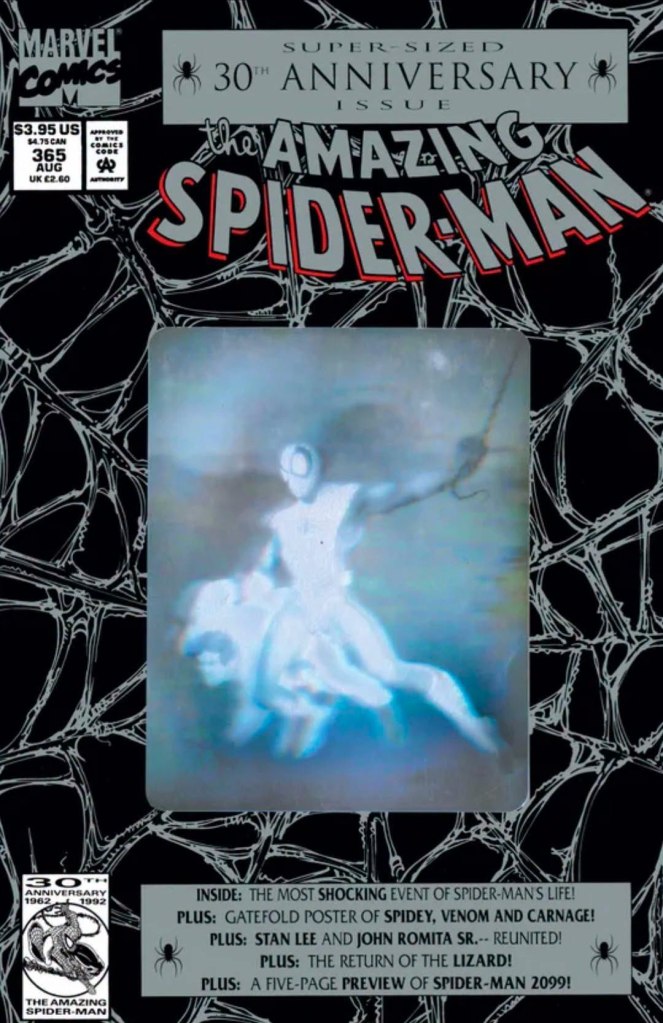
Back in 1992, Marvel Comics organized the celebration of what was back then the 30th anniversary of their most famous icon Spider-Man. Each Spider-Man monthly series that year had an anniversary celebration issue that had hologram covers and page content that was higher than usual. I previously reviewed Web of Spider-Man #90 and Spider-Man #26. The purest Spider-Man monthly series – Amazing Spider-Man – also had the anniversary treatment.
With those details laid down, here is a look back at Amazing Spider-Man #365, published in 1994 by Marvel Comics with the main story “Fathers and Sins” written by David Michelinie and drawn by Mark Bagley. Other stories here include “How I Created Spider-Man” by Michelinie and Aaron Lopresti; “I Remember Gwen” by Stan Lee, Tom DeFalco and John Romita; and “A Friend in Need” by DeFalco.
Early story (main story)
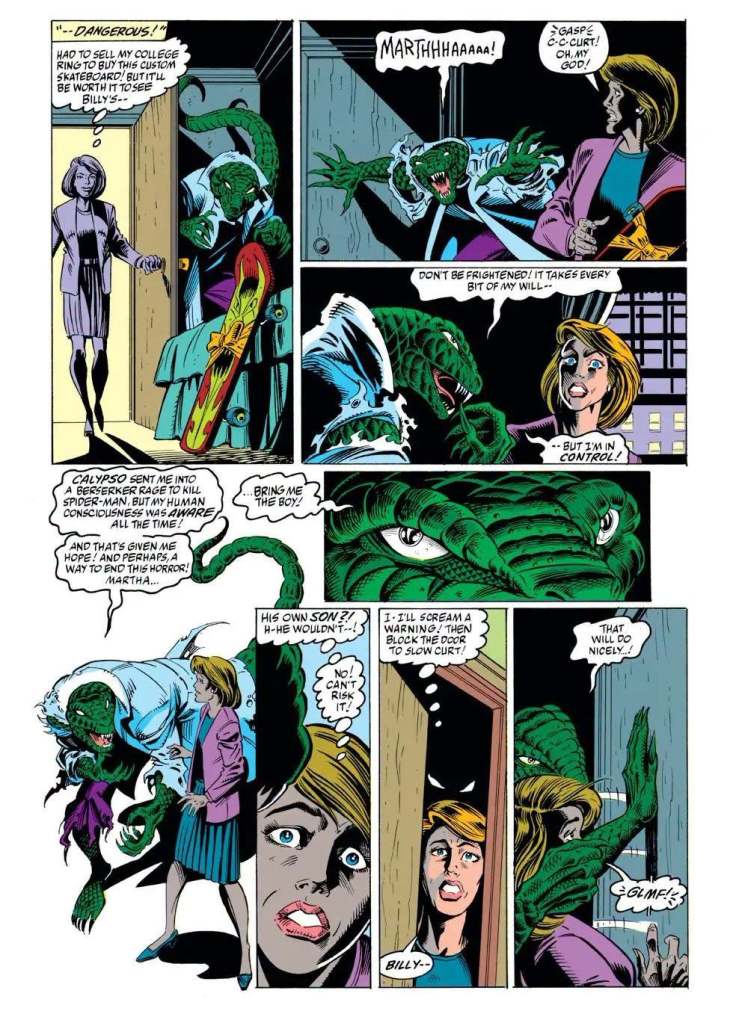
The story begins with the Lizard (Dr. Connors) prowling from one building to another during the night in New York City. He secretly stays outside the windows of the apartment of his wife Martha and their son. A birthday celebration is happening inside the apartment and among the guests are Peter Parker and his wife Mary Jane. Peter knows that growing up without a father is rough and he remembers that no one has seen Curt Connors since he last turned into the Lizard (refer to the Spider-Man: Torment storyline written and drawn by Todd McFarlane).
As the celebration goes on, the Lizard silently sneaks into the apartment through an open window. This alarms Peter through his spider sense which compels him to decide to secretly change into Spider-Man.
As Martha Connors enters a dark room to get a prepared gift for her son Billy, the Lizard shuts the door and confronts her. In his reptilian form, the Lizard communicates to his wife in English and assures her that he (Dr. Connors) is in control. He tells her that the evil sorceress Calypso sent her into a berserker rage to kill Spider-Man but his human consciousness was aware all the time. He tells her to bring to him their son. Martha is frightened and she knows that there is too much risk to grant her husband’s command…
Quality
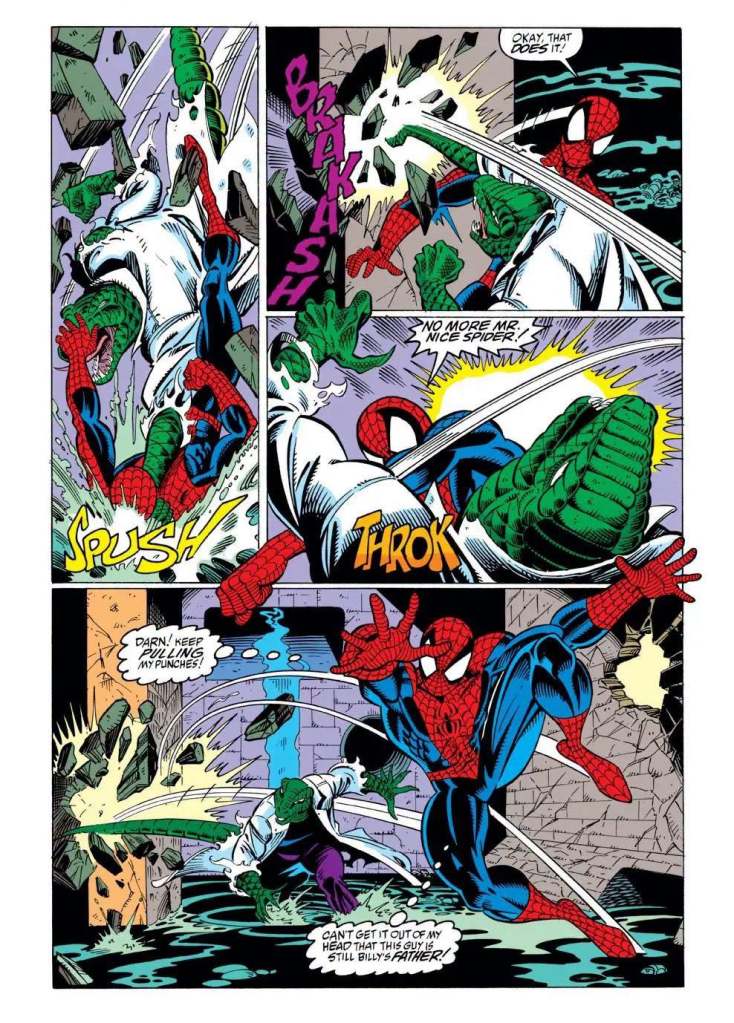
The main story “Fathers and Sins” is the anticipated rematch between Spider-Man and the Lizard following the very violent events that happened in the Torment storyline. Unlike that tale authored by McFarlane, this one has more depth and subtlety balanced with superhero spectacle.
David Michelinie carefully crafted the tale with clear progression in mind for the enduring rivalry between Spider-Man and the Lizard. He also took the opportunities to develop the characters whenever possible, and he did so with Dr. Connor’s wife and son. In fact, there are family dynamics within this story and the Lizard – portrayed here with multiple personality disorder (MPD) switching from Dr. Connor and the wild animal itself – is simply not the murderous entity seen in Torment. That said, this tale opens up questions such as how Dr. Connors will live on knowing the murders he committed as the Lizard, does he have any chance of keeping his family intact, and more.
More on Spider-Man himself, he was portrayed as a sensible and caring superhero. Even though he had traumatic encounters with the Lizard in Torment, he engaged his rival with reason instead of head-on violent action. He consistently believes that he could overcome the Lizard and somehow get Dr. Connors back intact knowing that the family needs him. When it comes to problems related with science and technology, Spider-Man here makes efforts to solve them using the knowledge he gained in university. The iconic webslinger here is pretty versatile, strategic and calculating. I should state that Mark Bagley has really fine artworks here and it is clear he truly captured the essence of Michelinie’s script.
The short story “How I Created Spider-Man” follows J. Jonah Jameson’s recollection of Spider-Man. This was cleverly written by Michelinie to revisit key moments from the origin and early superhero days of Spider-Man through Jameson’s memories, his own perception of the hero and his history of abusing his publishing power to make him look like a menace to society. The nostalgia and related details are easily the main attractions of this short story. This is something that fans of Spidey will enjoy.
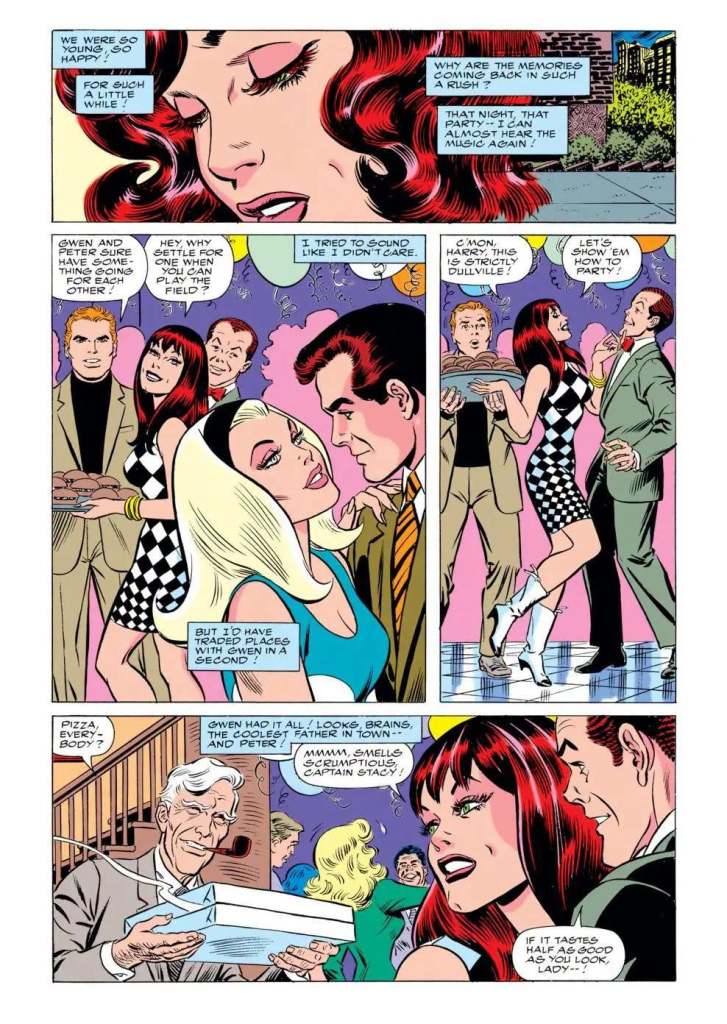
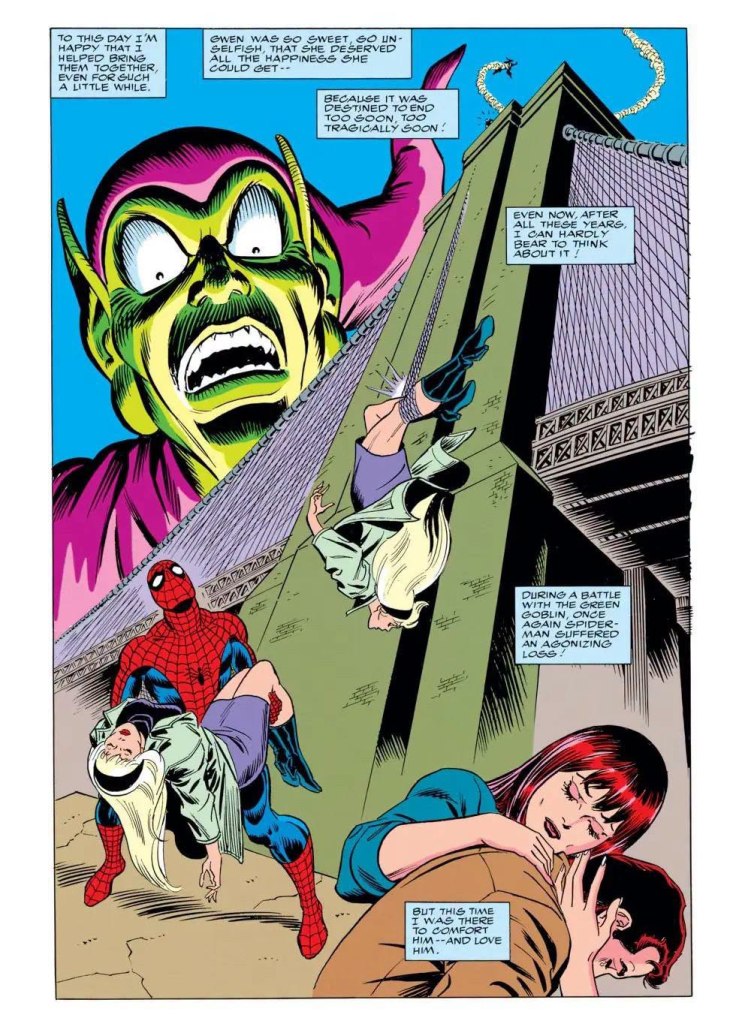
The Spider-Man nostalgia intensified in the 2nd short story “I Remember Gwen” which features artwork by the late John Romita. This one is about Mary Jane Parker recalling her friendship with the late Gwen Stacy (who back then was romantically linked with Peter Parker) and key moments she remembered from Spider-Man. This short story has fine art by Romita and this resulted in a retro visual ride that captured the 1970s aesthetics. As this tale revisited Spider-Man’s past relationship with Gwen, it also offered readers a close look at the MJ-Gwen friendship. That said, long-time fans of Spidey will enjoy this.
The final short story “A Friend in Need” is easily the weakest part of this anniversary celebration comic book. It features the Prowler and does not have much to do with Spider-Man. This one is a shallow filler-type of story.
Conclusion
As of now, I can say that Amazing Spider-Man #365 (1992) is easily the best of the 30th anniversary celebration comic books I have read so far. It has a very solid main story that moved the Spider-Man-Lizard rivalry forward (and also has a conclusion that tapped directly into the icon’s origin with a good element of surprise) and two of the three short stories are great offerings for the very dedicated Spider-Man fans. It also has short articles/special messages that highlight the importance of Spidey’s 30th anniversary, and a Spider-Man 2099 preview! In short, this anniversary celebration comic book is the complete package for the fans and is also one of the most defining Amazing Spider-Man comic books of the 1990s. It truly is worth having in your collection!
Overall, Amazing Spider-Man #365 (1992) is highly recommended.
+++++
Thank you for reading. If you find this article engaging, please click the like button below, share this article to others and also please consider making a donation to support my publishing. If you are looking for a copywriter to create content for your special project or business, check out my services and my portfolio. Feel free to contact me with a private message. Also please feel free to visit my Facebook page Author Carlo Carrasco and follow me on Twitter at @CarloCarrascoPH as well as on Tumblr at https://carlocarrasco.tumblr.com/ and on Instagram at https://www.instagram.com/authorcarlocarrasco

