

Disclaimer: This is my original work with details sourced from reading the comic book and doing personal research. Anyone who wants to use this article, in part or in whole, needs to secure first my permission and agree to cite me as the source and author. Let it be known that any unauthorized use of this article will constrain the author to pursue the remedies under R.A. No. 8293, the Revised Penal Code, and/or all applicable legal actions under the laws of the Philippines.
Welcome back superhero enthusiasts, 1980s arts and culture enthusiasts, Marvel Comics fans and comic book collectors! Today we go back to the year 1984 to take a close look at the official comic book adaptation of the classic sci-fi movie The Last Starfighter.
The Last Starfighter is highly memorable for its extensive use of computer-generated imagery (CGI) which brought its science fiction concepts of war and space travel to life. Directed by Nick Castle, the film is also remembered for its unique storytelling (note: with scenes set on Earth and in space) as well as the solid performances by Lance Guest, Robert Preston, Dan O’Herlihy, Catherine Mary Stewart and Norman Snow.
I should also state that the movie was released during the golden age of arcade games in America and its narrative has video game elements within. The Last Starfighter, which had unreleased ports for Atari consoles and an actual game released on the Nintendo Entertainment System (NES), clearly has a place in retro gaming culture. To know more about the movie, watch the retrospective video by Oliver Harper by clicking here, the retrospective video by GoodBadFlicks by clicking here and the movie trivia video by Minty Comedic Arts by clicking here.
Marvel Comics was in-charge of producing and publishing the comic book adaptation of the movie. In fact, it was released as issue #31 of the Marvel Comics Super Special (AKA Marvel Super Special) series and also in the form of a 3-issue mini-series.
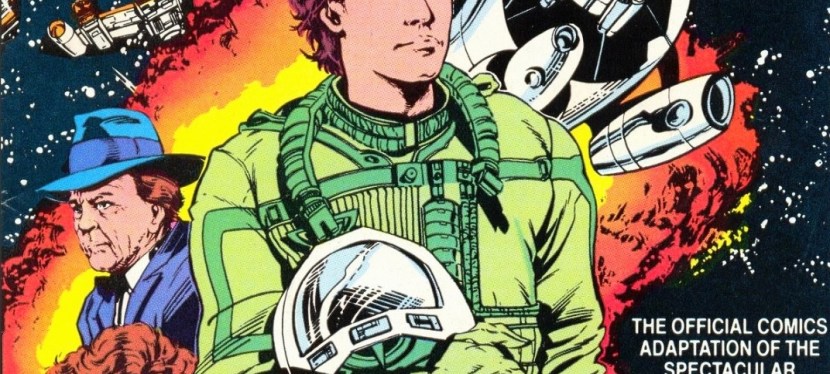
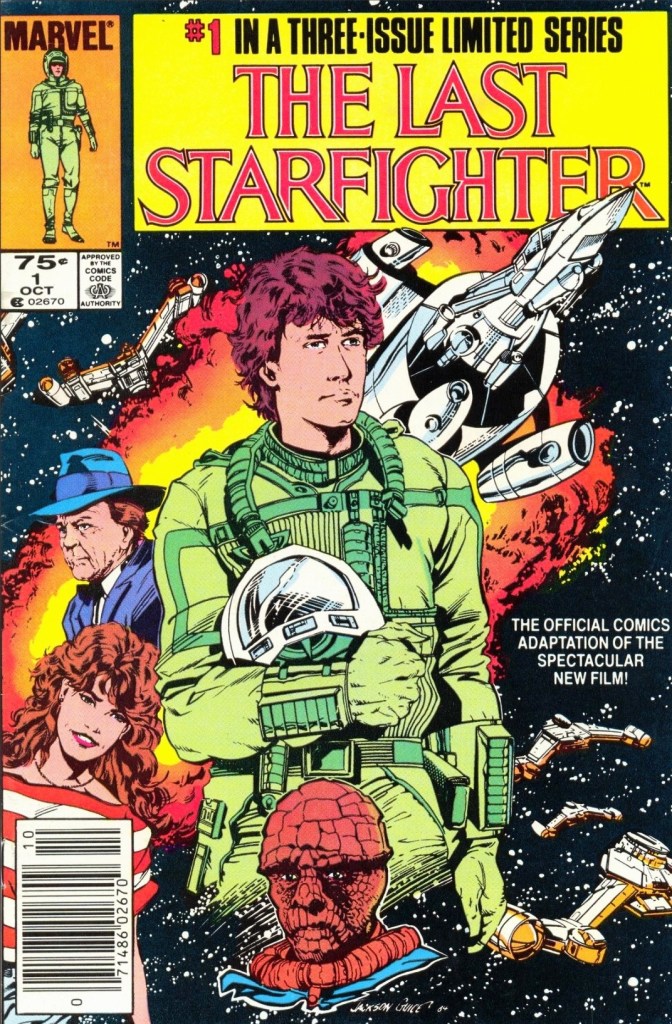
With those details laid down, here is a look back at The Last Starfighter #1, published in 1984 by Marvel Comics with a story written by Bill Mantlo and drawn by Bret Levins. This is the first chapter of the 3-issue mini-series.
Early story
The story begins on a sunny day at a trailer park filled with residents who know each other. Maggie Gordon searches for Alex who is busy playing The Last Starfighter arcade game inside the local store. Alex’s little brother Louis was told to inform him that a neighbor’s electricity problem needs fixing.
Alex is laser focused on playing the arcade game which has an immersive space shooter game design. As Maggie tells him that their friends had arrived, Alex decides to let Louis play the rest of the game as he moves out.
Just as Alex and Maggie are about the leave, his mother tells him that he the neighbor’s electricity problem needs his repair service making him miss the trip.
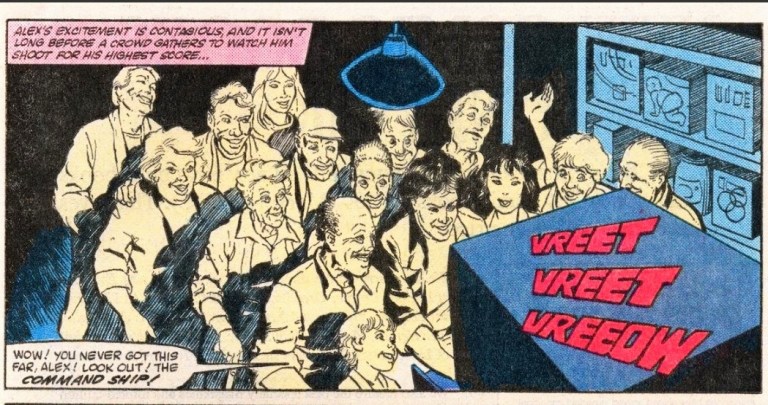
In the evening, Alex resumes playing The Last Starfighter and shortly after scoring over 900,000 points, many members of the local community flocked inside the grocery to watch him play…
Quality
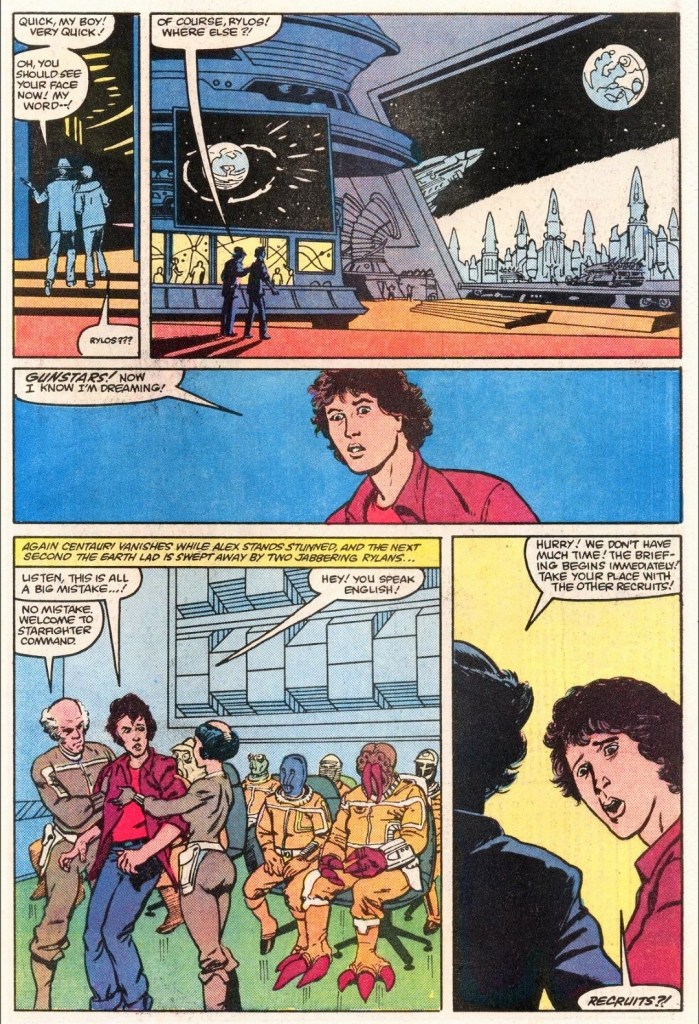
Considering the limited scope of the narrative – which ends with Alex already far away from home – and the creative liberties committed by the production team, this comic book is faithful for the most part and it does a good job replicating the vibe and tone of the movie.
Bill Mantlo’s script focused on the more important dialogue from the film and it did a good job following Alex Rogan (the protagonist) who is a video game achiever who happens to be striving to move forward with his life. He is a likable guy facing great odds as well as the harshness of reality, and he has hope with Maggie who just might become an integral part of his life in the years to come. Centauri is clearly the 2nd most notable character after Alex and through him, the narrative moves forward a lot leading to the greater science fiction stuff sourced from the movie.
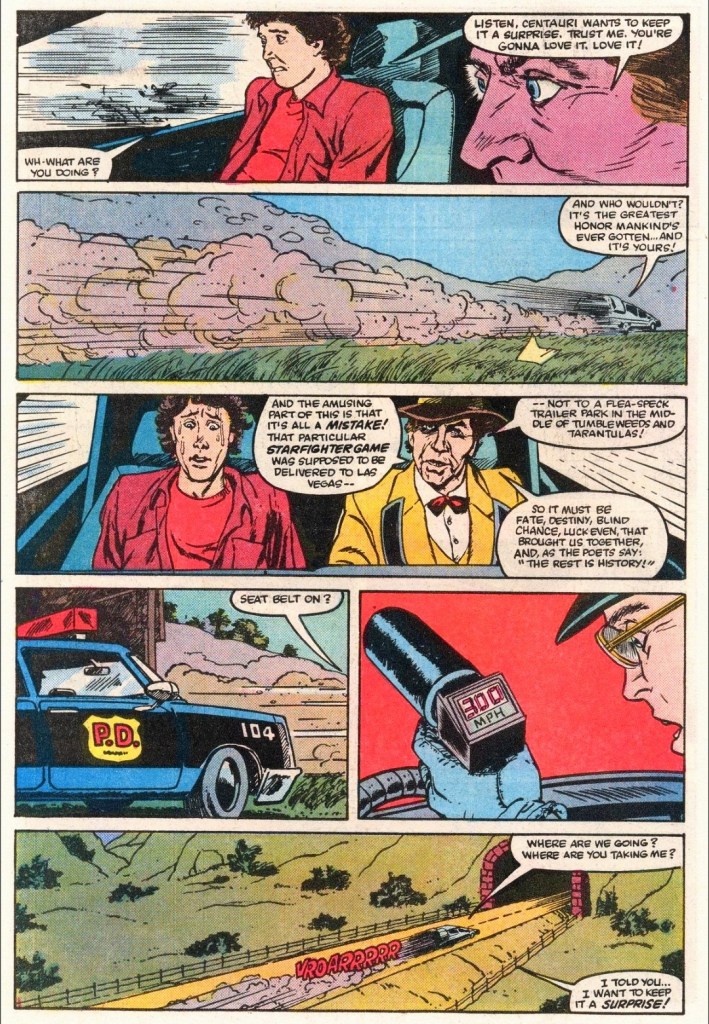
As it is clearly not a 100% replica of the movie’s screenplay, the script Mantlo made ensured that this comic book has a whole lot of relevant details, notable moments and characterization that readers can immerse themselves into.
For his part, Bret Blevins (note: his name was spelled as Brett Blevins here) did a fine job replicating the movie imagery that includes the locations, the characters, and the sci-fi elements. While it is not clear if the comic book team was authorized to use the actors’ likenesses when drawing the characters, there were a few instances in which Alex somewhat resembles actor Lance Guest, and Centauri looking a bit like the late Robert Preston.
Conclusion
Even though there were no battles within its narrative, The Last Starfighter #1 (1984) is a good comic book adaptation. Having seen the movie a number of times in my life, I can say that this comic book recaptures the feel and tone of the film in varying degrees. Of course, the illustrated literature format can only go so far with adapting the movie’s greatness. That being said, if you truly want mesmerizing imagery, strong thrills, great music and the dramatics of the characters, watching the movie is the clear option (note: The Last Starfighter 4K Blu-ray is available). This comic book is a worthy partial companion and I can confirm that it has convinced me to read the next issue.
Overall, The Last Starfighter #1 (1984) is recommended.
+++++
Thank you for reading. If you find this article engaging, please click the like button below, share this article to others and also please consider making a donation to support my publishing. If you are looking for a copywriter to create content for your special project or business, check out my services and my portfolio. Feel free to contact me with a private message. Also please feel free to visit my Facebook page Author Carlo Carrasco and follow me on Twitter at @HavenorFantasy as well as on Tumblr at https://carlocarrasco.tumblr.com/ and on Instagram at https://www.instagram.com/authorcarlocarrasco
 Author Carlo Carrasco