

Welcome back readers, fellow geeks and electronic gaming fans!
In this edition of the Retro Gaming Ads Blast (RGAB) series, we will examine print ads of Sega from the 1990s which was a notable period of time when they went from being a prominent video game company into a desperate, struggling entity by the end of the decade. All the Sega ads in this edition are promotions of their own video games that were exclusive to their consoles during the 1990s.
For the newcomers reading this, Retro Gaming Ads Blast (RGAB) looks back at the many print ads of games (console, arcade, computer and handheld) that were published in comic books, magazines, flyers and newspapers long before smartphones, social media, the worldwide web and streaming became popular. To put things in perspective, people back in the 1980s and 1990s were more trusting of print media for information and images about electronic games and related hardware.
With those details laid down, here is the newest batch of retro gaming print ads for you to see and enjoy…
1. Phantasy Star IV print ad

Long before the emergence of online console gaming that involved a high number of players, Sega released Phantasy Star IV for the Genesis console in America in 1994 which was praised by gamers and critics. This one also turned out to be the last single-player role-playing game (RPG) of the Phantasy Star series as Sega eventually turned it into a series of online RPGs since the year 2000.
This print ad is significant because a lot of gamers today are not aware that Phantasy Star started as a series of single-player RPGs the same year Final Fantasy debuted in Japan. Anyone interested to play Phantasy Star IV on a modern console should buy the Sega Genesis Classics collection.
2. Eternal Champions print ad
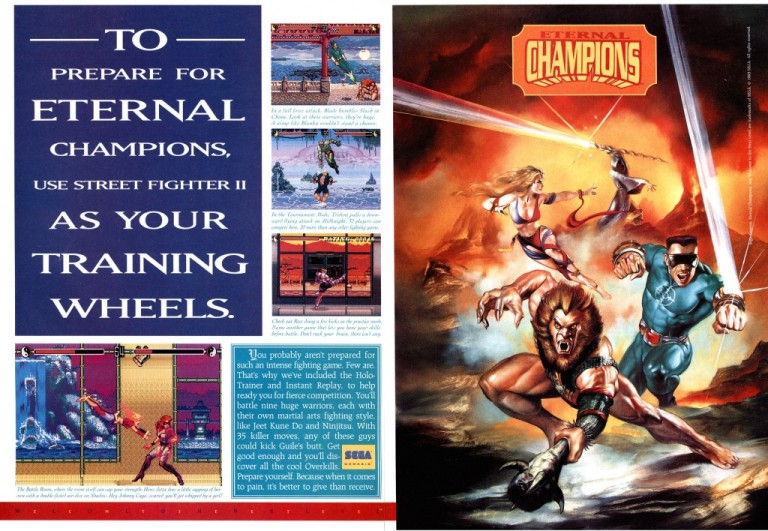
Back in the 1990s, the fighting game genre became wildly popular with gamers at the arcades and on consoles at home. Capcom literally sparked a wild fire with the Street Fighter II game and its upgraded editions, and other companies went on to make their own 2D fighting games to cash in. Sega was one of them and they released their own 2D fighting game Eternal Champions for the Sega Genesis console.
Unsurprisingly, the game was marketed aggressively and this 2-page print ad really stood out as it had the great looking painted art on the right, screenshots and details of the game, and most notably made a sarcastic reference to Street Fighter II. Eternal Champions sold enough copies, it led to the release of the sequel Eternal Champions: Challenge from the Dark Side and two spin-off games. I can only guess that referencing Street Fighter II was helpful in achieving commercial success.
3. Streets of Rage 3 print ad
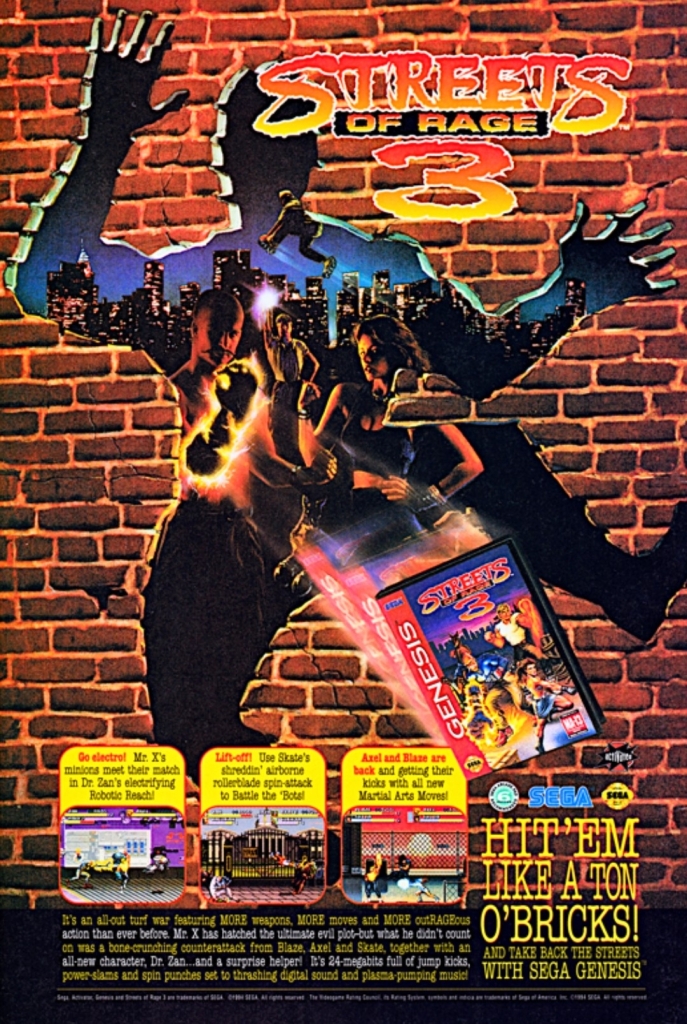
Streets of Rage (Japanese title: Bare Knuckle) was one of the most defining game franchises Sega came up with and it started on the Sega Genesis console. It was a series of side-scrolling, 2D beat-them-up games that ensured action and excitement for gamers. As the first two games were critically and commercially successful, Sega was confident in aggressively marketing Streets of Rage 3 and the print ad seen had a very attention-grabbing artwork.
The artistic style emphasized power and intensity as it shows a damaged wall with the shape of a human body (symbolizing that someone was thrown through it) and then there were images of people on the other side. The game went on to attract mostly positive reviews although it paled in comparison to its predecessors in terms of sales.
4. Shining Force II print ad
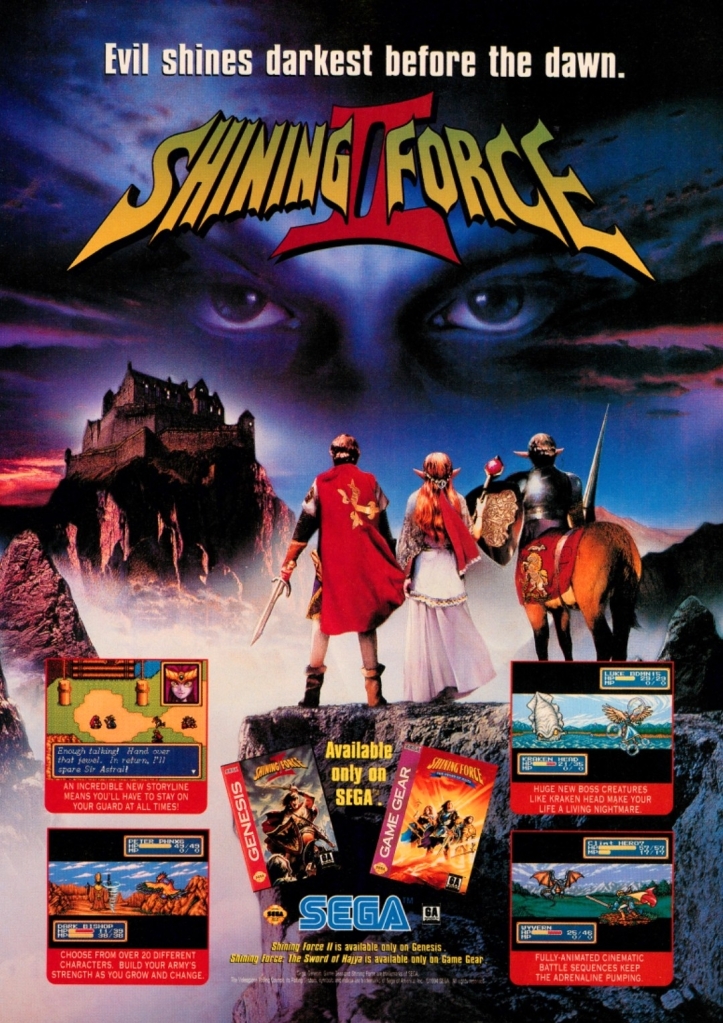
As Sega was so prolific with making and releasing games across different genres, they had their own tactical role-playing game series with Shining Force and the first game released on the Sega Genesis was a critical and commercial success. That being said, the company was confident with releasing Shining Force II on the same console more than a year later achieving critical and commercial success.
The North American print ad of the game had a visual presentation that closely captured the foreground-background style (characters facing the distance) used in-game, and the advertising team use photographic imagery to achieve a fantasy look. Very cleverly, Sega inserted the Sega Game Gear title Shining Force Shining Force: The Sword of Hajya into the ad. This print ad made me interested in acquiring a Sega Genesis for Shining Force II.
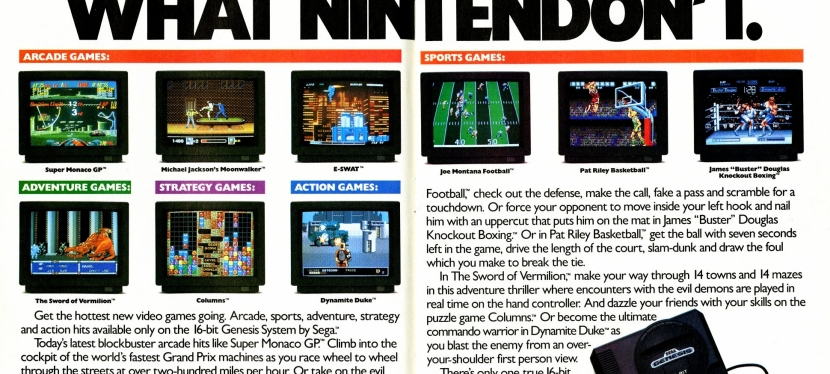
5. Genesis does what Nintendon’t print ad
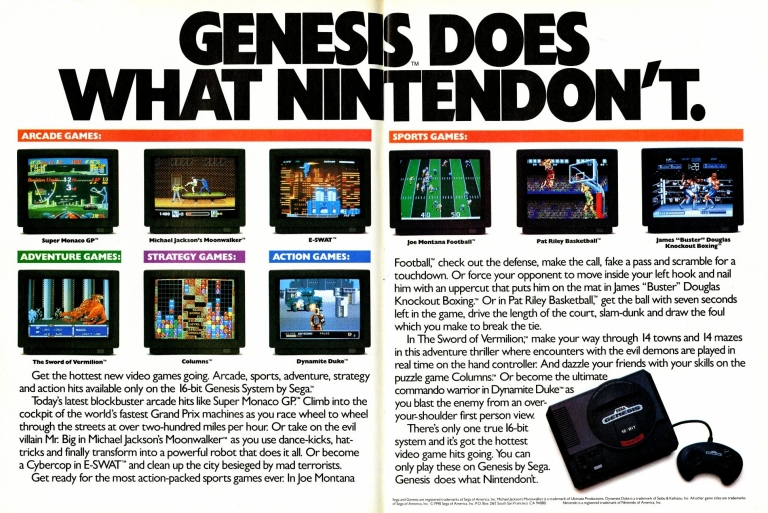
Now this print ad of Sega’s has the most definitive and best-known advertising line in the so-called 16-bit console generation: Genesis does what Nintendon’t. This was Sega’s aggressive marketing push to convince gamers to buy the Genesis console to play games and experience thrills of fun that they would not find on a Nintendo console at the time. Genesis was launched in America in 1989 with “16-bit” emphasized a lot, and the technological rival Super Nintendo Entertainment System (SNES) was released in the same market more than two years later.
The 2-year advantage helped Sega establish the Genesis as the next-gen machine for gaming at home and there were years in the 1990s when Sega’s console outsold Nintendo’s in America during the so-called 16-bit war. The Genesis also had lots of exclusive games plus strong software support from third-parties. While the SNES would eventually outsell the Genesis in other parts of the world, it was in America where Sega proved to be very competitive and successful.
6. Knuckles’ Chaotix print ad
In late 1994, Sega released in America and in Japan the 32X which was an add-on device for the Sega Genesis designed enhance its power while serving as a transition (a warm-up) into the so-called 32-bit era of console gaming. The 32X was the result of corporate decisions involving the American and Japanese executives of the company.
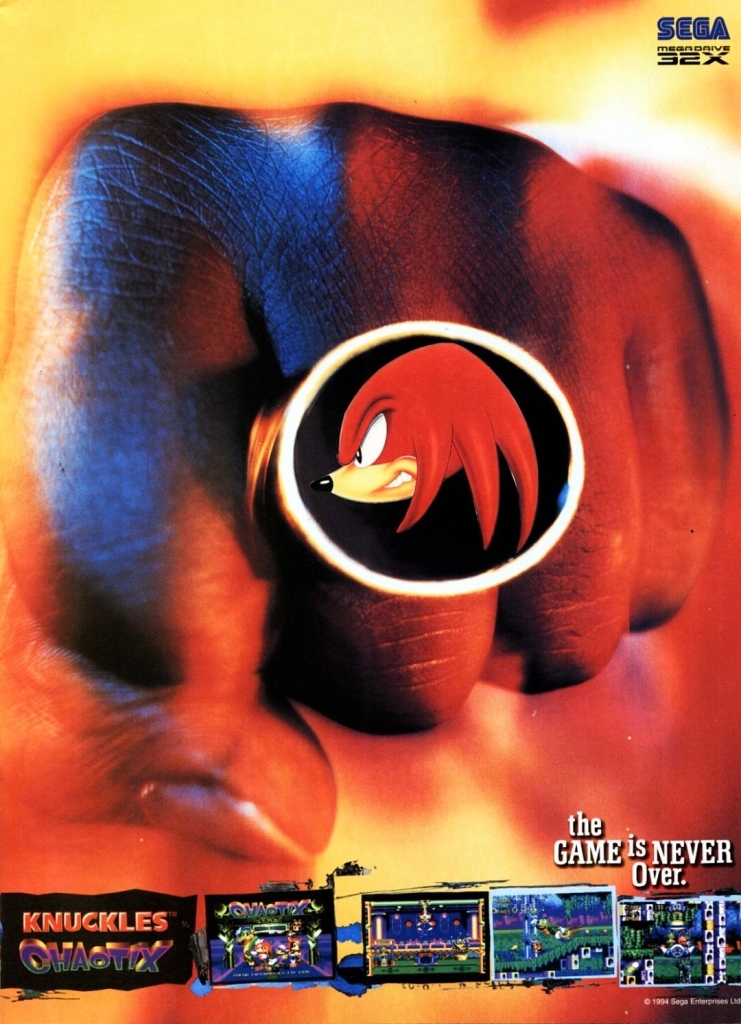
To keep 32X customers happy and boost hardware sales, Sega adjusted the development of Knuckles’ Chaotix (a Sonic spin-off) from being a Sonic project 32-bit console Sega Saturn into a standalone game for the add-on device. Even though Sega knew the game’s development was rushed, they went on to strongly promote the game and the print ad shown here was quite eye-catching.
The image of a fist with a ring showing the character Knuckles (a character from the Sonic games) emphasizes power and the colors used seem to express intensity. Then there were the selected screenshots shown without descriptive text. Although Sega tried hard, Knuckles’ Chaotix (launched in 1995) received mixed-to-positive reviews and sadly sold poorly. Unsurprisingly, the sales of the 32X dropped further and by then a lot of consumers knew that the Sega Saturn (the true successor to the Genesis) was all set to launch in America and Europe within 1995.
7. Sonic 3D Blast for Sega Saturn print ad

Back in the 1980s and 1990s, having a high-quality, console-exclusive game featuring a company mascot was crucial to sell game consoles while keeping dedicated fans happy. Like what Nintendo did with their icon Mario, Sega achieved great commercial success with the three Sonic the Hedgehog games they released exclusively on the Sega Genesis console and this naturally created expectations they would make new Sonic games on the Saturn console. Unfortunately, Sega and its teams failed to complete development of the Saturn-exclusive game Sonic X-treme and the company cancelled it which sent shockwaves through the games industry news.
With the 1996 holiday shopping season too crucial to ignore, Sega commissioned a Saturn version of the game Sonic 3D Blast which was originally made for the Genesis console. Sonic 3D Blast on the Saturn took seven weeks to make and there were some graphical enhancements implemented. While Sonic 3D Blast’s Genesis version attracted a positive reception from critics (and sold 700,000 copies), the reception for the Saturn version was mixed. This print ad of Sonic 3D Blast on Sega Saturn is a reminder of the company’s failed attempt to take their icon to the next-generation. They never replicated the big success they had with Sonic on the Genesis.
8. Die Hard Arcade print ad
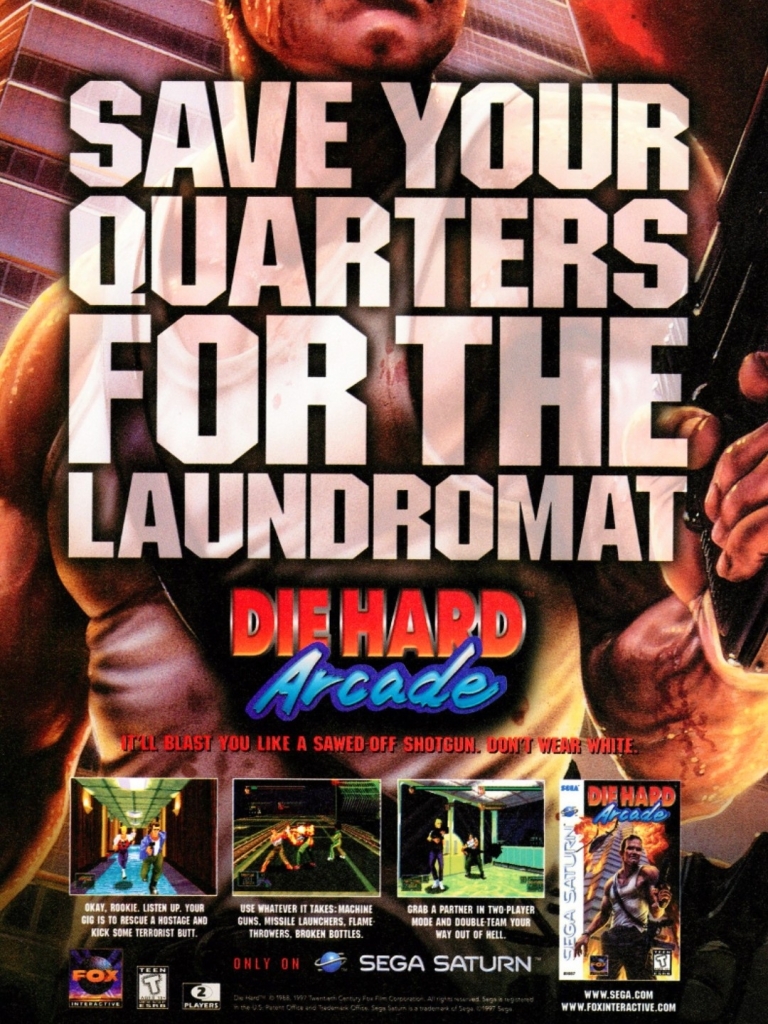
Like many other movie franchises, Die Hard has many video game adaptations released through the decades. In 1997, Sega released Die Hard Arcade (Japanese title: Dynamite Deka) on the Sega Saturn and the game critics praised it for its fun gameplay as well as its flawless conversion of the arcade version (released in 1996). To say the least, the development history of Die Hard Arcade is not as straightforward as many would think. To get the details and explanations of the development of the game, click here.
As for the print ad itself, this one cleverly used official game art as the background with imagery which instantly reminded me of what I saw in the classic 1988 movie that starred Bruce Willis. This ad made me interested to buy a Sega Saturn or find a place to rent it to play the game.
9. Shenmue Japanese print ad

When Shenmue was released exclusively on the Sega Dreamcast in Japan on December 29, 1999, it turned out to be a very mind-blowing experience for many gamers due to its ambitious game design, the intense attention to detail implemented, very high production values, in-depth exploration and very immersive gameplay.
It was the open-world game released at a time when “open-world” was not even a standard gaming term. Often called the masterpiece of the legendary game designer Yu Suzuki, Shenmue sold over 1.2 million copies in Japan and went on to be released worldwide in the months that followed. Sadly, the game failed to make a profit due to its very high budget of $70 million (which Suzuki himself said in English during an interview) and the fact that the number of Dreamcast units already sold to gamers was not massively high.
The Japanese print ad of Shenmue had a simplistic looking visual concept and yet it was engaging to look at because the way the characters appeared was how they appeared in the game during gameplay which was astounding. Take note that back in the 1990s, it was common for video game marketing materials to show human characters in high detail but in reality the polygonal models of those characters appeared looking blocky and much less detailed during gameplay.
+++++
Thank you for reading. If you find this article engaging, please click the like button below, share this article to others and also please consider making a donation to support my publishing. If you are looking for a copywriter to create content for your special project or business, check out my services and my portfolio. Feel free to contact me with a private message. Also please feel free to visit my Facebook page Author Carlo Carrasco and follow me on Twitter at @HavenorFantasy as well as on Tumblr at https://carlocarrasco.tumblr.com/ and on Instagram at https://www.instagram.com/authorcarlocarrasco



 Author Carlo Carrasco