
Retro Gaming Ads Blast – Part 4

Welcome back readers, fellow geeks and retro gaming fans!

In this edition of the Retro Gaming Ads Blast (RGAB) series, we will examine print ads from the 1990s that caught my attention and I will explain why they are worth look back at. In retrospect, the 1990s was a decade of serious changes in the world of electronic gaming as the industry saw the shift of graphics from 2D sprites and flat backgrounds to 3D polygons, the shift from cartridges to CDs for software distribution, and more.

For the newcomers reading this, Retro Gaming Ads Blast (RGAB) looks back at the many print ads of games (console, arcade, computer and handheld) that were published in comic books, magazines, flyers and newspapers long before smartphones, social media, the worldwide web and streaming became popular. To put things in perspective, people back in the 1980s and 1990s were more trusting of print media for game details and images.

With those details laid down, here is the newest batch of retro gaming print ads for you to see and enjoy…

1. Castlevania: Bloodlines print ad

Creepy looking but not horrific. The simplistic approach turned out to be effective on making Sega Genesis gamers excited for this Castlevania release.

During the early stage of the so-called 16-bit console wars, Konami’s Castelvania series made the huge next-generation leap with Super Castlevania IV on the Super Nintendo Entertainment System (SNES) which gave gamers loads of fun challenges along with technological improvements that added to the gameplay. Being a prolific multiplatform game maker, Konami knew it could not abandon its fans who own the 16-bit console of Sega and this led them to making a unique Castlevania experience with the Sega Genesis in mind – Castlevania: Bloodlines.

The above print ad of Castlevania: Bloodlines was very eye-catching as it showed a photographic presentation of the grave of the Belmont family (note: Simon Belmont is arguably the most known hero of the series) backed with a detailed text description as well as screenshots that showed exactly what Castlevania fans expected with gameplay and presentation. While the visual style of the ad had a subtle approach to horror, it succeeded in informing the public that another fun-filled Castlevania experience was coming. The game went on to be a hit among gamers and critics.

2.  The Granstream Saga print ad

THQ really tried hard to sell The Granstream Saga in North America at a time when a lot more Japanese RPGs started coming into the market.

Back in the late 1990s, there was a slew of Japanese role-playing games (JRPGs) that got released on the PlayStation console in North America arguably because of the massive sales success of Final Fantasy VII in 1997. In 1998, THQ (note: then a newcomer in video gaming) made the daring move to release The Granstream Saga in North America and it was part of the company’s plan of releasing more RPGs. With regards to the 1998 print ad, THQ marketing team wisely emphasized the fact that the game launched at #1 in Japan (published by Sony) although, strangely, the rest of the short descriptive text did not emphasize the fact that the game was one of the first fully polygonal RPGs ever released. The ad had one image of an animated cut scene while there were two gameplay images. When I first saw the print ad, I became interested with The Granstream Saga as I was fond of both RPGs and anime. I never got to play it due to a lack of time and money back then.

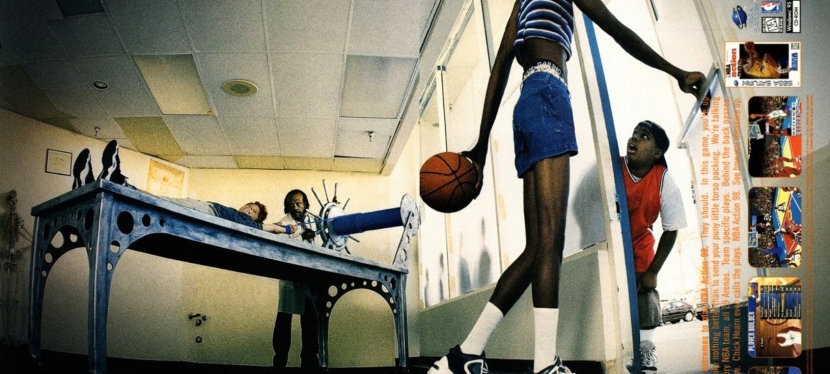
3. NBA Action 98 print ad

Do you find this print ad funny or disturbing or both?

The first time I saw Sega’s print ad of NBA Action 98 (a polygonal NBA basketball video game for the Sega Saturn), it caught my attention quickly mainly because of the concept of the imagery showing a really tall guy leaving the place after getting stretched to be tall (as emphasized by an adult operating a machine to stretch another kid’s body to get taller) as a kid from outside looks on. While it looked hilarious at first, the photographic imagery also had an unintentional dark tone as the adult operating the machine looked like he was torturing the kid. This print ad was really eye-catching in a rather disturbing fashion to me, so much so I did not have any interest left to check out the advertised game. The small size of the screenshots and the hard-to-read descriptive text did not help at all. In my view, this was a marketing misfire by Sega.

4. Flashback: The Quest for Identity print ad
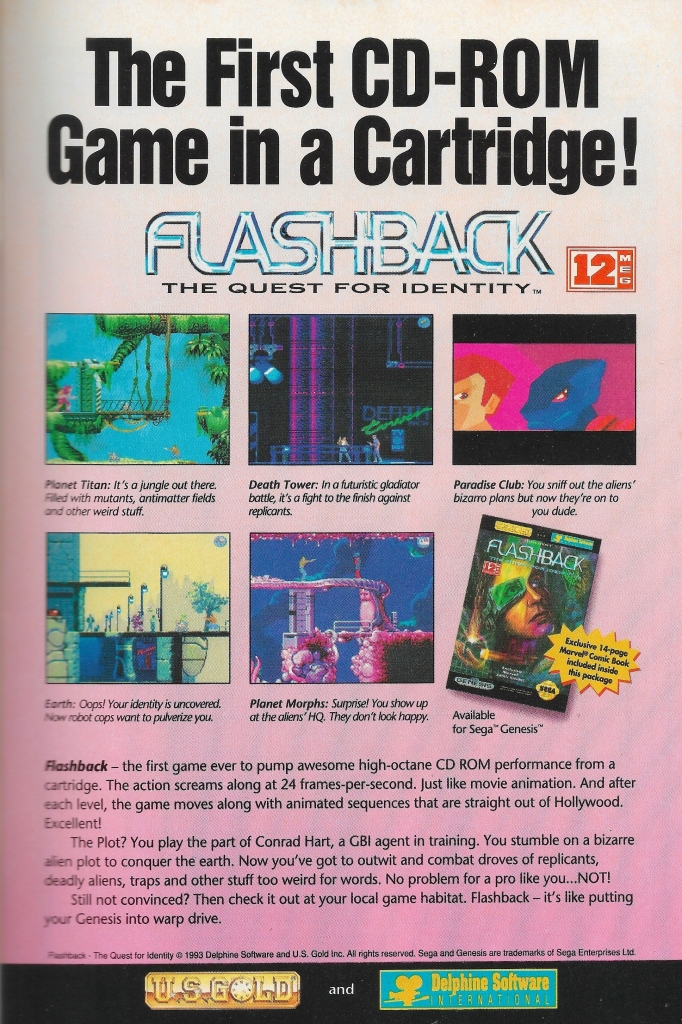
This was indeed an eye-catching print ad.

Back in the 1990s, the CD-ROM was cutting edge technology in the world of computing and CDs (compact discs) helped game companies have their game content as well as multimedia files (example: full motion videos or animated scenes) released together conveniently. In the middle of the decade, a version of the game Flashback: The Quest for Identity (note: a game with computer-generated animation scenes previously released on PC) was released in cartridge format for the Sega Genesis as well as the Super Nintendo Entertainment System (SNES). This was a big deal back in the days of the so-called 16-bit console war and the above print ad clearly emphasized it with the description “The First CD-ROM Game in a Cartridge!” The advertisers also assured consumers that the in-game 24 frames-per-second frame rate, the Hollywood-inspired high-quality visuals and related gameplay elements were intact for consoles. When I saw this particular ad, I became convinced to buy the game for my SNES (read my retro review by clicking here). To see how Flashback looks like on Sega Genesis, watch this.

5. Albert Odyssey: Legend of Eldean print ad

To make things clear, Albert Odyssey: Legend of Eldean is not based on any anime property. It was the 3rd game of its series and the first and only one to be released in English.

There is no denying the fact that Working Designs (closed since 2005) contributed a lot to console gaming by localizing and releasing several Japanese role-playing games (JRPGs) in America at a time when such games were not yet popular. Apart from the Lunar RPGs and Dragon Force, the company brought Albert Odyssey: Legend of Eldean to the Sega Saturn console in America and they had a very eye-catching print ad promoting it. Like their ads for Lunar RPGs, the Albert Odyssey: Legend of Eldean print ad had a dominating anime-style artwork that highlighted the fantasy concept and characters, plus screenshots and in-game animated (note: not anime but detailed pixel artworks) sequences that were meant to attract RPG enthusiasts and gamers looking for the next-generation console gaming experiences. It should be noted that Albert Odyssey: Legend of Eldean was actually the 3rd game of its franchise that started in Japan, and it was the first and only Albert Odyssey game to ever be released in English. To this day, Albert Odyssey: Legend of Eldean still has not been re-released nor remastered for other consoles and original Sega Saturn copies of the game are very expensive to acquire. That being said, this particular print ad is a lively reminder of Albert Odyssey’s only Western release.

6. Resident Evil 3: Nemesis print ad

Capcom efficiently showed the new monster Nemesis, screenshots of the game and the return of Jill Valentine in this 1999 print ad.

After the release of the best-selling and acclaimed Resident Evil 2, Capcom approved the production of several Resident Evil projects that include sequels and spin-offs. Along the way, Sony announced in 1999 that the PlayStation 2 console will come out in 2000 and this had an impact on Capcom’s RE projects as many of them were being developed for the aging PlayStation (PS1) console. Before the PS2 announcement, Capcom had a PS1 RE game project with its story set on a cruise ship. That project was abandoned following the PS2 announcement and because Capcom did not want to leave its fans to wait too long for another Resident Evil adventure on PS1, they reviewed their list of proposed spin-off games and went ahead making Resident Evil 3: Nemesis (Japanese title: Biohazard 3: Last Escape) for a late 1999 release while the PS1 console was still in good demand.  

In the above 1999 print ad, Resident Evil 3: Nemesis was shown with 3 screenshots assuring RE fans that the game has the tried-and-tested design of polygonal characters/monsters moving within pre-rendered environments, the action, the horror and adventure elements of the previous games. More notably, the new monster Nemesis had the biggest image and he rightfully became the main antagonist until the very end.

Lastly, the RE3 print ad featured the return of Jill Valentine (one of the protagonists of the first Resident Evil) and this time she had a clear sexualized look wearing a tube top and a mini-skirt. As I mentioned in my RE3 retro game review, I believe that the sexualized look of Jill was done by the game developers who were most likely influenced by the sexy appeal and iconography of the character Lara Croft from the Tomb Raider series of games. Like Lara Croft, Jill is sexy and capable of fighting with guns and other weapons. Whatever the intention of Capcom and the development behind the game, the print ad (which even had wrongful details about the timing of the story) clearly worked on getting RE fans and gamers’ attention as Resident Evil 3: Nemesis sold more than 3 million copies on PS1.

+++++

Thank you for reading. If you find this article engaging, please click the like button below, share this article to others and also please consider making a donation to support my publishing. If you are looking for a copywriter to create content for your special project or business, check out my services and my portfolio. Feel free to contact me with a private message. Also please feel free to visit my Facebook page Author Carlo Carrasco and follow me on Twitter at  @HavenorFantasy as well as on Tumblr at https://carlocarrasco.tumblr.com/ and on Instagram at https://www.instagram.com/authorcarlocarrasco
Retro Gaming Ads Blast

Welcome back readers, fellow geeks and electronic gaming fans!

Today I am launching a brand-new series of articles titled Retro Gaming Ads Blast (RGAB) which will explore the many print ads and promotions of video games, computer games, arcade games and handheld games that were published through the decades.

For the newcomers reading this, print ads of games were widely popular and heavily relied on by gamers/players long before smartphones, social media, the worldwide web and online videos even started. Back in the old days, print media was the most common method for companies to market their games while also helping hardware (machines which played the games) reach potential buyers. Such ads appeared in magazines, comic books and newspapers. Not only that, there were several print ads of games that were made to look creative, compelling and even intriguing.

With those details laid down, here is the first batch of retro gaming print ads for you to see and enjoy…

1. Parker Brothers’ Spider-Man-led print ad

Does this ad look amusing?

Remember Parker Brothers? That was a company that started way back in 1883 founded with a strong focus on the enjoyment of games in the form of board games, cards and toys. In the late 1970s, Parker Brothers started making electronic versions of their popular board games and engaged in the video game development and publishing. They also went on to make home ports of popular arcade games in the early 1980 for several gaming platforms.

Parker Brothers was very active with making games for the Atari 2600 console which became the dominant machine for home gaming in North America in 1982. In the above print ad, their marketing heavily emphasize the Spider-Man video game for Atari 2600 and added two others games they also published – Tutankham and Amidar – which was a clever move to market multiple games. The ad’s focus on Spider-Man was amusing and even without showing a single screenshot of the game, it was enough to entice people to watch out for it. Be aware that the Spider-Man game’s development was done by Laura Nikolich who was hired by Parker Brothers at a job fair. Nikolich had full creative control on making the game and had no contact whatsoever with Marvel Comics.

2. Advanced Dungeons & Dragons: Cloudy Mountain print ad

An ad like this was strong enough to motivate gamers’ imagination and interest.

Back in 1982, Advanced Dungeons & Dragons: Cloudy Mountain was released on the Intellivision game console and I was fortunate enough to watch my next-door neighbor play it repeatedly. The above print ad – which simply referred to the game as Advanced Dungeons & Dragons – only had a few words which directly pointed to the main objective of the game…the golden crown. While only one screenshot of the game was displayed, the advertisers heavily relied on hand-drawn, comic book-style fantasy art work to sell the game.

For those who were born long after the 1980s, let me share with you that ads like these were really impressive for their time. It was common for advertisers to use art works (even though they may not accurately reflect the gameplay or game design) and post at least one screenshot to catch the viewer’s attention with the hope that it would even encourage him/her to anticipate the game. It should be noted that ads like these were strong enough to make gamers’ imagination or curiosity grow stronger.  

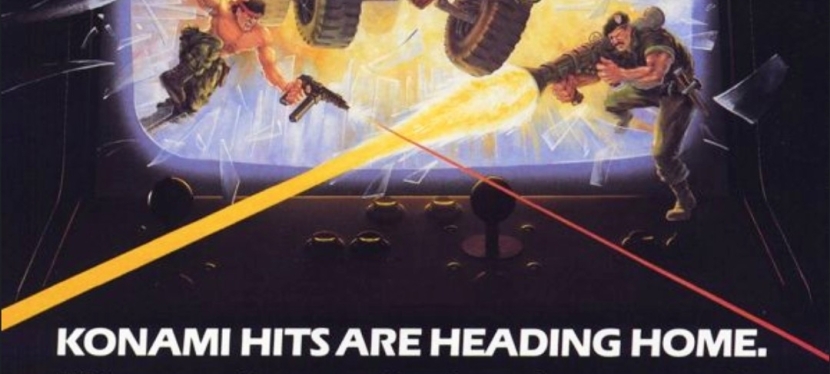
3. Konami’s collective military video games advertising

Print ad of four games for IBM, Amiga and Commodore.
Print ad of Jackal and Contra for the NES.

Konami, the Japanese company that has long been known for Metal Gear, Suikoden and the controversial sacking of famous game designer Hideo Kojima, was aggressive in the gaming business in the 1980s and arguably the aggressiveness was reflected in their publishing of several games that emphasized militarism during the late stages of the Cold War. In short, they made the military look cool and their activities fun to do in digital form.

While Konami has always been identified with console gaming, they actually released Rush’n Attack, Contra, Jackal and Boot Camp on IBM, Amiga and Commodore computers (as seen in the first print ad above) which were popular in the 1980s. The said ad also have a very amusing visual concept emphasizing the excitement and fun of military action games coming to gamers at home for their computers.

The 2nd print ad above – Jackal and Contra for the Nintendo Entertainment System (NES) – was very intriguing to see. It was very clear back in the 1980s that the NES always had a wholesome audience (note: a lot of buyers were parents who wanted to entertain their kids at home) and that includes a lot of very young players. To see the collective ad of Jackal and Contra (for the NES platform) having battle-hardened men in military gear holding guns was openly aggressive to perceive and instantly reminded people about the Cold War (and the menace of Communists, socialists, Marxists and terrorists) and the cultural impact of the mega blockbuster film Rambo: First Blood Part II. This is the kind of ad that would drive today’s woke-minded people crazy and even cause them to panic and pretend to be victims of militarism and patriotism. If you look at the ad closely, you will realize there is simply no room for the garbage of political correctness and wokeness.

Lastly, I myself had played Contra and Jackal with my friends on the Nintendo Family Computer (the Japanese counterpart of the NES) and both military games were a lot of fun to play from start to finish!

4. Batman Returns SNES game ad

This print ad appeared in some comic books I read in the early 1990s.

Way back in 1992, Batman Returns (the sequel to the mega blockbuster Batman movie of 1989) was released in cinemas with intense marketing and merchandising reflecting Warner Bros. intention to replicate the commercial success they had in 1989. Along the way, there were several video game adaptations of Batman Returns that were released on different platforms. Among those many video games was the Super Nintendo Entertainment System (SNES) game of Batman Returns which was developed and published by Konami in 1993 the form of a side-scrolling beat-them-up game.

The above ad was visually appealing with hand-drawn, comic book-style art dominating the spaces while leaving room for some screenshots and a written description of the game. Having seen this ad on multiple comic books I read back then, I can say that the ad was entertaining to see and was effective in making me interested in the game. I played Batman Returns on the SNES but never got to finish it. Oh yes, the game’s audio were really good and there were also digitized images from the movie for the in-game narrative.

5. Flashy Sonic the Hedgehog Japanese print ad

A dazzling approach by Sega on selling Sonic the Hedgehog.

1991 will always be remembered as the year of Sonic who eventually became not only Sega’s most defining mascot but also a video game industry icon. That same year, Sega released Sonic the Hedgehog on the Sega Genesis (referred to as Sega Megadrive in other parts of the world) console and it became a massive success with consumers and the game critics.

In the above Japanese print ad, a very captivating display of light and energy rays dominated the space leaving a minority share left for Sega’s console, screenshots and even a UFO Catcher arcade machine picture. While I could not understand the Japanese text, it seems to me that the flashy visual concept of the ad reflected Sega’s high ambitions with Sonic. How many gamers in Japan bought a copy of Sonic the Hedgehog because of this ad remains undetermined.

6. Japanese Super Star Wars print ad

A long time ago in a galaxy far, far away…

Before Nintendo released its 16-bit game console (referred to as Super Nintendo Entertainment System in America, and Super Famicom in Japan), there were lots of Star Wars video games released on varied platforms and the arcade.

With Nintendo’s 16-bit gaming platform realized, lots of game designers and business partners saw opportunities to make new games with gameplay concepts and designs using the technological advantages of the time. For LucasArts and its partners, taking Star Wars gaming into the next level was inevitable and they made it all come true in 1992’s Super Star Wars video game.

Published in Japan by JVC Musical Industries for the Super Famicom, Super Star Wars was a major leap forward in game design, visuals, sound and enjoyment. Apart from the 2D side-scrolling run-and-gun gameplay, gamers were deeply immersed into Star Wars’ universe with the Mode 7 landspeeder and X-Wing fighter sequences, as well as the first-person trench run sequence.

The Japanese print ad above cleverly presented screenshots from the game while using official imagery from the Star Wars movie poster of 1977 (look at how young Harrison Ford, Mark Hammill and the late Carrie Fisher were back then). The ad is a fine example of combining the greatness of the classic George Lucas-directed film with the highly enjoyable design of Super Star Wars. Lastly, these should remind you that there was a time when Star Wars was not yet tainted by wokeness and the garbage values of the Satanic Leftists (read: woke Disney).   

+++++

Thank you for reading. If you find this article engaging, please click the like button below, share this article to others and also please consider making a donation to support my publishing. If you are looking for a copywriter to create content for your special project or business, check out my services and my portfolio. Feel free to contact me with a private message. Also please feel free to visit my Facebook page Author Carlo Carrasco and follow me on Twitter at  @HavenorFantasy as well as on Tumblr at https://carlocarrasco.tumblr.com/ and on Instagram at https://www.instagram.com/authorcarlocarrasco