In what is an acknowledgment of slowing growth, the government of the Philippines officially reduced its economic growth targets until the year 2027, according to a news report by BusinessWorld.
To put things in perspective, posted below is an excerpt from the news report by BusinessWorld. Some parts in boldface…
The Philippines trimmed its economic growth targets until 2027, after growth likely slowed to about 4.8% to 5% this year, according to Economy Secretary Arsenio M. Balisacan.
In a briefing on Monday, Mr. Balisacan said the Development Budget Coordination Committee (DBCC) had lowered its gross domestic product (GDP) growth targets to 5%-6% for 2026 and 5.5%-6.5% for 2027. It kept the GDP growth target at 6%-7% for 2028.
The government earlier aimed to achieve 6%-7% GDP growth annually from 2026 until 2028.
This comes after Mr. Balisacan said the economy likely grew by 4.8-5% in 2025. This is much slower than the 5.7% GDP growth in 2024, and below the government’s 5.5-6.5% growth target.
“The emerging number, growth scenario for 2025, is something like 4.8 to 5%,” he said. “But if you achieve 5% for the entire year, because the first three quarters’ average is already 5%, that still puts the economy into one of the fastest growing economies in Asia.”
Economic growth slowed to an over four-year low of 4% in the third quarter, as the flood control scandal affected government spending and hurt business and consumer confidence.
“The developments last year are likely still to be felt this year, although in a diminishing effect, and so we expect growth perhaps in the first quarter or at least in the first half to be still quite not as rosy as we would want it to be,” the Economy chief added.
Let me end this post by asking you readers: What is your reaction to this recent development? Do you think the government spending this year should be increased somehow so that it will stimulate the national economy to grow more? Do you think investors based overseas are not convince to invest in the country soon?
As Japan struggles with economic challenges, an aging population, immigration and filling up the gaps of its workforce, an influential business lobby called for a stronger role by the government on issues related to foreign residents, according to a Kyodo News article. It should be noted that new rules regarding foreigners will be announced this month.
To put things in perspective, posted below is an excerpt from the news release of Kyodo News. Some parts in boldface…
Japan’s most influential business lobby has urged the government to show stronger leadership on issues concerning foreign residents and enact a “basic law” on policies related to non-Japanese as they become a growing part of the labor force and society.
The Japan Business Federation called for the establishment of a permanent headquarters led by the prime minister that will compile policies related to foreigners across agencies and ministries, saying a ministerial meeting launched by Prime Minister Sanae Takaichi in November was positive but insufficient.
The federation, also known as Keidanren, pointed out in a set of proposals released in mid-December that issues remain under the current framework regarding the effectiveness of medium- to long-term policymaking.
“A framework in which strong political leadership can be exerted is needed,” the group said.
It highlighted the need for a new ministerial post dedicated to foreigner-related policies with the authority to recommend that other agencies and ministries carry out investigations or formulate new rules.
The federation stressed that Japan is at a “turning point,” with steps to promote the smooth integration of foreign workers and their families into society essential, particularly with regard to education and social services.
With Japan’s population shrinking, the number of foreign residents will likely continue to rise beyond 2030, the group said.
It also noted “public anxiety and a sense of unfairness” in Japan, prompted by media reports that some foreigners were engaging in illegal activities and not complying with rules.
The House of (Councilors) election in July saw increased support for a populist party that campaigned on a “Japanese First” platform.
Takaichi, known for her conservative views, set up the ministerial meeting to demonstrate a stricter approach to foreigner-related issues, saying the government is seeking to “build a safe, secure, orderly, and inclusive society for the (Japanese) people and foreigners living in our country.“
As in a previous set of proposals released in 2022, the federation called for a shift in mindset from “passive acceptance of foreigners” to “strategic acquisition of foreign talent.”
It suggested placing more focus on the quality as well as quantity of foreigners accepted, including clearly defining what kind of human resources the country is hoping to attract from overseas.
Let me end this piece by asking you readers: What is your reaction to this development? Do you think the central government of Japan will be able to come out with new rules on foreigners that will make sense socially and economically?
With 2025 already behind us, one has to wonder how the Philippines performed when it comes to attracting foreign tourists and as of this writing, the final statistics have yet to be announced by the government. What is clear is that the Philippines really slumped on international tourism last year and the nation is behind many of its Southeast Asian neighbors, according to a recent news article by VnExpress International.
To put things in perspective, posted below is an excerpt from the news article of the VnExpress International. Some parts in boldface…
Vietnam and Malaysia are rising tourism stars in Southeast Asia thanks to relaxed visa policies and improving infrastructure while Thailand has lost its lead due to border clashes and safety concerns.
Vietnam received its 20th millionth foreign visitor in a year for the first time at the Phu Quoc International Airport on Dec. 15, marking a milestone for its tourism sector. The full-year is expected to exceed 21 million, surpassing the previous record of 18 million achieved in 2019 before Covid.
With its 21% growth rate this year, Vietnam is regarded by the United Nations World Tourism Organization as one of the fastest-growing markets in the world.
Malaysia attracted 28.2 million tourists in the first eight months of this year, a 14.5% increase year-on-year.
The industry will be supported by stronger Chinese tourist arrivals, improving flight connectivity and the government’s ambitious “Visit Malaysia 2026” campaign, according to HSBC Global Research.
“Malaysia is on track to easily exceed its 2025 tourism target of 31.4 million tourists, making it one of the few ASEAN economies to achieve its target.
“We estimate the number of tourists is likely to exceed 40 million.”
This year, both countries have strived to ease visa polices, enhance promotion campaigns and improve airport infrastructure.
Indonesia and Laos have also seen increasing tourist numbers.
Indonesia received over 12.76 million foreign visitors in the first 10 months, a 10% increase, with Malaysia, Singapore, Australia, and India being the leading source markets. Laos received 3.8 million, a 13% increase.
Challenging year for Thailand, Cambodia – Once a tourism powerhouse in Southeast Asia, Thailand has struggled with setback after setback this year.
The crisis began in January as many Chinese tourists canceled their trips to the country following the high-profile abduction of Chinese actor Xing Xing.
Two months later a deadly earthquake in Myanmar that sent tremors across Bangkok caused widespread damage to the tourism industry.
Escalating military clashes along the Thai-Cambodian border also triggered a surge in cancellations across provinces near the fighting. Some countries warned their citizens to postpone traveling to Thailand.
Arrivals as of early December declined by 7% to 30 million. Thailand had received 40 million tourists in 2019 and 35 million last year.
Meanwhile, Cambodia’s reputation took a beating in the eyes of South Koreans due to online scams and the disappearance of hundreds of their fellow citizens who entered that country.
The South Korean government has issued warnings to its citizens to cancel or postpone non-essential travel to the Cambodian capital Phnom Penh and areas like Sihanoukville and Bokor Mountain.
Cambodia attracted only 4.75 million tourists in January-October, a decrease of 11.6%.
The Philippines received 4.7 million foreign visitors in the first 11 months of the year, a 3.02% decline due to significantly lower arrivals from South Korea and China.
Let me end this post by asking you readers: What is your reaction to this recent development? Do you think the Philippines still has a lot of problems to solve regarding infrastructure, tourism promotions and domestic travel costs before it could become competitive with its Southeast Asian neighbors? If ever the Philippines fails to hit its 2025 foreign tourist arrivals target, do you think the Department of Tourism (DOT) will once again point to tourism revenues as a barometer for success? With its current standing on international tourism, do you consider the 2023-2028 National Tourism Development Plan (NTDP) of the Philippines a failure already?
With countless challenges – both internal and external – affecting Japan every day, Prime Minister Sanae Takaichi is determined to make the nation stronger and more prosperous by implementing reforms, according to a Kyodo News article. The Prime Minister delivered her New Year’s statement.
To put things in perspective, posted below is an excerpt from the news release of Kyodo News. Some parts in boldface…
Prime Minister Sanae Takaichi on Thursday pledged to make Japan “strong and prosperous” by carrying out “necessary reforms” to address various domestic and global challenges.
In her New Year’s statement, Takaichi, who became Japan’s first female prime minister on Oct. 21, said her government is committed to building a nation where younger generations can believe in the future and live in hope.
Takaichi emphasized that Japan faces a shrinking population, rising living costs after decades of deflation, and what she described as “the most severe and complex security environment” since the end of World War II.
Globally, political and economic uncertainties are growing as “the free and open international order is being shaken and hegemonic moves are increasing,” she said, in an apparent reference to China’s escalating military activities and Russia’s invasion of Ukraine.
Takaichi took office after winning the Liberal Democratic Party leadership race in early October, succeeding Shigeru Ishiba, who had announced the previous month that he would resign following the party’s heavy setback in the House of Councillors election in July.
With Takaichi’s Cabinet maintaining high approval ratings — well above those of her immediate predecessors — parliament is set to begin this year’s 150-day regular session on Jan. 23.
Let me end this piece by asking you readers: What is your reaction to this development? Apart from the pending new rules on foreigners, what kind of social and economic reforms do you think Prime Minister Takaichi and her administration will come up with over the next six months? Do you think the government will be able to come up with new policies to encourage married couples to have more children?
Here in the Philippines, the renewable energy sector suffered a tremendous setback at the Department of Energy (DOE) officially terminated eighty-four renewable energy service contracts over the failure of developers to meet their contractual obligations, according to a news release by the Philippine News Agency (PNA).
To put things in perspective, posted below is an excerpt from the news article of the PNA. Some parts in boldface…
The Department of Energy (DOE) has terminated 84 renewable energy service contracts this 2025 after developers failed to implement their contractual obligations.
These service contracts cover an “estimated 5,372.209 megawatts (MW) of potential capacity that had been factored into the country’s energy planning assumptions,” the DOE said in a press release Wednesday.
These were terminated “due to developers’ non-compliance with work program requirements, failure to satisfy the Green Energy Auction Program (GEAP) Terms of Reference, and non-adherence to established DOE standards.”
These actions, it said, “follow a comprehensive technical and legal evaluation of the affected projects’ compliance with the material terms and conditions of their respective service contracts.”
“The DOE will continue to uphold high standards for the succeeding GEAP rounds and may impose further sanctions, including blacklisting, forfeiture of performance bonds, and the imposition of applicable penalties,” it said.
The DOE said 43 other RE projects are under enforcement review and may be subject to termination.
With a big chunk of potential capacities unmet, the DOE said it is “actively revisiting supply-demand scenarios and undertaking further system planning to determine appropriate next steps toward meeting established generation targets.”
Let me end this post by asking you readers: What is your reaction to this recent development? Do you think the developers and stakeholders of the renewable energy sector of the Philippines are mostly incapable of fulfilling the requirements of the national government with regards to energy service contracts?
For the newcomers reading this, the ACCC is the private entity that owns and operates ATC. Rockwell Land is the corporation known for the Power Plant Mall and Rockwell Center in Makati City. The Philippine Star news report mentions the ATC operator in the new acquisition.
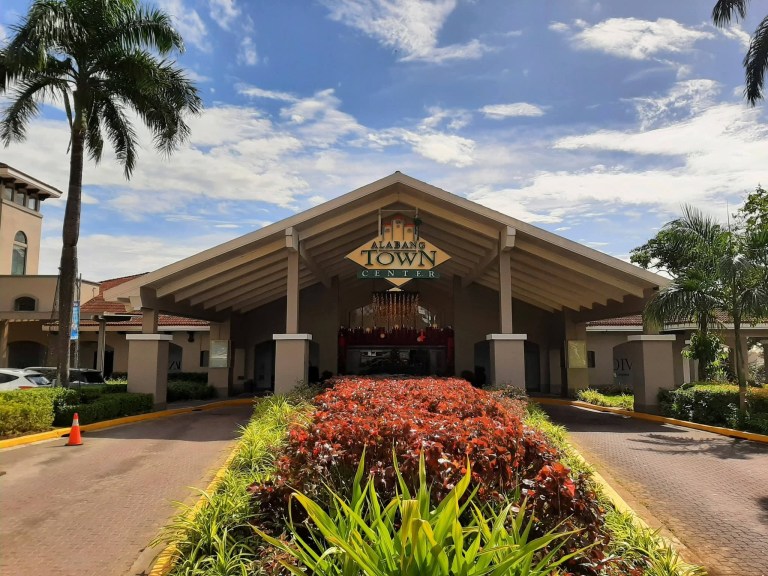
The front of Alabang Town Center along Madrigal Avenue.
To put things in perspective, posted below is the excerpt from the business news report of BusinessWorld. Some parts in boldface…
Lopez Family-led real estate developer Rockwell Land Corp. has acquired a 74.8% stake in the 17.5-hectare Alabang Town Center for P21.6 billion, expanding its commercial operations in the south.
“Earlier this year, Mr. Francisco ‘Jun’ M. Bayot invited us to consider redeveloping Alabang Town Center. It presented a compelling opportunity for Rockwell Land to further expand our presence in the south of Metro Manila, particularly given the scale and long-term potential of the property,” said Rockwell Land Chief Executive Officer Nestor J. Padilla in a statement on Monday.
“We are very grateful to Mr. Bayot and the Madrigal family for this opportunity. Our immediate focus is on ensuring a smooth transition and planning its redevelopment,” he added.
Alabang Town Center currently hosts more than 500 retail and office tenants, and its size offers significant redevelopment opportunities, the company said. Rockwell Land is known for its flagship mixed-use development, Rockwell Center Makati, anchored by the Power Plant Mall.
“Over the years, the company has enhanced its retail developments by integrating experiential and lifestyle-oriented spaces into its master planning, supported by curated tenant mixes. These efforts have enabled Rockwell Land to establish a strong track record in delivering a high-end retail experience,” it said.
Let me end this post by asking you readers: What is your reaction to this recent development? If you are a resident of Muntinlupa City, do you have any concerns about what would happen to Alabang Town Center under Rockwell’s control? Do you think the planned redevelopment of ATC will eventually make it better in the near future? What improvements do you hope to see at the ATC under Rockwell’s control?
For more South Metro Manila community news and developments, come back here soon. Also say NO to fake news, NO to irresponsible journalism, NO to misinformation, NO to plagiarists, NO to reckless publishers and NO to sinister propaganda when it comes to news and developments. For South Metro Manila community developments, member engagements, commerce and other relevant updates, join the growing South Metro Manila Facebook group at https://www.facebook.com/groups/342183059992673
It has been months since the flood control corruption scandal rocked the entire Philippines and the economic situation has turned for the worse along the way (click here, here and here). In the view of Fitch Ratings, the scandal puts the nation’s credit rating at risk, according to a news report by BusinessWorld.
To put things in perspective, posted below is an excerpt from the report of BusinessWorld. Some parts in boldface…
THE Philippine economy continues to bear the brunt of the ongoing flood control corruption scandal, Fitch Ratings said, noting that further unrest could spill over to the country’s credit rating.
Fitch Ratings Head of Asia-Pacific Sovereigns Thomas Rookmaaker said the controversy surrounding the anomalous government flood control projects threatens the country’s political stability, fiscal policy implementation, as well as business and consumer confidence.
“We believe that the flood control corruption scandal in the Philippines poses an ongoing risk to political stability, fiscal policy execution, and business and consumer confidence,” Mr. Rookmaaker told BusinessWorld in an e-mail.
Government officials, lawmakers and contractors have been accused of getting billions of pesos in kickbacks from substandard or nonexistent flood control projects. This has triggered widespread protests, slowed government spending, and hurt investor and consumer sentiment.
“The overall impact the scandal will have on the Philippines’ public finances is still uncertain,” Mr. Rookmaaker said.
“Public investment spending is likely to remain weak for quite some time, but continued social unrest could simultaneously lead to spending pressures to head off public discontent.”
In October, government spending fell for a third straight month to P430.6 billion, down 7.76% from P466.8 billion a year ago. Revenues likewise slipped by 6.64% to P441.7 billion from P473.1 billion last year.
Mr. Rookmaaker noted that the immediate impact of the scandal was reflected in the sharp economic slowdown in the third quarter.
Philippine gross domestic product (GDP) expanded by an over four-year low of 4% in the third quarter, as household final consumption expenditure and government spending slowed amid the corruption mess.
For the first nine months, GDP growth averaged 5%, well-below the government’s 5.5-6.5% full-year target.Public investments likewise took a hit from the corruption issues, he added.
In the third quarter, foreign investment pledges approved by investment promotion agencies plunged by 48.7% to P73.68 billion, Philippine Statistics Authority data showed.
“Persisting social tensions could become more of a drag on growth if confidence among foreign and domestic investors suffers,” the Fitch analyst said. “Tensions could also serve as a distraction for policymakers, impeding the passage of reforms that have the potential to enhance economic productivity and competitiveness.”
Mr. Rookmaaker said implementing reforms to enhance accountability and governance could bolster private investments and promote growth in the medium term.
Let me end this post by asking you readers: What is your reaction to this recent development? Did you think Fitch Ratings is correct with its economic analysis of the Philippines and the flood control corruption scandal? Do you think foreign investors have been turned off by the scandals and social unrest?
Even though there already is a foreign tourism boom in Southeast Asia, the Philippines has literally been left behind by its neighbors as it attracted only 5.235 million international tourist arrivals for the period of January to November 2025, according to a news report by BusinessWorld.
To put things in perspective, posted below is an excerpt from the report of BusinessWorld. Some parts in boldface…
VISITOR ARRIVALS in the Philippines fell by 2.16% in the first 11 months, amid a decline in tourists from South Korea and China, Tourism department data showed.
Data from the Department of Tourism (DoT) showed international tourist arrivals dropped to 5.235 million in the January-to-November period from 5.35 million in the same period in 2024.
Of the tourist arrivals, the bulk or 4.918 million were foreign tourists, while the rest were overseas Filipinos.
South Korea remained the biggest source of tourists in the first 11 months, accounting for 21.66% of the total. While 1.134 million South Koreans visited the Philippines as of November, this was a 21% decline from the 1.436 million Korean tourists a year ago.
The US was the second-biggest source of tourists, at 894,835 or 17.09% of the total as of end-November. This was 6.57% higher than last year’s 839,635 tourist arrivals from the US.
Japan was the third-biggest source of tourists, accounting for 406,794 or 7.77% of the total, 15.36% up from 352,630 a year ago.
Tourist arrivals from Australia increased by 16.17% to 268,892 in the 11-month period. Meanwhile, tourists from China fell by 16.55% to 248,339 as of end-November.
The other top markets were Canada, Taiwan, the United Kingdom, Singapore, and Malaysia, which cumulatively accounted for 793,750 of the total arrivals.
“The weaker South Korean won amid a volatile political and economic situation over the past year and slower economic growth in China, which is the world’s second-biggest economy, on top of territorial disputes partly weighed on foreign tourism numbers,” Rizal Commercial Banking Corp. Chief Economist Michael L. Ricafort said in a Viber message.
Mr. Ricafort noted that the government should improve infrastructure to make it more convenient for tourists to travel around the country.
“Challenges include the need to further expand and develop tourism-related infrastructure such as airports, seaports, accommodation facilities, and train systems, including the Metro Manila subway and toll roads,” he added.
Despite the decline in the first 11 months, Mr. Ricafort said that it is still possible for the country to surpass the tourist arrivals last year, which reached 5.949 million.
“It is still possible, considering some seasonal increase in foreign tourists during the Christmas holiday season, especially overseas Filipino workers and balikbayans, to spend the most festive time of the year, while others escape winter,” he said.
“A higher US dollar-peso exchange rate would make it cheaper for foreign tourists to come to the Philippines,” he added.
Meanwhile, Mr. Ricafort noted the growth in tourist arrivals from India and other countries, which helped “offset the decline in major traditional sources such as South Korea and China.”
India was the 11th biggest source of tourist arrivals in the January-to-November period, accounting for 85,885 or 1.64% of the total. Tourists from India increased by 17.06% from 73,369 arrivals in the same period in the previous year.
Earlier this year, the Philippines and India signed the Implementation Program on Tourism Cooperation for the years 2025 to 2028.
For his part, Colliers Research Director Joey Roi H. Bondoc said that with only 5.235 million as of end-November, it will be difficult for the country to even surpass last year’s arrivals.
“I think it will be very difficult… We may not be able to beat that or even meet that, but of course we want to end the year stronger,” he said in a phone interview.
“We see a lot of foreign tourists still in December because of the holiday season. Definitely that optimism should spill over to next year,” he added.
As for the drop in arrivals from South Korea, Mr. Bondoc attributed this to the economic downturn and political crisis in the country.
“If you look at some integrated casinos, they were initially targeting Koreans… so they are experiencing the pinch of slower arrivals from South Korea,” he said.
Mr. Bondoc said the Philippines should try to attract tourists from other markets.
For further insight about the tourism industry problem of the Philippines, watch the CNA Insider video below.
Let me end this post by asking you readers: What is your reaction to this recent development? Did you think the Philippines can still beat its 2024 record of international visitor arrivals and generate huge revenues for the economy? Do you think the current administration will be able to improve the nation’s infrastructure and make travel more efficient and convenient for all tourists? Do you think the Philippines is too expensive when it comes to air travel?
Have you been buying green tea products imported from Japan lately? Japan achieved a major milestone this year as its green tea exports in the first ten months of 2025 (January to October 2025) have reached the highest level in more than seventy years, according to a news release by Kyodo News. There is still more that could be achieved as the year comes to an end.
To put things in perspective, posted below is an excerpt from the news release of Kyodo News. Some parts in boldface…
Japan’s green tea exports in the first 10 months of this year reached the highest level in over 70 years on the back of the booming overseas market for matcha powder and the depreciation of the Japanese yen, government and industry data showed Saturday.
Tea exports between January and October grew 44 percent from the same period last year to 10,084 tons. The United States was the top destination, importing 3,497 tons in the 10 months, followed by Taiwan, Thailand and Germany.
Green tea exports have been increasing for nine consecutive years, reflecting the growing overseas popularity of Japanese foods among health-conscious consumers.
Despite rising overseas sales, annual shipments remained below 10,000 tons after peaking at 11,553 tons in 1954, partly as Chinese tea grew in popularity.
Despite sluggish green tea demand within Japan, tea leaf prices have been rising in recent years in line with falling production.
In 2024, Japan produced about 74,000 tons of tea leaves, more than 10 percent less than a decade earlier, amid declining demand for sencha used in brewing and an aging farming population.
Let me end this piece by asking you readers: What is your reaction to this development? Have been consuming green tea products from Japan over the past six months? If you did, what products are those and what were their brands?
A new age for the famous Alabang Town Center (ATC) in Muntinlupa City will soon begin as the developer Ayala Land Inc. (ALI) will sell its 50% stake in Alabang Commercial Center Corp. (ACCC) to the Madrigal family in a deal with P13.5 billion, according to a Manila Bulletin business news report.
For the newcomers reading this, the ACCC is the private entity that owns and operates ATC. Already, it has been reported that the Madrigal family is talking with Rockwell Land Corp. about redeveloping the high-end Alabang mall.
The front of Alabang Town Center along Madrigal Avenue.
To put things in perspective, posted below is the excerpt from the business news report of the Manila Bulletin. Some parts in boldface…
Ayala Land, Inc. (ALI) has agreed to sell its 50 percent stake in Alabang Commercial Center Corp. (ACCC), the entity that owns and operates the prominent Alabang Town Center mall in Muntinlupa City, back to the Madrigal family for ₱13.5 billion.
The real estate giant announced in a disclosure to the Philippine Stock Exchange that it executed a share purchase agreement with its existing joint-venture partner. The transaction is contingent on standard closing conditions.
“The unsolicited offer from our joint venture partner provided a premium, allowing ALI to recognize gains from the sale and monetize its stake in Alabang Town Center,” said ALI Chief Finance Officer and Treasurer Jose Eduardo A. Quimpo II.
He added that the “Proceeds from the sale will fuel further growth in our Leasing portfolio and provide our stakeholders with return of capital.”
In a separate statement, ALI said the deal allowed the company to realize “compelling value for the mature asset, crystallizing future earnings potential today.”
“This move is a deliberate execution of Ayala Land’s strategy to be a premier creator of value,” the company said. “It showcases a disciplined approach of developing assets, stabilizing their operations, and monetizing them at an optimal valuation to aggressively fund future growth and enhance shareholder returns.”
ALI President and Chief Executive Officer Meean B. Dy noted the firm’s strategic focus.
“Our strategy is focused on a dynamic cycle of value creation. We build, we stabilize, and we unlock value at the right time to fuel our next wave of innovation,” Dy said.
“This transaction is a prime example of that strategy in action. We are monetizing a legacy asset at peak valuation to accelerate the rollout of our expansive pipeline of commercial and retail spaces, which will define the Ayala brand of development for the next decade,” he added.
The proceeds from the sale are slated to be a key driver in funding ALI’s leasing pipeline, which includes nearly 700,000 square meters of new gross leasable area (GLA) over the next five years. This expansion is set to transform the commercial landscape in key growth centers across the Philippines.
Chinabank Capital Corp. Managing Director Juan Paolo Colet described the deal as “an opportunistic transaction that enabled Ayala Land to exit their joint venture with the Madrigal family at an attractive price. The company can readily use the cash for various projects in its growth pipeline.”
Colet noted that the future plans for the property remain uncertain.
“It remains to be seen what the Madrigal family will do with their prime commercial property. Given the price they paid, they would need to unlock more value from the asset. A major redevelopment might be on the table,” he said.
Situated adjacent to exclusive gated residential communities and active business developments, Alabang Town Center serves as a community anchor with multiple al fresco areas that contribute to a relaxed, homey atmosphere consistent with the local lifestyle.
Let me end this post by asking you readers: What is your reaction to this recent development? If you are a resident of Muntinlupa City, do you think the P13.5 billion deal will lead to a major redevelopment of Alabang Town Center in the near future? If you have visited the ATC before, how often do you visit the high-end shopping mall in Alabang? Do you feel confident the ATC will evolve and possibly expand under the control of the Madrigal family and Rockwell Land? Does Alabang Town Center’s current design and structure look old or outdated to you?
For more South Metro Manila community news and developments, come back here soon. Also say NO to fake news, NO to irresponsible journalism, NO to misinformation, NO to plagiarists, NO to reckless publishers and NO to sinister propaganda when it comes to news and developments. For South Metro Manila community developments, member engagements, commerce and other relevant updates, join the growing South Metro Manila Facebook group at https://www.facebook.com/groups/342183059992673






 Author Carlo Carrasco