A Look Back at WildC.A.T.S: Covert Action Teams #9 (1994)

Disclaimer: This is my original work with details sourced from reading the comic book and doing personal research. Anyone who wants to use this article, in part or in whole, needs to secure first my permission and agree to cite me as the source and author. Let it be known that any unauthorized use of this article will constrain the author to pursue the remedies under R.A. No. 8293, the Revised Penal Code, and/or all applicable legal actions under the laws of the Philippines.

Welcome back superhero fans, 1990s arts and culture enthusiasts and comic book collectors! Today we continue revisiting Jim Lee’s flagship title under the Image Comics label – WildC.A.T.S: Covert Action Teams!

Last time around, members of the WildC.A.T.S were split apart in terms of locations as they had their rest-and-relaxation period. While Grifter went away to do something urgent (read: the Kindred comic books), Zealot, Void and Jacob Marlowe’s executive assistant Jules picked up Warblade and Maul using their high-tech aircraft to head on to the Bahamas where an entire cruise ship disappeared with Marlowe, Voodoo and Spartan on it.

Unbeknownst to the WildC.A.T.S flying in their jet, Voodoo, Spartan and Marlowe found themselves as captives of an armored man (wearing a half-helmet) called Entropy inside his domain in an undetermined location. Entropy refers to Marlowe as lord Emp and states that he will suffer from his wrath. Marlowe does not recognize him.

With those details laid down, here is a look back WildC.A.T.S: Covert Action Teams , published by Image Comics in 1994 with a story written by Brandon Choi and Jim Lee. Lee did the art with Scott Williams in-charge with the ink work.
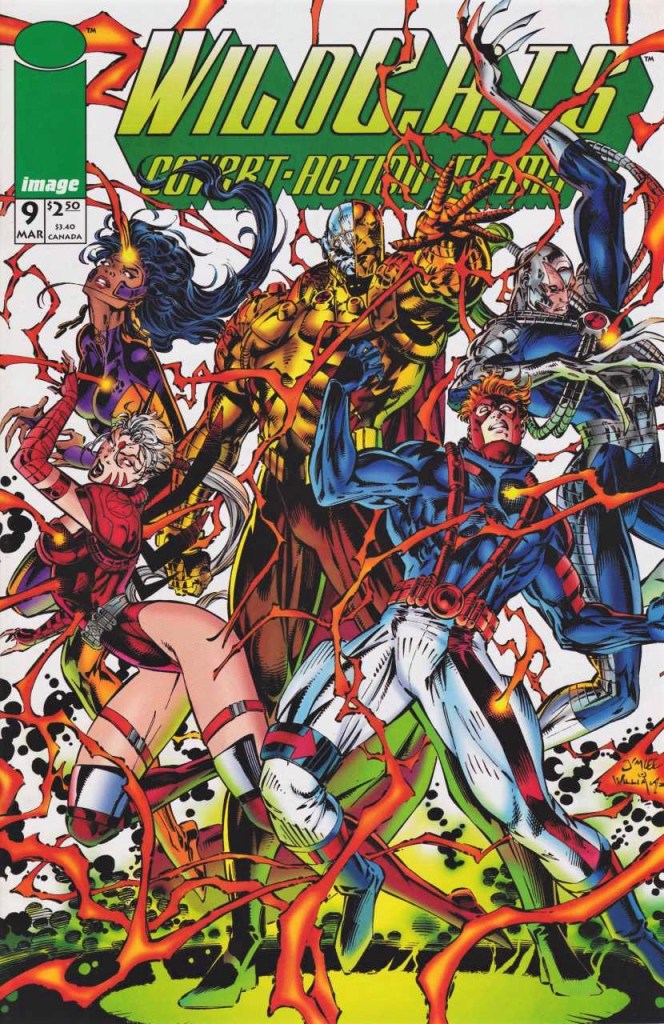
The cover.

Early story

The story begins with the partial WildC.A.T.S team arriving in the area of the Bermuda triangle with their aircraft. From their view, there was nothing to spot but Zealot insists that they keep on searching as they must be overlooking something.

Meanwhile, Spartan and Voodoo find themselves in deep trouble as a horde of Daemonites persistently attack them. Already heavily damaged, Spartan keeps on using his energy blasts to hold the monsters off. Voodoo on the other hand is too weak and could not concentrate to help her teammate.

Suddenly one of the Daemonites slashes Spartan’s left arm which neutralizes his energy blast. His body got pierced by one of the monsters which pinned him down, leaving Voodoo completely helpless…

Quality
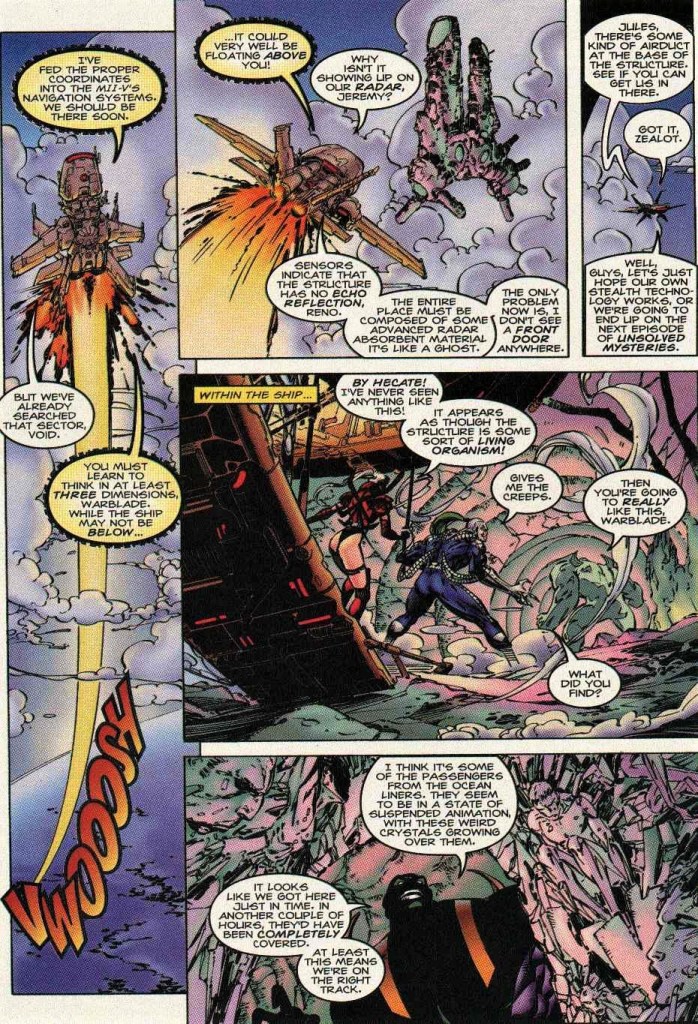
The WildC.A.T.S on search-and-rescue.

On face value, this comic book looks like another generic or even disposable good-versus-evil story drawn by Jim Lee. In reality, its story has more significance to it and the creators themselves came up with something fresh for WildC.A.T.S fans. Firstly, this is a story about one group of WildC.A.T.S trying to rescue their boss and their two other teammates from Entropy in a location that could not be easily found. Secondly, this comic book puts strong focus back on the Kherubim-Daemonite war which creatively looks back at one of the many events that took place in Jacob Marlowe’s past (which he could not remember at first) complete with implementing a strong fantasy (read: swords and armors) element which gives the story a mixed-genre aesthetic.

The good news here is that the storytelling and visual presentation by the creators are really well done! While the dual approach of storytelling involving both the present and the far past was used in Jim Lee’s past X-Men works with Marvel, the said approach was well executed with WildC.A.T.S which not only expanded its lore further but also developed Jacob Marlowe’s personality even further.

To have Entropy (note: he eerily resembles’ Mantra arch-villain Boneyard in the Ultraverse) as an enraged opposition figure living with a lust for revenge against Marlowe is a smart move and at the same time this adds variety to the kind of opposition WildC.A.T.S have. More on what happened in the past involving both Marlowe and Entropy, the flashback raises new questions about the value and true nature of the WildC.A.T.S’ leader who at this point was a brash manager who wields lots of resources to operate with. The flashback also challenges readers on how to evaluate Jacob Marlowe when it comes to being accountable about his past actions, including the many things he did but could not remember. All of these lead to a really impactful ending that you readers must see.

Conclusion
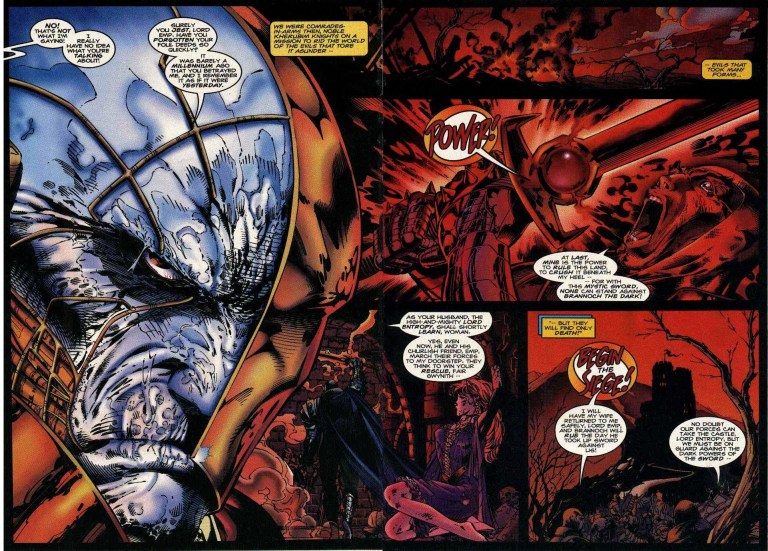
Meet Entropy, a man with a shared past with Jacob Marlowe.

WildC.A.T.S: Covert Action Teams (1994) is a Jim Lee-drawn tale that has solid depth and a very creative approach to its presentation, specifically its daring and well-executed method of mixing the superhero and fantasy elements. When it comes to the narrative, the creative team succeeded in telling both the present and the past tales followed by connecting them with each other while ultimately telling an overall cohesive tale. This is a Wild.C.A.T.S story that must be read from start to finish, and it is a powerful follow-up to issue .

If you are seriously planning to buy an existing hard copy of WildC.A.T.S: Covert Action Teams (1994), be aware that as of this writing, MileHighComics.com shows that the near-mint copy of the regular edition costs $30.

Overall, WildC.A.T.S: Covert Action Teams (1994) is highly recommended.

+++++

Thank you for reading. If you find this article engaging, please click the like button below and also please consider sharing this article to others. If you are looking for a copywriter to create content for your special project or business, check out my services and my portfolio. Feel free to contact me with a private message. Also please feel free to visit my Facebook page Author Carlo Carrasco and follow me on Twitter at  @HavenorFantasy as well as on Tumblr at https://carlocarrasco.tumblr.com/and on Instagram at https://www.instagram.com/authorcarlocarrasco/
A Look Back at Mantra #4 (1993)

Disclaimer: This is my original work with details sourced from reading the comic book and doing personal research. Anyone who wants to use this article, in part or in whole, needs to secure first my permission and agree to cite me as the source and author. Let it be known that any unauthorized use of this article will constrain the author to pursue the remedies under R.A. No. 8293, the Revised Penal Code, and/or all applicable legal actions under the laws of the Philippines.

Welcome back Ultraverse fans, geeks and fellow comic book collectors! If you want to discover more of the fantasy elements within the Ultraverse through Mantra – the pretty sorceress whose body is occupied by the soul of a male warrior named Lukasz – then you are in for something rather different.

To put things in perspective, the fantasy-swords-magic concept was made clear in Mantra #1 and that Lukasz and his band of warriors (led by an elder sorcerer) as well as their enemies (led by Boneyard) were definitely from another world. That other world will be explored at last in this look back at Mantra , published in 1993 by Malibu Comics with a story written by Mike W. Barr and drawn by Robb Phipps.

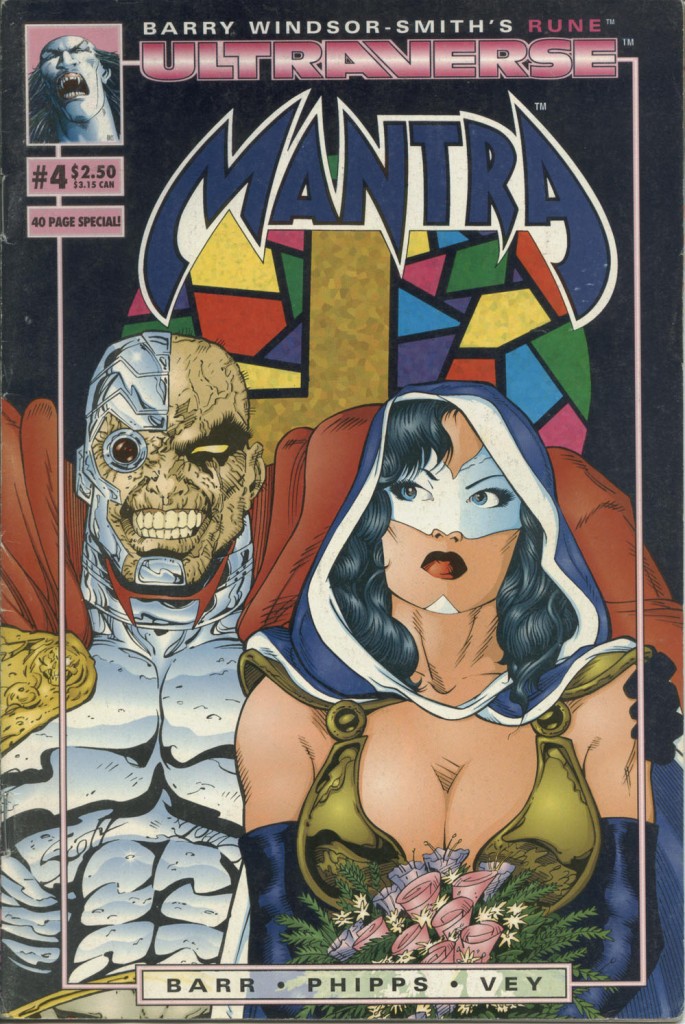
The cover.

Early story

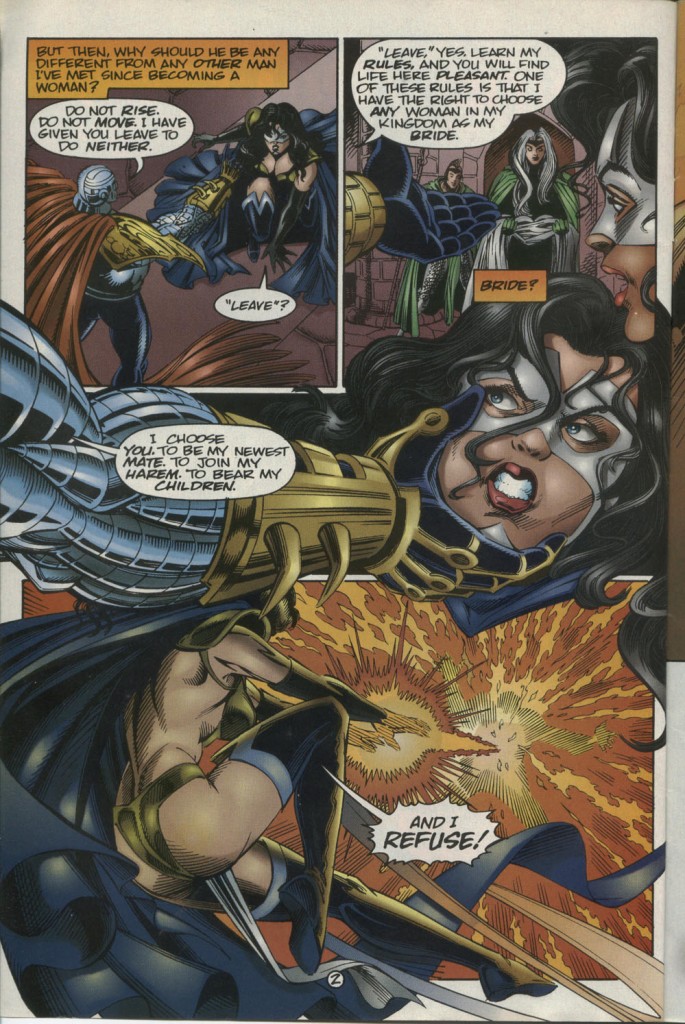
The story begins in the world of Boneyard, at his castle specifically. Down on her knees, Mantra is just in front of the villain Boneyard who says, “So this is Archimage’s last, best hope. Just a woman!!”

Boneyard tells Mantra not to rise nor move. As he does not yet know that Lukasz is inside Mantra’s body, Boneyard welcomes her and states that it is his right to choose any woman in his kingdom as his bride. In reaction to being selected as Boneyard’s newest mate with a purpose to potentially give birth to his children, Mantra strikes him with an energy blast symbolically rejecting him.

Boneyard then says, “Enough. I tolerate this dissent because your body carries much potential for magic, woman. It is only your body that saves you from death. Your bewildering loyalty to my defeated brother, Archimage, would ordinarily be enough to condemn you. Your genes, combined with mine will yield children to whom magic comes as easily as taking breath.”

As the villain talks, Mantra notices the sword pointed at her was the same one used to kill her when she was man (as Lukasz). She then makes moves to get Boneyard off-balanced and try to leave the castle…

Quality

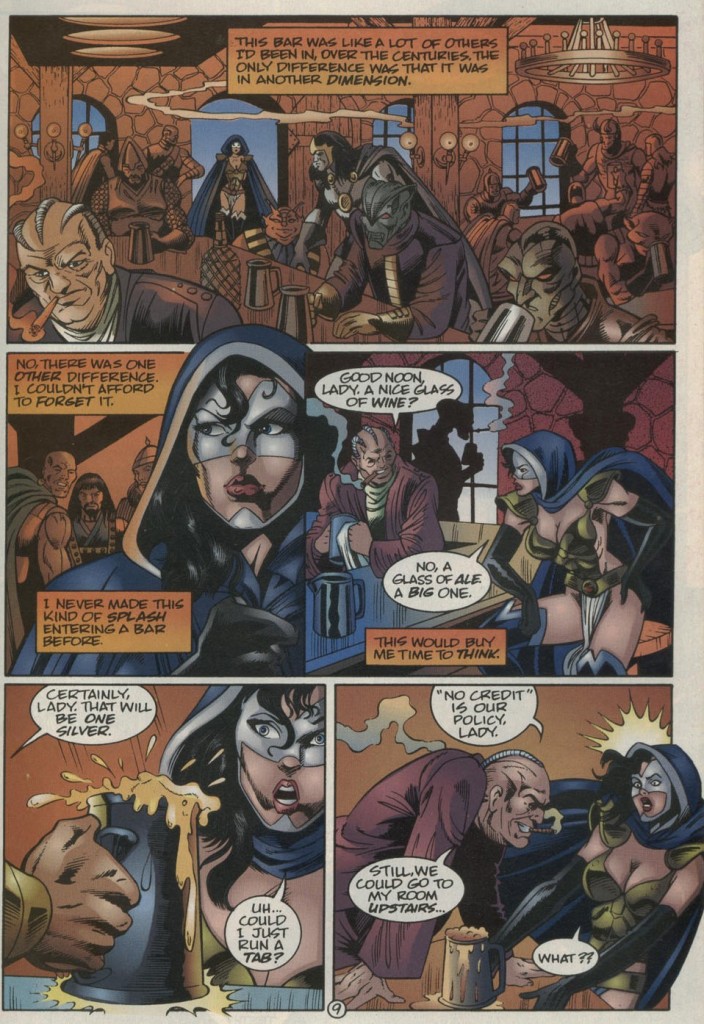
Mantra visits the tavern in the kingdom controlled by Boneyard.

I’ll start with the writing. What Mike W. Barr did here successfully was raising the stakes for Mantra which involves the drastic change of location and setting from the modern society of Earth into the fantasy realm where Boneyard and his army are based in. The mentioned change literally opened new opportunities to develop Mantra’s personality while at the same time offered readers a lot of new things and places for their exploration.

With the all-new setting, lots of fantasy genre tropes are present. There is the ever-present tavern filled with lots of people that include humans and non-human beings that go beyond dwarves and elves. There is also the slave auction of both men and women standing almost nakedly in front of the bidders. There also were people wearing capes, hoods, swords, spears and armor which Mantra smoothly blends in with.

Along the way, there is a lot spectacle here mainly acts of magic alternated with hard action moves. The way the spectacle is presented fits in excellently with the fantasy setting and I should state that Robb Phipps did a very solid job visualizing such elements while succeeding in making Mantra, Boneyard, Archimage and Warstrike look recognizable.

Back to the writing, Mike W. Barr prepared a lot of details in the story that explained Boneyard’s nature and even his status as the husband of multiple wives. This comic book also reveals that Boneyard is likely bisexual since, apart from being married to multiple women, he kissed Mantra and lusts for her even AFTER he learned that Lukasz is occupying the woman’s body. His intention to marry Mantra symbolizes homosexuality as well. To put things in perspective, this makes Boneyard very guilty of sexual immorality on top of his wickedness. Refer to 1 Corinthians 6:9-10 (sexual immorality and homosexuality), Galatians 5:19-21 (sorcery and sexual immorality) and Deuteronomy 17:17 (polygamy) in the Holy Bible.

Conclusion

Boneyard’s intention to marry Mantra (whose body is occupied by the soul of the male eternal warrior Lukasz) and impregnate her to produce his children is disgusting, even more so when the villain knows Lukasz is in Mantra.

To say the least, Mantra (1993) is entertaining enough mainly due to its fantasy setting and exposing key elements about the rivalry between Archimage and Boneyard. This was a daring and refreshing change of pace for Mantra series since the first three issues already emphasized Lukasz’s struggles on living in the body of Eden Blake (note: reincarnation is false and goes against the Holy Bible, read Hebrews 9:27 and Psalm 78:39 for insight) and living with her family as Eden’s soul was pushed into limbo. More notably, this issue shows more of how evil and wicked Boneyard is not simply because of his leading his army of evildoers but also because of his evil-filled nature. By comparison, Lukasz/Mantra is the lesser evil to Boneyard under the pretense of good-versus-evil in the story (which itself concluded in a predictable and underwhelming fashion).

If you are seriously planning to buy an existing hard copy of Mantra (1993), be aware that as of this writing, MileHighComics.com shows that the near-mint copy of comic book costs $8.

Overall, Mantra (1993) is satisfactory.

+++++

Thank you for reading. If you find this article engaging, please click the like button below and also please consider sharing this article to others. If you are looking for a copywriter to create content for your special project or business, check out my services and my portfolio. Feel free to contact me as well. Also please feel free to visit my Facebook page Author Carlo Carrasco and follow me at HavenorFantasy@twitter.com

A Look Back at Mantra #12 (1994)

Disclaimer: This is my original work with details sourced from reading the comic book and doing personal research. Anyone who wants to use this article, in part or in whole, needs to secure first my permission and agree to cite me as the source and author. Let it be known that any unauthorized use of this article will constrain the author to pursue the remedies under R.A. No. 8293, the Revised Penal Code, and/or all applicable legal actions under the laws of the Philippines.

Hey everyone! Welcome back to my continuing effort on reviewing Ultraverse comic books of Malibu Comics from the 1990s. This time we will continue on the crossover between Mantra and The Strangers that started in The Strangers #13.

What I enjoyed most in The Strangers is the interaction between Mantra and members of the superhero team as well as how Boneyard (mortal enemy of Mantra’s) impacts them. It comes to show that careful research of the characters and planning were done to ensure not only a very good story but one that makes mixing Mantra and the Strangers together memorable.

Will the high quality of story, art and crossing over continue? We can find out in the 2nd chapter of the Mantra-Strangers crossover in Mantra , published in 1994 by Malibu Comics with a story written by Mike W. Barr and illustrated by Terry Dodson.

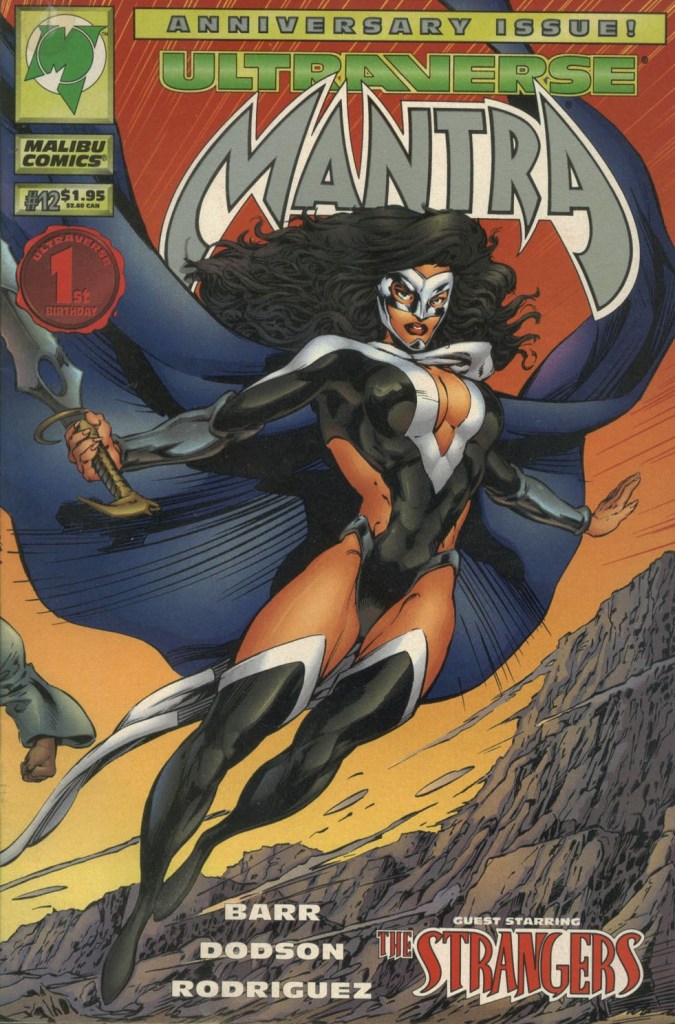
The cover.

Early story

The story begins with Mantra and the Strangers facing Boneyard, his companions and demons. Boneyard has Atom Bob held captive for his magic use. Determined to kill Boneyard, Mantra draws first blood by blasting one of the demons. Due to having weakened powers, Mantra struggles in battle until Electrocute helps taking the other demons off.

As the battle goes on, Boneyard (aided with Notch’s power) makes his move towards Mantra and touches her body with his….

Quality

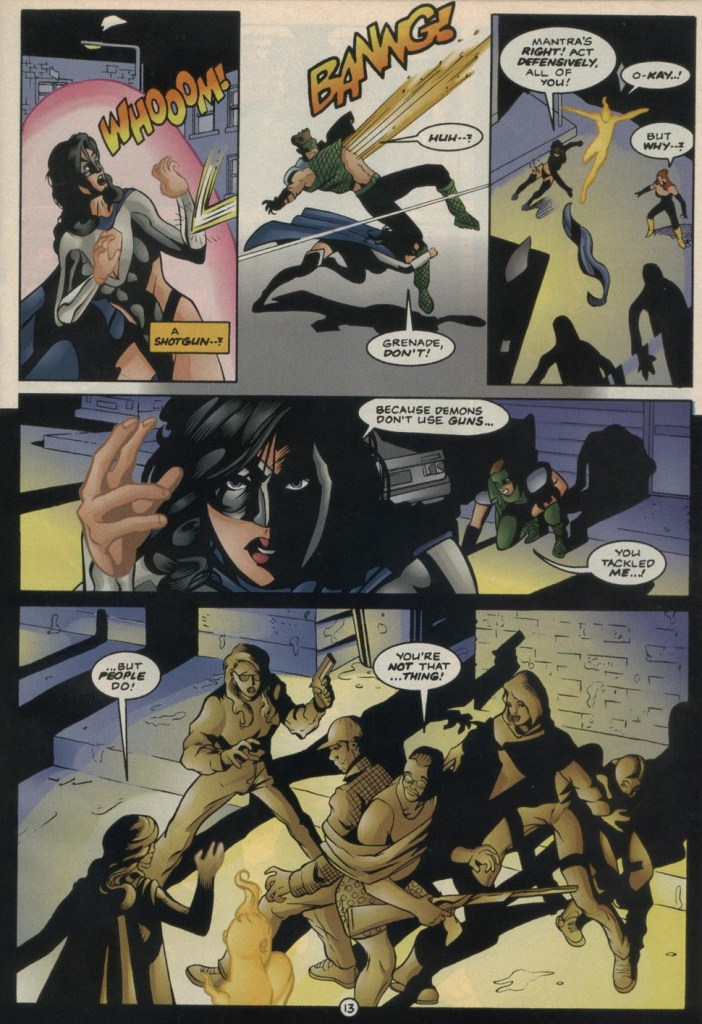
Action in the city.

The script written by Mike W. Barr (in coordination with Steve Englehart of The Strangers) is pretty solid in the sense that it took the interactions between Mantra and the Strangers a few levels deeper which paved the way for some character revelations and further development of varied personalities. To say the least, this one is pretty wordy and there was clear effort to define the characters even as the struggle went on. There were also common things between Boneyard and Yrial that was nicely explored when it comes to their respective abilities.

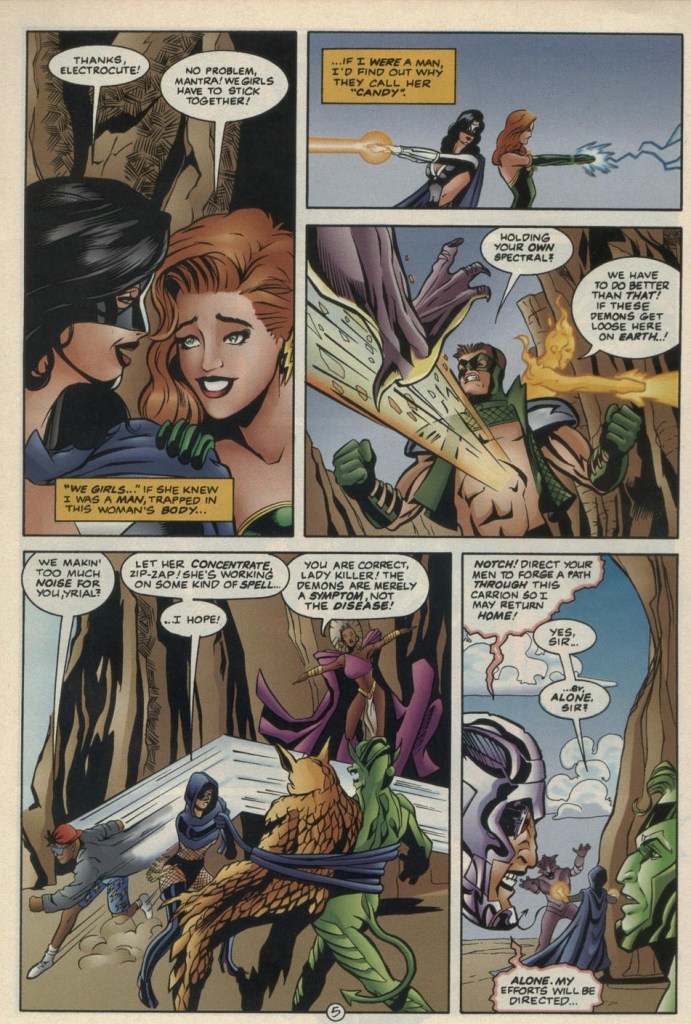
This comic book daringly touched on gender issues, particularly with the ever unholy topic of homosexuality (note: read 1 Corinthians 6: 9-10 in the Holy Bible) and even rape. There was this lesbian kiss scene between Electrocute and Mantra. Also it is made clear that even though Boneyard knows Mantra really is male warrior Lukasz occupying a female body, the said villain still wants to mate with the protagonist.

On the visuals, I found this one really looking odd even though it was credited to Terry Dodson. His art here really looked cartoony, so much so it’s almost as if someone else drew it. Try comparing Dodson’s art here with what he did in issue and you will see what I mean.

Conclusion

At the coast.

While it is well written, I should say that the crossover between the protagonist and the featured superhero team could have ended better. Compared to the conclusions of the Prototype-Strangers and Hardcase-Strangers crossovers, Mantra ended up lacking punch. As an anniversary issue, it is serviceable.

If you are seriously planning to buy an existing hard copy of Mantra (1994), be aware that as of this writing, MileHighComics.com shows that the near-mint copy costs $8.

Overall, Mantra (1994) is recommended.

+++++

Thank you for reading. If you find this article engaging, please click the like button below and also please consider sharing this article to others. If you are looking for a copywriter to create content for your special project or business, check out my services and my portfolio. Feel free to contact me as well. Also please feel free to visit my Facebook page Author Carlo Carrasco and follow me at HavenorFantasy@twitter.com